Simerg is an independent initiative dedicated to Ismaili Muslims, the Aga Khan — their Hereditary Imam — and the Ismaili Imamat, and Islam in general through literary readings, photo essays and artistic expressions
Fourteen Centuries After Ghadir Khumm, Ismaili Muslims Continue to be Guided by the Eternal Rope of Imamat: His Highness Prince Rahim Aga Khan is the 50th Hereditary Imam
“God chose Adam and Noah and the House of Abraham and the House of Imran above all beings, the seed of one another; God hears, and knows” — Qur’an, 3:33-34, translation by A. J. Arberry, see Corpus Quran for multiple translations
A calligraphy designed by Toronto’s Karim Ismail honouring the first Shia Imam Ali on the auspicious commemoration of Eid-e Ghadir.
On June 13, 2025, corresponding to the 16th day of the Muslim month Dhuʻl-Hijjah in the year 1446 A.H, Ismaili Muslims, united across Canada and the globe, will come together to observe and celebrate Eid-e Ghadir.
This momentous occasion, steeped in history, marks the pivotal gathering at Ghadir Khumm, where Prophet Muhammad (peace be upon him and his progeny) designated Hazrat Ali as his successor, the first in the continuing line of Hereditary Imams.
From the day our beloved Prophet Muhammad passed away on June 8, 632, and Hazrat Ali (A.S.) became the first Imam on the Divine Commandment that the Prophet had earlier received at Ghadir Khumm, there have been fifty Ismaili Imams, spanning an impressive 1393 years in human history.
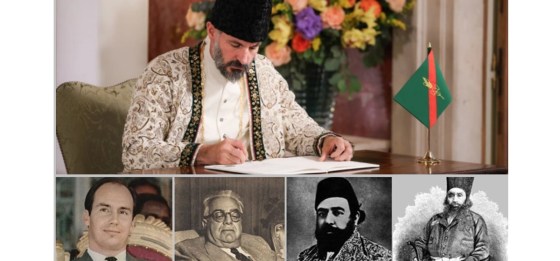
The 50th Imam, His Highness Prince Rahim Aga Khan, holds a unique place in our history. He succeeded his father, Mawlana Shah Karim, His Late Highness Aga Khan IV, upon his death on February 4, 2025. Like all other Imams before him, Mawlana Shah Rahim Al Hussaini, who is now devotionally and respectfully addressed as Mawlana Hazar Imam, being the Imam-of-the-Time, will continue the vital role of guiding and developing the Ismaili community, leaving a lasting legacy that continues to shape the community’s identity and beliefs.
The historical event of Eid-e Ghadir, a pivotal moment in the Ismaili faith, holds profound significance. Today, the Ismaili community is led by the Hereditary position. Mawlana Shah Karim, His Late Highness Aga Khan IV, proudly affirmed that ‘the Ismailis are the only Shia community who, throughout history, have been guided by a living, hereditary Imam in direct descent from the Prophet’ — His Late Highness Aga Khan IV, Parliament of Canada, Ottawa, February 27, 2014.
History records that on the way back to Medina after performing the final pilgrimage to Mecca, the Prophet received a revelation:
“O Messenger, deliver [to the people] what has been revealed to you from your Lord, and if you do not do so, then you will not have delivered His message”… Quran, Surah al-Ma’ida (5:67).
Upon receiving this revelation, the Holy Prophet stopped at an oasis known as Ghadir Khumm. This oasis, located strategically along the route from Mecca to Medina, was a natural gathering point for travellers. Here, the Prophet addressed a large gathering of Muslims who had accompanied him. The Prophet proclaimed: ‘Man kuntu mawlahu fa aliyyun mawlahu,’ meaning: ‘He whose Mawla I am, Ali is his Mawla.’ The Prophet then prayed: ‘O Allah, be a friend of whoever is his friend and extend your support to those who support him.’
This event, occurring at a crucial point in Islamic history, marked the transition of leadership from the Prophet to Hazrat Ali, setting the stage for the leadership and future of the Muslim community. By declaring Hazrat Ali Mawla after him, the Prophet transferred the spiritual authority bestowed upon him by Allah to Hazrat Ali, making him — and all the Imams that follow — the Amirul Mu’minin, or Master of the Believers. This title signifies his role as a Muslim community’s leader, protector, and guide, which Hazrat Ali and all his successors have fulfilled with unwavering dedication and commitment, ensuring the community’s well-being and prosperity.
Article continues below following excerpts and photographs
________________________________
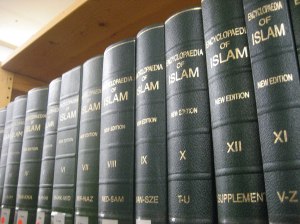
Excerpts from L. Veccia Vaglieri piece in Encyclopaedia of Islam, Second Edition
“Ghadir Khumm is famous in the history of Islam because of a sentence (or some sentences) in favour of ‘Ali which the Prophet uttered there during a discourse….Taking ‘Ali by the hand, he asked of his faithful followers whether he, Muhammad, was not closer to the Believers than they were to themselves; the crowd cried out: “It is so, O Apostle of God!”, he then declared. “He of whom I am the mawla, of him ‘Ali is also the mawla (man kuntu nawlahu fa-‘Ali mawlahu)
Photograph: Vysotsky – Own work, CC BY-SA 3.0, Wikimedia.
~~~~~~
“Most of those sources which form the basis of our knowledge of the life of the Prophet pass in silence over Muhammad’s stop at Ghadir Khumm….Consequently, the western biographers of Muhammad, whose work is based on these [Sunni] sources, make no reference to what happened at Ghadir Khumm. It is however certain that Muhammad did speak in this place and utter the famous sentence…the hadiths are so numerous and so well attested by the different isnads that it does not seem possible to reject them.” Vaglieri goes on to state that on instruction from Prophet Muhammad, Hazrat Ali received baiyat (the oath of allegiance) from the Muslims assembled there, including Umar b. al-Khattab, Islam’s second Caliph.
(Note: special access is required to read articles in the on-line edition of EI2. Vaglieri’s piece was reproduced in full in the UK Ismaili Association’s publication Ilm, December 1976, pages 28-30, with the permission of E.J. Brill, publishers of EI2.)
________________________________
Excerpts from the Pream ble of the Ismaili Constitution ordained by the 49th Ismaili Imam
“In accordance with Shia doctrine, tradition, and interpretation of history, the Holy Prophet (s.a.s.) designated and appointed his cousin and son-in-law Hazrat Mawlana Ali Amiru-l-Mu’minin (a.s) to be the first Imam to continue the Ta’wīl and Ta’līm of Allah’s final message and to guide the murids, a term referring to the followers and disciples of the Imams. The proclamation also established the principle of the Imamat continuing by heredity through Hazrat Mawlana Ali (a.s) and his daughter Hazrat Bibi Fatimat-az-Zahra, Khātun-i-Jannat (a.s)”
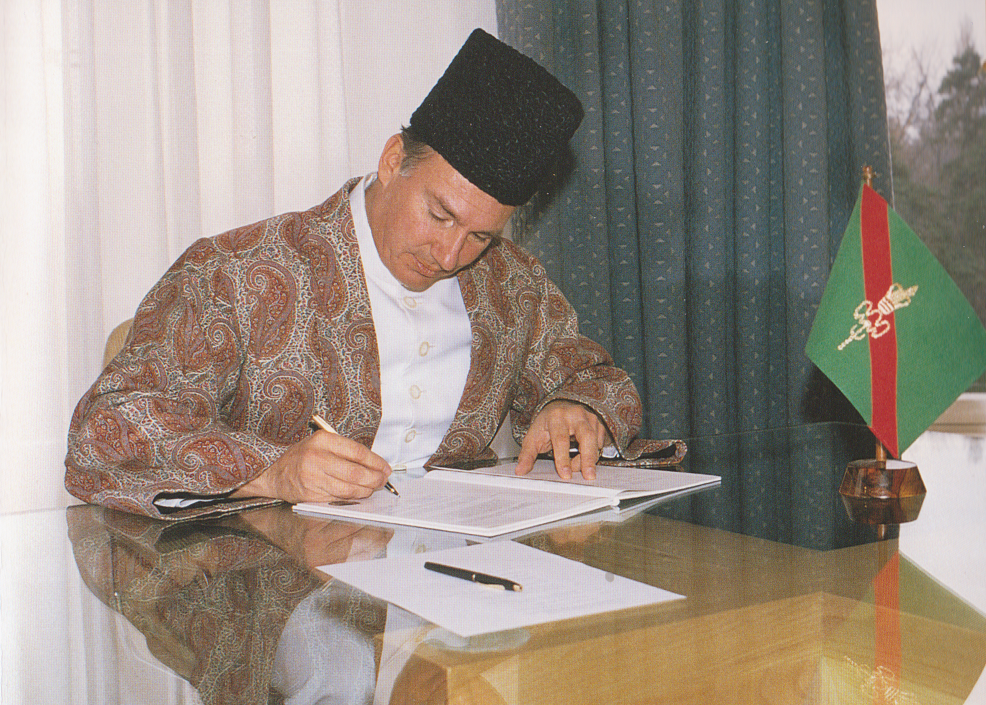
Mawlana Shah Karim, His Late Highness the Aga Khan, is seen signing a new constitution for the worldwide Ismaili community on his 50th birthday, December 13, 1986.
~~~~~~~~
The 50th Imam, Mawlana Shah Rahim Al Hussaini Hazar Imam, signs the Ismaili Constitution under his name on February 11, 2025
Mawlana Hazar Imam, His Highness Prince Rahim Aga Khan, signs the Ismaili Constitution in his name at the Diwan of the Ismaili Imamat, the Headquarters of the Imamat in Lisbon on the historic occasion of his Takht-nishini (ceremonial installation), February 11, 2025. Photograph: Akbar Hakim / The Ismaili.
________________________________
…. continued
On the instruction from Prophet Muhammad, Hazrat Ali received baiyat (the oath of allegiance) from the Muslims assembled there. According to Shia traditions and sources, following the proclamation, the final verse of the Qur’an was revealed to the Prophet:
“On this day, I have perfected for you your religion, completed my favours upon you, and have chosen for you Islam as your religion.”
Eid-e Ghadir is an anniversary of profound significance to all Shia Muslims. It is also associated with the following well-attested tradition that the Prophet is said to have proclaimed. This tradition, which is widely accepted and recognized by the Shia community, further underscores the importance of the event and its pivotal role in shaping the future of the Muslim community:
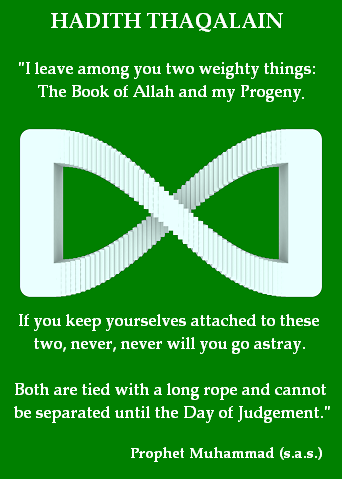
Credit: Infinity design povray.org
“I am leaving among you two matters of great weight (al-thaqalayn), the Book of Allah and my kindred (itrati), the People of my House (Ahl al-Bayt), and these two shall never be separated until they return to me at the Pool [of Kawthar in Paradise on the Day of Judgement]…”
The phrase ‘two matters of great weight’ refers to the Quran and the Ahl al-Bayt. The Quran, as the holy book of Islam, and the Ahl al-Bayt, as the Prophet’s kindred, are inseparable and hold eternal significance in the Shia Islamic tradition.
As we commemorate Eid-e Ghadir, the Ismaili community stands united, celebrating the seminal event of Ghadir Khumm. This celebration is a historical marker and a powerful reminder of our allegiance to the Imam-of-the-Time, the direct lineal successor and inheritor of Hazrat Ali’s authority.
The community is not just inspired but united and driven by the following remark made during Mawlana Shah Karim’s speech in Canada’s Parliament on February 27, 2024:
“Today, the Ismailis are the only Shia community who, throughout history, have been led by a living, hereditary Imam in direct descent from the Prophet.”




 Simerg - Insights from Around the World