Simerg is an independent initiative dedicated to Ismaili Muslims, the Aga Khan — their Hereditary Imam — and the Ismaili Imamat, and Islam in general through literary readings, photo essays and artistic expressions
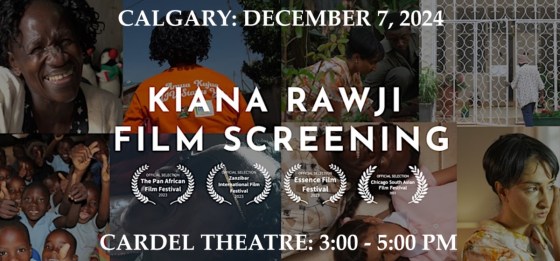
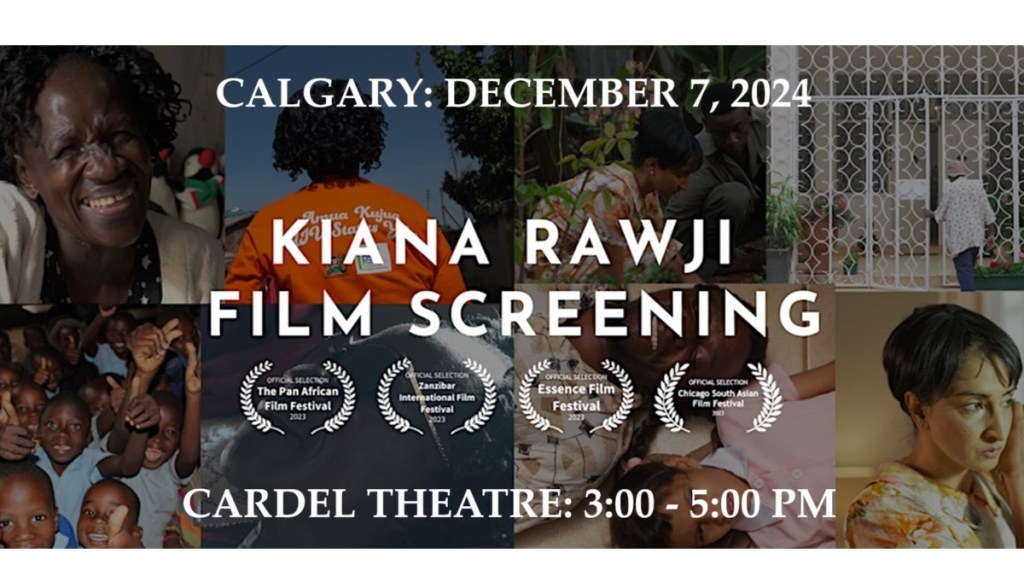
Award-winning filmmaker Kiana Rawji has returned to her hometown to screen her two highly acclaimed films at Calgary’s Cardel Theatre at 180 Quarry Park Blvd on December 7 from 3:00 to 5:00 PM. A few tickets are left, and they can be secured at https://rawjifilms.eventbrite.com.
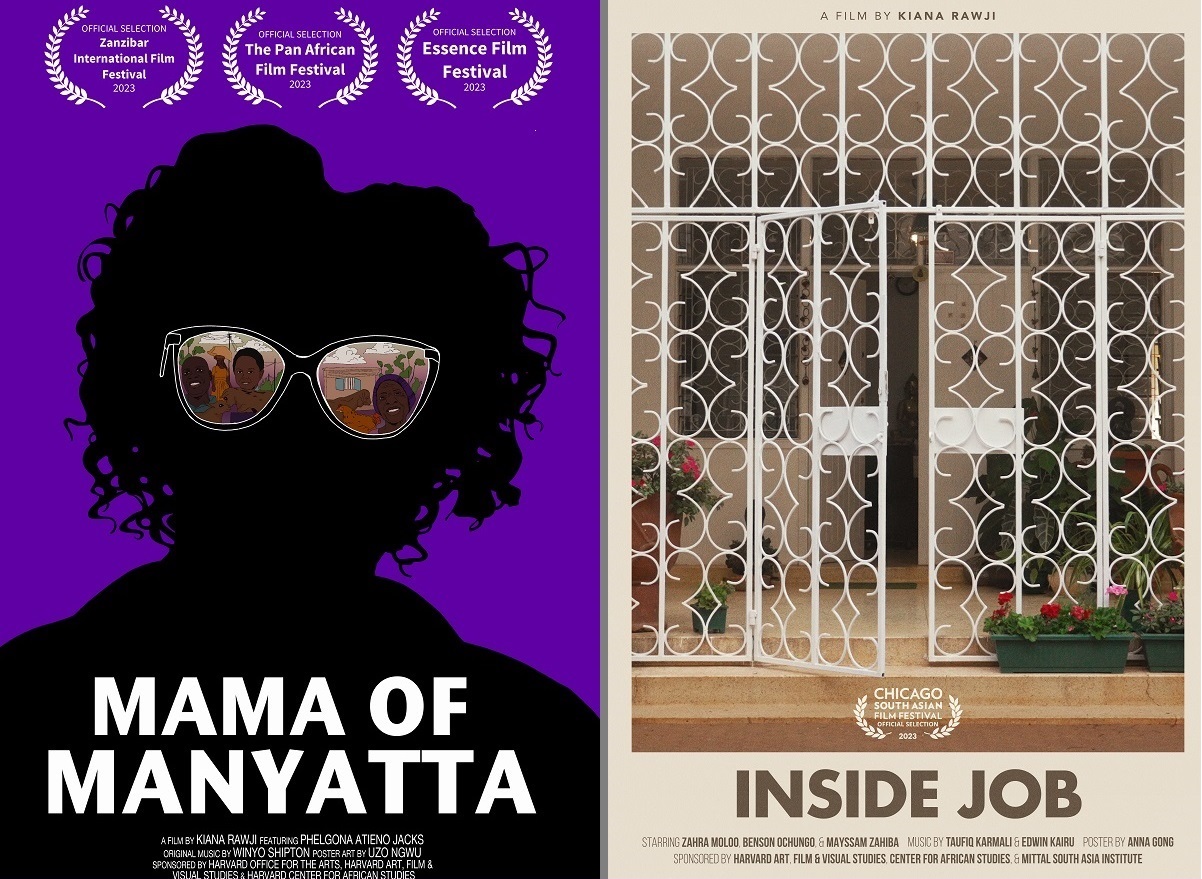
The movies “Inside Job” and “Mama of Manyatta,” both shot in Kenya, mark an essential milestone in Kiana’s career as a passionate filmmaker. This is a unique opportunity to witness Kiana’s exceptional career in filmmaking (read our earlier post HERE). The screening will be followed by an engaging Q&A session with the filmmaker herself, making this event a significant highlight in Calgary’s 2024 calendar.
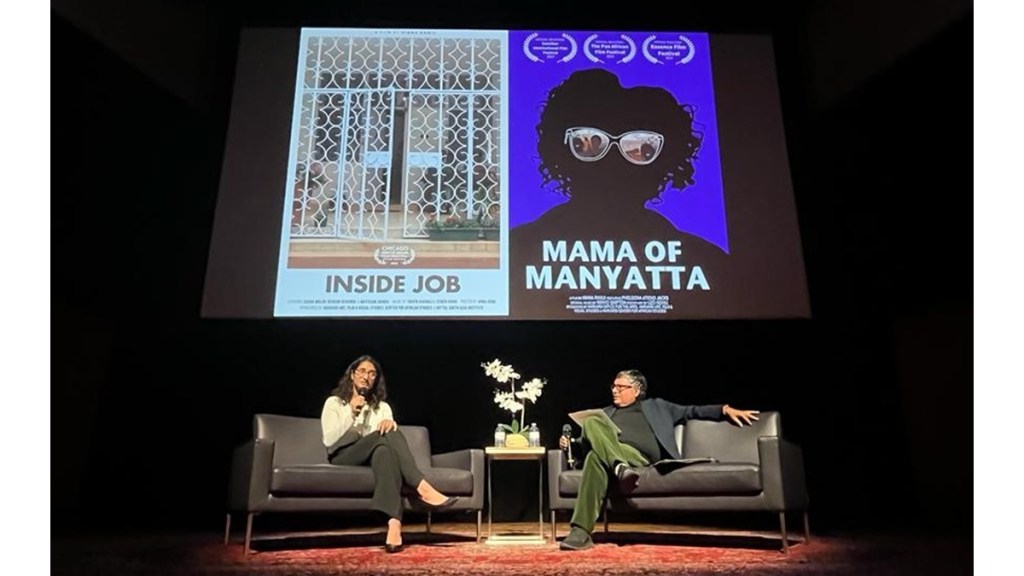
Kiana Rawji engages with the audience in the Nanji Family Foundation Auditorium at the Aga Khan Museum, Toronto, in October 2023.
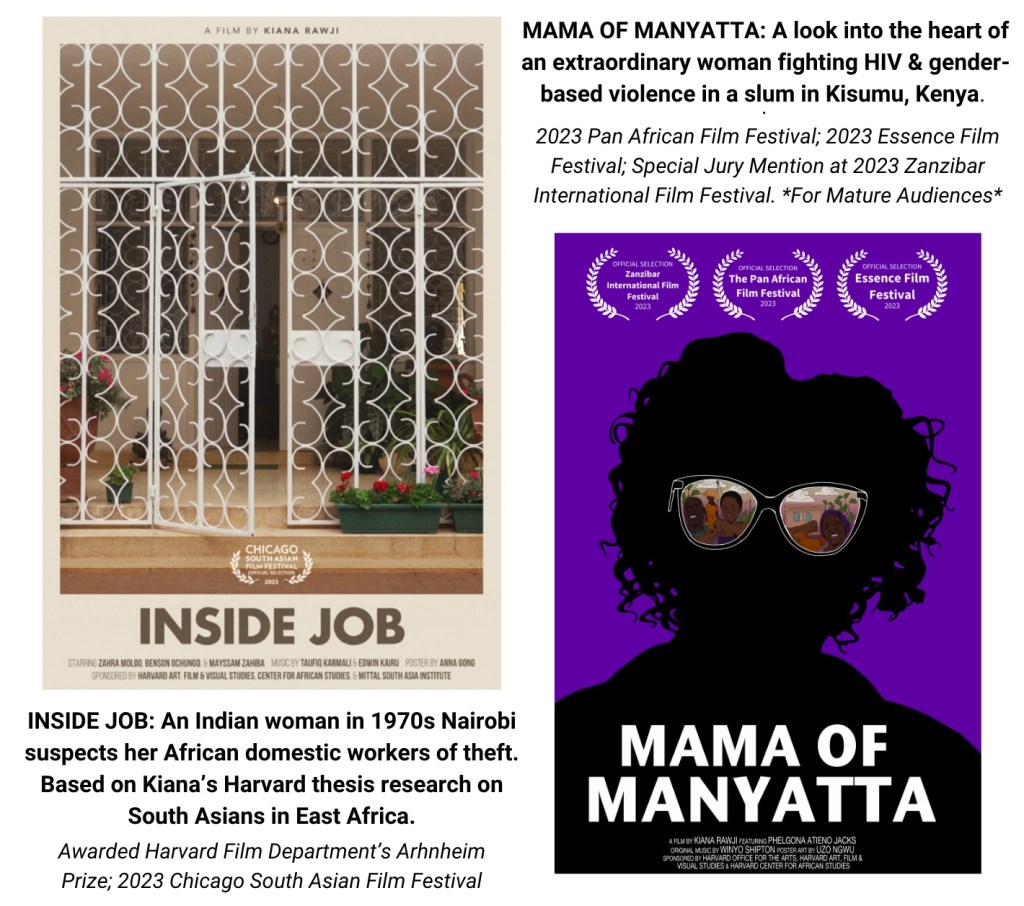
MAMA OF MANYATTA is a touching portrait of a woman fighting HIV and gender-based violence in a Kenyan slum. The film has been widely acclaimed, screening at the 2023 Pan African Film Festival, Essence Film Festival & Zanzibar International Film Festival, and receiving a Special Jury Mention.
INSIDE JOB is a fictional reconstruction of the lives of South Asians in Kenya in the 1970s. The film received the Harvard Film Department’s Arnheim Prize for most outstanding interdisciplinary project & premiered at the 2023 Chicago South Asian Film Festival.
The two films made their Canadian debut in October 2023 in the Nanji Family Foundation Auditorium at the Aga Khan Museum in Toronto to a packed and appreciative audience.
Event Summary and Tickets
What: Kiana Rawji Film Screening — Inside Job and Mama of Manyatta
I am thrilled to inform Calgarians and readers across Alberta about an event we have all eagerly anticipated. Calgary’s own, the young award-winning filmmaker Kiana Rawji, has organized a showing of her highly acclaimed films, Mama of Manyatta and Inside Job, which made their Canadian debut to a packed audience at the Aga Khan Museum in Toronto on October 15, 2023.
Kiana Rawji
The excitement is palpable as these films, created by our very own Kiana, are set to grace our city on Saturday, December 7 at Calgary’s Cardel Theatre at 180 Quarry Park Blvd. The films mark an essential milestone in Kiana’s career as a passionate filmmaker and an exciting and unique moment in the city’s 2024 calendar.
Cardel Theatre is small and will fill up quickly, so get your tickets now at EVENTBRITE. Following the screening, Kiana will conduct an in-person Q&A.
~~~~~~
The Films
Kiana describes the making of the films in her insightful interview below.
~~~~~~
Profile: Kiana Rawji
Kiana Rawji (www.kianarawji.com) is an award-winning Calgarian filmmaker who graduated from Harvard College with a concentration in Film and History & Literature. As an Ismaili Muslim woman and daughter of East African Asian immigrants, she is drawn to stories around diasporas, pluralism, and social justice. Her TEDx talks on Islam and the Cosmopolitan Ethic have reached 150,000+ people worldwide.
Kiana’s 2021 documentary, LONG DISTANCE, about migrant workers at an Albertan meat plant, won the Grand Jury Prize for Best Alberta Short Film at the 2021 Calgary International Film Festival.
Her 2023 documentary, MAMA OF MANYATTA, has been widely acclaimed, screening at the 2023 Pan African Film Festival, Essence Film Festival & Zanzibar International Film Festival, and receiving a Special Jury Mention. This film follows an extraordinary woman fighting HIV & gender-based violence in a Kenyan slum.
Kiana’s 2023 fiction film, INSIDE JOB, has also garnered attention. It is about an Indian woman who suspects her African domestic workers of stealing jewelry in 1970s Nairobi. The film received the Harvard Film Department’s Arnheim Prize for most outstanding interdisciplinary project & premiered at the 2023 Chicago South Asian Film Festival.
In 2023, INSIDE JOB & MAMA OF MANYATTA screened at the Unseen Nairobi theater in Kenya and the Nanji Family Foundation Auditorium at the Aga Khan Museum in Toronto. The sold-out Aga Khan Museum screening opened with remarks by Dr. Zainub Verjee, an accomplished writer, critic, curator, artist, and appointee of the honourable Order of Canada. “When I previewed these works,” Dr. Verjee explained in her introductory remarks, “I was really moved by its poetry. But more importantly, what struck me was its feminist ethos.”
The screening was followed by a moderated Q&A in which Kiana discussed her films’ historical, political, and social-justice underpinnings and her aim to grapple with the consequences of power and inequality in our lives.
“The screening of Inside Job and Mama of Manyatta [at the Aga Khan Museum] on October 15, 2023, was an inspiring event which gave those in attendance an early peek into the work of a gifted filmmaker with tremendous promise who will undoubtedly continue to make a real and meaningful difference through her films” — excerpt from review by Ali N. Alibhai
In Calgary, on December 7th, in addition to sharing her impactful work — and creating awareness around the social issues with which she artistically and intellectually engages — Kiana will share insights into the rigorous research and cosmopolitan ethos that drive her work.
~~~~~~
Tickets
INSIDE JOB and MAMA OF MANYATTA will be screened at Calgary’s Cardel Theatre from 3-5pm on Saturday, December 7th, 2024.
The theatre is small and will fill up quickly, so get your tickets now at this Eventbrite link.
The screening will be followed by an in-person Q&A with Kiana.
~~~~~~~~~
Sponsor and Support Kiana Rawji
Kiana Rawji welcomes sponsors who wish to support the event in Calgary and her continued work in film. Please contact her or submit your sponsorship via an e-transfer to kianarawjifilms@gmail.com. This budding young artist will appreciate any contribution.
~~~~~~~~~
Interview
“I strive to tell stories that recognize diversity, complexity, and nuance, while connecting people through universal, human experiences. I’m especially interested in topics surrounding migration, diasporas, and identity” — Kiana Rawji
Kiana Rawji engages with the audience at the Aga Khan Museum, Toronto, in October 2023.
To acquaint our Calgary and Alberta readers with Kiana’s work and what inspires her, we present an abridged version of our interview before her films premiered in Toronto (click HERE for the full interview.)
Simerg: Can you tell us about how you got into filmmaking?
Kiana Rawji: Throughout high school, I had been interested in the intersection between storytelling and social justice, and I had pursued that through writing and public speaking. Filmmaking was always a hobby of mine growing up, but I never even considered it as an academic or career path. When I got to Harvard, I took a class called Social Justice and the Documentary Film in my first year and I was drawn to film as a provocative medium to raise awareness, evoke empathy, and elevate marginalized voices. After I made my first short film in that class, I never looked back.
At Harvard, I pursued a joint concentration because through History & Literature, I could learn about the very histories, in all their nuance and complexity, that would inform the stories I want to tell through film. Inside Job was a perfect example of that.
Simerg: Where did the idea for Inside Job come from?
Kiana: The film was largely based on my own family history — my parents and grandparents grew up in Nairobi, but before that my family traces back to Gujarat, India. I knew I wanted to make a film set in the 1970s Kenya, during a period of exacerbated racial tensions, due to the rise of ethnocentric nationalism in the region. I was particularly interested in the ways “Africans” and “Indians”/“Asians” perceived and interacted with each other. Since society was so racially segregated though, I realized the most common realm of interracial interaction and intimacy was in the household; virtually all brown households employed black domestic “servants”. What was all the more interesting was that, despite the deeply entrenched taboo that restricted social contact between brown women and black men in particular, these two types of people consistently interacted on a daily basis through the domestic labor relationship. I started to wonder how larger cultural norms and boundaries as well as political tensions were both reinforced and transcended in such close quarters.
Interview continues below
Kiana Rawji’s fs Mama of Manyatta and Inside Job will be screened at the Cardel Theatre in Calgary on Saturday, December 7, 2024. For tickets, click EVENTBRITE.
So I decided to explore that dynamic through oral history research. I interviewed many East African Asian women who lived through the 70s, as well as black African domestic workers. These interviews informed my whole script, from the subtleties of the dialogue to the core elements of the plot. I decided to focus on the theme of theft because of how much it came up in my interviews, and how symbolic it was; it was clear that both sides felt the other had stolen something from them. South Asians in East Africa felt that their own homes, along with properties, businesses, etc., were stolen from them when they were largely expelled from the region in the 70s. At the same time, native East Africans felt that “Asians” had stolen all the wealth and land in the first place. Both were stuck in a colonial system of inequality and a highly racialized socioeconomic hierarchy that lasted well beyond the colonial period.
____________
“It doesn’t take much to start. You don’t need fancy equipment or huge amounts of funding — all you need is a camera (which could be your phone) and a good story” — Kiana Rawji
____________
Simerg: What was most difficult about filming Inside Job?
Kiana: Well, the effort to make a period film in a foreign country in under a week with a budget under $10,000 was a huge challenge in itself. But I was able to find an incredible, talented cast and crew to achieve this and make it all easier.
The biggest challenge I faced was trying to get it right. I was recreating a history that I hadn’t lived through. I studied Swahili at Harvard and that helped but I don’t even speak or understand Gujarati. But the way I addressed that challenge was to consult a lot of experts.
____________
“When it comes to filmmaking around social issues, I’ve learned that stories of injustice and adversity are incomplete without the stories of resilience and endurance that invariably exist alongside them” — Kiana Rawji
____________
Simerg: As for your other film, Mama of Manyatta, how did that come about? How did you come to meet the subject, Phelgone Jacks?
Kiana: A few years before I made the film, my older sister Zahra had met Mama Phelgone through a Harvard College summer global health program that connected students with local NGOs and CBOs. Mama Phelgone worked on removing stigma around those affected by HIV/AIDS in Kisumu. After spending some time with Mama Phelgone, Zahra told me there was a story there that I had to tell. The next summer (summer 2019), when I went to Kisumu and met Phelgone myself, I instantly agreed that hers was a story that needed to be told. Her community-centered approach to creating impact was remarkable, and she, herself, was one of the most generous, compassionate, and dedicated people I have ever met.
Twenty years ago, Phelgone founded a community-based organization fighting HIV/AIDS and gender-based violence in the slum of Manyatta in Kisumu. She was a mother figure to Manyatta’s young and old; she built an Early Childhood Development Center outside her home, hosted safe-sex workshops for teenage girls, counseling sessions for women survivors, and more. Though she helped people work through immense trauma, what was most remarkable about Mama Phelgone (as she was affectionately known in Manyatta) was that she cultivated strength and joy wherever she went, through prayer, song, and dance. She was, in her own words, an “ambassador of hope.”
Rather than the all-too-common narrative of the suffering African poor, I wanted Mama of Manyatta to present a portrait of African empowerment and leadership.
Soon after I shot Mama of Manyatta in 2022, Mama Phelgone was diagnosed with metastatic cancer. She passed away in the middle of my post-production. Though I was deeply saddened, my drive to preserve a remarkable life and legacy only intensified. Through my film, I hope Phelgone’s story continues to inspire change.
____________
“I decided I didn’t want to be a filmmaker who hides behind her lens, observing, recording, then leaving. I want to be the kind who knows when to stop being a fly on the wall and start engaging — when to be a friend, not just a filmmaker. When artists get proximate to their subjects — which sometimes requires those precious interactions unmediated by a camera lens — opening their souls and immersing themselves in the lives of others, the product is more meaningful and fulfilling for everyone involved” — Kiana Rawji
____________
Simerg: What were some of the most memorable moments from the production/filming of Mama of Manyatta?
Kiana: There were so many — it was such a joy and a privilege to be included in the circle of warmth and love that Mama Phelgone radiated.
But there is one moment in particular that stuck with me. It was in the middle of a workshop on gender-based-violence; Phelgone was helping a group of women — survivors of sexual assault –prepare for upcoming post-election violence and the risk it posed to women in the community, including themselves. I remember that, when Phelgone sensed the air in the room growing heavy, she suggested a dance break.
And so they got up, they played music, they danced, they smiled, and they laughed.
Phelgone and the women beckoned for me to join them. But the filmmaker in me was so keen to capture every detail of this moment — the rhythmic body movements, the courageous smiles, the unbridled laughter. Something unexpected and beautiful could happen any second, and if my camera wasn’t rolling. But that day, I realized that sometimes you also miss things when the camera is rolling. After filming the women dancing for a few minutes, I decided to set down my camera and join them. They showed me some moves, I was awful, they laughed at me, Ilaughed at me, and it was wonderful. I went into that shoot believing in the power of the camera, but I came out of it having also learned the power of putting it down.
Simerg: What inspires you? What drives your creative process?
Kiana: My intersecting identities as a South Asian Muslim woman and child of immigrants from East Africa inform the stories I want — and need — to tell.I strive to tell stories that recognize diversity, complexity, and nuance, while connecting people through universal, human experiences. I’m especially interested in topics surrounding migration, diasporas, and identity.
My creative process is driven by compassion, curiosity and collaboration. It begins with passion and personal investment in a story, followed by detailed research and engagement with real people and real stories.
Simerg: What is your advice to aspiring filmmakers?
Kiana: It doesn’t take much to start. You don’t need fancy equipment or huge amounts of funding — all you need is a camera (which could be your phone) and a good story. There are so many resources online. I taught myself how to use film editing software and write film scripts on the Internet. It just takes initiative and passion, and if you have those two things, you’re off to the races. I always remember what my idol, Ava DuVernay, said once when giving advice to filmmakers starting out. She said something along the lines of ‘don’t wait for something precious.’ Just begin. It doesn’t need to be the perfect, most eye-grabbing, world-changing idea. Everything you make will help you learn, and you’ll only get better. Just begin by telling stories you care about.
~~~~~~~~~
Event Summary
What: Kiana Rawji Film Screening — Inside Job and Mama of Manyatta
Support and Sponsor Filmmaker: Kiana Rawji welcomes sponsors who wish to support the event in Calgary and her continued work in film. The young artist will appreciate any contribution. Please contact her or submit your sponsorship via an e-transfer to kianarawjifilms@gmail.com.
Date posted: November 26, 2024.
Correction: The featured image in the original version mistakenly highlighted November 7, 2024, as the event date. The image has been corrected to reflect the correct event date, December 7, 2024. The editor apologizes for the error.




 Simerg - Insights from Around the World