Simerg is an independent initiative dedicated to Ismaili Muslims, the Aga Khan — their Hereditary Imam — and the Ismaili Imamat, and Islam in general through literary readings, photo essays and artistic expressions
Inna lillahi wa inna ilayhi raji’un “Surely we belong to God, and to Him we return” — Holy Qur’an, 2:156
“Life is a great and noble calling, not a mean and grovelling thing to be shuffled through as best as we can but a lofty and exalted destiny.” — Mawlana Sultan Mahomed Shah, His Highness the Aga Khan III (1877-1957), 48th Ismaili Imam.
I have learned with deep sadness that Kamadia Alijah Elhaque Nizar Dhananj, originally of Dar es Salaam, Tanzania, has passed away in London, UK, at the age of 59. Though not personally known to me, because I left London when he was in his early teens, Elhaque was fondly remembered by my mum, Mrs. Merchant, who taught him for many years in London’s Baitul Ilm classes during the 1970s and 1980s. She fondly recalled Elhaque as a top, well-disciplined, and enthusiastic student, and always cherished the wonderful memories of his Baitul Ilm years.
Following a family tradition of service to the Imam-of-the-Time and the Ismaili community — his father, Nizar Dhanani, served as the Kamadia of Palace Gate Jamatkhana during Mawlana Shah Karim His Late Highness Aga Khan IV’s visit to London in September 1979 — Elhaque was appointed to the position of the Kamadia of the London North West Jamatkhana from 2008 to 2012. He was then appointed by Mawlana Shah Karim as the Kamadia of Darkhana Jamatkhana from 2012 to 2019. The term coincided with Mawlana Shah Karim’s visit to the UK for his Diamond Jubilee in June 2018 (see photographs). My family and I have always felt a deep personal connection with Elhaque’s family. His father’s encouraging messages and prayers over the years, as well as thoughtful remembrance of my parents, have been especially inspirational. This personal bond has been a source of strength for us.
The passing of a child is one of the most difficult times for any family. We, as a community, stand united in this grief and convey our deepest condolences to his surviving father, Kamadia Nizar, Elhaque’s wife, Yasmin, and the entire Dhanani family and their loved ones. We offer our unwavering support and prayers for their strength and fortitude during this difficult period of bereavement and to face this difficult loss.
Story continues below
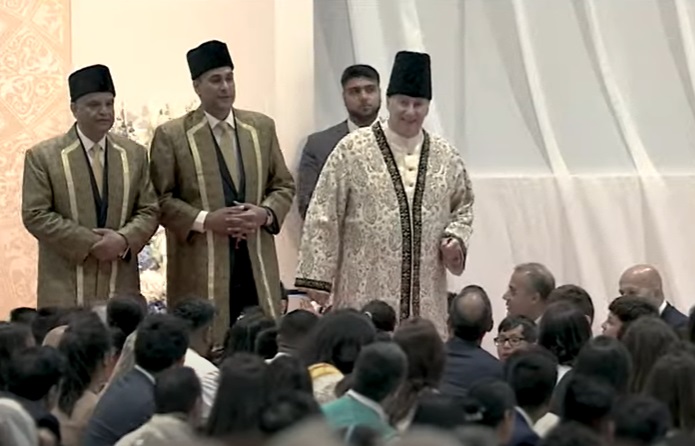
Mawlana Shah Karim, His Late Highness Aga Khan IV, blesses the Ismaili Jamat during his Diamond Jubilee visit to the UK in June 2018. Following him are Mukhi Farouk Walji (left) and Kamadia Elhaque Dhanani (d. August 2025) of the London Darkhana Jamatkhana. Photograph: Clip from the official Ismaili video.
~~~~~
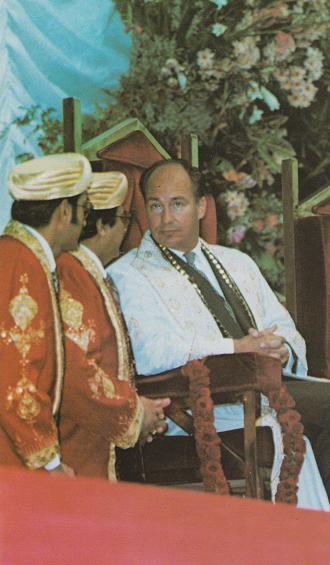
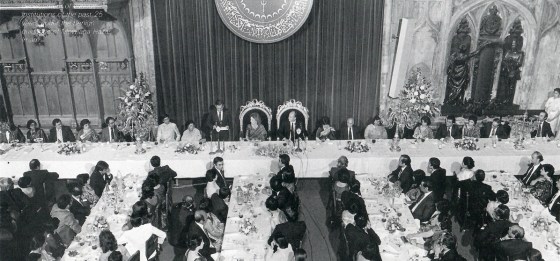
Mawlana Shah Karim, His Late Highness Aga Khan IV, pictured at the Olympia Hall, London, during his weeklong visit to the United Kingdom Jamat in September 1979. Seated next to him on the stage are Late Mukhi Nurdin Jivraj and Kamadia Nizar Dhanani, Elhaque’s father. Photograph: Jehangir Merchant Collection.
Condolences (dilsoji) to family members may be offered at the Darkhana Jamatkhana (in the Ismaili Centre, London) on Thursday, August 14. The funeral ceremony will be held at the Northwest Jamatkhana on Saturday, August 16, with the Fateha being offered at 9:30 AM.
We pray that Elhaque’s soul may rest in eternal peace. Ameen.
Condolence messages: We invite readers to submit their condolences, memories and tributes to Kamadia Elhaque Nizar Dhanani by clicking LEAVE A COMMENT. If you encounter technical difficulties submitting your feedback, email your message to mmerchant@simerg.com, subject: Elhaque Dhanani.
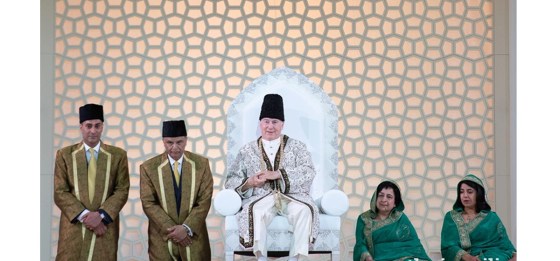
Featured photo at the top of the post: Mawlana Shah Karim, His Late Highness Aga Khan IV (d. February 4, 2025), 49th Hereditary Imam of the Shia Ismaili Muslims, at the Diamond Jubilee Darbar in London, with (l to r) Kamadia Elhaque Nizar Dhanani, Mukhi Farouk Rajabali Walji, Mukhiani Shahenaz Farouk Walji and Kamadiani Yasmin Elhaque Dhanani of London Darkhana Jamatkhana. Photograph: The Ismaili (visit UK Diamond Jubilee Gallery).
Date posted: August 13, 2025. Last updated: August 14, 2024.
Simerg, an independent platform, has published over 2,000 pieces on all aspects of Ismaili and Islamic history, culture and thought since its launch in 2009. Please see our Table of Contents in 2 parts — 2009-2019 and 2020-Current. Please visit Simerg’s sister websites, Barakah, which is dedicated to His Highness the Aga Khan, and Simergphotos, which features photo essays on history, culture and travel. Follow the publisher/editor Malik Merchant on @Facebook, @X and @LinkedIn. Check out Malik’s brief profile and contact information HERE.
Inna lillahi wa inna ilayhi raji’un “Surely we belong to God and to Him we return” — Holy Qur’an, 2:156
“Life is a great and noble calling, not a mean and grovelling thing to be shuffled through as best as we can but a lofty and exalted destiny.” — Mawlana Sultan Mahomed Shah, His Highness the Aga Khan III (1877-1957), 48th Imam of the Shia Imami Ismaili Muslims.
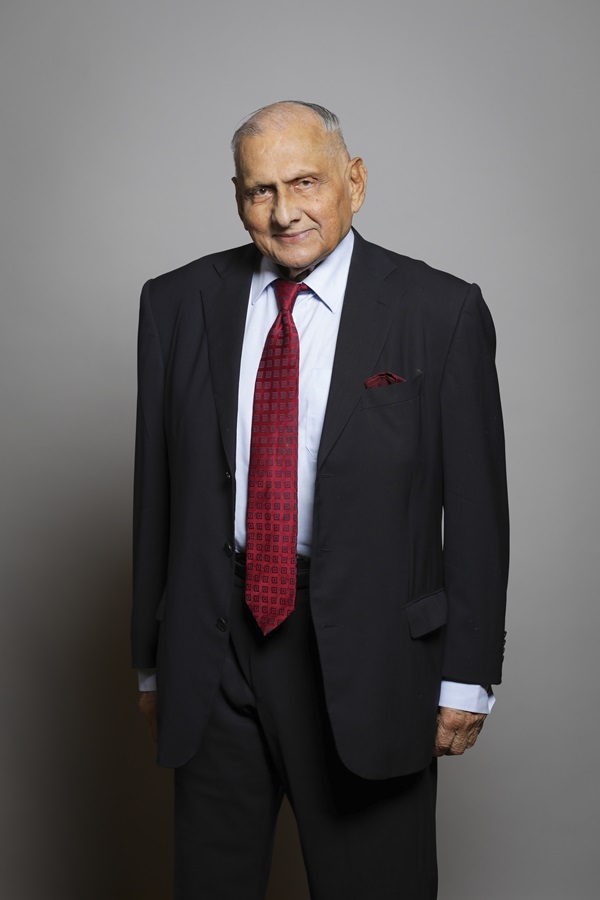
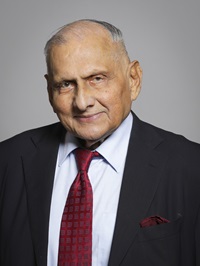
Amirali Alibhai Bhatia (b. March 18, 1932), a long-serving education administrator in the Imamat institutions of Mawlana Hazar Imam, His Highness the Aga Khan, in Tanzania and the UK, as well President of the Aga Khan Council for the UK from the late 1970s until the early 1980s, has died in London, England, at the age of 91.
Mr. Bhatia was bestowed with the title of Vazir by Mawlana Hazar Imam during his tenure as the President of the UK Aga Khan Council. Mr. Bhatia also served as member of the Board of Governors of the Institute of Ismaili Studies, which was created by Mawlana Hazar Imam on December 13, 1977.
Article continues below
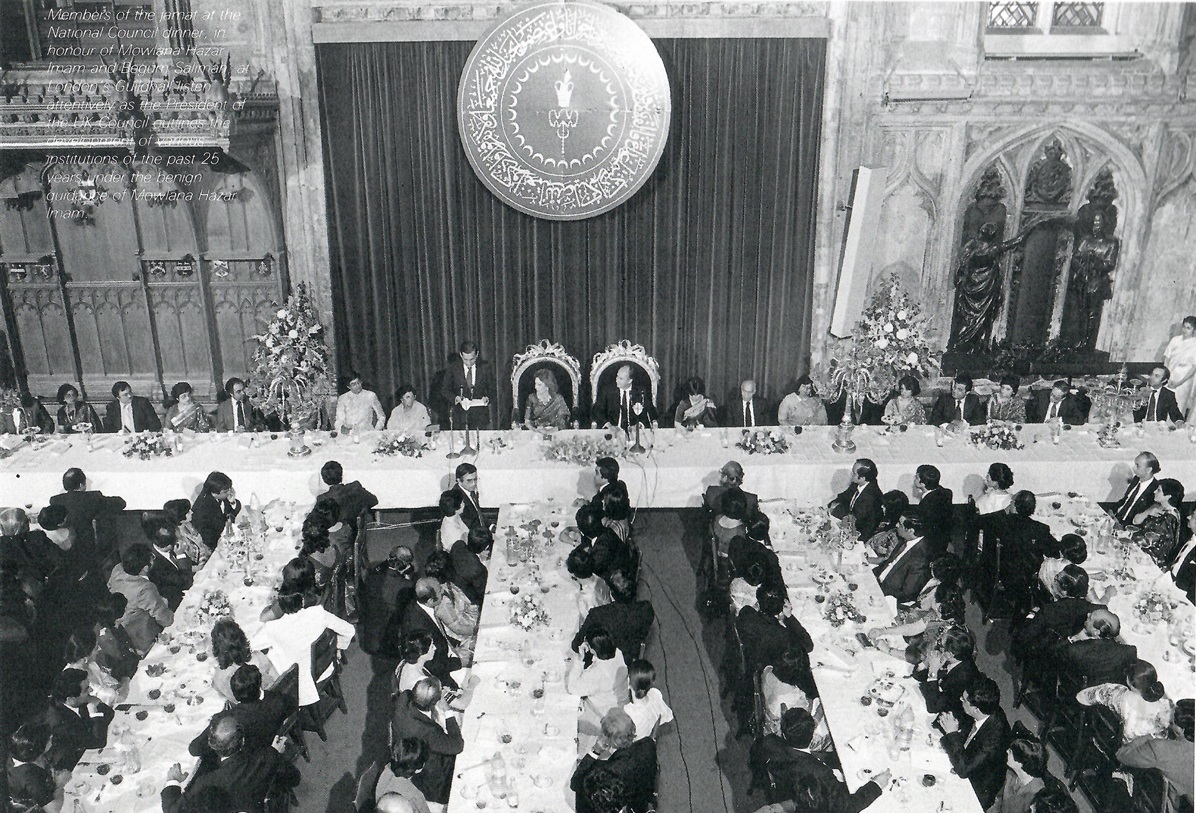
Mawlana Hazar Imam, His Highness the Aga Khan, and Begum Salimah look on as Vazir Amir Bhatia, President of His Highness the Aga Khan Shia Imami Ismaili Council for the UK, addresses members of the community at the Aga Khan Council dinner in honour of Mawlana Hazar Imam’s Silver Jubilee visit to the UK in July 1983. Photograph: Ismaili Forum, December 1983.
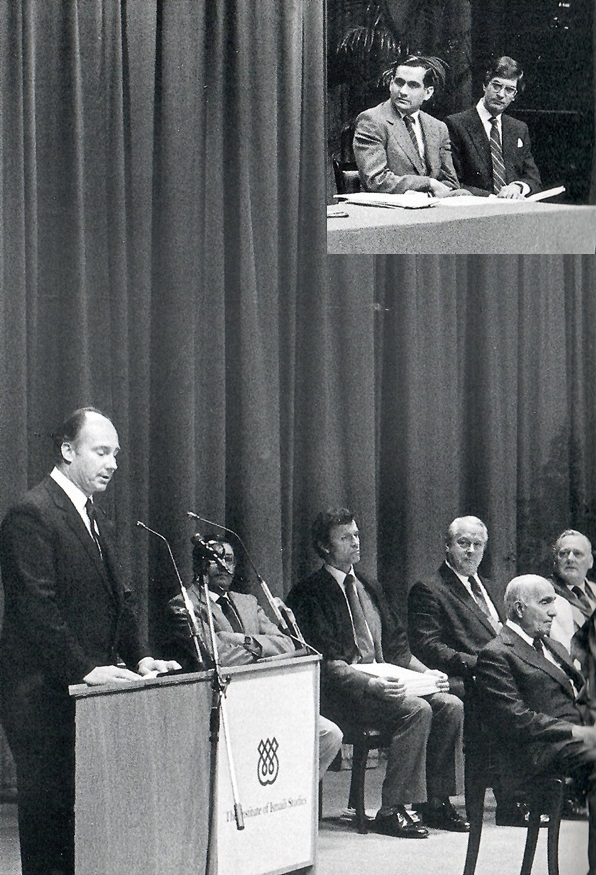
Mawlana Hazar Imam, His Highness the Aga Khan, addresses the new graduates at the University of London Institute of Education during his Silver Jubilee visit to the UK in July 1983. Seated in front row is Diwan Sir Eboo Pirbhai. Looking on, in the inset picture, are Amir Bhatia, President of the UK Aga Khan Council, and Anil Ishani, both of whom were members of the Board of Governors of the Institute of Ismaili Studies. Photograph: Ismaili Forum, December 1983.
Mr. Bhatia was awarded the Order of the British Empire (OBE) in 1997 for his numerous contributions in the UK, and was amongst the 15 peers appointed from 3000 nominations to the House of Lords in 2001 during Tony Blair’s term as the Prime Minister of the UK. He then took his seat in the House of Lords (The House of Lords is the upper chamber of the United Kingdom’s parliament. The members of the House of Lords are not elected by the public, but are appointed by the monarch, appointed by the Prime Minister, or are hereditary peers. To become a lord in the House of Lords, one can be appointed as a life peer by the monarch on the advice of the Prime Minister.)
Mr. Bhatia was thereafter referred to as Lord Bhatia and actively contributed in the House (see excerpts from 3 of his more than 150 oral statements, below). He ceased to be a member of the House of Lords in 2023 due to non-attendance. Several years earlier, in 2010, Lord Bhatia was mired in a controversy when he was found to have broken the House’s expense rules. He was suspended from the House of Lords for eight months. Aside from this and another similar controversy a few years later, and his indifference to an important sister Ismaili Institution in the 1980s, Vazir Bhatia was an outstanding administrator, and a very organizerd, hard-working and conscientious leader. In one of his speeches made at an event in London attended by the editor during the mid 1970s, Vazir Bhatia spoke about his role as Tanzania’s education administrator. He said that when he assumed the position, he studied all the files from the mid 1930s onwards to learn about the developments that had taken place in the education sector within the Ismaili community. The late Vazir was meticulous in all his undertakings.
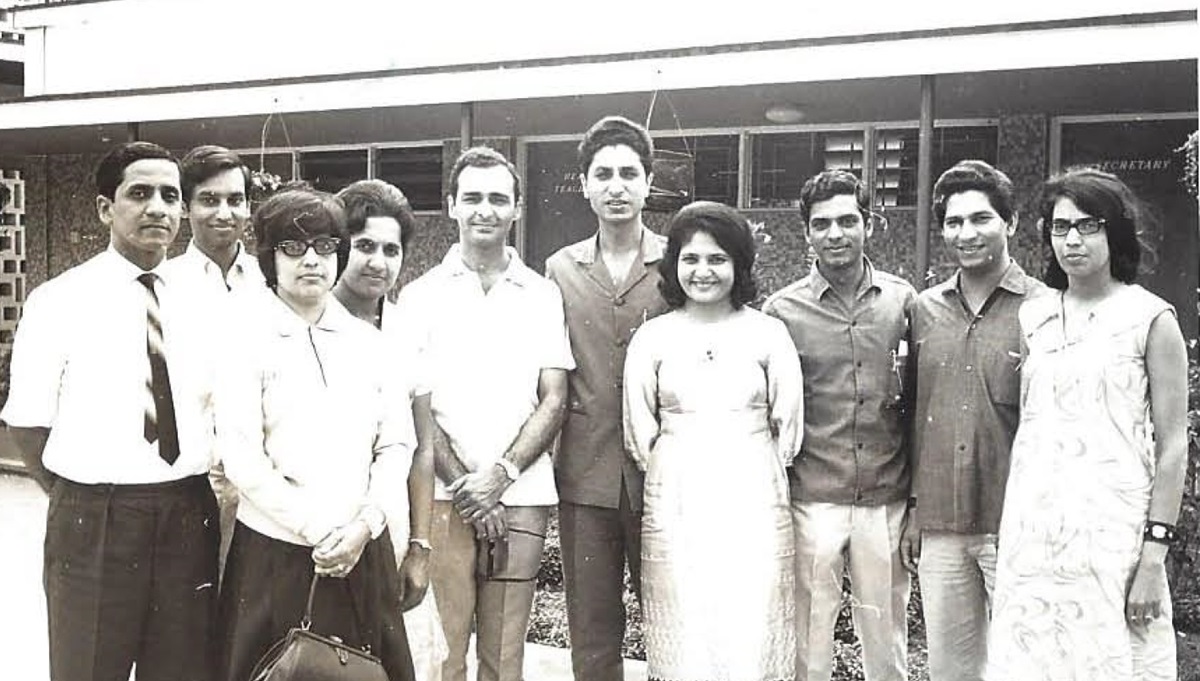
Mr. and Mrs. Merchant are pictured in front at left in this photograph submitted to Malik Merchant, editor of Simerg, by Lord Bhatia. Other recognizable faces in the photograph are Mr. Dina and Mr. and Mrs. Hasni Remtulla. Photograph: Lord Bhatia.
In recent years, Lord Bhatia was in touch with the editor of Simerg, commending him on his 3 websites, and also spoke to his mother, Mrs Merchant (d. 2021), to convey his condolences when her loving husband, Jehangir, died in 2018. To the editor’s surprise, Lord Bhatia shared a picture of Mr and Mrs Merchant when they were teachers at the Aga Khan Girls Secondary School in Dar es Salaam. Lord Bhatia wrote: “Dear Malic (sic): Here are some photos of your parents. I thought you would like them as you may not have them.” Indeed, I had never seen the photos before, and will treasure them for the rest of my life.
A very compact summary of Mr. Bhatia’s services is posted on the website of United Religions Initiative (URI). Readers are also invited to read an article published in 2004 in the UK Muslim magazine, Emel, entitled A Week in the Life of Lord Bhatia.
We convey our deepest condolences to the family of Vazir (Lord) Amirali Bhatia and pray that his soul may rest in eternal peace. Ameen.
We invite our readers to offer their condolences and tributes to Lord Bhatia by clicking on LEAVE A COMMENT
As part of this brief tribute, Simerg researched the UK Parliamentary Hansard and found transcripts of some 167 spoken statements made by Lord Bhatia between 2013 and 2121 on a wide range of subjects. We have excerpts from 3 statements that are important to our readers; they show Lord Bhatia’s insights into important issues of the day.
My Lords, I thank the noble Lord, Lord Elton, for initiating this timely debate on the persecution of people of faith in this century.
There are a number of national and international treaties on this subject; I will not repeat them because the noble Lord has already referred to them. Despite that, these treaties continue to be violated.
When I was introduced to the House of Lords, I took my oath with a Holy Koran and quietly started with the word “Bismillah”, meaning, “In the name of Allah, most beneficent and most merciful”. I have never differentiated between faiths. As a Muslim, my closest friends have been Hindus, Sikhs, Christians, Buddhists, Jews and those of no faith. The Holy Koran, in surah 2, says: “The Apostle believeth in what hath been revealed to him from the Lord, as do the men of faith. Each one of them believeth in God, His angels, His books and His apostles. ‘We make no distinction (they say) between one or another of His apostles’”.
As an ex-trustee of Oxfam, I met another trustee, Ansel Harris, and we became very good friends; our children and spouses became good friend as well. We travelled together to Israel, India and the Middle East. We learnt about the practice of each other’s faiths and shared each other’s jokes and stories. Ansel and his wife Lea were to attend my introduction to the House of Lords—but Ansel had another appointment, with his maker.
I attended the funeral and saw very little difference between Muslim and Jewish rituals. A few weeks later, there was a memorial service in Hampstead Town Hall. I was asked to speak and made my speech. Chief Rabbi Jonathan Sacks was present, and after a few days he wrote an article in the Times. I have deposited the full article in the Library, but will quote a few sentences:
“At the memorial service recently, one of the speakers was Lord Bhatia, whom he had come to know through his work for Oxfam. It was clear from the tone of his tribute that the two men shared a moral vision and had been close friends.
“What held them together, one a passionate Jew, the other a no less committed Muslim? The short answer is that they cared for something larger than their respective faith communities … When they saw disease, poverty and despair, they didn’t stop to ask who was suffering; they acted.
“They knew that tears are a universal language, and help a universal command. They saw faith not as a secluded castle but as a window onto a wider world. They saw God’s image in the face of a stranger, and heard His call in the cry of a starving child.
“Does faith make us great or does it make us small? On this question, much of the future of our world depends. Jews, Christians and Muslims can live together in friendship, so long as we never forget those things that transcend religious differences – of which human suffering is one.
“When we focus, not on ourselves, but on those who need help, our separate journeys converge and we become joint builders of a more gracious world”.
To conclude, whenever someone attacks Christians, I feel that they have attacked my faith. This is my contribution to this important debate. The world will be a better place if attacks on any faith are dealt with by the full force of the law. These attacks on faith are made by a small number of people who, in the name of their faiths or for political or personal gain, attack other faiths.
My Lords, the statement made by the Prime Minister on 3 June 2013 is correct and has been echoed by the leaders of the Labour Party and the Lib Dems. Terrorism and extremism has existed in people from all faiths and religions. The important thing to understand is that such terroristsform a very small part of the faith groups.
If one looks at the Muslim communities in Britain, there is a huge silent majority who abhor violence in the name of their religion. They are peace-loving British citizens who practise their faith and contribute to the welfare of their own communities, the wider communities and the United Kingdom. They oppose the attacks on innocent civilians. No religion advocates violence. Those who commit violence should be dealt with by the police and other law-enforcing agencies.
Turning to Islam as a faith community, I wish to say that Islam, although it is the fastest-growing faith in the world, is little understood or not understood at all in the West. There is a deficit of understanding of Islam. Islam is a peaceful faith and occasionally, like all other faiths, it is hijacked by a handful of radicalised people for their own perverted personal or political reasons and ambitions. Islam reveres all the prophets — Christ, Moses, Abraham and others. Muslims are shocked when the prophets are ridiculed or abused on the altar of freedom of speech and expression.
Freedom of expression is a democratic right, but it carries responsibility. Our democracy is based on the rule of law, and those who break the law should be dealt with in the courts. Our courts are independent and magistrates and judges ensure that justice is not only delivered but seen to be done.
Turning to the Muslim community in Britain, I ask the Minister whether more could be done to support newly arrived spouses and partners from different parts of the world who come to join their families. In order to integrate them into the wider communities, they need to learn English. There are thousands of Muslim women who need to learn English to be able to communicate with the wider community and participate in civic society. They also need to be able to communicate with their own children who go to school. I believe that English and the ability to use a computer with internet connectivity are the two tools that will bring such isolated groups of women from the margins to the mainstream.
English and computers will enable the mothers to understand what their children are doing with their computers when they return home from school. Are they doing their homework, or are they playing computer games or chatting with undesirable people? The Minister should consider talking to some of the charities who work with these isolated groups of women to explore how additional funding could be given to those charities to help these isolated groups of women.
My Lords, this year’s International Women’s Day is like no other. As countries and communities start to slowly recover from a devastating pandemic, we have the chance to finally end the exclusion and marginalisation of women and girls. Women must have the possibility to play a full part in shaping the pivotal decisions being made right now, as countries respond to and recover from the pandemic. These choices will affect the well-being of people and the planet for generations to come.
To do this, we must break down the deep-seated historic, cultural and socioeconomic barriers that prevent women taking their seat at the decision-making table, while ensuring that resources and power are more equitably distributed. However, having a seat at the table also leads to problems. The question is whether the women are heard or not. Unless the table has equal numbers of men and women, having a seat will not work.
Different countries have different attitudes to women. Disappointingly, there is a known attitude in some families that, if a girl is born, it is considered as a problem. Science now enables families to find out early in pregnancy whether it is a boy or a girl. The women are often encouraged, and in some cases forced, to abort. I came across an article written by a prominent lady researcher in India. She talked about a family who had a boy and a girl; as they grew up, the girl related to the researcher: “If you look at me or my mother, we are both weak and not in good health. My father and brothers are very healthy. If they are ill, the best doctors or hospitals are used. If I or my mother are ill, only the local untrained person is called in. At mealtimes, my brother and father are served first. My mother and I get the leftovers”.
Unless such attitudes are dealt with, women will always be second-class citizens in their families –and unless legislation is in force, things will not change. I hope that this International Women’s Day will highlight such problems and get Governments to give equal rights to women.
Date posted: January 16, 2024.
____________________
We invite our readers to offer their condolences and tributes to Vazir Amir Bhatia by clicking on LEAVE A COMMENT. If you encounter a technical issue submitting your comment, please email it to mmerchant@simerg.com, Subject Lord Bhatia.

 Simerg - Insights from Around the World