

Compiled and prepared by MALIK MERCHANT
Publisher/Editor Simergphotos, Simerg and Barakah
1. Video and Text of Speech by Princess Zahra Aga Khan, Trustee, Aga Khan University
“….the hope we feel today is warranted by you, the graduands. By your hunger for knowledge. Your compassion for your patients. Your joy in sparking curiosity in your students. And your zeal to find the facts and share them with your fellow citizens, without fear or favour” — Princess Zahra Aga Khan (watch video and read speech excerpts, below)
“The graduation of the Class of 2021 is a watershed in the lives of its members and their families. And the installation of President and Vice Chancellor Sulaiman Shahabuddin is a milestone in the history of the Aga Khan University. This is therefore a doubly joyous day – the kind that comes along once in a very great while.
“I will be speaking today on behalf of the University’s Chancellor, His Highness the Aga Khan. I would like to convey the Chancellor’s deep gratitude, and my own, to the Government of Kenya and the Commission for University Education for granting AKU its Charter. I am also delighted to welcome the founding members of the new AKU Kenya University Council, which will provide oversight of the University’s operations in Kenya.
“Today, I am filled with hope for the future. How could anyone not be, knowing what this day represents?
“President and Vice Chancellor Shahabuddin brings to his position a wealth of experience and a lengthy record of success in both East Africa and Pakistan. His career embodies the themes of opportunity, cross-cultural connection, and commitment to improving quality of life that define AKU and the Aga Khan Development Network.
“Already, he has begun to build on the strong foundations laid by former President Firoz Rasul. Moreover, he now enjoys the wise counsel of University Council Chairman Moyez Alibhai and of the new Chairman of the AKU Board of Trustees Zakir Mahmood.
“It is therefore with great pleasure that I welcome President Shahabuddin to his new role; thank former President Rasul; and congratulate Chairman Alibhai and Chairman Mahmood on their recent appointments. I also wish to thank our retiring Chairman of the Board, Dr. Haile Debas, for his extensive contributions to the University’s development for the past 12 years.
“It is with equally profound pleasure that I welcome each of you, our graduands, to the ranks of the alumni of the Aga Khan University. Your fellow graduates are changing lives from rural clinics and classrooms to the laboratories of world-renowned universities. I know how proud you are to be part of this illustrious tradition, and how proud your families are to be watching you today.
“This AKU class has worked harder for this moment than any other ever has. The last two years challenged you with lockdowns, quarantines, and isolation. But you found new ways to learn, to connect, and to maintain your motivation amid each new wave of the pandemic.
“The diplomas and degrees you are about to receive testify to your fortitude and agility. In the years to come, you will always be able to look back and draw strength from your achievements during this momentous period.
“Convocation is a celebration of individual accomplishment. But it also reminds us of our connections and our dependence on one another. Each of us is a link in a chain that extends backwards and forwards in time, and outward across borders and boundaries. That is especially true at AKU, as this globe-spanning event testifies.
“With these bonds in mind, I wish to thank all those who have made it possible to send these 664 women and men into the world to educate, enlighten, and care for their fellow human beings. Our faculty and staff have demonstrated extraordinary dedication to our students and to our mission. Our front-line health professionals have displayed exemplary courage in the face of Covid-19 – I cannot thank them enough and on behalf of the Chancellor for their many sacrifices. We are grateful to our alumni, partners, and volunteers. And we are profoundly thankful for the generosity of our donors.
“I began by speaking of hope. The hope I refer to is not an idle wish. It is the hope one feels when there is strong evidence for optimism. It is the hope our Chancellor, His Highness the Aga Khan, has called “probably the single most powerful trampoline of progress.”
“That is the hope that I believe unites us today. It is warranted, first, by the history and impact of the Aga Khan University. AKU will mark its 40th anniversary next year. From a seed in the mind of our Chancellor, it has blossomed into an institution that spans three continents and stands at the heart of the AKDN’s unwavering commitment to the countries that it serves. In Kenya, that commitment is vividly symbolized by AKU’s towering new University Centre in Nairobi — a world-class academic facility that is one of the largest investments in higher education in the country’s history.
“Globally, AKU has educated over 18,000 individuals. It cares for more than 2 million patients every year in internationally accredited hospitals, and was recently ranked among the top 100 universities in the world in public health. It also serves as a trusted advisor to government and is a powerful advocate for pluralism and for women’s empowerment.
”During the pandemic, the value of the University’s capacity for cutting-edge inquiry has never been clearer. Its researchers have made important contributions to the fight against Covid-19. And AKU is also contributing to another crucial battle, one that our Chief Guest Peter Kalmus will be talking about shortly – the battle against climate breakdown. Along with the AKDN as a whole, AKU has committed to becoming carbon neutral in its operations by 2030 — making it one of the first institutions in Pakistan and East Africa to do so.
“In short, the University’s record is surely one to instill hope.
“But most of all, the hope we feel today is warranted by you, the graduands. By your hunger for knowledge. Your compassion for your patients. Your joy in sparking curiosity in your students. And your zeal to find the facts and share them with your fellow citizens, without fear or favour.
“I have no doubt that the hope that fills our hearts, and the pride that swells our chests, will be amply confirmed by your achievements in the years to come. On behalf of the Chancellor, my thanks to all of you.”
Read full speech by Princess Zahra Aga Khan at SOURCE.
~~~~~~~~~~~
2. Video and Text of Speech by Chief Guest, Climate Scientist Peter Kalmus
“We need to help each other wake up, and quickly. We need a billion climate activists. We need a huge number of engaged, passionate, courageous climate activists. We need to come together, with courage, conviction, and creativity, to stop the meteor that’s hurtling toward us” — Peter Kalmus (watch video and read speech excerpts, below)
“Greetings and congratulations! What an honor it is to address you today, on this joyful occasion! Great job to all of you! I share your commitment to improving the lives of all beings on this Earth. I want to acknowledge AKU’s work to improve quality of life in the developing world, as well as the leadership that Prince Rahim and the AKDN are demonstrating in addressing climate change and environmental degradation.
“Now, this strikes me as a strange time in our planet’s four-and-half-billion-year history for giving convocation speeches.
“As a climate scientist, I see a meteor hurtling directly toward our achingly beautiful planet, and I don’t yet see society or world leaders mobilising to stop it. Fossil fuels are heating our planet at a rate of a tenth of a degree Celsius every five years. This may not sound like much, but for an entire planet to heat this quickly is both astounding and terrifying.
“The disasters we are living through now are just the beginning. At every additional fraction of heating, climate disasters will come faster and hit harder. Like gut punches to our global society, they will increasingly stress infrastructure systems, economic systems, energy systems, food and water systems, political systems and ecosystems.
“The proximal cause of climate destruction is burning fossil fuels. Before we had a fossil fuel industry, the planet was in energy balance. The same amount of energy came in as sunlight as went back out to space, so it stayed at a constant temperature. Burning gas, coal, and oil has changed that. It continues pushing our planet further and further out of balance, forcing it to heat up.
“The crisis has been overwhelmingly caused by the Global North, with impacts hitting the Global South soonest and hardest. And powerful vested interests are doing what they can to block action. So, what can we do?
“This is a question I’ve been grappling with for a very long time.
“Sixteen years ago, I was a physics PhD student in New York City, in love with the universe and its mysteries, overjoyed to finally be part of the noble quest for human knowledge. I was interested in cosmology — the big questions, where we come from, and where we’re going.
“The year 2006 brought two big changes to my life. First, I became a dad, which was expansive. It connected me to the future. And second, I heard a lecture about how the Earth was out of energy balance and heating up. This lecture rattled me. Earth is out of energy balance? This is absolutely monumental news, literally the biggest story on the planet. It was then, and it’s even more so today.
“I started learning about climate change. I tried to get my university to switch to electricity that came from wind power. I could only find one other person on campus who supported my cause – and not for a lack of trying, because back then, hardly anyone cared about climate change. Social norms around climate hadn’t started to shift.
“Now, social norms are unspoken but very powerful shared beliefs. They’re like society’s subconscious mind. For example, the belief that it’s normal to burn fossil fuels. Sure, it’s destroying our planet — but it’s a normal thing to do. Everyone’s doing it.
“Social norms are like the water surrounding a fish. We swim in them, every moment. They create society, they shape its systems and its power structures, but most of the time, we don’t even notice them. They are partly responsible for climate and ecological breakdown, as well as humanity’s breathtaking lack of response. How much we can still save will be largely determined by how quickly we can shift these norms.
“Now, as the years ticked by, I grew ever more alarmed and frustrated about climate inaction. By 2010, burning fossil fuels had become deeply upsetting to me. The connection between fossil fuels and worsening climate impacts was just too clear. So I started reducing my emissions systematically, scientifically, starting with the biggest things first: giving up air travel, biking instead of driving, and slashing my energy use at home, among many other changes. This taught me three valuable lessons. First, for me it was fun to live with less fossil fuel. It engaged my curiosity, led me to new hobbies and caused me to make new friends. Second, I experienced how we all rely on vast impersonal systems for all of our daily needs – food, water, clothes, streets – everything. To be able to get to zero fossil fuel use, all those systems are going to have to change. And third, very few people were actually willing to follow me in these sorts of changes.
“When I started, I hoped my actions would inspire other people. But I’d say roughly maybe one out of a hundred people are willing to systematically reduce their emissions. So, while I think it’s a great thing to do, it simply isn’t enough on its own.
“By 2012, I’d become so alarmed that I couldn’t focus on astrophysics any longer, so I switched into climate science. I also started speaking out as much as I could. I was told that scientists aren’t supposed to speak out, but I did it anyway. How could I not speak out, seeing what I see, and knowing what I know?
“We need to help each other wake up, and quickly. We need a billion climate activists. We need to build a global climate movement that’s even stronger than the fossil fuel industry. We need a huge number of engaged, passionate, courageous climate activists. We need to come together, with courage, conviction, and creativity, to stop the meteor that’s hurtling toward us. No one is safe from global heating. There is no hiding from it on this tiny, connected, pale blue dot of a planet. The only safety will come from stopping it, and doing this will require deep changes in how humanity organizes as a society, and how we live upon this Earth.
“Climate work will be humanity’s main task for the rest of this century: healing the Earth, restoring wild places, adapting to new disasters, and figuring out how to live side by side with each other and all the other species here, who have just as much of a right to be on this planet as we do. There’s infrastructure to build, technologies to invent. There are new legal and moral and even spiritual frameworks to come up with. There is new art to make, new economics to devise, and new stories to tell. We need institutions to devise new disciplines and new ways of thinking, rapidly reduce their emissions, educate the public, and create social change. AKU is already playing a hugely important role in the Global South and must keep going.
“We also need you, the graduates of the Aga Khan University — among the best and the brightest the world has to offer — to devote your lives to solving the greatest crisis humanity has ever faced. Contribute to global knowledge and innovation. Demand climate justice. Have the courage to cause good trouble. Be the voice for the voiceless, for all the species that are going extinct and for future generations.
“Climate disasters will get worse before they get better. But we could stop all of this, if we would make the collective choice to treat climate breakdown as an emergency. Imagine in the future that we’ve turned this corner, that the living Earth is in the process of healing, that our species was on the brink of destruction but came to its senses at the last moment. I foresee that this will bring a tremendous feeling of global solidarity, of cosmic solidarity with life in the universe. My dream is that I will live to experience a time when we are finally on the right path, toward a more mature humanity, a kinder and more grateful humanity, full of joy simply to be here, on this Earth – one strand in the tapestry of life.
“I know that a much better world is possible. No law of physics prevents it. It’s up to us. It’s the journey of a lifetime, and it beckons to each and every one of you. Go out there and do it.”
Read full speech by Peter Kalmus at SOURCE
~~~~~~~~~~
3. Video and Text of Speech by Aga Khan University President Sulaiman Shahabuddin
“We continue to believe, as we always have, in the power of knowledge to solve humanity’s biggest problems. And we continue to believe that AKU, as a powerful creator and disseminator of knowledge, can make an extraordinary contribution to improving life in Africa, Asia, and beyond.” — Sulaiman Shahabuddin (watch video and read speech excerpts, below)
“I am profoundly honoured to have been chosen to serve as President and Vice Chancellor by our Chancellor, His Highness the Aga Khan. As this medallion reminds me, I have been entrusted with a great responsibility. I am humbled by His Highness’s confidence in me. I pledge to do everything in my power to prove that it has been well placed.
“What a day this is! I am profoundly honoured to have been chosen to serve as President and Vice Chancellor by our Chancellor, His Highness the Aga Khan. As this medallion reminds me, I have been entrusted with a great responsibility. I am humbled by His Highness’s confidence in me. I pledge to do everything in my power to prove that it has been well placed.
“I am deeply grateful to you, Princess Zahra, for honoring us with your presence. Your participation speaks to the bright future of our graduands and our University. It adds luster to an already brilliant day.
“Most of all, I am excited by the opportunity I have been granted to carry forward the Chancellor’s vision, by AKU’s role as a powerful force for good in the world, and by the tremendous potential of all of you, our graduands.
“I remember watching my daughter, Anjiya, graduate from AKU’s Medical College. By my side was my wife, Zeenat, herself an alumna of the School of Nursing and Midwifery. Little did I know that I would be standing at this podium a few short years later while they and my son Basim look on. Certainly, when I stepped onto the AKU campus as a 22-year-old purchasing officer and a newly minted MBA, I could not have imagined that one day I would return to the University in my present role.
“But that just demonstrates the transformations that AKU makes possible.
“Each of you, our graduands, has taken your own unique path to this moment. Some of you are the first in your family to attend university. Others are carrying on a family tradition as the sons and daughters of teachers, nurses, or doctors. For some, our campus was their first home after leaving home. For others, AKU represented a return to academia after years in the workforce.
“I want to take a moment to acknowledge your individual journeys. The moments of doubt – the first time you got back an exam paper covered in questions and comments and you thought to yourself, “I’ve got work to do!” The moments that galvanized your confidence – that day in the classroom, in the newsroom, in the library or in the clinic when you achieved a new level of insight or excellence.
“I also want to recognize that you are part of a collective – one that stretches across three continents. As members of the Class of 2021, you have forged lasting relationships, supported one another’s academic development, and built a shared commitment to helping those in need.
“And now you are ready to make your mark on your professions and the world.
“This is a time of transition for our graduates. It is also a time of transition for AKU. But a change in leadership does not mean a change in the University’s guiding principles.
“We continue to believe, as we always have, in the power of knowledge to solve humanity’s biggest problems. And we continue to believe that AKU, as a powerful creator and disseminator of knowledge, can make an extraordinary contribution to improving life in Africa, Asia, and beyond.
“As our Chancellor, His Highness the Aga Khan told the Class of 1994, “At its best, the university is linked to the welfare of the society in which it is based. While taking knowledge from all quarters, such a university applies that knowledge to the solution of the pressing problems of the world, both at home and abroad.”
“That is, in fact, what AKU is doing. Allow me to elaborate:
“In East Africa, AKU and the University of Michigan are using cutting-edge artificial intelligence to identify individuals at risk of future health problems. We are not the only ones who think that project has tremendous potential – it just received more than $6 million in funding from the National Institutes of Health in the United States.
“In Pakistan, AKU reduced newborn death rates by more than 15 percent in eight rural districts that are home to 14 million people. How did we do it? By sharing our knowledge with hundreds of public and private health facilities and thousands of community health workers.
“AKU researchers are using stem cell science and gene editing to develop new treatments for blood disorders and cancers such as leukaemia. They have analyzed the test scores of 15,000 students to show which factors improve performance in math and science. They are studying indigenous efforts to protect the rights of minorities in Muslim-majority countries.
“As Princess Zahra highlighted a moment ago, we are also working to slash our carbon emissions and become one of the few universities in the world to achieve carbon neutrality. It is an ambitious goal that will require tremendous innovation. But we are committed to achieving it, and to helping other universities to follow in our footsteps.
“In the coming years, we will launch new undergraduate medical and nursing education programmes in East Africa. Build a new University Center and Hospital in Kampala. And open our Faculty of Arts and Sciences in Karachi to prepare young men and women as leaders with a unique education that spans the social sciences, natural sciences, and the arts.
“As all these examples show and as AKU approaches its 40th anniversary, we remain faithful to our founding vision, while acting boldly to meet new challenges.
“I am grateful to all those who make our success possible. The policymakers who create the enabling environment in which we work, among them our guest of honor, East African Community Secretary General Dr Peter Mathuki. Our generous donors, volunteers, alumni, and partners, including our fellow agencies of the Aga Khan Development Network. Nothing has given me more pleasure in my first months in office than getting to know and working with the diverse members of the AKU family.
“Ladies and gentlemen, the University’s biggest contribution to the countries we serve will always be our graduates.
“Graduands, our alumni – your predecessors – walked the same corridors and courtyards that you have walked, and learned in the same clinics and classrooms. They wore the same green and gold that you wear now. And every day, they are proving just how powerful an AKU education can be.
“They are founding schools and clinics in underserved communities. Winning international recognition for their teaching, research, and leadership. Serving in government and shaping public policy. Launching high-tech startups and writing award-winning poetry. Here at AKU, they are among our most valued leaders, scholars, and practitioners. Their record proves that you can achieve your most audacious ambitions.
“Today is not an end. Your journeys are just beginning. Now is the time for you to show the world what an AKU graduate can do. Thank you.”
Read full speech by Sulaiman Shahabuddin at SOURCE.
For complete coverage of the 2021 Global Convocation, please click HERE.
Date posted: March 3, 2022.
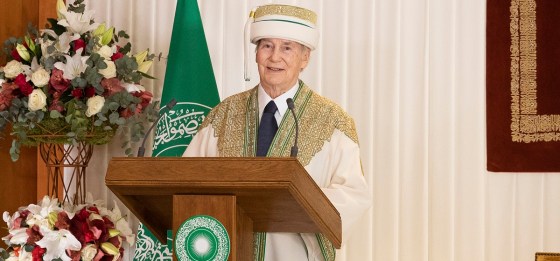
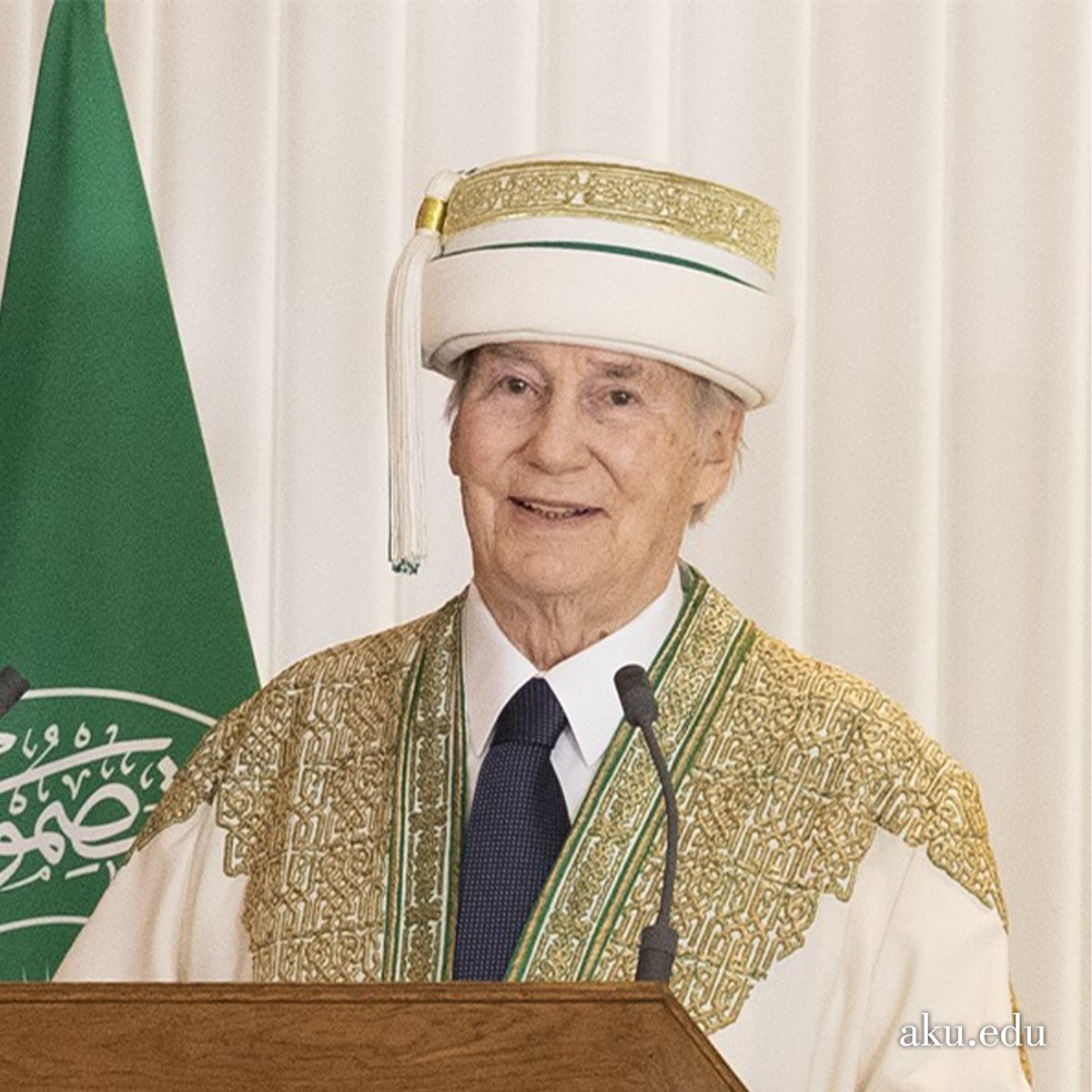
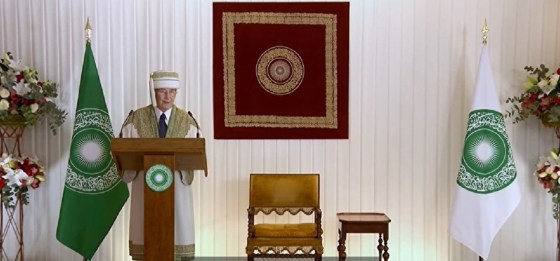
Featured image at top of post: The Seal of Aga Khan University is a visual representation of the principles which underlie the founding of the University. The circular form of the Seal, with its different levels of imagery contained in concentric circles, has its visual roots in the rosettes of early Islamic periods. The circle also symbolises the world and reflects the international presence of the University. At the centre of the Seal is a star, or sun. Light is a universal symbol for the enlightenment that education provides. The light emanating from the star is also symbolic of Nur (Divine light). The star incorporates 49 points to commemorate the University’s founding by His Highness Prince Karim Aga Khan, the forty-ninth Imam of the Ismaili Muslims.The outer ring circumscribes a Quranic Ayat rendered in classic thuluth script and reads as follows:
“And hold fast, All together, by the rope
Which God (stretches out for you),
And be not divided among yourselves,
And remember with gratitude
God’s favour on you:
For ye were enemies
And He joined your hearts
In love, so that by His grace
Ye became brethren” — Sura 3, Ayat 103
_____________________
Before departing this website please take a moment to review Simerg’s Table of Contents for links to hundreds of thought provoking pieces on a vast array of subjects including faith and culture, history and philosophy, and arts and letters to name a few. Also visit Simerg’s sister websites Barakah dedicated to His Highness the Aga Khan, and Simergphotos.






 Simerg - Insights from Around the World