Simerg is an independent initiative dedicated to Ismaili Muslims, the Aga Khan — their Hereditary Imam — and the Ismaili Imamat, and Islam in general through literary readings, photo essays and artistic expressions
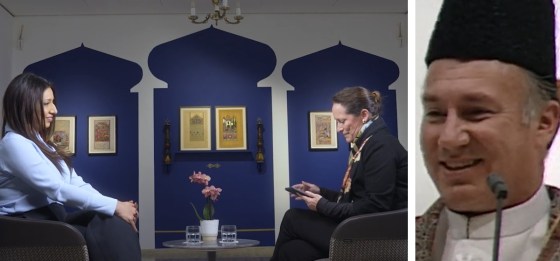
Farah Nasser, a seasoned award-winning Canadian journalist who has worked for Global News and Global National as an anchor for a decade, before leaving the network last summer, conducted a significant and enlightening interview with Princess Zahra Aga Khan, the eldest child of Mawlana Hazar Imam, His Highness the Aga Khan. The interview, held at the prestigious Aga Khan Centre in London, provided unique insight into Princess Zahra’s thoughts and perspectives.
The must-watch interview was aired on Ismaili.TV and on The Ismaili, the official website of the Ismaili Muslim community, on Friday, December 13, 2024, on the auspicious occasion of Mawlana Hazar Imam’s 88th Salgirah (birthday).
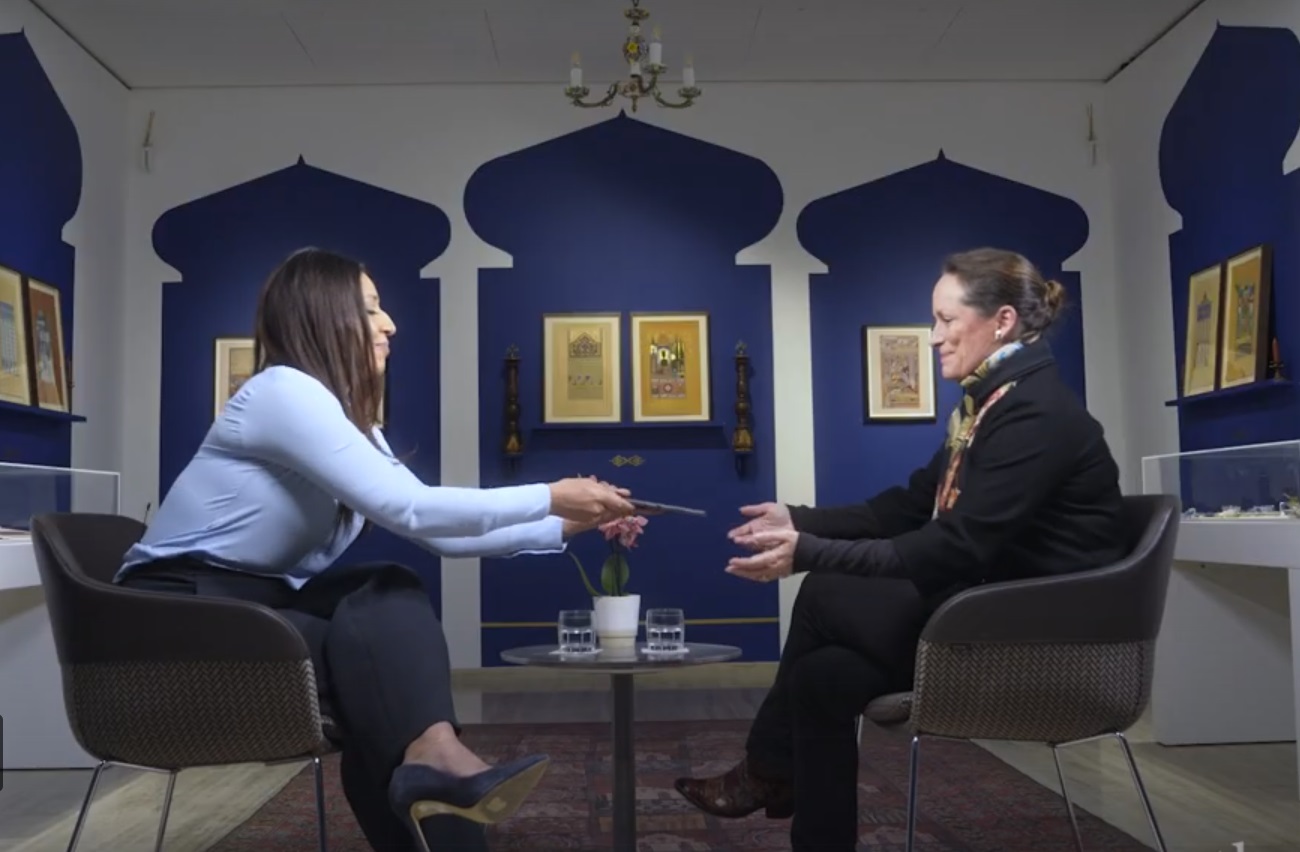
Farah Nasser hands Princess Zahra Aga Khan a Tablet, requesting that she watch a 1994 clip from a Farman delivered by Mawlana Hazar Imam to the UK Jamat gathered in London. Photograph: Still photo from interview.
~~~~~~
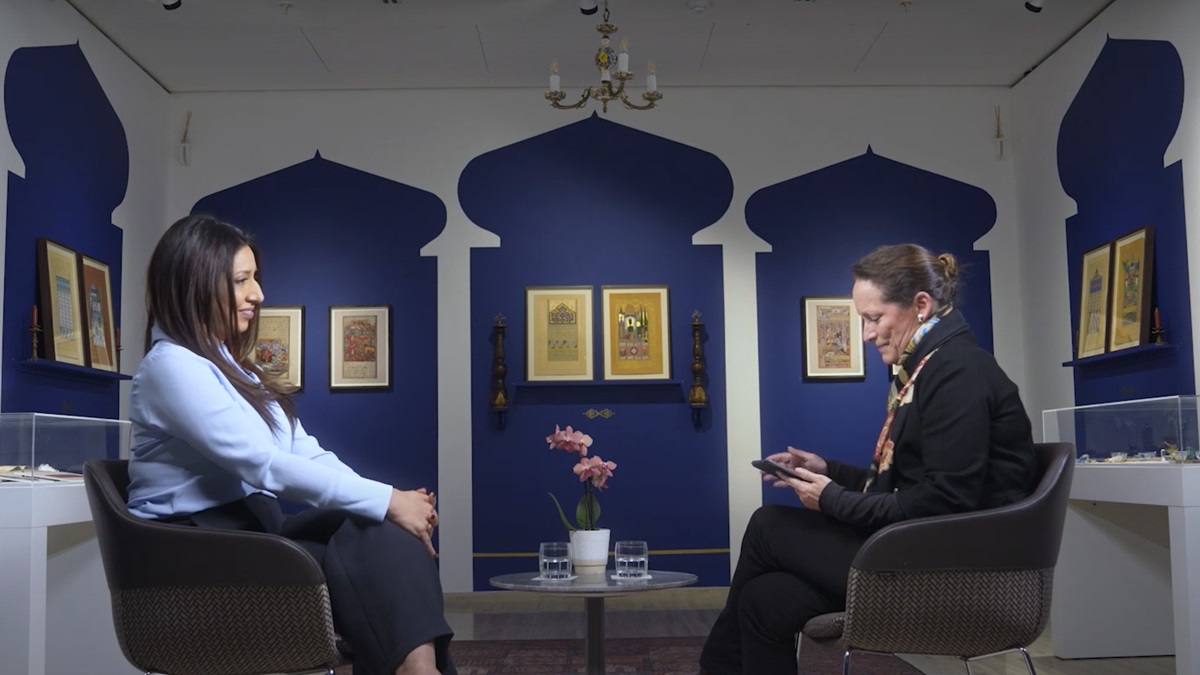
Princess Zahra Aga Khan watches a video clip of her father, Mawlana Hazar Imam, His Highness the Aga Khan, telling his Ismaili community in the UK in August 1992 that the Princess graduated from university with an honours degree and would be joining him to work by his side. Photograph: Still photo from interview.
At the start of the interview, Farah presented Princess Zahra with a tablet and requested that she view a clip from a rare thirty-year video dating back to 1994. The next image captures Princess Zahra engrossed in the clip, where Mawlana Hazar Imam, her father, joyfully mentions her university graduation and future work alongside him. It was a poignant moment as Princess Zahra focused on the Tablet screen, witnessing her father’s heartfelt words:
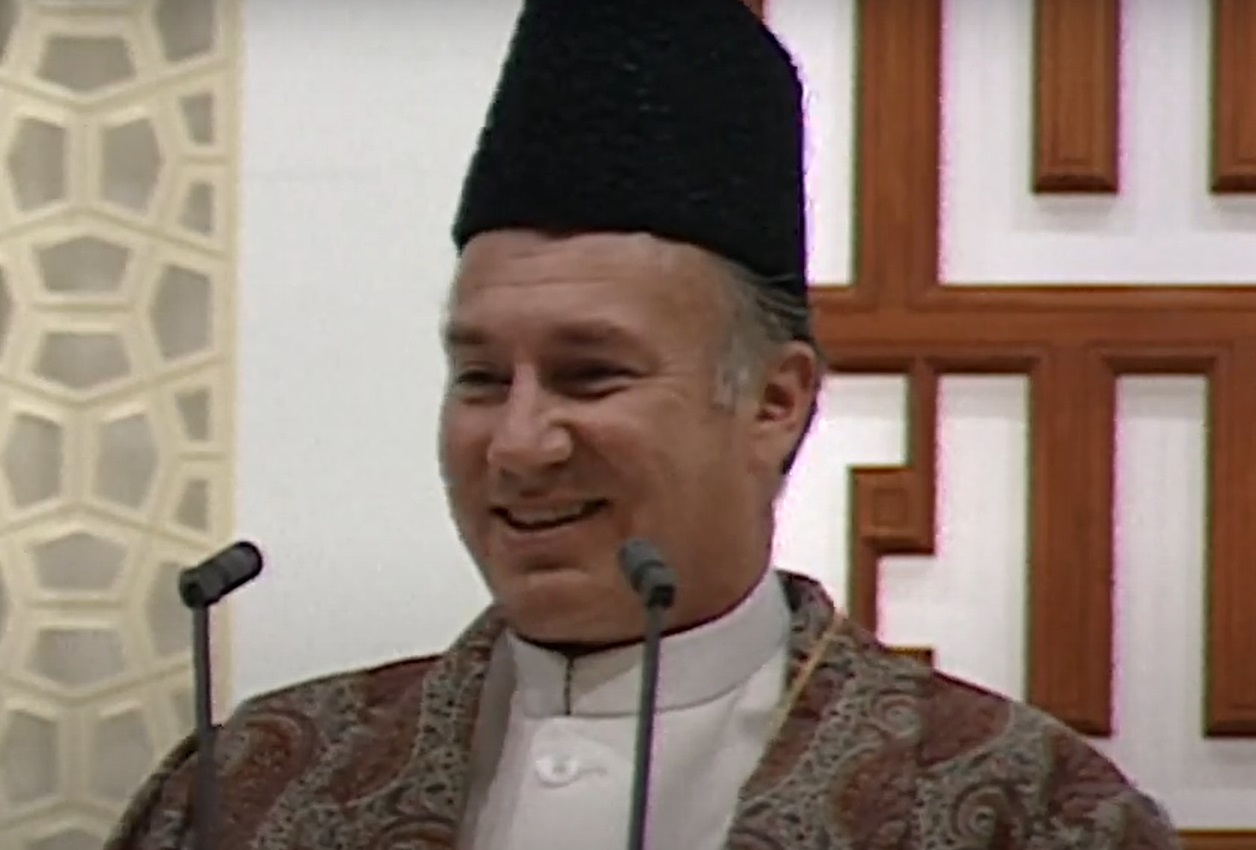
“In the past,” Mawlana Hazar Imam said, “I have not talked about my family except when my children were born or when I got married, and I thought I should tell you today that my eldest child has graduated from university…. She has received an honours degree in Development Studies. She selected that subject as she aspired to work and serve the Jamat [Ismaili community] in the developing world. And in September, she will join me to work by my side.”
The announcement was met with joy and waves of applause.
With deep happiness, Mawlana Hazar Imam, His Highness the Aga Khan, shared the news with his spiritual children gathered in London, England, in August 1994, that his daughter Princess Zahra had graduated with honours and would be joining him to work by his side. The news was met with joy and a wave of applause. Photograph: Still photo from video watched by Princess Zahra.
In the interview, Princess Zahra shares her academic journey, including her unique concentration in Development Studies. The engaging twenty-five-minute conversation concludes with Farah Nasser asking the Princess to convey the murids’ (Ismaili followers) affection and birthday wishes to Mawlana Hazar Imam. Princess Zahra assures that she will pass on the greetings, noting that he always appreciates receiving messages. She also shares that Hazar Imam requested a chocolate cake for his birthday. We now present the full YouTube interview to our readers worldwide.
“The architectural planning [of the Delegation of the Ismaili Imamat Building] has been entrusted to the capable hands of Fumihiko Maki, an architect of world standing. Maki and Associates have my enthusiastic admiration for addressing, with tact and empathy, challenges of design which are difficult and subtle. They call for translating concepts that have a context in our faith and our history, yet stride boldly and confidently ahead, into modernity; for expressing both the exoteric and the esoteric, and our awe and humility towards the mysteries of Nature, Time and beyond.” — His Highness the Aga Khan, June 2005.
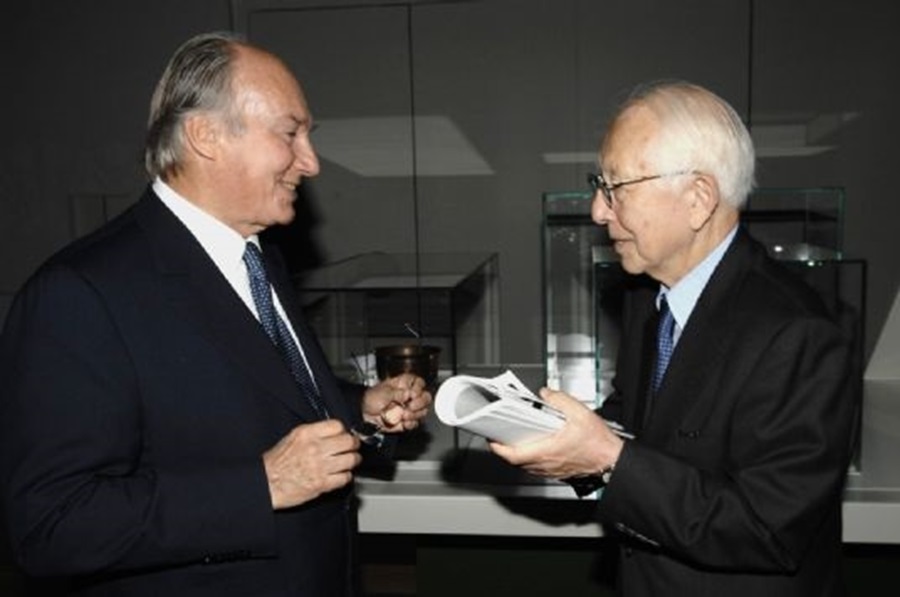
His Highness the Aga Khan with architect Fumihiko Maki at an Aga Khan Museum Exhibition held at the Louvre in 2007. The renowned Japanese architect served twice on the Master Jury of the Aga Khan Award for Architecture, and designed the Delegation of the Ismaili Imamat Building in Ottawa which was opened in December 2008 , the Aga Khan Museum in Toronto opened in September 2014., and the Aga Khan Centre in King’s Cross in London, opened in June 2018. Photo: AKDN/Gary Otte.
Reflecting back to 2005, I can’t help but feel a profound sense of loss as I note the passing of the renowned Japanese architect Fumihiko Maki on June 6, 2024, at the age of 95. His architectural firm, Maki and Associates, officially announced his demise. The news of Mr. Maki’s death reverberated across the globe, with obituaries appearing in esteemed publications such as the Washington Post, New York Times, and CNN, as well as prominent architectural websites like Architectural Record, World Architects, and Architect’s Newspaper.
The occasion in January 2005 was the award of the Vincent Scully Prize to Mawlana Hazar Imam, His Highness the Aga Khan, at the National Building Museum in Washington, D.C.
Stepping into the building, I found myself in the presence of Bruno Freschi, the architect behind the exquisite Ismaili Centre Vancouver, which had opened its doors in 1985. Just a few steps away stood Mawlana Hazar Imam, accompanied by Fumihiko Maki and Firoz Rasul, the President of the Aga Khan Council for Canada. It was a rare and profound moment, as Bruno had expressed his desire to meet both Mawlana Hazar Imam and Fumihiko Maki in person. I took the initiative and introduced Bruno to Rasul. In a later interview, Bruno shared his gratitude: “His Highness introduced me to Mr. Maki, and it was here that he again thanked me and said that the Jamatkhana (Ismaili Centre Vancouver) was indeed one of his favourite buildings. He encouraged Mr Maki to visit the building.”
Witnessing two remarkable architects with Mawlana Hazar Imam was a touching moment. The memory of that encounter is etched in my heart, a testament to the profound impact it had on me.
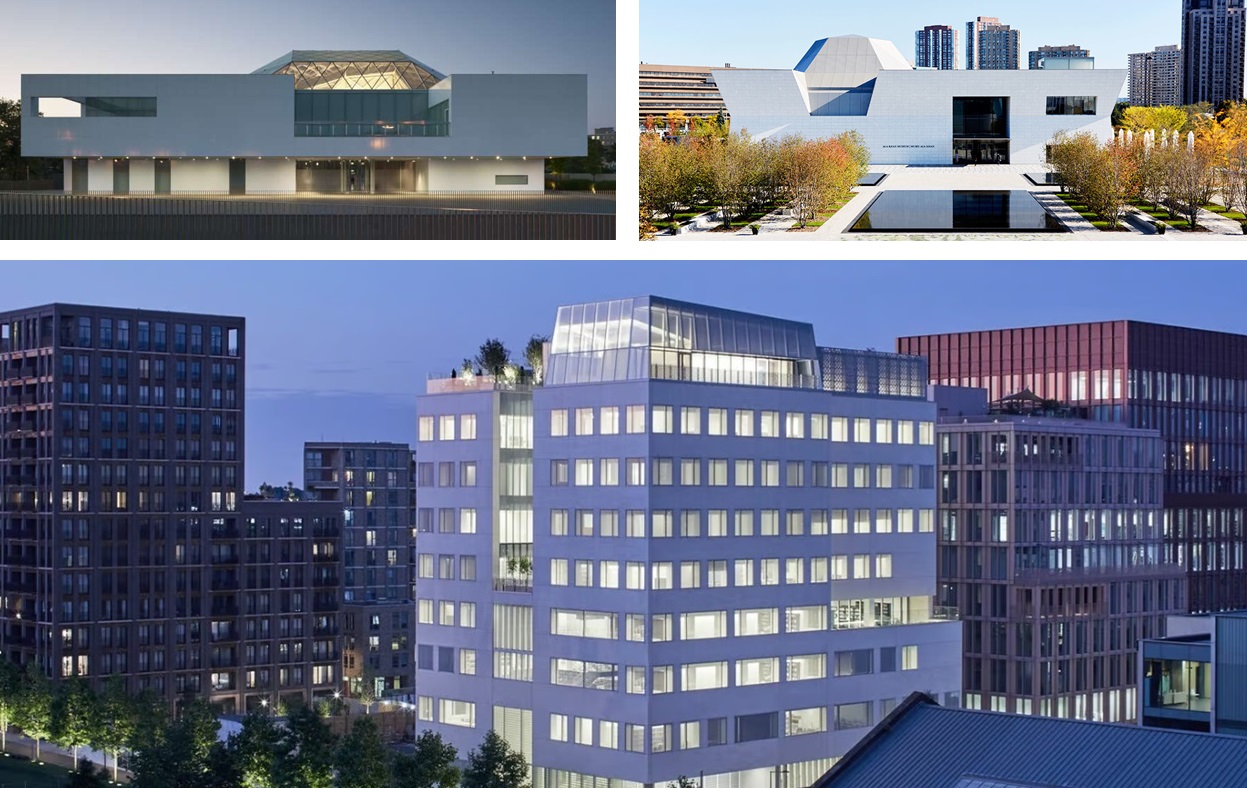
Buildings designed by Fumihiko Maki for His Highness the Aga Khan. Top: Delegation of the Ismaili Imamat, Ottawa (2008), and the Aga Khan Museum, Toronto (2014); bottom, Aga Khan Centre, London (2018).
We honour the renowned architect, Fumihiko Maki, by presenting links to photographs of three beautiful projects that he built for Mawlana Hazar Imam — the Delegation of the Ismaili Imamat building in Ottawa which was opened on December 9, 2008, as the Ismaili community marked the completion of Mawlana Hazar Imam’s Golden Jubilee, the Aga Khan Museum in Toronto which was opened on September 14, 2014, and the Aga Khan Centre in London which was inaugurated on June 26, 2018. We invite you to visit the links provided.
For each of these projects, Mawlana Hazar Imam made remarks on Fumihiko Maki. We publish a selection of the speech excerpts as part of Simerg’s tribute to Mr. Maki.
His Highness the Aga Khan on Fumihiko Maki’s Projects for the Ismaili Imamat
(1) The Delegation of the Ismaili Imamat Building, Sussex Drive, Ottawa
Remarks by the Aga Khan at the Foundation Ceremony of the Delegation Building, Ottawa, June 6, 2005
“The architectural planning [of the Delegation of the Ismaili Imamat Building] has been entrusted to the capable hands of Fumihiko Maki, an architect of world standing. Maki and Associates have my enthusiastic admiration for addressing, with tact and empathy, challenges of design which are difficult and subtle. They call for translating concepts that have a context in our faith and our history, yet stride boldly and confidently ahead, into modernity; for expressing both the exoteric and the esoteric, and our awe and humility towards the mysteries of Nature, Time and beyond. The outcome is an inter-play of multiple facets, like rock crystal. In it are platforms of pure but translucent horizontality. Light’s full spectrum comes alive and disappears as the eye moves. In Islam the divine is reflected in Nature’s creation. The building will rest on a solid linear granite podium. Above it will be a glass dome through which light will illuminate, from multiple directions, two symbolic spaces: an interior atrium and an exterior courtyard landscaped in four quarters, recalling the traditional Persian — Islamic garden, the Chahr-bagh. Nature, through the greenery of trees and flowers, will be on the site, but also in the building, just as we are sometimes able to see leaves and petals captured in rock crystal, but still visible through its unique translucency.
Remarks continue below
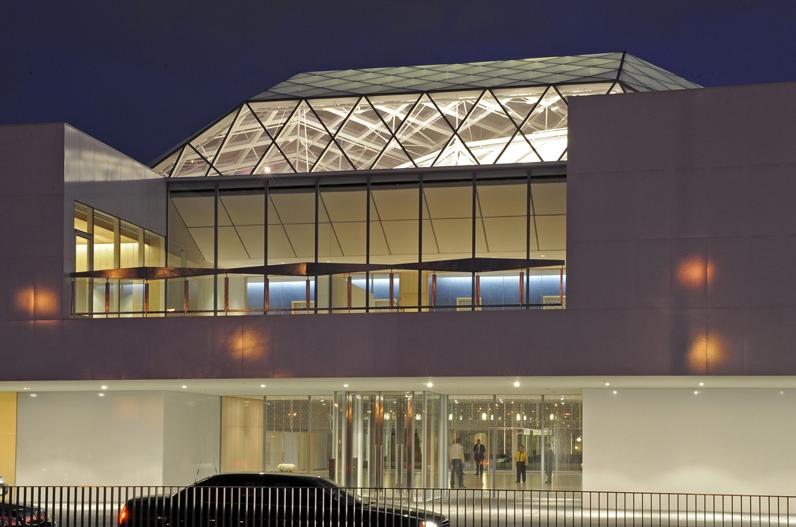
Exterior view, at night, of the entrance to the Delegation of the Ismaili Imamat on Sussex Drive in Ottawa, Canada. – Photo: AKDN/Gary Otte
“The building will be a metaphor for humanism and enlightenment and for the humility that comes from the constant search for answers that leads inevitably to more questions. The Delegation, with its openness and transparency, will be a symbolic seat for the Imamat’s permanent presence in Canada, and a platform for constructive exchanges that mutually broaden moral and intellectual horizons. It will be a window for the AKDN to reinforce existing, and cultivate new, partnerships with national and international agencies present in Ottawa, that share the ethic of contributing to an improved quality of life in the developing world.”
___________________________
(2) The Aga Khan Museum, Wynford Drive, Toronto
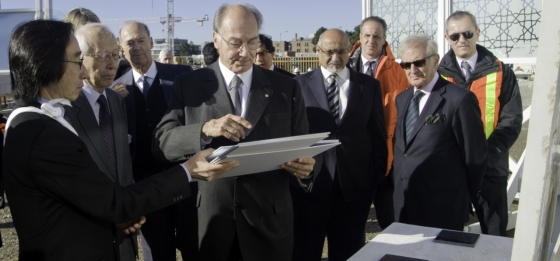
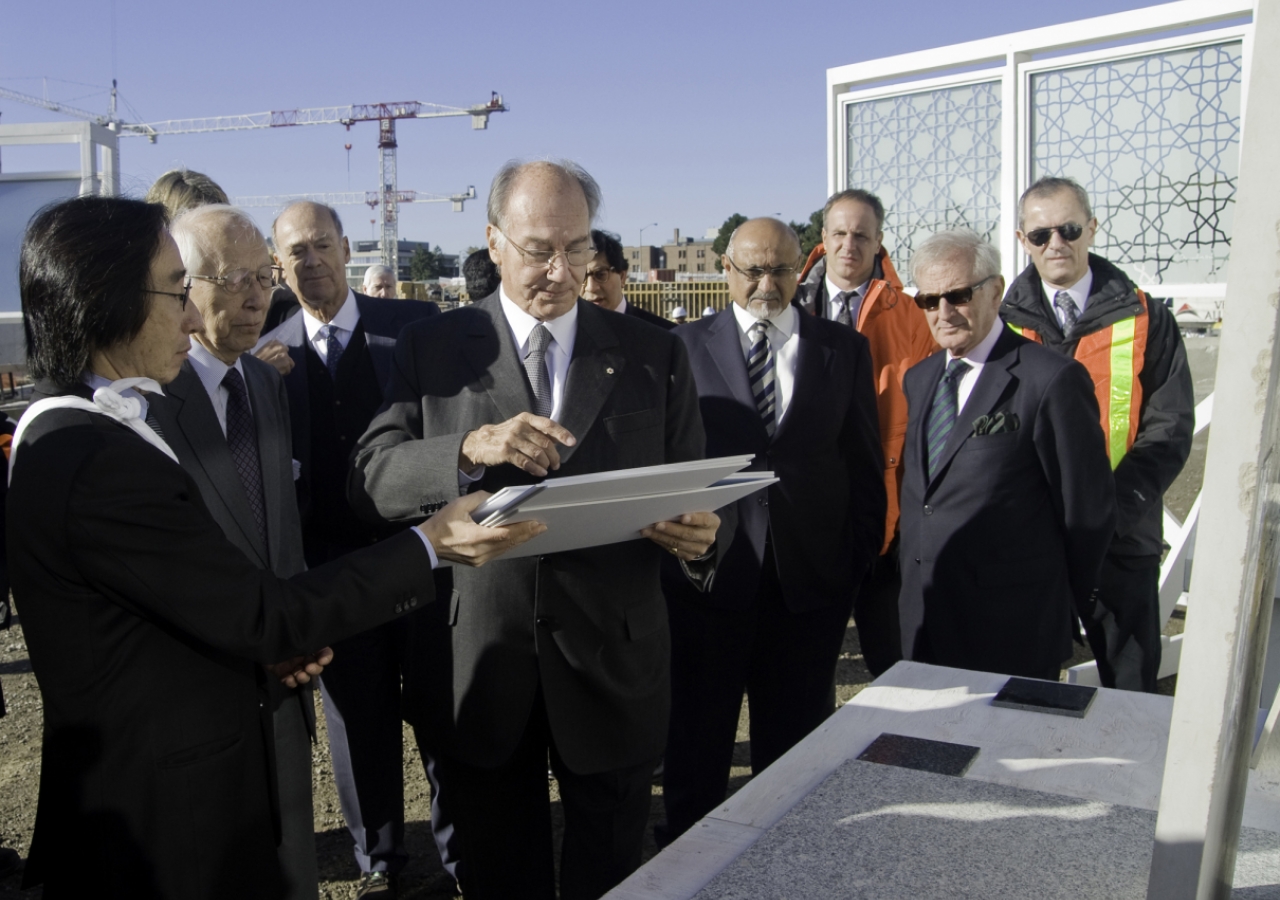
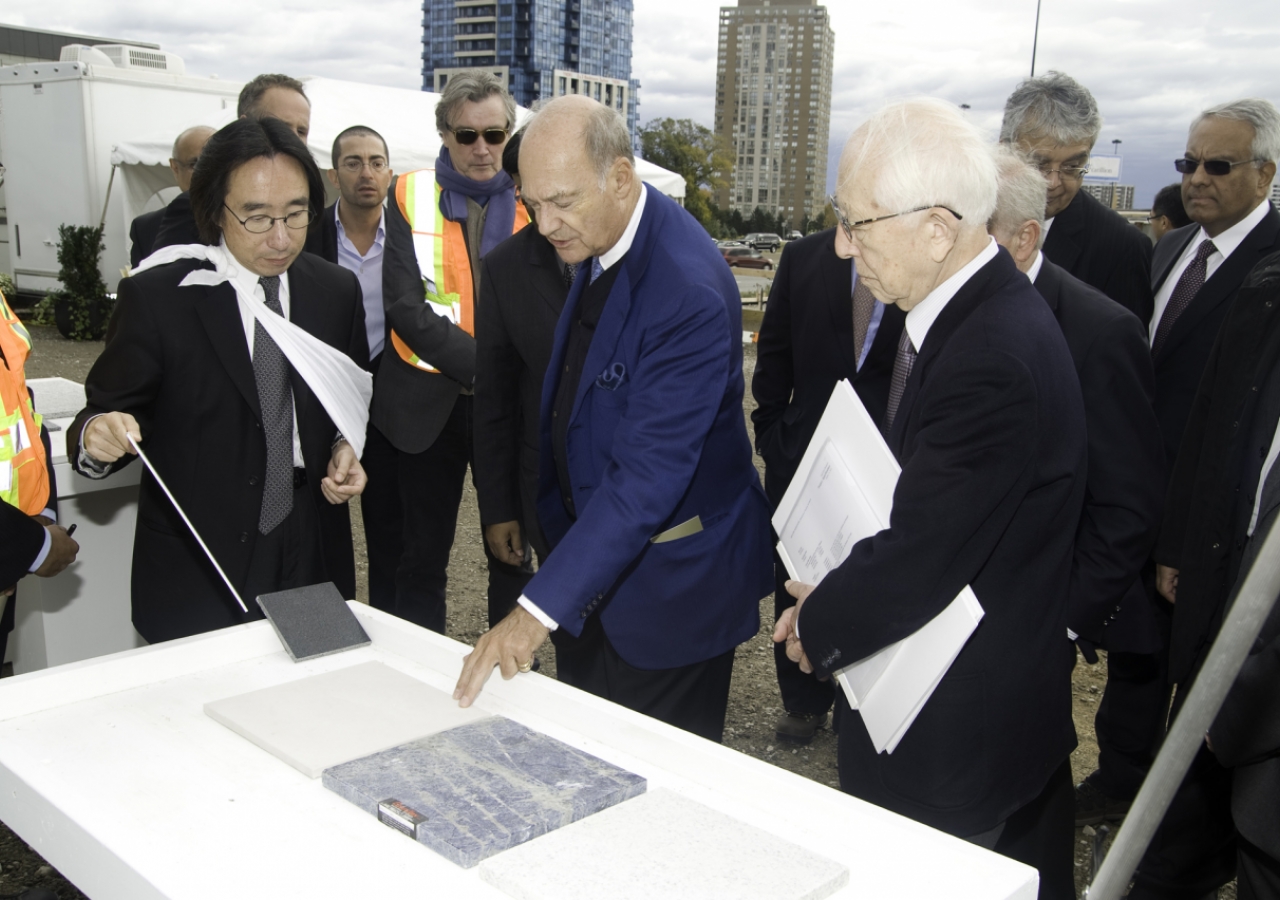
Fumihiko Maki and Gary Kamemoto of Maki & Associates review cladding stone for the Aga Khan Museum with His Highness the Aga Khan, October 2010. Photograph: The Ismaili.
(I) Remarks by the Aga Khan at the Inauguration of the Spirit and Life Exhibition, Ismaili Centre London, June 12, 2007
“What we see here today is the nucleus of the Islamic art collections of the future Aga Khan Museum in Toronto. This museum, which is being designed by the renowned Japanese architect Fumihiko Maki, is conceived as a primarily educational institution in the field of Islamic art and culture, a specific mandate that is not fulfilled so far by other North American museums. We hope and trust it will contribute to a deeper understanding among cultures — to the strengthening of true cultural pluralism — which is increasingly essential to peace, and to progress, in our world.”
~~~~~~~
(II) Remarks by the Aga Khan at the Foundation Ceremony of the Ismaili Centre, the Aga Khan Museum and their Park, Toronto, May 28, 2010,
“I should emphasise, as well, that the Museum building itself will be an important work of art — designed by the great Japanese architect Fumihiko Maki. Many of you know his superb building in Ottawa that has been the home for the Delegation of the Ismaili Imamat since 2008.
“That Delegation building was inspired by the evanescent mysteries of rock crystal. The new Toronto Museum will take as its theme the concept of light — suffusing the building from a central courtyard, through patterned glass screens. From the outside, it will glow by day and by night, lit by the sun and the moon.
Remarks continue below
Fumihiko Maki and Gary Kamemoto of Maki & Associates review materials for the exterior finish of the Aga Khan Museum with Prince Amyn Aga Khan in October 2010. Photograph: The Ismaili.
“From the outside, it will glow by day and by night, lit by the sun and the moon. This use of light speaks to us of the Divine Light of the Creator, reflected in the glow of individual human inspiration and vibrant, transparent community. As the poet Rumi has written: “The light that lights the eye is also the light of the heart… but the light that lights the heart is the Light of God.”
~~~~~~~
(III) Remarks by the Aga Khan on the Aga Khan Museum at the Opening of the Aga Khan Museum and the Ismaili Centre, Toronto, September 12, 2014
“The fusion of tradition and modernity which this building achieves, and the blend of spiritual, educational and social objectives that it embodies, have also characterised our other Ismaili Centres — in Vancouver, London, Lisbon, Dubai, and Dushanbe. All of them were designed by architects of great international standing, and, I would emphasise, of great multi-cultural sensitivity.
Remarks continue below
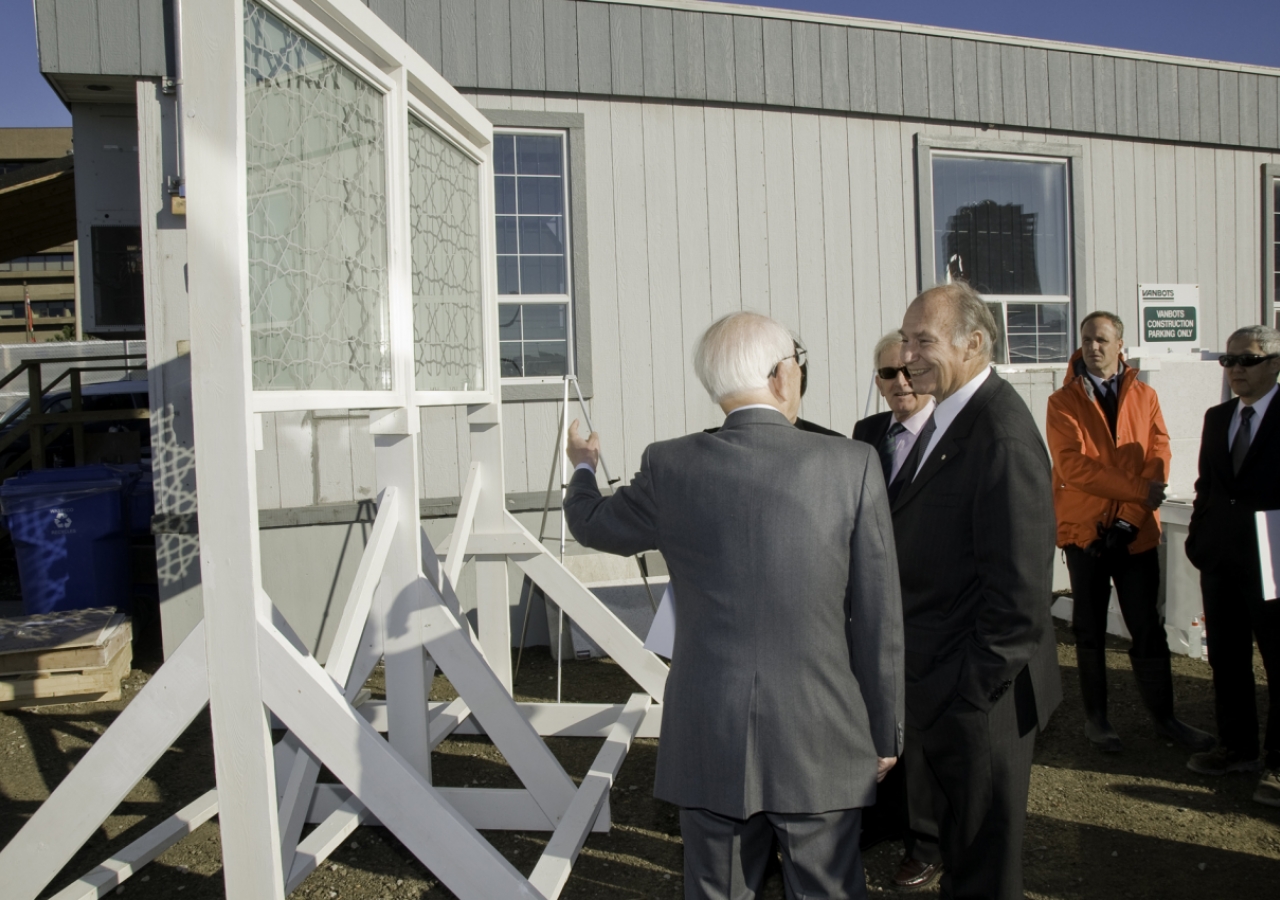
Fumihiko Maki and His Highness the Aga Khan discuss the glass finish options for the courtyard walls of the Aga Khan Museum in October 2010. Photograph: The Ismail
“Charles Correa, for example, comes from an Indian background and has also designed Hindu and Christian buildings. The architect for our Vancouver Centre 30 years ago was Bruno Freschi, whose family is of Italian background, and whose earlier work had included a Sikh place of worship. The new Aga Khan Park was designed by an architect of Lebanese heritage, Vladimir Djurovic. And the Aga Khan Museum is the work of a superb Japanese professional, Fumihiko Maki. How pleased we are that all of these fine artists are with us today.”
_____________________
The Aga Khan Centre, King’s Cross, London
“The Aga Khan Centre is the third project we have worked on with the distinguished architect Fumihiko Maki, a master of form and light” — His Highness the Aga Khan, quoted on Aga Khan Centre website
Gary Kamemoto and Professor Maki of Maki & Associates, the architects of the Aga Khan Centre, at the Aga Khan Centre Library.
Remarks by the Aga Khan at the inauguration of the Aga Khan Centre, June 5, 2018
“We celebrate today a beautiful new architectural accomplishment. This place has been shaped by many diverse influences — and among them we now welcome the rich traditions of Islamic architecture. One of those traditions – one that is appreciated by both the Islamic and the British cultures – is the special importance of the garden. We see the garden not merely as an adjunct to other constructions, but as a privileged space unto itself.
“And that is why I have emphasised, since our role began here in 2010, my own hope that the value of garden spaces should be embraced here. As we perambulate together through these spaces today, I trust that you will share my delight in seeing how that hope has been fulfilled. What we will see as we walk along are not only beautiful buildings — but also a unique series of gardens, courtyards and terraces – eight of them, in all, across our two buildings. Each one of them, moreover, has a distinctive identity: each one is inspired by a different region of the Islamic Ummah.
Remarks continue below
On Tuesday, June 26, 2018, HRH The Prince of Wales, now His Majesty King Charles, opened The Aga Khan Centre in King’s Cross in the presence of Mawlana Hazar Imam, His Highness the Aga Khan. Situated at the heart of London’s Knowledge Quarter, the Aga Khan Centre, designed by Maki and Associates, led by Fumihiko Maki, one of Japan’s most distinguished contemporary architects, provides a new home for a number of UK based organisations founded by His Highness the Aga Khan: The Institute of Ismaili Studies (IIS), the Aga Khan University Institute for the Study of Muslim Civilisations (AKU-ISMC) and the Aga Khan Foundation UK (AKF UK).
“Taken together, this winding ribbon of special spaces is an eloquent tribute to the rich diversity of the Muslim world. As we open this remarkable site, it is a privilege to salute those who have brought us to this moment. I would recognise, in particular, our fine relationship with the government of this borough, this city, and this country, as well as our rewarding partnership with the people at Argent. We are grateful, as well, for the talents of Maki and Associates, Allies and Morrison, Madison Cox and Nelson Byrd Woltz, as well as Rasheed Araeen and the late Karl Schlamminger. I would also like to thank our splendid team of staff and volunteers, including my brother Prince Amyn, who have stewarded this project to completion.”
Date posted: June 13, 2024.
_____________________
Please visit the Maki and Associates website for Professor Maki’s biography and curriculum vitae, which summarize his education, professional affiliations, and worldwide recognitions and awards.



 Simerg - Insights from Around the World