Simerg is an independent initiative dedicated to Ismaili Muslims, the Aga Khan — their Hereditary Imam — and the Ismaili Imamat, and Islam in general through literary readings, photo essays and artistic expressions
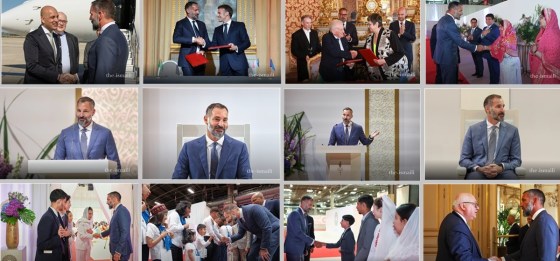
Mawlana Hazar Imam, His Highness Prince Rahim Aga Khan, concluded his official visit to France by gracing the France jurisdiction Jamat with a second Didar on July 13, 2025, meeting the youth of the Ismaili community and attending a special luncheon hosted by Ismaili Institutional leaders. He arrived in Paris on July 10, 2025, and on July 11, the first full day of his visit, he was warmly received at the Palais de l’Élysée by President Macron. He was accompanied by members of his family. President Macron decorated his uncle, Prince Amyn, younger brother of His Late Highness Aga Khan IV, with France’s highest and most prestigious order of merit. At the Palace, three important agreements were signed between the Ismaili Imamat and France in the presence of President Macron and His Highness. Later that same day, Mawlana Hazar Imam met with the French Foreign and Interior Ministers. On July 12, he met with his followers in a historic first of two Didars since becoming the 50th Hereditary Imam of the Ismailis. For a comprehensive and detailed coverage of his visit, visit our sister website, Barakah, which has a special page dedicated to the historic visit.
The official website of the Ismaili community, the Ismaili, has posted special video updates of the visit in four parts. We are sharing the YouTube videos with you below.
THE ISMAILI UPDATE, JULY 13, 2025: THE AGA KHAN BLESSES HIS FOLLOWERS WITH A SECOND DIDAR TO COMPLETE HIS FRANCE VISIT
_________________
THE ISMAILI UPDATE, JULY 11-12, 2025: THE AGA KHAN MEETS FRENCH FOREIGN MINISTER (JULY 11) AND BLESSES HIS FOLLOWERS WITH HISTORIC DIDAR (JULY 12)
_________________
THE ISMAILI UPDATE, JULY 11, 2025: PRESIDENT MACRON RECEIVES THE AGA KHAN
_________________
THE ISMAILI UPDATE, JULY 10, 2025: THE AGA KHAN ARRIVES IN FRANCE
Date posted: July 12, 2025. Last updated: July 17, 2025.
“I am suggesting that freedom of expression is an incomplete value unless it is used honorably, and that the obligations of citizenship in any society should include a commitment to informed and responsible expression.” — His Highness the Aga Khan, February 2006
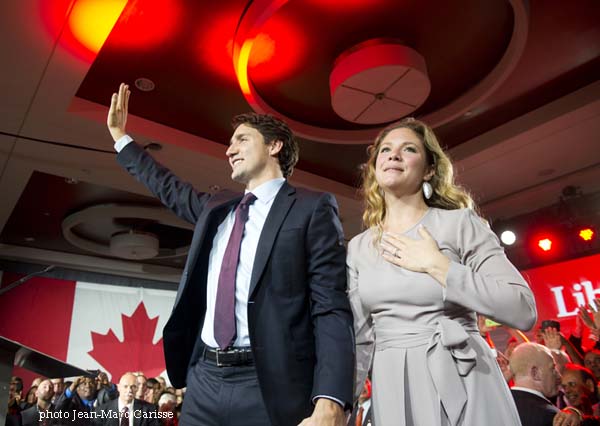
We owe it to ourselves to act with respect for others and to seek not to arbitrarily or unnecessarily injure those with whom we are sharing a society and a planet…..In a pluralist, diverse and respectful society like ours, we owe it to ourselves to be aware of the impact of our words, of our actions on others, particularly these communities and populations who still experience a great deal of discrimination” — Prime Minister Justin Trudeau, October 30, 2020 in response to a question from a journalist
Two weeks ago, French teacher Samuel Paty was beheaded after showing his class caricatures of the Prophet Muhammad in a civics class about freedom of expression. The cartoons had first appeared in the Danish newspaper Jyllands-Posten in 2005, and were reproduced in the French magazine Charlie Hebdo, which then led to killing of several of its journalists some years ago. The newspaper’s many critics worldwide said that the editorial staff was attacking Islam itself.
In response to the killing of the teacher recently, French President Emmanuel Macron defended the cartoons depicting Prophet Muhammad in the name of free speech, and said France would not “give up cartoons”, pledging that Islamists “will never have” his country’s future. This sparked protests and boycotts in a number of Muslim countries. Pakistani Prime Minister Imran Khan accused French President Emmanuel Macron of “attacking Islam” by defending the publication of the caricatures.
“Sadly, President Macron has chosen to deliberately provoke Muslims, including his own citizens, through encouraging the display of blasphemous cartoons targeting Islam & our Prophet PBUH (peace be upon him),” Khan said in a series of tweets. “It is unfortunate that he has chosen to encourage Islamophobia by attacking Islam rather than the terrorists who carry out violence, be it Muslims, White Supremacists or Nazi ideologists,” Khan wrote.
This week, three more people were in killed near a a church in Nice, in southern France, by a young Tunisian man. President Macron’s defiant statements may have triggered the brutal stabbings.
Canada’s parliament observed a moment of silence on Thursday, October 29. As he had done the day before with the leaders of the European Union, Prime Minister Trudeau condemned the “awful and appalling” extremist attacks in France.
However, in response to a newspaper’s question a day later, while defending free speech, Prime Minister Trudeau distanced himself from the position of French President Macron and pleaded for a careful use of free speech, He stated that freedom of speech was “not without limits” and it should not “arbitrarily and needlessly hurt” certain communities.
“We owe it to ourselves to act with respect for others and to seek not to arbitrarily or unnecessarily injure those with whom we are sharing a society and a planet. We do not have the right for example to shout fire in a movie theatre crowded with people, there are always limits,” the Prime Minister argued.
“In a pluralist, diverse and respectful society like ours, we owe it to ourselves to be aware of the impact of our words, of our actions on others, particularly these communities and populations who still experience a great deal of discrimination,” he said.
The Aga Khan on “The Great Conversation” of Our Times — Being Unafraid of Controversy but Also Being Sensitive to Others
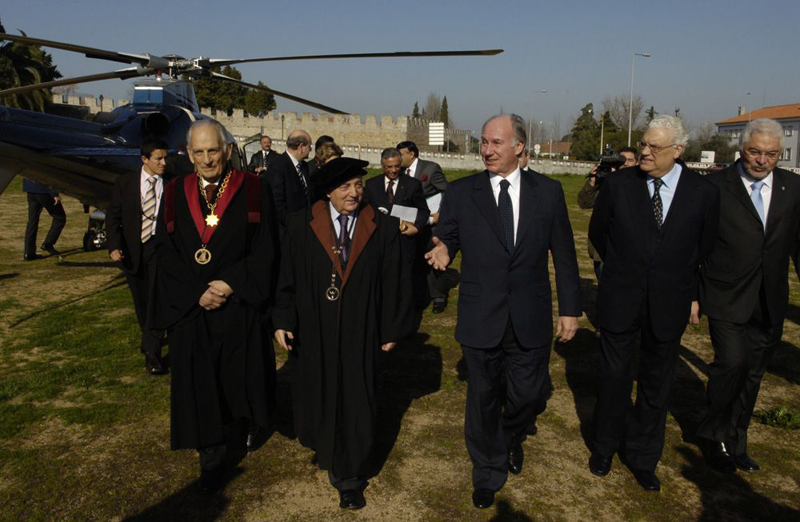
His Highness the Aga Khan arrives at the University of Évora , Portugal and is greeted by Professor Adriano Moreira, Manuel Ferreira Patricio, Rector of the University, Portuguese Foreign Minister, Freitas do Amaral and José Ernesto Oliveira, Mayor of the city of Évora. Photo: AKDN/Gary Otte.
Mawlana Hazar Imam, His Highness the Aga Khan, touched on the controversy soon after the cartoons first appeared in the Danish journal during a speech that he delivered at the University of Evora in Portugal. His remarks are as follows:
“An important goal of quality education is to equip each generation to participate effectively in what has been called “the great conversation” of our times. This means, on one hand, being unafraid of controversy. But it also means being sensitive to the values and outlooks of others.
“This brings me back to the current headlines. For I must believe that it is ignorance which explains the publishing of those caricatures which have brought such pain to Islamic peoples. I note that the Danish journal where the controversy originated acknowledged, in a recent letter of apology, that it had never realized the sensitivities involved.
“In this light, perhaps, the controversy can be described less as a clash of civilizations and more as a clash of ignorance. The alternative explanation would be that the offense was intended — in which case we would be confronted with evil of a different sort. But even to attribute the problem to ignorance is in no way to minimize its importance. In a pluralistic world, the consequences of ignorance can be profoundly damaging.
“Perhaps, too, it is ignorance which has allowed so many participants in this discussion to confuse liberty with license — implying that the sheer absence of restraint on human impulse can constitute a sufficient moral framework. This is not to say that governments should censor offensive speech. Nor does the answer lie in violent words or violent actions. But I am suggesting that freedom of expression is an incomplete value unless it is used honorably, and that the obligations of citizenship in any society should include a commitment to informed and responsible expression.
“If we can commit ourselves, on all sides, to that objective, then the current crisis could become an educational opportunity—an occasion for enhanced awareness and broadened perspectives.
Before departing this website please take a moment to review Simerg’s Table of Contents for links to hundreds of thought provoking pieces on a vast array of subjects including faith and culture, history and philosophy, and arts and letters to name a few.
We welcome feedback from our readers. Please complete the LEAVE A REPLY form below or, if you don’t see the box, please click Leave a comment. Your letter may be edited for length and brevity, and is subject to moderation.

 Simerg - Insights from Around the World