

(This article has been adapted and abridged from an article first published on the official website of the Ismaili Muslim community under the title Why Do Muslims Revere Jesus? Please note that the photograph of the Altar of Nativity and the selected verses from chapter 19 of the Qur’an, are not part of the Ismaili piece — Ed.)
Prepared by MALIK MERCHANT
Jesus and the Prophets of the Abrahamic Tradition
“Then she brought him to her own folk, carrying him. They said: O Mary! Thou hast come with an amazing thing.” — Qur’an, 19:27
His name is mentioned in the Holy Qur’an twenty-five times, often in the form ‘Isa ibn Maryam, meaning “Jesus, son of Mary.” In the Qur’an, he is referred to by the unique title of “Messiah” (al-masih in Arabic), meaning “anointed one.” Descriptions of Jesus in the Qur’an include many aspects of the narrative found in the Gospels about the life of Jesus, including his virgin birth, the signs given to him by God, that he was raised by God into His presence, and it also suggests his future return. Jesus is also referred to in the Qur’an as the “Word” and the “Spirit” of God, a special honour.

The Holy Qur’an frequently mentions that divine guidance was sent to humankind through various prophets. For example, it says:
“So [you believers], say, ‘We believe in God and in what was sent down to us and what was sent down to Ibrahim (Abraham), Isma’il (Ishmael), Ishaq (Isaac), Ya’qub (Jacob), and the Tribes, and what was given to Musa (Moses), ‘Isa (Jesus), and all the prophets by their Lord. We make no distinction between any of them, and we devote ourselves to Him’” (Qur’an 2:136).
This view that all prophets are considered to be equal is also supported by a widely-reported hadith, in which Prophet Muhammad (peace be upon him and his family) is believed to have said:
“Both in this world and in the Hereafter, I am the nearest of all the people to Jesus, the son of Mary. The prophets are paternal brothers; their mothers are different, but their religion is one.”
Many Qur’anic verses also describe the prophets as belonging to the same family. For example, there is a line of prophets descended from Prophet Ibrahim. Both of his sons, Ishaq and Isma’il were prophets, as was Prophet Ishaq’s son, Prophet Ya’qub, and his grandson, Prophet Yusuf, or Joseph (peace be upon them).
Thus, God chose certain families over others based on their devotion, faith and commitment towards the Divine, as reflected in the following two Qur’anic verses:
“Allah chose Adam and Nuh (Noah), the family of Ibrahim, and the family of Imran above all mankind: a progeny one from the other” (Qur’an, 3:33-34).
“We have already given the family of Ibrahim the Book and Wisdom and conferred upon them a great kingdom” (Qur’an, 4:54).
Article continues below, after quotes from the Qur’an
_________________________________________
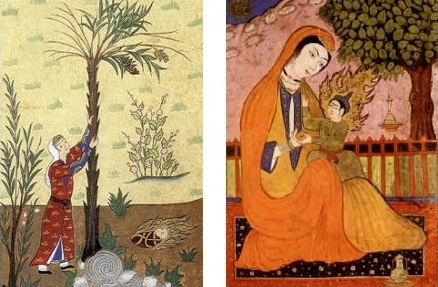
Mary and the Birth of Jesus in the Qur’an

_________________________________________
Jesus in Islamic Traditions
The Qur’an mentions that angels announced the coming birth of Prophet ‘Isa, saying:
The angels said, ‘O Maryam, Allah gives you good news of a Word [kalima] from Him. His name is [the Messiah], ‘Isa ibn Maryam, honoured in this world and in the next, and of those brought near [to God]’” (Qur’an, 3:45).
Throughout history, Prophet ‘Isa has been viewed by Muslims as someone who embodied the qualities of piety and a concern for the needy, and whose example inspired Prophet Muhammad. In Sufi literature, he is frequently portrayed as an example of detachment from the material world and closeness to God.
The Ikhwan al-Safa’, or Brethren of Purity, depicted Prophet ‘Isa as a spiritual exemplar par excellence. In his article “Jesus, Christians and Christianity in the Thought of the Ikhwan al-Safa’,” Dr Omar Ali-de-Unzaga writes:
“Jesus figures prominently in the Rasa’il, as one of the exemplars who embodied the views of the Ikhwan al-Safa’: belief in the eternity of the soul and the pursuit of the purification of the soul from matter by detachment from the bodily realm.”
The 49th Ismaili Imam, His Highness Prince Karim Aga Khan, spoke about Jesus in connection with pluralism in his acceptance speech for the Tutzing Evangelical Academy’s “Tolerance” award in 2006, saying:
“Despite the long history of religious conflict, there is a long counter-history of religious focus on tolerance as a central virtue – on welcoming the stranger and loving one’s neighbour. ‘Who is my Neighbour?’ – one of the central Christian narratives asks. Jesus responds by telling the story of the Good Samaritan – a foreigner, a representative of the Other, who reaches out sympathetically, across ethnic and cultural divides, to show mercy to the fallen stranger at the side of the road.”
THE people Of the book
In Islamic traditions, Jesus is held in high regard as a messenger of God and an exemplar of piety and as a guide to spiritual truth. He is also part of the shared heritage that binds the monotheistic faiths of Judaism, Christianity, and Islam. Together, they are known in the Qur’an as the ahl al-kitab, or People of the Book, that is, people to whom God sent revelation.
His Highness Prince Karim Aga Khan highlighted this shared Abrahamic heritage in his address to the Canadian parliament in 2014, stating:
“We find singularly little in our theological interpretations that would clash with the other Abrahamic faiths — with Christianity and Judaism. Indeed, there is much that is in profound harmony.”
Date posted: December 22, 2023.
_________________________
FURTHER READING:
- Simerg: Jesus Thorugh a Muslim Lens by Michael Wolf
- Simerg: The Verses of the ‘Immaculate Conception’ of Jesus Christ in the Holy Qur’an by Barnaby Rogerson
- The Guardian (UK): Jesus in Islam by Mehdi Hassan
~~~~~~~~
We welcome feedback from our readers. Please click LEAVE A COMMENT. Your letter may be edited for length and brevity and is subject to moderation.
~~~~~~~~
SOURCES:
- Faith and Practice in Islamic Traditions, vol. 1 (Student Reader). London: Islamic Publications Limited for The Institute of Ismaili Studies, 2015.
- The Qur’an and its Interpretations vol. 1 (Student Reader). London: Islamic Publications Limited for The Institute of Ismaili Studies, 2017.
- Shedinger, Robert F. “Jesus“, in: Oxford Bibliographies in Islamic Studies.
- Omar Ali-de-Unzaga. “Jesus, Christians and Christianity in the Thought of the Ikhwan al-Safa’”, in: Christian-Muslim Relations. A Bibliographical History. Volume 2 (900- 1050), ed. David Thomas et al. (Leiden: E.J. Brill, 2010); The History of Christian-Muslim Relations, 14; pp. 306-311.
- Andani, Khalil, “Jesus in Esoteric Islam: An Ismaili Muslim Christology,” Lecture for the Society of Comparative Theology, Harvard Divinity School, 1 March 2013.
- Aga Khan III. The Memoirs of Aga Khan: World Enough and Time. London: Cassell and Company Ltd, 1954.


 Simerg - Insights from Around the World