Simerg is an independent initiative dedicated to Ismaili Muslims, the Aga Khan — their Hereditary Imam — and the Ismaili Imamat, and Islam in general through literary readings, photo essays and artistic expressions
IMPORTANT ANNOUNCEMENT: As Simerg completes its 13 years of continuous publication, we launch a special series profiling Ismaili leaders of distinction over the past 125 years. The series will be dedicated to Ismaili institutional leaders as well as individuals who have achieved distinction and recognition working outside the Ismaili community, yet continuing to support the work of the Ismaili Imamat through its Jamati institutions and the Aga Khan Development Network and its agencies. We welcome articles from all over the world for this new initiative. Please write in confidence to the editor at mmerchant@barakah.com.
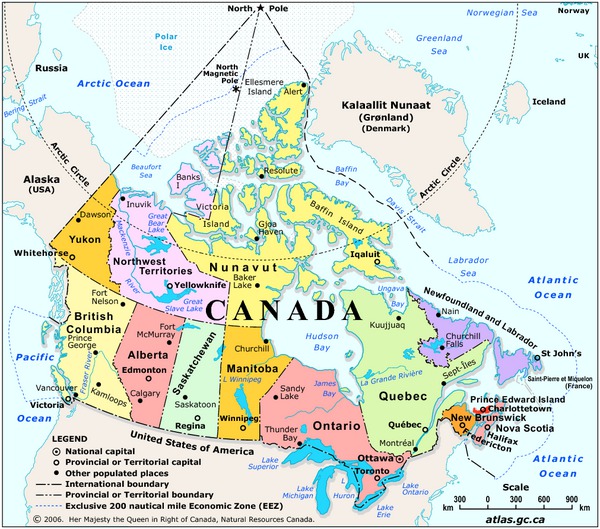
Map of Canada, world’s 2nd largest country (9,984,670 sq kms, 6.1% of world landmass) after Russia (17,098,242 sq kms, 11% of world landmass). The map represents Canada’s Political Divisions, and shows boundaries, capitals, selected place names, selected drainage and names, the Arctic Circle and adjacent foreign areas. Photo: Natural Resources Canada.
My first home in Canada was in Edmonton. I left London, England, in late December 1980, with the blessings of my mother, Malek (“Mrs. Merchant”), and arrived several hours later to my new home in the thick of winter. It was a clear day, and from the plane I only saw snow as it flew over Canada to my destination. My dad, who had arrived in the city a few days earlier from London to give talks on science and faith as well as other religious topics at the invitation of the local Ismaili Tariqah and Religious Education Board or ITREB (then known as the Ismailia Association) was there to receive me.
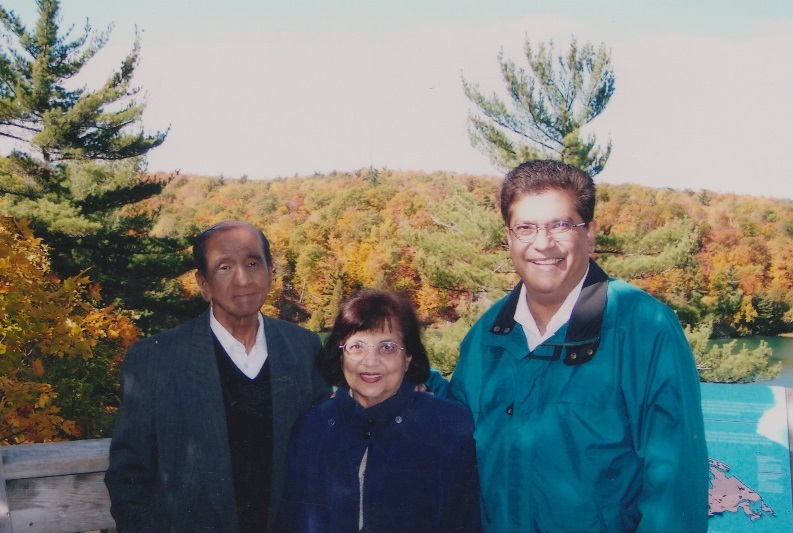
The editor of Simerg, Barakah and Simergphotos, Malik Merchant, is pictured with his beloved late parents, Jehangir (d. May 2018) and Malek Merchant (d. January 2021), at the Gatineau Park in the Canada’s National Capital Region during their visit to Ottawa in 2007. Photo: Jehangir Merchant Family Collection.
That weeklong presence of my beloved dad was inspirational, and filled me with immense courage during my first phase of settling down in a new country. Earlier during the year, I had successfully completed an IT assignment in Salt Lake City, Utah.
Edmonton was my home for just under 3 years, before my consulting firm, Cognos, relocated me to Ottawa, Ontario, in late 1983, due to branch closure. I am happy to say that, as of January 2022, Alberta has once again become my home. It will give me an opportunity to reconnect with my boyhood friends, the Jamat as well as many friends with whom I played sports in the past. The Jamat has grown significantly, and the opportunity of seeing thousands of Ismaili faces from Afghanistan excites me.
During my time in Edmonton in the early 1980’s, Dr. Zaheer Lakhani, was the Chairman of the Aga Khan Edmonton Council (or the Administrative Committee, as it was then known, I think), and I came to know him as an open-minded leader who reached out to the Jamat seeking out their suggestions, opinions and ideas. I have not met Zaheer for almost 40 years now, but I was extremely pleased to learn about his wife Salma’s appointment as the 19th Lieutenant Governor of Alberta.
Story continues below
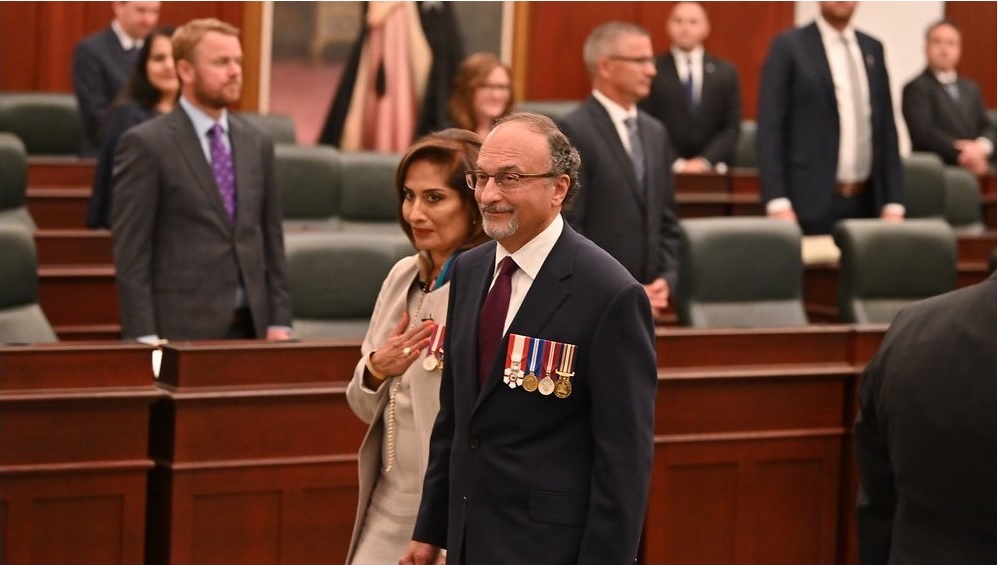
Dr. Zaheer Lakhani accompanies his wife Salma Lakhani at her installation ceremony as the Lieutenant Governor of Alberta on August 26, 2020. Photo: Via Al-Karim Walli’s Twitter page.
Salma’s appointment was announced on June 30, 2020 by Prime Minister Justin Trudeau. She became the first-ever Muslim to hold the ceremonial position in Canadian history. In a written statement on her appointment the Prime Minister said: “Ms. Lakhani is devoted to supporting people in her community, from new immigrants and young people, to women and families. As Lieutenant Governor of Alberta, I know she will serve the people of her province and our country well, and continue to be a source of inspiration for all Canadians.”
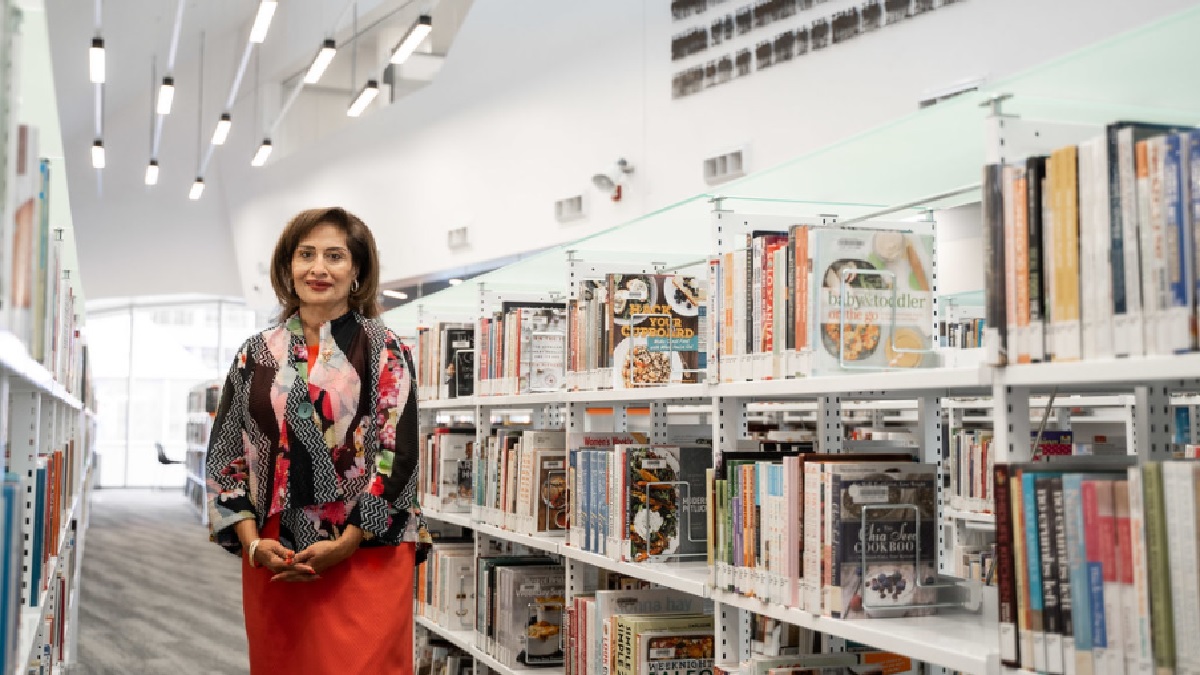
Lieutenant Governor Salma Lakhani is seen touring the new Stanley A. Milner Downtown Branch of the Edmonton Public Library, September 13, 2021. Photo: The Office of the Lieutenant Governor of Alberta.
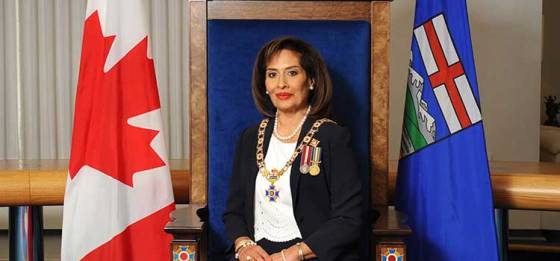
Salma Lakhani is a long-time resident of Edmonton, and a distinguished community advocate with a passion for education, health care, human rights, and support for new immigrants. A proud Ismaili Muslim, her longstanding service as a community leader and volunteer has been guided by her deep commitment to the values of pluralism and inclusion and her dedication to championing those who face barriers in life. Salma inherited her devotion to giving back from her parents, Abdul and Malek Rajabali, who were active members of the Ismaili community.
Salma was born and raised in Kampala, Uganda. A keen student with a deep seeded love of education, Salma attended the Aga Khan School in Kampala before pursuing post-secondary studies at the University of Manchester in England. Her life took an unforeseen and dramatic turn during a summer visit home to Kampala in 1972, when it was announced that the country’s entire Asian minority population was to be expelled. Salma’s parents pressed her to return immediately to England, travelling on her Ugandan passport. Within three months, her family would be stripped of virtually everything and she would be stranded in England with no funds to continue her education and no valid passport.
She had become a stateless person. Salma had two saving graces that sustained through this challenging time. First, she had the love and support of her fellow exile and future husband, Zaheer Lakhani. The couple also learned that their tuition would be covered by the British government, allowing Salma to complete her Honours degree in Clinical Biochemistry and Zaheer to graduate in Medicine from the University of Leeds. The couple married in Leeds in 1977. That year, the University of Alberta accepted Zaheer’s application to continue his postgraduate studies in Edmonton and the Lakhanis began writing a new chapter in Canada.
Dr. Lakhani went on to establish himself as a cardiologist while Salma helped to manage his practice and operated a business focused on early childhood education, which developed out of her innate affinity for teaching. She also began looking for opportunities to give back and to help those in need to thrive.
Story continues below
Her Honour Salma Lakhani (centre of photo) toured the Aga Khan Garden at the University of Alberta Botanic Garden located near Devon, Alberta, on September 23, 2020. She was joined by Minister of Culture, Multiculturalism and Status of Women Leela Aheer and University of Alberta Chancellor Peggy Garritty. Photo: The Office of the Lieutenant Governor of Alberta.
Salma was one of the first mentors in NorQuest College’s Youth in Transition program, providing valuable guidance for students with English as a second language. She was a founding member of the College’s 1000Women: A Million Possibilities movement, and served on its advisory committee for ten years. In addition she also shared her skills, energy and passion for service with the Lois Hole Hospital for Women, Kids Kottage, Sorrentino’s Compassion House, the Alberta Cancer Board, the Zebra Foundation and Aga Khan Foundation Canada. She received the NorQuest College Honorary Diploma in Community Services Leadership in 2019. In recognition of her services to the community and civil society, Ms. Lakhani was awarded the Alberta Centennial Medal in 2005 and the Queen Elizabeth II Diamond Jubilee Medal in 2012.
Upon her installation as Alberta’s vice-regal representative, she became a member of the Alberta Order of Excellence and Chancellor of the Order. Her Honour is Vice-Prior of the St. John Council for Alberta and a Dame of the Order of St. John. She received an Honourary Doctor of Laws degree from the University of Alberta in 2021. Their Honours Salama and Zaheer Lakhani make their home in Edmonton. Their family includes daughter Safia Lakhani, daughter Soraya Lakhani and son-in-law Zain Velji.
The Honourable Salama Lakhani’s Interview with Canadian Geographic
In August 2021, one year into her term as Lieutenant Governor, the Canadian Geographic magazine, which is dedicated to uncovering and communicating the stories about Canadian people, places, frontiers and issues (past and present) spoke with the Honourable Salma Lakhani. In the interview with Kate Helmore she reflected on her journey, and her hopes for her province and country. Please read the full interview on the Canadian Geographic website by clicking HERE or on the photo below.
“…after the discovery of the mass graves at Kamloops Indian Residential School, I had a meeting with a First Nations Elder, Roy Lewis. And he said to me that while this is extremely sad for all Indigenous people, and it’s sad for all Canadians, it is an amazing opportunity to learn and to understand. This is where I hope to be able to play a role” — Honourable Salma Lakhani in interview with Canadian Geographic magazine
Her Honour, the Honourable Salma Lakhani, Lieutenant Governor of Alberta. Photo: The Office of the Lieutenant Governor of Alberta. Please click on photo for Canadian Geographic interview
Date posted: February 7, 2022.
________________
Simerg welcomes your feedback. Please complete the LEAVE A REPLY form below or click on Leave a comment. Your letter may be edited for length and brevity, and is subject to moderation.
Before leaving this website please take a moment to visit Simerg’s Table of Contents for links to hundreds of thought provoking pieces on a vast array of subjects including faith and culture, history and philosophy, and arts and letters to name a few. Also, visit Simerg’s sister websites Barakah, dedicated to His Highness the Aga Khan, and Simergphotos.
Simerg’s editor, Malik, may be reached at mmerchant@barakah.com.
UPDATE (February 19, 2022): With over 100,000 votes cast during the last three weeks, ArchDaily has announced the 2022 ArchDaily Building of the Year Awards. The new but yet to be opened Ismaili Jamatkhana and Community Centre in Mumbai was nominated for the award in the religious building category (see story below) but did not come out as the winner. Readers can meet the winners for all the categories by clicking on Winners.
Our attention has been drawn by a reader to ArchDaily’s 2022 building awards, in which a new yet to be opened Ismaili Jamatkhana and Community Centre in Mumbai has been nominated as one of the buildings for the award in the religious buildings category. The following piece is compiled from Archdaily, NUDES (the website of the Jamatkhana’s design company), and a recent Mumbai Diary column in the e-paper Mid-Day — Ed.
For the 13th consecutive year, ArchDaily, the most visited architecture website worldwide, is asking its readers with the responsibility of recognizing and rewarding the projects that are making an impact in the profession with ArchDaily’s 2022 Building of the Year Awards. The nomination phase began on January 25th, 2022 and ends on February 9th, 2022, following which five projects per category that also includes religious buildings will move into the finalists stage, starting February 9th and ending on February 17th. Thus readers will be filtering over 4,500 projects down to just 15 stand-outs.
One of the candidates nominated for the award in the religious buildings category is the Ismaili Jamatkhana & Community Centre located in the neighbourhood of Oshiwara in the western suburban region of Mumbai.
No firm date has yet been established for the Jamatkhana’s opening. The building was designed by city based architectural firm NUDES, whose principal Nuru Karim has worked on a host of institutional projects both in competition/ schematic design and design development stages.
A collection of some 20 photographs of the Jamatkhana and Community Centre taken by Nazim Lokhandwalla are posted on the ArchDaily website.
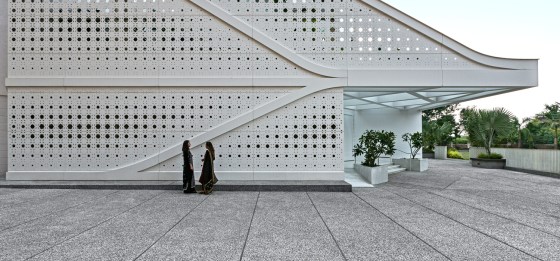
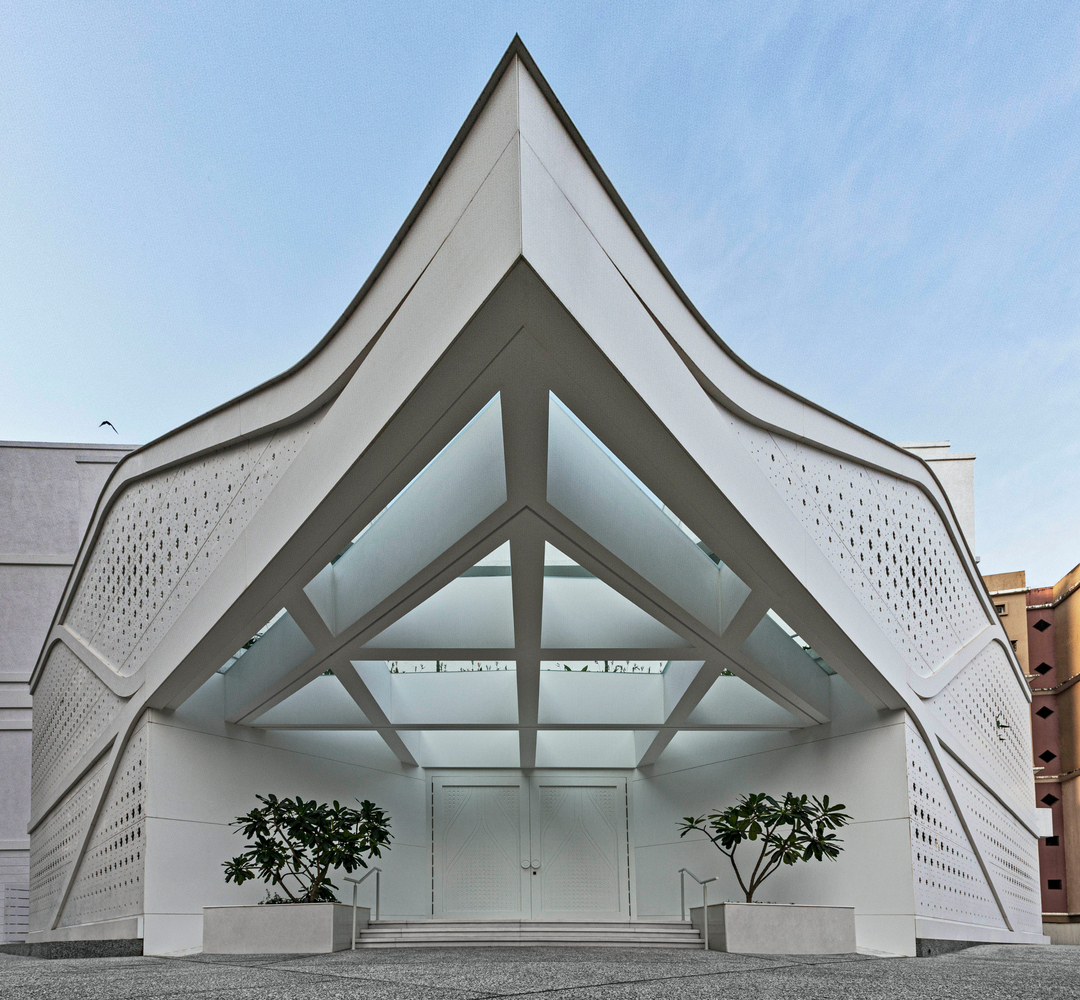
Ismaili Jamatkhana and Community Centre, Mumbai, India. Photo: Nazim Lokhandwalla/Via Archdaily. Please click on image for more photos on Archdaily.
Writing in the Mumbai Diary column of mid-day under the title All eyes on Oshiwara’s new architectural wonder, the diarist quotes Nuru Karim as saying, “The Jamatkhana and Community Centre design explores the relationship between light, Islamic geometrical patterns, and built form to create an experiential space”. Karim goes on to explain that Islamic geometrical patterns are analysed to develop arrays of multi-sided polygons, thereby creating “Mashrabiya,” that stems from “Ashrab,” meaning “to drink.” The diarist further notes that the term which was originally defined as a space to drink water, evolved later as a space to cool water stored in earthen pots.
We invite all our readers to visit the page highlighting nominations for religious buildings, learn more about the features of the buildings and cast their votes for the building that impresses them the most. The voting for the Ismaili Jamatkhana may be submitted HERE. Readers who wish to vote are required to create an Archdaily email account or sign in via their Google or Facebook account.
Date posted: February 4, 2022. Last updated: February 19, 2022 (see announcement at top, re : Winners)
Featured photo at top of post: Ismaili Jamatkhana and Community Centre, Mumbai, India. Photo: Nazim Lokhandwalla/Via Archdaily. Please click HERE for more photos of the project on Archdaily.
________________
Before leaving this website please take a moment to visit Simerg’s Table of Contents for links to hundreds of thought provoking pieces on a vast array of subjects including faith and culture, history and philosophy, and arts and letters to name a few. Also, visit Simerg’s sister websites Barakah, dedicated to His Highness the Aga Khan, and Simergphotos.
“At Kabul’s Pul-e-Sokhta bridge, the health workers face the grim, and heavy chore of removing the bodies, hauling them up to the street and away for burial. If no family can be located, they will be laid in an unmarked grave, with no one to mourn their loss. It is the mark of shame to be buried alone in Afghanistan.”
The following documentary and the accompanying transcript are reproduced from Voice of America (VOA). The documentary was aired on October 21, 2021 (and also on November 25, 2021). In a subsequent report by Roshan Noorzai dated December 10, 2021, VOA notes that farmers in Afghanistan say that they will continue to grow poppy amid uncertainty over the Taliban’s poppy eradication policy. “We have no choice but to cultivate opium poppy,” said Noor, 52, a farmer living in a remote village in the western Farah province. A father of 10 children, Noor said his family will go hungry without the opium poppy crop. “I am not sure how I will be able to provide food to my children until the harvest. We do not have food for a month, even. The prices have skyrocketed, and people cannot afford buying food”
The editor wishes to warn viewers that some scenes in the film may be disturbing, and viewer discretion is advised.
WARNING: The following film contains scenes and statements that some readers may find disturbing
A Voice of America Documentary
______________
Transcript
Excerpts from transcript of the documentary “The Inside Story: Afghanistan Addiction Crisis” shown on VOA on October 21, 2021.
While members of Congress and others debate the tactics of the U.S. withdrawal from Afghanistan and the strategies of 20 years of war, there is one issue that has constantly plagued that country: Drugs. Narcotics. Specifically, opium.
According to the U.N., Afghanistan produces 80 percent of the world’s opium.
While the rest of the world tries to deal with the trafficking of the drug, millions of people are addicted inside Afghanistan.
Before the U.S. withdrawal, VOA’s Afghan Service traveled through the country to document the extent of Afghanistan’s Addiction Crisis.
Our grim trip begins in the capital, Kabul.
Voice of narrator (Annie Ball):
In Afghanistan, this is where, and how, it sometimes ends. A drug addict’s life.
Health workers came to round-up the addicts and take them to addiction treatment centers. But today they encounter the lifeless bodies of three addicts.
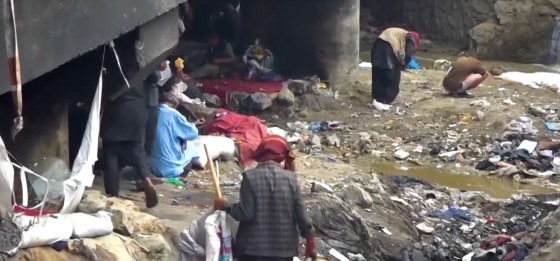
Here, at Kabul’s “Pul-e-Sokhta” bridge, the health workers face the grim, and heavy chore of removing the bodies, hauling them up to the street and away for burial. If no family can be located, they will be laid in an unmarked grave, with no one to mourn their loss. It is the mark of shame to be buried alone in Afghanistan.
For the workers and government officials, it reminds them they cannot help everyone.
Dr. Aref Wafa was working with addicts.
Dr. Aref Wafa, Department of Drug Demand Reduction:
Especially when we come here in the winter, our goal is to save their lives. They may increase the dose due to cold or chills. When they overdose, they do not feel it, therefore, this causes their death.
Narrator:
Doctors say, these addicts are consuming heroin, morphine, opium and increasingly, crystal meth. The cause of death is usually a drug overdose. They are taken to a Kabul cemetery for burial. How many bodies are buried there? No one knows. Officials don’t track the numbers.
Gholam Yahya’s brother lost his life to addiction under the bridge. Yahya, an addict like his brother, still lives under this bridge. Now, he describes the sadness — and shame — and how addicts’ deaths are treated by religious leaders.
Gholam Yahya, Drug Addict:
They said those who use drugs, commit suicide. Since they commit suicide, their funeral prayers are forbidden. They cannot be washed. His mother did not bring her child to this world to end up under Pull-e-Sokhta bridge. He did not wish this for himself., but I could not bury him in any cemetery.
Narrator:
In Kabul’s ‘Pul-e-Sokhta area, this is not just the story of Gholam Yahya’s life.
Throughout Afghanistan, it is known as a drug addiction center. The bridge in western Kabul has become a major hub for drug users for the past two decades. An iconic symbol of drug abuse in a nation rife with addiction.
The addicts don’t come just from Kabul, but many from the provinces, too. Hundreds of them share this grimy space, spending their days and nights getting high amidst the waste and debris. Most of them have been evicted by their families and have no shelter.
They live in squalor, surrounded by filth, black walls, and dirty water.
Over the years there have been several unsuccessful attempts to close the area. But it remains a popular gathering place for addicts.
Nazo is one of many looking for loved ones. Her husband and brother are addicted to drugs. Nazo’s husband uses opium and is remarried. He left her with the responsibility of taking care of their six boys. In Afghanistan, single mothers with no men in the house face a particularly difficult life, especially when the single mother is the only breadwinner. This is why Nazo hopes to find her brother, who is a heroin addict.
“I weave carpets to earn money. I use opium, that’s not cheap. I was on my way to collect waste when a car stopped, and the driver told me to get in the car. And he told me I will take you home and help you. Then I got in the car. The driver showed me the suicide jacket and asked me, ‘Do you want to do this? I will give you money.’ I said ‘No, I will not do it.’ And I jumped out of the car.”
Nazo, Sister of a Drug Addict:
It has been five months since I went to Kart-e-now, Arzan Qemat, Jada, and Cinema-e-Pamir to Shama-li so that anyone could tell me his whereabouts. I don’t know the area. I went to ask. I got home about ten o’clock at night. I am a woman. I cannot bear this grief, if God forbid. someone touches me or someone talks dirty behind my back.
Narrator:
In addition to her six children, Nazo also has been taking care of her mother and her brother’s wife. She washes dishes and cleans people’s laundry, making about $2.60 a day.
Nazo, Sister of a Drug Addict:
I suffered for him so much. The other day, I told my mother. ‘Mother!’ She said, ‘Yes.’ I said ‘it’s a pain, we can get over it. I will find a poison tablet and we will end everything together.
KATHERINE GYPSON:
Stories like Nazo’s are becoming more commonplace because of the drug trade’s grip on Afghanistan’s economy.
2017 was the peak, according to the U.N. Office on Drugs and Crime.
Nearly 10-thousand tons of opium brought in one-point-four billion dollars — seven percent of Afghanistan’s GDP.
And now the opium produced from the poppy plant has a rival that also grows wild in Afghanistan.
Narrator:
As a country, Afghanistan deals with insecurity, endless wars, corruption, poverty, a weak economy, high unemployment, and other challenges. But it also faces the problem of home-grown addiction and drug use. Some describe drug addiction in this country as a hidden tsunami; a large wave ready to crush what is in its wake.
Despite billions of dollars in international aid, government projects and efforts, Afghanistan remains the world’s top cultivator of poppy — the plant used to make opium and heroin.
The country is the world’s largest narcotics producer. A joint survey by the Afghan government and the United Nations Office on Drugs and Crime, UNODC, shows they are losing the war to eradicate the crop.
It says in 2020, poppy cultivation was up 37% in Afghanistan.
The report found that last year poppy was cultivated on nearly a quarter of a million hectares of land in 22 of the 34 provinces.
Most of the opium is smuggled abroad, but what remains is a problem at home.
“Most people here use drugs together, in groups, and out in the open. The lives of the villagers revolve around smoking drugs. When they have it, they use it.”
Mark Colhoun, Former UNODC Representative in Afghanistan:
We are seeing high level of opioid use in the country. We are seeing high level of cannabis use in the country and an emerging threat that we have been noticing for the last number of years is definitely methamphetamine and other amphetamine type stimulants in the country. So, these are all increasing the threats to the population exponentially, so we have drug production and then rising drug use in the country which is a severe threat to the people of the country.
Narrator:
Drug production and addiction go hand-in-hand, and both are on the rise.
User statistics are hard to come by. The most recent numbers are from a 2015 survey. It was conducted by INL, the Bureau of International Narcotics and Law Enforcement Affairs and the Afghan government. It found that 2.5 to 3.5 million Afghans are directly or indirectly addicted to drugs. At that time, one in three families tested positive for drugs. And the rural areas were three times worse than in the cities.
Dr. Ahmad Jawad Osmani, Former Afghanistan Minister of Public Health:
Unfortunately, drug addiction is not diminishing. It is increasing. And that’s why, we think that the number that was estimated in the past has increased even more.
Narrator:
Meanwhile, a recent report shows crystal methamphetamine — also called crystal or meth — is a growing problem in Afghanistan. Last November, the European Monitoring Centre for Drugs and Drug Addiction (EMCDDA) reported that the country is becoming a significant global producer of meth.
One reason is drug traffickers discovered that the ephedra plant, which commonly grows wild in parts of Afghanistan, can be used to make meth. The report focused on the production of meth in Bakwa district. It called the preliminary findings “worrying,” adding there is potential for meth to rival the country’s production of opiates.
KATHERINE GYPSON:
Concern over the rapid increase in meth production is its relative low cost to make.
And for many of Afghanistan’s addicts, low cost is what they are looking for.
And it is not limited to the cities.
VOA’s Afghan Service went about 180 kilometers west of Kabul — to Bamyan province — for a ground-level view of addiction’s reach into rural villages.
Narrator:
Bamyan is known for its beautiful landscapes. It is where, nearly 20 years ago (March 2001) the Taliban destroyed two ancient statues of Buddha, which had been the largest in the world.
Here, people in the cities and villages suffer from drug addiction.
Local officials say there are about 50,000 addicts, and people affected by addiction.
Head west, into more rural areas, and you find drugs even more prevalent than in central Bamyan province.
The Waras district is where most of the villagers use drugs.
The long drive to get there winds through scenic landscapes and rutted roads.
Waras district is surrounded by green hills and valleys.
People in this remote area live in poverty. They lack the benefits of modern society, like good schools, clinics or hospitals, and technology.
The sun shines brightly this morning in Bazobala village. Here, everyone, young and old, including the men, women and children are drug addicts.
Eighty families live in Bazobala.
Most people here use drugs together, in groups, and out in the open. The lives of the villagers revolve around smoking drugs. When they have it, they use it.
When asked why, they mention many reasons. Like this 18-year-old man:
Drug Addict, Bazobala Shuqol village:
The reason I became addicted to drugs was unemployment and poverty. I went to Iran, far away from home. I was unemployed and the situation was bad, so I got addicted to drugs. So, when I return here, I thought that the situation will be better. The situation is bad here as well.
Ali Yawar, Bazobala Shuqol village:
I have been using drugs for almost fifteen years. First, I used heroin, now I’m using in crystal.
Narrator:
It affects the children too. Parents not only use themselves, but also give drugs to their children. In addition to heroin, opium and crystal meth, the addicts of Bazobala are also familiar with other drug options, like tramadol tablets. It is a cheap alternative to heroin and opium.
Drug Addict, Bazobala Shugol village:
Those whose consumption is high, like myself, my spending is also high. I use may be one or one and half packet. A packet is 25 (32 cents) to 50 Afghanis. You can’t even purchase this tramadol 500 for 100 Afghanis.
“My older son is not here. It has been three years since he is missing. I don’t know if he is alive or dead. There are four of us, and all four of us are addicts. Yes, we sold everything. We sold bedsheets and everything that we had. And with the money, we bought drugs and used it.”
Narrator:
In Pezhandur village, women are also drug addicts.
In many families in the area, they use drugs with their husbands and children
This is Fatima. She has been addicted to drugs for 30 years. Fatima, her husband and her sons use drugs together.
Fatima, Pashandur Village:
I have asthma. I’m sick as well. I’m 65 years old. I go to work in the desert and mountains until late. I’m weak and my husband is also sick.
Narrator:
Villagers here work in farming and raising animals. Young people go to the mountains to collect grass for the animals, and the children are shepherds.
The idyllic life of these villages is disrupted by narcotics, brought in from neighboring provinces. Residents say they have repeatedly informed security agencies about the smugglers, but no action is taken.
The villagers want the government’s attention. They want help, and they want an addiction treatment center.
There is only one 20-bed clinic in Waras, which clearly lacks the ability to treat all the addicts in an area of tens of thousands of people. Local officials want more.
Qasim Ali, Chairman, People’s Council of the Peshandur & Bazobala Area:
Everyone is addicted to drugs. These people are all unfortunate. The reason is unemployment and poverty. The government does not care about these people. I request from the government, the international community, and human rights to build a hospital in the Shiwqol area. The hospital should be 100 beds or so so these people can be treated.
KATHERINE GYPSON
Addiction treatment is undergoing a change now that the Taliban are running Afghanistan.
Police have been recently rounding up addicts in Kabul, giving them a choice to either sober up or face beatings.
They are stripped, bathed and shaved before going into a 45-day treatment program.
But as one Taliban officer put it: “It’s not important if some of them will die. Others will be cured. After they are cured, they can be free.”
The addicts rounded up in these raids have been men. But women fall victim to drug addiction, too. Before the Taliban took over, our VOA Afghan Service team went to Balk province in northern Afghanistan and discovered the disturbing way women addicts can be preyed upon.
Narrator:
The yellow morning sun shines on Mazar-e-Sharif, Balkh’s capital.
This is one of the most populous provinces in northern Afghanistan, and Mazar-e-Sharif is the fourth largest city in the country.
The Blue Mosque, dating back to the 15th century, has made this city famous.
Mazar-e-Sharif hosts internally displaced people, IDPs, from nearby provinces. Security in the city brings people to come live here.
The city suffers from a large presence of drug addicts. Local officials say more than 300,000 people in Balkh province, including women and children, use drugs.
Easy access to drugs has led to more addicts. In the city of Mazar-e-Sharif, some women addicts are homeless, and some seek shelter in the cemetery at night.
This area is called Dasht-e-Shoor. These are the tents of internally displaced families.
This woman lives in the camp. She is an addict with a difficult story.
“Well, it’s narcotics, it gets you high. When we collect, we sniff, and it made us dizzy. Made us high, then we would sit down or go home with an excuse to relax and then go out. It had a bad effect. I had a headache when I went to school.”
Zohra, Homeless Drug Addict:
I was 13 years old, and my father was not there when my brother and mother married me. Now I am 31 years old, and I am lost. My mother-in-law was beating me. My father-in-law was beating me. I was smoking opium. I used to drink opium and that’s why they were beating me and telling me not to eat it. My husband left me and said “I don’t want a wife like you. You are free.” I have my two children with me. My husband hates me and doesn’t allow me to go home. I live in a tent. I have relatives, but they don’t care about me.
Narrator:
But Zohra says she is not addicted to drugs by her own free will. She says her family got her hooked. They used drugs in groups, she explains, to lessen the intense pain caused by their work as carpet weavers.
Zohra uses marijuana and opium. She has tried to quit several times but concerns about being homeless led her to relapse..
She walks the streets of Mazar-e-Sharif at night, begging and collecting usable garbage. This is NOT normal practice for women — because generally, it is not safe here for a woman to be out alone at night.
VOA went with her one night to see how she fares alone.
Zohra told us about how she pays for her habit. And in this harrowing story, she shared about someone giving her a ride, and the offer he made her:
Zohra/Homeless Drug Addict:
I weave carpets to earn money. I use opium, that’s not cheap. I was on my way to collect waste when a car stopped, and the driver told me to get in the car. And he told me I will take you home and help you. Then I got in the car. The driver showed me the suicide jacket and asked me, ‘Do you want to do this? I will give you money.’ I said ‘No, I will not do it.’ And I jumped out of the car.
KATHERINE GYPSON:
The United States spent more than eight-and-a-half billion dollars between 2002 and 2017 battling Afghanistan’s drug trade — That, according to the Special Inspector General for Afghanistan Reconstruction.
In May, the Special Inspector General said the Taliban gets an estimated 60 percent of its income from illegal drugs — About 400-million dollars between 2018 and 2019 according to the U.N.
And in Afghanistan’s easternmost province, VOA’s Afghan service found out that addiction knows no age — old or young.
Narrator:
Here in Badakhshan province, there are an estimated 25 to 30,000 addicts. Like elsewhere, addiction tends to run in families.
Jan Begum’s family is one of them. They live in the city of Faizabad. Her two sons and husband are addicted. They use crystal meth and heroin.
Jan Begum, Drug Addict:
We don’t have anything. They are both unemployed, this one is an addict, that one is an addict, too. My older son is not here. It has been three years since he is missing. I don’t know if he is alive or dead. There are four of us, and all four of us are addicts. Yes, we sold everything. We sold bedsheets and everything that we had. And with the money, we bought drugs and used it.
Narrator:
Jan Begum’s family used to live in a house in Faizabad. When the homeowner found out the family was using drugs, he kicked them out.
Now, they beg, take in laundry, and spend most of their income on drugs. Some of them have been treated several times for their addiction, but relapsed.
Samiullah is 18 years old. He uses drugs together with his mother, father, and brother.
Samiullah, Drug Addict:
I have been taking drugs from a young age. I take it with my parents. I go out to find then I take it. I wish the government would come and treat us and I would work as a server in a hotel.
Narrator:
Afghanistan remains the world’s largest opium producer.
Here in Nangahar province, children and teenagers work in the poppy fields collecting the gum with the elders in their family. They’re helping with opium production.
Mustafa is one of the teenagers working the poppy fields. Now,16 years old, Mustafa says he has been moving towards addiction for a long time, just because he works with poppies and opium.
Mustafa, 16-Year Old Poppy Field Worker:
Well, it’s narcotics, it gets you high. When we collect, we sniff, and it made us dizzy. Made us high, then we would sit down or go home with an excuse to relax and then go out. It had a bad effect. I had a headache when I went to school. I got permission to leave. It had a very bad effect because our heads were spinning, we were high. Drugs must cause this condition to our body.
Narrator:
This is some of Mustafa’s poppy harvest for the year. A few kilograms of opium have been harvested from the fields. He says that after collecting, he sold the opium and kept two more kilograms to sell later.
When the poppy season is over, he works in fields tending other crops like onions.
Mustafa says he has seen many people, including women, become addicted to drugs after working in poppy fields. He does not want to become an addict himself.
Mustafa, Poppy Field Worker:
If no narcotics were planted here, maybe no one would be addicted to drugs. Poppy made many people addicted to heroin. We want the government to stop the poppy cultivation. They should cultivate for us good, good fruit trees.
Narrator:
Less poppy production would mean less drug addiction, and fewer drug addicts ending up here, in this cemetery, in an unmarked grave. A sad and shameful death, in a nation where nothing is more important than family, honor and tradition.
Date posted: February 1, 2022.
The featured photo at top of this post is from the documentary.
___________________
Before leaving this website please take a moment to visit Simerg’s Table of Contents for links to hundreds of thought provoking pieces on a vast array of subjects including faith and culture, history and philosophy, and arts and letters to name a few. Also, visit Simerg’s sister websites Barakah, dedicated to His Highness the Aga Khan, and Simergphotos.



 Simerg - Insights from Around the World