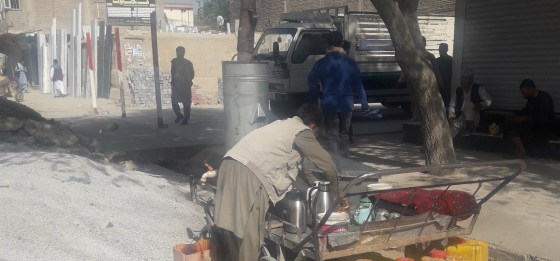
A man uses a makeshift carrier for providing tea drinking service at Kabul's Kote Sangi commercial hub sector of the city

Afghanistan Update: Misery and Humanitarian Crisis in Country is Overshadowed by Russia’s Invasion of Ukraine – Experts Call for Lifesaving Assistance to Afghanistan

Compiled and prepared by MALIK MERCHANT
(Publisher-Editor, Simerg, Barakah, and Simergphotos)

For the past week, the world’s attention has dramatically shifted from the misery that Afghanistan is facing to the invasion of Ukraine by the armed forces of Russia. The Ukraine war is indeed very very serious and frightening, especially with Russian President Putin asking his country’s nuclear deterrent forces to be on high alert. Hundreds of thousands of Ukrainian residents are escaping from the war, and showing up as refugees in neighbouring countries. While this tragedy in Eastern Europe unfolds, we should also remain focused on the humanitarian crisis that is in Afghanistan.

Two countries facing humanitarian crisis — Ukraine and Afghanistan (both circled). Image: Map adapted from Perry-Castañeda Library Map Collection, University of Texas.

In addition to our special correspondent in Kabul sending us his reports in the form of Letter from Afghanistan (please see Simerg’s Special Afghanistan Page), we also rely on authentic and accurate coverage of Afghanistan from the world media. In this respect, we find the Voice of America (VOA) to be a reliable and very useful source of information through reports that are produced on its website from journalists such as Ayaz Gul in Islamabad, Ayesha Tanzeem, who heads VOA’s Pakistan and Afghanistan bureau in Islamabad, and Lisa Schlein in Geneva. They are fair and factual in their news and commentary about the situation in the country.

To keep our readers up to date about the various aspects of life in Afghanistan, we share below a compilation from stories that appeared on VOA this past week, between February 23 and February 27, 2022. Readers may access VOA’s full coverage as well as special episodes on Afghanistan by clicking on VOA: Central and South Asia.

1. Experts: More Than Half of Afghanistan’s Population Need Lifesaving Assistance
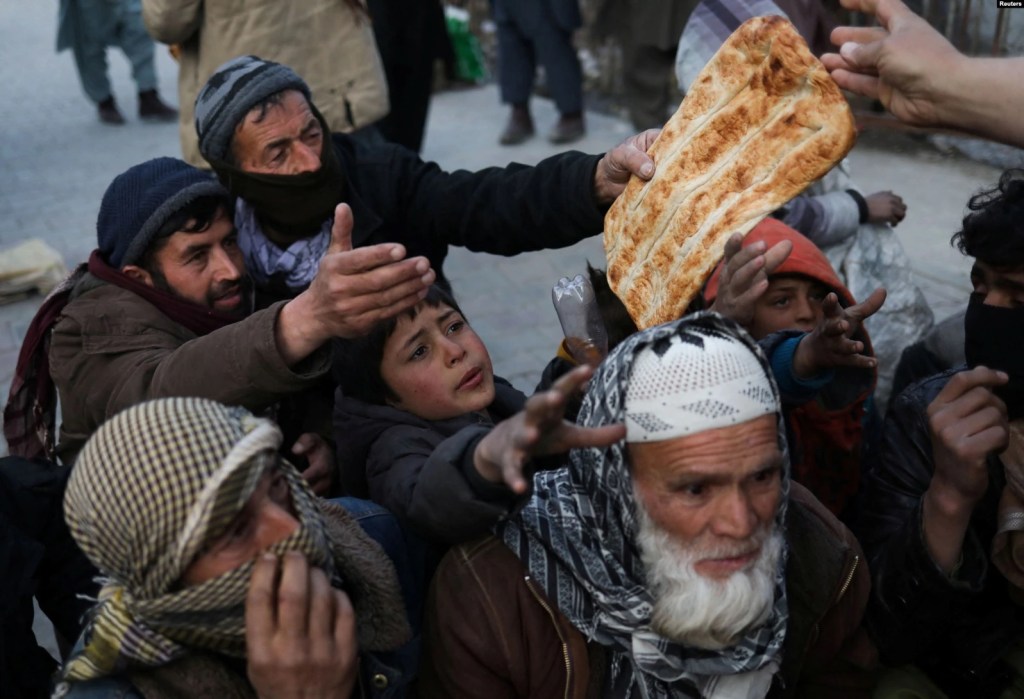
People reach out to receive bread, in Kabul, Afghanistan, January. 31, 2022. Photo: VOA file photo

By LISA SCHLEIN, VOA

Humanitarian experts warn that more than 24 million people, or 59% of Afghanistan’s population, are living on starvation diets and forced to take extreme measures to survive. Eight senior emergency experts from U.N. and non-governmental organizations recently concluded a five-day mission to Afghanistan. They describe the level of humanitarian needs as unprecedented. They say they are shocked at the enormity of human suffering they witnessed. The experts say many Afghans will not survive the dire conditions under which they are living without international support. And this, they note is severely lacking. The U.N. Office for the Coordination of Humanitarian Affairs (OHCA) reports only 13 percent of the United Nations’ $4.44 billion appeal for this year has been funded. OCHA spokesman Jens Laerke told VOA the competition for donor support from a myriad of countries including Ukraine, Yemen, and the Democratic Republic of Congo is intense and growing. Nevertheless, he said the plight of the Afghan people must not and cannot be ignored.

“People’s reserves are exhausted, forcing many into harmful coping mechanisms to survive, including child marriages and child labor. Women and girls in particular are affected with their human rights, participation in society, their ability to work, and access to education under threat,” he said. Laerke said the number of people requiring lifesaving assistance has risen 30% since the Taliban takeover of the country in August. He said the consequences of not responding to their needs are very stark. “It simply means that women who are pregnant will not have a hospital to go to for giving birth…We talk about girls and their access to school but here — this means that nobody goes to school… Peoples’ need for nutrition and food will not be met. People simply will not have enough to eat. They will starve,” he said. Laerke said donors’ fear that their money will go to the Taliban and not toward helping the Afghan people is unwarranted. He said all the money goes to the U.N. and private humanitarian organizations for which it is intended. Over the past months, he says aid agencies have been able to scale up their operations without interference to provide life-saving assistance to people in desperate need. (VOA full report HERE)

~~~~~~~~~~~~

2. All Public Universities in Afghanistan Open to Male, Female Students
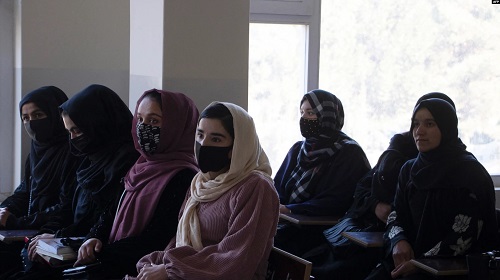
Students attend a class in the Badakshan University after Afghanistan’s main universities reopened, in Fayzabad on Feb. 26, 2022. Photo: AP via VOA

By AYAZ GUL, VOA

Public universities in Afghanistan’s colder areas, including Kabul, reopened Saturday, February 26, 2022, to both male and female students six months after the Islamist Taliban returned to power. The reopening marked the resumption of education in all of about 40 state-run universities in Afghanistan after Taliban authorities allowed university students earlier this month to return to their classes in provinces with a warm climate. The opening day at the country’s oldest and biggest university in the Afghan capital as well as campuses elsewhere was marred by low attendance and a lack of teaching staff. University administrations enforced gender segregation, including staggered operating hours and separate classes for men and women in accordance with the Taliban’s strict interpretation of Islam. Women must also wear hijabs. The Taliban banned co-education after taking control of Afghanistan on Aug. 15 [2021].

Students’ reaction was mixed after their first day back on Saturday. “I am very happy today as the Islamic Emirate reopened our universities,” Razia Kamal, a female student, was quoted by the Afghan TOLO news channel as saying. The Islamic Emirate is the official name of the Taliban government. In Kabul, student Haseenat said campus life for women was now very different than it was before. “There is no cafeteria anymore … we are not allowed to go to the university’s courtyard.”

“I am happy that the university resumed … we want to continue our studies,” said an English major who asked to be identified only as Basira. There was also a shortage of lecturers, she said, adding: “Maybe because some have left the country.” Tens of thousands of mostly educated Afghans have left the country fearing Taliban reprisals since the United States and other Western nations withdrew their troops in late August after a 20-year occupation.

In the western Afghan city of Herat, students also complained about a lack of tutors. “Some of our professors have also left the country, but we are happy that the university gates are open,” said Parisa Narwan, an arts major. The Taliban allowed males and females to resume education in some 150 private universities in the country in September under a gender-segregated classroom system. But they took time to reopen public universities, citing financial constraints and a lack of separate classrooms for men and women in accordance with Islamic Sharia law.

“It’s a positive move albeit late,” said Mohsin Amin, an Afghan policy analyst and researcher. “It’s of utmost importance to enhance the quality of education in all universities across Afghanistan for girls and address the scarcity of female teachers as well as professors.

“High schools for girls in all provinces should resume as soon as possible,” Amin told VOA. While the Taliban allowed boys to rejoin secondary schools in early September, most Afghan girls are still waiting for permission to resume class. Taliban officials have pledged to allow all girls to be back in school in late March, dismissing fears they intend to ban female education, as happened during the hardline group’s previous rule from 1996-2001. (VOA full report HERE)

~~~~~~~~~~~~

3. US to Allow All Commercial Transactions with Afghanistan
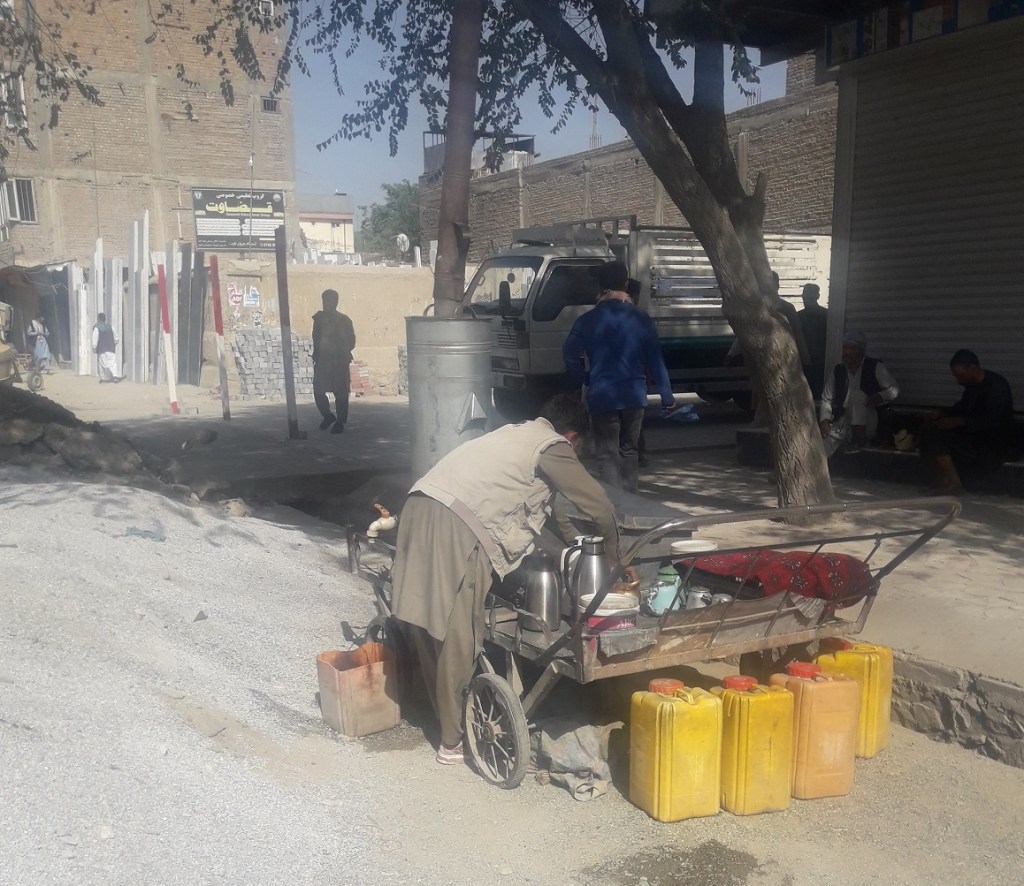
A man uses a makeshift carrier for providing tea drinking service at Kabul's Kote Sangi commercial hub sector of the city
A man uses a makeshift carrier for providing tea drinking service at Kabul’s Kote Sangi commercial hub sector of the city. Sunday May 29, 2021. Photo: Simerg correspondent, Kabul.

By VOA NEWS

The U.S. Treasury on Friday [February 25, 2022] issued a new general license authorizing all commercial transactions with Afghanistan’s governing institutions, expanding recently announced exemptions from sanctions against the Taliban and the Haqqani network. The new license, the seventh issued by Treasury in recent months, allows “all transactions involving Afghanistan and its governing institutions that would otherwise be prohibited by U.S. sanctions,” the Treasury Department said.

The action came after talks between the Treasury Department and private sector executives doing business in Afghanistan and is similar to a series of sanctions exemptions granted in recent months to nongovernmental organizations. “Our action today recognizes that in light of this dire crisis, it is essential that we address concerns that sanctions inhibit commercial and financial activity while we continue to deny financial resources to the Taliban, the Haqqani Network, and other malign actors,” Deputy Treasury Secretary Wally Adeyemo said in a statement. Wide-ranging U.S. economic sanctions against the Taliban date to their first time in power in the 1990s. However, in the wake of the Taliban takeover of Afghanistan in August, the Treasury Department has issued a series of sanctions exemptions to allow Afghanistan to cope with a teetering economy and a humanitarian crisis. “There are too many Afghans starving today, too many Afghans who are cold; we all need to act faster,” a senior administration official told reporters during a press call announcing the general license. (VOA full report HERE)

~~~~~~~~~~~~

4. New Wave of COVID-19, Measles Outbreak Stretch Fragile Afghan Health System
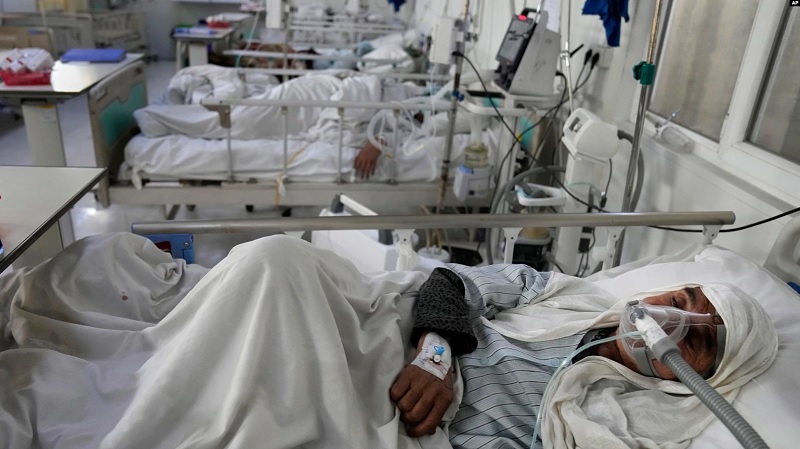
An Afghan patient infected with COVID-19 lies on a bed in the intensive care unit of the Afghan Japan Communicable Disease Hospital, in Kabul, Afghanistan, Feb. 7, 2022. Photo: AP/via VOA

By AYAZ GUL, VOA

Aid groups warned Wednesday [February 23, 2022] that a spike in COVID-19 infections and an alarming measles outbreak have compounded the health emergencies in Afghanistan, stretching the impoverished, war-torn country’s fragile health care system. The International Federation of Red Cross and Red Crescent Societies (IFRC) said in a statement that urgent global support, including health and testing services, as well as vaccinations, was needed to slow the spread of the coronavirus that is surging across Afghanistan.

“A new wave is hitting Afghanistan hard. Testing is inadequate, and the World Health Organization reports that almost half of tested samples are coming back positive, indicating an alarming spread of the virus,” the statement added.

It said the underfunded and understaffed national health system was struggling to cope with the surge in cases. Dozens of COVID-19 health facilities have closed because they didn’t have enough medicines, essential medical supplies and funds to pay the utilities and health workers’ salaries.

The aid group said that fewer than 10 of the country’s 37 public COVID-19 health facilities remained functional, and that they were unable to keep up with demand. Only 10% of the country’s estimated population of 40 million is fully vaccinated against the coronavirus. Mawlawi Mutiul Haq Khales, the acting president of Afghan Red Crescent, stressed the need for increasing the number of functional health facilities so that pressure can be eased on the few functioning hospitals.

“As the number of COVID-19 infections increases from cities to remote corners of the country, the international community needs to open up the doors to support critical health care, testing and other essential services before it’s too late for the people of Afghanistan,” Khales said. The IFRC noted in its statement that the measles outbreak has infected thousands and killed dozens of people in the last month in Afghanistan.

“The measles outbreak is alarming since Afghanistan is in the middle of one of the worst droughts and food crises in decades, leaving children malnourished and far more vulnerable to the highly contagious disease,” said Necephor Mghendi, IFRC’s country head.

Doctors Without Borders, an international charity known by its French acronym MSF, said in a separate statement that most of its programs, including those in southern Helmand and western Herat provinces, have seen high numbers of patients. It described the malnutrition rates as concerning.

“MSF is treating a high number of patients with measles in our projects in Helmand and Herat. Our teams are concerned about how the situation will progress unless more children are vaccinated against the disease,” the charity said. The ripple effect of long-running sanctions on the Taliban and the financial measures against the new rulers in Afghanistan are being felt nationwide, according to MSF. (VOA full report HERE)

Date posted: February 28, 2022.

___________________

Please also see VOA Special Project: Afghan Families Begin a New Chapter.

Simerg has created a special page on Afghanistan where you will find links to all our posts published on Afghanistan since the Taliban takeover. Please click AFGHANISTAN.

Before departing this website please take a moment to review Simerg’s Table of Contents for links to hundreds of thought provoking pieces on a vast array of subjects including faith and culture, history and philosophy, and arts and letters to name a few. Also visit Simerg’s sister websites Barakah, dedicated to His Highness the Aga Khan, and Simergphotos.
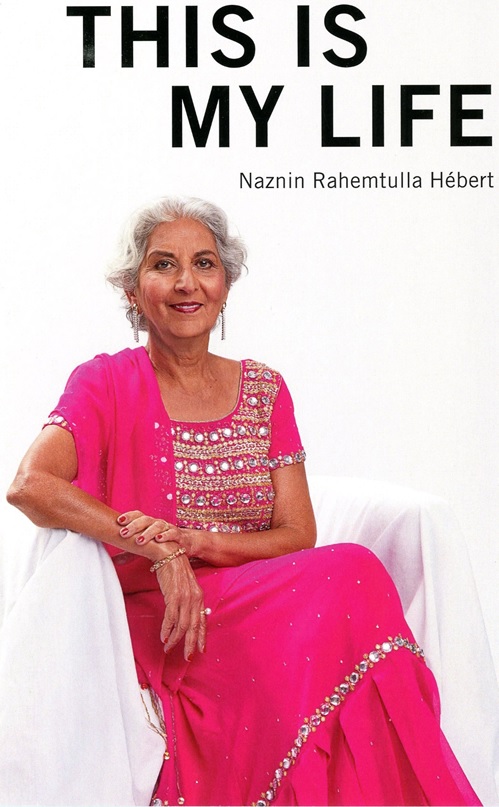
Simerg’s Special Series on Books by Ismaili Authors: “This is My Life” by Naznin Rahemtulla Hébert of Montreal, Canada – A Must Read Book About an Ismaili Family’s Life in 3 Continents

By MALIK MERCHANT
Publisher/Editor SimergBarakah and Simergphotos

Simerg’s series entitled “Books by Ismaili Authors” continues with Montreal based health care professional Naznin Rahemtulla Hébert’s biographical work “This is My Life.” We follow the same Q/A format as our earlier presentations of books written by Shairoz Lakhani, Shelina Shariff Zia, Ali Lakhani, Nizar Sultan, Nargis Fazal, Nazlin Rahemtulla, Azmina Suleman, Alnasir Rajan, Shafeen Ali, Mansoor Ladha, Zeni Shariff and Shamas Nanji. We invite Ismaili authors around the world to participate in this series, regardless of when their books were published. See details of the series HERE and submit your responses to Simerg’s editor, Malik, at mmerchant@barakah.com.

****************

“By reading this book, you will cry, you will laugh, you will be surprised, and you will travel the world with me. I can guarantee that everybody will relate to some parts of the book” — Naznin Rahemtulla Hébert

Click on photos for enlargement

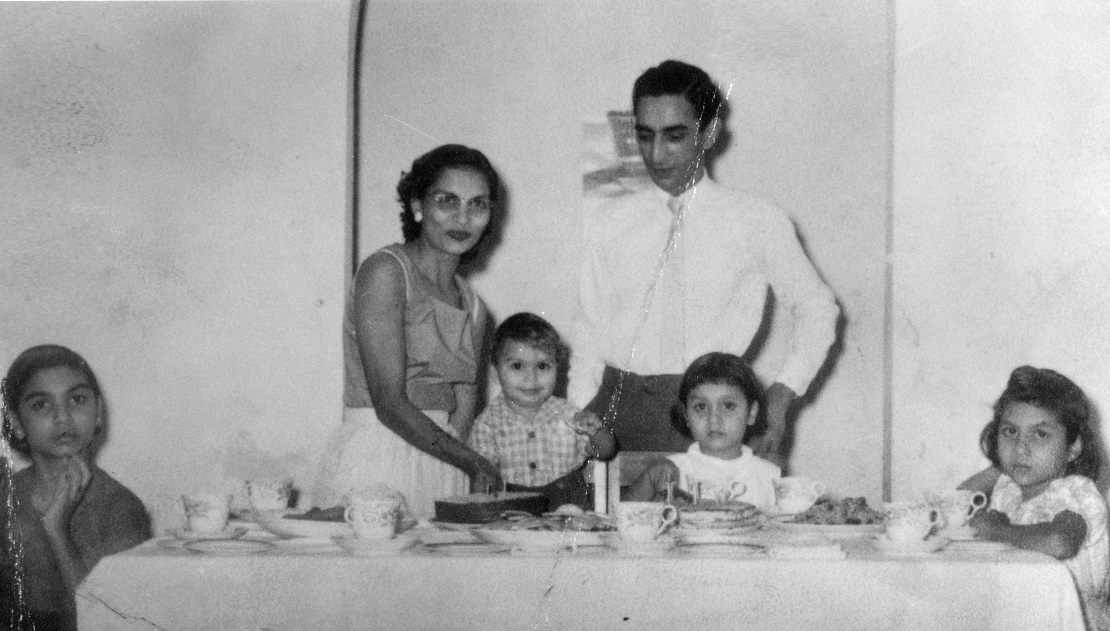
Naznin Rahemtulla author of This is My Life with her family. Simerg series on Ismaili authors
Naznin, author of “This is My Life” is seated on right in this family picture with her parents Zera (d. 1973) and Kamrudin (d. 2013), and siblings Ferial (left), Aziz and Azmina. Photo: Naznin Rahemtulla Hébert Family Collection

Simerg: What is behind the naming of the title of the book? 

Naznin Rahemtulla Hébert: The title of my book “This is My Life” is my family biography. It is about my journey from East Africa to the UK and now in Canada. It is the most precious inheritance I can leave for my children and grandchildren.

Simerg: Why would you want me or my family members to read the book, and what will we all learn from it?

Naznin: To know where we are going, we must first need to know where we came from. I think by reading my book, readers will appreciate the sacrifices and the treacherous journey our ancestors made for a better life for their families and about the pioneers who paved their way. They will also learn about the journey and passion of one person which may perhaps inspire them to relate their own journey. Everybody has a story to tell.

Simerg: What inspired you to write the book?

Naznin: The pandemic of the year 2020. When the pandemic hit the world and brought it to a standstill it made me reflect on a couple of things: (1) The fragility of life and (2) a meaningful project to occupy my time and my mind. That is when I made the decision to document my journey and dedicate it to my children and grandchildren so that one day when they grow up and want to know who their nanima (grandmother) really was, it will all be there on paper.

Article continues below

This is My Life by Naznin Rahemtulla He, Ismaili author
Front cover of Naznin Rahemtulla Hébert’s family biography “This is My Life.” 301 pp., self published, October 2021. Click on image for enlarged version.

Simerg: How can I purchase the book and what are its available formats?

Naznin: Readers may order the book by sending me an email at nazninh@gmail.com or visiting my Facebook page. The cost of the book is $ CDN 10.00 plus shipping, to any part of the world. Interested readers should contact me with their addresses and I will let them know the exact cost of the book, including shipping charges. The book is in soft cover, 301 pages long and was published in October 2021.

Simerg: How did you find a publisher for the book?

Naznin: I do not have a publisher. It was self-published.

Simerg: Did you hire an editor, an illustrator or did you do all the work by yourself?

Naznin: I had neither an editor nor an illustrator. I wrote it myself and self edited it. Luckily, I had a good collection of photos. I then sent my manuscript and the selected photos that I wanted to add to an infographiste who formatted it with my input. The whole document was then sent to the printers.

Simerg: How long did it take you to write This is My Life from start to finish and to begin marketing it?

Naznin: Twenty months. Before writing the book, I researched my ancestral history from the elderly members of the family since both my parents had passed on.

Article continues below

Aga Khan Council Tanga Tanzania, Ismaili authors, Simerg, Naznin Rahemtulla
Zera Rahemtulla, seated 4th from left, the only lady member in the Aga Khan Council for Tanga, Tanzania (then Tanganyika) in a group photo with Ismaili leaders taken in Tanga Jamatkhana’s Council Chambers. The beautiful Taj (crest) of Mawlana Hazar Imam, His Highness the Aga Khan, overlayed on the Ismaili Flag, forms a backdrop in this historical photo from the 1950’s. Photo: Naznin Rahemtulla Hebert Family Collection.

Simerg: Tell us something more about your book.

Naznin: In this book you will find a comprehensive glossary and 200 photos. The book is full of joy, discovery, and many heartwarming moments. By reading this book, you will cry, you will laugh, you will be surprised, and you will travel the world with me. I can guarantee that everybody will relate to some parts of the book. I might also add that my mom, Zera Rahemtulla, was the inspiration behind the book. Although she had a short lifespan of only 47 years, she put everything into her life and accomplished a lot. She was a business woman in East Africa in the 1950’s and also very much involved with the Ismaili community. She was the only woman member of the Aga Khan Council in Tanga among 10 men, and also served as the chairperson of the Ismaili Women’s Association. All this while raising and lovingly looking after her 4 children. I am hoping that you will enjoy reading this book as much as I did, writing it.

Date posted: February 26, 2022.

_______________________

Naznin Rahemtulla this is my life Ismaili author series
Naznin Hébert Rahemtulla

Born in Mogadishu, Somalia, Naznin Rahemtulla moved to Tanga, Tanzania, when she was only one year old. After completing her schooling in Tanga, she went to the UK to pursue a career in nursing and midwifery. She then settled in Montreal, Canada in the mid 1970’s and has worked as a health care professional for more than 35 years. In her role she has been fortunate to witness joy in the faces of new parents, as they bring the miracle of new life into the world.

During her long career, Naznin went on to became an International Board-Certified Lactation Consultant (IBCLC), one of the first ones in Quebec, and was responsible for founding the Lactation Consultant’s Association, the first Breastfeeding Clinic in Quebec and a peer support group. In the area of public heath, she has trained health care professionals in her region in breastfeeding as well has contributed as an evaluator for the Baby Friendly Certification with the Ministry of Health and Social Services.

Within the Ismaili community she has been a Mukhiani (congregational leader), a member of the Aga Khan Health Board as well as served in the funeral committee (referred to as the Mayat and Ghusal committee) where her responsibilities included giving courage and help to grieving family members who had lost their loved ones. She now finds joy from her partner in life, her 3 children as well as 5 grandchildren. The vibrant city of Montreal has been perfect for her for over 45 years. As a result of her settlement in Canada, she was able to assist her family to join her in Canada, and while in Montreal, she learnt a new language. The city also hosted the Olympic Games in 1976, shortly after arrival in 1975.

_______________

We welcome feedback from our readers. Please complete the LEAVE A REPLY form below or click Leave a comment. Your letter may be edited for length and brevity, and is subject to moderation.

Calling all Ismaili Authors

We encourage Ismaili writers to introduce their books in a similar format as has been done in the post above. Please also see the series launch article and submit your responses to Malik at Simerg@aol.com. All submissions will be acknowledged. If a writer has published multiple books, each book will be highlighted in a separate article, and not combined with other books into one post. All writers should include a brief profile with a portrait photo.

The Ismaili Authors’ Series so far (in chronological sequence, oldest article first):

  1. “Justice Bertha Wilson Pushes the Boundaries of Humanity” by Shamas Nanji (series start, February 10, 2021)
  2. “Little One, You Are The Universe” by Zeni Shariff (February 25, 2021)
  3. “Memoirs of a Muhindi” by Mansoor Ladha (March 6, 2021)
  4. “To Be One With God: Seven Journeys to the Meaning of Life” by Shafeen Ali (March 25, 2021)
  5. “Invisible Birthmarks” by Alnasir Rajan (April 13, 2021)
  6. “IN THE NAME OF JUSTICE – Portrait of a ‘Cowboy’ Judge” by Azmina Suleman (April 28, 2021)
  7. “RSVP Rice and Stew Very Plenty” by Nazlin Rahemtulla (May 28, 2021)
  8. “Coughdrops” by Nargis Fazal (June 12, 2021)
  9. “The Roots and the Trees” by Nizar Sultan (June 25, 2021)
  10. “Faith and Ethics: The Vision of the Ismaili Imamat” by M. Ali Lakhani (July 4, 2021)
  11. “Nairobi Days by Shelina_Shariff Zia (July 21, 2021)
  12. “Shine Brighter” by Shairoz Lakhani (December 8, 2021).
  13. “This is My Life” by Naznin Rahemtulla Hébert (February 26, 2022)

_______________________

Before departing this website please take a moment to review Simerg’s Table of Contents for links to hundreds of thought provoking pieces on a vast array of subjects including faith and culture, history and philosophy, and arts and letters to name a few. Also visit Simerg’s sister websites Barakah, dedicated to His Highness the Aga Khan, and Simergphotos.
Ismaili Jamtkhana and Center Houston, Simerg

A Must Read Article in the “Texas Monthly” on Houston’s New Ismaili Center: A Lush Centre and a Spiritual Retreat for All

Introduced by MALIK MERCHANT

An excellent piece by Molly Glentzer on the Houston Ismaili Center appeared in the Texas Monthly shortly after the lead architect Farshid Moussavi came to the city in November 2021 to unveil her design for the building. Subscribers to Texas Monthly can click on the link provided in this post and read Molly’s piece. If you are not a subscriber, Texas Monthly allows you to read 2 free articles. Many readers might qualify for the two free reads, and may even consider subscribing. Please click Texas Monthly on the Ismaili Centre Houston or on on any of the two images shown below. This is a great piece, with wonderful insights by the architect as well as leaders of the city.

Ismaili Centre Houston Imara Aga Khan Simerg
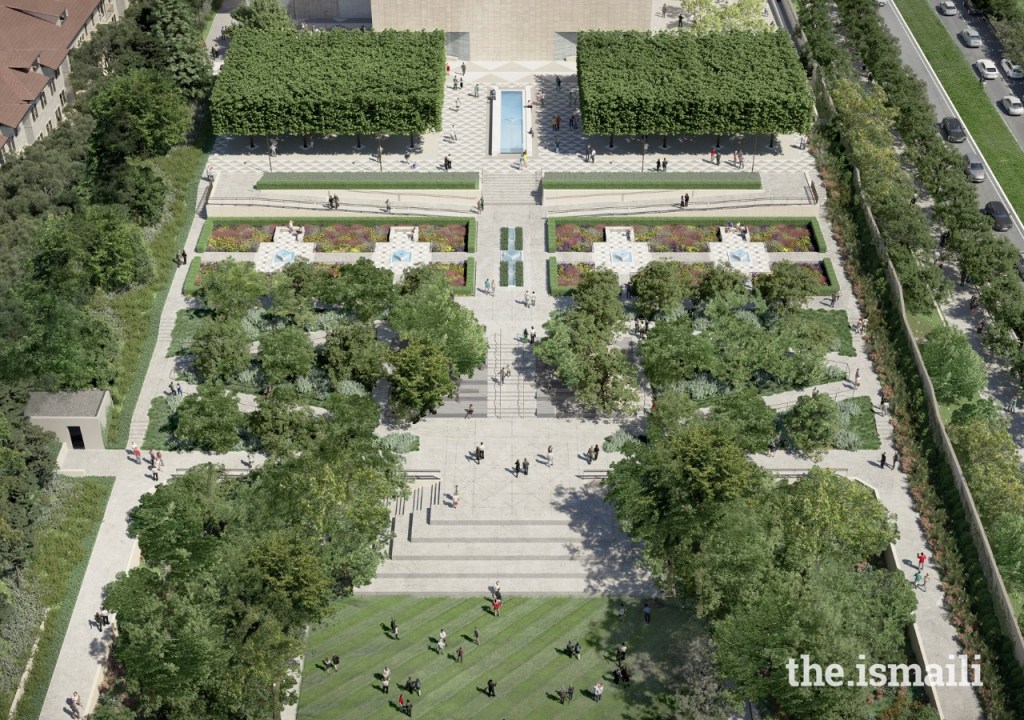
The new Ismaili Center in Houston will feature beautiful spaces, intricate geometry, and highly crafted work In this photo. In this depiction, the forecourt garden with its reflecting pool at the entrance of the building creates a contemplative atmosphere. IMAGE: IMARA HOUSTON INC. / IPL via the Ismaili

Ismaili centers are an invention of the Aga Khan. “They are places that reflect his belief in the power of architecture to improve lives,” Moussavi says. Each holds a jamatkhana, or prayer hall, but also serves as a brick-and-mortar ambassador for expressing the Ismailis’ commitment to uniting diverse people and cultures. Houston’s center will be the most public-focused yet — Excerpt from Texas Monthly

Ismaili Center Centre Houston Simerg Imara
From wherever one enters the site, visitors will be welcomed by garden spaces. The Center’s landscaped gardens will provide a sense of serenity and peace, offering a respite from its urban surroundings. IMAGE: IMARA HOUSTON INC. / IPL via The Ismaili

Date posted: February 22, 2022.

___________________

Before leaving this website please take a moment to visit Simerg’s Table of Contents for links to hundreds of thought provoking pieces on a vast array of subjects including faith and culture, history and philosophy, and arts and letters to name a few. Also, visit Simerg’s sister websites Barakah, dedicated to His Highness the Aga Khan, and Simergphotos that features photos and videos from around the world.

Malik, the founding publisher and editor of the 3 websites, may be reached at his email address, mmerchant@simerg.com.

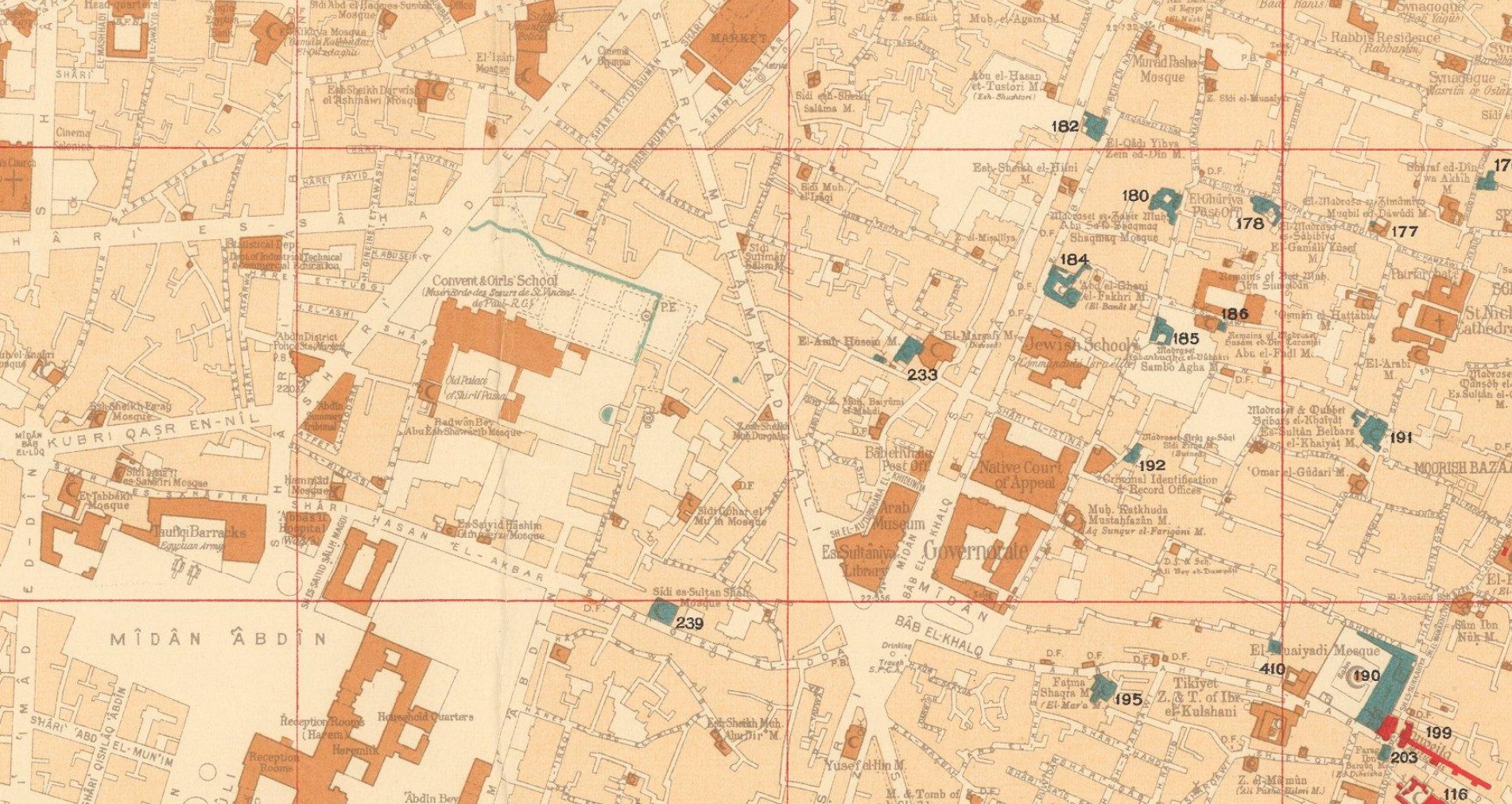
Map of Cairo showing Islamic monuments.

David Rumsey Map Collection: Historical Map Showing 600 Years of Islamic Monuments in Cairo from the Rise of the Fatimid Empire in North Africa in 909

Compiled by MALIK MERCHANT
Publisher/Editor SimergSimergphotos and Barakah

The David Rumsey Historical Map Collection focuses on 16th through 21st century maps of North and and South America, as well as maps of the World, Asia, Africa, Europe, and Oceania. Atlases, globes, school geographies, maritime charts, and a variety of separate maps including pocket, wall, children’s and manuscript maps are present on the website. The depth and breath of the digital collection is impressive, and is continuously growing. The website notes that the actual physical map collection is housed at the David Rumsey Map Center at the Stanford University Library.

My search on the website using the term “Fatimid” yielded one result. It is a map produced in 1924 by the Survey of Egypt, which was once regarded as “one of the most professional mapping agencies in the World, predicated upon the synergy of the most authoritative topographical and urban mapping combined with the latest archaeological surveys.”

Simerg is pleased to reproduce the map, along with an interesting narrative that accompanies the map on the David Rumsey Map Center website. We also invite readers to click on the link to enrich their viewing experience of the map, download the map (by using the Export Function) as well as to explore other maps that may be of interest to readers or to provide them with further information in their specific area of research.

Cairo During the Islamic Golden Age

Please click on image for enlargement

Map of Cairo showing Islamic monuments.
Map of Cairo showing Islamic monuments, with the ‘Fatimid and Pre-Fatimid Monuments’ (909 – 1171), shaded in Red; the ‘Aiyubid [Ayyubid] Monuments’ (1171 – 1260), shaded in Green; and the ‘Mameluke Monuments’ (1260 – 1517), shaded in Blue. Credit: David Rumsey Map Collection, David Rumsey Map Center, Stanford Libraries. This work is licensed under a Creative Commons License.

Cairo was the greatest centre of culture, learning and commerce during the ‘Islamic Golden age’. Commencing in the early 20th Century professional archaeologists as well as art and architectural historians became interested in scientifically recording Cairo’s sensational Islamic buildings and monuments.

The map employs colours to denote sites built across the city during the eras of the three great Islamic empires that controlled Cairo prior to the arrival of the Ottomans in 1517: the ‘Fatimid and Pre-Fatimid Monuments’ (909 – 1171), shaded in Red; the ‘Aiyubid [Ayyubid] Monuments’ (1171 – 1260), shaded in Green; and the ‘Mameluke Monuments’ (1260 – 1517), shaded in Blue.

These mosques, palaces, madrassas, and fortifications appear amidst the otherwise buff-coloured city which generally consisted of buildings built during the subsequent Ottoman and British Protectorate periods.

The map shows that many of the greatest edifices from the periods of the three great Islamic empires have survived, although only traces of the vast Fatimid Place can be found amongst the foundations of newer buildings. Each of the historical sites is named in Gothic script and features a corresponding numeral which refers to that which appears upon the plaques affixed to each building by the civic authorities. The two insets on the left-hand side showcase sites in areas outside of the city proper. We understand that the first edition the map was issued in 1924, while an Arabic language version was published in 1948. The present revised, official edition was issued in 1950-1 (correction, this copy is the first edition, issued in 1924), while several facsimile (unofficial) versions have been issued since then. The Survey of Egypt followed the initial production of the present issue of the map with a small booklet, Index to Mohammedan monuments appearing on the special 1:5000 scale maps of Cairo (Cairo, 1951), that is not present here, but seems to have been issued with the latter-releases of the map.

Cairo during the ‘Islamic Golden Age’ Cairo was traditionally the largest and most culturally and economically important city in the Islamic world. The Muslim conquest of Byzantine Egypt occurred between 639 and 646 AD. While the Cairo area has been settled for thousands of years, with the key Ancient Egyptian cities of Giza and Memphis located nearby, the city proper was not founded until 969, when it became the principal city, and sometimes capital, of the Fatimid Caliphate, a Shia Muslim empire which controlled much of North Africa, the Levant and Hejaz between 909 and 1171.

Cairo rapidly rose to become a centre of great wealth, at the nexus of global trade routes as well as home to some of the world’s foremost centres of education and the arts. Befitting its importance, great monuments of Islamic architecture were built across the city.

The Al-Azhar Madrassa (no. 97 on the map), which later grew into a university, was founded in 970-2 and today remains the world’s most prestigious institute of Islamic learning. The map notes some Islamic monuments made before 969, as the pre-Cairo rural landscape featured some small mosques, houses and fortifications.

The Fatimids were replaced by the Ayyubid Dynasty (1171 – 1260), a regime of Kurdish origin, founded by the legendary conqueror Saladin, whereupon Cairo remained the prosperous centre of an empire spanning much of the Middle East.

The Mamelukes were an elite class of soldier-bureaucrats descended from former Christian slaves. In 1250, they took over Egypt, the Levant and Hejaz, forming the Mameluke Sultanate, with its capital in Cairo. It was during the early part of their regime that Cairo reached its zenith as the principal centre of the Islamic Golden Age.

The epicentre of a global trading network that spanned from India to Spain, Cairo far surpassed all European cities in wealth and cultural sophistication, and many exquisite works of architecture were built to reflect this glorious state. The Mameluke Sultanate was conquered by the Ottomans in 1517 and Cairo ceased to be an imperial capital. However, while technically subject to the Sublime Porte, Egypt maintained a high degree of autonomy and was the wealthiest and most prosperous part of the Ottoman Empire; Cairo remained a highly important centre.

Fortunately, as the repent map reveals, the survival rate of Cairo’s great works of Islamic architecture from the Fatimid, Ayyubid and Mameluke periods is impressively high, and many sites can be visited today. References: OCLC: 17543226. (Alexander Johnson, 2020).

Date posted: February 22, 2022.

________________________

Before leaving this website please take a moment to visit Simerg’s Table of Contents for links to hundreds of thought provoking pieces on a vast array of subjects including faith and culture, history and philosophy, and arts and letters to name a few. Also, visit Simerg’s sister websites Barakah, dedicated to His Highness the Aga Khan, and Simergphotos that features photos and videos from around the world.

Malik, the founding publisher and editor of the 3 websites, may be reached at his email address, mmerchant@barakah.com.

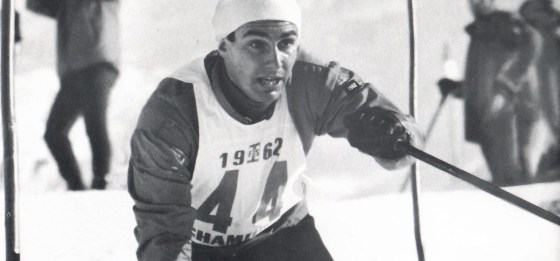
Mawlana Hazar Imam, His Highness the Aga Khan, skied for Iran in the 1964 Winter Olympics in Innsbruck, Austria

As the 2022 Winter Olympics in Beijing come to a close, Zahir Dharsee and Malik Merchant reminisce about Mawlana Hazar Imam His Highness the Aga Khan’s passion for skiing and sports in general. The piece appears on Simerg’s sister website, Barakah, which is dedicated to Mawlana Hazar Imam, members of his family and the Ismaili Imamat. The piece also includes an excerpt from an excellent narrative on Mawlana Hazar Imam’s visit to Iringa that mentions a skiing accident that had taken place earlier. Mawlana Hazar Imam arrived in Iringa with a cast on his foot. Please click MEMORIES or on photo below.

Aga Khan playing ice hockey in Switzerland, Simerg and Barakah
Mawlana Hazar Imam playing ice hockey. Please click on photo for article.

Date posted: February 19, 2021.

_________________

“Hidden Stories: Books Along the Silk Roads” – Visit the Aga Khan Museum’s Marquee Exhibition Before it Closes on Sunday, February 27, 2022

By ZAHIR DHARSEE

The Aga Khan Museum will be open between February 18 and February 27, 2022 as follows:

OPEN: February 18, 19, 20 as well as Monday 21 (Family Day) from 10 am–5:30 pm;
CLOSED: February 22, and 23 ; and
OPEN: February 24, 25, 26 and 27th from 10 am-5:30pm
.

Torontonians as well as visitors to the city have their last opportunity to visit the Aga Khan Museum to see a very informative exhibition entitled “Hidden Stories: Books along the Silk Roads” before its final day, Sunday, February 27. The exhibition opened on October 9, 2021 but Covid-19 restrictions imposed by the province forced the museum’s closure for the month of January 2022. The museum has reopened once again. During one of its opening windows, I made it a point to spend some time to see and learn about the Silk Road, with a view to putting together a review of the exhibition for Simerg. I was lucky with my timing, as the co-curator, Dr. Filiz Çakır Phillip, accompanied me to see the exhibition. She kindly provided me with links to materials which gave me interesting insights into specific objects.

Story continues below

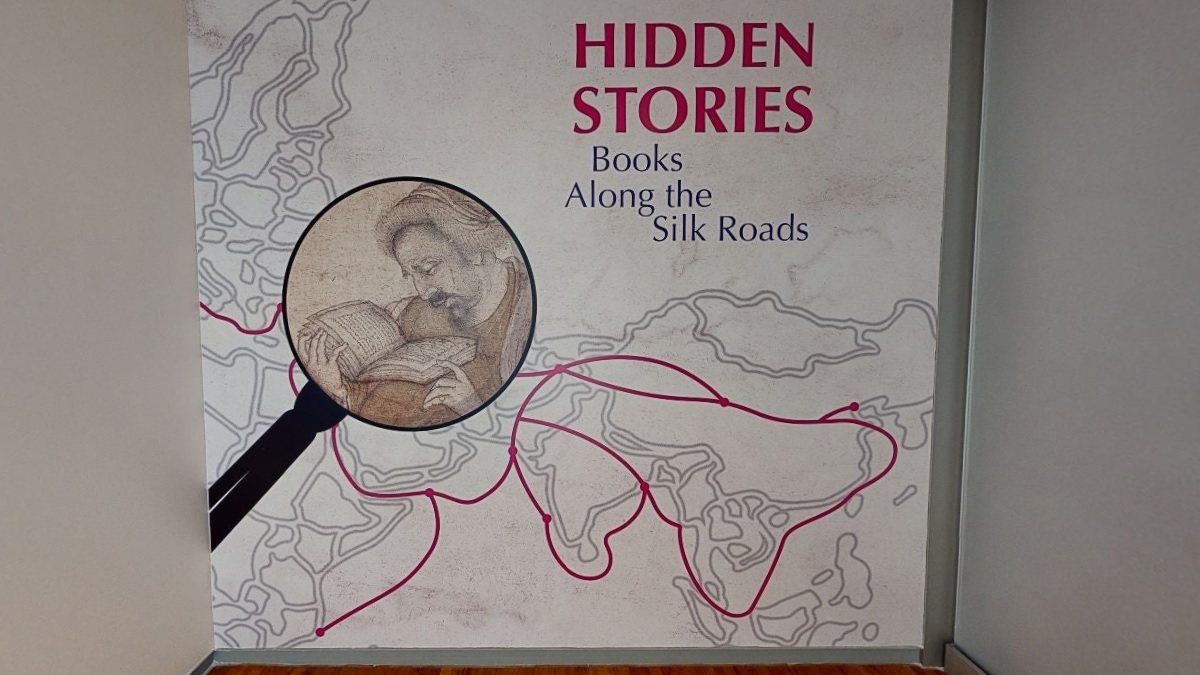
A sign displaying the exhibition title 'Hidden Stories: Books along the Silk Roads' with an illustration of a person reading a book, set against a map background.
The Aga Khan Museum Exhibition Hidden Stories – Books Along the Silk Roads concludes its Toronto run on Sunday, February 27, 2022. Photo: Simerg

I would urge members of the Islamic community as well as all other communities living in and around Toronto to visit this all inclusive marquee exhibition which is housed on the 2nd floor of the Aga Khan Museum. Children and youth will gain rich perspectives about the Silk Roads, a 6,400 km path that has for thousands of years covered a vast area that comprised the Old World of Europe, North and East and West Africa and the Middle East into Persia, Central Asia and the Indian sub- continent and China.

The term Silk Road was coined by a German geographer and traveler Ferdinand von Richthofen in 1877 C.E. It has been explained by the Electronic Cultural Atlas Initiative as “not simply a network of transportation routes. It is not only a geographical space. It is also a concept that illustrates the way that commodities, empires, religions, and even music, have traveled throughout Eurasia for thousands of years. The Silk Road is the idea that there is not a divide between “West” and “East” but an ongoing historical exchange of human experience.”

This vision of the Silk Road is clearly illustrated in the exhibition through the richness and diversity of the objects that are on display representing different cultures, faith and communities. The curators — Dr. Filiz Çakır Phillip (in-house curator) and Dr. Suzanne Conklin Akbari — have achieved a remarkable balance in this regard by treating and honouring different traditions and cultures respectfully and in a dignified manner.

A visitor to the exhibition will see on display an excellent collection of the various texts and books, prepared by the cultures that highlight the “Hidden Stories” along the Silk Roads. These works are handwritten in the many languages and scripts of the Far East, the Indian sub-continent, the Middle East and Europe that evolved along the Silk Roads. The scribes of the different religions and cultures along the Silk Roads also used various writing instruments and inks that were displayed to write their various “Hidden Stories”. To illustrate the power of these scribes, there is an interesting 1492 quote by Jami displayed in the exhibition: “The Pen is a key that opens the Door to the necessities of Life” below which is a glass case containing a few of the writing materials.

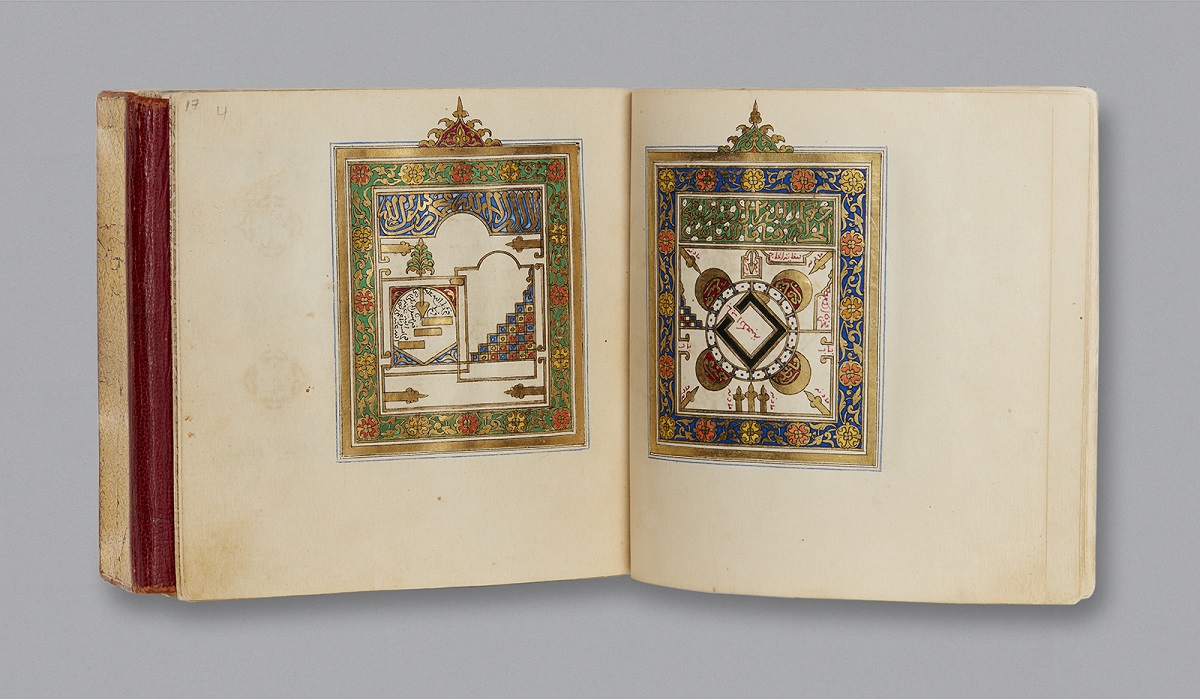
As one enters the exhibition, the first text on display is an Islamic Prayer Book (Dala’il al – Khayrat) originating from India, probably Kashmir, around 1818 CE. Co-curator Dr. Çakır Phillip notes: “This is the first object you see in the exhibition. With its fusion of Iranian and Indian influences, the prayer book embodies the powerfully creative cultural connections that formed across the Silk Roads over the centuries. Its patterned textile-inspired cover celebrates the intersection of textiles and text, two of the most important commodities to be transported across the Silk Roads network.”

Story continues below

An open illuminated Islamic prayer book featuring intricate, colorful designs on each page.
Prayer Book (Dala’il al – Khayrat). Photo: © Aga Khan Museum. Reproduced under Creative Commons CC BY-NC 2.5 CA.

Other faiths are also well represented in the exhibition. A Burmese book of Buddhist scriptures (Kamawa-sa) includes selections written in Pali from the Tipitaka (literally, ‘three baskets’) of Therevada, the most ancient form of Buddhism. Costly and ornate Kamawa-sa were written on cloth or palm leaves in chunky, square tamarind seed script, and offered as gifts to a monastery to commemorate the taking of religious vows. Reflects co-curator Dr. Suzanne Conklin Akbari, “I’m struck by the individual human experience and the materials that would have been on the human body, passing through time, actually becoming part of the book. Another aspect I’m charmed by is the beautiful script it’s written in. I point this out because Hidden Stories features a wide range of scripts but also many different script formats. This one is a striking example of a graphic format that contrasts with others you see in the exhibition.”

An example of a devotional anthology, featuring carbon black ink and pigments on paper with a textile covering, includes the Song of the Lord (Bhagavad Gita) and other works, produced in Kashmir in the 17th–19th century CE. The contents (Sanskrit text and Hindu iconography), materials (Islamic burnished paper and Indian textiles), and format (Islamic-style binding) of this manuscript containing the Hindu, Bhagavad Gita, all illuminate the fecund encounter of Persian and South Asian cultures in the valley of Kashmir. This manuscript also tells a complex story of book technology and cultural entanglement. Micro-CT (Computed Tomography) analysis confirms that its exquisite Indian mashru fabric, imported from Gujarat, extends around the whole cover, beneath the plain overlayer. The book has an Islamic-style pentagonal flap binding, but because Sanskrit is read in the opposite direction from Arabic and Persian, the flap wraps around on the right rather than the left. “Like so many of the objects in Hidden Stories, this beautiful volume takes us back to a particular time and place — in this case, to Kashmir in Mughal India, where we have whole range of traditions bumping up against each other. In this book format, we see Muslim and Hindu devotional practices and Sanskrit and Persian languages interacting with each other in a highly creative way,” noted Dr. Akbari.

Story continues below

Islamic prayer mat Aga Khan Museum Silk Road, Simerg
Islamic prayer rug from the M. M. Wolf Collection. Photo: Aga Khan Museum.

Among the rare manuscripts on display, is a Prayer Sheet (Avalokiteśvara) from Dunhuang, China, dated August 4, 947 CE. This is a woodblock print on paper. This Buddhist prayer sheet was produced to celebrate the annual Ghost Festival and is a rare survivor among hundreds of identical prints featuring Avalokiteśvara, a form of the Boddhisatva of compassion. In the early 11thh century, this print was enclosed behind a wall along with over 60,000 books and documents from the 5th to the 11th centuries in the Mogao Caves, in the western Chinese city of Dunhuang. The so-called ‘library cave,’ containing manuscripts and printed works in languages ranging from Judeo-Persian to Sanskrit to Tibetan, was rediscovered only in 1900. “This sheet is remarkable because, along with the pages of the Mishnah Torah it will be displayed alongside, it is one of the oldest objects in the exhibition. It’s beautiful how they function together in the sense that, while they’re from very different places and very different confessional traditions, they both date from so long ago. Because an exact date is printed on the sheet, it connects us through time to the people who printed it, as well as the people who saw it and who celebrated the festival,” writes Dr. Akbari.

Among the Christian works, is a Choir Book of ink and paint on parchment, wood cover with metal from Spain, 16th century CE. This choir book or ‘antiphoner’ includes chants for the Christian Holy Week of Easter. It is so heavy that it must be moved by two people. The enormous book would have been displayed open so that its monumental notation could be seen by all singers. This copy, animated in the micro-CT display in the exhibition, features wheel-shaped bosses on its cover, protecting against damage and perhaps evoking the emblematic wheel of St. Catherine. “The choir book is such an enchanting object to see in person because it’s incredibly large,” says Dr. Akbari. She further states that “unlike a small prayer book, a large volume like this one wasn’t intended for an individual’s private contemplation. The reason why it’s so big is precisely so multiple people could read and sing the notes at the same time. So when we think about the book, the book is a private space, but it’s also a shared space. And the choir book emphasizes that shared quality very effectively.”

Another unique item is a marriage contract (Hebrew, Ketubah) of David ben Shabettov and Serula bat Samuel, who were married in 1797 in Greece when it was part of the Ottoman Empire. This Jewish marriage contract details the groom’s financial obligations to the bride in the event of divorce or widowhood, and was designed to be displayed in the couple’s home. “This object represents so many cultures and traditions in a harmonious way. It is a Jewish marriage contract, it originates in Greece, and it showcases a luxurious Ottoman style. It is also very interesting because it speaks to relationships between men and women, and in particular, the roles and rights of women in the society,” noted Dr. Çakır Phillip.

Story continues below

An intricately embroidered robe featuring colorful scenes of people, animals, and flora, displayed in a museum setting. The robe is made from fabric with detailed patterns and designs, showcasing cultural artistry.
Robe from Central Asia. Prince Sadruddin Aga Khan Collection. Photo: Simerg

The exhibition also includes a display of the textiles that also travelled along the Silk Road. The curators selected a wool, woven, felted, and embroidered Robe from Central Asia. The luxurious robe tells four different stories. It shows the court of wise King Solomon, illustrating his marvellous ability to understand the languages of all creatures, followed by that of the Abbasid caliph Haroun al-Rashid, offering a 9th century model for exemplary rule. “With this piece, we wanted to emphasize the oral tradition and how knowledge and stories that were recorded in books were also implemented in other media such as paintings, mosaics, and embroidery. This piece is also fascinating because it consists of four stories from four different geographies and time periods, demonstrating wonderful connections between cultures and artistic traditions,” explains Dr. Çakır Phillip.

The Silk Road was also a major source of Eastern carpets. These were in great demand in other parts of the Middle East and Europe. The curators selected a wool, pile woven carpet from Azerbaijan, dated to the 19th century CE. The carpet illustrates the “inner workings” of the Silk Road. The lustrous wool carpet design seen in the exhibition is called shadda, a very ancient form with many different styles keyed to function, whether celebrating a holiday or wedding, or simply defining household space. Here, 22 Bactrian camels appear at the carpet’s centre, while 33 more run around its border. Almost 100 small animals — Siberian tigers, deer, dogs — draw the viewer’s eye from left to right in this striking design, creating a sense of energetic movement. “When we began talking about books and the Silk Roads network, my immediate question was about how trade happened over the centuries. On the Silk Roads, luxury goods, books, and other materials were most often carried on camelback. So I was fascinated to find this beautiful 19th century carpet from the Marshall and Marilyn R. Wolf Collection. It is very rich and it manifests the importance of the camel to this entire vast geography,” noted co-curator Dr. Çakır Phillip.

The Silk Road was also a major source of valuable personal items. An example is the Ethiopian Amulet Scroll. This item was used for protection against illness, difficult childbirth, and the evil eye.  This Ethiopian amulet scroll (Amharic, kitab; Arabic for ‘book’) was created by an ordained minister (Amharic, debtara) from pieces of parchment tailored to the height of the owner’s body. Inscribed with healing prayers, talismans, and images of armed angels, amulet scrolls like this one might be placed in a leather case to be worn or hung on a wall, and could also be wrapped around the body of the deceased as a form of prayer.

As co-curator Dr. Akbari explains, “An amulet scroll in this tradition brings out the way that books can be extremely personal. It was meant to bring health and wellbeing to the person who owned it. Their name appears on the scroll along with individually selected prayers and invocations, and the scroll would often be made to the length of the owner’s body as a way of creating a stronger correspondence between the sacred object and the person it was designed for. It’s a fascinating example of the book both as text and as an object imbued with a very particular kind of power.”

Jewellery was another important item traded along the Silk Road. The exhibition displays a silver, fire-gilded and cased, with niello inlay, decorative wire, and table-cut carnelians, cordiform (heartshaped) pendant, from Turkmenistan, Teke, mid-to-late 19th century CE.  Inner Asia is famous for the jewelry of its more than 30 Turkmen tribes, produced in silver, decorated with talismanic inscriptions, and adorned with carnelian or turquoise. Each element — metal, writing, and precious stones — is carefully chosen to offer protection and healing. Writes Dr. Çakır Phillip, “When we think of books, we think of reading in libraries or offices or while we are sitting on the subway. This piece, however, speaks to the practice of carrying a text on your body for protection from evil and misfortune. The cordiform’s tubes would have contained scrolls with verses from the Qur’an or other holy texts. I was fascinated by the fact that it would have been carried not on a person’s chest but on their back, where they are more vulnerable.”

Story continues below

Map illustrating the historical Silk Road routes and significant cultural artefacts, overlaying a geographical representation from 500 BCE to 1700 CE.
An informative and educational timeline of the Silk Road spread out on a wall at the Aga Khan Museum’s “Hidden Stories: Books along the Silk Road.” Photo: Clip from Aga Khan Museum’s virtual gallery exhibition.

There are also other educational items of interest for benefit of visitors. For the Book and the Body theme, there is displayed a green wrapping shawl, titled “the Quran in the Cloth” dated 1718 CE, originating from Mughal India. Similarly there are examples of Amulet holders from Central Asia where written inscriptions of verses on paper parchment from various Holy Scriptures can be inserted for protection and healing purposes.

As one departs the exhibition, there is a video display entitled Seeing Ghosts: Computed Tomography (CT) and the Study of Historical Books. This section represents an interesting aspect at the exhibition as it underscores the utilization and interaction of new modern 21st Century X-ray scanning technology to read and analyse the collection of books and manuscripts that were written or printed along the Silk Road over 1000 or more years ago. In this section, the visitor is familiarized as to how Micro-CT, a technology similar to the X-ray scans, used for looking at the internal structures of the human body, is used to examine the structures and pages of centuries old manuscripts and texts. Among the texts reviewed using this technology were the Canon Grandels’s Prayer Book, the Choir Book, the Bhagavad Gita as well as a manuscript of Rumi.

In conclusion, I wish to make a few personal observations. The founder of the museum himself, Mawlana Hazar Imam, His Highness the Aga Khan, has visited many places along the Silk Road. The first important visit was in 1981 when he attended a seminar on the Changing Rural Habitat in Beijing, China, organized by the Aga Khan Trust for Culture. During this visit he also visited the Silk Road cities of Xian, Urumchi and Kashgar where he was warmly greeted by the local communities. In subsequent years, the 49th Ismaili Imam has made numerous visits to the regions of the Silk Road including Tajikistan, Uzbekistan and Kyrgyzstan. Indeed in 2000, His Highness founded the University of Central Asia through an International Treaty signed by him and the Presidents of Tajikistan, the Kyrgyz Republic, and Kazakhstan. It was ratified by their respective parliaments and registered with the United Nations.

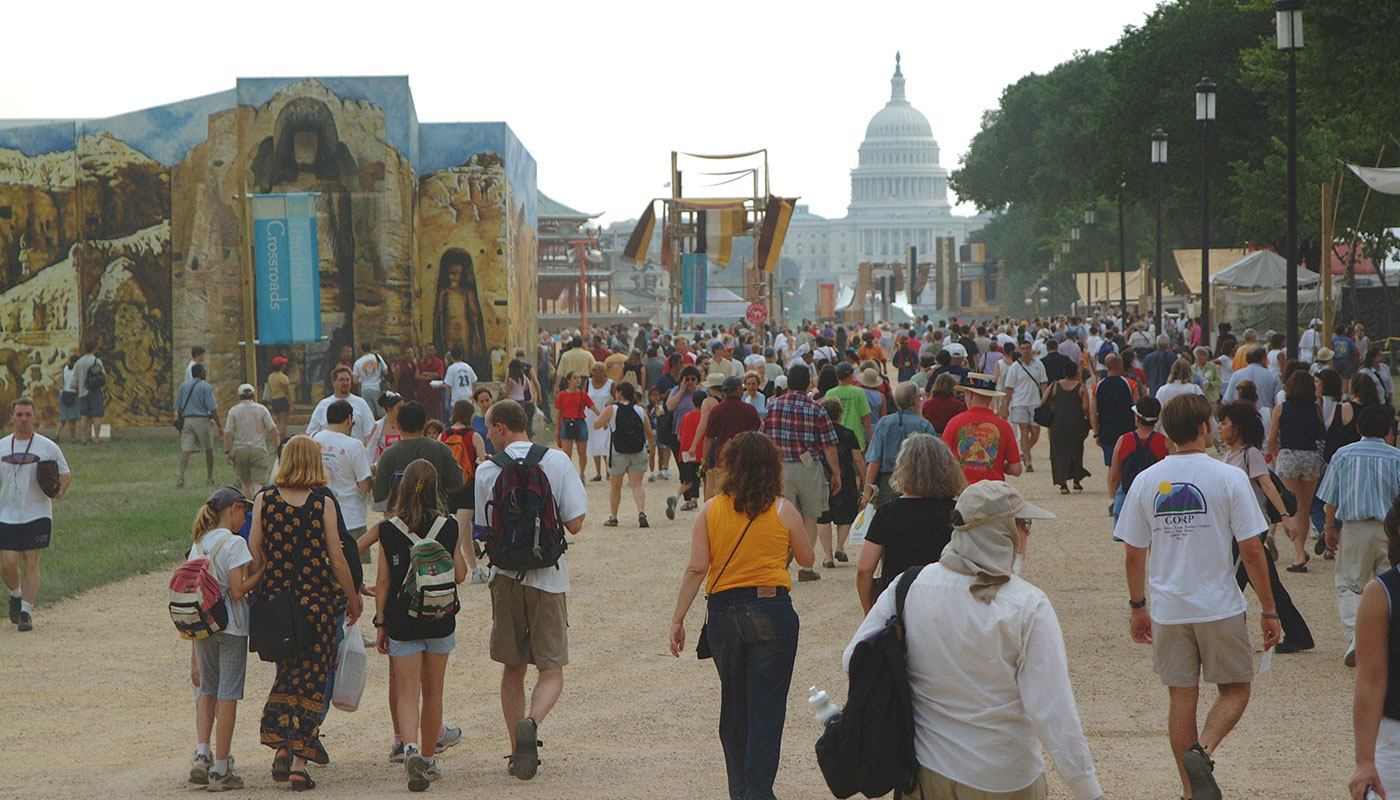
And in 2002, for the first time in its 36 year history, the Smithsonian Folklife Festival in Washington DC had a single and remarkably ambitious theme: The Silk Road. The festival was in large part supported by the Aga Khan Trust for Culture and turned the National Mall into a mammoth visual representation of the Silk Road.

Story continues below

Aga Khan in China at Great Mosque of Xian.
Mawlana Hazar Imam, His Highness the Aga Khan, at the Great Mosque of Xian with the Imam of the Mosque Mr. Mohamed Yunis during his visit to China in October 1981. Xian was an ancient imperial capital and an eastern departure point of the Silk Road. Formerly Chang’an, Xian has long been an important crossroads for people from throughout China, Central Asia, and the Middle East, and thus a hub of diverse ethnic identities and religious beliefs. Photo: Alnoor Magazine, December 1981, published by the Aga Khan Ismaili Council and Association for Portugal.
A large crowd walking on a pathway at an outdoor event, with decorative structures and the U.S. Capitol building in the background.
Large crowds at the Smithsonian Folklife Festival held along the National Mall in Washington DC during the summer of 2002. The festival was dedicated to the The Silk Road and was inaugurated in the presence of His Highness the Aga Khan. Photo: The Smithsonian Institution.
Aga Khan discusses Nasir Khusraw's work by Alice Hunsberger's with Tajikistan's President Rahmon
Tajikistan’s President Rahmon and Mawlana Hazar Imam, His Highness the Aga Khan, pause in the library of the new Ismaili Centre in Dushanbe during its opening on October 12, 2009. They engage over Alice Hunsberger’s book “Nasir Khusraw: The Ruby of Badakhshan.” Nasir Khusraw lived over a thousand years ago in the region that is modern Tajikistan.

More than a 1000 years ago during the reign of the Aga Khan’s ancestors, the Fatimids in Egypt, a Persian Ismaili traveller, Nasir Khushraw, made a voyage to Cairo between 1046 and 1052 AC. He documented his journey in a book called Safarnama which was first translated into English in the mid 1980’s by Wheeler Thackston under the title “Naser-e Khosraw’s Book of Travels.” A multi-part series of Nasir Khusraw’s travels focusing on his Hajj to Mecca by Michael Wolfe was also published on this website. Being fascinated with the translated works of Nasir Khushraw by Thackston, Wolfe and Alice Hunsberger over the past several decades, I had hoped that I would be able to view a manuscript of one of his works at the Aga Khan Museum’s exhibition.

I came out of “Hidden Stories” richly informed about the diverse and pluralistic nature of the Silk Road by seeing the display of books/texts, textiles, carpets, ornaments, clothing, writing material and many other objects. They provide a unique glimpse of the knowledge and technological contributions of the many peoples, cultures and religions that comprised the Silk Roads.

I highly recommend that you to visit this extraordinary exhibition. I would also suggest that during your visit to the Museum, you step out and walk through the Aga Khan Park to see the large sized photographic panels by a British photographer’s 2019 journey from Venice to Beijing.

Date posted: February 17, 2022.
Last updated: February 18, 2022 (see corrections below).

CORRECTIONS: The original version of this piece contained (1) typo errors, (2) incorrect dates on the closure and re-opening of museum; and (3) the map of the Silk Roads that was shown depicted the journey of the British photographer whose works are displayed at the Aga Khan Park. Simerg apologizes for these errors.

___________________

A portrait of Zahir Dharsee, a middle-aged man with dark hair and a friendly smile, wearing a suit against a blue background.
Zahir Dharsee

About the author: Zahir Dharsee came to Toronto, Ontario, Canada from East Africa in 1974. Zahir is a retiree from the Federal Public Service. He is currently pursing a Masters of Arts degree in History, at York University in Toronto. His area of specialization is researching the British Empire and its Colonization and Immigration policies and objectives. He lives in Mississauga, Ontario.

Before leaving this website please take a moment to visit Simerg’s Table of Contents for links to hundreds of thought provoking pieces on a vast array of subjects including faith and culture, history and philosophy, and arts and letters to name a few. Also, visit Simerg’s sister websites Barakah, dedicated to His Highness the Aga Khan, and Simergphotos.
Malik, the publisher/editor of the 3 websites may be contacted at mmerchant@barakah.com.

In Memoriam: Vazir Hon. Al Noor (Nick) Kassum (1924-2021) – One of Tanzania’s Earliest Voices for the Global South at the United Nations

By NAVROZ LAKHANI

Vazir Hon. Al Noor Kassum, popularly known as Nick Kassum, a retired Tanzanian politician passed away peacefully in Dar es Salaam on Thursday, November 18, 2021. His three sons, Saleem, Diamond and Jemal-ud-Din (Jamil) all flew to the Tanzanian capital from North America to be with their father at his bedside in the last few hours of his life.

Educated in Tanzania, India and the United Kingdom where he was called to the Bar at Lincoln’s Inn in 1954, Al Noor Kassum was a prominent figure in Tanzanian politics as well as in the Ismaili Muslim community (Jamat) where he served initially as an Education Administrator in the mid-1950s and early 1960s, and later towards the end of his life as the first Personal Representative of His Highness the Aga Khan in Tanzania.

Born as Noordin (‘Light of the Faith’) into the well-known Ismaili family of Count Kassum Sunderji, known for his years of dedicated service to the Imamat and at whose residence, the 48th Ismaili Imam, Sir Sultan Mahomed Shah, His Highness the Aga Khan III (1885-1957), stayed during his Diamond Jubilee in 1945.

Nick grew up in a family where service to the Jamat and the Imam-of-the-Time was a natural part of life. Nick was raised in colonial Tanganyika, as Tanzania was known before independence, where access to education was not available to the largest segment of society. Colonial society being highly stratified, opportunities for both basic and higher education were allocated strictly on racial lines. However, Nick was fortunate. By dint of family circumstances, for his further education he was able to go first to Britain and then to India. His early education was disrupted by the Second World War which was raging while he was still a teenager, and in 1950, Nick found himself back in Tanganyika working in his father’s business.

In 1950, at the suggestion of the British Governor in Tanganyika, Sir Edward Twining, Nick decided to go to England to study for the Bar. His father was not keen on Nick leaving his young family and going away for studies. Nick wrote to Imam Sir Sultan Mahomed Shah for advice and the Imam blessed his endeavour, highlighting that people like him would be needed in public life in the years to come. Consequently, in 1951 Nick left for the United Kingdom with his wife Shirin and their three infant sons. Meanwhile, as Nick’s professional career unfolded, Shirin dedicated her life to the family, the Jamat and the Ismaili Imamat.

Article continues below

Prince Aly Khan with London Ismaili Jamat
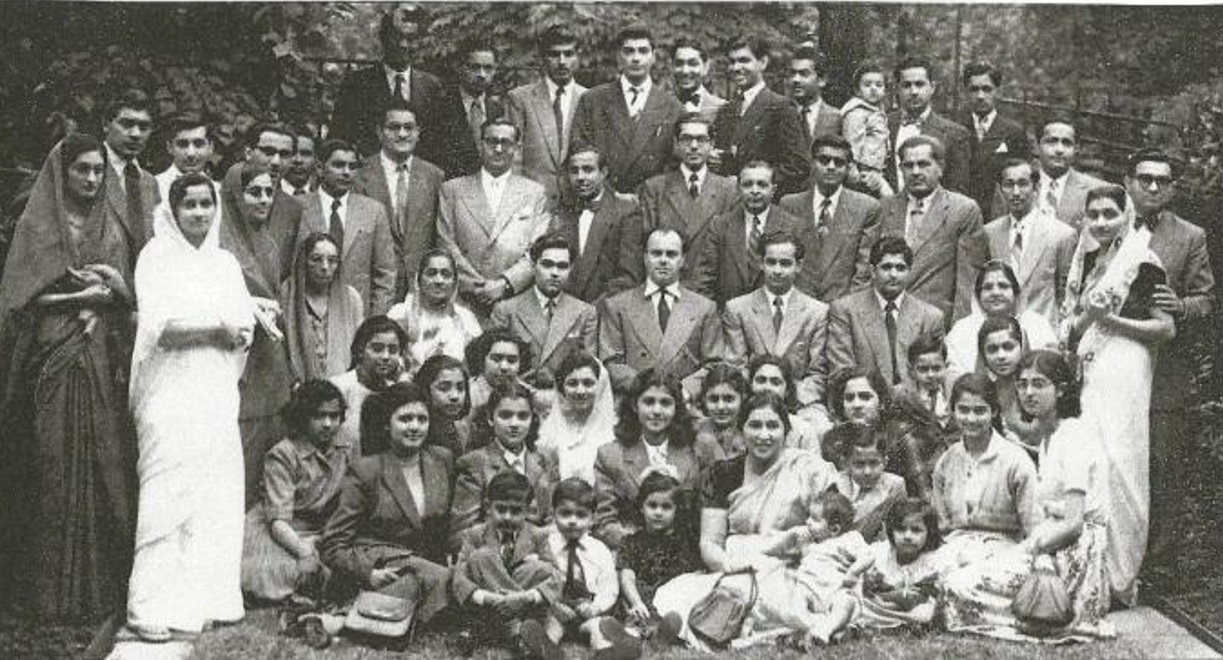
1952: The late Prince Aly Khan (seated, centre) with the London Jamat at a gathering at the Javeri residence in Hampstead, London. Shortly after this event, Hon. Al Noor Kassum (shown standing next to his wife Shirin, extreme left) was appointed by Sir Sultan Mahomed Shah, His Highness the Aga Khan III, as the first President of the Ismaili Council of the United Kingdom. Photo: (Late) Ameer Janmohamed family collection. Click on photo for enlargement.
Al Noor Kassum and Aga Khan III
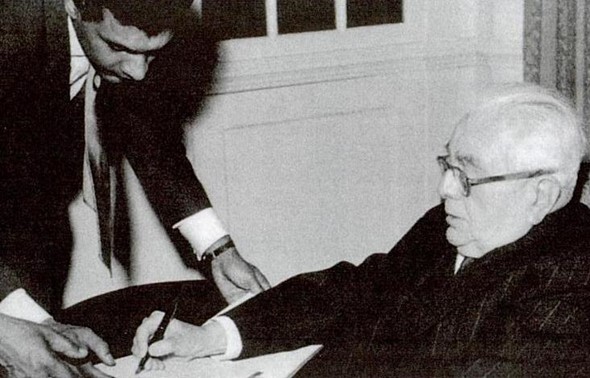
Hon. Al Noor Kassum looks on as Sir Sultan Mahomed Shah, His Highness the Aga Khan III, signs documents for the purchase of the building at 51 Kensington Court in London that became the first centre of the Ismaili community in the United Kingdom. Photo: Al Noor Kassum’s family collection.
Begum Aga Khan and Al Noor Kassum at opening of Knesington Court Jamatkhana.
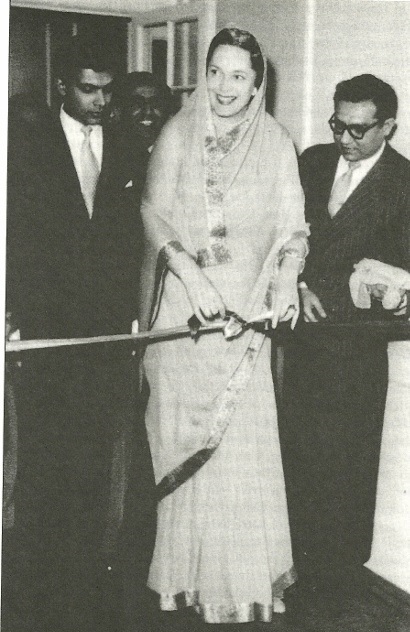
Mata Salamat, Begum Om Habibeh Aga Khan, cuts the ribbon during the opening ceremony of the Ismailia Social and Residential Club at 51 Kensington Court on May 17, 1953. The building also included a Jamatkhana prayer room. Looking on are Ismaili Council President Al Noor Kassum (left) and the Mukhi of the London Jamat, Tajdin Jiwan Hirji, on right. Photo: Al Noor Kassum’s family collection.

In London while studying for his law qualification, Nick played an important role in serving the Ismaili Jamat (community). He was appointed by the Imam to be the first President of the Ismaili Council of the United Kingdom, in a Jamat that was mainly made up of students from East Africa, the Middle East and the Indian subcontinent. It was during Nick’s tenure as President that 51 Kensington Court was purchased under guidance from Imam Sultan Mahomed Shah. This address became the first centre for the Ismaili community in the UK. This was soon followed by 5 Palace Gate in South Kensington which remained the centre until 1985 when the newly purpose-built Ismail Centre in South Kensington was inaugurated as a special Silver Jubilee Project of the 49th Imam, Shah Karim al Hussaini, His Highness the Aga Khan IV (henceforth referred to as the Aga Khan).

The years Nick studied in England were momentous ones for the decolonisation of Africa, with leading Africans such as Hastings Banda, Seretse Khama, Kwame Nkrumah, and others studying in the country and aspiring to go back to Africa someday to lead the campaign for political freedom. Little did Nick realise then that he too, one day, would become part of this movement, if not at the grassroots level, then certainly as its spokesperson at the highest fora in the world. After qualifying as a barrister, Nick went back to Tanganyika in 1954 where he enrolled as an Advocate of the High Court of Tanganyika and entered into legal practice, first with an established firm, Dharsee and Mc Roberts, and soon thereafter, on his own.

In 1954, Imam Sir Sultan Mahomed Shah Aga Khan appointed Nick as the Administrator of the Aga Khan Schools in Tanganyika — a position he held for the next 10 years. The Imam also bestowed upon him the title of “Vazir” for his many years of meritorious service. These ten years were crucial in the history of Tanganyika as the country attained its independence in 1961.

Aga Khan with Al Noor Kassum
Mawlana Hazar Imam, His Highness the Aga Khan, pictured in 1959 with the three East African Aga Khan Education Board territorial administrators. Standing (from left to right), Count Madatali A. Shariff, Kenya; Vazir Al Noor Kassum, Tanganyika (now Tanzania); and Vazir Jimmy R.K.S Verji, Uganda. Photo: Commemorative Issue 1977-1978, Sixty Years of Ismaili Education in Kenya, page 28.

Immediately prior to independence, the new Aga Khan, Prince Karim Aga Khan, on assuming his role as the 49th Imam of the Ismailis decided to realign the education institutions pioneered in his grandfather’s time under the old colonial system of government to the dynamics of new modern African states with their own needs for nation building. Nick was allocated this task in Tanganyika, which entailed upgrading existing schools and building new ones. Many students of both genders at the Aga Khan schools now sought scholarships to pursue higher education both in East Africa and overseas, a facility that was made possible by the Aga Khan. Consequently, a large number of men and women gained admission to institutions of higher learning in East Africa and some went to the United Kingdom, the USA, and elsewhere.

It was in early 1961, just after the country attained self-rule, that Nick was appointed Parliamentary Secretary to the Minister of Education and Information, Oscar Kambona. Within months, Kambona was appointed Tanganyika’s first Foreign Minister and was succeeded by Solomon Eliufoo. Nick was asked by Eliufoo to join Tanganyika’s delegation to the United Nations Educational, Scientific and Cultural Organization (UNESCO) in France. It was during UNESCO’s General Conference that Eliufoo suddenly fell ill, and Nick found himself heading the delegation. At the General Conference, Nick was appointed as Rapporteur to the one of the two commissions set up by the General Conference, called the Administrative Commission. Soon thereafter, he was appointed as a co-Chair of this Commission. One of the tasks of the Commission then was to preserve the monuments of Nubia (The Temples of Abu Simbel) in the face of the ecological threat posed by the construction of the Aswan Dam in Egypt. Nick worked very closely with Prince Sadruddin Aga Khan who was appointed by UNESCO to be the Executive Secretary of the International Action Committee for the Preservation of Nubia. According to Prince Sadruddin, the campaign to save the monuments of Nubia, was one of UNESCO’s great achievements. 

Article continues below

Nubia monuments Prince Sadruddin Aga Khan Al Noor Kassum Simerg tribute
The Nubian Monuments are in an archaeological zone of primary importance which extends from Aswan to the Sudanese border. It includes magnificent monuments as the Temples of Ramses II at Abu Simbel and the Sanctuary of Isis at Philae, which were saved from the rising waters of the Nile thanks to the International Campaign launched by UNESCO, in 1960 to 1980. Photo: UNESCO.

With a background in, and a passion for, education, Nick spent his early years after the country’s independence (late 1961) with educational issues, the main national objective being to enhance opportunities in primary education and to promote adult literacy. The building of a national university was very high on the priority list of the new country. Nick devoted his time mainly to the educational priorities of the country. This was not his only preoccupation, for he was also instrumental in setting up the Mwananchi Development Corporation that became the primary agency for the Tanzanian Government to ensure that it was able to govern the country’s resources more effectively and equitably for national development. In 1964 after the revolution in Zanzibar, when Tanganyika and Zanzibar merged to form the new Republic of Tanzania, Nick was appointed Parliamentary Secretary to the Ministry of Industries, Natural Resources, and Power.

These early days of his political career were momentous for various developments that were taking place in Africa where Tanzania under the stewardship of Julius Nyerere was beginning to play an important international role. These developments included the advent of independence in Uganda and Kenya in 1962 and 1963 respectively, the founding of the Organization for African Unity in Addis Ababa in 1963 and the mobilisation of major freedom movements in Southern Africa. The banning of political parties in South Africa and Mozambique led to thousands of political refugees seeking asylum in Tanzania. President Nyerere, a Pan Africanist par excellence, played a major supportive role in all these freedom movements.

In early 1965, at the behest of then then Director General of UNESCO, Rene Maheu, and with the approval of President Nyerere, Nick was appointed as Senior Liaison Officer, Bureau of Relations with International Organizations and Programmes at UNESCO in Paris — a position he held for two years. His work entailed coordinating UNESCO’s activities in the field of education with various international agencies such as the FAO (Food and Agriculture Organization) in Rome and the ILO (International Labour Organization) in Geneva. It also included persuading the UNDP (United Nationals Development Programme) in New York and the World Bank in Washington DC to finance various UNESCO projects.

Article continues below

Al Noor Kassam with UNSG U Thant
Hon. Al Noor Kassum with UN Secretary-General U Thant at a meeting in Rome of the UN Administrative Committee on Coordination, May 1969. Photo: Al Noor Kassum’s family collection. Click on photo for enlargement.

Among other duties Nick performed was participating in international conferences of the UN Economic and Social Council (ECOSOC) and the UN’s Administrative Committee on Coordination in both Geneva and New York. At the end of 1966, Rene Maheu asked Nick if he would be happy to head UNESCO’s Liaison Office at the UN in New York. Nick once again sought Nyerere’s approval, took up the offer and moved to New York in 1967. It was at the end of his two-year assignment in New York that C.V. Narasimhan of India, Chef de Cabinet to the UN Secretary General U Thant, invited Nick to join the UN Secretariat as assistant Secretary General at which time Nick again sought Nyerere’s approval only to be told that Tanzania needed his services more than the UN. Nick placed service to his country before service to his international career and came back to Tanzania to take on some pivotal national positions offered to him by the president.

Article continues below

Al Noor Nick Kassum UNSG Waldheim and Sen Kennedy, Tribute Simerg
Hon. Al Noor Kassum, with UN Secretary General Kurt Waldheim, Richard Gardner and US Senator Edward Kennedy at a UN workshop to discuss the report on how the United Nations system could be restructured. Photo: Al Noor Kassum’s family collection. Click on photo for enlargement.

For the next 50 years, Nick made Tanzania his principal residence and served in a number of capacities. We will just make brief mention of these in order to show the energy he brought to the positions he was asked to head and the innovations he made. On his return to Tanzania in 1969, he was appointed as Deputy General Manager of Williamson Diamond Mines in Mwadui near Shinyanga in which the Government of Tanzania was a shareholder but was often kept in the dark with regard to major decision making. Nick went down Shinyanga to the mine and spent the next few years studying the operational dynamics and suggesting significant changes in management. He commissioned a report called the Mwadui Report that showed the workings on the ground to the chagrin of the administration. This led to the appointment of the first Black African, Matthew Luhanga, as the General Manager of Williamson Diamond Mines.

In 1972, President Nyerere once again called upon Nick to play an important role in the country, this time as the East African Community (EAC) Minister of Finance and Administration. The appointment had to be endorsed by the Presidents of the three East African countries that made up the EAC which are Kenya, Tanzania, and Uganda. Nick feared that Idi Amin, who had constantly been attacking the Asians in Uganda, would withhold his ratification but surprisingly Idi Amin added his signature without demure six months before he expelled all the Asians from Uganda. Even so, Amin always treated Nick with courtesy and respect. During Nick’s tenure as East African Minister for Finance and Administration, the United Nations invited him to chair a group of 25 experts evaluating how the United Nations system could be restructured, following a UN resolution on the New World Economic Order. After the report was submitted to the UN Secretary General, Kurt Waldheim, a workshop was held where the panelists included Kurt Waldheim, and US Senator Edward Kennedy. The report was then placed before the UN General Assembly.

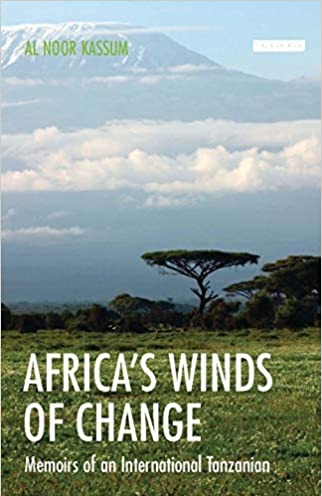
In March 1977, anticipating the impending demise of the EAC, President Nyerere invited Nick to head the Ministry of Water, Energy and Minerals. This was a few years after the price of petroleum soared as a result of the 1973 Arab-Israel war. The government established the Tanzania Petroleum Development Corporation (TPDC) as the chief purchasing agency, and the task of obtaining oil for the country on the world market for the very little foreign exchange that Tanzania had at that time devolved on Nick’s shoulders. Nick led ministerial delegations to places as diverse as Angola, Libya, Iran and Algeria, and his basic message was: “We are having temporary problems and so cannot pay immediately for the oil we need. However, we do have natural resources and so can pay you in the longer term. Could you please let us have oil on credit? And they did so.” (Al Noor Kassum, Africa’s Winds of Change: Memoirs of an International Tanzanian, p. 123, see book highlight below).

In 1991, after retiring from politics, His Highness the Aga Khan appointed Nick as his Personal Representative in Tanzania in which capacity Nick helped with the establishment of projects undertaken by the Aga Khan Development Network (AKDN) in Tanzania. These ranged from healthcare and education to culture and tourism. Nick also helped in negotiating the Protocol of Cooperation between the Government of Tanzania and the AKDN, which facilitated the AKDN’s contribution to Tanzania’s social and economic development. Nick held this position till 2002.

Article continues below

Aga Khan, Benjamin Mkapa, Kikwete and Al Noor Nick Kassum protocol signing Tanzania
His Highness the Aga Khan and (then) Tanzanian President Benjamin Mkapa exchange copies of a protocol for development cooperation, with Jakaya Kikwete (future and fourth President of Tanzania) and Hon. Al Noor Kassum in attendance, August 2001. Photo: Al Noor Kassum’s family collection.

In 1993, President Ali Hassan Mwinyi appointed Nick as the Chancellor of Sokoine University of Agriculture in Morogoro, Tanzania, and also bestowed on Nick the title of ‘Honourable’ for life. On November 28 1997, as Chancellor of the University, it fell upon Nick to award an honorary degree in philosophy to Nyerere in recognition of his lifelong service to humanity and his support to African countries struggling for their independence (see photo at the beginning of this post). To come back full circle, a year earlier Nyerere had appointed Nick as a trustee of a new foundation bearing his name called the Mwalimu Nyerere Foundation, established to promote peace, unity and people-centred development in Africa. On January 10 2000, after President Nyerere’s death, the Board of Trustees appointed Nick as interim Chairman for one year. Hon. Salim Ahmed Salim, a former Secretary General of the Organization of African Unity and former President of the UN General Assembly then succeeded Nick to this position.

Article continues below

l Noor Kassum confers an honorary Doctor of Philosophy degree on the first Tanzanian President, Julius Nyerere, on 28 November 1997
As Chancellor of Sokoine University of Agriculture, Hon. Al Noor Kassum confers an honorary Doctor of Philosophy degree on the first Tanzanian President, Julius Nyerere, on November 28, 1997. Photo: Al Noor Kassum’s family collection. Click on photo for enlargement.

Nick’s funeral at the Karimjee Hall in Dar es Salaam on November 20, 2021 was attended by leading members of the Tanzanian Government. The venue, where some sixty years earlier he had crossed the floor to join the Tanganyika African National Union (TANU), was dignified but not sad because it celebrated a life well lived in the service of the country and community. His funeral was attended by Prime Minister Kassim Majaliwa, ex-President Jakaya Kikwete, ex-President Amani Karume, ex-Prime Minister Joseph Warioba and many prominent Government officials and dignitaries who paid their respect.

Conveying condolence on behalf of President Mama Samia Suluhu Hassan to the Kassum family, the Tanzanian nation, the Aga Khan and the Ismaili community, the Prime Minister recollected the years of dedicated service Vazir Hon. Al Noor Kassum had rendered to the country, highlighting Nick’s mentorship to so many individuals who would become leaders of Tanzania. The Prime Minister also mentioned the deep friendship that Nick had enjoyed with President Nyerere and the bond of trust they shared in the service of the country, which he referred to as unique and very special. During the dignified funeral, Nick’s eldest son Saleem, on behalf of the Kassum family, thanked the past and present leaders of Tanzania, the leaders of the Ismaili Jamat and the AKDN for their presence, and for their kind words of tribute to Nick’s life .

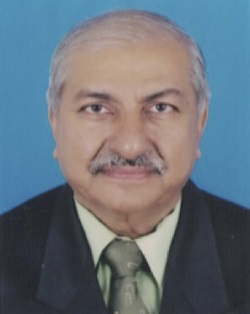
Portrait of Vazir Hon. Al Noor (Nick) Kassum (1924-2021), Tanzania politician, Ismaili leader
Vazir Hon. Al Noor Kassum (1924-2021)

According to Mohamed M. Keshavjee, an international specialist on cross cultural mediation: “Nick Kassum was a very special individual of prodigious diplomatic capability whose multiple talents were underpinned by sound administrative competence and hard work. Nick served Tanzania as a diplomat in the formative years of its evolution. He served the UN at a critical time of decolonisation. He enjoyed President Nyerere’s full confidence and was asked to come back to serve the country in a number of critical portfolios. Nick acquitted himself with great aplomb and assiduity of purpose. He excelled in whatever was assigned to him but, in the process, he never lost his humility and compassionate disposition which allowed others to shine when he found them capable of serving the country he so dearly loved.”

Rest in Peace dear Nick. What you had; you gave. What you could, you did.

Date posted: February 15, 2022.
Last updated: February 24, 2022 (new photo, Mawlana Hazar Imam with East African Ismaili education administrators)

______________________

We invite you to submit your condolences, memories and tributes to Vazir Hon. Al Noor (Nick) Kassum by completing the feedback form below or by clicking on Leave a comment.

Navroz Lakhani
Navroz Lakhani

About the writer: Navroz Lakhani (B.Sc Special Mathematics, London University, 1970), worked as a Software Engineer at major corporations, British Gas, Bell Canada and Saudi Arabian Airlines. From 2011-2016, he served as Management & Program Liaison Officer (MPLO) at the AKDN Diplomatic Office in Tanzania. Currently he is conducting research on the history of Ismaili Muslims in Africa and the contribution of AKDN in several countries in a rising Africa.

____________________

Africa's Winds of Change by Al Noor Kassum

Al Noor Kassum’s Africa’s Winds of Change — Memoirs of an International Tanzanian documents the changes that took place in Tanzania from the middle of the 20th century to around the middle of the first decade of the 21st century, through the prism of an East African Asian experience. The author sheds new light on the character and legacy of Julius Nyerere, who emerges as radically different from the stereotypical anti-Western firebrand which became his image in the West. Africa’s Winds of Change offers a fascinating personal history of a unique African nation at a critical stage in its development. Africa’s Winds of Change, hardback, 256 pages, was first published by I.B Tauris in October 2007. It is currently unavailable at new and used booksellers as well as other online sources that we checked out, including Amazon, AbeBooks and eBay.

______________________

More tributes to Al Noor Kassam (external links):

1. Daily News (Tanzania) — Reflections on Contributions, Legacy of Al Noor Kassum
2. The Citizen (Tanzania) — The Life and Times of Nick Kassum

______________________

Simerg invites Ismaili families to submit obituaries and tributes for deceased members of their families. For guidelines, please click Passings. Before leaving this website please take a moment to visit Simerg’s Table of Contents for links to hundreds of thought provoking pieces on a vast array of subjects including faith and culture, history and philosophy, and arts and letters to name a few. Also, visit Simerg’s sister websites Barakah, dedicated to His Highness the Aga Khan, and Simergphotos.
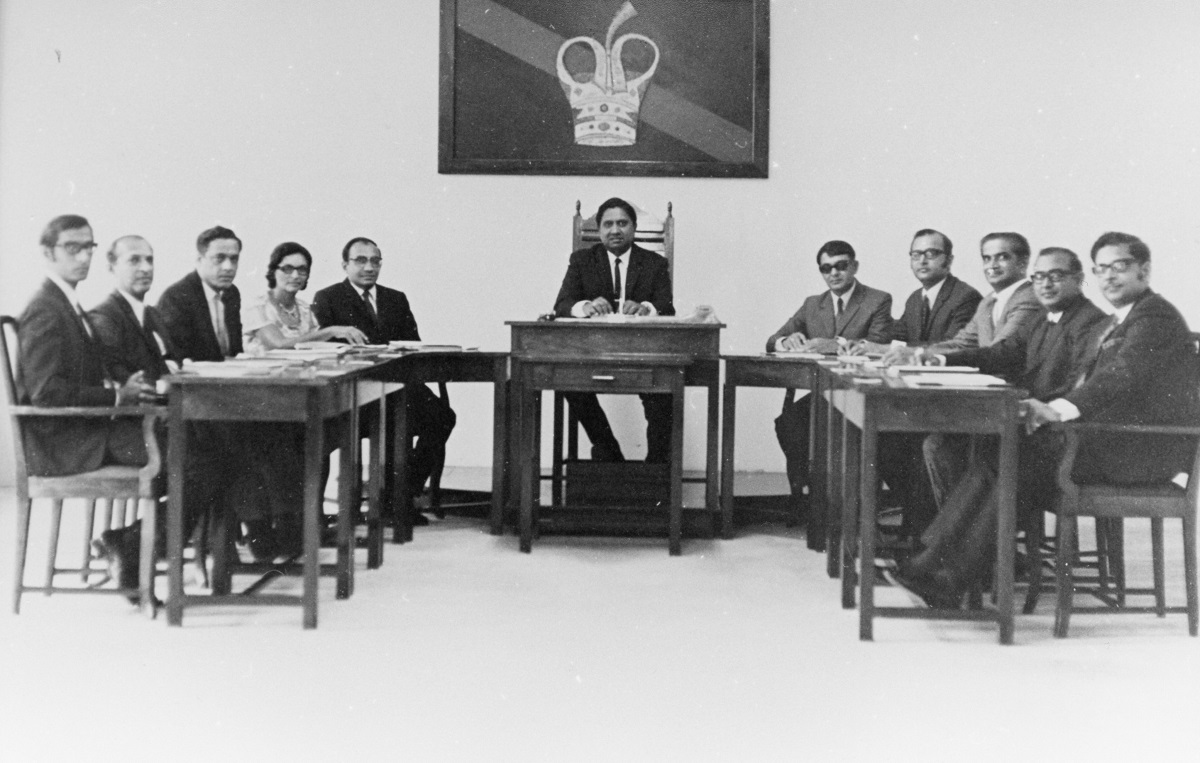
The editor of the 3 websites, Malik, may be reached at mmerchant@barakah.com.

Historical Valentine’s Cards from The Henry Ford

Introduced by MALIK MERCHANT

For Valentine’s day today, Monday February 14, Simerg’s sister website presents some extraordinary Valentine’s Day cards from the Digital Collections of The Henry Ford, dating back to the 1850’s. Please click Simerg Photos or on the image below.

In this referral post, our two images reflect our wish that world leaders will make every effort to seek out peace. The world is looking extremely dangerous at the moment with conflicts everywhere, that are multiplied even more with the challenges we have all faced over the last two years dealing with the coronavirus pandemic. Leaders — please seek to bring conflicts to an end.

Please click on image for more photos.

Date posted: February 12, 2022.

___________________

Before leaving this website please take a moment to visit Simerg’s Table of Contents for links to hundreds of thought provoking pieces on a vast array of subjects including faith and culture, history and philosophy, and arts and letters to name a few. Also, visit Simerg’s sister websites Barakah, dedicated to His Highness the Aga Khan, and Simergphotos. The editor of the 3 websites, Malik, may be reached at mmerchant@barakah.com.
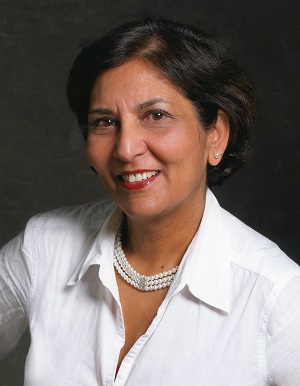
Letter from Afghanistan [6] – Simerg’s Special Correspondent Visits Ismaili Families in Sia Sang, a Remote Village in Wardak, Central Afghanistan

[This is our Kabul based special correspondent’s sixth report to provide the global Ismaili Jamat and our readers with reliable information regarding recent development in Afghanistan after the Taliban takeover. His previous letters can be read by clicking on the following links 1. August 26 2021, 2. August 29 2021, 3. September 5 2021, 4. December 4 2021 and 5. December 5 2021 — Ed.]

LETTER FROM AFGHANISTAN

FEBRUARY 13, 2022

Ismailis in Remote Villages Face Hardships Due to Meagre Food Reserves and Difficult Health Conditions: Local Jamati Institutions Have Failed to Meet Their Needs Over the Years

Please click on photos for enlargement

Sia sang- Bai Qobi - houses were once inhabited by Ismailis,
These houses in Sia sang — Bai Qobi — were once inhabited by Ismailis. They left the country upon the first reign of the Taliban. The houses are now occupied by Twelver Hazaras who are involved in farming activities in this village. Photo: Simerg Special Correspondent.

BY SIMERG’S SPECIAL CORRESPONDENT IN KABUL

Dear Jamats:

In my effort to continue to provide the world wide Ismaili Jamat with updates and insights about the latest developments in Afghanistan, I took the initiative to visit small villages in the remotest corners of the country. This report is based on interviews I conducted with five Ismailis in Sia Sang village, a remote village located in mountainous areas of Hesa-e-Awal Behsood, a district in the central province of Wardak (see map, below). I visited this gregarious small village which is mainly inhabited by Hazara ethnic minority. According to my information, once over 80 Ismaili families lived in Sia Sang. Now, only a small fraction of Ismailis, six households, live altogether. The vast majority that remain in the village are Twelver Shiites (Ithnasharies). The people of Afghanistan face an uncertain future, unemployment, poverty, hunger and drought since the Taliban takeover of the country on August 15, 2021.

The Ismaili villagers I met are surrounded by high mountains and hills and have been adversely affected by the recent upheavals as well. They are struggling with the current financial and economic crisis looming across the country. Afghanistan’s economy was facing severe challenges, and the international support was starting to wane even before the collapse of former western-backed government. The US congressional research noted that this past year 90 percent of Afghanistan’s population lived on less than US$ 2.00 a day, and warned that the loss of American support would weaken one of the world’s smallest economy.

Concerns about food insecurity are mounting and a looming drought is expected to make matters worse. The prices of food and other basic goods have soared and even doubled after the regime change in the country.

Story continues below

Wardak, Bamyan and Kabul Maps Simerg
Enlarged map of the Afghan provinces of Bamyan, Kabul and Wardak. The author of this piece visited the district of Hisah-ye Awal-e Bishud (circled) where the remote village of Sia Sang is located at an elevation of 3,117 meters (10226 ft) above sea level. The current daily minimum and maximum temperatures for the week of February 14, 2022 in Sia Sang will be in the range minus 17°C to minus 6°C. The map has been adapted from the provincial map of Afghanistan at the Perry-Castañeda Library Map Collection, University of Texas. For full provincial map of the country, click HERE – it will open in new tab.

MEALS HALVED, AND FARMERS LACK ACCESS TO MARKETS

According to the local Ismailis I met, they have to consume half of the food that they used to previously. For decades, these Ismaili farmers survived on stored wheat from their summer harvest and income from selling of farm animals and potato in the market. This year’s farming yielded good crops. However, with little access to the national market, they were unable to sell their agricultural products at a fair selling price. Unlike urban population, the farmers residing in rural areas of the country do not have a certain source of income other than agricultural production. There is no orderly and regular transportation system. Thus they are unable to take their family members in critical condition to a hospital. They have difficulty in purchasing food and other basic goods from the market.

Due to lack of access to a permanent and established market to procure food, and necessary goods and items, the local villagers in this part of the country have to take a trip to the neighboring province of Bamyan or the capital Kabul. Transportation fee, 3000 AFN (US$ 30.00), is high and the impoverished community settled here cannot afford paying such a high amount.

Story continues below

A boy standing in front of mud houses in Sia Sang Dasht- e- Rashak. Photo: Simerg Special Correspondent.

INADEQUATE HEALTH CARE AND TRANSPORTATION

Lack of access to basic health care services has made the living condition challenging. The closest local health care centers are three to four hours away by foot from this village, making it impossible to take their patients on time. The services provided by the health care centers do not enjoy high quality. So, they have to take the critically ill patients to Kabul or neighbouring Bamyan (see map above).

One Jamati member, Ahamad, told me, “I am alone and live only with my wife, I have no other family member to take care of me and my house. God forbid that if one of us gets sick, we must travel to Bamyan for treatment. So, who will take care of my house and belongings?”

The main highway passing through this village connects the central provinces with the capital Kabul. This highway is blocked to the traffic every year in winter due to heavy snowfall and storms that makes travel very difficult or virtually non-existent for several days.

Access to basic education is limited for children in this community. The nearest high school is one hour away from this locality. The former western backed government were in favor of girls’ education and encouraged the local population to send their girls to school. Thus, even with the Taliban ruling the country, education is not barred for girls in this community. The social perception towards education in this community specifically for girls is viewed in a positive light.

Story continues below

Sia Sang Ismaili Jamatkhana, Afghanistan.
The entrance of the local Jamatkhana in Sia Sang. A signboard hung above the main gate of the Jamatkhana reads as, Jamatkhana Shia Ismaili, Sia Sang village at the center, surrounded by Allah, Muhammad, Ali, Fatima, Hassan and Hussain. Photo: Simerg Special Correspondent.

PASSIONATE YOUTHS SEEK RELIGIOUS EDUCATION

This local Ismaili community deems religious education to be of the highest importance and absolutely necessary for their children. They have asked the Ismaili Tariqah and Religious Education Board (ITREB) and other responsible authorities in the Aga Khan National Council for Afghanistan to open a Baitul Ilm center (BUI). There are more than 13 Ismaili teens who need to acquire religious education and the villagers had many times requested the local ITREB board based in Bamyan to open a BUI center for this community. The local Jamat was very keen and showed passion for starting such a center, but no one addressed this issue and showed interest in this regard, said Ali, one of the local Ismailis I interviewed.

NO DEVELOPMENT PROJECTS OVER THE YEARS

It is extremely sad to report that no development project has been undertaken by either the government or by other NGOs including the Aga Khan Development Network (AKDN) agencies within the course of the past twenty years in this village. “Only a power station project had been initiated by Ismaili local council based in Bamyan province,” said Muhammad, another Jamati member I interviewed.

Story continues below

Snowfall in Sia sang - Dawlat murad -following a storm. Photo. Simerg Special Correspondent.
Snow in Sia Sang – Dawlat murad – following a snowstorm. Photo: Simerg Special Correspondent.

CONFLICTS WITH NEIGHBOURING NOMADS

Forty years of war and devastation have inflicted a major toll on infrastructure, economy and livelihood of its population. Civilians are the main victims and pay heavy price for instability and violence. Like other parts of the nation, this small Ismaili community is also concerned about insecurity and conflict in the future. Pashtun nomads used to come and graze their herds and camels on pastures in Hazarajat — the central parts of Afghanistan — during the summer. Many bloody conflicts had taken place between Hazara villagers and Pashtun nomads prior to collapse of US backed republic. “We are very worried about the future conflict and return of Pashtun nomads during the summer,” said Juma one of the local Ismaili interviewees. “They used to come and graze their flocks peacefully. But this year it is not clear what they will do to our farms,” he added.

A PLEA TO INSTITUTIONS AND JAMAT

The majority of interviewees agree that the economic catastrophe and collapse caused by the recent changes has negatively impacted their life and financial positions. They expect the AKDN and other aid organizations to help them and distribute food and other relief aid packages. They have enormous challenges and are very worried.

I again repeat my previous calls to Jamati institutions and the AKDN as well as Jamats around the world to go beyond their normal call of duty and involve themselves in action that will improve the situation of the Jamat and the citizens of Afghanistan. I am afraid the plight of Ismailis in some remote villages is not being addressed adequately, and I urge you not to be passive and indifferent to our well-being.

I look forward to submitting more letters to Simerg for everyone’s attention and consideration.

Thank you and Ya Ali Madad.
(Name withheld)

Date posted: February 13, 2022.

________________

We welcome feedback from our readers. Please complete the LEAVE A REPLY form below OR click Leave a Comment. Your letter may be edited for length and brevity, and is subject to moderation.

Please note that Simerg has created a special page on Afghanistan where you will find links to all our posts published on Afghanistan since the Taliban takeover. Please click AFGHANISTAN.

Before leaving this website please take a moment to visit Simerg’s Table of Contents for links to hundreds of thought provoking pieces on a vast array of subjects including faith and culture, history and philosophy, and arts and letters to name a few. Also, visit Simerg’s sister websites Barakah, dedicated to His Highness the Aga Khan, and Simergphotos. The editor of the 3 websites, Malik, may be contacted at the email address mmerchant@barakah.com.

Hazrat Ali Calligraphy by Karim Ismail

Yawm-e Ali: Quotes and Recitation of Ginanic Verses on the Anniversary of Hazrat Ali’s Birth

The Imams

We are the tree of Prophethood,
the place of descent
of Divine revelation,
the place of frequenting
of the angels,
and the mainsprings of knowledge.
Those who help us and love us
await (God’s) mercy…..Hazrat Ali

______________

The Tradition of the Ismaili Tariqah is the Tradition of Hazrat Ali

Aga Khan Digital Portrait, Simerg by Akbar Kanji
“The closer you come, the more you will see him.” A digital portrait of Mawlana Hazar Imam, His Highness the Aga Khan, direct descendant of the Prophet Muhammad and Hazrat Ali, by Toronto’s Akber Kanji. The portrait is composed of several hundred thumbnails representing a cross-section of events during Mawlana Hazar Imam’s Imamat. Photo: Copyright: Akber Kanji.

“This is a time of new freedoms, but it is also one in which new choices must be made wisely. In exercising freedom and making choices, our institutions must be guided, as they have been in the past, by the teachings of the Prophet Muhammad (Peace of Allah be upon him), and the tradition of our tariqah, which is the tradition of Hazrat Ali: A thinking Islam and a spiritual Islam — an Islam that teaches compassion, tolerance and the dignity of man — Allah’s noblest creation.” — His Highness the Aga Khan, May 14, 1992, Aga Khan Foundation 25th anniversary.

______________

The Ant

By God,
were I given all the seven heavens
with all they contain
in order that
I may disobey God
by depriving an ant
from the husk of a grain of barley,
I would not do it…..Hazrat Ali

The Prophet’s Household

To them (the Household of the Prophet)
pertain the noblest of human virtues described in the Qur’an,
and they are the treasures of the Beneficent Allah.
When they speak, they speak the truth,
but when they keep quiet, no one can out strip them…..Hazrat Ali

Patience

One who perseveres patiently
will not be without success,
even if it takes a long time…..Hazrat Ali

The Headstrong

One who is headstrong and opinionated perishes,
while one who seeks the advice of others
becomes a partner in their understanding…..Hazrat Ali

The Blessed

Blessed is one
who is humble regarding himself,

whose livelihood is good,
whose inner thoughts are virtuous,
whose character is good,
who spends the surplus from his wealth
and removes superfluity from his speech,
who keeps his evil away from people…Hazrat Ali

__________________

Recitations of Ginanic Verses by Late Shamshu Bandali Haji

Iconic Ismaili Ginan reciter - Shamshu Bandali Haji
Iconic Ismaili Ginan reciter, the Late Shamshu Bandali Haji of Nairobi and Edmonton.

Simerg is pleased to present a selection of verses from the Ginan Muman Chetamni composed by Syed Imam Shah that relate to the birth of Hazrat Ali (a.s.). The recitations are taken from Ginans Central, a truly exceptional website which curates Ginans for “long-term access and preservation to foster research and learning in the digital era.” The inspiration behind this unique project is Karim Tharani (read ARTICLE). Here are recitations of three verses followed by a link to the page containing many more Ginan recitations by Alwaez Shamshu Bandali Haji as well as other reciters from around the world.

Verse Eji te Murtaza Ali….recited by Shamshu Bandali Haji
Verse Eji Mataji Gayata Bait…recited by Shamshu Bandali Haji
Verse Eji Tare Salaam Kidha…..recited by Shamshu Bandali Haji

Please click HERE for beautiful recitations by Alwaez Shamshu and other great Ismaili reciters from around the world. Also, please visit  Ginans Central Home Page, then scroll down the page and see links to Ginan collections as well as tools and resources.

Date Posted: February 11, 2022.

_______________________

Before leaving this website please take a moment to visit Simerg’s Table of Contents for links to hundreds of thought provoking pieces on a vast array of subjects including faith and culture, history and philosophy, and arts and letters to name a few. Also, visit Simerg’s sister websites Barakah, dedicated to His Highness the Aga Khan, and Simergphotos.

The editor of the 3 websites, Malik, may be reached at mmerchant@barakah.com.