Simerg is an independent initiative dedicated to Ismaili Muslims, the Aga Khan — their Hereditary Imam — and the Ismaili Imamat, and Islam in general through literary readings, photo essays and artistic expressions
Location of Sialkot in Pakistan. Punjab Province; nicknames of city: City of Iqbal and World’s Football manufacturing capital; population: 655,852, 13th largest city in Pakistan. Credit: Wikipedia.
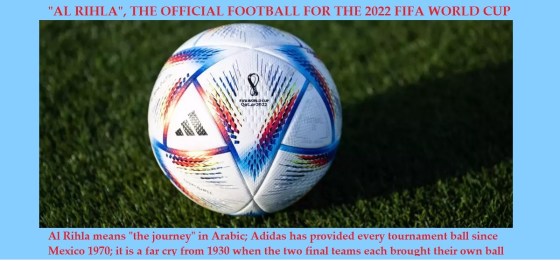
AL RIHLA: THE 2022 FIFA WORLD CUP SOCCER BALL
The 2022 FIFA world cup currently underway in Qatar is being watched by billions around the world. While we are all rooting for our respective countries and favourite teams, let us not overlook some extraordinary facts about the tournament and football in general. The football (soccer ball) is central to the sport, and for its origins and history please visit Ben’s website Yoursoccerhome: History of the Soccer Ball: From Origin to Modern Day.
Did you know that Sialkot, a city in northeast Pakistan near the Kashmiri border, makes more than two-thirds of the world’s soccer balls in one of the town’s 1,000 factories. That includes the Adidas Al Rihla, the official ball of the 2022 FIFA World Cup, that is now in the final stages of the group matches, with the knock-out stage of the competition set to begin on Saturday, December 3. Bloomberg has an excellent photo feature about the making of the Al Rihla football, and I think readers will be fascinated with the story. Please click on This Is Where Most of the World’s Soccer Balls Come From (Note: you are allowed to read 5 articles free). Al Rihla is the 14th official World Cup ball and, according to FIFA, the fastest and most accurate ball yet. The ball features a panel design inspired by a Dhow, a traditional Arab boat, with a blue, red, and yellow colour scheme that is meant to represent the landscape of Qatar. The Al Rihla balls are also the first World Cup ball made exclusively with water-based ink and glue, which are less harmful to the environment. The ball also includes a chip in the centre of the ball that can determine any contact by any player. What appeared to be a header flick by Portugal’s Cristiano Ronaldo, was ruled out as his goal and given to his teammate Bruno Fernandes who crossed the ball in the game against Uruguay.
In a piece for the Voice of America (VOA), Ayaz Gul who reports for VOA from Islamabad, Pakistan’s capital, notes that while Pakistan’s national teams have never qualified for the FIFA World Cup, its footballs repeatedly have. He further writes that Pakistan and China, have supplied the official match balls for the World Cup 2022, called Al Rihla, which means “the journey” in Arabic and is inspired by the culture, architecture, iconic boats and flag of Qatar.
Pakistan was also among the producers of the official match balls for the previously two World Cup championships in 2014 and 2018. The footballs are manufactured in Sialkot by German multinational Adidas through ‘Forward Sports’ whose managing director, Hassan Masood, said in a statement in the run-up to the 2022 World Cup that 3,000 footballs would be used during the tournament in Qatar and 8 million replicas are expected to be sold around the world. Sialkot is also famous for producing high quality sports goods and hosts many of the producers of FIFA certified footballs. May we remind you once again to read the Bloomberg photo feature on Al Rihla.
~~~~~~~~~
WOMEN REFEREES
Another heartwarming story that has come to our attention is that for the first time in the men’s world-cup history, three women referees will be officiating the crucial final Group E encounter between Germany and Costa Rica on Thursday, December 1. As the table stands now, any 2 of the 4 teams (Spain, Costa Rica, Japan and Germany) in the group could qualify for the round-of-16. French referee Stéphanie Frappart will be the referee in charge, and she will have Neuza Back of Brazil and Mexico’s Karen Diaz Medina as her assistants on the field. USA’s Kathryn Nesbitt will also be working as the offside specialist in the video review team. Two other women, Salima Mukansanga of Rwanda and Yoshimi Yamashita of Japan, are also on the FIFA list to referee games in Qatar.
Frappart refereed men’s games in World Cup qualifying and the Champions League, and this year’s men’s French Cup final. She also took charge of the 2019 Women’s World Cup final for FIFA. When asked if she ever has comments from players, managers or fans due to being a woman, Frappart said: “Since I started, I was always supported by teams, clubs and players. I was always welcome in the stadium, so I feel like another referee inside the pitch. I was always welcome, so I think I will be welcome as before.”
Date posted: November 30, 2022.
_______________________
Before departing this website, please take a moment to review Simerg’s Table of Contents for links to hundreds of thought-provoking pieces on a vast array of subjects including faith and culture, history and philosophy, and arts and letters to name a few. Also visit Simerg’s sister websites Barakah, dedicated to His Highness the Aga Khan, and Simergphotos.The editor may be reached via email at mmerchant@simerg.com.
Vancouver lawyer, M. Ali Lakhani, KC, was invited by the Senate of Canada to testify before its Standing Committee on Human Rights on the topic of Islamophobia. He was participating in his capacity as the Editor of Sacred Web: A Journal of Tradition and Modernity (www.sacredweb.com), a journal he founded 25 years ago, and now the leading journal in its field. Mr. Lakhani has written several articles on Islam, Islamophobia and on misunderstandings about Islam and Muslims, and he has spoken at universities and public events on these topics. Examples of his writing on these subjects are:
Each of three witnesses testifying before the Standing Committee made a 5-minute opening statement, which was followed by about an hour of questions from the Senators.
In his opening statement, Mr. Lakhani spoke of the value of viewing Islamophobia through the wider and harmonizing lens of human dignity rather than the Senate’s suggested frame of gender, and intergenerational and intersectional expressions of Islamophobia, which he said might be polarizing and subject to identity politics. He cited GK Chesterton’s comment, ‘When people begin to ignore human dignity, it will not be long before they begin to ignore human rights.’
Mr. Lakhani went on to discuss the causes of Islamophobia, quoting His Highness the Aga Khan at several points in his remarks, and highlighted the ideas of the Ismaili Imam and the initiatives of the Global Centre for Pluralism and Imamat Institutions contributing as educational correctives to Islamophobia. His presentation, and these ideas and initiatives, generated interest and comments from the Senators.
We invite our readers to view a video of Mr. Lakhani’s testimony HERE.
Date posted: November 30, 2022.
__________________
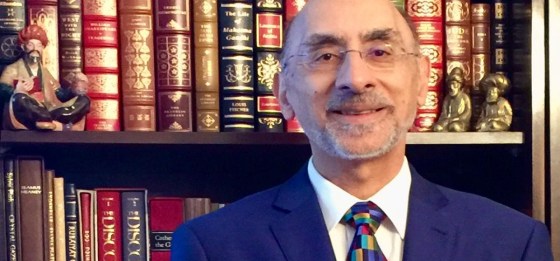
M. Ali Lakhani, QC, graduated from Cambridge University and has been practising as a barrister in Vancouver for the last forty years. Interested in applying metaphysics to modern world issues, in 1998 he founded Sacred Web: A Journal of Tradition and Modernity, a leading journal in the field that has published articles by the Prince of Wales, the Dalai Lama, Karen Armstrong, Huston Smith, Seyyed Hossein Nasr and William C. Chittick, among others. Mr. Lakhani’s book Faith and Ethics: The Vision of the Ismaili Imamat has been featured in Simerg’s special series on books by Ismaili authors.
__________________
Before departing this website, please take a moment to review Simerg’s Table of Contents for links to hundreds of thought-provoking pieces on a vast array of subjects including faith and culture, history and philosophy, and arts and letters to name a few. Also visit Simerg’s sister websites Barakah, dedicated to His Highness the Aga Khan, and Simergphotos.The editor may be reached via email at mmerchant@simerg.com.
We have learnt with immense sadness, through an obituary posted in Vineyard Gazette, that Thomas M. Payette, FAIA, renowned Cambridge architect and founder of Payette Associates, died on November 12, 2022, at the age of 90.
Raised in East Grand Rapids in Michigan, Tom studied at Michigan State University, where he received a degree in structural engineering. He married Ginny, his sweetheart from his grade school years, in 1954 and they moved to Cambridge, where Tom attended the Harvard Graduate School of Design. He received his Master’s in Architecture in 1960.
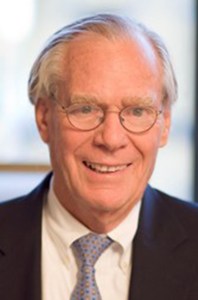
Thomas Payette (d. November 22, 2022), designed Aga Khan University
The obituary in Vineyard Gazette notes that, after graduating, Tom began working at Markus and Nocka. By 1965, he became president of the firm. It would later become Payette, an international design firm of more than 150 people. His selfless leadership and passion guided Payette into what it is today: an award-winning firm known for its leading design in hospitals, laboratories and universities. Included in its notable work is the Aga Khan Medical Center in Pakistan.
Over the three decades since its initial conception and planning, the Aga Khan University has withstood the test of time, growing and adapting to accommodate new emergent technology, political turmoil and cultural changes….A major force in the heart of the developing world of South Asia, the University represents both a link to the great Islamic academic traditions of the past and a bold, progressive action aimed at providing education and healthcare services to people in Pakistan and the surrounding region
JENNIFER HEGARTY, March 2019
In a short but illuminating piece published on the firm’s website under the title #PayetteForward: Our Roots with Aga Khan, Jennifer Hegarty notes the firm’s association with the Aga Khan University as follows:
“Our 30-year relationship with Aga Khan University has been a cornerstone of the firm we are today, a firm recognized by the AIA with the 2019 Architecture Firm Award. We are proud of the legacy of work we have produced and continue to develop with the Aga Khan University — which was the first of many fruitful international relationships in our portfolio.”
In her post, Jennifer also refers to the original master plan for the Aga Khan University and Thomas Payette’s continuous involvement with the institution in the ensuing years “to furthering the original vision through over 30 years and several master plan updates, keeping their pledge to the founders not only to keep the University true to cultural values, but to recognize the needs of the region in educating young people in the science of medicine and the care of patients.”
We invite our readers to learn more about Thomas Payette’s unique and extraordinary role in the design of the Aga Khan University by reading the following three illustrated pieces on the firm’s website:
Our readers join us in conveying our sincere condolences to all the members of the Payette family. In particular, our Ismaili readers will always remain grateful to Thomas M. Payette for playing such an important role in the planning, design and development of one of the most significant and cherished projects in the life of their beloved 49th Hereditary Imam, Mawlana Hazar Imam, His Highness the Aga Khan.
Date posted: November 23, 2022.
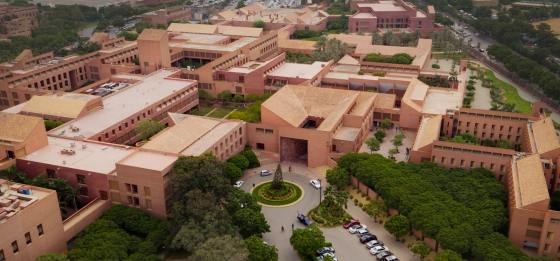
Featured photo at top of post: A view of the Aga Khan University, Karachi. Photograph: AKDN.
______________________
Before departing this website please take a moment to review Simerg’s Table of Contents for links to hundreds of thought-provoking pieces on a vast array of subjects including faith and culture, history and philosophy, and arts and letters to name a few. Also visit Simerg’s sister websites Barakah, dedicated to His Highness the Aga Khan, and Simergphotos.
The.Ismaili, the official website of the Ismaili Muslim community, recently started a series on the beliefs and practices of the Ismailis. We invite all our readers, Ismailis and non-Ismailis alike, to read the following articles published in the series so far:
If I am not mistaken, the Ask Me Anything (AMA) program has been active in Canada for quite some time — I have heard announcements in Jamatkhanas going back to pre-Covid-19 times — and I wonder how many Jamati members with questions pertaining to faith, beliefs and traditions have sought to seek answers to questions that have been or are on their minds. How much interaction, if any, is there between Jamati members today, and especially the youth, and those who are best equipped to answer their questions?
As a son of an Alwaez (Jehangir Merchant, d. 2018), who was also a religious education teacher, I recollect the frequency with which he was approached by members of the Jamat with questions, whether it was in Mozambique, Tanzania, Canada, the UK and in countries where he went for sermon duties. Often individuals would approach him in the Jamatkhana as he was about to depart but he patiently took his time to respond to the question. Both he and my mum (Mrs. Merchant, d. 2021) considered their students and members of the Jamat at the centre of their lives.
Of course, as a secondary school teacher, my dad would always engage in Q/A discussions with his students. If he did not have an answer, he would tell the students so and seek out a good and satisfactory response by conducting his own research or consulting with one of his learned colleagues. A leader of an Ismaili institution in Canada, in his tribute to my dad, wrote: “In the passing away of Alwaez Jehangir Merchant I have lost a confidant, a friend and a source of knowledge and wisdom that I will greatly miss. He was my Go-to person for Tariqah matters and was always willing to share.”
Often my parents would welcome Jamati members, young and old alike, to our homes to discuss religious issues and other personal and family matters that often required more time.
In my humble opinion, one of the most brilliant minds in my dad’s friend circle in Dar es Salaam was no other than Hassanali Bhaloo from Zanzibar, whose nickname was Din. A regular visitor to our home, he was an intellectual of the highest caliber, and although not a missionary, could take on any question on faith, science or ethic and answer it satisfactorily. He was also an outstanding Ginan reciter and watching him recite one in Jamatkhana would leave one with the impression he was in a heavenly realm.
On many occasions, the tone of questioning, especially on the part of youth, was harsh and while that would raise my dad’s eyebrows, Din would always respond with calmness and thoughtfulness that left the questioning student(s) with wonder and amazement. A very humble man, Din’s intellectual brilliance was recognized at a young age, and he was offered to study in one of America’s top schools upon completing his high school education. Alas, he had to forego the opportunity due to an untimely death in his family that forced him to attend to family matters for a number of years. He eventually joined the services of the Ismailia Association in Dar es Salaam, Tanzania, after the mid 1960’s and worked with my dad on many projects. My dad even placed me in his good hands to strengthen my religious knowledge, a few months before I departed Dar es Salaam.
Article continues below
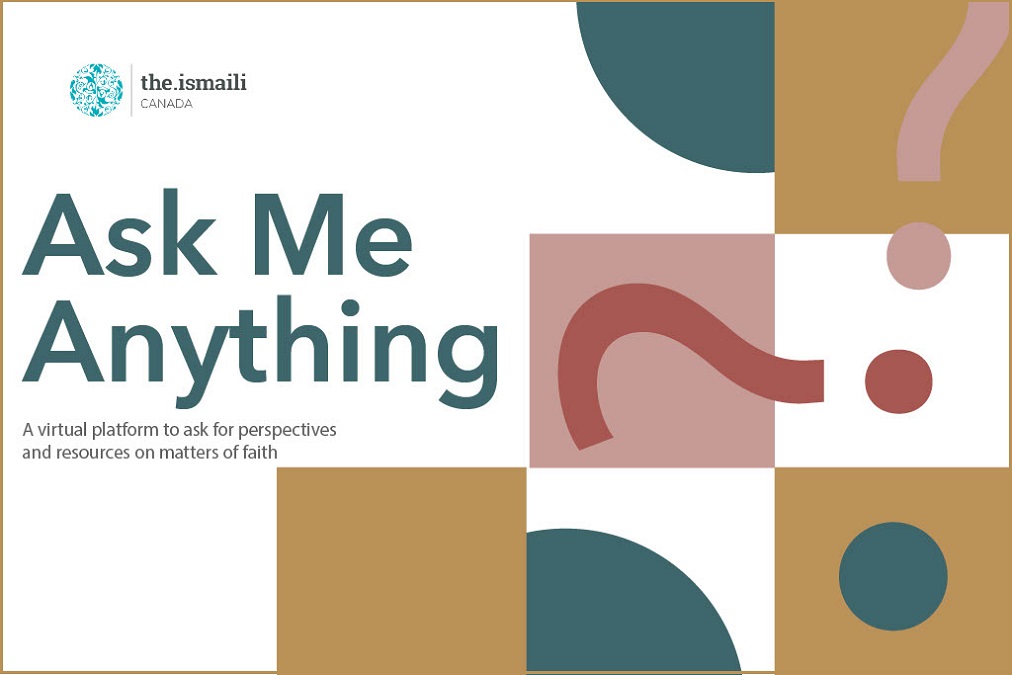
Ask Me Anything image in the Al-Akhbar newsletter published in Canada.
Like Din in Dar es Salaam, we have many brilliant minds in the Ismaili Muslim community (Jamat) today who are highly qualified as ethicists, scientists as well as in Islamic and Ismaili studies as missionaries and scholars. I sincerely hope that the AMA team will revert to the right individuals to give direction to individuals who come forward with their questions or concerns, and not necessarily restrict the asking of questions only to the Waezeen, as the Al-Akhbar announcement reads.
The announcement about the Ask Me Anything program, dated November 6, 2022, appears in the latest two issues of the Al-Akhbar newsletter which is distributed among subscribers to announce local as well as national programs and events organized by Ismaili institutions which are of benefit to the Jamat. The announcement in Al-Akhbar is reproduced below and reads as follows: (please also read it at SOURCE)
“Have a question on faith that you need clarity on? The Ask Me Anything program is here to help. Do you need more guidance or resources on questions about the faith? The Ask Me Anything (AMA) program provides an accessible and virtual medium to ask a Waezeen for perspectives or resources on faith-based questions. Book a session either one-on-one or as a group (up to 5) to address questions on faith in a non-judgmental and safe space. Sign-up for spots are available for Saturday, November 26 or Sunday, November 27.”
My inspiration for writing this post comes from Mawlana Hazar Imam’s guidance that he gave to the students during his visit to Mombasa, Kenya, on October 4, 1959. Referring to the memorization of the Qur’an and Ginans, Mawlana Hazar Imam said:
“These pieces of memorization are good, and they are necessary in practice, but at the same time I want you to be able to understand your religion. And if there are any questions do not hesitate to ask. It is much better to ask and receive an answer than to have a feeling of frustration inside you.”
Thus, in keeping with Mawalana Hazar Imam’s wish, please do not feel reluctant to approach the Ask Me Anything program with your question. Please visit Al-Akhbar for further information and to register or click REGISTER for the next Ask Me Anything session go be held on November 25/26, 2022.
Date posted: November 13, 2022. Last updated: November 15, 2022 (reformatting and link error.)
___________________
If you are a Canadian resident and have a question, please click REGISTER for a follow-up meeting with an Alwaez as mentioned in the announcement. The Ask Me Anything program is an Ismaili institution initiative, and NOT a Simerg project. If you live outside Canada, please consult your local Ismaili newsletter to find out if a program such as the one offered in Canada is available in your country.
Before departing this website please take a moment to review Simerg’s Table of Contents for links to hundreds of thought-provoking pieces on a vast array of subjects including faith and culture, history and philosophy, and arts and letters to name a few. Also visit Simerg’s sister websites Barakah, dedicated to His Highness the Aga Khan, and Simergphotos.The editor may be reached via email at mmerchant@simerg.com.
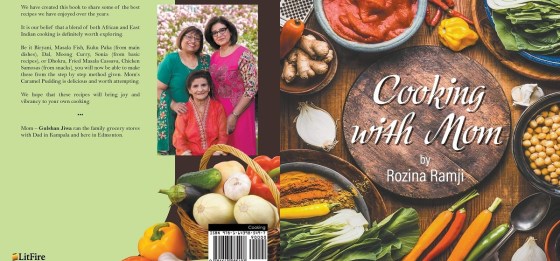
“Be it briyani, masala fish, kuku paka (from main dishes), dal, moong curry, sonia (from basic recipes), or dhokra, fried masala cassava, chicken samosas (from snacks), you will now be able to make these from the step-by-step method given. Mom’s Caramel Pudding is delicious and worth attempting” — Excerpt from back cover, “Cooking with Mom”, by Rozina Ramji
Simerg: What is behind the naming of the title of the book?
Rozina Ramji: To leave a legacy of my Mom’s cooking which the family has enjoyed for decades. Cooking has been a big part of our family culture and I have memories of the ladies (Grandmas, Aunts, and Mom) all cooking together, sharing techniques and conversing with each other. The cookbook was to cook with Mom and sharing time with her. I didn’t want to lose Mom’s recipes. The book is a great way to thank Mom and honour her and, thus, the title “Cooking with Mom.”
Simerg: Why would you want me or my family members to read the book, and what will we all learn from it?
Rozina: You’ll learn about the key recipes from African/Indian blend as well as common foods that are usually served in most homes that come from East Africa. With the step-by-step method to the recipe and the photos, anyone wishing to cook will easily create it.
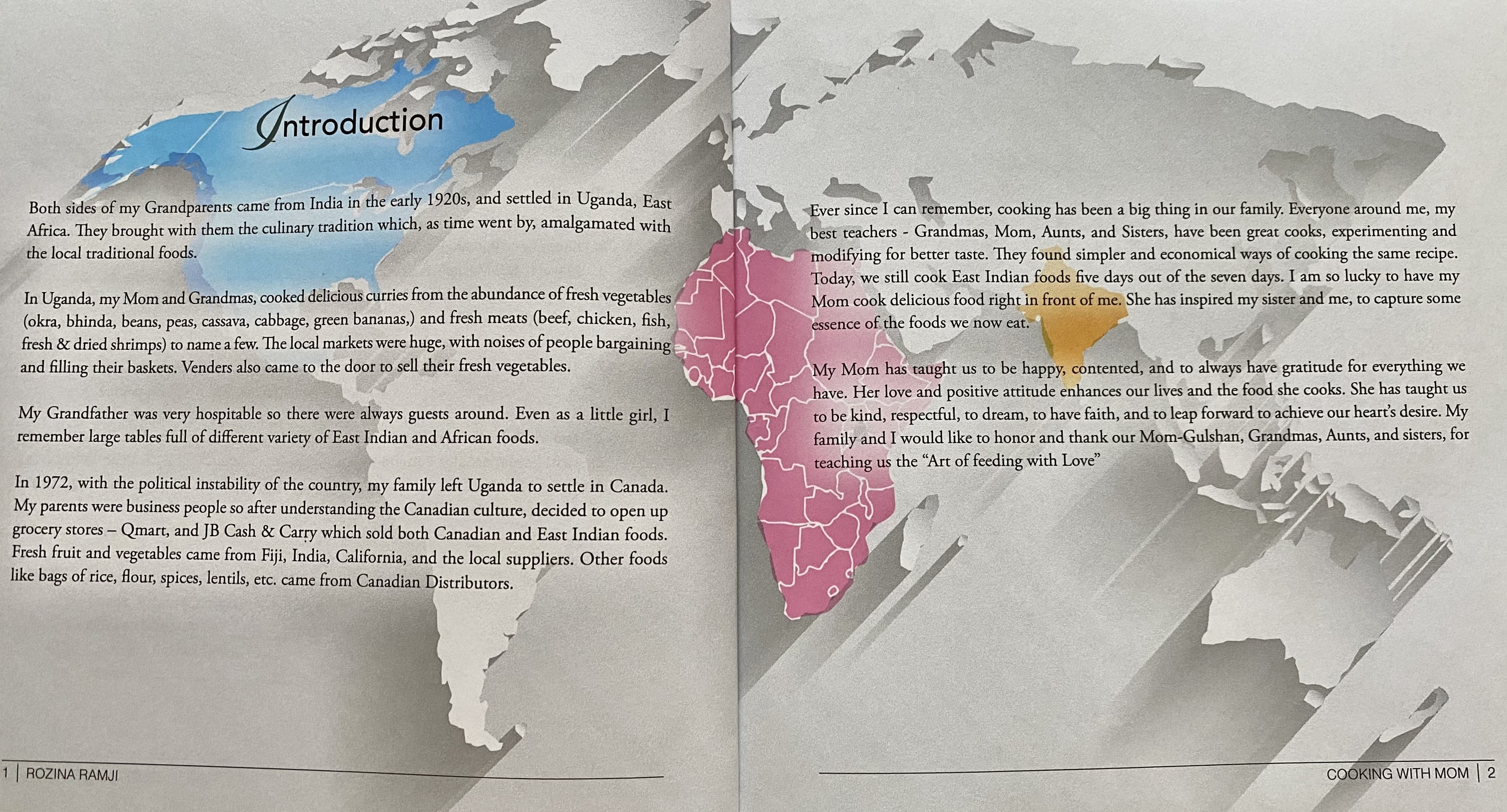
[The editor recommends that readers read Rozina Ramji’s beautiful and inspiring introduction to “Cooking with Mom” – see image, below, and click on it for enlargement]
Rozina Ramji’s introduction to “Cooking with Mom.” Photograph: Rozina Ramji, Edmonton. Please click on image for enlargement
Simerg: What inspired you to write Cooking with Mom?
Rozina: I remember my son and daughter asking me to make chicken samosas and shrimp curry that my Mom makes. I realized that it didn’t turn out like Mom’s. It’s at that point I decided I wanted to cook with Mom and learn about the ingredients, the steps to each recipe and any tips and tricks she could share.
In this way and with the backing of my children and other younger members of my family, I decided to write Cooking with Mom. It is fully illustrated, and I think even novices and those who find cooking somewhat daunting will be inspired to start cooking with the recipes I have provided in the book. I also invite expert cooks who specialize in other forms of cooking — Canadian, North American as well as ethnic — to explore and to try some of recipes that I have provided.
~~~~~~~~~~~~~~~
Article continues below
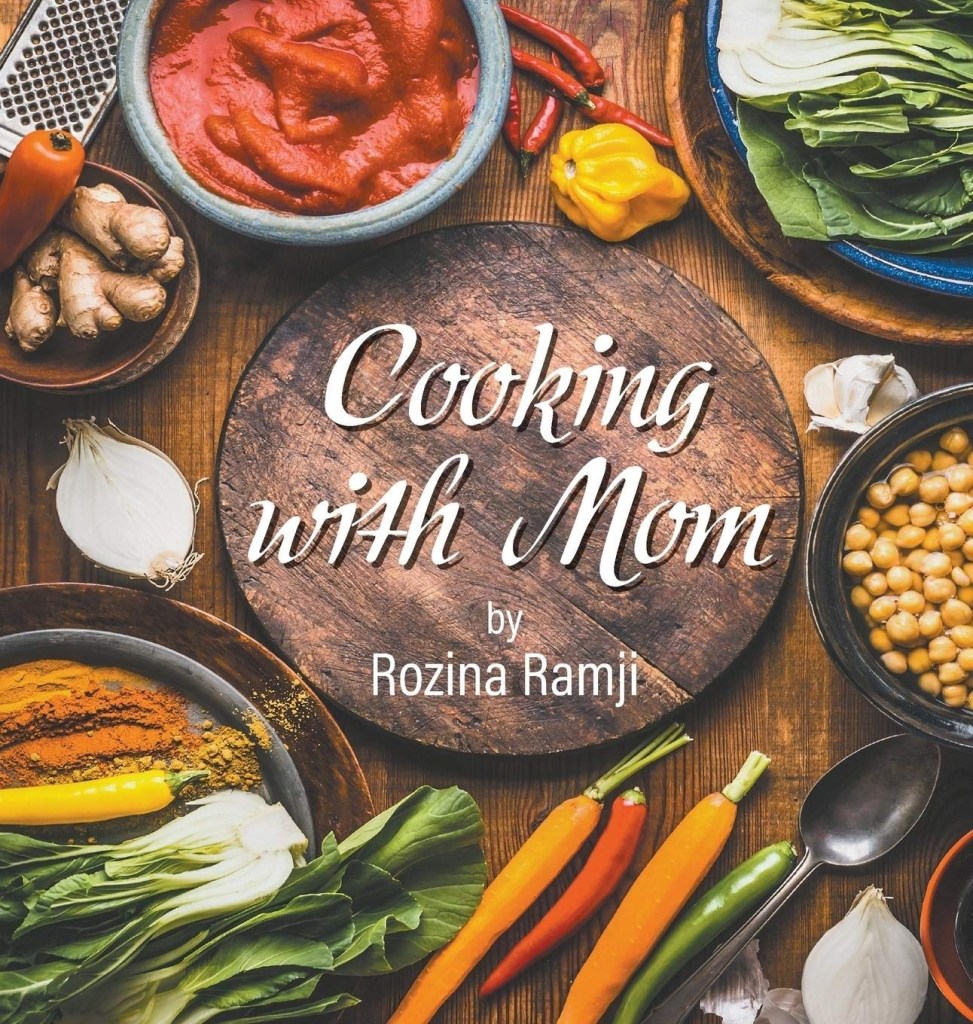
Cover page of Rozina Ramji’s book “Cooking with Mom.” Published by Litfire, September 2018, 122 pp. Available as paperback and hardcover.
Praise for Cooking with Mom
“The Cooking with Mom cookbook is one of the most interesting in my home library! The recipes are easy to understand, and the pictures are very helpful; they depict not only the finished dishes but also key steps in the preparation process. Packed with 41 recipes, the book is divided into 7 categories covering the gamut of Indian cuisine: main dishes, curries, rice dishes, east Indian bread, snacks, sweet things and drinks. I love the chicken biryani and my husband is wild about this particular recipe. My husband is not the most proficient person in the kitchen, but he did a credible job with the kheer (rice pudding.) We both enjoy Indian food and can’t wait to try out more of the recipes. Whether you’re an accomplished meal maker or a just a novice starting out in Indian cuisine, you won’t go wrong with this book!” — Joan Sinclair
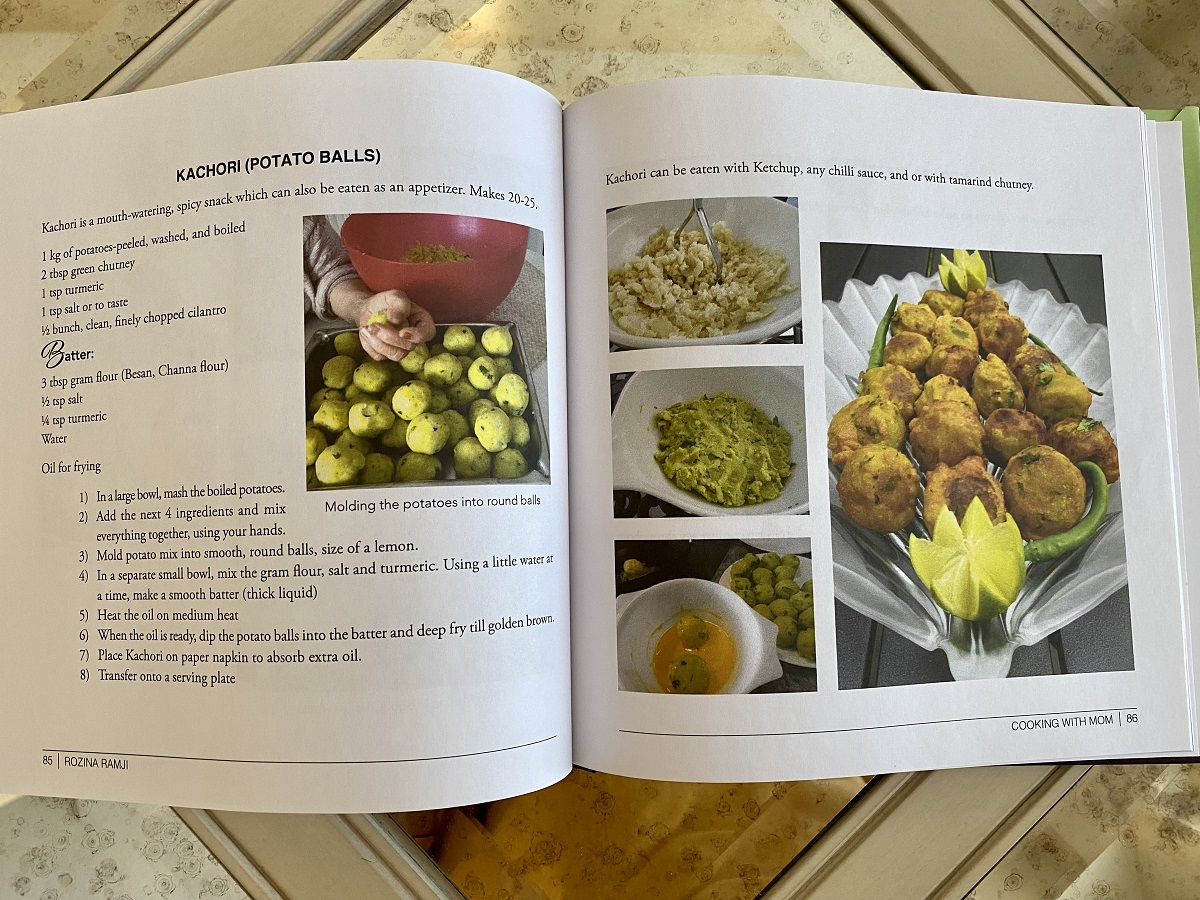
A 2-page spread from Rozina Ramji’s “Cooking with Mum” illustrating how to make the famous East African kachori (potato balls). Photograph: Rozina Ramji, Edmonton.
~~~~~~~~~~~~~~~~~~~~~~
Simerg: How can I purchase the book and what are its available formats?
Rozina: First of all, Cooking with Mom can be ordered directly from the publisher Litfire. You can also acquire it from major on-line stores such as Amazon, Indigo and Barnes and Nobles, among many other booksellers. The book is available both in paperback and hardcover.
Simerg: How did you find a publisher for the book?
Rozina: I was making inquiries about publishing and happened to talk to someone from LitFire publishing. They were very encouraging and told me about the support they provide. I felt comfortable.
Simerg: Did you hire an editor, an illustrator or did you do all the work by yourself?
Rozina: While I was cooking with my Mom, I took photos of everything and wrote down every recipe. Then the family tried to create food while following the recipe and asked questions. In this way, I tried my best to perfect the steps. My sister Bilkis along with my husband Alnasir helped with the book’s editing.
Simerg: Which was your first book and how many have you written?
Rozina:Cooking with Mom is my first book. I would love to write a sequel with other delicious recipes not included in the first.
Simerg: How long did it take you to write Cooking with Mom from start to finish and to begin marketing it?
Rozina: It took a year. I had been wanting to write a cookbook with Mom for several years but this dream only materialized in 2018.
Simerg: Tell us something more about your book.
Rozina: The cookbook has mouthwatering recipes that are not difficult to make like biryani, masala fish, dal, vegetable curries and then snacks like chicken samosas, dhokras, kebabs, sweet thaplas etc. Some drinks that are popular like kadho, lassi, sherbets and masala chai are also included. This is a book everyone will be able to follow, and those who do not cook will say that they now love to cook.
Date posted: November 11, 2022.
_______________
Get your own copy of Rozina Ramji’s Cooking with Mom. Order it from the publisher Litfire or other major on-line stores such as Amazon, Indigo and Barnes and Nobles. We welcome feedback from our readers. Please click LEAVE A COMMENT. Your letter may be edited for length and brevity and is subject to moderation.
_______________
ABOUT THE AUTHOR
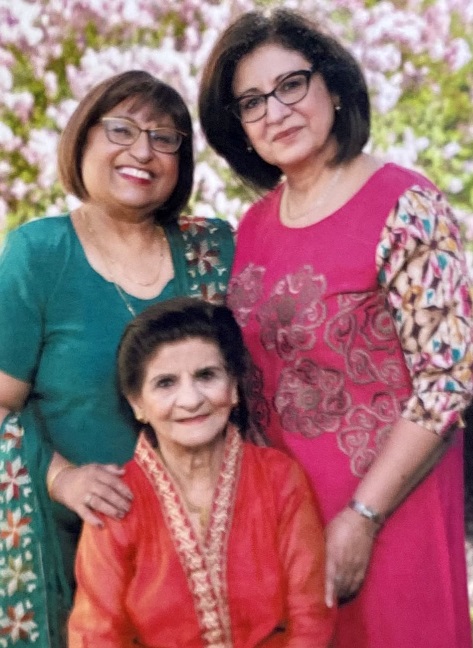
Rozina Ramji (left), and sister Bilkis Jiwa with their mom Gulshan Jiwa (centre).
Born and raised in Uganda, Rozina Ramji was pursuing her higher secondary education in the UK, when her parents, Pyarali and Gulshan Jiwa, were forced to flee Uganda following Idi Amin’s 1972 decree expelling South Asians from the country. Rozina’s parents settled in Edmonton and went on to open grocery stores that, among other items, sold ethnic groceries from around the world. Rozina joined her parents in Edmonton in 1973 and pursued a degree majoring in Education at the University of Alberta. She then commenced a long career in teaching with the Edmonton Public School Board, where she taught general subjects as well as math/science to students from SK to Grade 12. At the same time, she became engaged within her Ismaili Muslim community by volunteering in Ismaili institutions in numerous capacities, including giving Baitul Ilm (BUI) classes to Ismaili children and youth. Also, Rozina and her husband Alnasir were appointed to officiate as Kamadiani and Kamadia of the Edmonton Ismaili Headquarters Jamatkhana. She has two children; her son is a doctor while her daughter has completed her master’s program in Dispute Resolution. Indeed, it was at her children’s insistence that Rozina decided to write “Cooking with Mom” and she remains grateful to them for their inspiration.
______________
Calling all Ismaili Authors
We encourage Ismaili writers to introduce their books in a similar format as has been done in the post above. Please also see the series launch article and submit your responses to Malik at mmerchant@simerg.com. All submissions will be acknowledged. If a writer has published multiple books, each book will be highlighted in a separate article, and not combined with other books into one post. All writers should include a brief profile with a portrait photo.
_______________
Links to the Ismaili Authors’ Series (in chronological sequence, oldest article first):
Before departing this website please take a moment to review Simerg’s Table of Contents for links to hundreds of thought provoking pieces on a vast array of subjects including faith and culture, history and philosophy, and arts and letters to name a few. Also visit Simerg’s sister websites Barakah, dedicated to His Highness the Aga Khan, and Simergphotos.
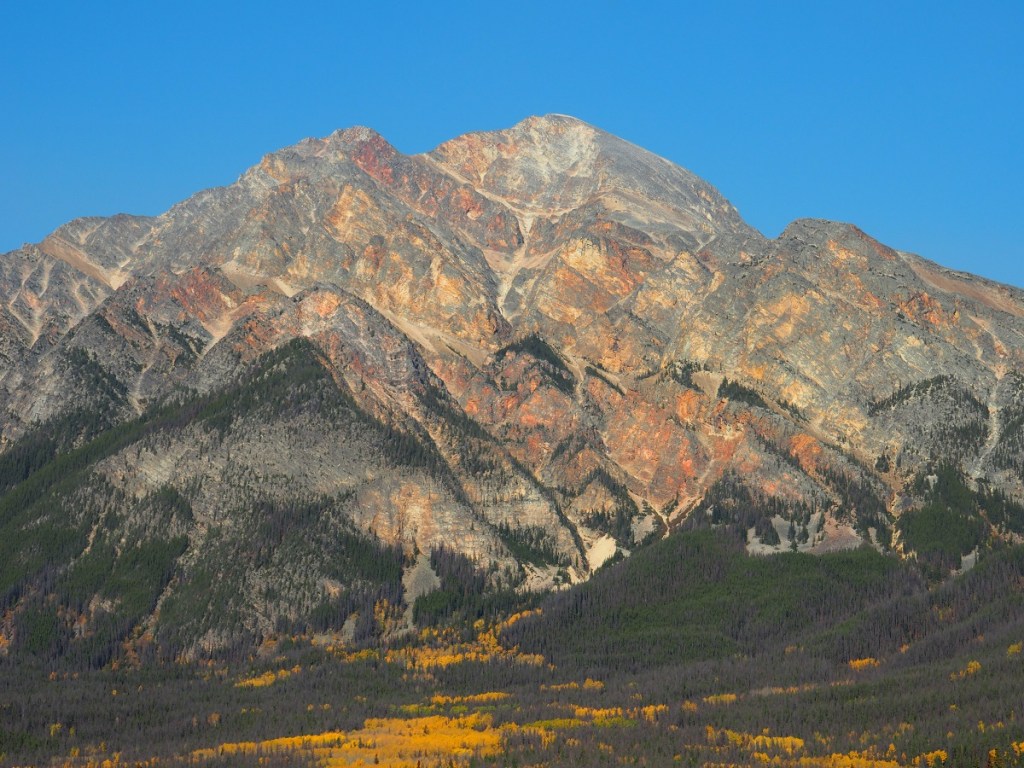
I fell in love with Pyramid Lake and the Pyramid Mountain behind it the moment I saw it on October 17, 2022. I kept going to it every day I was in Jasper, but nothing could be as breathtaking than being at the site on a dark clear night during Jasper’s annual Dark Sky Event. On October 18, I stood next to Ron Richey as he focused his lens into the sky and photographed the Milky Way and all the millions of stars above the Lake. I am pleased to share his photographs on Simergphotos. Do not miss this incredible awe-inspiring view of our universe by Ron, an avid photographer and a passionate lover of nature. And remember he took the photos in Jasper, the 2nd largest Dark Sky Preserve in the world. So, you can imagine!
Our Milky Way, stretching 1000,000 light years across and 13.6 billion years of age. Please click on photo for Ron Richey’s stunning photographs.
Date posted: November 1, 2022. Last updated: November 6, 2022 (as a repost.)





 Simerg - Insights from Around the World