
By Malik Merchant
Publisher-Editor, www.simerg.com

Crazy Horse Memorial is a tribute to the culture, tradition and living heritage of American Indians and the spirit of the legendary Lakota leader, Crazy Horse. Sculptor Korczak Ziolkowski began carving the world’s largest ongoing carving in 1948. Today his family and the Crazy Horse Foundation continue the dream and work on the sculpture that will stand 641 feet long and 563 feet high when completed. Photo: Malik Merchant. © Simerg.com.
One of the better investments I made during my recent 4,500 km road trip from Toronto to Vancouver, via the USA, was the purchase of the 2013 edition of Rand McNally’s Road Atlas (RMRA) at an Esso gas station just as I reached the U.S border in Sarnia, Ontario. This and a basic Garmin GPS system purchased a few hours earlier in Toronto became my best companions for the my eighteen-day trip. Who says state of the art and traditional guides won’t mix? The worthy RMRA helped me with my trip from Minneapolis onwards (still a few days away as my first stop would be in Chicago), while the GPS ensured I stayed on a correct course all the time, or each time I felt it had erred – sure enough it had not. A couple I encountered told me that they treated electronic gadgets such as the GPS with some apprehension after they had once been instructed to follow a path that reached a dead-end, with a brick-home staring at their faces. I am convinced, however, that technology more often than not, has to be trusted and is your friend.

Beautiful Sylvan Lake holds the designation as Custer Sate Park’s crown jewel. The lake was created in 1881 with the building of a dam across Sunday Gulch. Photo: Malik Merchant. © Simerg.com.
In my first post, I provided an overall sketch with a few photos of the first few days of my trip that included sightseeing in Chicago, Minneapolis, Mitchell, Rapid City and Badlands National Park. In Minneapolis, following a Minnesota Twins match-up against the Oakland A’s, I settled into my room and opened the invaluable atlas for the first time. My original plan from the Twin Cities was to head North-West to Glacier National Park, and cross into Canada to visit the sister Waterton National Park. Then, I would spend a few days in Calgary, before driving to Vancouver where my parents eagerly awaited me. Apparently, this 2013 edition of the Atlas, like the previous editions, had brief write-ups about America’s best voted small towns in different categories such as “most patriotic”, “most beautiful” and so on. The readers’ choices in the 2013 edition included Rapid City in South Dakota and Sandpoint in Idaho. I also noted that Badlands National Park was in South Dakota, and not too far off. I love National Parks and saw some good reviews of Badlands on Tripadvisor.

Spectacular needle like granite formations on the Needles Highway. The Highway began attracting public attention when it was completed in 1922. Like past years, visitors continue to drive the narrow roadway to revel at its natural beauty and admire its engineering feat. Photo: Malik Merchant. © Simerg.com
I decided to go with the recommendations in the Atlas, but first things first. I consulted with my aging parents. While my mum was worried that I would reach Vancouver later than my original arrival date, I could clearly hear my dad’s voice telling my mum, “Tell him not to rush, let him take his time and ask him not to worry,” although he was the one who was unwell. He had gathered what we were talking about. Should I trust dad? I was apprehensive and could sense some anxiety in my mum, but she acquiesced to my dad’s repeated “not to worry” call-outs! He ultimately came on the phone and had me moving along in the new direction. Consequently, I ended up visiting places that I had never imagined I would visit on this trip, or for a few years at least.

A view of the Mount Rushmore National Memorial from the Grand View Terrace following the Evening Lighting Ceremony. Photo: Malik Merchant. © Simerg.com
I have to salute the builders of the incredible towns and monuments as well as the founders, keepers, trustees, and supporters of USA’s magnificent State and National Parks System. Of course, my gratitude to Rand McNally for its special feature in the Atlas. The book is still intact and in great shape, thanks to the GPS that took care of the exits and the ramps by constantly guiding me, “Turn right on X Street, then take the ramp on the left….then drive 194 miles to Exit 34b.” Thank you! And thanks to the readers for their responses to my first post, especially after WordPress “Freshly Pressed” it. For newbies to my website, please read the first post (later!, after you have seen this one) by clicking Scenes from America by Malik Merchant. I invite everyone to also see the links at the end of this piece describing my visit with my daughter to Yellowstone and Grand Teton National Parks as well as Salt Lake City.
~~~~~~~~~
SOUTH DAKOTA AND ITS BLACK HILLS

A panoramic view of the Black Hills from the Mount Rushmore Memorial. Among its many attractions, Black Hills offers visitors the Mount Rushmore and Crazy Horse Memorials, the Jewel Cave National Monument, the Custer State Park, Scenic Byways as well as historical towns such as Sturgis, Deadwood and Keystone. Photo: Malik Merchant. © Simerg.com
South Dakota is a State with a diverse landscape decorated with rolling plains and the majestic mountain range known as “The Black Hills”. The State is also home to around 62,000 Dakota, Lakota or Nakota Native Americans. The name “Black Hills” is a translation of the Lakota Pahá Sápa. The hills were so-called because of their dark appearance from a distance, as they were covered in trees. Locals tend to divide the Black Hills into two areas: “The Southern Hills” and “The Northern Hills”. My focus is going to be on three major attractions in “The Southern Hills” which I visited in the following order – the Crazy Horse Memorial and Needles Highway on my first full-day at a nice town called Keystone, and the Rushmore National Memorial on my second full day. In fact Keystone’s proximity to Rushmore has given it the honourable title “The Home of Mount Rushmore.”
~~~~~~~~~~~~~~~~
CRAZY HORSE MEMORIAL – A TRIBUTE TO THE NATIVE AMERICANS
“My lands are where my dead lie buried,” replied Crazy Horse when asked, “Where are your lands now?”
The Sculptor’s Vision

Korczak Ziolkowski’s famous Crazy Horse 1/34th scale model sits majestically on the viewing veranda. In the model, the left hand of Crazy Horse is thrown out pointing in answer to the derisive question asked by a white man, “Where are your lands now?” Crazy Horse replied, “My lands are where my dead lie buried.” The final carving when completed is to be carved not so much as a lineal likeness but more as a memorial to the spirit of Crazy Horse to his people. Photo: Malik Merchant. © Simerg.com
~~~~~~~~~
A Work in Progress

A panoramic view of the 563-foot-tall granite sculpture of the iconic Native American leader, Crazy Horse, who defeated Custer at Little Bighorn in 1876. The scale of this work in the Black Hills of South Dakota is mind-boggling. Still in the making, when finished, the sculpture will be the world’s largest mountain carving – dwarfing such monuments as the Great Pyramid of Giza and the Statue of Liberty. In fact, all four of Rushmore’s presidents will fit inside Crazy Horse’s 87.5-foot-tall head. Photo: Malik Merchant. © Simerg.com
The finished work will depict Crazy Horse astride his horse, pointing to his sacred Black Hills. The sculpture will be 563 feet high and 641 feet long. It will be taller than the Washington Monument and almost twice the size of the Statue of Liberty. It’s so big that all four presidents from Mount Rushmore – see photos below – could fit inside Crazy Horse’s head. The project began on June 3, 1948. Sculptor Korczak Ziolkowski worked mostly on the face before his death in 1982 at age 74. Family members completed the face. There is no estimate of when the sculpture will be done. Ziolkowski initially thought he could do it in 30 years. Even as a work in progress, the more than one million visitors to Crazy Horse is a testimony to the growing interest in Native American themes. Crazy Horse has already become a must-see counterpart to Mount Rushmore National Memorial, fifteen miles away.
~~~~~~~~~
The Completed Face of Crazy Horse

Crazy Horse was born in South Dakota’s Black Hills in 1842. While at Fort Robinson, Nebraska, under a flag of truce, he was stabbed in the back by an American soldier and died September 6, 1877 at the age of 35. Crazy Horse Memorial in the Black Hills is one of South Dakota’s most notable destinations. Lakota leaders invited Korczak Ziolkowski, a New York sculptor, to create the Memorial in the heart of an area considered sacred by many tribes. The elders chose the symbolic representation of famed Little Bighorn leader Crazy Horse to honour all North American Indian people and proclaim “the red man has heroes also.” The 90 foot tall face of Crazy Horse was unveiled in 1998. Photo: Malik Merchant. © Simerg.com
~~~~~~~~~
The Museum, Veranda, Cultural Centre and Sculptor’s Log Home at Crazy Horse Memorial
“Prayer to the Great Spirit”
Oh Great Spirit, giver of all life;
You have been always, and before you nothing has been.
Look and smile upon us your children, so that we may live this day to serve you.
Watch over my relatives, the red, black, white and brown.
Sweeten my heart and fill me with light this day.
Give me strength to understand and the eyes to see.
Help me great spirit, for without you, I am nothing.” ….Paul War cloud [1]
~~~~~~~~~

A panel display in one of the 3-wings of the Indian Museum of North America, part of the larger complex of buildings at the Crazy Horse Memorial. Some of the panels show historical letters pertaining to Crazy Horse, one of them describing how the Native Indian leader met his ultimate fate at the hands of an American soldier at age 35. Photo: Malik Merchant. © Simerg.com
~~~~~~~~~~~

Historical pieces at the excellent Native American Cultural Centre at the Crazy Horse Memorial Centre. Photo: Malik Merchant. © Simerg.com
~~~~~~~~~~~

The Native American Cultural Center is part of a suite of buildings at the Crazy Horse Welcome Centre. It is on two levels and is visited by artisans from many tribes to exhibit their works. The centre also show cases historical artifacts. Other facilities at the impressive welcome centre include gift shops, theatres, an orientation center, the Laughing Water Restaurant which features excellent Native Indian meals, and the Sculptor’s log studio-home. Photo: Malik Merchant. © Simerg.com
~~~~~~~~~~~

Portraits of the late sculptor, Korczak Ziolkowski, and his surviving wife Ruth at the sculptor’s log studio-home which is furnished with many antiques and fine works of art. Even though the original sculptor, Korczak Ziolkowski, died in 1982, the work to complete Crazy Horse as envisioned by the sculptor continues even through present day. Photo: Malik Merchant. © Simerg.com
~~~~~~~~~~~
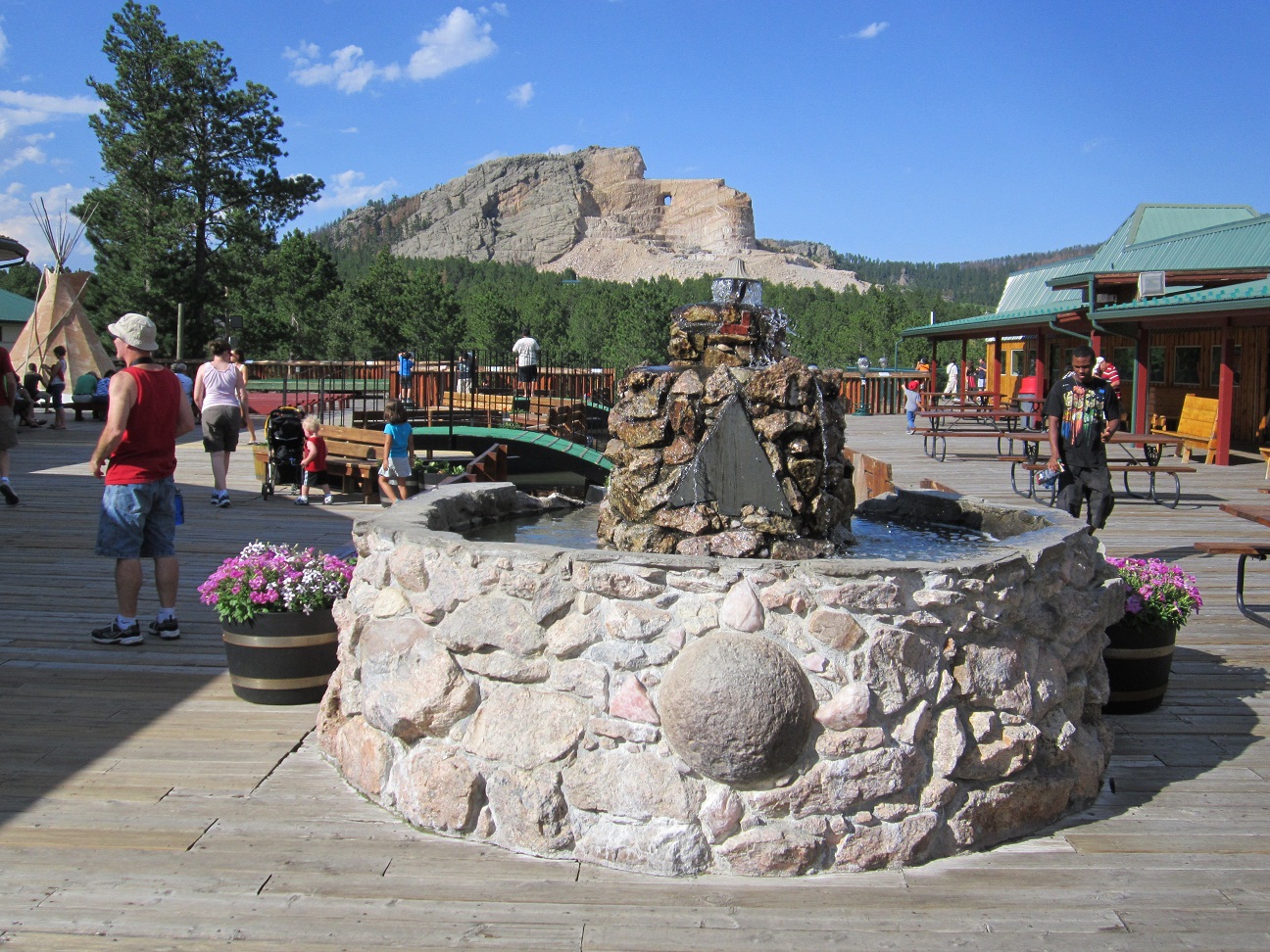
A view of Crazy Horse from the veranda of the Crazy Horse Memorial complex. The carving is still in progress, and one can watch the drillers and bulldozers at work, as well as experience the rumble of explosives shaping the world’s largest emerging mountain sculpture. Photo: Malik Merchant. © Simerg.com
~~~~~~~~~~~

For a nominal fee bus tours will take tourists to the base of the Crazy Horse Sculpture. Here I am pictured with a guide who is truly passionate about the Memorial. His knowledge about the Black Hills and accounts about the Native Indians made my 30 minute trip a truly enjoyable one. Crazy Horse Memorial is a tribute to the culture, tradition and living heritage of American Indians and the spirit of the legendary Lakota leader, Crazy Horse. Sculptor Korczak Ziolkowski began carving the world’s largest ongoing carving in 1948. Today his family and the Crazy Horse Foundation continue the dream and work on the sculpture that will stand 641 feet long and 563 feet high when completed. Photo: Malik Merchant collection. © Simerg.com
~~~~~~~~~~~
NEEDLES HIGHWAY – A SCENIC WONDER WITH A BEAUTIFUL LAKE AND MAGNIFICENT GRANITE FORMATIONS
From Crazy Horse Memorial, to return to the town of Keystone, I took the Needles Highway, part of the Peter Norbeck Scenic Byway in the Black Hills National Forest of Custer State Park. The 14 mile drive on the highway, named after the needle-like granite formations which seem to pierce the horizon along the highway, took me first to the scenic Sylvan Lake before I was challenged with hairpin turns and narrow tunnels. Of course I followed Norbeck’s admonition, “You are not supposed to drive here at sixty miles an hour. To do the scenery half-justice, people should drive twenty and under.”
A maze of spectacular granite formations, reminiscent of needles and cathedral spires, was the highlight of this fascinating drive through a forest also cloaked in ponderosa pine, birch, bur oak, Black Hills spruce and several willows. The Needles Highway began attracting public attention when it was completed in 1922. Like past years, visitors continue to drive the narrow roadway to revel at its natural beauty and admire its engineering feat.
The Needles and Cathedral Spires in Custer State Park offer some of the best climbing routes in the country. Rock climbers travel from around the world to challenge the nearby formations.
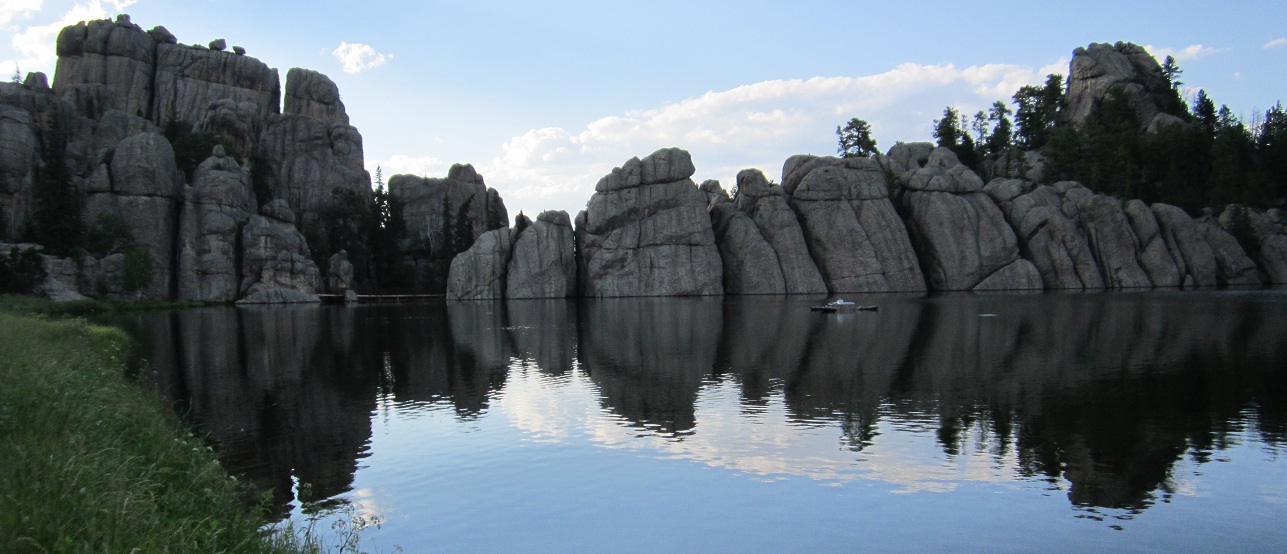
A stunning view of the Sylvan Lake, which holds the designation as Custer Sate Park’s Crown Jewel. Photo: Malik Merchant. © Simerg.com.
~~~~~~~~~~~

One of the several trails around Sylvan Lake. The trail is worth taking because it offers close-ups of the rock formations in the lake. The lake was created in 1881 with the building of a dam across Sunday Gulch. Photo: Malik Merchant. © Simerg.com
~~~~~~~~~~~
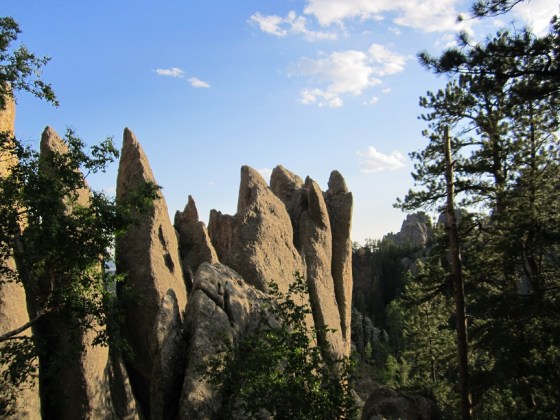
The Needles Highway gets its name from the needle-like granite formations which seem to pierce the horizon along the highway. The rock was formed underground from magma (liquid rock). The rock then pushed upward over millions of years, cooling very slowly. Photo: Malik Merchant. © Simerg.com
~~~~~~~~~~~

A unique rock formation called the Needle’s Eye, so named for the needle like opening created by wind, rain, freezing and thawing. Photo: Malik Merchant. © Simerg.com
~~~~~~~~~~~

A youth proudly takes a picture of his mum’s car as she successfully negotiates the narrow tunnel adjacent to Needle’s Eye, pictured above. Photo: Malik Merchant. © Simerg.com
~~~~~~~~~~~
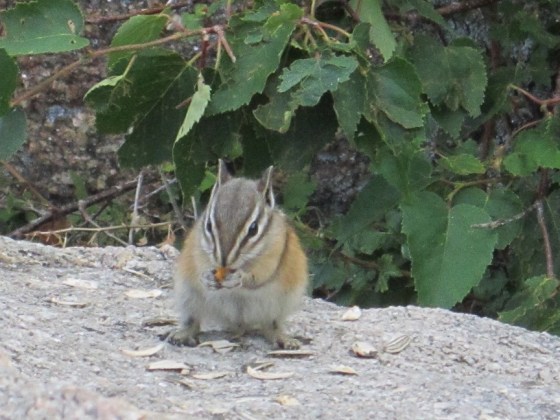
A cute and intelligent chipmunk on a rock near the Needles Granite Formations. Photo: Malik Merchant. © Simerg.com
~~~~~~~~
The Needle Spires, shown above, and the Cathedral Spires, below, in Custer State Park offer some of the best climbing routes in the country. Rock climbers travel from around the world to challenge the nearby formations.
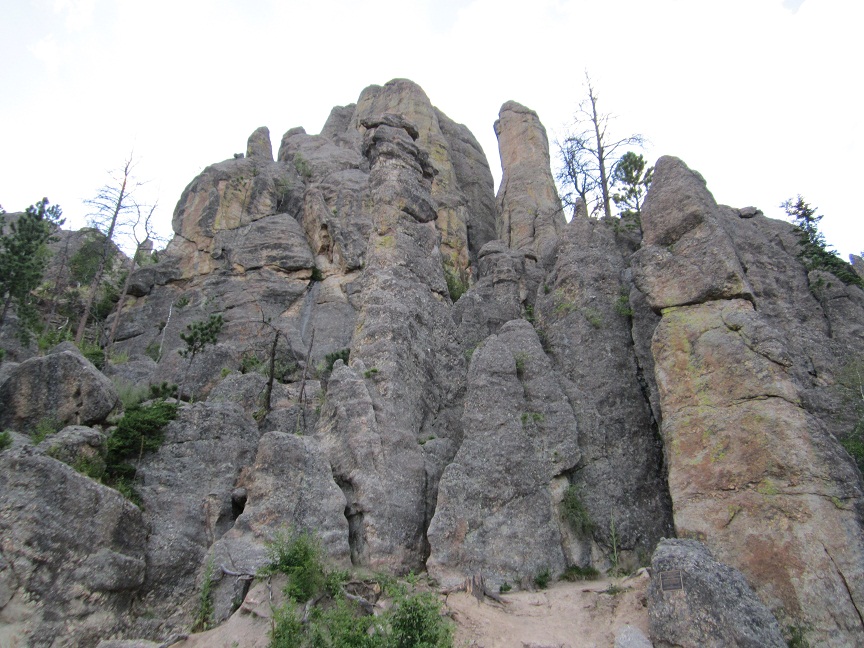
The Cathedral Spires, perhaps the most famous rock formation in the Black Hills, derives its name comes from the towering peaks which appear like organ pipes from the Needles Highway. Photo: Malik Merchant. © Simerg.com
~~~~~~~~~~~
THE FOUR FACES AT MOUNT RUSHMORE NATIONAL MEMORIAL

The Rushmore National Memorial, one of America’s most enduring patriotic symbols, is a massive carving of the colossal faces of US Presidents George Washington, Thomas Jefferson, Theodore Rossevelt and Abraham Lincoln representing the first 150 years of American history. Photo: Malik Merchant. © Simerg.com
“A lot of Indian people look at Mount Rushmore as a symbol of what white people did to this country when they arrived — took the land from the Indians and desecrated it…I’m not going to concentrate on that. But there is a huge need for Anglo-Americans to understand the Black Hills before the arrival of the white men. We need to talk about the first 150 years of America and what that means.” — Gerad Baker
This quote by Mount Rushmore’s first American Indian superintendent, appears in Smithsonian Magazine’s piece on Mt. Rushmore. The article also notes that Baker began to expand programs and lectures at the monument to include the Indian perspective. Until then, visitors learned about Rushmore as a patriotic symbol, as a work of art or as a geological formation, but nothing about its pre-white history — or why it raises such bitterness among many Native Americans. [2]
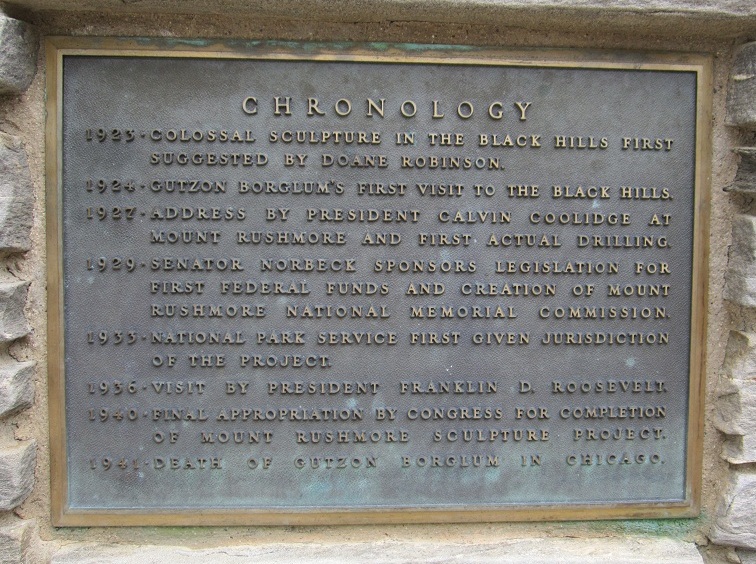
The chronology of Mount Rushmore Memorial in South Dakota. Photo: Malik Merchant. © Simerg.com
~~~~~~~~~

Over 450,000 tons of rock were removed from Mount Rushmore. Dynamite was used to remove 90% of it, but jack hammers and facing bits were used for the rest. The photo shows the largest of the three air compressors which was used to provide power to operate the jack hammers. This equipment is on display at the Mount Rushmore Memorial. An 1,800 foot, 3-inch pipeline followed the stairway up the mountain to carry the air for the jack hammers. During the winter months, a liquid gas was injected in the pipeline to prevent freezing. Photo: Malik Merchant. © Simerg.com
~~~~~~~~~
“On many occasions, when a new project is presented to you on paper and then, later on, when you see the accomplishment, you are disappointed, but it is just the opposite of that in what we are looking at now. I had seen the photographs. I had seen the drawings and I had talked to those who are responsible for this great work, and yet I had no conception until about ten minutes ago not only of its magnitude but of its permanent beauty and its permanent importance.” – President Franklin Roosevelt upon first seeing Mount Rushmore, August 30, 1936.
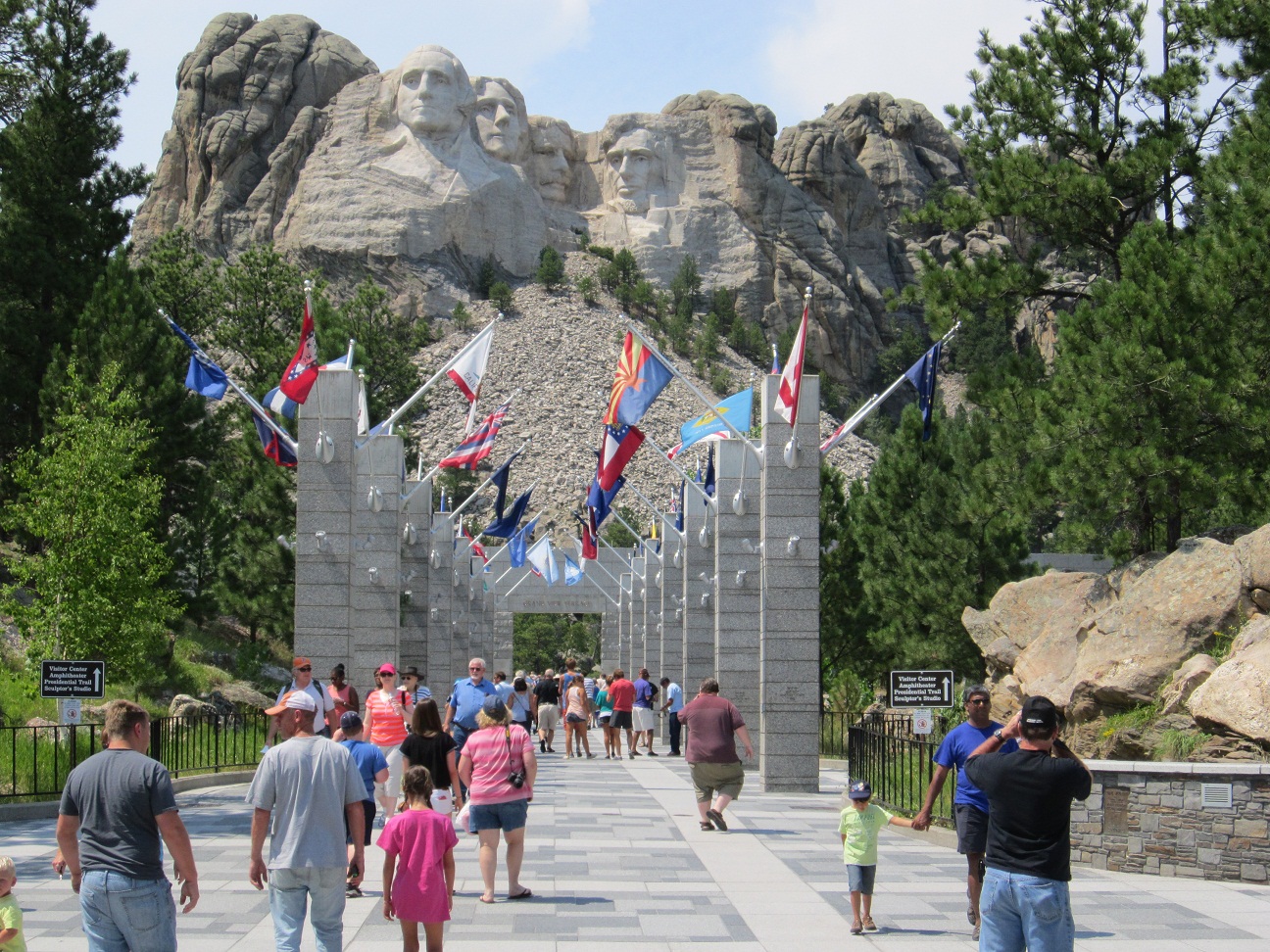
The Mount Rushmore Memorial from the Avenue of Flags. Fifty six flags of the states, districts, commonwealths and territories of the US adorn either side of the main avenue. Photo: Malik Merchant. © Simerg.com
~~~~~~~~~

A sculpture of Gutzon Borglum by his son Lincoln. It was left upto Lincoln to finish the project in October 1941, just few months after his father’s death in March of the same year. Borglum began to sculpt the Mount Rushmore in 1927 which took 14 years and $1 million to complete. For millions of Americans, the iconic sculpture of four famous American Presidents holds meaning and stirs emotions like no other tourism spot. Photo: Malik Merchant. © Simerg.com
~~~~~~~~~

A plaque commemorating the workers who with workers created the historic masterpiece of the faces of four American Presidents between October 4, 1927, and October 31, 1941. Today Mount Rushmore hosts more than three million visitors each year from across the USA and around the world. Photo: Malik Merchant. © Simerg.com.
~~~~~~~~~

The colossal face of George Washington as photographed from the Presidential Trail. The 1/2 mile trail begins on the Grand View Terrace, takes you to the base of the mountain, past the Sculptor’s Studio and back. George Washington (1732 – 1799), America’s first President is considered the father of the country and is therefore the most prominent figure on the mountain. Photo: Malik Merchant. © Simerg.com
~~~~~~~~~
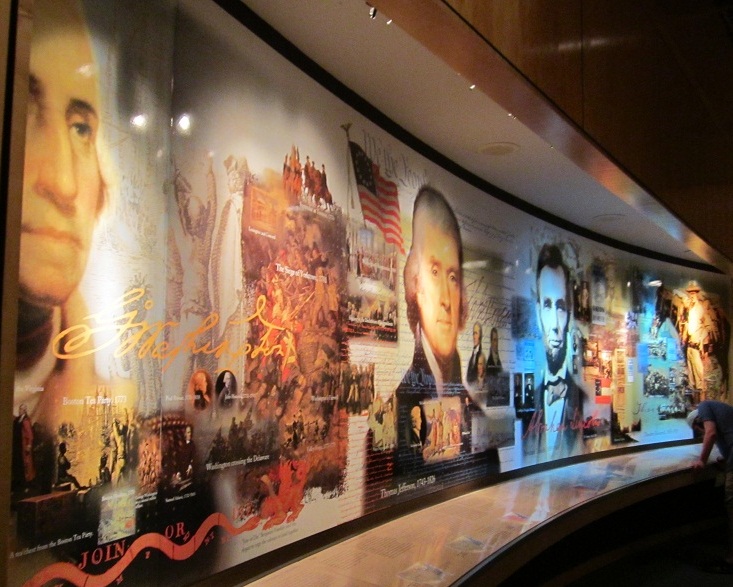
An exceptional educational panel display of the four presidents and 150 years of American history. The four presidents – Washington, Jefferson, Roosevelt and Lincoln – sculpted on Mount Rushmore respectively represent the birth, growth, development and preservation of the country. George Washington (1732 – 1799), America’s first President is considered the father of the country and is therefore the most prominent figure on the mountain. Thomas Jefferson (1743 – 1836) was the author of the Declaration of Independence and America’s third president. Theodore Roosevelt (1858 – 1919) led the country into the 20th century and Abraham Lincoln (1809-1865) is considered by many to be America’s greatest president. He held the nation together during the Civil War. Photo: Malik Merchant. © Simerg.com
~~~~~~~~~
Date posted: September 4, 2012.
Copyright: Simerg.com
__________
References:
[1] Quote of Paul War cloud (1930 – 1973) posted in the Indian Museum at the Crazy Horse Memorial.
[2] Read complete article in the May 2006 issue of Smithsonian Magazine, available on-line at Mt. Rushmore by Tony Perrottet.
___________
Also read my previous posts:
Scenes from America by Malik Merchant
Our Incredible ‘Yellowstone’ Holiday – Part I: Salt Lake City by Nurin and Malik Merchant
Our Incredible ‘Yellowstone’ Holiday: Part II – Wild Life Safari at Grand Teton National Park
Our Incredible ‘Yellowstone’ Holiday: Part III – The Yellowstone Caldera and Geysers of the Old Faithful Basin
For a complete list as well as links to all the articles posted on this blog since March 2009, please click WHAT’S NEW.















 Simerg - Insights from Around the World