Simerg is an independent initiative dedicated to Ismaili Muslims, the Aga Khan — their Hereditary Imam — and the Ismaili Imamat, and Islam in general through literary readings, photo essays and artistic expressions
“God chose Adam and Noah and the House of Abraham and the House of Imran above all beings, the seed of one another; God hears, and knows” — Qur’an, 3:33-34, translation by A. J. Arberry, see Corpus Quranfor multiple translations
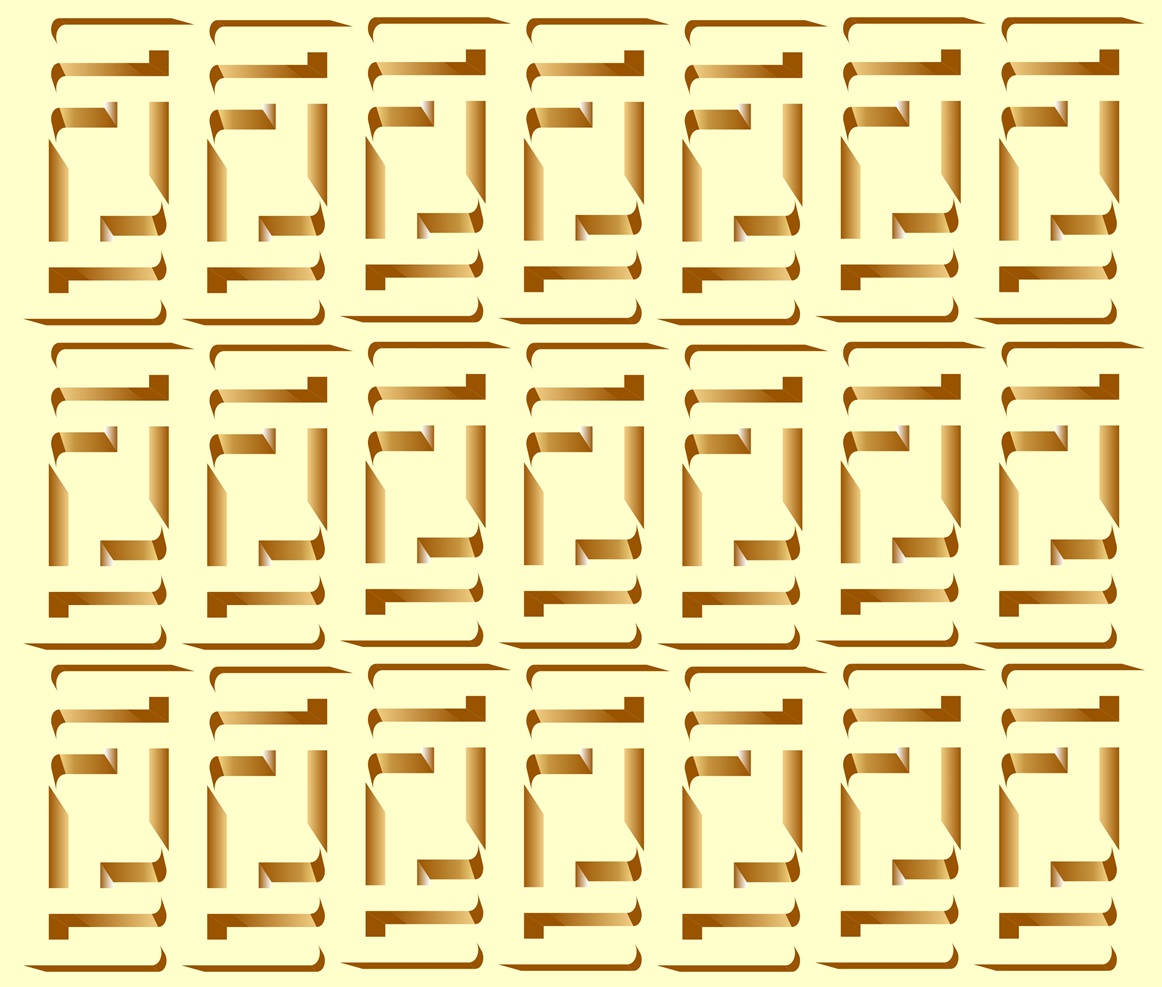
A calligraphy designed by Toronto’s Karim Ismail honouring the first Shia Imam Ali, on the auspicious commemoration of Idd-e Ghadir.
On Monday, June 24, 2024, Ismaili Muslims in Canada and other parts of the world will unite to observe and celebrate Eid-e Ghadir. This momentous occasion marks the pivotal gathering at Ghadir Khumm, where Prophet Muhammad (peace be upon him and his family) designated Hazrat Ali as his successor, the first in the continuing line of Hereditary Imams.
This historical event holds immense significance in the Ismaili faith. Today, the holder of the Hereditary position is Mawlana Hazar Imam, His Highness the Aga Khan, the 49th Imam in direct succession. In this regard, the Aga Khan has affirmed “that the Ismailis are the only Shia community who, throughout history, have been led by a living, hereditary Imam in direct descent from the Prophet” — His Highness the Aga Khan, Parliament of Canada, Ottawa, February 27, 2014.
History records that on the way back to Medina after performing the final pilgrimage to Mecca, the Prophet received a revelation:
“O Messenger, deliver [to the people] what has been revealed to you from your Lord, and if you do not do so, then you will not have delivered His message” Surah al-Ma’ida (5:67)
Upon receiving this revelation, the Holy Prophet stopped at an oasis known as Ghadir Khumm. He addressed a large gathering of Muslims who had accompanied him. The Prophet proclaimed: “Man kuntu mawlahu fa aliyyun mawlahu,” meaning: “He whose Mawla I am, Ali is his Mawla.” The Prophet then prayed: “O Allah, be a friend of whoever is his friend and extend your support to those who support him.”
This event, occurring at a crucial point in Islamic history, marked the transition of leadership from the Prophet to Hazrat Ali, setting the stage for the leadership and future of the Muslim community. Thus, by declaring Hazrat Ali Mawla after him, the Prophet transferred the spiritual authority bestowed upon him by Allah to Hazrat Ali, making him — and all the Imams that follow — the Amirul Mu’minin, or Master of the Believers. In this context, ‘Mawla’ refers to a leader, protector, and guide, indicating the profound responsibility and authority bestowed upon Hazrat Ali.
Article continues below following excerpts
________________________________
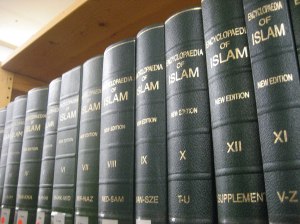
Excerpts from L. Veccia Vaglieri piece in Encyclopaedia of Islam, Second Edition
“Ghadir Khumm is famous in the history of Islam because of a sentence (or some sentences) in favour of ‘Ali which the Prophet uttered there during a discourse….Taking ‘Ali by the hand. he asked of his faithful followers whether he, Muhammad, was not closer to the Believers than they were to themselves; the crowd cried out: “It is so, O Apostle of God!”, he then declared. “He of whom I am the mawla, of him ‘Ali is also the mawla (man kuntu nawlahu fa-‘Ali mawlahu)
Photograph: Vysotsky – Own work, CC BY-SA 3.0, Wikimedia.
~~~~~~
“Most of those sources which form the basis of our knowledge of the life of the Prophet pass in silence over Muhammad’s stop at Ghadir Khumm….Consequently, the western biographers of Muhammad, whose work is based on these [Sunni] sources, make no reference to what happened at Ghadir Khumm. It is however certain that Muhammad did speak in this place and utter the famous sentence…the hadiths are so numerous and so well attested by the different isnads that it does not seem possible to reject them.” Vaglieri goes on to state that on instruction from Prophet Muhammad, Hazrat Ali received baiyat (the oath of allegiance) from the Muslims assembled there, including Umar b. al-Khattab, Islam’s second Caliph.
(Note: special access is required to read articles in the on-line edition of EI2. Vaglieri’s piece was reproduced in full in the UK Ismaili Association’s publication Ilm, December 1976, pages 28-30, with the permission of E.J. Brill, publishers of EI2.)
________________________________
Excerpts from the Preamble of the Ismaili Constitution
“In accordance with Shia doctrine, tradition, and interpretation of history, the Holy Prophet (s.a.s.) designated and appointed his cousin and son-in-law Hazrat Mawlana Ali Amiru-l-Mu’minin (a.s) to be the first Imam to continue the Ta’wīl and Ta’līm of Allah’s final message and to guide the murids, a term referring to the followers and disciples of the Imams. The proclamation also established the principle of the Imamat continuing by heredity through Hazrat Mawlana Ali (a.s) and his daughter Hazrat Bibi Fatimat-az-Zahra, Khātun-i-Jannat (a.s)”
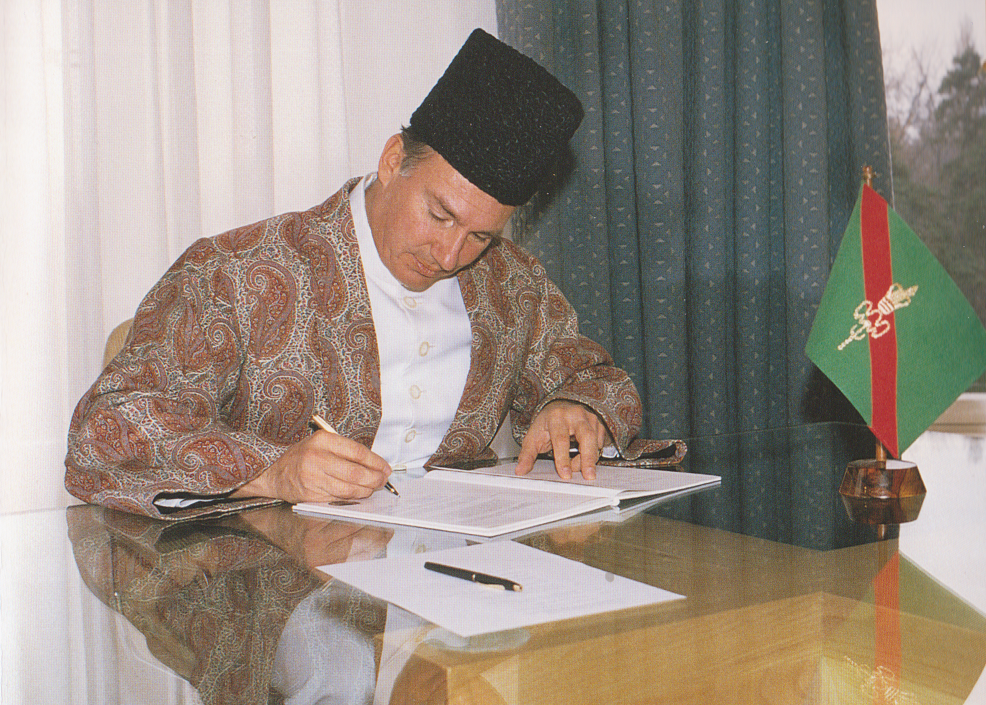
Mawlana Hazar Imam, His Highness the Aga Khan, is seen signing a new constitution for the worldwide Ismaili community on his 50th birthday, December 13, 1986. The preamble excerpts produced in this post are from this constitution.
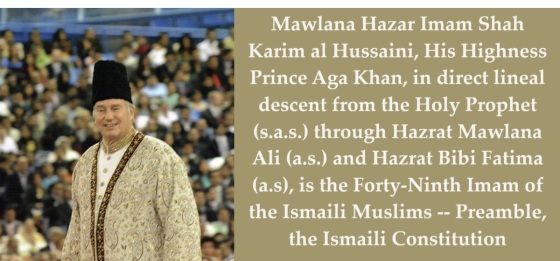
“Mawlana Hazar Imam Shah Karim al Hussaini, His Highness Prince Aga Khan, in direct lineal descent from the Holy Prophet (s.a.s.) through Hazrat Mawlana Ali (a.s.) and Hazrat Bibi Fatima (a.s), is the Forty-Ninth Imam of the Ismaili Muslims.”
________________________________
…. continued
On instruction from Prophet Muhammad, Hazrat Ali received baiyat (the oath of allegiance) from the Muslims assembled there. According to Shia traditions and sources, following the proclamation, the final verse of the Qur’an was revealed to the Prophet:
“On this day, I have perfected for you your religion, completed my favours upon you, and have chosen for you Islam as your religion.”
Eid-e Ghadir is an anniversary of profound significance to all Shia Muslims. It is also associated with the well-attested tradition that the Prophet is said to have proclaimed:
“I am leaving among you two matters of great weight (al-thaqalayn), the Book of Allah and my kindred (itrati), the People of my House (Ahl al-Bayt), and these two shall never be separated until they return to me at the Pool [of Kawthar in Paradise on the Day of Judgement]…”
The phrase ‘two matters of great weight’ refers to the Quran and the Ahl al-Bayt, emphasizing their inseparability and eternal significance in the Islamic faith.
In commemorating Eid-e Ghadir, the Ismaili community celebrates the seminal event of Ghadir Khumm, reaffirming their allegiance to the Imam of the Time as the direct lineal successor and inheritor of Hazrat Ali’s authority. The community is not just inspired, but united and driven by the following remark made during his speech in Canada’s Parliament on February 27, 2024:
“Today, the Ismailis are the only Shia community who, throughout history, have been led by a living, hereditary Imam in direct descent from the Prophet.”
Date posted: June 23, 2024.
____________________
Please click HERE for many more pieces on this website on the topic of Eid-e Ghadir.
Our climate is changing. Humans are primarily responsible for harmful emissions and the destruction of ecosystems as we indiscriminately pollute our air, water, and soil.
The main driver is primarily the burning of fossil fuels (coal, gas, and oil), which produce heat and trap heat between the ozone layer. This process significantly contributes to global warming, as evidenced by the record-breaking year in 2023. If concerted efforts are made soon to reduce the carbon footprint, it may be possible to turn the clock back.
The northern hemisphere is responsible for seventy percent of the catastrophe and damage caused by climate change, and the people most affected by the adverse conditions live in the global south. They are the least responsible for this phenomenon and, unfortunately, the least able to endure nature’s wrath.
Here are some things we can do individually to reduce our carbon footprint.
Reducing the use of fossil fuels would improve air quality and protect human and animal health.
Stop the wars which contribute to further destruction of the ozone layer besides unnecessary deaths.
Stop idling engines. Carpool, bicycle, or walk if possible, and also get exercise and reduce expenses.
Stop illegal campfires. Even one tiny spark can start a wildfire that can burn for days and destroy hectares of land.
Stop using fireworks. Consider light shows which are less damaging to the environment and noise pollution.
Stop polluting our water system and recycle properly — stop using single-use plastics, and pull tabs off masks so marine life and wildlife don’t get tangled in them. Recycling reduces waste sent to landfills and prevents pollution. It conserves natural resources and energy.
Article continues below
Mobina Marani pictured in front of her exhibit at the Red Ribbon Event in Fort Erie, Ontario, in November 2023. Photograph: Mobina Marani Collection.
With regard to the worldwide use of plastics, The Philippines, the United States of America, India, Malaysia, and China are among the most prominent plastic polluters worldwide.
Rwanda, Kenya, Sweden, Tanzania, Norway, and Germany are the least. A 2019 Tanzanian government declaration states that “plastic carrier bags regardless of their thickness will be prohibited from being imported, exported, manufactured, sold, stored, supplied and used in Mainland Tanzania.” According to the New York Times, anyone in the country found producing or importing plastics faces a fine of 426,000 dollars, or a jail term of up to two years. Rwanda has banned the manufacturing, usage, import or sale of plastic bags since 2008.
Canada recycles only 9% of its waste, whereas the rest goes into landfills. However, it wants to eradicate the use of plastic by 2030.
Cigarette butts contain tiny plastic fibres and “microplastic “ from synthetic clothing through washing. Fourteen million tons in our oceans yearly, particularly in the North Pacific Ocean — “The Pacific Patch.” Plastic can take up to 20-500 years to decompose, and even then, it never fully disappears.
In our small Ismaili community in Niagara-on-the-Lake, we recycle and reduce our garbage as best we can, and we are proud that our youth and Jamati members are involved and working hard at it. It may be noted that several steps have been taken in Jamatkhanas around Canada to reduce the use of plastic. Prince Hussain Aga Khan and his wife, Princess Fareen, have completely eliminated the use of plastics in their homes. As someone who deeply cares about the ocean and its creatures, the Prince laments: “Before, you didn’t see plastic in the sea. Now, it is everywhere. I see plastic each and every time I go on an expedition. In Egypt, in the Philippines, in Indonesia, in the Bahamas, in Sardinia…Wherever I go, I always find plastic.”
I invite readers to view the following paintings I completed in 2023 out of my concern about climate change and ocean pollution. Each image has an accompanying statement and can be clicked for enlargement.
1. “Global Pollution” (16″ x 20″) Acrylic on canvas
Global Pollution, April 2023, Acrylic on canvas, 16 X 20 inches. Artist: Mobina Marani.
Artist statement: It is gut-wrenching to witness the effects of humanity’s complacency in protecting and preserving our rivers, lakes, and oceans. Dumping undesirable waste products and harmful toxic materials has caused the demise of marine life and coral reefs, which provide excellent habitat and nourishment for many creatures that depend upon an enabling environment for their survival. In “Ocean Pollution,” she attempts to depict the types of pollutants found in the sea bed and their potential effects on marine life.
The artist, through this work seeks to emphasize the urgent need for responsible waste management, and hopes that it will inspire hope and action in our audience, showing them that we can still protect and restore these precious marine ecosystems.
~~~~~~~~~
2. “Force of Nature” (16″ x 20″) Acrylic on canvas
Force of Nature, Acrylic on canvas, 16 X 20 inches. Artist: Mobina Marani.
Artist statement: In December 2022, the ice storm Elliott hit the shores of Lake Erie with devastating consequences. A lot of the homes along the waterfront got pounded with 20 feet to 30 feet waves, and because of the frigid temperature and high winds, the water instantly froze on the roof to the base of the homes, completely covering them with ice and causing significant external and internal damage to the affected properties. Her rendering illustrates the impact on her neighbouring homes. The different ice formations and using minimal paint colours were a big challenge.
~~~~~~~~~
3. “Nature’s Fury” (16″ x 20″) Acrylic on canvas
Nature’s Fury, Acrylic on canvas, 16 X 20 inches. Artist: Mobina Marani.
Artist statement: The rising global temperatures have had an insurmountable and lasting impact on Mother Earth, demanding urgent action. Some parts of the worldwide community, like Pakistan in 2022, where 35 million people were displaced, have had to deal with devastating rainfall and flooding. In parts of Africa, global warming has manifested itself in extreme dry conditions, causing hunger, famine, and the displacement of the masses. Our country, Canada, has lost thousands of hectares to forest fires. Her rendering, Nature’s Fury, is a stark reminder of the ferocity and fury of such intense fire on our landscape. This is a call to action, a plea for us to act now to protect our planet.
Date posted: June 18, 2024.
___________________________
About the author: Mobina Marani, a woman with a passion for art, hails from Uganda. After completing her art education in England, she embarked on a new chapter in Canada in 1974. Settling in the picturesque Ridgeway/Crystal Beach area, she found herself managing a family business. It was here, amidst the joys of her first grandchild, Amarah, that she felt the urge to pick up the paintbrush again after a hiatus of 40 years. She created freehand renderings of her close family members and Mawlana Hazar Imam, His Highness the Aga Khan, the 49th Hereditary Imam of the Ismaili Muslims.
Mobina has also taken the pressing issue of climate change and the disregard of Mother Earth to heart. Her series of paintings shown above depict the catastrophic consequences of our actions. Each stroke of her brush is a plea for change, a call to action. Mobina’s dedication to her cause is evident in her process. She does her portrait paintings by hand, without tracing or enhancing devices, referring only to a picture. She meticulously applies layer upon layer of acrylic paint until she is satisfied with the degree of perfection.
Every year, on the 10th day of the Islamic month of Dhul-Hijjah, Muslims worldwide celebrate Eid al-Adha (also known as Eid-al-Nahr). This significant event, which this year falls on or around June 17, 2024, after the completion of the Hajj ceremonies, is rooted in a historical event. It commemorates the profound sacrifice of Prophet Ibrahim, who was willing to sacrifice his son, Prophet Ismail, as an act of obedience to Allah’s command. This act of sacrifice is what gives the festival its name. This story is narrated in the Holy Quran in surah (chapter) 37, ayats (verses) 100-112, as follows:
“My Lord, grant me [a child] from among the righteous.” (100)
So We gave him good tidings of a forbearing boy. (101)
And when he reached with him [the age of] exertion, he said, “O my son, indeed I have seen in a dream that I [must] sacrifice you, so see what you think.” He said, “O my father, do as you are commanded. You will find me, if Allah wills, of the steadfast.” (102)
And when they had both submitted and he put him down upon his forehead (103)
We called to him, “O Abraham, (104)
You have fulfilled the vision.” Indeed, We thus reward the doers of good. (105)
Indeed, this was the clear trial. (106)
And We ransomed him with a great sacrifice (107),
and We left for him [favorable mention] among later generations: (108)
“Peace upon Abraham.” (109)
Indeed, We thus reward the doers of good. (110)
Indeed, he was of Our believing servants. (111)
And We gave him good tidings of Isaac, a prophet from among the righteous. (112)
The story is a powerful demonstration of their unwavering faith and submission to Allah’s will. It is this faith and submission of Prophet Abraham and his son Prophet Ismaili that we commemorate and honour during Eid-al-Adha.
Examining the Quran further, one begins to understand and realize what Allah truly desires from us in the context of sacrifice. Allah says:
“Neither their meat nor blood reaches Allah. Rather, it is your piety that reaches Him. This is how He has subjected them to you so that you may proclaim the greatness of Allah for what He has guided you to and give good news to the good doers.” (Quran 22:37)
The above verse clearly states that what Allah considers is one’s righteousness, which is the way one practices and conducts one’s life.
Therefore, in all that one undertakes, it is essential to stay God-conscious (Taqwa) by remembering Allah in all walks of life. The Holy Quran says:
“O mankind, We have created you male and female, and We have made you into tribes and nations in order that you might come to know one another. Truly, in the sight of God, the most honoured amongst you is the most pious amongst you.” (Quran 49:13).
Our beloved Prophet and his hereditary successors, the Imams from Hazrat Ali to Mawlana Shah Karim al-Hussaini Hazar Imam, His Highness the Aga Khan, have always guided us to stay firm on Sirat-al-Mustaqim (the straight path).
They have provided us with invaluable guidance, urging us to practice Taqwa and seek spiritual advancement. This guidance, a beacon of light in the darkness, emphasizes the importance of developing an inner sense of God-consciousness, which is crucial for maintaining a righteous, honourable, respectful and fulfilling life.
In his sermon on the occasion of Eid al-Adha, 336 AH (June 21, 948 AC) at al-Mahdiyya in North Africa, the Fatimid Imam/Caliph Mawlana Mansur said:
“Pray to God most sincerely and implore Him wishfully, approaching with what He commands you to do or restrained you from.” (Walker, 2009)
Similarly, his successor, Imam Mu’izz, in his khutba (sermon) on Eid al-Adha, 341 AH (April 28, 953 AC), at al-Manṣuriyya, said:
“O people, God created you not in jest, (Quran — 23:115), nor will He overlook you without purpose. He does not impose on you a hardship in religion (Quran — 22:78), and yet He does not disregard being remembered, but rather He created you for worship, obeying Him, and He ordered you to obey His messenger. For obedience, He made fixed signs and written decrees. So draw near to God through what He commanded you to do. It is through piety that deeds are accepted and hopes are realized. Praise God for His having guided you (Quran — 22:37); thank Him for what He has given you.” (Walker, 2009)
Article continues below
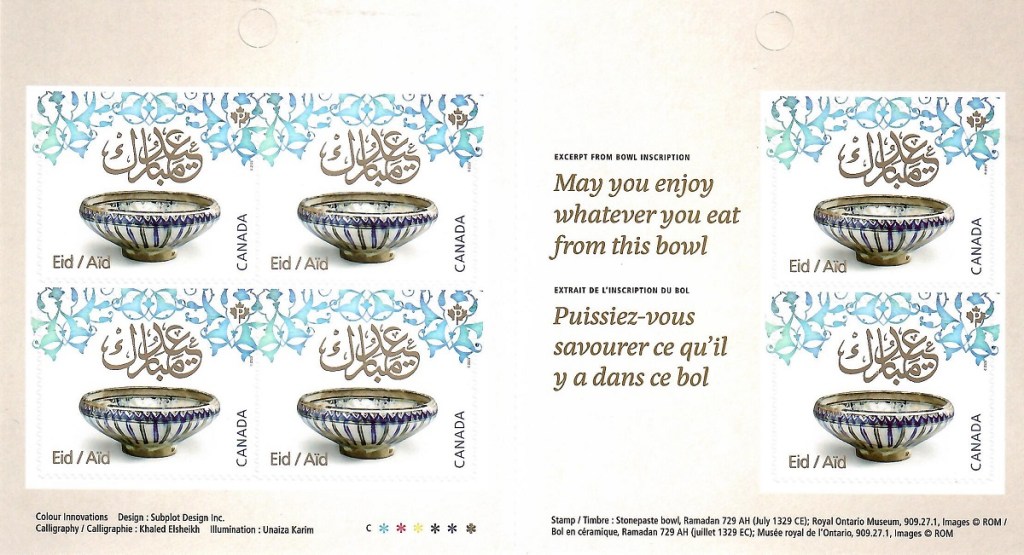
Eid Mubarak stamp issued by Canada Post in April 2023
These thoughtful words underline Islam’s fundamental principle, emphasizing the importance of obedience to God’s commands and the guidance of His messenger. Through sincere devotion and adherence to these teachings, one can attain spiritual elevation and happiness and realize the true purpose of one’s existence.
The connection between spirituality and moral consciousness is not just a personal journey, but a central theme in Islamic thought that unites us all. According to Islamic teachings, human beings are inherently endowed with a deep sense of God-consciousness, which forms the foundation of our shared moral and social responsibilities. This intrinsic awareness of right and wrong guides us in our personal lives and interactions with others, fostering a sense of community and mutual responsibility.
In a hadith (tradition), the Prophet Muhammad is reported to have said:
“Submission is public, and faith is in the heart.” Then, he pointed to his breast three times, repeating: “Fear of God (Taqwa) is here, fear of God is here.”
This profound statement highlights the intimate and internal nature of true faith. While outward acts of submission, such as rituals and observances, are visible to the public, the essence of faith lies deep within the heart, manifesting as a profound consciousness of God (Taqwa). This inner awareness shapes a person’s moral compass, guiding them toward righteousness and away from wrongdoing. This intrinsic God-consciousness forms the bedrock of ethical and social responsibilities, encouraging individuals to act with integrity, compassion, and justice in all aspects of life.
What does God’s consciousness and piety entail?
As M. Ali Lakhani eloquently articulates:
“Human beings are, according to Islam, endowed with a sense of God-consciousness (Taqwa)… In Islamic thought, the soul’s capacity for spiritual awareness is also implicit in its possession of a moral conscience, an innate sense of right and wrong (Quran 91:7-10). Both spiritual awareness and moral conscience are seen as attributes of the soul’s primordial nature. God consciousness is the foundation of moral consciousness, of which one aspect is social consciousness with its corresponding social responsibilities — of service, generosity, equity, cooperation — which are all part of the fiduciary obligations of human life.” (Lakhani, 2018)
In conclusion, we draw an excerpt from a speech made by Mawlana Hazar Imam, His Highness the Aga Khan, at the American University of Cairo upon receiving an honorary degree:
“…I think of the words of Hazrat Ali ibn Abi Talib, the first hereditary Imam of the Shia Muslims and the last of the four rightly guided Caliphs after the passing away of the Prophet (may peace be upon Him). In his teachings, Hazrat Ali emphasized that ‘No honour is like knowledge.’ And then he added that ‘No belief is like modesty and patience, no attainment is like humility, no power is like forbearance, and no support is more reliable than consultation’.
“Notice that the virtues endorsed by Hazrat Ali are qualities which subordinate the self and emphasize others – modesty, patience, humility, forbearance and consultation.” (Commencement address of His Highness the Aga Khan at the American University in Cairo, Egypt, 2006)
Through sincere devotion and adherence to these teachings mentioned by Mawlana Hazar Imam, one can attain spiritual enlightenment and realize the true purpose of one’s existence. Acts of piety and devotion to God, will act as protecting shields in our daily life and bring us closer to God.
This Eid — and throughout our lives — let us try to become more selfless and more God-conscious, performing meritorious deeds to please the Almighty and ultimately achieving the level of purity that will bring us closer to Allah. These deeds will also bring honour and respect to our lives.
Date posted: June 15, 2024.
Featured image at top of post: First Day Cover issued by Canada Post on March 27, 2024.
______________________
Shan-E-Ali Wazir Ali is a passionate Religious Education Centre Teacher and Educator from Karachi, Pakistan. He specializes in Ismaili literature, including devotional works, magazines, periodicals, articles, and books. He incorporates heritage materials into his REC Secondary Classes, fostering insightful discussions. He actively follows the work of Ismaili and AKDN institutions to stay current with their activities and the work of the Ismaili Imamat.
“In my calligraphic work, I use one line from the Quran. I repeat it over the years. The line in this work is from the Iqra Ayat, which states ‘God taught man what he did not know’ in the naskhi script. This is a line that I have used repeatedly over the last three decades. My challenge has been how to translate it into sculpture.” — Amin Gulgee
By ANIZA MEGHANI
Algorithm II, 2015, Copper, 37.7 x 29.2 x 31 inches. Artist: Amin Gulgee.
No one can miss Amin Gulgee’s home from a distance with its rooftop adorned with a mosaic of mult-coloured glass, tile and terra cotta. No doubt a tourist attraction. As I entered Amin’s gallery on the ground floor, I was stepping into a world of pure copper sculpted into Quranic words. When sunlight caught his sculptures, they reflected shadows on the walls that seemed to dance in spiritual twirls. We made our way to his living room on the first floor, up the steel staircase with copper railings, designed by the artist himself. I noticed a photograph of his late father’s lapis mosaic portrait of Sir Sultan Mahomed Shah hanging on the wall just before we entered his private quarters.
Amin told me a story about this piece: “That was one of my father’s works from the 1970s,” he said. “I grew up with it. I remember one day when I was a kid, the Aga Khan came to our house in KDA. He spent time with my parents, and he loved the portrait. Of course, my father said, ‘Your Highness, we will gift this to you.’ Imam responded, ‘No, you will not gift this to me. You must tell me how much you are charging for it.’ I remember when my parents took the mosaic portrait to the Aga Khan, they were feeling sad about parting with it. But what I truly remember most was that the Aga Khan refused to accept it as a present. How fantastic is that? Imagine the respect he had for the artist and his work!”
As I sat and drank mid-morning ginger tea, I could see from Amin’s balcony the courtyard that connected his home with that of his late parents. His parents, of course, were the renowned artist, Ismail Gulgee, and his wonderful wife, Zaro. How I miss them dearly! Here I was, once again, at his home, reflecting upon a family friendship that has spanned over three decades.
I met Amin when both father and son had a joint exhibition at the Ismaili Centre in London in 1994. Zaro-Aunty took my hand and walked me across the social hall, where Amin was surrounded by his sculptures and a display of his handmade jewellery. She proudly introduced me to him. “Aniza, this is my son, Amin; he is an artist, too. He makes sculpture.” I was drawn to his jewellery and nickel-plated copper sculptures in kufic with large crystal stones set within. Tall and handsome, with shoulder-length hair, he showed me his beautiful collection.
Now as I sat in his living room, reflecting on that day, I was mesmerised by his father’s work adorning the walls and wondered whether Amin’s own creativity had been sparked by it. My mind raced with this and many other questions.
Perforated Egg, 2018 Copper, 27 x 16 x 16 inches. Artist Amin Gulgee.
Amin was born in Karachi, Pakistan and studied at the Karachi American School from kindergarten to the twelfth grade. He went on to do his bachelor’s degree from Yale University in the United States. I asked whether he was inspired to study art history because of his father. He replied, “Although both my parents were liberal, they didn’t want me to be an artist. I agreed with them as I saw how difficult the life of an artist can be. I didn’t think I had the courage to be an artist. Wishing to be the good South Asian boy, I majored in economics at Yale.”
However, when his classmate Dominique Malaquais took him for his first art history class freshman year, it was the beginning of a journey that made him realise that this is what he wanted to do. Economics was simply too “boring” to endure! This art history class was a study of Baroque gardens, which inspired him to take even more art history classes and to pursue a double major in art history and economics. He wanted to write his senior thesis on Moghul gardens, but at that time it was “problematic”, as there was no Islamic art history department at Yale. He was advised to do his thesis on European gardens instead, but Amin’s heart was set on writing about the Shalimar Gardens in Lahore, constructed by the Moghul Emperor Shah Jahan between 1641 and 1642.
Char Bagh II, 2003, Copper, 37 x 37 x 35 inches. Artist: Amin Gulgee.
With help from his late father’s connections in the art world, Amin was introduced to Dr Oleg Garbar, the renowned authority on Islamic art and Harvard’s first Aga Khan Professor of Islamic Art and Architecture. Dr Garbar agreed to be Amin’s secondary advisor. (His primary adviser at Yale was Dr Judith Colton, an expert on European gardens of the 17th to 19th centuries.) Amin’s senior thesis, “A Walk Through Shalimar: A Char-Bagh Garden of 17th Century Mughal India Seen as a Manifestation of Imperial Divine Right”, went on to win the Conger Goodyear Fine Arts Award from Yale’s art history department.
Amin was spiritually drawn towards exploring Islamic art as a result. A new journey of his life began when he embarked upon a career not as a painter like his father, but as a sculptor. I asked him if he kept his first art piece. He emphatically replied, “No! I am not sentimental!”
I was curious about what gave him inspiration to create his artwork. He explained, “All my work is personal. Everything relates to me at a certain point in my life.”
Iqra
I wanted to further explore his creative mind, how art evolves within it. What made him tick? Did he get up in the middle of the night to sketch out an idea, or write it down? Where did it all come from? So, I pointed to a tall sculpture. Amin talked me through it: “In my calligraphic work,” he explained, “I use one line from the Quran. I repeat it over the years. The line in this work is from the Iqra Ayat, which states ‘God taught man what he did not know’ in the naskhi script. This is a line that I have used repeatedly over the last three decades. My challenge has been how to translate it into sculpture. I like the idea of repetition. For me it becomes intellectually, aesthetically and conceptionally challenging to keep the same line in the same script, but to vary its physical form. I explored this idea in a solo shown that I called ’7’. I chopped the line into seven portions and rearranged them. There was nothing legible anymore as the letters were no longer in their original order. ‘7’ was co-curated by the late Paolo De Grandis and Claudio Crescentini and was held at the Museum of Modern Art in Rome, a short walk from the Spanish Steps. My installation was shown in the courtyard of the museum, which had once been a cloister.”
I asked him why he was drawn to this particular Quranic line. He replied, “It’s personal. It’s spiritual and I do not wish to share this. You must remember it’s private for me.”
I respected his answer. As in life, spiritual moments are personal and cannot be shared. I kind of understood. Correction: I understood him totally.
Cosmic Chapati, Unknown Centre, 2011, Copper, 35 x 35 x 2 inches. Artist: Amin Gulgee.
~~~~~~~
Another line Amin has used repeatedly is from the Surah-e-Rehman, which asks, “Which of the favours of God can one deny?” in new style kufic. (He has not created a work around this since 2008, however.) In this series as well, you can no no longer read the line. Amin explains, “You can only read the text in sculptures where I use the phrase Al-Hamdulillah (Praise be to God), which I render in the square kufic script. These are geometric, architectonic works.”
Amin stopped making his art jewellery in 2007. Although he called it jewellery, these gold-plated organic forms embellished with crystal and semi-precious stones were more like wearable sculpture. There was a relationship between his jewellery and his larger sculptures as he sometimes used these smaller works to work out ideas that might develop into bigger pieces. These were his sketches, in a way.
Embrace, 1999, Copper and rock crystals, 34 x 25 x 24 inches. Artist. Amyn Gulgee.
We got talking about Amin’s work as a curator. It began, he said, in the late 1990s, when he curated an art festival at the Sheraton Hotel in Karachi (now the Mövenpick). In the old days, the lobby was a place where young people used to hang out drinking coffee all day, “trying to be fancy”, as Amin put it. Being a semi-public space, it appealed to Amin as a venue to organise an exhibition that he would call Urban Voices. Amin curated four iterations of the group art show, which juxtaposed the work of recent graduates from the city’s art schools with that of established artists. The money generated from the sales of the artwork from these events went towards a scholarship at the prestigious National College of Arts in Lahore.
Rung I, 1994, Copper, rock crystals, and glass, 24 x 15 x 9 inches. Artist: Amin Gulgee.
In 2000, Amin inaugurated the Amin Gulgee Gallery on the ground floor of his newly built home in Clifton, a seaside neighbourhood. About once a year, he has opened up the space for large-scale, thematic shows of his contemporaries. (John McCarry, whom Amin met at Yale, is the coordinator of this artist-led space.) Amin explained, “Lahore is where all the art institutions are. Karachi is where the commercial galleries are. We wanted to do exhibitions without any kind of commercial point of view.”
The Bird Rickshaw, 2004 Copper, 84 x 100 x 42 inches. Artist: Amin Gulgee.
Having had many years of experience curating shows, Amin was approached in 2015 by Niilofur Farrukh, now the CEO of the Karachi Biennale, who asked him whether he would like to be the Chief Curator of its first edition in 2017. Amin readily accepted the challenge, despite the nascent biennial’s severe lack of funding. Amin began the task of creating a team of Karachi-based millennials, none of whom had any experience in curating a large art event. It included Zeerak Ahmed, Humayun Memon and Sara Pagganwala, all of whom had their own art practices.
The team worked collectively and tirelessly. With minimal financial backing but huge ambitions, the team was able to gather 182 artists from around the world, including Yoko Ono and Michelangelo Pistoletto, a key figure in Italy’s Arte Povera movement. There were twelve locations throughout the city to show their work. The whole process took two years. Six months prior to the opening, Amin invited Zarmeene Shah, who is now the director of graduate studies at the Indus Valley School of Art and Architecture in Karachi, to come on board in an advisory role as curator-at-large. The biennial –Pakistan’s first — was no easy task, but Amin and his team pulled off an outstanding event.
Perforated Wall I, Love Letter. 2014, Copper, 24 x 12 x 1 inches. Artist: Amin Gulgee.
I asked Amin how he envisions the future for artists in Pakistan. He replied, “I was born in the art scene. The scene has become much bigger now. I wish my parents were alive to see it! Now there is a Lahore Biennale as well as a Karachi Biennale. When I did my first show, there was only one gallery of note, Ali Imam’s Indus Gallery. Now we have more than 50 galleries in Karachi alone.” Amin is expanding his non-commercial gallery while also renovating his father’s adjoining museum. When I visited in May of 2024, building work was still in progress. The din of construction resounded in the connecting courtyard below. The aim is to open his parents’ former home as a small, private museum in 2025.
Amin has also been busy compiling a monograph on his work. It will be published in the spring of 2025 by Skira, a Milan-based publisher of art books that has brought out books on Picasso and Matisse as well as of important contemporary artists. Amin commented, “It’s a real honour for me that they have chosen my book to print. I am not nostalgic or sentimental, therefore the process of looking back has been hard.” He added with a laugh, “I’m just so happy that the two-year process of compiling it is now coming to an end!”
~~~~~~~
Amin Gulgee
“I think it’s very important that we record our own history and not wait around for someone abroad to do it for us. We must take control of our own narrative. I put all my documentation on my website (www.gulgeeamin.com). It is all free and downloadable. You will find a whole section of catalogues, not only on my work but on my curatorial projects, which discuss a whole variety of issues.” — Amin Gulgee
~~~~~~~
Ascension III, 2018, Copper, 88 x 27 x 27 inches. Artist: Amin Gulgee.
This led us to the topic of documentation of Pakistani art in general. Every show he curates, whether at his gallery or elsewhere, is accompanied by either a physical or electronic catalogue, and often a video and webinar as well. “Documentation is extremely important,” he explained. “When I compile a catalogue of a show I’ve curated, I not only write about the artists and the exhibition, but I also invite outside writers to contribute essays about issues and concerns they have about Pakistan in general. So, these become free platforms to express ideas. For example, Niilofur Farrukh and I co-curated a show at my gallery on the 1970s in Pakistan. This led to a book called Pakistan’s Radioactive Decade: An Informal Cultural History of the 1970s co-edited by me, Niilofur and John McCarry that was published by Oxford University Press in 2019. After the secession of Bangladesh, Pakistan swung from democratic liberalism to Islamist military rule. Those early democratic years saw a boom in cultural expression, whether it was in the visual arts, literature, film or music. This book included essays as well as Q and As with Pakistanis who helped forge the cultural life of Pakistan in that most pivotal of decades. I think it’s very important that we record our own history and not wait around for someone abroad to do it for us. We must take control of our own narrative. I put all my documentation on my website (www.gulgeeamin.com). It is all free and downloadable. You will find a whole section of catalogues, not only on my work but on my curatorial projects, which discuss a whole variety of issues.”
The Iron Horn, 203, Iron, 71 x 77 x 24 inches. Artist: Amin Gulgee.
I asked Amin what advice he would give to someone wishing to be an artist today. He laughed his booming laugh and answered: “Choose something else, sweatheart! Being an artist is so difficult. It’s easier doing something else. However, if you really want to do it, then be prepared to pay your pound of flesh. Follow your dreams as you don’t know how long you are going to live. Just be prepared. It’s a strange, strange way of making a living.”
Has it been an enjoyable journey being an artist for him? Amin replied, “Aniza, I am free. I am grateful. I am now an old man! I have done exactly what I wanted to do in my life.”
“The architectural planning [of the Delegation of the Ismaili Imamat Building] has been entrusted to the capable hands of Fumihiko Maki, an architect of world standing. Maki and Associates have my enthusiastic admiration for addressing, with tact and empathy, challenges of design which are difficult and subtle. They call for translating concepts that have a context in our faith and our history, yet stride boldly and confidently ahead, into modernity; for expressing both the exoteric and the esoteric, and our awe and humility towards the mysteries of Nature, Time and beyond.” — His Highness the Aga Khan, June 2005.
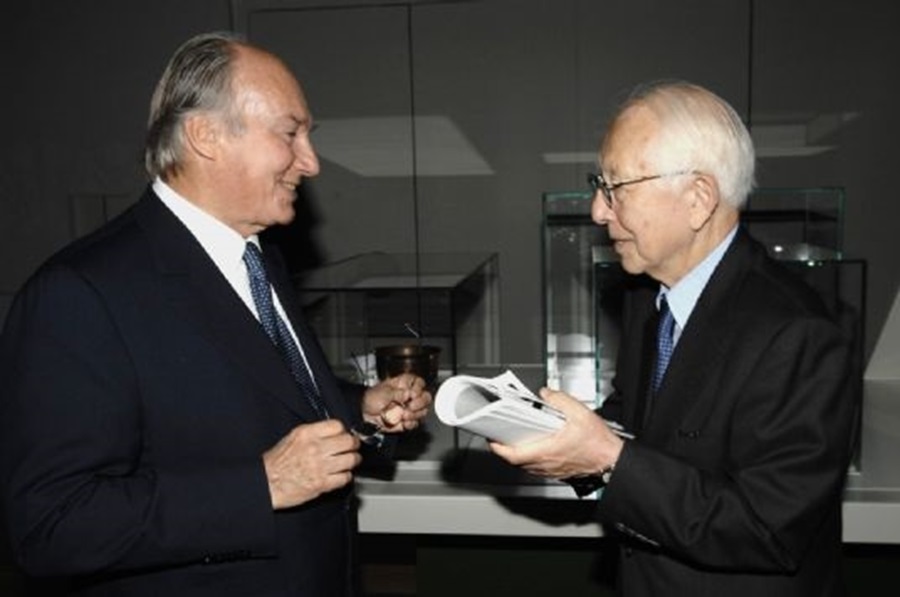
His Highness the Aga Khan with architect Fumihiko Maki at an Aga Khan Museum Exhibition held at the Louvre in 2007. The renowned Japanese architect served twice on the Master Jury of the Aga Khan Award for Architecture, and designed the Delegation of the Ismaili Imamat Building in Ottawa which was opened in December 2008 , the Aga Khan Museum in Toronto opened in September 2014., and the Aga Khan Centre in King’s Cross in London, opened in June 2018. Photo: AKDN/Gary Otte.
Reflecting back to 2005, I can’t help but feel a profound sense of loss as I note the passing of the renowned Japanese architect Fumihiko Maki on June 6, 2024, at the age of 95. His architectural firm, Maki and Associates, officially announced his demise. The news of Mr. Maki’s death reverberated across the globe, with obituaries appearing in esteemed publications such as the Washington Post, New York Times, and CNN, as well as prominent architectural websites like Architectural Record, World Architects, and Architect’s Newspaper.
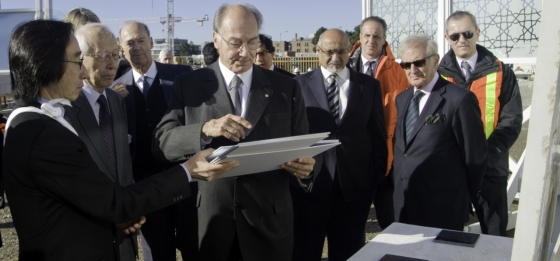
The occasion in January 2005 was the award of the Vincent Scully Prize to Mawlana Hazar Imam, His Highness the Aga Khan, at the National Building Museum in Washington, D.C.
Stepping into the building, I found myself in the presence of Bruno Freschi, the architect behind the exquisite Ismaili Centre Vancouver, which had opened its doors in 1985. Just a few steps away stood Mawlana Hazar Imam, accompanied by Fumihiko Maki and Firoz Rasul, the President of the Aga Khan Council for Canada. It was a rare and profound moment, as Bruno had expressed his desire to meet both Mawlana Hazar Imam and Fumihiko Maki in person. I took the initiative and introduced Bruno to Rasul. In a later interview, Bruno shared his gratitude: “His Highness introduced me to Mr. Maki, and it was here that he again thanked me and said that the Jamatkhana (Ismaili Centre Vancouver) was indeed one of his favourite buildings. He encouraged Mr Maki to visit the building.”
Witnessing two remarkable architects with Mawlana Hazar Imam was a touching moment. The memory of that encounter is etched in my heart, a testament to the profound impact it had on me.
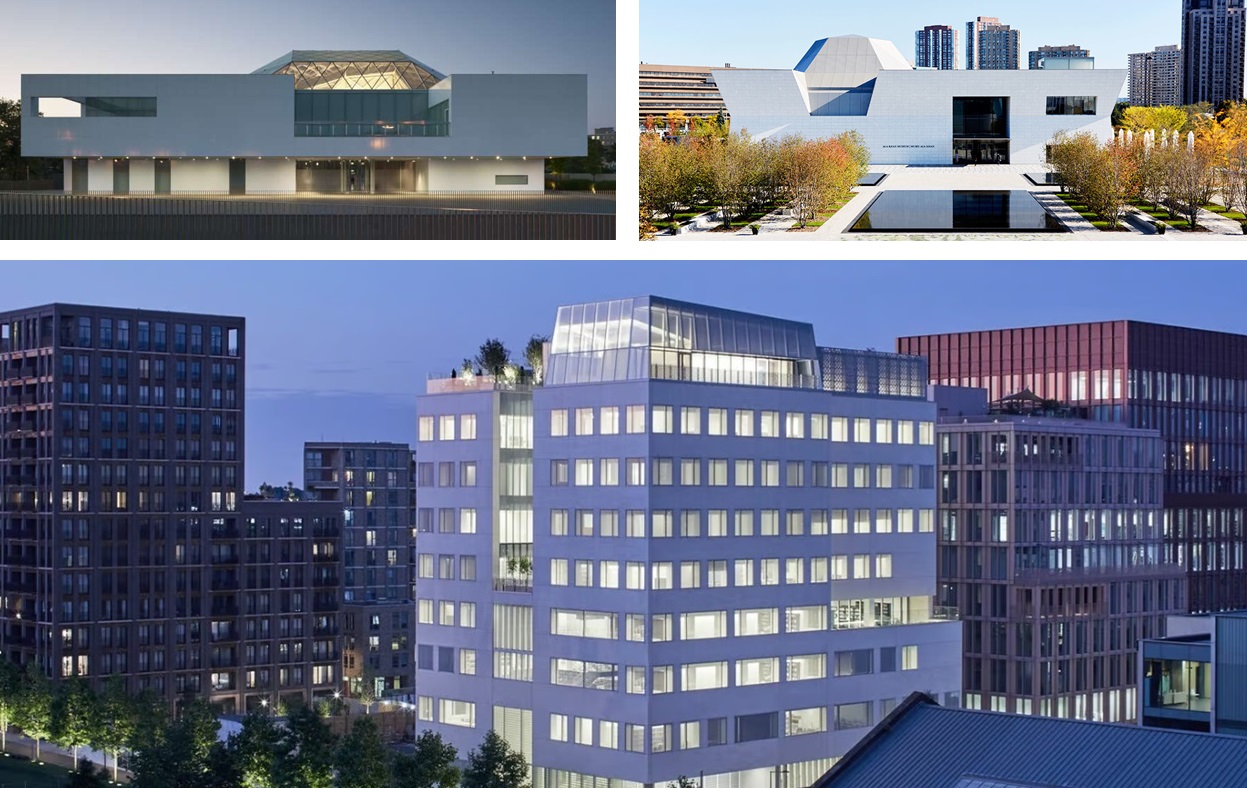
Buildings designed by Fumihiko Maki for His Highness the Aga Khan. Top: Delegation of the Ismaili Imamat, Ottawa (2008), and the Aga Khan Museum, Toronto (2014); bottom, Aga Khan Centre, London (2018).
We honour the renowned architect, Fumihiko Maki, by presenting links to photographs of three beautiful projects that he built for Mawlana Hazar Imam — the Delegation of the Ismaili Imamat building in Ottawa which was opened on December 9, 2008, as the Ismaili community marked the completion of Mawlana Hazar Imam’s Golden Jubilee, the Aga Khan Museum in Toronto which was opened on September 14, 2014, and the Aga Khan Centre in London which was inaugurated on June 26, 2018. We invite you to visit the links provided.
For each of these projects, Mawlana Hazar Imam made remarks on Fumihiko Maki. We publish a selection of the speech excerpts as part of Simerg’s tribute to Mr. Maki.
His Highness the Aga Khan on Fumihiko Maki’s Projects for the Ismaili Imamat
(1) The Delegation of the Ismaili Imamat Building, Sussex Drive, Ottawa
Remarks by the Aga Khan at the Foundation Ceremony of the Delegation Building, Ottawa, June 6, 2005
“The architectural planning [of the Delegation of the Ismaili Imamat Building] has been entrusted to the capable hands of Fumihiko Maki, an architect of world standing. Maki and Associates have my enthusiastic admiration for addressing, with tact and empathy, challenges of design which are difficult and subtle. They call for translating concepts that have a context in our faith and our history, yet stride boldly and confidently ahead, into modernity; for expressing both the exoteric and the esoteric, and our awe and humility towards the mysteries of Nature, Time and beyond. The outcome is an inter-play of multiple facets, like rock crystal. In it are platforms of pure but translucent horizontality. Light’s full spectrum comes alive and disappears as the eye moves. In Islam the divine is reflected in Nature’s creation. The building will rest on a solid linear granite podium. Above it will be a glass dome through which light will illuminate, from multiple directions, two symbolic spaces: an interior atrium and an exterior courtyard landscaped in four quarters, recalling the traditional Persian — Islamic garden, the Chahr-bagh. Nature, through the greenery of trees and flowers, will be on the site, but also in the building, just as we are sometimes able to see leaves and petals captured in rock crystal, but still visible through its unique translucency.
Remarks continue below
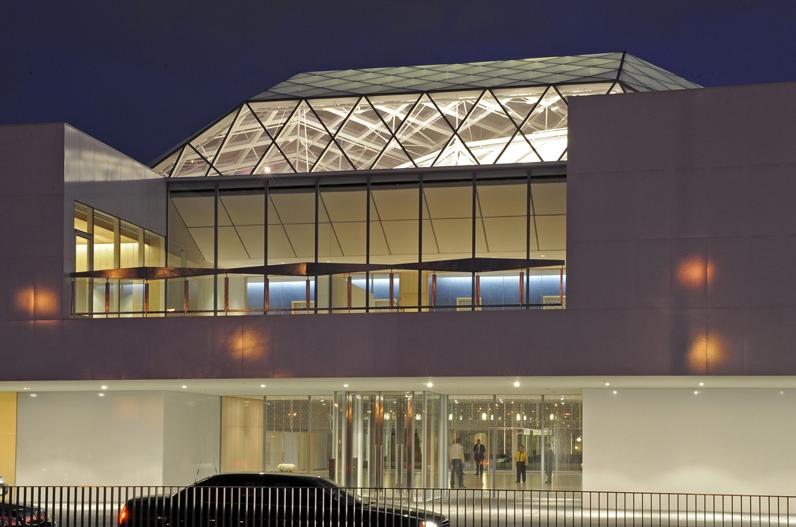
Exterior view, at night, of the entrance to the Delegation of the Ismaili Imamat on Sussex Drive in Ottawa, Canada. – Photo: AKDN/Gary Otte
“The building will be a metaphor for humanism and enlightenment and for the humility that comes from the constant search for answers that leads inevitably to more questions. The Delegation, with its openness and transparency, will be a symbolic seat for the Imamat’s permanent presence in Canada, and a platform for constructive exchanges that mutually broaden moral and intellectual horizons. It will be a window for the AKDN to reinforce existing, and cultivate new, partnerships with national and international agencies present in Ottawa, that share the ethic of contributing to an improved quality of life in the developing world.”
___________________________
(2) The Aga Khan Museum, Wynford Drive, Toronto
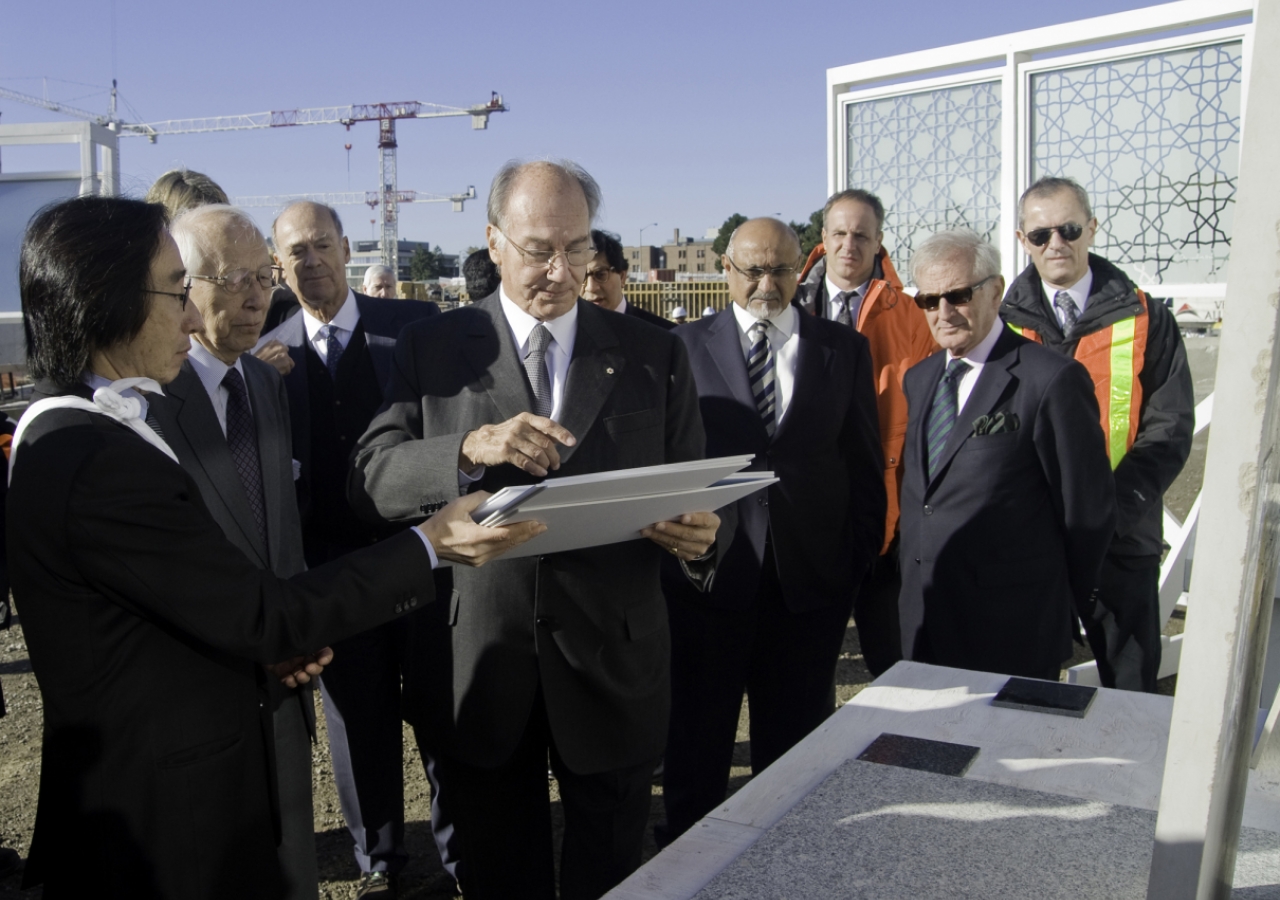
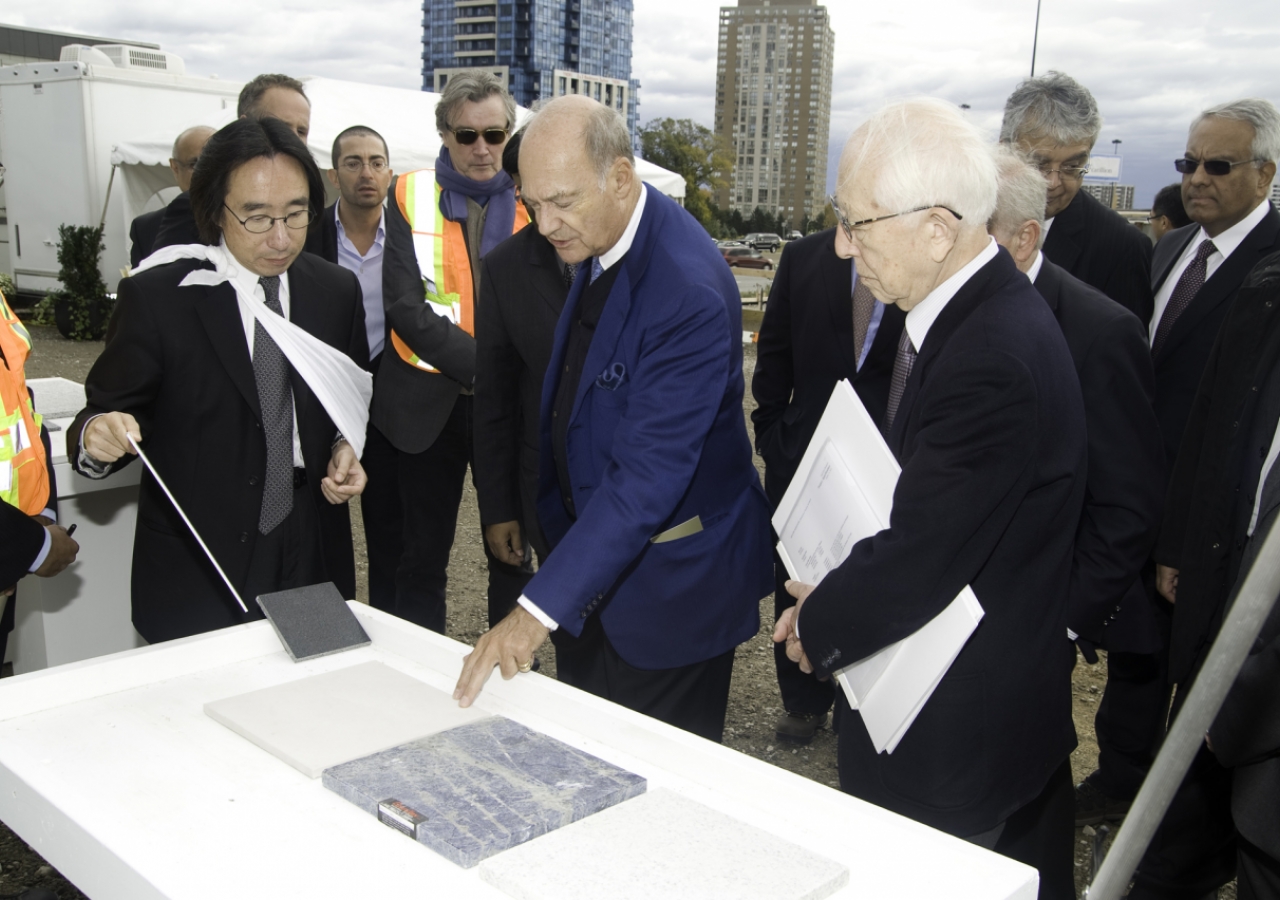
Fumihiko Maki and Gary Kamemoto of Maki & Associates review cladding stone for the Aga Khan Museum with His Highness the Aga Khan, October 2010. Photograph: The Ismaili.
(I) Remarks by the Aga Khan at the Inauguration of the Spirit and Life Exhibition, Ismaili Centre London, June 12, 2007
“What we see here today is the nucleus of the Islamic art collections of the future Aga Khan Museum in Toronto. This museum, which is being designed by the renowned Japanese architect Fumihiko Maki, is conceived as a primarily educational institution in the field of Islamic art and culture, a specific mandate that is not fulfilled so far by other North American museums. We hope and trust it will contribute to a deeper understanding among cultures — to the strengthening of true cultural pluralism — which is increasingly essential to peace, and to progress, in our world.”
~~~~~~~
(II) Remarks by the Aga Khan at the Foundation Ceremony of the Ismaili Centre, the Aga Khan Museum and their Park, Toronto, May 28, 2010,
“I should emphasise, as well, that the Museum building itself will be an important work of art — designed by the great Japanese architect Fumihiko Maki. Many of you know his superb building in Ottawa that has been the home for the Delegation of the Ismaili Imamat since 2008.
“That Delegation building was inspired by the evanescent mysteries of rock crystal. The new Toronto Museum will take as its theme the concept of light — suffusing the building from a central courtyard, through patterned glass screens. From the outside, it will glow by day and by night, lit by the sun and the moon.
Remarks continue below
Fumihiko Maki and Gary Kamemoto of Maki & Associates review materials for the exterior finish of the Aga Khan Museum with Prince Amyn Aga Khan in October 2010. Photograph: The Ismaili.
“From the outside, it will glow by day and by night, lit by the sun and the moon. This use of light speaks to us of the Divine Light of the Creator, reflected in the glow of individual human inspiration and vibrant, transparent community. As the poet Rumi has written: “The light that lights the eye is also the light of the heart… but the light that lights the heart is the Light of God.”
~~~~~~~
(III) Remarks by the Aga Khan on the Aga Khan Museum at the Opening of the Aga Khan Museum and the Ismaili Centre, Toronto, September 12, 2014
“The fusion of tradition and modernity which this building achieves, and the blend of spiritual, educational and social objectives that it embodies, have also characterised our other Ismaili Centres — in Vancouver, London, Lisbon, Dubai, and Dushanbe. All of them were designed by architects of great international standing, and, I would emphasise, of great multi-cultural sensitivity.
Remarks continue below
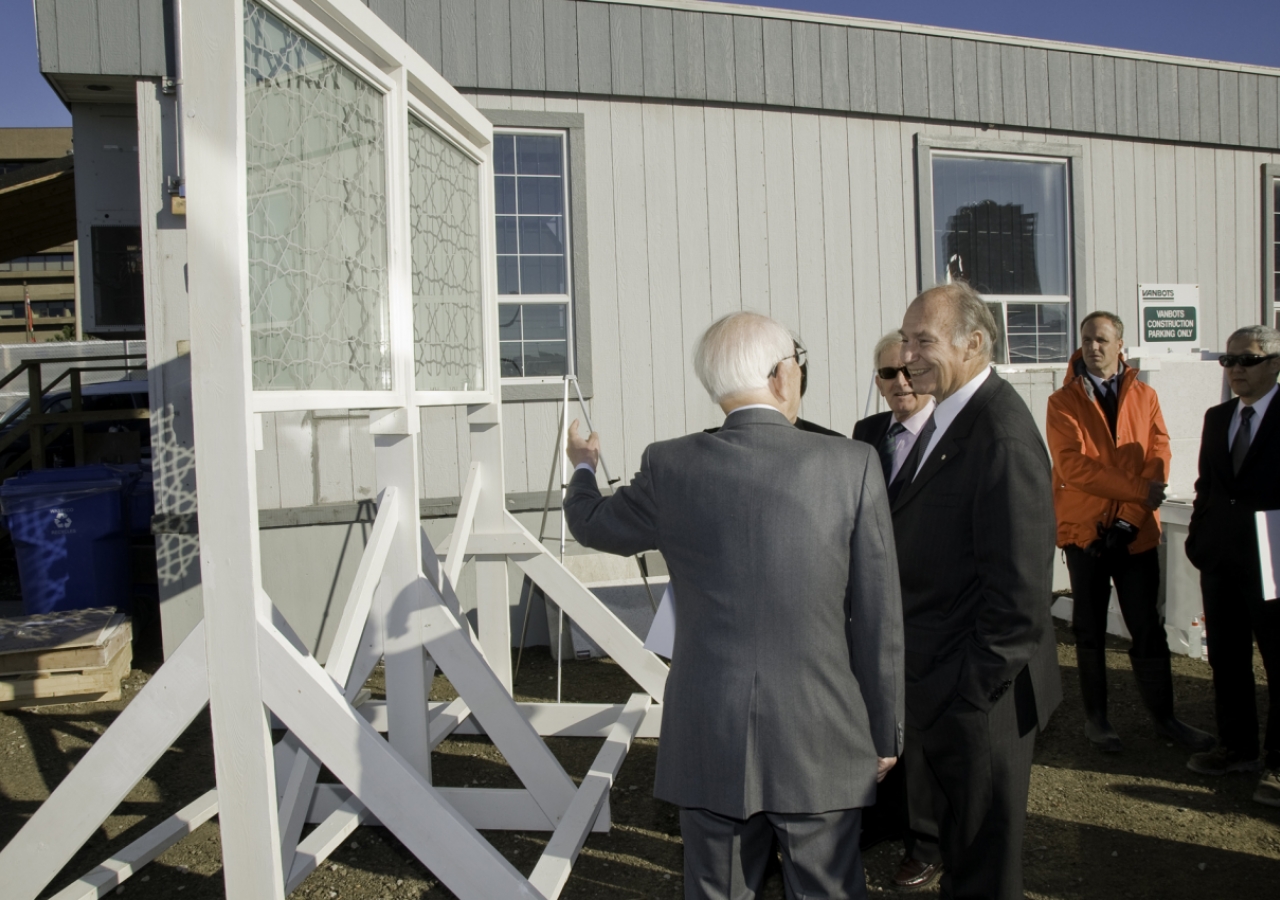
Fumihiko Maki and His Highness the Aga Khan discuss the glass finish options for the courtyard walls of the Aga Khan Museum in October 2010. Photograph: The Ismail
“Charles Correa, for example, comes from an Indian background and has also designed Hindu and Christian buildings. The architect for our Vancouver Centre 30 years ago was Bruno Freschi, whose family is of Italian background, and whose earlier work had included a Sikh place of worship. The new Aga Khan Park was designed by an architect of Lebanese heritage, Vladimir Djurovic. And the Aga Khan Museum is the work of a superb Japanese professional, Fumihiko Maki. How pleased we are that all of these fine artists are with us today.”
_____________________
The Aga Khan Centre, King’s Cross, London
“The Aga Khan Centre is the third project we have worked on with the distinguished architect Fumihiko Maki, a master of form and light” — His Highness the Aga Khan, quoted on Aga Khan Centre website
Gary Kamemoto and Professor Maki of Maki & Associates, the architects of the Aga Khan Centre, at the Aga Khan Centre Library.
Remarks by the Aga Khan at the inauguration of the Aga Khan Centre, June 5, 2018
“We celebrate today a beautiful new architectural accomplishment. This place has been shaped by many diverse influences — and among them we now welcome the rich traditions of Islamic architecture. One of those traditions – one that is appreciated by both the Islamic and the British cultures – is the special importance of the garden. We see the garden not merely as an adjunct to other constructions, but as a privileged space unto itself.
“And that is why I have emphasised, since our role began here in 2010, my own hope that the value of garden spaces should be embraced here. As we perambulate together through these spaces today, I trust that you will share my delight in seeing how that hope has been fulfilled. What we will see as we walk along are not only beautiful buildings — but also a unique series of gardens, courtyards and terraces – eight of them, in all, across our two buildings. Each one of them, moreover, has a distinctive identity: each one is inspired by a different region of the Islamic Ummah.
Remarks continue below
On Tuesday, June 26, 2018, HRH The Prince of Wales, now His Majesty King Charles, opened The Aga Khan Centre in King’s Cross in the presence of Mawlana Hazar Imam, His Highness the Aga Khan. Situated at the heart of London’s Knowledge Quarter, the Aga Khan Centre, designed by Maki and Associates, led by Fumihiko Maki, one of Japan’s most distinguished contemporary architects, provides a new home for a number of UK based organisations founded by His Highness the Aga Khan: The Institute of Ismaili Studies (IIS), the Aga Khan University Institute for the Study of Muslim Civilisations (AKU-ISMC) and the Aga Khan Foundation UK (AKF UK).
“Taken together, this winding ribbon of special spaces is an eloquent tribute to the rich diversity of the Muslim world. As we open this remarkable site, it is a privilege to salute those who have brought us to this moment. I would recognise, in particular, our fine relationship with the government of this borough, this city, and this country, as well as our rewarding partnership with the people at Argent. We are grateful, as well, for the talents of Maki and Associates, Allies and Morrison, Madison Cox and Nelson Byrd Woltz, as well as Rasheed Araeen and the late Karl Schlamminger. I would also like to thank our splendid team of staff and volunteers, including my brother Prince Amyn, who have stewarded this project to completion.”
Date posted: June 13, 2024.
_____________________
Please visit the Maki and Associates website for Professor Maki’s biography and curriculum vitae, which summarize his education, professional affiliations, and worldwide recognitions and awards.
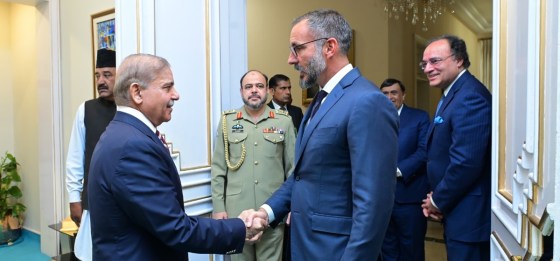
Barakah, our sister website, dedicated to His Highness the Aga Khan, the 49th Hereditary Imam of the Ismaili Muslims, has a special page covering news related to the Aga Khan and his family members. Prince Rahim, his oldest son, concluded his five-day visit to Pakistan on June 10, 2024, with a meeting with the Pakistan Prime Mnister Shehbaz Sharif (see featured photo, top of post). On June 7, the Prince was awarded Pakistan’s Highest Civilian Order by the President of Pakistan, Asif Ali Zardari.
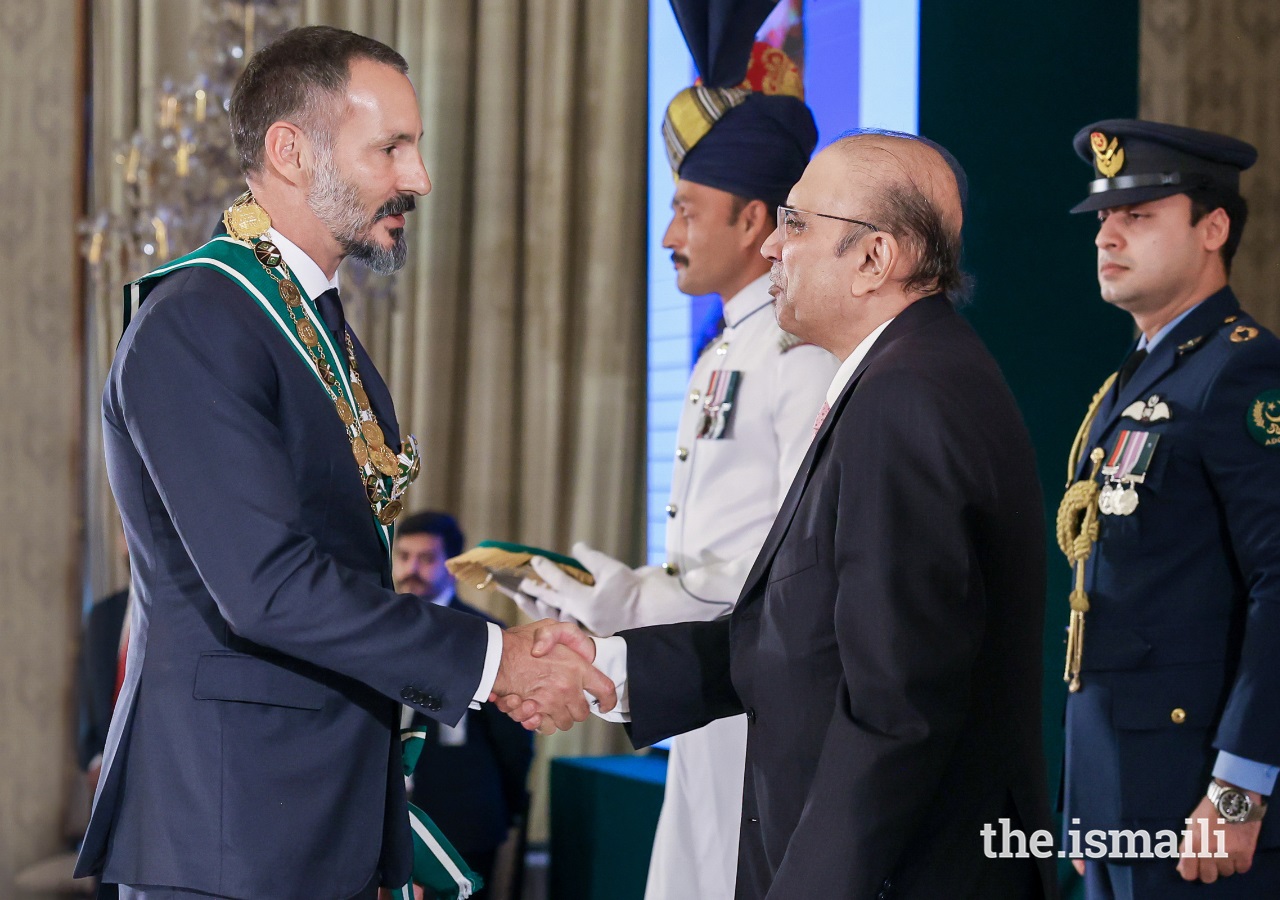
The President of Pakistan, Asif Ali Zardari, congratulates Prince Rahim Aga Khan after conferring on him the Nishan-i-Pakistan on June 7, 2024, at a ceremony held at Aiwan-e-Sadr, the President’s official residence in Islamabad. Photograph: AKDN/Akbar Hakim. Please click on the photo for more coverage of the event and other events since the beginning of 2024.
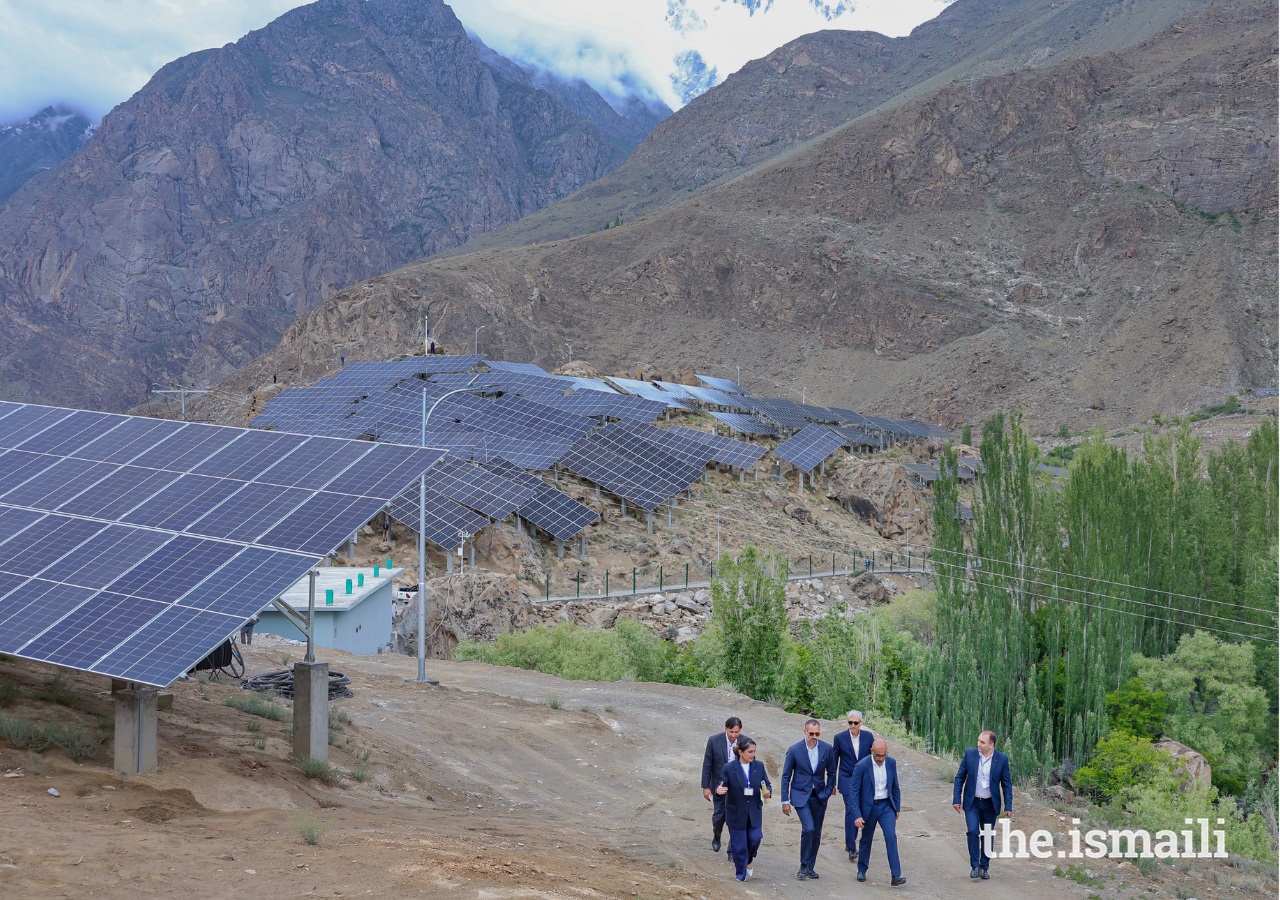
Prince Rahim then visited Hunza to launch projects related to the development of Solar Power Plants and a high-tech Software Park, visited the 800-year-old restored historic fort of Altit and saw the completion of the five-star Hotel Serena. On June 9, he inaugurated the new Headquarters of HBL Microfinance Bank in Gilgit.
Prince Rahim Aga Khan climbs up Duiker Hill to get a bird’s eye view of the areas that will benefit from the expansion of the power plant in Hunza. Please click on the image for this and other stories. Photograph: AKDN/Akbar Hakim.
Prince Rahim’s sister, Princess Zahra, visited the Aga Khan Development Network’s work in Hunza and Chitral between May 22 and 26.
On May 11, their aunt, Princess Yasmin Aga Khan hosted the highly successful Rita Hayworth Gala in Chicago. This remarkable event, which raised nearly US $900,000, is a shining example of how collective efforts can make a significant difference in supporting the Alzheimer’s Association’s care, support, and research programs.
Visit Barakah for news, insightful and inspirational articles about the Aga Khan and the Ismaili Imamat.
Date posted: June 7, 2024. Last updated: June 10, 2024.
The preview night of Zahida Rahemtulla’s play The Wrong Bashir at Toronto’s renowned Crow’s Theatre on Tuesday, May 21, 2024, was a sell-out event. Crow’s Theatre picked up the play for its bold, ambitious and imaginative 2024-2025 season following The Wrong Bashir’s successful Vancouver showing in May 2023. The Wrong Bashir is Burnaby-born Ismaili playwright Zahida Rahemtulla’s debut play. The play runs until June 16.
Special Discounts to See The Wrong Bashir
For tickets for all shows from May 21 to June 16, 2024, please click Buy Tickets for The Wrong Bashir and use the following promotion codes, as applicable:
May 21 to May 26, 2024: General Admission Adult and Senior Tickets can be purchased 2-FOR-1. Please use promotion code WRONG241;
May 21 to June 1, 2024: General Admission Adult and Senior tickets will be discounted 25%. Please use promotion code BASHIR25; and
Throughout the entire run (May 21st-June 9th), there is also a 20% discount for groups of 8+ anytime, which can be obtained by contacting the Crow’s Theatre box office at boxoffice@crowstheatre.com or calling (647) 341-7390.
The performance on June 16 is Pay-What-You-Can.
With its heartwarming and humorous portrayal of an intergenerational, transitional moment in the life of a family and community, the play is a must-see for all Ismaili community members. The Wrong Bashir affectionately shows much humour within the worldwide Ismaili community. The play elicited ample laughs and resonated widely with Ismaili and broader audiences in Vancouver and on its debut night in Toronto.
We are truly gratified by the magnificent success new Ismaili artists and filmmakers such as Zahida Rahemtulla and Kiana Rawji, whom we featured in 2023, are achieving in the early days of their careers. Simerg values their inspiring accomplishments and extends a warm invitation to other talented Ismaili youth. This is your chance to seize the opportunity and share your original stories of success and recognition in your respective areas of endeavour with national and/or international impact. Remember, your stories are not just personal triumphs, but also an integral part of the Ismaili Muslim community’s narrative, shaping our collective identity and inspiring future generations.
Date posted: May 23, 2024. Last updated: June 4, 2024 (links added to reviews of the play, see update notice at the top of post, and play extended by a week to June 16).
Correction: In an earlier version, we had incorrectly stated May 21, 2024, as the opening night of “The Wrong Bashir.” May 21 was the preview night. The official opening took place on Friday, May 24.
________________
PLAYWRIGHT ZAHIDA RAHEMTULLA AND DIRECTOR PAOLO SANTALUCIA
Zahida Rahemtulla
Zahida Rahemtulla is a playwright and short story writer. Her debut play, The Wrong Bashir, premiered with Touchstone Theatre in Vancouver in May 2023 and makes its Toronto premiere on May 21, 2024, at the Crow’s Theatre, which has been a leading force in new play creation in the Canadian theatre landscape. Zahida currently facilitates Paragon Theatre’s East of Tarragon Project in Scarborough and is passionate about education and working on new playswith new playwrights.
~~~~~~
Paolo Santalucia
Paolo Santalucia is an award-winning actor, director and writer. He is a Soulpepper Academy graduate and has been a member of Soulpepper’s ensemble for the past ten seasons. Paolo is a co-founder and Artistic Leader of the award-winning Howland Company. Paolo also teaches classical performance with the University of Toronto’s Theatre and Drama Studies Program, and is the recipient of two Dora Mavor Moore Awards in acting, one nomination for direction, and has been shortlisted for the John Hirsch Award for Directing.
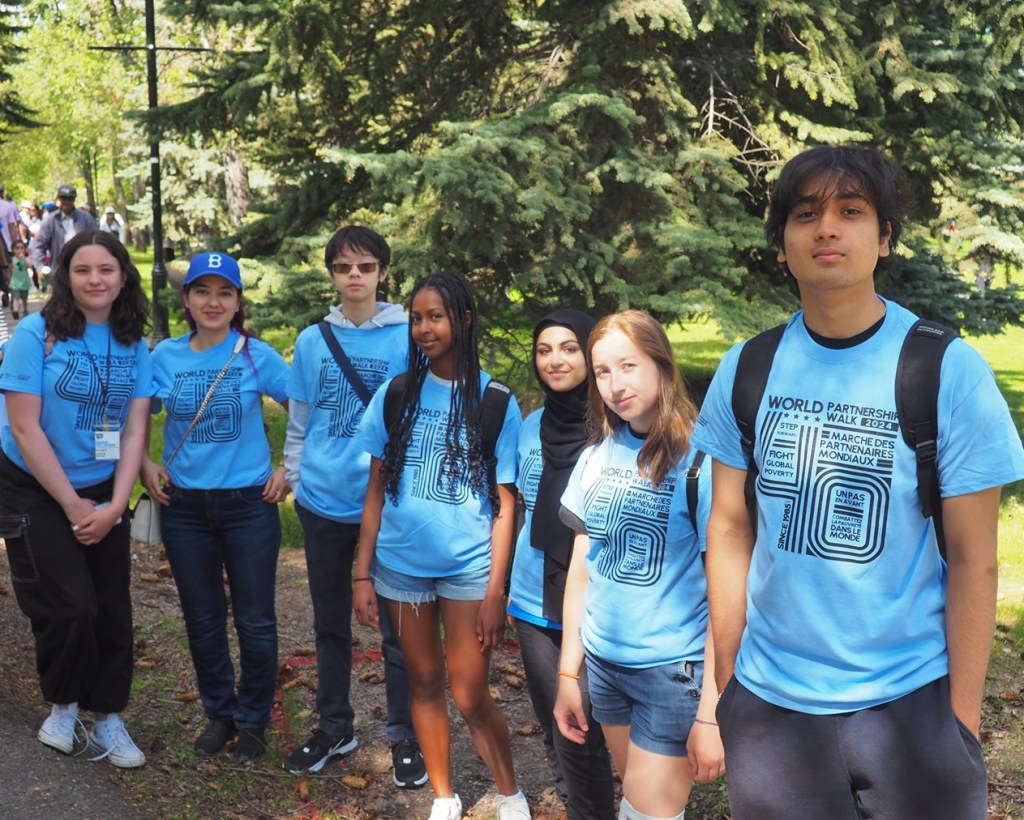
The “physical” World Partnership Walk (WPW) returned to Calgary downtown’s beautiful Prince’s Island Park after COVID-19 had turned it into a virtual event from 2020 onwards. The Walk in Edmonton was held on the grounds of the Alberta Legislature. The presence and participation of youth as walkers, volunteers, and entertainers were particularly heartwarming. The Ismaili community’s discipline and organization of the walk were truly admirable. The Walk was a special day for 11-year-old Izmir Kassam of Calgary whose goal was to collect $40,000 on the 40th anniversary of the Walk. Please see our WPW pictorial coverage HERE or click on the photo below.
Please click on photo for World Partnership Walk story.










 Simerg - Insights from Around the World