Simerg is an independent initiative dedicated to Ismaili Muslims, the Aga Khan — their Hereditary Imam — and the Ismaili Imamat, and Islam in general through literary readings, photo essays and artistic expressions
Author Archives: Malik Merchant, Editor
Founding publisher and editor of www.barakah.com, www.simerg.com and www.simergphotos.com.
“In my calligraphic work, I use one line from the Quran. I repeat it over the years. The line in this work is from the Iqra Ayat, which states ‘God taught man what he did not know’ in the naskhi script. This is a line that I have used repeatedly over the last three decades. My challenge has been how to translate it into sculpture.” — Amin Gulgee
By ANIZA MEGHANI
Algorithm II, 2015, Copper, 37.7 x 29.2 x 31 inches. Artist: Amin Gulgee.
No one can miss Amin Gulgee’s home from a distance with its rooftop adorned with a mosaic of mult-coloured glass, tile and terra cotta. No doubt a tourist attraction. As I entered Amin’s gallery on the ground floor, I was stepping into a world of pure copper sculpted into Quranic words. When sunlight caught his sculptures, they reflected shadows on the walls that seemed to dance in spiritual twirls. We made our way to his living room on the first floor, up the steel staircase with copper railings, designed by the artist himself. I noticed a photograph of his late father’s lapis mosaic portrait of Sir Sultan Mahomed Shah hanging on the wall just before we entered his private quarters.
Amin told me a story about this piece: “That was one of my father’s works from the 1970s,” he said. “I grew up with it. I remember one day when I was a kid, the Aga Khan came to our house in KDA. He spent time with my parents, and he loved the portrait. Of course, my father said, ‘Your Highness, we will gift this to you.’ Imam responded, ‘No, you will not gift this to me. You must tell me how much you are charging for it.’ I remember when my parents took the mosaic portrait to the Aga Khan, they were feeling sad about parting with it. But what I truly remember most was that the Aga Khan refused to accept it as a present. How fantastic is that? Imagine the respect he had for the artist and his work!”
As I sat and drank mid-morning ginger tea, I could see from Amin’s balcony the courtyard that connected his home with that of his late parents. His parents, of course, were the renowned artist, Ismail Gulgee, and his wonderful wife, Zaro. How I miss them dearly! Here I was, once again, at his home, reflecting upon a family friendship that has spanned over three decades.
I met Amin when both father and son had a joint exhibition at the Ismaili Centre in London in 1994. Zaro-Aunty took my hand and walked me across the social hall, where Amin was surrounded by his sculptures and a display of his handmade jewellery. She proudly introduced me to him. “Aniza, this is my son, Amin; he is an artist, too. He makes sculpture.” I was drawn to his jewellery and nickel-plated copper sculptures in kufic with large crystal stones set within. Tall and handsome, with shoulder-length hair, he showed me his beautiful collection.
Now as I sat in his living room, reflecting on that day, I was mesmerised by his father’s work adorning the walls and wondered whether Amin’s own creativity had been sparked by it. My mind raced with this and many other questions.
Perforated Egg, 2018 Copper, 27 x 16 x 16 inches. Artist Amin Gulgee.
Amin was born in Karachi, Pakistan and studied at the Karachi American School from kindergarten to the twelfth grade. He went on to do his bachelor’s degree from Yale University in the United States. I asked whether he was inspired to study art history because of his father. He replied, “Although both my parents were liberal, they didn’t want me to be an artist. I agreed with them as I saw how difficult the life of an artist can be. I didn’t think I had the courage to be an artist. Wishing to be the good South Asian boy, I majored in economics at Yale.”
However, when his classmate Dominique Malaquais took him for his first art history class freshman year, it was the beginning of a journey that made him realise that this is what he wanted to do. Economics was simply too “boring” to endure! This art history class was a study of Baroque gardens, which inspired him to take even more art history classes and to pursue a double major in art history and economics. He wanted to write his senior thesis on Moghul gardens, but at that time it was “problematic”, as there was no Islamic art history department at Yale. He was advised to do his thesis on European gardens instead, but Amin’s heart was set on writing about the Shalimar Gardens in Lahore, constructed by the Moghul Emperor Shah Jahan between 1641 and 1642.
Char Bagh II, 2003, Copper, 37 x 37 x 35 inches. Artist: Amin Gulgee.
With help from his late father’s connections in the art world, Amin was introduced to Dr Oleg Garbar, the renowned authority on Islamic art and Harvard’s first Aga Khan Professor of Islamic Art and Architecture. Dr Garbar agreed to be Amin’s secondary advisor. (His primary adviser at Yale was Dr Judith Colton, an expert on European gardens of the 17th to 19th centuries.) Amin’s senior thesis, “A Walk Through Shalimar: A Char-Bagh Garden of 17th Century Mughal India Seen as a Manifestation of Imperial Divine Right”, went on to win the Conger Goodyear Fine Arts Award from Yale’s art history department.
Amin was spiritually drawn towards exploring Islamic art as a result. A new journey of his life began when he embarked upon a career not as a painter like his father, but as a sculptor. I asked him if he kept his first art piece. He emphatically replied, “No! I am not sentimental!”
I was curious about what gave him inspiration to create his artwork. He explained, “All my work is personal. Everything relates to me at a certain point in my life.”
Iqra
I wanted to further explore his creative mind, how art evolves within it. What made him tick? Did he get up in the middle of the night to sketch out an idea, or write it down? Where did it all come from? So, I pointed to a tall sculpture. Amin talked me through it: “In my calligraphic work,” he explained, “I use one line from the Quran. I repeat it over the years. The line in this work is from the Iqra Ayat, which states ‘God taught man what he did not know’ in the naskhi script. This is a line that I have used repeatedly over the last three decades. My challenge has been how to translate it into sculpture. I like the idea of repetition. For me it becomes intellectually, aesthetically and conceptionally challenging to keep the same line in the same script, but to vary its physical form. I explored this idea in a solo shown that I called ’7’. I chopped the line into seven portions and rearranged them. There was nothing legible anymore as the letters were no longer in their original order. ‘7’ was co-curated by the late Paolo De Grandis and Claudio Crescentini and was held at the Museum of Modern Art in Rome, a short walk from the Spanish Steps. My installation was shown in the courtyard of the museum, which had once been a cloister.”
I asked him why he was drawn to this particular Quranic line. He replied, “It’s personal. It’s spiritual and I do not wish to share this. You must remember it’s private for me.”
I respected his answer. As in life, spiritual moments are personal and cannot be shared. I kind of understood. Correction: I understood him totally.
Cosmic Chapati, Unknown Centre, 2011, Copper, 35 x 35 x 2 inches. Artist: Amin Gulgee.
~~~~~~~
Another line Amin has used repeatedly is from the Surah-e-Rehman, which asks, “Which of the favours of God can one deny?” in new style kufic. (He has not created a work around this since 2008, however.) In this series as well, you can no no longer read the line. Amin explains, “You can only read the text in sculptures where I use the phrase Al-Hamdulillah (Praise be to God), which I render in the square kufic script. These are geometric, architectonic works.”
Amin stopped making his art jewellery in 2007. Although he called it jewellery, these gold-plated organic forms embellished with crystal and semi-precious stones were more like wearable sculpture. There was a relationship between his jewellery and his larger sculptures as he sometimes used these smaller works to work out ideas that might develop into bigger pieces. These were his sketches, in a way.
Embrace, 1999, Copper and rock crystals, 34 x 25 x 24 inches. Artist. Amyn Gulgee.
We got talking about Amin’s work as a curator. It began, he said, in the late 1990s, when he curated an art festival at the Sheraton Hotel in Karachi (now the Mövenpick). In the old days, the lobby was a place where young people used to hang out drinking coffee all day, “trying to be fancy”, as Amin put it. Being a semi-public space, it appealed to Amin as a venue to organise an exhibition that he would call Urban Voices. Amin curated four iterations of the group art show, which juxtaposed the work of recent graduates from the city’s art schools with that of established artists. The money generated from the sales of the artwork from these events went towards a scholarship at the prestigious National College of Arts in Lahore.
Rung I, 1994, Copper, rock crystals, and glass, 24 x 15 x 9 inches. Artist: Amin Gulgee.
In 2000, Amin inaugurated the Amin Gulgee Gallery on the ground floor of his newly built home in Clifton, a seaside neighbourhood. About once a year, he has opened up the space for large-scale, thematic shows of his contemporaries. (John McCarry, whom Amin met at Yale, is the coordinator of this artist-led space.) Amin explained, “Lahore is where all the art institutions are. Karachi is where the commercial galleries are. We wanted to do exhibitions without any kind of commercial point of view.”
The Bird Rickshaw, 2004 Copper, 84 x 100 x 42 inches. Artist: Amin Gulgee.
Having had many years of experience curating shows, Amin was approached in 2015 by Niilofur Farrukh, now the CEO of the Karachi Biennale, who asked him whether he would like to be the Chief Curator of its first edition in 2017. Amin readily accepted the challenge, despite the nascent biennial’s severe lack of funding. Amin began the task of creating a team of Karachi-based millennials, none of whom had any experience in curating a large art event. It included Zeerak Ahmed, Humayun Memon and Sara Pagganwala, all of whom had their own art practices.
The team worked collectively and tirelessly. With minimal financial backing but huge ambitions, the team was able to gather 182 artists from around the world, including Yoko Ono and Michelangelo Pistoletto, a key figure in Italy’s Arte Povera movement. There were twelve locations throughout the city to show their work. The whole process took two years. Six months prior to the opening, Amin invited Zarmeene Shah, who is now the director of graduate studies at the Indus Valley School of Art and Architecture in Karachi, to come on board in an advisory role as curator-at-large. The biennial –Pakistan’s first — was no easy task, but Amin and his team pulled off an outstanding event.
Perforated Wall I, Love Letter. 2014, Copper, 24 x 12 x 1 inches. Artist: Amin Gulgee.
I asked Amin how he envisions the future for artists in Pakistan. He replied, “I was born in the art scene. The scene has become much bigger now. I wish my parents were alive to see it! Now there is a Lahore Biennale as well as a Karachi Biennale. When I did my first show, there was only one gallery of note, Ali Imam’s Indus Gallery. Now we have more than 50 galleries in Karachi alone.” Amin is expanding his non-commercial gallery while also renovating his father’s adjoining museum. When I visited in May of 2024, building work was still in progress. The din of construction resounded in the connecting courtyard below. The aim is to open his parents’ former home as a small, private museum in 2025.
Amin has also been busy compiling a monograph on his work. It will be published in the spring of 2025 by Skira, a Milan-based publisher of art books that has brought out books on Picasso and Matisse as well as of important contemporary artists. Amin commented, “It’s a real honour for me that they have chosen my book to print. I am not nostalgic or sentimental, therefore the process of looking back has been hard.” He added with a laugh, “I’m just so happy that the two-year process of compiling it is now coming to an end!”
~~~~~~~
Amin Gulgee
“I think it’s very important that we record our own history and not wait around for someone abroad to do it for us. We must take control of our own narrative. I put all my documentation on my website (www.gulgeeamin.com). It is all free and downloadable. You will find a whole section of catalogues, not only on my work but on my curatorial projects, which discuss a whole variety of issues.” — Amin Gulgee
~~~~~~~
Ascension III, 2018, Copper, 88 x 27 x 27 inches. Artist: Amin Gulgee.
This led us to the topic of documentation of Pakistani art in general. Every show he curates, whether at his gallery or elsewhere, is accompanied by either a physical or electronic catalogue, and often a video and webinar as well. “Documentation is extremely important,” he explained. “When I compile a catalogue of a show I’ve curated, I not only write about the artists and the exhibition, but I also invite outside writers to contribute essays about issues and concerns they have about Pakistan in general. So, these become free platforms to express ideas. For example, Niilofur Farrukh and I co-curated a show at my gallery on the 1970s in Pakistan. This led to a book called Pakistan’s Radioactive Decade: An Informal Cultural History of the 1970s co-edited by me, Niilofur and John McCarry that was published by Oxford University Press in 2019. After the secession of Bangladesh, Pakistan swung from democratic liberalism to Islamist military rule. Those early democratic years saw a boom in cultural expression, whether it was in the visual arts, literature, film or music. This book included essays as well as Q and As with Pakistanis who helped forge the cultural life of Pakistan in that most pivotal of decades. I think it’s very important that we record our own history and not wait around for someone abroad to do it for us. We must take control of our own narrative. I put all my documentation on my website (www.gulgeeamin.com). It is all free and downloadable. You will find a whole section of catalogues, not only on my work but on my curatorial projects, which discuss a whole variety of issues.”
The Iron Horn, 203, Iron, 71 x 77 x 24 inches. Artist: Amin Gulgee.
I asked Amin what advice he would give to someone wishing to be an artist today. He laughed his booming laugh and answered: “Choose something else, sweatheart! Being an artist is so difficult. It’s easier doing something else. However, if you really want to do it, then be prepared to pay your pound of flesh. Follow your dreams as you don’t know how long you are going to live. Just be prepared. It’s a strange, strange way of making a living.”
Has it been an enjoyable journey being an artist for him? Amin replied, “Aniza, I am free. I am grateful. I am now an old man! I have done exactly what I wanted to do in my life.”
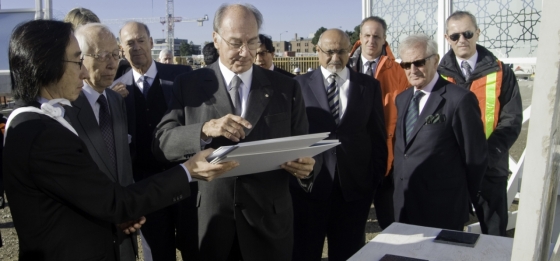
“The architectural planning [of the Delegation of the Ismaili Imamat Building] has been entrusted to the capable hands of Fumihiko Maki, an architect of world standing. Maki and Associates have my enthusiastic admiration for addressing, with tact and empathy, challenges of design which are difficult and subtle. They call for translating concepts that have a context in our faith and our history, yet stride boldly and confidently ahead, into modernity; for expressing both the exoteric and the esoteric, and our awe and humility towards the mysteries of Nature, Time and beyond.” — His Highness the Aga Khan, June 2005.
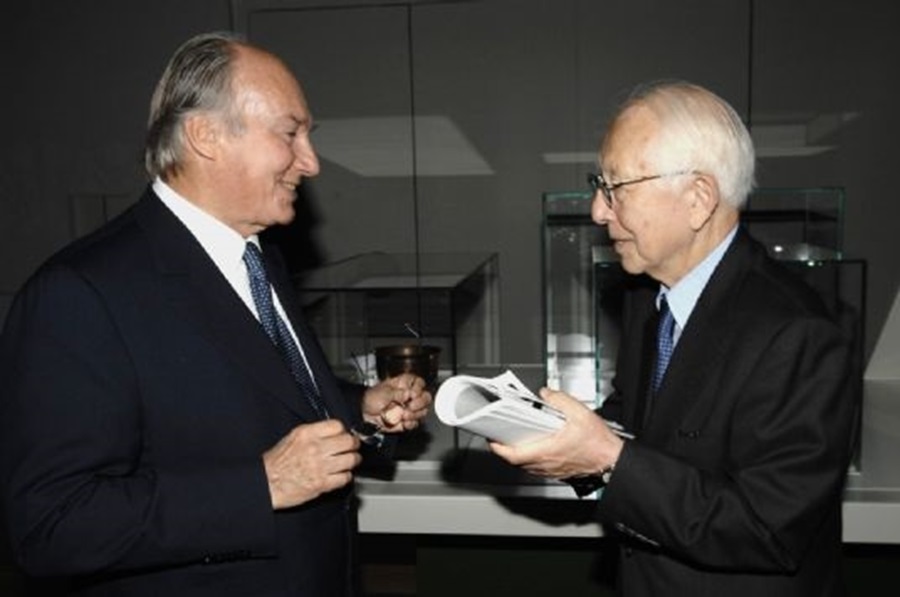
His Highness the Aga Khan with architect Fumihiko Maki at an Aga Khan Museum Exhibition held at the Louvre in 2007. The renowned Japanese architect served twice on the Master Jury of the Aga Khan Award for Architecture, and designed the Delegation of the Ismaili Imamat Building in Ottawa which was opened in December 2008 , the Aga Khan Museum in Toronto opened in September 2014., and the Aga Khan Centre in King’s Cross in London, opened in June 2018. Photo: AKDN/Gary Otte.
Reflecting back to 2005, I can’t help but feel a profound sense of loss as I note the passing of the renowned Japanese architect Fumihiko Maki on June 6, 2024, at the age of 95. His architectural firm, Maki and Associates, officially announced his demise. The news of Mr. Maki’s death reverberated across the globe, with obituaries appearing in esteemed publications such as the Washington Post, New York Times, and CNN, as well as prominent architectural websites like Architectural Record, World Architects, and Architect’s Newspaper.
The occasion in January 2005 was the award of the Vincent Scully Prize to Mawlana Hazar Imam, His Highness the Aga Khan, at the National Building Museum in Washington, D.C.
Stepping into the building, I found myself in the presence of Bruno Freschi, the architect behind the exquisite Ismaili Centre Vancouver, which had opened its doors in 1985. Just a few steps away stood Mawlana Hazar Imam, accompanied by Fumihiko Maki and Firoz Rasul, the President of the Aga Khan Council for Canada. It was a rare and profound moment, as Bruno had expressed his desire to meet both Mawlana Hazar Imam and Fumihiko Maki in person. I took the initiative and introduced Bruno to Rasul. In a later interview, Bruno shared his gratitude: “His Highness introduced me to Mr. Maki, and it was here that he again thanked me and said that the Jamatkhana (Ismaili Centre Vancouver) was indeed one of his favourite buildings. He encouraged Mr Maki to visit the building.”
Witnessing two remarkable architects with Mawlana Hazar Imam was a touching moment. The memory of that encounter is etched in my heart, a testament to the profound impact it had on me.
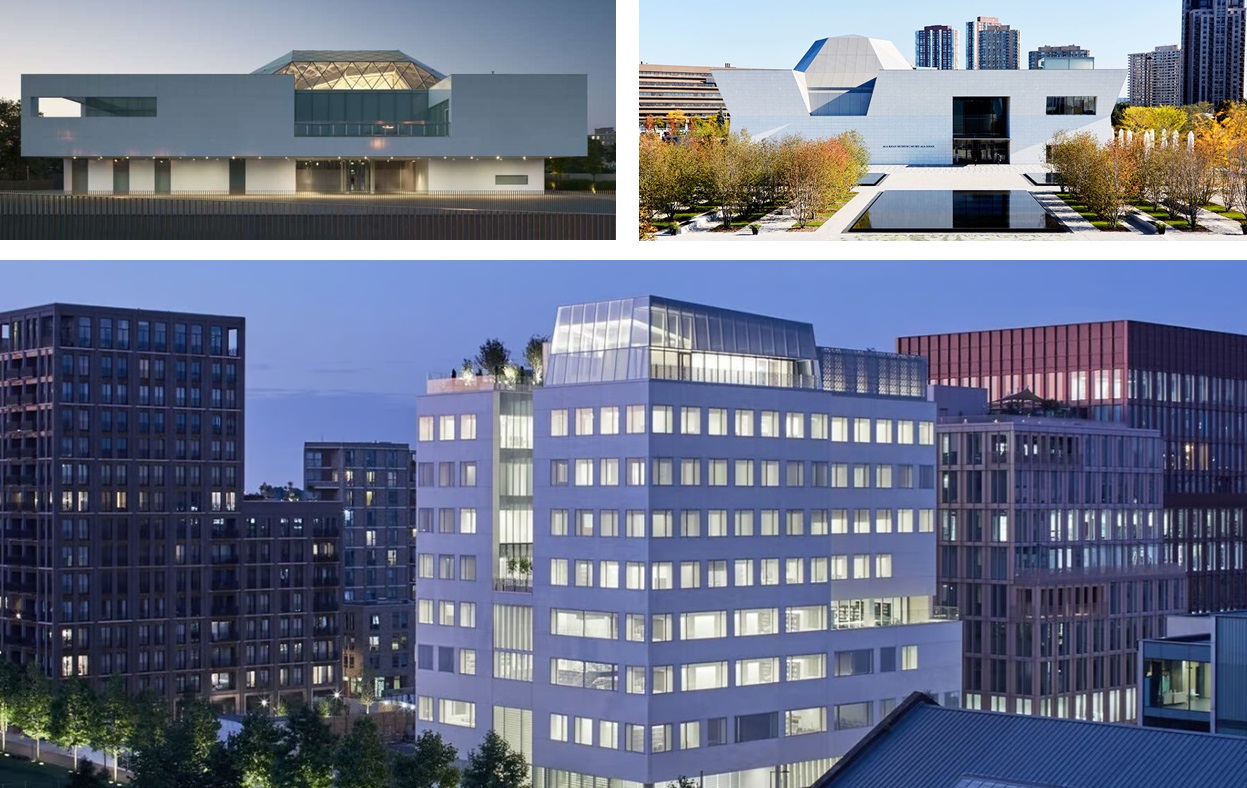
Buildings designed by Fumihiko Maki for His Highness the Aga Khan. Top: Delegation of the Ismaili Imamat, Ottawa (2008), and the Aga Khan Museum, Toronto (2014); bottom, Aga Khan Centre, London (2018).
We honour the renowned architect, Fumihiko Maki, by presenting links to photographs of three beautiful projects that he built for Mawlana Hazar Imam — the Delegation of the Ismaili Imamat building in Ottawa which was opened on December 9, 2008, as the Ismaili community marked the completion of Mawlana Hazar Imam’s Golden Jubilee, the Aga Khan Museum in Toronto which was opened on September 14, 2014, and the Aga Khan Centre in London which was inaugurated on June 26, 2018. We invite you to visit the links provided.
For each of these projects, Mawlana Hazar Imam made remarks on Fumihiko Maki. We publish a selection of the speech excerpts as part of Simerg’s tribute to Mr. Maki.
His Highness the Aga Khan on Fumihiko Maki’s Projects for the Ismaili Imamat
(1) The Delegation of the Ismaili Imamat Building, Sussex Drive, Ottawa
Remarks by the Aga Khan at the Foundation Ceremony of the Delegation Building, Ottawa, June 6, 2005
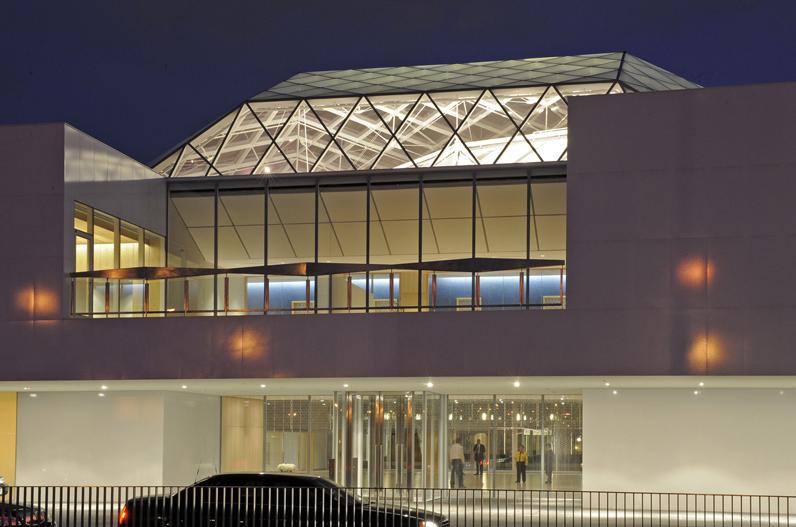
“The architectural planning [of the Delegation of the Ismaili Imamat Building] has been entrusted to the capable hands of Fumihiko Maki, an architect of world standing. Maki and Associates have my enthusiastic admiration for addressing, with tact and empathy, challenges of design which are difficult and subtle. They call for translating concepts that have a context in our faith and our history, yet stride boldly and confidently ahead, into modernity; for expressing both the exoteric and the esoteric, and our awe and humility towards the mysteries of Nature, Time and beyond. The outcome is an inter-play of multiple facets, like rock crystal. In it are platforms of pure but translucent horizontality. Light’s full spectrum comes alive and disappears as the eye moves. In Islam the divine is reflected in Nature’s creation. The building will rest on a solid linear granite podium. Above it will be a glass dome through which light will illuminate, from multiple directions, two symbolic spaces: an interior atrium and an exterior courtyard landscaped in four quarters, recalling the traditional Persian — Islamic garden, the Chahr-bagh. Nature, through the greenery of trees and flowers, will be on the site, but also in the building, just as we are sometimes able to see leaves and petals captured in rock crystal, but still visible through its unique translucency.
Remarks continue below
Exterior view, at night, of the entrance to the Delegation of the Ismaili Imamat on Sussex Drive in Ottawa, Canada. – Photo: AKDN/Gary Otte
“The building will be a metaphor for humanism and enlightenment and for the humility that comes from the constant search for answers that leads inevitably to more questions. The Delegation, with its openness and transparency, will be a symbolic seat for the Imamat’s permanent presence in Canada, and a platform for constructive exchanges that mutually broaden moral and intellectual horizons. It will be a window for the AKDN to reinforce existing, and cultivate new, partnerships with national and international agencies present in Ottawa, that share the ethic of contributing to an improved quality of life in the developing world.”
___________________________
(2) The Aga Khan Museum, Wynford Drive, Toronto
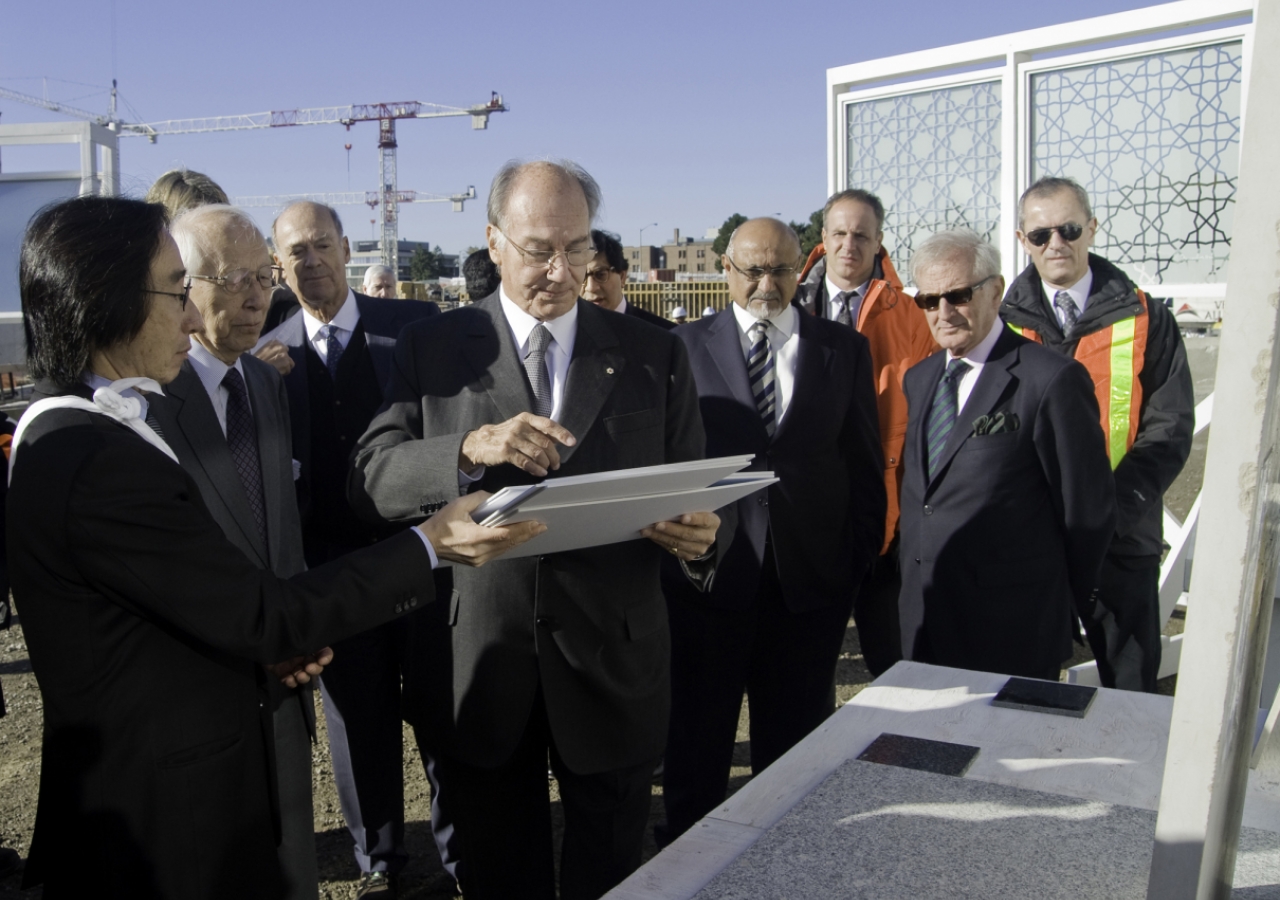
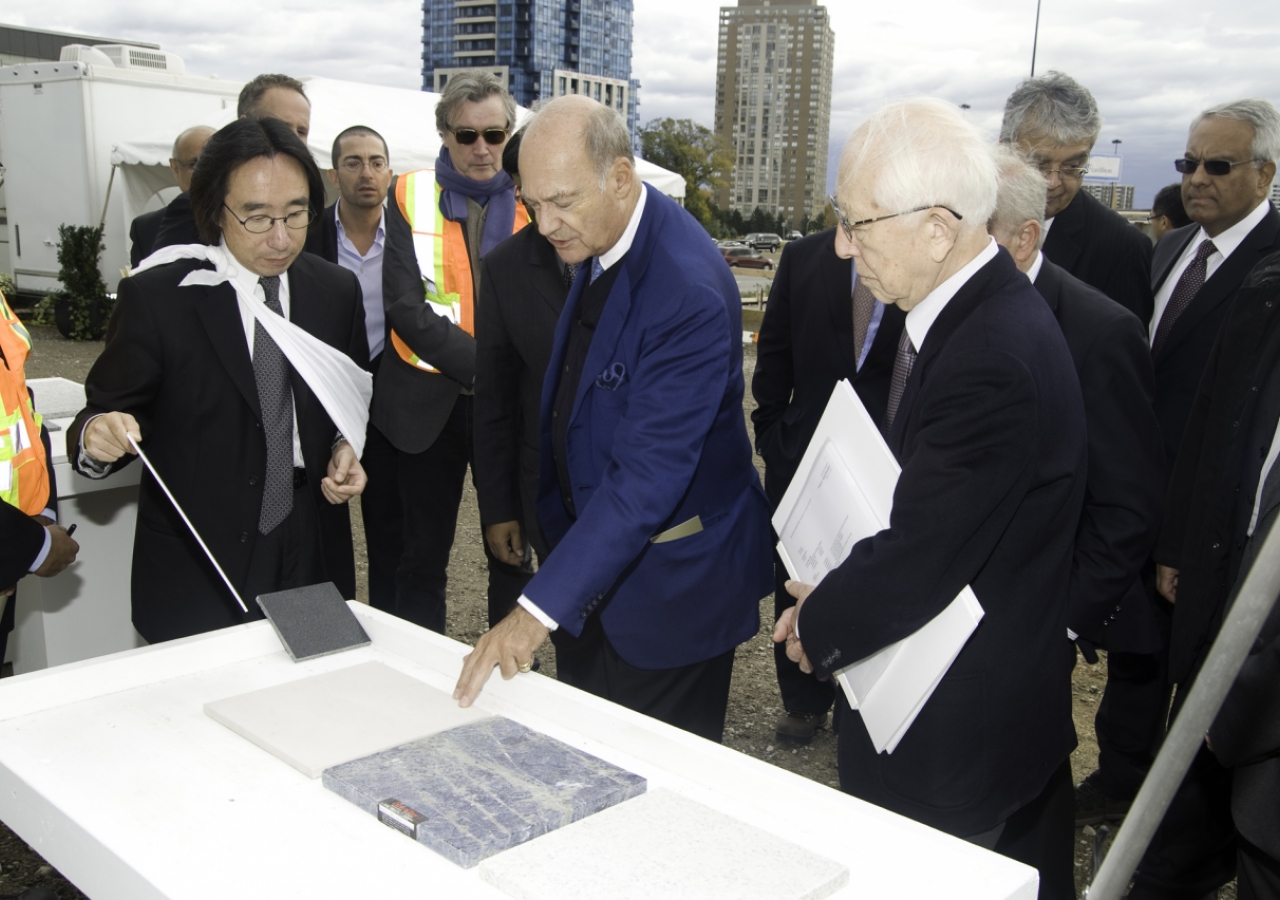
Fumihiko Maki and Gary Kamemoto of Maki & Associates review cladding stone for the Aga Khan Museum with His Highness the Aga Khan, October 2010. Photograph: The Ismaili.
(I) Remarks by the Aga Khan at the Inauguration of the Spirit and Life Exhibition, Ismaili Centre London, June 12, 2007
“What we see here today is the nucleus of the Islamic art collections of the future Aga Khan Museum in Toronto. This museum, which is being designed by the renowned Japanese architect Fumihiko Maki, is conceived as a primarily educational institution in the field of Islamic art and culture, a specific mandate that is not fulfilled so far by other North American museums. We hope and trust it will contribute to a deeper understanding among cultures — to the strengthening of true cultural pluralism — which is increasingly essential to peace, and to progress, in our world.”
~~~~~~~
(II) Remarks by the Aga Khan at the Foundation Ceremony of the Ismaili Centre, the Aga Khan Museum and their Park, Toronto, May 28, 2010,
“I should emphasise, as well, that the Museum building itself will be an important work of art — designed by the great Japanese architect Fumihiko Maki. Many of you know his superb building in Ottawa that has been the home for the Delegation of the Ismaili Imamat since 2008.
“That Delegation building was inspired by the evanescent mysteries of rock crystal. The new Toronto Museum will take as its theme the concept of light — suffusing the building from a central courtyard, through patterned glass screens. From the outside, it will glow by day and by night, lit by the sun and the moon.
Remarks continue below
Fumihiko Maki and Gary Kamemoto of Maki & Associates review materials for the exterior finish of the Aga Khan Museum with Prince Amyn Aga Khan in October 2010. Photograph: The Ismaili.
“From the outside, it will glow by day and by night, lit by the sun and the moon. This use of light speaks to us of the Divine Light of the Creator, reflected in the glow of individual human inspiration and vibrant, transparent community. As the poet Rumi has written: “The light that lights the eye is also the light of the heart… but the light that lights the heart is the Light of God.”
~~~~~~~
(III) Remarks by the Aga Khan on the Aga Khan Museum at the Opening of the Aga Khan Museum and the Ismaili Centre, Toronto, September 12, 2014
“The fusion of tradition and modernity which this building achieves, and the blend of spiritual, educational and social objectives that it embodies, have also characterised our other Ismaili Centres — in Vancouver, London, Lisbon, Dubai, and Dushanbe. All of them were designed by architects of great international standing, and, I would emphasise, of great multi-cultural sensitivity.
Remarks continue below
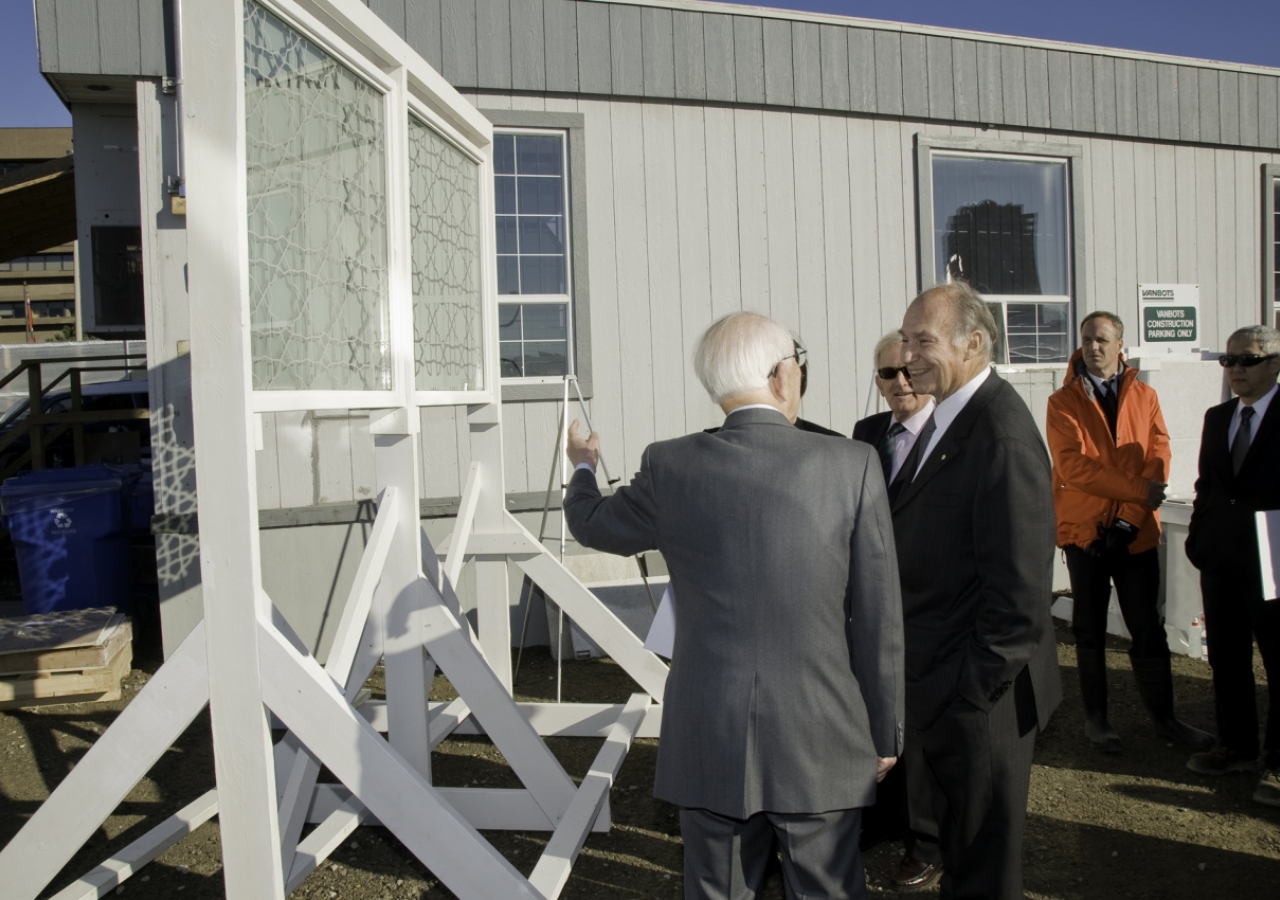
Fumihiko Maki and His Highness the Aga Khan discuss the glass finish options for the courtyard walls of the Aga Khan Museum in October 2010. Photograph: The Ismail
“Charles Correa, for example, comes from an Indian background and has also designed Hindu and Christian buildings. The architect for our Vancouver Centre 30 years ago was Bruno Freschi, whose family is of Italian background, and whose earlier work had included a Sikh place of worship. The new Aga Khan Park was designed by an architect of Lebanese heritage, Vladimir Djurovic. And the Aga Khan Museum is the work of a superb Japanese professional, Fumihiko Maki. How pleased we are that all of these fine artists are with us today.”
_____________________
The Aga Khan Centre, King’s Cross, London
“The Aga Khan Centre is the third project we have worked on with the distinguished architect Fumihiko Maki, a master of form and light” — His Highness the Aga Khan, quoted on Aga Khan Centre website
Gary Kamemoto and Professor Maki of Maki & Associates, the architects of the Aga Khan Centre, at the Aga Khan Centre Library.
Remarks by the Aga Khan at the inauguration of the Aga Khan Centre, June 5, 2018
“We celebrate today a beautiful new architectural accomplishment. This place has been shaped by many diverse influences — and among them we now welcome the rich traditions of Islamic architecture. One of those traditions – one that is appreciated by both the Islamic and the British cultures – is the special importance of the garden. We see the garden not merely as an adjunct to other constructions, but as a privileged space unto itself.
“And that is why I have emphasised, since our role began here in 2010, my own hope that the value of garden spaces should be embraced here. As we perambulate together through these spaces today, I trust that you will share my delight in seeing how that hope has been fulfilled. What we will see as we walk along are not only beautiful buildings — but also a unique series of gardens, courtyards and terraces – eight of them, in all, across our two buildings. Each one of them, moreover, has a distinctive identity: each one is inspired by a different region of the Islamic Ummah.
Remarks continue below
On Tuesday, June 26, 2018, HRH The Prince of Wales, now His Majesty King Charles, opened The Aga Khan Centre in King’s Cross in the presence of Mawlana Hazar Imam, His Highness the Aga Khan. Situated at the heart of London’s Knowledge Quarter, the Aga Khan Centre, designed by Maki and Associates, led by Fumihiko Maki, one of Japan’s most distinguished contemporary architects, provides a new home for a number of UK based organisations founded by His Highness the Aga Khan: The Institute of Ismaili Studies (IIS), the Aga Khan University Institute for the Study of Muslim Civilisations (AKU-ISMC) and the Aga Khan Foundation UK (AKF UK).
“Taken together, this winding ribbon of special spaces is an eloquent tribute to the rich diversity of the Muslim world. As we open this remarkable site, it is a privilege to salute those who have brought us to this moment. I would recognise, in particular, our fine relationship with the government of this borough, this city, and this country, as well as our rewarding partnership with the people at Argent. We are grateful, as well, for the talents of Maki and Associates, Allies and Morrison, Madison Cox and Nelson Byrd Woltz, as well as Rasheed Araeen and the late Karl Schlamminger. I would also like to thank our splendid team of staff and volunteers, including my brother Prince Amyn, who have stewarded this project to completion.”
Date posted: June 13, 2024.
_____________________
Please visit the Maki and Associates website for Professor Maki’s biography and curriculum vitae, which summarize his education, professional affiliations, and worldwide recognitions and awards.
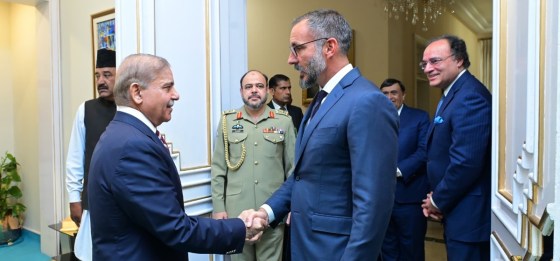
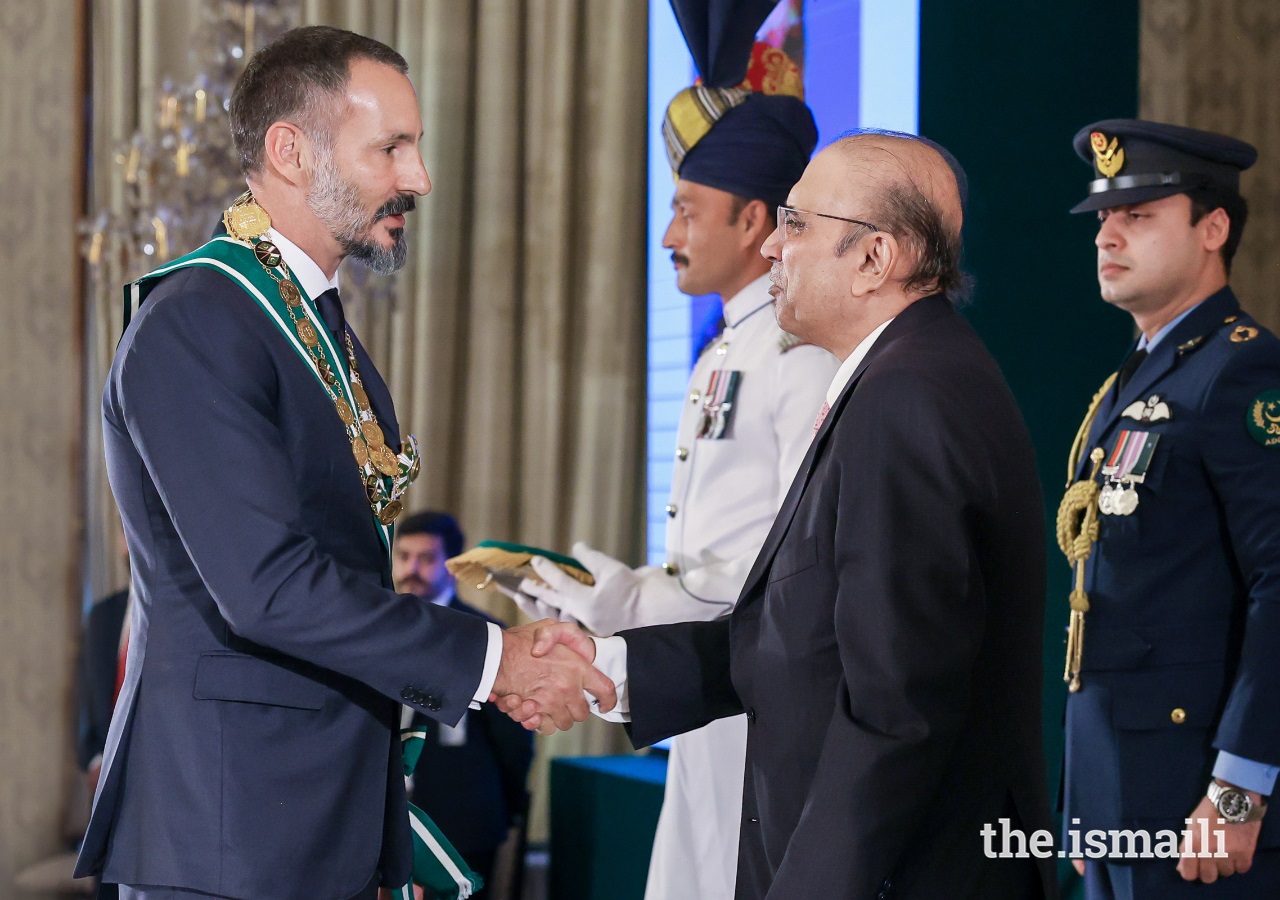
Barakah, our sister website, dedicated to His Highness the Aga Khan, the 49th Hereditary Imam of the Ismaili Muslims, has a special page covering news related to the Aga Khan and his family members. Prince Rahim, his oldest son, concluded his five-day visit to Pakistan on June 10, 2024, with a meeting with the Pakistan Prime Mnister Shehbaz Sharif (see featured photo, top of post). On June 7, the Prince was awarded Pakistan’s Highest Civilian Order by the President of Pakistan, Asif Ali Zardari.
The President of Pakistan, Asif Ali Zardari, congratulates Prince Rahim Aga Khan after conferring on him the Nishan-i-Pakistan on June 7, 2024, at a ceremony held at Aiwan-e-Sadr, the President’s official residence in Islamabad. Photograph: AKDN/Akbar Hakim. Please click on the photo for more coverage of the event and other events since the beginning of 2024.
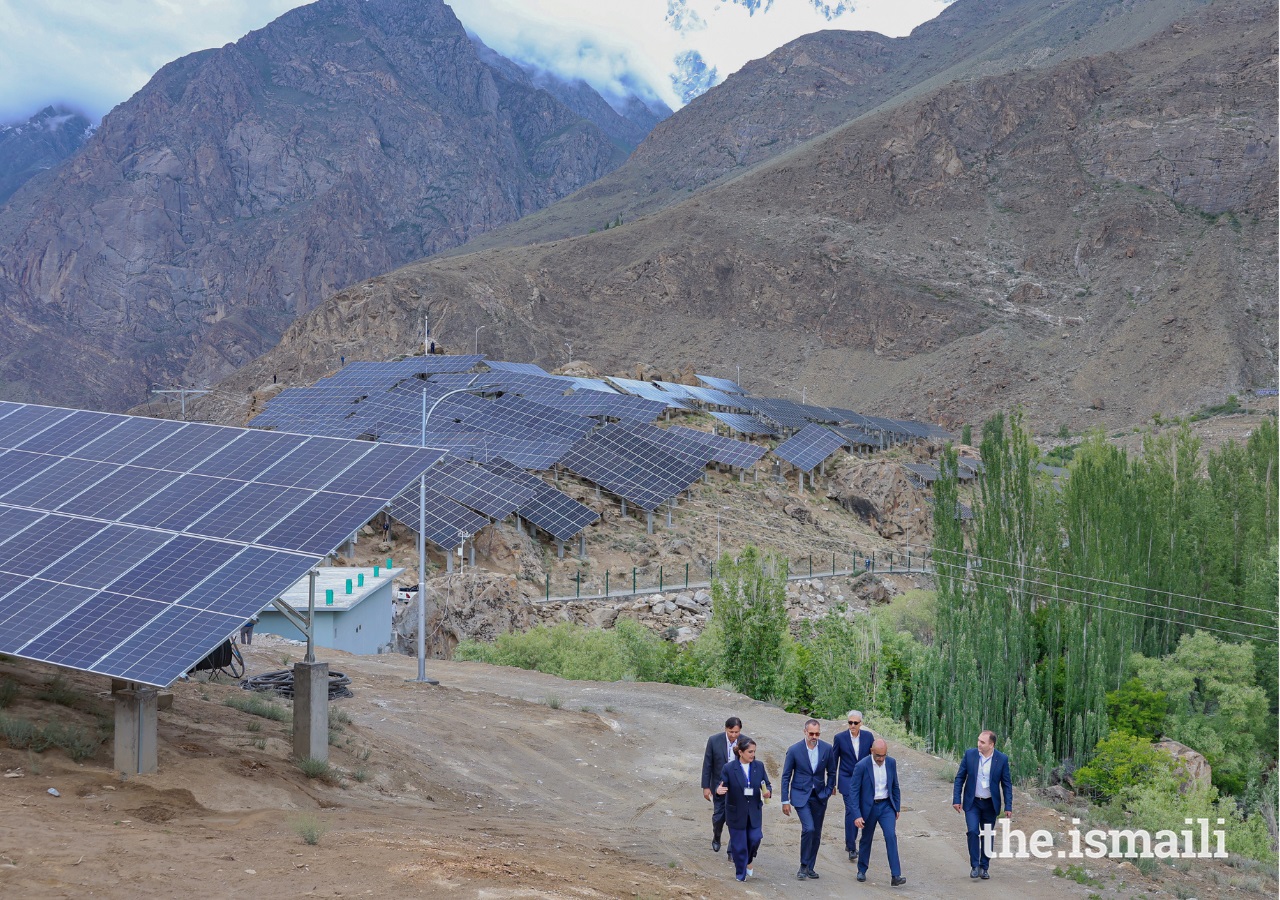
Prince Rahim then visited Hunza to launch projects related to the development of Solar Power Plants and a high-tech Software Park, visited the 800-year-old restored historic fort of Altit and saw the completion of the five-star Hotel Serena. On June 9, he inaugurated the new Headquarters of HBL Microfinance Bank in Gilgit.
Prince Rahim Aga Khan climbs up Duiker Hill to get a bird’s eye view of the areas that will benefit from the expansion of the power plant in Hunza. Please click on the image for this and other stories. Photograph: AKDN/Akbar Hakim.
Prince Rahim’s sister, Princess Zahra, visited the Aga Khan Development Network’s work in Hunza and Chitral between May 22 and 26.
On May 11, their aunt, Princess Yasmin Aga Khan hosted the highly successful Rita Hayworth Gala in Chicago. This remarkable event, which raised nearly US $900,000, is a shining example of how collective efforts can make a significant difference in supporting the Alzheimer’s Association’s care, support, and research programs.
Visit Barakah for news, insightful and inspirational articles about the Aga Khan and the Ismaili Imamat.
Date posted: June 7, 2024. Last updated: June 10, 2024.
The preview night of Zahida Rahemtulla’s play The Wrong Bashir at Toronto’s renowned Crow’s Theatre on Tuesday, May 21, 2024, was a sell-out event. Crow’s Theatre picked up the play for its bold, ambitious and imaginative 2024-2025 season following The Wrong Bashir’s successful Vancouver showing in May 2023. The Wrong Bashir is Burnaby-born Ismaili playwright Zahida Rahemtulla’s debut play. The play runs until June 16.
Special Discounts to See The Wrong Bashir
For tickets for all shows from May 21 to June 16, 2024, please click Buy Tickets for The Wrong Bashir and use the following promotion codes, as applicable:
May 21 to May 26, 2024: General Admission Adult and Senior Tickets can be purchased 2-FOR-1. Please use promotion code WRONG241;
May 21 to June 1, 2024: General Admission Adult and Senior tickets will be discounted 25%. Please use promotion code BASHIR25; and
Throughout the entire run (May 21st-June 9th), there is also a 20% discount for groups of 8+ anytime, which can be obtained by contacting the Crow’s Theatre box office at boxoffice@crowstheatre.com or calling (647) 341-7390.
The performance on June 16 is Pay-What-You-Can.
With its heartwarming and humorous portrayal of an intergenerational, transitional moment in the life of a family and community, the play is a must-see for all Ismaili community members. The Wrong Bashir affectionately shows much humour within the worldwide Ismaili community. The play elicited ample laughs and resonated widely with Ismaili and broader audiences in Vancouver and on its debut night in Toronto.
We are truly gratified by the magnificent success new Ismaili artists and filmmakers such as Zahida Rahemtulla and Kiana Rawji, whom we featured in 2023, are achieving in the early days of their careers. Simerg values their inspiring accomplishments and extends a warm invitation to other talented Ismaili youth. This is your chance to seize the opportunity and share your original stories of success and recognition in your respective areas of endeavour with national and/or international impact. Remember, your stories are not just personal triumphs, but also an integral part of the Ismaili Muslim community’s narrative, shaping our collective identity and inspiring future generations.
Date posted: May 23, 2024. Last updated: June 4, 2024 (links added to reviews of the play, see update notice at the top of post, and play extended by a week to June 16).
Correction: In an earlier version, we had incorrectly stated May 21, 2024, as the opening night of “The Wrong Bashir.” May 21 was the preview night. The official opening took place on Friday, May 24.
________________
PLAYWRIGHT ZAHIDA RAHEMTULLA AND DIRECTOR PAOLO SANTALUCIA
Zahida Rahemtulla
Zahida Rahemtulla is a playwright and short story writer. Her debut play, The Wrong Bashir, premiered with Touchstone Theatre in Vancouver in May 2023 and makes its Toronto premiere on May 21, 2024, at the Crow’s Theatre, which has been a leading force in new play creation in the Canadian theatre landscape. Zahida currently facilitates Paragon Theatre’s East of Tarragon Project in Scarborough and is passionate about education and working on new playswith new playwrights.
~~~~~~
Paolo Santalucia
Paolo Santalucia is an award-winning actor, director and writer. He is a Soulpepper Academy graduate and has been a member of Soulpepper’s ensemble for the past ten seasons. Paolo is a co-founder and Artistic Leader of the award-winning Howland Company. Paolo also teaches classical performance with the University of Toronto’s Theatre and Drama Studies Program, and is the recipient of two Dora Mavor Moore Awards in acting, one nomination for direction, and has been shortlisted for the John Hirsch Award for Directing.
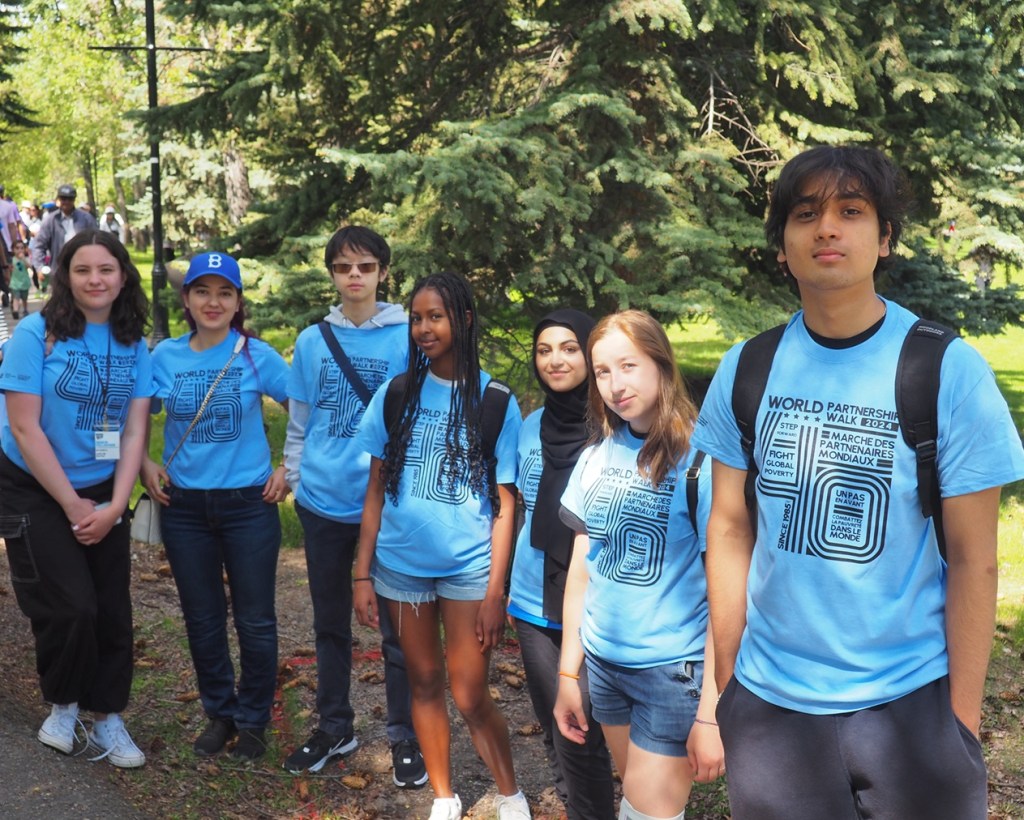
The “physical” World Partnership Walk (WPW) returned to Calgary downtown’s beautiful Prince’s Island Park after COVID-19 had turned it into a virtual event from 2020 onwards. The Walk in Edmonton was held on the grounds of the Alberta Legislature. The presence and participation of youth as walkers, volunteers, and entertainers were particularly heartwarming. The Ismaili community’s discipline and organization of the walk were truly admirable. The Walk was a special day for 11-year-old Izmir Kassam of Calgary whose goal was to collect $40,000 on the 40th anniversary of the Walk. Please see our WPW pictorial coverage HERE or click on the photo below.
Please click on photo for World Partnership Walk story.
From Running for Earthquake Victims to Acting as an Advocate for Education for Girls, Izmir Kassam Has Participated in 25 Races Since the Age of 4 and Raised Thousands of Dollars
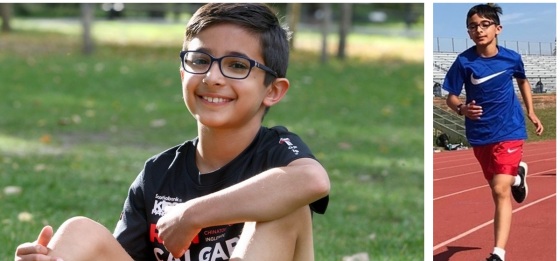
11-year-old Izmir Kassam, a fifth-grade student in Calgary, Alberta, Canada, aims to raise $40,000 by running 40 km in honour of the 40 years of the World Partnership Walk (WPW) that is scheduled to take place on Sunday, June 2, 2024, at Calgary downtown’s beautiful Prince’s Island Park.
TThe WPW is an initiative of Aga Khan Foundation Canada (AKFC), an agency within the vast Aga Khan Development Network dedicated to improving the quality of life of those in need, mainly in Asia and Africa, irrespective of their origin, faith, or gender. The AKDN’s multifaceted development approach aims to help communities and individuals become self-reliant. In Canada, the AKFC has partnered with the Government of Canada, Canadian institutions, and individual Canadians on hundreds of programs to tackle the root causes of poverty and inequality. One of its fund raising programs, the WPW, has united Canadians of all ages across the country for 40 years to fight global poverty. The WPW is Canada’s largest public movement in support of global development.
Story continues below
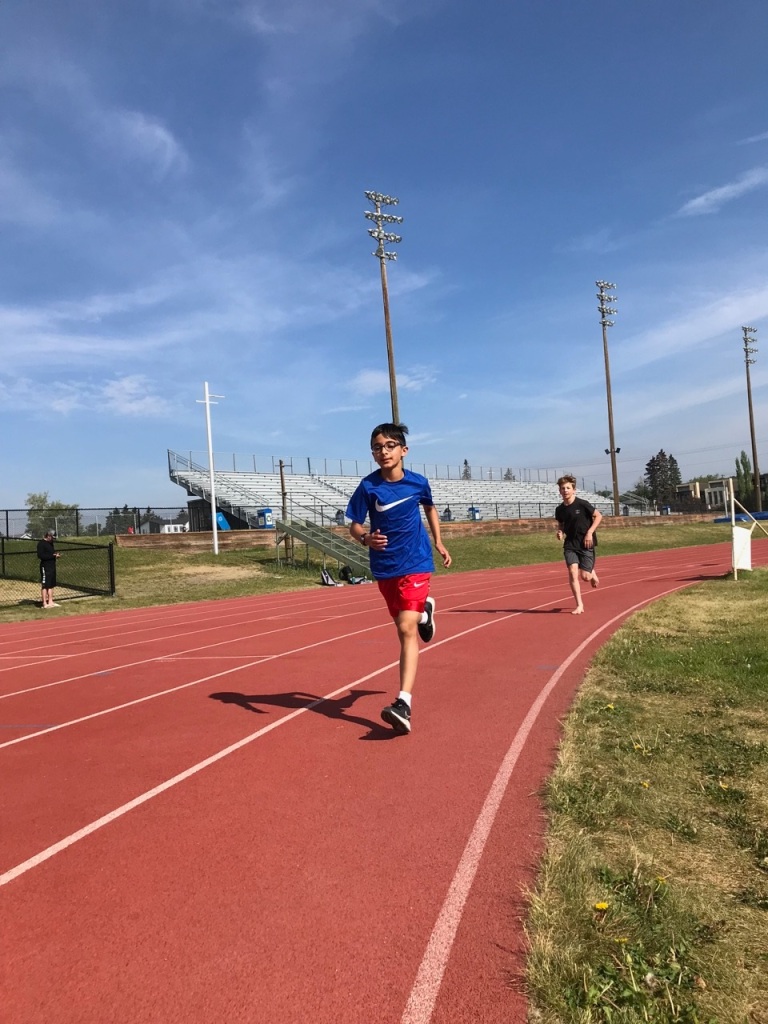
Izmir Kassam running the final 10 km in 10x10km run for earthquake relief in Turkey and Syria at the Glenmore Athletic Park, Calgary, June 10, 2023. Photograph: Izmir Kassam.
While hundreds at Sunday’s Walk will be walking, Izmir will be running! Izmir’s love for running has led him to conquer various distances, from 10 km races to half marathons and even 100 km. Since starting to run at 4, Izmir has completed over 25 races. Despite the lack of distance running competitions for students of his age, he boldly races with adults, often finishing in the top 5% to 10% of runners.
“We are so glad that Izmir chose the Humanitarian Coalition for his fundraising initiative. We re all in awe of his dedication and commitment” — Catherine Dufour
When he was 8 years old, Izmir watched the withdrawal of the US from Afghanistan and the takeover by the Taliban, with graphic images of Afghans hanging onto the moving front wheels of planes taking off, making a desperate last attempt to leave a country doomed to abject poverty and total suppression of freedoms. He learnt subsequently about the ban on girls’ education that the Taliban placed immediately upon taking over the rule of Afghanistan.
Izmir, upon discovering that girls his age in Afghanistan were denied the right to education, was not just saddened but deeply empathetic. He had a newborn sister then and could not imagine her growing up without an education. The thought was unbearable. This profound empathy for the girls’ plight fueled his determination to transform his passion for running into a campaign for girls’ education in Afghanistan. That year, he completed a half marathon of 21 km, raising a significant $ 2,000 to support Canadian Women for Women in Afghanistan (CW4WAfghan). His inspiring effort was recognized in a Calgary Herald story titled Young Runner Going the Distance for Afghan Girls.
Story continues below
Eight-year-old Izmir Kassam poses for a photo at Sandy Beach Park in Calgary, SW, before his September 17, 2021, run to raise money for Canadian Women for Women in Afghanistan. Photograph: Brendan Miller/Postmedia.
~~~~~~~
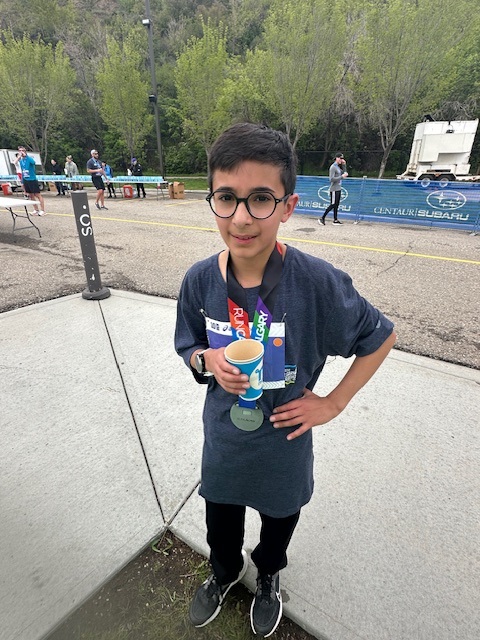
Izmir Kassam with medal after finishing the 10 km race in The Calgary Servus Marathon held on May 26, 2024, at Enmax Park, Calgary. His time was 43.20 minutes. Photograph: Izmir Kassam.
In 2023, on his tenth birthday, a powerful earthquake hit Turkey and Syria. This earthquake resulted in over 50,000 deaths and over 250,000 buildings being damaged or destroyed in the region. That morning, after seeing the images of the devastation the earthquake caused, Izmir was spurred into action again! He took on the challenge of running 100 kilometres (ten runs of 10 kilometres each) to raise money via the Humanitarian Coalition. This Canadian charity unites top aid organizations in responding to global crises.
Story continues below
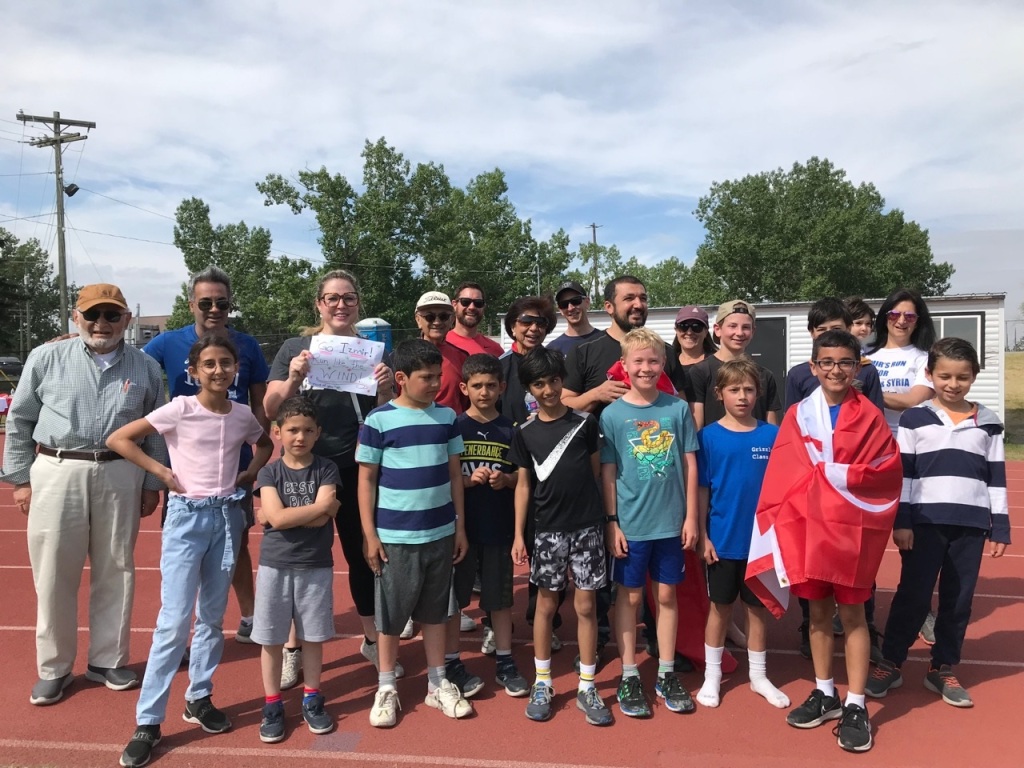
Izmir Kassam, shown wrapped in a Canadian Flag, with members of the Calgary Turkish community, friends, and family after the final 10 km run (out of 100 km) for earthquake relief in Turkey and Syria at the Glenmore Athletic Park, Calgary, June 10, 2023. Photograph: Izmir Kassam.
With the added support of government matching, Izmir raised $30,000, and his fundraising efforts were recognized by His Excellency Kerim Uras, the Ambassador of the Republic of Türkiye to Canada. Catherine Dufour of the organization Humanitarian Coalition commented, “We are so glad that Izmir chose the Humanitarian Coalition for his fundraising initiative. We are all in awe of his dedication and commitment.”
“Women and girls should have the opportunities and freedoms my sister and I have in Canada. No girl should grow up without an education or the freedom to be who she wants” — Izmir Kassam
The Aga Khan Development Network’s mandate is to work in challenging places where peace and stability are not always present. Infrastructure is often limited to help ensure that all women have a chance to harness their potential, have decent lives, and contribute to their communities. Izmir’s dedication to advancing this commitment is unwavering. He eloquently states women and girls should “have the opportunities and freedoms my sister and I have in Canada. No girl should grow up without an education or the freedom to be who she wants.”
Inspired also by his great aunt Mehrun Hassanali’s work with the World Partnership Walk, who was instrumental in its founding 40 years ago, Izmir decided to commemorate the WPW’s 40th anniversary by running 40 kilometres (four 10-kilometre runs).
His culminating run of the 10 final kilometres will take place on June 2 at the Calgary WPW event. He aims to complete the run within 40 minutes. The fundraising target for this 40th WPW Anniversary run is $40,000, and Izmir invites others to join him in this worthy cause.
Through this website, I invite readers to support Izmir and others like him in Calgary and around Canada, trying to raise money to support the Aga Khan Foundation’s annual World Partnership Event. In Izmir’s case, he aims to raise $40,000 to help eliminate global poverty. If 400 people donated $100 each, Izmir would reach his goal of $40,000. He also welcomes the support of other individuals to help him reach the target. Please click 2024 WORLD PARTNERSHIP WALK – IZMIR KASSAM
Story concludes below
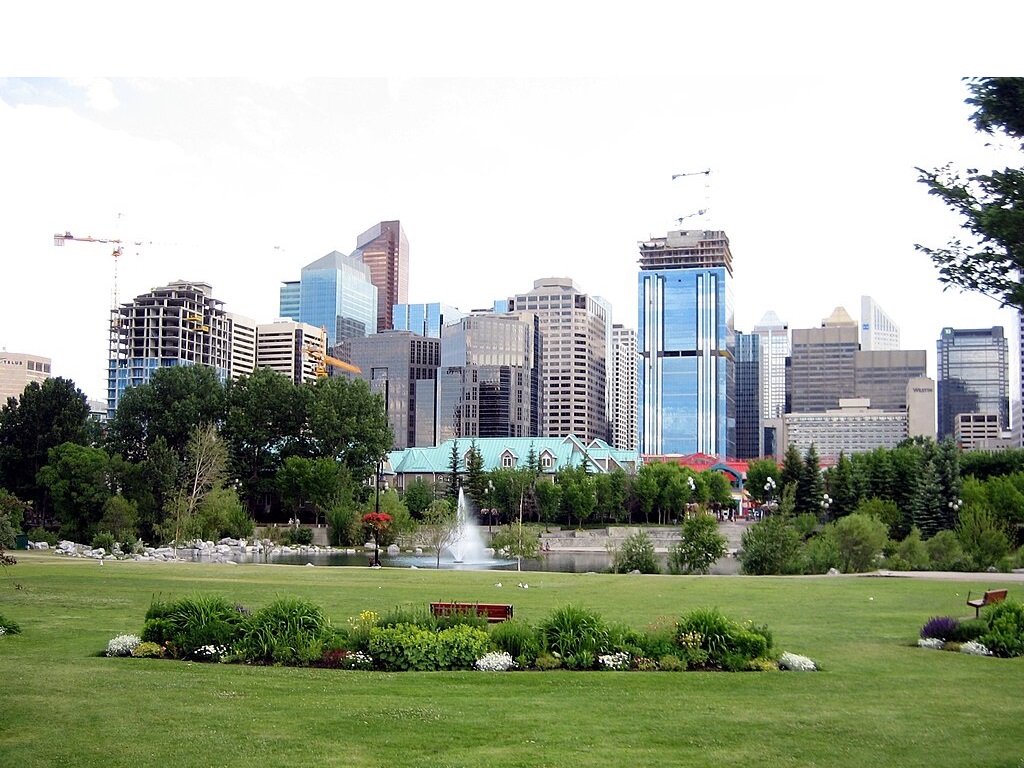
World Partnership Walk setting. A view of Prince’s Island Park in downtown Calgary, the venue for the 40th WPW to be held Sunday, June 2, 2024. Photograph: Brenden Matthews via Wikimedia.
And to all Calgarians and visitors to Calgary, please come to the beautiful Prince’s Island Park on June 2 and watch Izmir cross the finish line. The Park is located in Calgary downtown on 4 St. and 1 Ave. S.W.
Carpentry is traditionally considered a man’s job in Pakistan, but a few brave women are changing that mindset, from carving unique wooden utensils to building an entire house. In two short films, VOA and BBC Urdu Services spoke to several women who wanted to hammer home the point that not only are women integral to their community and the economy, they can also build things as well as men.
Video 1: Women Carpenters in Pakistan by VOA Urdu Service
“Carpentry is considered a man’s work in Pakistan and women are often discouraged from doing it. Wherever women go, they face issues that affect their honour, religion, culture, and social norms. However, when they step out and do something in order to take care of their family, then they realize that their honour, religion, culture and everything is still in place” — Excerpt from the video below, which has been reproduced from the VOA website. Bezhan Hamdard narrates the report in English.
“Much like Kim’s Convenience, The Wrong Bashir offers characters familiar to and loved by their communities…and a laugh-yourself-silly evening.” — JoLedingham.ca
Zahida Rahemtulla’s play The Wrong Bashir, which ran to packed houses when it was launched a year ago in Vancouver, is premiering at Toronto’s renowned Crow’s Theatre on May 21, 2024. It will run until June 9, 2024. The Theatre picked up Zahida’s new play as part of its bold, ambitious and imaginative 2024-2025 season following The Wrong Bashir’s successful Vancouver showing. It then issued a special call for Ismaili actors based in Eastern Canada to audition for some roles. Crow’s Theatre has been home to groundbreaking and award-winning productions.
The Wrong Bashir is Burnaby-born Ismaili playwright Zahida Rahemtulla’s debut play.
The play delves into the life of Bashir Ladha, a young philosophy major who has strayed from his Ismaili Muslim roots. The story takes a hilarious turn whenBashir’s parents receive a call that their unconventional podcaster son has been chosen as the student’s Mukhisaheb, a significant role in Ismaili Jamatkhanas. They dutifully accept the role on behalf of their son. Before Bashir can argue, two official committee representatives arrive at the Ladha household. The representatives soon realize a mistake in selection, adding to the comedic chaos. The doorbell rings, and Bashir’s excited grandparents and family friend make a surprise visit, having caught wind of the news at their Jamatkhana.
With its heartwarming and humorous portrayal of an intergenerational, transitional moment in the life of a family and community, the play is a must-see for all Ismaili community members. The Wrong Bashir affectionately shows much humour within the worldwide Ismaili community. The play elicited ample laughs and resonated widely with Ismaili and broader audiences in Vancouver.
Vancouver’s world premiere featured Ismaili actors Sabrina Vellani, Shera Haji, Salim Rahemtulla, and Hussein Janmohamed. The Toronto premiere will feature Ismailis Nimet Kanji, Zaitun Esmail, and Salim Rahemtulla alongside a large cast (click The Team link on the page). Supporting sponsors for the production are Shabin and Nader Mohamed and Tazmin Merali and Nasir Noormohamed.
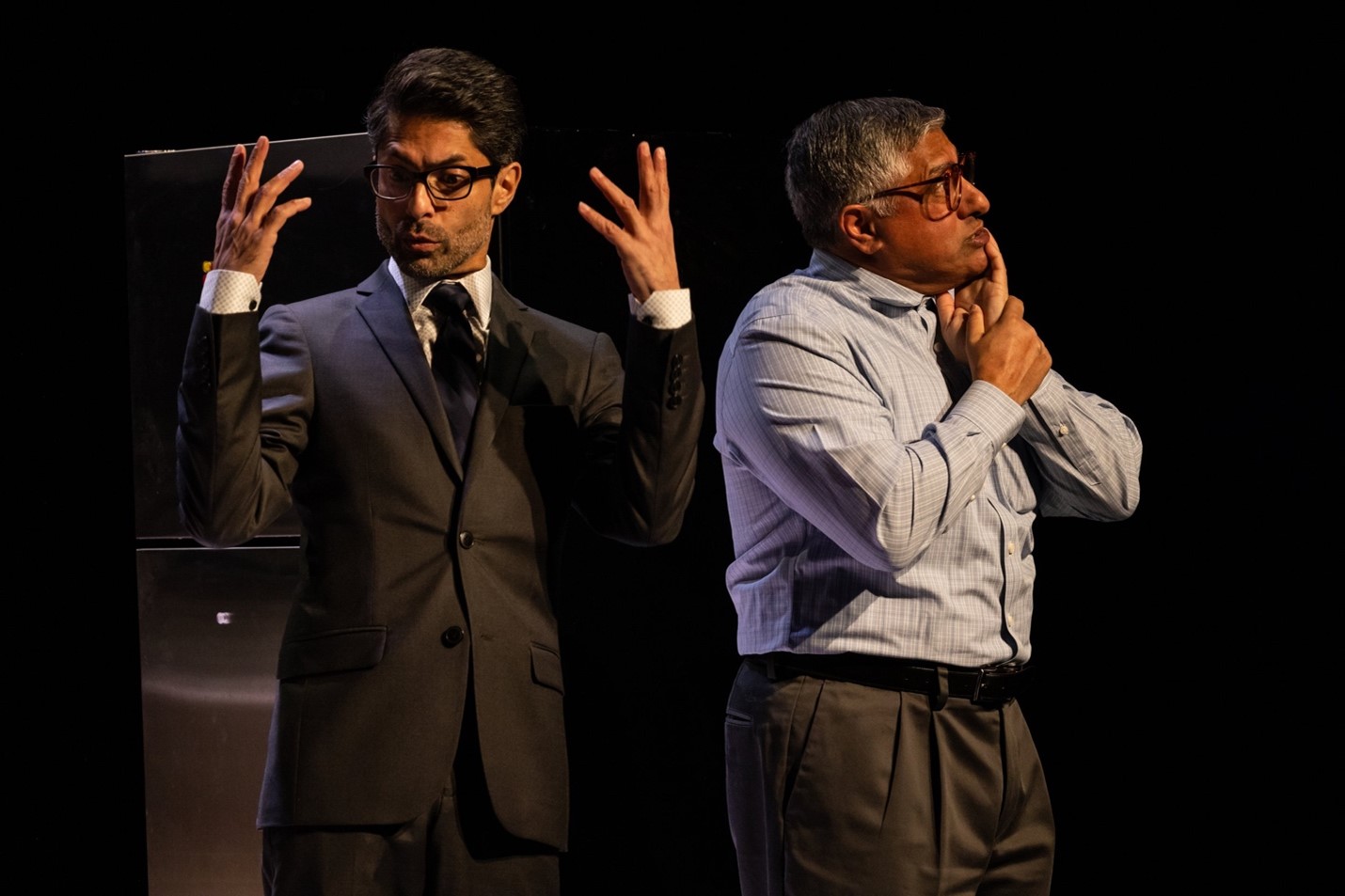
A scene from Zahida Rahemtulla’s The Wrong Bashir.
“The Wrong Bashir found the right audience on opening night if gales of laughter are any indication. From the curtain opener to the surprise at curtain fall, the sold-out crowd at the Firehall had a grand time. The Wrong Bashir is going to be a big hit; for some, it will be a laugh-yourself-silly evening” — Jo Ledingham, Vancouver Theatre Review.
The play is directed by award-winning Toronto director Paolo Santalucia. Crow’s Artistic Director, Chris Abraham, who was already familiar with the Ismaili community in Toronto, championed its inclusion in the 2024 season and brought it to the theatre.
Playwright Zahida says she is excited to see it premiere in Toronto, where the story has shifted from its original Vancouver setting to Toronto’s Don Mills.
Special Discounts: Purchase Tickets for The Wrong Bashir
For tickets for all shows from May 21 to June 9, 2024, please click Buy Tickets for The Wrong Bashir and use the following promotion codes, as applicable:
May 21 to May 26, 2024: General Admission Adult and Senior Tickets can be purchased 2-FOR-1. Please use promotion code WRONG241;
May 21 to June 1, 2024: General Admission Adult and Senior tickets will be discounted 25%. Please use promotion code BASHIR25; and
Throughout the entire run (May 21st-June 9th), there is also a 20% discount for groups of 8+ anytime, which can be obtained by contacting the Crow’s Theatre box office at boxoffice@crowstheatre.com or calling (647) 341-7390.
Date posted: May 13, 2024. Date updated: May 14, 2024 (added promotion codes for discounted tickets).
________________
PLAYWRIGHT ZAHIDA RAHEMTULLA AND DIRECTOR PAOLO SANTALUCIA
Zahida Rahemtulla
Zahida Rahemtulla is a playwright and short story writer. Her debut play, The Wrong Bashir, premiered with Touchstone Theatre in Vancouver in May 2023 and makes its Toronto premiere on May 21, 2024, at the Crow’s Theatre, which has been a leading force in new play creation in the Canadian theatre landscape. Zahida currently facilitates Parragon Theatre’s East of Tarragon Project in Scarborough and is passionate about education and working on new plays and with new playwrights.
~~~~~~
Paolo Santalucia
Paolo Santalucia is an award-winning actor, director and writer. He is a graduate of the Soulpepper Academy, and has been a member of Soulpepper’s ensemble for the past ten seasons. Paolo is a co-founder and Artistic Leader of the award-winning Howland Company. Paolo also teaches classical performance with the University of Toronto’s Theatre and Drama Studies Program, and is the recipient of two Dora Mavor Moore Awards in acting, one nomination for direction, and has been shortlisted for the John Hirsch Award for Directing.
“As mayor, Nenshi embraced innovative solutions to urban issues like public transit, affordable housing, and sustainable development. He proved his leadership abilities during the devastating 2013 Calgary floods, rallying the city through the crisis with compassion and resolve. Now, Nenshi wants to bring that same progressive, consensus-building approach to the provincial level as leader of the NDP. His vision is an Alberta that works for everyone — not just a few.”
For over a decade, Naheed Nenshi has been a trailblazer in Canadian politics. Now, he’s setting his sights beyond Calgary on an even more significant challenge — leading Alberta’s New Democratic Party (NDP) and charting a new course for the province.
To do that, Nenshi’s team is reminding residents across Alberta to purchase an NDP membership on nenshi.ca by April 22nd — for just $10. This will allow them to vote for Naheed Nenshi as the party’s next leader in June and have their voices heard.
Story continues below
Naheed Nenshi offers guidance and reflections to members of the Ismaili community gathered at the Ismaili Centre Toronto, 2017. Photograph: Shameela Karmali-Rawji collection.
Nenshi’s rise has been an inspiring underdog story. After initially trailing far behind in the polls during Calgary’s 2010 mayoral race, his campaign of bold ideas and grassroots engagement struck a chord. He defied the odds to become the first Muslim mayor of a major North American city. Nenshi’s journey has been one of resilience, hard work, and a steadfast commitment to public service rooted in the importance of family and community values.
The son of immigrants from Mwanza, Tanzania, he grew up witnessing his parents’ struggles to build a better life. This instilled in him that opportunity shouldn’t be taken for granted.
Story continues below
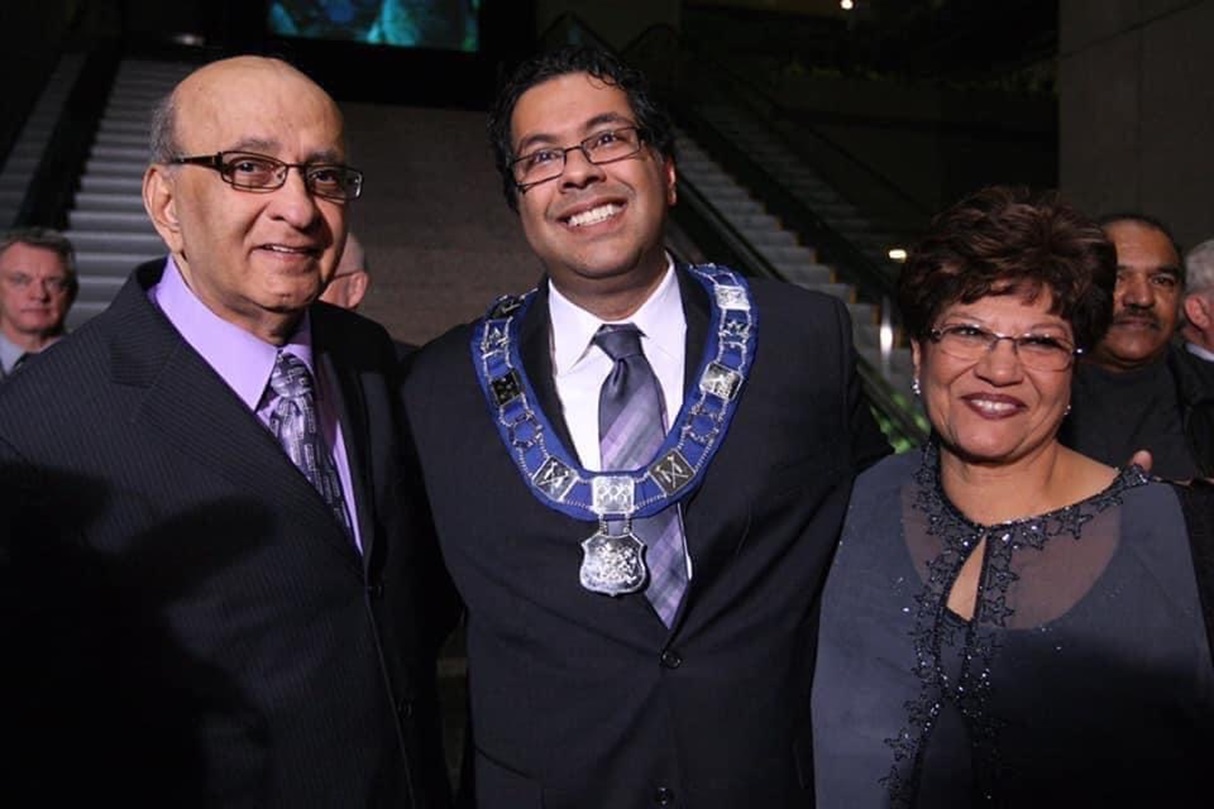
Naheed Nenshi with parents Kurban and Noorjah Nenshi after Mayoral swearing-in ceremony, 2010. Photograph: Shameela Karmali-Rawji collection.
~~~~~~
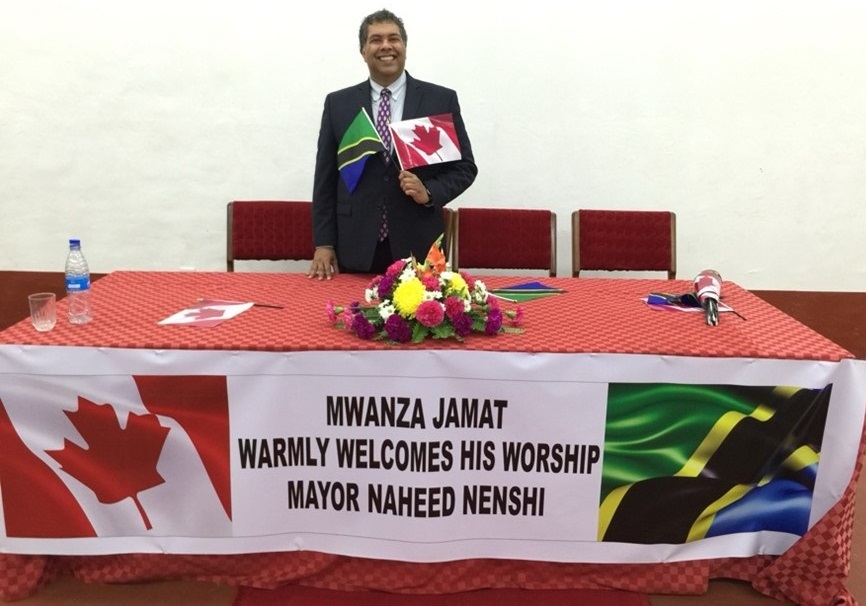
The Ismaili community of Mwanza, Tanzania, celebrates Naheed Nenshi, 2015. Photograph: Shameela Karmali-Rawji collection.
As mayor, Nenshi embraced innovative solutions to urban issues like public transit, affordable housing, and sustainable development. He proved his leadership abilities during the devastating 2013 Calgary floods, rallying the city through the crisis with compassion and resolve.
Now, Nenshi wants to bring that same progressive, consensus-building approach to the provincial level as leader of the NDP. His vision is an Alberta that works for everyone — not just a few.
Story continues below
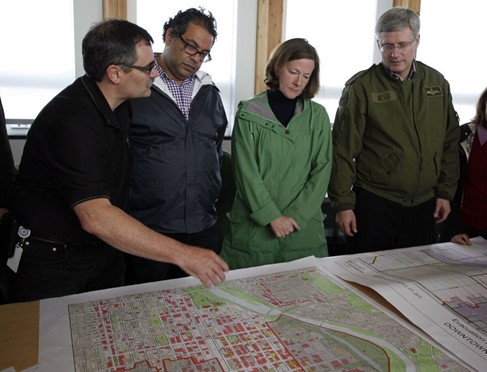
Calgary Mayor Naheed Nenshi, Alberta Premier Alison Redford and Canadian Prime Minister Stephen Harper review plans with emergency management personnel during Calgary 2013 floods. Photograph: Shameela Karmali-Rawji collection.
Nenshi believes the NDP can rally widespread support by promoting pro-business and pro-worker policies focused on diversifying the provincial economy beyond oil and gas. His entrepreneurial approach aims to drive collaboration between industry, government, and communities to secure Alberta’s future.
At his core, Nenshi is driven by a passionate belief in service, equality, and doing what’s right — regardless of political convenience. He champions initiatives that bring the public directly into governance through participatory budgeting. He advocates bold climate action rooted in environmental science. He understands that prosperity must be sustainable and inclusive to all cultures and communities. He also embraces Alberta’s place as part of a pluralistic Canada united in its diversity.
Story continues below
Alberta NDP Leader Rachel Notley presents Naheed Nenshi with the Queen Elizabeth II’s Platinum Jubilee Medal, 2023. Photograph: Shameela Karmali-Rawji collection.
With his unique perspective forged from lived experiences, Nenshi could be the dynamic leader to reinvigorate the NDP’s vision for a fairer, greener, and more innovative Alberta. But he needs the grassroots support of Albertans who share that vision.
Alberta stands at a crossroads. By choosing Nenshi, the province can embrace a leader who sees its boundless potential and will fight to uplift all of its people. The path ahead won’t be easy — but few leaders are better prepared to forge it than Naheed Nenshi.
Date posted: April 20, 2024.
________________________
Shameela Karmali-Rawji
Dr. Shameela Karmali-Rawji, MS MD CCFP FCFP, is a global health consultant, entrepreneur and family physician. She has established multiple medical clinics and telemedicine platforms and oversaw several retirement and assisted living facilities in Ontario and Alberta. She launched the first Urgent Care Clinic in a public-private partnership in primary care with Calgary Health Services in 2006. She has worked as a policy advisor and consultant with WHO, UNICEF, and AKDN, and she led the development of a groundbreaking, collaborative health agenda in the First Nations community of T’suu Tina, which resulted in the establishment and expansion of health services, including a medical centre. She has also planned several medical centres and hospitals in East Africa and community-based primary and secondary healthcare systems in Northern Pakistan serving over 1 million people.
Dr. Karmali-Rawji had served as a member of the His Highness the Aga Khan Shia Imami Ismaili Council for Canada, where she established its first Women’s Portfolio, and as Chairman of the Aga Khan Health Board for Canada. She co-convened the International Ismaili Women’s Forum in Toronto with Princess Zahra Aga Khan. She was Vice Chairman of the commissioning Board of Generations Calgary, an assisted living and long term care facility. Dr. Karmali-Rawji obtained her MD at McMaster University and her MS in International Health at Harvard University.
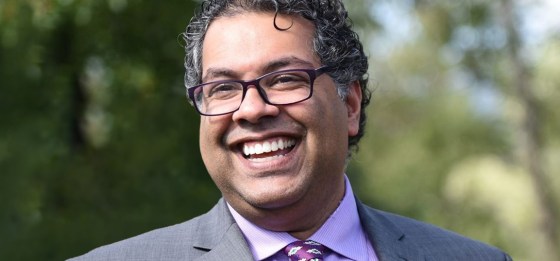
Naheed Nenshi, the esteemed former mayor of Calgary, is paving his way to lead Alberta’s New Democratic Party (NDP) in the Party’s June 2024 Elections. To have a say in this crucial decision, it’s essential that you register as an NDP party member before Monday, April 22. This simple step, which costs only $10.00, will enable you to cast your vote in the June elections. Please visit Nenshi.ca to become an NDP member.
One morning last summer, I joined hundreds of Ismaili Muslims to celebrate the 66th anniversary of Mawlana Hazar Imam, His Highness the Aga Khan, as the 49th Hereditary Imam of the Ismaili Muslim community with chai, sherbet and delicious snacks at a Calgary Jamatkhana’s social hall. Considering my compromised immune system, I sat in an area with only a few people around me. I glanced to my left multiple times and asked myself: “Can it be? Is the guy next to me Naheed Nenshi?” I could not hold back and told him. “You look like Naheed Nenshi.” And he answered, “You are right, I am.”
Seated next to him was his beloved mother. I remembered how, a few years earlier, I would take my mum to the Ismaili Centre and Jamatkhana in Vancouver and, on celebratory occasions, take her to the social hall upstairs to enjoy Ismaili delicacies and chat with community members. Naheed’s care, love and warmth for his mum touched me on this significant day in Ismaili history. In the few minutes I had with him, I dared to suggest that he should, one day, seek to lead a Federal Party. His brief response told me that the idea wasn’t exactly in his mind!
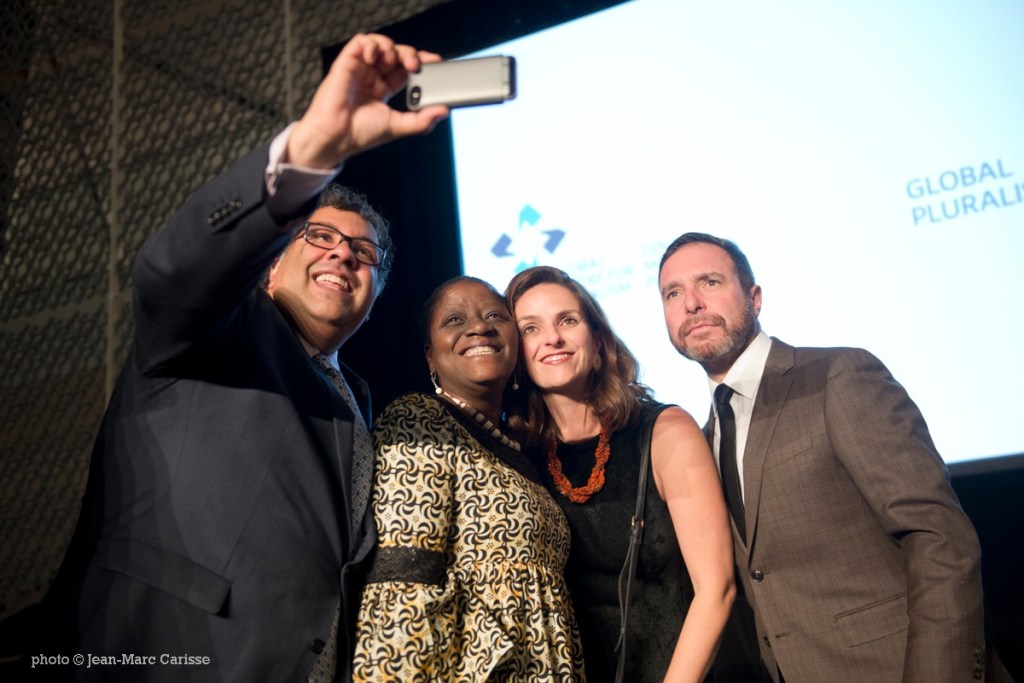
On two earlier occasions in Ontario, when Nenshi was still Mayor of Calgary, I briefly introduced myself to him with a handshake: first at the Aga Khan Museum opening in Toronto in September 2014 and three years later at the Global Centre of Pluralism’s First Award Ceremony at the Delegation of the Ismaili Imamat Building in Ottawa in November 2017. At the first meeting in Toronto, I expressed my interest in interviewing him one day, and he welcomed the idea. However, I have yet to approach him and request an interview.
Since relocating to Alberta two years ago, I’ve witnessed the profound impact of Naheed Nenshi’s leadership as Calgary’s mayor between 2010 and 2021. As the first Muslim mayor of a major North American city, Nenshi garnered widespread respect and admiration from both Calgarians and residents of the Bow Valley for his significant achievements and profound connection with the people. Despite his decision not to seek re-election for a fourth term, his legacy remains robust, and his leadership skills are undeniable.
Naheed Nenshi’s announcement on March 11, 2024, to stand for the election to become the new leader of Alberta’s New Democratic Party (NDP) is a significant development. His decision has sparked a wave of anticipation across the province. Nenshi is up against Kathleen Ganley, Sarah Hoffman, Jodi Calahoo Stonehouse and Gil McGowan to replace Rachel Notley as Alberta’s NDP leader. Notley, who led the party for a decade and served as the province’s premier from 2015 to 2019, announced in January 2024, eight months after her party lost the provincial elections to the United Conservative Party, that she would be stepping down as the leader of the NDP. She will continue to lead the party until after the June elections, when her successor will be decided.
It is noteworthy that even before Nenshi had declared his interest, a Pollara poll revealed that “One in three (33%) Albertans who say they are likely to buy an NDP membership would be “excited” if Nenshi became the next NDP leader, significantly higher than the 10-to-14% who feel that way about the three declared candidates” [at the time]. The report further highlights that “Feelings towards Nenshi are largely positive province-wide, with about twice as many Albertans feeling positive (41%) rather than negative (22%) at the prospect of him leading the NDP.” This positive sentiment underscores the potential impact of Nenshi’s leadership. His leadership has always been driven by strong values and ethics of building community, integrity and honesty and is founded on human justice and cosmopolitanism.
Since entering the race, Nenshi has graciously praised all the other candidates. Still, he feels he would be the best person to lead the NDP and defeat Premier Danielle Smith in the next provincial election in 2017.
Whether you decide to vote for Naheed Neshi or any other candidate in the June 2024 election, it is crucial that you first become an NDP party member by April 22, 2024. This is the date of the membership deadline for voting eligibility. Your participation is vital in shaping the future of the party. Please click on Nenshi.ca to become a member. As Nenshi urges in his video below, you do not need to pay more than $10.00 at this time, as options are available to submit to membership at higher and more significant amounts.
~~~~~~~~~~~~
Naheed Nenshi’s Important Message to the Ismaili Community
~~~~~~~~~~~~
Naheed Nenshi: Tweets
We live in one of the most amazing places on Earth. It’s time we start talking about what we stand FOR, not what we’re against. For Alberta. For all of us. Join the movement today and purchase your membership at https://t.co/OqpFCojan7. pic.twitter.com/1260AdBpwn