Simerg is an independent initiative dedicated to Ismaili Muslims, the Aga Khan — their Hereditary Imam — and the Ismaili Imamat, and Islam in general through literary readings, photo essays and artistic expressions
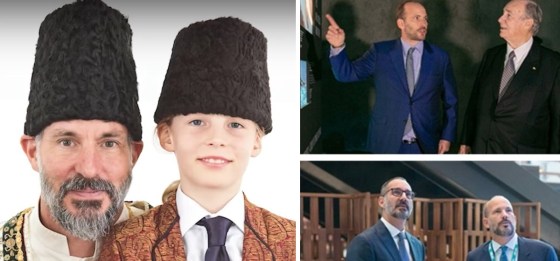
April 10 and 11 mark the birthdays of Prince Hussain Aga Khan and his nephew, Prince Irfan Aga Khan, older of the two sons of Mawlana Hazar Imam, His Highness Prince Rahim Aga Khan, who became the 50th Imam of the Ismaili Muslims when his father, Mawlana Shah Karim, His Late Highness Aga Khan IV, passed away February 4, 2025. To celebrate these birthdays, Malik Merchant, a trusted publisher and editor of Barakah, a blog dedicated to the Aga Khan and his family, has meticulously compiled information and photographs about the two princes you must read. Please click:
Prince Irfan’s procession walk in Aswan, leading the group of mourners with his brother Prince Sinan in a disciplined, dignified and respectful manner, was extraordinary. He exhibited confidence….READ MORE
~~~~~~~~~~~
Swimming with whales is unbelievably rewarding. As corny as it sounds, the whales do “change your life”. They’re simply too majestic, too enormous, too touching and too intelligent not to…..READ MORE
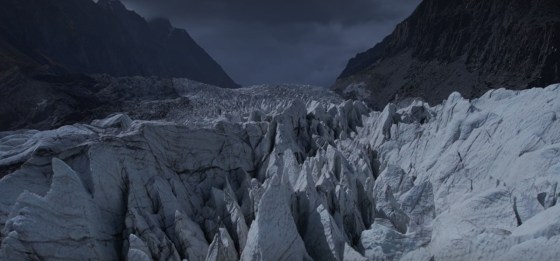
According to the Aga Khan Development Network (AKDN), more than 48,000 people across Gilgit Baltistan and Chitral are at high risk from a lake outburst or landslide. Some, like the village of Badswat in the neighbouring district of Ghizer, are in such peril they are being evacuated entirely to relative safety, their homes rendered impossible to live in.
Caroline Davies of BBC News has captured this crisis in an illustrated story from Gilgit-Baltistan. View her visually compelling story — click BBC: Melting glaciers leave homes teetering in valley of jagged mountains — and watch the YouTube video below, which highlights the effects of climate change on the part of the world referred to by some as the “Third Pole” because it has more ice than any other part of the world outside the polar regions.
Originally from Mumbai, India, I have long been an artist and am currently pursuing a graduate program in Printmaking at the University of Iowa through an Iowa Arts Fellowship. My recent visit to Toronto happily coincided with the presentation by Prince Hussain Aga Khan of his exhibition The Living Sea: Fragile Beauty at the Aga Khan Museum. I then spent a considerable amount of time viewing the exhibition in the Ismaili Centre Toronto’s social hall and patio. I left the two events feeling inspired and motivated to do whatever I can to assist Prince Hussain in his goals of educating us and raising our awareness about the disturbing state of the oceans and its sea creatures.
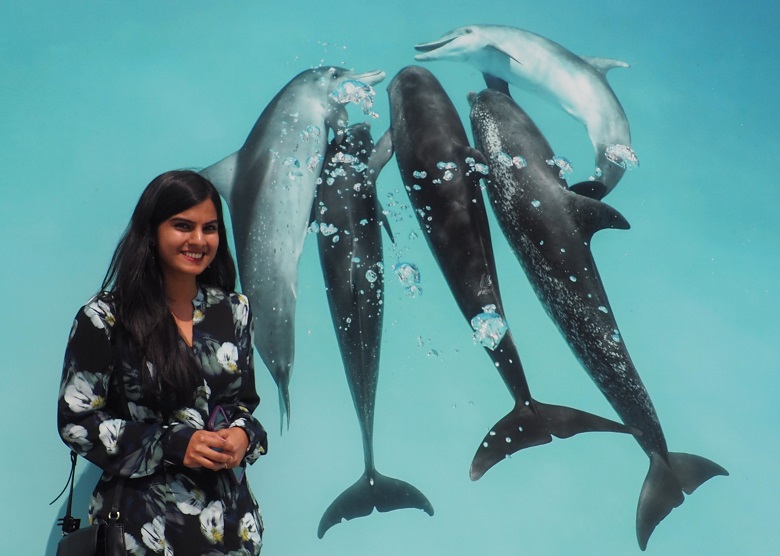
Al-Qawi Nanavati, a graduate student pursuing Printmaking at the University of Iowa pictured at Prince Hussain Aga Khan’s exhibition The Living Sea — Fragile Beauty, at the Ismaili Centre Toronto; May 22, 2023. Photograph: Malik Merchant/Simerg.
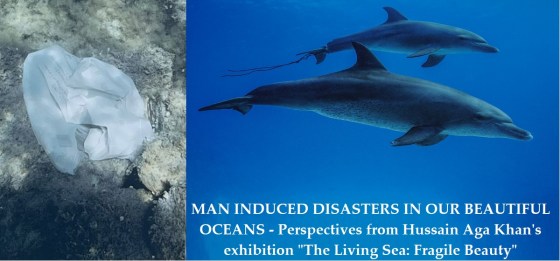
The two images shown below captured my attention the most after hearing Prince Hussain speak about his passions and purpose behind the show. The images are mounted on a large panel in the patio of the Ismaili Centre. Titled Plastic Bag and Plastic Waste, they were taken in two different parts of the world, the Philippines and Sardinia, 3 years apart. I thought a lot about these two photographs long after I left the show. They were extremely poignant and show us a mirror into what we are doing to our planet.
Story continues below
Two photographs captured by Prince Hussain Aga Khan of plastic bags in the ocean (top the Philippines, bottom Sardinia) that alarmed Al-Qawi Nanavati when she visited his exhibition The Living Sea — Fragile Beauty at the Ismaili Centre Toronto; May 22, 2023. Photograph: Al-Qawi Nanavati/Simerg.
Prince Hussain has caption notes accompanying the two photographs. For the first photo, taken in May 2017 in the Philippines, the Prince writes: “This was the most depressing thing I’ve ever witnessed.”
For the bottom photo, taken in August 2020 in Sardinia, Prince Hussain laments: “Unfortunately few, if any, effective solutions exist to rid our oceans of this ongoing problem. Most would be difficult to bring to scale. As long as mankind isn’t ready to give up plastic or capable of producing reliable alternatives, our marine environment (and others!) will suffer.”
____________________________
The image of a snared dolphin that sunk my heart
By DR. NURIN MERCHANT
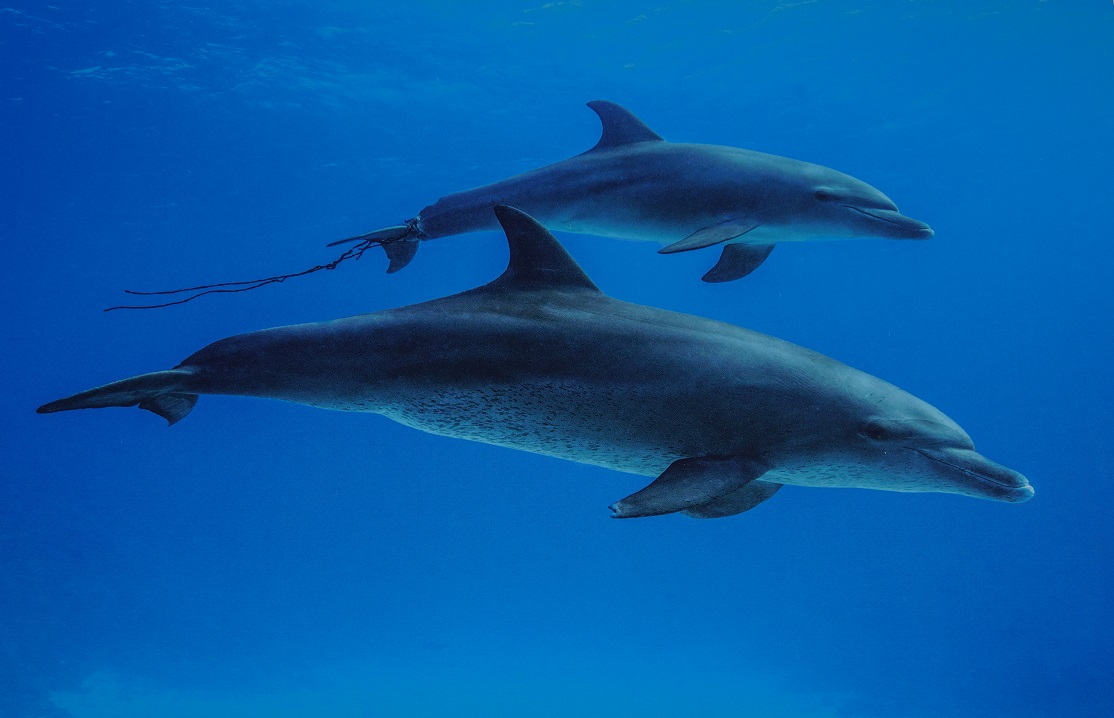
The photograph by Prince Hussain Aga Khan of two dolphins swimming side by side had the greatest impact on me when I visited his exhibition The Living Sea — Fragile Beauty at the Ismaili Centre Toronto.
My eyes were immediately drawn to one of the dolphin’s tails, which had a black rope (presumably from fishing equipment) tightly ensnared around it. The rope had been cinched so tight over time that it was now embedded in the dolphin’s skin. My heart sank — such an intelligent yet helpless creature experiencing so much pain and suffering due to mankind’s irresponsibility with its creation.
I would like for the readers to think about something we can all relate to for a moment — pretend that one day you are walking barefoot on a beach, somewhat far from home. Suddenly, OUCH! You feel a sharp pain, and notice that you have accidentally stepped on a piece of glass that has become deeply embedded in the sole of your foot. Somehow, no matter how hard you try, you cannot remove the glass. No one is around to help you, so you are forced to walk all the way home; each step is a painful burden as the glass digs in, deeper and deeper. A few hours later you reach home, fetch a pair of tweezers, and thankfully succeed in removing the shard.
Habituated bottlenose dolphins taken by Prince Hussain Aga Khan at a site known as Dolphin Reef near Hurghada, Egypt, November 2020. Note the rope attached and digging deep into the second dolphin’s tail — impossible for a simple diver to remove. Photograph: Nurin Merchant/Simerg
This dolphin has no one to help it. In the scenario you just imagined, just like we use our feet to propel us forward, the dolphin uses its tail. Unlike the scenario though, this dolphin has likely been living with this injury for months, not hours. And one day, it is very probable that he or she will die from this injury.
This photograph highlights the damage that we continue to inflict upon nature and juxtaposes it with nature’s strong will and resiliency. I see it every day in my career as a veterinarian — animals are far more resilient and perseverant than humans, but this is because they have no choice but to survive, but to persevere.
We must be their voice. And we must always remember: nature’s resiliency cannot compete with our destruction. One day, just as this dolphin — an animal recognized by many scientists as a non-human person due to their high level of intelligence and ability to be self-aware — will succumb to its injuries, so will our ecosystems and the species who call it home (ourselves included).
Each and every one of us has a duty to protect, preserve, and conserve Nature and our home, Planet Earth. Without it, there is no us.
Date posted: May 28, 2023. Last updated: June 01, 2023 (reformatting.)
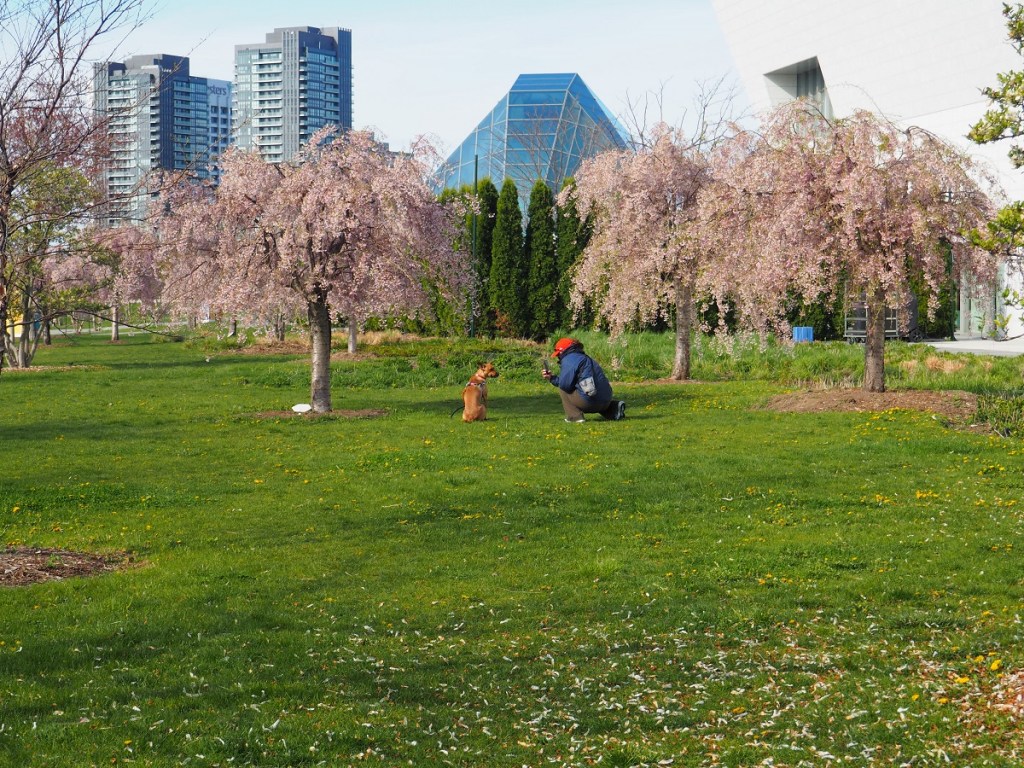
Malik Merchant returns to Aga Khan Park after a 3-week absence, and sees visitors excitedly taking photos of masses of pink flowers behind the Aga Khan Museum. A young boy goes from one weeping cherry tree to another to feel the soft petals of the blossoming trees, a dog owner has her beautiful 1 year old dog, Cice, pose in front of a tree, a bird perches on top of one while a robin wanders around pecking on grass around the trees. And as Malik finally leaves the site of the Aga Khan Park via the east side, he captures a stunning shot of the Aga Khan Museum under a lovely blue sky! Click here for story and photos
Cice poses for a photo for her owner Dana McIvor in front of a weeping cherry tree at Toronto’s Aga Khan Park. May 8, 2021. Please click on image for more photos and story.
Date posted: May 10, 2021.
__________________
Before departing this website please take a moment to review Simerg’s Table of Contents for links to hundreds of thought provoking pieces on a vast array of subjects including faith and culture, history and philosophy, and arts and letters to name a few. Also visit Simerg’s sister websites Barakah, dedicated to His Highness the Aga Khan, and Simergphotos.
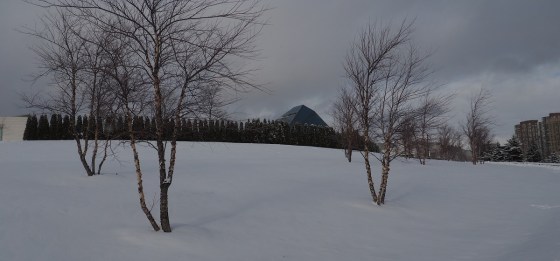
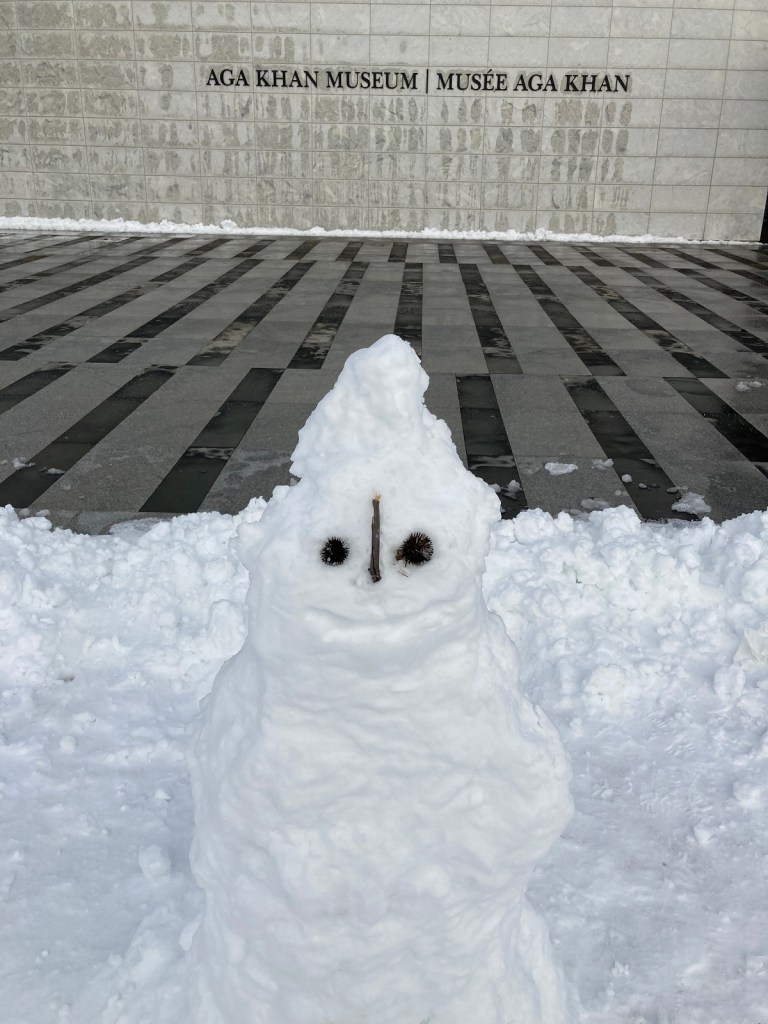
With more than 10 cms of overnight snow, affirming December 25, 2020 as white Xmas, Malik Merchant put on his winter boots, in addition to wearing warm clothes, and headed to his favourite spot armed with a fully charged camera, an orange and an apple (to keep the doctor away)! Someone’s genuine love for winter, however, put Malik behind in second place, as a cheerful looking snowman had already been constructed…..MORE
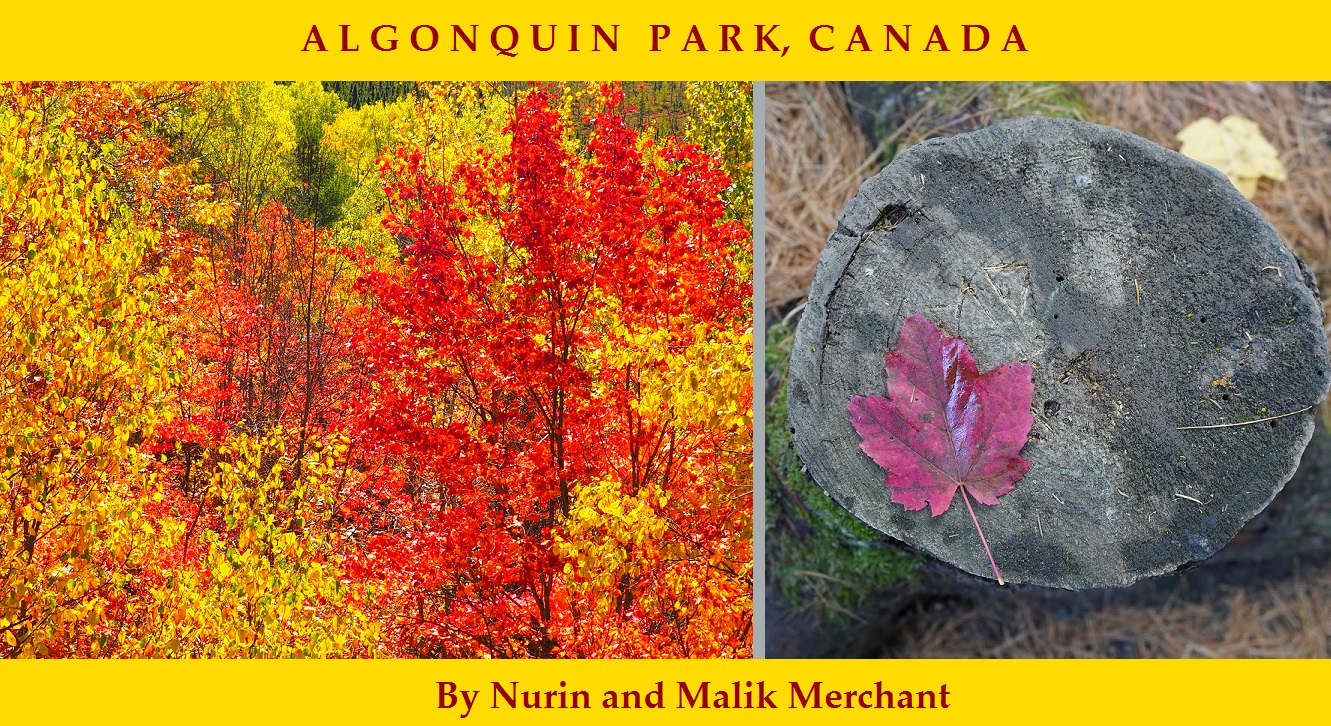
Its beyond fall colours! This park has so much of the natural world to offer, and should be in everyone’s bucket list. My daughter and I had limited time and made the most effective use of the 15 hours we had which included around 6 hours of driving time from and back to Ottawa. With time management, and inspiration from youth anything is possible! If you are in Ontario and close to the Park, make it this week — even for a day!
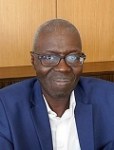
To meet the challenge that the global ecological crisis presents today, there is an urgent need to draw on humanity’s philosophical and spiritual repertoire – because it teaches us valuable lessons on the importance of taking care of life in all its forms. Senegalese philosopher Souleymane Bachir Diagne draws on this source here, by blending the philosophical novel of a twelfth-century Andalusian Muslim scholar, African words of wisdom and thoughts from Western philosophers. We are not nature’s masters and owners, the Senegalese philosopher warns us.
By SOULEYMANE BACHIR DIAGNE
My intention is to think about a major crisis – the ecological crisis, which we agree, defines the era we are living in − by showing how the history of philosophy can shed light on it and give us guidance on the actions we must take to deal with it. More precisely, I would like to show how there is continuity between the way philosophy helps us to consider a policy of humanity and the way it illuminates a policy of the “humanization of the Earth”, in the words of the French philosopher and theologian Pierre Teilhard de Chardin (1881-1955).
I use this expression as signifying the duty and the responsibility that the human has to act accordingly, from the moment he understands that nature is entrusted to him and to humanity in the future. It forbids me to consider myself as “nature’s master and owner”, to cite the well-known phrase by the seventeenth-century French philosopher, René Descartes. On this point, regarding a philosophy that is simultaneously spiritual and ecological, I would like to evoke the ideas of the Andalusian scholar Abu Bakr Ibn Tufayl (1105-1185). They are masterfully expressed in his magnum opus, the philosophical novel Hayy ibn Yaqzān.
He presents the idea that humans realize their humanity fully only when they reach ecological consciousness − which allows them to simultaneously understand the evolution of their own becoming and the responsibility which is incumbent on them to protect life on earth.
Homo perfectus
The Arabic philosophical fable, after its translation into Latin in 1671, under the title Philosophus autodidactus, and later into English, was a source of inspiration for many writers, including the English writer, Daniel Defoe, the author of Robinson Crusoe.
Indeed, the Andalusian philosopher’s novel is the story of the survival of Hayy, a child abandoned on an island that has never known a human presence, and who is rescued, protected and fed by a doe. When the animal dies, Hayy learns to use his hands, his practical and then theoretical intelligence, in an ontogeny (the origin and development of the individual organism, from conception to death) that recapitulates phylogeny (evolution of the species over the ages): the child develops into homo perfectus, the insānkāmil of Islamic mysticism. In other words, he becomes an accomplished human who rediscovers not only the essence of civilization (and especially fire), but also the sense of transcendence that leads him to the idea, and then to the experience of the divine. We find an echo of the Philosophus autodidactus in the philosophical debate about the tabula rasa, the clean slate that represents our ability to know before experience begins to record our knowledge on it.
Thus we have underlined the continuity between the idea illustrated by the novel about Hayy and An Essay Concerning Human Understanding by the seventeenth-century English philosopher John Locke. We should note, in passing, that the teaching of the history of philosophy as it is presented in most textbooks leaves little room for a work as important as Ibn Tufayl’s, or for the intellectual tradition to which it belongs − this calls for another way of teaching the history of philosophy, which does not make it a purely European matter.
The caliph of God on Earth
The first shock that sets in motion the practical and theoretical intelligence of the child is the question that confronts him, plunging him into suffering and incomprehension, at the moment his mother, the doe, dies − what is this thing, life, which has left the body of the mother and made her forever deaf to her child’s calls? To answer this question, Hayy devotes himself to the practice of dissecting dead animals, and then attempts to surprise the vital principle in living animals by performing vivisections on them − not seeing, in his ignorance and his innocence, the cruelty of his actions. He abandons this research, again because of failure. Later, when he attains full awareness of self, God, Creation and his own place within it and responsibility for it, Hayy will understand his responsibility to be the guardian of life, in all its forms. He will take from nature only what is necessary for his sustenance, ensuring that the capacity for renewal of life is perfectly preserved, and that nature reconstitutes what it gives him.
Ibn Tufayl’s insistence on Hayy’s ecological consciousness is a philosophical illustration of Koranic anthropology that defines the human as “the caliph of God on Earth”. The word caliph, which means substitute, and the best translation for which is no doubt lieutenant – or more precisely lieu-tenant, place-holder, in French etymology – teaches humans what they have to be and defines their responsibility to watch over their environment, namely the Earth. Moreover, this word caliph, inspite of what we hear today, has in the Koran only this meaning, denoting the destination of the human. An important message from Ibn Tufayl’s book is, therefore, that the human is guardian of the Earth for itself and for the generations to come, because the human is originally the depository of what makes him the placeholder of God on Earth. Today, we need more than ever to heed this responsibility, without it being necessarily linked to a religious meaning.
Making humanity together
I’ll sum up my point in one word: ubuntu. This Bantu word gained worldwide fame when it was used by South Africans Desmond Tutu and Nelson Mandela. It literally means “to make humanity together” − to create, thanks to other people, the human that I have to become, and at the same time, create “one humanity” with others.
To be the receptacle of what makes me a placeholder of God on Earth makes me understand that “making humanity together” is the opposite of depredation. It gives me the duty to look after life in general − to think that although animals, for instance, do not themselves formulate rights that must be recognized as declared, these are not any less real to me, because my humanity obligates me to them.
In my opinion, I am not one of those people who go overboard in their efforts to bring down anthropocentrism – and for whom the different kingdoms should be self-represented in a sort of “natural contract” replacing the social contract. It is not necessary to dissolve humanity to forbid it to behave, as another seventeenth-century philosopher, Baruch Spinoza, wrote, “like an empire in an empire” − to make humans understand that they are not free nor separate from natural necessities. On the contrary, we must affirm our humanity, but affirm it as ubuntu. Ubuntu is a philosophical concept with universal scope and it seems to me that it encompasses the meaning and the role of the humanities − in particular, the philosophical humanities. By showing how these can enlighten us, I want to emphasize their contribution, even their “utility”. But it is not a matter of exaggerating what philosophy can do, nor of giving in to the imperative of the profitability of knowledge, considered solely from the point of view of its technical implementation – by insisting on the use to be made of it.
Instead, when it comes to the thought and action required by the major crises of our time, I want to show that we can, we must, rely just as much on a philosophical novel written in the twelfth century in Muslim Spain as on Western philosophical thought, or African words of wisdom. To meet the challenges of changing times, we need to revitalize ourselves by delving into what humans have thought all around the world and at different times.
In other words, I want to recall that philosophy, and the humanities in general, are what give meaning to an education aimed towards the total, complete human − the homo perfectus – who is able to use the knowledge of history to invent a future we must build all together.
Date posted: July 29, 2019.
[The article is reproduced from The UNESCO Courier, April-June 2018, under IGO Creative Commons Licence type: CC BY-SA 3.0 IGO, that has been adopted by UNESCO to give the public the right to re-use a work as freely as possible – Ed.]
Before departing this website, please take a moment to visit the Table of Contents for links to a vast collection of articles published on this blog as well as its two sister blogs Barakah and Simergphotos.
__________________
About the author: Professor Souleymane Bachir Diagne, currently Chair in the Department of French & Romance Philology at Columbia University (New York), was born in Saint-Louis, Senegal. He received his academic training in France. An alumnus of the École Normale Supérieure in Paris, he took his Ph.D (Doctorat d’État) in philosophy at the Sorbonne (1988) where he also took his BA (1977). His field of research includes Boolean algebra of logic, history of philosophy, Islamic philosophy, African philosophy and literature. Author of numerous books, his work, Bergson postcolonial: L’élan vital dans la pensée de Senghor et de Mohamed Iqbal (Paris: Editions du CNRS, 2011) is forthcoming in an English version to be published by Fordham University Press. That book was awarded the Dagnan-Bouveret prize by the French Academy of Moral and Political Sciences for 2011 and on that same year professor Diagne received the Edouard Glissant Prize for his work. Professor Diagne’s current teaching interests include history of early modern philosophy, philosophy and Sufism in the Islamic world, African philosophy and literature, and twentieth century French philosophy.
___________________
We welcome feedback from our readers. Please clickLEAVE A COMMENT


 Simerg - Insights from Around the World