Simerg is an independent initiative dedicated to Ismaili Muslims, the Aga Khan — their Hereditary Imam — and the Ismaili Imamat, and Islam in general through literary readings, photo essays and artistic expressions
“God chose Adam and Noah and the House of Abraham and the House of Imran above all beings, the seed of one another; God hears, and knows” — Qur’an, 3:33-34, translation by A. J. Arberry, see Corpus Quranfor multiple translations
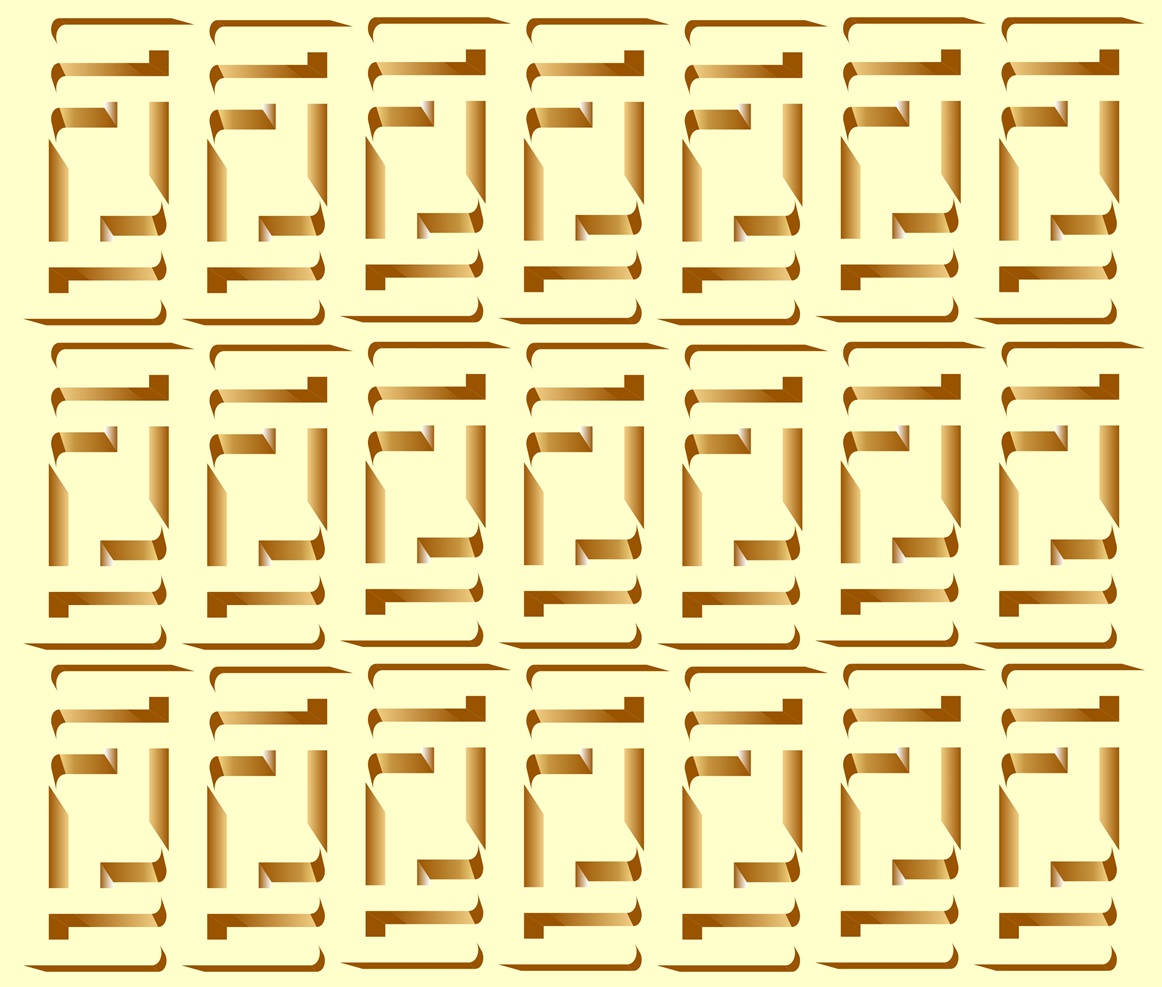
A calligraphy designed by Toronto’s Karim Ismail honouring the first Shia Imam Ali, on the auspicious commemoration of Idd-e Ghadir.
On Monday, June 24, 2024, Ismaili Muslims in Canada and other parts of the world will unite to observe and celebrate Eid-e Ghadir. This momentous occasion marks the pivotal gathering at Ghadir Khumm, where Prophet Muhammad (peace be upon him and his family) designated Hazrat Ali as his successor, the first in the continuing line of Hereditary Imams.
This historical event holds immense significance in the Ismaili faith. Today, the holder of the Hereditary position is Mawlana Hazar Imam, His Highness the Aga Khan, the 49th Imam in direct succession. In this regard, the Aga Khan has affirmed “that the Ismailis are the only Shia community who, throughout history, have been led by a living, hereditary Imam in direct descent from the Prophet” — His Highness the Aga Khan, Parliament of Canada, Ottawa, February 27, 2014.
History records that on the way back to Medina after performing the final pilgrimage to Mecca, the Prophet received a revelation:
“O Messenger, deliver [to the people] what has been revealed to you from your Lord, and if you do not do so, then you will not have delivered His message” Surah al-Ma’ida (5:67)
Upon receiving this revelation, the Holy Prophet stopped at an oasis known as Ghadir Khumm. He addressed a large gathering of Muslims who had accompanied him. The Prophet proclaimed: “Man kuntu mawlahu fa aliyyun mawlahu,” meaning: “He whose Mawla I am, Ali is his Mawla.” The Prophet then prayed: “O Allah, be a friend of whoever is his friend and extend your support to those who support him.”
This event, occurring at a crucial point in Islamic history, marked the transition of leadership from the Prophet to Hazrat Ali, setting the stage for the leadership and future of the Muslim community. Thus, by declaring Hazrat Ali Mawla after him, the Prophet transferred the spiritual authority bestowed upon him by Allah to Hazrat Ali, making him — and all the Imams that follow — the Amirul Mu’minin, or Master of the Believers. In this context, ‘Mawla’ refers to a leader, protector, and guide, indicating the profound responsibility and authority bestowed upon Hazrat Ali.
Article continues below following excerpts
________________________________
Excerpts from L. Veccia Vaglieri piece in Encyclopaedia of Islam, Second Edition
“Ghadir Khumm is famous in the history of Islam because of a sentence (or some sentences) in favour of ‘Ali which the Prophet uttered there during a discourse….Taking ‘Ali by the hand. he asked of his faithful followers whether he, Muhammad, was not closer to the Believers than they were to themselves; the crowd cried out: “It is so, O Apostle of God!”, he then declared. “He of whom I am the mawla, of him ‘Ali is also the mawla (man kuntu nawlahu fa-‘Ali mawlahu)
Photograph: Vysotsky – Own work, CC BY-SA 3.0, Wikimedia.
~~~~~~
“Most of those sources which form the basis of our knowledge of the life of the Prophet pass in silence over Muhammad’s stop at Ghadir Khumm….Consequently, the western biographers of Muhammad, whose work is based on these [Sunni] sources, make no reference to what happened at Ghadir Khumm. It is however certain that Muhammad did speak in this place and utter the famous sentence…the hadiths are so numerous and so well attested by the different isnads that it does not seem possible to reject them.” Vaglieri goes on to state that on instruction from Prophet Muhammad, Hazrat Ali received baiyat (the oath of allegiance) from the Muslims assembled there, including Umar b. al-Khattab, Islam’s second Caliph.
(Note: special access is required to read articles in the on-line edition of EI2. Vaglieri’s piece was reproduced in full in the UK Ismaili Association’s publication Ilm, December 1976, pages 28-30, with the permission of E.J. Brill, publishers of EI2.)
________________________________
Excerpts from the Preamble of the Ismaili Constitution
“In accordance with Shia doctrine, tradition, and interpretation of history, the Holy Prophet (s.a.s.) designated and appointed his cousin and son-in-law Hazrat Mawlana Ali Amiru-l-Mu’minin (a.s) to be the first Imam to continue the Ta’wīl and Ta’līm of Allah’s final message and to guide the murids, a term referring to the followers and disciples of the Imams. The proclamation also established the principle of the Imamat continuing by heredity through Hazrat Mawlana Ali (a.s) and his daughter Hazrat Bibi Fatimat-az-Zahra, Khātun-i-Jannat (a.s)”
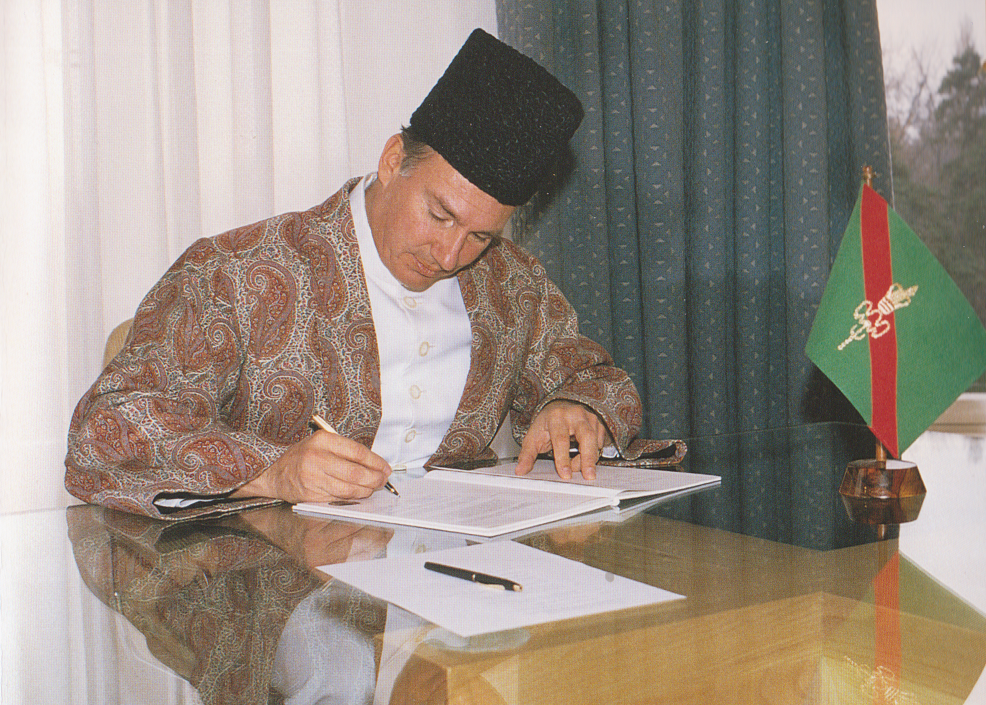
Mawlana Hazar Imam, His Highness the Aga Khan, is seen signing a new constitution for the worldwide Ismaili community on his 50th birthday, December 13, 1986. The preamble excerpts produced in this post are from this constitution.
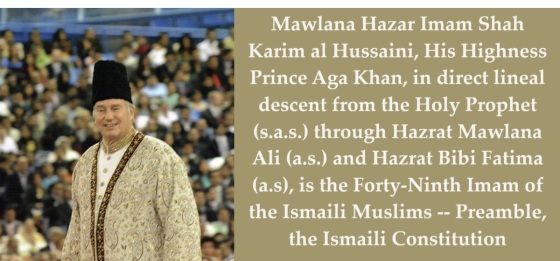
“Mawlana Hazar Imam Shah Karim al Hussaini, His Highness Prince Aga Khan, in direct lineal descent from the Holy Prophet (s.a.s.) through Hazrat Mawlana Ali (a.s.) and Hazrat Bibi Fatima (a.s), is the Forty-Ninth Imam of the Ismaili Muslims.”
________________________________
…. continued
On instruction from Prophet Muhammad, Hazrat Ali received baiyat (the oath of allegiance) from the Muslims assembled there. According to Shia traditions and sources, following the proclamation, the final verse of the Qur’an was revealed to the Prophet:
“On this day, I have perfected for you your religion, completed my favours upon you, and have chosen for you Islam as your religion.”
Eid-e Ghadir is an anniversary of profound significance to all Shia Muslims. It is also associated with the well-attested tradition that the Prophet is said to have proclaimed:
“I am leaving among you two matters of great weight (al-thaqalayn), the Book of Allah and my kindred (itrati), the People of my House (Ahl al-Bayt), and these two shall never be separated until they return to me at the Pool [of Kawthar in Paradise on the Day of Judgement]…”
The phrase ‘two matters of great weight’ refers to the Quran and the Ahl al-Bayt, emphasizing their inseparability and eternal significance in the Islamic faith.
In commemorating Eid-e Ghadir, the Ismaili community celebrates the seminal event of Ghadir Khumm, reaffirming their allegiance to the Imam of the Time as the direct lineal successor and inheritor of Hazrat Ali’s authority. The community is not just inspired, but united and driven by the following remark made during his speech in Canada’s Parliament on February 27, 2024:
“Today, the Ismailis are the only Shia community who, throughout history, have been led by a living, hereditary Imam in direct descent from the Prophet.”
Date posted: June 23, 2024.
____________________
Please click HERE for many more pieces on this website on the topic of Eid-e Ghadir.
The Hajj, the annual pilgrimage to Mecca, drew almost 2.5 Muslims from around the world in 2019. This year’s Hajj has begun and will end on August 2/3. On Friday, July 31, the 10th day of the Islamic month of Dhul al-Hijjah, Muslims will observe the festival of Eid al-Adha which will last into Sunday or Monday August 2/3. This year’s Hajj is limited to 10,000 pilgrims. Pilgrim selection has been done from among local residents of Saudi Arabia as well as overseas citizens who are already living in the country. Pilgrims are required to wear face masks and will only be able to drink holy water from the Zamzam well in Mecca that has been prepackaged in plastic bottles. Pebbles for casting away evil that are usually picked up by pilgrims along hajj routes will be sterilized and bagged before being distributed to the pilgrims….FULL STORY WITH PHOTOS AT ASSOCIATED PRESS
Please click on image for full article and more photos at Associated Press Website
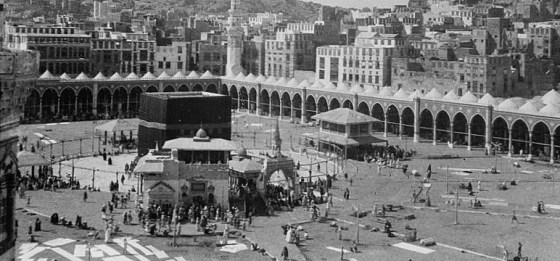
Featured image at top of page: Mecca, ca. 1910. Bird’s-eye view of uncrowded Kaaba. Photo: G. Eric and Edith Matson Photograph Collection / US Library of Congress.
Before departing this website please take a moment to review Simerg’s Table of Contents for links to hundreds of thought provoking pieces on a vast array of subjects including faith and culture, history and philosophy, and arts and letters to name a few.
Date posted: July 28, 2020. Last updated: July 29, 2020.
One day, in Mecca, the Prophet Muhammad dropped a bombshell on his followers: He told them that all people are created equal.
“All humans are descended from Adam and Eve,” said Muhammad in his last known public speech. “There is no superiority of an Arab over a non-Arab, or of a non-Arab over an Arab, and no superiority of a white person over a black person or of a black person over a white person, except on the basis of personal piety and righteousness.”
In this sermon, known as the Farewell Address, Muhammad outlined the basic religious and ethical ideals of Islam, the religion he began preaching in the early seventh century. Racial equality was one of them. Muhammad’s words jolted a society divided by notions of tribal and ethnic superiority.
Today, with racial tension and violence roiling contemporary America, his message is seen to create a special moral and ethical mandate for American Muslims to support the country’s anti-racism protest movement.
Apart from monotheism – worshipping just one God – belief in the equality of all human beings in the eyes of God set early Muslims apart from many of their fellow Arabs in Mecca.
Chapter 49, verse 13 of Islam’s sacred scripture, the Quran, declares: “O humankind! We have made you…into nations and tribes, so that you may get to know one another. The noblest of you in God’s sight is the one who is most righteous.”
Muslims of all backgrounds praying around the Kaʻbah during Hajj, the annual pilgrimage to Mecca, in a photo taken between 1885-1889. Photo: Al Sayyid Abd al-Ghaffār, Physician of Mecca / US Library of Congress
This verse challenged many of the values of pre-Islamic Arab society, where inequalities based on tribal membership, kinship and wealth were a fact of life. Kinship or lineal descent – “nasab” in Arabic – was the primary determinant of an individual’s social status. Members of larger, more prominent tribes like the aristocratic Quraysh were powerful. Those from less wealthy tribes like the Khazraj had lower standing.
The Quran said personal piety and deeds were the basis for merit, not tribal affiliation – an alien and potentially destabilizing message in a society built on nasab.
As is often the case with revolutionary movements, early Islam encountered fierce opposition from many elites.
The Quraysh, for example, who controlled trade in Mecca – a business from which they profited greatly – had no intention of giving up the comfortable lifestyles they’d built on the backs of others, especially their slaves brought over from Africa.
The Prophet’s message of egalitarianism tended to attract the “undesirables” – people from the margins of society. Early Muslims included young men from less influential tribes escaping that stigma and slaves who were promised emancipation by embracing Islam.
Women, declared to be the equal of men by the Quran, also found Muhammad’s message appealing. However, the potential of gender equality in Islam would become compromised by the rise of patriarchal societies.
By Muhammad’s death, in 632, Islam had brought about a fundamental transformation of Arab society, though it never fully erased the region’s old reverence for kinship.
Early Islam also attracted non-Arabs, outsiders with little standing in traditional Arab society. These included Salman the Persian, who traveled to the Arabian peninsula seeking religious truth, Suhayb the Greek, a trader, and an enslaved Ethiopian named Bilal.
All three would rise to prominence in Islam during Muhammad’s lifetime. Bilal’s much-improved fortunes, in particular, illustrate how the egalitarianism preached by Islam changed Arab society.
An enslaved servant of a Meccan aristocrat named Umayya, Bilal was persecuted by his owner for embracing the new faith. Umayya would place a rock on Bilal’s chest, trying to choke the air out of his body so that he would abandon Islam.
Moved by Bilal’s suffering, Muhammad’s friend and confidant Abu Bakr, who would go on to rule the Muslim community after the Prophet’s death, set him free.
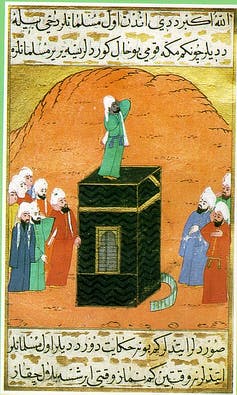
Bilal, center, found freedom in Islam. Wikimedia Commons
Bilal was exceptionally close to Muhammad, too. In 622, the Prophet appointed him the first person to give the public call to prayer in recognition of his powerful, pleasing voice and personal piety. Bilal would later marry an Arab woman from a respectable tribe – unthinkable for an enslaved African in the pre-Islamic period.
For many modern Muslims, Bilal is the symbol of Islam’s egalitarian message, which in its ideal application recognizes no difference among humans on the basis of ethnicity or race but rather is more concerned with personal integrity. One of the United States’ leading Black Muslim newspaper, published between 1975 and 1981, was called The Bilalian News.
More recently Yasir Qadhi, dean of the Islamic Seminary of America, in Texas, invoked Islam’s egalitarian roots. In a June 5 public address, he said American Muslims, a population familiar with discrimination, “must fight racism, whether it is by education or by other means.”
Many Muslims in the U.S. are taking action, supporting the Black Lives Matter movement and protesting police brutality and systemic racism. Their actions reflect the revolutionary – and still unrealized – egalitarian message that Prophet Muhammad set down over 1,400 years ago as a cornerstone of the Muslim faith.
Date posted: July 16, 2020.
[Editor’s Note: I first read the above piece in the religion section of the Salt Lake Tribune, which republished it from The Conversation under a Creative Commons Licence. We do likewise, and invite our readers to read the original piece by clicking HERE; it includes several more hyperlinks within the body of the article that some readers may find useful for further study. Image(s) in Simerg’s piece may vary from those posted in The Conversation and the Tribune .]
Before departing this website please take a moment to review Simerg’s Table of Contents for links to hundreds of thought provoking pieces on a vast array of subjects including faith and culture, history and philosophy, and arts and letters to name a few.
_______________________-
Asma Afsaruddin is Professor of Islamic Studies and former Chairperson, Department of Middle Eastern Languages and Cultures, Indiana University.
This article is republished from The Conversation under a Creative Commons license. To read original article in The Conversation, please click HERE.
_________________
The editor highly recommends the following recent pieces published in Simerg:
The following piece has been compiled and adapted from material supplied by the Aga Khan Museum; it incorporates notes by Dr. Ulrike al-Khamis, the Museum’s Director of Collections and Public Programs.
From Mecca to Toronto
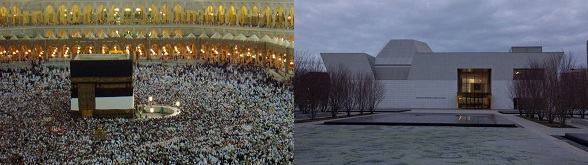
Ka’ba in Mecca. Photo: Aga Khan Museum; Toronto’s Aga Khan Museum. Photo: Rian Dewji.
On display for the first time in Toronto is a 100-year-old silk fragment from a hizam — part of a ceremonial draping that covers the Ka’ba, Islam’s holiest site to which millions of Muslims made the annual pilgrimage on Friday August 9, 2019.
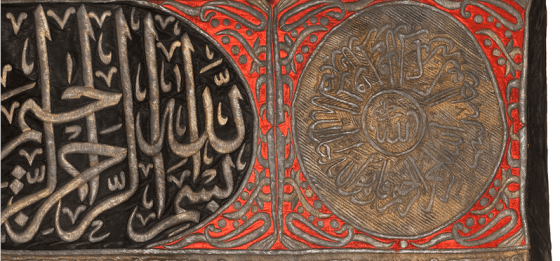
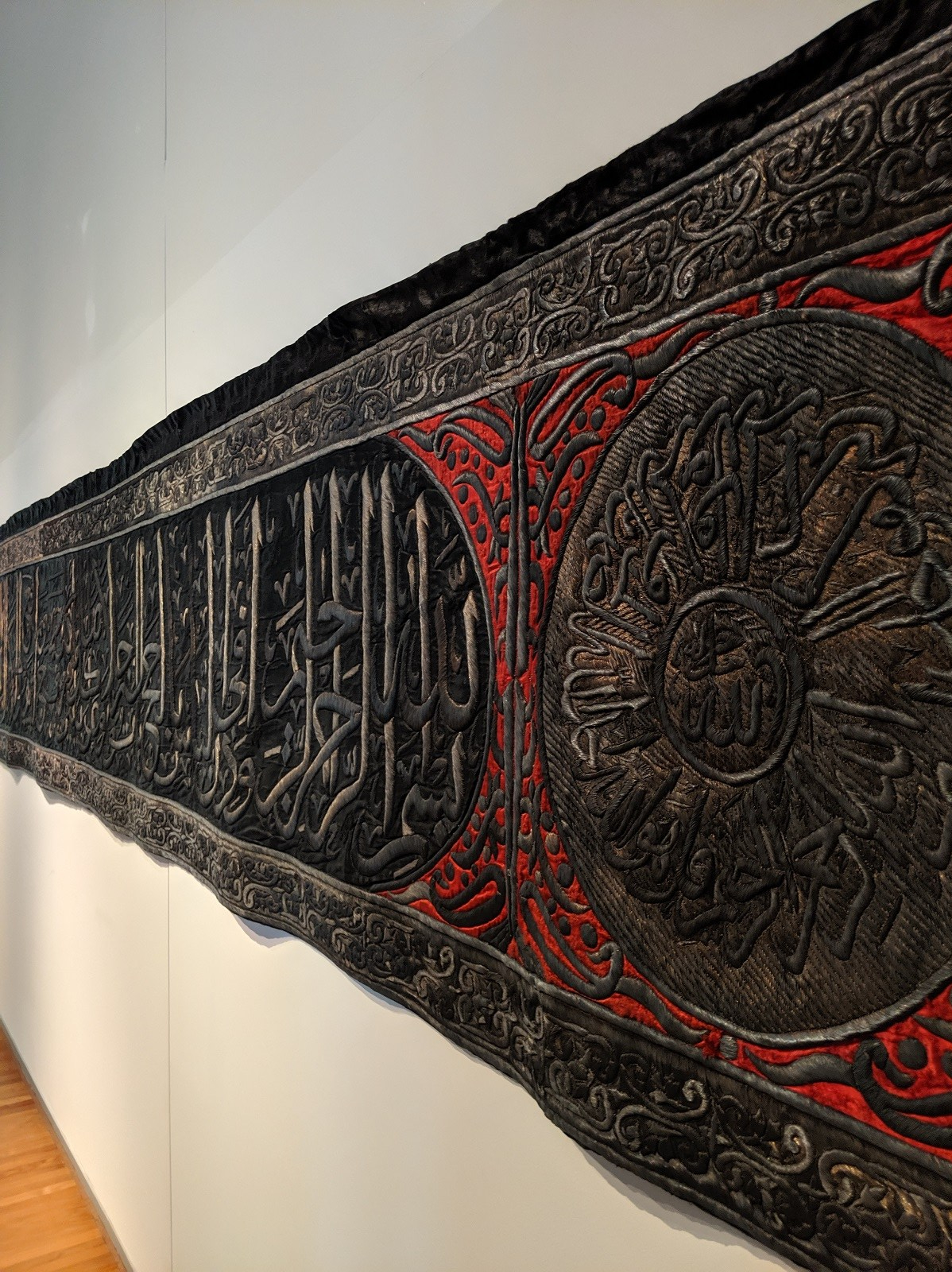
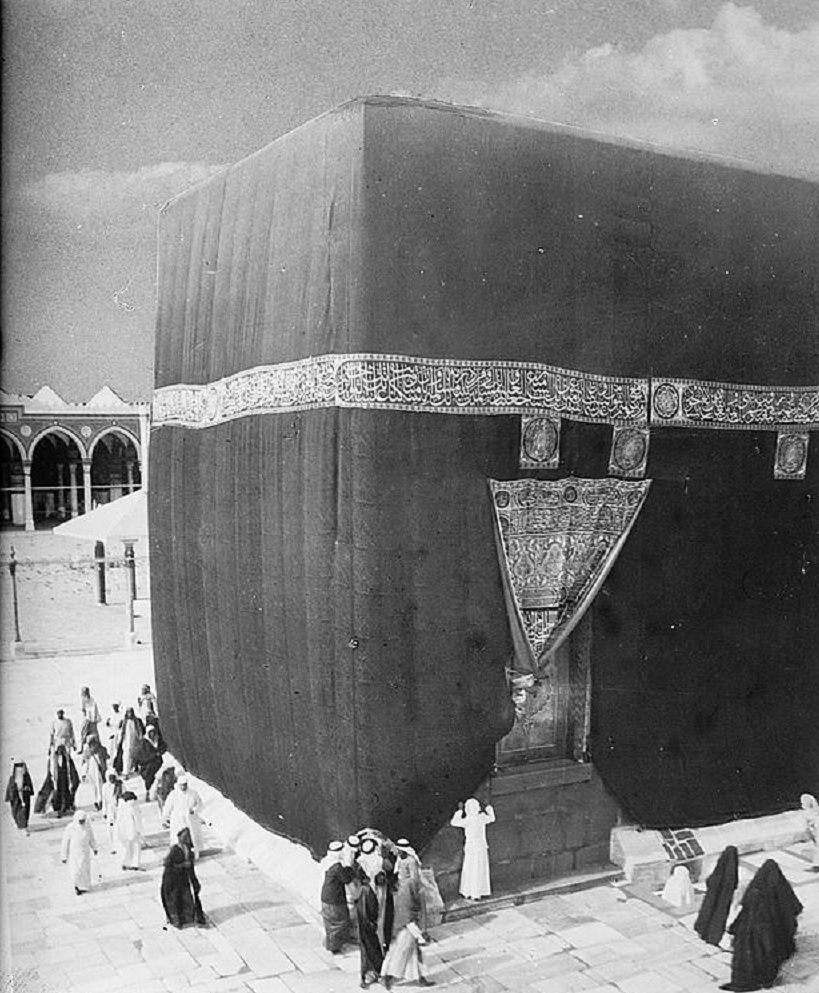
The Ka’ba is draped in a black ceremonial covering known as the kiswa, and around the upper part of the kiswa runs the hizam — an ornamented belt embroidered in silver and silver-gilt thread with Qur’anic verses relating to the pilgrimage.
This hizam is one of the Aga Khan Museum’s most significant textiles and is on special display until September 9, 2019. Measuring eight metres long and nearly one metre tall, it once belonged to a kiswa that measured 47 meters and was made in Cairo around the early 20th century.
This textile from the Ka’ba is on display at the Aga Khan Museum until September 9, 2019. Free viewing was available during celebrations marking the Hajj and Eid al-Adha from August 10-14. Photo: The Aga Khan Museum.
As one of the most prominent kiswa ornaments, the hizam traditionally runs the length of the Ka‘ba’s upper perimeter. The inscription here contains verses 27-29 from chapter 22 (Al-Hajj) of the Qur’an:
“And proclaim to mankind the hajj. They will come to you on foot and on every lean camel, they will come from every deep and distant mountain highway. That they may witness things that are of benefit to them, and mention the name of Allah on appointed days, over the beast of cattle that He has provided for them. Then eat thereof and feed therewith the poor who have a very hard time. Then let them complete their prescribed duties and perform their vows, and circumambulate the Ancient House.”
The roundels contain further Qur’anic references that mention ‘God the Eternal’ as well as the Prophet Muhammad.
The Ka‘ba receives a new drape every year during the pilgrimage season. After it ends, the kiswa is taken down, divided and either gifted to dignitaries or sold to raise money for charity.
Note: The museum is open everyday from 10 am to 6 pm (8 pm on Wednesdays). It is closed on Mondays, except holiday Mondays.
19th/20th Century Views of Ka’ba
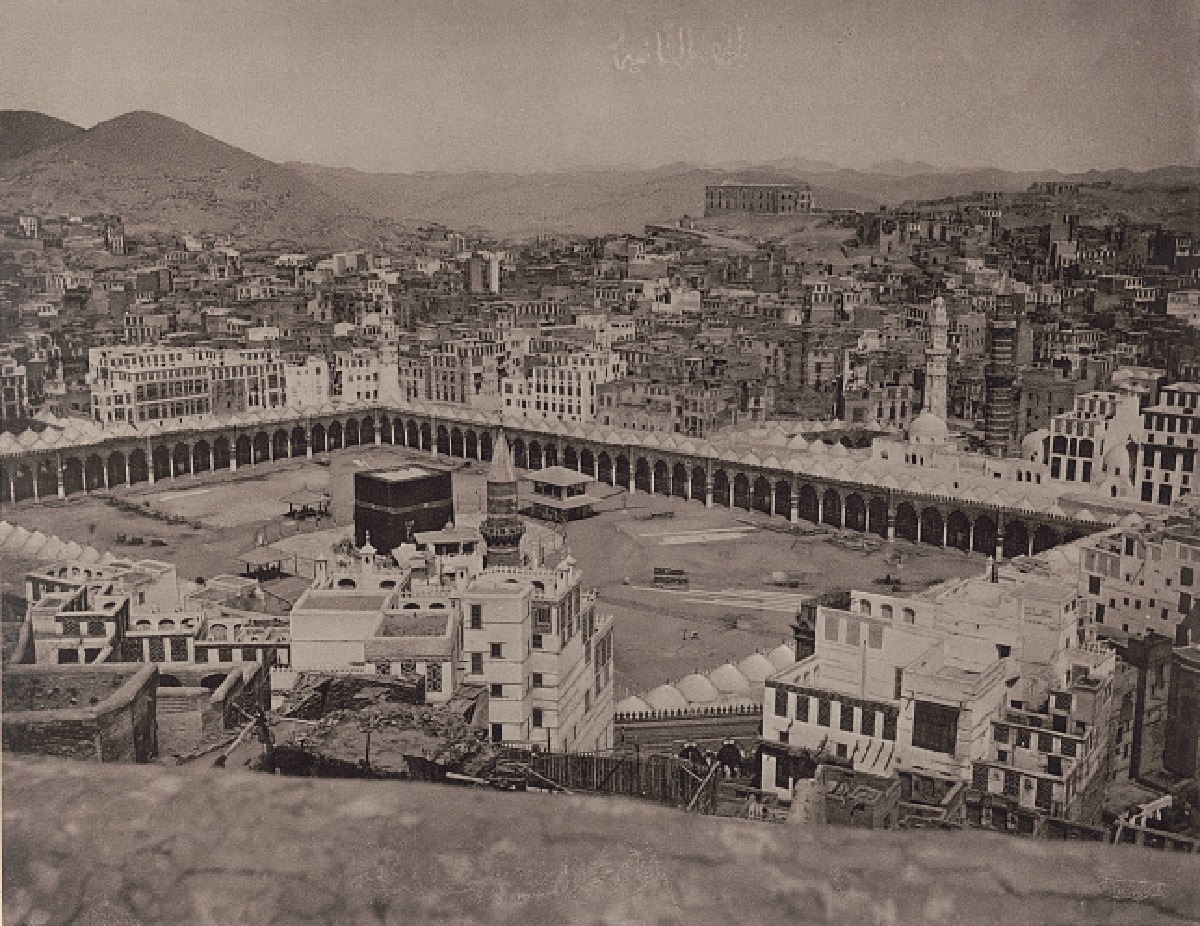
A bird’s eye view of the Ka’ba as photographed in 1889. Note the hizam that runs around the upper part of the Ka’ba. Photo: US Library of Congress.
ca. 1910. A close-up photo of the Ka’ba with the hizam running around the upper part of the black cloth (the kiswa). Photo: US Library of Congress.
Date posted: August 7, 2019. Last updated: August 15, 2019.
[Before leaving this page, please take a moment to visit Simerg’s Table of Contents for links to a vast and rich collection of articles and photographs published on this blog as well as its two sister blogs Barakah and Simergphotos.]




 Simerg - Insights from Around the World