“Allah did choose Adam and Noah, the family of Abraham, and the family of Imran above all people – offspring, one of the other, and Allah knows and hears all things.” (Holy Qur’an, 3:33-34)
I. PREAMBLE OF THE ISMAILI CONSTITUTION

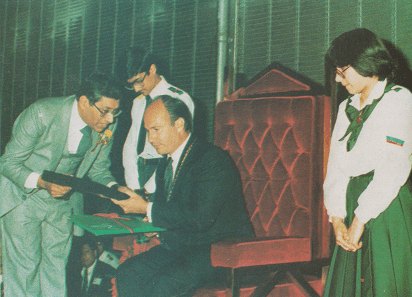
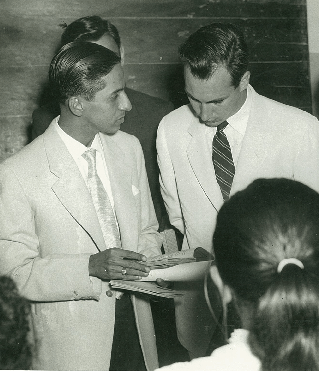
His Highness the Aga Khan seen ordaining a new constitution for the Ismaili community worldwide. Clause (G) of the Preamble states: “Mawlana Hazar Imam Shah Karim al Hussaini, His Highness Prince Aga Khan, in direct lineal descent from the Holy Prophet (s.a.s.) through Hazrat Mawlana Ali (a.s.) and Hazrat Bibi Fatima (a.s), is the Forty-Ninth Imam of the Ismaili Muslims.”
“In accordance with Shia doctrine, tradition, and interpretation of history, the Holy Prophet (s.a.s.) designated and appointed his cousin and son-in-law Hazrat Mawlana Ali Amiru-l-Mu’minin (a.s), to be the first Imam to continue the Ta’wīl and Ta‘līm of Allah’s final message and to guide the murids, and proclaimed that the Imamat should continue by heredity through Hazrat Mawlana Ali (a.s) and his daughter Hazrat Bibi Fatimat-az-Zahra, Khātun-i-Jannat (a.s).” – The Preamble of The Constitution of the Shia Imami Ismaili Muslims. [1]
~~~~~~~~~~~
II. IDD-E-GHADIR STAMPS
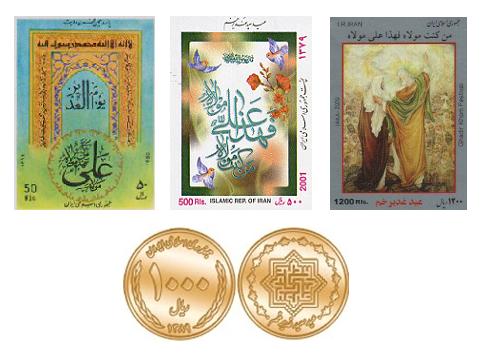
Images of some stamps and coins issued by the Islamic Republic of Iran between 1990 and 2010 commemorating the Idd-e-Ghadir. The inscriptions include the Shahada, Qur’anic ayats and the declaration made by Prophet Muhammad at Ghadir Khumm, “Mun Koontu Mawla, Fa Hada, Aliyun Mawla” meaning “He of whom I am the Mawla Ali is also the Mawla.”
~~~~~~~~~~~
III

With 9,000 chronological quotations arranged in 90 thematic chapters, this huge treasury is bursting with historical gems.
“Muhammad said: ‘He of whom I am the Mawla, Ali is his Mawla. O God, be the friend of him who is his friend and be the enemy of his enemy.’
“This became the proof text for the Shia claim that Ali, the Prophet’s cousin and son-in-law, was the Prophet’s rightful successor after the Prophet’s death in 632. The meaning of Mawla here probably implies the role of patron, lord or protector.” — History in Quotations by M. J. Cohen and John Major.
~~~~~~~~
IV. HIS HIGHNESS THE AGA KHAN AND
HIS DEVELOPMENT NETWORK ON HAZRAT ALI

His Highness addressing the Evangelical Academy of Tutzing upon receiving the Tolerance Award, 20 May 2006.
“…As you know, the Shi’a divided from the Sunni after the death of the Prophet Muhammad. Hazrat Ali, the cousin and son-in-law of the Prophet, was, in Shi’a belief, named by the Prophet to be the Legitimate Authority for the interpretation of the faith. For the Shi’a today, all over the world, he is regarded as the first Imam.” – His Highness the Aga Khan, Tutzing Evangelical Academy, May 20, 2006. [2]
___________
“The Ismaili Imamat is a hereditary institution of Muslim leadership, linked to Prophet Muhammad (peace be upon him and his family) by direct lineal descent through Hazrat Ali, his cousin and son-in-law. The line of Ismaili Imams has continued uninterrupted by hereditary succession from Hazrat Ali through to the present, 49th Imam, His Highness the Aga Khan.” – The Aga Khan Development Network (AKDN) , Brazil and the Ismaili Imamat sign a Protocol. [3]
~~~~~~~~~~~
V. “I WISH I’D BEEN THERE”
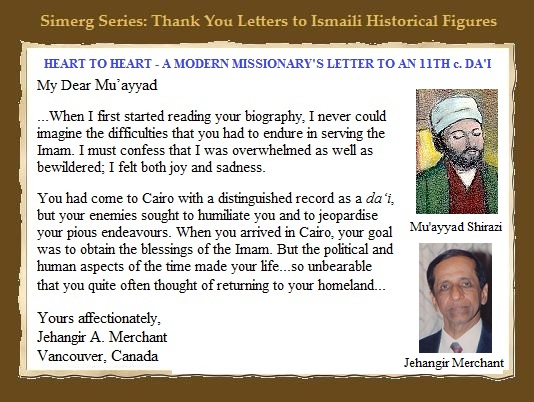
By Jehangir Merchant, Aziz Kurwa and Barnaby Rogerson

Please click for Jehangir A. Merchant’s “Ghadir-Khumm and the Two Weighty Matters”
Ghadir-Khumm and the Two Weighty Matters by Jehangir Merchant
The last obligatory duty that Allah sent down was al-Walaya (adherence to the guardian designated by Allah). Then, He sent down the verse: “This day have I perfected your religion for you and have completed My favours upon you and have chosen for you Islam as your religion.” (Holy Qur’an, 5:3)…
~~~~~~~~~

Please click for Aziz Kurwa’s “Volunteering at the Dawning of the Age of Imamat”
Volunteering at the Dawn of the Age of Imamat by Aziz Kurwa
Rasul-illah mounted the pulpit and placed Ali on his right. He then delivered a sermon, thanking Allah for His bounty. Taking Hazrat Ali by the hand, he then declared: He of whom I am Mawla, of him Ali is also the Mawla. The volunteers cleared everything and then we sat around campfires in groups. In my group the conversations was buzzing over the historical and momentous events of the day…
~~~~~~~~~~

Please click for Barnaby Rogerson’s “A Christian Envoy at the Ghadir Khumm Campsite”
A Christian Envoy at the Ghadir Khumm Campsite by Barnaby Rogerson
What an offer! To travel back in time and return as a true witness to the history that I have so often thought and dreamed about… (and) witness to the exact succession of events at the Ghadir Khumm campsite: the blessings, the sermon and the ritual actions of the Prophet ordaining Ali as his successor…
To download complete series please click I Wish I’d Been There Series – PDF. To read individual pieces, please visit I Wish I’d Been There.
___________________
[1] To read background story and complete preamble, please click The Preamble Of “The Constitution of the Shia Imami Ismaili Muslims”.
[2] To read this and other published speeches at the AKDN Website, please click Tolerance Award from the Evangelical Academy of Tutzing and Speech Archives.
[3] See The Ismaili Imamat note in AKDN–Brazil Protocol.
___________________
A Note to Readers: Please scroll down or click Home page for other recent posts and click What’s New for links to all articles published on this blog since March 2009. Subscribe to this Website via the box near the top right of this page.


 The term Salgirah is of Persian origin. Sal means anniversary and girah means knot and hence Salgirah literally means ‘an anniversary knot added on to a string kept for the purpose’. This article approaches the subject of Mawlana Hazar Imam’s birthday in terms of the Imam’s love for his murids and the love and devotion of the murids for their Imam.
 The new Ismaili Constitution was ordained, signed and sealed by His Highness the Aga Khan on December 13th, 1986, his 50th birthday. His Highness did this with the belief that the Constitution would provide a strong institutional and organizational framework for his Ismaili community to contribute meaningfully to the societies among whom they live.