To commemorate the Diamond Jubilee visit to Canada, the Jamat of Canada presented Mawlana Hazar Imam, His Highness the Aga Khan, a very rare version of a manuscript of Nasir Khusraw’s Divan. The presentation was made on behalf of the Jamat by Karima Karmali, the Vice President of the Aga Khan Council for Canada, on May 11, 2018 during the final Mulaqat in Calgary.
In response, Mawlana Hazar Imam said that the gift of the manuscript was a “beautifully wise” choice. It is therefore befitting that we celebrate the extraordinary life of Nasir Khusraw through this special tribute prepared by Sujjawal Ahmad of Pakistan.
An Introduction and Tribute to Nasir Khusraw
By SUJJAWAL AHMAD

A depiction of Nasir Khusraw. Photo: AkimArt
A Persian poet, philosopher, Ismaili scholar, theologian, traveler and one of the greatest writers in Persian literature, Nasir Khusraw has befittingly been called a Ruby. He was a jewel, a jewel that has to pass through many tribulations until it is able to give its own light to others. My admiration for Nasir Khusraw started when I was a teen at a high school, and I began reading about his life and teachings.
I was most impressed by his story which has left an indelible mark on me. It tells of a life that was transformed from that of worldly possessions and luxury to an exemplary life of ethic, self-discipline, courage and dedication in the path of faith. Nasir Khusraw epitomises the Prophet’s saying: ‘Seek knowledge even unto China’ by setting off on a journey of seven years which he calls a ‘Journey to the Seventh Sphere’.
The Safarnama, an account of his travels, and his other works like the Divan enable one to get a picture of key events that led to the development of his thoughts that finally made him embrace the Ismaili faith.
A brief article such as the one I have attempted here cannot do justice to the incredible life of Nasir Khusraw, and I hope this endeavour captures the salient points of his life and will also inspire readers to learn more about the sage from recent new works that have been published.
Early Life
Nāsir Khusraw was born in Qabodiyon, Khorasan (present day Tajikistan) in the year 1004 AC. He belonged to a family of government officials in Qabadiyan and spent his early years travelling and studying. Following family tradition, he joined government service where he earned a reputation of a high achiever. He demonstrated remarkable ability in all pursuits of knowledge of religion, philosophy, literature, science and mathematics. Nasir Khusraw was a prolific writer on a wide variety of subjects, including a book on mathematics Gahra’ib al-hisab which has now been lost.
Turning Point
One night while he was on an official trip outside the city of Marv, he had a dream that was to change course of his life. In his vision a wise man appeared before him, calling him to forsake the life of drunkenness. In reply he told the wise man there was no better thing than wine to lessen his sorrow. The wise man told him to seek out what increased reason and wisdom instead of seeking that which lessened wisdom. ‘Where can I find such a thing?’ he asked.
Pointing towards the Qibla, the wise man said: ‘Search and ye shall find’.
On awakening, with the vision still vivid in his mind, he lamented to himself: ‘I have woken up from last night’s dream. But now I must awaken from a dream that has lasted forty years’.
He was determined to change his life accordingly, interpreting the dream as a sign from God. A month later, on December 19th, 1045, Nasir Khusraw went to mosque, fell to his knees and bowed his forehead to the ground, asking help from God in guiding him to accomplish what he had to do in his life.
He took leave from his job, and announced that he was going for a pilgrimage to the holy city of Mecca. Thus, began his seven year journey of a wayfarer in search of true spiritual wealth,
Nasir Khusraw in Cairo
He travelled westward through northern Iran passing Nishapur, Tabriz, Aleppo, and then across the Mediterranean coast until he reached Jerusalem. During his three months stay here, he visited the holy shrines in Jerusalem and then set out for his first pilgrimage to Mecca. From Mecca by the way of Damascus to Jerusalem, he proceeded by land to Egypt. The oracle in his dream had pointed him in the direction of the Qibla, which was also the direction of Cairo, the capital of the Fatimid Caliphate, which was then under the reign of Imam al-Mustansir billah.
In July, 1047 AC standing in the city of Cairo, his face full of radiance and grace, and heart enlightened, he was now voicing his thanks to the Divine, saying:
“Praise to the Lord that nothing burdens my back. Thanks to the generosity of His favor and grace, that I have come to know the truth of the true Imam, his certainty and justice of his cause; that he is that matchless king whose domain of all the earth is free of devilery. O Lord help me to spend days and nights in devotion to him to string together from time to time a few pious verses based on his knowledge and wisdom.”
This was the city that was blessed with the presence of Imam of Time, as he rightfully said: “to which the heavenly bodies and spheres themselves were subservient”. Upon his arrival in the city he felt a voice instructing him, “Go no further! Seek here what you need.”
He had arrived to embrace his dream! He had reached the true House of Knowledge of which the Prophet had said, Ali was the gate. Now he would spend days and nights benefiting as much as he could from that sacred House. His soul was illuminated with the radiance of the light of Imam of Time. So profound was the effulgence of Imam’s Glory to him that he extolled every sign of his gratitude, praise and admiration.
“Wherever I may be, so long as I live, time and again,
My pen, ink pot and parchment will speak
my gratitude to you (O Imam of Time).”
Nasir Khusraw and the grand Ismaili missionary al-Shirazi
He had started his journey from his hometown with a burning desire to seek answers to the questions of existence and purpose in the world; and now he had to stay for the next two to three years, in the companionship of the great Ismaili intellectuals. In Cairo he met with many Ismaili dais including Mu’ayyad fi’l-Din al-Shirazi, who later became his mentor and teacher. Nasir’s conversation with al-Shirazi struck him with amazement. Upon his first meeting, he told al-Shirazi about his soul’s grief and frailty and al-Shirazi gazed intently upon his face for a while and then said, “Fear not, for your mine has now transformed into gems.” These words were no less than but of a soothsayer to him that served to fortify his hopes and confidence. Al-Shirazi expounded on Nāsir’s questions in terms he neither had read nor heard before. He spoke with Nasir with such a knowledge and fluency that the sweetness of his discourse finally impelled Nasir to accept him as his teacher and call him ‘Ridwan’ — the one who is Warden of Paradise.
During his stay in the Fatimid capital he engaged in deep study of all branches of religion such as theology, philosophy, metaphysics and ethics.
Nasir Khusraw’s Departure from Cairo

A statue of the Ismaili dai, philosopher, poet and seasoned traveller Nasir Khusraw in Badakhshan.
Sparkling with light and enthusiasm, he was now ready to start the next part of his journey back to his home with a spirit full of courage and determination. From the moment he left Cairo, he was now heading his mission as a Hujjat, the supreme office in Dawa, for the spread of his new Ismaili faith to new territories, including Khurasan and Badakhshan. His life was now to be committed with ceaseless activity, promoting Ismaili teachings to all people.
Nasir Khusraw returned to Persia in the year 1052 AC, and stayed at Balkh, his hometown, and started preaching his new faith in the surrounding areas. Envious of Nasir Khusraw’s influence, the exoteric clerics of his town tried to poison the minds of the already hostile Seljuq authorities resulting in attacks that caused great distress to him. He had to flee from his hometown to the high mountains of Yumgan, living in a period of exile in the last years of his life. Throughout this period of exile, he continued to struggle conversing with the wise and learned on themes and topics that occupied their minds. He breathed his last in the mountains of Yumgan in the upper reaches of Oxus river. His body lies under the earth, but his spirit lives on, in hearts of his people calling:
“That strength of youth that heavenly face —
O mindless body of mine, why did you ever leave them behind?
When your body was beautiful, you acted pretty ugly,
Now that you are ugly, you should beautify your actions.
Time has made your torso feeble:
Yesterday a peacock, today a porcupine.”
Nasir Khusraw’s Teachings
Nasir Khusraw along with other Ismaili preachers of his time, offer such an understanding of religion where intellectual investigation of faith is the supreme virtue of a believer. He never promoted dogmatic attitudes of thought and belief. The path that he calls for considers intellect (aql ) as the primary tool in the soul’s endeavor to cleanse itself and for its salvation. Intellect is always predominant, as an essential criterion, for individual’s search for truth. He gives us an intellectual and logical understanding of spirituality. There exists, at microcosmic level, for each individual being, a spiritual dimension of existence which is the most fundamental and the most important aspect of his reality. While physical bodies reside at the material world of zahir, the soul exists at spiritual world of batin. Ultimate journey is the journey of the batin, that is, of soul, so that it may find the presence in higher spheres of the world of ‘Amr’. He tells us how to elevate our souls so as to make them receptive to the Divine emanations:
“Kindle the candle of intellect in thy heart and hasten with it to the world of brightness.”
His views conceives of man to be essentially a rational being, superior to the physical creation, possessing a ‘rational soul’. God provides man with tools such as consciousness, discursive reasoning, and the power of intellect. From his perspective, intellect is the most crucial gift bestowed from God to mankind, that enables man to gain wisdom (hikmat), true understanding of God’s plan and will.
It is only through a conscious and repeated use of reason and intelligence that man can achieve that wisdom. Food for man to achieve this is knowledge. But man’s knowledge is incomplete like his intellect, so there must be a person always present on earth, with Perfect Knowledge and Intellect, whom people can approach to seek guidance. Pearl of knowledge, he says, is Intellect, and pearl of Intellect, he says, is God’s Command, Be!
God’s gift for mankind through his Divine Will thus includes wellsprings of Divine guidance, that are Prophets and Imams. They are the true House of Knowledge. But it is incumbent upon man to search for his Imam of Age. His whole story revolves around his quest to identify such a pinnacle of Divine Guidance. His quest is fulfilled when he finds this pinnacle in the person of Imam Mustansir-i billah in Cairo.
One distinguishing character that makes him unique is that Nasir Khusraw was not a sage. He never aspired to seek monastic withdrawal from the world. The path that he preached never lead one away from the worldly life. Even though he warns against being seduced by the attractions of this world, he also exhorts his readers to actively engage with the world and make use of it for their own perfection and become the best human beings they can. For him, the physical world holds clues to the next world as well as tools to make the journey possible.
Nasir Khusraw’s Poetry and Works
Nasir Khusraw remains one of the most fascinating figures in Islamic history. Despite diverse themes and styles of his writings, one finds them imbued with his primary and consistent concern for Ismaili faith. His poetry not only reflects his inspiration and expression but also, as a paragon of distinctive style and eloquence, it combines philosophy and theology to the mould of Persian literary tradition and attracts a passionate attention of any aspiring reader. He often makes use of poetic imagery and the basic ingredients of rhyme and rhythm in order to illustrate his practical wisdom of a virtuous life, as in the following example:
Have you heard? A squash vine grew beneath a towering tree.
In only twenty days it grew and spread and put forth fruit.
Of the tree it asked: ‘How old are you? How many years?’
Replied the tree: ‘Two hundred it would be, and surely more.’
The squash laughed and said: ‘Look, in twenty days, I’ve done more than
you; tell me, why are you so slow?’
The tree responded: ‘O little squash, today is not the day of reckoning
between the two of us.’
‘Tomorrow, when winds of autumn howl down on you and me, then shall it be
known for sure which one of us is the real man!’
He is known not only for his prose and poetry but also in his unique capacity as the only eminent philosopher of his era to have composed all his works in Persian.
He has several works to his credit, revealing the exemplary perfection of his intellectual personality. It would be no exaggeration to say that his works are invaluable to the philosophical curriculum of medieval Muslim thought. Most of his writings range from responses to the personal requests of his followers or correspondents to profound elaborations, elucidations and interpretations of Ismaili theology and philosophy. These include Jami‘ al-hikmatayn, Gushayish va Rahayish, Zad al-Musafirin (or Travelling Provisions of Pilgrims), Wajh-i-Din (or The Face of Religion), and many others.
A series of excellent teachings of his philosophy are found in his Jami‘ al-hikmatayn and Gushayish va Rahayish. It is here that he addresses and expounds a wide range of various questions: How did we come to be? What is Soul? What is meant by time and space? and so on. It is also here that he applies rational tools to explain and expound his theology, allowing us to capture and understand not only the significance of his own thought, but also the beliefs of his age.
Today as I pause, his life and his story renders me to reflect on how his journey that started with a dream led him to the highest rank in the Ismaili Dawa among Ismaili intellectuals of his time. We may conclude by reading his story from his own writings that the foundation of his life and journey was to learn enough to be worthy of teaching to others. He never considered it either sufficient or ethical to acquire knowledge first and then hold that knowledge to his own self. He considered it imperative to disseminate the knowledge that he acquired to others, and to call others to the truth that he had found in the Ismaili faith.
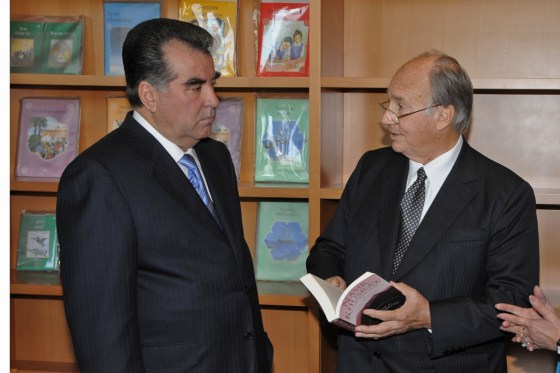
Tajikistan’s President Rahmon and Mawlana Hazar Imam, pause in the library of the new Ismaili Centre in Dushanbe during its opening on October 12, 2009. They engage over a book about renowned poet and Ismaili philosopher, Nasir Khusraw, who lived over a thousand years ago in the region that is modern Tajikistan.
Nasir Khusraw shines, today, in the learned world like a lamp of knowledge, and his voice of wisdom shimmers the minds of the world’s most wise. To me, his message seems perfectly compatible with modern ethos of intellectual change. I conclude my article with following remarks of Mawlana Hazar Imam Shah Karim al-Hussaini, made on 30th August 2003 during the foundation ceremony of the Dushanbe Ismaili Centre:
The passage of a millennium has not diminished Nasir Khusraw’s relevance nor dulled the lustre of his poetry. It continues to uplift and inspire, reminding us that we are the authors of our own destiny. As he has said, we can be like a poplar tree which chooses to remain barren, or we can let our path be lit by the candle of wisdom, for only “with intellect, we can seek out all the hows and whys. Without it, we are but trees without fruit.” Another lesson that we learn from this great philosopher is that, in the ebb and flow of history, “knowledge is a shield against the blows of time.” It dispels “the torment of ignorance” and nourishes “peace to blossom forth in the soul.”
Date posted: June 16, 2018.
_____________________
All Nasir Khusraw quotations are from Nasir Khusraw: The Ruby of Badakhshan by Alice C. Hunsberger.
 Sujjawal Ahmad holds a Masters degree in Molecular Biology from Quaid-i Azam University, Pakistan, where his work and research focused on targeted molecular therapeutics. He has a passion for philosophy, and has written several articles on classical philosophy and comparative religions.
Selected readings on Nasir Khusraw:
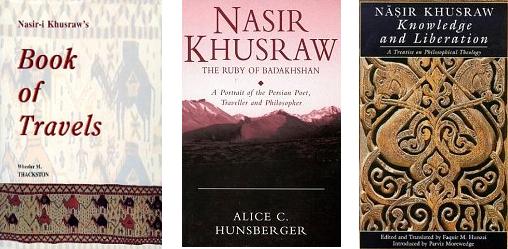
Some of the works of Nasir-i Khusraw now available in English.





 Simerg - Insights from Around the World