Simerg is an independent initiative dedicated to Ismaili Muslims, the Aga Khan — their Hereditary Imam — and the Ismaili Imamat, and Islam in general through literary readings, photo essays and artistic expressions
Author Archives: Malik Merchant, Editor
Founding publisher and editor of www.barakah.com, www.simerg.com and www.simergphotos.com.
In the early 1990’s Michael Wolfe, a prolific American writer and award winning producer of Islamic documentaries including Muhammad: The Legacy of a Prophet, became aware of a string of accounts by Muslims and non-Muslims who over the last one thousand years had gone to Mecca on the pilgrimage. Wolfe’s accounts are collected into a single volume called One Thousand Roads to Mecca, and the first of the twenty-four edited accounts is based on the Book of Travels, a classic text by the famous Ismaili poet, philosopher and traveller Naser-e Khosraw who lived during Islam’s expansive Middle period between the 11th and 14th centuries. The period has also been called the Golden Age of Muslim travel and, as Wolfe notes, Khosraw set the tone for a thousand years of Persian travel writing.
‘‘When I was 15 there were 21 people living in the house and my friend Hasiet and I had to do all the weekly washing for the whole family, even in winter. It took all day and I got frost bite in my feet several times. My toes would turn black. We’d go down to the river and make a fire to heat the water. We used to burn our socks, trying to warm our toes by the fire. It was hard to find enough money to buy new ones with all those people in the house.’’ — Hussn Bibi
A stunning view of the Indian Ocean from the roof-top of the Bagamoyo Jamatkhana. Please click for home page of Simerg’s Photo Blog. Photo: Shariffa Keshavjee, Nairobi, Kenya. Copyright.
The following posts have been added to Simerg’s new photo blog since September 21, 2012. They are revised versions of photo essays that appeared on this website previously.
The Daily Monitor of Uganda reports that President Museveni and His Highness the Aga Khan will formally commission the $860 million (Shs2.1 trillion) Bujagali Hydro Power Project in Jinja on Monday, October 8, 2012. “Construction has come to completion. The new chapter is exciting for us, we are thrilled…” Mr Bill Groth, the Bujagali Energy Ltd’s resident construction manager, said ahead of the commissioning. The Monitor adds that ten regional leaders who are attending the country’s jubilee celebrations are expected to grace the opening ceremony. The foundation ceremony of the dam was laid on August 21, 2007 during the Golden Jubilee celebrations of His Highness the Aga Khan. During that ceremony, the 49th Ismaili Imam noted: “The laying of this foundation stone is indeed an historic moment. The project we celebrate today is an unprecedented endeavour.”
Bujagali Dam will be officially opened on Monday October 8, 2012 by His Highness the Aga Khan and President Museveni to mark Uganda’s 50th Independence Anniversary. A report by Arne Doornebal for Radio Netherlands noted that since the long-awaited Bujagali Dam started producing 250 megawatts in June 2012, power cuts have fallen sharply. Photo: Bujagali Energy Limited.
REPEATING AND RENEWING AN ANCIENT STORY
By His Highness the Aga Khan
“Everywhere in the world today, people are searching for ways to reduce the threat of global warming both by limiting greenhouse gas emissions and by fighting the blight of deforestation. The key to both efforts is to move away from plant and fossil fuels, and to depend instead on renewable energy sources. Hydro electric power fulfills that goal. It is “clean” energy – advancing sustainable development while minimizing its environmental impact.
“If this were not the case, we would not have taken up this project, and we could not have attracted such a wide range of public-minded supporters to join in this endeavour. We feel deeply that environmental goals and development goals must be part of a Complementary Agenda – we can serve one set of goals only if we also serve the other. We are proud that the Bujagali project advances that Complimentary Agenda.
“From the very beginnings of civilization, the use of water – intelligently, respectfully, and creatively – has been at the very center of human concerns. The Nile River itself has been a great source and sustainer of life for thousands of years. Today, we repeat and renew that ancient story once again as we lay this Foundation Stone – and thus signal the opening of a new era in African history.” — Excerpts from a speech made by His Highness the Aga Khan on August 21, 2007
~~~~~
CLICK ON PHOTO TO WATCH A SHORT VIDEO OF THE FOUNDATION CEREMONY
August 21, 2007: His Highness the Aga Khan and His Excellency President Yoweri Museveni of Uganda, lay the foundation stone for the Bujagali Hydropower Project, Jinja. The US$ 770 million project is the country’s first private hydroelectric power project, and is expected to significantly lower the price of electricity in Uganda. The plant is also one of the largest independent power plants in sub-Saharan Africa. – Photo: AKDN/Gary Otte
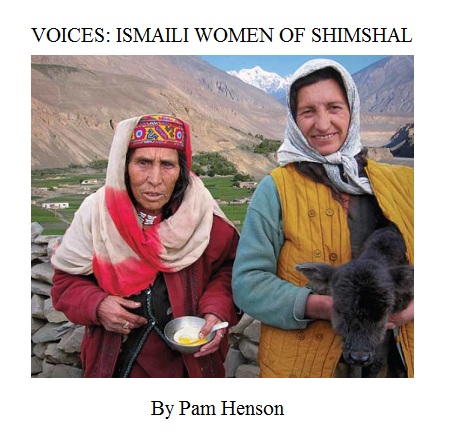
“I don’t read or write but I am very interested in animal husbandry and I have always worked hard on the farm. It was my dream for my children to be educated so I worked hard and provided for their education…” — Guljon Bibi
This is a fascinating collection of autobiographical tales told by women from the Ismaili village of Shimshal, in the remote Karakoram mountains. On the eastern border of Pakistan, the women of Shimshal live peaceful lives of extreme hardship and good-humoured tolerance.
Originally aired on PBS to a word-wide audience exceeding 150 million people
“CANDID, THOUGHTFUL AND VISUALLY STUNNING” – Los Angeles Times
Prophet Muhammad (s.a.s) changed world history in 23 years and continues to shape and inspire the lives of more than 1.4 billion Muslims around the world.
Simerg is pleased to make available for its readers around the world a link to the film, Muhammad: Legacy of a Prophet, that was originally aired on PBS to a world-wide audience exceeding 150 million people. The internet age is a blessing of our time that, through outstanding movies such as this, we are able to learn more about the wonderful and noble qualities of Prophet Muhammad. In his Presidential Address to the Seerat Conference in 1976, His Highness the Aga Khan had asked:
“In the face of this changing world, which was once a universe to us and is now no more than an overcrowded island, confronted with a fundamental challenge to our understanding of time, surrounded by a foreign fleet of cultural and ideological ships which have broken loose, I ask, ‘Do we have a clear, firm and precise understanding of what Muslim Society is to be in times to come?’ And if as I believe, the answer is uncertain, where else can we search then in the Holy Qur’an, and in the example of Allah’s last and final Prophet?”
His Highness continued:
“The Holy Prophet’s life gives us every fundamental guideline that we require to resolve the problem as successfully as our human minds and intellects can visualise. His example of integrity, loyalty, honesty, generosity both of means and of time, his solicitude for the poor, the weak and the sick, his steadfastness in friendship, his humility in success, his magnanimity in victory, his simplicity, his wisdom in conceiving new solutions for problems which could not be solved by traditional methods, without affecting the fundamental concepts of Islam, surely all these are foundations which, correctly understood and sincerely interpreted, must enable us to conceive what should be a truly modern and dynamic Islamic Society in the years ahead.”
Some of these examples from the Prophet’s life come alive through this ground-breaking PBS film, which takes the viewers from the ancient Arabian sites where Prophet Muhammad’s story unfolded to the homes, mosques, and workplaces of some of America’s estimated seven million Muslims. The Los Angeles Times called the film “a candid, thoughtful, flowing, visually stunning film,” while The Catholic News Service commented that the Prophet’s biography offers viewers fresh insights into the spiritual foundations of Islam.
Simerg is grateful to Daniel Tutt of upf.tv for facilitating the showing of the film though this website. We strongly encourage all the viewers to watch the complete film, if not in one seating then by watching the timed segmented clips which will open at the bottom of the viewing window. We are sure you will enjoy this film. Please click:
Readers who wish to watch a preview of the film and other selected clips before viewing the full-length movie are invited to click http://www.muhammadfilm.tv or on the following image:
Please click for links to full length movie and excerpts
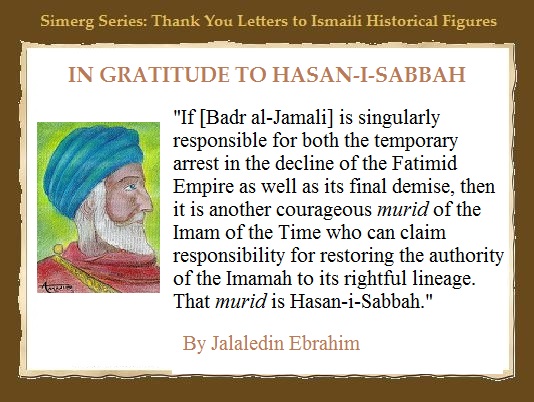
“…[Hasan-i-Sabbah] is officially welcomed by representatives of the Imam because of his referral by the chief dai of Persia. There is no evidence of an official meeting with the Imam of the Time, but there is also no evidence that he does not receive a glimpse of the Imam. But even if that is not possible to substantiate, he certainly has the opportunity to make a pragmatic and sagacious assessment of the Fatimid political system…” Continue readingThanking Ismaili Historical Figures: Hasan-i-Sabbah
“…..The Islam that the scholars of Timbuktu taught the world was (and remains) a profoundly humanist tradition. On humble wooden boards…children learned the words that Muslims believe to be God’s verbatim speech, and with it a deep respect for Him, and His most noble creation, the children of Adam….” says Rudolph Ware in an excellent piece in the Huffington Post. But, as Ware notes, Timbuktu has for some months been under siege from a radical group calling itself Ansar Dine (“Protector of the Faith”).
In our piece, with links to the Huffington Post and other articles on the subject, Jocelyne Sambira of AfricaRenewal explains what is going on in Northern Mali’s City of Saints…..”Using hoes, pick-axes and chisels, they [Ansar Dine] hammered away at the two earthen tombs until they were completely destroyed.” Read more….Timbuktu Under Siege.
Djinguereber mosque in Timbuktu. Members of the group Ansar Dine have destroyed some of the mosque’s mausoleums, along with other holy shines in the ancient northern city. Photo: Wikipedia.
Three gold quarter dinars of the Fatimid Imam-Caliph al-Hakim were among the Fatimid objects found in a shipwreck in Turkey. Please visit Simerg’s new photo blog. Click on image. Photo credit: Institute of Nautical Archaeology.