Simerg is an independent initiative dedicated to Ismaili Muslims, the Aga Khan — their Hereditary Imam — and the Ismaili Imamat, and Islam in general through literary readings, photo essays and artistic expressions
Category Archives: Modern Ismaili Artistic Expressions
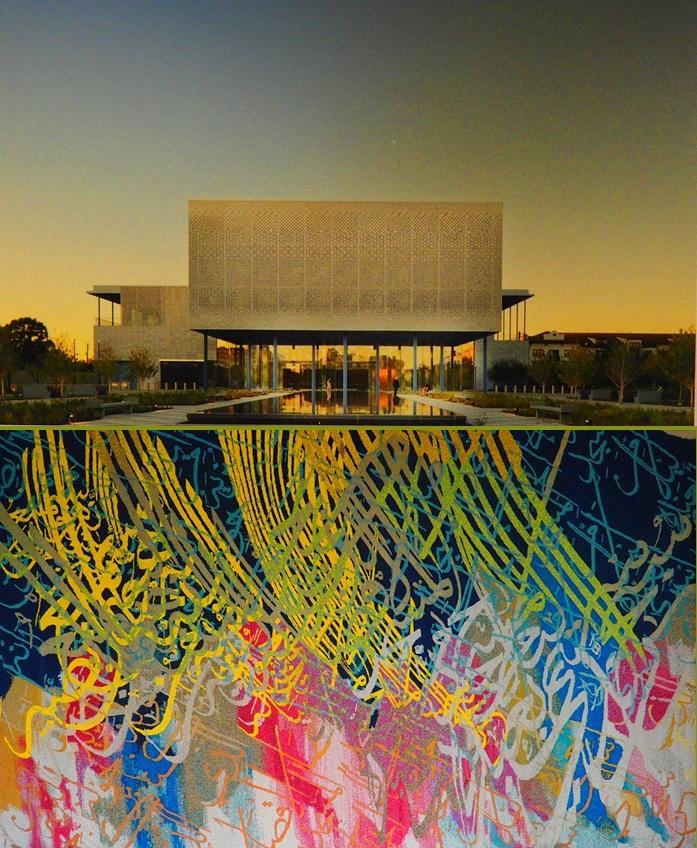
The Ismaili Center in Houston was inaugurated on November 6, 2025, by His Highness Prince Rahim Aga Khan, the 50th Hereditary Imam of the Shia Imami Ismaili Muslims, and John Whitmire, the Mayor of Houston. The Center, a beacon of beauty and elegance, is a sight to behold.
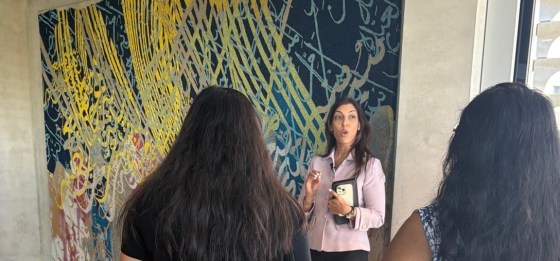
Like six other Ismaili Centers worldwide, it is adorned with stunning works of art, tastefully mounted on walls or placed on the floor. One large, lovely piece, titled Nocturnal Journey, on the 3rd floor, is a masterpiece that takes your breath away when you hear the story behind it.
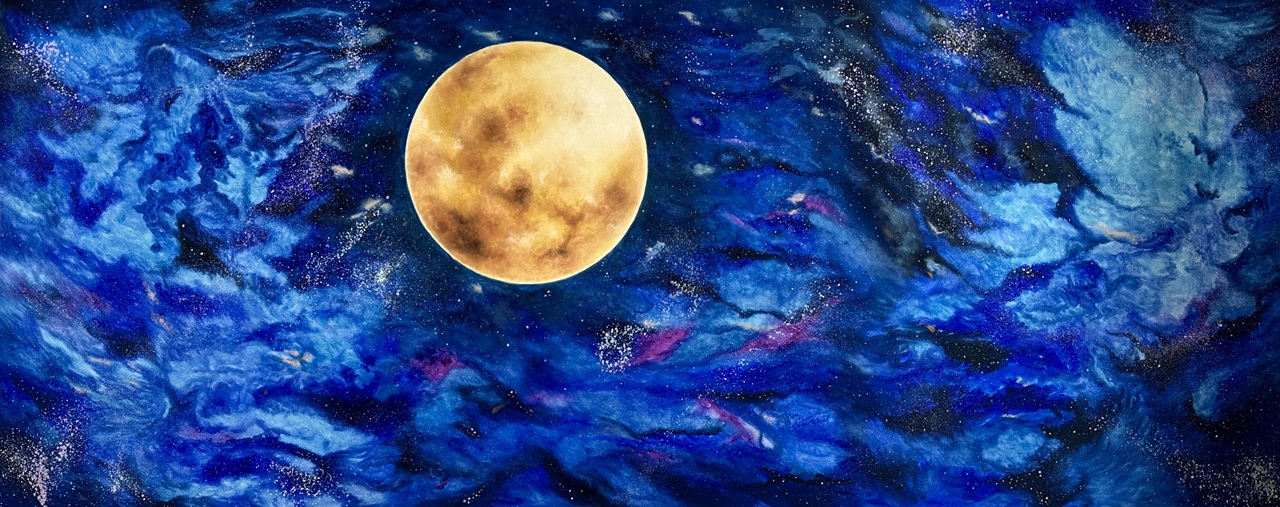
Formed from a staggering four million beads, each meticulously embroidered by hand onto a textile substrate, the composition is a testament to the dedication and craftsmanship of the Egyptian-British artist Ahmed Moustafa and the twenty Ismaili women from the Ismaili Helping Society (IHS) in Mumbai, India. The artwork is based on a calligraphic painting produced by Moustafa in 1984, titled Nocturnal Journey, which commemorates the text of the first verse of Surah al-Isrāʾ (Chapter 17, The Night Journey) of the Holy Qur’an. This work, along with several others that form part of the Ismaili Center’s permanent art collection, is featured in a special piece on our sister website Simergphotos.
The Ismaili Center, Houston, depicted in an artwork (top), features a large embroidery with 4 million beads on its 3rd floor. It is one of many pieces of art at the newly inaugurated Center. Please click on the image for more pictures and stories of the Center’s permanent art collection.
Date posted: November 15, 2025.
Featured photo at the top of the post: Visitors attending the inauguration ceremony of the Ismaili Center in Houston get an introduction to the artwork, “Nocturnal Journey.”
Editor’s note: As children, we have created some stunning works of art and written beautiful essays that we might have long forgotten. However, for our parents, these creations are not just objects, but the threads that weave our family memories, preserving our childhood in their hearts. A model of Hasanabad, a 3-month labour of love and creativity by Sarah and Sophia Ladha some 14 years ago, remains a cherished part of the Ladha family home in Toronto. It stands as a testament to the role of childhood creations in preserving our family memories, even as the two girls embark on their journeys in distant cities. We present their story, celebrating the enduring connection that childhood creations bring to our families.
If there is an iconic piece of art or object related to Ismaili Muslim culture that your children made years ago and remains part of your family’s proudest moment, we would like to hear about it. The Ladha sisters have set an excellent example with their inspiring project, and we encourage you to follow in their footsteps. Write to mmerchant@simerg.com and be part of this inspiring initiative. Simerg and its sister websites Barakah and Simergphotos are independent platforms, committed to encouraging the pursuit of knowledge in all areas of Ismaili history, art and culture, the Divine Institution of Imamat and His Highness the Aga Khan.
The Hasanabad Model
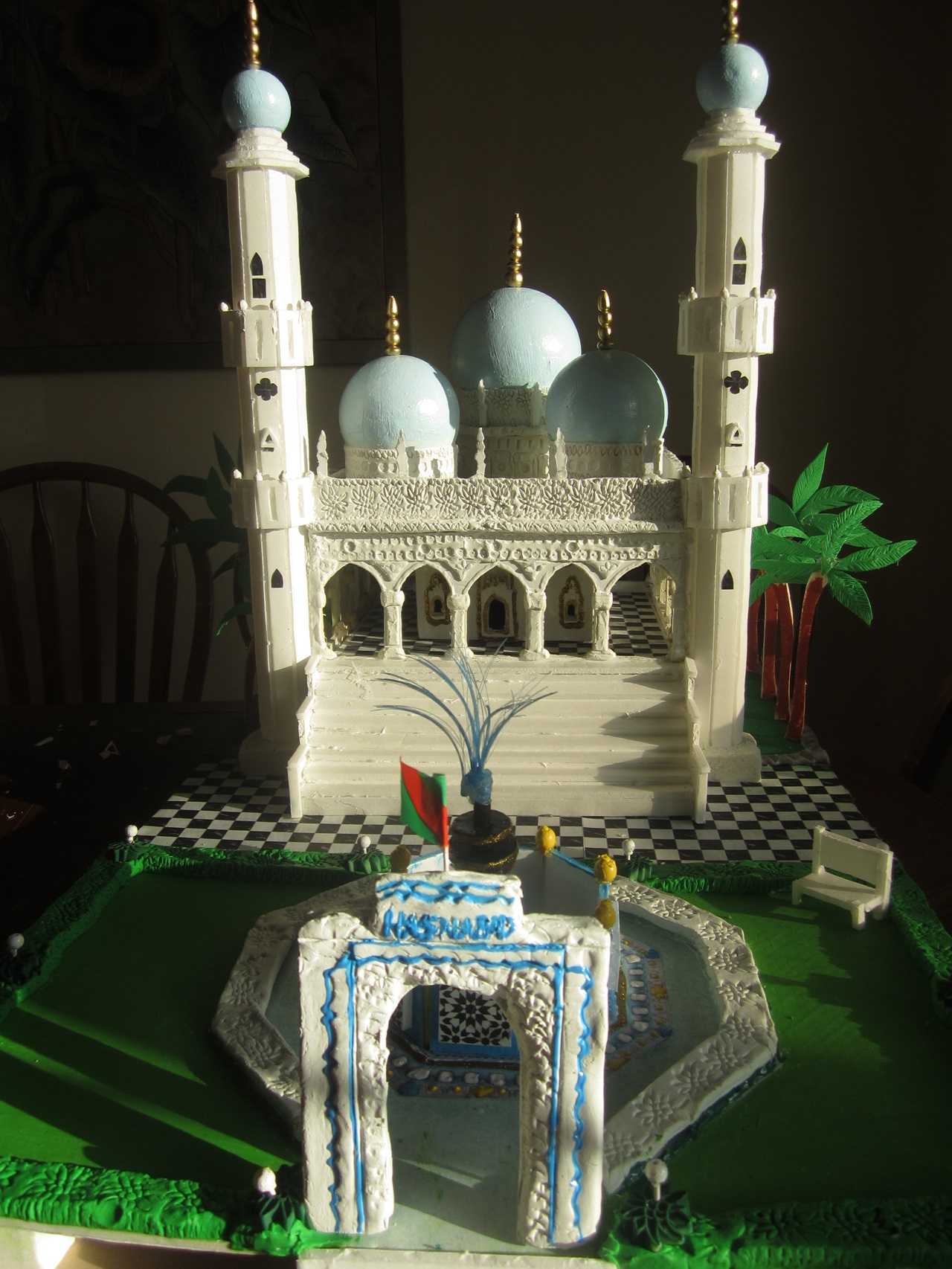
Hasanabad Model, 29″ x 19″, by Sarah and Sophia Ladha. Photograph: Murad Ladha family collection.
We were inspired to create the Hasanabad model after a profoundly personal visit to Hasanabad and its grounds, which include a Jamatkhana and a housing complex in Mumbai in 2011. This trip was particularly meaningful to us because Hasanabad is where my dad, Dr. Murad Ladha, spent his formative years as one of five children of Amina Ladha and Moledina Ladha. Experiencing its breathtaking architecture up close and learning about its historical significance left a lasting impression on us.
Hasanabad, more than just an architectural marvel, is a place of profound historical significance. It is the final resting place of the 46th Ismaili Imam, Mawlana Hasan Ali Shah, who in 1846, journeyed from Iran to Mumbai, establishing the Seat of Imamat in India after centuries in Persia.
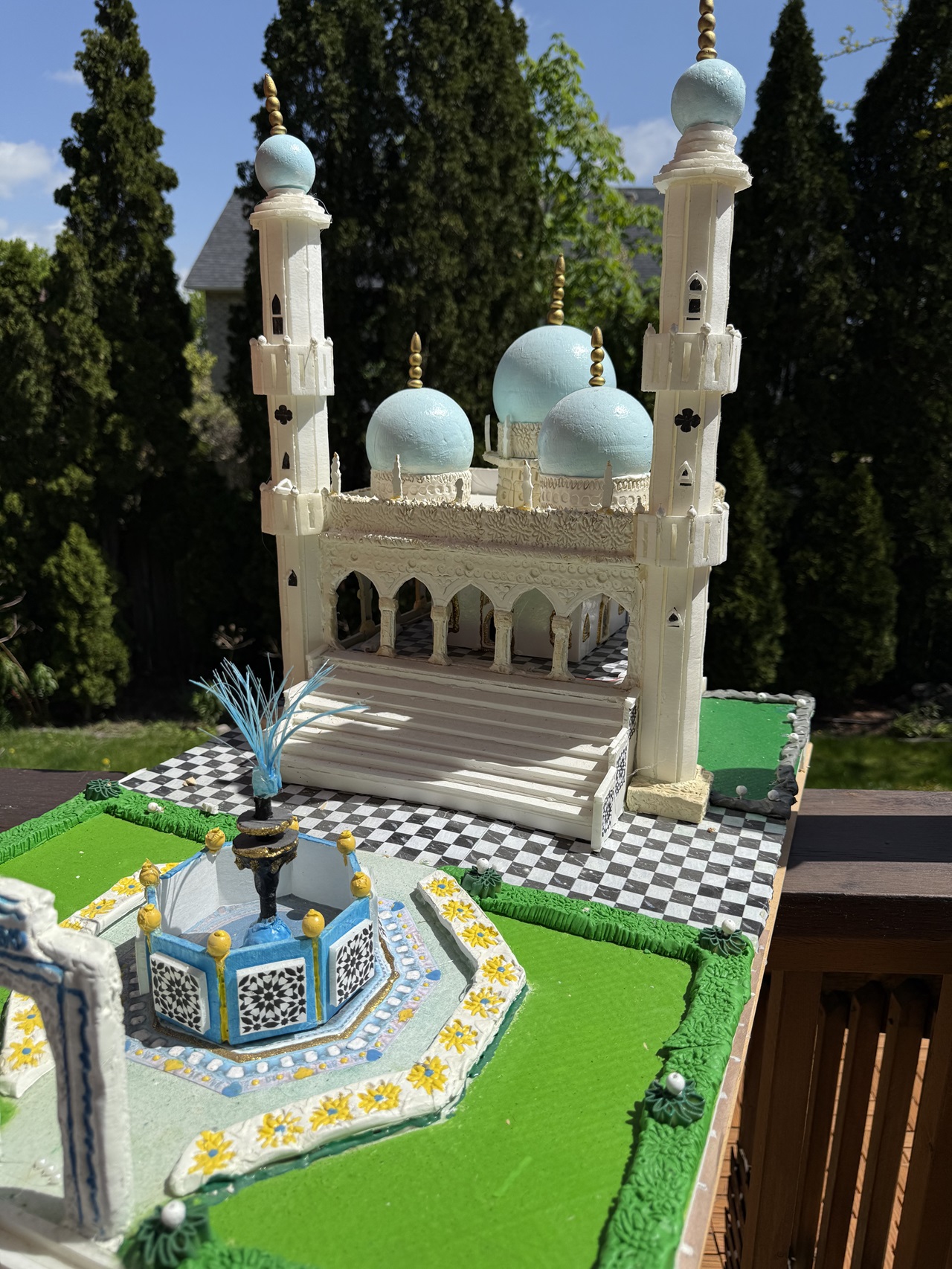
Inspired by the grandeur of the Taj Mahal, Hasanabad’s design features intricate detailing, majestic domes, and perfect symmetry, making it a remarkable landmark and the only Ismaili historical site in India. Inside the Hasanabad Dargah — where Imam Hasan Ali Shah (Aga Khan I) is buried — there is intricate Islamic art decorating the interior of the kuba (the dome). However, due to architectural limitations and lighting, visitors do not readily see or appreciate this artwork. To address this, the fountain in the model was intentionally designed to help reflect and highlight the variety of Islamic artistic elements within the Dargah. This allows members of the Jamat, especially those unable to visit in person, to engage with and appreciate the spiritual and artistic heritage embodied in the structure.
Moved by its historical and cultural significance, we dedicated three months to meticulously crafting our 29″ x 19″ model, striving to capture every detail. Using materials like clay, styrofoam spheres, beads, and pastels, we sought to bring the essence of Hasanabad to life.
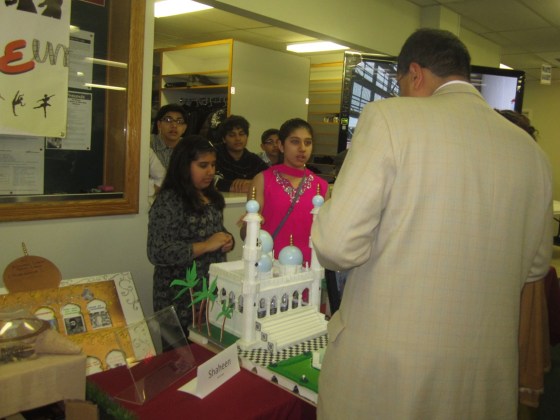
Members of the Jamat view the model of Hasanabad created by sisters Sophia and Sarah Ladha. Photo: Murad Ladha family collection.
~~~~~~~~
The fountain featured in front of historic Hasanabad is not part of the building but was created by Sarah and Sophia Ladha to depict some of the artistic work in the dome inside the building. Photograph: Murad Ladha family collection.
~~~~~~
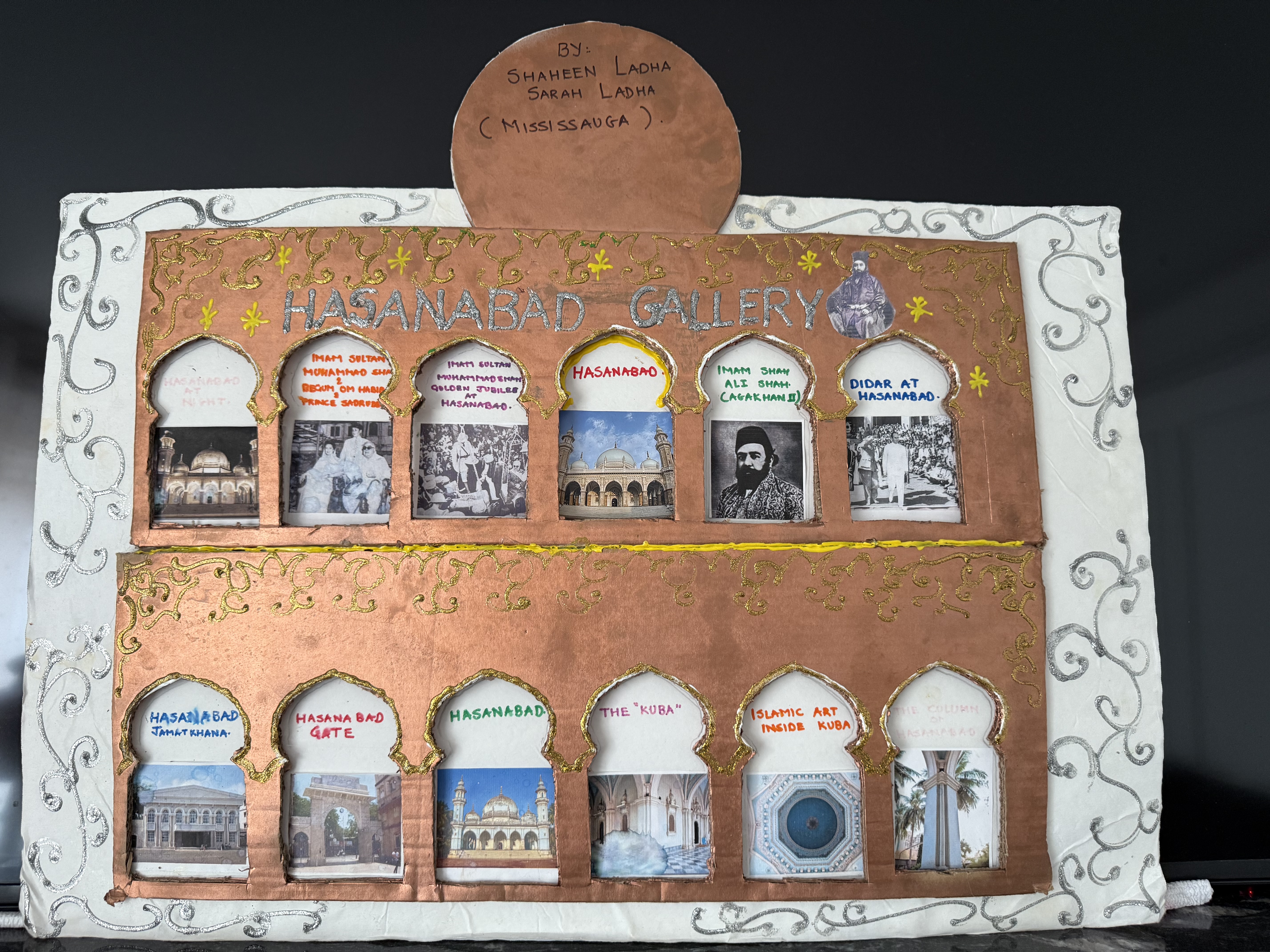
Hasanabad Gallery, accompanying the model exhibit. Photograph: Murad Ladha family collection.
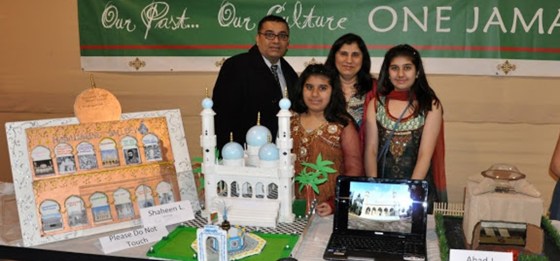
The Ismaili Art and Cultural Committee recognized our model for its craftsmanship, attention to detail, and the story behind it. They appreciated how it highlighted Hasanabad’s architectural beauty and helped share its rich history with others. We displayed the model in Etobicoke Jamatkhana, along with a PowerPoint presentation explaining the the significance of historic Hasanabad to the Jamat. Subsequently, the model was displayed at the Toronto’s International Centre, during a large Navroz gathering of the Greater Toronto Area Jamats. This allowed even more members to experience and connect with this unique representation of Ismaili heritage. Today, the model is a treasured object in our parents’ home in Toronto, and we hope that other children, who have created interesting art work related to Ismaili culture and history will come forward and share their projects through this website.
Featured photo at the top of the post: Sophia and Sarah with their parents, Mr. and Mrs. Murad Ladha, during the Hasanabad model exhibit at Etobicoke Jamatkhana.
Date posted: June 8, 2025. Last updated: September 24, 2025.
___________________
ABOUT THE ARTISTS
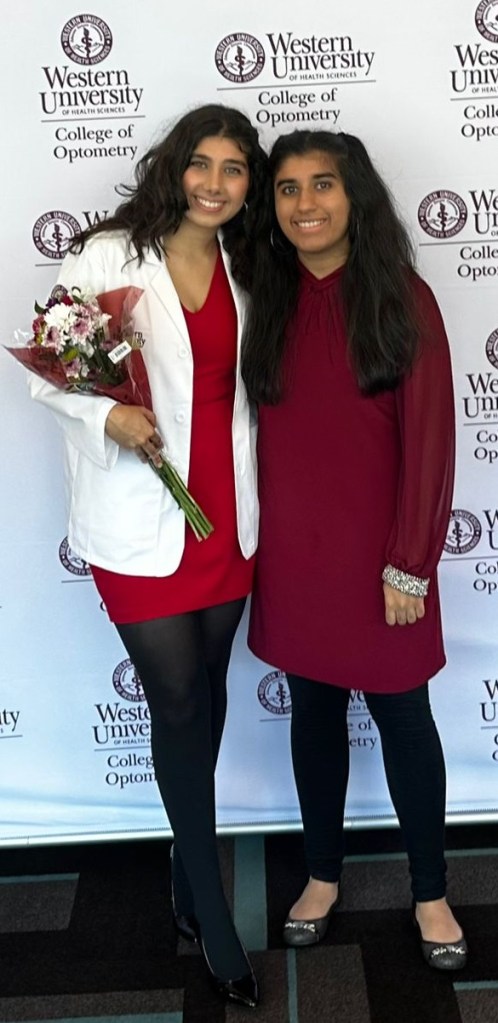
Sisters Dr. Sophia (left) and Sarah Ladha.
Dr. Sophia Ladha is a dedicated optometrist who recently completed her Doctor of Optometry degree at Western University of Health Sciences. She also holds a Bachelor of Science in Optometry from City University in the United Kingdom. Dr. Ladha is passionate about providing patient-centered eye care, combining clinical expertise with a compassionate approach. Outside of the clinic, she enjoys exploring Islamic art and calligraphy, finding harmony between scientific precision and creative expression.
Sarah Ladha is a medical student currently studying in Pennsylvania. Outside of medicine, she has a deep passion for architecture and design. She is fascinated by how structure, form, and function converge to create spaces that are not only visually striking but also purposeful. Sarah draws inspiration from the stories behind buildings — the history, culture, and intention that shape their design. Exploring these elements allows her to see architecture not just as construction, but as a form of living art.
We welcome your feedback. Please click LEAVE A COMMENT. If you are unable to post your comment, please email it to mmerchant@simerg.com. Simerg, an independent platform, has published over 2,000 pieces on all aspects of Ismaili and Islamic history, culture and thought since its launch in 2009. Please see our Table of Contents in 2 parts — 2009-2019 and 2020-Current. Please visit Simerg’s sister websites, Barakah, which is dedicated to His Highness the Aga Khan, and Simergphotos that features photo essays on history, culture and travel. Follow the publisher/editor Malik Merchant on @Facebook, @X and @LinkedIn
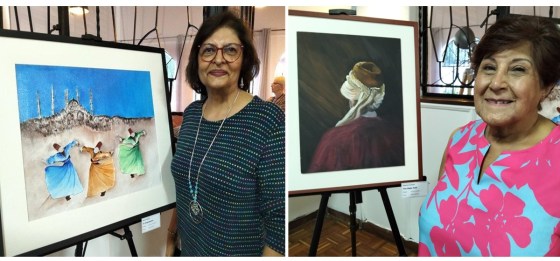
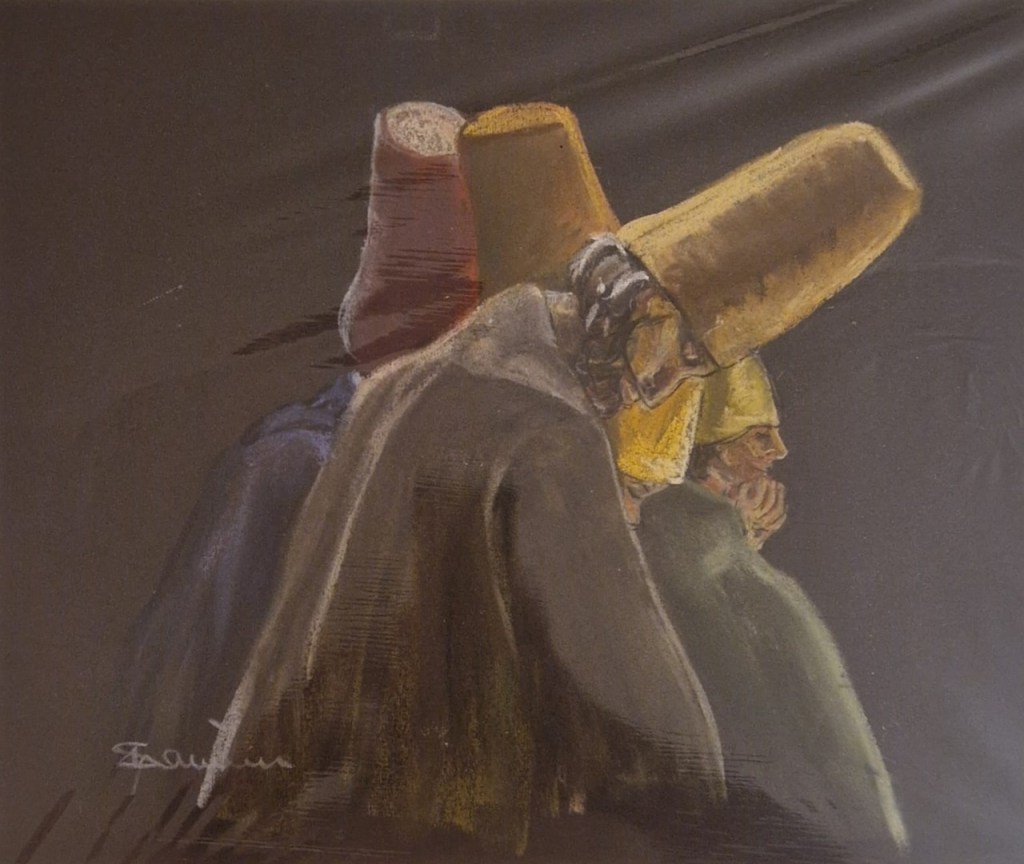
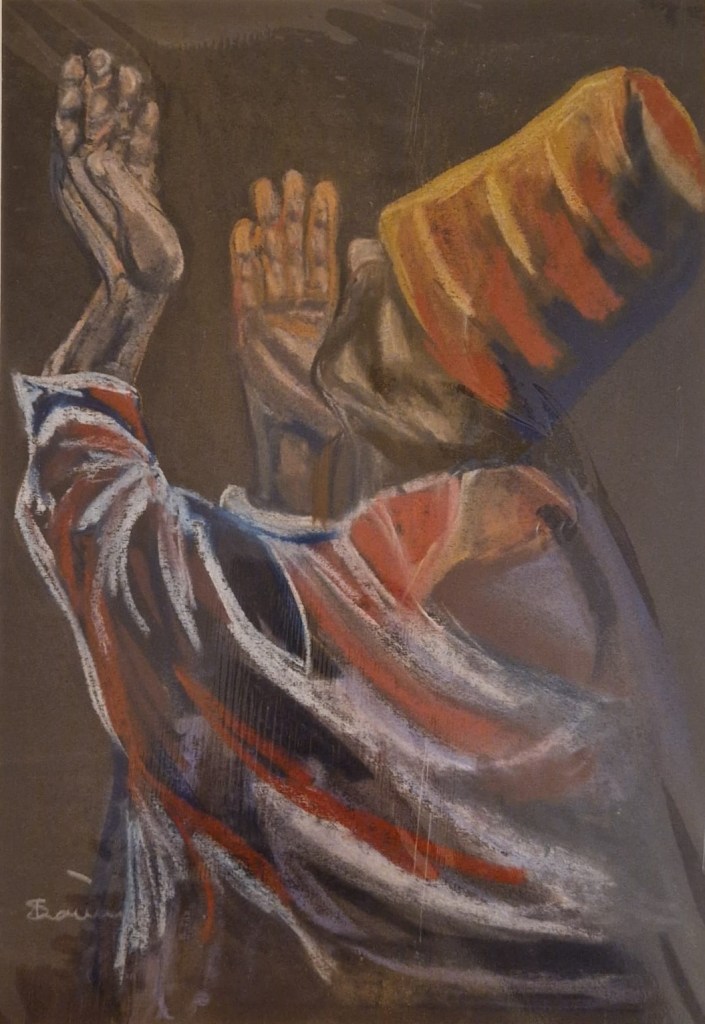
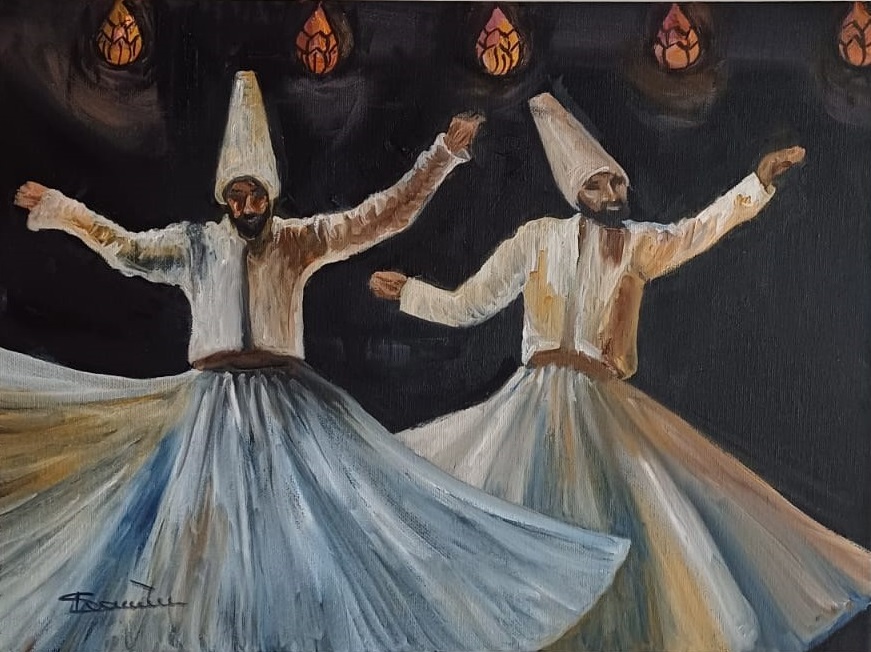
Chez Mahmadi, a renowned sanctuary in Nairobi, Kenya, graciously invited two Ismaili artists, Nimira Shariff and Shamim Subzali, to exhibit a collection that uniquely depicted a theme anchored on Sufism — the mystical aspect of Islam. Despite being separated by the winds of time and space, living oceans apart, these two artists embarked on a collaborative journey that transcended physical distance. They displayed their noteworthy pieces from their respective collections of artwork, each showcasing a unique style of inspiration and talent, all under the singular theme of Sufism. Chez Mahmadi, the serene host that showcased the beautiful exhibition from February 1 – 23, 2025, is a multifunctional space that champions an aura designed to inspire, connect, and nurture one’s mind in unison with the soul.
In a story featured in the Asian Weekly, Tanya Vas noted that the exhibition was a harmonious blend of art and atmosphere, each element resonating with the Sufi theme. She described the art pieces as having vibrant hues and swirling patterns, which seemed to breathe, vividly bringing to life the spiritual essence of Sufism.
Artist Nimira Shariff noted the differences in their artistic styles yet emphasized how their works complemented each other. Shamim Subzali shared the joy they found in working with the Sufi theme. The artists are thrilled to showcase a collection of their exhibition work in Simerg, which warmly welcomes and encourages Ismaili artists worldwide to showcase a selection of their works in our continuing series on Ismaili Artistic Expressions.
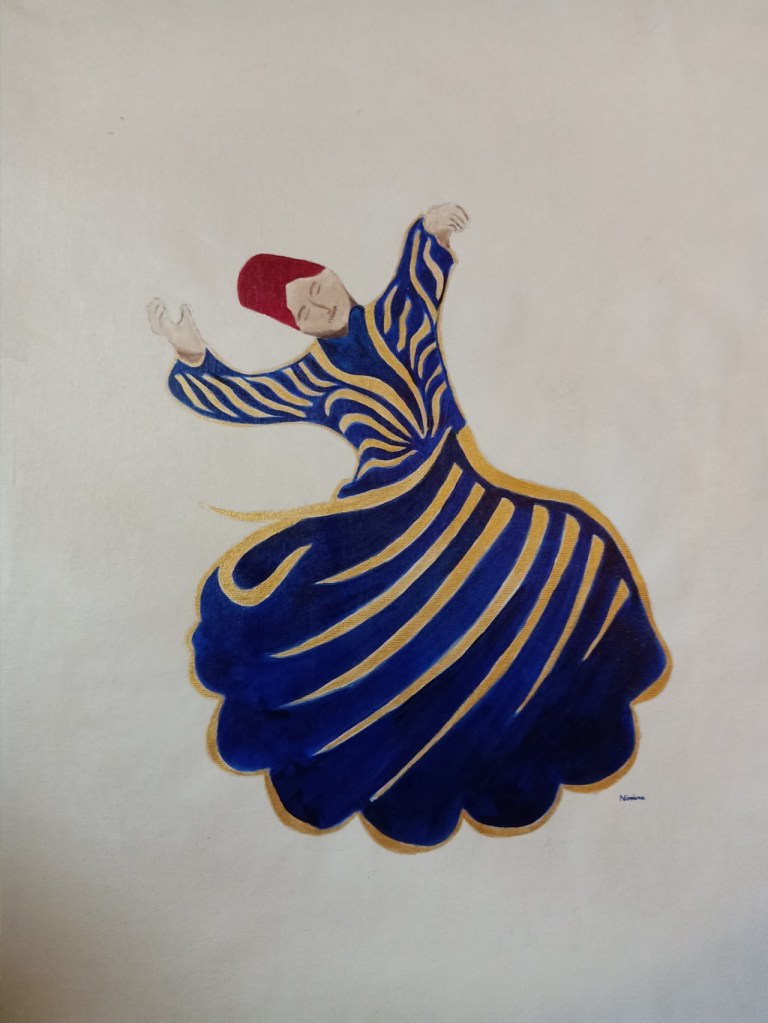
ARTWORK BY NIMIRA SHARIFF
Nimira Shariff
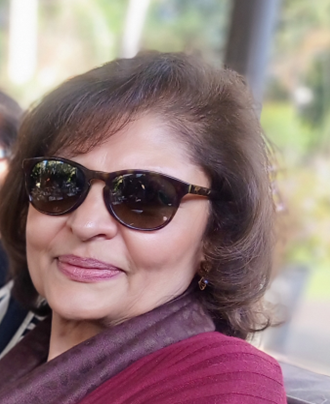
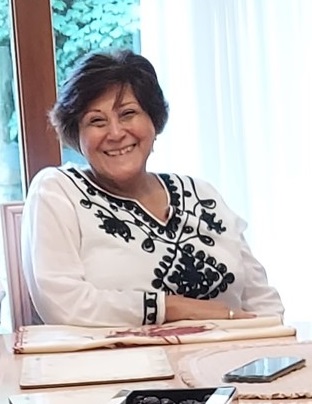
Nimira Shariff is inspired by pursuing a lifelong passion for ‘Art,’ validating that which is authentic or allegorical at the heart of a given scene. This is evident as she displays her talent stimulated by the inner beauty within her environment and the inner being she yearns for. Using watercolours, Nimira finds harmony in depicting animals, birds, flowers, landscapes, whirling dervishes, and silhouettes of African women. In addition, she has dabbled meticulously using Oils and Pastels. The medium she applied for the Chez Mahmadi Sufi Art Exhibition was Acrylic. This exhibit engrossed her to plough further into ‘The World of Sufism’, exemplifying her passion and the cornerstone of her disposition, illustrating that ‘no literature is enough for her to dwell in.’
Shamim Subzali has nurtured her skill by creating impressive pieces of artwork. She favours the formation of portraitures yet continues to explore various art themes, as is demonstrated in this specific Sufi art works. Some of her other creations encompass animals, landscapes, whirling dervishes, life drawings, still life, seascapes, and portraits, drawing inspiration from impressionists. At the Chez Mahmadi exhibit, Shamim harnessed the use of Oils, Pastels, and Watercolours. She continues to excel by experimenting with various other mediums and techniques, such as charcoal and pencil. Shamim’s artful approach is a testament to her talent as she states ‘the learning curve is ever evolving, and never diminishes’. Her ongoing artistic journey is an inspiration to all. Discover the intriguing wonders of an enchanting journey by reading Shamim Subzali’s BIO.
“BROTHERHOOD” by Shamim Subzali.
~~~~~~~~~~
“PRAISE” by Shamim Subzali.
~~~~~~~~~~
“SAMA BROTHERHOOD” by Shamim Subzali.
~~~~~~~~~~
“TOTAL SUBMISSION” by Shamim Subzali.
Date posted: March 31, 2025. Last updated: April 1, 2025 (inserted links).
_______________________
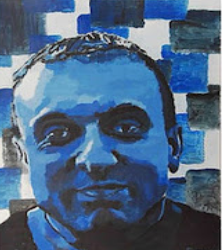
“DAD” (Al-Karim Jaffer), acrylic painting by son Faizaan Jaffer.
About the contributor: Al-Karim Jaffer, the youngest of four siblings, was born in Burundi and has travelled extensively, having resided in the Democratic Republic of Congo (DRC), the UK, and the USA. Presently, he lives in Vancouver, B.C., where he cherishes his family and community. As a proud father of two outstanding young men, his commitment to their well-being and the well-being of his community is unwavering. He is ready to serve with outright dedication and passion. Volunteerism has consistently been the tenet of his being. Life has taken him on a spiritual search path by composing allegorical poetry inspired by faith, the environment, and nature photography.
The editor invites Ismaili artists to submit a selection of their paintings and other works of art for publication in Simerg. Please submit images of no more than 8 objects in Jpeg (1280 x 940) and your profile to the editor, Malik, at mmerchant@simerg.com.
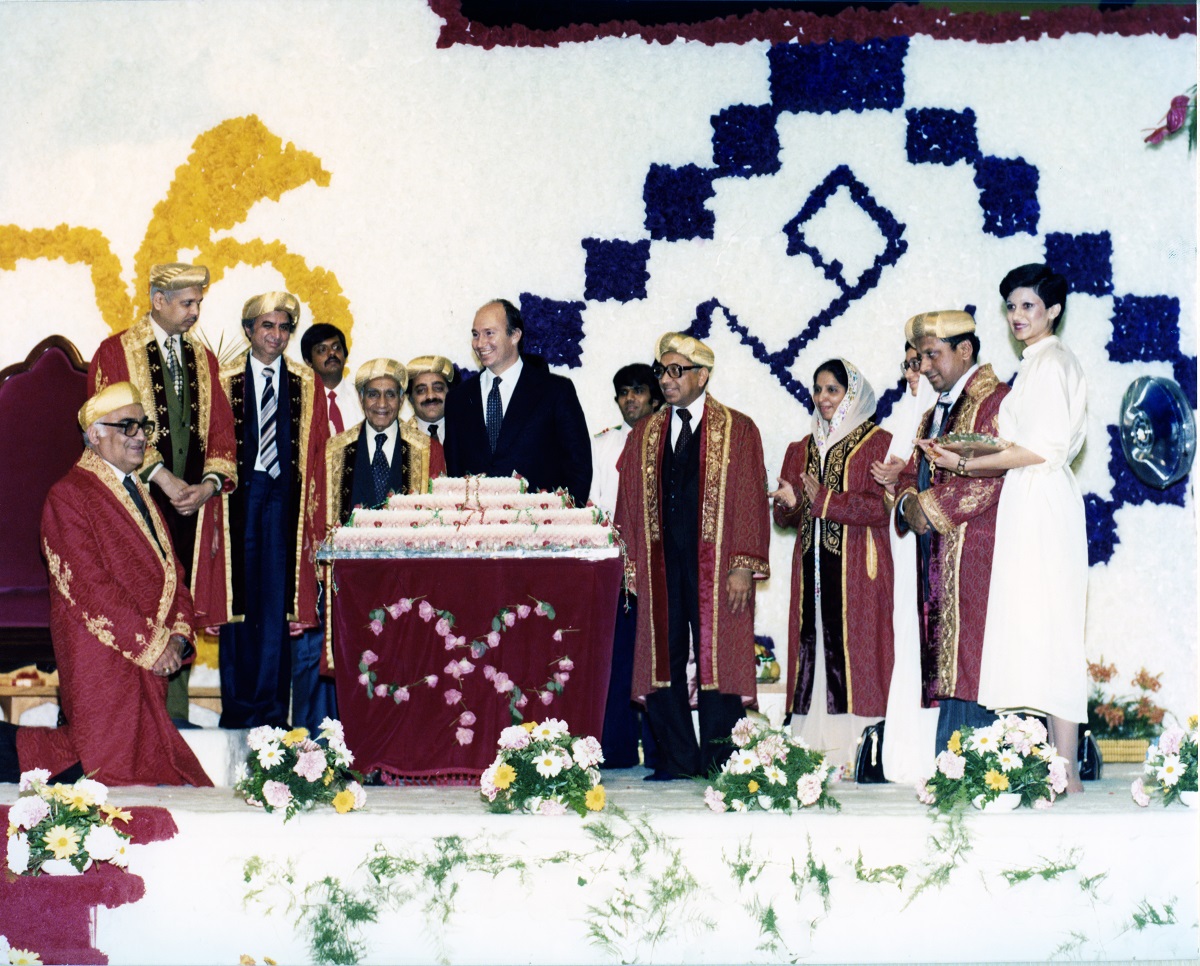
Mawlana Hazar Imam, His Highness the Aga Khan, is presented with a birthday cake at the International Centre in Toronto ahead of his birthday on December 13, during his first visit to his Ismaili Muslim followers in Canada in November 1978. Photograph: Zeenat Virani Family Collection, Vancouver.
Social media platforms are filled with unique and beautiful birthday (Salgirah) greetings, birthday cakes and artwork on the auspicious occasion of Mawlana Hazar Imam, His Highness Prince Karim Aga Khan’s 88th birthday.
Born on December 13, 1936, he became the 49th Hereditary Imam of the Shia Ismailis on July 11, 1957. At 88, Mawlana Hazar Imam is the oldest living Imam in Ismaili history, and his reign of 67 years is the second longest. His grandfather ruled for an astonishing 71 years and celebrated the Platinum Jubilee.
Story continues below
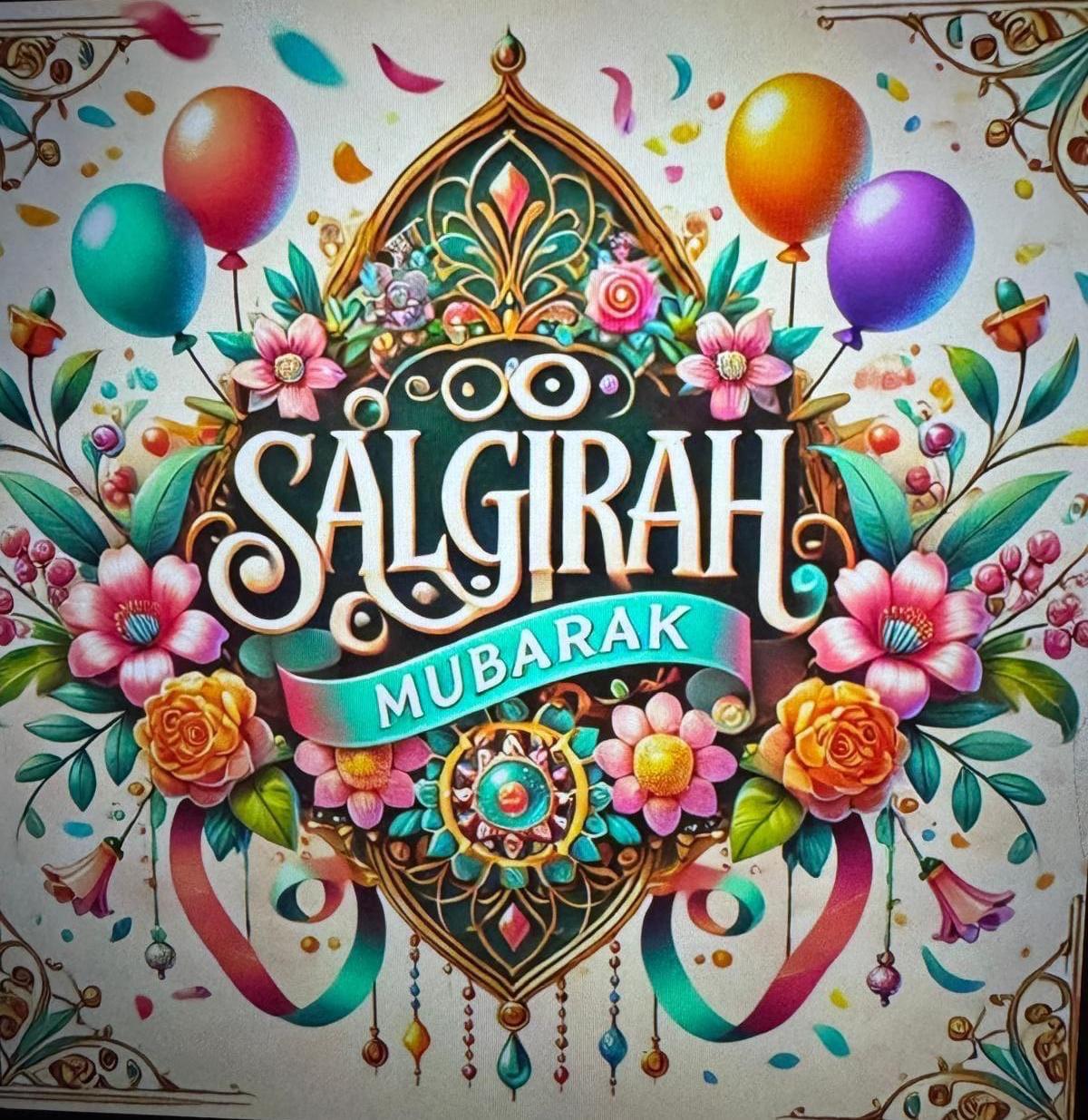
A beautiful greeting on the auspicious occasion of the birthday of Mawlana Hazar Imam, His Highness the Aga Khan. Photograph: Social Media.
~~~~~
~~~~~~
As Ismailis celebrate their Imam’s birthday, they take pride in the historical significance of his reign, which has inspired and guided the community through the years. They are also mindful of their brothers and sisters’ difficulties in conflict areas in several parts of the world. The messages embedded in several greetings reflect the problematic situation and include inspiring prayerful notes.
Artistic greeting with a poem honouring Mawlana Hazar Imam, His Highness the Aga Khan. Photograph: Social Media.
~~~~~~
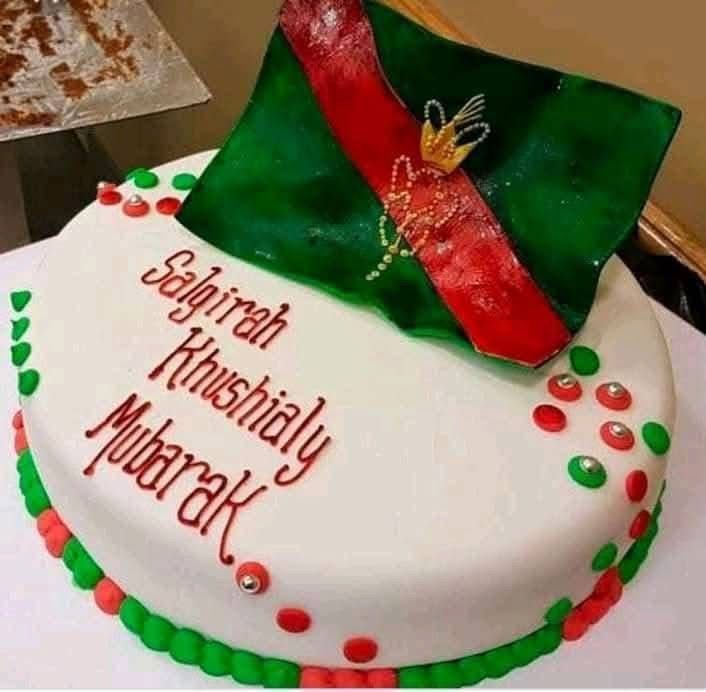
A cake celebrating the birthday of Mawlana Hazar Imam, His Highness the Aga Khan, with the red-green Ismaili flag containing the Aga Khan’s crest in the centre. Photograph: Social Media.
~~~~~~
A Swahili Song Honouring the Aga Khan on His Birthday
Swahili Song circulating on social media greeting His Highness Prince Karim Aga Khan Mawlana Hazar Imam on his birthday (Salgirah or Khushiali Mubarak) and thanking him for his guidance.
We join Ismailis worldwide in conveying our gratitude to our beloved Imam on his 88th birthday for guiding his spiritual children on the Straight Path, Blessing us and always keeping us under his loving paternal-maternal care. We pray for the happiness and mushkil ahsan — protection from difficulties — of Ismailis around the world.
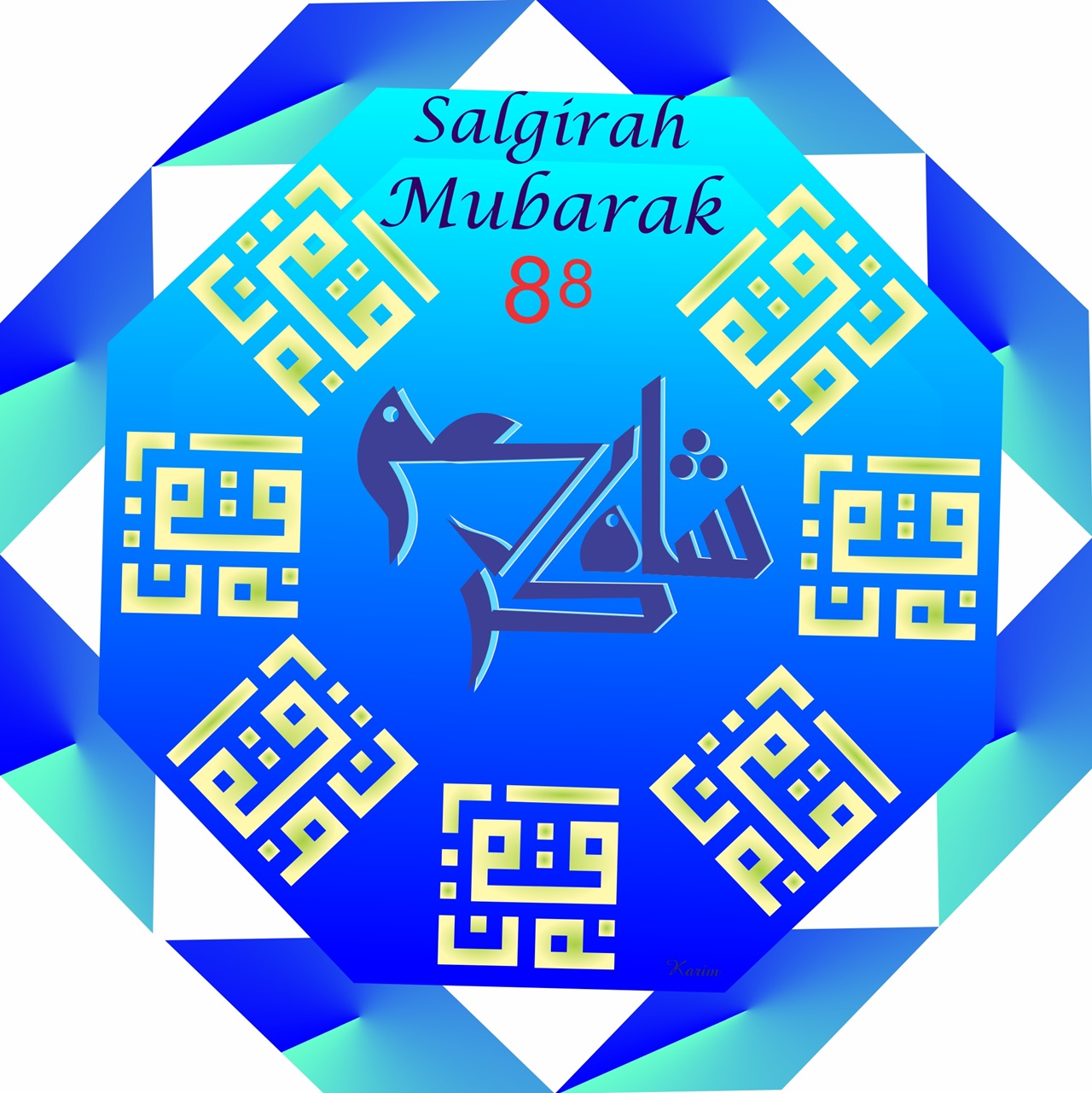
Artwork for Mawlana Hazar Imam, His Highness the Aga Khan’s 88th Salgirah (birthday). The names Shah Karim and Imam-e-Zaman (Imam-of-the-Time) are repeated in Kufi Kairouani script and Square Kufic seven times. Calligraphy amd design by Karim Ismail, Toronto.
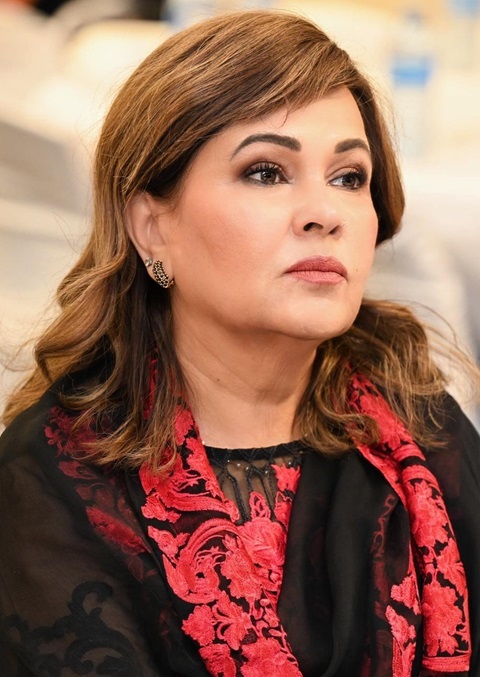
I first became aware of Salma Jadavji’s fascinating artwork when she and her husband, Taj, invited me to their Calgary home. I humbly gifted them several back issues of Ilm magazine published by the Ismaili Tariqah and Religious Education Board for the UK under my late dad Jehangir’s editorship, which I had as duplicates, which they graciously accepted. After a fantastic meal, I was privileged to get a closer look at Salma’s incredible and inspiring works of art. The Jadavji home is genuinely artistic! The visit was not just enjoyable but also a memorable experience. I am thrilled that she accepted my invitation to present a selection of her artwork for Simerg’s series on Ismaili Artistic Expressions.
Calgary-based Ismaili artist Salma Jadavji.
Salma was born and raised in Pakistan. She was always interested in arts and crafts but ended up in medical school and became a doctor in 1975. She got married to Dr. Taj Jadavji and moved to Canada in 1976. In 1992, Salma discovered she had a hidden talent: She could paint. This discovery opened a new chapter in her life. She started experimenting with different mediums and styles and has never looked back. Salma loves to paint, especially Islamic calligraphy. She has taught calligraphy to Ismaili Muslim students attending the Baitul Ilm (BUI) program, and her passion for art inspires others. Salma’s art has catalyzed the Ismaili community unity by curating art exhibitions that have benefited various charitable causes, making a tangible difference. Notably, her contributions to the Aga Khan Foundation exhibitions have been significant, raising funds to address the root causes of poverty and inequality.
Through her career as an artist, Salma has also sought to bring together the South Asian community and the broader Calgary community, fostering a spirit of philanthropy and cultural appreciation. This has promoted a deeper understanding and celebration of South Asian art and culture, creating a sense of belonging and inclusion for all.
Aside from her artwork, Salma has been a radio host for the last 12 years for a weekly radio show, Salaam Namaste Calgary. She has broken many traditional gender barriers as a woman of colour in the media and art world and paved a pathway for many females to come forward.
Salma’s art is not just a form of expression but a powerful tool that has connected her with the community on many different levels. Her Islamic Calligraphy and the message of peace Islam promotes, as well as her works of the Rockies and picturesque landscapes around Alberta, have left a lasting impact. This post showcases Salma’s passion for art, through which she inspires the community as an artist and a great art leader. Once you have viewed her paintings on this page, please visit her website with the theme, “Let me take you on an artistic journey.” Indeed! Click Salma Jadavji.
________________
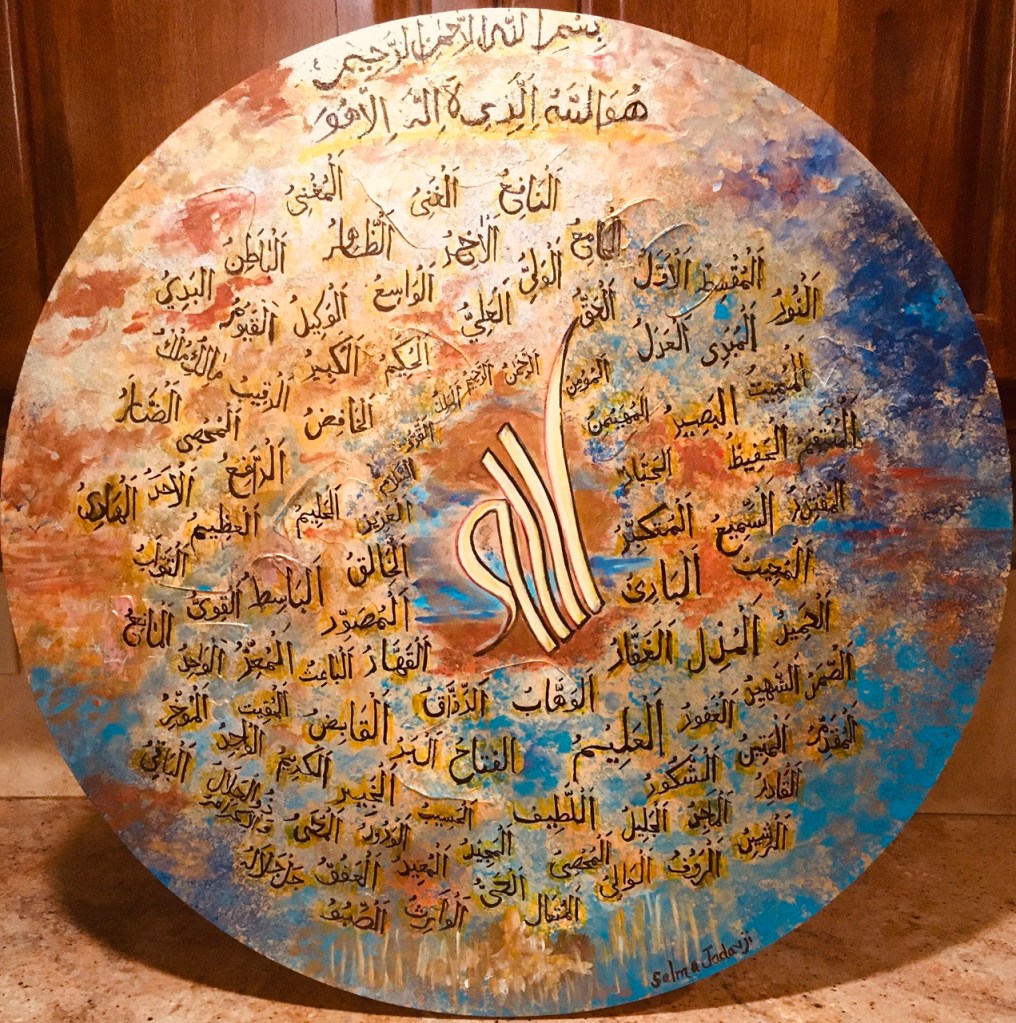
Beautiful names of Allah
Beautiful names of Allah, Oil on Canvas, 24″ diameter, 2022, sold in auction for $3000.00 to aid Shaukat Khanum Hospital, Karachi. Art by Salma Jadavji.
~~~~~~
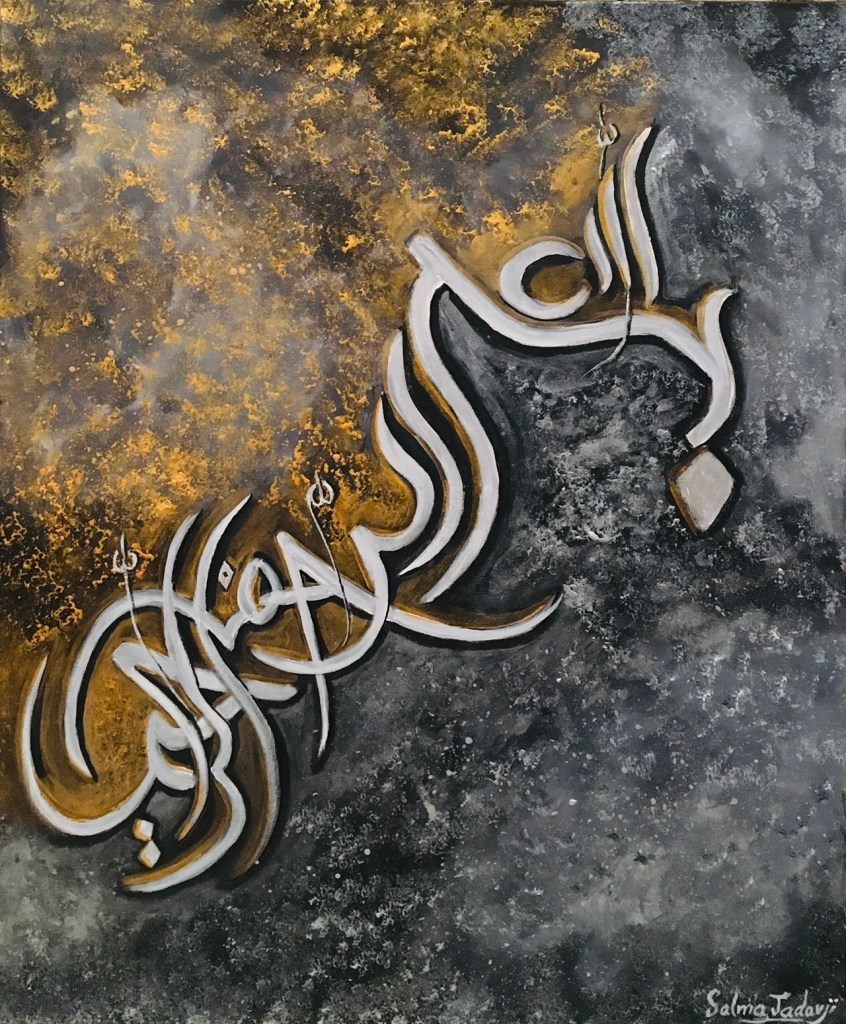
Bismillah-ir-Rahman-ir-Rahim
Bismillah-ir-Rahman-ir-Rahim, Acrylic on Canvas, 40″ x 30″, 2022. Art by Salma Jadavji.
~~~~~~
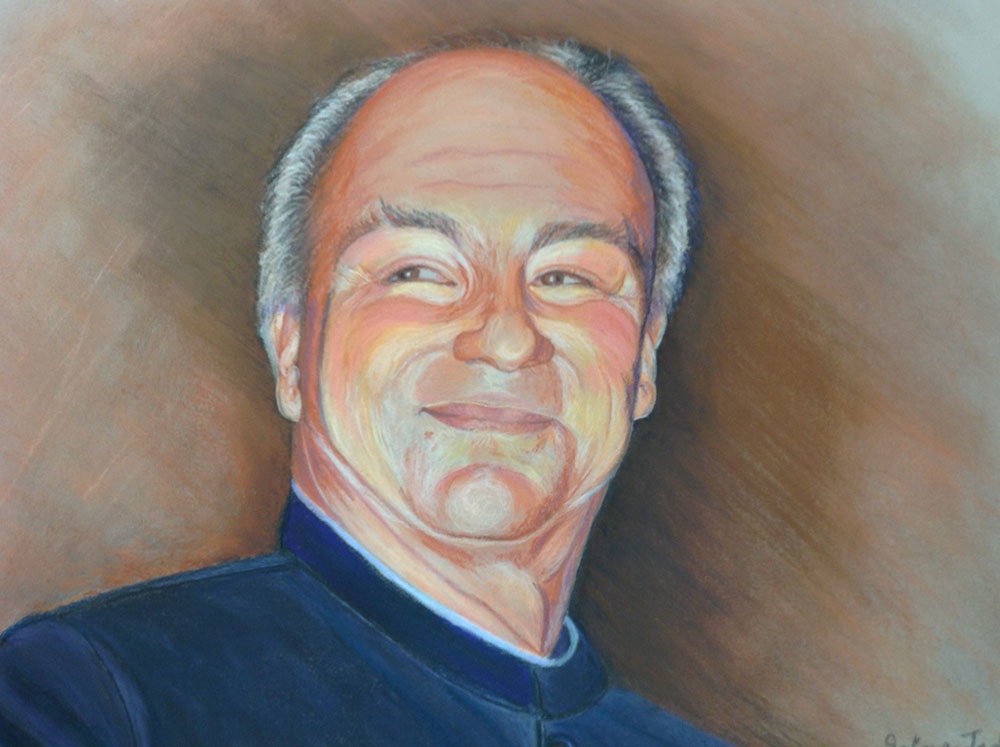
Mawlana Hazar Imam
Mawlana Hazar Imam, Pastels, 30″ x 24″, 2017. Art by Salma Jadavji.
~~~~~~
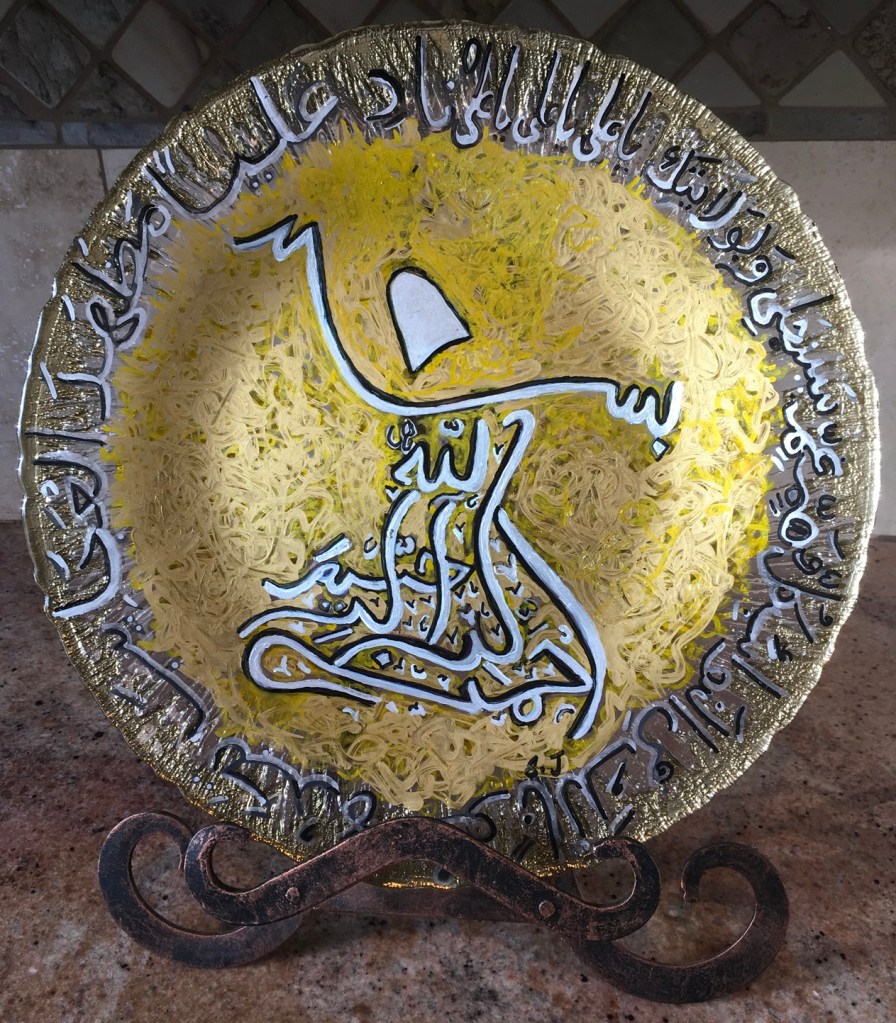
Nad-e-Ali
Nad-e-Ali, Acrylic, 12″ diameter, 2023. Art by Salma Jadavji.
~~~~~~
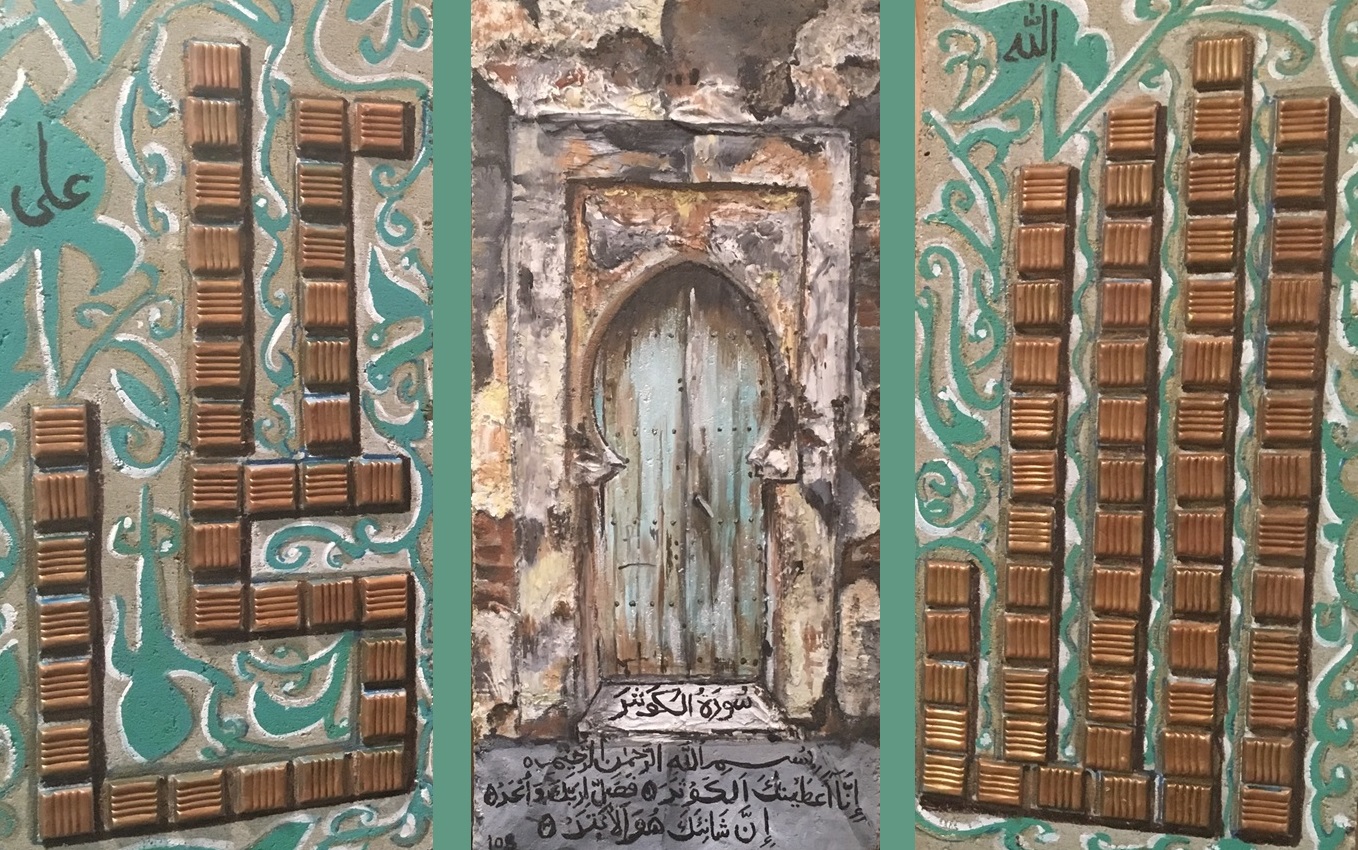
Heavenly Abode
Heavenly Abode, Mixed Media, 11″ x 17″, a three-panel display of tiled artwork depicting (left) Ali; (centre) Qur’anic verses 108:1-3, “In the Name of Allah, the Most Gracious, Most Merciful Indeed, We have granted you (O Muhammad) Alkausar. So pray to your Lord and sacrifice. Indeed, your enemy is the one cut off (from the root); and (right) Allah. The panels were displayed at the Diamond Jubilee Art Exhibition in 2018 as one exhibit (not exactly as shown). Art by Salma Jadavji, Calgary
~~~~~~
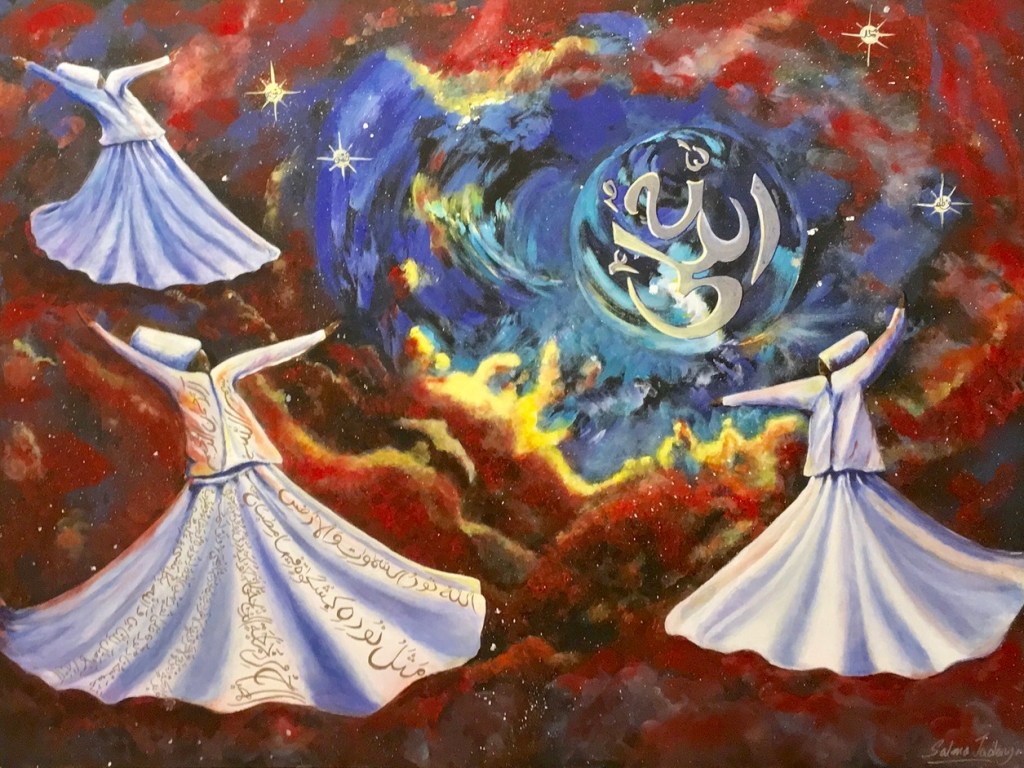
Lost in Spiritual Galaxy
Lost in Spiritual Galaxy, Acrylic, 60″ x 36″, 2021, donated to the Aga Khan Museum to raise funds for the annual Lapis Gala. Art by Salma Jadavji.
~~~~~~
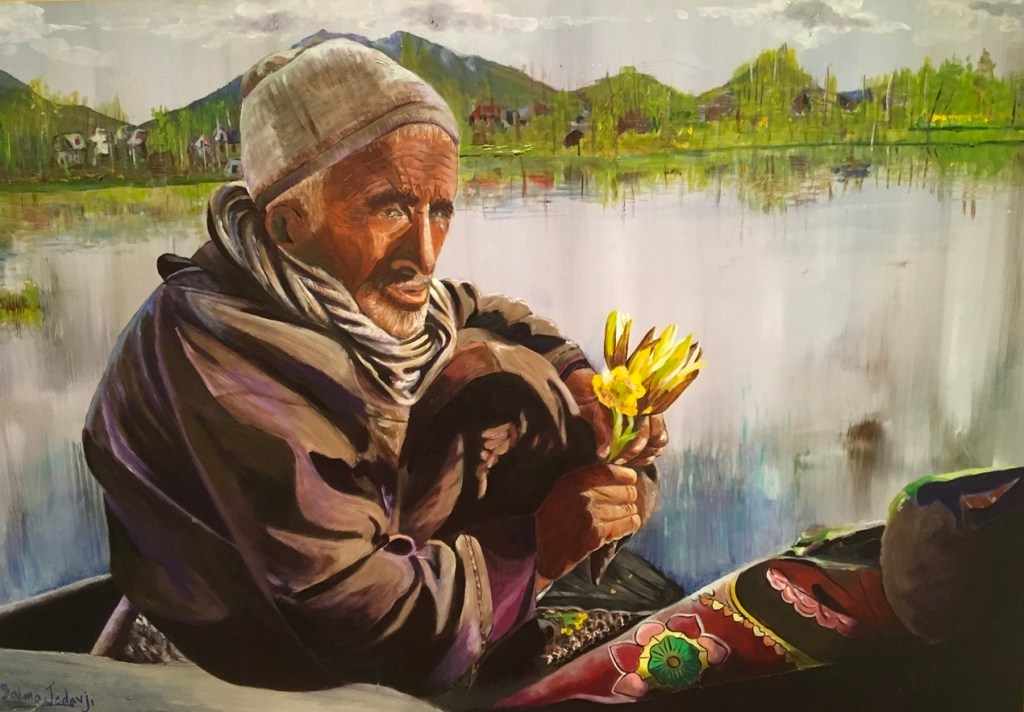
My Paradise
My Paradise, Oil on Wood Board, 30″ x 24″, 2016. Art by Salma Jadavji.
~~~~~~
Three in a Row
Three in a Row, Pastels, 30″ x 24″, 2016 for the Aga Khan Foundation World Partnership Walk. Art by Salma Jadavji.
Date posted: November 21, 2024.
________________
We invite you to visit Salma Jadavji’s Website to view more of her artwork. We welcome feedback/letters from our readers. Please click LEAVE A COMMENT. Your feedback may be edited for length and brevity and is subject to moderation. We are unable to acknowledge unpublished letters.
The editor invites Ismaili artists to submit a selection of their paintings and other works of art for publication in Simerg. Please submit images of no more than 8 objects in Jpeg (1200 x 900) and your profile to the editor, Malik, at mmerchant@simerg.com.
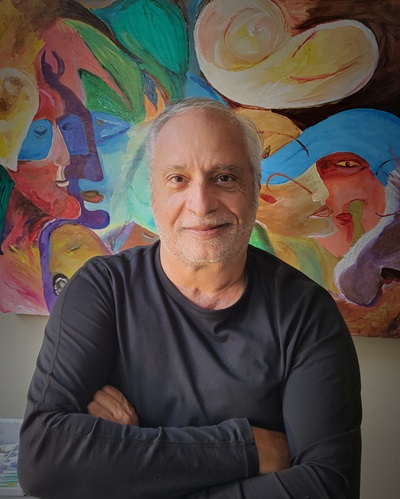
I am a self-taught artist from Tanzania based in Vancouver/Burnaby, Canada. I am retired and work from home in my studio. My art is inspired by vibrant landscapes and diverse wildlife. I try and capture them in my paintings. I also enjoy exploring abstraction and the human figure in my work. I like using vibrant colours in my art because I want to engage the viewer in a brighter way of seeing and experiencing life. I view these images through the artistic lens, looking at every angle, shape, and ray of light as a direct receptacle for creation.
Canadian Ismaili artist Mehboob Rajwani
I have exhibited works at the Roundhouse Community Centre organized by the Aga Khan Ismaili Council for Canada and various local exhibitions, including the Vancouver Outsider Arts Festival and Ismaili Center Vancouver. Recently, my artwork was accepted for display in Dubai for the Global Encounters 2025. My art piece, “Baobab Buffaloes,” was published in a book by Taslim Samji, “Kampala to Canada.” My work has also been published in the Artany Magazine, U.K.
I am enrolled at Emily Carr University of Arts and Design to demonstrate my commitment to art. I am glad to share a few of my art pieces through this forum in Simerg, which highlights the work of Ismaili Muslim artists worldwide.
Dadimaa
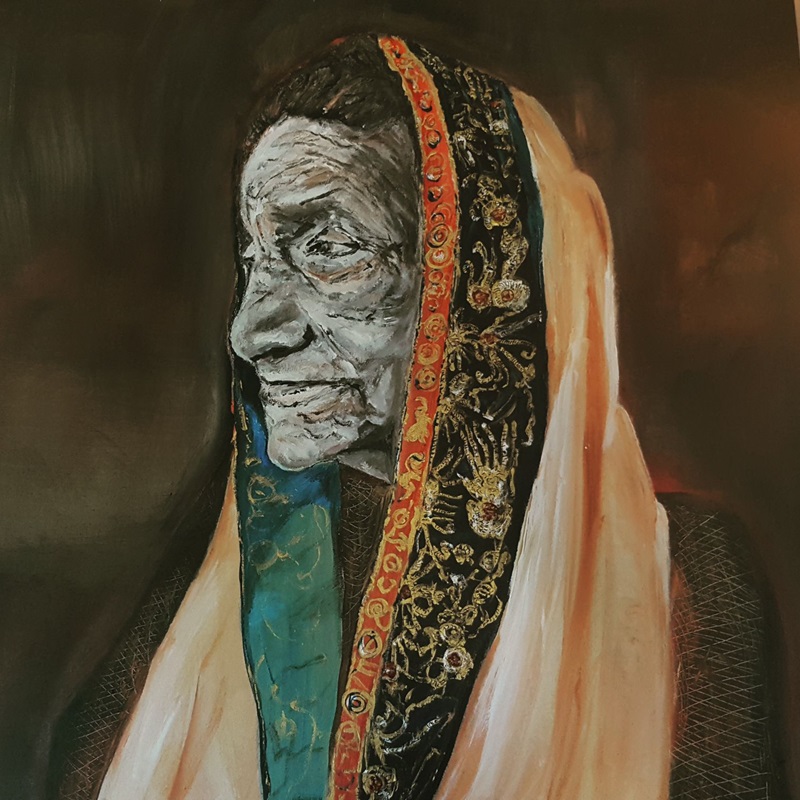
Dadimaa, Acrylic on Canvas,30″ x 30″, July 2017, painting by Mehboob Rajwani
This portrays the ever-knowing grandmother. Though she may be shrouded in elegant brocade, her face shows what lies beneath. Her eyes carry the weight from years of life. Guile imbues her profile as wisdom unravels itself from a loom of knowledge. The intricacies of her wins and losses, light and darkness, defeats and accomplishments, are captured in this still singular moment. She has been left and loved, witnessed wars, and seen the world shift like a handful of sand slipping between her fingers. Where there is pain, one finds Allah giving her strength and His compassion to forge ahead into the present, no longer lost but found. This painting was inspired by a photograph of Sultan Bhaloo’s grandmother.
______________________
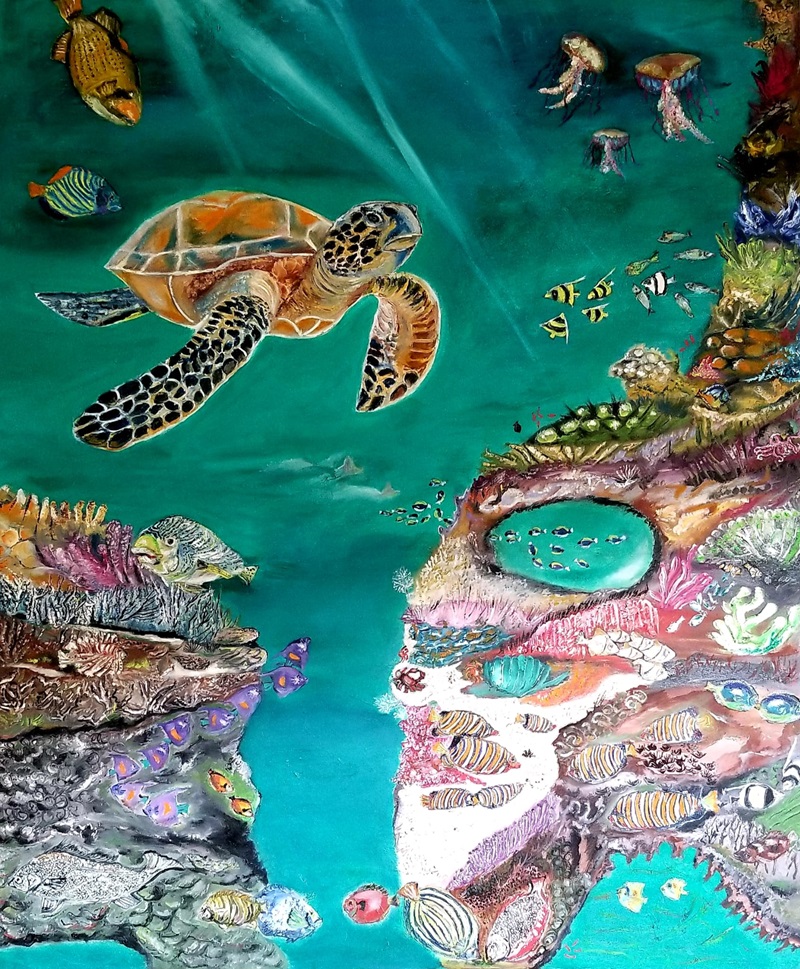
Vanishing Paradise
Vanishing Paradise, Oil, 48″ x 60″, January 2024, painting by Mehboob Rajwani.
All of us have an opportunity to save the natural world in one way or another. They say we fall in love with nature in different ways. For some, it is beholding orcas leaping out of the ocean, a heron silently stalking fish in a lagoon at dawn, the tragic joy of a salmon run. Thus, representing all of nature in its fragility. As such, I have created an underwater ocean floor to bring awareness for the beauty and splendour of the diverse species and coral that are unfortunately facing extinction.
I used oil paints to create an imaginative multi-coloured reef in an aquamarine background with a swimming turtle, exotic fish, and other colourful species. This work also depicts the gradual extinction of coral as it becomes dead and bleached, thus reducing the number of inhabitants.
My goal is to show the ocean’s importance as our home and the need to care for it as such. “In the existential quest to save the future, we need loving, persuasive leaders to save Earth,” says environmentalist Calvin Sandborn.
______________________
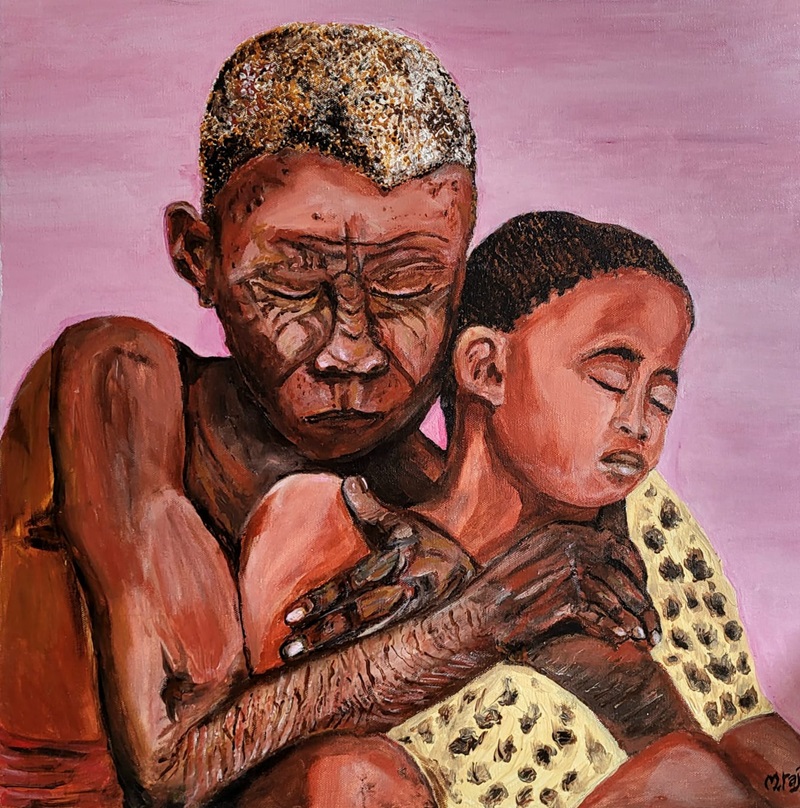
Let Me Protect You
Let Me Protect You, Acrylic on Canvas, 26″ x 26″, 2023, painting by Mehboob Rajwani.
This piece depicts a loyal grandmother and child embracing in a moment of shared love.
______________________
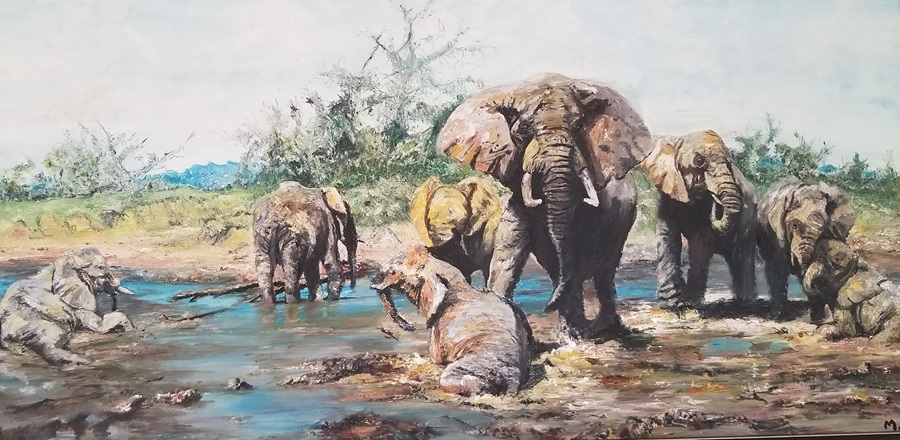
Elephants in Mud
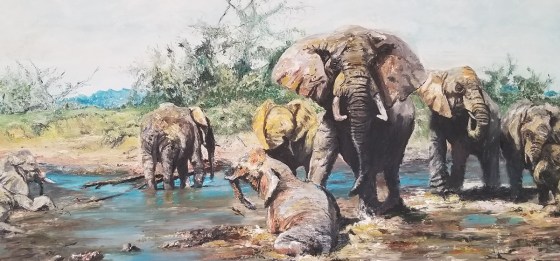
Elephants in Mud, Oil, 30″ x 60″, 1977, by Mehboob Rajwani
This piece is sentimental to me as it is the first one of my works done in Canada. It reminds me of the wildlife memories I left behind in Africa. It took me some time as I painted it slowly, creating each elephant at a time. It displays the mother and calves enjoying playing in the mud, washing each other’s backs with their long trunks and being protective and caring. Their proximity to the water hole offers sustenance and a desirable cooling effect. Their unique ability to remember is poignant and touching, as they remain with their herd for years. Elephant mothers are fiercely nurturing and protective. As a result, nature has so much to teach us about family, love and caring for one another. At a time when poachers are prevalent, it is important to celebrate and protect these beautiful creatures. This piece has been selected by Global Encounters 2025 for exhibition in Dubai.
______________________
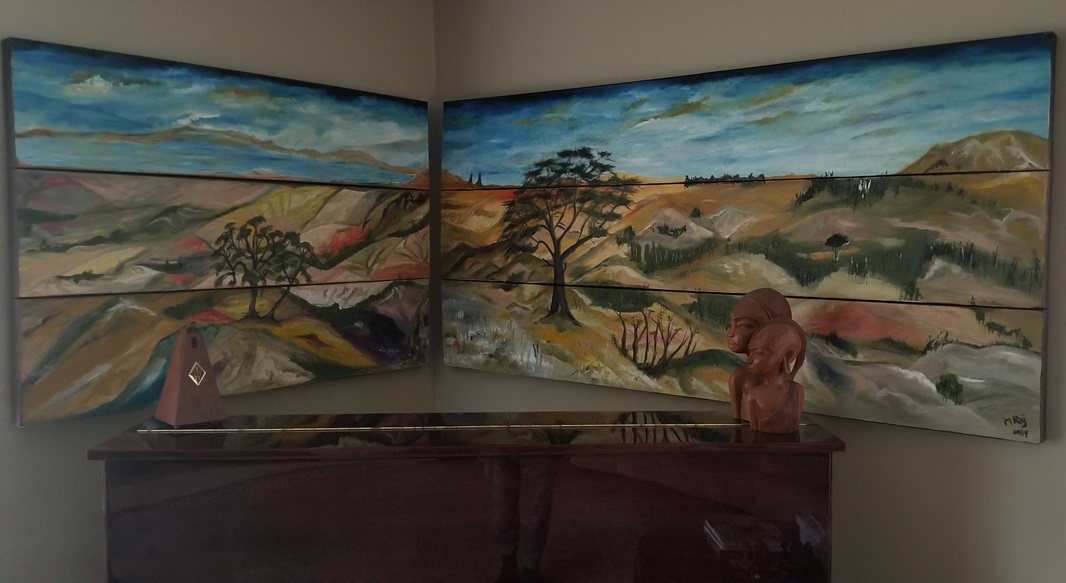
Dreamscape
Dreamscape, Oil, series of two paintings, 33” X 47″ and 33” x 70”, paintings by Mehboob Rajwani,
This painting represents The Okanagan Desert and is the common name for a semi-arid shrubland located in the southern region of the Okanagan Valley in British Columbia. It is centered around the city of Osoyoos and is the only semi-arid shrubland in Canada. Part of this ecosystem is called the Nk’mip Desert by the Osoyoos Indian Band. It is one of the most endangered ecosystems in Canada.
The artistic vision of this work is to show the dry arid hills’ breadth and the land’s scope, which still maintain their beauty despite their fragility. The hills are dream-like to me, representing waves that could go on for miles and miles, yet looking stark and even lost because of their lack of vegetation. I have added robust colours to this imaginary scape to bring out the vividness of the land as it may have been at one time in the past. I have used six-panel canvases to bring the segments in unison. When placed together as one painting, they symbolically mark the fragmented nature of this piece and the possibility of wholeness in nature.
______________________
Mardi Gras
Mardi Gras, Acrylic on Canvas, 30″ x 66″, painting by Mehboob Rajwani.
Mardi Gras is celebrated with faces depicting masks of love, hate, despair, and hope. The intricacies of bright colours and festivities demonstrate my representation of humanity. By bringing all cultures together and blending them into one another, Mardi Gras creates a peaceful symbol of unification and celebration. Here, difference is encouraged and complementary to the final vision.
Date posted: October 22, 2024. Last updated: October 23, 2024.
Corrections: (1) Taslim Samji was misspelled as Talim, and (2) it was incorrectly mentioned that Sultan Bhaloo took photographs of the paintings displayed here. A portrait of Bhaloo’s grandmother inspired Mehboob Rajwani’s painting Dadimaa. The corrections are reflected in our latest update.
__________________
We welcome feedback/letters from our readers. Please click Leave a comment. Your feedback may be edited for length and brevity and is subject to moderation. We are unable to acknowledge unpublished letters.
The editor invites Ismaili artists to submit a selection of their paintings and other works of art for publication in Simerg. Please submit images of no more than 8 objects in Jpeg (1200 x 900) and your profile to the editor, Malik, at mmerchant@simerg.com.
Much of the inspiration for my paintings comes from Mawlana Hazar Imam His Highness the Aga Khan’s guidance to the Ismaili community on the importance of brotherhood, pluralism, and living a life where we “do not forsake the soul for the material world.” Indeed, I draw continued encouragement from the Imam’s guidance as an artist and in my daily life.
Take Me Away by Shafina Jaffer. Medium: Oil on canvas. Size: 200 x 80 cm (78.7 x 31.5 in). This painting was projected on the facade of Windsor Castle during the Coronation Concert honouring the Coronation of Their Majesties King Charles III and Queen Camilla, on May 7, 2023. Shafina presented the original painting to Mawlana Hazar Imam, His Highness the Aga Khan, for the auspicious occasion of Navroz, March 21, 2024. Photograph: Shafina Jaffer collection.
Last year, I curated a painting for King Charles’s coronation, and on the occasion of Navroz — the Persian New Year — on March 21, 2024, the same painting, “Take Me Away,” was gifted to Mawlana Hazar Imam, who graciously accepted it and encouraged me to pursue my talents. His message moved me, and as a show of gratitude to celebrate his 67th Imamat Day on July 11, 2024, I have embarked on a series of Mawlana Hazar Imam portrait paintings that will be presented in the coming months on this website.
Simerg and its sister website, Barakah, share the first painting in this series that captures a very youthful Hazar Imam. When asked about my choice to depict Mawlana Hazar Imam at this age, I explain that it’s the image that has been etched in my mind growing up: a sympathetic, youthful figure radiating with light. This personal connection with the Imam drives my artistic expression and deepens my sense of gratitude.
Delving into mixed-media mediums, I use my heritage and strong affiliation with spirituality to sow the seeds of my creativity. Since completing my Graduate Diploma (Art & Design) and Master’s Degree (Painting) from the Royal College of Art, I have explored the intricacies of nature, human relationships, and spirituality within the field of art and their interrelationship.
Religion and spirituality are not just important themes in my art; they are the essence of my work, reflecting my deep exploration of faith and the human connection to the divine. My canvases are vibrant and alive, filled with a playful mix of colour, form, and texture, with natural mediums playing a pivotal role. Faith pushes me to transcend the physical and visible, uncovering what resides at the core and infusing the outer edges with life. Indeed, with such portraiture of the Imam, the lines between literal and divine interpretation are moving and profound.
Please click on image for enlargement
Mawlana Hazar Imam, His Highness the Aga Khan, by Shafina Jaffer. Medium: Oil, Gold and Charcoal; Size: 42 x 32 cm. Original photograph for painting: Gary Otte (cover page and page 121 of Depth of Field: The Aga Khan Beyond the Lens).
This portrait of the Aga Khan, painted with meticulous care and deep gratitude, captures his serene and compassionate essence. I have highlighted his gentle smile and thoughtfully intelligent eyes, conveying wisdom and kindness. The subtle use of colours and shading brings out the depth of his character and position in humanity, reflecting his profound impact as a spiritual leader and guide. One can easily see an overarching glow settled upon the canvas — reflecting his holy and elevated demeanour.
The border, crafted in real gold and liquid charcoal, symbolizes his love for nature and adds a unique, elegant touch to the piece. This artwork is a heartfelt tribute, expressing deep appreciation for the Aga Khan’s guidance and positive influence on my life and practice. It stands as a testament to the enduring respect and admiration he commands.
Upon gazing at this painting, one can forget that it is not a photograph. My brush has sought to create a three-dimensional profound effect which makes it appear that the face is emerging from the confines of the page to look into the viewer’s eyes, saying:
“Everybody makes mistakes. Never regret them; correct them. There’s no such thing as a perfect world or perfect life” — His Highness the Aga Khan.
Date posted: July 9, 2024.
_________________
Work in progress, as Ismaili artist Shafina Jaffer paints a portrait of His Highness the Aga Khan in her studio in Dar es Salaam, Tanzania. The iconic artist was invited to the residence of the US Ambassador to Tanzania on US Independence Day, July 4, 2024, to exhibit her paintings featuring African women.
Our climate is changing. Humans are primarily responsible for harmful emissions and the destruction of ecosystems as we indiscriminately pollute our air, water, and soil.
The main driver is primarily the burning of fossil fuels (coal, gas, and oil), which produce heat and trap heat between the ozone layer. This process significantly contributes to global warming, as evidenced by the record-breaking year in 2023. If concerted efforts are made soon to reduce the carbon footprint, it may be possible to turn the clock back.
The northern hemisphere is responsible for seventy percent of the catastrophe and damage caused by climate change, and the people most affected by the adverse conditions live in the global south. They are the least responsible for this phenomenon and, unfortunately, the least able to endure nature’s wrath.
Here are some things we can do individually to reduce our carbon footprint.
Reducing the use of fossil fuels would improve air quality and protect human and animal health.
Stop the wars which contribute to further destruction of the ozone layer besides unnecessary deaths.
Stop idling engines. Carpool, bicycle, or walk if possible, and also get exercise and reduce expenses.
Stop illegal campfires. Even one tiny spark can start a wildfire that can burn for days and destroy hectares of land.
Stop using fireworks. Consider light shows which are less damaging to the environment and noise pollution.
Stop polluting our water system and recycle properly — stop using single-use plastics, and pull tabs off masks so marine life and wildlife don’t get tangled in them. Recycling reduces waste sent to landfills and prevents pollution. It conserves natural resources and energy.
Article continues below
Mobina Marani pictured in front of her exhibit at the Red Ribbon Event in Fort Erie, Ontario, in November 2023. Photograph: Mobina Marani Collection.
With regard to the worldwide use of plastics, The Philippines, the United States of America, India, Malaysia, and China are among the most prominent plastic polluters worldwide.
Rwanda, Kenya, Sweden, Tanzania, Norway, and Germany are the least. A 2019 Tanzanian government declaration states that “plastic carrier bags regardless of their thickness will be prohibited from being imported, exported, manufactured, sold, stored, supplied and used in Mainland Tanzania.” According to the New York Times, anyone in the country found producing or importing plastics faces a fine of 426,000 dollars, or a jail term of up to two years. Rwanda has banned the manufacturing, usage, import or sale of plastic bags since 2008.
Canada recycles only 9% of its waste, whereas the rest goes into landfills. However, it wants to eradicate the use of plastic by 2030.
Cigarette butts contain tiny plastic fibres and “microplastic “ from synthetic clothing through washing. Fourteen million tons in our oceans yearly, particularly in the North Pacific Ocean — “The Pacific Patch.” Plastic can take up to 20-500 years to decompose, and even then, it never fully disappears.
In our small Ismaili community in Niagara-on-the-Lake, we recycle and reduce our garbage as best we can, and we are proud that our youth and Jamati members are involved and working hard at it. It may be noted that several steps have been taken in Jamatkhanas around Canada to reduce the use of plastic. Prince Hussain Aga Khan and his wife, Princess Fareen, have completely eliminated the use of plastics in their homes. As someone who deeply cares about the ocean and its creatures, the Prince laments: “Before, you didn’t see plastic in the sea. Now, it is everywhere. I see plastic each and every time I go on an expedition. In Egypt, in the Philippines, in Indonesia, in the Bahamas, in Sardinia…Wherever I go, I always find plastic.”
I invite readers to view the following paintings I completed in 2023 out of my concern about climate change and ocean pollution. Each image has an accompanying statement and can be clicked for enlargement.
1. “Global Pollution” (16″ x 20″) Acrylic on canvas
Global Pollution, April 2023, Acrylic on canvas, 16 X 20 inches. Artist: Mobina Marani.
Artist statement: It is gut-wrenching to witness the effects of humanity’s complacency in protecting and preserving our rivers, lakes, and oceans. Dumping undesirable waste products and harmful toxic materials has caused the demise of marine life and coral reefs, which provide excellent habitat and nourishment for many creatures that depend upon an enabling environment for their survival. In “Ocean Pollution,” she attempts to depict the types of pollutants found in the sea bed and their potential effects on marine life.
The artist, through this work seeks to emphasize the urgent need for responsible waste management, and hopes that it will inspire hope and action in our audience, showing them that we can still protect and restore these precious marine ecosystems.
~~~~~~~~~
2. “Force of Nature” (16″ x 20″) Acrylic on canvas
Force of Nature, Acrylic on canvas, 16 X 20 inches. Artist: Mobina Marani.
Artist statement: In December 2022, the ice storm Elliott hit the shores of Lake Erie with devastating consequences. A lot of the homes along the waterfront got pounded with 20 feet to 30 feet waves, and because of the frigid temperature and high winds, the water instantly froze on the roof to the base of the homes, completely covering them with ice and causing significant external and internal damage to the affected properties. Her rendering illustrates the impact on her neighbouring homes. The different ice formations and using minimal paint colours were a big challenge.
~~~~~~~~~
3. “Nature’s Fury” (16″ x 20″) Acrylic on canvas
Nature’s Fury, Acrylic on canvas, 16 X 20 inches. Artist: Mobina Marani.
Artist statement: The rising global temperatures have had an insurmountable and lasting impact on Mother Earth, demanding urgent action. Some parts of the worldwide community, like Pakistan in 2022, where 35 million people were displaced, have had to deal with devastating rainfall and flooding. In parts of Africa, global warming has manifested itself in extreme dry conditions, causing hunger, famine, and the displacement of the masses. Our country, Canada, has lost thousands of hectares to forest fires. Her rendering, Nature’s Fury, is a stark reminder of the ferocity and fury of such intense fire on our landscape. This is a call to action, a plea for us to act now to protect our planet.
Date posted: June 18, 2024.
___________________________
About the author: Mobina Marani, a woman with a passion for art, hails from Uganda. After completing her art education in England, she embarked on a new chapter in Canada in 1974. Settling in the picturesque Ridgeway/Crystal Beach area, she found herself managing a family business. It was here, amidst the joys of her first grandchild, Amarah, that she felt the urge to pick up the paintbrush again after a hiatus of 40 years. She created freehand renderings of her close family members and Mawlana Hazar Imam, His Highness the Aga Khan, the 49th Hereditary Imam of the Ismaili Muslims.
Mobina has also taken the pressing issue of climate change and the disregard of Mother Earth to heart. Her series of paintings shown above depict the catastrophic consequences of our actions. Each stroke of her brush is a plea for change, a call to action. Mobina’s dedication to her cause is evident in her process. She does her portrait paintings by hand, without tracing or enhancing devices, referring only to a picture. She meticulously applies layer upon layer of acrylic paint until she is satisfied with the degree of perfection.
“In my calligraphic work, I use one line from the Quran. I repeat it over the years. The line in this work is from the Iqra Ayat, which states ‘God taught man what he did not know’ in the naskhi script. This is a line that I have used repeatedly over the last three decades. My challenge has been how to translate it into sculpture.” — Amin Gulgee
By ANIZA MEGHANI
Algorithm II, 2015, Copper, 37.7 x 29.2 x 31 inches. Artist: Amin Gulgee.
No one can miss Amin Gulgee’s home from a distance with its rooftop adorned with a mosaic of mult-coloured glass, tile and terra cotta. No doubt a tourist attraction. As I entered Amin’s gallery on the ground floor, I was stepping into a world of pure copper sculpted into Quranic words. When sunlight caught his sculptures, they reflected shadows on the walls that seemed to dance in spiritual twirls. We made our way to his living room on the first floor, up the steel staircase with copper railings, designed by the artist himself. I noticed a photograph of his late father’s lapis mosaic portrait of Sir Sultan Mahomed Shah hanging on the wall just before we entered his private quarters.
Amin told me a story about this piece: “That was one of my father’s works from the 1970s,” he said. “I grew up with it. I remember one day when I was a kid, the Aga Khan came to our house in KDA. He spent time with my parents, and he loved the portrait. Of course, my father said, ‘Your Highness, we will gift this to you.’ Imam responded, ‘No, you will not gift this to me. You must tell me how much you are charging for it.’ I remember when my parents took the mosaic portrait to the Aga Khan, they were feeling sad about parting with it. But what I truly remember most was that the Aga Khan refused to accept it as a present. How fantastic is that? Imagine the respect he had for the artist and his work!”
As I sat and drank mid-morning ginger tea, I could see from Amin’s balcony the courtyard that connected his home with that of his late parents. His parents, of course, were the renowned artist, Ismail Gulgee, and his wonderful wife, Zaro. How I miss them dearly! Here I was, once again, at his home, reflecting upon a family friendship that has spanned over three decades.
I met Amin when both father and son had a joint exhibition at the Ismaili Centre in London in 1994. Zaro-Aunty took my hand and walked me across the social hall, where Amin was surrounded by his sculptures and a display of his handmade jewellery. She proudly introduced me to him. “Aniza, this is my son, Amin; he is an artist, too. He makes sculpture.” I was drawn to his jewellery and nickel-plated copper sculptures in kufic with large crystal stones set within. Tall and handsome, with shoulder-length hair, he showed me his beautiful collection.
Now as I sat in his living room, reflecting on that day, I was mesmerised by his father’s work adorning the walls and wondered whether Amin’s own creativity had been sparked by it. My mind raced with this and many other questions.
Perforated Egg, 2018 Copper, 27 x 16 x 16 inches. Artist Amin Gulgee.
Amin was born in Karachi, Pakistan and studied at the Karachi American School from kindergarten to the twelfth grade. He went on to do his bachelor’s degree from Yale University in the United States. I asked whether he was inspired to study art history because of his father. He replied, “Although both my parents were liberal, they didn’t want me to be an artist. I agreed with them as I saw how difficult the life of an artist can be. I didn’t think I had the courage to be an artist. Wishing to be the good South Asian boy, I majored in economics at Yale.”
However, when his classmate Dominique Malaquais took him for his first art history class freshman year, it was the beginning of a journey that made him realise that this is what he wanted to do. Economics was simply too “boring” to endure! This art history class was a study of Baroque gardens, which inspired him to take even more art history classes and to pursue a double major in art history and economics. He wanted to write his senior thesis on Moghul gardens, but at that time it was “problematic”, as there was no Islamic art history department at Yale. He was advised to do his thesis on European gardens instead, but Amin’s heart was set on writing about the Shalimar Gardens in Lahore, constructed by the Moghul Emperor Shah Jahan between 1641 and 1642.
Char Bagh II, 2003, Copper, 37 x 37 x 35 inches. Artist: Amin Gulgee.
With help from his late father’s connections in the art world, Amin was introduced to Dr Oleg Garbar, the renowned authority on Islamic art and Harvard’s first Aga Khan Professor of Islamic Art and Architecture. Dr Garbar agreed to be Amin’s secondary advisor. (His primary adviser at Yale was Dr Judith Colton, an expert on European gardens of the 17th to 19th centuries.) Amin’s senior thesis, “A Walk Through Shalimar: A Char-Bagh Garden of 17th Century Mughal India Seen as a Manifestation of Imperial Divine Right”, went on to win the Conger Goodyear Fine Arts Award from Yale’s art history department.
Amin was spiritually drawn towards exploring Islamic art as a result. A new journey of his life began when he embarked upon a career not as a painter like his father, but as a sculptor. I asked him if he kept his first art piece. He emphatically replied, “No! I am not sentimental!”
I was curious about what gave him inspiration to create his artwork. He explained, “All my work is personal. Everything relates to me at a certain point in my life.”
Iqra
I wanted to further explore his creative mind, how art evolves within it. What made him tick? Did he get up in the middle of the night to sketch out an idea, or write it down? Where did it all come from? So, I pointed to a tall sculpture. Amin talked me through it: “In my calligraphic work,” he explained, “I use one line from the Quran. I repeat it over the years. The line in this work is from the Iqra Ayat, which states ‘God taught man what he did not know’ in the naskhi script. This is a line that I have used repeatedly over the last three decades. My challenge has been how to translate it into sculpture. I like the idea of repetition. For me it becomes intellectually, aesthetically and conceptionally challenging to keep the same line in the same script, but to vary its physical form. I explored this idea in a solo shown that I called ’7’. I chopped the line into seven portions and rearranged them. There was nothing legible anymore as the letters were no longer in their original order. ‘7’ was co-curated by the late Paolo De Grandis and Claudio Crescentini and was held at the Museum of Modern Art in Rome, a short walk from the Spanish Steps. My installation was shown in the courtyard of the museum, which had once been a cloister.”
I asked him why he was drawn to this particular Quranic line. He replied, “It’s personal. It’s spiritual and I do not wish to share this. You must remember it’s private for me.”
I respected his answer. As in life, spiritual moments are personal and cannot be shared. I kind of understood. Correction: I understood him totally.
Cosmic Chapati, Unknown Centre, 2011, Copper, 35 x 35 x 2 inches. Artist: Amin Gulgee.
~~~~~~~
Another line Amin has used repeatedly is from the Surah-e-Rehman, which asks, “Which of the favours of God can one deny?” in new style kufic. (He has not created a work around this since 2008, however.) In this series as well, you can no no longer read the line. Amin explains, “You can only read the text in sculptures where I use the phrase Al-Hamdulillah (Praise be to God), which I render in the square kufic script. These are geometric, architectonic works.”
Amin stopped making his art jewellery in 2007. Although he called it jewellery, these gold-plated organic forms embellished with crystal and semi-precious stones were more like wearable sculpture. There was a relationship between his jewellery and his larger sculptures as he sometimes used these smaller works to work out ideas that might develop into bigger pieces. These were his sketches, in a way.
Embrace, 1999, Copper and rock crystals, 34 x 25 x 24 inches. Artist. Amyn Gulgee.
We got talking about Amin’s work as a curator. It began, he said, in the late 1990s, when he curated an art festival at the Sheraton Hotel in Karachi (now the Mövenpick). In the old days, the lobby was a place where young people used to hang out drinking coffee all day, “trying to be fancy”, as Amin put it. Being a semi-public space, it appealed to Amin as a venue to organise an exhibition that he would call Urban Voices. Amin curated four iterations of the group art show, which juxtaposed the work of recent graduates from the city’s art schools with that of established artists. The money generated from the sales of the artwork from these events went towards a scholarship at the prestigious National College of Arts in Lahore.
Rung I, 1994, Copper, rock crystals, and glass, 24 x 15 x 9 inches. Artist: Amin Gulgee.
In 2000, Amin inaugurated the Amin Gulgee Gallery on the ground floor of his newly built home in Clifton, a seaside neighbourhood. About once a year, he has opened up the space for large-scale, thematic shows of his contemporaries. (John McCarry, whom Amin met at Yale, is the coordinator of this artist-led space.) Amin explained, “Lahore is where all the art institutions are. Karachi is where the commercial galleries are. We wanted to do exhibitions without any kind of commercial point of view.”
The Bird Rickshaw, 2004 Copper, 84 x 100 x 42 inches. Artist: Amin Gulgee.
Having had many years of experience curating shows, Amin was approached in 2015 by Niilofur Farrukh, now the CEO of the Karachi Biennale, who asked him whether he would like to be the Chief Curator of its first edition in 2017. Amin readily accepted the challenge, despite the nascent biennial’s severe lack of funding. Amin began the task of creating a team of Karachi-based millennials, none of whom had any experience in curating a large art event. It included Zeerak Ahmed, Humayun Memon and Sara Pagganwala, all of whom had their own art practices.
The team worked collectively and tirelessly. With minimal financial backing but huge ambitions, the team was able to gather 182 artists from around the world, including Yoko Ono and Michelangelo Pistoletto, a key figure in Italy’s Arte Povera movement. There were twelve locations throughout the city to show their work. The whole process took two years. Six months prior to the opening, Amin invited Zarmeene Shah, who is now the director of graduate studies at the Indus Valley School of Art and Architecture in Karachi, to come on board in an advisory role as curator-at-large. The biennial –Pakistan’s first — was no easy task, but Amin and his team pulled off an outstanding event.
Perforated Wall I, Love Letter. 2014, Copper, 24 x 12 x 1 inches. Artist: Amin Gulgee.
I asked Amin how he envisions the future for artists in Pakistan. He replied, “I was born in the art scene. The scene has become much bigger now. I wish my parents were alive to see it! Now there is a Lahore Biennale as well as a Karachi Biennale. When I did my first show, there was only one gallery of note, Ali Imam’s Indus Gallery. Now we have more than 50 galleries in Karachi alone.” Amin is expanding his non-commercial gallery while also renovating his father’s adjoining museum. When I visited in May of 2024, building work was still in progress. The din of construction resounded in the connecting courtyard below. The aim is to open his parents’ former home as a small, private museum in 2025.
Amin has also been busy compiling a monograph on his work. It will be published in the spring of 2025 by Skira, a Milan-based publisher of art books that has brought out books on Picasso and Matisse as well as of important contemporary artists. Amin commented, “It’s a real honour for me that they have chosen my book to print. I am not nostalgic or sentimental, therefore the process of looking back has been hard.” He added with a laugh, “I’m just so happy that the two-year process of compiling it is now coming to an end!”
~~~~~~~
Amin Gulgee
“I think it’s very important that we record our own history and not wait around for someone abroad to do it for us. We must take control of our own narrative. I put all my documentation on my website (www.gulgeeamin.com). It is all free and downloadable. You will find a whole section of catalogues, not only on my work but on my curatorial projects, which discuss a whole variety of issues.” — Amin Gulgee
~~~~~~~
Ascension III, 2018, Copper, 88 x 27 x 27 inches. Artist: Amin Gulgee.
This led us to the topic of documentation of Pakistani art in general. Every show he curates, whether at his gallery or elsewhere, is accompanied by either a physical or electronic catalogue, and often a video and webinar as well. “Documentation is extremely important,” he explained. “When I compile a catalogue of a show I’ve curated, I not only write about the artists and the exhibition, but I also invite outside writers to contribute essays about issues and concerns they have about Pakistan in general. So, these become free platforms to express ideas. For example, Niilofur Farrukh and I co-curated a show at my gallery on the 1970s in Pakistan. This led to a book called Pakistan’s Radioactive Decade: An Informal Cultural History of the 1970s co-edited by me, Niilofur and John McCarry that was published by Oxford University Press in 2019. After the secession of Bangladesh, Pakistan swung from democratic liberalism to Islamist military rule. Those early democratic years saw a boom in cultural expression, whether it was in the visual arts, literature, film or music. This book included essays as well as Q and As with Pakistanis who helped forge the cultural life of Pakistan in that most pivotal of decades. I think it’s very important that we record our own history and not wait around for someone abroad to do it for us. We must take control of our own narrative. I put all my documentation on my website (www.gulgeeamin.com). It is all free and downloadable. You will find a whole section of catalogues, not only on my work but on my curatorial projects, which discuss a whole variety of issues.”
The Iron Horn, 203, Iron, 71 x 77 x 24 inches. Artist: Amin Gulgee.
I asked Amin what advice he would give to someone wishing to be an artist today. He laughed his booming laugh and answered: “Choose something else, sweatheart! Being an artist is so difficult. It’s easier doing something else. However, if you really want to do it, then be prepared to pay your pound of flesh. Follow your dreams as you don’t know how long you are going to live. Just be prepared. It’s a strange, strange way of making a living.”
Has it been an enjoyable journey being an artist for him? Amin replied, “Aniza, I am free. I am grateful. I am now an old man! I have done exactly what I wanted to do in my life.”
Simerg is pleased to present a selection of artwork by Shafina Jaffer, whose painting entitled Take Me Away was projected onto the facade of Windsor Castle at the Coronation Concert held outside Windsor Castle on May 7, 2023, in celebration of the coronation of King Charles III and Queen Camilla. We sincerely thank Aniza Meghani of London, England, for introducing us to Shafina and her magnificent artwork. The following profile of Shafina is based on the material that was submitted by her for this post. We have learned that the artist is hosting a special art session on Friday, February 23, 2024, at the Upanga Jamatkhana Social Hall in Dar es Salaam, Tanzania, to set the tone for the Aga Khan Youth and Sports Board’s special Navroz Art Fiesta.
Ismaili artist Shafina Jaffer in her hand-painted bark cloth sari. Photograph: Shafina Jaffer collection.
Shafina Jaffer is an Ismaili spiritual contemporary artist born in Dar es Salaam, Tanzania, and raised in Karachi and Dubai. She received her education in the UK, graduating from the prestigious Royal College of Art in Fine Art.
In 2023, her painting was selected for the Coronation Concert of Their Majesties King Charles and Queen Camilla as a backdrop for the Romeo & Juliet play performance. She was invited to attend the event as a VIP guest, witnessing her work titled Take Me Away projected onto the facade of Windsor Castle and witnessed live by millions of people across the world.
Shafina has exhibited in many art shows internationally and the world-renowned galleries of Saatchi Gallery in London, Zeitz Mocca in Cape Town, the Venice Biennale and London Art Fair. Most recently, she was invited to exhibit at the National Gallery in Dar es Salaam, Tanzania, representing the Ismaili community on the 75th Anniversary of the Indian Republic Day to celebrate the Indian-Tanzanian shared history of culture. Her painting, The Temptation (see below), painted on tree bark, with natural mineral pigments received praise from the Minister of Tourism and the Indian High Commission.
Please click on images for enlargements
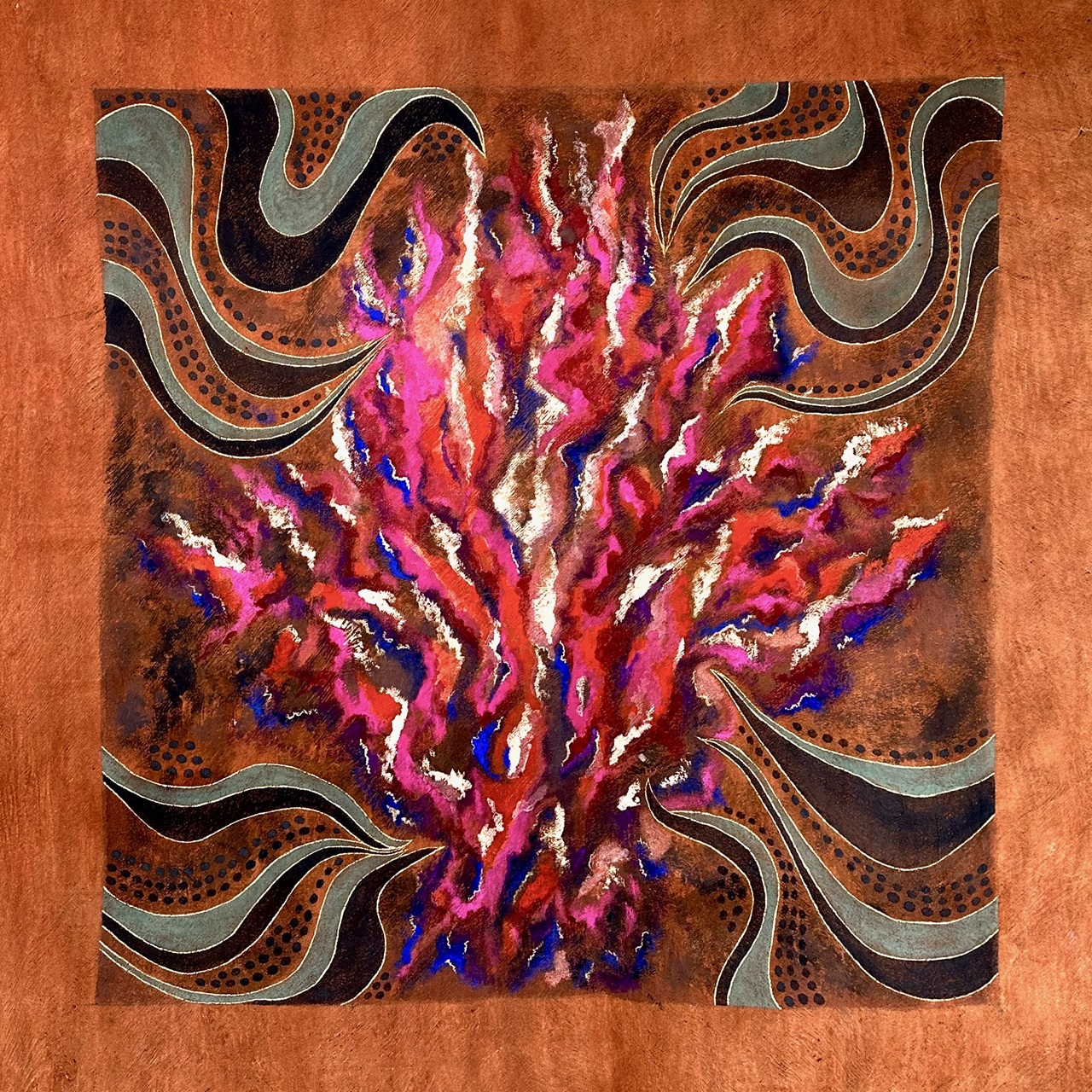
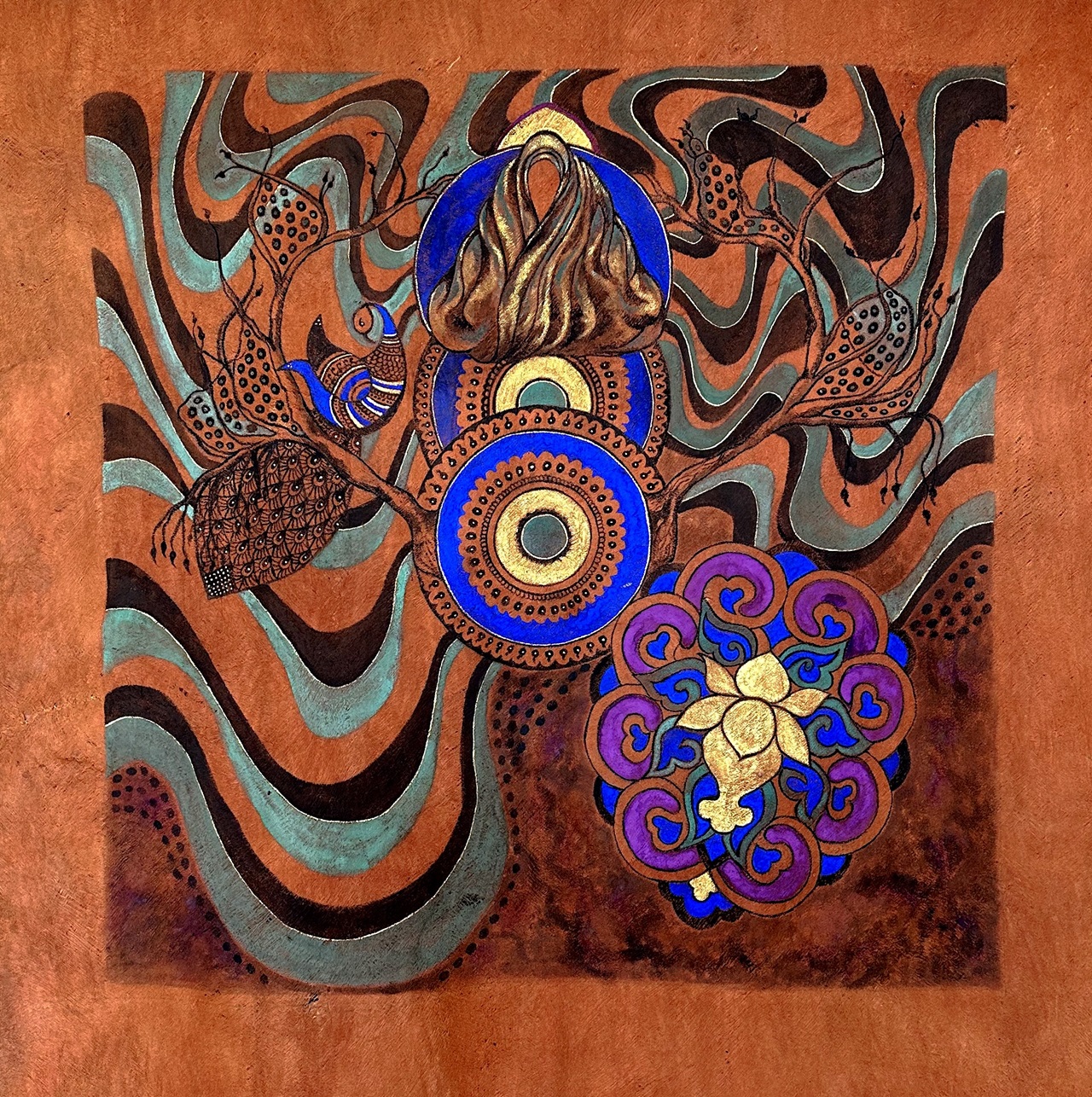
Flames of Creation in the Garden of Eden by Shafina Jaffer. Medium: Bark cloth, natural pigments: 22K Gold, cow bone pigment, malachite crystal, Majorelle blue, charcoal, rose madder, Masaai hair pigment, Tanzanian clay. Size: 80 x 80cm (31.4 x 31.4in). Photograph: Shafina Jaffer collection.
~~~~~~~
Take Me Away by Shafina Jaffer. Medium: Oil on canvas. Size: 200 x 80 cm (78.7 x 31.5 in). This painting was projected on the facade of Windsor Castle during the Coronation Concert honouring the Coronation of Their Majesties King Charles III and Queen Camilla, on May 7, 2023. Photograph: Shafina Jaffer collection.
~~~~~~~
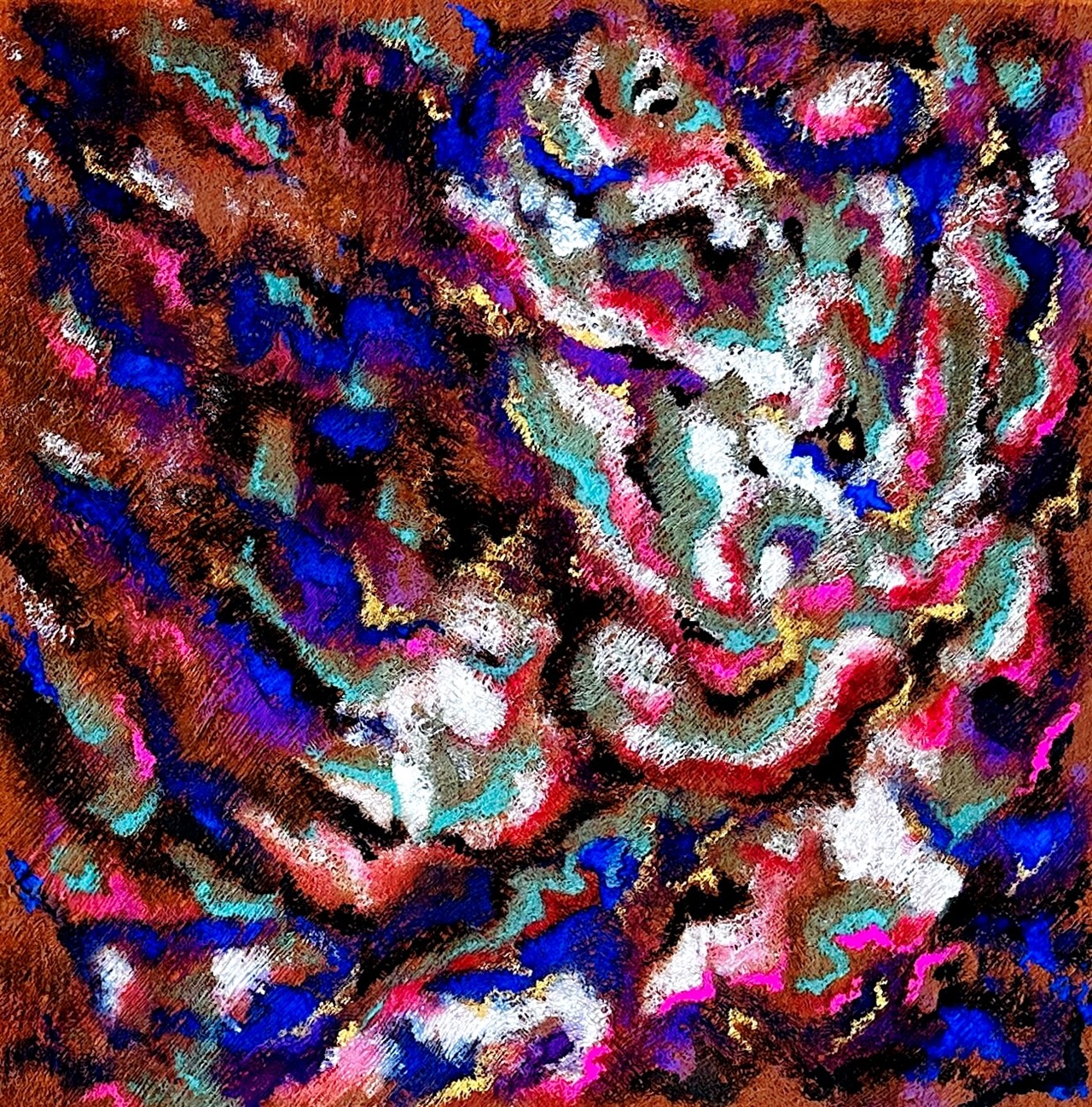
Voices of Creation, by Shafina Jaffer. Medium: Bark cloth, natural pigments: 22K Gold, cow bone pigment, malachite crystal, Majorelle blue, charcoal, Masaai hair pigment, rose madder, spinnel black, zinc white, Tanzanian clay. Size 40 x 40 cm ( 31.5 x 31.5in). Photograph: Shafina Jaffer collection.
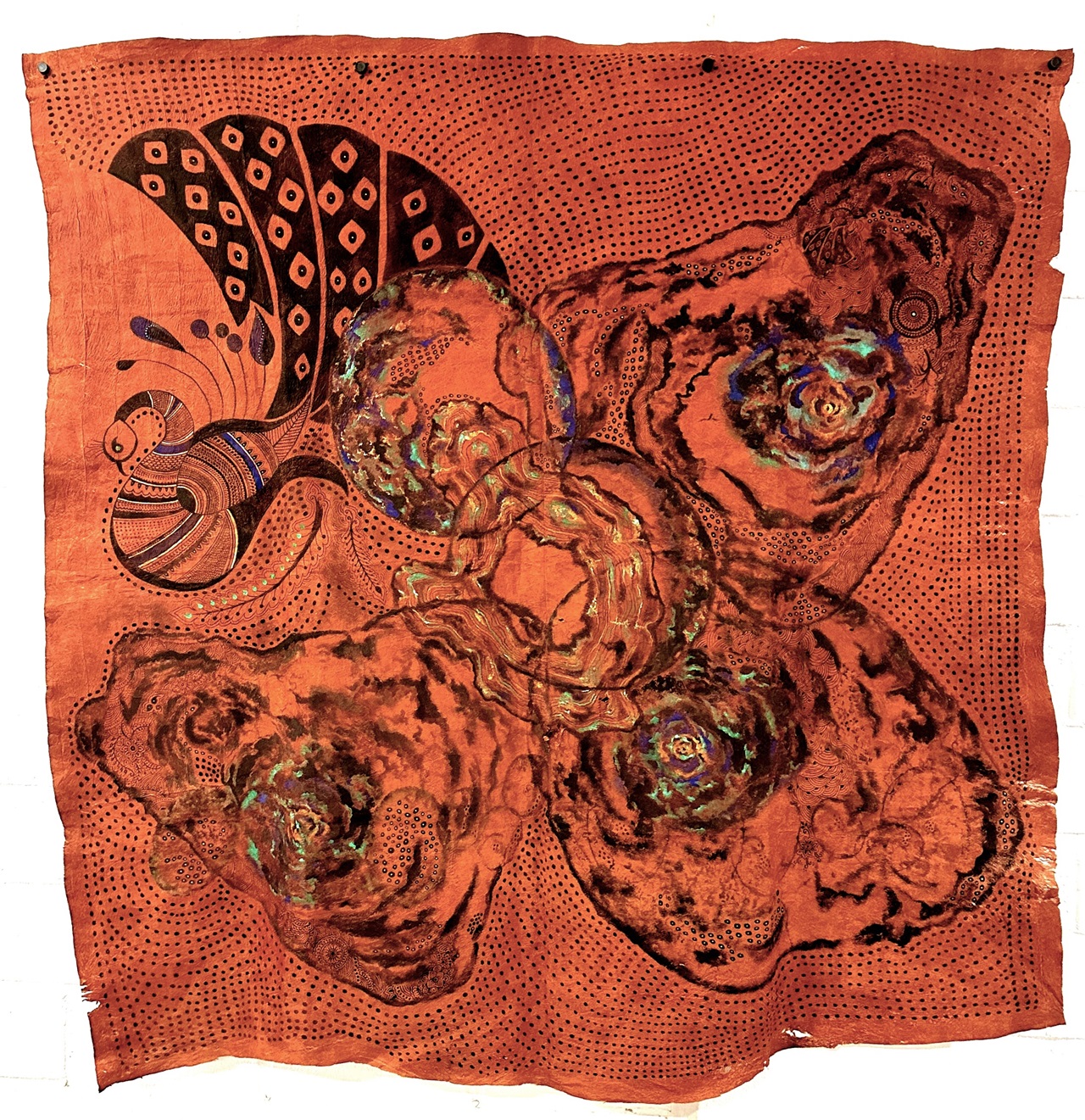
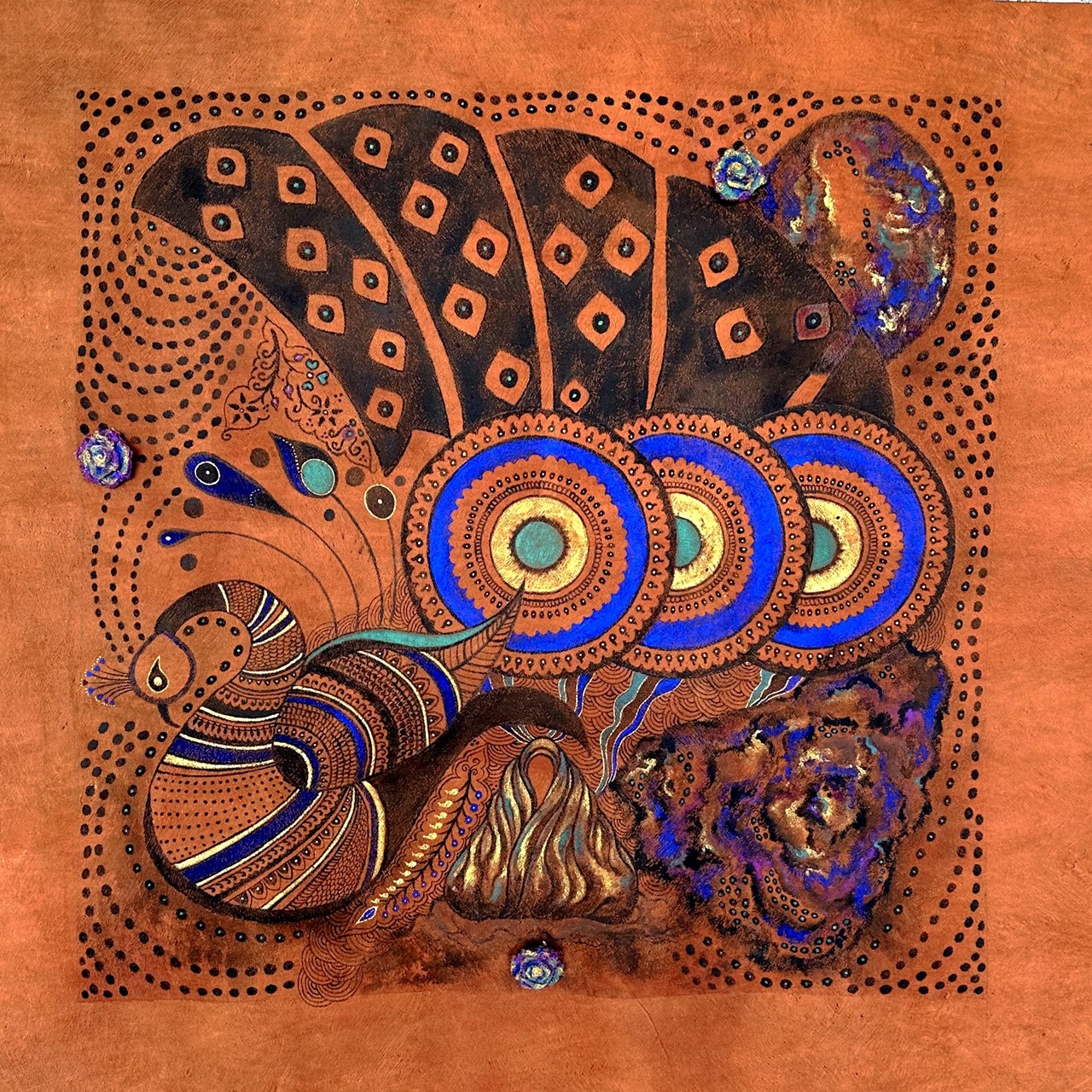
Shafina’s art is unique, for she is the first one to create a genre of art where Indian and African art synthesize to deliver a unique visual dance that combines Indian traditions of miniature painting with African natural mediums and design. She also creates large installations using recycled plastic bottles to draw attention to plastic waste, recycling, and environmental mindfulness. These have been featured extensively in the media and news in Tanzania.
Shafina navigates the realm of abstract art, seamlessly weaving together elements of religion, spirituality, natural mediums, ontology, and a profound exploration of the divine to convey a powerful message of heightened morality, spiritual awareness, and the meaning of life. Her artistic journey is a tapestry of inspiration drawn from her multicultural background, where the interplay of diverse influences shapes her unique artistic identity.
~~~~~~~
Creating Eden by Shafina Jaffer. Medium: Bark cloth, natural pigments: 22K Gold, cow bone pigment, malachite crystal, Majorelle blue, charcoal, Masaai hair pigment, Tanzanian clay. Size: 80 x 80 cm (31.5 x 31.5 in).
~~~~~~~
Creation of Eden by Shafina Jaffer. Medium: Bark cloth natural pigments: 22K Gold, cow bone pigment, malachite crystal, Majorelle blue, charcoal, Masaai hair pigment, Tanzanian clay. Size: 200 x 200 cm (78.7 x 78.7 in). Photograph: Shafina Jaffer collection.
Born into a family that celebrated both Eastern and Western traditions, Shafina was exposed to a rich tapestry of beliefs and practices, laying the foundation for her transcendent art. At the core of her work is exploring abstract art as a vehicle for expressing the ineffable and transcendent aspects of human existence. Her canvases are vibrant playgrounds of colour, form, and texture, inviting viewers into a world where the boundaries of conventional representation dissolve, leaving room for interpretation and personal introspection.
Religion and spirituality are recurring themes in her art, reflecting her deep exploration of faith and the human connection to the divine. Through her abstract interpretations, she delves into the universal quest for meaning and purpose, exploring the intersection of different religious traditions and spiritual philosophies. Her works serve as visual meditations, encouraging viewers to contemplate the shared threads that bind humanity’s spiritual journey.
Shafina Jaffer poses beside her framed painting, The Temptation, that was on display at the National Art Gallery in Dar es Salaam for the 75th Anniversary of the Indian Republic Day. Medium: Dark cloth, natural pigments: 22K Gold, cow bone pigment, malachite crystal, Majorelle blue, charcoal, rose madder, Masaai hair pigment, Tanzanian clay. Size: 250 x 100cm (98.4 x 39.3 in). Photograph: Shafina Jaffer collection.
Natural mediums play a pivotal role in her artistic process. She embraces the inherent beauty and symbolism found in organic materials, utilising them to create textures that evoke a connection to the natural world. Bark, leaves, and earthy pigments become integral elements in her compositions, fostering a harmonious relationship between the earthly and the divine. This intentional use of natural mediums adds depth to her works, serving as a metaphor for the interconnectedness of all life.
Ontology, the study of being and existence, becomes a philosophical undercurrent in her art. Her abstract expressions delve into questions of existence, identity, and the nature of reality. Through the interplay of forms and colours, she invites viewers to search within themselves for the profundity of life. Each brushstroke becomes a philosophical inquiry, prompting introspection on the profound questions that define the human experience.
Manifestation of Eden, by Shafina Jaffer. Medium: Bark cloth, natural pigments: 22K Gold, cow bone pigment, malachite crystal, Majorelle blue, Masaai hair pigment, Tanzanian clay. Size: 80 x 80 cm (31.5 x 31.5 in). Photograph: Shafina Jaffer collection.
God, in its various manifestations and interpretations across cultures, becomes a central motif in her art. Her abstract compositions serve as visual prayers, transcending the boundaries of religious dogma and inviting viewers to connect with a higher consciousness. Her art becomes a vessel for the divine, a bridge between the earthly and the spiritual, fostering a sense of reverence and awe.
In essence, Shafina Jaffer’s art is a testament to the transformative power of creativity and spirituality. Her abstract expressions serve as a catalyst for introspection, inviting viewers to embark on a journey of self-discovery and heightened moral awareness. Through the marriage of abstract art, religion, spirituality, natural mediums, ontology, and a profound exploration of the divine, she offers a visual sanctuary where the meaning of life unfolds in every brushstroke and colour palette.
Date posted: February 19, 2024.
_________________
Simerg welcomes feedback from readers. Please click on LEAVE A COMMENT. You may remain anonymous if you wish. Your email is required for comment submission, but it will never be displayed.















 Simerg - Insights from Around the World