Simerg is an independent initiative dedicated to Ismaili Muslims, the Aga Khan — their Hereditary Imam — and the Ismaili Imamat, and Islam in general through literary readings, photo essays and artistic expressions
Note to readers: The program commences in the YouTube video below shortly after the 22-minute mark with Omar Sachedina, the Chief News Anchor and Senior Editor for CTV’s national evening newscast CTV National News, acting as the emcee. Princess Zahra Aga Khan, who is a Board Member of the Global Centre for Pluralism, presented the prizes on behalf of her father, His Highness the Aga Khan, the Chairman of the Board. This was the 4th edition of the Award which is held every 2 years. A report and photographs of the event will be shared later with our readers on our sister blog Barakah, which is dedicated to the Aga Khan.
Editor’s note: On November 12, 2023, a day after the publication of the article “A Legacy of Lost Heritage” below, Simerg received a communique from ITREB in Karachi, via an Ismaili institutional leader, providing further details on the extent of the damage to the Ismaili institution’s Central library located in Karachi. According to the communique, the damage was more limited than initially thought and reported in our piece. In particular, the more than 200 manuscripts are completely safe because of protective measures taken to ensure their safekeeping. The Gujarati and Khojki-language magazines were previously moved to a different location within the library and were also saved. While a significant number of other materials in the library were damaged due to heat, smoke and water, rather than completely destroyed, they may be recoverable to some degree.
Simerg sincerely hopes that the majority of important objects and documents in the ITREB library remain in their original state and that those that were damaged are recoverable. We also hope that proper fire safety rules are in place to avoid such incidents from taking place in the library as well as Ismaili institutional buildings, especially the older ones, around the world. As noted in a UNESCO Study, the cost of restoring documents and books damaged in a library fire is substantially greater than what would be spent to store the materials under the best fire protection conditions.
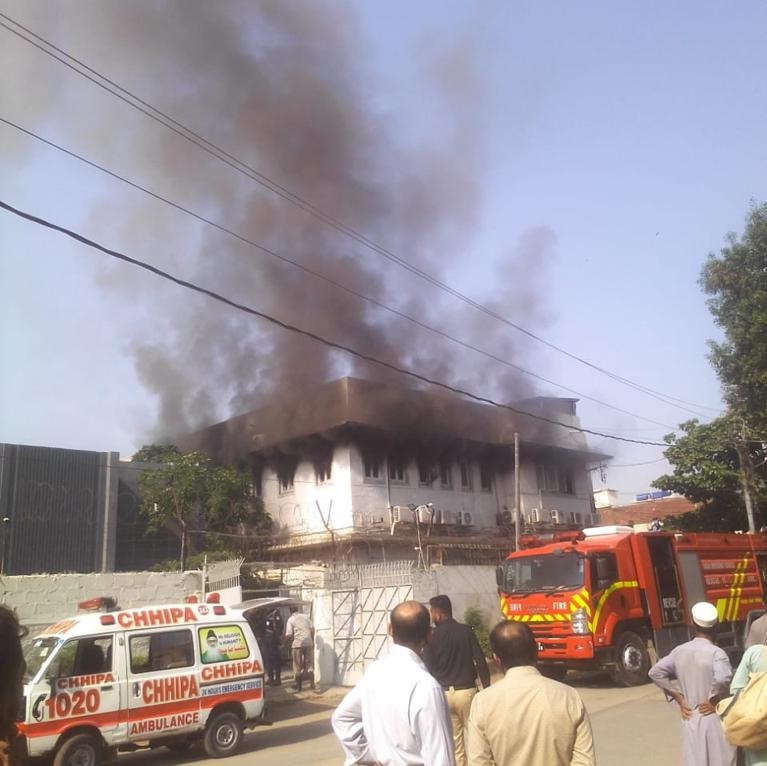
On the morning of November 2nd, 2023, at 9:15am local time, the National ITREB (Ismaili Tariqah and Religious Education Board) building for Pakistan located in the Garden East district of Karachi caught on fire. Fortunately, no one was hurt in the blaze. However, it quickly became apparent there would be another casualty.
Story continues below; click on images for enlargements
Smoke billows from a fire on November 2, 2023, at the ITREB building in Karachi, Pakistan, housing an important library collection of tens of thousands of printed materials, photographs, memorabilia, audiovisual materials, and manuscripts.
Located within the building was an important library housing tens of thousands of printed materials, photographs, memorabilia, audiovisual materials and manuscripts. The fire destroyed much of the collection. What wasn’t burnt or singed by the fire was then subject to water damage as firetrucks attempted to extinguish the blaze which was fed by the thousands of pages of flammable material in the building.
In the context of the Central ITREB Library located in Karachi, the local history, writing and output of the Khoja Jamats in particular, and more broadly of the Jamats of the Indian Subcontinent and to a lesser extent Eastern Africa and Northern Pakistan were preserved in the portion of the collection that focused on the contemporary period. In this post, I have included some gems of materials that I was able to capture on some of my journeys as an homage to the library and its role in my own archival research and being able to cobble together a social and religious history of the Ismailis.
Story continues below
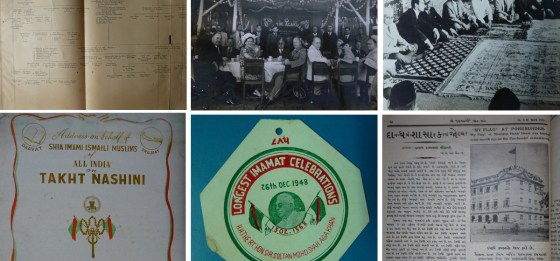
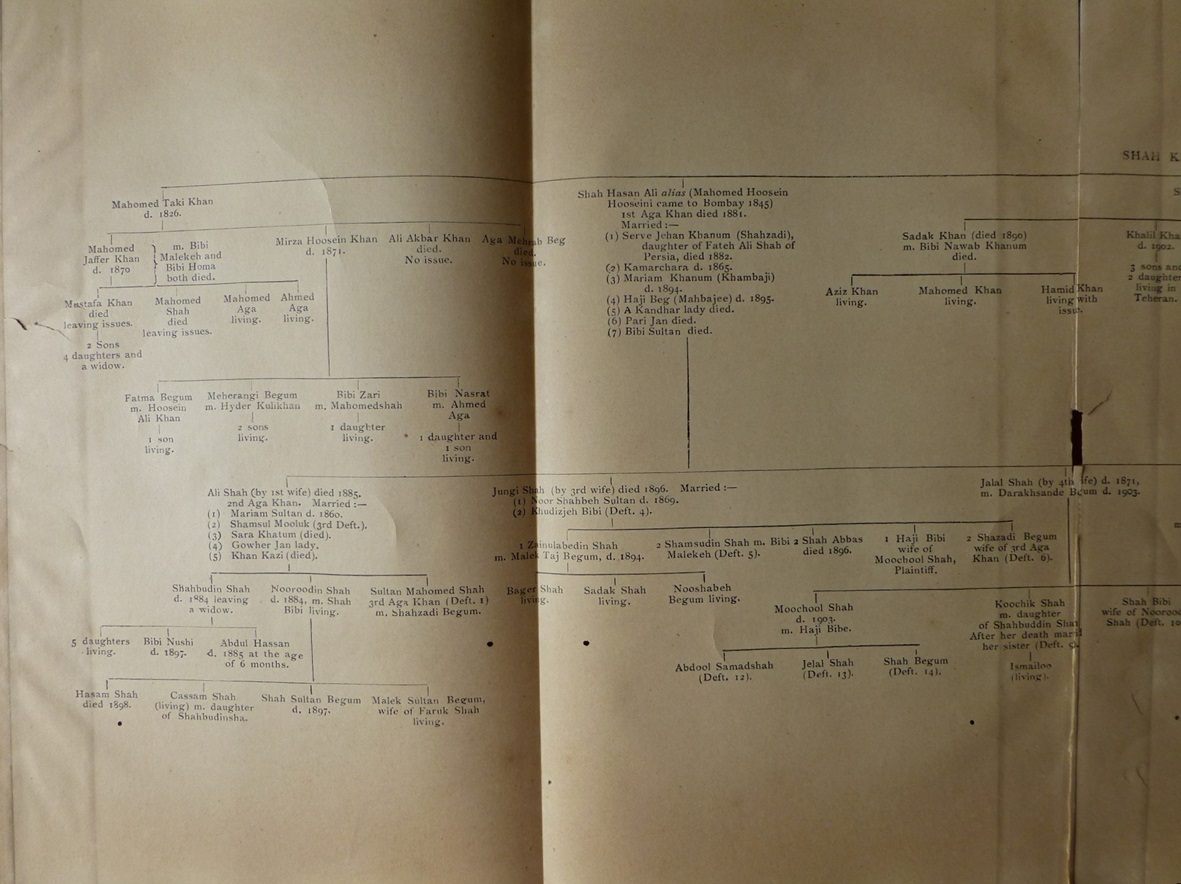
One section of the foldout outlining the family tree of the 46th Imam, Shah Hasan Ali Shah (d. 1881), that formed part of book of the judgement made by Justice Russell who proceeded over what became known colloquially as the Haji Bibi Case. In this section of the family tree, some of Imam Hasan Ali Shah’s siblings, wives, children, and their relations are listed. The case lasted from February 3, 1908 to August 7, 1908 and until that point was the longest ever trial in Bombay’s High Court.
~~~~~~
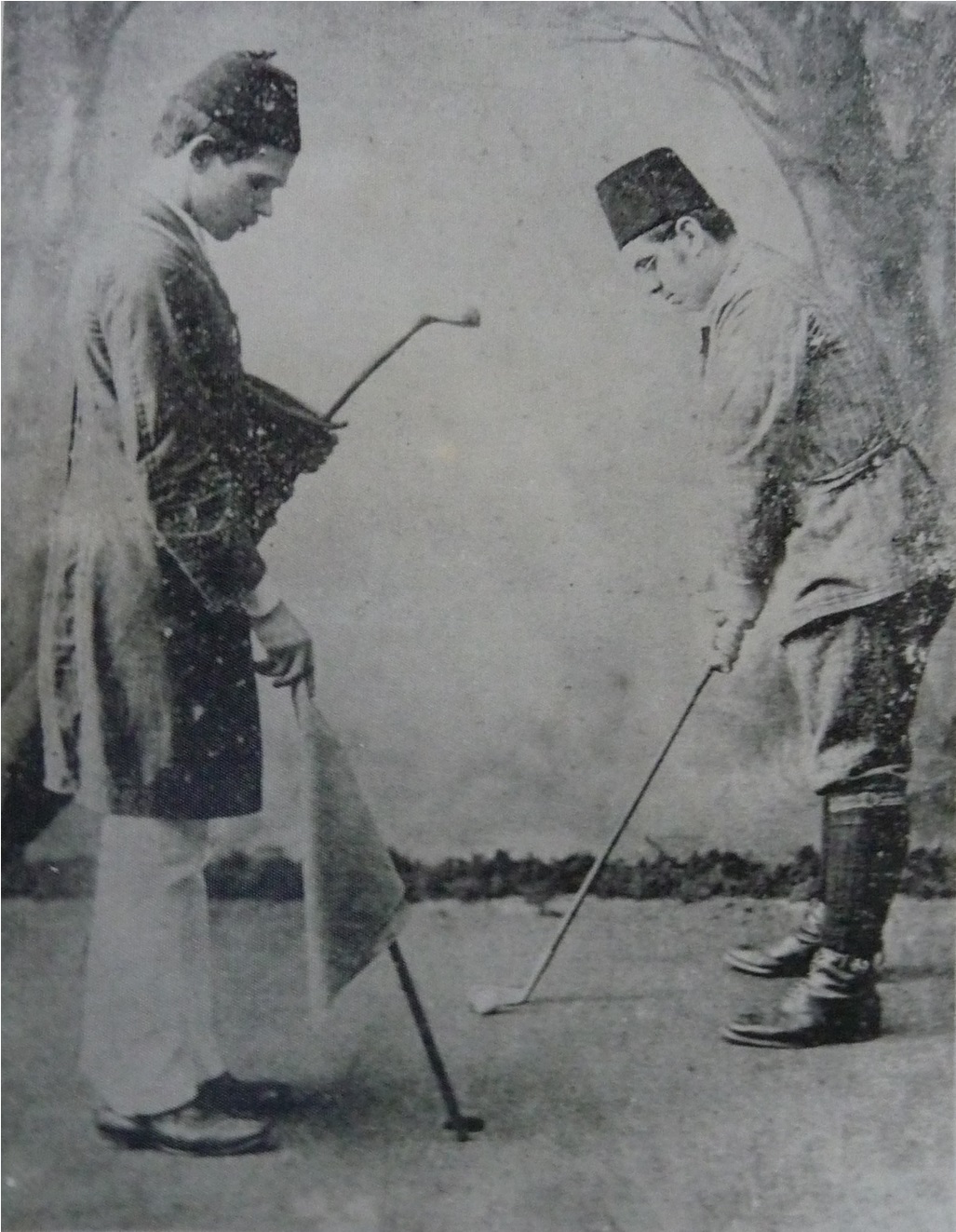
Photograph of Imam Sultan Mahomed Shah, His Highness the Aga Khan, playing golf in his youth.
~~~~~~
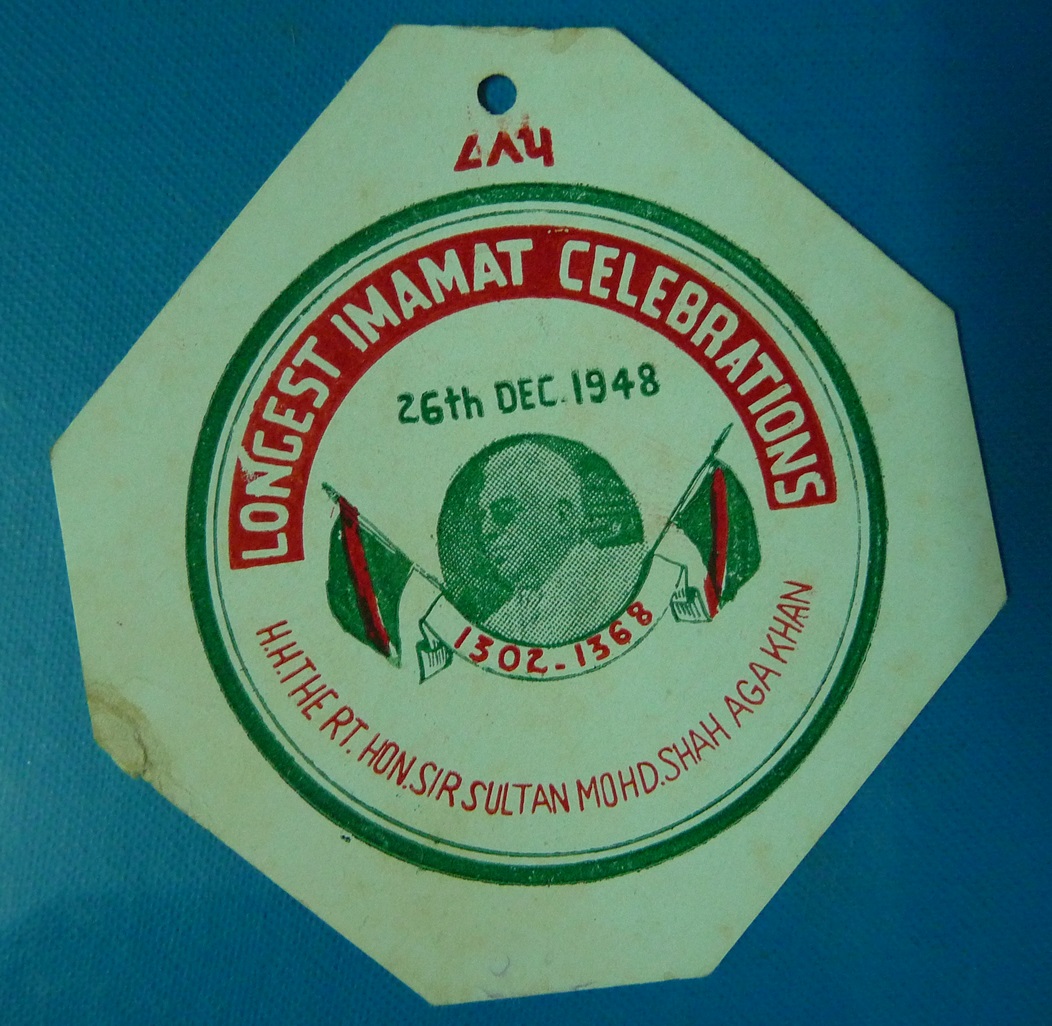
Souvenir produced to mark the occasion of the milestone reached by Imam Sultan Mahomed of the longest-ever Imamat in 1948 after surpassing 63 years as Imam of the Ismailis at the age of 71 years. The 48th Imam died nine years later on July 11, 1957, at the age of 79 having been the Imam for 71 years. He became the Imam in August 1885 at the age of 7.
While assessing the full extent of the damage is still an ongoing process, a number of items were able to be saved including a unique collection of Khojki manuscripts which were housed in fire retardant boxes. When I first heard about the tragedy the next day, I was devastated to learn of the loss of such a treasure trove of materials so important to better understanding the history of the Ismaili community. I had had the opportunity to consult the library on several occasions during my visit to Karachi over the years, including on my last visit in 2013. I was amazed from my first visit in 2006 at the breadth and richness of the collection and easily lost myself for hours and days within the library perusing its shelves, flipping through the pages of its meticulously organized items and often feeling a sense of delight at a personal discovery of a publication or image I was unaware of or that shed important light on a question I’d been pondering.
Story continues below
A picture of the first Muslim Baronet in British India, Sir Karimbhoy Ibrahim published in one of the earlier Ismaili periodical publications, Ismaili Sitaro in July 1910.
~~~~~~
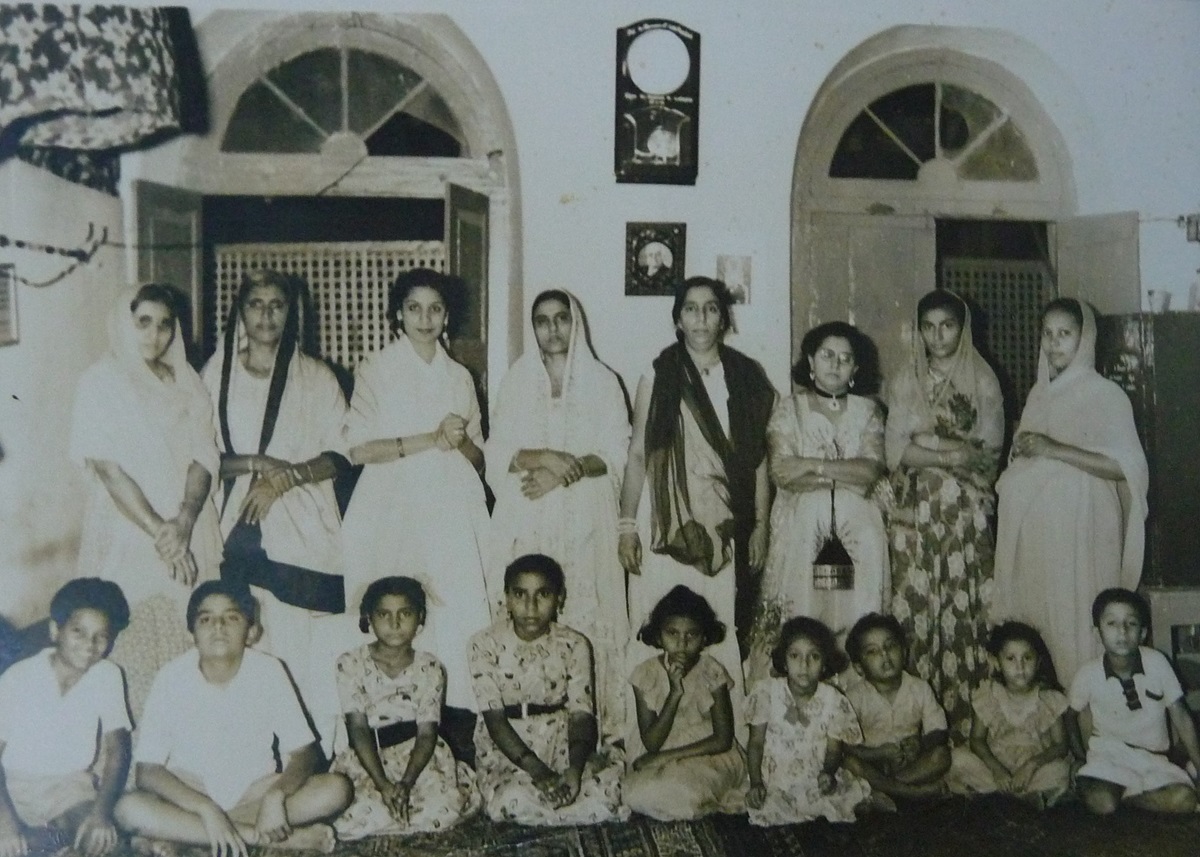
Photograph of women and children of the Ismaili Jamat in Aden, Yemen.
~~~~~~
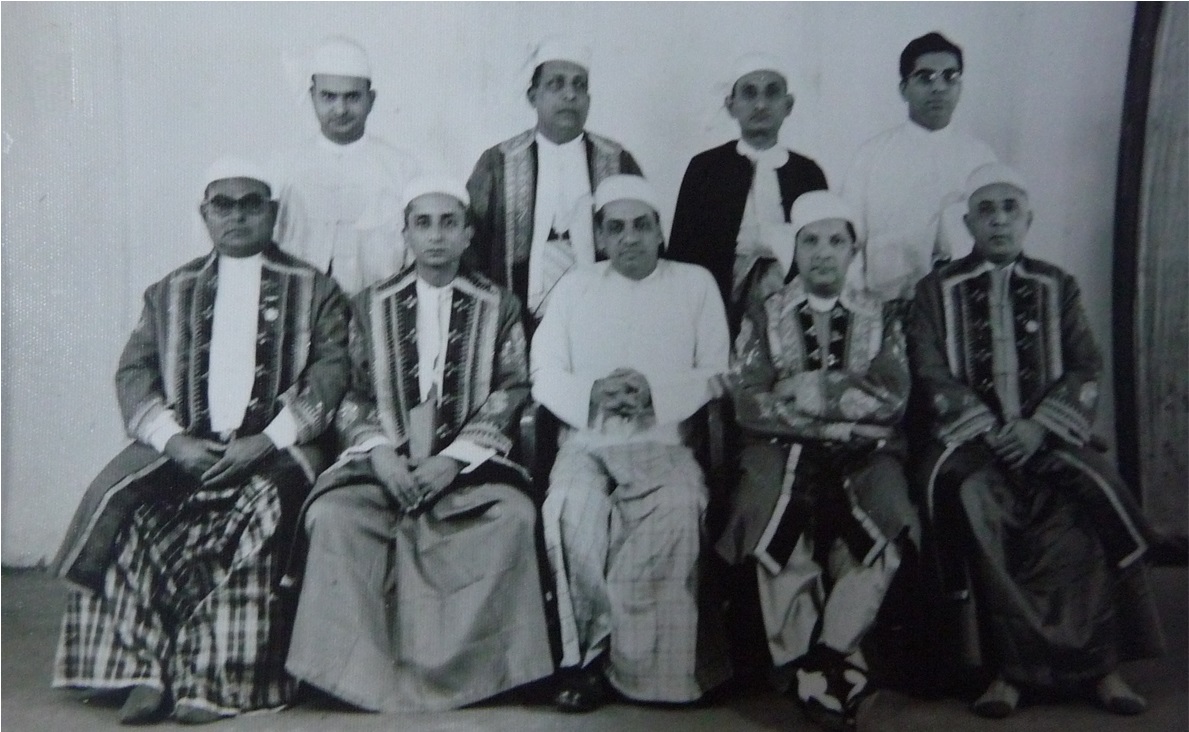
Photograph of members of the Ismaili Supreme Council, Burma 1958.
My own research interests were in the printed collection of the library in English and Gujarati including the photographic documentation of the community in the Indian Subcontinent and around the world. I had taken the opportunity to photograph umpteen works so that I could consult them in more detail and at my leisure once I returned to my home and now I realize the singular importance of those acts of documenting the legacy of the production of individual Ismailis and of Ismaili communities and institutions around the world. Much of ITREB’s Central Library collection owes a debt to Ismailis in Karachi, Pakistan, and around the world who donated materials including photographs as well as the library’s role in actively obtaining and safeguarding those materials.
Story continues below
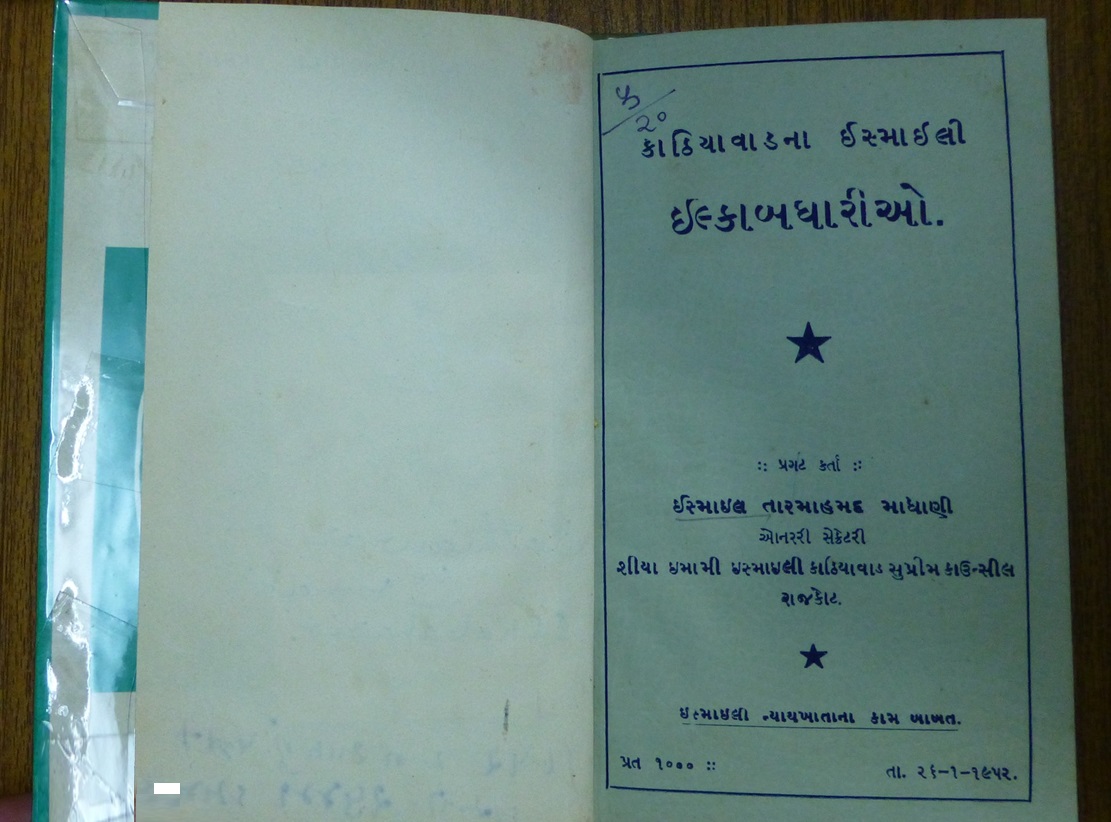
Cover page of the Kathiawadana Ismaili Ilkabadhara’o, Ismaili Census of Kathiawar published by Ismail Tarmahmad Madhani, Honorary Secretary of the Imami Ismaili Kathiawar Supreme Council Rajkot, 1952.
The Importance of Local Libraries
Since the establishment of The Institute of Ismaili Studies in London in 1977, a central repository of the community has been under development and many familial, local, institutional and national collections have been kindly donated to the IIS for safekeeping, preservation, digitization with the larger mandate of providing resources for research. However, before that, the guardians of these materials were often personal collectors, families and smaller institutions such as The Ismaili Society and Ismailia Associations, the predecessors of the now-ITREBs as well as local Jamatkhana libraries. In fact, it was because of these collections, not necessarily large-scale libraries, that scholars such as Wladimir Ivanow, Husayn Hamdani, Asaf Fyzee, Jawad Muscati and many now celebrated Nizari Ismaili authors, scholars, khalifas and waezeen of current and previous generations were able to make breakthroughs in their understanding of the Ismaili past and had source materials for their research.
Story continues below
The cover page of the Constitution of the Ismailia Association of West Pakistan from 1950.
~~~~~~
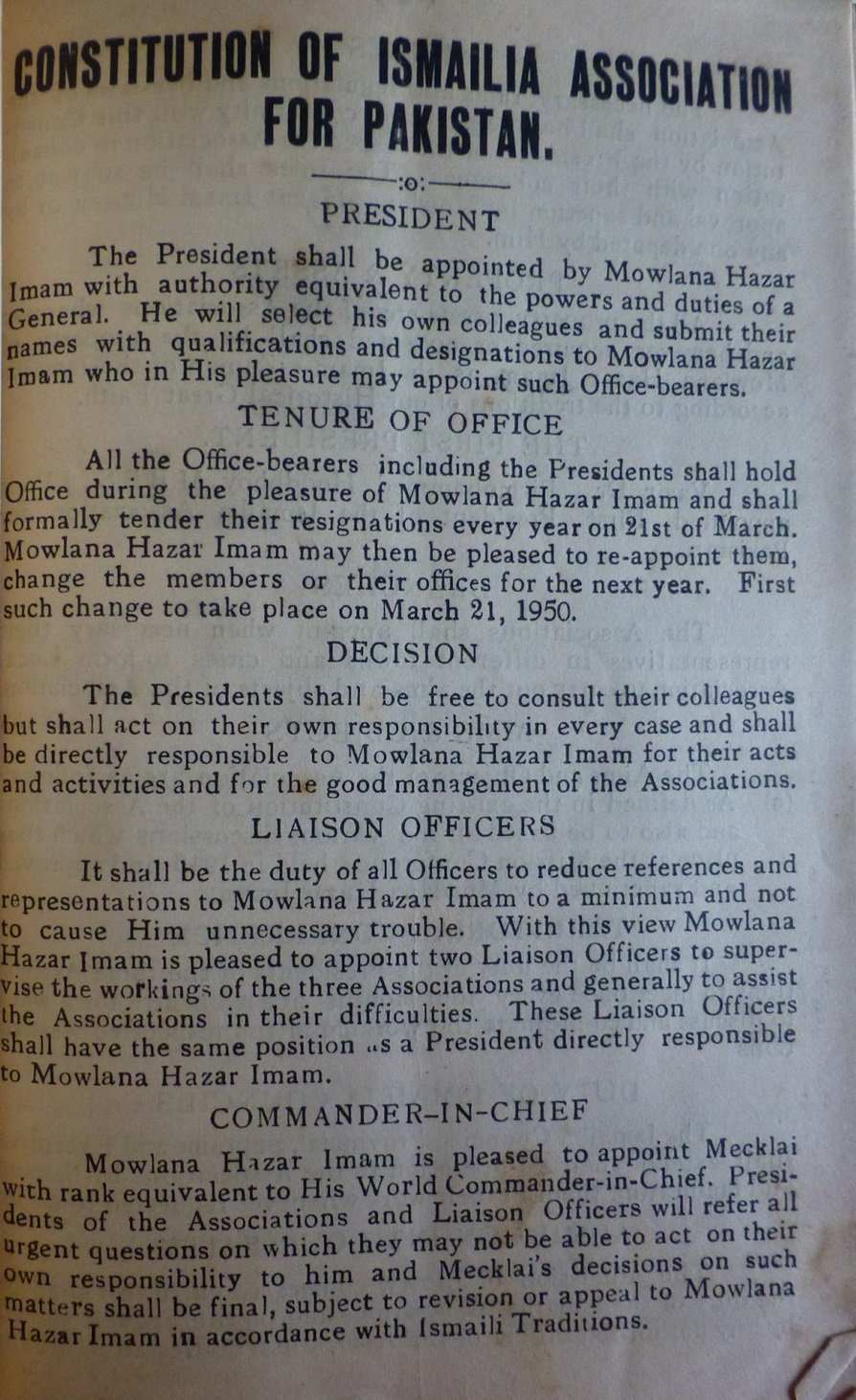
The opening page of the Constitution of the Ismaili Association of West Pakistan from 1950 outlining the system, structure, and rules that were to be abided by for members of the Ismailia Association of West Pakistan (in contrast to the jurisdiction of East Pakistan, which eventually became Bangladesh).
The importance of these regional libraries, especially for local researchers, cannot be underestimated. Throughout my travels over the past 25 years to areas where Ismailis live or once lived, its has often been the works preserved in individual homes, in smaller institutional collections and in local and regional Jamatkhana libraries that have provided some of the most unique documents and witnesses to history; and it is through them that have come the greatest insights and breakthroughs. Large institutional collections such as those of national libraries or of learned societies have become more accessible as they digitize their collections, but it is our debt to local institutions that cannot be underestimated.
Story continues below
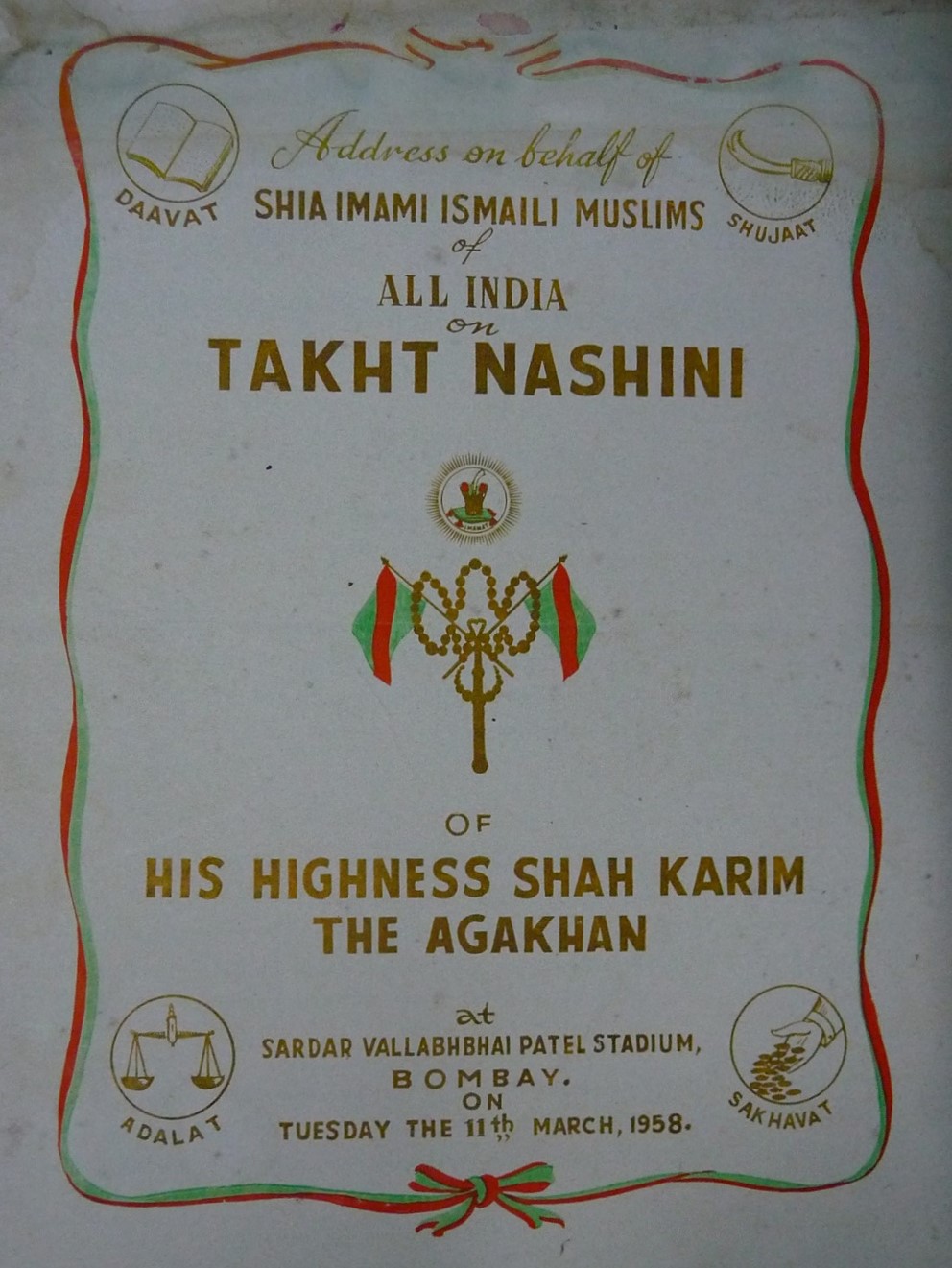
Cover of the Souvenir of Mawlana Hazar Imam’s Takht Nashini (accession ceremony to the office of Imamat) in Bombay in 1958.
~~~~~~
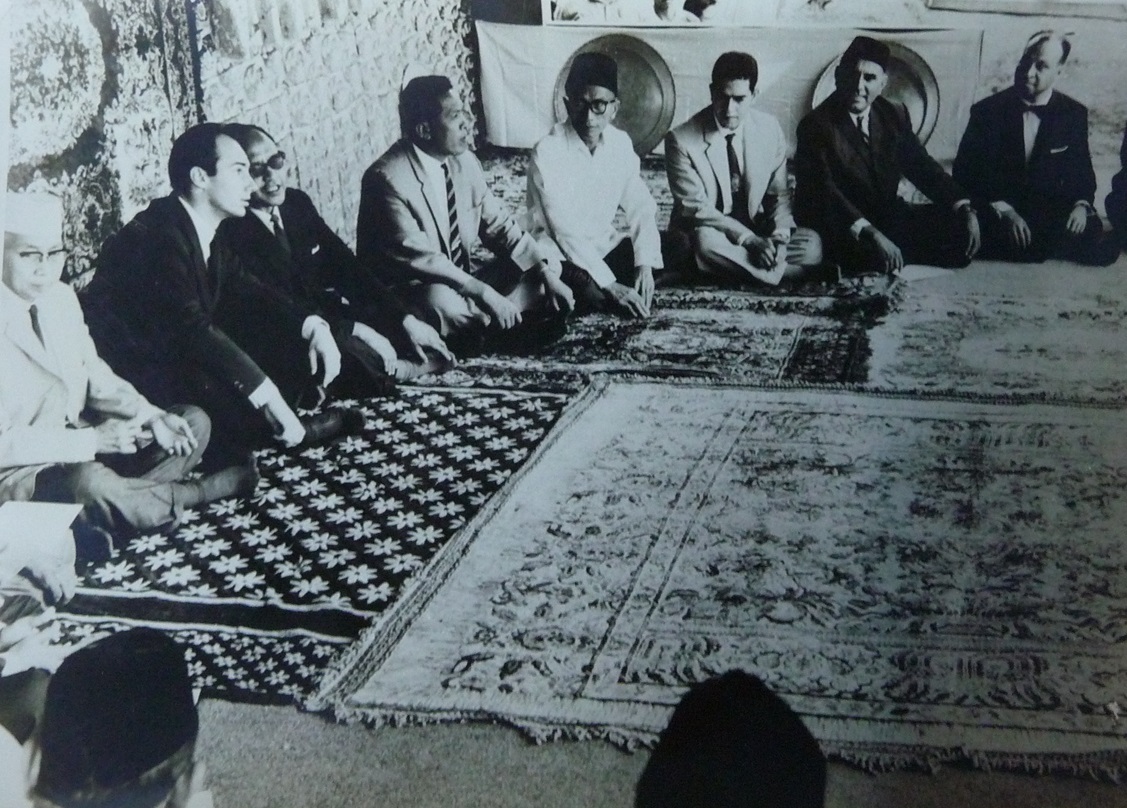
Mawlana Hazar Imam at a meeting with the leadership of Mindanao University and Kalimul Islam Colleges, Philippines during his visit in 1963. The information on the back of the photo reads: “Kamilul Islam Colleges Convocation Function in Honour of H.R.H. Prince Karim Aga Khan. The Aga Khan is seen sitting in the Philippine Native style flanked by Dr. Antonio Isidro, President of Mindanao State University on his right and Honourable Ahmed Domocao Alanto President of Colleges on his left. In the picture also are seen Mr. Amirali Fancy on his extreme left (back to camera) and Captain Amirali Currim second from the right, both wearing Philippine caps, who accompanied H.R.H on Philippine tour as his ministers”.
~~~~~~
Local institutions, including Jamatkhanas, throughout the world have often preserved innumerable documents, manuscripts, published works, photographs and even newspaper cuttings which shed light on one of the least understood and most complex periods of Ismaili history — the last few hundred years. As Jamats in local environments fell under the dominion of various empires and rulers, and later national governments, local histories become increasingly important for understanding how Ismaili communities have come to be where they are today.
Story continues below
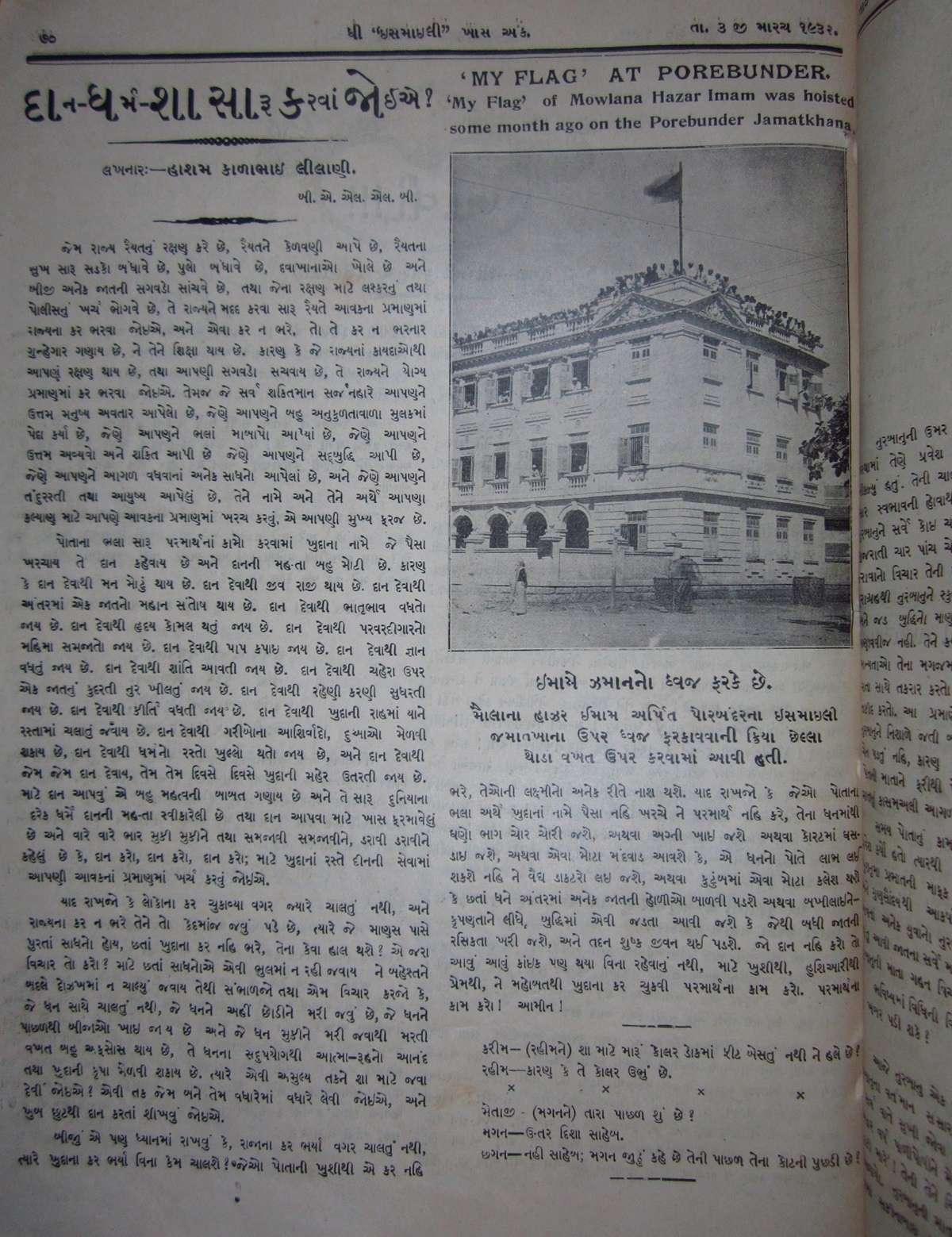
A page from The Ismaili magazine, March 3rd, 1932 edition showing a photograph of the newly raised “My Flag” at Porbander Jamatkhana.
Furthermore, since the early 1980s as part of the global processes of standardization and institutionalization, the focus of important publications such as local Ismaili magazines have shifted the majority of their spotlights to the Imam, his family and the work of Imamat institutions where previously the magazines also included much more detail, output on the production and development of Ismaili communities through the lens of the local and told from the ground-up. While there has been many things gained in the centralization of the Ismaili magazines, one of the most notable losses has been the capturing of stories of the ground realities, literary output, reflections of individual Ismailis and the vibrancy and details of the local development of Ismaili communities.
Story continues below
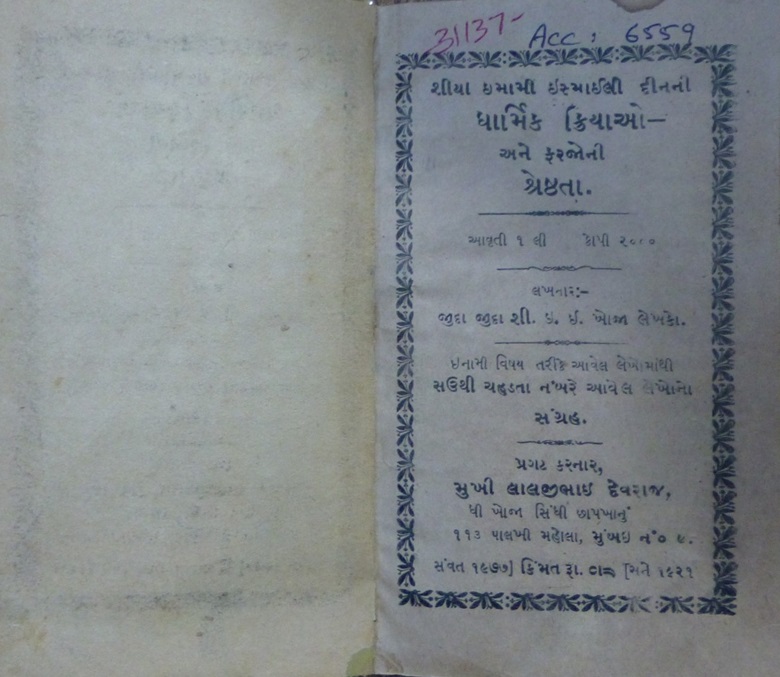
The cover of a text on religious ceremonies by Mukhi Laljibhai Devraj published by a Sindhi press in Mumbai in 1921.
~~~~~~
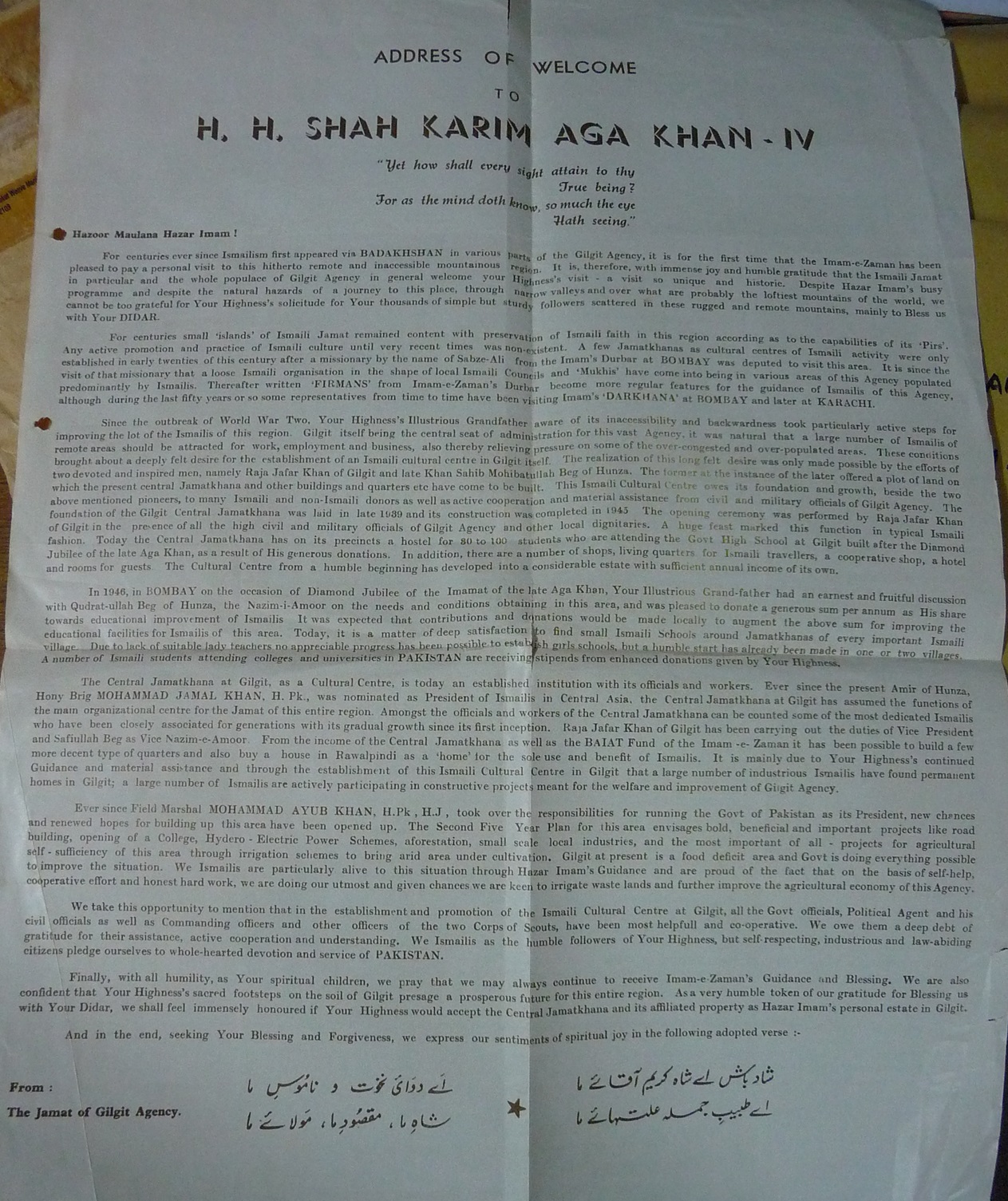
Address of Welcome offered to Mawlana Shah Karim Hazar Imam, His Highness the Aga Khan, on the occasion of his first visit to the Gilgit Agency in October 1960.
~~~~~~
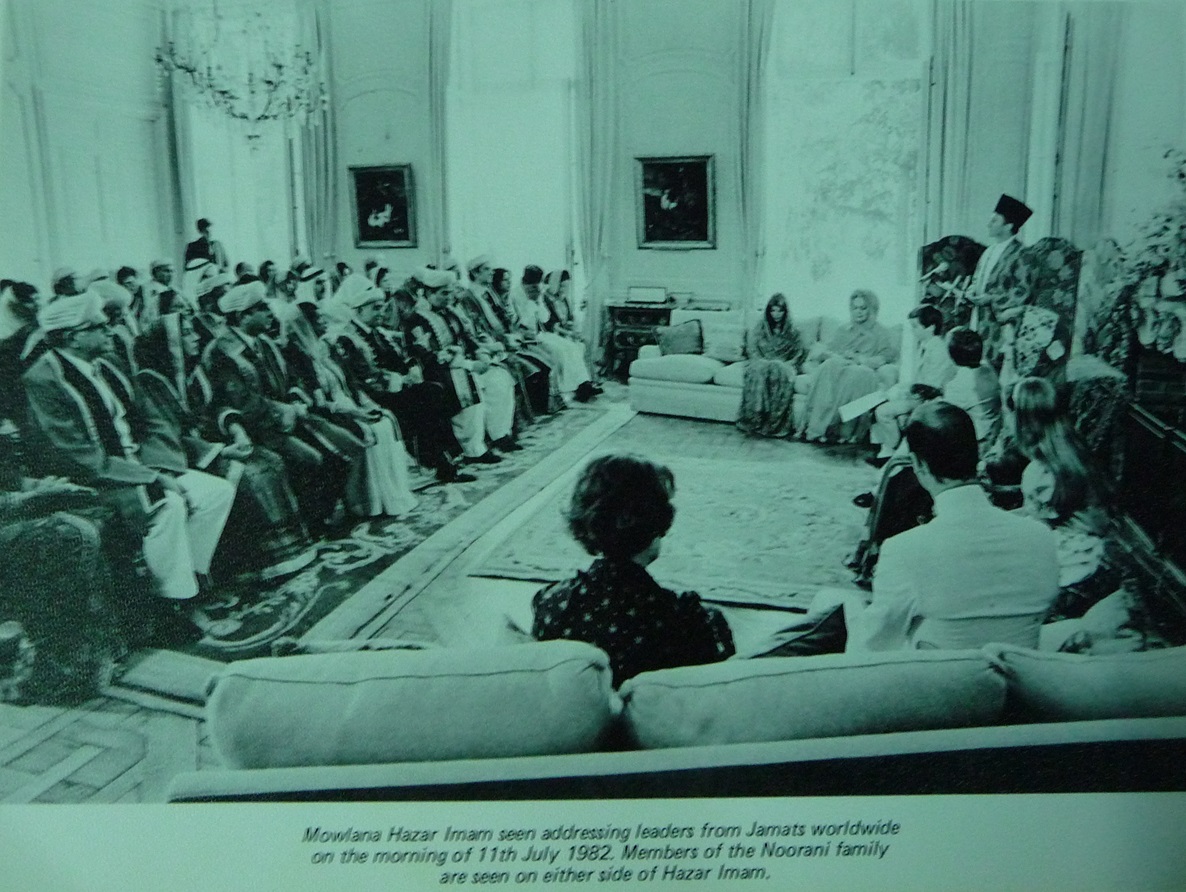
Mawlana Hazar Imam, His Highness the Aga Khan, addressing leaders of the global Jamat in the presence of his family on July 11, 1982, the occasion of his Silver Jubilee as the 49th Imam of the Ismaili Muslims.
I wrote this short piece with the hopes that it would be an homage or memorial of sorts to the Central ITREB Library Pakistan and to encourage families and small institutions to safeguard their collections for the benefit of the community in the service of documenting its past. We must also remember that just as important, however, is to preserve the present for future generations.
Date posted: November 11, 2023. Last updated: November 13, 2023 (see editor’s note at top of page).
__________________
About the author: Rizwan Mawani has a background in Anthropology and Religious Studies and is the author of Beyond the Mosque: Diverse Places of Muslim Worship (I. B. Tauris in association with The Institute of Ismaili Studies, 2019). Rizwan has written for a wide variety of audiences and his work has appeared in academic publications, encyclopedias as well as the Wall Street Journal and The Huffington Post. Rizwan was previously Website Content Editor and Research Coordinator in the Department of Constituency Studies at The Institute of Ismaili Studies. His current research focuses on the past two centuries of global Ismaili history with a focus on the Jamatkhana and its development during that period.
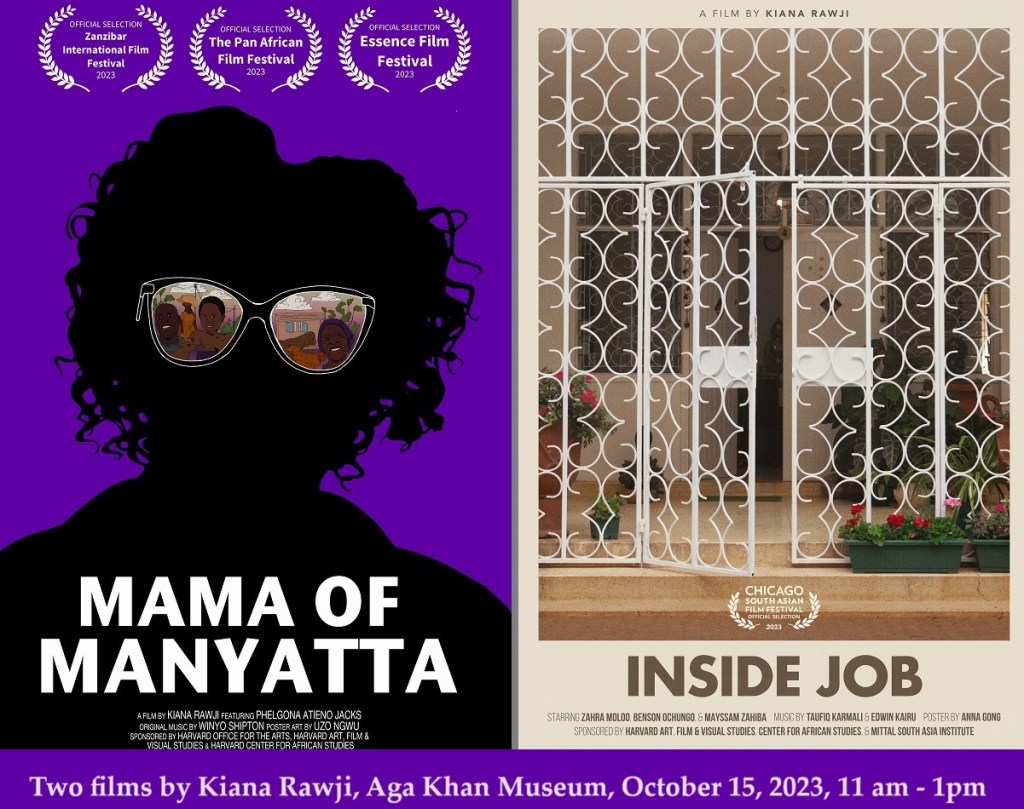
On October 15th, 2023, two extraordinary films — Inside Job and Mama of Manyatta — made by a remarkable young artist, Kiana Rawji, screened at the Nanji Family Foundation Auditorium at the Aga Khan Museum in Toronto with resounding success. In the packed auditorium of over 200 people on a Sunday afternoon, the event evoked laughter, tears, and in the end, a well-deserved standing ovation. I had the honour and privilege of serving as the emcee for the event, and thoroughly enjoyed seeing both films which explored vastly different issues albeit in the same East African country where I was born and lived until the age of seven. I found Inside Job especially thought-provoking and it resonated with me very powerfully as it examined important themes with which my own family would have grappled around the time that we left Kenya in 1972. I found myself deeply moved and indeed very emotional after the screening of Mama of Manyatta in which Rawji very skillfully tells a story of hope, resilience, compassion and the truly incredible journey of a community leader and mother figure working tirelessly for social justice.
Inside Job is a fictional film about an Indian woman who, when preparing to leave her home in 1970s Kenya, loses a piece of jewelry and suspects that one of her African domestic workers stole it. Mama of Manyatta is a short documentary film about Phelgone Jacks, an extraordinary woman fighting HIV and gender-based violence in a Kenyan slum.
Zainub Verjee giving her opening remarks
The event began with opening remarks made by Dr. Zainub Verjee, an accomplished writer, critic, curator, contemporary artist, and public intellectual, as well as an accomplished leader in the arts and culture sector. “When I previewed these works,” Dr. Verjee said, “I was really moved by its poetry. But more importantly, what struck me was its feminist ethos.” She continued to speak about the importance of films made with a political consciousness and the role of artists and filmmakers as imperative witnesses and narrators. Dr. Verjee asserted, “It takes moral courage to tell a story. It takes moral courage to act and to speak for the public good. To speak for the oppressed. To speak for a society, to speak for peace, to speak for pluralism, and to speak for making this world a better place.”
The screening of the two films was followed by a Q&A moderated by Narendra Pachkhédé, a trained filmmaker who practiced as a multidisciplinary artist, curator, programmer, critic and writer. Remarking on Rawji’s films that screened, Pachkhédé reflected, “In both these works, the story emerges as a site of micropolitics, albeit in different ways. Inside Job cleverly frames the power relations within this interracial narrative, and yet stays clear of dipping into a sentimental tone… And how those boundaries are drawn that keeps just the right distance between the subject and the perspective and the mood of the film: the pacing… While Mama of Manyatta defines how communities of care are formed.”
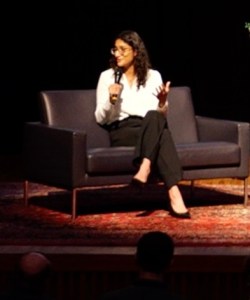
Kiana Rawji in conversation with Narendra Pachkhédé following the screening of her two short films at the Aga Khan Museum Toronto, October 15, 2023.
When asked about what drew her to filmmaking in the first place, Kiana reflected on the first film class she ever took, out of sheer curiosity, during her first year at Harvard: it was a course at MIT called Social Justice and the Documentary Film taught by filmmaker and Professor Vivek Bald. This class opened her eyes in more ways than one. Kiana explained that it was her realization of the power of film to engage with social justice issues combined with the discovery of her passion for it that propelled her into the practice. She explained, “I absolutely loved the process; I learned so much about myself, about others, about the world around me… I loved holding a camera, I loved interviewing people, I loved the research… something clicked for me, and I realized this is what I want to do, and I haven’t looked back since.”
Inside Job, a film by Kiana Rawji premirred with Mama of Manyatta on Sunday, October 15, 2023, at the Aga Khan Museum, Toronto.
Rawji discussed various elements of the films and what inspired them both. With Inside Job, it was important to her to shed light on history through the lens of those often unheard in the archives, impacted by colonialism. “If you think about what gets counted in the history books,” she said, “it’s so rare to have a Harvard research project about a woman’s life in the kitchen. But that’s what I was really interested in from a very academic, intellectual standpoint, and from an emotional standpoint — I wanted to know what life was like, because that’s what you need to make a film and create the world.” She was interested in how intertwined racial and socioeconomic hierarchies constructed during the colonial era affected daily, intimate relationships between black and brown East Africans in the household; how cultural norms could be both reinforced and transcended behind closed yet porous doors.
Mama of Manyatta, a film by Kiana Rawji premiered with Inside Job on Sunday, October 15, 2023, at the Aga Khan Museum Toronto.
With Mama of Manyatta, Rawji similarly sought to give voice to those overlooked in society and to change the narrative. She asserted, “There is so much resistance in resilience, in joy, in dignity. And these are all things that Phelgone was cultivating every day, despite that hardship and the trauma that she was witnessing and helping people move through.” Rawji did not want to create another narrative of the suffering African poor, and instead, wanted to tell a story of African self-empowerment, endurance, and resilience.
Kiana Rawji engages with the audience.
On the topic of race and its role in her work, Rawji referenced a historian who influenced her own thinking early on at Harvard, teaching her that, though race is a social construct and is not “real,” the consequences of it are real and cannot be ignored. Rawji explained that her own films strive to “tackle the consequences of race – the ways that the constructions we have of each other, and systems of oppression that are based on race, are affecting people in their daily lives, whether it’s in Manyatta or in an East African Asian home in 1970s Nairobi. And I think the implications are always there, looming, and it’s about how we move through what race has caused in our societies.”
It was a real pleasure to have the opportunity to watch these two wonderful and very well-made films by such a talented, up-and-coming young artist. What Rawji has so ably done, through both Inside Job and Mama of Manyatta, is teach us about history from a truly unique perspective. She has given us so much to think about in the profoundly moving way that she gives voice to the forces of resilience, community, and hope. The screening of Inside Job and Mama of Manyatta on October 15 was an inspiring event which gave those in attendance an early peek into the work of a gifted filmmaker with tremendous promise who will undoubtedly continue to make a real and meaningful difference through her films.
Date posted: November 1, 2023.
______________________
We welcome feedback from our readers. Please click LEAVE A COMMENT. Your letter may be edited for length and brevity and is subject to moderation.
Aly Alibhai
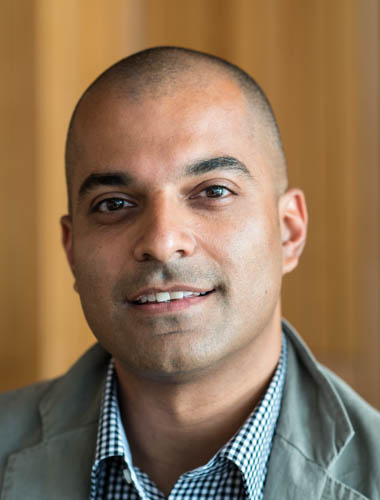
About the author: Aly N. Alibhai has a Bachelor of Commerce degree from the University of British Columbia’s Sauder School of Business and obtained a Juris Doctor degree from the Faculty of Law at the University of Windsor. He has worked in different capacities as a lawyer, adjudicator and public sector executive at different levels of government in Canada and has an extensive and longstanding history of community service and engagement in the governance of a host of different not-for-profit and civil society organizations. Currently, Mr. Alibhai serves as an executive with Ontario Public Service as theDirector of the Child, Youth and Family Services Act Review Branch in the Strategic Policy Division of the Ministry of Children, Community and Social Services and is the Vice-Chair of the Board of Directors of Bellwoods Centres for Community Living Inc. in Toronto, a member of the Board of Directors of Rooftops Canada/Abri International, and a member of the Complaints Committee for the Human Resources Professionals Association of Canada.
~~~~~~
Kiana Rawji
About the filmmaker: Kiana Rawji is an award-winning filmmaker from Calgary, Alberta, and daughter of South Asian immigrants from Kenya. She recently graduated summa cum laude from Harvard College studying Film and History & Literature. Through film, she tries to amplify social issues and drive cultural change; from independent theatres to Oscar-qualifying film festivals, her films have screened across Canada, the USA, and East Africa. Kiana’s TEDx talks on Islam and the Cosmopolitan Ethic have reached over 150,000 people worldwide. She has a website www.kianarawji.com and you can stay tuned for upcoming opportunities to view Kiana’s films and stay updated on her future work by following her on Instagram @kianarawjifilms.
February 14th, Valentine’s Day, and Mother’s Day are the most significant days for the flower industry. Still, there is almost an entire season — and not just a day — in Canada and the USA where the pumpkin remains the king in indoor and outdoor markets and at numerous events celebrating corn and pumpkin harvests. In fact, Calgary and other cities acround Canada including Edmonton, Milton, Burnaby and Ottawa are hosts to “Pumpkins After Dark“, Canada’s award-winning outdoor fall event that feature over 10,000+ hand-carved pumpkins.
The pumpkin is associated with Thanksgiving in Canada (2nd Monday in October) and the USA Thanksgiving (4th Thursday in November), and is one of the most popular desserts served during the holiday. In between, on Halloween Day, October 31, pumpkin heads are put to scary uses through creative works of art. Aside from the pumpkins’ use in decorations and artistics works, the fruit is used in restaurants in North America, such as Starbucks, Tim Horton, McDonalds and many others for special pumpkin chais, coffees and desserts.
Story continues below
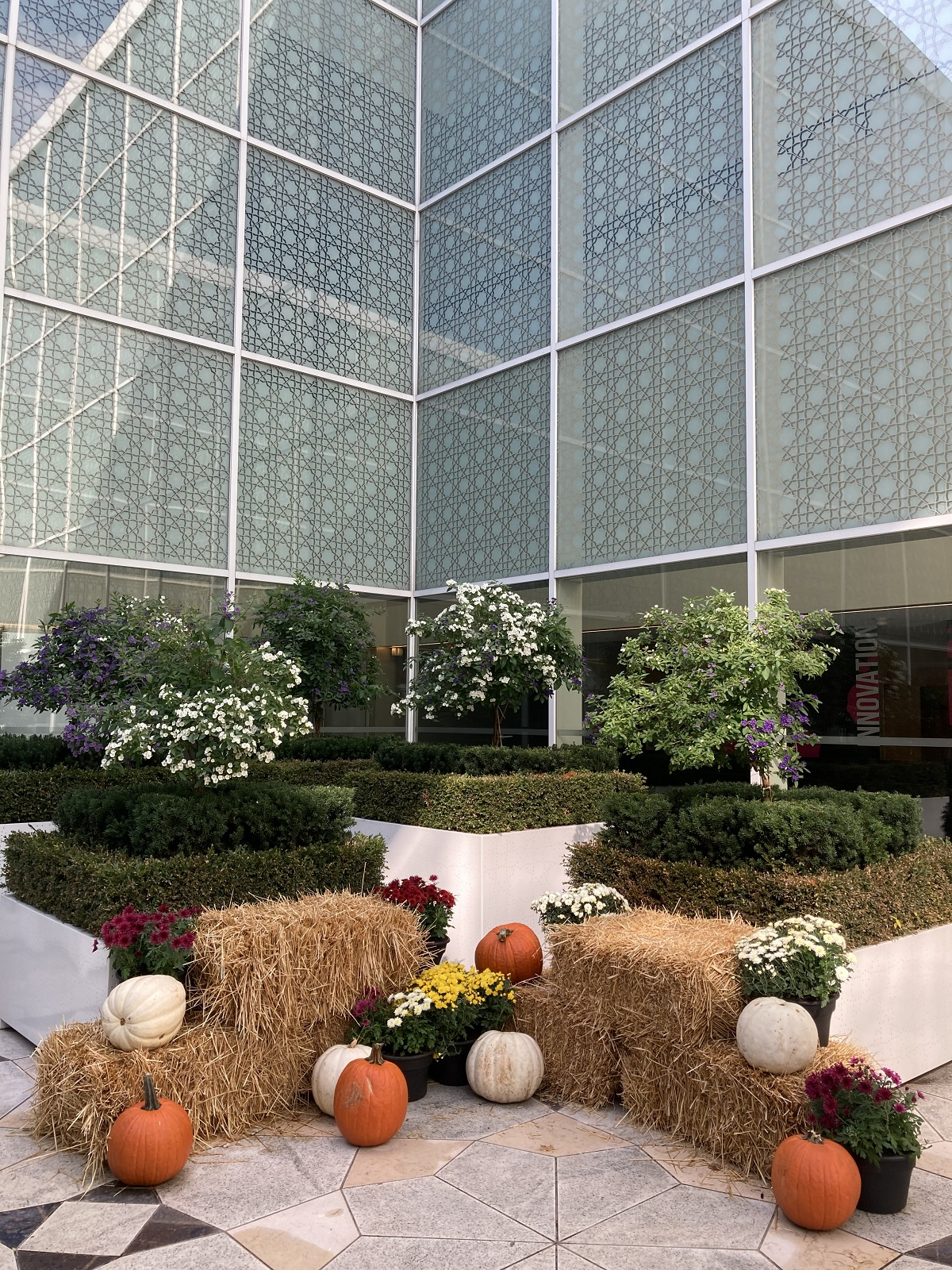
Aga Khan Museum Toronto Courtyard decorated with pumpkins, October 23, 2020. Photograph: Malik Merchant / Simerg.
My real interest on the health benefits of the pumpkin was drawn when I saw the large fruit decoratively laid out at the Aga Khan Museum’s coutyard during the pumpkin season some three years ago. I then wondered whether the fruit was mentioned anywhere in Islamic literature and, to my amazement, I read that the Prophet Muhammad (may peace be upon him and his progeny) was fond of pumpkins. I am pleased to include a small selection of adaptations from readings that I found.
“I saw the Prophet being served with soup and containing gourd (pumpkin or squash) and cured meat, and I saw him picking and eating the pieces of gourd.” — Bukhari Volume 7, Book 65, Number 348.
It is related that a sailor once invited Prophet Muhammad to eat some food that he had prepared. Anas bin Malik, a companion of the Prophet, noted that the Prophet was served barley bread and a soup with pumpkin in it. The Prophet keenly ate the pumpkin around the dish, and from that day Anas made it his favourite food. Traditions also note that whenever a a dish of bread, meat and broth was presented to the Prophet and it contained pumpkin, the Prophet would pick up the pumpkin because he really liked it, and made the heart strong. Other Muslim traditions note that the pumpkin increases brain function and brain strength.
Ibn Ridwan, in a medical treatise written during the Fatimid period, recommended the pumpkin as a diet for healthy living along with several other fruits and vegetables such as celery, carrots, lentils and cucumbers.
Interestingly, there is also a general consensus among researchers and scholars about the Arabic word yaqteen that is mentioned in the Holy Qur’an. They say that it refers to the pumpkin — a food that nourished and helped heal Prophet Yunus, after he was cast into the wilderness while he was sick (see Qur’an, 37:144-146, at Corpus Quran English Translation).
The website healthline mentions that pumpkin is rich in vitamins, minerals and antioxidants, and is incredibly healthy. Moreover its low calorie content makes it a weight-loss-friendly food. It goes on to add that “its nutrients and antioxidants may boost your immune system, protect your eyesight, lower your risk of certain cancers and promote heart and skin health.”
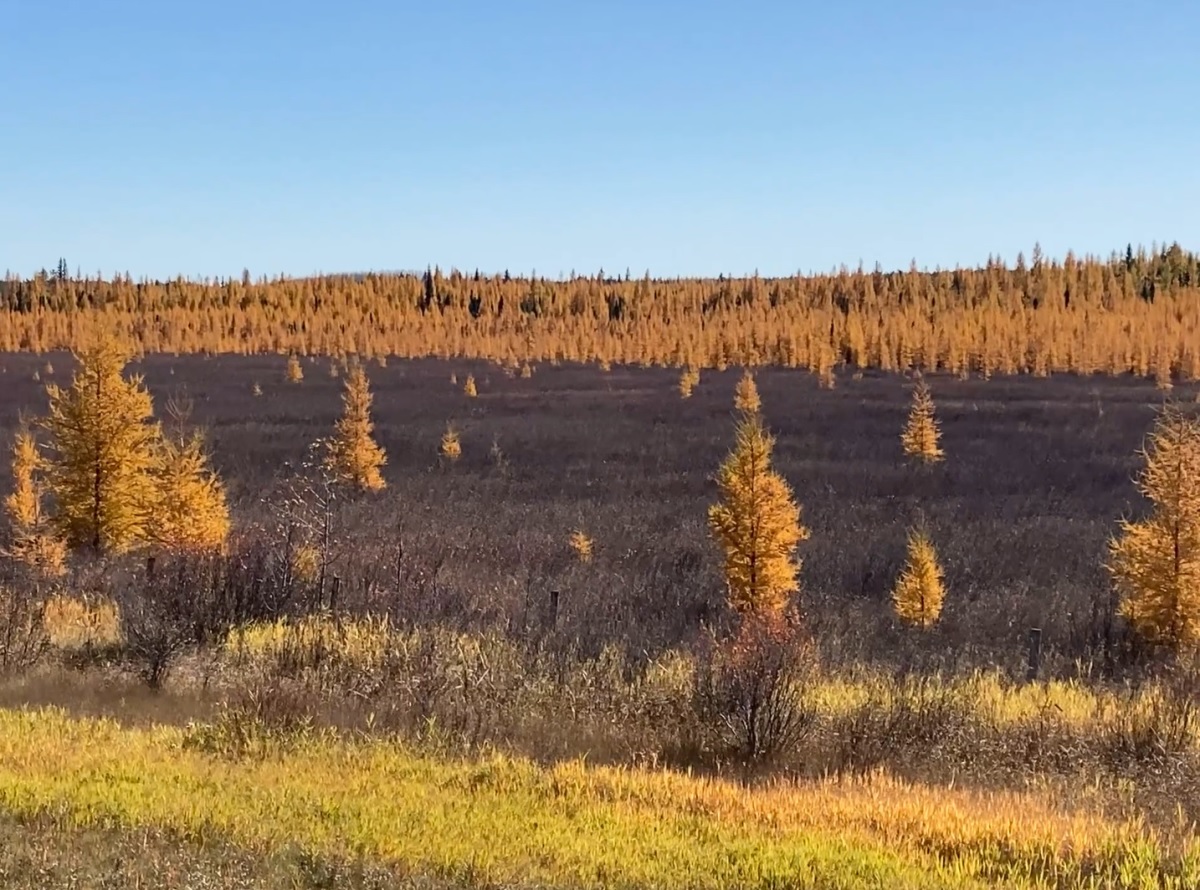
Larch trees along Alberta Hwy 12. Photograph: Malik Merchant/Simerg Photos.
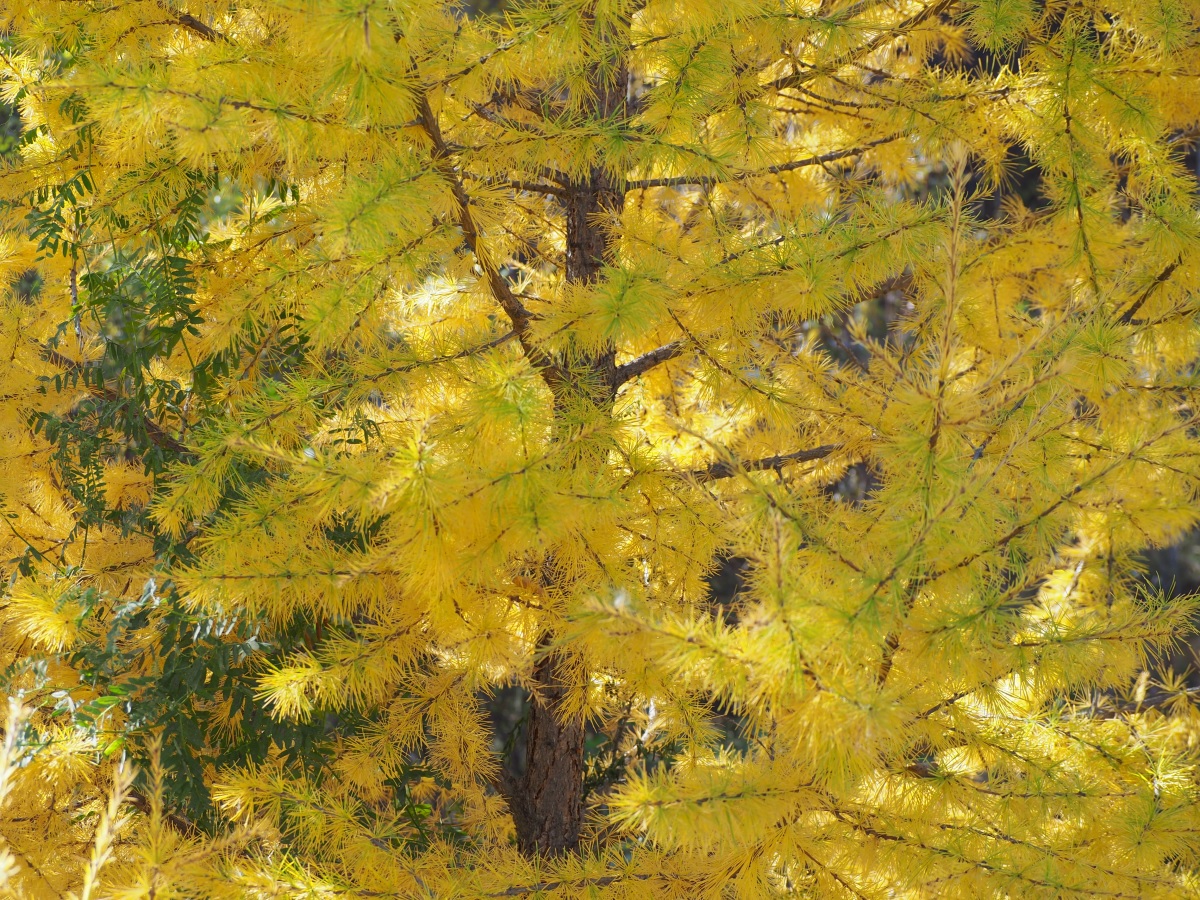
What a beautiful tree the larch tree is all year round. In autumn, larches in Alberta’s Rocky Mountains put on a spectacular show as their needles turn from green to golden yellow. The foliage attracts thousands of visitors from within Alberta and around the world. Found mostly at higher elevations, it often requires some hiking to see the spectacular LARCH autumn show from close range. However, I came across planted larch trees in Calgary’s Baker and Confederation Parks, and a week ago at the University of Alberta’s Botanic Garden in Edmonton — the focus of my visit was the Aga Khan Garden, a gift to Alberta by His Highness the Aga Khan, the 49th Hereditary Imam of the Ismaili Muslims. I might also note that I ran into large fields of larch trees as I took to Nordegg via Highways 12 and 11 (David Thompson Highway). Click Among the Larches to see my photos of foliage at the Aga Khan Garden. I also have other photo essays of my memorable trips to Alberta’s extraordinary parks and heritage sites and I invite you to see them on my beautiful photo blog.
Close-up, larch tree at Aga Khan Garden, University of Alberta Botanic Garden. Please click on image for autumn foliage photographs.
We are pleased to announce that a generous sponsor has donated a limited number of tickets for students, seniors (75+), newcomers, and any others for whom cost is a barrier to Kiana Rawji’s Film Screening in the Nanji Family Foundation Auditorium at the Aga Khan Museum on Sunday, October 15, 2023. Those identifying with these categories may use the promo code KRFILMS2023. The link to obtain tickets is https://krfilms.eventbrite.com/. When the screen is displayed, click on the icon Get Tickets; it will take you to the check-out screen where you can enter the promo code KRFILMS2023. The cost of the ticket, CA$22.63, will be waived and you will get a free ticket provided tickets are still available.
The two films screening on October 15th are:
Inside Job: A short fictional film about an Indian woman who, when preparing to leave her home in 1970s Kenya, loses a piece of jewelry and suspects one of her African domestic servants stole it; and
Mama of Manyatta: A short documentary about an extraordinary woman fighting HIV and gender-based violence in a Kenyan slum.
Kiana recently gave us an EXCLUSIVE INTERVIEW where she told us about her work and what inspires her. We now invite you to watch her two short films at the Aga Khan Museum in Toronto on Sunday, October 15.
Purchase Tickets at Eventbrite for Kiana Rawji’s Film Screening at the Aga Khan Museum, October 15, 2023, 11 AM – 1 PM
Click on https://krfilms.eventbrite.com/ or on the image below to obtain your tickets. If cost is a barrier, use the Promo Code KRFILMS2023 to acquire a free ticket; Kiana wants everyone who wants to attend to be able to attend the screening of her films. Tickets are limited!
Please click on image to purchase tickets at Eventbrite. If cost is a barrier, enter promo code KRFILMS2023 at checkout for a free ticket.
Date posted: October 14, 2023.
____________________
Kiana Rawji
Kiana Rawji is an award-winning filmmaker from Calgary, Alberta, and daughter of South Asian immigrants from Kenya. She recently graduated summa cum laude from Harvard College studying Film and History & Literature. Through film, she tries to amplify social issues and drive cultural change; from independent theatres to Oscar-qualifying film festivals, her films have screened across Canada, the USA, and East Africa. Kiana’s TEDx talks on Islam and the Cosmopolitan Ethic have reached over 150,000 people worldwide. Please click https://krfilms.eventbrite.com/ to attend her two short film screenings at the Aga Khan Museum on Sunday, October 15, 2023.
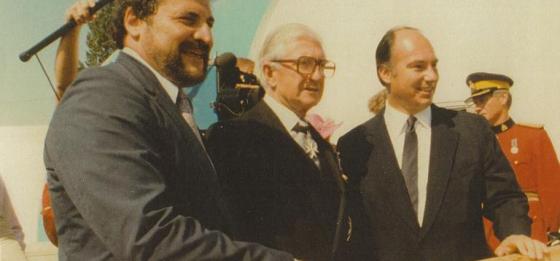
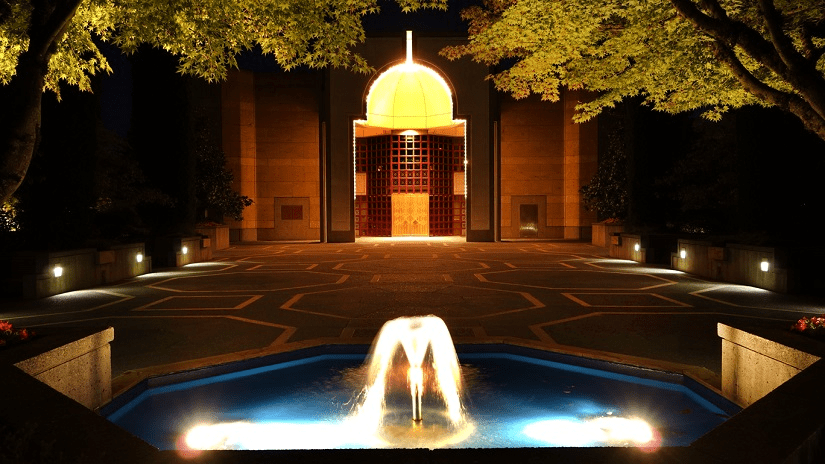
Bruno Freschi (Order of Canada, OC) discusses his project of building the first Ismaili Centre in North America in Burnaby, British Columbia, and his compassionate journey with His Highness the Aga Khan, the 49th Hereditary Imam of the Ismaili Muslims, in creating a new Jamatkhana for the Ismailis. Freschi writes: “The journey was a patient, creative search with the Ismaili community, exploring architecture for an established culture in a new community. In all his architectural undertakings, His Highness has honoured both the Islamic architectural traditions and evolutions of that heritage within diverse cultures.” READ MORE
On October 15, at the Aga Khan Museum’s Nanji Foundation Auditorium, will be the Canadian premiere of two short films by award-winning Canadian filmmaker, Kiana Rawji. Kiana recently graduated summa cum laude from Harvard College with a joint concentration in History & Literature and Film, specializing in Cross Cultural Encounters, Diasporic Identities and The Indian Ocean. From independent theaters to Oscar-qualifying film festivals, her films have screened across Canada, the US, and East Africa.
The two films screening on October 15th are:
Inside Job: A short fictional film about an Indian woman who, when preparing to leave her home in 1970s Kenya, loses a piece of jewelry and suspects one of her African domestic servants stole it; and
Mama of Manyatta: A short documentary about an extraordinary woman fighting HIV and gender-based violence in a Kenyan slum
In our interview with Kiana we learn more about her work and what inspires her. We invite you to watch her two short films at the Aga Khan Museum in Toronto on Sunday, October 15:
Voices: Simerg’s Interview with Kiana Rawji
“I strive to tell stories that recognize diversity, complexity, and nuance, while connecting people through universal, human experiences. I’m especially interested in topics surrounding migration, diasporas, and identity” — Kiana Rawji
Kiana Rawji
Simerg: Can you tell us about how you got into filmmaking?
Kiana Rawji: Throughout high school, I had been interested in the intersection between storytelling and social justice, and I had pursued that through writing and public speaking. Filmmaking was always a hobby of mine growing up, but I never even considered it as an academic or career path. When I got to Harvard, I thought I was going to study Government and go to Law School. But then I took a class called Social Justice and the Documentary Film my first year and I was drawn to film as a provocative medium to raise awareness, evoke empathy, and elevate marginalized voices. After I made my first short film in that class, I never looked back. Now I can’t imagine myself as anything other than a filmmaker.
At Harvard, I pursued a joint concentration because through History & Literature, I could learn about the very histories, in all their nuance and complexity, that would inform the stories I want to tell through film. Inside Job was a perfect example of that.
Simerg: Where did the idea for Inside Job come from?
Kiana: The film was largely based on my own family history — my parents and grandparents grew up in Nairobi, but before that my family traces back to Gujarat, India. I knew I wanted to make a film set in the 1970s Kenya, during a period of exacerbated racial tensions, due to the rise of ethnocentric nationalism in the region. I was particularly interested in the ways “Africans” and “Indians”/“Asians” perceived and interacted with each other. Since society was so racially segregated though, I realized the most common realm of interracial interaction and intimacy was in the household; virtually all brown households employed black domestic “servants”. What was all the more interesting was that, despite the deeply entrenched taboo that restricted social contact between brown women and black men in particular, these two types of people consistently interacted on a daily basis through the domestic labor relationship. I started to wonder how larger cultural norms and boundaries as well as political tensions were both reinforced and transcended in such close quarters.
Interview continues below
Inside Job, a film by Kiana Rawji that will premiere with Mama of Manyatta on Sunday, October 15, 2023, at the Aga Khan Museum, Toronto.
So I decided to explore that dynamic through oral history research. I interviewed many East African Asian women who lived through the 70s, as well as black African domestic workers. These interviews informed my whole script, from the subtleties of the dialogue to the core elements of the plot. I decided to focus on the theme of theft because of how much it came up in my interviews, and how symbolic it was; it was clear that both sides felt the other had stolen something from them. South Asians in East Africa felt that their own homes, along with properties, businesses, etc., were stolen from them when they were largely expelled from the region in the 70s. At the same time, native East Africans felt that “Asians” had stolen all the wealth and land in the first place. Both were stuck in a colonial system of inequality and a highly racialized socioeconomic hierarchy that lasted well beyond the colonial period. It’s a complex issue. Both sides built up mythologies around and resentments toward each other, and I think part of that can be reflected in relationships fostered in the household.
Simerg: What was most difficult about filming Inside Job?
Kiana: Well, the effort to make a period film in a foreign country in under a week with a budget under $10,000 was a huge challenge in itself. But I was able to find an incredible, talented cast and crew to achieve this and make it all easier.
The biggest challenge I faced was trying to get it right. I was recreating a history that I hadn’t lived through. I studied Swahili at Harvard and that helped but I don’t even speak or understand Gujarati. But the way I addressed that challenge was to consult a lot of experts.
The interviews I conducted before writing the script were, themselves, instrumental to helping me understand the details of what it was like to live in 1970s East Africa, from the food that was eaten to the daily routines. I looked at old photos from my interview subjects as source material for my costume designer. I based the Indian family off of an Ismaili family, since that’s who I was primarily interviewing and that’s my family history, so that meant that the family would be much more westernized than other South Asians in the region, wearing western clothing and using British dishware.
I was fortunate to receive generous support from Nazim Mitha at the National Museum in Nairobi; he connected me with one of the main museum curators (who was helping put together the upcoming exhibit on East African Indians) who was basically my set design consultant, guiding me on props and setups. Shariffa Keshavjee, who has been a regular contributor to Simerg and an avid patron of the arts, was also such an amazing source of support; she was a source of cultural knowledge and also helped connect me to people in the local film industry. And then one of the most important things was finding actors who spoke the languages of the film (English, Gujarati, and Swahili) and could move authentically and fluidly between them, infusing scripted lines with their own touch. All these details are what helped me build the world of my film in a colorful, sensitive, and authentic way. It was one of the most fun and rewarding experiences I’ve had.
____________
“When it comes to filmmaking around social issues, I’ve learned that stories of injustice and adversity are incomplete without the stories of resilience and endurance that invariably exist alongside them” — Kiana Rawji
____________
Simerg: As for your other film, Mama of Manyatta, how did that come about? How did you come to meet the subject, Phelgone Jacks?
Kiana: A few years before I made the film, my older sister Zahra had met Mama Phelgone through a Harvard College summer global health program that connected students with local NGOs and CBOs. Mama Phelgone worked on removing stigma around those affected by HIV/AIDS in Kisumu. After spending some time with Mama Phelgone, Zahra told me there was a story there that I had to tell. The next summer (summer 2019), when I went to Kisumu and met Phelgone myself, I instantly agreed that hers was a story that needed to be told. Her community-centered approach to creating impact was remarkable, and she, herself, was one of the most generous, compassionate, and dedicated people I have ever met.
Twenty years ago, Phelgone founded a community-based organization fighting HIV/AIDS and gender-based violence in the slum of Manyatta in Kisumu. She was a mother figure to Manyatta’s young and old; she built an Early Childhood Development Center outside her home, hosted safe-sex workshops for teenage girls, counseling sessions for women survivors, and more. Though she helped people work through immense trauma, what was most remarkable about Mama Phelgone (as she was affectionately known in Manyatta) was that she cultivated strength and joy wherever she went, through prayer, song, and dance. She was, in her own words, an “ambassador of hope.”
Rather than the all-too-common narrative of the suffering African poor, I wanted Mama of Manyatta to present a portrait of African empowerment and leadership.
In a similar vein, while my 2021 documentary Long Distance was an exposé of systemic racial injustice in Canada’s immigration system, it was also, at its core, a love story about a Filipino immigrant couple — two resolute dreamers who prevailed despite the forces working against them. When it comes to filmmaking around social issues, I’ve learned that stories of injustice and adversity are incomplete without the stories of resilience and endurance that invariably exist alongside them.
Soon after I shot Mama of Manyatta in 2022, Mama Phelgone was diagnosed with metastatic cancer. She passed away in the middle of my post-production. Though I was deeply saddened, my drive to preserve a remarkable life and legacy only intensified. Through my film, I hope Phelgone’s story continues to inspire change.
Interview continues below
Mama of Manyatta, a film by Kiana Rawji that will premiere with Inside Job on Sunday, October 15, 2023, at the Aga Khan Museum Toronto.
____________
“I decided I didn’t want to be a filmmaker who hides behind her lens, observing, recording, then leaving. I want to be the kind who knows when to stop being a fly on the wall and start engaging — when to be a friend, not just a filmmaker. When artists get proximate to their subjects — which sometimes requires those precious interactions unmediated by a camera lens — opening their souls and immersing themselves in the lives of others, the product is more meaningful and fulfilling for everyone involved” — Kiana Rawji
____________
Simerg: What were some of the most memorable moments from the production/filming of Mama of Manyatta?
Kiana: There were so many — it was such a joy and a privilege to be included in the circle of warmth and love that Mama Phelgone radiated.
But there is one moment in particular that stuck with me. It was in the middle of a workshop on gender-based-violence; Phelgone was helping a group of women — survivors of sexual assault –prepare for upcoming post-election violence and the risk it posed to women in the community, including themselves. I remember that, when Phelgone sensed the air in the room growing heavy, she suggested a dance break.
And so they got up, they played music, they danced, they smiled, and they laughed.
Phelgone and the women beckoned for me to join them. But the filmmaker in me was so keen to capture every detail of this moment — the rhythmic body movements, the courageous smiles, the unbridled laughter. Something unexpected and beautiful could happen any second, and if my camera wasn’t rolling, I thought, I might miss it. But that day, I realized that sometimes you also miss things when the camera is rolling. After filming the women dancing for a few minutes, I decided to set down my camera and join them. They showed me some moves, I was awful, they laughed at me, Ilaughed at me, and it was wonderful.
I went into that shoot believing in the power of the camera, but I came out of it having also learned the power of putting it down. I decided I didn’t want to be a filmmaker who hides behind her lens, observing, recording, then leaving. I want to be the kind who knows when to stop being a fly on the wall and start engaging — when to be a friend, not just a filmmaker.When artists get proximate to their subjects — which sometimes requires those precious interactions unmediated by a camera lens — opening their souls and immersing themselves in the lives of others (whether through dancing, sharing meals, or conversations), the product is more meaningful and fulfilling for everyone involved.
Simerg: What inspires you? What drives your creative process?
Kiana: My intersecting identities as a South Asian Muslim woman and child of immigrants from East Africa inform the stories I want — and need — to tell.I strive to tell stories that recognize diversity, complexity, and nuance, while connecting people through universal, human experiences. I’m especially interested in topics surrounding migration, diasporas, and identity.
My creative process is driven by compassion, curiosity and collaboration. It begins with passion and personal investment in a story, followed by detailed research and engagement with real people and real stories. Sometimes my work is based on my personal life and serves as catharsis. Other times, I start with family history, like in Inside Job. Other times yet, I look for the extraordinary in ordinary people who endure injustice, like in Mama of Manyatta, or my previous documentary, Long Distance.
Simerg: What is your advice to aspiring filmmakers?
Kiana: It doesn’t take much to start. You don’t need fancy equipment or huge amounts of funding — all you need is a camera (which could be your phone) and a good story. There are so many resources online. I taught myself how to use film editing software and write film scripts on the Internet. It just takes initiative and passion, and if you have those two things, you’re off to the races. I always remember what my idol, Ava DuVernay, said once when giving advice to filmmakers starting out. (I remember meeting her at a Harvard event, and feeling so energized and unbelievably inspired by her; she is the person who made me realize I wanted to be a filmmaker in the first place). She said something along the lines of ‘don’t wait for something precious.’ Just begin. It doesn’t need to be the perfect, most eye-grabbing, world-changing idea. Everything you make will help you learn, and you’ll only get better. Just begin by telling stories you care about.
~~~~~~~~~
Purchase Tickets at Eventbrite for Kiana Rawji’s Film Screening at the Aga Khan Museum, October 15, 2023, 11 AM – 1 PM
A limited number of tickets to the screening of Kiana’s two films on Sunday, October 15, 2023 from 11 AM – 1 PM at the Aga Khan Museum’s Nanji Foundation Auditorium are available and can be purchased by clicking on EVENTBRITE – KIANA RAWJI FILM SCREENING. Secure your tickets ASAP before they sell out! The price of the ticket includes parking at the Museum.
On the day of the screening, the Museum’s restaurant, Diwan, will be open (it is recommended to make a reservation in advance) as well as the Museum cafe.
Film screening guests will receive a 50% off discount on museum tickets (normally valued at $20), and are invited to explore the Aga Khan Museum exhibitions before or after the screening, during operating hours of 10 AM – 5:30 PM.
~~~~~~~~~
Visit Kiana Rawji’s Website
Details about Kiana and her previous work can be found at www.kianarawji.com.
Date posted: September 28, 2023.
____________________
Kiana Rawji
Kiana Rawji is an award-winning filmmaker from Calgary, Alberta, and daughter of South Asian immigrants from Kenya. She recently graduated summa cum laude from Harvard College studying Film and History & Literature. Through film, she tries to amplify social issues and drive cultural change; from independent theatres to Oscar-qualifying film festivals, her films have screened across Canada, the USA, and East Africa. Kiana’s TEDx talks on Islam and the Cosmopolitan Ethic have reached over 150,000 people worldwide.
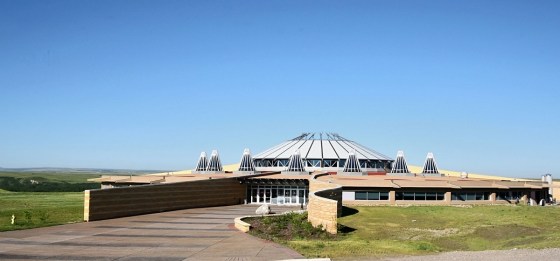
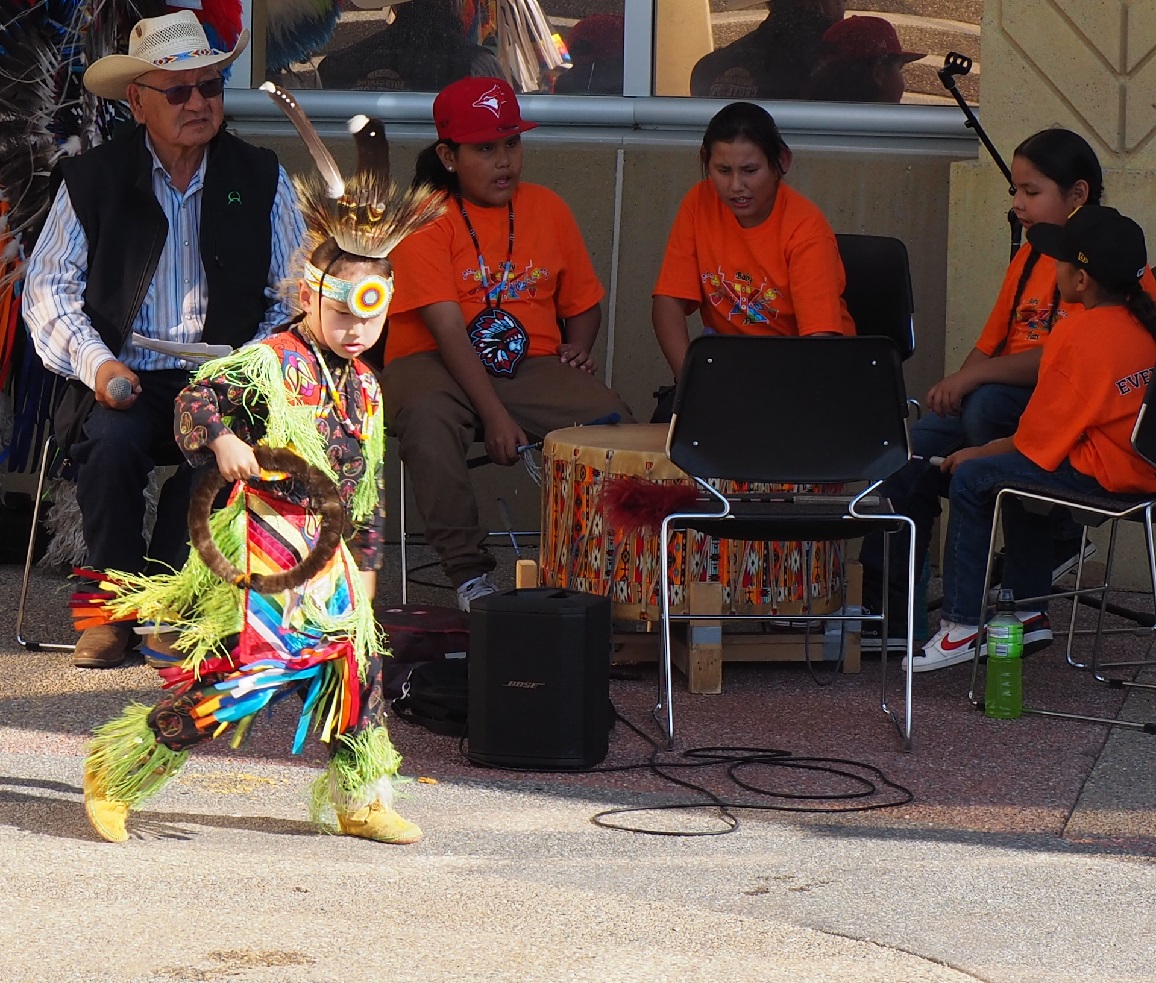
On Friday, September 22, 2023, Blackfoot Crossing, the Historic Site of the signing of Treat No. 7, held a special commemoration event to celebrate the 146th year of the signing with traditional activities that included drum beating and dancing by the children and youth of The Siksika People — also known as The Blackfoot. Malik Merchant drove down to the stunning site overlooking the Bow River. While he enjoyed the traditional activities as well as a BBQ lunch — all free on Commemoration Day — he was impressed and inspired by the exhibits in the beautifully curated museum dedicated to showcasing the history and culture of The Blackfoot.
Story continues below
A traditional dance performance by a young child to the tune of traditional drum beating by children and youth of the Siksika Nation. Please click on image for full report and more photographs.
~~~~~~~
A view of the valley and Bow River from Blackfoot Crossing’s lookout point. Please click on photo for full report and more photographs.
The Historical Park is just over an hours drive from Calgary and one cannot fail to admire and be impressed by the central building’s architecture that has tipis and tipi shaped structures incorporated into its design. The centre includes a cafeteria, a gift shop, a beautiful little theatre as well as an amphitheatre. The lookout point is 300 metres from the building and there is also a paved trail leading to see tipi tents and other interesting features of the area. Please click HERE or on the images below to view Malik’s full report and photographs. Also click Blackfoot Crossing Historical Park Website for more information about the unique heritage site. Plan a day to visit and learn about the history and culture of the Siksika First Nations People as well as to enjoy the beautiful natural surroundings and easy trails for the entire family.
~~~~~~~
A view of Blackfoot Crossings beautiful museum dedicated to the Siksika First Nations. Please click on photo for full report and more photographs.
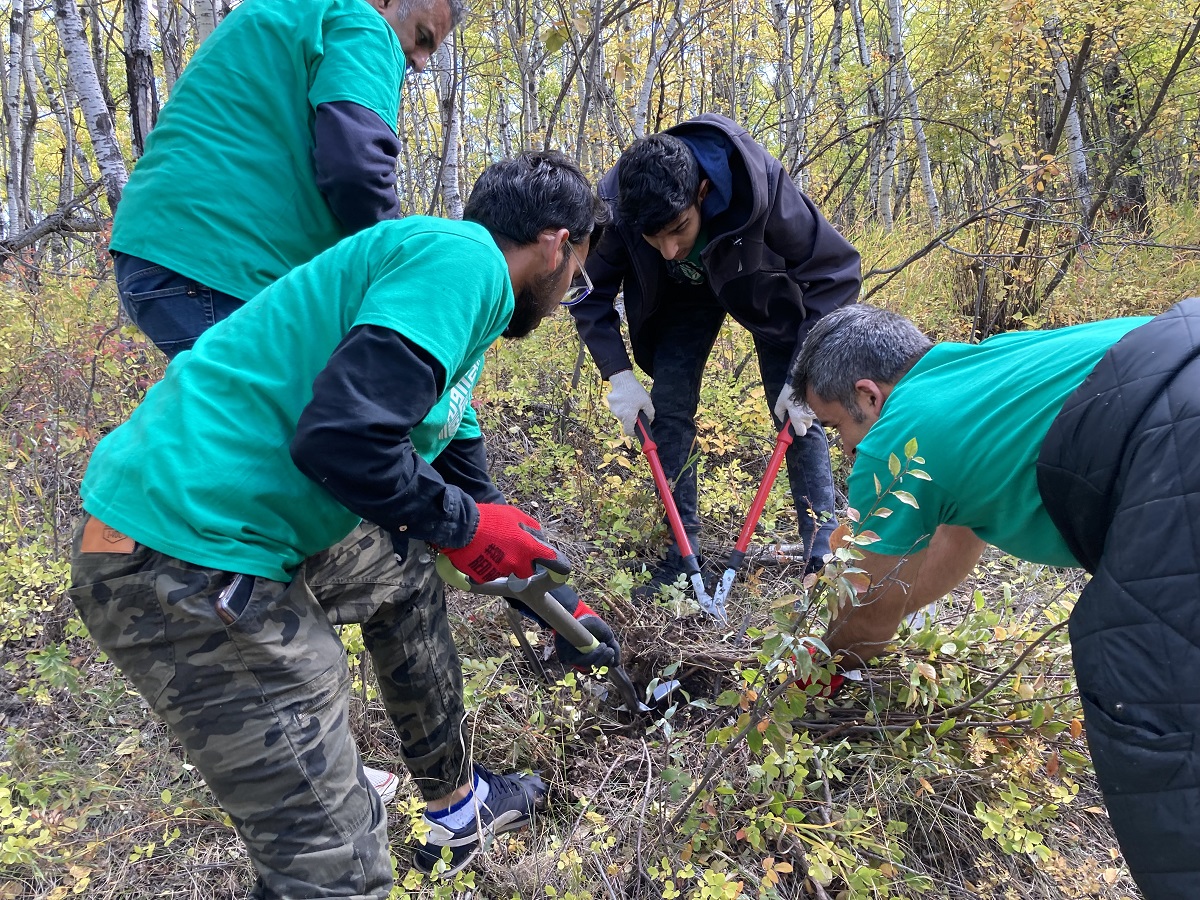
Guided by Dylann Golbeck, Coordinator of the Invasive Plants Program at the Weaselhead/Glenmore Park Preservation Society, Ismaili Civic Day volunteers participated in pulling out more than 100 invasive plants from a section of the Weaselhead Flats Natural Environment Park in SW Calgary on Sunday, September 24, 2023. Thousands of Ismailis around the world participated in unique ways in the annual Ismaili Civic Day weekend to contribute to local communities where they live. This year’s theme was Environmental Stewardship. For full story and photographs, please click ISMAILI CIVIC DAY CALGARY
Ismaili Civic Day volunteers pull out invasive plants from a Calgary Park. Please click on photograph for full story.