Simerg is an independent initiative dedicated to Ismaili Muslims, the Aga Khan — their Hereditary Imam — and the Ismaili Imamat, and Islam in general through literary readings, photo essays and artistic expressions
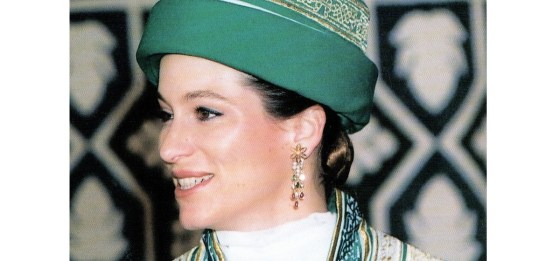
For almost three decades, Princess Zahra Aga Khan has immersed herself in the work of the Ismaili Imamat, a Hereditary Divine Institution which is led by her father, His Highness the Aga Khan, the 49th Imam in direct descent of the Prophet Muhammad (may peace be upon him and his family). The scope of the work of the Imamat extends to all areas of human endeavour and the entire family of the Aga Khan contributes to Ismaili institutions around the world as well as to the Imamat’s primary development organization, the Aga Khan Development Network (AKDN).
Princess Zahra is one of four children of the Aga Khan. As she celebrates her 53rd birthday on September 18, we bring to our readers her beautiful story through a selection of photographs that we have been able to gather from printed Ismaili community magazines as well as the official websites of the Ismaili Imamat. Please click PRINCESS ZAHRA AGA KHAN.
Albertans and Canadians may note that she was here 12 months ago for the opening of the Diwan Pavilion at the Aga Khan Garden in Edmonton, part of the University of Alberta’s Botanic Garden. The garden was a gift from the Aga Khan to the university.
Please click on photo for story of Princess Zahra Aga Khan.
The Ismaili Imamat is a Hereditary Institution and originates from the time the Prophet Muhammad (may peace be upon him and his family) appointed Hazrat Ali — his cousin and son-in-law — to succeed him as the Imam at a pivotal gathering held between Mecca and Medina following his final pilgrimage. The current Hereditary Imam of the Shia Imami Ismaili Muslims, directly descended from Imam Ali (may peace be on him), is His Highness the Aga Khan (actual name Shah Karim Al Hussaini) who is lovingly addressed by his Ismaili Muslim followers as Mawlana Hazar Imam (Our Lord, the manifest and present living Imam).
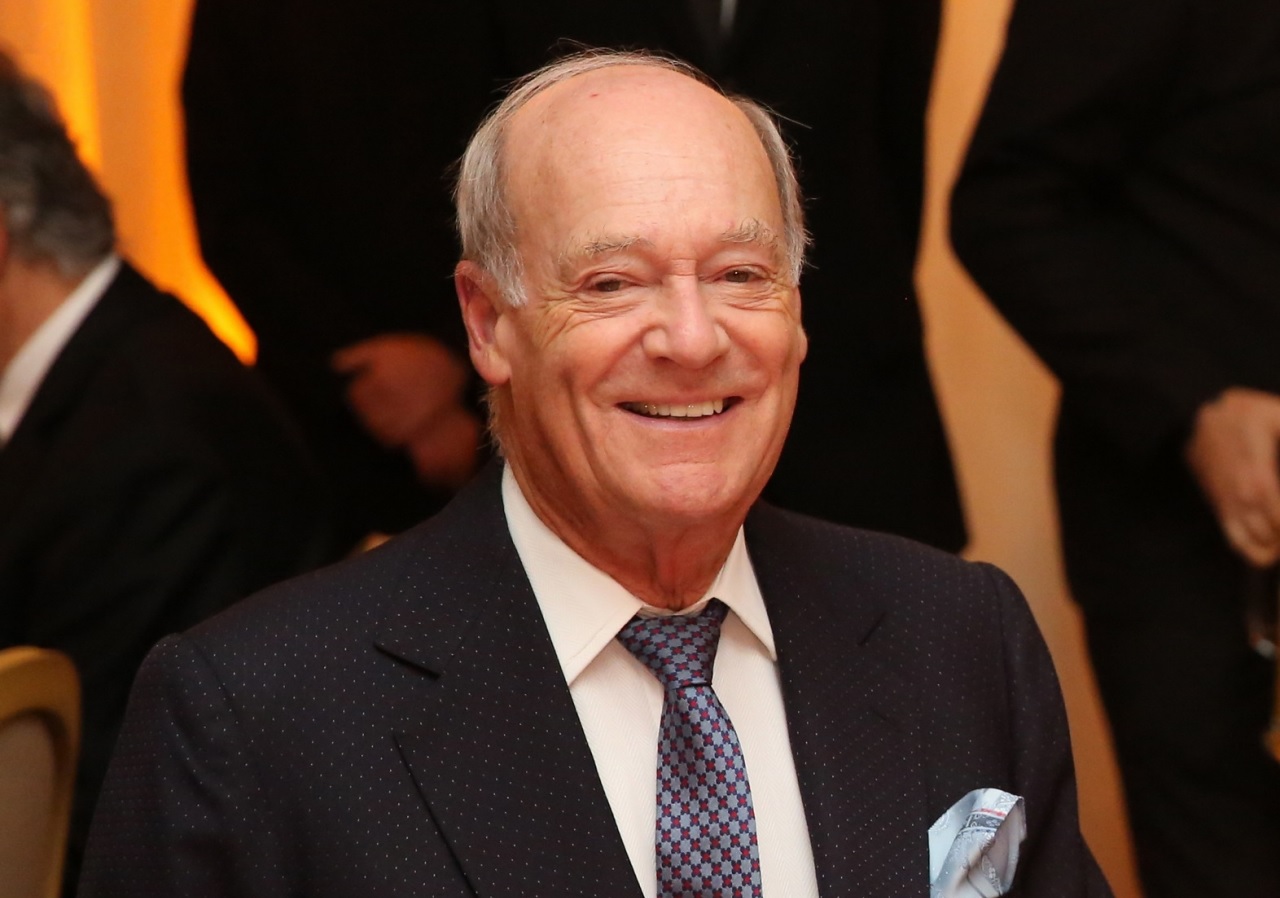
Canada is home to more than 100,000 Ismailis and the Aga Khan Museum in Toronto, the Aga Khan Garden in Edmonton, and the Global Centre for Pluralism in Ottawa are just some of the many projects of the Ismaili Imamat in Canada. The Aga Khan’s younger brother Prince Amyn has been singularly involved in these and other projects of the Imamat around the world for almost six decades and we honour him today, September 12, 2023, as he celebrates his 86th birthday. Please click Prince Amyn Aga Khan or on the photographs to find out more about his contribution and devotion to the Imamat.
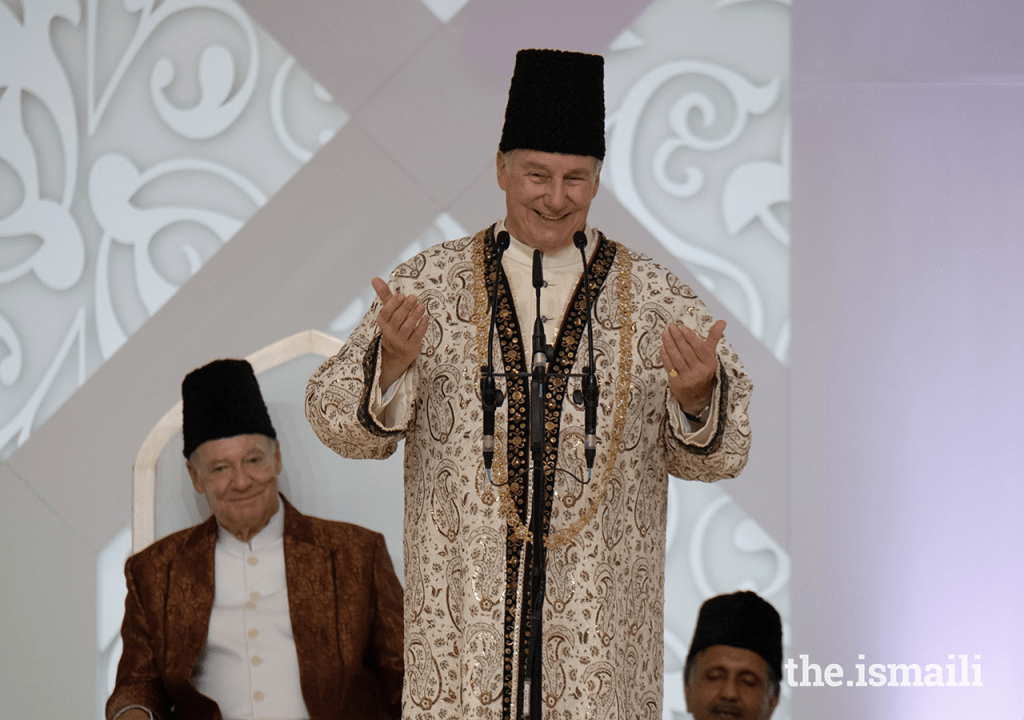
Prince Amyn Aga Khan, seated at left, looks on as his older brother, His Highness the Aga Khan, addresses his Ismaili Muslim followers at a Darbar — a grand ceremonial gathering — in Lisbon, Portugal, during his Diamond Jubilee celebrations in July 2018. Photograph: The Ismaili.
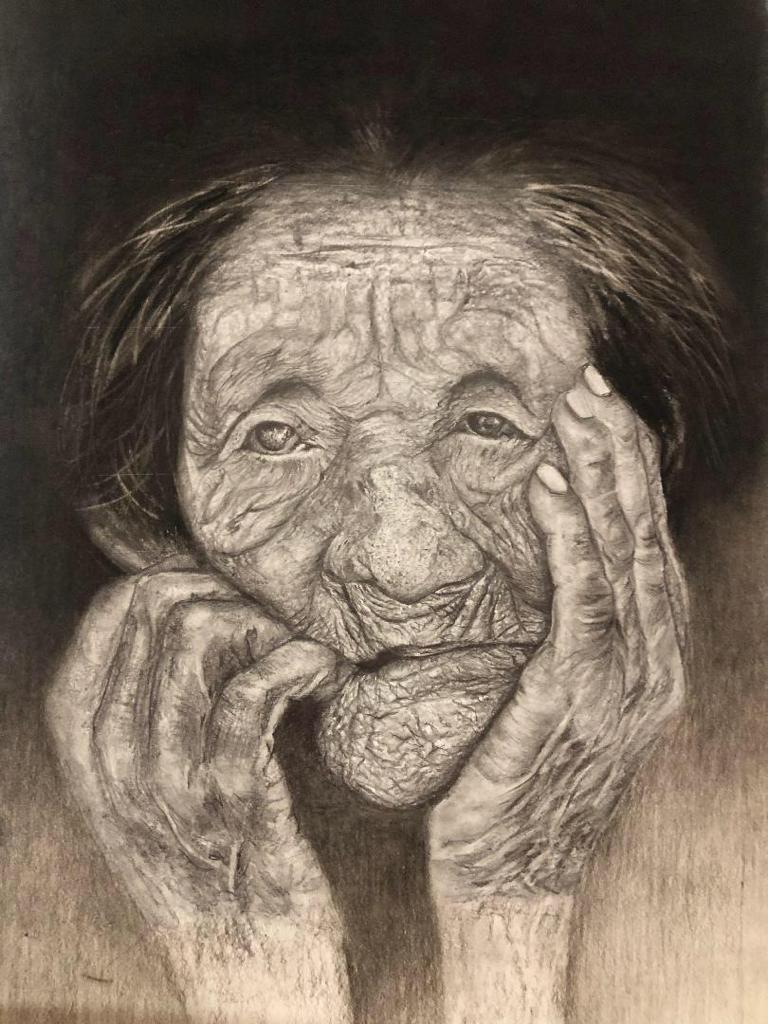
UPDATE, September 9, 2023:This is an update to a post featuring UK based Ismaili Muslim artist Taniya Dharani who has created a special platform to support the Ismaili Artist Community around the world through Artany Art Gallery and Advisory (AAGA). Readers can view Taniy’as beautiful artwork as well as learn about her motivation and purpose for establishing AAGA below, after this special announcement about the launch of a new print magazine.
Established and Emerging Ismaili Artists: Submit Your Details to be Included in New Print Magazine
In her latest venture, Taniya Dharani is launching a special quarterly print magazine in collaboration with Ismaili Artist Alliance, led by Shakeel Bhamani, and Ismaili Artists Worldwide, led by Rubina Rajan, to support the global emerging and established Ismaili artists. The first issue will be printed on December 12, 2023 and will feature a special section on Global Ismaili Artists. Artists are advised to submit their details no later than October 12 by clicking on Magazine Registration.
Taniya is passionate about Ismaili artists and seeks to promote their artworks in an international context and bringing their artworks to the international art market. The Ismaili Muslim community is culturally diverse and the artists are globally dispersed. She works with artists and team members from international backgrounds such as China, USA, India, Canada, Uganda, and Pakistan, among other countries. The commercial aspect of Artany has facilitated sponsoring artists from Afghanistan, Tajikistan, Syria and other countries. Through Artany, Taniya also offers strategic mentorship to emerging artists to enhance and encourage their creativity.
With the deadline for the print edition fast approaching, Taniya is requesting all Ismaili artists to contact her by clicking on Contact – ARTANY or submitting their details at Magazine Registration.
_____________________
Taniya Dharani Creates an Inspirational Platform for Ismaili as Well as Emerging Global Artists from Around the World
“Supporting the Ismaili Artist Community is enormously valuable to me. I wanted to create a platform that I wish I had when I was an aspiring artist…Students in high school and college who are interested in the arts can also apply for internships at Artany within the department of graphic design, marketing, content creation, website management, and business development. In order to provide internships, we have now collaborated with the Aga Khan Academy in Hyderabad” — Taniya Dharani, Founder, Artany Art Gallery and Advisory
Taniya Dharani, founder of Artany Art Gallery and Advisory.
By ARTANY ART GALLERY AND ADVISORY (Special to Simerg)
“Supporting the Ismaili Artist Community is enormously valuable to me. I wanted to create a platform that I wish I had when I was an aspiring artist,” says Taniya Dharani, founder of Artany Art Gallery and Advisory (AAGA).
A digital gallery space and art consultancy, AAGA focuses on emerging Ismaili artists with a global audience and specializes in contemporary art. The artistic narratives and skills of up-and-coming artists from various multicultural origins are artistically rendered by Artany. Along with supporting the Ismaili artistic community, we mentor them and aim to elucidate their work on a global scale.
How did she find her way into the artistic world?
Taniya explains: “Without the support of their family, friends, and loved ones, I don’t believe anyone can become a practicing professional artist. I consider myself fortunate to have a family who supports what I do, has faith in my artistic and entrepreneurial approach, and is very understanding of my development.”
Having thus found a way to build a solid platform, AAGA now seeks to encourage both the global emerging artist community and the Shia Imami Ismaili Muslims.
Taniya obtained a Master’s degree in Art Business from the Sotheby’s Institute of Art in London with an emphasis on establishing a platform for commercial as well as aesthetic promotion, encouragement, and instruction of up-and-coming artists. Having come from a diverse and cosmopolitan background, Taniya seeks to use her vast knowledge and professional experience to bridge the gap between Eastern and Western cultures. She is able to interact effectively and appropriately with a wide range of stakeholders due to her bilingual skills and understanding of both Far Eastern and Western cultures, including those of India, Namibia, and England.
Mawlana Hazar Imam, His Highness the Aga Khan, by Taniya Dharani, UK. Credit: Artany Art Gallery and Advisory.
Taniya grew aware of the necessity for a mentor and a platform for the encouragement of artists. After identifying a market gap, she made the decision to further her education by enrolling in the “Fundamentals of the Gallery Business” programme at the Sotheby’s Institute in Manhattan, New York, followed by a Masters in Art Business from the same Institute in London, England.
Her goal and objective is to make sure Artany’s team is in tune with both the contemporary and diverse Ismaili community and the larger world of artists.
Portrait by Taniya Dharani, UK. Credit: Artany Art Gallery and Advisory.
Today, Artany offers a portfolio of art investment collections that include original works by Ismail Gulgee, limited-edition “Ashtavinayak” serigraphs by Maqbool Fida Husain, and authentic Vaikuntham Thota.
The gallery continues to expand with works by Aquil Virani of Toronto, up-and-coming artists Zainab Khuwaja and Nizar Macojia from Texas, Dr. Mubarak Muhammad Ali from Pakistan, and Rukshana Hooda from India, to name a few. Their artistic styles of Islamic calligraphy, Sufi art, geometric patterns, realism, and contemporary are just a few of the several artistic genres they work in.
Painting by Rukshana Hooda, India.Credit: Artany Art Gallery and Advisory.
~~~~~
Painting by Dr. Mubarak Muhammad Ali, Pakistan.Credit: Artany Art Gallery and Advisory.
~~~~~
Calligraphy by Zainab Khuwaja. Texas, USA. Credit: Artany Art Gallery and Advisory.
~~~~~
Nizar Macojia, Texas, USA.Credit: Artany Art Gallery and Advisory.
~~~~~
Aquil Virani, Toronto. Credit: Artany Art Gallery and Advisory.
Students in high school and college who are interested in the arts can also apply for internships within Artany in the departments of graphic design, marketing, content creation, website management, and business development. In order to provide internships, we have now collaborated with the Aga Khan Academy in Hyderabad. We encourage Ismaili artists at all levels and of all ages to collaborate with Artany by either contacting Taniya Dharani or registering as an artist.
Date posted: January 24, 2023. Last updated: September 9, 2023.
____________________
Taniya Dharani
Taniya Dharani is founder of Artany Art Gallery and Advisory. She has worked as a contemporary artist, curator, and mentor for up-and-coming artists. She is a member of the associate team for the International Art Gallery at Global Encounters and is presently studying at the Bares Atelier in London to become a traditional classical realist artist. You can collaborate or sign up as an Artany artist, by clicking HERE. Please also visit Artany’s Gallery on Instagram.
____________________
REVIEW SIMERG’S TABLE OF CONTENTS AND VISIT ITS SISTER WEBSITES
Before departing this website, please take a moment to review Simerg’s Table of Contents for links to hundreds of thought-provoking pieces on a vast array of subjects including faith and culture, history and philosophy, and arts and letters to name a few. Also visit Simerg’s sister websites Barakah, dedicated to His Highness the Aga Khan, and Simergphotos. The editor may be reached via email at mmerchant@simerg.com.
The Karakoram Highway (KKH) cuts through some of the most astounding rock faces on the planet. Often coined the “Eighth Wonder of the World”, it’s a road trip of dreams, yet few have ever heard of it, or how it came to be. The highway stretches for 1,300 km from Pakistan to China, but Samantha Shea was particularly drawn to the 194km stretch of the highway that runs through the Hunza Valley, a region surrounded by the Karakoram Mountains that give the highway its name.
“This impossibly beautiful section is where you can see pristine glaciers, alpine lakes and snow-capped peaks right from the comfort of your ride. However, as alluring as the journey is, it’s the incredible people and traditions of the Hunza Valley that make this part of the highway so special….Hunza is known for being the most liberal region, in part due to the predominance of Ismailism, a moderate sect of Islam known for promoting tolerance and women’s rights. Education and sports are encouraged for girls, and many go on to study at university and beyond.” READ MORE ON BBC TRAVEL
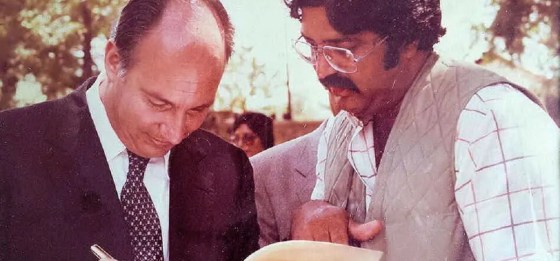
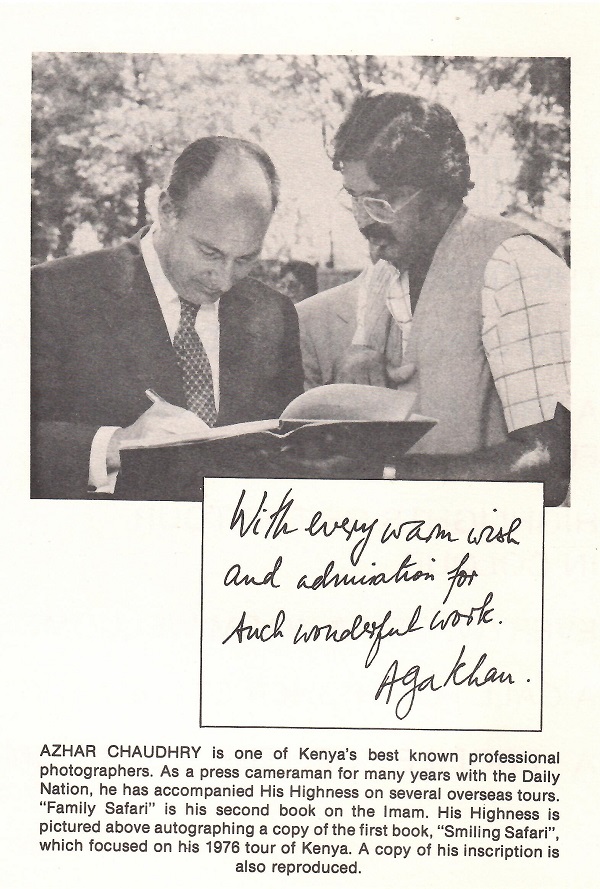
Featured photo at top of post: Former Daily Nation chief photographer Azhar Chaudhry (d. November 2020, aged 75) looks on as His Highness the Aga Khan signs a copy of a special souvenir publication entitled “Smiling Safari” that Azhar published in 1976 to commemorate the 49th Ismaili Imam’s visit to Kenya in the same year. Photograph: Azhar Chaudhry Family Collection. See same image in black and white below, that includes the Aga Khan’s inscription in the souvenir.
By FAISAL (FAS) NADEEM
In the early hours of November 1, 2020, my beloved uncle Azhar Chaudhry lost his battle to live and I lost one of my heroes.
Azhar was only two years old in 1947 at the time of Indo-Pak partition and his family migrated from Indian Punjab to Pakistan’s rich farmlands of South Punjab. Soon after, his father took them to Kenya as he had found work on the railways.
In his early 20’s, Azhar had to go through a personal tragedy when due to some medical complications one of his legs was amputated. But he never had this get him down as he narrates his own story in Zarina Patel’s book “The In-between World of Kenya’s Media: South Asian Journalism, 1900-1992,” a limited edition of which was published in 2016.
Azhar was a self-made man through and through. He started his professional life as an apprentice with the Kenyan newspaper, The Standard, working as a Lino Operator and trained to become a professional photographer at the London School of Arts. From 1963 he worked for The Daily Nation and later on became their Chief Photographer and Picture Editor. His love and passion for photography remained in his DNA for the rest of his life and Azhar contributed to many important publications. In 1969, Azhar’s published his first book “Jomo Kenyatta: A man and his people”.
Being a keen traveler, shooter, safari enthusiast and photographer was a combination that opened several high-profile avenues for him. He travelled with former Kenyan President Moi and also with the Aga Khan, the founder of the Nation Group of newspapers, and documented the Aga Khan’s travels to Kenya through two special souvenir issues — Smiling Safari published in 1976 and Family Safari published in 1981.
Story continues below
Cover page of “Smiling Safari — H.H. The Aga Khan on Tour,” photos by Azhar Chaudhry and text by Kul Bhushan, published by Azhar Chaudhry, 1976, 80 pp.; out of print.
~~~~~~~
Cover page “Family Safari — H.H. The Aga Khan on Kenya Tour,” pictures by Azhar Chaudhry, published by Azhar Chaudhry, 1981, 108 pp., out of print.
~~~~~~~
This black and white image appears in Azhar Chaudhry’s Family Safari, his second pictorial souvenir which commemorated the Aga Khan visit to Kenya in 1981. The Aga Khan’s signed inscription in the book reads “With every warm wish and admiration for such wonderful work. Aga Khan.”
Azhar was a keen rifle shooter and represented Kenya’s shooting team at various world shooting events. He was part of the overseas teams that took part at the international shooting events of 1986 and 1990 at The National Rifle Association of the United Kingdom (Bisley, Surrey).
A man of many talents, Azhar had developed his love for cooking into passion and from early 1990’s Azhar had become a full-time restaurateur. He successfully ran the famous Nairobi restaurant renowned for its steaks ‘The Professional’. Located in the heart of Nairobi and just opposite the Kenyan Parliament Buildings, this famous joint was based in the Kenyatta International Conference Centre. He ran this restaurant for a decade or so.
Azhar was a colorful man in his personal life too, and for various reasons he got married about 4 times but was never able to settle in a long-term marriage. During the first decade of the 2000, when Azhar was in his 4th marriage, he left Kenya and settled with his wife and two boys Ayman and Areeb in Nelspruit, South Africa. His first venture here was to run a butcher’s shop furthering his culinary skills. By 2005 he was keeping the family in Nelspruit and had moved himself to Johannesburg.
This is the time when I had planned to do an extensive family holiday in South Africa with visits to places such as Cape Town Peninsula, Robyn Island, Nelsprut, Kruger Safari Park, Johannesburg and Sun City. During this trip, we had the pleasure of spending time with his family in Nelspruit and then visited him at his newly opened Pakistani restaurant Dawat. I must say it was one of the best restaurants that I experienced in South Africa; it not only specialised in Pakistani cuisine but also served Chinese, Thai and Continental dishes including his famous steaks. Over the years many celebrities visited the famed Dawat which was located in Fordsberg (Johannesburg). Subsequently, he opened a branch in Cape Town as well. He sold both these restaurants to settle into his retirement days.
I had the pleasure of meeting and spending time with Azhar in Pakistan during 2015 when he was accompanying his friend from South Africa, the world-renowned orthopaedic specialist Professor Charles Lautenbach who was in Lahore to deliver his research paper at a Conference. Professor Lautenbach had designed a procedure for treating bone infections, which he researched and continued to refine over the span of his medical career. He also trained a number of doctors from around the world in what became known as the ‘Lautenbach technique’. It was a pleasure to accompany Azhar and the Professor to a few private dinners. I was lucky enough to meet Azhar again for the last time in 2017 when he came to Lahore for dental treatment.
He then re-organised his personal life and settled in Port Alfred with his elder son Ayman who was completing his commercial pilot training there. I last spoke with Azhar on Aug 29, 2020, after he and Ayman had moved to their new place in Port Alfred by the river.
Sadly, during the last week of October 2020, when visiting his younger son Areeb in Cape Town, he felt poorly and had to be taken to the Netcare Christiaan Barnard Memorial Hospital. He was diagnosed with COVID-19 and never recovered from this episode and passed away during the early hours of November 1, 2020. Azhar’s last resting place is at Grassy Park Cemetery, Cape Town.
Rest in Peace Azhar. You will always be my hero. Your family — the Chaudhry clan — and your friends all over the globe will miss you dearly.
Date posted: August 31, 2023. Last updated: September 1, 2023 (link updates.)
____________________
As Chief Photographer of the Daily Nation for many years, Azhar Chaudhry was well-known by readers of the Daily Nation and widely respected by his colleagues in the East African media. Of course, many know him through his popular restaurants in Nairobi and South Africa. We invite our readers to submit their personal tributes and fond memories of Azhar Chaudhry by clicking on LEAVE A COMMENT.
ABOUT THE AUTHOR
Faisal Nadeem
Faisal (Fas) Nadeem is an electrical engineer and an IT specialist by profession and lives near Oxford, England. As a hobby, Fas spends his time researching on those who are near and dear to him, as well as his family who come from a humble Punjabi farming background. With facts not easy to come by, he relies on older members of his family for information gathering. Fas is widely travelled and has toured several countries across Europe, Asia, Africa and the Middle East. Thus his interests span across many cultures and faiths. Fas, who has two grown-up sons, is surrounded by members of his extended family and has many friends in the UK who are from East Africa and the Sub-Continent. Fas may be reached by email at fasnadeem@gmail.com.
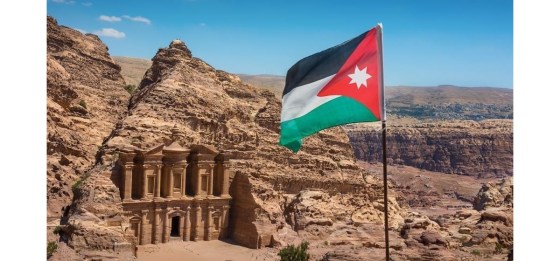
The featured photo of Jordan’s flag at the top of this post is reproduced from the website Embassy of the Hashemite Kingdom of Jordan, Tokyo, Japan. The following textual material has been gathered from the Embassy’s website as well as the websites of North Carolina’s Timothy S. Y. Lam Museum of Anthropology and a-z-animals, an interesting educational website on animals that also provides factual and well-researched information on other topics while describing animals in a specific country.
The Jordanian flag, in its current form, was adopted in 1922. It is inspired, in shape and colours, by the Great Arab Revolt banner, which was raised from the plains of Mecca in 1916.
Each of the three stripes represents a different caliphate, with black representing the Abbassid Caliphate, white, representing the Ummayyad Caliphate, and green, representing the Fatimid Caliphate, while the red chevron encompassing the flag’s components represents the Hashemite Family, in addition to paying homage to the Arab Revolt. The Fatimids, who ruled in North Africa and Egypt from 909 – 1171 CE are the ancestors of the current 49th Hereditary Imam of the Shia Ismaili Muslims, His Highness the Aga Khan, who is respectfully addressed by his Ismaili followers as Mawlana Hazar Imam — Our Lord, the Present/Living Imam.
The red triangle contains a seven-pointed star to symbolize the seven verses of the Surat Al Fatiha, the opening chapter of the Holy Qur’an. The website A-Z Animals adds that the verses symbolize unity as well as include “humanity, virtue, humility, faith in one God, national spirit, social justice, and aspiration.”
The website of the Timothy S. Y. Lam Museum of Anthropology located in North Carolina, mentions that colours are used to represent beliefs, traditions, and concepts in many religious traditions. The article also notes that “the color green is associated with Islam because it is believed to have been the Prophet Muhammad’s favorite color. It is said he wore a green cloak and turban, and his teachings reference the color. The Qur’an states that green will be worn by the inhabitants of paradise.”
Article 4 of the Constitution of Jordan specifies the form and dimensions of the Jordanian flag as follows:
“The length of the flag shall be twice its width. It shall be divided horizontally into three parallel and equal stripes, the uppermost of which shall be black, the center, white and the lowest, green. At the end of the flag-staff the flag shall have a red chevron, the base of which shall be equal to the flag’s width and the altitude of which shall be half of the flag’s length. In the chevron, there shall be a white seven-pointed star of such a size that it may be one-fourteenth of the flag’s length. The star shall be so placed that its center shall be at the intersection of the lines bisecting the angles of the chevron, and the axis running through one of its points shall be parallel to the base of the chevron.”
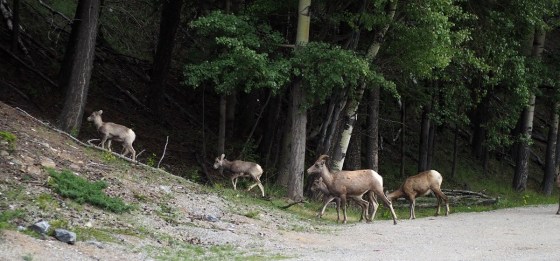
For tourists from around the world as well as individuals and families living close to Canmore or Banff National Park, whether in Alberta or British Columbia, as well as those in “distant” cities like Edmonton — and Canadians DO love driving their cars — make it to Lake Minnewanka and Grassi Lakes during these last 7 days in August, before schools commence. With almost a full week of sunshine promised — and daytime highs in the mid to upper 20s — your children will love the trip to these amazing places and they will have a lot of fun including swimming and seeing wildlife! The loop drive to Minnewanka Lake would include stops at the beautiful Two Jake Lake, Johnson Lake and the Cascade Ponds. Near Canmore, you have the stunning Grassi Lakes, and the two separate 1.9km trails to the lakes from the parking area are easy to moderate.
Please click on the links LAKE MINNEWANKA and GRASSI LAKES — or on the images below — for full stories and photographs.
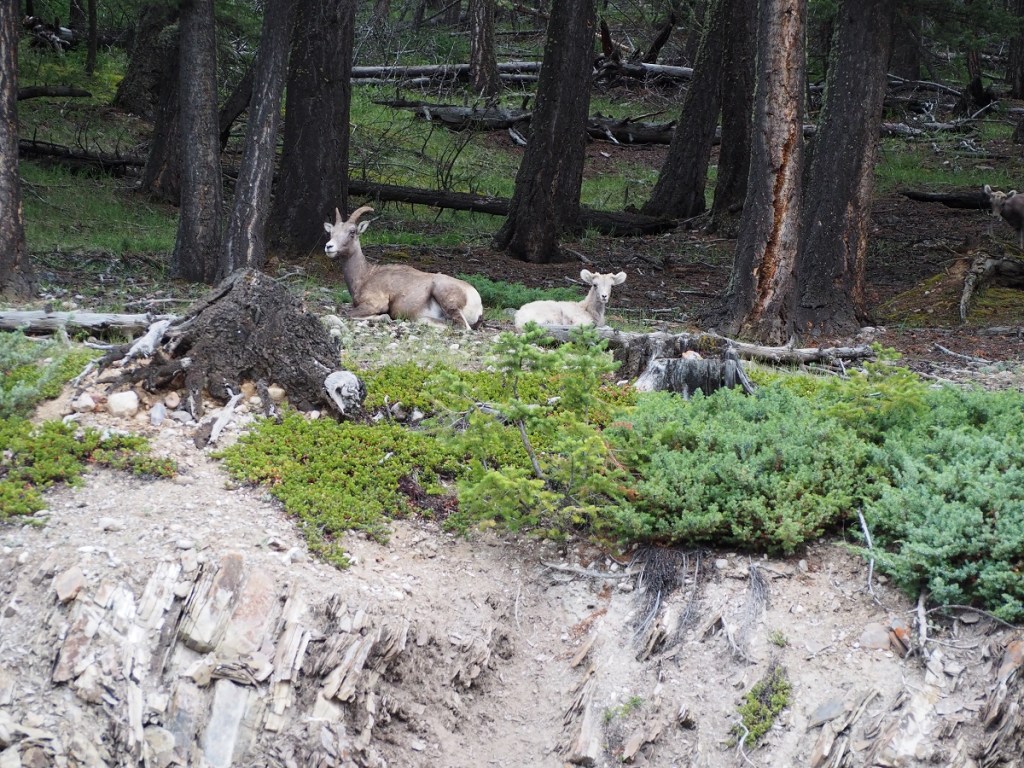
Big Horn Sheep near Two Jack Lake on the Lake Minnewanka loop drive. Please click on photograph for complete story and more beautiful photographs.
A view of the Upper Grassi Lake. Please click on photograph for complete story and more beautiful photographs.
Date posted: August 17, 2023. Last updated: August 24, 2023.
Yasser Desai’s rendition of a Naat (song) honouring the Prophet Muhammad has been making its rounds in the social media. The reaction to the Naat — that is presented below through YouTube — has been very positive from listeners around the world. Listeners wrote (selected excerpts): “The song brought tears to my eyes!….Your voice is magical and unique. I love your passion while singing this amazing Naat e Mustafa….As a Muslim [the song] melts my heart and I felt some inner peace.”
Story continues below, with lyrics of song
Born on November 15, 1989 in Mumbai, India, Yasser Desai started his journey in music from the age of 11. Completely self-taught, Yasser Desai has sung many highly acclaimed songs like “Dil Ko Karaar Aaya”, “Hue Bechain”, and “Aankhon Me Aansoon Leke”, among others; he has more than 200 songs to his credit in Bollywood movies. He has also sung several singles for Zee Music Company and many other music channels.
LYRICS
(the text of the lyrics corresponds to the flow of the song; refrains are therefore repeated in the text)
Hasbi Rabbi Jallallah Mafi Qalbi Ghair ullah Noor e Muhammad Sallallah La ilaha illallah
Hasbi Rabbi Jallallah Mafi Qalbi Ghair ullah Noor e Muhammad Sallallah La ilaha illallah
Tere Sadqe main Aaqa Saare jahaa(n) ko deen mila Be-deeno(n) ne kalma parha La ilaha illallah
Simt e Nabi Abu-Jehal gaya Aaqa se usne ye kaha Tum ho Nabi batlaao zara Meri muthi mai hai kya
Simt e Nabi Abu-Jehal gaya Aaqa se usne ye kaha Tum ho Nabi batlaao zara Meri muthi mai hai kya
Aaqa ka farmaan hua Aur Fazl e Rahman hua Muthi se pathar bola La ilaha illallah
Hasbi Rabbi Jallallah Mafi Qalbi Ghair ullah Noor e Muhammad Sallallah La ilaha illallah
Wo jo Bilal e Habshi hain Sarwar e dee(n) ka pyara hai Dunya kay har aashiq ki Aankho(n) ka wo taara hai
Wo jo Bilal e Habshi hain Sarwar e dee(n) ka pyara hai Dunya kay har aashiq ki Aankho(n) ka wo taara hai
Zulm hue kitne us par Seenay pay rakha pathar Phir bhi zubaa(n) pay jaari tha La ilaha illallah
Hasbi Rabbi Jallallah Mafi Qalbi Ghair ullah Noor e Muhammad Sallallah La ilaha illallah
Apni behen se bole Umar Ye to bata kya karti thi Mere aane se pehle Kya chupke chupke parhti thi
Apni behen se bole Umar Ye to bata kya karti thi Mere aane se pehle Kya chupke chupke parhti thi
Behen ne jab Qur’an parha Sun ke kalaam e paak e khuda Dil ye umar ka bol utha La ilaha illallah
Hasbi Rabbi Jallallah Mafi Qalbi Ghair ullah Noor e Muhammad Sallallah La ilaha illallah
Dunya ke insaan sabhi Shirk o bid’at kartay thay Rab ke thay banday phir bhi Buut ki ibadat kartay thay
Dunya ke insaan sabhi Shirk o bid’at kartay thay Rab ke thay banday phir bhi Buut ki ibadat kartay thay
Butt khaney hai tharraye Mere Nabi hain jab aaye Kehnelagi makhlooq e khuda La ilaha illallah
Hasbi Rabbi Jallallah Mafi Qalbi Ghair ullah Noor e Muhammad Sallallah La ilaha illallah
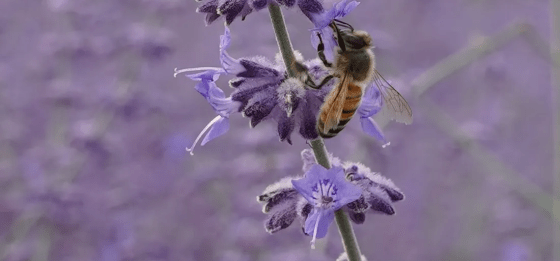
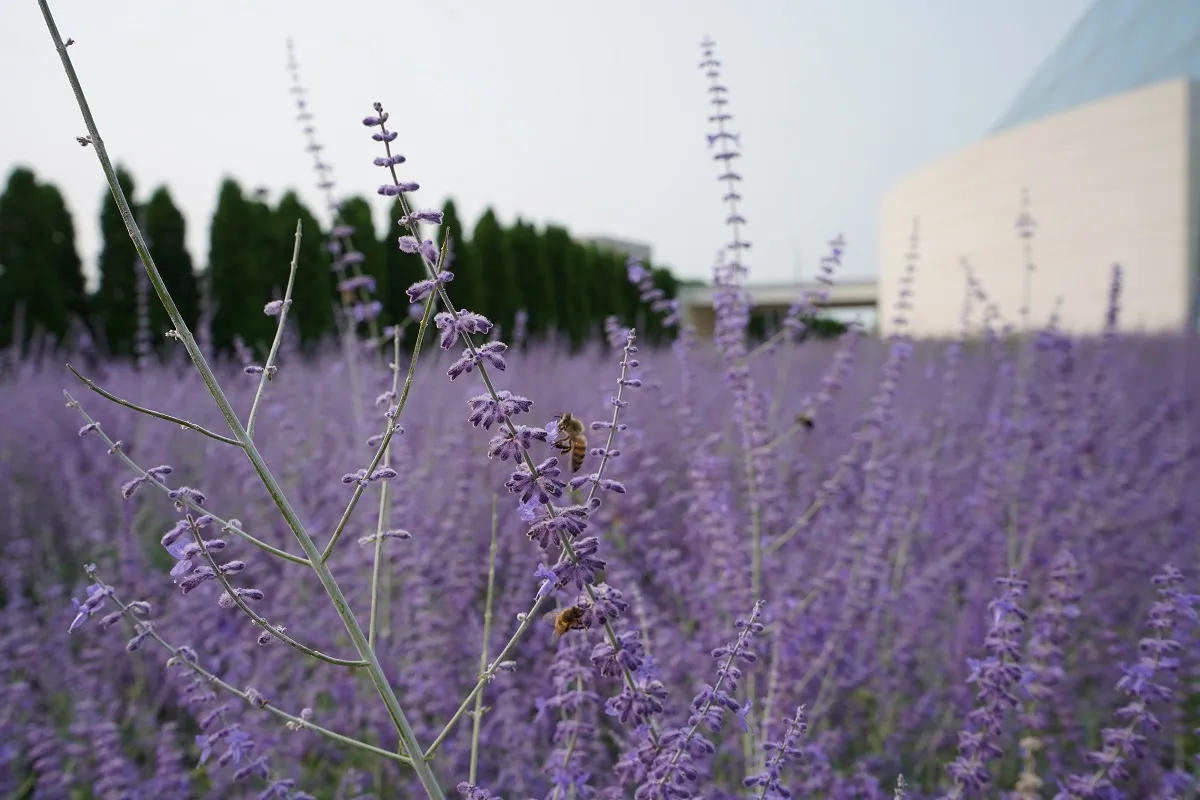
During my stay in Toronto between 2018-2021, the Aga Khan Park became my primary getaway place as it was so close from where I lived. The spring, summer and autumns months were particularly exciting as the park attracted lots of wildlife (see our stunning photo essays on The Hawk and The Birth of Goslings.) The sage and lavender plants in front of the Kaaba facing niche of the Ismaili Jamatkhana building attracted bees for pollination during the warm and sunny summer days. My daughter Nurin, on one of her visits to Toronto, captured some magnificent photographs of the bees. After relocating to Alberta, I read that the province produces nearly 40 million pounds of honey each year making it the fifth largest honey producing region in the world. There are 1,400 beekeepers in Alberta, managing over 300,000 bee colonies. Of course, the vast amount of honey produced is made possible by the alfalfa and clover nectar that is plentiful in the province.
Amazingly, of the 114 chapters or suras in the Qur’an, several are named after animals and insects. Examples are: Al-Baqarah (Chapter 2, The Calf, The Cow), Al-Anam (6, The Cattle), An-Nahl (16, The Bees), An-Naml (27, The Ant), An-Ankabut (26, The Spider), and Al-Feel (105, The Elephant). Many other chapters are named after objects or events in nature and the universe, including The Daybreak, The Earthquake, The Fig Tree, The Bright Morning Hours, The Night, The Sun, The Constellations, The Moon and so on.
Over time, we will endeavour to highlight the verses in the Qur’an that speak of God’s bountiful creation but we begin with the Bees and the Ants. These two insects are regarded as industrious, and they are also disciplined. They work together to support their colonies.
God speaks of The Bees in the following verses from chapter 16:
“And thy Lord revealed unto the bees, saying: ‘Take unto yourselves, of the mountains, houses, and of the trees, and of what they are building. Then eat of all manner of fruit, and follow the ways of your Lord easy to go upon.’
“Then comes there forth out of their bellies a drink of diverse hues wherein is healing for men. Surely in that is a sign for a people who reflect” — Quran, 16:68-69 (translation by A. J. Arberry, see Corpus Qur’an.)
In these verses, mankind is told about the healing power found in the different coloured honey made by the hard-working bees. The teamwork and level of organisation that goes into its production — because a single bee can’t make honey on its own — should serve us as an example on the importance of working and living together in the spirit of one-humanity.
The bees are venerated for their diligence and sacrifices. The importance that Islam holds for the insect is mentioned again in the following hadith (tradition) of the Prophet Muhammad (peace be upon him and his family):
“By the one in whose hand my soul is, the believer is like a bee which eats that is pure and wholesome and lays that which is pure and wholesome. When it lands on something, it doesn’t break or ruin it.”
Although chapter 27 in the Qur’an is called “The Ant”, there is only one verse that specifically mentions the hard-working ant. It is part of the story of Prophet Sulaiman (Solomon), who was gifted with the ability to speak and understand the language of animals, birds and insects.
The Qur’an tells of his encounter with the smallest of creatures as follows:
“….When they [Soloman’s army] came on the Valley of Ants, an ant said, ‘Ants, enter your dwelling-places, lest Solomon and his hosts crush you, being unaware!’
“But he smiled, laughing at its words, and he said, ‘My Lord, dispose me that I may be thankful for Thy blessing wherewith Thou hast blessed me and my father and mother, and that I may do righteousness well-pleasing to Thee; and do Thou admit me, by Thy mercy, amongst Thy righteous servants’.” — Qur’an, 27:18-19 (translation by A. J. Arberry, see Corpus Qur’an.)
The Prophet couldn’t hold back a smile as he heard the ant talk, and he thanked God for the many favours bestowed upon him, including his ability to understand and avoid trampling over the homes of the ants.
These verses and stories illustrate the importance Islam places on all God created life forms.
Inna lillahi wa inna ilayhi raji’un “Surely we belong to God and to Him we return” — Holy Qur’an, 2:156
“Life is a great and noble calling, not a mean and grovelling thing to be shuffled through as best as we can but a lofty and exalted destiny” — Mawlana Sultan Mahomed Shah, His Highness the Aga Khan III (1877-1957), 48th Imam of the Shia Imami Ismaili Muslims.
It is with deep sadness that we announce the passing on August 5, 2023, of the well-known Ismaili musician and composer Enoo in Orlando, Florida, at the age of 67, just days before his 68th birthday on August 11 — he was born in 1955. His funeral and burial ceremonies were held in Orlando on Wednesday, August 8.
Enoo is survived by his son Shehzad Ali, brothers Mushtaq and Ishtiaq and sister Rezia.
Some 8 years ago in 2015, Enoo had penned a loving tribute to his father Mohammed Ibrahim Ali who had passed away in Dallas, Texas, on March 15, 2014, at the age of 88. Eight years later, in 2022, Enoo lost his mother, Roshan Ibrahim Ali.
Shortly after his mother’s death, Enoo sent me the following message:
“I was closest at bedside when she breathed her final and I recited in her ear the Kalima, Salwaat, Ya Allah, Ya Muhammad, Ya Ali and Ya Shah Karim. As per everyone who was around her, my dearest mom was waiting for me and yes with Mawla Hazar Imam’s blessings I made it to her bedside. It was a miraculous day.”
Enoo had often expressed the wish to pen a tribute to his mother, just as he had done for his father.
Alas, and very sadly, Enoo was diagnosed with a terminal illness and was informed that he had a few months left to live. He spent the last days of his life as a patient in hospice and hospital care. He absorbed the news with courage. In a number of profound telephone conversations with me, he shared the challenges that he faced as he was coping with his illness that appeared so suddenly in his life.
Enoo pictured singing a rendition of the timeless Ismaili Ginan Sahebji Tu More Man Bhave composed by Ismaili missionary Syed Imam Shah many centuries ago. In the Ginan, the Syed expresses his deep love, faith and trust in the Imam-of-the-Time; the popular Ginan is recited by Ismailis of all ages with deep devotion and happiness. Photograph: Clipped from Enoo’s video of the Ginan’s rendition.
In one of the last conversations with him, when he called me from his hospital bed, he told me he was unafraid of death. As an Ismaili Muslim, he expressed his immense love for his 49th Imam, Mawlana Hazar Imam, His Highness the Aga Khan, and said that the music that he had composed in his honour had sustained and inspired him at this extremely difficult period in his life. While he was talking to me, a nurse entered his room and interrupted our conversation. She signalled to him that the latest tests that the hospital had carried out did not look good at all.
Enoo communicated the nurse’s message to me and said that death was inevitable and not far away. In the midst of all this news, he told me his spirits remained high and that he followed the precepts of the Imam-of-the-Time, that each day was a day that must be lived and that during that day we should fulfill our responsibilities to the best of our ability (Mumbai, India,1973). He lived up to Mawlana Hazar Imam’s expectations until the last day of his life, meeting his struggles with joy and hope. He took a firm attitude toward coping with his suffering and did not become despondent.
For the last few weeks, I have been waiting to hear about Enoo’s latest status. He had told me that I would learn about his death “from someone”. On the evening of August 5, as I returned to my car after celebrating my 70th birthday, I received a text informing me that Enoo had passed away the same morning. Having already been informed in advance by Enoo about the inevitable, the news did not come as a shock to me. My thoughts immediately turned to Enoo’s special place in the life hereafter of happiness and peace, in the presence of Divine Light. The Qur’anic verse Inna lillahi wa inna ilayhi raji’un (Surely we belong to God and to Him we return), is the oft-remembered verse by Muslims on sad moments such as someone’s death.
Enoo was a musician all his life. Inspired by the voice of his mother, Roshan, Enoo’s passion for music manifested when he was still a young boy in Chennai, India. After moving to Pakistan at the age of 14, he began to cultivate a spiritual way of life, tightly interwoven with music. As a result of the steady musical influence, Enoo received awards for playing the harmonium and became a well-known artist at Radio Pakistan.
Ismaili musician and artist, Enoo (August 11, 1954 – August 5, 2023). Photograph: Enoo archives.
Over the years, Enoo built himself a great reputation as a composer and musician, and performed around the world at important events and worked with radio and TV stations as well as the film industry. After settling in the USA in the 1980’s, first in Chicago before he made Orlando his home, Enoo continued to thrive and perform with a unique blend of jazz. He commemorated the Golden Jubilee of Mawlana Hazar Imam with a special CD. Shorty after the Golden Jubilee, The Ismaili, the official website of the Ismaili community, wrote a special piece about Ismaili musicians that also featured Enoo.
In his last weeks of his life, he sent me a number of emails that he said I should share with readers when I penned a tribute to him. On July 1, 2023, shortly after being seen by an oncologist, he wrote: “Only GOD knows but medically I have 3 weeks to most 3 months or less!” Very graciously, and I was truly touched, he wrote in the same email that he enjoyed reading my photo pieces about my adventure trips in Alberta. He also urged me to look after my health, knowing that my own health had been compromised by a serious autoimmune condition.
A week later on July 7, he said briefly in his email: “Seems very soon, Allah ki marzi” (as is God’s wish.) He then passed away a month later on August 5, 2023.
We ask all all readers to join us in our heartful prayer for Enoo that his soul may rest in eternal peace. Ameen. We convey our condolences to Enoo’s beloved family members and friends around the world and share in their sadness at this difficult time of bereavement.
Date posted: August 11, 2023.
________________________
We invite you to submit your condolences and tributes to Enoo in the comments by clicking on LEAVE A COMMENT.