His Highness the Aga Khan Shows Path to Renew and Re-Express the Post Millennium Development Goals Agreed on by World Leaders in 2000

Compiled and presented by Abdulmalik Merchant
(Editor-Publisher, http://www.simerg.com and http://www.simergphotos.com)

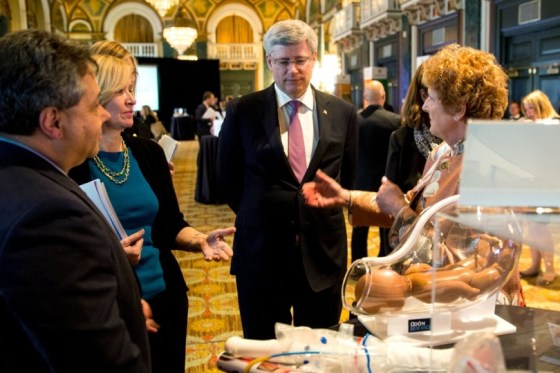
Prime Minister Stephen Harper receiving an explanation about an exhibit displaed at the summit Saving Every Woman, Every Child: Within Arm’s. Phooto: The website of the Prime Minister of Canada.

Prime Minister Stephen Harper receiving an explanation about an exhibit displayed at the summit Saving Every Woman, Every Child: Within Arm’s Reach. Photo Credit: The website of the Prime Minister of Canada.

Editor’s note: In 2000 world leaders joined together in an unprecedented UN summit to develop a blueprint to meet the needs of the world’s poorest, with the targeted date of 2015.  The leaders along with the support of worldwide institutions set the following eight goals in what became known as the Millennium Development Goals (MDGs):

  • Eradicate Extreme Hunger and Poverty
  • Achieve Universal Primary Education
  • Promote Gender Equality and Empower Women
  • Reduce Child Mortality
  • Improve Maternal Health
  • Combat HIV AIDS Malaria and Other Diseases
  • Ensure Environmental Sustainability
  • Develop a Global Partnership for Development

A special summit in Toronto under the theme Saving Every Woman Every Child: Within Arm’s Reach, is addressing some of the MDGs goals and we are pleased to publish below excerpts from His Highness the Aga Khan’s remarks made at the summit on May 29, 2014.

~~~~~

Bismillah-ir-Rahman-ir-Rahim

His Highness the Aga Khan, 49th Ismaili Imam and the direct descendant of the Prophet Muhammad (s.a.s), delivers keynote remarks at the Maternal, Newborn and Child Health Summit in Toronto on 29 May 2014. Photo: The Ismaili/Zahur Ramji.

His Highness the Aga Khan, 49th Ismaili Imam and the direct descendant of the Prophet Muhammad (s.a.s), delivers keynote remarks at the Maternal, Newborn and Child Health Summit in Toronto on 29 May 2014. Photo: The Ismaili/Zahur Ramji.

I. THE ISMAILI IMAM EXPLAINS HIS PRESENCE

“Like you, I am here today because of my conviction that improving maternal, neonatal and child health should be one of the highest priorities on the global development agenda. I can think of no other field in which a well-directed effort can make as great or as rapid an impact.

“I am here, as well, because of my enormous respect for the leadership of the Government of Canada in addressing this challenge. And I am here too, because of the strong sense of partnership which our Aga Khan Development Network has long experienced, working with Canada in this critical field.

“Leadership and partnership – those are words that come quickly to mind as I salute our hosts today and as I greet these distinguished leaders and partners in this audience.”

II. THE MUSKOKA INITIATIVE AND ONE OF ITS OFF-SHOOTS

“Mr Prime Minister – I recall how our partnerships were strengthened four years ago when you launched the Muskoka Initiative. It led to an important new effort in which our Network has been deeply involved in countries such as Afghanistan, Pakistan, Tanzania, Mozambique, and Mali.

“In all of these efforts, we’ve built on our strong history of work in this field. It was 90 years ago that my late grandfather founded the Kharadhar Maternity Home in Karachi. In that same city, for the last thirty years, the Aga Khan University has worked on the cutting edge of research and education in this field – including its new specialised degree in midwifery.”

III. WHAT THE AGA KHAN UNIVERSITY’S NEW REPORT REVEALS, AND HOW THE WORK OF AKDN WORK IMPACTS MILLIONS

“One of our Aga Khan University scholars [Dr. Zulfiqar Bhutta] helped fashion the new series of reports on this topic that was released last week – an effort that involved more than 54 experts from 28 institutions in 17 countries. The reports tell us that right intensified steps can save the lives of an additional 3 million mothers and children annually.

“To that end, our Development Network has also focused on building durable, resilient healthcare systems. One example is the not-for-profit health system by the Aga Khan Health Service in Northern Pakistan – a community-based network of facilities and health workers, including a growing number of nurse-midwives.

Photo: The Government of Canada.

Photo: The Government of Canada.

“We have extended these approaches to other countries, including a remarkable partnership in Tanzania funded by the Canadian government and implementing in close partnership with the Tanzanian government.

“Such AKDN activity now serves some two-and-a-half million people in 15 countries, with 180 health centres both in urban and rural areas, often in high-conflict zones, and embracing some of the world’s poorest and most remote populations.

“Last year alone, these facilities served nearly 5 million visitors, inpatients and outpatients, with more than 40,000 newborn deliveries.

IV. HIS HIGHNESS SHARES WHAT HIS NETWORK
HAS LEARNED FROM EXPERIENCE

“So our experience has been considerable. But what have we learned from it? Let me share a quick overview.

1. Sustainable Systems

“First, I would underline that our approaches have to be long-term. Sporadic interventions produce sporadic results, and each new burst of attention and activity must then start over again. The key to sustained progress is the creation of sustainable systems.

2. Local Ownership

“Second, our approaches should be community-oriented. Outside assistance is vital, but sustainable success will depend on a strong sense of local “ownership”.

3. Broad Health-Care Focus

“The third point I would make is that our approaches should support the broad spectrum of health care. Focusing too narrowly on high-impact primary care has not worked well – improved secondary and tertiary care is also absolutely essential.

4. New Financial Models – Savings Groups, Debts Financing, Tax-Privileged Donations

“Our approaches should encourage new financial models. Donor funding will be critical, but we cannot sustain programmes that depend on continuing bursts of outside money. Let me underscore for example, the potential of local “savings groups” and micro-insurance programmes, as well as the under utilised potential for debt-financing. Also – and I think this is very, very important indeed – we have watched for many years as many developing countries, and their economies of course, have created new financial wherewithal among their people. These growing private resources can and I think should, help social progress, motivated by a developing social consciousness and by government policies that encourage tax-privileged donations to such causes.

5. Reaching the Hardest to Reach with Modern Communications Technology

“Our approaches should also focus on reaching those who are hardest to reach. And here, new telecommunications technologies can make an enormous impact. One example has been the high-speed broadband link provided by Roshan Telecommunications, one of our Network’s companies, between our facilities in Karachi and several localities in Afghanistan and in Tajikistan. This e-medicine link can carry high-quality radiological images and lab results. It can facilitate consultations among patients, doctors and specialists at various centres. And it can contribute enormously to the effective teaching of health professionals in remote areas.

6. Multi-Sectoral Challenges Need Effective Multi-Input Coordination

“Our approaches should be comprehensive, working across the broad spectrum of social development. The problems we face have multiple causes, and single-minded, “vertical” interventions often fall short. The challenges are multi-sectoral, and they will require the effective coordination of multiple inputs. Creative collaboration must be our watchword. This is one reason for the growing importance of public-private partnerships.

“These then are the points I would emphasise in looking back at our experience. I hope they might be helpful as we now move into the future, and to the renewal and re-expression of the Post Millennium Development Goals.”

V. THE USEFULNESS OF MEETINGS –  BUT PARTNERS MUST TALK AND WORK WELL TOGETHER THROUGH CANDID EXCHANGE

His Highness the Aga Khan, President Kikwete of Tanzania and Prime Minister Stephen Harper of Canada, who hosted the 3 days summit in Toronto. Photo: The website of the Prime Minister of Canada. Copyright.

His Highness the Aga Khan with President Jakaya Kikwete of Tanzania and Prime Minister Stephen Harper of Canada, who hosted the summit in Toronto. Photo credit: The website of the Prime Minister of Canada. Copyright.

“As we undertake the new planning process, the opportunity to exchange ideas at meetings of this sort can be enormously helpful. And potential partners must be able to talk well together if they are going to work well together.

“I would hope such occasions will be characterised by candid exchange, including an acknowledgment of where we have fallen short and how we can do better. The truth is that our efforts have been insufficient and uneven. We have not met the Post Millennium Development Goals.”

VI. LEVERAGING PROGRESS THROUGH THE FIELD OF MATERNAL AND NEWBORN HEALTH

“At the same time, we must avoid the risk of frustration that sometimes accompanies a moment of reassessment. Our challenge – as always – is a balance [between] honest realism with hopeful optimism.

“And surely there are reasons to be optimistic.

“In no other development field is the potential leverage for progress greater than in the field of maternal and newborn health.”

VII. RESULTS: THE HEARTENING EXAMPLE OF AFGHANISTAN

“….I thought I might close by talking about some of the results. My example comes from Afghanistan – a heartening example from a challenging environment.

“The rural province of Afghan Badakhshan once had minimal infrastructure and few health-related resources. Less than a decade ago it had the highest maternity mortality ratio ever documented.

“It was about that time that the Afghan government, supported by international donors, contracted with the Aga Khan Health Service to create a single non-governmental health organisation in each district and in each province. Today, the Badakhshan system alone includes nearly 400 health workers, 35 health centres, two hospitals, serving over 400,000 people. Its community midwifery school has graduated over 100 young women.

“The impact has been striking. In Badakhshan in 2005, six percent of mothers died in childbirth – that is 6,000 for every 100,000 births. Just eight years later, that number was down twenty-fold – for every 100,000 live births, death has gone from 6,000 down to 300.

“Meanwhile, infant mortality in Badakhshan has fallen by three-quarters, from over 20 percent to less than 6 percent.”

VIII. CHILDBIRTH RISKS GAPS ARE NOT DESTINED – WITH SCIENCE AND EFFECTIVE COORDINATION RISKS CAN BE TRANSFORMED FOR THE BETTER

“For most of the world, science has completely transformed the way life begins, and the risks associated with childbirth. But enormous gaps still exist. These gaps are not the result of fate – they are not inevitable. They can be changed, and changed dramatically.

“When government and private institutions coordinate effectively in challenging a major public problem, as this example demonstrates, we can achieve substantial, genuine, quantifiable progress – and fairly rapidly.

“This is the story we need to remember, and this is the sort of action we need to take as leaders and as partners in addressing one of the world’s most critical challenges.”

Date posted: Friday, May 30, 2014.

________________

Photos and text used in this post compilation were obtained from the following sources.

1. http://www.pm.gc.ca (Prime Minister of Canada)
2. http://www.akdn.org (the Aga Khan Development Network)
3. http://www.theismaili.org (official website of the Ismaili Community)
4. http://www.undp.org/content/undp/en/home/mdgoverview/
(The Millennium Development Goals)

Shaheeds Khudabaksh Talib, Karmali Dahya and Lalji Ladha: An Account of their 1925 Tragic Accident in Tanganyika by Sadru Meghji

“This account of a Jamati tragedy that occurred almost ninety years ago, in 1925,  is based on an authentic Gujarati narrative that was prepared by an officer  of the Aga Khan Council in Dar-es-Salaam, just four days after the accident that took the lives of three Ismailis, namely Khudabaksh Talib, Karmali Dahya and Lalji Ladha, who were bestowed with the title of Shaheeds….” — Sadru Meghji

Please click: A True Account of How Three Ismaili “Shaheeds” Lost Their Lives in a Tragic Accident in 1925 Near Kilosa, Tanganyika

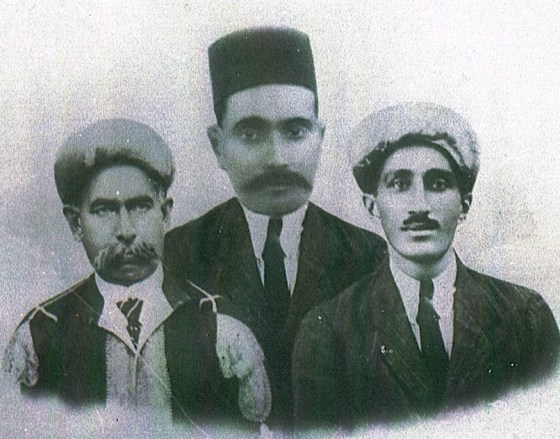
Portraits of the three Shahids, Karmali Dahya, Lalji Ladha and Missionary Khudabaksh Talib (right), who died when their lorry slid into a ditch near Kilosa in 1925. The photo was displayed in the lobbies of jamatkhanas around East Africa at the instruction of the 48th Ismaili Imam, Mawlana Sultan Mahomed Shah, His Highness the Aga Khan (1877-1957). Photo: Anverali Talib Family Collection, Montreal, PQ, Canada.

Portraits of the three Shaheeds, Karmali Dahya, Lalji Ladha and Missionary Khudabaksh Talib (right), who died when their lorry slid into a ditch near Kilosa in 1925. The photo was displayed in the lobbies of jamatkhanas around East Africa at the instruction of the 48th Ismaili Imam, Mawlana Sultan Mahomed Shah, His Highness the Aga Khan (1877-1957). Photo: Anverali Talib Family Collection, Montreal, PQ, Canada.

In Ogden Memorial Lecture, Ismaili Imam Speaks About the Communications Revolution and Its Risks, and Says Progress is Possible When Today’s Complex World Issues are Subject to Competent, Intelligent, Nuanced and Sophisticated Dogmatic Free Analysis, and Based Upon What He Describes as “Empathetic Knowledge”

Compiled and presented by Abdulmalik J. Merchant
Publisher-Editor, www.simerg.com

I. Excerpts from President Christina Paxson’s Introduction to His Highness the Aga Khan
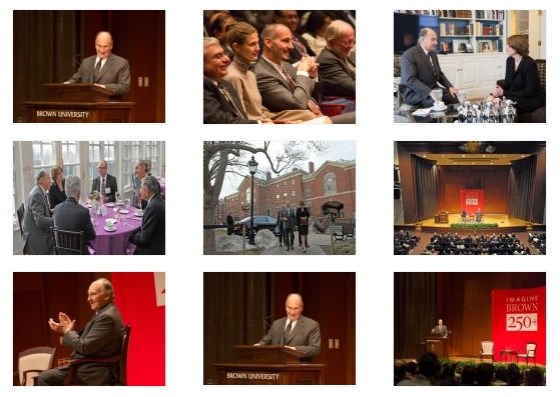
A collection of thumbnails from His Highness the Aga Khan's visit to Brown University to deliver the Ogden lecture on the occasion of the University's 250th anniversary.

A collection of thumbnails from His Highness the Aga Khan’s visit to Brown University where delivered the Ogden lecture on the occasion of the University’s 250th anniversary. Photo: The Ismaili

Today we welcome His Highness the Aga Khan to the Brown campus — not as a newly arrived guest, but as a returning friend of the University and a Brown parent. In May 1996, Brown conferred the honorary Doctor of Law degree upon His Highness. At that time, President Vartan Gregorian said of him:

“He has become a major activist for civilised humanity and universal values. Not in words but in deeds. Not in one location but around the world. For he believes in the long tradition of Ismaili community values — that education, self-reliance, solidarity, and character are the elements which keep a community vibrant and healthy and lead to enlightenment and dignity.”

In the 18 years since, His Highness’s critically important work has intensified and expanded. As the 49th hereditary Imam — the spiritual leader — of the Shia Ismaili Muslims, His Highness has been productively engaged with the development of Asia and Africa, work he and his organisations have pursued for nearly 60 years. He is the founder and chairman of the Aga Khan Development Network, one of the world’s largest private development agencies, which has improved living conditions and opportunities for people in 30 countries through work in healthcare, education, architecture, rural development, the built environment, and the promotion of private-sector enterprise…About 80,000 people work for the Network.
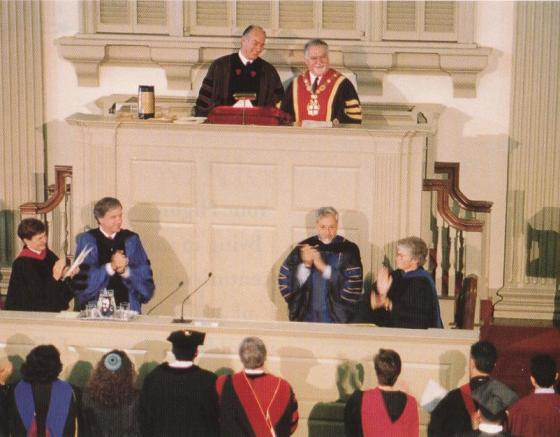
Eighteen years ago, on May 26, 1996, His Highness the Aga Khan receives a standing ovation at the conclusion of the Baccalaureate Address at Brown University, Providence, Rhode Island. Next to him is Vartan Gregorian who was then President of the University.

Eighteen years ago, on May 26, 1996, His Highness the Aga Khan receives a standing ovation at the conclusion of the Baccalaureate Address at Brown University, Providence, Rhode Island. Next to him is Vartan Gregorian who was then President of the University.

The Network’s efforts range from small — the micro loans and financing that are so important to eager but resource-poor entrepreneurs — to two entire universities: The five campuses of the Aga Khan University, and the University of Central Asia, whose School of Professional and Continuing Education has served nearly 50,000 students in Tajikistan, Kyrgyzstan, and Kazakhstan. His Highness once made the following remark:

“Education has been important to my family for a long time. My forefathers founded Al-Azhar University in Cairo some 1,000 years ago… Discovery of knowledge was seen by those founders as an embodiment of religious faith — faith as reinforced by knowledge of workings of the Creator’s physical world. The form of universities has changed over those 1,000 years, but that reciprocity between faith and knowledge remains a source of strength.”

Whether for 250 years or a thousand, we at Brown recognise and celebrate the institutions and people throughout the world who champion fundamental values like the discovery of knowledge and the notion that knowledge is a globally shared source of strength.

Ladies and gentlemen, please join me in welcoming His Highness the Aga Khan.

~~~~~~~~

II. Excerpts from His Highness the Aga Khan’s Ogden Lecture Delivered on March 10, 2014
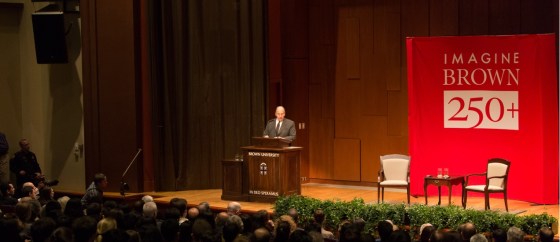
His Highness the Aga Khan visited Brown at the invitation of University President Christina Paxson. His Ogden Lecture was part of the school’s 250th anniversary celebrations. - Photo: AKDN / Farhez Rayani

His Highness the Aga Khan visited Brown at the invitation of University President Christina Paxson. His Ogden Lecture was part of the school’s 250th anniversary celebrations. – Photo: AKDN/Farhez Rayani

Bismillah-ir-Rahman-ir-Rahim

1. STEPHEN OGDEN, PRINCE RAHIM, AND
THE AGA KHAN DEVELOPMENT NETWORK

Thank you very much, Madame President, for your very kind introduction. It is a great honour for me to give the Ogden Lecture…and to pay tribute to the memory of Stephen Ogden.

I have long felt a close sense of belonging at Brown; my eldest son was a member of the Brown Class of 1995, and I treasure the fact that I received an honorary degree from Brown, and was privileged at that time to give the Baccalaureate Address.

My own education has blended Islamic and Western traditions. I was studying at Harvard some 56 years ago when I inherited the Ismaili Imamat. It is not a political role, as has been mentioned, but let me emphasise that Islamic belief sees the spiritual and material worlds as inextricably connected. Faith should deepen our concern for improving the quality of human life in all of its dimensions. That is the overarching objective of the Aga Khan Development Network, which President Paxson has described so well.

2. 1996 AND NOW 

It has been said that giving an effective university lecture requires the boldness to make some strong predictions about the future.

As I look back, over some 18 years now, to 1996, I think I actually under-estimated how many things would change in the years ahead. If you were a student at Brown 18 years ago, you would not have had any Facebook friends and you wouldn’t be following anyone on Twitter. And, even more sadly perhaps, no one would be following you!

There was no instant messaging at that time; indeed, as I recall, people actually used their telephones primarily for talking!

In fact, email itself was still quite a new thing in 1996. And those are only the most obvious examples of transformative change in our world.

What has been the impact of such changes? We often think about technological innovation as a great source of hope for the world. We hear about how the internet can reach out across boundaries, helping us all to stay in touch, and giving us access to information from every imaginable source.

3. COMMUNICATION TECHNOLOGIES – FULFILLED HOPES AND DISAPPOINTMENTS

But it is worth remembering that the same affirmations have greeted new communication technologies for centuries, from the printing press to the telegraph to television and radio. Yet in each case, while many hopes were fulfilled, many were also disappointed. In the final analysis, the key to human cooperation and concord has not depended on advances in the technologies of communication, but rather on how human beings go about using – or abusing – their technological tools.

Yes, the Information Revolution, for individuals and for communities, can be a great liberating influence. But it also carries some important risks.

A. Risks: Fleeting attention spans, Impulsive Judgments and Isolation

More information at our fingertips can mean more knowledge and understanding. But it can also mean more fleeting attention-spans, more impulsive judgments, and more dependence on superficial snapshots of events. Communicating more often and more easily can bring people closer together, but it can also tempt us to live more of our lives inside smaller information bubbles, in more intense but often more isolated groupings.

B. Risk: Greater Connectivity # Greater Connection

We see more people everywhere these days, standing or sitting or walking alone, absorbed in their hand-held screens. But, I wonder whether, in some larger sense, they are really more “in touch?” Greater “connectivity” does not necessarily mean greater “connection.”

Information travels more quickly, in greater quantities these days. But the incalculable multiplication of information can also mean more error, more exaggeration, more misinformation, more disinformation, more propaganda. The world may be right there on our laptops, but the truth about the world may be further and further away.

C. Risk: Contribution to Fragmentation

Among the risks of our new communications world is its potential contribution to what I would call the growing “centrifugal forces” in our time – the forces of “fragmentation.” These forces, I believe, can threaten the coherence of democratic societies and the effectiveness of democratic institutions.

The problem of fragmentation in our world is not a problem of diversity. Diversity itself should be a source of enrichment. The problem comes when diverse elements spin-off on their own, when the bonds that connect us across our diversities begin to weaken.

D. Risk: Knowledge Gaps…Becoming Empathy Gaps

Too often, as the world grows more complex, the temptation for some is to shield themselves from complexity, we seek the comfort of our own simplicities, our own specialities. As has often been said, we risk learning more and more, about less and less. And the result is that significant knowledge gaps can develop and persist.

The danger is that knowledge gaps so often run the risk of becoming empathy gaps. The struggle to remain empathetically open to the Other in a diversifying world is a continuing struggle of central importance for all of us.

The danger of having knowledge gaps grow into empathy gaps – that was the theme of my address in 1996. I discussed then what was becoming an enormous knowledge gap, nearly an ignorance gap, between the worlds of Islam and the non-Muslim world. Since that time, to be sure, there have been moments of encouraging progress on this front, including academic-centred efforts here at Brown, with your wonderful Digital Islamic Humanities Project.

4. THE WORSENING KNOWLEDGE GAP, AND THE LOSS OF AN IMPORTANT ISLAMIC TRADITION

But in many ways, that knowledge gap has worsened.

We have heard predictions for some years now about some inevitable clash of the industrial West with the Muslim world. These multiplied, of course, in the wake of the 9/11 tragedies and other violent episodes. But most Muslims don’t think that way; only an extreme minority does. For most of us, there is singularly little in our theology that would clash with the other Abrahamic faiths, with Christianity and Judaism. And there is much more in harmony. What has happened to the Islamic tradition that says that our best friends will be from the other Abrahamic Faiths, known as the “People of the Book”, all of whose faith builds on monotheistic revelation?

Of course, much of what the West has seen about the Muslim world in recent years has been through a media lens of instability and confrontation. What is highly abnormal in the Islamic world thus often gets mistaken for what is normal. But that is all the more reason for us to work from all directions to replace fearful ignorance with empathetic knowledge.

5.  NON-RECOGNITION IN THE WEST OF MUSLIM CONTRIBUTIONS

Down through many centuries, great Muslim cultures were built on the principle of inclusiveness. Some of the best minds and creative spirits from every corner of the world, independent of ethnic or religious identities, were brought together at great Muslim centres of learning. My own ancestors, the Fatimids, founded one of the world’s oldest universities, Al-Azhar in Cairo, over a thousand years ago. In fields of learning from mathematics to astronomy, from philosophy to medicine Muslim scholars sharpened the cutting edge of human knowledge. They were the equivalents of thinkers like Plato and Aristotle, Galileo and Newton. Yet their names are scarcely known in the West today. How many would recognise the name al-Khwarizmi – the Persian mathematician who developed some 1,200 years ago the algorithm, which is the foundation of search engine technology?

6. HOSTILITY BETWEEN AND WITHIN FAITHS

In the Muslim world itself, as is true outside of it, much of our history, culture and art, has been obscured, and with it a clear sense of Muslim diversity. Among other “in-comprehensions” is the increasing conflict between Sunni and Shia Muslims. In places like Pakistan and Malaysia, Iraq and Syria, Lebanon and Bahrain, Yemen and Somalia and Afghanistan, the Sunni-Shia conflict is becoming an absolute disaster.

The harsh truth is that religious hostility and intolerance, between as well as within religions, is contributing to violent crises and political impasse all across the world, in the Central African Republic, in South Sudan and Nigeria; in Myanmar, in the Philippines and in the Ukraine, and in many other places.

Such hostilities, of course, represent the most sinister side of what I have described as the centrifugal, fragmenting patterns of our times.

7. RESPONSES TO INTOLERANCE

A.  Recognition of Pluralism

How can we respond to such tendencies? The response, I would emphasise today is a thoughtful, renewed commitment to the concept of pluralism and to the closely related potential of civil society.

A pluralist commitment is rooted in the essential unity of the human race. Does the Holy Quran not say that mankind is descended from “a single soul?” In an increasingly cosmopolitan world, it is essential that we live by a “cosmopolitan ethic,” one that addresses the age-old need to balance the particular and the universal, to honour both human rights and social duties, to advance personal freedom and to accept human responsibility.

It is in that spirit that we can nurture bonds of confidence across different peoples and unique individuals, welcoming the growing diversity of our world, even in matters of faith, as a gift of the Divine. Difference, in this context, can become an opportunity – not a threat – a blessing rather than a burden.

B. Good Governance: The Example of America’s First President, George Washington

This brings us to the challenges for governance in our time. How do we organise our complex societies to achieve harmony and perhaps some progress, even at this time of growing diversity? These have always been difficult questions and they are not getting any easier. As you know, they were particularly difficult questions for the United States back in this university’s earliest years, as 13 former colonies tried to write a new national constitution.

George Washington, who had presided over the Constitutional Convention, came to this campus in 1790, after just one year as President, when Brown itself was only a quarter of a century old. He travelled to Providence to mark the recent adoption of the new US Constitution by the state of Rhode Island – the last of the original 13 states to do so.

The colossal face of  George Washington as photographed from the Presidential Trail at the Rushmore Memorial. George Washington (1732 - 1799), America's first President is considered the father of the country and is therefore the most prominent figure on the mountain. Photo: Malik Merchant. © Simerg.com

The colossal face of George Washington as photographed from the Presidential Trail at the Rushmore Memorial. George Washington (1732 – 1799), America’s first President is considered the father of the country and is therefore the most prominent figure on the mountain. Photo: Malik Merchant. © Simerg.com

Washington’s visit in Providence marked a moment of historic constitutional significance. And the questions we have raised today, balancing centrifugal, fragmenting realities on the one hand with the imperatives of national bonding and governing on the other, were central concerns for Washington at that moment and throughout his career. After eight years of coping with these issues as the first American president, he made them the major theme of his famous Farewell Address.

He was worried, principally, he said then, about what he called the spirit of “faction” and its ability to undermine a sense of democratic nationhood. He described faction as a spirit, that “kindles the animosity of one part against another,” creating a “fatal tendency to elevate a small but artful and enterprising minority of the community” against the whole. It threatened, he said, “a frightful despotism”, one that could “render alien to each other those who ought to be bound together…”

C. New Government Frameworks and Constitutions Honouring Human Rights:  Kenya and Tunisia

Such threats to bonding, and thus to balance, have long presented a central governance challenge, here and elsewhere. And these issues are now being addressed with new intensity all across the world.

Amazing as it may seem, fully 37 countries have been writing or rewriting their constitutions in the last ten years, with another 12 countries recently embarking on this path….And nearly half of these 49 countries have majority Muslim populations.

Clearly, many Muslim societies are seeking new ways to organise themselves. And there can be no “one size fits all”. The outcomes obviously are going to be many and varied. The process will challenge the creativity of the world’s best political and legal thinkers. Especially in the developing world, such matters will increasingly be in the hands of younger, more educated men and women, provided the system allows them to come to the forefront.

These governance issues are frankly today, of global concern. And I believe that the great universities of the world and Brown University in particular, can also play an especially creative role in responding to them.

The challenge, as we have said, will be one of balancing values and interests, honouring the importance of religious and ethical traditions, for example, while also respecting the free will of individual human beings; accommodating both the role of central governments and regional demands, reconciling the urban and the rural; providing for democratic change, and institutional continuity.

Creating new governance frameworks is obviously not an easy task. But it can be accomplished. In Kenya just three and a half years ago, for example, a new constitution ratified by two-thirds of the voters, redistributed power dramatically from the central level to 47 county governments. In Tunisia, just a few weeks ago, a new “consensus” constitution with 94 per cent approval from the elected Constituent Assembly reaffirmed the Islamic identity of the Tunisian state, while also protecting the human rights of religious and ethnic minorities.

D. Good and Quality Civil Society: Vital to Democratic Governance

In these cases, and in other places such as Bangladesh, one of the fundamental constructive forces at work has been the strength of civil society, it is a topic that is worth serious attention.

By civil society I mean an array of institutions that operate on a private, voluntary basis, but are motivated by high public purposes. They include institutions devoted to culture, to science and to research; to commercial, labour, ethnic and religious concerns; as well as a variety of professional societies. They include institutions of the media and education.

I think the conclusion is the success of democratic societies will depend in the end on more than democratic governments. The scale and the quality of civil society will become a factor, I believe, of enormous importance.

A quality civil society has three critical underpinnings: a commitment to pluralism, an open door to meritocracy, and a full embrace of what I described earlier as a cosmopolitan ethic.

The voices of civil society will reflect and express the growing complexity of society, not as autonomous fragments, but as diversified institutions seeking the common good. And I believe that the voices of civil society can be among the most powerful forces in our time. Where change has been overdue, they can be voices for change. Where people live in fear, they can be voices of hope.

 8. ATTRIBUTES OF A GOOD CIVIL SOCIETY

A. Talent and Voluntary Service

One of the energizing forces that makes a quality civil society possible, of course, is the readiness of its citizens to contribute their talents and energies to the social good. What is required is a profound spirit of voluntary service, a principle cherished in Shia Ismaili culture, and honoured, I know, here at Brown.

B. Diversified Input

Progress is possible when the multiple, diversified needs of any society can be matched by multiple, diversified inputs; that is also what civil society is all about. This is why great universities, with their broad, diversified programmes, can be a resource of importance in the development of quality civil society, in their own countries but also around the world. And again, Brown offers a powerful example.

C. Predictability and Sophisticated Analysis

Perhaps the biggest quandary we face in our economic and social development programmes is the problem of “predictability”; knowing what changes are going to arise, and then deciding what is more or less likely to work in a given situation. But again, progress is possible when complex issues are subjected to competent, intelligent, nuanced and sophisticated analysis, free from dogmatism, and based upon what I would describe as “empathetic knowledge.” This happens best in open, meritocratic societies, where people’s responsibilities are based on their competence. It also happens best when the intellectual resources of the world’s great universities, like Brown, are brought into play.

D. Well-Informed Leaders with Broad Outlooks

A quality civil society, in any setting, will require well-informed leaders who are sensitive to a wide array of disciplines, and outlooks and cultures. It will require people with the ability to continue their learning in response to new knowledge. I know these are central concerns for Brown University, articulated so well in its new Strategic Plan and its call for “Building on Distinction.”

E. Diversity Without Fragmentation

As we look ahead, in sum, we face a world in which centrifugal and fragmenting influences are of growing importance, presenting new governance challenges all across the planet, and especially in fragile societies. In such a world, the voices of pluralistic civil society can help ensure that diversity does not lead to disintegration, and that a broad variety of energies and talents can be enlisted in the quest for human progress. Diversification without disintegration, this is the greatest challenge of our time.

9. THE IMPORTANCE OF THE HUMAN INTELLECT IN THE SHIA ISMAILI TRADITION AND THE ROLE OF IMAMAT INSTITUTIONS
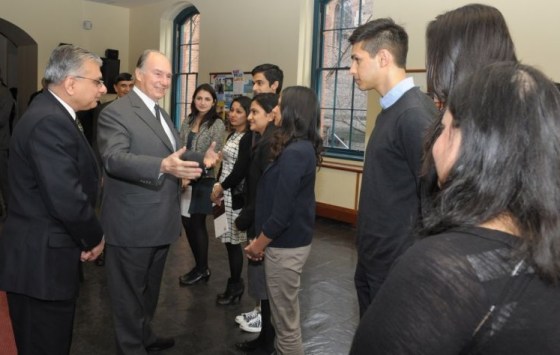
His Highness the Aga Khan meets with Ismaili students at Brown University.

His Highness the Aga Khan meets with Ismaili students at Brown University. Photo: The Ismaili/Aly Z. Ramji

One of the important values of the Shia Ismaili tradition is the transformative power of the human intellect – that conviction underscores AKDN’s strong commitment to education, at all levels, wherever we are present. These activities include the Aga Khan University – now thirty years old – our newer University of Central Asia, our Aga Khan Academies at the primary and secondary levels, and our major commitment to the potential of Early Childhood Development.

The Aga Khan University in Karachi and East Africa is in the process today of creating a new Liberal Arts faculty, while also establishing eight new post-graduate schools. I would emphasise both these initiatives. Professional education is sorely needed in the developing world, but equally important is the capacity to integrate knowledge, to nurture critical thinking and ethical sensitivity and to advance interdisciplinary teaching and research.

10. FINAL REMARKS: SPEAKING FROM PERSONAL EXPERIENCE
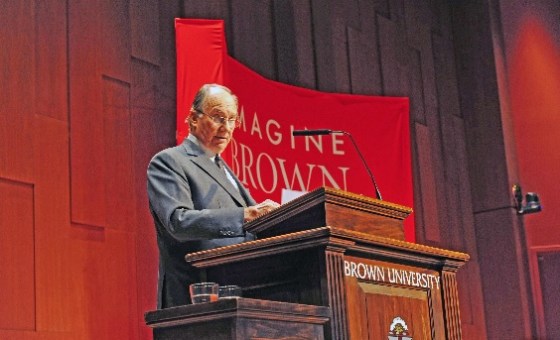
His Highness the Aga Khan delivers an Ogden lecture titled "Modern governance in a more complex world: Challenges and responses" at Brown University. - Photo: AKDN / Aly Z. Ramji

His Highness the Aga Khan delivers an Ogden lecture titled “Modern governance in a more complex world: Challenges and responses” at Brown University. – Photo: AKDN / Aly Z. Ramji

Over the past six decades I have been immersed in the problems of developing societies, grappling with ways to assist their populations, despite both natural hazards and human errors. It is my conviction that a strong, high-quality, ethical and competent civil society is one of the greatest forces we can work with to underwrite such progress. And, if this is correct, then the role of great universities has never been more important.

I am convinced that Brown will be among the greatest universities stepping up to this challenge, as it finishes its first 250 years, and embarks on its next quarter of a millennium!

Date posted: Wednesday, March 12, 2014

___________________

Please visit Ismailimail for a comprehensive collection of links to all material related to the above event. It is the best referral website for anything related to His Highness the Aga Khan and the Ismaili community.

Please also visit:

www.brown.edu
http://www.akdn.org
http://www.theismaili.org
www.nanowisdoms.org

Brown University’s Ogden Lecture, and a photo of His Highness the Aga Khan that I took in 1996 at Providence which will remain my greatest treasure!

Stephen A. Ogden Jr.

Stephen A. Ogden Jr.

INTRODUCTION: Founded in 1764, Brown University, the seventh-oldest college in the United States, is celebrating the 250th anniversary of its founding this year. As part of this anniversary, His Highness the Aga Khan, the 49th Imam of Ismaili Muslims, will deliver a Stephen A. Ogden Jr. ’60 Memorial Lecture on International Affairs at Brown University on Monday, March 10, 2014, at 5 p.m. The ceremony will be will be carried live  at http://www.brown.edu/web/livestream/.

Since 1965, the Ogden Lectures have been the most distinguished of their kind, serving both the Brown and Rhode Island communities in the field of International Relations.

Stephen A. Ogden Jr., an active member of the Brown class of 1960, was seriously injured in an automobile accident in the spring of his junior year. After a valiant fight for life, he died in 1963. Established by his family, the Ogden lectureship came into being two years later as a means of achieving in some small measure what Steve Ogden had hoped to accomplish in his life: the advancement of international peace and understanding.

The Ogden Lectures are a living tribute to the memory of a young man who had hoped to devote his abilities and energy to the field of international relations. These lectures have brought to the University and to Rhode Island a large number of U.S. and foreign diplomats as well as many other observers of the international scene. All have given lectures, free and open to the public, on current world topics.

_______________

A Cherished Photo

By Abdulmalik J. Merchant
Publisher-Editor, www.simerg.com

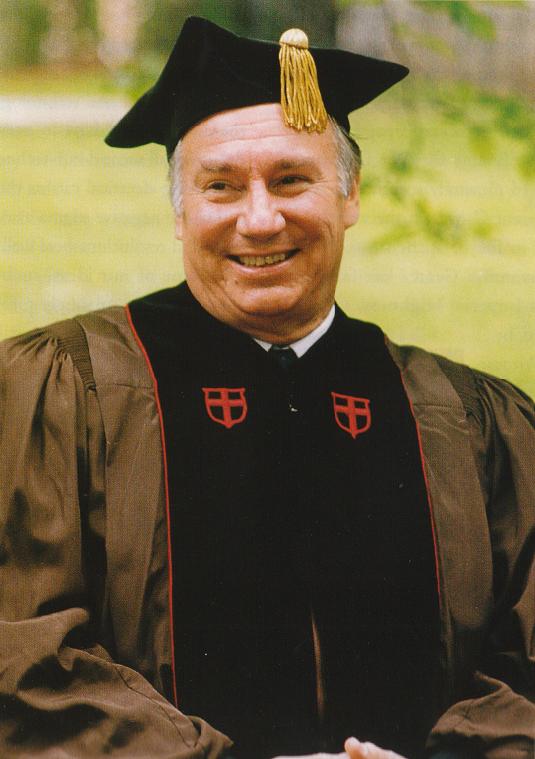
Aga Khan IV, 49th Ismaili Imam, pictured at Brown University in May 1996. Photo: Akdn.org

His Highness the Aga Khan, the direct descendant of the Prophet Muhammad (s.a.s) and 49th Imam, pictured at Brown University in May 1996. Photo: Akdn.org

A family member living overseas called me in Philadelphia, USA, during the third week of May in 1996, and asked me to obtain a speech that he thought Mawlana Hazar Imam, His Highness the Aga Khan, had already delivered at Brown University in Providence, Rhode Island, earlier that month. Without waiting another second, I called Brown’s main number, and was swiftly connected to a very kind and knowledgeable gentleman. When I requested for a copy of the speech, he informed me that the speech had not yet been delivered and that His Highness would be addressing the University’s Baccalaureate Service during the coming Memorial Day Weekend. Obviously, my next question was if I was permitted to attend the event, and without hesitation he asked me to come over and bring my friends too! He explained that the address would take place at the First Baptist Church, where sitting would be limited to the graduating students. However, all the visitors would be able to watch the videocast on a large-screen on the College Green. I thanked him with all my heart. But before wishing me good-bye, he thoughtfully asked me to spend an extra day in Providence, as Mawlana Hazar Imam along with eight other individuals would also be conferred with an Honorary Degree at a special University Ceremony on the same Green.

The Memorial weekend was only two days away! I rushed to get a rented car and prepared for the event, including purchasing a couple of $9.00 disposable cameras from a nearby drugstore in downtown Philadelphia, where I lived. I set out for the 6 hour drive on Saturday morning, May 25th. I first stopped at Scranton University and attended my cousin Akber’s graduation ceremony. I then proceeded to Connecticut to meet Anaar Naran, a close family friend who was my younger brother Fahar’s teacher at Dar-es-Salaam’s Aga Khan Boys Primary School in the 1960’s.

The following morning, Sunday, 26th May, upon reaching Providence, I first decided to locate the whereabouts of the Green. Satisfied, I checked into a nearby hotel and returned with immense excitement to the event site well before the start of the 1:30 pm Baccalaureate Service in the First Baptist Church.

May 26, 1996: His Highness the Aga Khan receives a standing ovation at the conclusion of the Baccalaureate Address at Brown University, Providence, Rhode Island. Next to him is Vartan Gregorian who was then President of the University.

May 26, 1996: His Highness the Aga Khan receives a standing ovation at the conclusion of the Baccalaureate Address at Brown University, Providence, Rhode Island. Next to him is Vartan Gregorian who was then President of the University.

Seated at the front of the Green, I witnessed the entire ceremony on the large screen that had been set-up. The ceremony  embraced lively expressions of thanksgiving, harmony, and rhythm and included music and spiritual readings from Islam, Christianity and Hinduism as well as other faiths, incorporating the many spiritual and cultural traditions of the Brown community. The program that was distributed contained the texts of the spiritual readings. I was captivated and deeply touched by the distinguished and dignified ceremony which respected and recognized world-faiths.

As I heard a Hindu reading which alluded to the Lord Vishnu as the Preserver of the Universe and one who would manifest himself again, my thoughts turned to that notion of manifestation as presented by Ismaili missionaries and Pirs in some of their ginans, which were aimed at converting Hindus to the Ismaili faith.

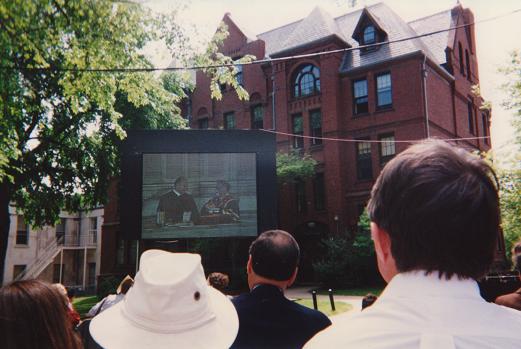
May 26, 1996: An audience at Brown Univeristy's "Green" watches a live telecast from the Meeting House of the First Baptist Church where the Aga Khan delivered the Baccalaureate Address to graduating class. Photo: Abdulmalik Merchant

May 26, 1996: An audience at Brown University’s “Green” watches a live telecast from the Meeting House of the First Baptist Church where the Aga Khan delivered the Baccalaureate Address to graduating class. Photo: Abdulmalik Merchant

The entire service including President Gregorian’s and Mawlana  Hazar Imam’s speeches (Vartan Gregorian’s Tribute to His Highness the Aga Khan at Brown University in 1996) was overpowering and unforgettable, and I was given an opportunity to share my thoughts about the complete event with the Philadelphia jamat a few days later at the invitation of the mukhi. During that talk I also read out the scripture excerpts from Brown’s programme booklet. Alas, the diskette with the hard-copy of my speech is in storage and not easily accessible.

The following morning on Monday, 27th May, bagpipers, highland drummers, marching bands and more than 5,000 graduates, alumni, faculty, parent educators and University guests marched in a mile-long procession that announced Brown University’s 228th Commencement exercises, in  one of the largest and most colorful academic pageants in the nation.

By approximately 11:45 all the three groups – the medical students, graduate students as well as undergraduates – had returned from their separate convocations for the University Ceremony on The College Green.

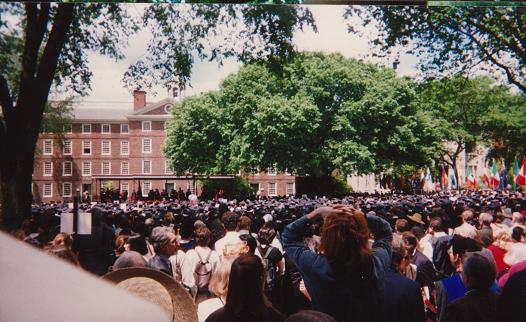
May 27, 2009: A section of the large crowd witnessing the University Ceremony at Brown University's "Green." The Honorary Degree recipients, including the Aga Khan, are on the stage in the distant. Photo: Malik Merchant

May 27, 1996: A section of the large crowd witnessing the University Ceremony at Brown University’s “Green.” The Honorary Degree recipients, including the Aga Khan, are on the stage in the distant. Photo: Malik Merchant

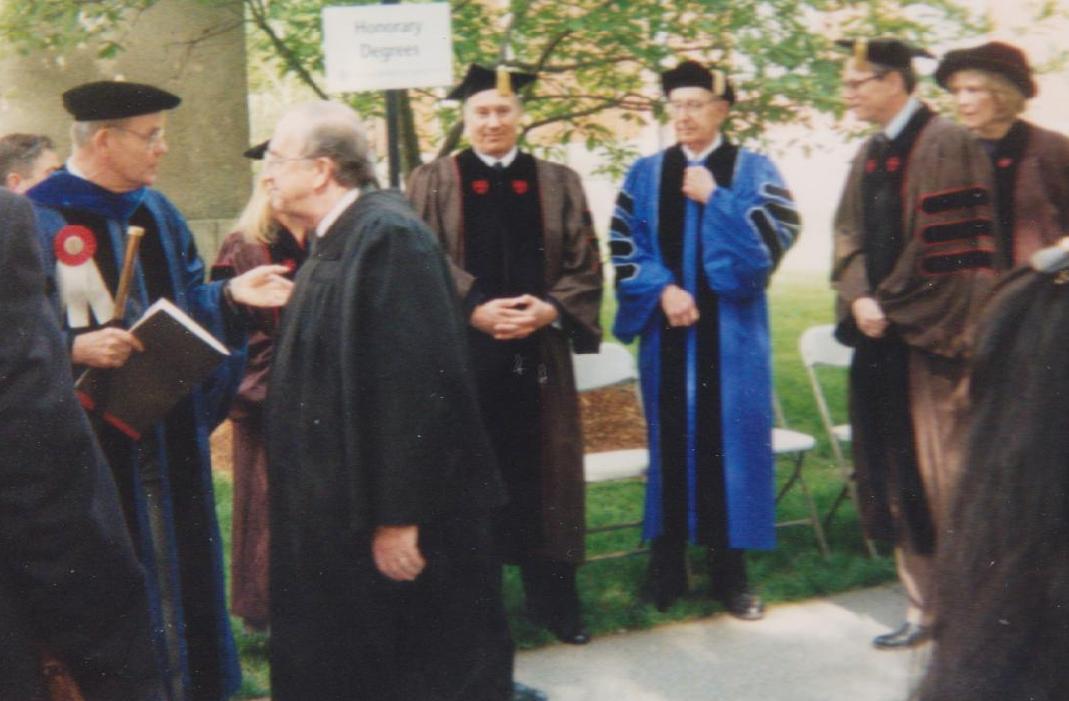
In the meantime I wandered around the Green, enjoying and soaking in the lively atmosphere. Near one end of the Green I spotted Mansoor Saleh, a class-mate from my 1964 primary school days in Dar-es-Salaam. He was with the Council for USA. I was meeting him after several years, and I greeted him with immense enthusiasm and excitement, not knowing who was around us. A few moments earlier I had seen Princess Zahra Aga Khan and Prince Rahim Aga Khan, and I asked Mansoor where Hazar Imam might be. He asked me to turn to the left, and there standing just a few metres away was Mawlana Hazar Imam in the company of other distinguished individuals, who were also going to be conferred with honorary degrees. I should have been a little quieter in greeting Mansoor, I thought to myself! But then it was a meeting of brothers after years, I said to myself. Wouldn’t my Imam feel happy at that very warm brotherly encounter and greeting?

Dozens of academic staff passed by in the University’s regalia, and many stopped to greet Mawlana Hazar Imam and other dignitaries. I saw President Shams Kassim-Lakha, in his elegant Aga Khan University regalia, approaching Mawlana Hazar Imam and readied my camera to click them together. But a person blocked the scene, and I was momentarily delayed. I clicked as soon as the person had passed. I was uncertain about the shot I had taken and who might be in it. This wasn’t a digital camera – the film had to be sent to the lab to be processed! Everything happened too swiftly.

I thanked Mansoor, wished him goodbye, and proceeded to the back of the Green to watch the University ceremony during which President Vartan Gregorian presented special awards and honors as well as conferred honorary degrees to Mawlana Hazar Imam and eight others – namely Mary Chapin Carpenter, Edward D. Eddy, Timothy Forbes, Agnes Gund, Arthur Mitchell, Sandra Day O’Connor, Itzhak Perlman and James Wolfensohn. Flags from more than 50 nations, representing the homelands of the Class of 1996, were flown during the University ceremony which was filled with thousands of people. When Mawlana Hazar Imam was presented with the honorary degree, President Vartan Gregorian prompted the gathering to give him a special ovation.

A truly memorable event had come to an end. I returned to Philadelphia, and my first action was to submit the cameras for processing. I was quite clear about the contents of dozens of photos that I had captured, with the exception of one.

…AND THE PHOTO

Mawlana Hazar Imam, His Highnes the Aga Khan, pictured at "The Green" at Brown University, 1996. Photo: Abdulmalik Merchant

THE TREASURED PHOTO – please click for enlargement. Mawlana Hazar Imam, His Highness the Aga Khan, with other honorary degree recipients before the ceremony at “The Green” at Brown University, 1996. Photo: Abdulmalik Merchant.

I soon collected the processed prints, and started flipping through the photos, which were essentially of average quality. I felt satisfied considering I had used a very rudimentary camera, a disposable one. Then as I neared the end of the second set of prints, I realized that President Shams Kassim-Lakha had been too fast for my shutter speed. I brought the photo closer to my eye. It filled me with immense joy and happiness. I didn’t know that the camera had harmoniously coordinated with other forces to capture the image. Either by fluke or providence this (‘posed’) photo of Mawlana Hazar Imam is one that I will cherish and treasure throughout my life.

Date posted: Sunday, March 9, 2014.

Copyright. Simerg.

___________________

Mawlana Hazar Imam’s 1983 and 2014 Visits to the Parliament of Canada by Farouk B.K.S. Verjee

A QUANTUM LEAP

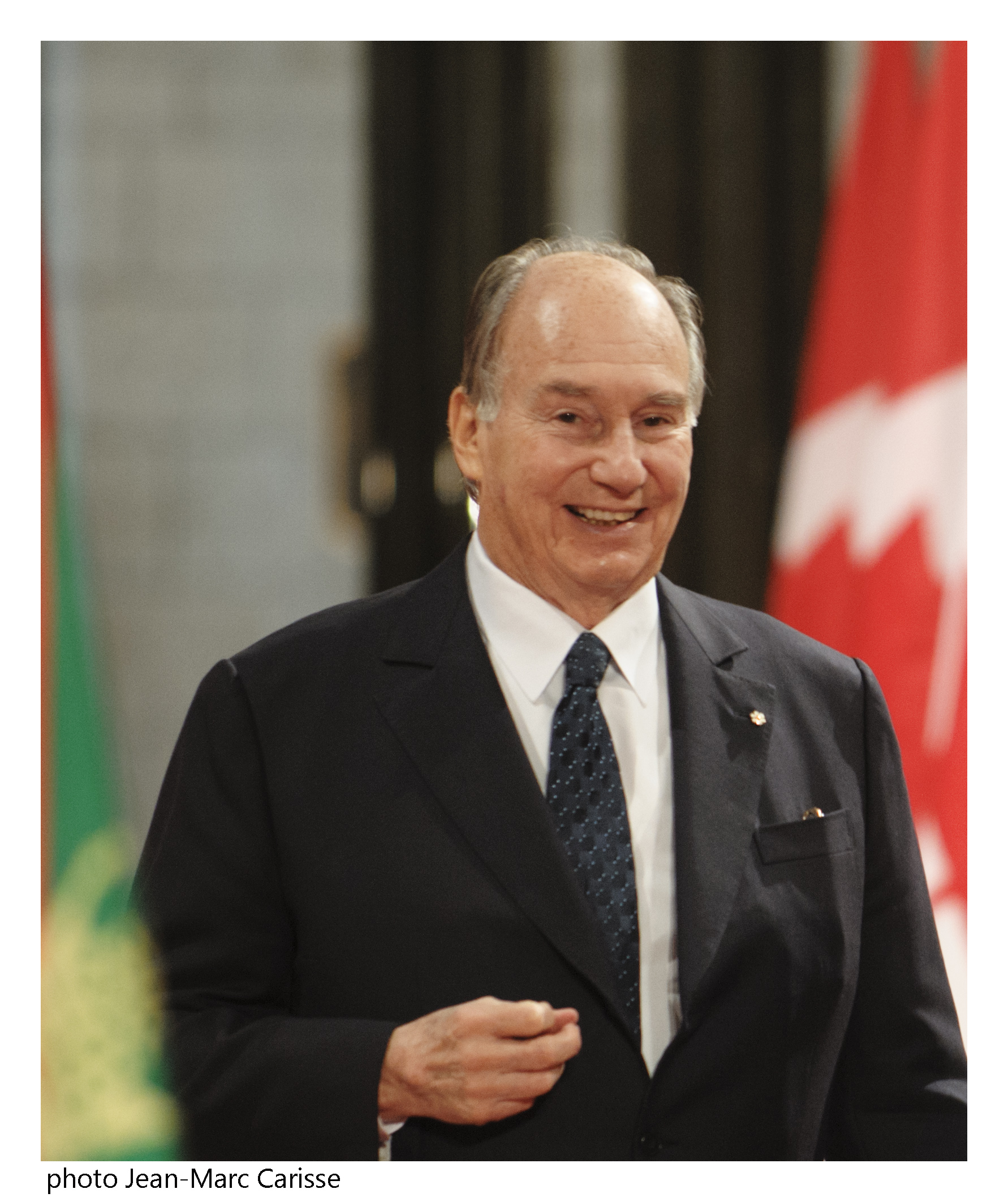
Mawlana Hazar Imam, His Highness the Aga Khan, 49th Imam and the direct descendant of the Prophet Muhammad (s.a.s.), at the Canadian Parliament on Thursday, February 27, 2014. Simerg Exclusive Photo: Copyright Jean-Marc Carisse.

Mawlana Hazar Imam, His Highness the Aga Khan, the direct descendant of the Prophet Muhammad (s.a.s) and 49th hereditary Imam at the Canadian Parliament on Thursday, February 27, 2014. Simerg Exclusive Photo: Copyright Jean-Marc Carisse. Please click on photo for enlargement.

By Farouk B.K.S. Verjee

Parliament Hill

27th February, 2014 will be etched as a momentous day in Ismaili history with Mawlana Hazar Imam becoming the first faith leader in 75 years to address the Joint Session of the Parliament of Canada, at the invitation of the Prime Minister, Stephen Harper. Our group of invitees who travelled to Parliament in a coach proudly sang “O Canada,” and as we reached the snow-covered lawns of the Parliament Building we saw the Imamat flag flying on the hill. We had truly arrived!

The Chamber of the House of Commons was filled to capacity. Shortly after 11 a.m as Mawlana Hazar Imam entered the House to rousing applause from both sides of the House, my eyes welled up in tears as I travelled back in time to the Silver Jubilee.

 Mawlana Hazar Imam signs the distinguished visitors books for the House of Commons and the Senate in the Canadian Parliament Rotunda as Prime Minister Stephen Harper, his wife Laureen Harper, The Honourable Andrew Scheer, Speaker of the House of Commons and the Honourable Noël Kinsella, Speaker of the Senate, and other individuals look on. Photo: Post Media Clip


Mawlana Hazar Imam signs the distinguished visitors books for the House of Commons and the Senate in the Canadian Parliament Rotunda as Prime Minister Stephen Harper, his wife Laureen Harper, The Honourable Andrew Scheer, Speaker of the House of Commons and the Honourable Noël Kinsella, Speaker of the Senate, and other individuals look on. Photo: Post Media Clip. See video link below.

I had been the Hon. Secretary of the Ismaili Council for Canada during Mawlana Hazar Imam’s Silver Jubilee visit, and was thinking back to how far we had come since his first visit to the House during the Jubilee in April, 1983. Pierre Trudeau was the Prime Minister, and Zulficar Lalji our National President. During that visit, Mawlana Hazar Imam was recognised from the Distinguished Visitors’ Gallery by the speaker of the House, Madame Jeanne Sauve.

A unique and historical photo signed by the late Canadian Prime Minister, Pierre Trudeau, which was taken in the Prime Minister's Office during Mawlana Hazar Imam's Silver Jubilee visit to Canada in April 1983.  (l to r) -  Hon. Sec Farouk Verjee (National Council), Mr. Gerry Wilkinson (His Highness the Aga Khan's Secretariat, Aiglemont, France), Hon. Sec Mohamed Manji (Ontario Council), President Amirali Rhemtulla (Grants Council), Mawlana Hazar Imam, Prime Minister Pierre Trudeau, Prince Amyn Muhammad Aga Khan, President Mehboob Dhanani (Ontario Council) and President Zulficar Lalji(National Council). Canada. The full signature line note from the Prime Minister read:  To Farouk with the best of Memories . Trudeau. 1983. Photo: Photo: Farouk Verjee Collection, Vancouver,

This unique and historical photo signed by the late Canadian Prime Minister, Pierre Trudeau, was taken in the Prime Minister’s Office during Mawlana Hazar Imam’s Silver Jubilee visit to Canada in April 1983. (l to r) – Hon. Secretary Farouk Verjee (Aga Khan Council for Canada), Mr. Gerry Wilkinson (His Highness the Aga Khan’s Secretariat, Aiglemont, France), Hon. Secretary Mohamed Manji (Aga Khan Ontario Council), President Amirali Rhemtulla (Aga Khan Grants Council), Mawlana Hazar Imam, Prime Minister Pierre Trudeau, Prince Amyn Muhammad Aga Khan, President Mehboob Dhanani (Aga Khan Ontario Council) and President Zulficar Lalji (Aga Khan Council for Canada). The full signature line note from the Prime Minister read: To Farouk with the best of Memories. Trudeau. 1983. Photo: Farouk Verjee Collection, Vancouver. Please click for enlargement.

After a raucous question period relating to a budget leak, the late Prime Minister invited Hazar Imam, Prince Amyn Muhammad and the accompanying Ismaili leaders to his office. He immediately asked if we would like to have a picture taken (see photo above). It was like being in seventh heaven! Prime Minister Trudeau praised our jamats’ engagement in all aspects of National Life, having arrived here only a decade earlier. It is a well know-historical fact that the Prime Minister facilitated the settlement of thousands of stateless Asians, including Ismailis, after they were forced to leave Uganda by Idi Amin in 1972. Referring to the rowdy question period earlier, the Prime Minister jokingly said it was like going to the dentist every day! The charismatic Mr. Trudeau with his usual panache was always at his very best with his sharp wit.

At one point I quipped that hopefully by the next Jubilee we would have Ismailis in the House. The Prime Minister with his typical shrug said, “Why not earlier?” Until recently we had Yasmin Rattansi (Liberal — Toronto) and Rahim Jaffer (Conservative — Edmonton) as Federal MP’s. Mobina Jaffer sits in the Senate.

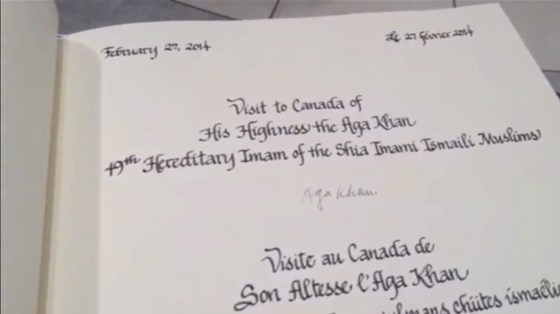
Mawlana Hazar Imam's signature in the Visitor's Book from the signing ceremony shown in a previous photo. Credit: Post Media Clip.

Mawlana Hazar Imam’s signature in the Visitor’s Book from the signing ceremony shown in a previous photo. Credit: Post Media Clip. See video link below.

Last week’s address by Mawlana Hazar Imam to both houses was extensive, and was punctuated by numerous applauses. It ended beautifully with the following quote from the Holy Qur’an:

“Oh Mankind, fear your Lord, who created you of a single soul, and from it created its mate, and from the pair of them scattered abroad many men and women.”

Following the joint session of Parliament, Prime Minister Harper and Mawlana Hazar Imam signed an important Protocol of Understanding with the Government of Canada and the Ismaili Imamat in the Hallway of Honour, which was draped with our National flag and the Imamat flag. As part of this historical visit Mawlana Hazar Imam also signed the distinguished Visitors Books of the House of Commons and the Senate.

Massey Hall

On the following day, a very large gathering of some 2500 people from all walks of life attended Massey Hall in Toronto to hear both the Prime Minister and Mawlana Hazar Imam.

More than 2500 people from all walks of life and from different communities lined up on Friday February 28, 2014, in frigid temperatures outside Toronto's iconic Massey Hall Theatre to attend an event hosted by Prime Minister Stephen Harper in honour of Mawlana Hazar Imam. Photo: Nurin Merchant. Copyright.

More than 2500 people from all walks of life and from different communities lined up on Friday February 28, 2014, in frigid temperatures outside Toronto’s iconic Massey Hall Theatre to attend an event hosted by Prime Minister Stephen Harper in honour of Mawlana Hazar Imam. Photo: Nurin Merchant. Copyright.

As we huddled outside the iconic 120 year old building in extreme weather with a temperature of around -28c with windshield, to go through the security checks, I was impressed by the number of non-Ismailis who were lining up in good cheer to hear our Imam. One individual got a large canister of Starbucks coffee and handed it out freely to the freezing crowd!

Our jamat can be truly proud of the events at the Parliament and Massey Hall and we can now all look forward to the opening this year in Toronto of the magnificent Ismaili Centre, the Aga Khan Museum and the Park.

Date posted: Friday, March 7, 2014.

Copyright: Farouk Verjee/Simerg. 2014.

_________________

Click on  Aga Khan Signs Visitors Books to watch a brief 1 minute video of the signing ceremony.

Other related links at Simerg:

About the writer: Farouk B.K.S. Verjee served as the Honorary Secretary of His Highness the Aga Khan Ismaili Council for Canada for a period of 5 years from 1979-1984, following which he became its President until 1987. His terms of office saw the foundation laying ceremony of the Ismaili Jamatkhana and Centre (a Silver Jubilee Project) by the Honourable Henry Bell-Irving, Lieutenant-Governor General of British Columbia, as well as its opening in 1985 by Canada’s Prime Minister, Brian Mulroney. Both the ceremonies took place in the presence of Mawlana Hazar Imam and members of the Noorani family. In a farman made to the jamat on the opening day, Mawlana Hazar Imam declared the jamatkhana as Canada’s darkhana. 

Watch short 1 minute video of the signing ceremony, please click on story:  Conservatives Harvested Emails

Photo Collection and Stirring Speech Excerpts of His Highness the Aga Khan at Simergphotos

Simerg’s recent post about His Highness the Aga Khan’s dynamic and stirring address to members of the Canadian Parliament has been published at Simergphotos under a different page theme suited for photos. Please click on the following image to read the speech as well as view the photos, some of which are exclusive to Simerg.

Please click on image to read post at ww.Simergphotos.com

Please click on image to read post at www.Simergphotos.com

For the original Simerg post, please click on In a Dynamic and Stirring Address to Members of the Canadian Parliament, His Highness the Aga Khan Shares His Faith Perspectives

His Highness the Aga Khan at the Parliament of Canada: Selected Excerpts from the Live English Translation of Remarks Made in French

The following English translation of selected parts of His Highness the Aga Khan’s speech on February 27, 2014 to the Canadian Parliament which were in French was obtained from the live translation that was provided during the broadcast.

HONOUR AND THE WORLDWIDE RECOGNITION OF IMAMAT

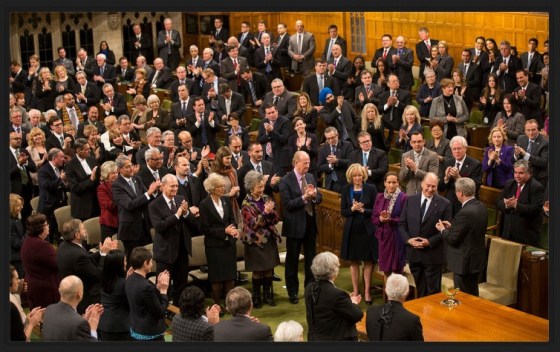
His Highness the Aga Khan humbly accepts a standing ovation and honour at the Canadian Parliament on Thursday February 24, 2014. Prime Minister Stephen Harper is seen applauding, with Princess Zahra, the daughter of His Highness, and Laureen Harper, the Prime Minister's wife, standing alongside the 49th Ismaili Imam. Photo credit: The Office of the Prime Minister of Canada

His Highness the Aga Khan humbly accepts a standing ovation and honour at the Canadian Parliament on Thursday February 24, 2014. Prime Minister Stephen Harper is seen applauding, with Princess Zahra, the daughter of His Highness, and Laureen Harper, the Prime Minister’s wife, standing alongside the 49th Ismaili Imam. Photo credit: The Office of the Prime Minister of Canada

Bismillah-ir-Rahman-ir-Rahim

….Thank you again, Prime Minister, for your invitation. It is for me an unprecedented honour. It is a feeling, a profound feeling…because I have been told that this is the first time in 75 years that a spiritual leader has addressed the Senate and the House of Commons together as part of an official visit.

It is, therefore, with humility and awareness of eminent responsibility that I address to you today, elected representatives of the Federal Canadian Parliament and in the presence of other Senior Federal Officials.

I have the great privilege of representing the Ismaili Imamat — this institution which has stretched beyond borders for more than 1400 years and which defines itself and is recognised by an increasingly large number of states, as the succession of Shia Imami Ismaili Imams.

As the 49th Imam, I have for the past 50 years, looked after two inseparable responsibilities: overseeing the spiritual wellbeing of Ismailis, as well, at the same time, as focusing on improving their quality of life and that of the people with whom they live.

Even if there was a time when Ismaili Imams were also Caliphs — in other words, Head of States, for example in Egypt during Fatimid times — my duties today are apolitical. All Ismailis are first and foremost citizens of their countries of birth or adoption. The reach of the Ismaili Imamat is, however, much larger than it was at that time since it is active today in many regions of the world. It is from this perspective that I will share with you some thoughts with you that I feel are worthy of your presence here today.

OPPOSING FORCES BUT HARMONY IS POSSIBLE
THROUGH A CONSTITUTIONAL PROCESS

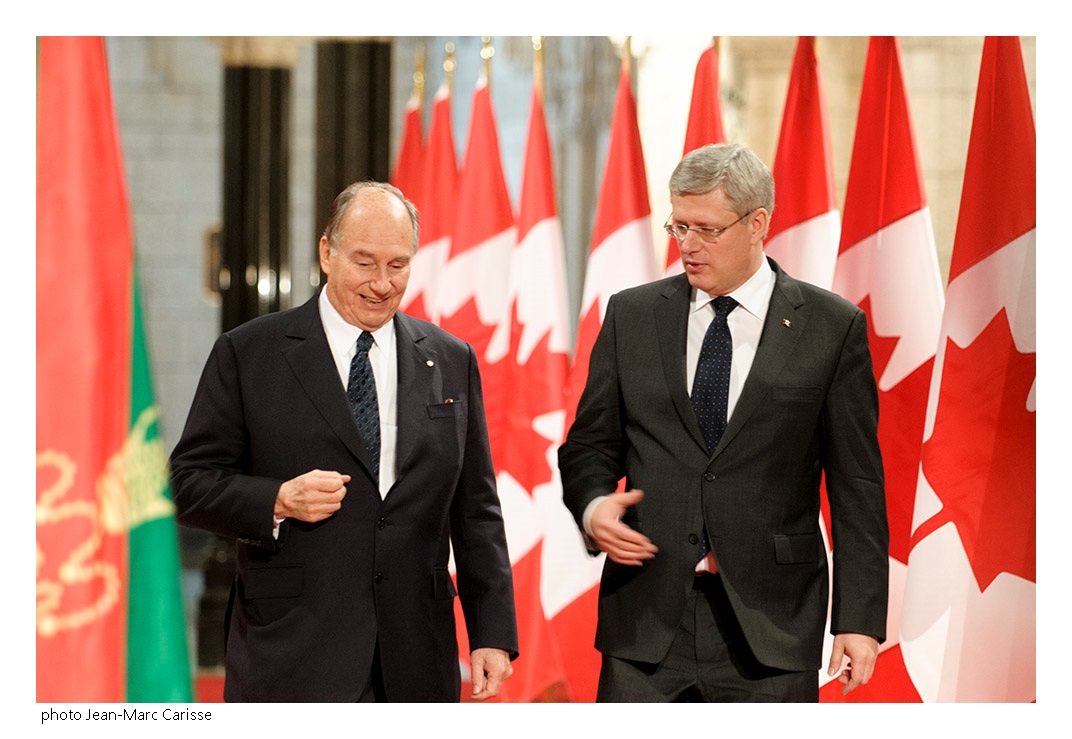
His Highness the Aga Khan and Prime Minister Harper in a conversation as they proceed to the signing ceremony of  the protocol of understanding between the Ismaili Imamat and Canada. They are flanked on either side by the flags of the red and green flags of the Ismaili Imamat and the maple leaf of Canada. Photo: Jean-Marc Carisse. Copyright.

His Highness the Aga Khan and Prime Minister Harper in a conversation as they proceed to the signing ceremony of the protocol of understanding between the Ismaili Imamat and Canada. They are flanked on either side by the flags of the red and green flags of the Ismaili Imamat and the maple leaf of Canada. Photo: Jean-Marc Carisse. Copyright.

Allow me at this point to address you again in French. I have just spoken about the incomprehension that exists between industrialised world and Muslim world and about how opposing forces have undermined relations with the great traditions of Islam. Yet, our hearts, our minds, and for many, our faith, tell us that harmony is possible. In fact, recent developments are an indication of this.

I would like to say how important constitutional development is in correcting the inability of several existing constitutions to match the evolution of societies, especially when these societies are evolving. This is a fundamental issue that, given my responsibilities, I cannot ignore. You maybe surprised to learn that 37 countries throughout the world have adopted a new constitution over the past 10 years, and 12 are at an advanced phase of modernising their own constitutions. That is a total of 49 countries. In other words, this movement involves a quarter of the UN member states. Out of that 49, 25 percent have a Muslim majority. This shows that there is now no turning back from the demand by civil societies for new constitutional structures.

I would like to take a moment now to speak to a specific political difficulty that involves the Muslim world. Religious parties, by their very structure, are based on the principle of inseparability between religion and daily life. The consequence of this is that when it comes time to negotiate constitutional terms with those who want separation between state and religion, a consensus of overarching legislation becomes very difficult to reach.

THE EXAMPLE OF TUNISIA: A GREAT STEP FORWARD

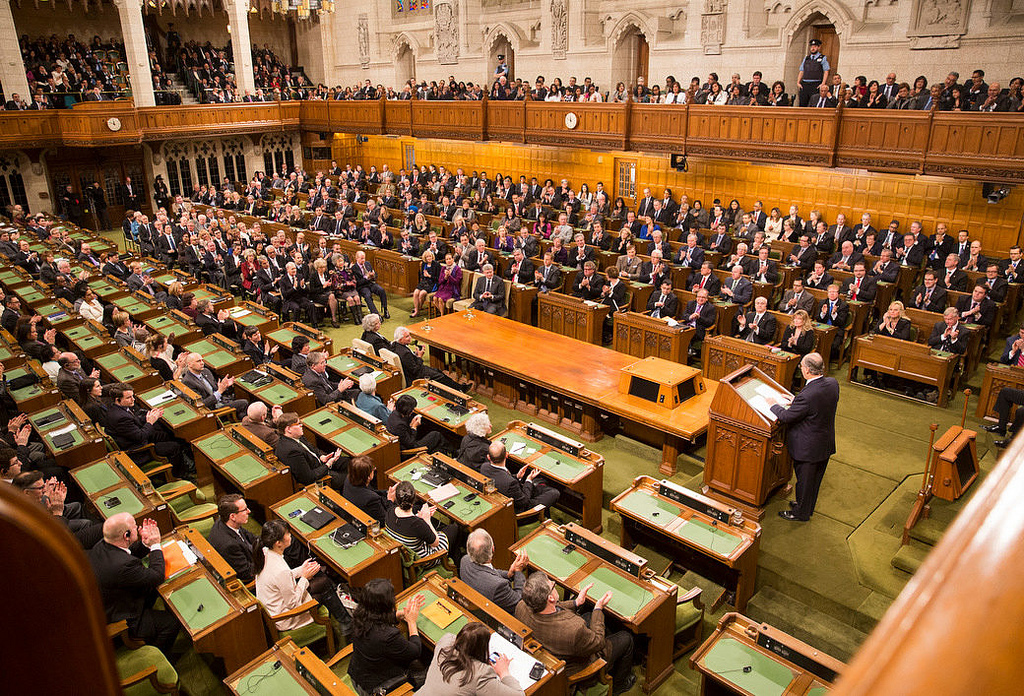
His Highness the Aga Khan seen addressing at the House of Commons Chambers to both the houses of Canadian Parliament on Thursday, February 24, 2014. Photo credit: The Office of the Prime Minister of Canada.

His Highness the Aga Khan seen addressing at the House of Commons Chambers to both the houses of Canadian Parliament on Thursday, February 24, 2014. Photo credit: The Office of the Prime Minister of Canada.

However, there is one country that has shown us now that this is possible, and that is the Tunisian Republic.

Now is not the time or the place to go into details on its new Constitution, however, allow me to point out that this is the outcome of a responsible pluralist debate, and that it appears to contain the necessary rules to ensure mutual respect between the various parts of civil society. This is reflected in, among other things, a use of notion of coalition, whether that be at an electoral level or government level. This is a great step forward for the kind of pluralism that Canada and the Ismaili Imamat have been hoping for.

Allow me also to make note of a hopeful outcome of these developments. That is that the forum for debate and conflict within any pluralist society no longer has to be the street or square, but that it can be the constitutional court of a state’s law.

THE PORTUGUESE CONNECTION AND THE ROLE OF CIVIL SOCIETY 

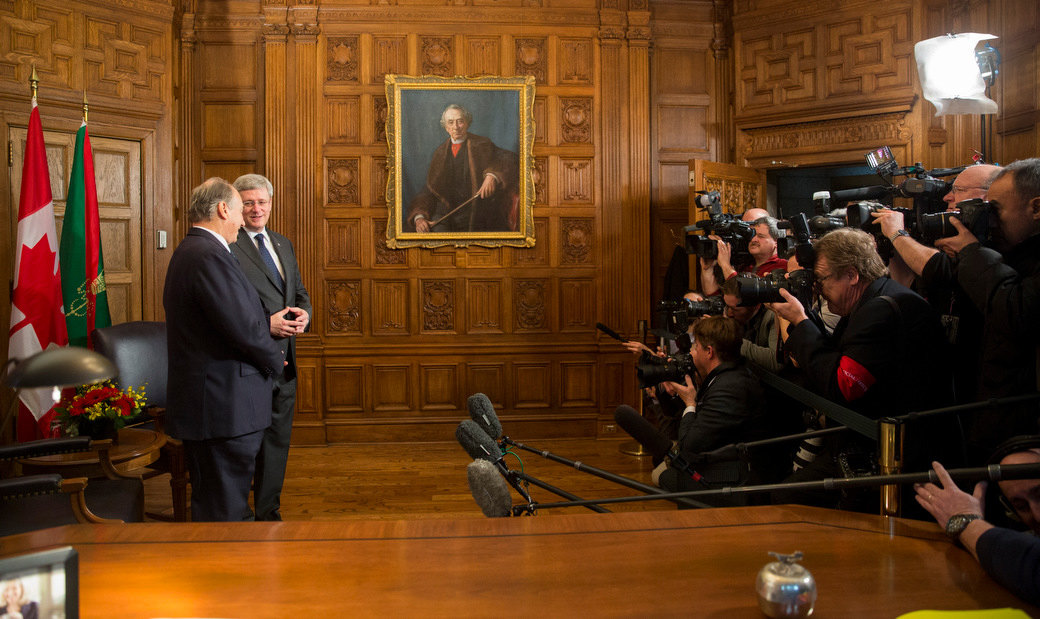
His Highness the Aga Khan and the Right Honourable Stephen Harper, the Prime Minister of Canada, face eager cameras at the Canadian Parliament Building on Thursday, 27 February, 2014. An oil on canvas painting of The Right Honourable Sir John Alexander Macdonald, Prime Minister (1867-1873; 1878-1891) adorns a wall as part of the House of Commons Heritage Collection, while the Ismaili Imamat and Canadian Flags form a backdrop in this historical photo. Photo credit: The Office of the Prime Minister of Canada.

His Highness the Aga Khan and the Right Honourable Stephen Harper, the Prime Minister of Canada, face eager cameras at the Canadian Parliament Building on Thursday, 27 February, 2014. An oil on canvas painting of The Right Honourable Sir John Alexander Macdonald, Prime Minister (1867-1873; 1878-1891) adorns a wall as part of the House of Commons Heritage Collection, while the Ismaili Imamat and Canadian Flags form a backdrop in this historical photo. Photo credit: The Office of the Prime Minister of Canada.

Besides the genius of Tunisian constitutionalists, the preparatory work of this involved consultations on comparative Constitutional Law. And I would like to acknowledge in particular the role that the Portuguese legal experts have played, citizens of the country that I greatly admire and that, like Canada, has developed a civilisation of mutual respect between communities and openness to religions. I am referring here to the law regulating the relations between the Portuguese Republic and the Ismaili Imamat since 2010. I am very pleased to add, before this very honourable audience, that this law was unanimously passed and it recognises the nature of the Ismaili Imamat as being a supranational entity.

In conclusion, on the Tunisian constitution, Mr Francois Hollande, the President of the French Republic, said in Tunis that “what makes your revolution unique and even your constitution, is the role of civil society.”

Date posted: Sunday March 1, 2014

Please also see: In a Dynamic and Stirring Address to Members of the Canadian Parliament, His Highness the Aga Khan Shares His Faith Perspectives on the Imamat, Collaboration with Canada, the Muslim World Community (the Ummah), the Nurturing of Civil Society, Early Childhood Education, Voluntary Work, and the Unity of the Human Race

 _____________________

His Highness the Aga Khan – “The Smile of a Prince” by President Léopold Sédar Senghor…and more

Flashback into the 1960′s: Admiration for His Highness the Aga Khan by President Senghor and A K Brohi

“….What we admire in you above all is the fact not that you have a modernised religion, but that you have been able to integrate a modern outlook with religion so that religion has been allowed its true role which is not merely to provide an all-embracing explanation of the universe but also to furnish the fundamental solutions of the problems which life poses us…”

Please click for “Admiration for His Highness the Aga Khan”

Historical Photographs from ‘The Ismaili’ Collection of Master Khimani of South Africa @ Simerg

A Brief Note on Master Khimani’s Service to the South African Jamat, and Historical Photos from His Family Archives

“…The Master’s wisdom and profound knowledge of Islam drew many members of the Jamat to him to help resolve disputes, seek personal advice as well as to gain a deeper understanding of the faith. Their exemplary lives remain an inspiration to the South African Jamat everywhere.”

Please click for Historical Photos from the Collection of Master Khimani. Photo: Front Cover of a special birthday edition of “The Ismaili” (dated 17th April, 1928) in Master Khimani’s family archives.

_______________
Note to Readers: Please scroll down or click  Home page for other recent posts and click What’s Newfor links to all articles published on this blog since March 2009. Subscribe to this Website via the box near the top right of this page.

Previous post: Salim Kanji’s Thank You Letter to Three Ismaili Pioneers in East Africa

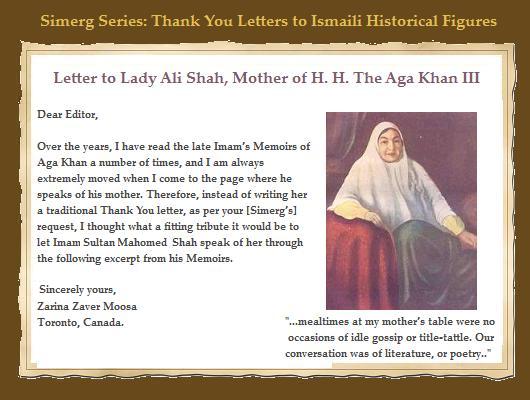
Reflection for Mother’s Day: A Thank You Letter to Lady Ali Shah, Mother of Imam Sultan Mahomed Shah Aga Khan III, by Zarina Moosa @ Simerg

Thank You Letter to Lady Ali Shah Through the Voice of Her Son, Sir Sultan Mahomed Shah Aga Khan III

“PARADISE LIES AT THE FEET OF YOUR MOTHER”
A tradition of the Prophet Muhammad (s.a.s.)

Please click for “Thank You” Letter

Note to Readers: Please scroll down or click  Home page for other recent posts and click What’s New for links to all articles published on this blog since March 2009. Subscribe to this Website via the box near the top right of this page.

Previous post: Reminiscences of Two Great Ismaili Missionaries, Pir Sabzali and Meghji Missionary