Simerg is an independent initiative dedicated to Ismaili Muslims, the Aga Khan — their Hereditary Imam — and the Ismaili Imamat, and Islam in general through literary readings, photo essays and artistic expressions
At long last, literature counters in Jamatkhanas across Canada have received Dr. Farhad Daftary’s “The Ismaili Imams: A Biographical History” in larger quantities than what was available in 2021-2022 at the height of COVID-19. That inventory sold out quickly, and the new inventory has reached several Jamatkhanas around the country. We request families to visit the literature counters at their respective Jamatkhanas before the book is sold out. Simerg has collaborated with the Ismaili Tariqah and Religious Education Board (ITREB) for Canada to facilitate the sale and distribution of the The Ismaili Imams by mail to Ismailis in Canada who live remotely or who do not have easy access to Jamatkhana literature counters. The book will be sold at the same price as at literature counters, but postage, packing and shipping costs will be added.
How to Purchase The Ismaili Imams: A Biographical History from Simerg
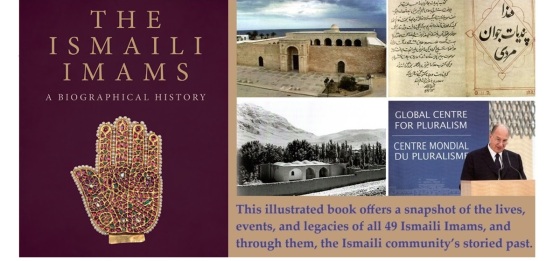
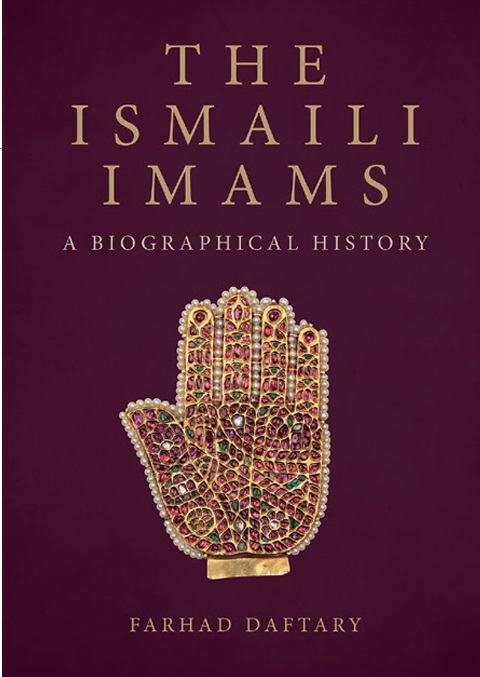
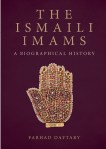
Cover page of The Ismaili Imams: A Biographical History by Farhad Daftary, Hardback, 260 pp., published October 2020, I.B.Tauris in association with the Institute of Ismaili Studies.
Ismaili individuals and families who live remotely or who do not have access to the book at their own Jamatkhana literature counters are advised to order Ismaili Imams through Simerg’s offer before the book is completely sold out.
The book will be sold at the same price as at Ismaili Jamatkhana literature counters across Canada. However, postage, package and handling charges of C$25.00 will be added to the book’s COST PRICE of C$23.00, for a total price of C$48.00. Note that each shipment will be sent via Canada Post’s expedited parcel post. A tracking number will be provided to track the shipment.
To inquire if the book is still available, and to order/reserve the book, please write to Malik Merchant of Simerg, Barakah and Simergphotos at mmerchant@simerg.com. Please provide your full name, phone number and address where you can be reached. Simerg will contact you within 24 hours to verify your address and provide you with payment information. Please note that payments will only be accepted via Interac E-transfer or by cheque. The book will be shipped out within 24 hours upon receipt of the payment.
Each individual/family will be able to order a maximum of 2 copies, as Simerg’s stock is limited.
What arguably should have been among the first publications to be published by the Institute of Ismaili Studies (IIS) in London was ultimately published in October 2020, 43 years after its founding on December 13, 1977. The book, The Ismaili Imams: A Biographical History, has now reached literature counters in Ismaili Jamatkhanas across Canada in larger quantities than the first stock that arrived in the midst of Covid-19, when the book quickly sold out. The long awaited book, in my humble opinion, should find a place in every Ismaili home and should be read by the youth and professionals in the Jamat.
Simerg is pleased to collaborate with the Ismaili Tariqah and Religious Education Board (ITREB) for Canada to facilitate the sale and distribution of the The Ismaili Imams by mail to Ismailis in Canada who live remotely or who do not have easy access to Jamatkhana literature counters. The book will be sold at the same price as at literature counters, but postage, packing and shipping costs will be added. See details below.
Article continues below
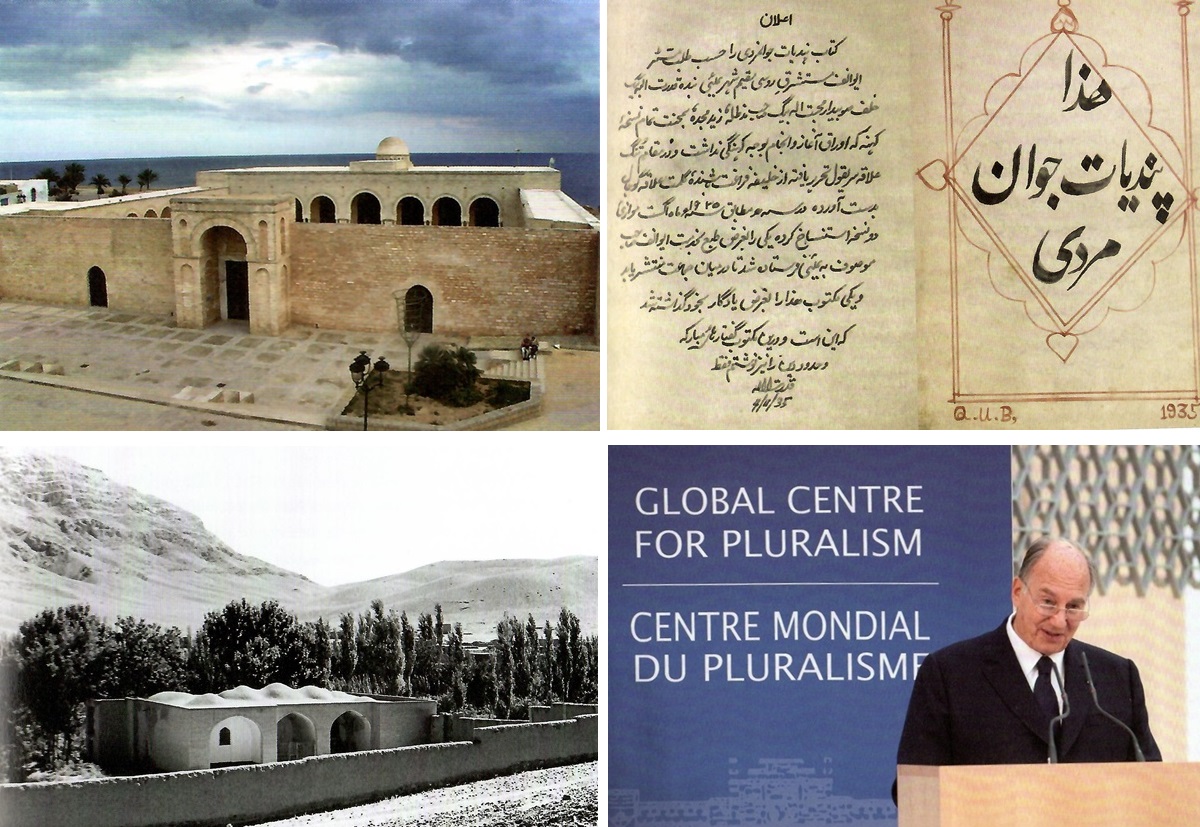
Top left: Great Mosque of Mahdiyya; top right: Title page and opening page of a manuscript of the Pandiyat-i javanmardi, a collection of the sermons of Imam Mustansir bi’llah; bottom left: Restored mausoleum of Imam Shah Nizar in Kahak; and Mawlana Hazar Imam, His Highness the Aga Khan, delivering a speech at the Global Centre for Pluralism, Ottawa. All Illustrations: The Ismaili Imams: A Biographical History.
The Ismaili Imams: A Biographical History has been authored by Farhad Daftary, a pre-eminent authority on Ismaili Studies, and author and editor of dozens of books and articles on Ismaili history and literature. Dr Daftary, who joined the IIS in 1988, became the head of its Department of Academic Research and Publications, and went on to become its co-director upon the departure of Dr Azim Nanji. Daftary finally stepped down from his management roles in 2022, and was succeeded as IIS director by Professor Zayn Kassam in January 2023.
On January 18, 2023, Dr Daftary was honoured in the presence of Prince Rahim at a special reception held in London. During the event, Prince Rahim announced that Mawlana Hazar Imam, His Highness the Aga Khan, had decided to acknowledge Dr Daftary’s contributions to the Institute by attaching his name to PhD Scholarships awarded by IIS. Prince Rahim also recognized Dr Daftary’s central role not only as a leader, but as the IIS’s most respected and productive scholar and author.
___________________
Cover page of The Ismaili Imams: A Biographical History by Farhad Daftary, Hardback, 260 pp., published October 2020, I.B.Tauris in association with the Institute of Ismaili Studies.
The Ismaili Imams is the first collection of biographies of all the Ismaili Imams, from the seminal Imams of early Shi’i Islam, through to those of the first ‘period of concealment’ when their public identities remained hidden, to the Imam-caliphs of the illustrious Fatimid dynasty, and those of the Alamut period, up to the Aga Khans of the modern period. The Ismaili Imams draws from the rich scholarship of the developing field of Ismaili Studies, providing a simple and clear resource for both the Ismailis themselves and for general readers, ensuring accessibility for all. This extensively illustrated book offers a snapshot of the lives, events, and legacies of all 49 Ismaili Imams, and through them, the Ismaili community’s storied past.
___________________
The 260 page richly illustrated hardback volume features the 49 Ismaili Imams through the following nine sections: 1.The Ismaili Imamat in History; 2.The Early Imams (from Hazrat ‘Ali to Imam Muhammad b. Isma’il); 3.The Concealed Imams (Imam Wafi Ahmad to Imam Radi al-Din ‘Abd Allah); 4.The Early Fatimid Imam-Caliphs (from Imam al-Mahdi to Imam Nizar); 5.The Imams at Alamut (from Imam al-Hadi to Imam Rukn al-Din Khurshah); 6.The Early Imams after Alamut (Imam Shams al-Din Muhammad to Imam Muhammad b. Islam Shah); 7.The Imam of the Anjudan Period (Imam Mustansir bi’llah to Imam Khalil Allah ‘Ali); 8.The Imams in the Eighteenth Century (Imam Shah Nizar to Imam Shah Khalil Allah); and 9.The Imams in the Modern Age (Imam Shah Hasan ‘Ali Shah, Aga Khan I, to Mawlana Shah Karim al-Husayni, Aga Khan IV). The book ends with a four page glossary, select bibliography, and an index. The full contents page is available on the IIS website HERE.
How to Purchase The Ismaili Imams: A Biographical History from Simerg
SOLD OUT: We do not have any more copies of the book in stock. Please check the availability of Ismaili Imams at the Jamatkhana literature counters in your respective countries, or buy it from Amazon.ca or Amazon.com.
Simerg is pleased to facilitate the distribution of The Ismaili Imams: A Biographical History in conjunction with ITREB Canada, to Ismaili addresses in Canada. Ismaili individuals and families who live remotely or who do not have access to the book at their own Jamatkhana literature counters, should take advantage of this offer before the book is completely sold out.
The book will be sold at the same cost price as at Ismaili Jamatkhana literature counters across Canada. However, postage, package and handling charges amounting to a total of C$25.00 will be added to the book’s COST PRICE of C$23.00, for a total payment price of C$48.00. Note that each shipment will be nicely packaged and sent via Canada Post’s expedited parcel post. A tracking number will be provided to track the shipment.
To order/reserve the book, please write to Malik Merchant of Simerg, Barakah and Simergphotos at mmerchant@simerg.com. Please provide your full name, phone number and address where you can be reached. Simerg will contact you within 48 hours to verify your address and provide you with payment details. Please note that payments will only be accepted via Interac E-transfer or by cheque. The book will be shipped out immediately upon receipt of the payment.
Each individual/family will be able to order a maximum of 2 copies.
Over the past 14 years, Simerg has had the privilege and honour to support Prince Hussain Aga Khan’s books such as Animal Voyage, Diving Into Wildlife and The Living Sea. We are happy to collaborate with ITREB Canada in this new endeavour and look forward to serving members of the Ismaili community in this joint initiative. Ismaili readers should note that the book is available for purchase through online booksellers like Amazon, albeit at a higher price.
Date posted: February 17, 2024. Last updated: August 16, 2025.
____________________
Have you read The Ismaili Imams? We want to hear from you. Please submit your feedback on the book by clicking on LEAVE A COMMENT.
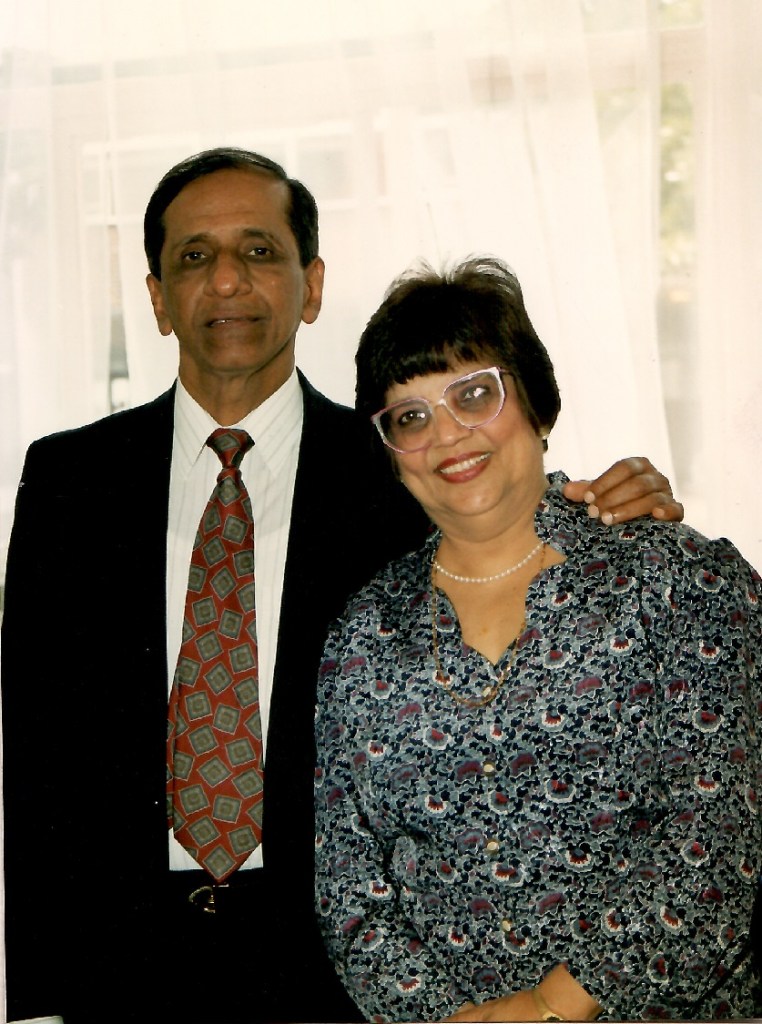
January 21, 2023, marks the 2nd anniversary of the death of my beloved mother, “Mrs. Merchant“. She and my late dad, Jehangir, who passed away in May 2018, worked hand in hand for over 60 years in the service of the Ismaili community, its institutions and the Imam-of-the-Time, Mawlana Shah Karim al Hussaini Hazar Imam, His Highness the Aga Khan. In their service, they also contributed to the work of the Institute of Ismaili Studies (IIS.)
My mum could read the Khojki script, and she and my dad undertook the task of cataloguing the Khojki manuscripts at the IIS. As the manuscripts had been transferred onto microfiche, the IIS provided my parents with a microfiche reader which enabled them to catalogue the manuscripts.
Photograph: Tribute album prepared by the BUI students of London, England, on the retirement of Mr. and Mrs. Merchant. Photo: Jehangir Merchant Family Collection.
On January 20, Simerg’s sister website produced a piece about the honour that was given to Dr. Farhad Daftary on January 18, 2023, for his devoted services to the Institute of Ismaili Studies, which he joined in 1988.
Prince Rahim Aga Khan was present at the event and expressed everyone’s gratitude to Dr. Daftary for his lifetime of work to the field of Ismaili studies. During his long tenure at the IIS, Dr. Daftary authored or edited 23 books and oversaw the publication of 150 books as well as contributed countless articles in scholarly journals and encyclopedias.
Most recently, in 2020, Dr. Daftary published a much anticipated volume entitled The Ismaili Imams: A Biographical History. The much sought book, unfortunately, has been a hard find at literature counters in Calgary and in other parts of Canada. I think very little effort has been made to restock the title, as I get a blank stare from literature counter members when I ask about the availability of the book and when they are expected to receive more stock! Perhaps, this important book is out of print and if that be the case then the IIS should certainly reprint it. This is one work that the Jamat had waited for more than 40 years since the IIS was established on December 13, 1977.
However, of all the books that Daftary published over the past 30 years, there is one that will always remain his seminal contribution to Ismaili studies. Entitled The Ismalis: Their History and Doctrines, the first edition was published in the early 1990’s and the 2nd edition came out in 2007. The voluminous 800 page book was more suited to scholars, researchers and keen readers of history. A few years later, in 1998, Dr. Daftary published a shorter version of the volume under the title A Short History of the Ismailis. Translations were done in numerous European languages.
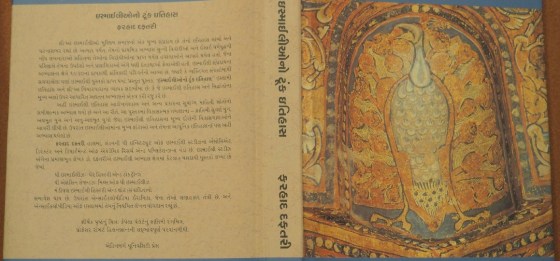
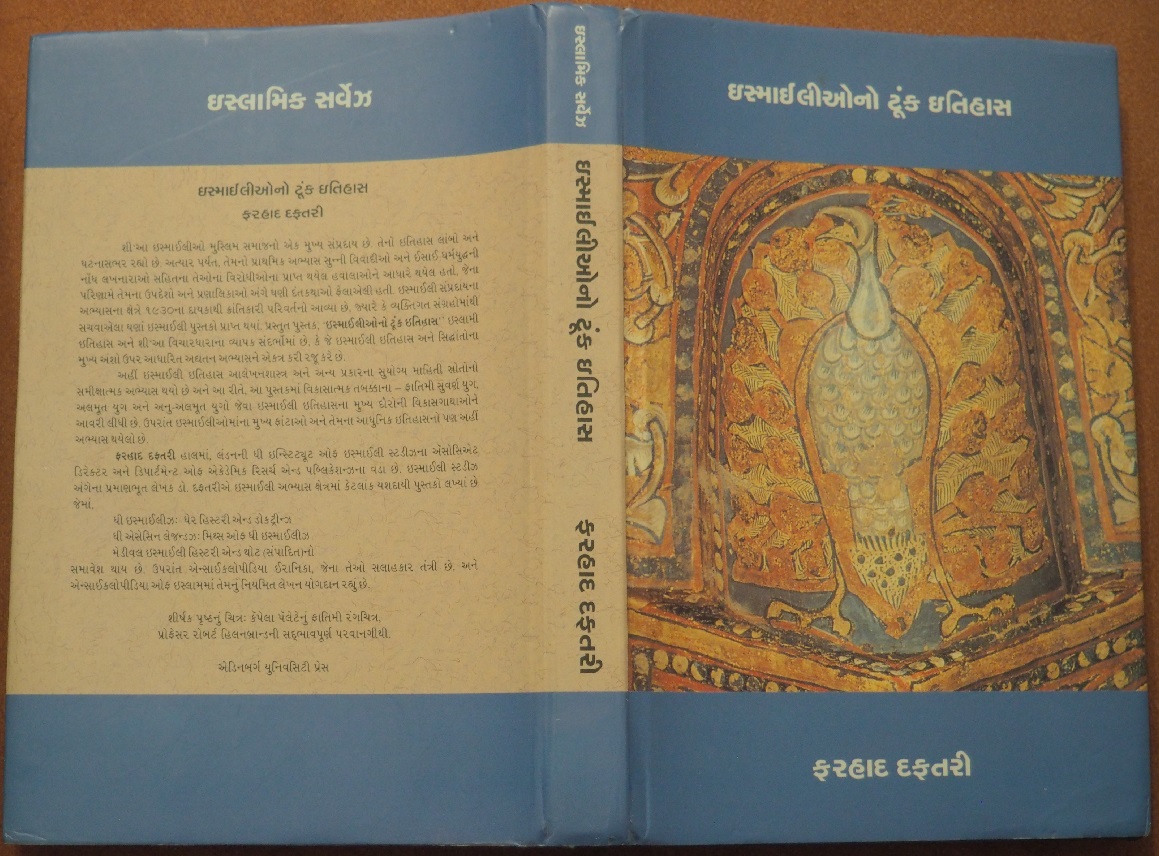
Front and back cover flap of the Gujarati translation of Dr. Farhad Daftary’s work A Short History of the Ismailis. The translation was done under the title Ismailiono Toonk Itihas by Ismaili missionaries Jehangir Merchant and Sultanali Mohamed.
My dad was approached and whole heartedly accepted the challenge to do the Gujarati translation of the work. His Gujarati was very good but he was a very humble man. He sought the help of his missionary colleague Sultanali Mohamed to assist him and improve the translation even further.
Until the commencement of this project, my dad had looked after himself well physically. Such was his stamina that my daughter, Nurin, who went to visit him before he began the translation told me that during her morning walks with her grandad, he would outpace her leaving her metres behind. All this physical activity that he had conducted for years, came to a standstill once he undertook the Gujarati translation. He devoted day and night to the translation. He wanted the translation to be as perfect as possible and ensure that it adhered to Dr. Daftary’s style of writing. It wasn’t easy but he did it sincerely and from the bottom of his heart.
Missionary Sultanali Mohamed (1927-2020), co-translator with Jehangir Merchant of Farhad Daftary’s Short History of the Ismailis.
Sultanali missionary and my mum were very closely involved in the translation. The book went to India for printing and my dad insisted that he should see the proofs before the book was published.
What a shock when the proofs came back! The translation had been altered in many parts of the book and mistakes had been introduced. He decided to withdraw his name as the translator if the book was to be published in its sub-standard revised form without his approval He was deeply hurt, and responded to Dr. Daftary citing examples of the alterations that had been made in many parts of the book that were not acceptable to him. Moreover, numerous errors had been introduced. He found it hard to understand why the changes were made. He and Sultanali would have accepted the proof if it was better than the translation they had submitted for publication.
Dr. Daftary respectfully requested my dad to do the needful to bring the translation to its original form. My dad spent the next several weeks and reworked on the proofs that he had been provided. Throughout his dedicated time, he would have in front of him Gujarati-English dictionaries to ensure the best possible translation. He and my mum were thorough in all the services they rendered to Jamati institutions which they had begun in the early 1950’s after qualifying as missionaries and religious education teachers. Their first professional job was as teachers in Lourenço Marques (now Maputo), Mozambique.
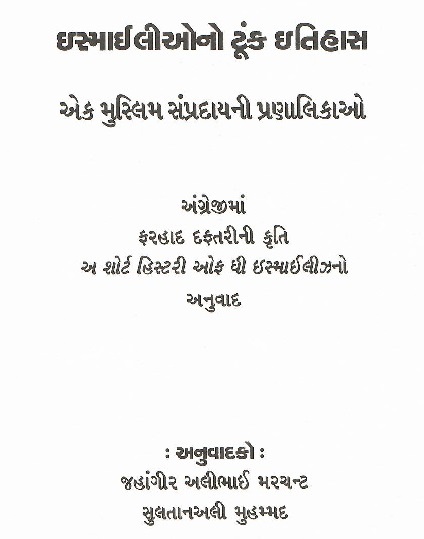
Finally, after weeks of additional hard work, my dad and Sultanali’s translation was published and I have published, above, an image of the cover of the book. It doesn’t carry their names on the cover flap. However, they are listed in the inside title page of the book, shown below.
A cropped image of the inside title page of the Gujarati translation of Dr. Farhad Daftary’s book A Short History of the Ismailis. The names of translators, Jehangir Alibhai Merchant and Sultanali Mohamed, appear on the last two lines of the page.
I vividly recollect his dedication to Dr. Daftary’s book. Even I was ignored during my visits to Vancouver. Such was his love and dedication during his service to institutions. We were their “secondary children”, their students always receiving the highest priority but we accepted that throughout our lives. They sought and did everything for our education and to raise us to be good murids of Mawlana Hazar Imam.
On this day, we as a family pray for the rest of their souls in eternal peace. Their contribution to the Jamat was sincere. They worked hard for Jamati institutions and did the very best to set the best possible standards for themselves and their students. My mum is still fondly remembered by her students for the number of times she would call them when they had recitation duties in Jamatkhana — whether it was delivering prayers, ginans, waeze’s (sermons) or any other literary or religious recital. She wanted to ensure they were well prepared and fully ready for their recitations.
My parents had aspirations for their children and grandchildren as well as the youth of the Jamat, and I sincerely hope that we are able to fulfill their hopes and expectations of being good Ismaili Muslims, following its ethics and maintaining our devotion and love for Mawlana Hazar Imam.
Date posted: January 20, 2023. Last updated: January 21, 2023 (see correction note below.)
Correction: An earlier version of the post stated that Mrs. Merchant was involved in the transliteration of titles of Khojki manuscripts at the IIS. She was actually involved in cataloguing the manuscripts with her husband, Jehangir. The oversight is regretted and the post has been revised.
____________________________
REVIEW SIMERG’S TABLE OF CONTENTS AND VISIT ITS SISTER WEBSITES
Before departing this website, please take a moment to review Simerg’s Table of Contents for links to hundreds of thought-provoking pieces on a vast array of subjects including faith and culture, history and philosophy, and arts and letters to name a few. Also visit Simerg’s sister websites Barakah, dedicated to His Highness the Aga Khan, and Simergphotos. The editor may be reached via email at mmerchant@simerg.com.
The websites of the Institute of Ismaili Studies and the Ismaili community, The Ismaili, have jointly announced the appointment of Dr. Zayn Kassam as the new Director of the Institute of Ismaili Studies (IIS), following the decision by Dr. Farhad Daftary to retire from his management roles, which included serving as the co-director of the IIS for the past 12 years.
Dr. Daftary will continue his scholarly research, writing and teaching activities at IIS indefinitely. As appropriate recognition of Dr. Daftary’s contributions to IIS and his long service of 34 years, Dr Daftary has been conferred the lifetime title Director Emeritus when he relinquishes his current role and will be appointed to the IIS Board of Governors. In this way, IIS staff, students and other stakeholders will continue to benefit directly from his knowledge, wisdom and guidance.
Story continues below
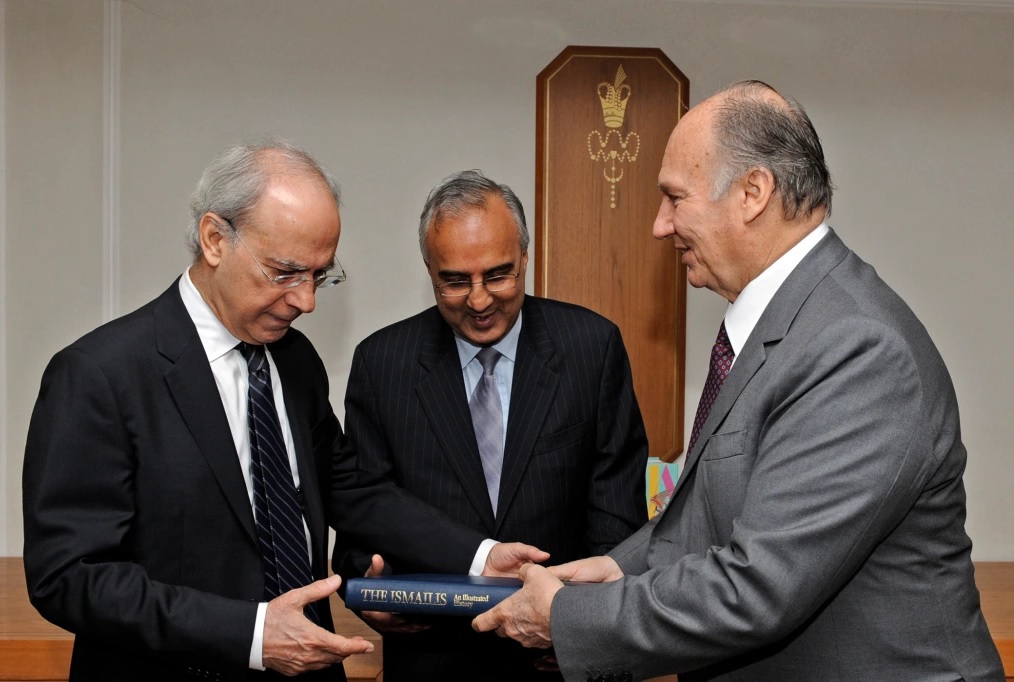
Professor Azim Nanji (centre), then Director of the Institute of Ismaili Studies, and his successor Dr Farhad Daftary (left) present Mawlana Hazar Imam, His Highness the Aga Khan, with a copy of The Ismailis: An Illustrated History on July 4, 2008 during his Golden Jubilee visit to the United Kingdom. Photo: Gary Otte
Following a thorough and extensive international search process undertaken by the Board of Governors which considered internal and external candidates, Professor Zayn Kassam of Pomona College in California has been appointed as the next Director to succeed Dr Daftary with effect from January 2023. Professor Kassam is a highly accomplished scholar and academic leader and has spent the last 27 years in a variety of positions at Pomona College in California. Her profile page on the College’s website reads as follows:
“Zayn Kassam is the John Knox McLean Professor of Religious Studies at Pomona College, Claremont, California. A graduate of McGill University (Ph.D. 1995), she teaches courses on mysticism, gender, literature, ethics, and the environment.
“She has lectured widely on gender issues in the United States, Canada, and Britain. She has been honored with three Wig Awards for Distinguished Teaching at Pomona College, as well as an American Academy of Religion Excellence in Teaching Award.
Story continues below
Zayn Kassam, who will succeed Farhad Daftary as the new Director of the Institute of Ismaili Studies in January 2023. Photo: Pomona College.
“Kassam is the author of Introduction to the World’s Major Religions: Islam (2006), and editor of Women and Islam (2010) and Women in Asian Religions (2018). She is also the section editor for Islam for the volume on Islam, Judaism, and Zoroastrianism for the Encyclopedia of Indian Religions (2018).
“She has chaired the department of religious studies at Pomona College, and has coordinated the programs in gender and women’s studies, Asian studies and Middle Eastern studies. She is currently the director of the Pacific Basin Institute. She serves on several national editorial boards, including the Journal of Feminist Studies in Religion and the Journal of the American Academy of Religion.”
Simerg congratulates Dr. Zayn on her new appointment, and wishes Dr. Daftary good health and success in all his scholarly endeavours as he continues to serve the IIS in the years to come.
Book that was presented by Dr. Farhad Daftary to Mawlana Hazar Imam during his Golden Jubilee visit to London in July 2008. See photo at beginning of post (without jacket cover)
While the IIS has been in existence since December 1977, it was not until Dr. Daftary joined the Institute that we began seeing a significant increase in the number published texts, short papers and monographs on Ismaili and Shia Studies in particular, and Islamic studies in general. As well as his own books, Dr. Daftary’s fervour for Ismaili history, philosophy and culture, encouraged other specialty scholars in the field of Ismaili studies to submit their scholarly research for publication through the IIS. Among the books that Dr. Daftary published himself or as a co-author or editor of numerous volumes, we would like to mention a few of them: The History of the Ismailis, A Short History of the Ismailis, The Assassin Legends: The Myth of the Ismailis, Historical Dictionary of the Ismailis, The Ismailis: Their History and Doctrines, The Shia World, A History of Shia Islam, The Ismailis: An Illustrated History, Islam: An Illustrated Journey and, most recently, The Ismaili Imams: A Biographical History. (We invite you to visit IIS Listing of Publications and also Amazon.)
With regard to Zayn Kassam, in addition to some the works mentioned in her profile, we are pleased to share links to two pieces that she contributed to Simerg:
“The Board thanks Dr Daftary for his many years of service to IIS, congratulates him on his appointment to the Board of Governors and wishes him continued success in his new role as well as welcoming Professor Kassam as the incoming Director of IIS.”
Date posted: September 22, 2022.
_________________
We welcome feedback from our readers. Please click Leave a comment. Your letter may be edited for length and brevity and is subject to moderation.
Before departing this website please take a moment to review Simerg’s Table of Contents for links to hundreds of thought provoking pieces on a vast array of subjects including faith and culture, history and philosophy, and arts and letters to name a few. Also visit Simerg’s sister websites Barakah, dedicated to His Highness the Aga Khan, and Simergphotos.The editor may be reached via email at mmerchant@simerg.com.
Editor’s note: Shortly after the 9/11 attacks in the USA in 2001 which killed almost 3000 people in an instant, numerous articles began to appear in the media around the world that drew parallels between the actions of Al-Qaeda and the warfare activity of the Ismailis during the 12th and 13th centuries that over time grew into fantastic legendary tales. In response to one such column that appeared in the October 8 edition of Canada’s National Post newspaper, Professor Azim Nanji and Dr. Farhad Daftary of the Institute of Ismaili Studies in London contributed the following letter in the newspaper:
“It is unfortunate that the search for historical connections in the aftermath of the terrible events of Sept. 11 has made historical truth itself a casualty. George Jonas’s column, Mortal Enemies Are to be Destroyed (Oct. 8) attempts to draw parallels between the ancient history of the Ismaili Muslims and the actions of these terrorists. In the last 25 years, scholarship, Muslim and Western, has shown the legend about the Assassins to be a fabrication concocted by contemporary enemies of the Ismailis. The Nizari branch of Ismaili Muslims organized a state in Iran and Syria in the 12th and 13th centuries. It flourished for almost two centuries, as a place of learning, scholarship and international influence, in spite of adverse circumstances and militant hostility from its neighbours. These Ismailis were heirs to the Fatimid dynasty that founded Cairo and established the University of Al‑Azhar, acts which represented a truly brilliant epoch in medieval Muslim history However, due to hostility prevailing in political and military spheres, the Ismailis became the object of theological and intellectual attacks, as their society attracted many scholars and scientists to their libraries and observatories. This climate of threat was accentuated by direct military attempts to destroy their centres and communities. It is in this context that their attempts at self‑defence need to be understood. These were directed at political and military figures and never against the general populace: a fact recognized by their enemies. Reporters obsessed with tracing tenuous historical links to current episodes of violence can learn much from history about the rich intellectual and cultural interactions among Muslims, Christians, Jews and others.”
Sporadic responses like the letter above, academic books by Dr. Daftary and the late Dr Peter Willey and many others as well as scholarly articles in journals do not appear to have made any impact in demystifying and debunking the myth of the assassins. Furthermore, the non-availability and non-distribution of important historical and theological works on Ismailis, in giant brick and mortar stores like Chapters and Indigo in Canada haven’t helped the cause either. There are a number of enjoyable, accessible and easy to comprehend books, produced by the Institute of Ismaili Studies and other academic and non-academic publishers, that should be on bookstore shelves alongside numerous Sunni, Shia and general works on Islam and other religions to counter misperceptions and negative stereotyping about the Ismailis as well as to impart an understanding of the community’s religious doctrines from Ismaili sources.
The plot of the highly popular video game “Assassins’ Creed” which is now available on almost all computer platforms revolves around the legendary “assassins” of the 12th and 13th centuries. The video game, which was created in 2007, was inspired by the 1930’s novel Alamut by the Slovenian writer Vladimir Bartol. New versions of the game have appeared annually since but the 2016 edition has been bypassed to prepare for a greatly enhanced 2017 version. However, a movie version of the video game is planned for release at the end of this year under the title “Assassin’s Creed: The Movie.”
Now, in response to the idea that ISIS or IS (Islamic State) is based on the Assassins, Dr. Farhad Daftary has contributed the following piece for the February 21, 2016, (USA) edition of The Conversation, which has a mission to provide readers with a reliable source of high quality, evidence based information.
Islamic State and the Assassins: reviving fanciful tales of the medieval Orient
(How do we account for forces and events that paved the way for the emergence of Islamic State? Our series on the jihadist group’s origins tries to address this question by looking at the interplay of historical and social forces that led to its advent.
Today, historian Farhad Daftary debunks the idea that Islamic State is based on the so-called Assassins or hashishin, the fighting corps of the fledgling medieval Nizari Ismaili state).
Many Western commentators have tried to trace the ideological roots of Islamic State (IS) to earlier Islamic movements. Occasionally, they’ve associated them with the medieval Ismailis, a Shiʿite Muslim community made famous in Europe by returning Crusaders as the Assassins.
But any serious inquiry shows the teachings and practices of medieval Ismailis, who had a state of their own in parts of Iran from 1090 to 1256, had nothing in common with the senseless terrorist ideology and ruthless destruction of IS and its supporters.
Attacks on civilians, including women and children, and engaging in the mass destruction of property are forbidden both by Prophet Muhammad and in the tenets of Islamic law. Needless to say, the Ismailis never descended to such terrorist activities, even under highly adversarial circumstances.
Significant discordance exists between the medieval Ismailis and contemporary terrorists, who – quite inappropriately – identify themselves as members of an Islamic polity.
Fanciful Oriental tales
The Ismailis, or more specifically the Nizari Ismailis, founded a precarious state in 1090 under the leadership of Hasan-i Sabbah. As a minority Shi’ite Muslim community, they faced hostility from the Sunni-Abbasid establishment (the third caliphate after the death of the Prophet Muhammed) and their political overlords, the Seljuq Turks, from very early on.
Struggling to survive in their network of defensive mountain fortresses remained the primary objective of the Ismaili leadership, centred on the castle of Alamut (in the north of modern-day Iran). Their state survived against all odds until it was destroyed by the all-conquering Mongols in 1256.
During the course of the 12th century, the Ismailis were incessantly attacked by the armies of the Sunni Seljuq sultans, who were intensely anti-Shiʿite. As they couldn’t match their enemies’ superior military power, the Ismailis resorted to the warfare tactic of selectively removing Seljuq military commanders and other prominent adversaries who posed serious existential threats to them in particular localities.
An agent (fida’i) of the Ismailis (left, in white turban) fatally stabs Nizam al-Mulk, a Seljuk vizier, in 1092. Public domain via Wikimedia Commons
These daring missions were carried out by the Ismaili fidaʾis, who were deeply devoted to their community. The fidaʾis comprised the fighting corps of the Ismaili state.
But the Ismailis didn’t invent the policy of assassinating enemies. It was a practice employed by many Muslim groups at the time, as well as by the Crusaders and many others throughout history.
Unfortunately, almost all assassinations of any significance occurring in the central lands of Islam became automatically attributed to the Ismaili fidaʾis. And a series of fanciful tales were fabricated around their recruitment and training.
These tales, rooted in the “imaginative ignorance” of the Crusaders, were concocted and put into circulation by them and their occidental observers; they’re not found in contemporary Muslim sources.
The so-called Assassin legends, which culminated in Marco Polo’s synthesis, were meant to provide satisfactory explanations for the fearless behaviour of the fidaʾis, which seemed otherwise irrational to medieval Europeans.
The very term Assassin, which appears in medieval European literature in a variety of forms, such as Assassini, was based on variants of the Arabic word hashish (plural, hashishin) and applied to the Nizari Ismailis of Syria and Iran by other Muslims.
In all the Muslim sources where the Ismailis are referred to as hashishis, the term is used in its pejorative sense of “people of lax morality”. There’s no suggestion that they were actually using hashish. There’s no evidence that hashish, or any other drug, was administered to the fida’is, as alleged by Marco Polo.
The literal interpretation of the term for the Ismailis as an “order of crazed hashish-using Assassins” is rooted entirely in the fantasies of medieval Europeans.
Modern scholarship in Ismaili studies, based on the recovery and study of numerous Ismaili textual sources, has now begun to dispel many misconceptions regarding the Ismailis, including the myths surrounding their cadre of fidaʾis.
And the medieval Assassin legends, arising from the hostility of the Sunni Muslims to the Shiʿite Ismailis as well as the medieval Europeans’ fanciful impressions of the Orient, have been recounted and deconstructed.
A culture of learning and tolerance
Living in adverse circumstances, the Ismailis of Iran and Syria were heirs to the Fatimid dynasty that founded the city of Cairo and established al-Azhar, perhaps the earliest university of the world. Although preoccupied with survival, the Ismailis of the Alamut period maintained a sophisticated outlook and a literary tradition, elaborating their teachings within a Shiʿite theological framework.
An entirely fictional illustration from The Travels of Marco Polo showing the Nizari imam Alâ al Dîn Muhammad (1221-1255) drugging his disciples. Public Domain via Wikimedia Commons
Their leader, Hasan-i Sabbah, was a learned theologian. And the Ismaili fortresses of the period, displaying magnificent military architecture and irrigation skills, were equipped with libraries holding significant collections of manuscripts, documents and scientific instruments.
The Ismailis also extended their patronage of learning to outside scholars, including Sunnis, and even non-Muslims. They were very tolerant towards other religious communities.
In the last decades of their state, in the 13th century, even waves of Sunni Muslims found refuge in the Ismaili fortress communities of eastern Iran. These refugees were running from the Mongol hordes who were then establishing their hegemony over Central Asia.
All this stands in sharp contrast to the destructive policies of IS, which persecutes religious and ethnic minorities and enslaves women.
The medieval Ismailis embodied qualities of piety, learning and community life in line with established Islamic teachings. These traditions continue in the modern-day Ismaili ethos. And the present-day global Ismaili community represents one of the most progressive and enlightened communities of the Muslim world.
The Ismailis have never had anything in common with the terrorists of IS, who murder innocent civilians at random and en masse, and destroy monuments of humankind’s shared cultural heritage.
Global terrorism in any form under the banner of Islam is a new phenomenon without historical antecedents in either classical Islamic or any other tradition. IS’s ideology reflects a crude version of the intolerant Wahhabi theology expounded by the Sunni religious establishment of Saudi Arabia, which is itself a narrow perspective that fails to recognise any pluralism or diversity of interpretations in Islam.
Date posted on Simerg:Monday, February 29, 2016. Last updated:March 1, 2016 (12:50 EST).
_______
This is the fifth article in The Conversation website’s series on the historical roots of Islamic State. Look out for more stories on the theme in the coming days on The Conversation website.





 Simerg - Insights from Around the World

