Simerg is an independent initiative dedicated to Ismaili Muslims, the Aga Khan — their Hereditary Imam — and the Ismaili Imamat, and Islam in general through literary readings, photo essays and artistic expressions
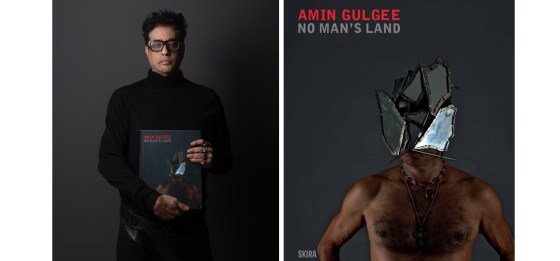
Last June, Aniza Meghani of the UK conducted an exclusive interview with Amin Gulgee for Simerg during her visit to Karachi. The interview includes a selection of outstanding works of art by Amin and provides an excellent introduction to his artistic background. We invite our readers to read Aniza’s excellent piece. The last few weeks have seen the release of Gulgee’s first monograph, “No Man’s Land,” published on March 25, 2025. We are delighted to feature the monograph as part of our continuing series of books by Ismaili authors. We follow a similar Q/A format as our earlier presentations of books, which are listed chronologically below, ensuring our readers are always up to date with our series in an organized manner. We encourage Ismaili authors from around the world to participate in this series, regardless of when their books were published. See details of the series HERE and submit your responses to Simerg’s editor, Malik, at mmerchant@simerg.com.
Amin Gulgee on his monograph “No Man’s Land”
Simerg: What constitutes your book No Man’s Land? Why would you want me to read it, and what will we learn from it?
Amin Gulgee: This is the first monograph dedicated to my career as an artist and curator. Spanning over three decades, my multifaceted practice unfolds through a tapestry of techniques and themes. I invite readers to immerse themselves in the intertwined layers of my work. Featuring insightful essays from esteemed figures across the contemporary creative landscape — curators, novelists, artists, academics, and critics — this volume illuminates my artistry from myriad perspectives. I feel honored to include an essay by the late Dr. Oleg Grabar, a preeminent Islamic art historian, who wrote an essay for the catalogue of a solo exhibition I had at Galeri Petronas in Kuala Lumpur in 2008. Also included is a Q and A by Dr. Maryam Ekthiar, a senior curator at the Met, who asked me challenging questions. From spirituality to politics, from the universal to the particular, my trajectory attempts to navigate the complexities of my existence and invites contemplation on the depths of our collective consciousness. Spanning my diverse career, from my early work in jewelry to my sculptures, installations, paintings, performances and curatorial projects, this volume offers a comprehensive insight into the breadth and depth of my artistic journey. Illustrated with over 300 meticulously selected images and QR codes unlocking access to videos and catalogues, No Man’s Land immerses readers in a visual odyssey through my creative practice.
Simerg: What is behind the name and title of the book?
Gulgee: I chose the title No Man’s Land because I feel that my path occupies this liminal space.
Story continues below
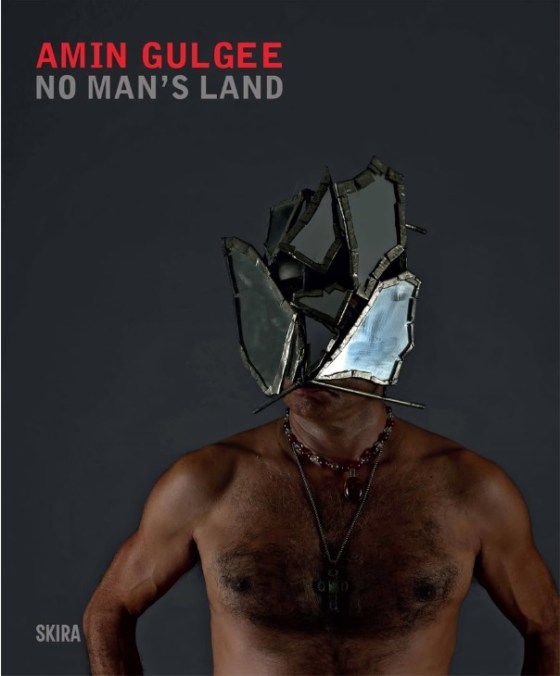
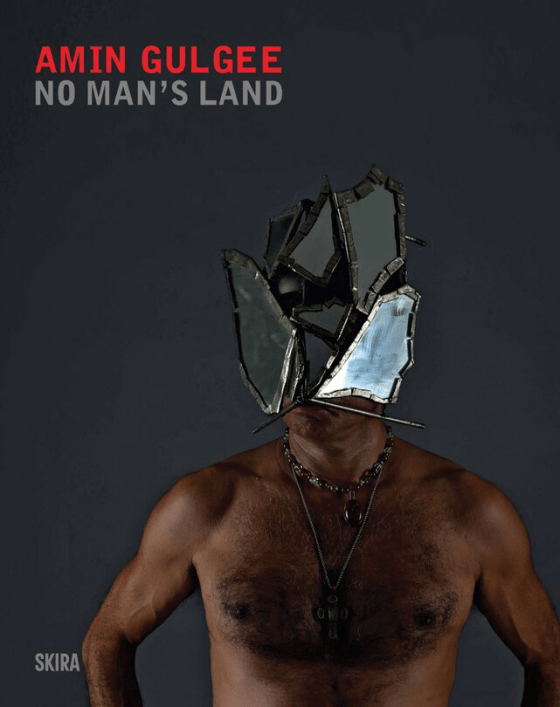
Front cover of Amin Gulgee’s “No Man’s Land,” edited by John McCarry, published by SKIRA, March 25, 2025, Hardcover, 416 pp.
Simerg: How did you find a publisher for this book?
Gulgee: I was introduced to the prestigious publication house Skira, based in Milan, by the late Italian curator Paolo de Grandis. I was well aware of Skira because they had published books on Picasso and Matisse, among many other artists. I had known Paolo since 1998, when I first participated in “OPEN”, an exhibition of installation and sculpture that he established in Venice. Later, in 2017, when I was appointed Chief Curator of the inaugural Karachi Biennale, I invited him to be a guest curator. He included works by Yoko Ono and Michelangelo Pistoletto, among others. In 2018, he and Claudio Crescentini curated my solo shows at the Galleria d’Arte Moderna and Mattatoio, both in Rome. When the book was nearing completion, I asked if he would know any publishers who might be interested in my monograph, and he suggested Skira. I sent them a few chapters and I was thrilled when they accepted to take the project on. I then collaborated with Skira’s team over the next seven months to finalize the project. They were all tremendous to work with.
Story continues below
__________________
Reflections on Amin Gulgee and his monograph No Man’s Land
“Both as a practitioner and as a curator Amin Gulgee’s storytelling is fluid, both creating and dispelling unease. Amin Gulgee explores the vastness of the Universe as the backdrop for those narratives…Contemplating spiritual goals, while confronting the insecurities and displacements of our existence, [he] calls for constant negotiation and inventiveness.” — Salima Hashmi, art historian and artist, in “Fearless,” an afterword to Amin Gulgee’s book.
~~~~~~~
“Amin Gulgee defies easy categorisation: he’s a metal sculptor, a curator, and one of Pakistan’s most innovative and cherished artists, the beating heart of his home city of Karachi’s creative scene. His metalwork is as dramatic and eccentric as Amin is. He’s in your face, uncompromising, a living and breathing performance piece” — Excerpt from BBC Documentary podcast, “In the Studio: Amin Gulgee — Heavy metal” (listen to podcast HERE).
~~~~~~~
“Amin’s art explores the unexpected. Whether it’s connections or the stories illustrated, he doesn’t follow a norm…Whilst being so different can pose its own challenges, instead, it makes Amin’s work deeply personal and unique to him. It’s also meant, from the start of his career, he’s had a strong sense of self-confidence in embracing uniqueness — Excerpt from “Amin Gulgee: Going against the norm” in The Ismaili.
________________
Simerg: Did you hire an editor or designer or did you do all the work yourself?
Gulgee: The editor of the book is John McCarry, who was a classmate of mine at Yale. He has written for National Geographic as well as many other publications. He has also published two other books. He is the coordinator of the Amin Gulgee Gallery and edits all its publications. I chose Kiran Ahmad as my designer, as she is one of the most sought-after book designers in Pakistan. I have worked with her many times in the past; however, this monograph was a truly daunting task. We spent over two years trying to make sense of my journey. Her perseverance and her commitment to her craft are commendable. Also, she can make me laugh!
Simerg: What inspired you to do this monograph?
Gulgee: The last time I saw my mother was on December 13, 2007. She had come over to my place in the afternoon since it was the birthday of Prince Karim Aga Khan IV. She brought with her a painting by my father, which she presented to me as a gift. “Look at this, Amin,” she exclaimed. “These are the colors of life!” She then sat me down and said, “I want you to do three things for me: one, give up smoking; two, do a book on your work; and three — I don’t remember now, but it will come to me.” She sadly never had the chance to state her third demand. However, in 2020 I had my last delicious cigarette, and in 2022, I decided to start working on my monograph.
Simerg: How long did it take you to complete your monograph and what were the difficulties?
Gulgee: I live in the moment and I do not like looking back. When I finally came to the decision to fulfill my late mother’s wishes, I was trepidatious. John and I had decided that we would approach writers and let them choose any angle of my trajectory that engaged them. We chose to reprint only two essays — the one by Oleg Grabar and another by Dr. Kishwar Rizvi, who is the Robert Lehman Professor in the History of Art, Islamic Art and Architecture at Yale University. The rest of the ten essays were to be new writing on my practice. We were both delighted by the essays that came in. As far as the images are concerned, since my trajectory began in predigital, archaic times, my early work was documented on slides. When I asked my young technical advisor how can I digitize them, he asked me, “What is a slide?” This, of course, made me feel like a dinosaur! But we got the painstaking job done. Then, there was the challenge of organizing my trajectory, which Kiran and I did in sections. It took two years and I am so very grateful for all the support I received along the way.
Date posted: April 22, 2025.
______________
Links to the Ismaili Authors’ Series (in chronological sequence, oldest article first)
Before departing this website please take a moment to review Simerg’s Table of Contents for links to hundreds of thought provoking pieces on a vast array of subjects including faith and culture, history and philosophy, and arts and letters to name a few. Also visit Simerg’s sister websites Barakah, dedicated to His Highness the Aga Khan, and Simergphotos. Simerg’s editor may be reached via email at mmerchant@simerg.com.
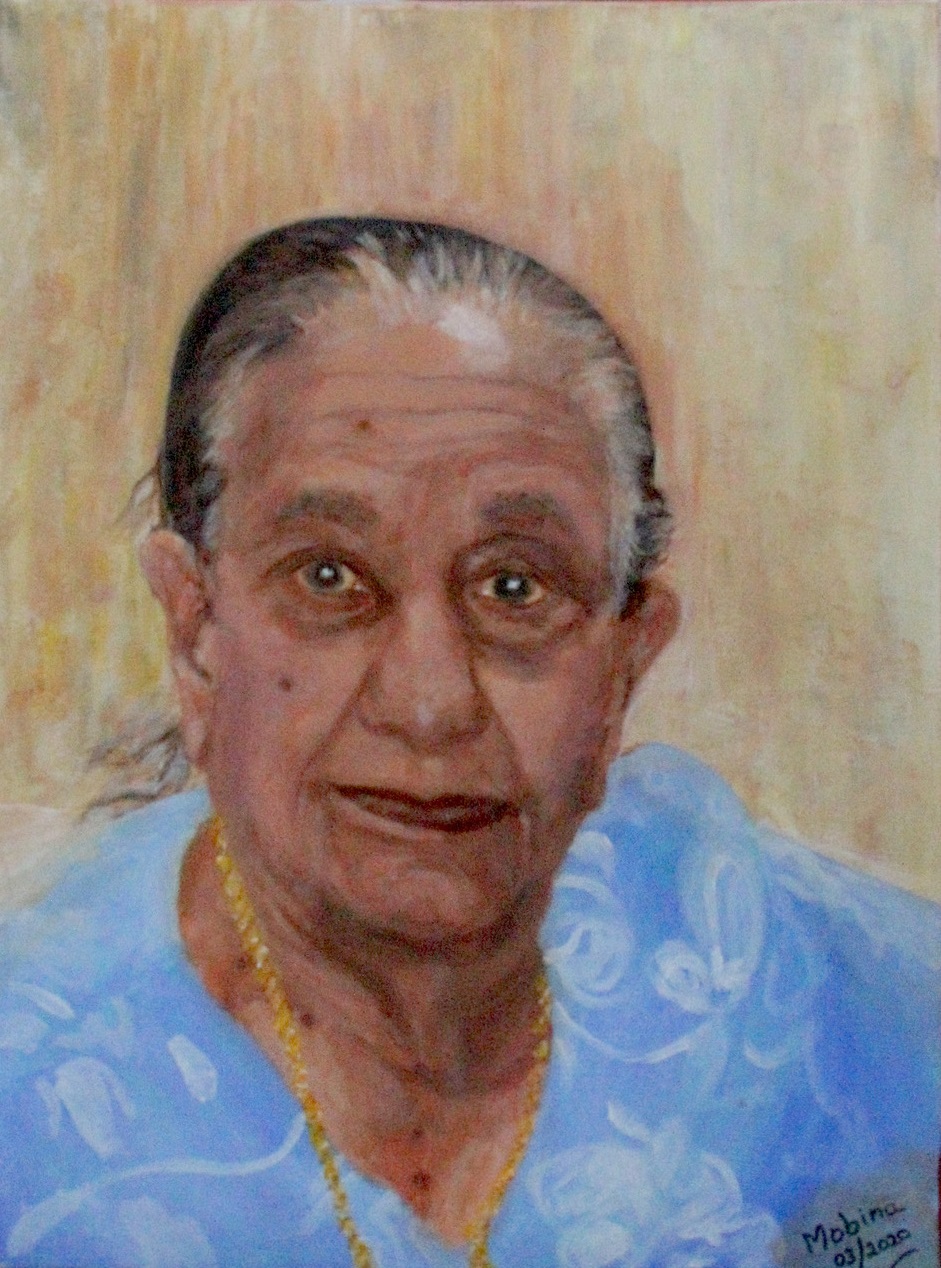
Aunt, Nurumasi, at 100! Acrylic, 16″ x 20″, March 2020. Painting by Mobina Marani, Crystal Beach, Ontario, Canada.
By MOBINA MARANI
Two years ago, I introduced a selection of my paintings on this website as part of its Artistic Expressions category, which encourages Ismaili Muslim artists to showcase their works of art. Among the paintings on the website was a portrait that I had painted of my aunt when she turned 100. The work was completed for her 100th birthday, celebrated on March 4, 2020.
Recently, I exhibited at the Illume Festival — an event showcasing talented Ismaili artists from across Canada — at both the regional and national levels. Out of the four paintings shown at the regional event, one was picked for display at the National Illume Festival held in November 2023 at the Ismaili Centre Toronto. It was that of my beloved aunt! This couldn’t have made me happier. My aunt, carrying a tasbih (rosary), honoured me by attending the event.
Nurbanu Esmail — popularly known as Nurumasi — was born in Uganda and married Haiderali Esmail, who passed away in Kampala on December 28, 1971, when she was only 51. All their children — daughters Khatoon, Parin, Firoza and Laila, and son Sultan — are still alive. She has 9 grandchildren and 13 great-grandchildren. Nurumasi, at 104, may be among the oldest living Ismailis in Canada.
My aunt dedicated her life to serving the Ismaili community, its institutions, and the Imam-of-the-Time, Mawlana Hazar Imam, His Highness the Aga Khan. She has served as a congregational leader in an Ismaili Jamatkhana and held many voluntary positions in Ismaili institutions. She was also a member of the ghusal committee that oversees all the funeral arrangements and preparations for deceased Ismaili community members. This is one of the noblest services one can perform.
Nurumasi has also keenly followed all the worldwide Imamat projects and travelled widely to see them.
Ismaili artist Mobina Marani pictured with her aunt, turning the beads on her tasbih (rosary), at the National Illume Ismaili Art Festival held at the Ismaili Centre Toronto in November 2023. On the wall is Mobina’s painting of her aunt, completed in March 2020, when she turned one hundred on March 4. Photograph: Mobina Marani Collection.
Nurumasi’s immense strength has come from regularly attending the Jamatkhana for prayers and services and her devotion and love for Mawlana Haza Imam. She has come to be adored by the community members who seek her out for prayers for strength in all aspects of their and their family’s lives.
It is a privilege for me and all the family members to have been blessed with an outstanding lady who has been with us for so long. Her presence and inspiration have been a source of strength and courage to all of us. Nurumasi is indeed one of the elders who has lived by Mawlana Hazar Imam’s guidance to both the young and older community members, in which he asked us to fulfill our material and spiritual responsibilities to the best of our abilities. He told the old that they were never too old and that as long as they were alive, every day must be lived, and we must seek to fulfill our responsibilities. That message has guided her throughout her life, leading to the age of 104.
May Allah, in His Infinite Mercy, continue to shower our beloved Nurumasi with strength, courage and faith and bestow her with the Light (Noor) of the Imam-of-the-Time in the days and weeks to come. Ameen.
Date posted: April 2, 2024.
_________________
Is anyone in your family a centenarian? We would like to hear from you, with a story and a photograph or two! Please write to the editor Malik at mmerchant@simerg.com.
We welcome feedback/letters from our readers. Please click Leave a comment. Your feedback may be edited for length and brevity and is subject to moderation. We are unable to acknowledge unpublished letters.
Artistic Greeting Cards by Karim Ismail, Brief Notes on the Imamat and the Aga Khans, and an Explanation and Recitation of a Celebratory Ismaili Ginan (Hymn)
Simerg and its sister websites, Barakah and Simergphotos, convey heartiest felicitations to Ismailis and friends of the Ismaili community in Canada and around the world on the auspicious occasion of His Highness Prince Karim Aga Khan’s 66th Imamat Day anniversary which falls on July 11, 2023. The Aga Khan succeeded to the Hereditary Throne of Imamat on July 11, 1957 at the age of 20 upon the death of his grandfather, Mawlana Sultan Mahomed Shah Aga Khan III, whose reign of 71 years as the 48th Imam is the longest in the 1400 year history of the Shia Ismaili Muslims.
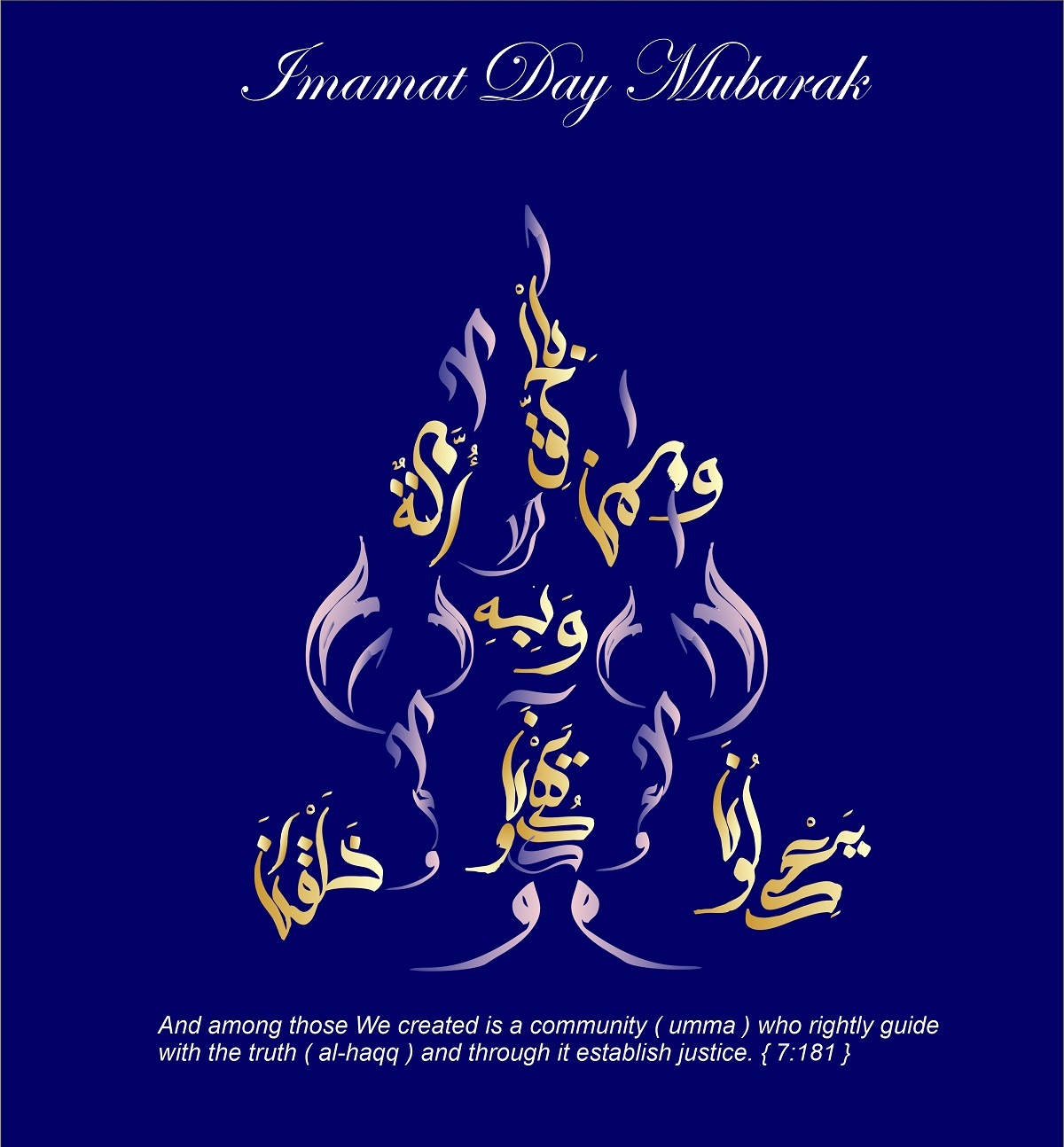
Yesterday, on July 10, 2023, we presented a unique collection of pages from the Tanganyika Standard newspaper that reported on the death of the late Aga Khan and the succession and enthronement of his grandson Prince Karim. For July 11, we present a series of beautiful works of Imamat related calligraphies created over the years by Toronto’s Karim Ismail, including one for 2023 which is shown below.
Inspiration for the calligraphy was drawn from the book “The Master and the Disciple” in which the ayat (7:181) is quoted, and which relates to the Imams. The book is an early Islamic spiritual Dialogue by Ja’far b. Munsur al-Yaman. In this section of the book two characters are involved in a dialogue. One is an Ismaili da’i by the name of Salih and a knowledgeable Mullah called Abu Malik. After some time the dialogue turns to the concept of Divine Justice where Salih refers to 7:181 several times. The Ismaili da’i explains to Abu Malik (who has gained the surname of Cube of scholars) that God’s act of justice towards His servants is through just witnesses (7:181). Salih uses the Arabic word adl to also mean witness (7:181). In Shi’i and especially Ismaili understanding, these just witnesses are the Imams (Ahl al-bayt). Upon hearing this, Abu Malik exclaims, ‘By my life, this is the very foundation of justice!’. He now understands that God’s justice is by means of the just witnesses mentioned in 7:181.
According to well-known Muslim traditions, the Prophet Muhammad (May peace be upon him and his family) said:
“I am leaving amongst you two weighty things after me, the Qur’an and my Progeny (ahl al-bayt). Verily, if you hold fast to them both you will never go astray. Both are tied with a long rope and cannot be separated till the Day of Judgement.” (Muslim, Vol. II, pg. 279).
The Prophet appointed Hazrat Ali to be his successor as the Imam in a pivotal gathering during his return to Medina from his final pilgrimage to Mecca. The Aga Khan, who is respectfully addressed by the Ismailis as Mawlana Hazar Imam (our Lord the present/living Imam), is the 49th Hereditary Imam in direct succession of Imams since Imam Ali.
In the Ismaili Ginan (hymn) Girbah Vali, attributed to the Ismaili missionary Pir Sadr al-Din, the Pir says:
“If the Imam did not have his feet on this earth for even a moment, then the world, moon, sun would vanish and nothing would exist, neither the heaven nor the earth.”
This notion of the cosmic necessity of an Imam, expressed by the Pir, is also found in famous traditions of the Prophet Muhammad (cited in “The Divine Guide in Early Shi’ism,” pp 125-131):
“The earth cannot be devoid of an Imam; without him, it could not last an hour,” and also: “If there were only two men left in the world, one of them would be the Imam.”
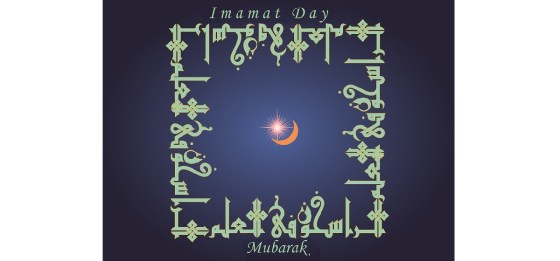
The calligraphies that Toronto’s Karim Ismail has created for Imamat Day over the past few years, are inspired by Qur’anic phrases that in Shia tradition refer to the Imam, and we are happy to include all the calligraphies that he has contributed to the website since 2020.
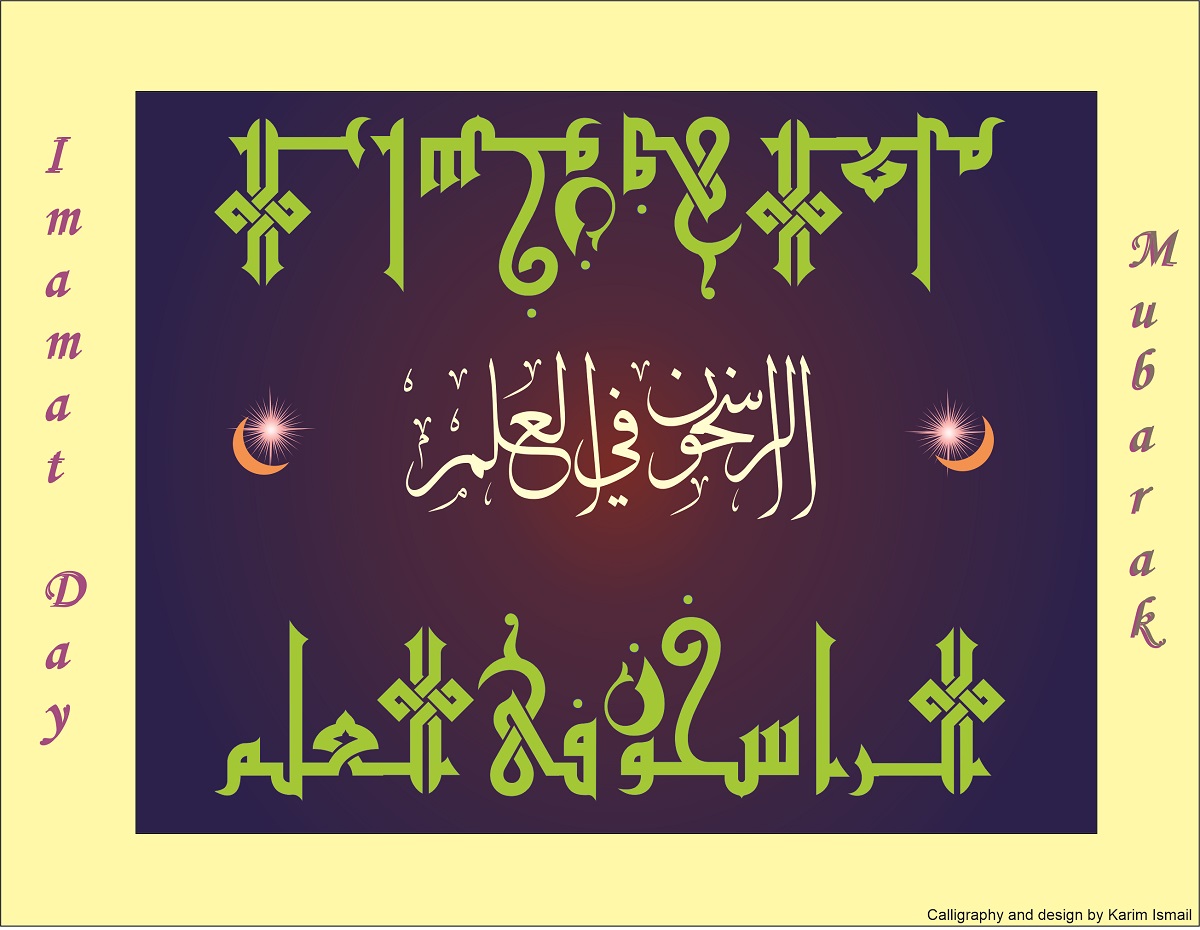
The Qur’anic phrase Al-rasikhun fi’l-ilm (Those firmly rooted in knowledge) in Fatimid Kufi script on all 4 sides of the art work. The Fatimids were rulers of North Africa and Egypt from the 10th through the 12th centuries. The Fatimid Imams or Caliphs were ancestors of the current Aga Khan.
The Qur’anic phrase Al-rasikhun fi’l-ilm (Those firmly rooted in knowledge) on top and bottom of the art work in Fatimid Kufi script; the centre of the art work has the same phrase in Thuluth script. Calligraphy and design by Karim Ismail, Toronto.
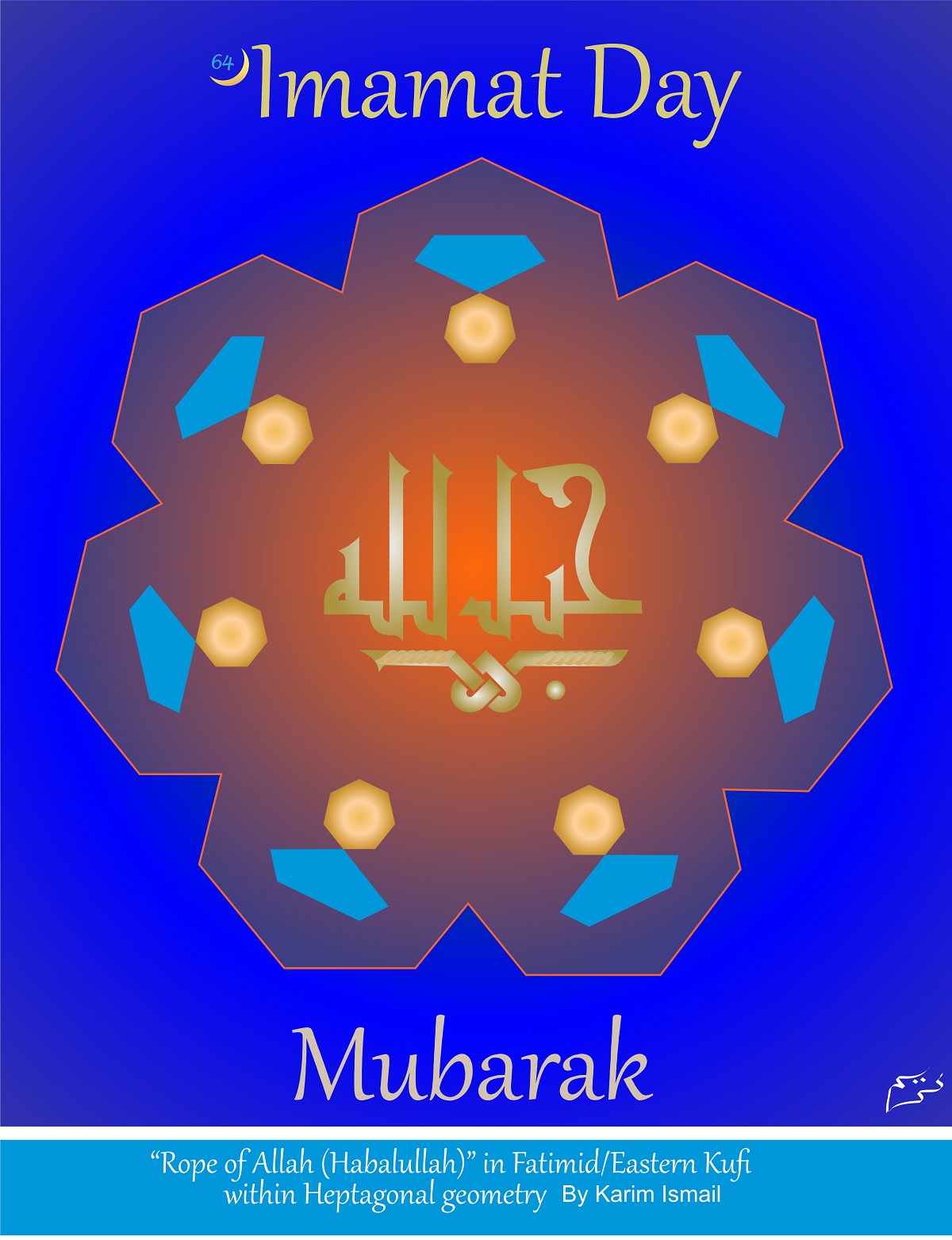
In Shi’i tradition, “The Rope of Allah” (Qur’an 3:103) refers to the “Ahl al Bayt” — the Imams from the House of the Prophet Muhammad (S.A.S). This important tradition appears in the card within heptagonal geometry (seven-sided polygon) about which the (Late) Karl Schlamminger, creator of extraordinary designs and distinctive calligraphies for the Ismaili Centres in London, Lisbon and Toronto, observed as follows in an essay for Arts & The Islamic World (volume 3, number 3, page 25-26): “The floor of the outer entrance hall [of the Ismaili Centre London] has an open ended pattern in heptagonal form which rises at the focus of the room to create a fountain: such a pattern in such space is of course a completely classical Islamic response — but I have never heard of a heptagonal pattern anywhere in Islamic architecture. “The number seven symbolizes for Ismailis the values of its essential philosophy — but has never been used in an architectural context. Here the sevenness of the design is no superficial effigy or naturalistic picture of an idea, but — as always in Islam — is expressed in geometry (literally: measurement of the earth).”
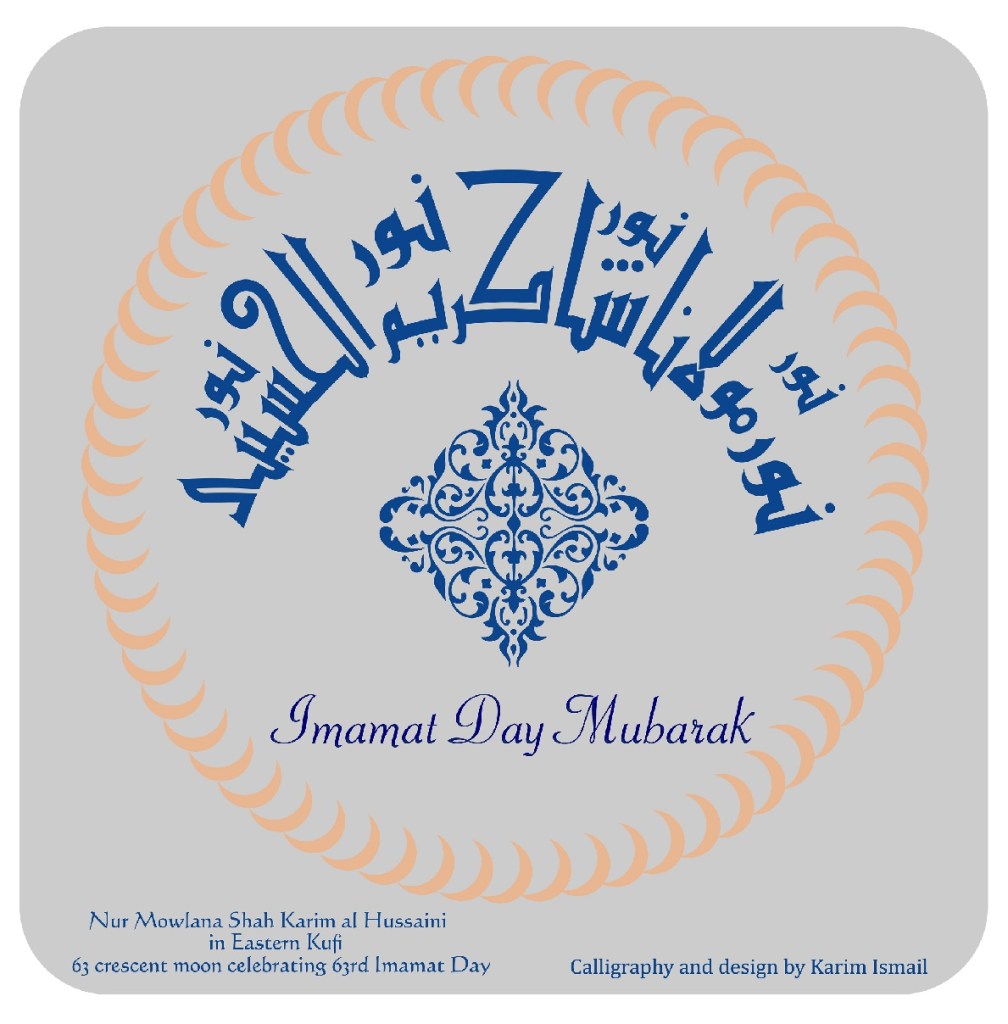
Calligraphy by Karim Ismaili on the auspicious occasion of Mawlana Hazar Imam’s 63rd Imamat Day Anniversary.
_______________________
The Aga Khans
From the day the Prophet Muhammad (May peace be upon him and his family) passed away on June 8, 632, and Hazrat Ali became the first Imam on the Divine Commandment that the Prophet had received at Ghadir Khumm, there have been forty-nine Ismaili Imams in continuous Hereditary Succession, spanning a period of 1391 years in Islamic history.
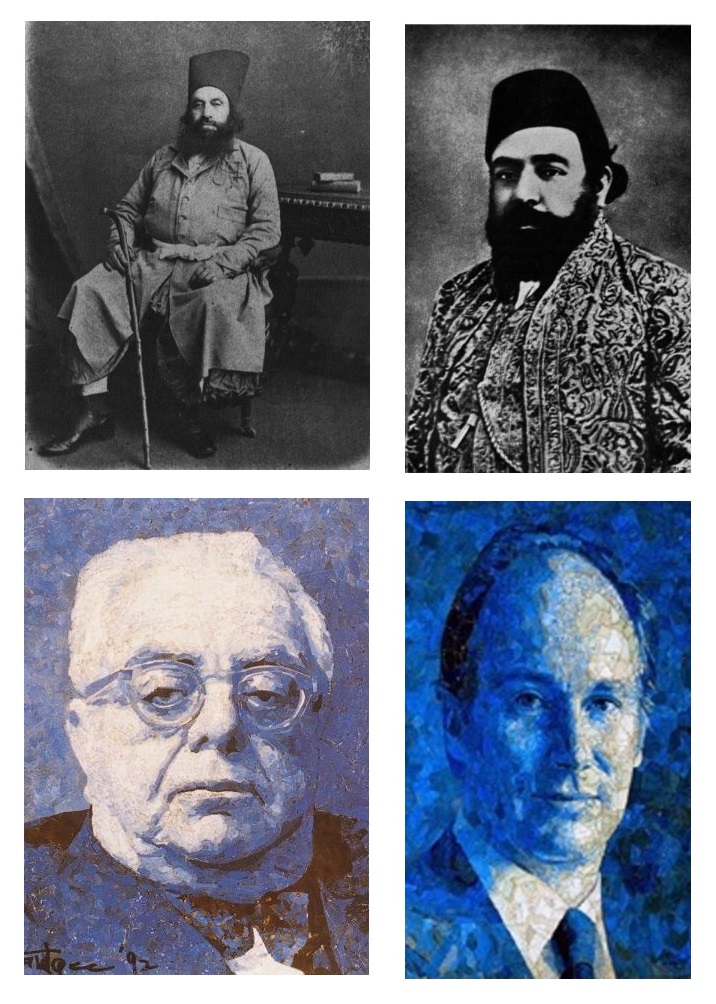
Upper row: Imam Shah Hassanali Shah (Aga Khan I) and Imam Shah Ali Shah (Aga Khan II). Lower row: Imam Sultan Mahomed Shah (Aga Khan III) and Mawlana Shah Karim Al Hussaini (Aga Khan IV). Total reign of the four Imams 203 years from 1817 to current year (2021). Longest reign Aga Khan III, 71 years; followed by Aga Khan I and Aga Khan IV, each 64 years.
The current Aga Khan and his immediate three predecessors have reigned the Ismaili community for a total of 207 years or 14.9 % of the entire span of Imamat, as follows:
1. Mawlana Shah Karim Al Hussaini Hazar Imam (His Highness the Aga Khan IV, Imam from 1957 – Current, 66 years, he became the 49th Imam at the age of 20); 2. Imam Sultan Mahomed Shah (His Highness the Aga Khan III, Imam from 1885 – 1957, Imam for 71 years, he became the 48th Imam at the age of 7 years); 3. Imam Shah Ali Shah (Aga Khan II, 1881 – 1885, Imam for 4 years, he became the 47th Imam at the age of 51 years); and 4. Imam Shah Hassanali Shah (Aga Khan I, 1817 – 1881, Imam for 66 years, he became the 46th Imam at the age of 13 years).
This 207 year period of the reign of 4 successive Ismaili Imams accounts for more time than does the entire Fatimid period, reigned by 8 Imams from Imam Mehdi (11th Imam, North Africa) to Imam Mustansir bi Allah (18th Imam, Cairo).
On that historical and interesting statistical fact, we convey to members of the Ismaili community around the world as well as friends and supporters of the community Imamat Day Mubarak. We also pray for the fulfillment of our readers’ wishes and that everyone’s lives are filled with barakah (happiness) and success. We particularly wish families with young children and youth success in their studies. On this auspicious day, we also pray that the souls of the deceased may rest in eternal peace and that their family members may find strength and courage to overcome the grief over the loss.
_______________________
An Explanation and Recitation of the Ismaili Celebratory Ginan Ya Ali Khuba Mijalas
Editor’s note: This is a very condensed, yet comprehensive, post on the munajat, Ya Ali Khuba Mijalas that is recited in many Ismaili Jamatkhanas around the world for the auspicious celebration of Imamat Day. For the complete version, which offers much more in terms of the Ginan’s history, composition, style, and explanation with a glossary, please click Original article.
By SADRUDIN K. HASSAM
INTRODUCTION
Popular tradition has it that the Munajat,Ya Ali Khuba Mijalas, was first recited during the enthronement ceremony of the 48th Imam, Mawlana Sultan Mahomed Shah, His Highness the Aga Khan III, which took place at Aga Hall at Mazagon Road in Mumbai in September 1885. Another tradition says that the recitation first took place when the young Imam met his followers at the main Ismaili Jamatkhana in Mumbai, known as the Darkhana. In any case, the munajat became very much part of the Ismaili tradition in many parts of the world to recite it in jamati gatherings (mijalas) to commemorate the enthronement of their 48th Imam Sultan Muhammad Shah, the late Aga Khan III (1877 – 1957). Continuing with this tradition, this Munajat, with slight variations, is now recited on the occasion of the anniversary of the ascension of Mawlana Shah Karim al-Hussaini (His Highness the Aga Khan IV) as the 49th Ismaili Imam. July 11th, 2023 marks his 66th Imamat anniversary.
The Arabic word Munajat is formed from the root word na-ja-wa which means ‘to converse secretly’ or ‘confidentially’. From the context of the Ginanic literature of the Ismailis, the term Munajat would be equivalent to venti (supplication). Apart from conveying this basic idea of venti, the term Munajat also has the connotation of conveying mubaraki (greetings) and adoration or reverence to a holy person, in this case the Ismaili Imam.
The complete Munajat has eight stanzas of four lines each, the chopai. At the end of each stanza there is a warani (refrain) of four lines which ends with the words ‘Mubarak hove’. This refrain is repeated at the end of each stanza for collective recitation and participation of the Jamat.
EXPLANATION
It is not an easy task to explain and translate a Ginan or Qasida from one language to another. For this Munajat which is a blend of several languages and is suffused with deep feelings and sublime supplication, the task becomes even more daunting. A conscious effort has been made to be as close to the original as possible and we hope that this explanation will impart our readers with some understanding about Ya Ali Khuba Mijalas.
VERSE ONE
Transliteration
Ya Ali Khuba Mijalas Zinat Karake Farasha Bichhai Gali, Aan Baithe Hay Takht-Ke Upar Shah Karim Shah Vali
Refrain
Aaj Raj Mubarak Hove, Noor Ain Alikun Raj Mubarak Hove, Shah Aal-e Nabi Kun Raaj Mubarak Hove, Hove Hove Aaj Raj Mubarak Hove.
Explanation
O Ali! In the fair assembly, gloriously adorned with carpets spread on the floor, Our Lord Shah Karim sits on the takht, our Lord Shah Karim our Guardian.
Refrain
Today blessed be your rule Oh the light of Ali’s eye, Blessed be your rule Shah, the descendant of the Holy Prophet, Blessed be your rule today Blessed be your rule today.
VERSE TWO
Transliteration
Ya Ali Didar Lenekun Aye Shah Teri, Hindi Jama-et Sari, Sijada Baja Kar Najaran Deve Jan Apniku Vari…. Aaj.
Explanation
O Ali! To be blessed with didar (glimpse of the Imam) your whole Indian jamat have assembled. They prostrate and they offer nazrana (homage) devoting their lives to you.
VERSE THREE
Transliteration
Ya Ali Tera Nasiba Roje Awal-Se, Deta Haire Kamali, Shah Sultan Shah Ke Mukhamen Se Nikala, Shah Karim Shah Vali….Aaj
Explanation
O Ali! Your fortune from the very first day (right from the beginning) has bestowed perfection upon you, Hazrat Imam Shah Sultan Muhammad Shah declared that Mawlana Shah Karim is the Lord and the Guardian.
VERSE FOUR
Transliteration
Ya Ali Shah Kahun To Tujakun Baja Hay, Bakhta Bulanda Peshani, Chhoti Umarmen Aali Marataba, Taluki Hay Nishani….Aaj
Explanation
O Ali! To call you Lord is your due. Your fortune and greatness is evident on your forehead. Your exalted status at the young age is a sign of greatness.
VERSE FIVE
Transliteration
Ya Ali Takhta Ne Chhatra Tujakun Mubarak, Zaheraji-Ke Piyare, Abul Hasan Shah Karani So Teri Jannat Aap Sanvare….Aaj
Explanation
O Ali! May your throne and canopy (exalted position) be blessed, the dear one of Fatimatuz Zahra. O Mawla Ali! All this is because of your glorious deeds. Paradise is embellished by your presence.
VERSE SIX
Transliteration
Ya Ali Takht ne Chhatra sunake tere Falakase Barase Nooran, Moti Tabaka Hathunmen Lekar, Shah KunVadhave Huran….Aaj
Explanation
O Ali! At the news of your Takht Nashini (Takhta ne Chhatra) the heavens shower Light, with trays of pearls in their hands, the houris (chaste heavenly maidens) greet the Lord.
VERSE SEVEN
Transliteration
Ya Ali Maheman Khanemen Momankun Jab La-i ‘Id Musal-le Shamsi Jo Salavat Pada Kar Marafat-Ki Khushiyali….Aaj
Explanation
In the guest-house when the celebration of your Takht Nashini takes place, the momins celebrate like ‘Id. They recite the Shamsi prayer, the salwat, and they experience the ecstasy of spiritual enlightenment.
VERSE EIGHT
Transliteration
Ya Ali Teri Mubarak Badike Khatar, Sayyad Karte Munajat, Shah Najaf Tere Pushta Panah Tere Dushman Hove Fanah….Aaj
Explanation
O Ali! To offer greetings, the Sayyads make their humble supplication (munajat) O Ali, the Lord of Najaf, may your progeny be protected and your enemies be destroyed.
~~~~~~~~~~~
Recitation of the Munajat by Shamshu Bandali Haji
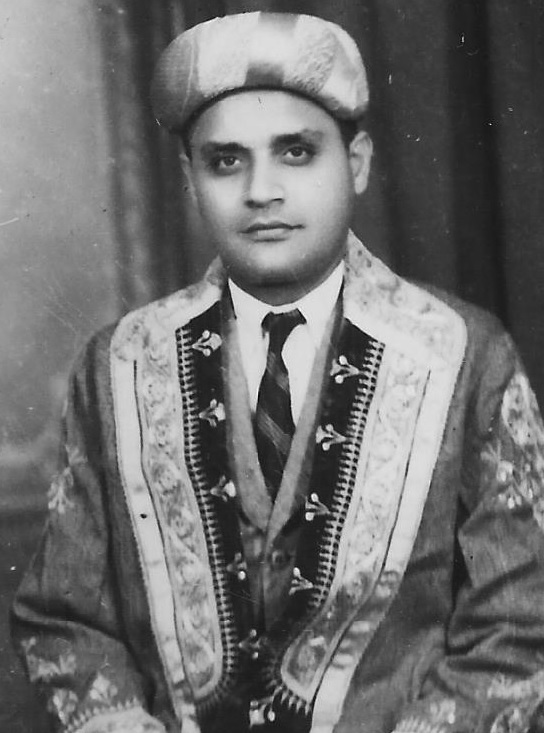
A rare portrait of the late Ismaili missionary Shamshu Bandali Haji from his early years. Photograph: Shamshu Bandali Haji Family Collection.
Simerg welcomes your feedback. Please complete the LEAVE A REPLY form below or click on Leave a comment Your letter may be edited for length and brevity, and is subject to moderation.
CONTRIBUTORS
Karim Ismail
Originally from Uganda, Karim Ismail lived in England before settling in Canada. By profession, he is a Pharmacist (retired). It was in England, in 1986, that he came across the artwork of a German Muslim, Karl Schlamminger (1935-2017), at the Ismaili Centre London. Karl’s artwork on calligraphy and geometrics, had a profound effect on Karim. He is frequently seen conducting calligraphy workshops for children at the Aga Khan Museum in Toronto. Karim is also active on the literature counter at the Ismaili Centre Toronto.
Malik Merchant
Malik Merchant is the founding publisher and editor of Barakah (2017) as well as its two sister websites Simerg (2009) and Simergphotos (2012). See full profile HERE
Before departing this website please take a moment to review Simerg’s Table of Contents for links to hundreds of thought provoking pieces on a vast array of subjects including faith and culture, history and philosophy, and arts and letters to name a few. Also visit Simerg’s sister websites Barakah, dedicated to His Highness the Aga Khan, and Simergphotos.
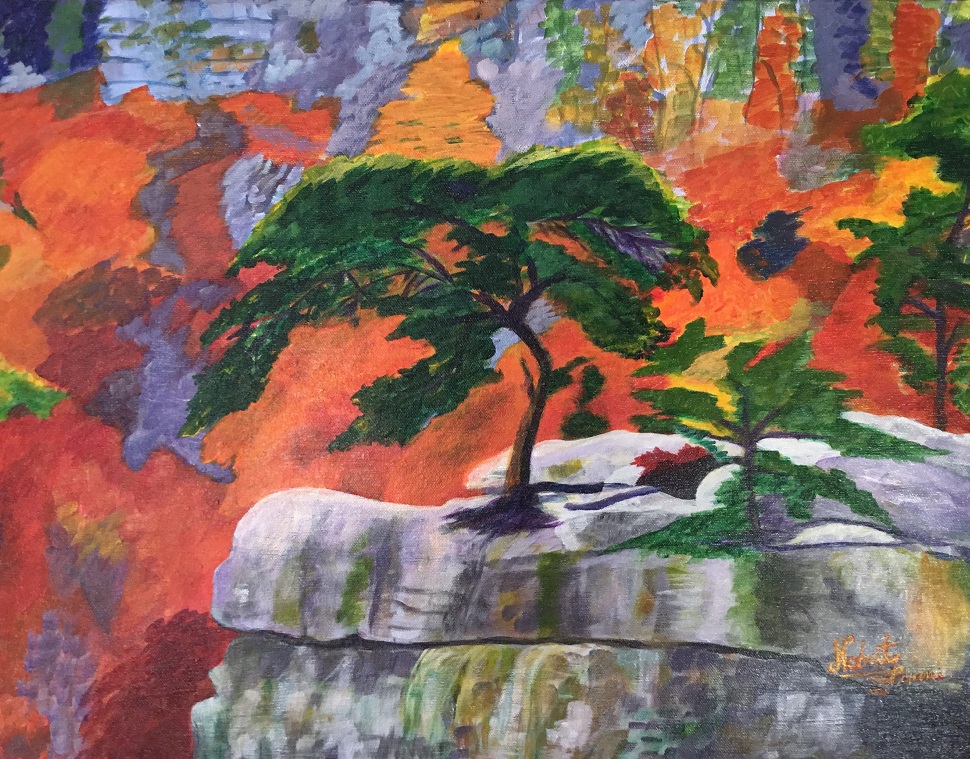
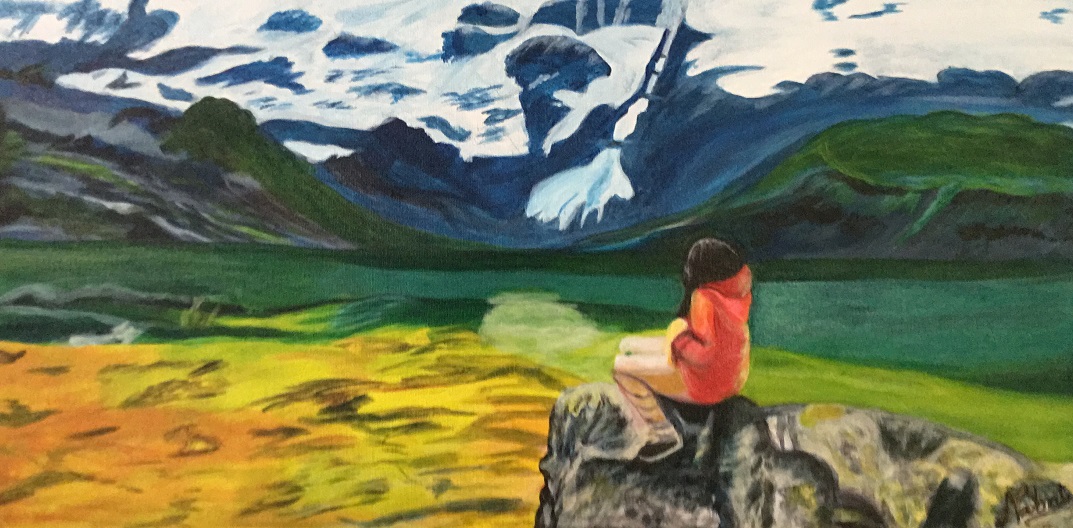
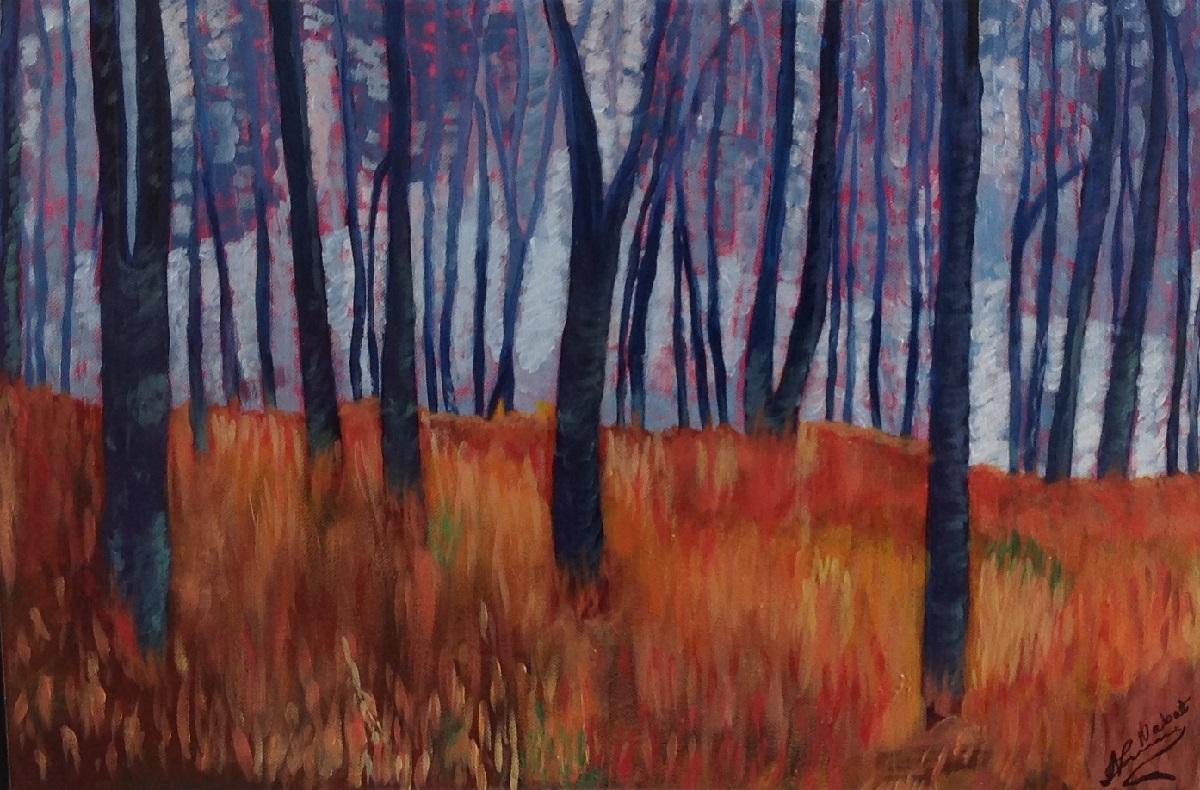
Born in Uganda, the Pearl of Africa, I was always surrounded by luscious greenery, red earth and bright blue skies. Immigrating to Canada, the landscapes were also breathtaking with the ocean, snow-capped mountains and green pastures.
It was not until my retirement years that I began to paint, with inspiration from my memories of Africa and my beautiful home in Canada. I enjoy painting scenery, landscapes and abstract art using watercolours, acrylic and oil mediums. I live in Vancouver, Canada, with my husband Amin (Aguli) and have 3 grown kids and 5 grandchildren.
~~~~~~~~~~
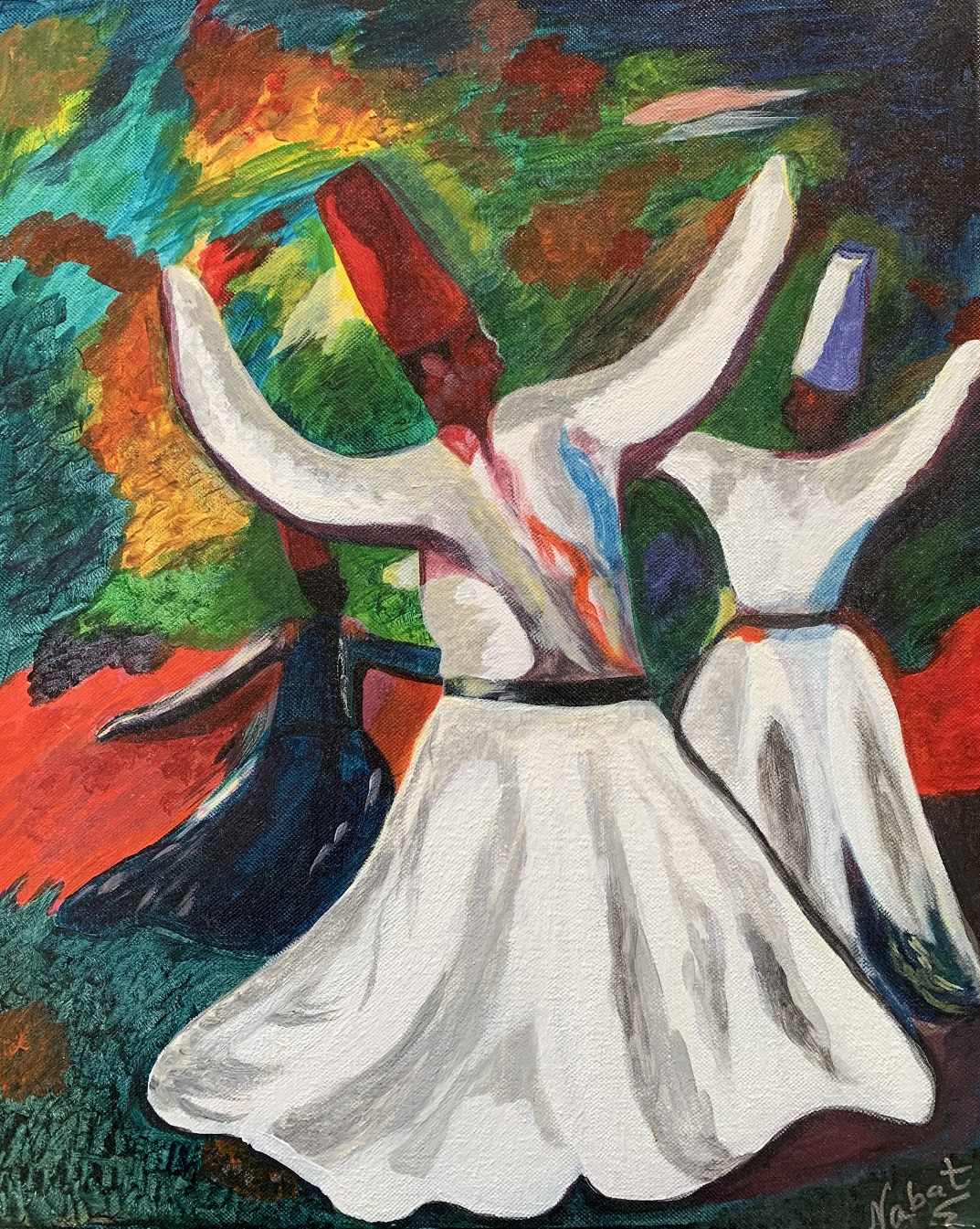
Paintings by Nabat Pirani
Please click on images for enlargements
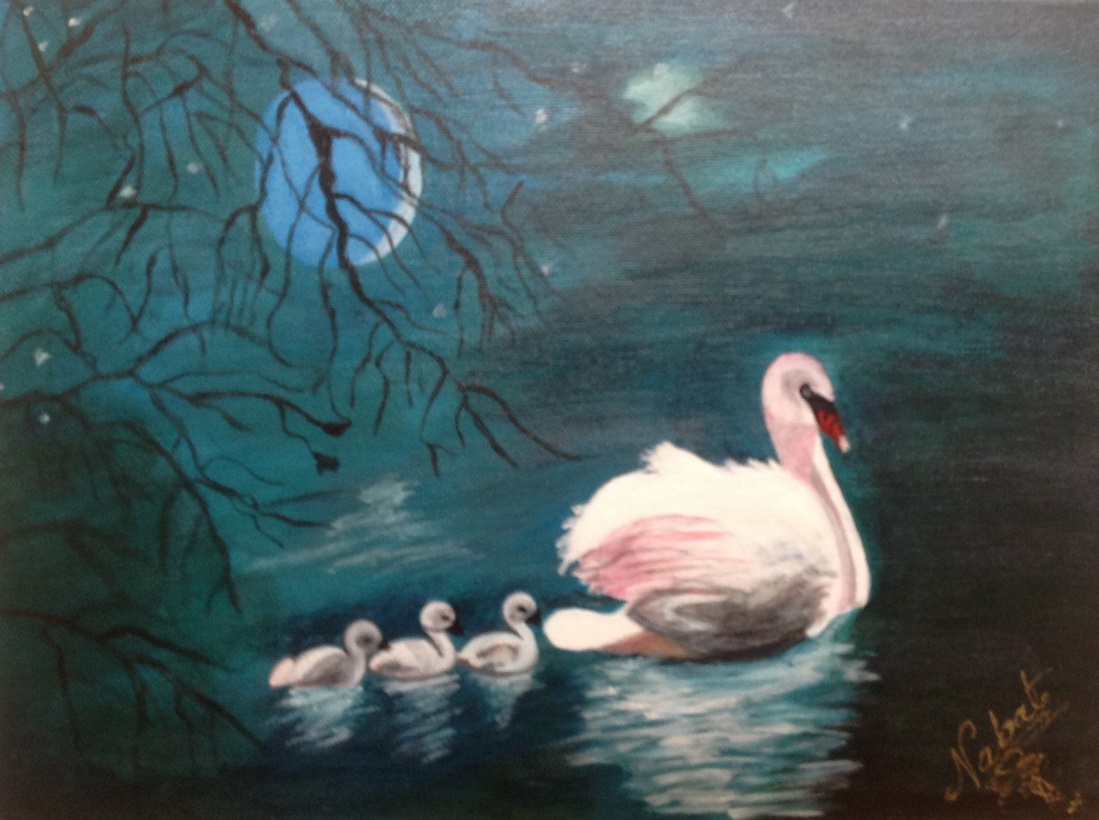
Mamma. Acrylic, 15″ x 11″, October 2016. Painting by Nabat Pirani.
~~~~~~~
Fall Lover. Acrylic, 18″ x 24″, November 2014. Painting by Nabat Pirani.
~~~~~~~
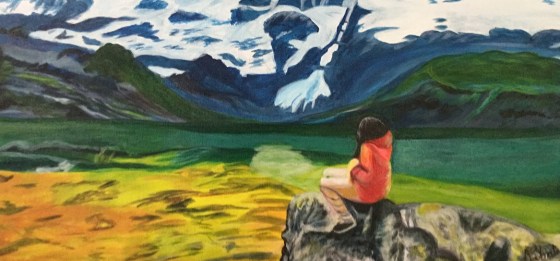
Hear the Silence. Acrylic, 18″ x 24″, 2019. Painting by Nabat Pirani.
~~~~~~~
Way Out. Acrylic, 16″ x 24″. November 2014. Painting by Nabat Pirani.
~~~~~~~
Sufi Dancer. Acrylic, 13″ x 10″, 2021. Painting by Nabat Pirani.
~~~~~~~
Best Season. Watercolour, 13″ x 10″. Painting by Nabat Pirani.
~~~~~~~
Safari Sunset, Watercolour, 18″ x 14″, 2016. Painting by Nabat Pirani.
~~~~~~~
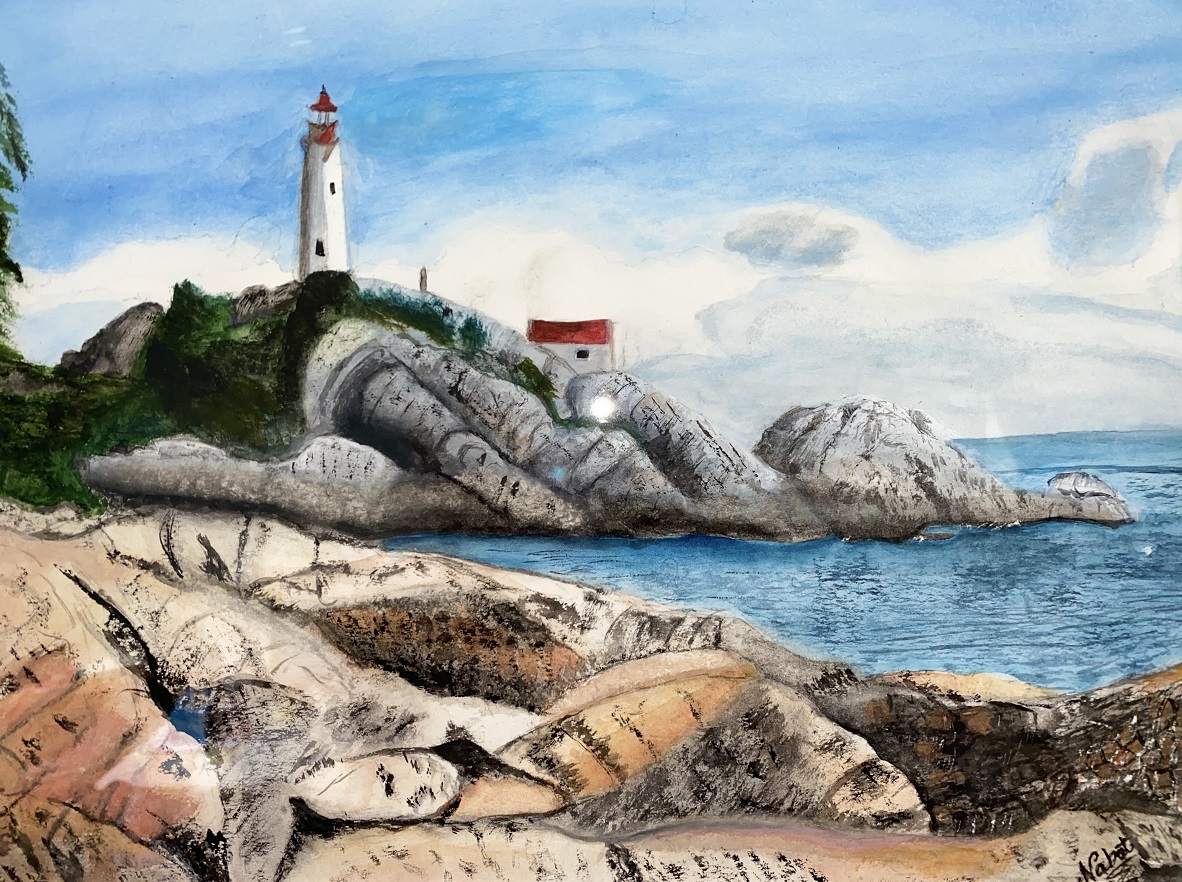
Lighthouse. Watercolour, 15″ x 11″, 2019. Painting by Nabat Pirani.
Date posted: October 23, 2022.
_____________________
We welcome feedback/letters from our readers. Please use the LEAVE A REPLY box which appears at the bottom of this page or click Leave a comment. Your feedback may be edited for length and brevity, and is subject to moderation. We are unable to acknowledge unpublished letters.
The editor invites Ismaili artists to submit a selection of their paintings and other works of art for publication in Simerg. Please submit images of no more than 8 objects in Jpeg (1200 x 900) along with your profile to the editor Malik, at mmerchant@simerg.com.
~~~~~~~~~~
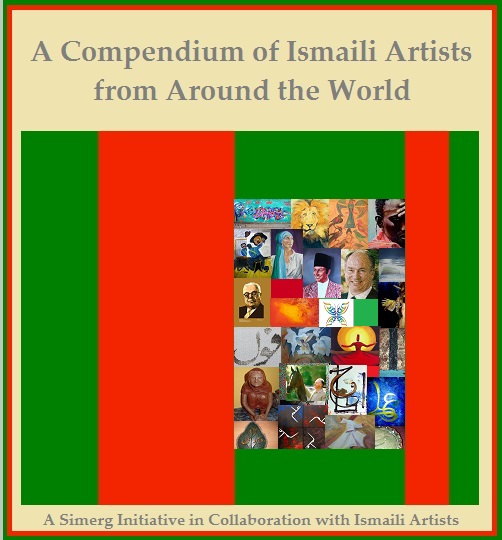
Compendium of Ismaili Artists
By MALIK MERCHANT Publiser/Editor, Simerg
Please click on image to download compendium
Some 8 years ago, we produced a beautiful PDF publication entitled “A Compendium of Ismaili Artists from Around the World” that can be downloaded HERE. It contained a short profile and one work of art for each of the 33 different Ismaili artists from around the world who wanted to be featured in the compendium. As much as we wanted to publish an expanded edition of the compendium featuring many more Ismaili artists, we are sorry to note that the response was disappointing despite a major announcement on this platform as well as pertinent social media pages. We are keen to publish an expanded edition of the compendium provided we can, at the least, double up on the original number of 33 artists that were featured in the first edition. There are hundreds of Ismaili artists around the world, judging from their participation during the Golden and Diamond Jubilee celebrations of Mawlana Hazar Imam held in 2007-08 and 2017-18 respectively. We therefore urge Ismaili artists to review the entries in the first edition, and send their details for the compendium accordingly to Malik Merchant at mmerchant@simerg.com. Please do not ask us to prepare your profiles by submitting your elaborate CV or resume or asking us to visit your website to prepare the profile. We need the information from you, based on the format in the compendium; each artist will be allotted one page in the compendium that will include a brief profile and one image. Please read the compendium!
My name is Nizarali R.V. Makan. I am 73 years old and a recently retired Dermatologist and Skin Surgeon. I was born in Zanzibar, and attended the Aga Khan Nursery, Primary and Secondary Schools there, followed by post-secondary education in Dar es Salaam. I received my college, medical school education and postgraduate specialty and fellowship training in the United States, and practiced medicine for nearly forty years in Orange County, California, and Bellingham, Washington.
Nizarali Makan
I started painting during the Covid-19 pandemic and lockdown, never having used a paint brush before, except for a single course in painting at the Emily Carr Institute of Art and Design in Vancouver, B.C.
Over the past several decades I have been blessed to serve Ismaili institutions in the United States and Canada. As a young physician in the pre-TKN days (1987), I served as guest consultant in dermatology at the Aga Khan University Hospital in Karachi, and visited Gilgit and Hunza under the auspices of the Aga Khan Health Services Pakistan. In latter years, I served as both Regional and National Convener for the Institute of Ismaili Studies London. My wife Nazira is from Kampala, Uganda, and we have three children. My hobbies, besides painting, include piano and astrophotography. I am pleased to share a selection of my modest works of art with readers of Simerg, and invite you to view more of my paintings on my Facebook page.
~~~~~~~~~~
Please click on images for enlargements
Paintings by Nizarali Makan
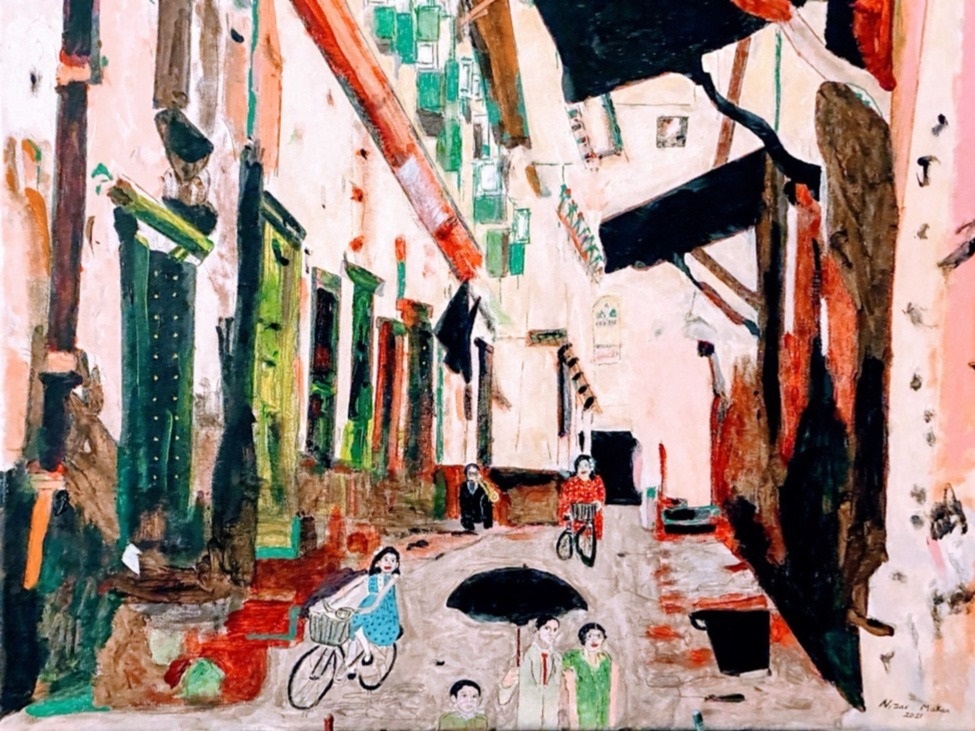
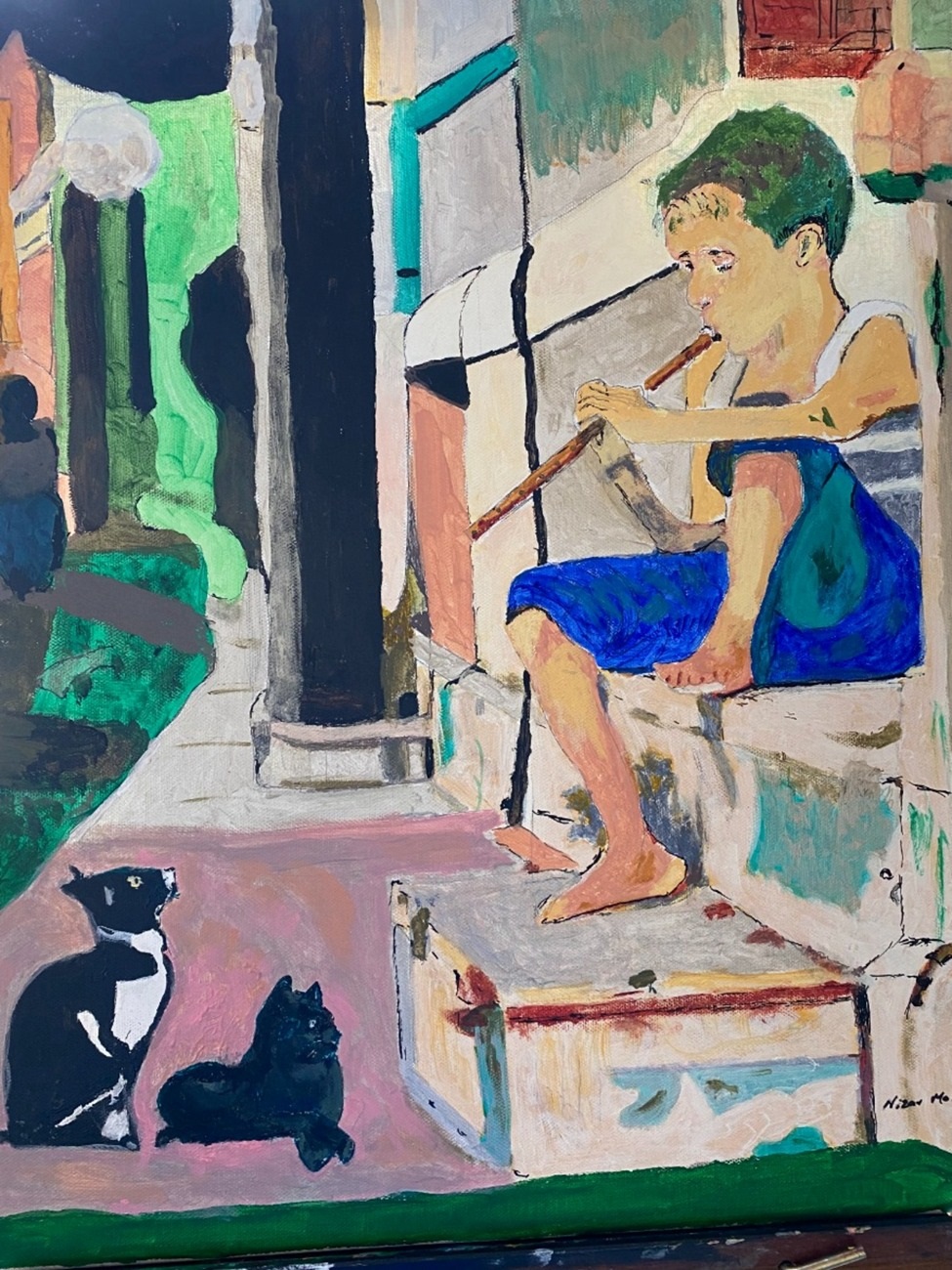
“My Street.” Acrylic on canvas, 16” x 20”, by Nizar Makan, Burnaby B.C. (2021).
Artist’s note on “My Street”: I was born and grew up in Stone Town, Zanzibar, down the narrow alley from the Ismaili Jamatkhana, and a stone’s throw from the Bohra Masjid and the Mehfil e-Abbas of the Khoja Shia Ithnasheri community. That is why my late mother, who passed away at the age of fifty-two when I was 15 years old, used to make fun of me when I was little — that my faith was Ismaili, my shortcut to the other side of the Zanzibar streets went through the alley of the Mehfil-e Abbas, and with a Maulidi cap at Idd I could easily pass as a Bohra.
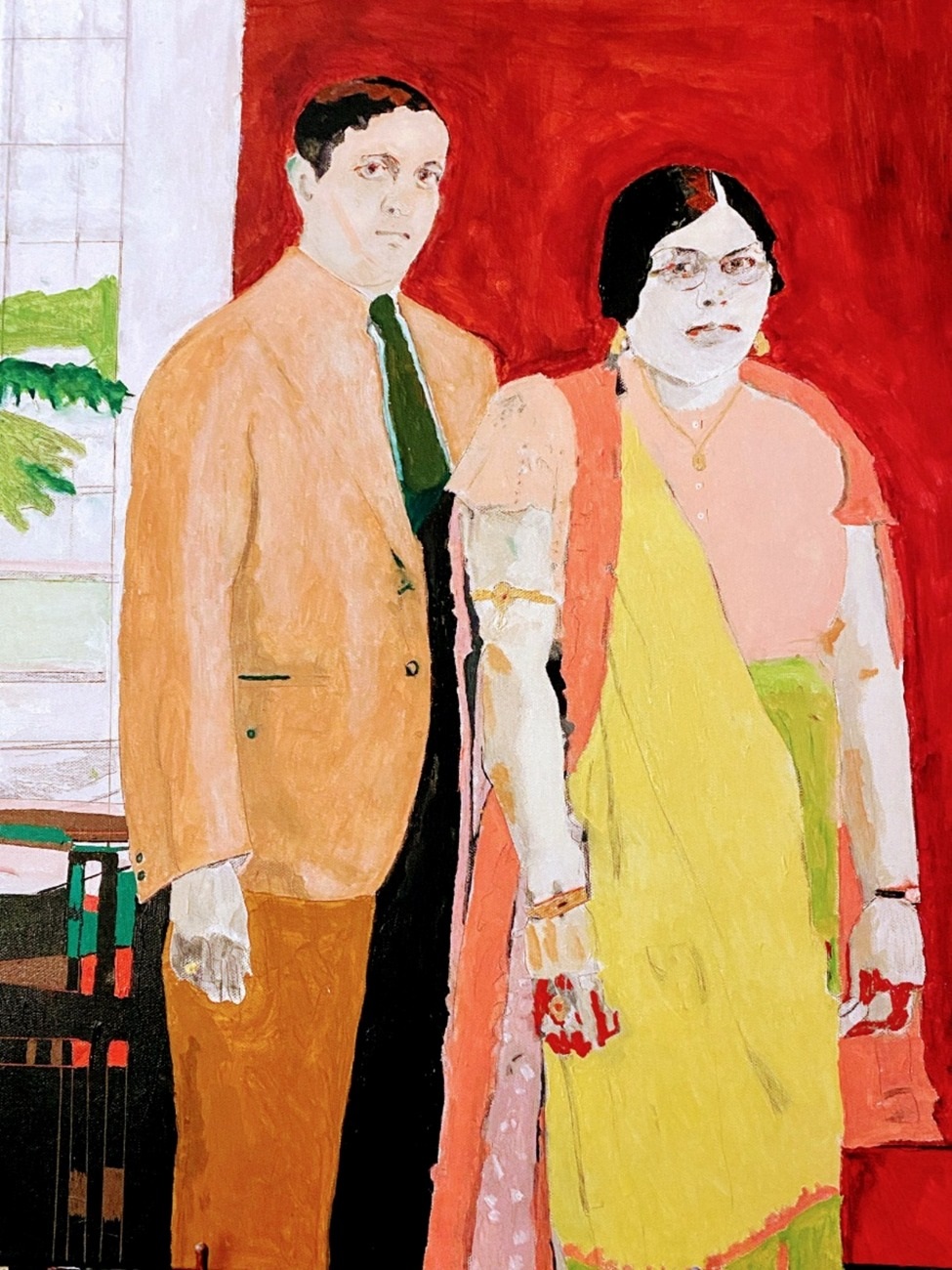
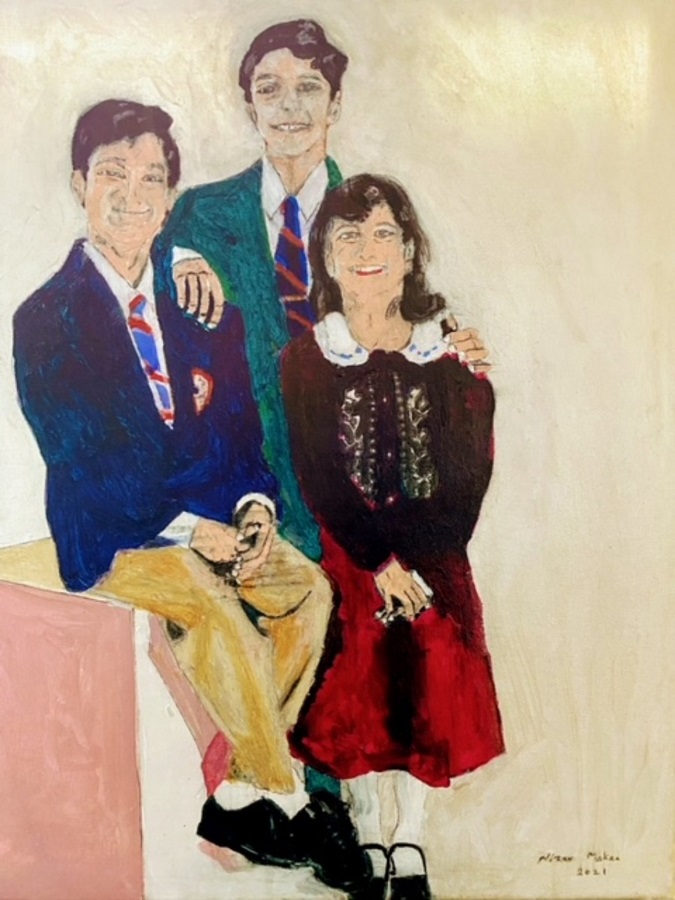
“Parents”, acrylic on canvas, 24” x 18”, by Nizar Makan, Burnaby B.C. (2021).
~~~~~~~~
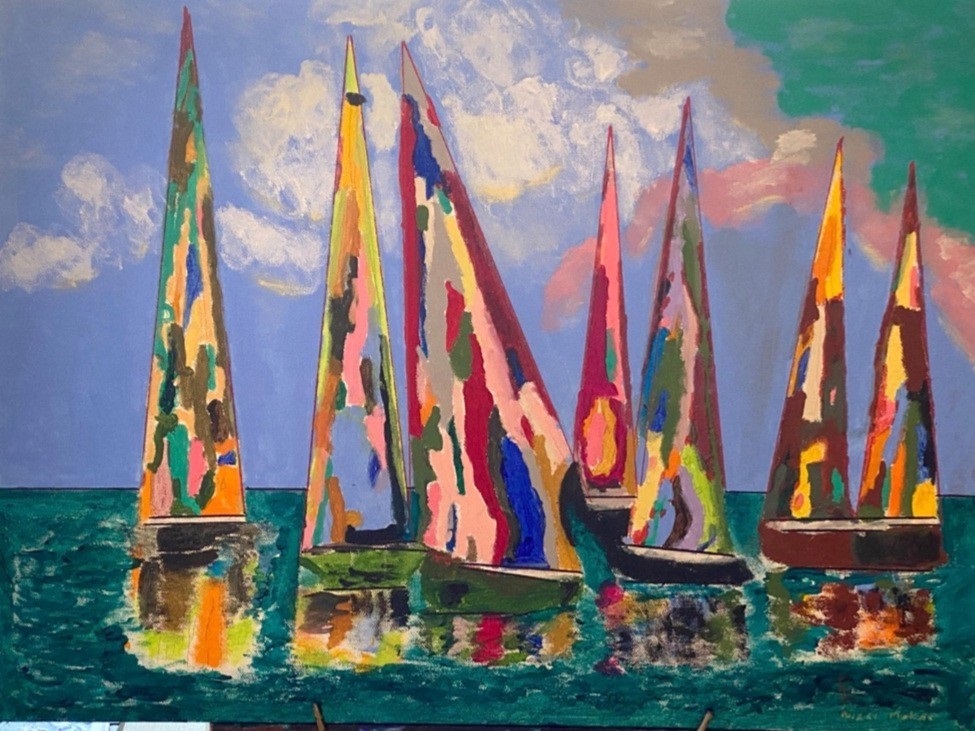
“Cacophony of Colours”, acrylic on canvas, 18” x 24”, by Nizar Makan, Burnaby B.C. (2021).
~~~~~~~~
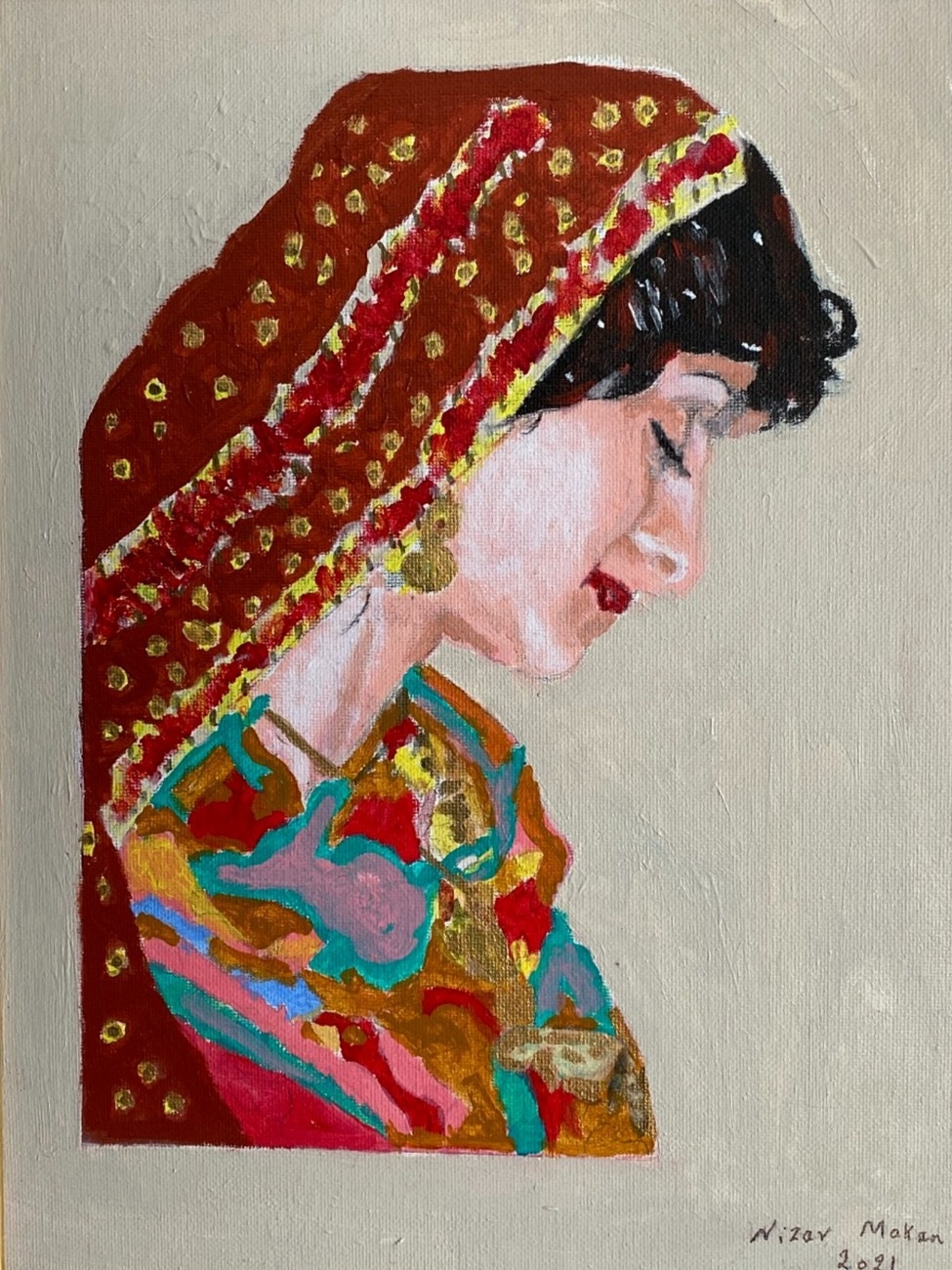
“The Bride”, acrylic on canvas, 20” x 16”, by Nizar Makan, Burnaby B.C. (2021).
~~~~~~~~
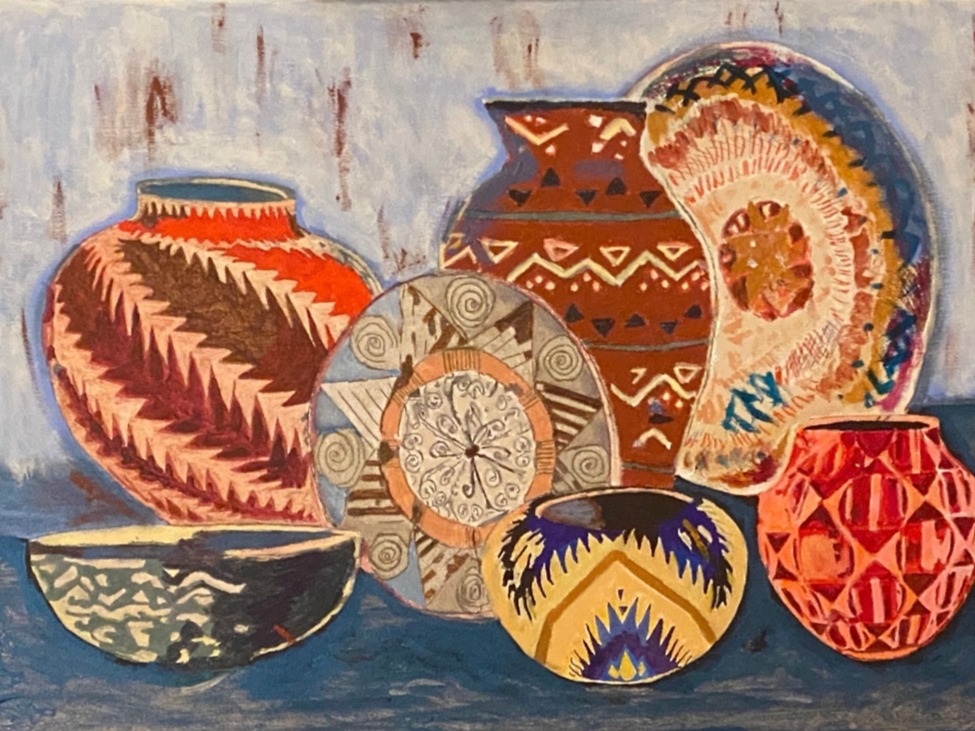
“Clay“, acrylic on canvas, 16” x 20”, by Nizar Makan, Burnaby B.C. (2021).
~~~~~~~~
“Children”, acrylic on canvas, 20” x 16”, by Nizar Makan, Burnaby B.C. (2021).
~~~~~~~~
“Story of Love”, acrylic on canvas, 20” x 16”, by Nizar Makan, Burnaby B.C. (2020).
~~~~~~~~
“Cosmic communication”, acrylic on canvas, 16″ x 12”, by Nizar Makan, Burnaby B.C. (2020).
Artist’s note on “Cosmic communication”: It is said that God endowed Prophet Dawud (David), a shepherd, with the most beautiful and melodious voice, such that when he sang the Psalms, birds and animals would pause to listen. This painting is a rather simplified representation and reminder of that mystical communication and cosmic bond between all of God’s creatures. After all, we are all interconnected and made up of the same stardust, and our physical bodies are like garments to be shed some day.
“Venice, the city of romance, drama and intrigue”, acrylic on canvas, 18” x 24”, by Nizar Makan, Burnaby B.C. (2021).
~~~~~~~~
“Rocks shaped by Water”, acrylic on canvas, 16” x 20”, by Nizar Makan, Burnaby B.C. (2021).
~~~~~~~~
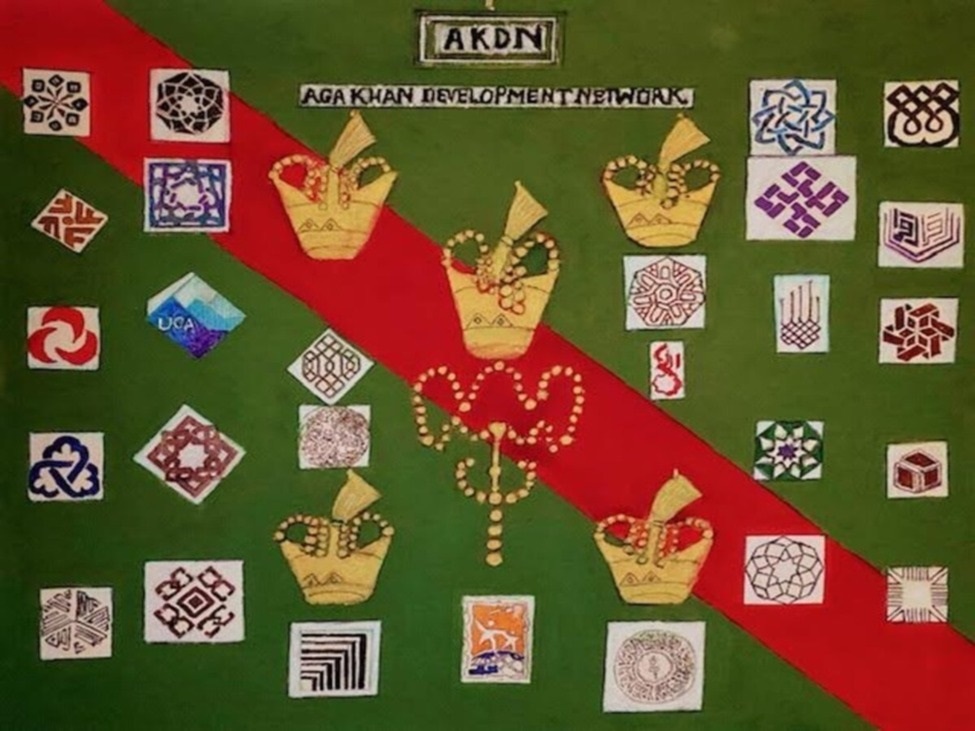
“AKDN”, acrylic on canvas, 16” x 20”, by Nizar Makan, Burnaby B.C. (2021).
A note by the artist on “AKDN”: Each AKDN, Jamati and Apex agency or entity within the Ismaili Imamat has its own unique logo that powerfully represents its goal and objective. In this painting, I have sought to artistically render the logos that I have come across over the past several years onto the Ismaili Flag. I hope to provide meaning of logos in a future piece. Hyperlinks are provided for logos whose meanings have already appeared in Simerg or its sister websites Barakah and Simergphotos.
Column 2: Aga Khan Trust for Culture, The Ismaili Centre London (UK), University of Central Asia, The Ismaili Centre Lisbon (Portugal), and Aga Khan Agency for Habitat;
Column 3: Personal Standard or Crest of Mawlana Hazar Imam (top portion), The Ismaili Centre Vancouver (Canada); The Ismaili Magazine, Crest (repeat), and Aga Khan Fund for Economic Development;
Column 4: Personal Standard or Crest of Mawlana Hazar Imam (full), and World Partnership Walk (an initiative of The Aga Khan Foundation);
Column 5: Crest (repeat), The Ismaili Centre Dubai (United Arab Emirates), information about the logo not known, and the Seal of the Aga Khan University (also see HERE with explanations of 3 other logos);
Columns 6: Aga Khan Museum (Toronto), The Ismaili Centre Dushanbe (Tajikistan), Aga Khan Foundation, The Ismaili Centre Toronto, and Aga Khan Centre London (UK); and
Column 7: The Institute of Ismaili Studies, London (UK), Aga Khan Education Services, Aga Khan Planning and Building Services, The Aga Khan Academies, and Aga Khan Award for Architecture.
We welcome feedback/letters from our readers. Please use the LEAVE A REPLY box which appears at the bottom of this page or click on LEAVE A COMMENT. Your feedback may be edited for length and brevity, and is subject to moderation. We are unable to acknowledge unpublished letters.
The editor invites Ismaili artists to submit a selection of their paintings and other works of art for publication in Simerg. Please submit images, preferably a maximum 8 objects in Jpeg (1200 x 900) along with your profile to the editor Malik, at mmerchant@simerg.com.
Simerg and its sister websites, Barakah and Simergphotos, convey heartiest felicitations to Ismailis and friends of the Ismaili community in Canada and around the world on the auspicious occasion of His Highness the Aga Khan’s 65th Imamat Day anniversary (July 11, 2022). He succeeded to the Throne of Imamat on July 11, 1957 at the age of 20 upon the death of his grandfather, Mawlana Sultan Mohamed Shah Aga Khan III, whose Imamat (spiritual leadership) of 71 years is the longest in the 1400 year history of the Shia Ismaili Muslims.
According to well-known Muslim traditions, the Prophet Muhammad (S.A.S) said:
“I am leaving amongst you two weighty things after me, the Qur’an and my Progeny (ahl al-bayt). Verily, if you hold fast to them both you will never go astray. Both are tied with a long rope and cannot be separated till the Day of Judgement.” (Muslim, Vol. II, pg. 279).
The Prophet appointed Hazrat Ali (A.S.) to be his successor as the Imam, and His Highness the Aga Khan, who is respectfully addressed by the Ismailis as Mawlana Hazar Imam, is the 49th Hereditary Imam in direct succession of Imams since Imam Ali.
In the Ismaili Ginan (hymn) Girbah Vali, attributed to the Ismaili missionary Pir Sadr al-Din, the Pir says:
“If the Imam did not have his feet on this earth for even a moment, then the world, moon, sun would vanish and nothing would exist, neither the heaven nor the earth.”
The notion of the cosmic necessity of an Imam, expressed by the Pir, is also found in famous traditions of the Prophet Muhammad (cited in “The Divine Guide in Early Shi’ism,” pp 125-131):
“The earth cannot be devoid of an Imam; without him, it could not last an hour” and also “If there were only two men left in the world, one of them would be the Imam.”
The two calligraphies that Karim Ismail has created express another important notion of the Imam based on the Qur’anic phrase: Al-rasikhun fi’l-ilm (those firmly rooted in knowledge). According to the Ismaili Baitul Ilm Secondary Curriculum, Volume 1, produced by the Institute of Ismaili Studies in London, the phrase, in the Shia tradition, is understood to be referring to the Imam descended from the Prophet’s family.
The first calligraphy has the Qur’anic phrase Al-rasikhun fi’l-ilm in Fatimid Kufi script on all the 4 sides of Karim Ismail’s artwork. The Fatimids were rulers of Egypt and North Africa in the 10th through the 12th centuries. The Fatimid Imams or Caliphs were ancestors of the current Aga Khan.
The Qur’anic phrase Al-rasikhun fi’l-ilm (Those firmly rooted in knowledge) on all 4 sides of the art work. Calligraphy and design by Karim Ismail. Toronto.
The second calligraphy, shown below, has the same phrase on the top and bottom borders in Fatimid Kufi script, as above. The centre has the same phrase in Thuluth script. We sincerely thank Karim Ismail for conceiving these pieces of art for Imamat Day.
The Qur’anic phrase Al-rasikhun fi’l-ilm (Those firmly rooted in knowledge) on top and bottom of the art work in Fatimid Kufi script; the centre of the art work has the same phrase in Thuluth script. Calligraphy and design by Karim Ismail, Toronto.
We wish all our readers a very Happy Imamat Day, with prayers for everyone’s good health, strength in Iman (faith), family unity and the fulfillment of all our wishes. May we fulfill the aspirations that Mawlana Hazar Imam has of each one of us of staying on the path of Sirat al Mustaqim (the Straight Path), excelling in our studies and endeavours, and keeping the right balance between our material and spiritual lives.
As we celebrate Mawlana Hazar Imam’s 65th Imamat Day, may we always remain under his guidance, loving care and protection. Ameen.
Date posted: July 11, 2022.
___________________
FEEDBACK
Simerg welcomes your feedback. Please complete the LEAVE A REPLY form below or click on COMMENT. Your letter may be edited for length and brevity, and is subject to moderation.
CONTRIBUTORS
Karim Ismail
Originally from Uganda, Karim Ismail lived in England before settling in Canada. By profession, he is a Pharmacist (retired). It was in England, in 1986, that he came across the artwork of a German Muslim, Karl Schlamminger (1935-2017), at the Ismaili Centre London. Karl’s artwork on calligraphy and geometrics, had a profound effect on Karim. He is frequently seen conducting calligraphy workshops for children at the Aga Khan Museum in Toronto. Karim is also active on the literature counter at the Ismaili Centre Toronto.
Malik Merchant
Malik Merchant is the founding publisher and editor of Barakah (2017) as well as its two sister websites Simerg (2009) and Simergphotos (2012). His interest for literature and community publications began in his childhood years in Tanzania through the work of his late parents Jehangir (d. May 2017, aged 89) and Malek Merchant (d. January 2021, also 89), who both devoted their lives to the service of the Ismaili community, its institutions and the Imam-of-the-Time, His Highness the Aga Khan, as missionaries and religious education teachers. In the UK, Malik edited the flagship Ismaili magazine, ILM, with his father. A resident of Ontario since 1983, he relocated to Alberta in January 2022. He has an animal loving daughter Dr. Nurin Merchant; she is a vet and practices in Ontario. Malik can be contacted by email at mmerchant@simerg.com. He can also be reached — and followed — @twitter and @facebook.
Before departing this website please take a moment to review Simerg’s Table of Contents for links to hundreds of thought provoking pieces on a vast array of subjects including faith and culture, history and philosophy, and arts and letters to name a few. Also visit Simerg’s sister websites Barakah, dedicated to His Highness the Aga Khan, and Simergphotos.
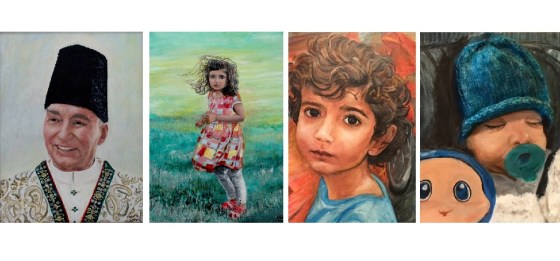
My name is Mobina, and I live in Crystal Beach, a lakefront community in Fort Erie, located some 180 kilometres from Toronto, Canada. I was born in Kampala, Uganda, and developed an interest in art at a very early age. After leaving Uganda, I attended an art school in England where I learned to work with many mediums, including paint, metalwork, and ceramic, amongst others.
After marrying Nizar Marani and having two beautiful daughters Zahra and Zaynah, and buying a pharmacy which I owned with my husband for almost 30 years, my artistic endeavours were put on hold.
Ismaili artist Mobina Marani
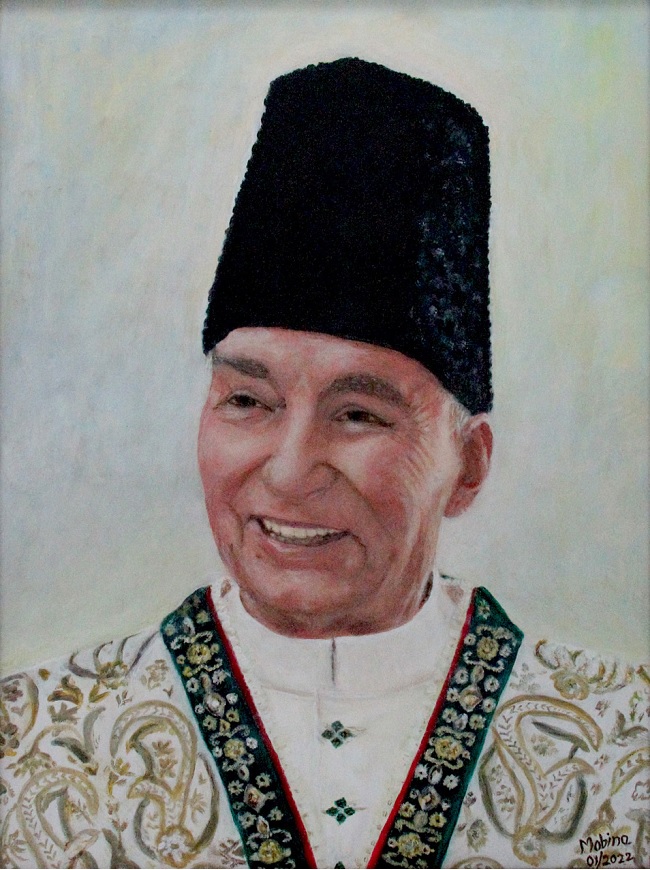
It was not until almost 40 years later, shortly after the birth of my first granddaughter, Amarah, that I was inspired to pick up a paintbrush again and find time to dedicate to my artistic expressions. Over the ensuing years, I completed portraits of all my immediate family members. Earlier this year, I rendered a painting of Mawlana Hazar Imam from one of his numerous portrait photographs that were taken during the Diamond Jubilee Year in 2017-2018. I hope to continue expressing myself artistically in the years to come, and fulfill an interest that began in my early childhood.
I would like to express my thanks to Simerg for introducing Ismaili artists such as myself to the worldwide Ismaili community and readers of this website.
~~~~~~~~~~
Please click on images for enlargements
Portrait Paintings by Mobina Marani
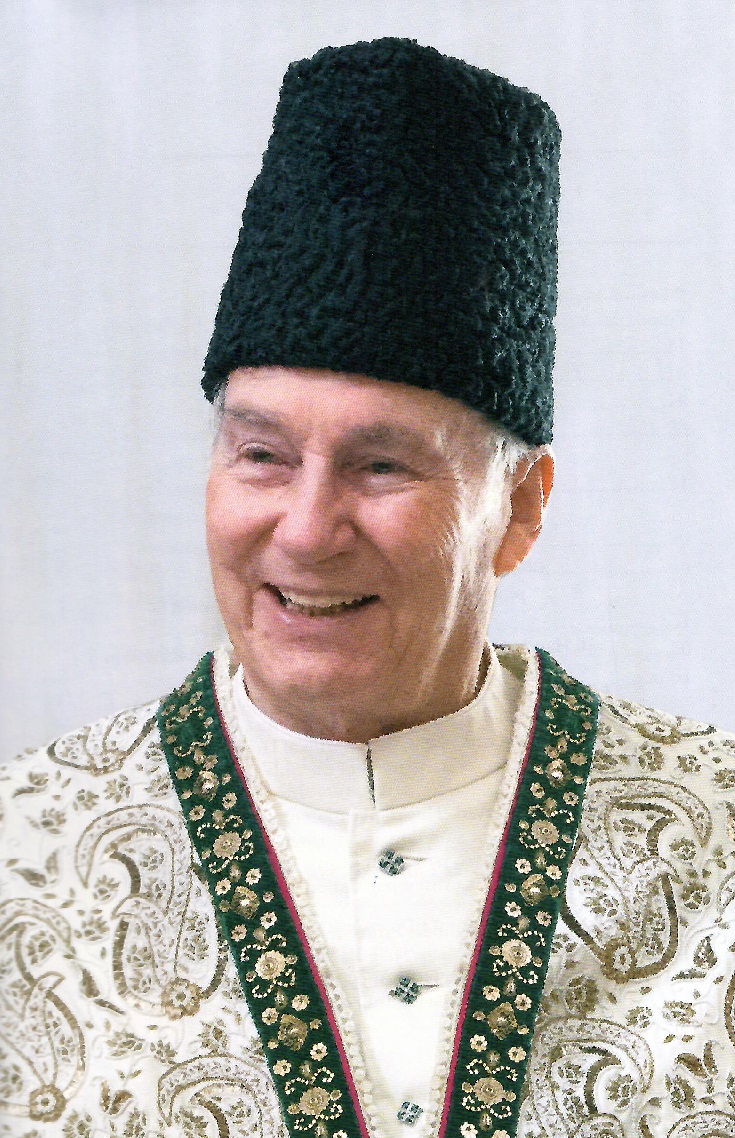
Mawlana Hazar Imam, His Highness the Aga Khan. Acrylic on composite wood 13″ x 17″, January 2022. Painting by Mobina Marani, Crystal Beach, Ontario, Canada. Mobina rendered her painting from the original official photo shown immediately below.
One of several portrait photos of Mawlana Hazar Imam, His Highness the Aga Khan, taken during his Diamond Jubilee Year (2017-2018).
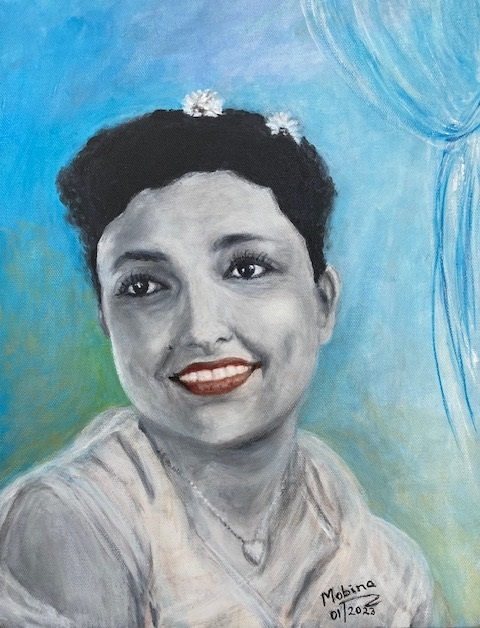
Mother, Daulat (Dolly), Acrylic, 16″ x 20″, January 2023. Painting by Mobina Marani, Crystal Beach, Ontario, Canada.
Amarah, first granddaughter. Acrylic, 16″ x 20″, May 2018. Painting by Mobina Marani, Crystal Beach, Ontario, Canada.
Grandson, Aaran. Acrylic, 16″ x 20″, October, 2018. Painting by Mobina Marani, Crystal Beach, Ontario, Canada.
Husband, Nizar, at 15. Acrylic, 13 3/4″ x 17 1/2″, January 2019. Painting by Mobina Marani, Crystal Beach, Ontario, Canada.
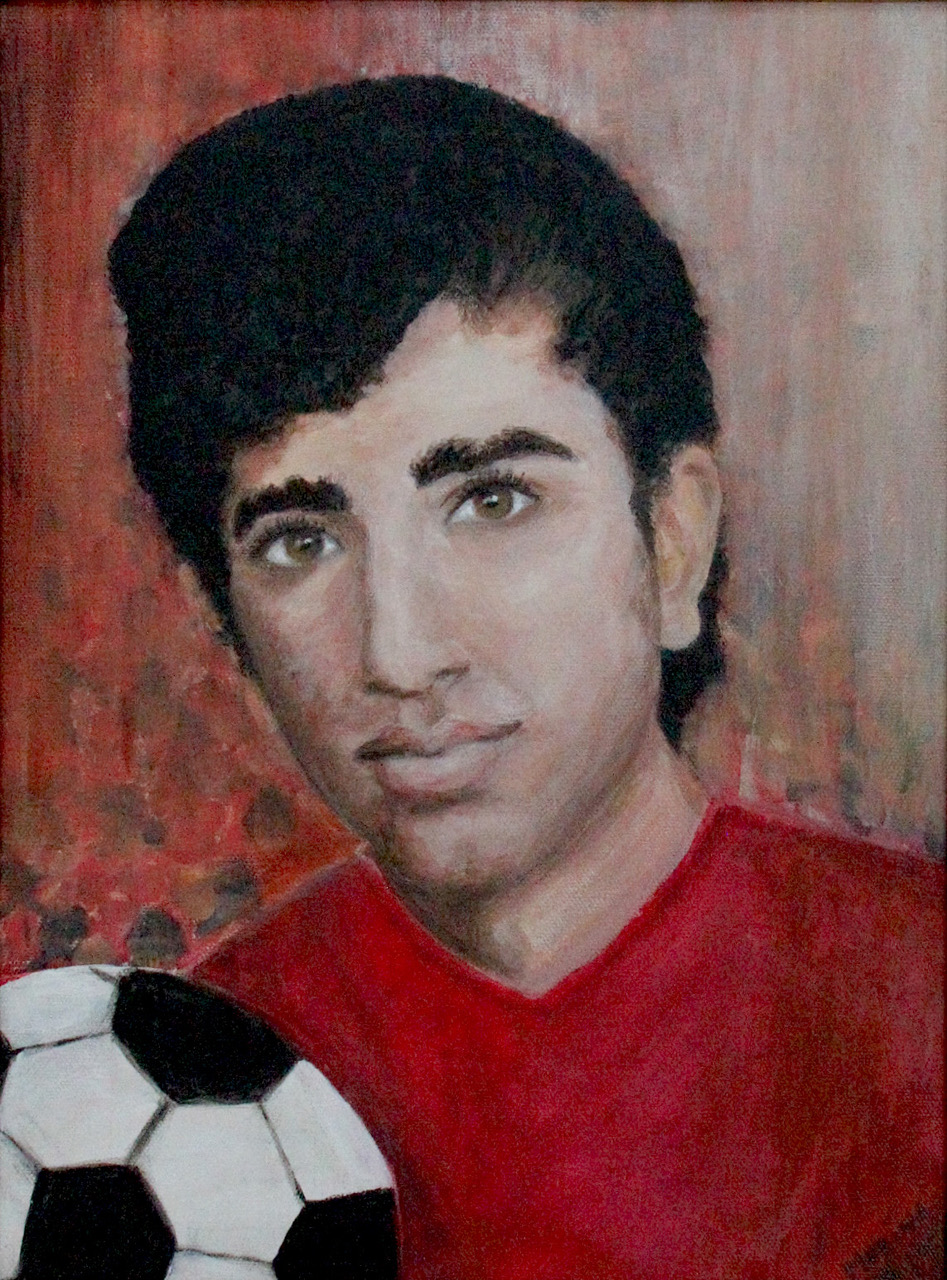
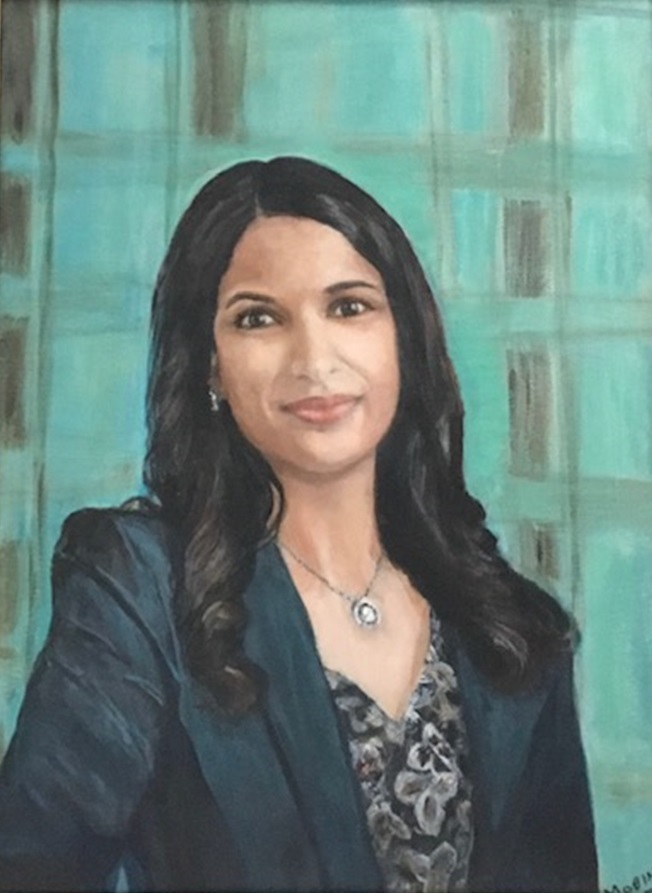
Daughter Zahra. Acrylic, 19 1/2″ x 15 1/2″, September 2019. Painting by Mobina Marani, Crystal Beach, Ontario, Canada.
Aunt, Nurumasi, at 100! Acrylic, 16″ x 20″, March 2020. Painting by Mobina Marani, Crystal Beach, Ontario, Canada.
Grandson, Jordan. Acrylic and wool (hat), 10″ x 10″, April 2020. Painting by Mobina Marani, Crystal Beach, Ontario, Canada.
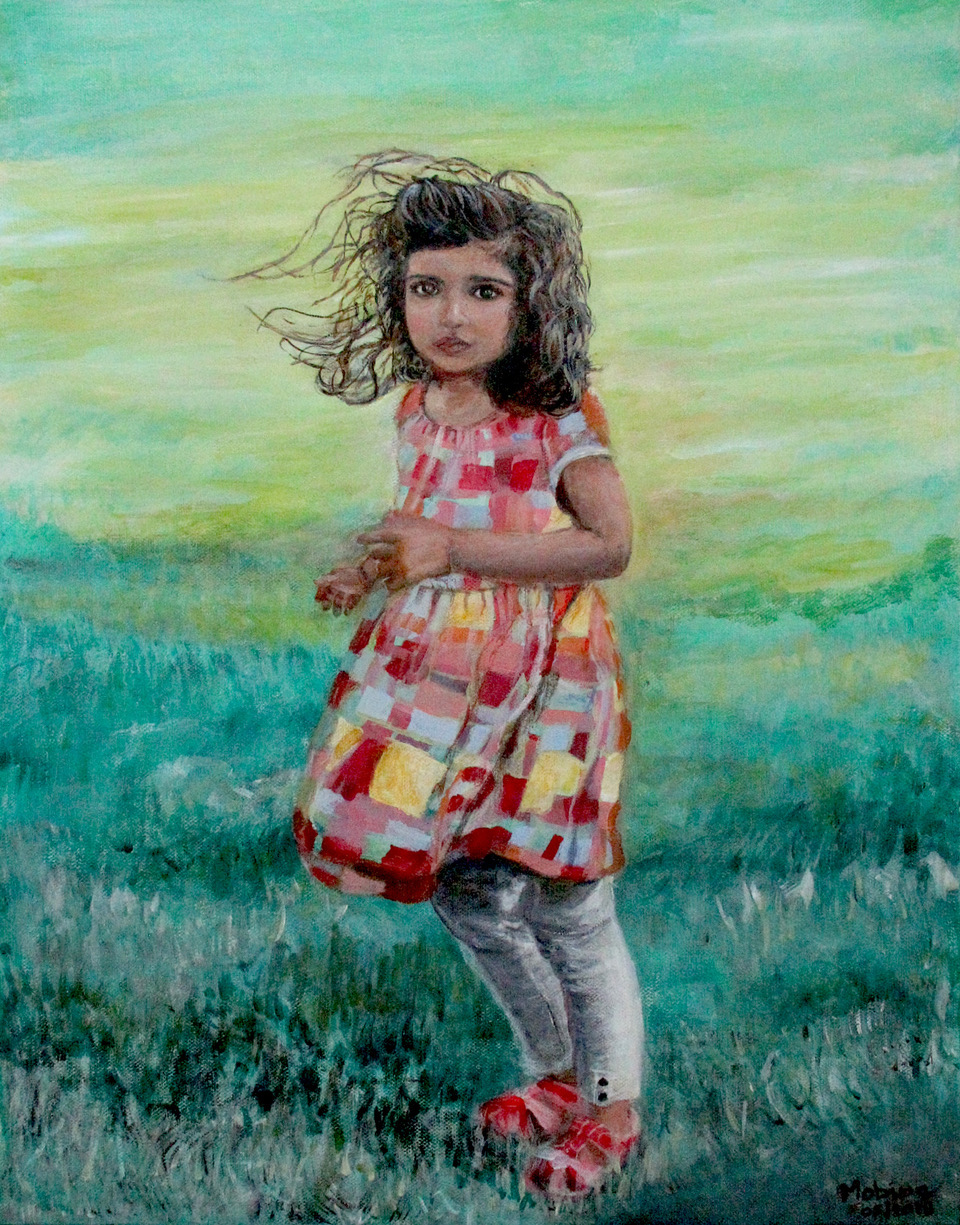
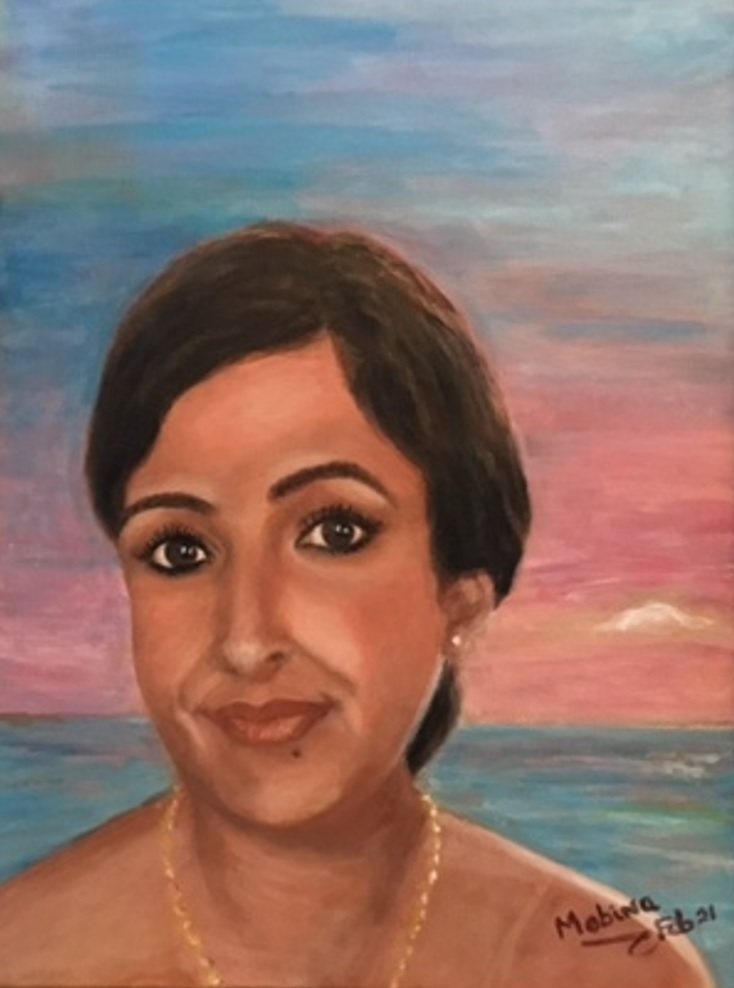
Daughter, Zaynah. Acrylic, 16″ x 18″, February 2021. Painting by Mobina Marani, Crystal Beach, Ontario, Canada.
Mom (Bhabhi), Acrylic on Composite Wood, 12″ x 16″, July 2024. Painting by Mobina Marani, Crystal Beach, Ontario, Canada.
Date posted: May 31, 2022. Last updated: October 21, 2024 (painting “Mom” added).
_____________________
We welcome feedback/letters from our readers. Please use the LEAVE A REPLY box which appears at the bottom of this page or click Leave a comment. Your feedback may be edited for length and brevity, and is subject to moderation. We are unable to acknowledge unpublished letters.
The editor invites Ismaili artists to submit a selection of their paintings and other works of art for publication in Simerg. Please submit images of no more than 8 objects in Jpeg (1200 x 900) along with your profile to the editor Malik, at mmerchant@simerg.com.
~~~~~~~~~~
Compendium of Ismaili Artists
By MALIK MERCHANT Publiser/Editor, Simerg
Please click on image to download compendium
Some 8 years ago, we produced a beautiful PDF publication entitled “A Compendium of Ismaili Artists from Around the World” that can be downloaded HERE. It contained a short profile and one work of art for each of the 33 different Ismaili artists from around the world who wanted to be featured in the compendium. As much as we wanted to publish an expanded edition of the compendium featuring many more Ismaili artists, we are sorry to note that the response was disappointing despite a major announcement on this platform as well as pertinent social media pages. We are keen to publish an expanded edition of the compendium provided we can, at the least, double up on the original number of 33 artists that were featured in the first edition. There are hundreds of Ismaili artists around the world, judging from their participation during the Golden and Diamond Jubilee celebrations of Mawlana Hazar Imam held in 2007-08 and 2017-18 respectively. We therefore urge Ismaili artists to review the entries in the first edition, and send their details for the compendium accordingly to Malik Merchant at mmerchant@simerg.com. Please do not ask us to prepare your profiles by submitting your elaborate CV or resume or asking us to visit your website to prepare the profile. We need the information from you, based on the format in the compendium; each artist will be allotted one page in the compendium that will include a brief profile and one image. Read the compendium!
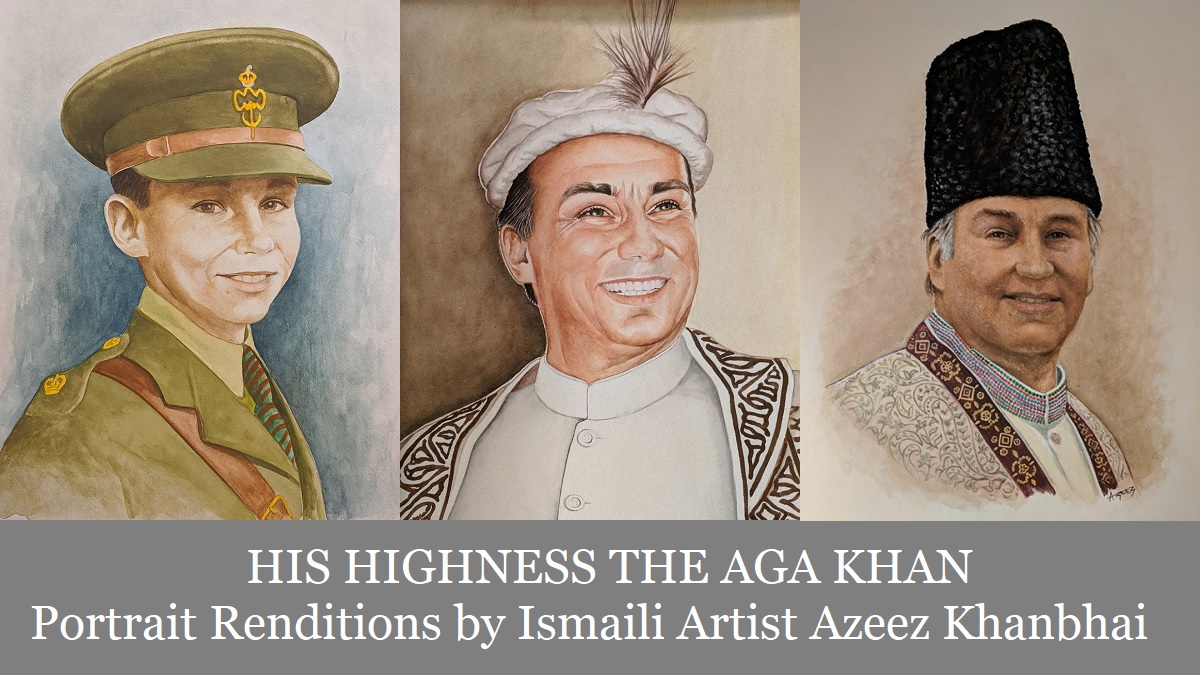
Azeez Khanbhai’s first portrait rendering of Mawlana Hazar Imam, His Highness the Aga Khan, was completed in 1959 and presented to the 49th Ismaili Imam in 1959 during his visit to Nairobi, Kenya. Mawlana Hazar Imam signed the painting, with his blessings. Khanbhai has continued his passion of painting Mawlana Hazar Imam’s portraits over the past 60 years, and Simerg’s sister website Barakah, which is dedicated to Mawlana Hazar Imam, members of his family and the Ismaili Imamat is pleased to present a selection of Khanbhai’s amazing works that also include portrait renditions of Princess Zahra, Prince Rahim and Prince Hussain. Please click HERE or on image below to view the Khanbhai collection in Barakah.
Please click on image for portraits of Mawlana Hazar Imam by Azeez Khanbhai
Date posted: October 30, 2021.
_______________
Before departing this website please take a moment to review Simerg’s Table of Contents for links to hundreds of thought provoking pieces on a vast array of subjects including faith and culture, history and philosophy, and arts and letters to name a few. Please also visit Simerg’s sister websites Barakah and Simergphotos.




















 Simerg - Insights from Around the World