His Highness the Aga Khan on Lake Sarez: Mitigating a Catastrophic Risk if the Lake’s Natural Dam Would Break

LAKE SAREZ NASA IMAGE

Please click on image for enlargement
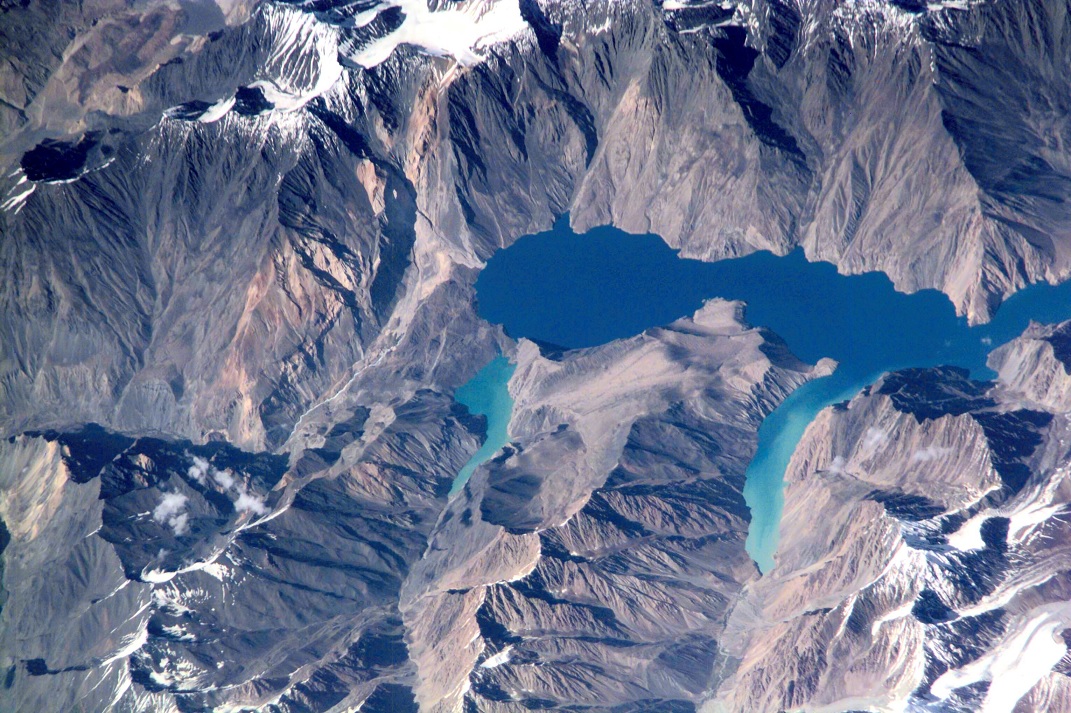
Lake Sarez in the Pamirs of TajikistanLake Sarez, deep in the Pamir mountains of Tajikistan, was created 90 years ago when a strong earthquake triggered a massive landslide that, in turn, became a huge dam along the Murghob River, now called the Usoi Dam. The resulting lake is perched above surrounding drainages at an elevation greater than 3000m, and is part of the watershed that drains the towering Akademi Nauk Range (see the regional image, below). The lake is 61 km long and as deep as 500 m, and holds an estimated 17 cubic km of water. The area experiences considerable seismic activity, and scientists fear that part of the right bank may slump into the lake, creating a huge wave that will top over and possibly breach the natural dam. Such a wave would create a catastrophic flood downstream along the Bartang, Panj and Amu Darya Rivers, perhaps reaching all the way to the Aral Sea. Currently, central Asian governments, as well as the World Bank and the UN are monitoring the dam closely, and have proposed gradually lowering the lake level as a preventive measure. Image: NASA Earth Observatory; digital photograph  was taken in the spring of 2001 from Space Station Alpha and is provided by the Earth Sciences and Image Analysis Laboratory at Johnson Space Center.

REMARKS BY HIS HIGHNESS THE AGA KHAN

“…From a global perspective, it is here, in Central Asia, that one of the most unusual water situations exists. I am referring to Lake Sarez. It is some 60 kilometres in length, containing some 17 cubic kilometres of water, is at 3200 meters altitude and has a natural dam of 550 meters, the highest of any dam in the world. For years it has been seen as a major hazard to millions of lives in this country [Tajkistan] and in Afghanistan, Uzbekistan, Turkmenistan and Kazakhstan. It is clear that if the rock dam, caused by an enormous landslide following an earthquake in 1911, were to break as a result of another such event; or if another earthquake were to cause landslides to fall into the lake, raising the level of the water and causing a massive spill across the top of the dam, the consequence would be a major catastrophe. It is estimated that 5 million lives could be at risk. Fear of this happening has dominated the thinking of government officials and the population living in the area around and below Lake Sarez for years.
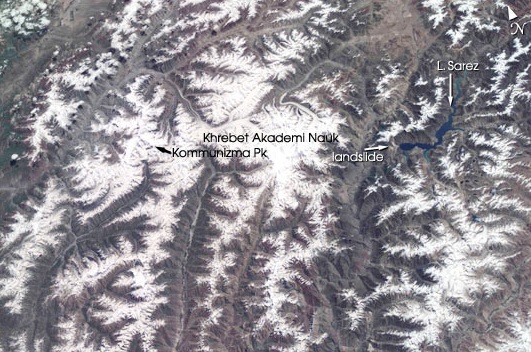
Lake Sarez

“More recently the World Bank, the Aga Khan Development Network (AKDN), USAID and the Swiss Government have expended time, thought and resources to develop a credible protective response that can alert downstream populations as quickly as possible. In simple terms, this is risk management. The question I wish to raise today is whether we are not perhaps also facing a question of opportunity management. Thousands of cubic meters of consumable water are trapped at high altitude. Is this not a situation which could be turned into a force for development, rather than a threat of tragedy? Studies are presently underway to test this idea, in particular in regard to the use of the Sarez Lake waters for hydro energy and irrigation for the area they now threaten, and probably much more. Any wisdom that this conference could bring to bear on these issues would be an extremely valuable outcome…” — Excerpts from a speech made by His Highness the Aga Khan, 49th hereditary Ismaili Imam, at the Dushanbe Fresh Water Forum (Dushanbe, Tajikistan), August 30, 2003.

~~~~~~

ACTION TAKEN

In 2004, a special satellite equipment and early warning system for monitoring the situation around Lake Sarez was installed by a World Bank project working on risk mitigation in the area, a step to ensure early warning for the vulnerable population in the region.

According to an interview with IRIN (Humanitarian News and Analysis), Rustam Bobojonov, a coordinator of the project said that “the equipment is for monitoring the situation around Lake Sarez, the dam and the Bartang valley, including seismic activity, landslides, water, wind speed and so on. It is aimed at ensuring early warning for the Tajik government, including the emergency ministry, international community and the residents of all the villages in the Bartang Valley about the possible risk.”

The total cost of the project was at US$4.5 million out of which the Aga Khan Foundation contributed US$1, with the Swiss Government providing another US$2.9 million.

~~~~~~

Background Article

“…Below the Usoi dam there are more than 30 small villages in the Bartang Valley, with a total population of about 7,000 mountain Ismaili people. Most villages (kishlaks) are sited on alluvial cones near to the river and use all available gently sloping land. Many of the villages are subject to floods, landslides, mudflows, and avalanches annually…”

TAJIKISTAN: LAKE SAREZ AND THE PAMIR MOUNTAINS

Please click on map for enlargement.
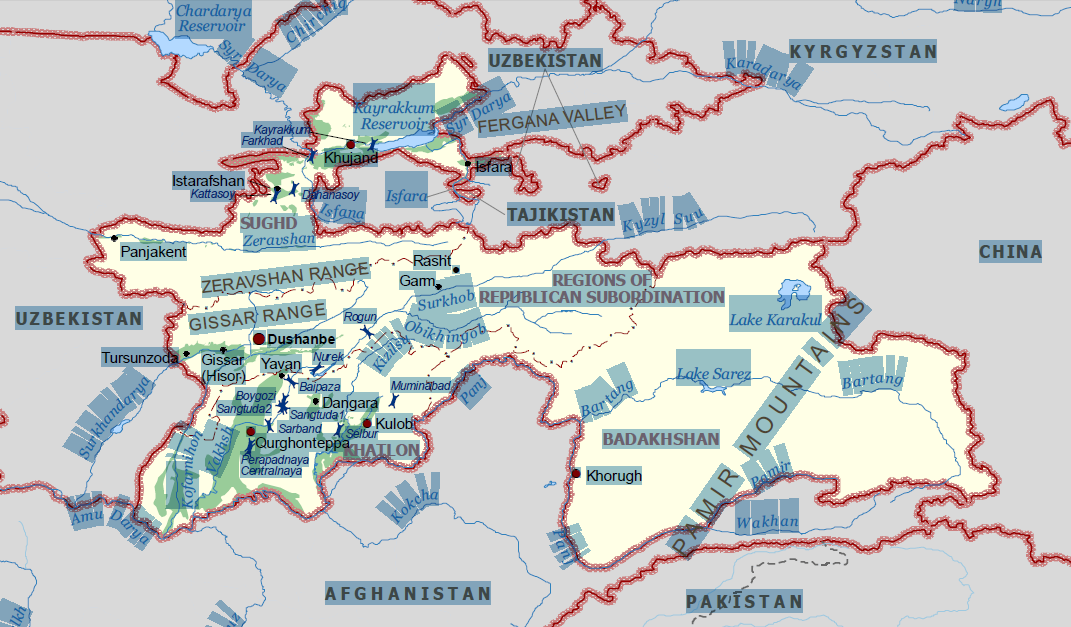
FAO Map Tajikistan and Lake SarezPlease click on map for enlargement. This map has been adapted from the original map produced on the website of FAO.

(Map shown above and the following article have been adapted from the website of the United Nations Food and Agriculture Organization, FAO, see link below)

Lake Sarez, high in the Pamir Mountains is close to 3,000 m above sea level and its location is one of the most remote in the world. It formed following a very large landslide, set off by an earthquake in the winter of 1911. The landslide, with a volume of some 2-3 km3 , plunged down a mountain side to form a dam between 500 and 600 metres in height and two kilometres wide to block the Murgab River. This river is a tributary of the Bartang River which, below the confluence with the Murgab, flows for 120 km through a gigantic mountain gorge to join the Pianj River, itself a tributary of the Amu Darya. The Amu Darya is one of the two major rivers that drains into the Aral Sea 2,000 km below the dam site. The Pianj and Amu Darya rivers form part of the frontier between Tajikistan and Afghanistan and further downstream their combined waters flow through Uzbekistan and Turkmenistan. The fallen mass of rock and earth was named the Usoi Dam after the village that it completely annihilated. The dammed waters of the Murgab River produced Lake Sarez, named for a village that was submerged by the rising waters. Initially, the level of the lake rose at a rate of about 75 metres a year.

Today it is more than 60 km in length and has a maximum depth in excess of 500 metres. Its total volume is about 17 km3. The lake surface is close to 3,200 m above sea level and surrounded by peaks rising to more than 6,000 m. The Usoi dam is the highest dam, natural or man-made, in the world. Set in the heart of the Pamir Mountains, the lake itself and its surroundings form a magnificent mountain landscape.

It is also located in a region that has been central to major political and military tensions for more than 200 years. During the 19th and early 20th centuries the three rival empires, Czarist Russia, Great Britain, and China competed on a gigantic and heroic scale that became known, following the writing of Rudyard Kipling, as the ‘Great Game’. Much earlier a main branch of the Silk Road passed through the Pamir and carried Marco Polo and his uncles to the court of Kublai Khan. The present republics of Central Asia were moulded by Soviet Russia from a series of Khanates, together with territories of no clear political allegiance. Currently, with a massively disturbed Afghanistan, Pakistan, Kashmir, and India, all virtually within walking distance, and with Iran, Iraq, and Turkey as neighbours with more than a passing interest, political instability may seem the order of the day. The Pamir Mountains, in general, represent one of the most active seismic regions on the world’s geophysical map.

Lake Sarez, therefore, is a focal point for a great amount of concern. A disaster of significant proportions could be triggered in several ways. A major earthquake could shatter the Usoi dam and send an enormous flood wave down the Bartang Valley and into the Pianj and Amu Darya rivers; the dam could collapse under the pressure of the water as the lake continues to rise; the piping of water through the dam, which is occurring today, could enlarge and cause the dam to collapse; or collapse could be induced by the continued rise of the lake level and eventually over-topping it. Finally, another large landslide, caused either by an earthquake, or the spontaneous failure of the mountain wall above the lake, could fall into the lake and generate a giant wave to over-top the dam. Even if the dam was not broken by such a wave, the wall of water rushing down the Bartang Valley could set off fast moving mudflows and trigger secondary landslides by under-cutting the talus slopes along the valley sides. This could be sufficient to eliminate all the thirty villages in the valley, and even more as the disturbance entered the Pianj Valley.

It has been estimated that, in the worst case, the lives of five million people could be affected. Furthermore, the torrential flood waters could extend as far downstream as the Aral Sea itself, with the additional danger of disturbing the toxic sediments that have been exposed as the sea has dried up.

The problem is rendered the more complex by a number of other factors. The vicinity of Lake Sarez is extremely remote and physical access along the Bartang Valley is a challenge. The final approach to the dam involves a difficult ascent on foot along steep mountain slopes, with a gain in altitude of more than 1,000 metres. This would render road construction, if heavy equipment would be needed, extremely expensive and technically difficult to maintain. The regional approach also constitutes a challenge; there are two main roads into the upper Pianj Valley and Khorog, the regional capital. One of these is very long and involves transit through a small part of the territories of Uzbekistan and Kyrgyzstan and a high altitude section (above 4,000 m) across the Pamir Plateau. The other, more direct, requires passage of the Pianj gorge, with very unstable slopes and a narrow road bed subject to rockfall, mudflow, landslide, and avalanche. Both roads are closed by heavy snow for several months of the year. The difficulty of access alone would appear to eliminate large-scale engineering solutions, such as reinforcing the dam artificially, or attempting a controlled partial drainage and lowering of the lake level.
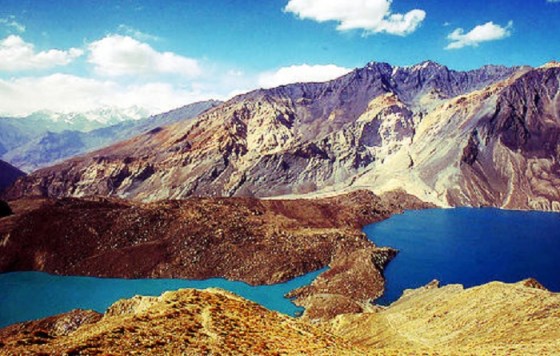
Lake Sarea and the Usoi Dam

The naturally formed Usoi dam separates the Sarez (right) and Shadau (left) lakes. Photo: Wikipedia.

Below the Usoi dam there are more than 30 small villages in the Bartang Valley, with a total population of about 7,000 mountain Ismaili people. Most villages (kishlaks) are sited on alluvial cones near to the river and use all available gently sloping land. Many of the villages are subject to floods, landslides, mudflows, and avalanches annually; while these natural hazards are individually of small magnitude, compared to that posed by a potential failure of the Usoi dam, they are frequent in occurrence and constantly restrict access to the valley and would constrain any needed evacuation. Any landslide-induced flood wave capable of over-topping the dam would place all or most of the villages at risk. Soviet and Tajik scientists became aware of the threat posed by Lake Sarez some decades ago. Early warning and lake-level monitoring systems were established. The warning signals, however, were only directed to Moscow and Dushanbe. Thus, in the event of a medium- or large-scale flood, any secondary warning to reach the Bartang villages from either Moscow or Dushanbe would likely arrive after the event, if at all. With the collapse of the USSR even this approach to early warning and lake-level monitoring ended.

Then followed the civil war of 1992-1997 when the problem of Lake Sarez was put aside. Over the last three years, the dangers posed by Lake Sarez have begun to be taken seriously. Various reconnaissance visits have been made to the lake and dam and to the Bartang Valley. Several high-level planning meetings have been held: in Dushanbe, Geneva, and Washington, DC. The involved Asian republics, and especially Tajikistan, appear to favour a development approach based on the assumption that the worst case scenario (total collapse of the Usoi dam) was credible. A major investigation was mounted during June 1999. This was financed primarily by the World Bank, with additional support from the UN disaster relief organization, Focus Humanitarian Assistance (one of the Aga Khan family of organizations), and the government of Tajikistan. An international group of engineers, geophysicists, geologists, and geographers visited Lake Sarez and examined all the approach routes. There was unanimous agreement that the prospect of a worst case scenario was sufficiently remote that it should be accorded a low level of priority. However, there was strong support for installation of monitoring and early warning systems. Unlike the earlier Soviet approach, the new approach would relate to all the villages in the Bartang Valley and ensure the direct input of the local people. Concurrently, it was recommended that computer mapping and simulation of the potential impacts of various levels of natural disaster be undertaken. It was also pointed out that further, and much more detailed, studies should be undertaken of the cultural and socioeconomic situation of the local people. Sites for safe havens should be located and equipped, and a full accounting made of the attitudes of the local people toward the various levels of possible danger. One additional, and very important point, is that steps should be taken to ensure that the likelihood of actual large-scale disaster (worst case scenario) not be over-stated, so that the risk of any government-ordered forced evacuation of the Bartang Valley could be avoided. By February 2000 it appeared that, under the leadership of the World Bank and with contributions from several major donors, the recommendations of the June 1999 reconnaissance team were to be acted upon (United Nations, 2000). A year later, at time of this writing, significant planning progress has been made. Thus, the case of Lake Sarez, while representing one of the largest ever potential disasters based upon a natural situation in a high mountain region, embraces many complex inter-relations between highlands and lowlands. Ultimately, the challenging task of seeking collaboration amongst several independent countries on the use and management of a large international river, the Amu Darya and its headstreams, will have to be faced. Given the international rivalries prevailing in the region, this might well be the single most difficult task. Nevertheless, while the magnitude of the problems emanating from the potential instability of Lake Sarez may be an order of magnitude, or more, higher than other mountain hazards in the same region, their identification, evaluation, and treatment should provide a formula for ways in which other hazardous situations could be approached.

Date posted: October 31, 2015.

_________________

Credits:

  1. For complete speech of His Highness the Aga Khan, please visit http://www.akdn.org.
  2. Please visit http://www.nasa.gov for images of Lake Sarez
  3. For complete background article, please visit http://www.fao.org and enter Lake Sarez in the search box.

Exclusive Photos by Jean-Marc Carisse: “Victorious Trudeau”, His Highness the Aga Khan and Liberal MP Yasmin Ratansi

LETTER FROM PUBLISHER

2015 1019 _0657 low-res

“Victorious Trudeau”
Justin Trudeau with wife Sophie Grégoire-Trudeau just as results from polling stations across the country confirmed a Liberal majority government. Photo: Jean-Marc Carisse. Copyright.

By Abdulmalik Merchant

“Victorious Trudeau” is the caption of this large, beautiful and poignantly touching photograph on the front window of Jean-Marc Carisse’s Studio Café located on Elgin Street in Ottawa. It’s a remarkable record of history in the making, as it was taken by Mr. Carisse in Montreal just as Mr. Justin Trudeau’s Liberal Party won the 2015 Federal Elections in Canada held on Monday, October 19th.

Countless other photos adorn the walls of the studio café Jean-Marc and his wife have lovingly and meticulously built on Elgin Street. Mr. Carisse, an award winning photographer (see profile below), has seen action around the world for more than forty years. From activists to artists, and singers to prominent world leaders, past and present, Carisse has the iconic figures as well as the common man well represented in his European inspired space that I call The Jean-Marc Carisse Museum of Photography.

SudioCafe&Gallery-MCarisse

Carisse Studio Cafe Photography Gallery on Elgin Street in Ottawa.

Ask Jean-Marc Carisse – the humble, lively and ever-joyous and smiling man – about the background and context of the photos, and he will oblige with details so rich, interesting and, sometimes, amusing that you will want to go back and look at the photos on the walls again and again.

Jean-Marc’s enormous collection include hundreds of photos of the 49th Ismaili Imam, His Highness the Aga Khan, in group settings. One that Carisse is particularly attached to, in which His Highness appears alongside former USA President Jimmy Carter and Cuban leader Fidel Castro, was taken at the funeral of Justin’s father, Prime Minister Pierre Trudeau. In this photo Justin, the loving son, and now Canada’s Prime Minister designate – he officially becomes the Prime Minister on November 4 – is seen resting his head on his late father’s casket. This is a truly remarkable and poignant photo taken in sadder circumstances.

Pierre Trudeau FuneralThe photograph shows former Prime Minister Pierre Elliott Trudeau’s family, friends, colleagues, and official guests in attendance to observe his passing. His son, Justin, rests his head on the casket of his father. Margaret Trudeau is in the front pew with son, Alexandre. In attendance next to Cuban President Fidel Castro are former Governor-General Romeo Leblanc, His Highness Prince Karim Aga Khan and former U.S. President Jimmy Carter. Other notables present at the ceremony not shown in this photograph include past Canadian Prime Ministers John Turner, Joseph Clark, Brian Mulroney, and Jean Chrétien. Photo: Copyright Jean-Marc Carisse.

When I asked Mr. Carisse to create a special dropbox for me of the photos of His Highness, he gladly obliged for the photos that were electronically available which he had shot over the past 12 years or so. These photos were from the Ismaili Imam’s visits or meetings with Ministers who during the 2002-06 time frame headed the Department of External Affairs. The Liberals were in power at that time, and Ms. Yasmin Ratansi, an Ismaili Muslim, was the Liberal MP representing the Don Mills East constituency. She lost her seat in the 2011 Federal Elections to the Conservative member by less than 1,000 votes in what turned out to be a watershed election for the Liberals, who could only keep 34 seats out of 308. But last week in a major turn around, Ms Ratansi won the same riding by almost 10,000 votes, with Liberals increasing their count by a substantial margin to 184!

I wondered whether I might find Yasmin somewhere in the dropbox of thumbnails that Jean-Marc had set up for me. Indeed! I found her, and there were quite a few. I met with Jean-Marc Carisse late yesterday, Monday, October 26, to view the actual enlarged versions, out of which we selected a couple with two Ministers. Also Carisse shared a portrait of His Highness the Aga Khan (see below)

This is our little tribute to Ms. Ratansi who has worked hard for Canadians. Undaunted, this remarkable lady was not prepared to go into oblivion just because she and her party were defeated four years ago. She has come out strong, and we wish her well in the years to come in her service to the people of this great country.

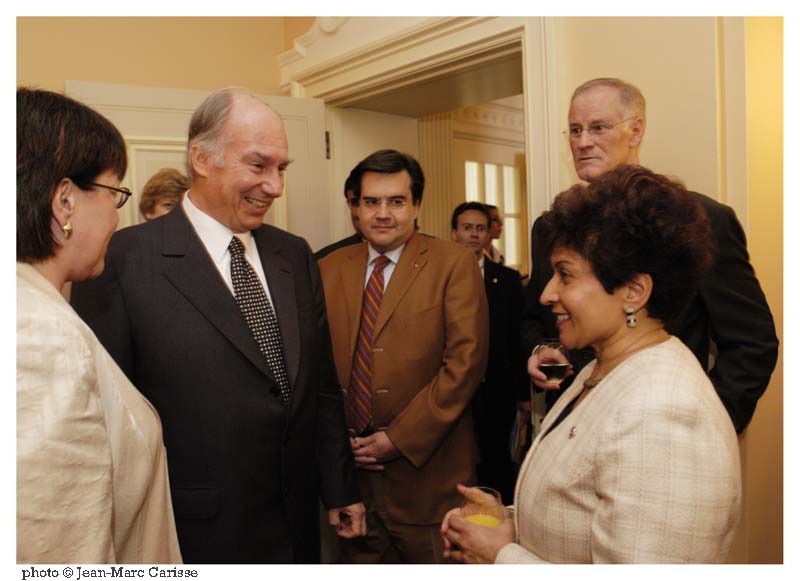
re, Bill Graham & Yasmin RatansiHis Highness the Aga Khan and Yasmin Ratansi (right) in a happy exchange with Canadian External Affairs Minister Bill Graham (2002-2004), looking on. Photo: Jean-Marc Carisse. Copyright.

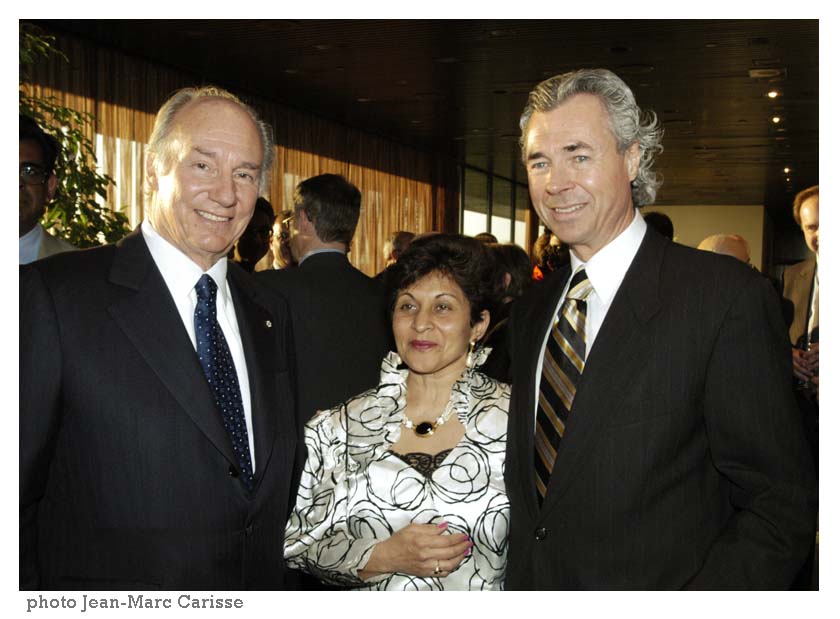
Marc Carisse 2005 0607 203His Highness the Aga Khan, MP Yasmin Ratansi and External Affairs Minister Pierre Pettigrew (July 2004 – February 2006). Photo: Jean-Marc Carisse. Copyright.

With regard to Mr. Justin Trudeau, who will officially become the Prime Minister on November 4, I might note that the relationship of the Ismaili Imamat with his family goes back more than 40 years, when the Liberal Government under Justin’s father, Mr. Pierre Trudeau, accepted thousands of Asian refugees including  Ismailis from Uganda.

Judging by the respect and warmth that Mr. Justin Trudeau has shown towards the Ismaili Imam and the Ismaili community, we expect that the fraternal bonds between the Ismaili Imamat and Canada will continue to remain strong, as they have been under the leadership of Prime Minister Stephen Harper and other Prime Ministers  before him.

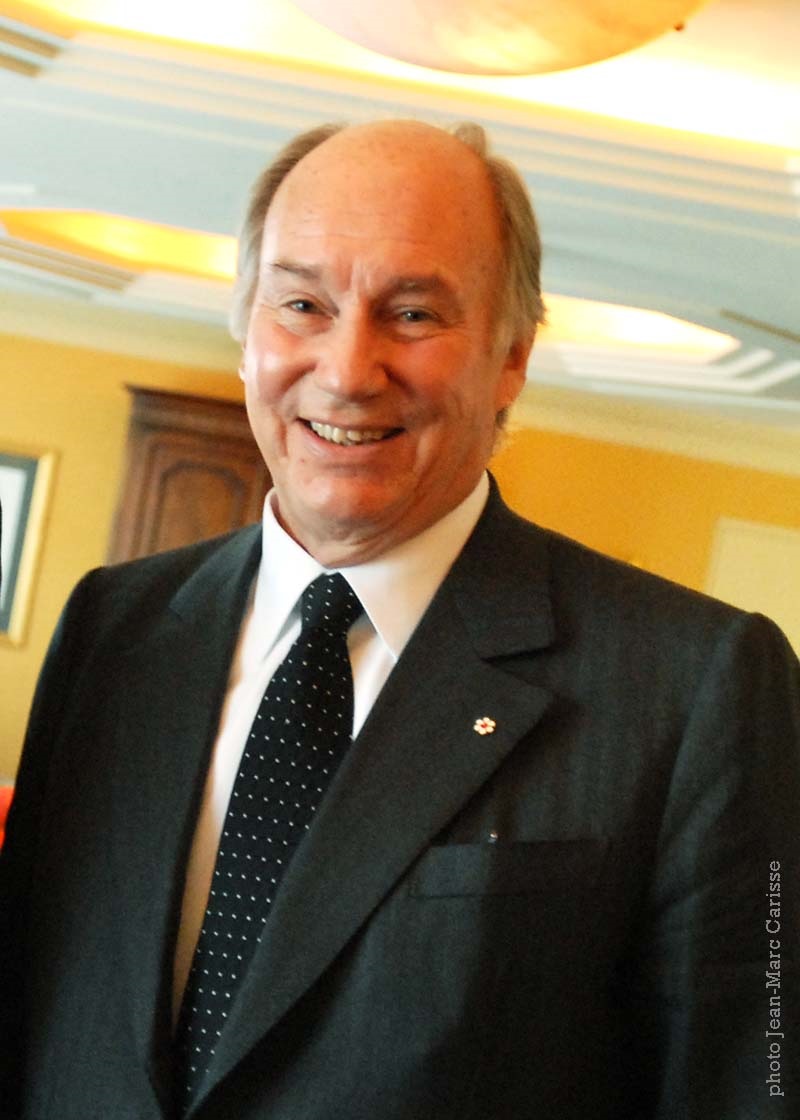
Aga Khan by Jean-Marc CarisseHis Highness the Aga Khan. Photo by Jean-Marc Carisse. Copyright

We wish Mr. Justin Trudeau and his  Liberal Government the very best to serve this country well, and to lead the country to loftier heights. The Ismaili community, as ever, will continue to excel in its commitment to this magnificent country in all spheres of human endeavour, under the guidance of their beloved Imam, His Highness the Aga Khan, who asked his Ismaili followers in 1978 to make Canada their permanent homes.

We conclude by mentioning that the Diamond Jubilee (60th Imamat Day Celebrations) of His Highness the Aga Khan will be celebrated in July 2017, at the same time that Canada celebrates its 150th anniversary. We look forward to celebrating these two great milestones in Canadian and Ismaili history under the leadership of Prime Minister Justin Trudeau.

Date posted: Tuesday, October 27, 2015.
Last updated: October 28, 2015.

Please also visit Simerg’s photoblog at http://www.simergphotos.com for an enhanced version of this piece containing additional photos of His Highness the Aga Khan. _______________

We invite your feedback – please click Leave a comment.

Jean-Marc CarisseAward winning photographer, Jena Marc Carisse has photographed the political, cultural and social scenes in Ottawa and around the world for over 40 years.  He was official photographer for the Prime Minister’s Office for many years serving Prime Ministers Trudeau, Turner and Chrétien, as well as serving Official Opposition Leaders Bill Graham, Stéphane Dion and Michael Ignatieff. He’s also photographed consecutive Prime Ministers from Diefenbaker to Harper, US Presidents from Ford to Obama and hundreds of world leaders. Many of his photographs have appeared on the covers and pages of history and political books (including his own coffee table book “Privileged Access w/ Trudeau, Turner & Chrétien” by Warwick Publ. 2000),  magazines including Time, Paris Match and Maclean’s, as well as TV documentaries and biographies.
Profound Reflections on Nature by the 49th Ismaili Imam, His Highness the Aga Khan; and Stunning Photos of the Autumn Foliage in Ottawa-Gatineau

“Look at the mountains, the rivers, the trees, the flowers, as evidence of Allah’s love for the people He has created”

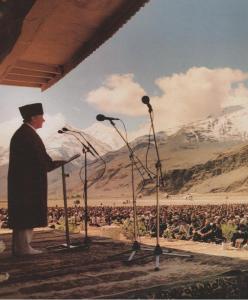
His Highness the Aga Khan or Mawlana Hazar Imam is seen addressing his followers in Ishkashim, Badakhshan, during his first historic visit to the region in 1995.

His Highness the Aga Khan, the 49th Ismaili Imam, is seen addressing his followers in Ishkashim, Badakhshan, during his first historic visit to the region in 1995.

“The Qur’an refers very often to nature as a reflection of Allah’s power of creation, and it says, look at the mountains, the rivers, the trees, the flowers, as evidence of Allah’s love for the people whom He has created. Today, I look at the environment and I say to you, I believe Allah is smiling upon you, and may His smile always be upon you.” — His Highness the Aga Khan speaking in a mountainous setting in Badakhshan in 1995.

Please click on image for autumn foliage in the Ottawa-Gatineau, the National Capital Region.

Visitors enjoying fall colours on the grounds of Rideau Hall. Please click on image for photos of autumn foliage in Ottawa-Gatineau, the National Capital Region. Photo: Malik Merchant/Simerg

Please visit http://www.simergphotos.com for a marvellous and unique collection of photo essays

~~~~~

“When I invited Professor Maki, a master of form and light, to design this [Delegation of the Ismaili Imamat] building, I made a suggestion to him – one that I hoped would help connect this place symbolically to the Faith of Islam. The suggestion I made focused on creating a certain mystique, centred around the beautiful mysteries of rock crystal.

The architecture of the dome of Delegation of the Ismaili Imamat Building seen above from Jacques Cartier Park is centred around the beautiful mysteries of rock crystal. Please see the Ismaili Imam's quote and click on image for photos of Ottawa-Gatineau foliage.

The architecture of the dome of the Delegation of the Ismaili Imamat Building seen above from Jacques Cartier Park is centred around the beautiful mysteries of rock crystal. Please read the Ismaili Imam’s quote and click on image for photos of Ottawa-Gatineau foliage. Photo: Malik Merchant/Simerg

“Why rock crystal? Because of its translucency, its multiple planes, and the fascination of its colours – all of which present themselves differently as light moves around them. The hues of rock crystal are subtle, striking and widely varied – for they can be clear or milky, white, or rose coloured, or smoky, or golden, or black.

Please click: Photo Essay: The Beauty and Glory of Autumn Foliage in Ottawa-Gatineau, Canada’s Capital Region

“It is because of these qualities that rock crystal seems to be such an appropriate symbol of the profound beauty and the ever-unfolding mystery of Creation itself – and the Creator. As the Holy Qur’an so powerfully affirms, “Allah is the Creator and the Master of the heavens and the earth.” And then it continues: ‘Everything in the heavens and on earth, and everything between them, and everything beneath the soil, belongs to Him’.” — His Highness the Aga Khan, on the occasion of the inauguration  of the Delegation of the Ismaili Imamat Building in Ottawa on December 6, 2008.

Date posted: Sunday, October 25, 2015.

_________________

Dear David Price: We are all ROOTING for 9 Priceless Innings from you for the Toronto Blue Jays tonight

CRUCIAL GAME

By Malik Merchant

David Price on the mound for Toronto on August 8, 2015. Photo: Wikipedia.

David Price on the mound for Toronto on August 8, 2015. Photo: Wikipedia.

For Toronto Blue Jays, hope takes root at the pitcher’s mound with a must win situation in the penultimate game tonight, Friday, against the Kansas City Royals, who are 3-2 up in the Best of Seven American League Championship Series (ALCS).

David Price, who was acquired by the Jays on July 30, 2015, will  be on the mound for the game starting at 8:00 ET. He has contributed significantly to Toronto’s resurgence since his arrival, and for the team’s top standing in AL East. His superb performance throughout his career during the regular season with over 100 wins, has not translated well going into the post season in the playoffs.

Ask any baseball coach “Where Hope Takes Root,” and he will say on the pitcher’s mound. All the Jays’ fans wish David Price well in the game, and with his fine pitching complemented with some great defense and stellar hits from the Jays batters, we shall all celebrate one more time before tomorrow’s decider on who plays the New York Mets in the World Series. The Mets easily defeated Chicago 4-0 in the National League Championship Series.

Go Jays Go. And Price, for all your hard work over the years, you just might have a NO-HITTER when you and your fans want it most! However, a WIN is a WIN, and we are all rooting for you and the entire team as well as the coaching staff.

Simerg’s Iconic Moments in Bautista’s Home Run in the Deciding Game Between the Toronto Blue Jays and Texas Rangers

José Antonio Bautista’s home run which gave the Toronto Blue Jays a 3-run lead over the Texas Rangers in the 7th inning of the deciding game played at the Rogers Centre in Toronto on Wednesday, October 14, 2015, is worth relishing. Bautista’s swing of the bat that brought the 3 runs, his stare at the direction of the pitcher immediately after the ball had left his bat, and the tossing of his bat over his right shoulder are Simerg’s iconic moments of this incredibly exciting game. Please click on the following collage to see MLB’s video clip of this unbelievable inning. This makes baseball a truly thrilling and exciting game!

PLEASE CLICK IMAGE BELOW OR http://m.mlb.com/video/v523054683/textor-gm5-bautista-hammers-goahead-threerun-shot/?game_pk=446255

Iconic moments of the game. Jose Bautista's home run, his stare at the pitcher and the tossing of the bat. Please click on image to view a video clip at the website of MLB.com.

Iconic moments of the game. Jose Bautista’s swing of the bat that scored 3 runs, his stare at the pitcher and the tossing of the bat. Please click on image to view a video clip at the website of MLB.com.

The Jays will now meet the Kansas City Royals, who beat the Houston Astros, in a best-of-seven series beginning Friday, October 16th. Kansas City won the American League and therefore have the home advantage – the first 2 games in the series will be played in Kansas, then the 3rd and 4th games as well as the 5th game (if necessary) in Toronto. The series will move to Kansas for the 6th and 7th games, if necessary.

Prince Rahim Aga Khan On How Muslims Can Harness the Creativity of Our Knowledge Society to Impact Humanity

On the occasion of Prince Rahim Aga Khan’s 44th birthday on Monday, October 12, 2015, we are pleased to produce excerpts from his commencement address that he delivered at the Graduation Ceremony of the Institute of the Ismaili Studies held in London, England, in September 2007.

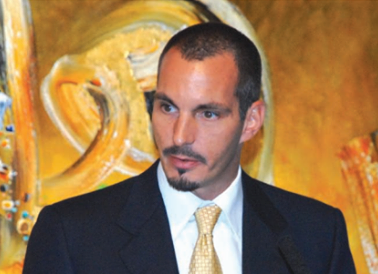
Prince Rahim and Princess Salwa on their wedding day on August 31, 2013. Photo: TheIsmaili / Gary Otte.

Prince Rahim Aga Khan and Princess Salwa on their wedding day on August 31, 2013. They have one child, son Prince Irfan, who was born on April 11, 2015. Photo Credit: TheIsmaili /Gary Otte. Copyright.

Prince Rahim is the eldest son of the 49th hereditary Ismaili Imam, His Highness Prince Karim Aga Khan, the direct descendant of the Prophet Muhammad (peace be upon him), and Begum Salimah Aga Khan. Prince Rahim graduated from Phillips Academy in Andover, Massachusetts, in 1990, and from Brown University in the United States in 1995. Based at the Secretariat of His Highness at Aiglemont, north of Paris, France, Prince Rahim is an executive Director of the Aga Khan Fund for Economic Development — the economic development arm of the Aga Khan Development Network.

~~~~~

Islam Enjoins Us To Make a Positive and Visible Impact on the World

“…Absolutist, exclusivist, and rejectionist claims to the truth, especially to religious truth, are increasingly heard from all quarters. Rather than seeing religion as a humble process of growth in faith, some people presume to claim that they have arrived at the end of that journey and can therefore speak with near-divine authority…”

Prince Rahim Aga Khan delivering his commencement address for the Graduation Ceremony of the Institute of Ismaili Studies held at the Ismaili Centre in London in 2007.

Prince Rahim Aga Khan delivering his commencement address at the Graduation Ceremony of the Institute of Ismaili Studies held in London in 2007 at the Ismaili Centre.

BY PRINCE RAHIM AGA KHAN

I am thrilled to join the graduation ceremony in honour of those completing the IIS [Institute of Ismaili Studies] Graduate Programme in Islamic Studies and Humanities. To you, to your families and to all those who have helped you in this achievement, I say mash’Allah.

I am convinced that the institutions of the Imamat and of the Jamat could benefit directly from the contribution of each of you, either in a professional or a voluntary capacity. Such a contribution would certainly be in keeping with the ethic of our faith that makes it incumbent upon each of us to use our blessings –- be they material or intellectual –- to assist our families, to serve the Jamat and the Ummah, and to help improve society, and indeed, all of humanity. The Jamat and its institutions need young and dynamic women and men like you, who are able to draw on the rich heritage of our past, and on the best educations of the present, to address the challenges of the future.

Education, international studies and diplomacy, non-profit leadership, media, development, law, and regional studies will all be among the most relevant fields of expertise in the decades ahead. This will be particularly true in the developing world.

I was impressed to learn that amongst you are represented five different nationalities, as are several diverse cultural traditions of our Jamat. I am certain that this diversity has enhanced your classroom experience, and I am confident that it will have given you a deeper appreciation of the meaning and value of diversity itself.

We are all aware that we live in a world where diversity is often evoked as a threat and, more particularly, where diversity in the interpretation of a faith can be seen as a sign of disloyalty. This phenomenon is sometimes perceived to apply principally to Muslims, but it also exists in other societies. Absolutist, exclusivist, and rejectionist claims to the truth, especially to religious truth, are increasingly heard from all quarters. Rather than seeing religion as a humble process of growth in faith, some people presume to claim that they have arrived at the end of that journey and can therefore speak with near-divine authority.

Unfortunately, in some parts of the Muslim world today, hostility to diverse interpretations of Islam, and lack of religious tolerance, have become chronic, and worsening, problems. Sometimes these attitudes have led to hatred and violence. At the root of the problem is an artificial notion amongst some Muslims, and other people, that there is, or could ever be, a restricted, monolithic reality called Islam.

Our Ismaili tradition, however, has always accepted the spirit of pluralism among schools of interpretation of the faith, and seen this not as a negative value, but as a true reflection of divine plenitude. Indeed, pluralism is seen as essential to the very survival of humanity. Through your studies you have known the many Qur’anic verses and hadiths of our beloved Prophet Muhammad (peace be upon him) that acknowledge and extol the value of diversity within human societies. You all know, I am sure, the hadith to the effect that differences of interpretation between Muslim traditions should be seen as a sign of the mercy of Allah.

It should also be clear to anyone who has studied Islamic history or literature, that Islam is, and has always been, a quest that has taken many forms. It has manifested itself in many ways — in different times, amongst different peoples, with changing and evolving emphases, responding to changing human needs, preoccupations, and aspirations.

Even during the early centuries of Islam, there was diversity of intellectual approaches among Muslims. Today, however — both outside the Islamic world and inside it — many people have lost sight of, or wish to be blind to, Islam’s diversity, and to its historical evolution in time and place along a multitude of paths. It befalls us, then, to help those outside the Muslim World to understand Islamic diversity, even as we provide an intellectual counterpoint to those within Islam who would reject it.

I hope that you, as graduates of this programme, will include this message in your own ways in the years ahead, through your work and your words, by your attitudes, by your actions, and by example.

The untrue and unfair, but increasingly widespread equating of the words “Islam” and “Muslim” with “intolerance”, sometimes even with the word “terrorism”, could lead some Muslims to feel despair, indignation, or even shame. To me, however, the current global focus on the Muslim world, and on Islam itself, presents a golden opportunity for us to educate and enlighten, while actively exemplifying the counterpoint I mentioned before. To my eyes, it creates an opportunity, and an even-greater obligation for us to make a positive and visible impact on the world – on culture and art, science and philosophy, politics and ecology, among others.

In order to respond to this opportunity, it will be crucial to reverse another damaging consequence of intolerance, which has been the dissuasion of many Muslim populations from seeking access to what has been called the Knowledge Society. Without an acceptance of diversity, without the ability to harness the creativity that stems from pluralism, the very spirit of the Knowledge Society is stifled. We must encourage, I believe, that Muslims of all communities come together, working collaboratively to tap into the vast endowment of knowledge available today, and without which progress is, if not halted, at least deferred. This cannot be done in the absence of open-mindedness and tolerance.

Implicit in this approach is the need for humility, which is also a central Muslim value. We must all search for the answers to the challenges of our generation, within the ethical framework of our faith, and without pre-judging one another or arbitrarily limiting the scope of that search. Like the great Muslim artists, philosophers and scientists of centuries past, we must enthusiastically pursue knowledge on every hand, always ready to embrace a better understanding of Allah’s creation, and always ready to harness this knowledge in improving the quality of life of all peoples.

As you look towards the future, I hope that you will remember that intellectual pursuits should, wherever possible, seek to address the universal aspirations of humankind, both spiritual and concrete. Those aspirations, for our generation more than for any before, are intertwined in a single global community.

It can be overwhelming at times to ponder the vast array of new problems which seem to multiply in this globalised world.

These include the implications of new technologies and new scientific insights, raising new ethical and legal questions. They include delicate and complex ecological issues, such as the great challenge of climate change. They include matters ranging from the widening gap between rich and poor, to issues of proper governance and effective, fair, and representative government, and to the spread of rampant consumerism and greed, at the expense of others, or of our environment. In some communities, illiteracy and innumeracy are not only continuing problems but are even growing problems. And our challenges also include the increasing difficulty of nurturing pluralism in the face of strong normative trends – finding ways to accommodate our differences – even as hugely differing peoples find themselves in much closer contact with one another.

You have been engaged in studies, some of which analysed the achievements of past Muslim civilisations. What I hope you have come to see is that understanding past Muslim achievements, traditions, values, and ethics should also have equipped you exceptionally well to address the great emerging issues of our own times.

As you now graduate into this challenging world, you will be taking with you the hopes of those who founded, and of those who now drive this study programme. Their central hope is that you will become global leaders in a variety of fields, bearing with you as you go, and applying always, the open-mindedness of our tradition, and the ethics of our faith.

Date posted: Monday, October 12, 2015.

__________

We welcome feedback/letters from our readers. Please click Leave a comment.