Simerg is an independent initiative dedicated to Ismaili Muslims, the Aga Khan — their Hereditary Imam — and the Ismaili Imamat, and Islam in general through literary readings, photo essays and artistic expressions
Author Archives: Malik Merchant, Editor
Founding publisher and editor of www.barakah.com, www.simerg.com and www.simergphotos.com.
The websites of the Institute of Ismaili Studies and the Ismaili community, The Ismaili, have jointly announced the appointment of Dr. Zayn Kassam as the new Director of the Institute of Ismaili Studies (IIS), following the decision by Dr. Farhad Daftary to retire from his management roles, which included serving as the co-director of the IIS for the past 12 years.
Dr. Daftary will continue his scholarly research, writing and teaching activities at IIS indefinitely. As appropriate recognition of Dr. Daftary’s contributions to IIS and his long service of 34 years, Dr Daftary has been conferred the lifetime title Director Emeritus when he relinquishes his current role and will be appointed to the IIS Board of Governors. In this way, IIS staff, students and other stakeholders will continue to benefit directly from his knowledge, wisdom and guidance.
Story continues below
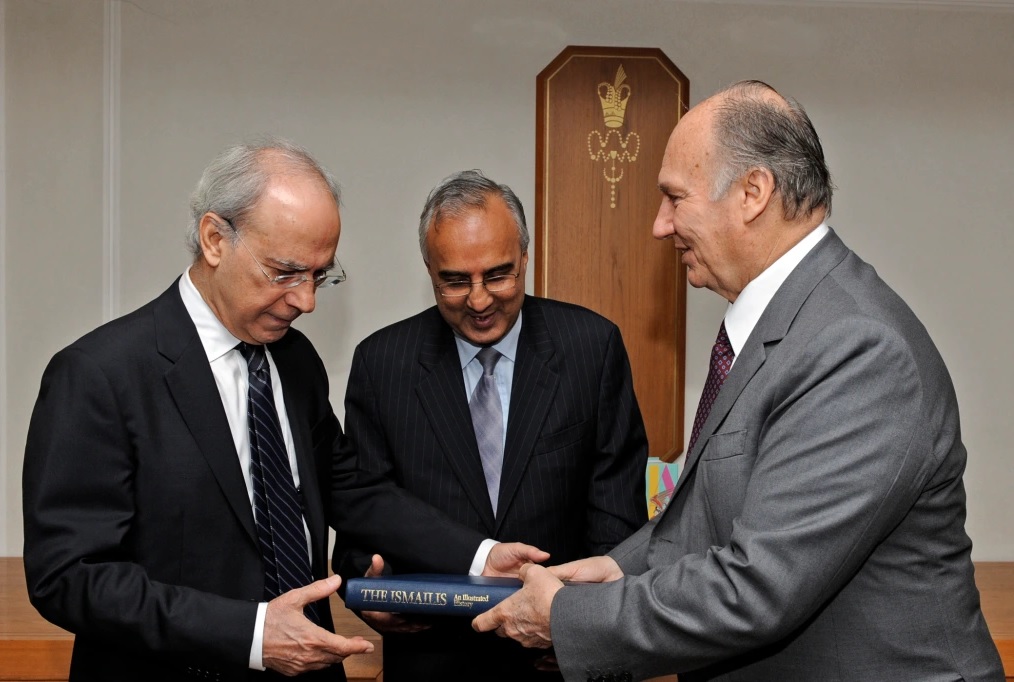
Professor Azim Nanji (centre), then Director of the Institute of Ismaili Studies, and his successor Dr Farhad Daftary (left) present Mawlana Hazar Imam, His Highness the Aga Khan, with a copy of The Ismailis: An Illustrated History on July 4, 2008 during his Golden Jubilee visit to the United Kingdom. Photo: Gary Otte
Following a thorough and extensive international search process undertaken by the Board of Governors which considered internal and external candidates, Professor Zayn Kassam of Pomona College in California has been appointed as the next Director to succeed Dr Daftary with effect from January 2023. Professor Kassam is a highly accomplished scholar and academic leader and has spent the last 27 years in a variety of positions at Pomona College in California. Her profile page on the College’s website reads as follows:
“Zayn Kassam is the John Knox McLean Professor of Religious Studies at Pomona College, Claremont, California. A graduate of McGill University (Ph.D. 1995), she teaches courses on mysticism, gender, literature, ethics, and the environment.
“She has lectured widely on gender issues in the United States, Canada, and Britain. She has been honored with three Wig Awards for Distinguished Teaching at Pomona College, as well as an American Academy of Religion Excellence in Teaching Award.
Story continues below
Zayn Kassam, who will succeed Farhad Daftary as the new Director of the Institute of Ismaili Studies in January 2023. Photo: Pomona College.
“Kassam is the author of Introduction to the World’s Major Religions: Islam (2006), and editor of Women and Islam (2010) and Women in Asian Religions (2018). She is also the section editor for Islam for the volume on Islam, Judaism, and Zoroastrianism for the Encyclopedia of Indian Religions (2018).
“She has chaired the department of religious studies at Pomona College, and has coordinated the programs in gender and women’s studies, Asian studies and Middle Eastern studies. She is currently the director of the Pacific Basin Institute. She serves on several national editorial boards, including the Journal of Feminist Studies in Religion and the Journal of the American Academy of Religion.”
Simerg congratulates Dr. Zayn on her new appointment, and wishes Dr. Daftary good health and success in all his scholarly endeavours as he continues to serve the IIS in the years to come.
Book that was presented by Dr. Farhad Daftary to Mawlana Hazar Imam during his Golden Jubilee visit to London in July 2008. See photo at beginning of post (without jacket cover)
While the IIS has been in existence since December 1977, it was not until Dr. Daftary joined the Institute that we began seeing a significant increase in the number published texts, short papers and monographs on Ismaili and Shia Studies in particular, and Islamic studies in general. As well as his own books, Dr. Daftary’s fervour for Ismaili history, philosophy and culture, encouraged other specialty scholars in the field of Ismaili studies to submit their scholarly research for publication through the IIS. Among the books that Dr. Daftary published himself or as a co-author or editor of numerous volumes, we would like to mention a few of them: The History of the Ismailis, A Short History of the Ismailis, The Assassin Legends: The Myth of the Ismailis, Historical Dictionary of the Ismailis, The Ismailis: Their History and Doctrines, The Shia World, A History of Shia Islam, The Ismailis: An Illustrated History, Islam: An Illustrated Journey and, most recently, The Ismaili Imams: A Biographical History. (We invite you to visit IIS Listing of Publications and also Amazon.)
With regard to Zayn Kassam, in addition to some the works mentioned in her profile, we are pleased to share links to two pieces that she contributed to Simerg:
“The Board thanks Dr Daftary for his many years of service to IIS, congratulates him on his appointment to the Board of Governors and wishes him continued success in his new role as well as welcoming Professor Kassam as the incoming Director of IIS.”
Date posted: September 22, 2022.
_________________
We welcome feedback from our readers. Please click Leave a comment. Your letter may be edited for length and brevity and is subject to moderation.
Before departing this website please take a moment to review Simerg’s Table of Contents for links to hundreds of thought provoking pieces on a vast array of subjects including faith and culture, history and philosophy, and arts and letters to name a few. Also visit Simerg’s sister websites Barakah, dedicated to His Highness the Aga Khan, and Simergphotos.The editor may be reached via email at mmerchant@simerg.com.
Simerg: What is behind the naming of the title of the book?
Mahmoud Hirji: I have two stories out of the fourteen, anchoring the book of short stories. One of them, called “Monkey Tales” is about a French expatriate working on a project in Africa, in the fictitious land of “Nyani” (which means monkey in Swahili ) where he experiences riotous encounters with the police (which I’m sure many of your readers originally from the southern hemsphere, will identify with ) and with a troop of baboons. Another reason is because many of my stories also speak to “monkey business” between humans.
Simerg: Why would you want me or my family members to read the book, and what will we all learn from it?
Hirji: My stories are full of humor, suspense, poignancy and a-twist-in-the-tale that audiences will love to read. To lend authenticity to the places, period and construction industry they are set in, I write about racism, sexism, exploitation, greed and attitudes of the time — sentiments that we have all at one time or anther encountered as immigrants to western countries.
I also think these stories are important for present day and next generations to read and learn about their parents’ and grandparents’ struggles as new immigrants.
However, I want readers and especially young parents to realize that this is not a story book for their children due to strong language and content to be authentic in describing the times, places and workplaces in my stories. I recommend a rating of 18+ for readers.
Simerg: What inspired you to write Monkey Tales?
Hirji: I have always been a story teller and an essay writer — perhaps a little long winded, some may say — and the pandemic gave me the chance to devote time to this endeavour, working from home.
Article continues below
Cover page of Mahmoud Hirji’s book “Monkey Tales and Other Short Stories.” Published by Friesen Press, Altona, Manitoba, July 2022, 248 pp. Available as hardback, paperback and Ebook.
Simerg: How can I purchase the book and what are its available formats?
Hirji: My book is available through the publisher Friesen Press — in soft cover, hard cover and Ebook formats. They are also available through Amazon, Chapters Indigo (as a Kobo Ebook), Barnes & Noble (Nook) among many other on-line bookstores worldwide.
Simerg: How did you find a publisher for the book?
Hirji: A good family friend, Nizar Sultan, author of the recently published epic tale, The Roots and the Trees, reviewed options with me and recommended Friesen Press as my best choice. And I must say, I have been very pleased with their work.
[“The Roots and the Trees” has been featured in Simerg as part of our Ismaili authors’ series. Please click HERE for our interview with Nizar Sultan – Ed.]
Simerg: Did you hire an editor, an illustrator or did you do all the work by yourself?
Hirji: I self-published through Friesen Press who provide coaching and a menu of services at different levels that one can use, enabling creative control on my part. I opted to consult with and use Friesen’s editor services, graphic design services, print layout and publishing services — and of course coaching on pricing and promotions.
Article continues below
~~~~~~~~~
MONKEY TALES: “A MOST PLEASANT READ”
The ease with which Monkey Tales and Other Short Stories transitions from one setting to another is fascinating. There is no constant. You don’t know if you should expect to be scared, excited, or amused when you finish one and start the next one. The only constant is the superb writing style and the details that can come only from intimate knowledge of the settings or from sound research. Each story is unique, interesting, informative, and entertaining. A most pleasant read — Nizar Sultan, author of The Roots and the Trees
~~~~~~~~~
Simerg: Which was your first book and how many have you written?
Hirji: “Monkey Tales and other Short Stories” is my first book and I am now writing a sequel — my second book called “Monkey Business.”
Simerg: How long did it take you to write “Monkey Tales” from start to finish and to begin marketing it?
Hirji: Approximately two and a half years.
Simerg: Would you like to offer further thoughts about your book?
Hirji: There are 14 short stories, and the genre is autofiction. A central character that runs thorough many of them is Aziz, born and raised in Tanzania, then emigrating to Canada and about his adventures studying and working here and abroad as an expatriate, sprinkled with lots of mirchi masala! I cannot tell all here, so will mention 4 stories:
In my first story, “When the Sun comes Up,” inspired by my favorite author Jefferey Archer, I have challenged myself to write a story that is exactly two hundred words in length.
In my title story, “Monkey Tales,” you will read about the daily conflicts between man and animal, among peoples and races, about greed and corruption, and sadly, about the way our world turns.
In “Churro,” I have attempted to shock and entertain the reader at the same time, sprinkling it with macabre humour in the style of another great author, Steven King.
And finally, in “La Colorada,” my most ambitious and complex short story — a novella, really — I have written about a family’s sad, poignant history, switching back and forth across almost two centuries, with threads of love, romance, terror, the supernatural, and the omnipresent greed and savagery of mankind running through it.
Date posted: September 10, 2022.
_______________
We welcome feedback from our readers. Please click Leave a comment. Your letter may be edited for length and brevity, and is subject to moderation.
~~~~~~~~~
Mahmoud Hirji’s Book is Featured on CTV’S “Your Morning” Program: Watch Short Clip
“Monkey Tales” was featured on CTV’s “Your Morning” show that was aired across Canada on September 6, 2022. You can watch the full episode by clicking on CTV: Your Morning Show; Mahmoud’s interview with the host, Anne Marie Mediwake, begins at around the 1:14:09 mark. Below, we provide our readers with the clip that was aired on CTV.
Mahmoud Hirjis’ interview with Your Morning host Anne Marie Mediwake. Video Credit: CTV and Mahmoud Hirji
_______________
Mahmoud Hirji
Mahmoud Hirji grew up in Moshi, Tanzania and finished his high schooling in Canterbury, England before moving to Vancouver, BC, Canada. Mahmoud studied Civil Engineering, and worked on several remote area construction projects around BC. Mahmoud later moved to Toronto, where he worked on a multitude of engineering and construction infrastructure projects in Canada and overseas as an expatriate. Now a professional construction consultant, the globe-trotting Hirji has lived on four continents, worked on projects in 23-countries and travelled to 46-countries.
Mahmoud lives in Toronto with his wife and daughter. They enjoy a shared passion for travel and the outdoors — hiking, canoeing, cottaging, skiing. They currently actively volunteer within and outside the Ismaili community.
Monkey Tales and other Short Stories is Mahmoud’s first book. His next book, Monkey Business, which he has begun writing, will be out next spring.
_______________
Calling all Ismaili Authors
We encourage Ismaili writers to introduce their books in a similar format as has been done in the post above. Please also see the series launch article and submit your responses to Malik at mmerchant@simerg.com. All submissions will be acknowledged. If a writer has published multiple books, each book will be highlighted in a separate article, and not combined with other books into one post. All writers should include a brief profile with a portrait photo.
We welcome feedback from our readers. Please click Leave a comment. Your letter may be edited for length and brevity, and is subject to moderation.
_______________
The Ismaili Authors’ Series so far (in chronological sequence, oldest article first):
Before departing this website please take a moment to review Simerg’s Table of Contents for links to hundreds of thought provoking pieces on a vast array of subjects including faith and culture, history and philosophy, and arts and letters to name a few. Also visit Simerg’s sister websites Barakah, dedicated to His Highness the Aga Khan, and Simergphotos.
Simerg has learnt with deep sadness that Her Majesty Queen Elizabeth II ( April 21, 1926 – September 8, 2022) has passed away at the age of 96. Like hundreds of millions of people around the world who adored the Queen and what she represented, we deeply mourn her death and pray that she may Rest in Eternal Peace. We have compiled the following piece from numerous sources including Wikipedia ,the Voice of America and a statement on her passing made by the Governor General of Canada. In the coming days, we hope to publish a special piece dedicated to the British Monarchy and its strong historic bond with the Ismaili Imamat and the Ismaili Muslim community.
Queen Elizabeth was Britain’s longest reigning monarch, and during her reign worked with 15 British prime ministers, beginning with Winston Churchill. She served as head of state for both Labour and Conservative governments in the UK, following the modern royal tradition of remaining neutral on political matters. When the Her Majesty became the Queen in 1952, she was the monarch and head of state of seven independent states: the United Kingdom, Canada, Australia, New Zealand, South Africa, Pakistan, and Ceylon. Over the ensuing years, many countries under British rule became independent and the realm of the monarchy changed. Later, many of the newly independent became republics. Canada along with 14 other nations continued to regard the British monarch as its Head of Statement. With the passing of the Queen, the new sovereign is King Charles.
Queen Elizabeth helped lead her country through the aftermath of World War II, the Cold War, economic booms and busts, strife in Northern Ireland, the creation of the European Union and Brexit. Admired for her dedication to her job, Queen Elizabeth was seen by many Britons as a pillar of strength for the country at a time when the nation was navigating its diminishing world power.
Earning the distinction of Britain’s longest reigning monarch on September 9, 2015, tHer Majesty the Queen characteristically went about her daily duties, which included opening a new railway in Scotland, barely mentioning the distinction. “Inevitably, a long life can pass by many milestones; my own is no exception,” she said at the ceremony.
As a young royal, Princess Elizabeth was placed directly in line for the throne when her uncle, Edward VIII, abdicated in 1936 in order to marry an American divorcee. Her father, George VI, inherited the role of head of state, and led the monarchy from 1936 to his death in 1952. Princess Elizabeth was on a tour in Kenya when she learned of her father’s death. She was just 25 years old at the time and only four years into her marriage to navy Lieutenant Philip Mountbatten, a Greek prince, whom she wed at age 21. Married to Prince Philip, for 73 years, the prince was often by the queen’s side, or the two paces behind at official events that is required by royal protocol. The Queen hailed Prince Philip after his death as her “strength and stay” throughout their marriage and her reign. The couple had four children, Charles, born in 1948 (who now becomes the King), Anne, born in 1950, Andrew in 1960 and Edward in 1964.
Article continues below
VOICE OF AMERICA: IN PHOTOS – THE LIFE OF BRITAIN’S QUEEN ELIZABETH II
Please click on photograph for Voice of America’s special photo gallery on the life of Britain’s Queen Elizabeth II (d. September 8, 2022).
A rare photograph of Queen Elizabeth II with Maryland governor Theodore McKeldin (right) and University of Maryland president Wilson Homer “Bull” Elkins (left), at a Maryland Terrapins vs. the North Carolina Tar Heels football game in College Park, Maryland. Photograph: Leffler, Warren K. Created/Published on October 19, 1957. Repository: Library of Congress Prints and Photographs Division Washington.
Supporters of the queen say she was instrumental in helping the monarchy to survive in Britain when the institution had been abandoned in many countries around the world. Known for her pragmatism and unshowy dedication to the job, the queen came to personify Britain in the eyes of many. Through her steadfast presence at countless events representing her country, she earned the respect of large majorities in Britain as well as popularity abroad, becoming one of the world’s most recognizable figures. Britain’s Express newspaper reported in 2020 that the Queen had traveled more than a million miles, calling her “the most traveled head of state of all time.” The report said she had visited 110 countries, with her longest trip a 44,000-mile tour of the Commonwealth in 1953.
In 2002, the Queen traveled more than 40,000 miles to celebrate her Golden Jubilee — 50 years on throne — including visits to the Caribbean, Australia, New Zealand and Canada as well as 70 towns and cities in England, Scotland, Wales and Northern Ireland.
Some of her travels were diplomatic milestones for Britain, including her visit to West Germany in 1965, the first official visit by a British royal to Germany since 1913. The trip marked the 20th anniversary of the end of WWII. In 1986, the queen became the first visit British monarch to visit the Chinese mainland, and 25 years later she became the first British monarch in 100 years to travel to the Republic of Ireland.
She earned praise for her speech in Ireland in 2011, saying that her visit “reminds us of the complexity of our history, its many layers and traditions, but also the importance of forbearance and conciliation. Of being able to bow to the past, but not be bound by it.”
The queen was a patron of more than 500 charities in Britain. Research from the Charities Aid Foundation released in 2012, when the monarch celebrated 60 years on the throne, showed that Queen Elizabeth had helped organizations raise nearly $2 billion.
Canadians may note that the Queen’s reign of 70 years encompassed the mandates of 12 Canadian prime ministers and 13 governors general. She undertook 22 official visits to Canada, where she professed her love for our county again and again. She was a steadfast presence during some of the most tumultuous times of our lives, and most recently gave comfort to so many during the pandemic.
Today, my husband, Whit, and I join all Canadians in mourning the passing of our extraordinary sovereign, Her Majesty Queen Elizabeth II.
Her Majesty The Queen was, in equal measures, compassionate, dedicated, humble, engaged and wise. She believed in service to her people above all, and inspired so many with her dedication to the Crown.
For many of us, we have only ever known one Queen.
When I was growing up, my grandmother revered The Queen, as did so many in the Arctic. She would tell us stories about Her Majesty, about her role and her commitment.
Her Majesty’s warm welcome when we spent time with her earlier this year was a profound moment in our lives and a memory we will cherish forever.
Her reign encompassed the mandates of 12 Canadian prime ministers and 13 governors general. On 22 occasions, she undertook official visits to Canada, where she professed her love for our county again and again. She was a steadfast presence during some of the most tumultuous times of our lives, and most recently gave comfort to so many during the pandemic.
On behalf of all Canadians, I offer deepest condolences to the members of the Royal Family, who grieve the loss of a loving mother, grandmother and great-grandmother.
Mary Simon
____________________
Live Statement from the Governor General
September 8, 2022
Hello, bonjour, [Inuktitut greeting].
Today, we mourn the loss of our Queen of Canada, Her Majesty Queen Elizabeth II.
In countless languages around the world, people are sharing solemn words of remembrance. Today, in Inuktitut, I add to these tributes.
[In Inuktitut] On behalf of all Canadians, I extend my condolences to Her Majesty’s family. We honour her memory.
On behalf of all Canadians, my husband, Whit, and I offer our condolences to the Royal Family on the loss, not just of a queen, but of a mother, grandmother and great-grandmother.
Her Majesty cared about people, about our well-being. This was clear every time we spoke. She cared about Canada, and all the unique stories that make up our beautiful country.
She learned our stories as she visited every corner of Canada during her many Royal Tours. She called Canada her “second home.”
Her Majesty celebrated our achievements, reassured us in difficult times and inspired us with her steadfast dedication to service.
Until her final days, she remained engaged and committed to her country, to the Commonwealth and to her family. With her passing, we mourn the end of an era.
I’m proud to have represented Her Majesty as governor general. Following my appointment, Her Majesty said to me: “be gentle with yourself.” I’ve come to understand her words to mean that while we should work hard on the issues that matter, we should also take time to pause. To be patient. To lead with understanding and respect.
I can see the wisdom in these words.
To the entire Royal Family and to a Commonwealth in mourning, our thoughts are with you.
The memories of The Queen will always have a place here, in Canada. Her second home.
Thank you. Merci. Miigwetch. Nakurmiik.
____________________
Statement by the Prime Minister of Canada
September 8, 2022 Ottawa, Ontario
The Prime Minister, Justin Trudeau, today issued the following statement on the passing of Her Majesty Queen Elizabeth II:
“It is with the heaviest of hearts that we learned of the passing of Canada’s longest-reigning Sovereign, Her Majesty Queen Elizabeth II.
“For most Canadians, we have known no other Sovereign. Queen Elizabeth II was a constant presence in our lives. Time and again, Her Majesty marked Canada’s modern history. Over the course of 70 years and twenty-three Royal Tours, Queen Elizabeth II saw this country from coast to coast to coast and was there for our major, historical milestones.
“She would proclaim ‘it was good to be home’ when returning to her beloved Canada. She was indeed at home here, and Canadians never ceased to return her affection.
“Her Majesty vowed to devote her life to the service of the Commonwealth and its people. On behalf of all Canadians, I thank Queen Elizabeth II for honouring this vow and for a lifetime of service.
“Her Majesty’s reign spanned so many decades – a period when we came into our own as a confident, diverse, and forward-looking country. It is her wisdom, compassion, and warmth that we will always remember and cherish.
“Today, a page has not only been turned, but a chapter in our shared history has drawn to a close. I know Her Majesty’s service to Canada and Canadians will forever remain an important part of our country’s history. The coming days will be a period of mourning for Canadians, as it will be for all Commonwealth citizens, ending with a national day of mourning when a commemorative service will be held to mark the passing of our Sovereign.
“On behalf of the Government of Canada, I express our heartfelt condolences to members of the Royal Family during this most difficult time.”
Date posted: September 8, 2022 (16:42 EDT.) Last updated: September 8, 2022 (19:00, EDT, added Governor General’s live statement.)
________________
We invite our readers to submit their thoughts and tributes to Her Majesty Queen Elizabeth II who has passed away at the age of 96. Please click onLeave a comment. Your feedback may be edited for length and brevity, and is subject to moderation. We are unable to acknowledge unpublished letters. Simerg’s editor Malik Merchant may be reached via email at mmerchant@simerg.com
This year marks the 50th anniversary of Uganda’s former dictator, Idi Amin, expelling the 80,000-member Asian community. Vancouver’s Salim Rahemtulla, who never set out to be a playwright, is releasing a special play “90 Days” that tells the story of an Ismaili Muslim family’s forced exodus from Uganda in 1972. Salim Rahemtulla’s father waited until two days left before the deadline before getting the remaining family members out of the country. He made this decision after Amin signalled his intention to disperse all Asians left in Kampala to other parts of the country. It was a harrowing experience for his father and mother. “They didn’t even know where they were going,” Rahemtulla says. “They were told on the plane…and they ended up in Malta — my parents and my two younger brothers. One brother ended up in Austria” — PLEASE READ MORE IN THE GEORGIA STRAIGHT
Poster announcing the world premiere in Vancouver of a new play 90 Days.
A Brief Statement on “90 Days”
By SALIM RAHEMTULLA
“I started writing the play three years ago and my goal was to have it completed and performed for the 50th anniversary of the Uganda Expulsion. The play is set in 1972 in Kampala, and Idi Amin, then President of Uganda, has had a dream he should expel all Asians from the country and give them 90 Days to leave. Yusuf Rahim, a Kampala shopkeeper, is disbelieving of the order and refuses to uproot his wife and two children. He decides to stay. As the family navigates the uncertainties of the ninety days that follow and come into conflict with each other about what to do, the dangers of staying in Kampala become too clear to ignore. As the family makes hard choices about whether to seek asylum in countries that do not want them, the traumatic expulsion is brought to life through the lens of a modest Ismaili family grappling with the pains of separation and tearing themselves away from a country they thought was home.”
Writing to his friends around the world, Salim says:
“I hope you can come to Vancouver and celebrate the play with me and my family and all the wonderful people at Western Gold Theatre and the very talented and experienced cast, the director and all others involved in the staging of this play.”
For more details and to purchase tickets please visit the website: www.westerngoldtheatre.org. The Western Gold Theatre focuses on sharing and celebrating the talents of senior professional theatre artists. In conjunction with the performances, the theatre is also presenting a series of supplementary educational and social activities under the umbrella term, Recounting 90 Days.
Date posted: September 8, 2022.
_______________________
As a note to our readers, Salim Rahemtulla and his daughter Zahida worked together to prepare The Aga Khan’s View of the World for our sister website Barakah during the Diamond Jubilee of Mawlana Hazar Imam.
We welcome feedback/letters from our readers. Please click on Leave a comment. Your feedback may be edited for length and brevity, and is subject to moderation. We are unable to acknowledge unpublished letters. Simerg’s editor Malik Merchant may be reached via email at mmerchant@simerg.com
“I know welcoming me into your homes every night is not a right; its a privilege. I will work hard with our team to earn and build your trust for that continued privilege. That’s my commitment to you.” — Excerpt from Omar Sachedina’s message to CTV viewers, September 5, 2022 ( see link to full message, below.)
SEPTEMBER 6, 2022: This is an updated version of our recent piece on Omar Sachedina’s appointment to top position at CTV News, Canada’s Most-Watched National Newscast (please see text of original post published on August 27, following this September 6 update.)
On Monday September 5, 2022, Sachedina delivered a welcome message to all viewers of CTV News as he assumed his role as its chief anchor. To view his message, please click A MESSAGE FROM OMAR SACHEDINA.
Upon the announcement of his appointment to the position in late August, Sachedina had given an interview to one of his colleagues, Angie Seth, at CTV News providing his perspectives on his new role at CTV as well as his personal memory of a specific tragic refugee situation of the war in Ukraine that he said would always remain etched in his mind. In the interview, he recounted a similar situation from his own parents experiences who were expelled from Uganda in 1972 along with thousands of other South Asians, and were compassionately welcome into Canada. Please watch his interview with Angie on the YouTube link below or by clicking HERE.
__________________
Ismaili Journalist Omar Sachedina Moves into a Top Position at CTV News, Canada’s Most-Watched National Newscast
AUGUST 27, 2022: Omar Sachedina is one of a growing number of Ismailis who’ve become high-profile journalists, writes Georgia Straight’s editor Charlie Smith in a story related to Sachedina’s recent appointment as anchor of CTV news. Other Ismailis include CTV Vancouver anchor Nafeesa Karim, CBC foreign correspondent Salimah Shivji, CBC reporter Zahra Premji, former Breakfast Television host Riaz Meghji, Overstory Media CEO Farhan Mohamed, and MSNBC host Ali Velshi. Sachedina is expected to replace veteran journalist Lisa LaFlamme on September 5….Read More at GEORGIA STRAIGHT.
The official CTV news release of Omar Sachedina’s appointment states:
“As a veteran journalist who brings years of experience to his new role as anchor, Omar Sachedina is the ideal choice to lead the coverage being delivered by CTV NATIONAL NEWS each and every day across a variety of platforms,” said Karine Moses, Senior Vice President, Content Development & News, Bell Media and Vice Chair, Québec, Bell. “For more than a decade, he has played a key role in keeping Canadians informed of breaking news unfolding across Canada and around the world. Omar is a skilled anchor who connects with our viewers, and with him at the helm, we’re excited to maintain the status of CTV NATIONAL NEWS as Canada’s most-watched national newscast.” — READ MORE ON CTV NEWS and also see his CTV PROFILE.
There has been a backlash to Bell Media’s decision to end Lisa LaFlamme’s contract. Daily Hive notes that there is a petition growing to reinstate LaFlamme as CTV’s news anchor. And in a column for the Toronto Star, Amira Elghawaby writes, “Angry reactions to the sudden ousting of decorated broadcaster Lisa LaFlamme from her job as CTV’s chief news anchor and senior editor haven’t abated” — READ MORE (subscription may be required).
Date posted: August 27, 2022. Last updated: September 7, 2022 (Omar Sachedina starts his new role as CTV News anchor, and typos)
______________________
We welcome feedback/letters from our readers. Please click on Leave a comment. Your feedback may be edited for length and brevity, and is subject to moderation. We are unable to acknowledge unpublished letters.
Photo Credit: Featured photograph at top of post — the Government of the UK.
In a Tweet dated September 4, 2022, Pakistan’s Prime Minister Shehbaz Sharif has expressed his indebtedness to Mawlana Hazar Imam, His Highness the Aga Khan, for contributing US $10 million for relief efforts following the severe flooding in Pakistan. He said on his Twitter page:
“Deeply indebted to His Highness the Aga Khan for contribution of $10 million for the flood victims in Pakistan. In a telephonic chat with Prince Rahim Aga Khan today, I requested His Highness to play his role in raising awareness about flood situation in international community.”
Deeply indebted to His Highness the Aga Khan for contribution of $10 million for the flood victims in Pakistan. In a telephonic chat with Prince Rahim Aga Khan today, I requested His Highness to play his role in raising awareness about flood situation in international community.
The announcement of the contribution was also reported in the media. Bol News in a report dated September 4, said:
“The son of Prince Karim Agha Khan, Prince Rahim telephoned Prime Minister Shehbaz Sharif and conveyed the message of good wishes of Prince Karim Agha Khan to him.
“The prince also expressed his sorrow over the losses of human lives and properties and devastation caused by the floods….All institutions of the Agha Khan Development Network have been instructed to fully participate in relief and rehabilitation activities in flood-hit areas.”
On Tuesday August 30, 2022 the United Nations and Pakistan issued an appeal for $160 million in emergency funding to help millions affected by record-breaking floods that have killed more than 1,150 people.
Ismaili Imamat Donates US $10 Million to Pakistan Flood Relief Efforts
Lisbon, Portugal, September 4, 2022: The Ismaili Imamat has announced it will be donating US$10 million to support relief efforts following the severe flooding in Pakistan. $5m will be donated directly to the Government of Pakistan while a further $5m will be provided to the Aga Khan Development Network (AKDN) agencies in the country, which are engaged in the relief efforts.
The donation comes following a discussion on Sunday between the Prime Minister of Pakistan, Mr. Shahbaz Sharif, and Prince Rahim Aga Khan, Chair of AKDN’s Environment and Climate Committee and eldest son of His Highness the Aga Khan, the 49th hereditary Imam of the Shia Ismaili Muslims.
Prince Rahim said “I am deeply concerned about the impact of the current floods in Pakistan, which have been intensified by the effects of climate change. These floods, and the many other weather events we are experiencing around the world, require us all — governments, businesses, communities, and individuals — to redouble our efforts to combat the climate crisis which threatens to engulf us. The institutions of the Ismaili Imamat have been mobilised to support the government in its relief and rehabilitation efforts.”
During the discussion, the Prime Minister expressed appreciation on behalf of the people and Government of Pakistan for the unwavering support of the Ismaili Imamat and the AKDN institutions. He also expressed his deepest respects for the work that the AKDN institutions have been delivering in Pakistan since its independence.
The Aga Khan Agency for Habitat and FOCUS are AKDN’s lead response agencies for relief efforts. To date over 8,000 people have been successfully evacuated from affected areas while more than 4,000 families have been provided with food packages since the start of the flooding. Healthcare camps have been set up in several parts of the country by the Aga Khan University and Aga Khan Health Service where over 2,000 flood affected people have been given assistance.
HBL Bank and Jubilee Life Insurance, both part of the Aga Khan Fund for Economic Development portfolio, have been active supporters in the relief efforts providing food rations and waterproof tents to over 12,000 families. Additionally, social safety payments by the Government of Pakistan are being disbursed to over 1 million people through HBL’s Konnect platform.
AKDN Helicopter operations have also been assisting in rescue missions and supporting the delivery of food items and medicines to remote areas in Chitral and Gilgit-Baltistan.
Date posted: September 4, 2022.
__________________________
We welcome feedback/letters from our readers; please click Leave a comment. Your feedback may be edited for length and brevity, and is subject to moderation. We are unable to acknowledge unpublished letters.
Simerg’s editor Malik Merchant may be reached via email at mmerchant@simerg.com.
Featured Image at top of post: The floods in Pakistan have turned plains into seas. The featured image shows the district of Qambar on August 4, 2022 (left) and on August 28 (right).The following piece has been adapted from the NASA website. To read the article on NASA that contains additional information and features, please click Devastating Floods in Pakistan – Ed.]
Since mid-June 2022, Pakistan has been drenched by extreme monsoon rains that have led to the country’s worst flooding in a decade. According to Pakistan’s National Disaster Management Authority, the floods have affected more than 33 million people and destroyed or damaged more than 1 million houses. At least 1,100 people were killed by floodwaters that inundated tens of thousands of square kilometers of the country.
Satellite Image August 4, 2022
Satellite Image August 28, 2022
The false-color images above were acquired by the Operational Land Imagers aboard the Landsat 8 and Landsat 9 satellites on August 4 and 28, respectively. The images combine shortwave infrared, near infrared, and red light (bands 6-5-4) to better distinguish flood waters (deep blue) beyond their natural channels.
The worst flooding occurred along the Indus River in the provinces of Punjab, Khyber Pakhtunkhwa, Balochistan, and Sindh. The provinces of Balochistan and Sindh have so far this year received five to six times their 30-year average rainfall. Most of that arrived in summer monsoon rains.
Across the country, about 150 bridges and 3,500 kilometers (2,200 miles) of roads have been destroyed, according to ReliefWeb. More than 700,000 livestock and 2 million acres of crops and orchards have also been lost.
Satellite Image August 31, 2022
The image above (the white rectangle denotes the area shown in the Landsat overview in the previous images), acquired by the Visible Infrared Imaging Radiometer Suite (VIIRS) on the NOAA-20 satellite on August 31, 2022, shows the extent of flooding in the region. The image uses a combination of near-infrared and visible light to make it easier to see where rivers are out of their banks and spread across floodplains.
The immense volume of rain- and meltwater inundated the dams, reservoirs, canals, and channels of the country’s large and highly developed irrigation system. On August 31, the Indus River System Authority authorized some releases from dams because the water flowing in threatened to exceed the capacity of several reservoirs.
In the southern reaches of the Indus watershed, the deluge has turned plains into seas. The following two detailed images show the districts of Qambar and Shikarpur in Sindh province, which from July 1 to August 31 received 500 percent more rainfall than average.
Qambar and Shikarpur Districts on August 4 and August 28
Qambar on August 4, 2022 (left) and on August 28 (right).Also shown as feature image at top of this post
Shikarpur on August 4, 2022 (left) and on August 28 (right).
The effect of the monsoon rains has been compounded by the continued melting of Pakistan’s 7,000 glaciers. The country holds the most glacial ice found outside the polar regions. Climate warming and recent heat waves have precipitated several glacial-outburst floods. In the rugged northern part of the country, the combined rain and meltwater has turned slopes into hill torrents.
On August 30, the Pakistani government declared a national emergency and, with the United Nations Office for the Coordination of Humanitarian Affairs, called for international aid for humanitarian relief efforts.
Pakistan last faced such dramatic and widespread flooding in 2010.
Date posted: September 2, 2022. Last updated: September 2, 2022 (6 AM EDT, see correction note below)
Correction: The title in the original version of the post suggested that all the images shown above were taken by NASA satellites. As is very clear in the story, the images are from more than one source, and the title has been revised accordingly. The editor apologizes for the oversight.
___________________
CONTRIBUTORS (profiles and profile photos from NASA website)
Sara Pratt
Sara Pratt has been a science writer for the NASA Earth Observatory since 2021. She is a former senior editor of EARTH Magazine, and her work has appeared in Eos, Oceanus, NOVA, and Discover. She also has editorial experience in science educational publishing. Sara holds a bachelor’s degree in geology and environmental studies from Penn and dual master’s degrees in earth & environmental science journalism from Columbia. She enjoys writing about any aspect of earth science but is most interested in coastal and marine geology, oceanography, and climate science.
Sara lives in Colorado, where she enjoys skiing, hiking, camping, and touring the geology of the West and the National Parks with her husband and two children.
Joshua Stevens
Since 2015, Joshua Stevens has been the lead visualizer of the NASA Earth Observatory. He has researched and taught cartographic design, geovisual analytics, and remote sensing for more than a decade. He was the lead author of the 2012 update to the online geography textbook, Mapping Our Changing World. His work has been featured by a variety of media, including The New York Times, The Washington Post, National Geographic, and the Discovery Channel.
Joshua was an NSF IGERT Fellow in big data social science at The Pennsylvania State University, where he pursued a Ph.D. in geography. He also earned a master’s in geography and a bachelor’s degree in geographic information science at Michigan State University. Joshua is a member of the North American Cartographic Information Society, and he enjoys geocaching, photography, and spending time with his wife and two children.
We welcome feedback/letters from our readers; please click Leave a comment. Your feedback may be edited for length and brevity, and is subject to moderation. We are unable to acknowledge unpublished letters.
Simerg’s editor Malik Merchant may be reached via email at mmerchant@simerg.com.
The Aga Khan Development Network (AKDN) in Pakistan has mobilised its agencies to provide relief to those affected by the catastrophic floods in Pakistan. The Aga Khan Agency for Habitat’s early warning system and a team trained Community Emergency Response Team (CERT) volunteers helped safely evacuate more than 8,000 people in the catastrophic floods.
The Aga Khan University has set up a Flood Response Fund. Please click HERE and joins hands with the AKU in supporting the citizen’s of Pakistan in their hour of need. Your contribution can be made in any one of the following currencies: Pakistani Rupee, US and CDN Dollars, British Pound, Euro, and United Arab Emirates Dhirham.
Again, click DONATE NOW to make your donation via the website of the Aga Khan University.
___________________
[Much of the material that follows below is reproduced from reports by Voice of America’s Lisa Schlein who is based in Geneva. Her full reports on the floods can be read HERE and HERE — Ed.]
“Pakistan is Awash in Suffering”
“Pakistan is awash in suffering. The Pakistani people are facing a monsoon on steroids — the relentless impact of epochal levels of rain and flooding,” warned U.N. Secretary General (UNSG) Antonio Guterres in a pre-recorded video message (read transcript). He continued, “Millions are homeless, schools and health facilities have been destroyed, livelihoods are shattered, critical infrastructure wiped out, and people’s hopes and dreams have been washed away.” The U.N., together with the Pakistani government, launched a $160 million flash funding appeal on Tuesday, August 30, simultaneously in Islamabad and Geneva. Guterres said the U.N.’s flash appeal will help provide 5.2 million people with food, water sanitation, emergency education, protection and health support in the South Asian nation.
Story continues below
Displaced people float belongings salvaged from flood-hit homes through a flooded area, on the outskirts of Peshawar, Pakistan. Photogrpah: AP via the Voice of America “Day in Photos“
The UNSG said that South Asia is one of the world’s global “climate crisis hotspots” and people living in these hotspots are 15 times likely to die from climate impacts. “Let’s stop sleepwalking towards the destruction of our planet by climate change. Today, it’s Pakistan. Tomorrow, it could be your country,” Gutteres warned. Torrential rains have been pounding Pakistan since June. The government estimates some 33 million people have been affected and that more than 1,000 have died, among them hundreds of children. Jens Laerke, spokesman for the U.N. office for the coordination of humanitarian affairs, said nearly one million homes have been damaged, and more than 700,000 livestock lost in what is seen as the worst flooding in decades.
“Some 500,000 people displaced by the floods are sheltering in relief camps, with many more living with host families,” he said. “Access to assistance is difficult due to the flooding and landslides, with around 150 bridges washed away and nearly 3,500 kilometers of roads damaged.”
Pakistan’s National Disaster Management Authority (NDMA), leading the country’s response in coordinating assessments and directing humanitarian relief to affected people, has listed 72 out of the country’s 160 districts as calamity-hit. More than 33 million residents there have been affected, tens of thousands of others displaced, with massive losses inflicted on key cash crops. Pakistani officials informed Tuesday’s event that the economic impact of the flooding could reach at least $10 billion, and may require years to rehabilitate victims. Some countries, including China, Turkey and the United Arab Emirates, have already sent cargo planes that are carrying tents, food, medicines and other relief supplies, and rescue teams. More relief aid is on the way, according to Pakistani officials.
Story continues below
Displaced families line up to receive food as they take refuge on a roadside after fleeing their flood-hit homes in Sohbat Pur city, a district of Pakistan’s southwestern Baluchistan province, Aug. 30, 2022. Photogrpah: AP via the Voice of America.
The International Rescue Committee anticipates a sharp increase in food insecurity and a severe impact on the national economy. “Our needs assessment showed that we are already seeing a major increase in cases of diarrhea, skin infections, malaria and other illnesses,” the group said in a statement.
Pakistan is home to more than 7,000 glaciers, but experts warn rising global temperatures are causing them to melt fast, creating thousands of glacial lakes. The South Asian nation says it is responsible for only less than 1% of greenhouse gas emissions but listed among the top ten countries suffering from the climate change effects.
The International Water Management Institute (IWMI) said it was working closely with Pakistani authorities to help assess the flood damage using remote sensing and satellite imagery to support prioritization of humanitarian responses. “The unprecedented and early heatwave this year also accelerated the melting of glaciers in the Himalaya, Hindu Kush and Karakoram mountain ranges, creating thousands of glacial lakes in northern Pakistan, around 30 of which could cause a deluge,” said Mohsin Hafeez, the country representative for the IWMI.
In the meantime, the World Meteorological Organization forecasts the heavy rains are set to continue. WMO spokeswoman Clare Nullis said the worst rainfall in decades follows the worst drought in decades, and the worst heatwave in decades. “Even before the latest flooding incident, Pakistan and northwest India had been witnessing above average monsoon rainfall.…This is the footprint of climate change,” she said. “The weather is becoming more extreme.”
The World Health Organization warns of disease outbreaks, such as cholera and diarrhea because of the flooding and lack of safe drinking water. WHO spokesman Christian Lindmeier said at least 888 health facilities have been damaged, including 180 that have been destroyed. He said this will make it difficult for anyone affected to receive treatment.
“All the noncommunicable diseases will severely lack support,” he said. “People cannot reach health facilities for simple things like diabetes. Women in pregnancy or giving birth have immense problems having safe access to health facilities or even having safe hygiene situations.”
The country is in a state of emergency, with Federal Minister for Climate Change Senator Sherry Rehman describing the situation as a climate-induced humanitarian disaster. She tweeted on August 28: “Pakistan has never seen an unbroken cycle of monsoons like this. 8 weeks of non-stop torrents have left huge swathes of the country under water. This is no normal season, this is a deluge from all sides, impacting 33 million plus people, which is the size of a small country.”
The Aga Khan University has set up a Flood Response Fund. Please click DONATE NOW and joins hands with the AKU in supporting the citizen’s of Pakistan in their hour of need. Your contribution can be made in any one of the following currencies: Pakistani Rupee; US and CDN Dollars; British Pound; Euro; and United Arab Emirates Dhirham.
Date posted: August 31, 2022.
_________________________
We welcome feedback/letters from our readers. Please click on Leave a comment. Your feedback may be edited for length and brevity, and is subject to moderation. We are unable to acknowledge unpublished letters. Simerg’s editor Malik Merchant may be reached via email at mmerchant@simerg.com.
Voice of America’s (VOA) 52 DOCUMENTARY is a new documentary series that connects you with the global community through human interest stories. The compelling films allow you to explore new places via spectacular visuals and brilliant storytelling, empowering you to engage with the world in new ways. To watch previews of the 52 DOCUMENTARY series, click HERE. We are pleased to share one such documentary, “Symphony of Courage”, that premiered on VOA+ on August 24, 2022.
About Afghanistan Symphony of Courage: The Afghanistan National Institute of Music (ANIM), the first of its kind, closed down in August 2021 as its members faced fear for their futures as musicians under the Taliban. Founded in 2010, ANIM was renowned for its inclusiveness. It became a symbol of a new Afghanistan, with boys and girls studying together and performing to full houses in the United States and Europe. Dr. Ahmad Sarmast, the institute’s founder and leader, fearing that music was not welcome in Afghanistan under Taliban, teamed up with famed cellist Yo-Yo Ma, and worked tirelessly to secure safe passage out of the country for the institute’s nearly 300 students, including its all-female orchestra whose 250 members range in age from 12 to 20.
“Symphony of Courage” follows the dramatic journey of two students and sisters, Farida and Zohra, as they navigate life in hiding under the Taliban rule, and eventually made their escape to Qatar and eventually to Lisbon, Portugal, where they are free to make music once again.
Date posted: August 30, 2022.
___________________
We welcome feedback/letters from our readers. Please click on Leave a comment. Your feedback may be edited for length and brevity, and is subject to moderation. We are unable to acknowledge unpublished letters.
This question really needs to be reframed, because it implies a singular view. Islam isn’t monolithic, and there is no single Islamic attitude about abortion. The answer to the question depends on what kinds of Islamic sources, scriptural, legal or ethical, are applied to this contemporary issue by people of varying levels of authority, expertise or religious observance.
Muslims have had a long-standing, rich relationship with science, and specifically, the practice of medicine. This has yielded multiple interpretations of right and wrong when it comes to the body, including ideas about and practices surrounding pregnancy.
Islamic frameworks for thinking about abortion
The typical framing of the question of whether abortion ought to be legal hinges upon American Christian debates about when life begins. Muslims who get abortions don’t always ask “when does life begin?” to ascertain Islamic positions on the matter. Rather, as my research in the Abortion and Religion project and forthcoming book “Women as Humans” has found, Muslims who get abortions generally consider under what circumstances abortion would be permitted in the Islamic tradition.
Further, the Quranic verses and hadith – recorded sayings of the Prophet Muhammad — are not about abortion per se, nor the moment when life begins or whether abortion is akin to taking a life. Instead, they are descriptions for people to reflect on God’s miracle of what happens in the womb, or rahm in Arabic, which is part of God’s mercy and compassion.
It is often a deeply theological discussion about human actions in context of God’s will, omnipotence and omniscience when it comes to life and death. The dialogue often yields answers that are specific to the person’s cosmic and religious beliefs about God’s nature and mercy and their circumstances in the abortion decision-making process.
Many contemporary Muslim jurists and bioethicists point to specific verses in the Quran as well as hadiths with descriptions of the stages of human gestation that are mapped onto the pregnancy timeline in the contemporary abortion debate. The often-cited Quranic verses are 23:12-14: “And indeed We created humankind from an essence of clay. Then We placed him as a sperm-drop in a resting place firm; then We created the sperm-drop into a clinging substance, then We created the clinging substance into an embryonic lump, then We created from the embryonic lump bones, then We clothed the bones with flesh, then We produced it as another creation. So blessed is God, the best of creators.”
Then there is the hadith in which Prophet Muhammad describes what happens in the womb: “The human being is brought together in the mother’s womb for forty days in the form of a drop of fluid, and then becomes a clot of thick blood for a similar period, and then a piece of flesh for a similar period. … Then the soul is breathed into him. …”
These scriptural traditions divide the pregnancy timeline into stages. Muslim jurists consider the 120-day mark of ensoulment (40 days x 3 stages), when God is believed to blow life into the fetus, as the point at which the fetus becomes a legal entity with financial rights. The fetus is believed to have inheritance rights; it can leave an inheritance to its siblings or other kin if it dies, or provide its parents with blood money in the event of a violent action against the mother.
While reference to the scriptural tradition might be enough for many Muslims, some might look to the Muslim legal tradition for precedence. Premodern jurists’ inquiries into stage of pregnancy were mainly to settle questions such as what inheritance laws might come into effect in the event of fetal death. They weren’t asking when life begins to settle abortion questions. And even as they touched on the question of legal personhood of a fetus, they ruled on a case-by-case basisrather than through blanket pronouncements.
Contemporary jurisprudence
Most Muslim jurists and bioethicists today argue that abortion before 120 days of pregnancy is permissible on certain grounds and after this term in cases of mortal danger to the mother. When it comes to abortion, the Islamic legal principle of preservation of life isuniversally interpreted to mean the mother’s life. Other grounds for abortion vary depending on school of thought but include health concerns for mother or fetus and sometimes include unintended pregnancy, depending on the circumstances of how the pregnancy came about.
Since maternal health can be a nebulous category, acceptance of mental health reasons for abortion may depend on whether people take mental health itself seriously. Concerns might include the mental capacity of a mother to care for herself or a child, or potential suicidal thoughts that put the mother’s life at risk.
Financial affordability is generally frowned upon as a reason for abortion because God is seen as provider, but still accepted in some schools of thought, as the tradition generally promotes mercy above else.
Regardless of contemporary jurists’ positions on the subject, however, Muslims who pursue abortion often do so based on their broad Islamic understanding of God’s compassion rather than in consultation with religious authorities who might act as gatekeepers.
American Muslims post-Dobbs
Part of Islamic discourse’s nuance about abortion is the result of a long relationship between medicine and Islamic thought. For American Muslims, that history is overshadowed by the U.S. Supreme Court upholding the heavy dominance and influence of one Christian view as the only American view on abortion.
There is often a global assumption, which is held by many Muslims as well, that Muslim rules about gender and women’s rights are stricter than dominant Christian American ones. There have been many problematic comparisons of the Dobbs decision and Sharia. Some have called it “Christian Sharia” to characterize the ruling and abortion bans nationwide as religious, yet in doing so they draw on anti-Muslim sentiment and stereotypes of Islam as uniquely gender oppressive.
When American Muslims themselves mirror evangelical Christian views on abortion, however, it may be a form of virtue signaling or out of ignorance of Muslims’ rich historical relationship with medicine.
Even in so-called religiously conservative Muslim countries, such as Saudi Arabia and Iran, laws on abortion are much more liberal than in U.S. states banning abortion. Legally, not only is the life of the mother always prioritized, but because the idea that ensoulment occurs at 120 days is taken seriously, abortion before that point may, and often does, take place in a variety of circumstances such as rape, serial births, mental health issues, untimeliness of pregnancy, etc.
About the write:Zahra Ayubiis a scholar of women and gender in premodern and modern Islamic ethics. She specializes in feminist philosophy of Islam and has published on gendered concepts of ethics, justice, and religious authority, and on Muslim feminist thought and American Muslim women’s experiences. Her first book, Gendered Morality: Classical Islamic Ethics of the Self, Family, and Society (Columbia, 2019)rethinks the tradition of Islamic philosophical ethics from a feminist critical perspective. Developing a lens for a feminist philosophy of Islam, Ayubi analyzes constructions of masculinity, femininity, and gender relations in classic works of philosophical ethics by Abu Hamid Muhammad al-Ghazali, Nasir-ad Din Tusi, and Jalal ad-Din Davani. She interrogates how these thinkers conceive of the ethical human being as an elite male within a hierarchical cosmology built on the exclusion of women and nonelites. She calls for a philosophical turn in the study of gender in Islam based on resources for gender equality that are unlocked by feminist engagement with the Islamic ethical tradition.
FEEDBACK
Simerg invites ethicists, bioethicists as well as scholars within the Ismaili Muslim community to respond to this piece or submit their articles on the subject of abortion in Islam. We also invite our readers to provide their thoughtful feedback on Zahra Ayubi’s piece by clicking on Leave a comment. Please cite specific material from Ismaili Muslim and other related Islamic traditions that may be relevant to the subject.
Simerg’s editor Malik Merchant may be reached via email at mmerchant@simerg.com.