Simerg is an independent initiative dedicated to Ismaili Muslims, the Aga Khan — their Hereditary Imam — and the Ismaili Imamat, and Islam in general through literary readings, photo essays and artistic expressions
Category Archives: Literary Readings from Ismaili History
The 50th Hereditary Imam of the Ismaili Muslims, His Highness Prince Rahim Aga Khan — respectfully addressed as Mawlana Hazar Imam (our Lord, the present Imam) by the Ismailis — made history as he, in his capacity as the new Imam of the worldwide community, met his followers for the first time during his historic visit to France from July 10-13, 2025. The Ismailis refer to this encounter or sight of the Imam as Didar. These are rare and epic moments in the life of every Ismaili, and the visit to France and his visits to Ismailis worldwide in the coming year will be remembered as a significant milestone in Ismaili history.
Global Encounters is on. Have you followed the sporting events? Here is Simerg’s post on getting to the trailhead. Then it becomes easy to get excited and see how your country’s athletes are participating in Global Encounters, happening now in Dubai.
To get a summary of all 17 sporting events taking place in Dubai, click on Sports Matches.
A Jubilee Games screen will be presented, with links to Medal Count and a Sports Blog (with a load more feature)
Of the 17 sports, click on the sport of interest to you displayed on the screen.
You will be presented with hyperlinks (for desktops, etc.) or a drop-down (for mobile) for various sporting disciplines (19+ singles, men’s singles, etc.). Click on what is of interest to you.
For scores for individual or group sports, click on ‘Schedule’ (I would prefer it to be precise and say ‘Scores and Schedule’).
The hyperlink ‘Standings’ provides a summary of performance for individual(s) or groups.
Ismaili.TV has hosted live streaming of key moments from the festival, and it will be exciting to follow the finals of group sports matches. I enjoyed seeing a series of inspiring and creative short films presented at the festival by talented Ismaili filmmakers from around the world.
Finally, Ismaili Update videos on the YouTube channel provide very brief, sketchy highlights of the day’s events. Click on the following:
The Ismaili Update: July 27, 2025
~~~~~~~~
The Ismaili Update: July 26, 2025
~~~~~~~~
The Ismaili Update: July 25, 2025
~~~~~~~~
The Ismaili Update: July 24, 2025
~~~~~~~~
The Ismaili Update: July 22, 2025
~~~~~~~~
The Ismaili Update: July 21, 2025
Please also visit our sister website, Barakah, for coverage of the opening day’s events, including speeches made by Mawlana Hazar Imam, His Highness the Aga Khan, and his younger brother, Prince Aly Muhammad.
Date posted: July 23, 2025. Last updated: July 28, 2025.
Mawlana Hazar Imam, His Highness Prince Rahim Aga Khan, concluded his official visit to France by gracing the France jurisdiction Jamat with a second Didar on July 13, 2025, meeting the youth of the Ismaili community and attending a special luncheon hosted by Ismaili Institutional leaders. He arrived in Paris on July 10, 2025, and on July 11, the first full day of his visit, he was warmly received at the Palais de l’Élysée by President Macron. He was accompanied by members of his family. President Macron decorated his uncle, Prince Amyn, younger brother of His Late Highness Aga Khan IV, with France’s highest and most prestigious order of merit. At the Palace, three important agreements were signed between the Ismaili Imamat and France in the presence of President Macron and His Highness. Later that same day, Mawlana Hazar Imam met with the French Foreign and Interior Ministers. On July 12, he met with his followers in a historic first of two Didars since becoming the 50th Hereditary Imam of the Ismailis. For a comprehensive and detailed coverage of his visit, visit our sister website, Barakah, which has a special page dedicated to the historic visit.
The official website of the Ismaili community, the Ismaili, has posted special video updates of the visit in four parts. We are sharing the YouTube videos with you below.
THE ISMAILI UPDATE, JULY 13, 2025: THE AGA KHAN BLESSES HIS FOLLOWERS WITH A SECOND DIDAR TO COMPLETE HIS FRANCE VISIT
_________________
THE ISMAILI UPDATE, JULY 11-12, 2025: THE AGA KHAN MEETS FRENCH FOREIGN MINISTER (JULY 11) AND BLESSES HIS FOLLOWERS WITH HISTORIC DIDAR (JULY 12)
_________________
THE ISMAILI UPDATE, JULY 11, 2025: PRESIDENT MACRON RECEIVES THE AGA KHAN
_________________
THE ISMAILI UPDATE, JULY 10, 2025: THE AGA KHAN ARRIVES IN FRANCE
Date posted: July 12, 2025. Last updated: July 17, 2025.
His Highness the Aga Khan, the 50th Hereditary Imam of the Ismaili Muslims, arrived in Maputo, Mozambique, on June 22, 2025, to attend the 50th anniversary of the country’s independence. Our sister website, Barakah, which is dedicated to His Highness, follows the visit with unparalleled enthusiasm through official sources, including media reports, government websites, and posts on social media. We invite you to click Special Coverage of His Highness the Aga Khan’s visit to Mozambique for a comprehensive and detailed account of this historic moment in the life of the Aga Khan, who is visiting the country for the first time as the Imam of the worldwide Ismaili community. He became the 50th Imam on February 4, 2025, succeeding his father, His Late Highness Aga Khan IV, who reigned the community for 67 years.
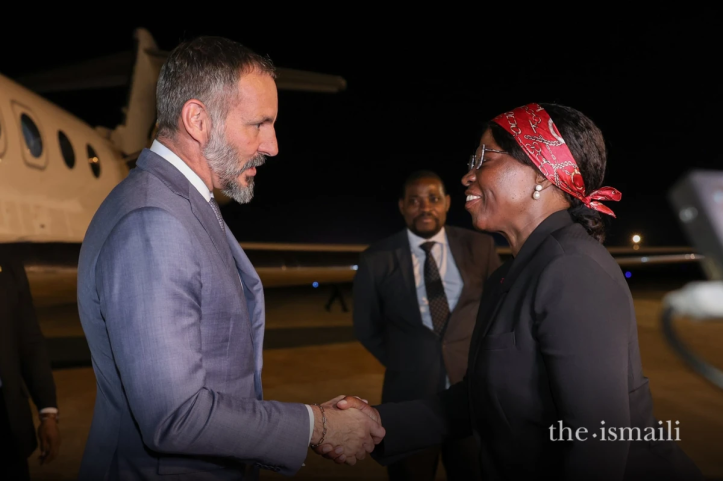
The Minister of Foreign Affairs, Her Excellency Ambassador Manuela Lucas, receives His Highness the Aga Khan at Maputo Airport on his arrival in Mozambique, June 22, 2025. Photograph: AKDN / Akbar Hakim.
The President of the Republic of Mozambique, Daniel Chapo, on June 18, 2025, visited the Aga Khan Academy located in Matola, the largest suburb of the capital, Maputo, and expressed great appreciation for the education the Academy offers. Mozambique celebrates its 50th Independence Day from Portugal on June 25, 2025.
The Aga Khan Academy was inaugurated on Saturday March 19, 2022, by Mawlana Shah Rahim Al Hussaini Hazar Imam, His Highness the Aga Khan, then Prince Rahim, representing his father, the 49th Hereditary Ismaili Imam, Mawlana Shah Karim, His Late Highness Aga Khan IV, who had laid the foundation stone of the Academy on June 25, 2004.
Flashback 2004: Mawlana Shah Karim, Foundation Ceremony, Aga Khan Academy Maputo
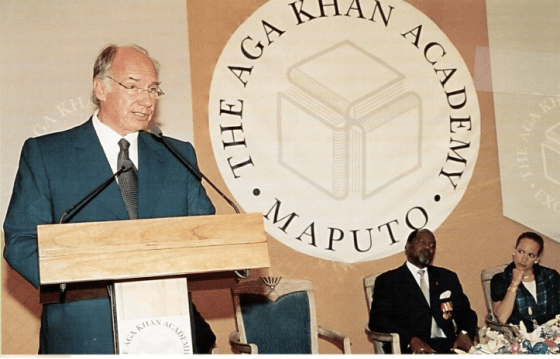
Then President Chissano of Mozambique and Princess Zahra Aga Khan look on as Mawlana Shah Karim, His Late Highness Aga Khan IV, addresses dignitaries at the foundation laying ceremony of the Aga Khan Academy Maputo on June 25, 2004. Photograph: The Ismaili USA, December 13, 2004.
~~~~~~~~
To the students here today, I would like to share with you one perspective. Throughout your studies and your youth, adults will tell you that the future is ahead of you. I want to tell you that the future is what you leave behind you, shaped by every one of your actions and your statements and your decisions. The future follows behind you in the path that you choose. Look at this academy — it’s an institution born of past decisions and past actions, which now will shape the future: your future, the future of your families, and the future of this beautiful country, Mozambique. — Prince Rahim Aga Khan, Maputo, March 19, 2022.
Flashback 2022: Mawlana Shah Rahim Hazar Imam, then Prince Rahim, Inauguration of Aga Khan Academy Maputo
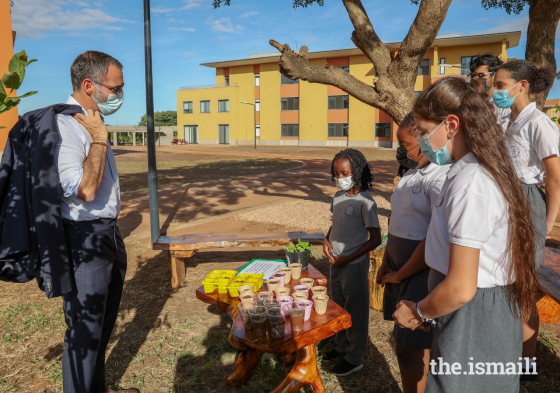
Students at the Aga Khan Academy Maputo present an environmental project to Mawlana Hazar Imam, His Highness the Aga Khan, then Prince Rahim, during his visit to the campus on March 18, 2022, ahead of its inauguration on Saturday, March 19. Photograph: Akbar Hakim / IPL.
~~~~~~~
June 18, 2025: Mozambique President Daniel Chapo visits Aga Khan Academy
The President of Mozambique, Daniel Chapo, visits the Aga Khan Academy in Maputo on June 18, 2025, ahead of Mozambique’s Independence Day celebration on June 25, 2025. Photograph: Opais
President Chapo’s visit to the Academy took place on Wednesday morning, June 18. During it, he had the opportunity to learn about the functioning of the institution and the programs promoted by the Aga Khan Development Network. According to him, it is a model of excellence in education that combines an international curriculum with a strong leadership training component.
“We are very impressed. The assessment we are making of this visit is extremely positive”, declared the President, highlighting the cultural diversity of the school community and the inclusion of students from different Mozambican provinces and countries such as Syria and South Africa, many of whom are beneficiaries of scholarships.
Addressing the 50th anniversary of national independence celebrations, which will take place on June 25, the President linked the role of education to the country’s development, stressing that institutions such as the Aga Khan Academy contribute to the training of leaders capable of transforming Mozambique.
Tweet: President Chapo visits Maputo Aga Khan Academy
Date posted: June 19, 2025. Last updated: June 20, 2025 (added more external links, see below).
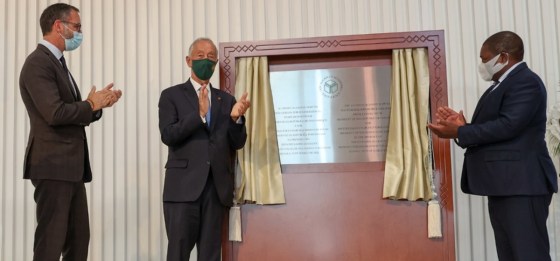
Featured picture at the top of the post: Mawlana Hazar Imam, His Highness the Aga Khan, then Prince Rahim, representing his father Mawlana Shah Karim, His Late Highness Aga Khan IV, looks on as Mozambique’s then-President Filipe Nyusi and Portugal’s President Marcelo Rebelo de Sousa unveil the inaugural plaque of the Aga Khan Academy on March 19, 2022.
“God chose Adam and Noah and the House of Abraham and the House of Imran above all beings, the seed of one another; God hears, and knows” — Qur’an, 3:33-34, translation by A. J. Arberry, see Corpus Quran for multiple translations
A calligraphy designed by Toronto’s Karim Ismail honouring the first Shia Imam Ali on the auspicious commemoration of Eid-e Ghadir.
On June 13, 2025, corresponding to the 16th day of the Muslim month Dhuʻl-Hijjah in the year 1446 A.H, Ismaili Muslims, united across Canada and the globe, will come together to observe and celebrate Eid-e Ghadir.
This momentous occasion, steeped in history, marks the pivotal gathering at Ghadir Khumm, where Prophet Muhammad (peace be upon him and his progeny) designated Hazrat Ali as his successor, the first in the continuing line of Hereditary Imams.
From the day our beloved Prophet Muhammad passed away on June 8, 632, and Hazrat Ali (A.S.) became the first Imam on the Divine Commandment that the Prophet had earlier received at Ghadir Khumm, there have been fifty Ismaili Imams, spanning an impressive 1393 years in human history.
The 50th Imam, His Highness Prince Rahim Aga Khan, holds a unique place in our history. He succeeded his father, Mawlana Shah Karim, His Late Highness Aga Khan IV, upon his death on February 4, 2025. Like all other Imams before him, Mawlana Shah Rahim Al Hussaini, who is now devotionally and respectfully addressed as Mawlana Hazar Imam, being the Imam-of-the-Time, will continue the vital role of guiding and developing the Ismaili community, leaving a lasting legacy that continues to shape the community’s identity and beliefs.
The historical event of Eid-e Ghadir, a pivotal moment in the Ismaili faith, holds profound significance. Today, the Ismaili community is led by the Hereditary position. Mawlana Shah Karim, His Late Highness Aga Khan IV, proudly affirmed that ‘the Ismailis are the only Shia community who, throughout history, have been guided by a living, hereditary Imam in direct descent from the Prophet’ — His Late Highness Aga Khan IV, Parliament of Canada, Ottawa, February 27, 2014.
History records that on the way back to Medina after performing the final pilgrimage to Mecca, the Prophet received a revelation:
“O Messenger, deliver [to the people] what has been revealed to you from your Lord, and if you do not do so, then you will not have delivered His message”… Quran, Surah al-Ma’ida (5:67).
Upon receiving this revelation, the Holy Prophet stopped at an oasis known as Ghadir Khumm. This oasis, located strategically along the route from Mecca to Medina, was a natural gathering point for travellers. Here, the Prophet addressed a large gathering of Muslims who had accompanied him. The Prophet proclaimed: ‘Man kuntu mawlahu fa aliyyun mawlahu,’ meaning: ‘He whose Mawla I am, Ali is his Mawla.’ The Prophet then prayed: ‘O Allah, be a friend of whoever is his friend and extend your support to those who support him.’
This event, occurring at a crucial point in Islamic history, marked the transition of leadership from the Prophet to Hazrat Ali, setting the stage for the leadership and future of the Muslim community. By declaring Hazrat Ali Mawla after him, the Prophet transferred the spiritual authority bestowed upon him by Allah to Hazrat Ali, making him — and all the Imams that follow — the Amirul Mu’minin, or Master of the Believers. This title signifies his role as a Muslim community’s leader, protector, and guide, which Hazrat Ali and all his successors have fulfilled with unwavering dedication and commitment, ensuring the community’s well-being and prosperity.
Article continues below following excerpts and photographs
________________________________
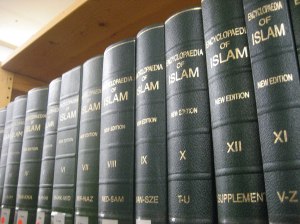
Excerpts from L. Veccia Vaglieri piece in Encyclopaedia of Islam, Second Edition
“Ghadir Khumm is famous in the history of Islam because of a sentence (or some sentences) in favour of ‘Ali which the Prophet uttered there during a discourse….Taking ‘Ali by the hand, he asked of his faithful followers whether he, Muhammad, was not closer to the Believers than they were to themselves; the crowd cried out: “It is so, O Apostle of God!”, he then declared. “He of whom I am the mawla, of him ‘Ali is also the mawla (man kuntu nawlahu fa-‘Ali mawlahu)
Photograph: Vysotsky – Own work, CC BY-SA 3.0, Wikimedia.
~~~~~~
“Most of those sources which form the basis of our knowledge of the life of the Prophet pass in silence over Muhammad’s stop at Ghadir Khumm….Consequently, the western biographers of Muhammad, whose work is based on these [Sunni] sources, make no reference to what happened at Ghadir Khumm. It is however certain that Muhammad did speak in this place and utter the famous sentence…the hadiths are so numerous and so well attested by the different isnads that it does not seem possible to reject them.” Vaglieri goes on to state that on instruction from Prophet Muhammad, Hazrat Ali received baiyat (the oath of allegiance) from the Muslims assembled there, including Umar b. al-Khattab, Islam’s second Caliph.
(Note: special access is required to read articles in the on-line edition of EI2. Vaglieri’s piece was reproduced in full in the UK Ismaili Association’s publication Ilm, December 1976, pages 28-30, with the permission of E.J. Brill, publishers of EI2.)
________________________________
Excerpts from the Pream ble of the Ismaili Constitution ordained by the 49th Ismaili Imam
“In accordance with Shia doctrine, tradition, and interpretation of history, the Holy Prophet (s.a.s.) designated and appointed his cousin and son-in-law Hazrat Mawlana Ali Amiru-l-Mu’minin (a.s) to be the first Imam to continue the Ta’wīl and Ta’līm of Allah’s final message and to guide the murids, a term referring to the followers and disciples of the Imams. The proclamation also established the principle of the Imamat continuing by heredity through Hazrat Mawlana Ali (a.s) and his daughter Hazrat Bibi Fatimat-az-Zahra, Khātun-i-Jannat (a.s)”
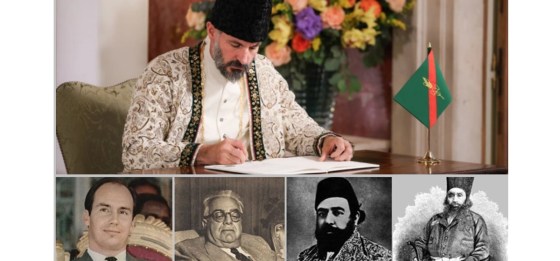
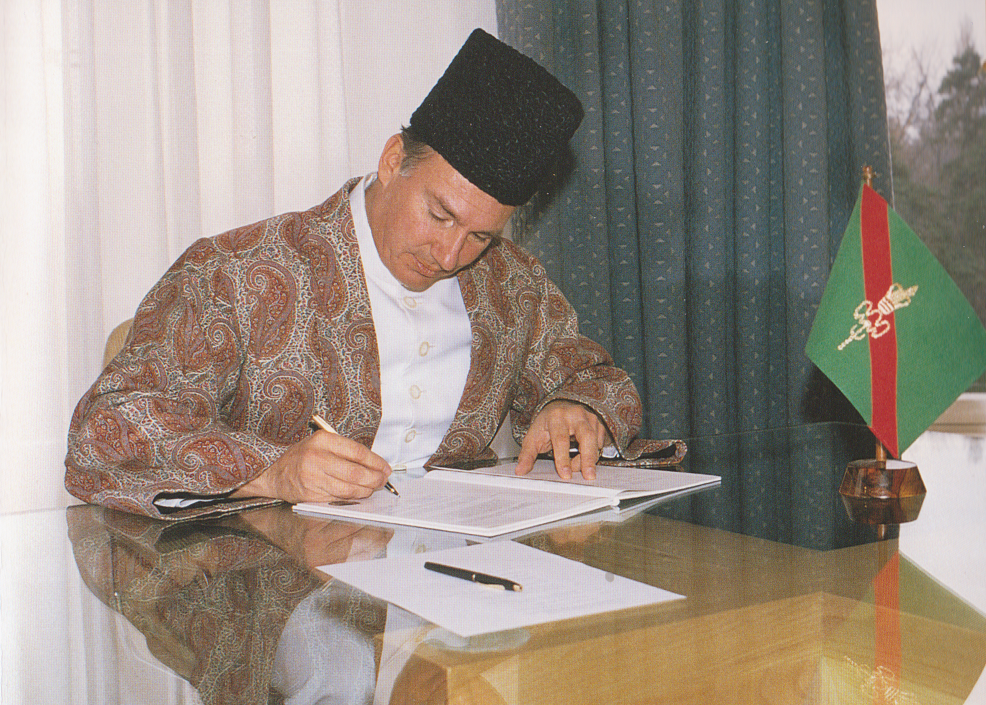
Mawlana Shah Karim, His Late Highness the Aga Khan, is seen signing a new constitution for the worldwide Ismaili community on his 50th birthday, December 13, 1986.
~~~~~~~~
The 50th Imam, Mawlana Shah Rahim Al Hussaini Hazar Imam, signs the Ismaili Constitution under his name on February 11, 2025
Mawlana Hazar Imam, His Highness Prince Rahim Aga Khan, signs the Ismaili Constitution in his name at the Diwan of the Ismaili Imamat, the Headquarters of the Imamat in Lisbon on the historic occasion of his Takht-nishini (ceremonial installation), February 11, 2025. Photograph: Akbar Hakim / The Ismaili.
________________________________
…. continued
On the instruction from Prophet Muhammad, Hazrat Ali received baiyat (the oath of allegiance) from the Muslims assembled there. According to Shia traditions and sources, following the proclamation, the final verse of the Qur’an was revealed to the Prophet:
“On this day, I have perfected for you your religion, completed my favours upon you, and have chosen for you Islam as your religion.”
Eid-e Ghadir is an anniversary of profound significance to all Shia Muslims. It is also associated with the following well-attested tradition that the Prophet is said to have proclaimed. This tradition, which is widely accepted and recognized by the Shia community, further underscores the importance of the event and its pivotal role in shaping the future of the Muslim community:
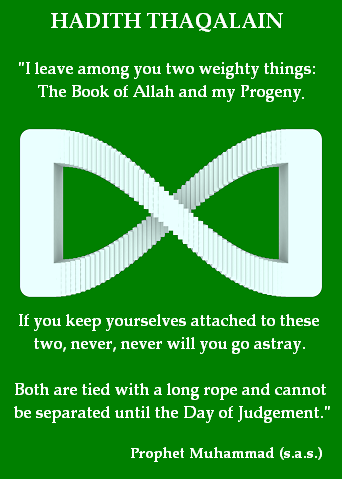
Credit: Infinity design povray.org
“I am leaving among you two matters of great weight (al-thaqalayn), the Book of Allah and my kindred (itrati), the People of my House (Ahl al-Bayt), and these two shall never be separated until they return to me at the Pool [of Kawthar in Paradise on the Day of Judgement]…”
The phrase ‘two matters of great weight’ refers to the Quran and the Ahl al-Bayt. The Quran, as the holy book of Islam, and the Ahl al-Bayt, as the Prophet’s kindred, are inseparable and hold eternal significance in the Shia Islamic tradition.
As we commemorate Eid-e Ghadir, the Ismaili community stands united, celebrating the seminal event of Ghadir Khumm. This celebration is a historical marker and a powerful reminder of our allegiance to the Imam-of-the-Time, the direct lineal successor and inheritor of Hazrat Ali’s authority.
The community is not just inspired but united and driven by the following remark made during Mawlana Shah Karim’s speech in Canada’s Parliament on February 27, 2024:
“Today, the Ismailis are the only Shia community who, throughout history, have been led by a living, hereditary Imam in direct descent from the Prophet.”
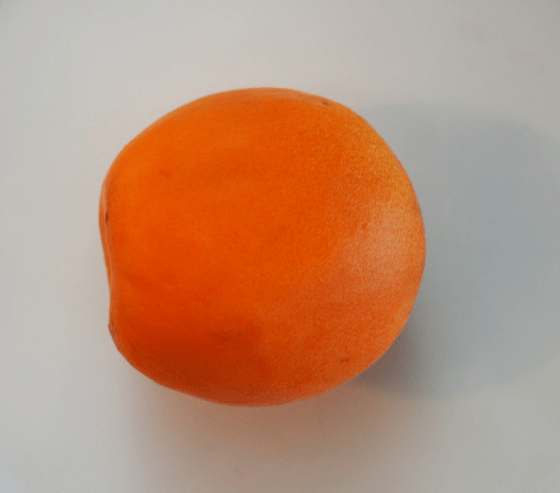
On one of my regular visits to Toronto’s St Lawrence Market in June 2021, I picked up a bagful of large apricots. I published a photograph of the largest apricot in the lot and other interesting and exciting moments from my week.
About the apricot, I wrote: “With energy from consuming a large sweet apricot, the size of a peach, that I bought from St Lawrence Market …. I spent an hour or so at the [Aga Khan] Park.” My article continued: “Imagine supermarkets all around North America offering a fruit from Hunza, where it is grown in abundance. Fair-traded organic apricots from HUNZA, the labels on the fruit shelf would read. We find New Zealand kiwis, South African oranges, Australian apples, Moroccan and Spanish clementines, Mexican ataulfo mangoes and many other tropical fruits from Latin American countries. Now, how about apricots from Hunza! Imagine its impact on the livelihood of farmers and their families in the Northern regions of Pakistan!”
Moreover, apricot lovers in North America — and other parts of the world — would delight in consuming fruit from the exotic and enchanting Hunza Valley.
~~~~~~~
A new partnership model spreads apricots from the Karakoram Mountains in Hunza to the rest of the world
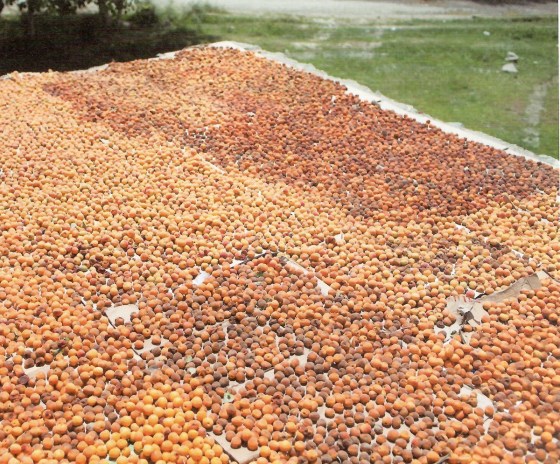
More than three years later, my heart jumped with joy as I read a piece describing IFAD’s public-private-producer partnership (4Ps) to make Hunza-grown apricots reach the rest of the world from the high mountain passes. This inspiring initiative, a beacon of hope and a potential game-changer for the future of agriculture and apricot farmers in Hunza, is part of IFAD’s unwavering long-term commitment to transforming rural communities. IFAD has been transforming rural communities for almost 50 years, and believes that “a better future starts in rural areas.” Please read Getting good grades: apricot farmers in the Hunza Valley strive for the best, which describes this inspiring initiative.
If extended to other parts of Pakistan, such as Chitral, and Central Asian countries, such as Afghanistan and Tajikistan, the initiative could not only improve the livelihood of farmers who cultivate this vital crop but also create numerous job opportunities. The apricot, a versatile fruit, can be consumed fresh, processed into dried apricots, jams, jellies, or used in juice and other products. The apricot kernels yield oil, which is used in cosmetics and other applications, such as press cake, which can be further processed as animal feed, fertilizer, and other industrial applications.
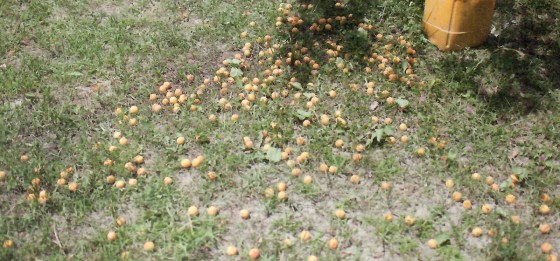
My search for Hunza apricots in North America led me to One Green World, a family-owned and operated nursery in Portland, Oregon. This unique nursery offers a diverse range of food plants and their companions worldwide, including the rare and unique Hunza apricot. The nursery states on its website that the Hunza apricot is a precious variety from northwest Pakistan, where it grows wild in the Hunza Valley. It describes the fruit as delectably sweet and tender, and fully ripe apricots as a unique, tasty treat. The bloom time for these apricots is March, and they ripen in June or July. Don’t miss the chance to experience the seasonal availability of Hunza Apricots at One Green World.
I hope this story of the Hunza Apricot will inspire Jamati institutions and the Aga Khan Development Network to seek ways to collaborate with the brokers of the 4P initiative to encourage the farmers further. Similarly, Ismaili-owned grocery chains and stores can work together to import this delicious fruit and its byproduct and make it widely available across North America, contributing to the economic well-being of Hunza and its beautiful people.
WATCH A VIDEO ABOUT HOW IFAD IS TRANSFORMING APRICOT FARMERS AND A RURAL COMMUNITY IN HUNZA
Over the years, Zarina Moosa, a teacher by profession, has read the late Aga Khan’s autobiography, The Memoirs of Aga Khan, several times. She was always highly moved when she came to the page where he spoke of his mother, Lady Ali Shah. Read Zarina’s introductory piece and the Aga Khan’s reflections on his mother on our sister website, Barakah, a platform dedicated to preserving and sharing the wisdom of His Highness the Aga Khan.
His Late Highness Aga Khan III (1877 — 1957), 48th Hereditary Imam of the Ismaili Muslims; inset with his mother, Lady Ali Shah. Please click on the image for the article.
[As Mawlana Hazar Imam, His Highness the Aga Khan, confers the title of Diwan on Shafik Sachedina at his residence in Lisbon on May 4, 2025, a significant event that was announced through a Talika (Holy written message) read out on the same evening in Ismaili Jamatkhanas around the world, we present Alnoor Merchant’s exploration of its use in Islamic and Ismaili history, rooted in a rich historical context. Please also read our exclusive tribute to Diwan Shafik in Barakah, which includes excerpts from Mawlana Hazar Imam’s Talika of May 4, and a selection of photographs highlighting Diwan Shafik’s immeasurable services to the Imam-of-the-Time over the past several decades — Ed.]
Besides referring to a collection of poetry or prose, the term diwan (divan in Persian) may be defined as meaning a register or a collection of records. Within an administration context, the term first meant a register for troops, and later it was used for office. During the Umayyad and Abbasid periods, various diwans were established: diwan al-jund (register for fighting forces), diwan al-kharaj (register for taxes), diwan al-rasa’il (register for correspondence), etc. These diwans were most often under a wazir (vazir in Persian).
During the Fatimid period, the diwan al-rasa’il came to be known as the diwan al-insha’; its head was the sahib diwan al-insha’ or ra’is (head) and was addressed as al-shaykh al-ajall (Excellency). The diwan al-jund was called the diwan al-jaysh, and there was a bureau known as the diwan al-majalis (diwan of the Council) where all the administration was concentrated. In Iran, the term diwan was generally used to mean the central government in general, in which sense it was also more specifically known as the divan-i a‘la, and fell within the purview of the vazir; during the Qajar period, the chief official of the divan-i a‘la was the sadr-i a‘zam (chief minister).
A significant change occurred during the Mughal period in India: the head of the department of revenue and finance came exclusively to be known as the diwan. Indeed, during the reign of the Mughal emperor Akbar, the word wazir was seldom used, having been replaced by the term diwan, which had come to denote a person rather than an institution or a government department. During the Mughal period, the diwan performed multifarious duties. He was not only responsible for the disposal of revenue papers but also drafted urgent royal letters and farmans. He had to submit revenue collection and expenditure returns to the emperor who was in this way kept informed of the finances of the State. He allocated duties to all high dignitaries on first appointment and received regular reports from them. Later, in some of the princely states of India, the chief minister came to be known as the Diwan.
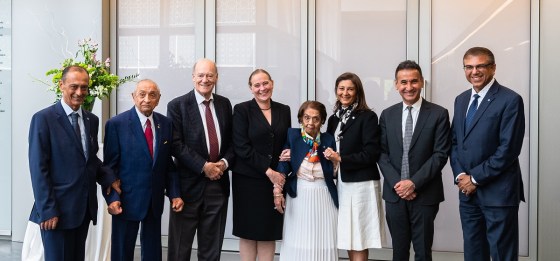
Mawlana Hazar Imam, His Highness the Aga Khan, with Diwan Shafik Sachedina and his wife Diwan-banoo Nadia Sachedina. Photograph:: IPL / Akbar Hakim
It is, most likely, in this context, that the term diwan was adopted in the modern period of Ismaili history, and came to be applied to an individual. The first individual to be invested with the title of Diwan was Muhammad Ibrahim Rawjee, who served as the President of the Aga Khan Federal Council for India from 1934 to 1958. Imam Sultan Mahomed Shah, our 48th Imam, appointed him as the legal advisor for all Ismaili Councils in India in 1935 and, in March 1935, referred to Wazir (at that time) Muhammad Rawjee as “my Chief Minister”. In 1936, the Imam bestowed upon him the title of Diwan; Diwan Rawjee passed away in 1965. The second individual to be invested with the title of Diwan by Imam Sultan Mahomed Shah was Count Ghulam Hussain Muhammad Jindani; this was through a telegraphic message on 29th December, 1948, which read:
“Occasion Imamate record, I confer on you for all your great services title Dewan for first time given in Africa.”
Diwan Jindani passed away in 1983.
During the Silver Jubilee of Mawlana Shah Karim Shah, our 49th Imam bestowed the title of Diwan on Count Sir Eboo Pirbhai in London, on 7th July, 1983. In his Farman, the Imam said:
Diwan Sir Eboo Pirbhai
“The second thing I wish to do today is to recognise in an exceptional manner in front of the Jamat, the services of a member of the Jamat who has served my grandfather, who has served me, and who has served the Jamat consistently for more than fifty years, taking even personal risks at times of crisis in the developing world, extending to the Jamat all the benefit of his time and wisdom; and I have decided to give the title of Diwan to Count Sir Eboo Pirbhai. This is also a symbol, because the Imam is saying to the Jamat that the Imam wishes to recognise publicly, exceptional service by a very young man.”
Diwan Pirbhai passed away in January 1990.
On 11th July 2018, Mawlana Shah Karim Shah officially designated the Henrique de Mendonca Palace in Lisbon as the Seat of the Ismaili Imamat, and declared that it be known as the “Diwan of the Ismaili Imamat.” This reflects, in one way, the dual nature of the nomenclature Diwan as being applicable in both an institutional and an individual context.
About the author: Alnoor Jehangir Merchant is a librarian, curator and independent researcher based in London. Between 1987 and 2012 – a period extending nearly twenty-five years — Alnoor was instrumental in developing the collections of the Library of The Institute of Ismaili Studies (IIS), London, acquiring and cataloguing materials — rare books, manuscripts, documents, coins — relating to all aspects of Ismaili studies; these are now part of the Ismaili Special Collections Unit (ISCU). Alnoor served as Head of the IIS Library from 2009 to 2012.
Besides his extensive experience in Library operations, Alnoor played a significant role, over nearly two decades, in the acquisition of artefacts and manuscripts for the Ismaili Imamat, a majority of which are presently housed at the Aga Khan Museum, Toronto.
Over the past decade, with his wide-ranging knowledge and understanding of Islamic studies and the cultures of Islam, Alnoor has advised museums, libraries and private individuals on artworks, manuscripts, rare books and coins relating to the Islamic world. Besides his research interests on various aspects of Ismaili history and material culture, Alnoor continues to be involved with work for the Ismaili Imamat and its institutions.
Last June, Aniza Meghani of the UK conducted an exclusive interview with Amin Gulgee for Simerg during her visit to Karachi. The interview includes a selection of outstanding works of art by Amin and provides an excellent introduction to his artistic background. We invite our readers to read Aniza’s excellent piece. The last few weeks have seen the release of Gulgee’s first monograph, “No Man’s Land,” published on March 25, 2025. We are delighted to feature the monograph as part of our continuing series of books by Ismaili authors. We follow a similar Q/A format as our earlier presentations of books, which are listed chronologically below, ensuring our readers are always up to date with our series in an organized manner. We encourage Ismaili authors from around the world to participate in this series, regardless of when their books were published. See details of the series HERE and submit your responses to Simerg’s editor, Malik, at mmerchant@simerg.com.
Amin Gulgee on his monograph “No Man’s Land”
Simerg: What constitutes your book No Man’s Land? Why would you want me to read it, and what will we learn from it?
Amin Gulgee: This is the first monograph dedicated to my career as an artist and curator. Spanning over three decades, my multifaceted practice unfolds through a tapestry of techniques and themes. I invite readers to immerse themselves in the intertwined layers of my work. Featuring insightful essays from esteemed figures across the contemporary creative landscape — curators, novelists, artists, academics, and critics — this volume illuminates my artistry from myriad perspectives. I feel honored to include an essay by the late Dr. Oleg Grabar, a preeminent Islamic art historian, who wrote an essay for the catalogue of a solo exhibition I had at Galeri Petronas in Kuala Lumpur in 2008. Also included is a Q and A by Dr. Maryam Ekthiar, a senior curator at the Met, who asked me challenging questions. From spirituality to politics, from the universal to the particular, my trajectory attempts to navigate the complexities of my existence and invites contemplation on the depths of our collective consciousness. Spanning my diverse career, from my early work in jewelry to my sculptures, installations, paintings, performances and curatorial projects, this volume offers a comprehensive insight into the breadth and depth of my artistic journey. Illustrated with over 300 meticulously selected images and QR codes unlocking access to videos and catalogues, No Man’s Land immerses readers in a visual odyssey through my creative practice.
Simerg: What is behind the name and title of the book?
Gulgee: I chose the title No Man’s Land because I feel that my path occupies this liminal space.
Story continues below
Front cover of Amin Gulgee’s “No Man’s Land,” edited by John McCarry, published by SKIRA, March 25, 2025, Hardcover, 416 pp.
Simerg: How did you find a publisher for this book?
Gulgee: I was introduced to the prestigious publication house Skira, based in Milan, by the late Italian curator Paolo de Grandis. I was well aware of Skira because they had published books on Picasso and Matisse, among many other artists. I had known Paolo since 1998, when I first participated in “OPEN”, an exhibition of installation and sculpture that he established in Venice. Later, in 2017, when I was appointed Chief Curator of the inaugural Karachi Biennale, I invited him to be a guest curator. He included works by Yoko Ono and Michelangelo Pistoletto, among others. In 2018, he and Claudio Crescentini curated my solo shows at the Galleria d’Arte Moderna and Mattatoio, both in Rome. When the book was nearing completion, I asked if he would know any publishers who might be interested in my monograph, and he suggested Skira. I sent them a few chapters and I was thrilled when they accepted to take the project on. I then collaborated with Skira’s team over the next seven months to finalize the project. They were all tremendous to work with.
Story continues below
__________________
Reflections on Amin Gulgee and his monograph No Man’s Land
“Both as a practitioner and as a curator Amin Gulgee’s storytelling is fluid, both creating and dispelling unease. Amin Gulgee explores the vastness of the Universe as the backdrop for those narratives…Contemplating spiritual goals, while confronting the insecurities and displacements of our existence, [he] calls for constant negotiation and inventiveness.” — Salima Hashmi, art historian and artist, in “Fearless,” an afterword to Amin Gulgee’s book.
~~~~~~~
“Amin Gulgee defies easy categorisation: he’s a metal sculptor, a curator, and one of Pakistan’s most innovative and cherished artists, the beating heart of his home city of Karachi’s creative scene. His metalwork is as dramatic and eccentric as Amin is. He’s in your face, uncompromising, a living and breathing performance piece” — Excerpt from BBC Documentary podcast, “In the Studio: Amin Gulgee — Heavy metal” (listen to podcast HERE).
~~~~~~~
“Amin’s art explores the unexpected. Whether it’s connections or the stories illustrated, he doesn’t follow a norm…Whilst being so different can pose its own challenges, instead, it makes Amin’s work deeply personal and unique to him. It’s also meant, from the start of his career, he’s had a strong sense of self-confidence in embracing uniqueness — Excerpt from “Amin Gulgee: Going against the norm” in The Ismaili.
________________
Simerg: Did you hire an editor or designer or did you do all the work yourself?
Gulgee: The editor of the book is John McCarry, who was a classmate of mine at Yale. He has written for National Geographic as well as many other publications. He has also published two other books. He is the coordinator of the Amin Gulgee Gallery and edits all its publications. I chose Kiran Ahmad as my designer, as she is one of the most sought-after book designers in Pakistan. I have worked with her many times in the past; however, this monograph was a truly daunting task. We spent over two years trying to make sense of my journey. Her perseverance and her commitment to her craft are commendable. Also, she can make me laugh!
Simerg: What inspired you to do this monograph?
Gulgee: The last time I saw my mother was on December 13, 2007. She had come over to my place in the afternoon since it was the birthday of Prince Karim Aga Khan IV. She brought with her a painting by my father, which she presented to me as a gift. “Look at this, Amin,” she exclaimed. “These are the colors of life!” She then sat me down and said, “I want you to do three things for me: one, give up smoking; two, do a book on your work; and three — I don’t remember now, but it will come to me.” She sadly never had the chance to state her third demand. However, in 2020 I had my last delicious cigarette, and in 2022, I decided to start working on my monograph.
Simerg: How long did it take you to complete your monograph and what were the difficulties?
Gulgee: I live in the moment and I do not like looking back. When I finally came to the decision to fulfill my late mother’s wishes, I was trepidatious. John and I had decided that we would approach writers and let them choose any angle of my trajectory that engaged them. We chose to reprint only two essays — the one by Oleg Grabar and another by Dr. Kishwar Rizvi, who is the Robert Lehman Professor in the History of Art, Islamic Art and Architecture at Yale University. The rest of the ten essays were to be new writing on my practice. We were both delighted by the essays that came in. As far as the images are concerned, since my trajectory began in predigital, archaic times, my early work was documented on slides. When I asked my young technical advisor how can I digitize them, he asked me, “What is a slide?” This, of course, made me feel like a dinosaur! But we got the painstaking job done. Then, there was the challenge of organizing my trajectory, which Kiran and I did in sections. It took two years and I am so very grateful for all the support I received along the way.
Date posted: April 22, 2025.
______________
Links to the Ismaili Authors’ Series (in chronological sequence, oldest article first)
Before departing this website please take a moment to review Simerg’s Table of Contents for links to hundreds of thought provoking pieces on a vast array of subjects including faith and culture, history and philosophy, and arts and letters to name a few. Also visit Simerg’s sister websites Barakah, dedicated to His Highness the Aga Khan, and Simergphotos. Simerg’s editor may be reached via email at mmerchant@simerg.com.