Simerg is an independent initiative dedicated to Ismaili Muslims, the Aga Khan — their Hereditary Imam — and the Ismaili Imamat, and Islam in general through literary readings, photo essays and artistic expressions
[Note: The event has ended. A link to a recording of the presentation will be provided when it becomes available; please read background article below — Ed.]
The rich and beautiful tradition of Ginans (Hymns, contemplative or reflective knowledge), sometimes referred to as poetry, that was introduced into the Indian subcontinent by Ismaili dais (missionaries) such as Pirs Satgur Noor, Shams, Sadardin helped gain new converts as well as sustain the faith of their subsequent generations for hundreds of years. The hope and promise given by the Pirs in their compositions that their hereditary spiritual master — the Imam who was at the time based in Iran — would one day make his appearance in the subcontinent (jampu dip) was realized several centuries later with the arrival of the 46th Imam, Mawlana Shah Hassanali Shah, Aga Khan I, in the 19th century.
Memorized and sung in Ismaili homes and religious gatherings, the Ginans remained the most powerful tool for keeping the faith alive. Today, in the western world, the tradition continues to thrive with Ginans being recited by Ismaili children as young as 5 or 6. With the arrival of thousands of Ismailis from the Middle East and Central Asia over the past 30 years, it is inspiring to note that they too have adopted the Ginanic tradition, just as Ismailis, whose origins are in South Asia have adopted the tradition of reciting Qasidas composed in Arabic and Farsi by eminent Ismaili figures and dais such Nasir Khusraw and Shams Tabriz.
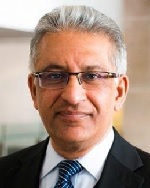
Karim H Karim
However, how well are Ginans and their meanings understood by the new generation of Ismailis? Why is there so much confusion surrounding the Hindu element in Ginans? For that matter, are Ginans essentially Hindu in nature? And what about the solid Islamic concepts of the Unity of God (Tawhid) and Muslim ethics of compassion, honesty, forgiveness that are enshrined in the Ginans? The Prophet Muhammad himself is featured in many Ginans. Hopefully, Karim H. Karim, will seek to enlighten his audience on Saturday December 17 in his talk entitled “Are Ginans Islamic or Hindu?”
The term Satpanth (true path) was introduced by Ismaili Pirs in their compositions. In his brief synopsis about his lecture, Karim H. Karim notes:
“Satpanth’s core beliefs are founded on Shia Islamic concepts. Its ginans articulate Ismaili principles in Indic languages, music, and symbols. Like other pluralist traditions in India, Satpanth has drawn from mythological and cosmological knowledge that is integral to South Asian spirituality. Ginans flourish at the religious cross-roads of the sub-continent, the Middle East and Central Asia. This liminal space is rich and dynamic: it is integrative of traditions and worldviews, generative of art and thought, and nourishing of spirituality. It is a site of the human quest for truth that narrow notions about religion cannot confine.”
Simerg hopes that all its readers — Ismaili Muslims, non-Ismaili Muslims as well as people of other faiths — will participate in Dr. Karim’s Zoom presentation that will take place as follows:
Zoom connection:https://tinyurl.com/2sru2w7j Zoom ID : 9150118939, Passcode: asg22 Broadcast Date: Saturday, December 17, 2022. Broadcast times in various parts of the world: India (Mumbai): 9:30 PM; Pakistan: 9:00 PM; East Africa: 7:00 PM; Syria: 12:00 PM (Noon) Dubai: 1:00 PM; UK, Portugal (GMT): 4:00 PM; France, Spain etc.: 5:00 PM; and North America:EST (Toronto, Atlanta, New York etc.): 11:00 AM; CST (Chicago, Houston etc): 10:00 AM; MST (Calgary, Denver etc.): 9:00 AM; PST (Vancouver, Los Angeles etc.): 8:00 AM.
Readers in other worldwide cities in the Middle East, Central and South Asia, the Far East well as Australia and New Zealand, should calibrate their time according to the GMT time of 4:00 PM (16:00 hours, Saturday December 17, 2022).
Date posted: December 16, 2022. Last updated: December 17, 2022.
_______________________
FEEDBACK
Simerg welcomes your feedback. Please click on Leave a comment. Your letter may be edited for length and brevity, and is subject to moderation.
REVIEW SIMERG’S TABLE OF CONTENTS AND VISIT ITS SISTER WEBSITES
Before departing this website, please take a moment to review Simerg’s Table of Contents for links to hundreds of thought-provoking pieces on a vast array of subjects including faith and culture, history and philosophy, and arts and letters to name a few. Also visit Simerg’s sister websites Barakah, dedicated to His Highness the Aga Khan, and Simergphotos. The editor may be reached via email at mmerchant@simerg.com.
Introduced by MALIK MERCHANT (compiled from material published on the websites of The Samara Centre for Democracy and the CBC)
The Samara Centre for Democracy (see featured image at top of post) holds a public lecture each year called In Defence of Democracy. This year it was delivered by former Calgary mayor, Naheed Nenshi, in November 2022 at the Toronto Public Library. It was aired on CBC Radio’s IDEAS program on December 9, 2022. IDEAS is hosted by Nahlah Ayed, an award-winning veteran of foreign reporting. You can tune in to Nenshi’s presentation and read Ayed’s interview with the former mayor by clicking on Keep Fighting to Build Strong Communities.
Nenshi is a proud first-generation Canadian of Indian ancestry, whose parents immigrated from Tanzania. His family and his Ismaili Muslim faith, which is today led by the 49th Hereditary Ismaili Imam, His Highness the Aga Khan, instilled in him the ethic of seva (or service), something he tries to live every day. During his three terms as mayor between 2010 and 2021, Calgary was named as one of the best cities to live in the Western Hemisphere.
Click on photograph for CBC’s IDEAS
His Highness the Aga Khan is warmly greeted by the then Lieutenant Governor Lois Mitchell and Calgary Mayor Naheed Nenshi during his visit to Calgary in May 2018 to celebrate his Diamond Jubilee. Photograph: The Ismaili.
In recognition of his leadership, Nenshi was awarded the World Mayor Prize in 2014 by the City Mayors Foundation. He is also the recipient of the President’s Award from the Canadian Institute of Planners and the Humanitarian Award from the Canadian Psychological Association for his contribution to community mental health. Today, Nenshi is an intentionally known voice on urban issues. He has presented to audiences across Canada and the world, including the World Economic Forum. Hear Nenshi’s IDEAS presentation by clicking Keep Fighting to Build Strong Communities.
Date posted: December 14, 2022.
_____________________
FEEDBACK
Simerg welcomes your feedback. Please click Leave a comment. Your letter may be edited for length and brevity, and is subject to moderation.
REVIEW SIMERG’S TABLE OF CONTENTS AND VISIT ITS SISTER WEBSITES
Before departing this website, please take a moment to review Simerg’s Table of Contents for links to hundreds of thought-provoking pieces on a vast array of subjects including faith and culture, history and philosophy, and arts and letters to name a few. Also visit Simerg’s sister websites Barakah, dedicated to His Highness the Aga Khan, and Simergphotos. The editor may be reached via email at mmerchant@simerg.com.
Location of Sialkot in Pakistan. Punjab Province; nicknames of city: City of Iqbal and World’s Football manufacturing capital; population: 655,852, 13th largest city in Pakistan. Credit: Wikipedia.
AL RIHLA: THE 2022 FIFA WORLD CUP SOCCER BALL
The 2022 FIFA world cup currently underway in Qatar is being watched by billions around the world. While we are all rooting for our respective countries and favourite teams, let us not overlook some extraordinary facts about the tournament and football in general. The football (soccer ball) is central to the sport, and for its origins and history please visit Ben’s website Yoursoccerhome: History of the Soccer Ball: From Origin to Modern Day.
Did you know that Sialkot, a city in northeast Pakistan near the Kashmiri border, makes more than two-thirds of the world’s soccer balls in one of the town’s 1,000 factories. That includes the Adidas Al Rihla, the official ball of the 2022 FIFA World Cup, that is now in the final stages of the group matches, with the knock-out stage of the competition set to begin on Saturday, December 3. Bloomberg has an excellent photo feature about the making of the Al Rihla football, and I think readers will be fascinated with the story. Please click on This Is Where Most of the World’s Soccer Balls Come From (Note: you are allowed to read 5 articles free). Al Rihla is the 14th official World Cup ball and, according to FIFA, the fastest and most accurate ball yet. The ball features a panel design inspired by a Dhow, a traditional Arab boat, with a blue, red, and yellow colour scheme that is meant to represent the landscape of Qatar. The Al Rihla balls are also the first World Cup ball made exclusively with water-based ink and glue, which are less harmful to the environment. The ball also includes a chip in the centre of the ball that can determine any contact by any player. What appeared to be a header flick by Portugal’s Cristiano Ronaldo, was ruled out as his goal and given to his teammate Bruno Fernandes who crossed the ball in the game against Uruguay.
In a piece for the Voice of America (VOA), Ayaz Gul who reports for VOA from Islamabad, Pakistan’s capital, notes that while Pakistan’s national teams have never qualified for the FIFA World Cup, its footballs repeatedly have. He further writes that Pakistan and China, have supplied the official match balls for the World Cup 2022, called Al Rihla, which means “the journey” in Arabic and is inspired by the culture, architecture, iconic boats and flag of Qatar.
Pakistan was also among the producers of the official match balls for the previously two World Cup championships in 2014 and 2018. The footballs are manufactured in Sialkot by German multinational Adidas through ‘Forward Sports’ whose managing director, Hassan Masood, said in a statement in the run-up to the 2022 World Cup that 3,000 footballs would be used during the tournament in Qatar and 8 million replicas are expected to be sold around the world. Sialkot is also famous for producing high quality sports goods and hosts many of the producers of FIFA certified footballs. May we remind you once again to read the Bloomberg photo feature on Al Rihla.
~~~~~~~~~
WOMEN REFEREES
Another heartwarming story that has come to our attention is that for the first time in the men’s world-cup history, three women referees will be officiating the crucial final Group E encounter between Germany and Costa Rica on Thursday, December 1. As the table stands now, any 2 of the 4 teams (Spain, Costa Rica, Japan and Germany) in the group could qualify for the round-of-16. French referee Stéphanie Frappart will be the referee in charge, and she will have Neuza Back of Brazil and Mexico’s Karen Diaz Medina as her assistants on the field. USA’s Kathryn Nesbitt will also be working as the offside specialist in the video review team. Two other women, Salima Mukansanga of Rwanda and Yoshimi Yamashita of Japan, are also on the FIFA list to referee games in Qatar.
Frappart refereed men’s games in World Cup qualifying and the Champions League, and this year’s men’s French Cup final. She also took charge of the 2019 Women’s World Cup final for FIFA. When asked if she ever has comments from players, managers or fans due to being a woman, Frappart said: “Since I started, I was always supported by teams, clubs and players. I was always welcome in the stadium, so I feel like another referee inside the pitch. I was always welcome, so I think I will be welcome as before.”
Date posted: November 30, 2022.
_______________________
Before departing this website, please take a moment to review Simerg’s Table of Contents for links to hundreds of thought-provoking pieces on a vast array of subjects including faith and culture, history and philosophy, and arts and letters to name a few. Also visit Simerg’s sister websites Barakah, dedicated to His Highness the Aga Khan, and Simergphotos.The editor may be reached via email at mmerchant@simerg.com.
We have learnt with immense sadness, through an obituary posted in Vineyard Gazette, that Thomas M. Payette, FAIA, renowned Cambridge architect and founder of Payette Associates, died on November 12, 2022, at the age of 90.
Raised in East Grand Rapids in Michigan, Tom studied at Michigan State University, where he received a degree in structural engineering. He married Ginny, his sweetheart from his grade school years, in 1954 and they moved to Cambridge, where Tom attended the Harvard Graduate School of Design. He received his Master’s in Architecture in 1960.
Thomas Payette (d. November 22, 2022), designed Aga Khan University
The obituary in Vineyard Gazette notes that, after graduating, Tom began working at Markus and Nocka. By 1965, he became president of the firm. It would later become Payette, an international design firm of more than 150 people. His selfless leadership and passion guided Payette into what it is today: an award-winning firm known for its leading design in hospitals, laboratories and universities. Included in its notable work is the Aga Khan Medical Center in Pakistan.
Over the three decades since its initial conception and planning, the Aga Khan University has withstood the test of time, growing and adapting to accommodate new emergent technology, political turmoil and cultural changes….A major force in the heart of the developing world of South Asia, the University represents both a link to the great Islamic academic traditions of the past and a bold, progressive action aimed at providing education and healthcare services to people in Pakistan and the surrounding region
JENNIFER HEGARTY, March 2019
In a short but illuminating piece published on the firm’s website under the title #PayetteForward: Our Roots with Aga Khan, Jennifer Hegarty notes the firm’s association with the Aga Khan University as follows:
“Our 30-year relationship with Aga Khan University has been a cornerstone of the firm we are today, a firm recognized by the AIA with the 2019 Architecture Firm Award. We are proud of the legacy of work we have produced and continue to develop with the Aga Khan University — which was the first of many fruitful international relationships in our portfolio.”
In her post, Jennifer also refers to the original master plan for the Aga Khan University and Thomas Payette’s continuous involvement with the institution in the ensuing years “to furthering the original vision through over 30 years and several master plan updates, keeping their pledge to the founders not only to keep the University true to cultural values, but to recognize the needs of the region in educating young people in the science of medicine and the care of patients.”
We invite our readers to learn more about Thomas Payette’s unique and extraordinary role in the design of the Aga Khan University by reading the following three illustrated pieces on the firm’s website:
Our readers join us in conveying our sincere condolences to all the members of the Payette family. In particular, our Ismaili readers will always remain grateful to Thomas M. Payette for playing such an important role in the planning, design and development of one of the most significant and cherished projects in the life of their beloved 49th Hereditary Imam, Mawlana Hazar Imam, His Highness the Aga Khan.
Date posted: November 23, 2022.
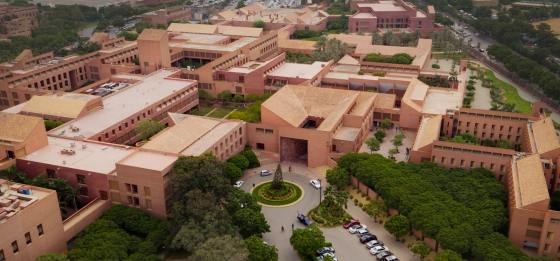
Featured photo at top of post: A view of the Aga Khan University, Karachi. Photograph: AKDN.
______________________
Before departing this website please take a moment to review Simerg’s Table of Contents for links to hundreds of thought-provoking pieces on a vast array of subjects including faith and culture, history and philosophy, and arts and letters to name a few. Also visit Simerg’s sister websites Barakah, dedicated to His Highness the Aga Khan, and Simergphotos.
The.Ismaili, the official website of the Ismaili Muslim community, recently started a series on the beliefs and practices of the Ismailis. We invite all our readers, Ismailis and non-Ismailis alike, to read the following articles published in the series so far:
If I am not mistaken, the Ask Me Anything (AMA) program has been active in Canada for quite some time — I have heard announcements in Jamatkhanas going back to pre-Covid-19 times — and I wonder how many Jamati members with questions pertaining to faith, beliefs and traditions have sought to seek answers to questions that have been or are on their minds. How much interaction, if any, is there between Jamati members today, and especially the youth, and those who are best equipped to answer their questions?
As a son of an Alwaez (Jehangir Merchant, d. 2018), who was also a religious education teacher, I recollect the frequency with which he was approached by members of the Jamat with questions, whether it was in Mozambique, Tanzania, Canada, the UK and in countries where he went for sermon duties. Often individuals would approach him in the Jamatkhana as he was about to depart but he patiently took his time to respond to the question. Both he and my mum (Mrs. Merchant, d. 2021) considered their students and members of the Jamat at the centre of their lives.
Of course, as a secondary school teacher, my dad would always engage in Q/A discussions with his students. If he did not have an answer, he would tell the students so and seek out a good and satisfactory response by conducting his own research or consulting with one of his learned colleagues. A leader of an Ismaili institution in Canada, in his tribute to my dad, wrote: “In the passing away of Alwaez Jehangir Merchant I have lost a confidant, a friend and a source of knowledge and wisdom that I will greatly miss. He was my Go-to person for Tariqah matters and was always willing to share.”
Often my parents would welcome Jamati members, young and old alike, to our homes to discuss religious issues and other personal and family matters that often required more time.
In my humble opinion, one of the most brilliant minds in my dad’s friend circle in Dar es Salaam was no other than Hassanali Bhaloo from Zanzibar, whose nickname was Din. A regular visitor to our home, he was an intellectual of the highest caliber, and although not a missionary, could take on any question on faith, science or ethic and answer it satisfactorily. He was also an outstanding Ginan reciter and watching him recite one in Jamatkhana would leave one with the impression he was in a heavenly realm.
On many occasions, the tone of questioning, especially on the part of youth, was harsh and while that would raise my dad’s eyebrows, Din would always respond with calmness and thoughtfulness that left the questioning student(s) with wonder and amazement. A very humble man, Din’s intellectual brilliance was recognized at a young age, and he was offered to study in one of America’s top schools upon completing his high school education. Alas, he had to forego the opportunity due to an untimely death in his family that forced him to attend to family matters for a number of years. He eventually joined the services of the Ismailia Association in Dar es Salaam, Tanzania, after the mid 1960’s and worked with my dad on many projects. My dad even placed me in his good hands to strengthen my religious knowledge, a few months before I departed Dar es Salaam.
Article continues below
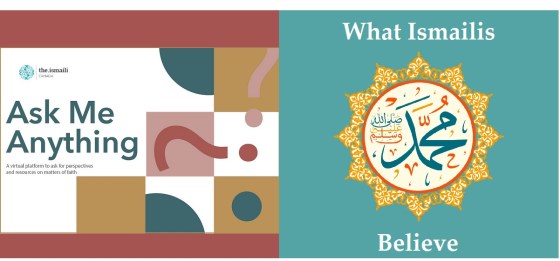
Ask Me Anything image in the Al-Akhbar newsletter published in Canada.
Like Din in Dar es Salaam, we have many brilliant minds in the Ismaili Muslim community (Jamat) today who are highly qualified as ethicists, scientists as well as in Islamic and Ismaili studies as missionaries and scholars. I sincerely hope that the AMA team will revert to the right individuals to give direction to individuals who come forward with their questions or concerns, and not necessarily restrict the asking of questions only to the Waezeen, as the Al-Akhbar announcement reads.
The announcement about the Ask Me Anything program, dated November 6, 2022, appears in the latest two issues of the Al-Akhbar newsletter which is distributed among subscribers to announce local as well as national programs and events organized by Ismaili institutions which are of benefit to the Jamat. The announcement in Al-Akhbar is reproduced below and reads as follows: (please also read it at SOURCE)
“Have a question on faith that you need clarity on? The Ask Me Anything program is here to help. Do you need more guidance or resources on questions about the faith? The Ask Me Anything (AMA) program provides an accessible and virtual medium to ask a Waezeen for perspectives or resources on faith-based questions. Book a session either one-on-one or as a group (up to 5) to address questions on faith in a non-judgmental and safe space. Sign-up for spots are available for Saturday, November 26 or Sunday, November 27.”
My inspiration for writing this post comes from Mawlana Hazar Imam’s guidance that he gave to the students during his visit to Mombasa, Kenya, on October 4, 1959. Referring to the memorization of the Qur’an and Ginans, Mawlana Hazar Imam said:
“These pieces of memorization are good, and they are necessary in practice, but at the same time I want you to be able to understand your religion. And if there are any questions do not hesitate to ask. It is much better to ask and receive an answer than to have a feeling of frustration inside you.”
Thus, in keeping with Mawalana Hazar Imam’s wish, please do not feel reluctant to approach the Ask Me Anything program with your question. Please visit Al-Akhbar for further information and to register or click REGISTER for the next Ask Me Anything session go be held on November 25/26, 2022.
Date posted: November 13, 2022. Last updated: November 15, 2022 (reformatting and link error.)
___________________
If you are a Canadian resident and have a question, please click REGISTER for a follow-up meeting with an Alwaez as mentioned in the announcement. The Ask Me Anything program is an Ismaili institution initiative, and NOT a Simerg project. If you live outside Canada, please consult your local Ismaili newsletter to find out if a program such as the one offered in Canada is available in your country.
Before departing this website please take a moment to review Simerg’s Table of Contents for links to hundreds of thought-provoking pieces on a vast array of subjects including faith and culture, history and philosophy, and arts and letters to name a few. Also visit Simerg’s sister websites Barakah, dedicated to His Highness the Aga Khan, and Simergphotos.The editor may be reached via email at mmerchant@simerg.com.
The material in this post has been compiled from the official websites of the Ministry of Information of the Sultanate of Oman — see link to October 23 story “HH Sayyid Theyazin to Patronize over Aga Khan Award Distribution Ceremony on 31 October” — and the Aga Khan Development Network (AKDN). Please visit the Music Awards and Architecture Awards pages at AKDN.
Map of the Sultanate of Oman, shaded white (2016), surrounded by Saudi Arabia, UAE and Yemen. The Gulf of Oman separates the Sultanate from the Islamic Republic of Iran. Credit: Perry-Castañeda Library, Map Collection, University of Texas.
The 2022 Aga Khan Award for Architecture and Aga Khan Music Awards
His Highness Sayyid Theyazin bin Haitham Al Said, Minister of Culture, Sports and Youth, will preside over the distribution of Aga Khan Award for Architecture (AKAA) at the Royal Opera House Muscat (ROHM) on October 31, 2022. The AKAA on June 2, 2022, announced 20 shortlisted projects for the 15th edition of the Award cycle. The projects will compete for a share of the US$ 1 million prize, one of the largest in architecture. The 20 shortlisted projects were selected by an independent Master Jury from a pool of 463 projects nominated for the 15th Award Cycle (2020-2022).
The event marks the 45th anniversary of the award, which was established by Mawlana Hazar Imam, His Highness the Aga Khan, in 1977. The first AKAA ceremony was held in 1980 at the Shalimar Gardens in Lahore, Pakistan.
The ceremonies, scheduled at the ROHM, will be held in the presence of ministers, undersecretaries, a selection of Omani architects and musicians and about 250 international guests — in addition to members of the Awards Steering Committee, the jury, candidates and winners of the Architecture and Music Awards.
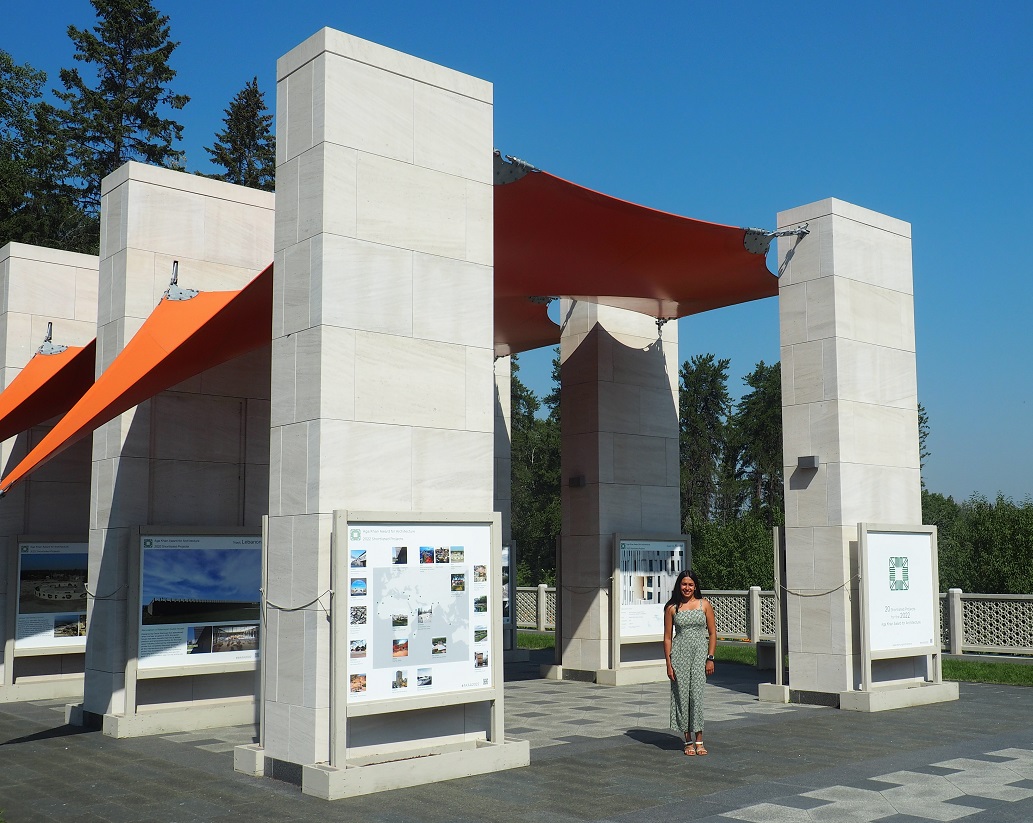
Nurin Merchant poses in front of the Talar Building during her visit in August 2022 to the Aga Khan Gardens in Edmonton. Twenty shortlisted projects for the 2022 Aga Khan Award for Architecture were beautifully showcased on Talar’s large pillars. Photograph: Malik Merchant/Simerg.
Coinciding with the presentation of the AKAA will be the award ceremony for the 2nd edition of the Aga Khan Music Awards. The Aga Khan Awards for Music was established in 2018 by Mawlana Hazar Imam and is administered by a Steering Committee co-chaired by Mawlana Hazar Imam and his younger brother Amyn Aga Khan.
This is the first time that two award ceremonies are being held together at one location. The distribution of the music awards will be attended in a number of related events by His Highness Sayyid Bilarab bin Haitham Al Said and His Highness Sayyid Kamil bin Fahd Al Said.
Laureates of the 2022 Aga Khan Music Awards. Photograph: AKDN.
Sayyid Said bin Sultan Al Busaidi, Undersecretary of the Ministry of Culture, Sports and Youth for Culture gave the following statement: “The distribution of the Aga Khan Awards for Architecture and Music 2022 in the Sultanate of Oman offers a variety of opportunities to academic researchers, musicians and architects. It will enable them to learn about new and outstanding areas highlighted by the awards. It will allow them to be in touch with winners from different countries of the world and the protocols associated with the awards. It will also expand the Omani cultural scene integration with various countries of the world and consolidate social awareness about participation in these international awards. The hosting of the events provides a true manifestation of Oman’s vision to become a destination for art, literature and culture.”
Busaidi further added that the follow-up of the event via media platforms will highlight Oman’s economic and scholarly domains, thus achieving one of the most important pillars of the country’s cultural strategy, which targets cultural openness to the world and the global propagation of the Omani cultural identity.
Date posted: October 24, 2022. Last updated: October 25, 2022 (external links added, see below)
_____________________
Related articles:
For explanations of the two logos featured at top of this post, please visit:
Simerg welcomes your feedback. Your email will not be shown, and you may choose to remain anonymous. Please click Leave a comment. Your letter may be edited for length and brevity and is subject to moderation.
REVIEW SIMERG’S TABLE OF CONTENTS AND VISIT ITS SISTER WEBSITES
Before departing this website please take a moment to visit Simerg’s Table of Contents for links to almost 2000 pieces published since the website was created in 2009. Also visit Simerg’s two sister websites Barakah, dedicated to His Highness the Aga Khan, and Simergphotos. Barakah’s editor may be reached at mmerchant@simerg.com. Malik may be followed @Facebook and @Twitter.
Prince Rahim Aga Khan (R.) visiting a project in West Africa with his father, His Highness the Aga Khan, affectionately and respectfully addressed by his Ismaili followers as Mawlana Hazar Imam (Our Lord the Present Living Imam). Please click on photo for article.
Prince Rahim Aga Khan, the eldest son of the 49th Hereditary Ismaili Imam, His Highness the Aga Khan, is immersed more than ever in the work of his father through the institutions of the Ismaili Imamat and Aga Khan Development Network. Most recently he represented His Highness for the committal of Her Majesty Queen Elizabeth II at Windsor Castle and also visited Vancouver to sign an historic agreement with the Government of British Columbia. However, his engagement with the Ismaili Imamat goes back to the 1990’s, and on the occasion of his 51st birthday on October 12, 2022, we pay him a special pictorial tribute with a collection of photographs, many of which have not been seen before. Please click Prince Rahim Aga Khan: 51 Years in Pictures or on the photograph shown above. Prince Rahim is a graduate of USA’s Brown University in Providence, Rhode Island.
Date posted: October 11, 2022.
___________________________
FEEDBACK
Simerg welcomes your feedback. Your email will not be shown, and you may choose to remain anonymous. Please click Leave a comment. Your letter may be edited for length and brevity and is subject to moderation.
REVIEW SIMERG’S TABLE OF CONTENTS AND VISIT ITS SISTER WEBSITES
Before departing this website please take a moment to visit Simerg’s Table of Contents for links to almost 2000 pieces published since the website was created in 2009. Also visit Simerg’s two sister websites Barakah, dedicated to His Highness the Aga Khan, and Simergphotos. Simerg’s editor may be reached at mmerchant@simerg.com. Malik may be followed @Facebook and @Twitter.
[The original version of this piece by Rizwan Mawani was published on Simerg’s sister website Barakah. This reformatted version includes a number of licensed photographs of Mawlana Hazar Imam, His Highness the Aga Khan, with Prince Charles that were not part of the Barakah article. We have also included excerpts from speeches made by Prince Charles at events where Mawlana Hazar Imam was also present, prior to the Prince of Wales becoming King Charles III upon the death of his mother, Her Majesty Queen Elizabeth II, on September 8, 2022 — Ed.]
In advance of Queen Victoria’s Golden Jubilee commemorations in January 1887, a 10-year-old Imam Sultan Mahomed Shah (1877-1957), accompanied by his uncle Aga Jungi Shah (d. 1896) addressed the jamat at Bombay’s Darkhana in Persian. His private secretary, Kurrim Khan, translated the speech for the jamat in their native tongue and its English translation was published in the local newspaper. The reign of the sovereign was commemorated across the Empire and a decade earlier, in the same year that Imam Sultan Mahomed Shah was born in Karachi, the Queen was also proclaimed the Empress of India further cementing her relationship to the Subcontinent and its people.
Article continues below
Imam Sultan Mahomed Shah as a young boy (seated holding a book) with members of his family. His uncle, Aga Jungi Shah, the son of Imam Hassan Ali Shah and the brother of Imam Aga Ali Shah, is likely the person with the cane. Photograph: “H.R.H. Prince Aga Khan’s visit to Iran 1951,” published by the Ismailia Association for Pakistan.
The young Aga Khan III began his speech: “I have great pleasure to inform you, all members of the jamat in and out of Bombay, that her Most Gracious Majesty the Queen Empress of India’s subjects are about to show their loyalty in celebrating the Jubilee year of the reign of her Majesty…”
In his heartfelt oration, the Imam spoke of his gratitude to the Crown. For under its rule, his community was able to practice its faith in relative peace and of the long-standing tradition of the Khoja Ismailis to offer their thanksgiving for this privilege. He continued: “On reference to your prayer books you will find that loyalty to rulers is directed from the foundation of your faith by one of my ancestors, Islam Shah, who instructed Pir Sadr al-Din, the great missionary to the Khojas to teach them to pray daily, ‘God preserve the Raj of the reigning king and grant prosperity to his subjects.’ There are also traditions from his Holiness the Prophet Muhammad to the same effect.”
“I further suppose,” he said, “that many of you present here this morning will remember that my grandfather, Sarkar Aga [Khan I, Imam Hassan Ali Shah], preached in this Jamatkhana to a large assembly of the jamat on the same subject to which I am this day drawing your special attention. I allude to the occasion when public prayer throughout Her Majesty’s dominions was offered up for the recovery of His Royal Highness the Prince of Wales from a dangerous illness, and that my grandfather said that he knew of many traditions of his Holiness the Prophet Muhammad, to the effect that it is necessary for all to pray for the safety of the reigning king under whose protection they were living…”
Article continues below
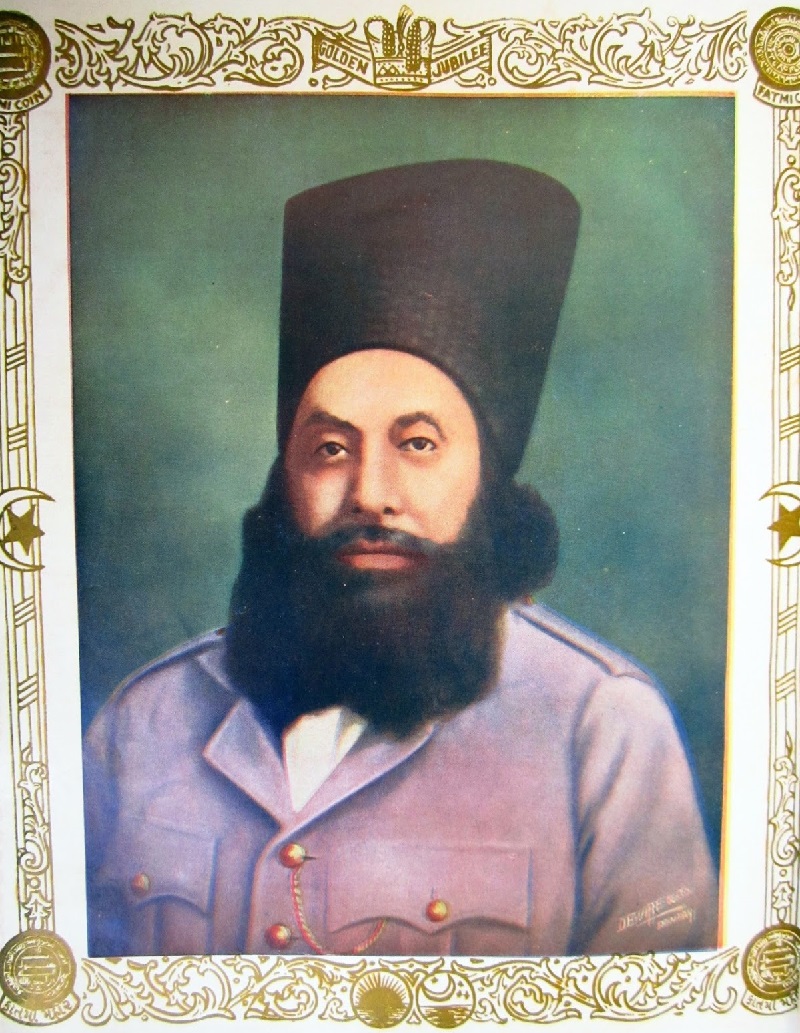
Painted photograph of Imam Hassan Ali Shah, Aga Khan I (1804–1881). Photograph: The Ismaili Bombay 1936, Golden Jubilee Number.
In this speech, the 48th Imam of the Nizari Ismailis alluded to the relationship of respect that his predecessor, Aga Khan I had with the monarchy, and in hindsight one that would, as we now know, be fostered and strengthened in the coming generations. The Ismaili Imamat, from its early days, has forged relationships with the leadership of international bodies, heads-of-state and religious representatives promoting peace, cooperation and hope. This happened at the state level at times when the Imams also were political rulers. In more recent generations, Ismaili Imams have been concertedly working towards improving the lives of some of the world’s most impoverished and at-risk populations, alongside the betterment of the global Ismaili community through these diplomatic relationships.
The Ismaili Imamat and the British Monarchy share a number of features. They are institutions anchored in history and tradition, both reaching back over a millennium, and yet through their holders-of-office engage with and respond to the challenges of the modern world. They are entrenched in an ethic of service and exemplify this through their many global endeavours aimed at reaching populations regardless of creed or background, despite being associated with Islam and Christianity respectively. Furthermore, they are guided and informed by a duty and responsibility inherent to the position.
The relationship between the Imams and the Queens and Kings of England began to take shape once Imam Hassanali Shah, Aga Khan I, left his native Persia and found himself in the territories under the rule of the British. The aftermath of a political power struggle in the Qajar ruling family, propelled the 46th Ismaili Imam to leave his native home — and the home of at least 25 Ismaili Imams before him. Before settling in Bombay in 1845, the Imam spent time in Afghanistan and Sindh, where he and his retinue rendered his services to the British Crown. In gratitude, Queen Victoria honoured the Aga Khan with the hereditary title of His Highness.
While Imam Hassanali Shah never traveled to London — the metropole and centre of the British Empire — nor spoke English, he was instrumental in forging an important relationship between two long-standing institutions that continues to this day. He regularly corresponded and visited with senior representatives of the monarchy in India, including a number of Viceroys. When the Duke of Edinburgh and Prince of Wales, the future King Edward VII, visited India in 1875, they visited Aga Khan I at his home, an honour usually only afforded to ruling princes within the Empire. The two leaders also bonded over their love of horses and this common interest and passion drew the two figures, and those of their descendants closer together.
Article continues below
The SS Laos. The ocean liner taken by Mawlana Sultan Mahomed Shah on his first trip to Europe in 1898.
It was not until the time of Imam Sultan Mahomed Shah that an Ismaili Imam would meet a British sovereign for the first time. In February 1898, Imam Sultan Mahomed Shah left Bombay for Europe on the French Ocean Liner, the Messageries Maritimes SS Laos. [2] On the same trip, he visited London where he had an audience with Queen Victoria at Windsor Castle and also with Edward VII, the future King of England, who became a close friend. In May of that year, as part of her birthday honours, the Queen conferred on the Ismaili Imam the title of Knight Commander of the Indian Empire (KCIE) for his valuable service in British India during times of riot, famine and plague. [3] A year earlier he worked with Professor Haffkine in developing an inoculation for the plague. In doing so, he helped break down barriers and fears about inoculation and establishing hospitals for the various communities in India to battle the disease.
Article continues below
Imam Sultan Mahomed Shah, Aga Khan III, sporting his decorations and honours from the British Monarchy. Photograph: The Ismaili Bombay. Birthday Number, 1932. Thursday 3rd March 1932 (25th Shawwal 1350/Mana Vad II Samvat 1988).
Until Queen Elizabeth II surpassed the milestone, Victoria was the longest reigning British monarch and the longest reigning queen in world history. She died in 1902 and was succeeded by her son, Edward VII. Imam Sultan Mahomed Shah was personally invited to attend the coronation of the new King Emperor and Queen Empress Alexandra. He was further honoured as a personal guest of the royal couple and visited Buckingham Palace and York House outside the formality of the official ceremonies taking place. [4] As a memento of the occasion, the King and Queen sent him two large photos with royal signatures as a souvenir of his visit to England.
Article continues below
Imam Sultan Mahomed Shah in Garten Robes in London for the Coronation of King George VI, 1936. Photograph: Life Magazine, September 27, 1937 (also republished in Ismaili magazines)
In 1906, before he was King, George V came to India. During his tour, he visited Aligarh University, an institution which Imam Sultan Mahomed Shah was instrumental in establishing with the intent to provide equal opportunities for quality education for Muslims of the Empire. The King was impressed with both the cause and vision of the fledgling institution, and he eulogized the university on his return to England at London’s Guildhall. To return his admiration, Imam Sultan Mahomed Shah set on the process of naming the Academy of Sciences at the school after the then-Prince of Wales. [6]
In May 1910, news reached India of the King Emperor’s death. Imam Sultan Muhammad Shah sent a telegram from Paris as did his mother, Lady Aly Shah, from Mahableshwar relaying the news to the jamat. As with monarchs past, the Jamat conveyed their condolences on behalf of the Ismaili community to the Royal Family and the new King. [7] The Imam, in addition to his condolences sent a wreath comprised of over a thousand lilies. [8] Imam Sultan Mahomed Shah attended the funeral at St. George’s Chapel in Windsor and was only one of three people representing India and its princes.
By this time, the Ismaili Imam had become an important figure not only within the British Empire, but also on the world stage. In addition to holding the office of the Ismaili Imam, he was now also representing and providing a voice for the concerns and priorities of a significant proportion of the world’s Muslim population and in particular was an advocate for their educational uplift. In his role as honorary president of a newly formed body whose seeds were sown at the Muhammadan Educational Conference a quarter-century earlier, he was a champion for the opportunities of Muslims across the Empire.
In the first decade of the new century, there had been an increasing volume in the sentiments against Empire and Empirical rule in various corners of the world. It is likely for this reason that the Reuter’s Agency interviewed Imam Sultan Mahomed Shah on the role and values of the monarchy in the changing world: “Speaking first for myself personally, secondly as president of the All-India Moslem League, representing seventy million Moslems; and thirdly on this question on behalf of all Indians, I gladly pay a tribute to King Edward and to his successor.” In the interview, Sultan Mahomed Shah spoke about the relationships that Britain’s Kings and Queens had with Indians, their values and their service. He also reflected upon the visits of India’s ruling princes to England and the Crown’s regal visits to India. He noted the complexities of rule and that varied sentiments did exist in some quarters and yet noted, “[t]he Thone is the only object in the Empire which unites us with white British fellow-subjects — a common centre of loyalty and love.” [9]
At the time of King George’s ascension to the throne, one half of the world’s Muslim population was still governed by the British monarchy. [10] Many states in which Ismaili Muslims lived were also under British governance, rule or influence. This remained the case for significant parts of the 20th century even as members of the community migrated and relocated from their ancestral lands. These countries where the community’s residence intersected with British rule included the now independent states of Afghanistan (1919), Australia (1901-1986), Bahrain (1971), Canada (1867-1982), Egypt (1922), India (1947), Iraq (1932), Kenya (1963), Kuwait (1961), Malaysia (1957), Myanmar/Burma, New Zealand (1948-1986), Pakistan (1947), Qatar (1971), South Africa (1910-1961), Sri Lanka (1948), Tanzania (1961), Uganda (1962), United Arab Emirates (1971), Yemen (1967), and of course the United Kingdom.
Article continues below
King George V and Aga Khan III at the Armstice Day Memorial Service in London. Photograph: Souvenir of The All-Africa Celebrations of the Diamond Jubilee of Hazar Imam, His Highness the Rt. Hon Sir Sultan Muhammad Shah Aga Khan, 1946.
In June 1911, Imam Sultan Mahomed Shah was invited as a guest of the nation to attend the coronation of King Edward. On this occasion he also requested from the King a Charter for the Muslim university at Aligarh alongside other champions of Muslim education including the Begum of Bhopal. Later that year, the Aga Khan was decorated with the Star of India from the King during the Coronation Darbar. In 1916, he was further honoured with the status of Chief of the Bombay Presidency for Life which was accompanied by an 11-gun salute, a mark of respect and admiration for his service. From 1914 onwards during his trips to London, the Imam regularly lunched with the King and Queen and also had the opportunity to further their social bonds at Ascot and other racecourses.
In January 1936, due to the illness, and later death, of King George V, Imam Sultan Mahomed Shah muted his own Golden Jubilee commemorations in Bombay and cancelled commemorations in other cities where Ismailis lived. The deep respect and depth of the sentiments of the Imamat to the British Monarchy echoed throughout the Jamat as a result of this gesture.
In 1937, Mawlana Sultan Mahomed Shah attended the coronation of King George VI, father of Queen Elizabeth II, at Westminster Abbey. In his long illustrious career as Imam, Sultan Mahomed Shah was offered 5 titles by 4 different British monarchs: the Knight Commander of the Order of the Indian Empire, KCIE by Queen Victoria, Knight Grand Commander of the Order of the Indian Empire, GCIE by King Edward VII, Knight Grand Commander of the Order of the Star of India, GCSI and Knight Grand Cross of the Royal Victorian Order, GCVO by King George V and Knight Grand Cross of the Order of St. Michael and St George, GCMG by Queen Elizabeth II.
Upon Imam Sultan Mahomed Shah’s death in July 1957, Queen Elizabeth wrote a personal note of sympathy to Mata Salamat Om Habibeh, the Imam’s widow. It read:
“It is with deep sorry that I have learned of the death of His Highness, the Aga Khan. I and my predecessors on the Throne have for many years enjoyed the loyalty and devotion of His Highness, and we have been pleased to welcome him on many pleasant occasions when he has visited Britain.” [11]
Article continues below
A portrait of Mawlana Sultan Mahomed Shah, His Highness the Aga Khan, and Mata Salamat Begum Om Habibeh Aga Khan, in the French edition of the Memoirs of Aga Khan.
Two weeks after the succession of the new Imam, Prince Karim Aga Khan in 1957, Queen Elizabeth bestowed the title of His Highness upon him in the tradition of her predecessors. Although the British Empire had irreparably eroded into an emerging world of nation-states, the reinvestment of the title underscored the continued importance of the Imam on the world stage. Aga Khan IV was to demonstrate over the decades of his Imamat, the office and institution he represented was able to transcend political and geographical ties in a constantly evolving world. This enviable position allowed him to play a unique role in the Muslim world and on the global stage. This was in addition to his transnational community, whose many members continued to live in the independent countries once part of British dominions.
While in the Western world, colonialism was simply an ideology, subjects who experienced this rule first-hand often had very mixed and sometimes devastating experiences. Despite this, one of the greatest legacies of Queen Elizabeth will be the creation of the Commonwealth and the facilitation of the various movements towards independence throughout Asia and Africa. Like the Imamat, the British monarch also was responsible for stewarding and bringing together diverse groups of people under a common cause.
In May 2002, Mawlana Hazar Imam joined ambassadors from Commonwealth nations as well as the United States and France to honour the Queen as part of her Golden Jubilee celebrations. Recognizing the shared history and traditions of these countries and the strength of diplomatic lineages that had been forged, His Highness the Aga Khan remarked, “This event serves to acknowledge the Commonwealth’s importance in maintaining good relations among countries through both good and less good times in their shared history.” He continued, “The event honours the personal attention that Her Majesty the Queen has accorded to that history and the admirable manner in which she has exercised, and continues to exercise, the challenging role of Head of the Commonwealth.” The culmination to her Golden Jubilee celebrations and the crown of this event was the “All the Queen’s Horses” event, the largest of its kind in the world.
In 2020, Mawlana Hazar Imam attended the Annual Commonwealth Service at Westminster Abbey on special invitation by the Queen. He is currently the Vice-President of the Commonwealth Society which was under the patronage of the Queen until her death with the now-Queen Consort Camilla as its Vice Patron. In March 2022, Prince Rahim Aga Khan, the eldest son of the Ismaili Imam, attended the Commonwealth Day service at Westminster Abbey at the Queen’s invitation, representing Mawlana Hazar Imam. In Prince Rahim’s capacity as Vice-President Designate, he led the Loyal Societies and met with Charles, then Prince of Wales, who represented Her Majesty at the service as well as Their Royal Highnesses the Duke and Duchess of Cambridge. This year’s service had marked the beginning of the Queen’s Platinum Jubilee.
Article continues below
A section of page 3 of The Commonwealth Service held at Westminster Abbey on Monday March 14, 2022, at which Prince Rahim Aga Khan represented Mawlana Hazar Imam, His Highness the Aga Khan. Please click image to view the complete PDF file of the service.
The Queen, or her representative, were often seen along Mawlana Hazar Imam at events of mutual importance and international significance. These included independence events of a number of countries which were previously under British rule and where the Imam had communal representation or followers. At one of these occasions, on December 12, 1963, the Duke of Edinburgh and Mawlana Hazar Imam were both present in Nairobi, Kenya, to witness and participate in the handover of the instruments of independence to Prime Minister Jomo Kenyatta. Representatives of 78 countries were in attendance along with those from the Vatican and the United Nations.
Like his predecessor, the Imam also received honours from the British Monarchy. In 2004, the Imam received the title of Knight Commander of the British Empire (KBE) from Queen Elizabeth II.
Mawlana Hazar Imam also had warm and friendly relations with the current King Charles III. They shared common interests and a commitment to bettering the world around them and met publicly on numerous occasions while Charles was still Prince of Wales. Their respect extended to each other’s responsibilities and many of these meetings allowed them to better understand the breadth and scope of each other’s work and how it improved the wellbeing of its beneficiaries. Aga Khan IV welcomed the then-Prince Charles to Al-Azhar Park in Egypt’s capital, Cairo in March 2006 and hosted him later that year in Pakistan as they toured development projects in the South Asian country.
Article continues below after special photo section
____________________
Special Presentation: His Highness the Aga Khan and King Charles III – An Album of Photographs and Speech Excerpts from the Last 30 Years
[IMPORTANT NOTE: A number of images in this section are reproduced under a licensing arrangement with Alamy photos, and may not be reproduced without Alamy’s written permission — Ed.]
OCTOBER 1993: Prince Charles and His Highness Aga Khan at Oxford Centre for Islamic Studies
“I believe wholeheartedly that the links between these two worlds matter more today than ever before, because the degree of misunderstanding between the Islamic and Western worlds remains dangerously high, and because the need for the two to live and work together in our increasingly interdependent world has never been greater….
“It is odd, in many ways, that misunderstandings between Islam and the West should persist. For that which binds our two worlds together is so much more powerful than that which divides us. Muslims, Christians — and Jews — are all ‘peoples of the Book’. Islam and Christianity share a common monotheistic vision: a belief in one divine God, in the transience of our earthly life, in our accountability for our actions, and in the assurance of life to come.
“We share many key values in common: respect for knowledge, for justice, compassion towards the poor and underprivileged, the importance of family life, respect for parents. ‘Honour thy father and thy mother’ is a Quranic precept too. Our history has been closely bound up together” — Excerpts from speech Islam and the West by Prince Charles, Oxford Centre for Islamic Studies, October 27, 1993
Mawlana Hazar Imam, His Highness the Aga Khan, with Prince Charles and the Director of the Oxford Centre for Islamic Studies, Dr. Farham Nizami, at a lecture presented by Prince Charles on “Islam and the West” at Oxford’s Sheldonian Theatre on October 27, 1993. Photograph: The Ismaili, Canada, March 1994.
~~~~~~
NOVEMBER 1993: Prince Charles and His Highness the Aga Khan at the University of Wales
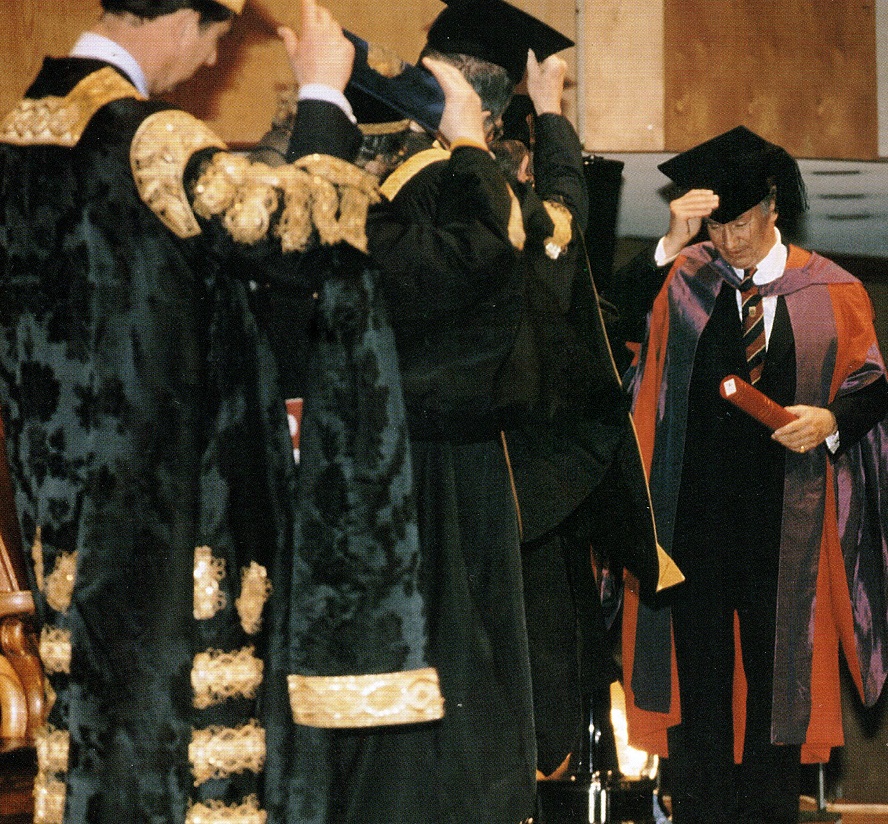
Mawlana Hazar Imam, His Highness the Aga Khan, Prince Charles, Chancellor of the University of Wales, and other members of the Chancellor’s procession “doff” their caps following the award of the honorary degree of the Doctor of Laws (LL. D) to Mawlana Hazar Imam on the occasion of the 100th anniversary of the foundation of the University of Wales, November 30, 1993. Photograph: The Ismaili Canada, March 1994.
~~~~~~
Mawlana Hazar Imam, His Highness the Aga Khan, in conversation with Prince Charles as President Mary Robinson of Ireland signs the Visitors’ Book at a banquet held on November 30, 1993 at the Cardiff City Hall honouring recipients of Honorary Degrees earlier during the day on the occasion of the 100th anniversary of the foundation of the University of Wales. Photograph: The Ismaili Canada, March 1994.
~~~~~~
DECEMBER 1997: Prince Charles and His Highness the Aga Khan at Asia Society in London
Mawlana Hazar Imam, His Highness the Aga Khan, greets Prince Charles at a special banquet hosted in July 1997 by the Asia Society to celebrate the 50th anniversary of the independence of India and Pakistan. Photograph: The Ismaili Canada, December 1997.
~~~~~~
MARCH 2006: Prince Charles and His Highness the Aga Khan at Al Azhar Park, Cairo
Mawlana Hazar Imam, His Highness the Aga Khan, welcomes HRH The Prince of Wales (now King Charless III) and The Duchess of Cornwall (now Queen Consort) to Al-Azhar Park in March 2006 at the beginning of their official 2-week to Egypt, Saudi Arabia and India. Photograph: AKDN/Gary Otte.
~~~~~~
NOVEMBER 2006: Prince Charles and His Highness the Aga Khan in Northern Pakistan
“….. if I may say so, [the Ismaili Imamat] is that same leadership and vision which has enabled the Aga Khan Development Network to grow into an organization of international importance, addressing development needs in some thirty-five countries around the World, bridging boundaries of race and religion. My darling wife and I were privileged to see some of this work, towards the end of last year [November 2006], in Altit and Nansoq villages in Northern Pakistan — in fact I was devastated when I had to leave behind the gift I was given, in Altit: a very beautifully shampooed Yak! I got a crate to bring it back, and actually I think a Yak is the only rare breed I haven’t got” — Prince Charles’ reference to the yak (see photo below) was made during his speech at the opening of the Spirit and Life Exhibition on July 12, 2007, at the Ismaili Centre London. Please read the full speech HERE
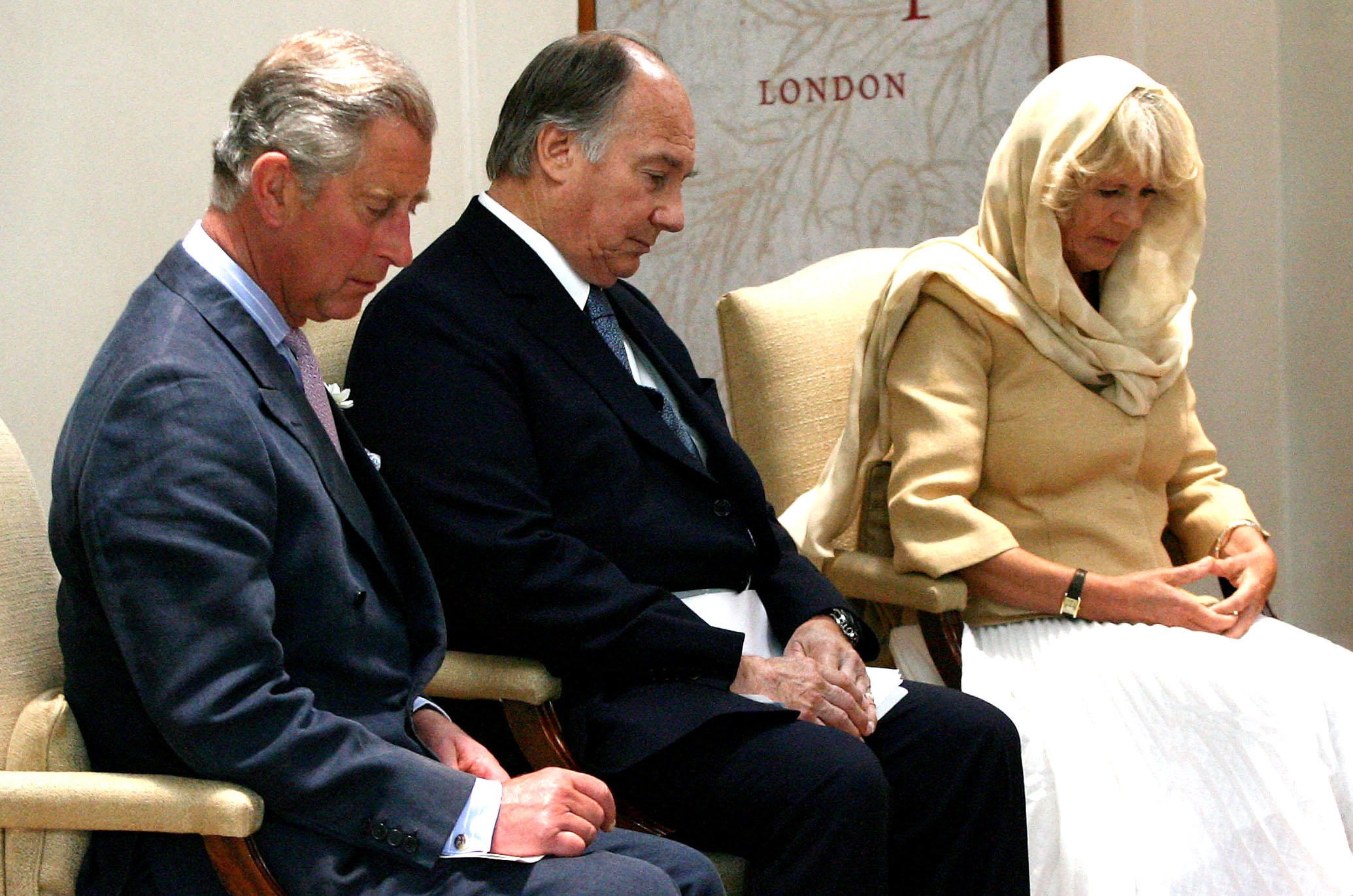
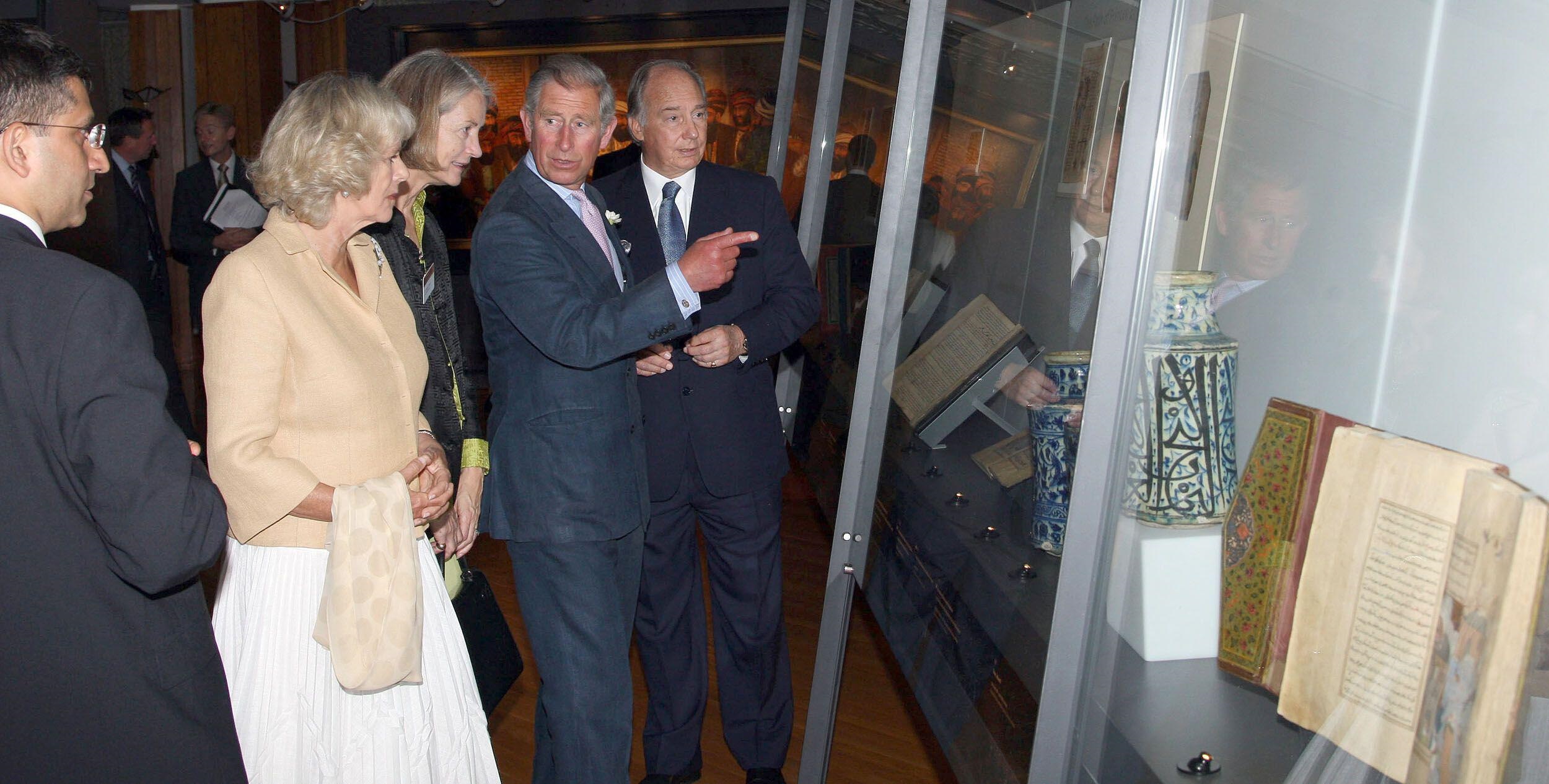
“Your Highness, Ladies and Gentlemen. I cannot tell you what a pleasure it is for my wife and I to join you this afternoon in celebrating the Fiftieth Anniversary of His Highness the Aga Khan’s succession to the Imamat. It is, if I may say so, London’s great good fortune that His Highness has chosen to open his Golden Jubilee celebrations with the ‘Spirit and Life’ Exhibition which my wife and I have just seen – we had to drag ourselves away from it! I understand that this is the first time these masterpieces of Islamic art have been seen in London. They are of quite exceptional historical importance and beauty. But, perhaps still more importantly, they also convey the clearest possible message about the close ties between the Abrahamic Faiths. For example, the magnificent Eleventh Century Canon of Medicine, which originated in Iran, was equally indispensable to Western scholars for the better part of five hundred years.” — Excerpt from speech made by Prince Charles at the opening of the Spirit and Life Exhibition on July 12, 2007. Please read the full speech HERE.
JUNE 2018: Prince Charles and His Highness the Aga Khan at the Opening of the Aga Khan Centre, London
“Your Highness, the extraordinary work that you have done throughout your lifetime, in the service of humanity and in the name of Islam, is as remarkable as it is invaluable. For that, you are owed the greatest debt of gratitude and I did just want to take this opportunity to thank you on behalf of us all, if I may.
“It is clear to me that in holding dear the values of humility, honour, magnanimity and hospitality, the Ismaili Community takes its inspiration from you, Your Highness, and from your extraordinary ‘Greatness of Soul’.” — Prince Charles, Aga Khan Centre Opening, June 26, 2018. Please read the full speech HERE
On Tuesday, June 26, 2018, King Charles III (then The Prince of Wales opened) The Aga Khan Centre in King’s Cross in the presence of Mawlana Hazar Imam. Situated at the heart of London’s Knowledge Quarter, the Aga Khan Centre, designed by Maki and Associates, led by Fumihiko Maki, one of Japan’s most distinguished contemporary architects, provides a new home for a number of UK based organisations founded by His Highness the Aga Khan: The Institute of Ismaili Studies (IIS), the Aga Khan University Institute for the Study of Muslim Civilisations (AKU-ISMC) and the Aga Khan Foundation UK (AKF UK).
Prince Charles and Mawlana Hazar Imam, His Highness the Aga Khan, discuss the features of the Garden of Life at the new Aga Khan Centre in London with garden designer Madison Coxon during the inauguration of the Centre on June 26, 2018. Photograph: AKDN/Nayyir Damani.
In similarly inspiring this Centre, you have set it on a path to serve the world with great distinction, just as Your Highness has yourself done throughout your remarkable life. My wife and I have been fortunate enough to see just what an inspiration you are to your community when we accompanied you to Altit years ago. Never will we forget that occasion nor, for that matter, the magnificently shampoo-ed bull yak with which I was presented and which, very sadly, I was unable to transport back to Highgrove to graze in my Islamic Garden! — Prince Charles, Aga Khan Centre Opening, June 26, 2018. Please read the full speech HERE.
~~~~~~
MARCH 2019: Prince Charles and His Highness the Aga Khan at Buckingham Palace
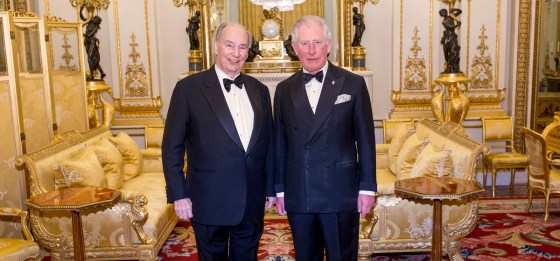
Prince Charles named Mawlana Hazar Imam, His Highness the Aga Khan, as Global Founding Patron of The Prince’s Trust’s work. They are pictured at a dinner at Buckingham Palace on March 12, 2019. Photograph: Ian Jones/AKDN.
____________________
Rizwan Mawani’s article continues here
During the Imam’s Golden Jubilee, Mawlana Hazar Imam welcomed the Prince of Wales to the Ismaili Centre London on July 12, 2007, to view the Spirit and Life Exhibition showcasing the beauty, diversity and rich legacy of Islamic Art. Many of these artifacts are now on display at the Aga Khan Museum in Toronto. In June 2018, Prince Charles opened the Aga Khan Centre in London in the presence of Mawlana Hazar Imam. The Aga Khan Centre is the current home of the Aga Khan University’s Institute for the Study of Muslim Civilization, The Institute of Ismaili Studies as well as a research library and residences for students. In 2019, Mawlana Hazar Imam was appointed as a Global Founding Partner of the Prince’s Trust UK, then under the patronage of the future King Charles. There have been other occasions when the current King, His Majesty Charles III, as well as members of his family met or honoured Mawlana Hazar Imam that illustrate the bond between the Ismaili Imamat and the British Monarchy.
Article continues below
Mawlana Hazar Imam, His Highness the Aga Khan, is conferred an Honorary Degree of Doctor of Literature in Education at the University of London by Princess Anne, Chancellor of the University, on October 12, 1989. Photograph: UK Ismaili Newsletter, November/December 1989.
~~~~~~
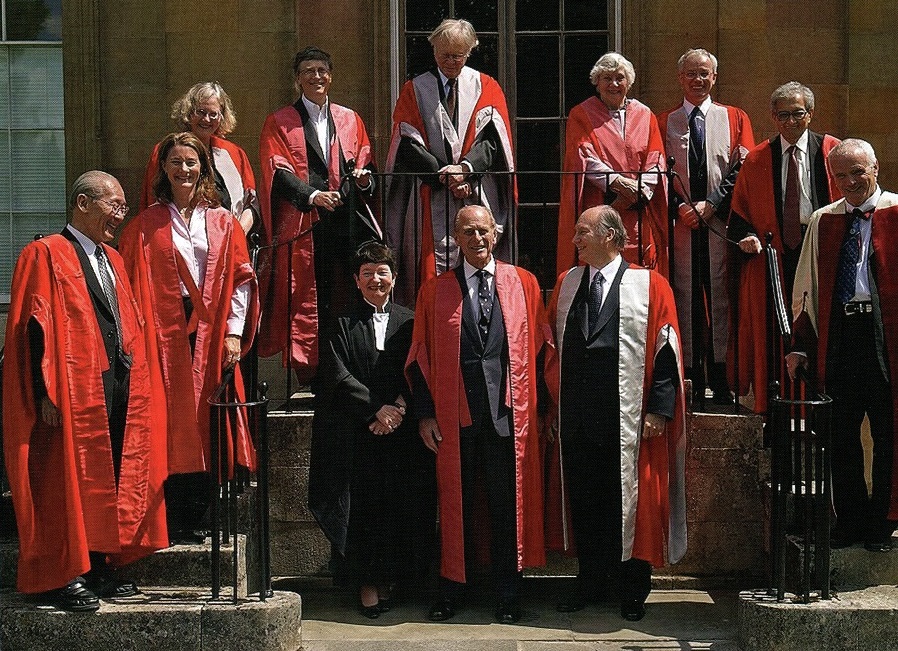
On June 12, 2009, the University of Cambridge, conferred Mawlana Hazar Imam, His Highness the Aga Khan with a Doctor of Divinity, the first Muslim ever to have received this degree. The Late Duke of Edinburgh was the Chancellor of the University and he is seen in the front row with Mawana Hazar Imam and the University’s Vice Chancellor Professor Alison Richard. Also in the photograph are other Honorary degree recipients. Photograph: University of Cambridge via The Ismaili Canada, December 2009.
The relationship between the Imamat and the British Monarchy has also extended to members of each of the institutions’ families and their representatives. A result of their mutual interests and common dedication to the service of humanity has also meant celebrating milestones and achievements in addition to co-operation on programmes and projects.
Article continues below
Lady Aly Shah, mother of Imam Sultan Mahomed Shah.
Aga Khan II’s wife and mother of Imam Sultan Mahomed Shah, Shamsul Muluk, more commonly known as Lady Aly Shah, was an important contributor to welfare projects throughout the British Empire. She was a champion for women’s rights, a skilled fundraiser and a force of change for both the Ismaili community as well as for Muslim women in India. For many years she was president of the influential Mohammedan Purdah Ladies Committee which held its first major conference in 1911. As part of this work, she formed strong relationships with a number of the wives of the Viceroys, or Governors-General of India, including Lady Willingdon. For her dedication and service to humanity, she was honoured with the title of the Imperial Order of the Crown of India, membership which is normally reserved for Queens, ruling princesses and the Vicerenes. For the occasion, she travelled to London at the age of 86 where she was personally invested by King George V.
On the occasion of the funeral and Committal Ceremony of Her Majesty Queen Elizabeth on September 19, 2022, Mawlana Hazar Imam was represented by his son Prince Rahim at the service. Members of the Imam’s family were also present during a dinner hosted by Queen Elizabeth at Buckingham Palace on the occasion of Aga Khan IV’s Golden Jubilee in 2008 and at Windsor Castle in 2018 for his Diamond Jubilee.
Likewise, Prince William and the Duchess of Cambridge, Kate Middleton, met with Mawlana Hazar Imam at the Aga Khan Centre in London on October 2, 2019, for an event that preceded their tour of Pakistan later that month.
Article concludes below
Mawlana Hazar imam, His Highness the Aga Khan, together with Her Majesty Queen Elizabeth II and His Royal Highness The Duke of Edinburgh, Prince Philip, during a dinner hosted in honour of His Highness the Aga Khan at Buckingham Palace to commemorate his Golden Jubilee, London, July 7, 2008. Photograph: AKDN/Gary Otte
~~~~~~
Mawlana Hazar Imam, His Highness the Aga Khan, presents his second son, Prince Hussain, to Her Majesty the Queen. His brother, Prince Amyn, and his oldest son Prince Rahim prepare to be greeted by His Royal Highness The Duke of Edinburgh and the Duchess of Cornwall, as Princess Yasmin, his sister, looks on. Photo: AKDN/Gary Otte.
~~~~~~
Court Circular
March 8
Buckingham Palace
8th March, 2018
The Queen gave a Dinner Party for The Aga Khan at Windsor Castle this evening to mark His Highness’s Diamond Jubilee at which The Prince of Wales and The Duchess of Cornwall, The Duke of York, The Princess Royal and Vice Admiral Sir Tim Laurence, and Members of The Aga Khan’s Family were present.
The Duke of Edinburgh this morning received Mr Martin Palmer (Secretary General, Alliance of Religions and Conservation).
The Prince of Wales, on behalf of The Queen, held an Investiture at Buckingham Palace this morning.
[Note: The Court Circular is the official record of royal engagements and appears daily in the London Times — Ed.]
~~~~~~
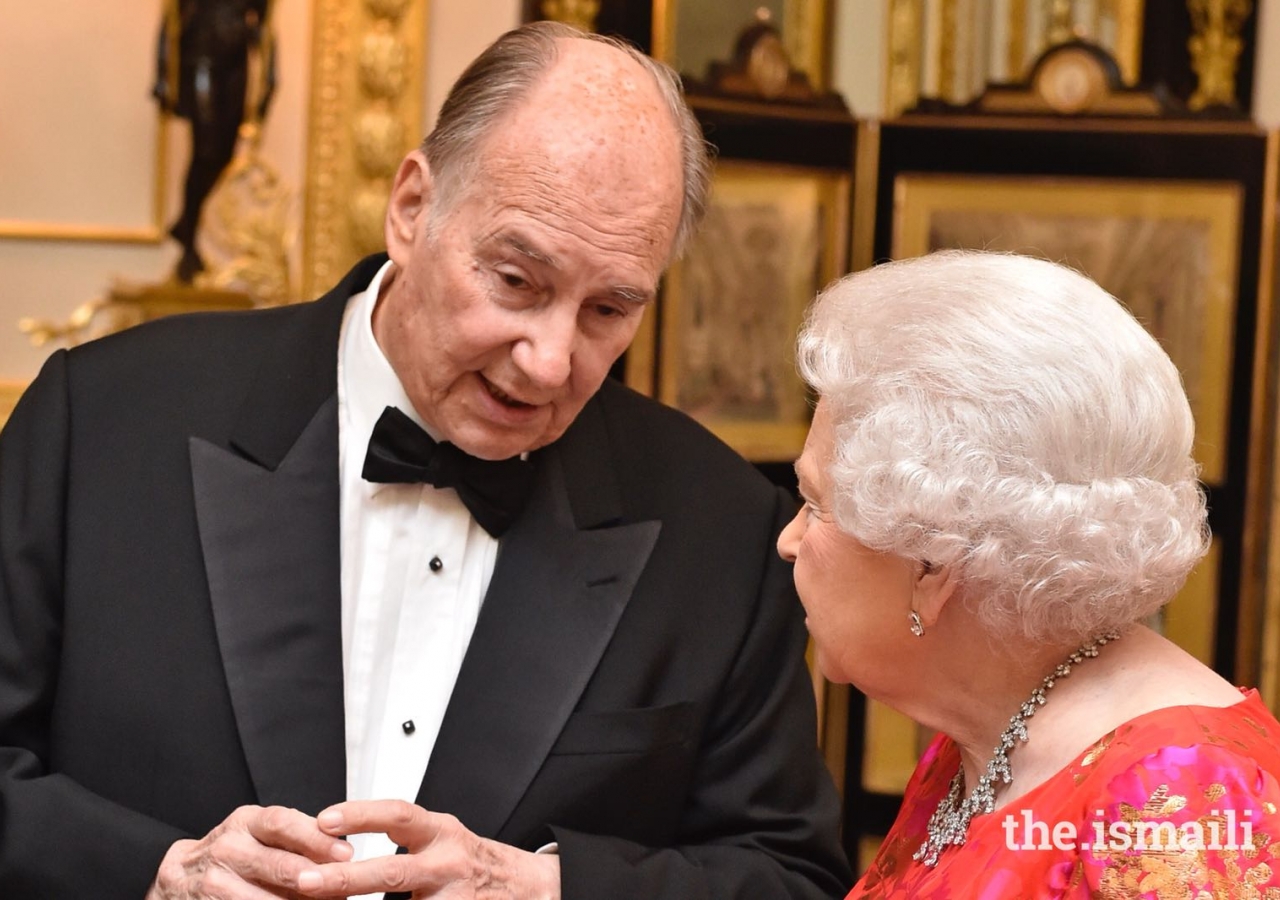
Her Majesty Queen Elizabeth II in conversation with Mawlana Hazar Imam, His Highness the Aga Khan, at a dinner hosted on March 8, 2018 by Her Majesty at Windsor Castle on the occasion of his Diamond Jubilee. Photo: AKDN/Gary Otte.
~~~~~~
Mawlana Hazar Imam, His Highness the Aga Khan, welcomes Prince William and the Duchess of Cambridge at the Aga Khan Centre in London on October 2, 2019. Photo: The Ismaili/Anya Campbell
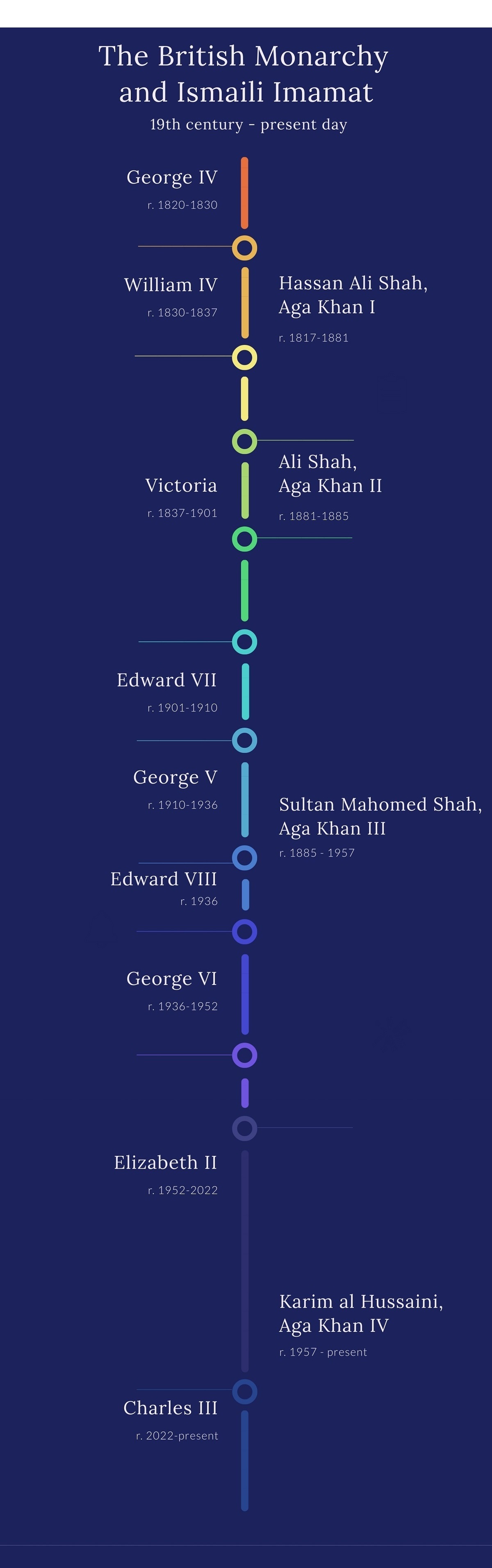
The article has shown that the relationship of the Ismaili Imamat and the British Monarchy blossomed beginning in the 19th century. Through many monarchs and 4 Ismaili Imams, beginning with Aga Khan I, we have outlined their relationship of respect, cooperation and friendship over the last 150 years from Queen Victoria to King Charles. This relationship is illustrated in the chart shown above at the beginning of this article.
Date posted: October 6, 2022. Last updated: October 7, 2022.
___________________
ABOUT THE AUTHOR
Rizwan Mawani
Rizwan Mawani has a background in Anthropology and Religious Studies and is the author of Beyond the Mosque: Diverse Places of Muslim Worship (I. B. Tauris in association with The Institute of Ismaili Studies, 2019). Rizwan has written for a wide variety of audiences and his work has appeared in academic publications, encyclopedias as well as the Wall Street Journal and The Huffington Post. Rizwan was previously Website Content Editor and Research Coordinator in the Department of Constituency Studies at The Institute of Ismaili Studies. His current research focuses on the past two centuries of global Ismaili history with a focus on the jamatkhana and its development during that period.
FEEDBACK
Simerg welcomes your feedback. Your email will not be shown, and you may choose to remain anonymous. Please click LEAVE A COMMENT. Your letter may be edited for length and brevity and is subject to moderation.
REVIEW SIMERG’S TABLE OF CONTENTS AND VISIT ITS SISTER WEBSITES
Before departing this website please take a moment to visit Simerg’s Table of Contents for links to almost 2000 pieces published since the website was created in 2009. Also visit Simerg’s two sister websites Barakah, dedicated to His Highness the Aga Khan, and Simergphotos. Barakah’s editor may be reached at mmerchant@simerg.com.
[1] The Times of India, January 24, 1887, p. 7 [2] The Times of India, February 19, 1898, p. 5 [3] The Times of India, May 23, 1898, p. 4 [4] The Times of India, July 7, 1902, p. 6 [5] The Times of India, June 3, 1903, p. 5 [6] The Times of India, May 14, 1910, p. 9 [7] The Times of India, May 9, 1910, p. 5 [8] Rand Daily Mail (Johannesburg), May 16, 1910, p. 7 [9] The Times of India, May 28, 1910, p. 10 [10] The Times of India¸ May 30, 1910, p. 6 [11] Times of India, July 13, 1957.
New, new and new! Several new developments related to the Aga Khan Development Network (AKDN) have been announced in the last 48 hours. Regrettably the AKDN website itself does not mention the new developments — or the author simply cannot locate the information easily at AKDN (this has been problematic in the past which hopefully has been addressed with the website redesign).
The new features are mentioned on the websites of the Ismaili and the news section of the University of Central Asia. They include a new URL, http: the.akdn (you may still access it using the old one www.akdn.org), a revamped website and a new logo that has been approved by Mawlana Hazar Imam, His Highness the Aga Khan, the 49th hereditary Imam of the Shia Ismaili Muslims. He heads the AKDN as well as all the institutions that are part of his Ismaili community around the world.
The Ismaili website states that the new AKDN website brings a fresh look with simplified navigation options and enhanced visuals. The design aims to be more user-friendly, and has been optimised for a variety of browsers and mobile devices. It invites the readers and members of the Ismaili community around the world to “explore the new AKDN website and to share feedback and suggestions by sending a message to website@akdn.org.”
The AKDN logo expresses interconnectivity. Polygons of three, five, and seven, form 49 different yet congruent units which interact with and reinforce each other to become one. They represent the Network as an interconnected programme encompassing social, cultural, and economic dimensions to improve the quality of life of individuals and the societies in which they live.
Date posted: September 23, 2022.
__________________
We welcome feedback from our readers. Please click Leave a comment. Your letter may be edited for length and brevity and is subject to moderation.
Before departing this website please take a moment to review Simerg’s Table of Contents for links to hundreds of thought-provoking pieces on a vast array of subjects including faith and culture, history and philosophy, and arts and letters to name a few. Also visit Simerg’s sister websites Barakah, dedicated to His Highness the Aga Khan, and Simergphotos.The editor may be reached via email at mmerchant@simerg.com.
The websites of the Institute of Ismaili Studies and the Ismaili community, The Ismaili, have jointly announced the appointment of Dr. Zayn Kassam as the new Director of the Institute of Ismaili Studies (IIS), following the decision by Dr. Farhad Daftary to retire from his management roles, which included serving as the co-director of the IIS for the past 12 years.
Dr. Daftary will continue his scholarly research, writing and teaching activities at IIS indefinitely. As appropriate recognition of Dr. Daftary’s contributions to IIS and his long service of 34 years, Dr Daftary has been conferred the lifetime title Director Emeritus when he relinquishes his current role and will be appointed to the IIS Board of Governors. In this way, IIS staff, students and other stakeholders will continue to benefit directly from his knowledge, wisdom and guidance.
Story continues below
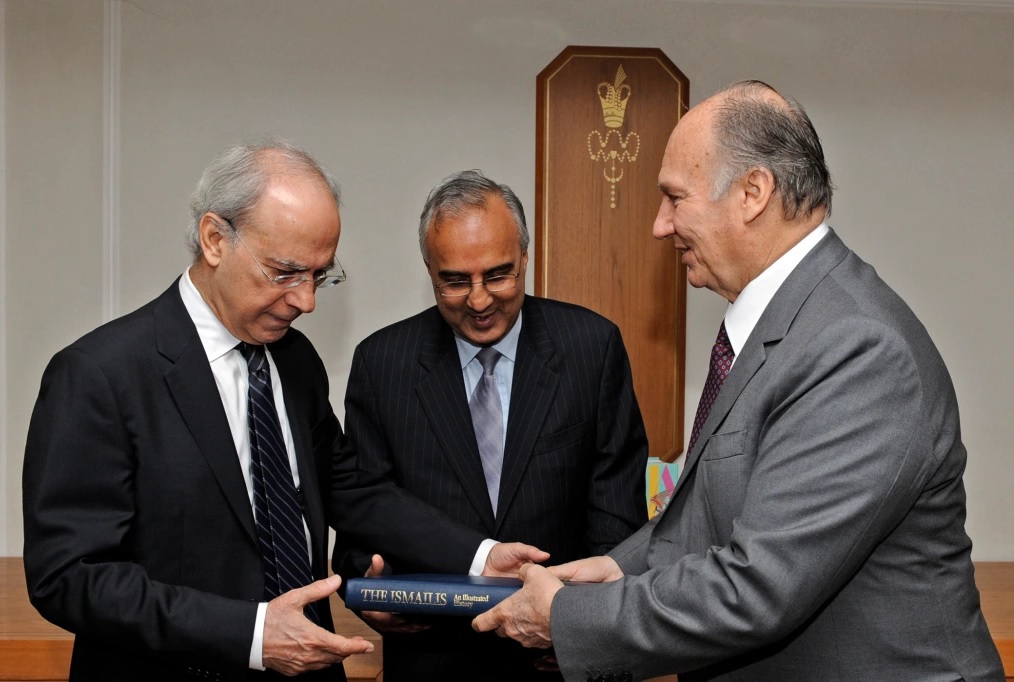
Professor Azim Nanji (centre), then Director of the Institute of Ismaili Studies, and his successor Dr Farhad Daftary (left) present Mawlana Hazar Imam, His Highness the Aga Khan, with a copy of The Ismailis: An Illustrated History on July 4, 2008 during his Golden Jubilee visit to the United Kingdom. Photo: Gary Otte
Following a thorough and extensive international search process undertaken by the Board of Governors which considered internal and external candidates, Professor Zayn Kassam of Pomona College in California has been appointed as the next Director to succeed Dr Daftary with effect from January 2023. Professor Kassam is a highly accomplished scholar and academic leader and has spent the last 27 years in a variety of positions at Pomona College in California. Her profile page on the College’s website reads as follows:
“Zayn Kassam is the John Knox McLean Professor of Religious Studies at Pomona College, Claremont, California. A graduate of McGill University (Ph.D. 1995), she teaches courses on mysticism, gender, literature, ethics, and the environment.
“She has lectured widely on gender issues in the United States, Canada, and Britain. She has been honored with three Wig Awards for Distinguished Teaching at Pomona College, as well as an American Academy of Religion Excellence in Teaching Award.
Story continues below
Zayn Kassam, who will succeed Farhad Daftary as the new Director of the Institute of Ismaili Studies in January 2023. Photo: Pomona College.
“Kassam is the author of Introduction to the World’s Major Religions: Islam (2006), and editor of Women and Islam (2010) and Women in Asian Religions (2018). She is also the section editor for Islam for the volume on Islam, Judaism, and Zoroastrianism for the Encyclopedia of Indian Religions (2018).
“She has chaired the department of religious studies at Pomona College, and has coordinated the programs in gender and women’s studies, Asian studies and Middle Eastern studies. She is currently the director of the Pacific Basin Institute. She serves on several national editorial boards, including the Journal of Feminist Studies in Religion and the Journal of the American Academy of Religion.”
Simerg congratulates Dr. Zayn on her new appointment, and wishes Dr. Daftary good health and success in all his scholarly endeavours as he continues to serve the IIS in the years to come.
Book that was presented by Dr. Farhad Daftary to Mawlana Hazar Imam during his Golden Jubilee visit to London in July 2008. See photo at beginning of post (without jacket cover)
While the IIS has been in existence since December 1977, it was not until Dr. Daftary joined the Institute that we began seeing a significant increase in the number published texts, short papers and monographs on Ismaili and Shia Studies in particular, and Islamic studies in general. As well as his own books, Dr. Daftary’s fervour for Ismaili history, philosophy and culture, encouraged other specialty scholars in the field of Ismaili studies to submit their scholarly research for publication through the IIS. Among the books that Dr. Daftary published himself or as a co-author or editor of numerous volumes, we would like to mention a few of them: The History of the Ismailis, A Short History of the Ismailis, The Assassin Legends: The Myth of the Ismailis, Historical Dictionary of the Ismailis, The Ismailis: Their History and Doctrines, The Shia World, A History of Shia Islam, The Ismailis: An Illustrated History, Islam: An Illustrated Journey and, most recently, The Ismaili Imams: A Biographical History. (We invite you to visit IIS Listing of Publications and also Amazon.)
With regard to Zayn Kassam, in addition to some the works mentioned in her profile, we are pleased to share links to two pieces that she contributed to Simerg:
“The Board thanks Dr Daftary for his many years of service to IIS, congratulates him on his appointment to the Board of Governors and wishes him continued success in his new role as well as welcoming Professor Kassam as the incoming Director of IIS.”
Date posted: September 22, 2022.
_________________
We welcome feedback from our readers. Please click Leave a comment. Your letter may be edited for length and brevity and is subject to moderation.
Before departing this website please take a moment to review Simerg’s Table of Contents for links to hundreds of thought provoking pieces on a vast array of subjects including faith and culture, history and philosophy, and arts and letters to name a few. Also visit Simerg’s sister websites Barakah, dedicated to His Highness the Aga Khan, and Simergphotos.The editor may be reached via email at mmerchant@simerg.com.


























 Simerg - Insights from Around the World