Readers who live(d) in Zanzibar or Tanzania, have visited the marvellous East African countries, or are somewhat familiar with the beautiful continent of Africa, will be thrilled to view a collection of photos dated 1936 at Simerg’s companion website, www.simergphotos.com. The photos are from the Matson (G. Eric and Edith) Photograph Collection which is housed at the US Library of Congress. Please click Beautiful People and Places of Zanzibar and Tanganyika: Photos from 1936 or on the image below.
“I Wish I’d Been There” – Volunteeering at the Dawn of the Age of Imamat by Aziz R. Kurwa
In History in Quotations, which reflects five thousand years of World History, authors M. J. Cohen and John Major write as follows:
“Muhammad said:
‘He of whom I am the Mawla (patron), Ali is his Mawla. O God, be the friend of him who is his friend and be the enemy of his enemy.’
“This became the proof text for the Shia claim that Ali, the Prophet’s cousin and son-in-law, was the Prophet’s rightful successor after the Prophet’s death in 632. The meaning of Mawla here probably implies the role of patron, lord or protector.”
The authors then sum up by stating that through the use of the term Mawla, Prophet Muhammad (s.a.s.) was giving Mawlana Ali (a.s.) the parity with himself in this function. Dr. Aziz Kurwa, a long serving member of the Ismaili community, takes us to the beginning of Islamic and Ismaili history and imaginatively constructs the role he played as a volunteer on that eventful and historic occasion, a day which was described by one of our readers as “an introduction to a new world order”. Aziz Kurwa was among the thirty-one who contributed to Simerg’s highly acclaimed series I Wish I’d Been There.
Please click on image below or: Volunteering at the Dawn of the Age of Imamat

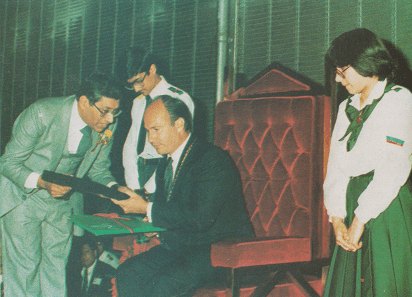
London, 1979: His Highness the Aga Khan, 49th hereditary Imam of the Ismailis and direct descendant of the Prophet Muhammad (s.a.s) receiving Fatimid Gold dinars from Dr. Aziz Kurwa, a long serving leader of the Ismaili community who was at the time President of the Ismailia Association for the U.K.
Ghadir-Khumm and the Two Weighty Matters by Jehangir A. Merchant
In our classic series, I Wish I’d Been There, we had asked our readers to pick up one incident in Ismaili History which they would like to have witnessed. One of the thirty-one contributors for the series, Ismaili missionary (Alwaez), teacher and writer Jehangir Merchant, went back 1400 years to the beginnings of Islamic history and imaginatively constructed a picture of the iconic event when Prophet Muhammad (s.a.s) raised the hand of Hazrat Ali (a.s.) and declared, “He of whom I am the Mawla, Ali is also the Mawla!” Based on authoritative sources, this piece by a long-serving Alwaez shows his vast knowledge and flair, and brings alive a pivotal time in human history.
Please click Ghadir-Khumm and the Two Weighty Matters

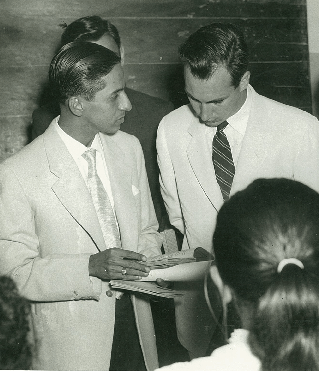
Lourenço Marques, 1958: His Highness the Aga Khan, direct descendant of the Prophet Muhammad (s.a.s.) and current 49th hereditary Imam of the Shia Ismaili Muslims is seen taking a keen interest as Alwaez Jehangir explains the Gujarati history texts that were used to impart religious education to Ismaili youth in Mozambique.
Photo Essay: The Historical Jubilees of His Highness the Aga Khan (1877 – 1957)
“The measure of the Imam’s achievement can be gauged from the phenomenal progress of the Ismaili Community during the Imam’s regime. The community’s proud position in modern civilization during the course of only about half a century, is a saga of success with probably no parallel in history…the Imam was the architect of this modern miracle…The resurgence of the Ismaili Community, literally from rags to riches, is a fitting monument to the Imam’s indefatigable efforts”
Photo Essays: His Highness the Aga Khan in Alberta and His Past Meetings with Leaders of US and Canada
Simerg’s photo blog, www.simergphotos.com, brings you two more informative photo essays following the publication recently of some magnificent photos of Chateau de Chantilly and His Highness the Aga Khan’s visit to France’s cultural gem. Please click on the following links or images to read the latest photo essays, as well other previously published posts.
~~~~~
The Hajj by Naser-e Khosraw, from Michael Wolfe’s “One Thousand Roads to Mecca”
IN PART III OF NASER-E KHOSRAW’S TRAVELS
“….The tallest mountain near Mecca is Abu Qubays, which is round like a dome, so that if you shoot an arrow from the foot of the mountain it reaches its top.…Having come into the city, you enter the Haram Mosque, approach the Ka’ba, and circumambulate….. always keeping the Ka‘ba to your left [shoulder]. Then you go to the corner containing the Black Stone, kiss it, and pass on….”
Naser-e Khosraw’s Pilgrimages to Mecca

A bird’s-eye view of the Ka’ba crowded with pilgrims. The photo is from the archives of the US Library of Congress and was created by American Colony (Jerusalem), Photo Dept., in 1910. Please click for article by Naser-e Khosraw.
________________
Previous posts in the four-part series (the above is Part III):
Naser-e Khosraw’s Pilgrimages to Mecca: From “One Thousand Roads to Mecca” Edited by Michael Wolfe (Part I)
Naser-e Khosraw in Fatimid Cairo: From “One Thousand Roads to Mecca” Edited by Michael Wolfe (Part II
Naser-e Khosraw on Fatimid Cairo’s Biggest Ceremony, from Michael Wolfe’s “One Thousand Roads to Mecca”
IN PART II OF NASER-E KHOSRAW’S TRAVELS
“….There is a lighthouse that I saw in Alexandria, on top of which used to be an incendiary mirror. Whenever a ship came from Istanbul and approached opposite the mirror, fire would fall from the mirror and burn the ship up…. On the morning when the Sultan is going out for the ceremony, ten thousand men are hired to hold the steeds….At some distance behind all of these comes the Sultan [al-Mustansir], a well-built, clean-shaven youth with cropped hair, a descendant of Husayn son of Ali. He is mounted on a camel with plain saddle and bridle with no gold or silver and wears a white shirt…”
Naser-e Khosraw in Fatimid Cairo: From “One Thousand Roads to Mecca” Edited by Michael Wolfe

Map of Naser-e Khosraw’s travels as described in his “Safarnama” or the Book of Travels. Credit: Wikipedia. Please click for article.
_________
Previous instalment: One Thousand Roads to Mecca: Naser-e Khosraw’s Writing About the Muslim Pilgrimage
Magnificent Photos of His Highness the Aga Khan at the Chateau de Chantilly on Simergphotos.com
Just over a month ago, this website (Simerg.com) announced the launch of a sister website Simergphotoblog.wordpress.com with the theme Photos, Images and Videos from Around the World.
Effective October 18, 2012, the new photo blog has begun to operate under an easier to remember domain name www.simergphotos.com. The format and layout that we have adopted for simergphotos was carefully selected from numerous premium photo themes available at WordPress.com, where Simerg has been hosted since March 2009. We feel confident that with this enterprising initiative, our readers will enjoy the photos even more. In this regard, it is proposed to incorporate many of the photo essays already published on Simerg in Simergphotos. The process has already commenced, and we feel the republished posts appear much more appealing in the new photo blog.

Prince Karim Aga Khan, president of the Foundation for the preservation and development of the Chantilly estate on June 22, 2012 in Chantilly, France. (Photo by Philippe Petit/Paris Match via Getty Images).
The first photo essay being exclusively published at Simergphotos.com is a magnificent piece on France’s cultural jewel, Chateau de Chantilly, which is being restored to its original glory under a partnership that includes His Highness the Aga Khan, the World Monuments Fund (WMF) and the Institut de France.
We invite you to view the photo essay by clicking His Highness the Aga Khan’s Visit to the Jewel of French Culture.
During your visit, please take a few moments to view some of the other interesting photo posts on www.simergphotos.com.
Thank you
Malik Merchant
Publisher-Editor
Simerg.com &
Simergphotos.com
simerg@aol.com
CANADA
__________________
One Thousand Roads to Mecca: Naser-e Khosraw’s Writing About the Muslim Pilgrimage Edited and Introduced by Michael Wolfe
In the early 1990’s Michael Wolfe, a prolific American writer and award winning producer of Islamic documentaries including Muhammad: The Legacy of a Prophet, became aware of a string of accounts by Muslims and non-Muslims who over the last one thousand years had gone to Mecca on the pilgrimage. Wolfe’s accounts are collected into a single volume called One Thousand Roads to Mecca, and the first of the twenty-four edited accounts is based on the Book of Travels, a classic text by the famous Ismaili poet, philosopher and traveller Naser-e Khosraw who lived during Islam’s expansive Middle period between the 11th and 14th centuries. The period has also been called the Golden Age of Muslim travel and, as Wolfe notes, Khosraw set the tone for a thousand years of Persian travel writing.
To begin reading Naser-e Khosraw’s spirited account of his journey, with an excellent introduction by Michael Wolfe, please click One Thousand Roads to Mecca: Naser-e Khosraw’s Writing About the Muslim Pilgrimage, or the image below.
_______________
Previous post:
Ismaili Women of Shimshal: Celebrations After a Difficult Trip and Other Fascinating Stories by Pam Henson
‘‘When I was 15 there were 21 people living in the house and my friend Hasiet and I had to do all the weekly washing for the whole family, even in winter. It took all day and I got frost bite in my feet several times. My toes would turn black. We’d go down to the river and make a fire to heat the water. We used to burn our socks, trying to warm our toes by the fire. It was hard to find enough money to buy new ones with all those people in the house.’’ — Hussn Bibi
____________
Previous installment:
Remarkable Tales of Ismaili Women from Shimshal, a Remote Village in the Karakoram