Simerg is an independent initiative dedicated to Ismaili Muslims, the Aga Khan — their Hereditary Imam — and the Ismaili Imamat, and Islam in general through literary readings, photo essays and artistic expressions
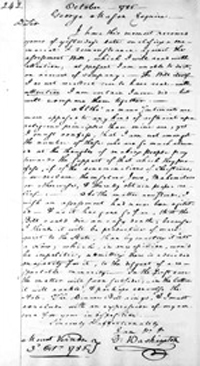
The US Library of Congress contains the papers of 23 presidents, from George Washington to Calvin Coolidge. Manuscript Division Chief James Hutson draws upon the papers of Washington, Thomas Jefferson and other primary documents to discuss the relationship of Islam to the new nation.
George Washington’s 1785 letter wherein he declared that he would welcome “Mohometans” to Mount Vernon if they were “good workmen.” Image credit: Library of Congress. Please click for article
In History in Quotations, which reflects five thousand years of World History, authors M. J. Cohen and John Major write as follows:
“Muhammad said:
‘He of whom I am the Mawla (patron), Ali is his Mawla. O God, be the friend of him who is his friend and be the enemy of his enemy.’
“This became the proof text for the Shia claim that Ali, the Prophet’s cousin and son-in-law, was the Prophet’s rightful successor after the Prophet’s death in 632. The meaning of Mawla here probably implies the role of patron, lord or protector.”
The authors then sum up by stating that through the use of the term Mawla, Prophet Muhammad (s.a.s.) was giving Mawlana Ali (a.s.) the parity with himself in this function. Dr. Aziz Kurwa, a long serving member of the Ismaili community, takes us to the beginning of Islamic and Ismaili history and imaginatively constructs the role he played as a volunteer on that eventful and historic occasion, a day which was described by one of our readers as “an introduction to a new world order”. Aziz Kurwa was among the thirty-one who contributed to Simerg’s highly acclaimed series I Wish I’d Been There.
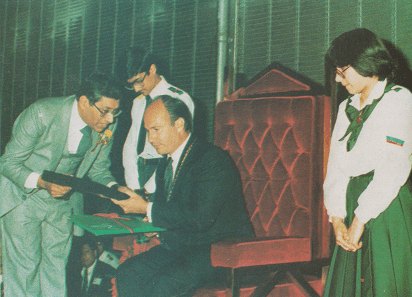
London, 1979: His Highness the Aga Khan, 49th hereditary Imam of the Ismailis and direct descendant of the Prophet Muhammad (s.a.s) receiving Fatimid Gold dinars from Dr. Aziz Kurwa, a long serving leader of the Ismaili community who was at the time President of the Ismailia Association for the U.K.
In our classic series, I Wish I’d Been There, we had asked our readers to pick up one incident in Ismaili History which they would like to have witnessed. One of the thirty-one contributors for the series, Ismaili missionary (Alwaez), teacher and writer Jehangir Merchant, went back 1400 years to the beginnings of Islamic history and imaginatively constructed a picture of the iconic event when Prophet Muhammad (s.a.s) raised the hand of Hazrat Ali (a.s.) and declared, “He of whom I am the Mawla, Ali is also the Mawla!” Based on authoritative sources, this piece by a long-serving Alwaez shows his vast knowledge and flair, and brings alive a pivotal time in human history.
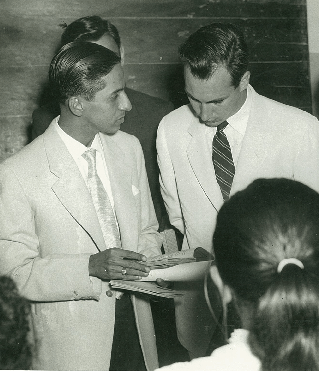
Lourenço Marques, 1958: His Highness the Aga Khan, direct descendant of the Prophet Muhammad (s.a.s.) and current 49th hereditary Imam of the Shia Ismaili Muslims is seen taking a keen interest as Alwaez Jehangir explains the Gujarati history texts that were used to impart religious education to Ismaili youth in Mozambique.
“The measure of the Imam’s achievement can be gauged from the phenomenal progress of the Ismaili Community during the Imam’s regime. The community’s proud position in modern civilization during the course of only about half a century, is a saga of success with probably no parallel in history…the Imam was the architect of this modern miracle…The resurgence of the Ismaili Community, literally from rags to riches, is a fitting monument to the Imam’s indefatigable efforts”
“….The tallest mountain near Mecca is Abu Qubays, which is round like a dome, so that if you shoot an arrow from the foot of the mountain it reaches its top.…Having come into the city, you enter the Haram Mosque, approach the Ka’ba, and circumambulate….. always keeping the Ka‘ba to your left [shoulder]. Then you go to the corner containing the Black Stone, kiss it, and pass on….”
A bird’s-eye view of the Ka’ba crowded with pilgrims. The photo is from the archives of the US Library of Congress and was created by American Colony (Jerusalem), Photo Dept., in 1910. Please click for article by Naser-e Khosraw.
________________ Previous posts in the four-part series (the above is Part III):
In the early 1990’s Michael Wolfe, a prolific American writer and award winning producer of Islamic documentaries including Muhammad: The Legacy of a Prophet, became aware of a string of accounts by Muslims and non-Muslims who over the last one thousand years had gone to Mecca on the pilgrimage. Wolfe’s accounts are collected into a single volume called One Thousand Roads to Mecca, and the first of the twenty-four edited accounts is based on the Book of Travels, a classic text by the famous Ismaili poet, philosopher and traveller Naser-e Khosraw who lived during Islam’s expansive Middle period between the 11th and 14th centuries. The period has also been called the Golden Age of Muslim travel and, as Wolfe notes, Khosraw set the tone for a thousand years of Persian travel writing.
Originally aired on PBS to a word-wide audience exceeding 150 million people
“CANDID, THOUGHTFUL AND VISUALLY STUNNING” – Los Angeles Times
Prophet Muhammad (s.a.s) changed world history in 23 years and continues to shape and inspire the lives of more than 1.4 billion Muslims around the world.
Simerg is pleased to make available for its readers around the world a link to the film, Muhammad: Legacy of a Prophet, that was originally aired on PBS to a world-wide audience exceeding 150 million people. The internet age is a blessing of our time that, through outstanding movies such as this, we are able to learn more about the wonderful and noble qualities of Prophet Muhammad. In his Presidential Address to the Seerat Conference in 1976, His Highness the Aga Khan had asked:
“In the face of this changing world, which was once a universe to us and is now no more than an overcrowded island, confronted with a fundamental challenge to our understanding of time, surrounded by a foreign fleet of cultural and ideological ships which have broken loose, I ask, ‘Do we have a clear, firm and precise understanding of what Muslim Society is to be in times to come?’ And if as I believe, the answer is uncertain, where else can we search then in the Holy Qur’an, and in the example of Allah’s last and final Prophet?”
His Highness continued:
“The Holy Prophet’s life gives us every fundamental guideline that we require to resolve the problem as successfully as our human minds and intellects can visualise. His example of integrity, loyalty, honesty, generosity both of means and of time, his solicitude for the poor, the weak and the sick, his steadfastness in friendship, his humility in success, his magnanimity in victory, his simplicity, his wisdom in conceiving new solutions for problems which could not be solved by traditional methods, without affecting the fundamental concepts of Islam, surely all these are foundations which, correctly understood and sincerely interpreted, must enable us to conceive what should be a truly modern and dynamic Islamic Society in the years ahead.”
Some of these examples from the Prophet’s life come alive through this ground-breaking PBS film, which takes the viewers from the ancient Arabian sites where Prophet Muhammad’s story unfolded to the homes, mosques, and workplaces of some of America’s estimated seven million Muslims. The Los Angeles Times called the film “a candid, thoughtful, flowing, visually stunning film,” while The Catholic News Service commented that the Prophet’s biography offers viewers fresh insights into the spiritual foundations of Islam.
Simerg is grateful to Daniel Tutt of upf.tv for facilitating the showing of the film though this website. We strongly encourage all the viewers to watch the complete film, if not in one seating then by watching the timed segmented clips which will open at the bottom of the viewing window. We are sure you will enjoy this film. Please click:
Readers who wish to watch a preview of the film and other selected clips before viewing the full-length movie are invited to click http://www.muhammadfilm.tv or on the following image:
Please click for links to full length movie and excerpts
“….What we admire in you above all is the fact not that you have a modernised religion, but that you have been able to integrate a modern outlook with religion so that religion has been allowed its true role which is not merely to provide an all-embracing explanation of the universe but also to furnish the fundamental solutions of the problems which life poses us…”
Please click for “Admiration for His Highness the Aga Khan”
“….No one could ever doubt the devotion with which Ali held Muhammad and the many bonds that connected them: Ali was the Prophet’s cousin, the Prophet’s son-in-law, the Prophet’s first male believer, the father of the Prophet’s only male grandchildren, the Prophet’s most intimate disciple and the first heroic warrior champion of Islam. Ali had also served the Prophet as an army commander, missionary, diplomat and administrative secretary…..”
This is an image of Nurin Merchant’s mixed media canvas painting titled “Nature of Prayer.” Secured on the 14″ x 10″ canvas with strong glue are a handmade Tasbih (prayer beads), and 3 dried leaves bearing the Arabic inscriptions of Allah, Ali, and Muhammad. The whole piece represents prayer through the invocation of these names. Copyright: Nurin Merchant. Please click for Barnaby Rogerson’s article.
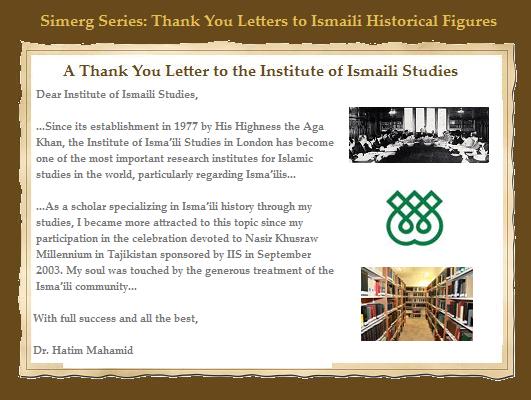
Please click on image to read complete "Thank You" letter.
Note to Readers: Please scroll down or click Home page for other recent posts and click What’s New for links to all articles published on this blog since March 2009. Subscribe to this Website via the box near the top right of this page.



 Simerg - Insights from Around the World