Al-Qaeda, IS and drawing unfortunate parallels with the “so-called Assassins” or Ismailis of the 12th and 13th centuries

Editor’s note: Shortly after the 9/11 attacks in the USA in 2001 which killed almost 3000 people in an instant, numerous articles began to appear in the media around the world that drew parallels between the actions of Al-Qaeda and the warfare activity of the Ismailis during the 12th and 13th centuries that over time grew into fantastic legendary tales. In response to one such column that appeared in the October 8 edition of Canada’s National Post newspaper, Professor Azim Nanji and Dr. Farhad Daftary of the Institute of Ismaili Studies in London contributed the following letter in the newspaper:

“It is unfortunate that the search for historical connections in the aftermath of the terrible events of Sept. 11 has made historical truth itself a casualty. George Jonas’s column, Mortal Enemies Are to be Destroyed (Oct. 8) attempts to draw parallels between the ancient history of the Ismaili Muslims and the actions of these terrorists. In the last 25 years, scholarship, Muslim and Western, has shown the legend about the Assassins to be a fabrication concocted by contemporary enemies of the Ismailis. The Nizari branch of Ismaili Muslims organized a state in Iran and Syria in the 12th and 13th centuries. It flourished for almost two centuries, as a place of learning, scholarship and international influence, in spite of adverse circumstances and militant hostility from its neighbours. These Ismailis were heirs to the Fatimid dynasty that founded Cairo and established the University of Al‑Azhar, acts which represented a truly brilliant epoch in medieval Muslim history However, due to hostility prevailing in political and military spheres, the Ismailis became the object of theological and intellectual attacks, as their society attracted many scholars and scientists to their libraries and observatories. This climate of threat was accentuated by direct military attempts to destroy their centres and communities. It is in this context that their attempts at self‑defence need to be understood. These were directed at political and military figures and never against the general populace: a fact recognized by their enemies. Reporters obsessed with tracing tenuous historical links to current episodes of violence can learn much from history about the rich intellectual and cultural interactions among Muslims, Christians, Jews and others.”

Sporadic responses like the letter above, academic books by Dr. Daftary and the late Dr Peter Willey and many others as well as scholarly articles in journals do not appear to have made any impact in demystifying and debunking the myth of the assassins. Furthermore, the non-availability and non-distribution of important historical and theological works on Ismailis,  in giant brick and mortar stores like Chapters and Indigo in Canada haven’t helped the cause either. There are a number of enjoyable, accessible and easy to comprehend books, produced by the Institute of Ismaili Studies and other academic and non-academic publishers, that should be on bookstore shelves alongside numerous Sunni, Shia and general works on Islam and other religions to counter misperceptions and negative stereotyping about the Ismailis as well as to impart an understanding of the community’s religious doctrines from Ismaili sources.

The plot of the highly popular video game “Assassins’ Creed” which is now available on almost all computer platforms revolves around the legendary “assassins” of the 12th and 13th centuries. The video game, which was created in 2007, was inspired by the 1930’s novel Alamut by the Slovenian writer Vladimir Bartol. New versions of the game have appeared annually since but the 2016 edition has been bypassed to prepare for a greatly enhanced 2017 version. However, a movie version of the video game is planned for release at the end of this year under the title “Assassin’s Creed: The Movie.”

Now, in response to the idea that ISIS or IS (Islamic State) is based on the Assassins, Dr. Farhad Daftary has contributed the following piece for the February 21, 2016, (USA) edition of The Conversation, which has a mission to provide readers with a reliable source of high quality, evidence based information.

Islamic State and the Assassins: reviving fanciful tales of the medieval Orient

By Farhad Daftary, The Institute of Ismaili Studies

Article reproduced from The Conversation

(How do we account for forces and events that paved the way for the emergence of Islamic State? Our series on the jihadist group’s origins tries to address this question by looking at the interplay of historical and social forces that led to its advent.

Today, historian Farhad Daftary debunks the idea that Islamic State is based on the so-called Assassins or hashishin, the fighting corps of the fledgling medieval Nizari Ismaili state).

Many Western commentators have tried to trace the ideological roots of Islamic State (IS) to earlier Islamic movements. Occasionally, they’ve associated them with the medieval Ismailis, a Shiʿite Muslim community made famous in Europe by returning Crusaders as the Assassins.

But any serious inquiry shows the teachings and practices of medieval Ismailis, who had a state of their own in parts of Iran from 1090 to 1256, had nothing in common with the senseless terrorist ideology and ruthless destruction of IS and its supporters.

Attacks on civilians, including women and children, and engaging in the mass destruction of property are forbidden both by Prophet Muhammad and in the tenets of Islamic law. Needless to say, the Ismailis never descended to such terrorist activities, even under highly adversarial circumstances.

Significant discordance exists between the medieval Ismailis and contemporary terrorists, who – quite inappropriately – identify themselves as members of an Islamic polity.

Fanciful Oriental tales

The Ismailis, or more specifically the Nizari Ismailis, founded a precarious state in 1090 under the leadership of Hasan-i Sabbah. As a minority Shi’ite Muslim community, they faced hostility from the Sunni-Abbasid establishment (the third caliphate after the death of the Prophet Muhammed) and their political overlords, the Seljuq Turks, from very early on.

Struggling to survive in their network of defensive mountain fortresses remained the primary objective of the Ismaili leadership, centred on the castle of Alamut (in the north of modern-day Iran). Their state survived against all odds until it was destroyed by the all-conquering Mongols in 1256.

During the course of the 12th century, the Ismailis were incessantly attacked by the armies of the Sunni Seljuq sultans, who were intensely anti-Shiʿite. As they couldn’t match their enemies’ superior military power, the Ismailis resorted to the warfare tactic of selectively removing Seljuq military commanders and other prominent adversaries who posed serious existential threats to them in particular localities.

An agent (fida’i) of the Ismailis (left, in white turban) fatally stabs Nizam al-Mulk, a Seljuk vizier, in 1092. Public domain via Wikimedia Commons

These daring missions were carried out by the Ismaili fidaʾis, who were deeply devoted to their community. The fidaʾis comprised the fighting corps of the Ismaili state.

But the Ismailis didn’t invent the policy of assassinating enemies. It was a practice employed by many Muslim groups at the time, as well as by the Crusaders and many others throughout history.

Unfortunately, almost all assassinations of any significance occurring in the central lands of Islam became automatically attributed to the Ismaili fidaʾis. And a series of fanciful tales were fabricated around their recruitment and training.

These tales, rooted in the “imaginative ignorance” of the Crusaders, were concocted and put into circulation by them and their occidental observers; they’re not found in contemporary Muslim sources.

The so-called Assassin legends, which culminated in Marco Polo’s synthesis, were meant to provide satisfactory explanations for the fearless behaviour of the fidaʾis, which seemed otherwise irrational to medieval Europeans.

The very term Assassin, which appears in medieval European literature in a variety of forms, such as Assassini, was based on variants of the Arabic word hashish (plural, hashishin) and applied to the Nizari Ismailis of Syria and Iran by other Muslims.

In all the Muslim sources where the Ismailis are referred to as hashishis, the term is used in its pejorative sense of “people of lax morality”. There’s no suggestion that they were actually using hashish. There’s no evidence that hashish, or any other drug, was administered to the fida’is, as alleged by Marco Polo.

The literal interpretation of the term for the Ismailis as an “order of crazed hashish-using Assassins” is rooted entirely in the fantasies of medieval Europeans.

Modern scholarship in Ismaili studies, based on the recovery and study of numerous Ismaili textual sources, has now begun to dispel many misconceptions regarding the Ismailis, including the myths surrounding their cadre of fidaʾis.

And the medieval Assassin legends, arising from the hostility of the Sunni Muslims to the Shiʿite Ismailis as well as the medieval Europeans’ fanciful impressions of the Orient, have been recounted and deconstructed.

A culture of learning and tolerance

Living in adverse circumstances, the Ismailis of Iran and Syria were heirs to the Fatimid dynasty that founded the city of Cairo and established al-Azhar, perhaps the earliest university of the world. Although preoccupied with survival, the Ismailis of the Alamut period maintained a sophisticated outlook and a literary tradition, elaborating their teachings within a Shiʿite theological framework.

An entirely fictional illustration from The Travels of Marco Polo showing the Nizari imam Alâ al Dîn Muhammad (1221-1255) drugging his disciples. Public Domain via Wikimedia Commons

Their leader, Hasan-i Sabbah, was a learned theologian. And the Ismaili fortresses of the period, displaying magnificent military architecture and irrigation skills, were equipped with libraries holding significant collections of manuscripts, documents and scientific instruments.

The Ismailis also extended their patronage of learning to outside scholars, including Sunnis, and even non-Muslims. They were very tolerant towards other religious communities.

In the last decades of their state, in the 13th century, even waves of Sunni Muslims found refuge in the Ismaili fortress communities of eastern Iran. These refugees were running from the Mongol hordes who were then establishing their hegemony over Central Asia.

All this stands in sharp contrast to the destructive policies of IS, which persecutes religious and ethnic minorities and enslaves women.

The medieval Ismailis embodied qualities of piety, learning and community life in line with established Islamic teachings. These traditions continue in the modern-day Ismaili ethos. And the present-day global Ismaili community represents one of the most progressive and enlightened communities of the Muslim world.

The Ismailis have never had anything in common with the terrorists of IS, who murder innocent civilians at random and en masse, and destroy monuments of humankind’s shared cultural heritage.

Global terrorism in any form under the banner of Islam is a new phenomenon without historical antecedents in either classical Islamic or any other tradition. IS’s ideology reflects a crude version of the intolerant Wahhabi theology expounded by the Sunni religious establishment of Saudi Arabia, which is itself a narrow perspective that fails to recognise any pluralism or diversity of interpretations in Islam.

Date posted on Simerg: Monday, February 29, 2016.
Last updated: March 1, 2016 (12:50 EST).

_______

This is the fifth article in The Conversation website’s series on the historical roots of Islamic State. Look out for more stories on the theme in the coming days on The Conversation website.

This article by Dr. Farhad Daftary was originally published on The Conversation. Read the original article.

Simerg welcomes your feedback. Please click Leave a comment.

35 Historical and Rare Photos of His Highness the Aga Khan by “Papa Jaan” On One Image

Please click on the following image to zoom on an excellent PDF version of the photo

Please click on image to view PDF file. Copyright Simerg/Abdul M. Ismaily Family Collection.

Please click on image to view PDF file. Copyright Simerg/Abdul M. Ismaily Family Collection.

Simerg was thrilled and privileged to recently publish on its sister photoblog never-before-seen photos of Mawlana Hazar Imam, His Highness the Aga Khan, which were captured by Abdul M. Ismaily (1926-1981) during Hazar Imam’s visits to Hunza, Uganda and Pakistan in the early 1960’s. The collection was provided for exclusive publication on Simerg by the family of the late “Papa Jaan,” through Muslim Harji of Montreal.

We pay a small tribute to the memory of “Papa Jaan” for his outstanding photos by presenting a PDF image (click image on top) which contains 35 images from more than fifty that appeared in the Hunza, Uganda and Pakistan pieces. First time visitors to this website as well as readers who may have overlooked one or more photo posts are invited to click on the following links:

Copyright. Simerg.

Date posted: February 23, 2016

________________

We welcome your feedback. Please click Leave a comment

Egyptian President al-Sisi Meets His Highness the Aga Khan and Hails AKDN’s Work + Memorial Photo

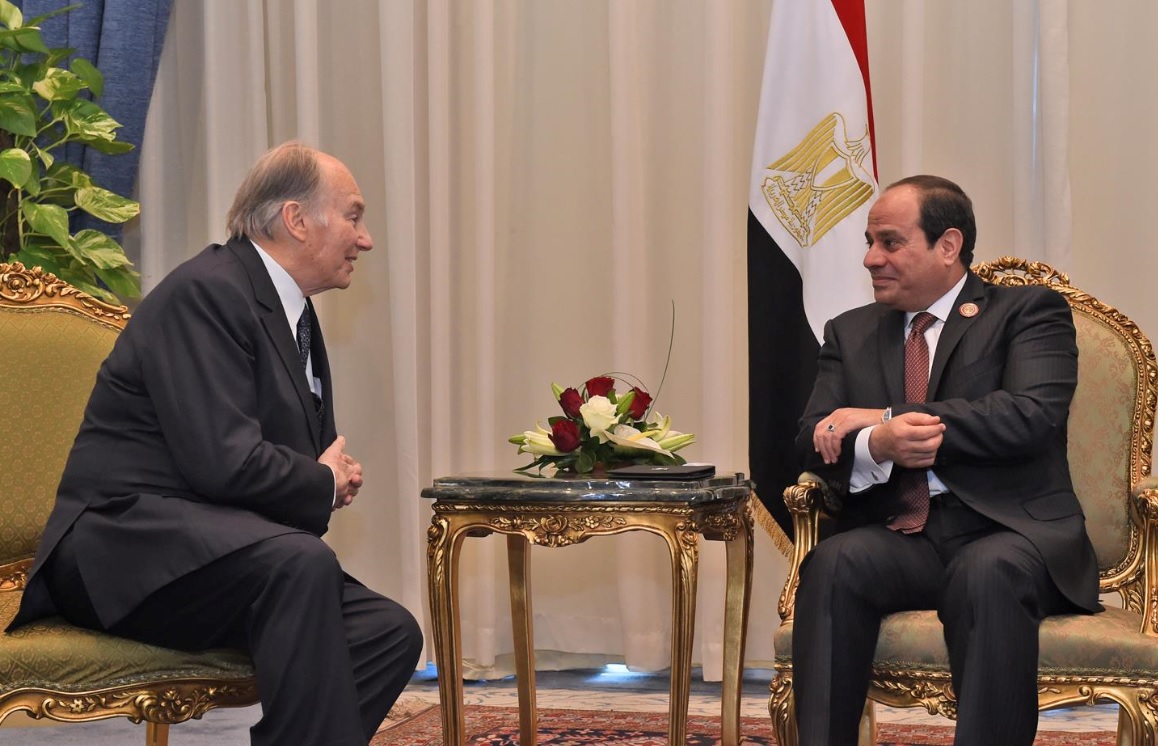
Alaa Youssef, spokesperson for President Abdel Fattah al-Sisi, said that the President met with Mawlana Hazar Imam, His Highness the Aga Khan, on Saturday, February 20, 2016,  and hailed the positive role played by the Aga Khan Development Network (AKDN) which he considered as an example of non-governmental organizations contributing to development in the society and creating jobs. President Sisi also praised the AKDN’s efforts in Egypt, especially in the area of childhood development. [1]

Please click on photos to enlarge

Mawlana Hazar Imam, His Highness the Aga Khan, pictured with Egypt's President al-Sisi on February 20, 2016. Photo Credit: The Egyptian Presidency.

Mawlana Hazar Imam, His Highness the Aga Khan, pictured with Egypt’s President al-Sisi on February 20, 2016. Photo Credit: The Egyptian Presidency.

The 49th Ismaili Imam said that he was looking forward to boosting the Network’s activities in various Egyptian cities, referring to AKDN’s projects in Aswan. He added that the foundation plans to finance more projects for the needy segments, especially in the health and educational sectors. His Highness the Aga Khan was in Egypt to deliver the keynote address at the Africa 2016 investment forum in Sharm el Sheikh. Thematic excerpts of the speech will appear on this website during the week of February 22, 2016.

Egyptian President Abdel Fattah al-Sisi (C) takes a memorial photo with other heads of state and government and the participating delegations during the Africa 2016 Business for Africa, Egypt and the World Forum in the Red Sea resort of Sharm el-Sheikh, Egypt, February 20, 2016. His Highness the Aga Khan is pictured second from right in the front row. The 49th Ismaili Imam will be giving a key note speech at the forum on Sunday, February 21, 2016 at approximately 9:00 am (Cairo Time). Photo Credit: The Egyptian Presidency.

Egyptian President Abdel Fattah al-Sisi (C) takes a memorial photo with other heads of state and government and the participating delegations during the Africa 2016 Business for Africa, Egypt and the World Forum in the Red Sea resort of Sharm el-Sheikh, Egypt, February 20, 2016. His Highness the Aga Khan is pictured second from right in the front row. The 49th Ismaili Imam will be giving a key note speech at the forum on Sunday, February 21, 2016 at approximately 9:00 am (Cairo Time). Photo Credit: The Egyptian Presidency.

Egyptian President Abdel-Fattah El-Sisi delivers his speech during the opening session of the African international business forum in the Red Sea resort of Sharm El-Sheikh in the South Sinai governorate of Egypt, 20 February 2016. Photo Credit: The Egyptian presidency.

Egyptian President Abdel-Fattah El-Sisi delivers his speech during the opening session of the African international business forum in the Red Sea resort of Sharm El-Sheikh in the South Sinai governorate of Egypt, 20 February 2016. Photo Credit: The Egyptian presidency.

We invite our readers to click on the following exclusive pieces published recently at Simergphotos:

Date posted: February 20, 2016.
Last updated: February 21, 2016.

_________

[1] Report compiled from the website of Egypt’s State Information Service, http://www.sis.gov.eg/en/.

Pakistan Visit 1961: Exclusive Photos of His Highness the Aga Khan, Mawlana Hazar Imam, by Abdul M. Ismaily

PLEASE CLICK: Exclusive: Photos of Mawlana Hazar Imam’s Visit to Pakistan by the Late Abdul M. Ismaily (“Papa Jaan”)

Please click on image for exclusive photos by Abdul M. Ismaily

Please click on image for exclusive photos by Abdul M. Ismaily

Date posted: February 20, 2016.

____________

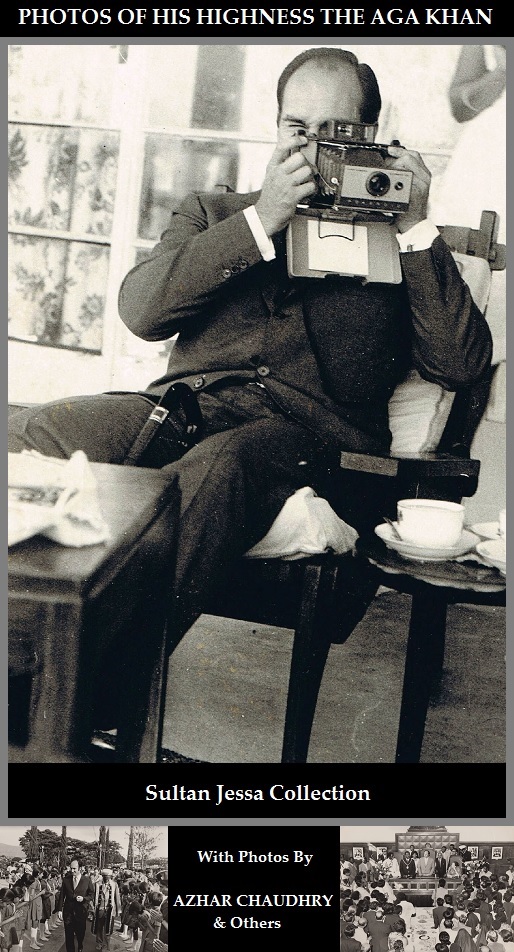
Sultan Jessa Collection: Photos of Mawlana Hazar Imam, His Highness the Aga Khan, by Azhar Chaudhry & Others

PLEASE CLICK: Photos of His Highness the Aga Khan’s Visits to East Africa by Azhar Chaudhry

Please click on image for photos by Azhar Chaudhry & others

Please click on image for photos by Azhar Chaudhry & others

Date posted: February 17, 2017.

__________________

An Anecdote Illustrating the Wisdom and Judgement of His Highness the Aga Khan: “I was Serving No Ordinary Man” by the Late Michael Curtis

Aga Khan Photos by Azhar Chaudhry - 004

His Highness the Aga Khan being greeted by Mr. Michael Curtis of the Nation Group. Photo: Azhar Chaudhry. Sultan Jessa Collection.

Mr. Michael Curtis, a British Fleet Street editor and executive, was introduced to Mawlana Hazar Imam, His Highness the Aga Khan, just as he had been proclaimed the 49th Ismaili Imam by his grandfather, Imam Sultan Mahomed Shah, His Highness the Aga Khan III.  His recruitment as a staff of His Highness was intended as a short term assignment as a speech writer and publicity organizer during a series of public appearances in Asia and Africa related to the Aga Khan’s installation as Imam. This brief assignment, however, grew into an engagement with His Highness that spanned several decades. The visionary Michael Curtis — who was noted by UK’s Guardian Newspaper as being 50 years ahead of his time in the paper’s obituary to the journalist — was asked to establish the Nation Media Group, which started publishing the Sunday Nation and subsequently the Daily Nation in Kenya, competing successfully with the existing colonial newspapers, the Tanganyika Standard and the East African Standard. At the culmination of the process of Africanising the Nation Group, Michael Curtis stepped down in 1977, after pioneering the introduction of the first web-offset presses installed outside the United States as well as increasing the Nation’s circulation to 165,000 and a readership reputed to touch three million.

Mr. Curtis moved to His Highness the Aga Khan’s Headquarters in Aiglemont, France, where he oversaw the Ismaili Imamat’s rapidly expanding non-denominational health and educational activities throughout South Asia and East Africa, until his retirement in 1994.

Michael Howard Curtis, who was born in Cambridge in 1920, died from cancer in 2004 at the age 84.

The following is an excerpt from a piece written by Mr. Michael Curtis for the Daily Nation’s special souvenir published on the occasion of His Highness the Aga Khan’s wedding in 1969 to Princess Salimah.

“I was Serving No Ordinary Man”

BY MICHAEL CURTIS (1920 – 2004)

It was 12 years ago in Dar-es-Salaam in October 1957. Prince Karim, His Highness the Aga Khan, was to be installed as successor to his grandfather in the first of a series of elaborate ceremonies to be held that year throughout Africa and Asia.

As personal aide to His Highness, I had gone ahead as part of an advance party and was greeted by the local leaders who told me that a serious problem had arisen. The only other such ceremony in living memory had taken place 72 years before in Bombay, when Aga Khan III had succeeded to the Imamate.

Not surprisingly, there was some doubt about the form the service would take and it seemed that an acute difference of opinion had arisen as to which verses of the Koran should be included. There was clearly nothing to be done but to await a ruling from the Aga Khan himself.

It was an unforgettable scene and took place in one of the state rooms of Government House where the Aga Khan was guest of the Colonial Governor at that time, the late Lord Twining. The Ismaili leaders were seated, as is their custom, cross-legged in a semi-circle around their young Imam and the two factions elaborated their different points of view.

To a non-Muslim the arguments were difficult to follow, but it was clear to me that a strong difference of opinion existed and that the Aga Khan would be called upon to resolve a ticklish point of theological doctrine.

This was the first occasion on which he had been called to exercise the responsibilities bequeathed to him by his grandfather. Still an undergraduate at Harvard, he looked very young, a trifle pale and tense as he listened to the rival claimants. There was a pause as they finished. Then the Aga Khan asked a question which obviously puzzled his followers. “Who,” he asked, “will recite the verses you wish me to decide upon?”

A chorus of voices assured him that a young man from Zanzibar had been procured for the recitation and that his fame as a psalmodist of the Koran was acclaimed far and wide.

“If that is so,” said His Highness, “let this young man suggest those verses in which his ability is most outstanding and thereafter I shall decide which particular chapters and verses will be selected.”

It was a solution that delighted everyone. The opposing factions accepted it gladly, for neither had lost face. The choirboy for certain would sing as he had never sung before — which in truth he did the following afternoon. It was a decision which reflected the instinctive simplicity of true wisdom and first revealed to me that I was serving no ordinary man.

I have related this tale before, and if I repeat it today it is because I know of no other anecdote which more aptly illustrates his wisdom and judgement.

Date posted: February 15, 2016.

____________

Profile of Mr. Michael Curtis compiled from Wikipedia, The Guardian and the Daily Telegraph. Please click on https://en.wikipedia.org/wiki/Michael_Curtis_(journalist), and the references cited in the article.

Uganda: Exclusive Photos of Mawlana Hazar Imam, His Highness the Aga Khan, by Abdul M. Ismaily (“Papa Jaan”)

PLEASE CLICK: Exclusive: Photos of Mawlana Hazar Imam’s Visit to Uganda by the Late Abdul M. Ismaily (“Papa Jaan”) 

Please click on image for more photos by "Papa Jaan" of His Highness the Aga Khan's visit to Uganda. Photo: Abdul M. Ismaily. Copyright.

Please click on image for more photos by “Papa Jaan” of His Highness the Aga Khan’s visit to Uganda. Photo: Abdul M. Ismaily. Copyright.

Editor’s Note: Following our recent posting of the late Abdul Mohamed Ismaily’s photographs of His Highness the Aga Khan’s historical first visit to Hunza in 1960, we now present you a collection of his photographs taken in Uganda. Please share this website with your family and friends via email and the social media. We thank our readers for their excellent response to the Hunza photos, and welcome your feedback by completing the applicable comments box or by sending an email to simerg@aol.com.

PLEASE CLICK: Exclusive: Photos of Mawlana Hazar Imam’s Visit to Uganda by the Late Abdul M. Ismaily (“Papa Jaan”) 

Date posted: February 14, 2016.

____________

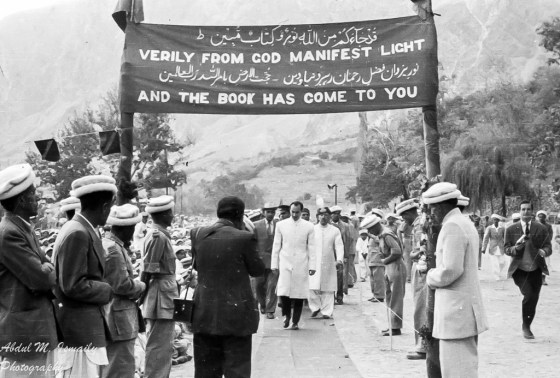
For Hunza photos, please click Exclusive: Photos of Mawlana Hazar Imam’s 1960 Visit to Hunza by the Late Abdul M. Ismaily (“Papa Jaan”)

Special Series: Exclusive Photos of His Highness the Aga Khan by “Papa Jaan”

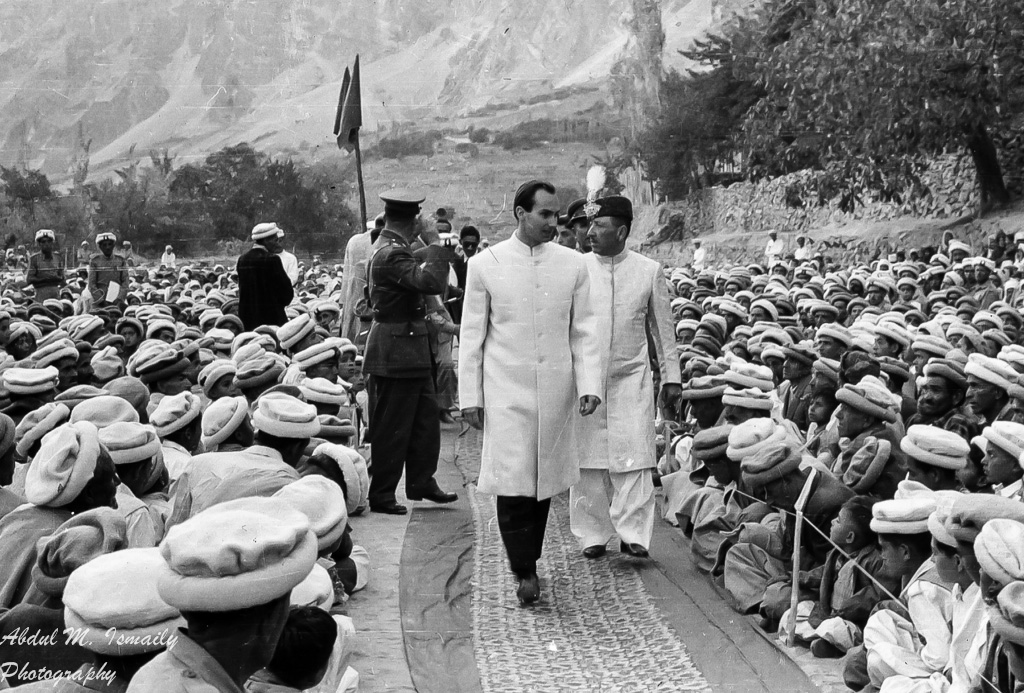
PLEASE CLICK: Exclusive: Photos of Mawlana Hazar Imam’s 1961 Visit to Hunza by the Late Abdul M. Ismaily (“Papa Jaan”)

Photo: Abdul M. Ismaily. Copyright. Please click on image for more photos.

Photo: Abdul M. Ismaily. Copyright. Please click on image for more photos.

Editor’s Note: Over the coming weeks Simergphotos, the sister blog of this literary website, will be publishing historical photos of His Highness the Aga Khan that were captured by the late Abdul Mohamed Ismaily, lovingly known to his family and friends as “Papa Jaan.” A passionate amateur photographer, Mr. Ismaily followed His Highness and his entourage during the Ismaili Imam’s visits to his followers in Hunza, Kampala, and Dar-es-Salaam.

"Papa Jaan"

“Papa Jaan”

Papa Jaan passed away in 1981 at the age of 55, and his photos remained part of his estate. They have been reproduced here with the permission of his family. We commence the series with Mr. Ismaily’s photos of Mawlana Hazar Imam’s visit to Hunza in 1961, which also includes a  rare anecdote by a journalist who accompanied  His Highness to Hunza. Please click Exclusive: Photos of Mawlana Hazar Imam’s 1961 Visit to Hunza by the Late Abdul M. Ismaily (“Papa Jaan”)

~~~~~

NEXT: PHOTOS OF HIS HIGHNESS THE AGA KHAN IN UGANDA

Mawlana Hazar Imam, His Highness the Aga Khan, arriving at Kampala's Entebbe Airport. Photo: Abdul M. Ismaily ("Papa Jaan"). Copyright,

Mawlana Hazar Imam, His Highness the Aga Khan, arriving at Kampala’s Entebbe Airport. Photo: Abdul M. Ismaily (“Papa Jaan”). Copyright,

1957-1958 Photos: His Highness the Aga Khan and Prince Aly Khan in Lourenço Marques + Forthcoming @Simergphotos

PLEASE CLICK: Photos of Visits by Mawlana Hazar Imam and Prince Aly Khan to Mozambique in the late 1950’s

Prince Aly Khan, Lourenco Marques, 1957Please click image for more photos

~~~~~

Forthcoming Photo Essays at Simergphotos

EXCLUSIVE PHOTOS BY PAPA JAN: HUNZA AND UGANDA 
(from Muslim Harji Collection, to be published week of Monday, February 8, 2016)

Please click on photos for enlargement

Papa Jan Photo: His Highness the Aga Khan Hunza VisitHunza. Photo by Papa Jan (late Abdul Mohamed Ismaily). Copyright.

~~~~~

EXCLUSIVE PHOTOS BY AZHAR CHAUDHRY
(from Sultan Jessa Collection, to be published week of Monday, February 15, 2016)

Photo: Azhar Chaudhry. Copyright

Nairobi, Kenya. Photo: Azhar Chaudhry. Copyright.

Date posted: Saturday, February 6, 2016.

______________

We invite readers to submit historical photos in their collection for publication on this web site and its sister blog, http://www.simergphotos.com. Please write to the editor, Abdulmalik Merchant, at simerg@aol.com.


In London Conference, His Highness the Aga Khan, 49th Ismaili Imam, Calls for ‘Islands of Stability’ in War-Torn Syria

In remarks made at an International Conference under the theme “Supporting Syria and the Region Conference”, in London, England, Mawlana Hazar Imam, His Highness the Aga Khan, today called for the establishment of ‘islands of stability’ in war-ravaged Syria that could provide areas of relative safety in the midst of conflict. The conference, co-hosted by Germany, Kuwait, Norway, the United Kingdom and the United Nations. was attended by representatives from sixty countries, including 30 world leaders.

“The situation in Syria is a close to hell as we are likely to find on this earth,” said UN Secretary General Ban Ki-moon. Referring to the Geneva meeting between the Syrian Government and the opposition parties that had broken down just a day earlier, he said the talks were “undermined by the continuous lack of sufficient humanitarian access, and by a sudden increase of aerial bombings and military activities within Syria”. He urged the warring sides to “get back to the table, not to secure more gains on the battlefields”.

Aga Khan 2016 Support Syria Conference London

Deploring the devastation in war-ravaged Syria, Mawlana Hazar Imam, His Highness the Aga Khan, called for the establishment of “islands of stability” to provide areas of relative safety in the midst of conflict. The 49th Shia Ismaili Imam, pledged $200 million towards achieving peace, stability, and reconstruction in the country.

The British Prime Minister, David Cameron, said that “if ever there was a moment to take a new approach to the humanitarian crisis in Syria surely it is now,” mentioning the huge number of Syrians who “fear they have no alternative than to put their lives in the hands of evil-people smugglers in search of a future”.

The following are the transcript and video of the remarks made by His Highness the Aga Khan at the Supporting Syria and the Region Conference.

Bismillah-ir-Rahman-ir-Rahim

Co-hosts of the Conference on Supporting Syria and the Region,

Excellencies,

Ladies and gentlemen,

I thank the co-hosts for organising this much-needed initiative to deepen the understanding of, and garner international support for the peoples of Syria, Alongside all those present here today, I am deeply distressed over the indiscriminate and widespread devastation of life and property, including that of irreplaceable cultural assets which are the manifestation of Syria’s stunningly rich pluralistic history.

The Aga Khan Development Network (AKDN), which is the Ismaili Imamat’s global agency for supporting development, is fully engaged with the peace process under UN leadership, and is firmly committed to helping build a Syria that continues to respect pluralism, remains secular, and embarks on a political process led by Syrians.

AKDN’s development and humanitarian work in Syria began many years before the war. In the present situation, we have committed resources and efforts to ensure that Internally Displaced People receive humanitarian assistance, and are supported to sustain their livelihoods. We are taking two approaches:

First, we are supporting local community leaders, teachers, doctors, engineers and others to foster stability, protecting their families and their communities. We are thus building and strengthening civil society to take as much responsibility as possible for their own future.

Second, we are investing in communities, by supporting agriculture, income generation, early childhood education, schools, and hospitals. We also provide vocational training to create skills. Our goal is to sustain hope.

We aim to meet the urgent needs of the present, but where also possible to protect and strengthen the foundations for the future. We seek to create “islands of stability”, where there is public consensus, in the face of war. It is my conviction that “islands of stability” can be replicated wherever security permits. Investing in them will help prevent displacement of people and anchor communities that would otherwise flee as refugees.

Since the onset of conflict in 2011, AKDN has dedicated $50 million towards these endeavours in Syria and is now committing to increasing this investment to $200 million over the next four years. Our efforts will expand to wider areas of the country. Our goal is peace, stability, and reconstruction.

Thank you.

_________________

Date posted: February 4, 2016.