Simerg is an independent initiative dedicated to Ismaili Muslims, the Aga Khan — their Hereditary Imam — and the Ismaili Imamat, and Islam in general through literary readings, photo essays and artistic expressions
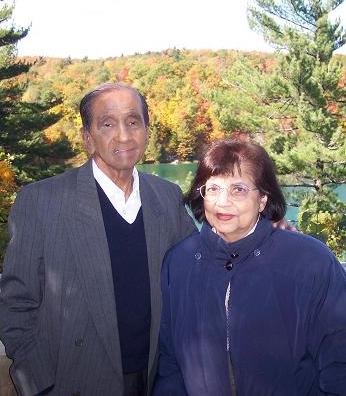
Alwaez Jehangir and Alwaeza Maleksultan Merchant pictured at Gatineau Park during their visit to Ottawa in 2007.
Thursday May 27, 2021, will be the 3rd anniversary of the passing of Jehangir Merchant (December 13, 1928 – May 27, 2018), father of Malik (publisher and editor of this website), Fahar and his wife Nina, Alnoor and his fiance Shellina; grandchildren Naim and Nurin; and sister Banu. Our mother and grandmother, Maleksultan (popularly known as Mrs. Merchant), who was our dad’s partner of 66 years, was then still alive; she passed earlier this year on January 21, 2021. This website was launched twelve years ago in the spring of 2009 with their encouragement, guidance and support. The first piece published in Simerg was entitled The Mystery of the Missing Mount Nasir Khushraw.
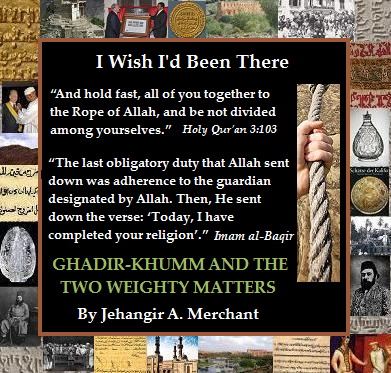
Among several articles by my dad that were published on Simerg, two original contributions that absolutely stand out and are a must read are (1) a letter of gratitude to his greatest hero in Ismaili history, the Fatimid missionary Muayyad din Shirazi and; (2) Ghadir Khumm and the Two Weighty Matters for the acclaimed series I Wish I’d Been There. Please read the two pieces by clicking on the hyperlinks I have provided in the preceding sentence or on the two images shown below.
Please click on image to read Jehangir A. Merchant’s thank you letter to Fatimid missionary Al-Mu’ayyad al-Shirazi
*******
Please click on image to read Jehangir A. Merchant’s “Ghadir-Khumm and the Two Weighty Matters”
We fondly remember our parents and grandparents, and pray for the eternal peace of their souls. Ameen.
Simerg’s series entitled “Books by Ismaili Authors” continues with Canadian writer Azmina Suleman’s book “In the Name of Justice – Portrait of a ‘Cowboy’ Judge.” We follow the same Q/A format as our recent presentations of books written by Alnasir Rajan, Shafeen Ali, Mansoor Ladha, Zeni Shariff and Shamas Nanji. We encourage Ismaili authors to participate in this series, regardless of when their books were published. See details of the series HERE and submit your responses to the editor of Simerg, Malik, at Simerg@aol.com.
****************
Simerg: What is behind the naming of the title of the book?
Azmina Suleman: A man of honor, principle and great personal integrity, James Valentine Hogarth Milvain’s name was often synonymous with ‘Justice’ in Alberta. He was appointed judge of the Alberta Supreme Court in 1959 and Chief Justice in 1968. Known for his ready wit, wisdom and innate ‘horse sense,’ Milvain was also popularly dubbed the ‘Cowboy Judge’ where his ranching background kept him close to people, and where ethics and morality guided him in everything he did.
Simerg: Why would you want me or my family members to read the book, and what will we all learn from it?
Azmina: The book reads like an ‘oral’ judgment. Its tone and text has been kept deliberately simple and free of ‘legal jargon’ so even the ordinary man on the street not necessarily well-versed in the law can appreciate Alberta’s law and its early history – the hardships, courage and tenacity of the early pioneers who helped open up the ‘old West’ in Canada.
Simerg: What inspired you to write the book?
Azmina: I actually had the privilege of knowing Milvain for a short period of time Yet, he managed to leave a lasting impression on my mind – more for his humility, compassion and ‘common touch’ than his formidable list of legal accomplishments. After graduating from journalism, I felt inspired to write about this outstanding human being whom I genuinely admired and respected, and simply called ‘Uncle Val.’ I may note that in 1987 Justice Milvain was appointed an Officer of the Order of Canada.
Article continues below
Cover of Azmina Suleman’s “In the Name of Justice — Portrait of a ‘Cowboy’ Judge,” pp. 316, available in Hardback.
Simerg: How can I purchase the book and what are its available formats?
Simerg: How did you find a publisher for the book?
Azmina: The book was published through LASA and printed in Canada.
Simerg: Did you hire an editor, an illustrator or did you do all the work by yourself?
Azmina: The book was professionally edited, but I created the cover myself and had some help formatting the manuscript itself.
Simerg: Which was your first book and how many have you written?
Azmina: I have written two books: My first book “In the Name of Justice – Portrait of a ‘Cowboy’ Judge,” that is being highlighted in this post, was published in 1998.My second book: “A Passage to Eternity – A Mystical Account of a Near-Death Experience and Poetic Journey into the Afterlife” was published in 2004.
Simerg: How long did it take you to write In the Name of Justice — from start to finish and to begin marketing it?
Azmina: Approximately 4 to 5 years from start to finish.
Simerg: Tell us something more about the book and its main character.
Azmina: Justice Milvain was born in 1904 on a ranch in Southern Alberta during the days of the pioneers, legendary cowboy, horse-buggy and itinerant country doctor. From his humble farm beginnings to his slow rise in the legal profession in Calgary, Milvain became known for his special no-nonsense brand of ‘western’ justice and practical landmark decisions, which went beyond the mere letter of the law to invoke its true spirit while administrating justice in the ‘wild and woolly West.’ Milvain’s passing away in 1993 served as a stark reminder of the fact that a material part of Alberta’s living history was slipping away. Consequently, this book now forms a part of the oral and written history of Alberta. To put it in Milvain’s own words: “Without the written or spoken word, it is not possible that wisdom and knowledge can be passed on to others.”
Date posted: April 28, 2021.
_______________________
Azmina Suleman
Azmina Suleman was born and educated in Nairobi, Kenya and moved to England to complete her post-secondary education, before immigrating to Canada in the early 1980’s. She has a Master’s degree in legal history and is a published author and journalist. She lives in Calgary, Alberta.
_____________________
CALLING ALL ISMAILI AUTHORS
We encourage Ismaili writers to introduce their books in a similar format as has been done in the post above. Please also see the series launch article and submit your responses to Malik at Simerg@aol.com. All submissions will be acknowledged. If a writer has published multiple books, each book will be highlighted in a separate article, and not combined with other books into one post. All writers should include a brief profile with a portrait photo.
The Ismaili Authors’ Series so far (in chronological sequence, oldest article first):
We welcome feedback from our readers. Please complete the LEAVE A REPLY form below or click Leave a comment. Your letter may be edited for length and brevity, and is subject to moderation.
Before departing this website please take a moment to review Simerg’s Table of Contents for links to hundreds of thought provoking pieces on a vast array of subjects including faith and culture, history and philosophy, and arts and letters to name a few. Also visit Simerg’s sister websites Barakah, dedicated to His Highness the Aga Khan, and Simergphotos.
Simerg’s series entitled “Books by Ismaili Authors” continues with Canadian writer Alnasir Rajan’s book “Invisible Birthmarks.” We follow the same Q/A format as our recent presentations of books written by Shafeen Ali, Mansoor Ladha, Zeni Shariff and Shamas Nanji. We encourage Ismaili authors to participate in this series, regardless of when their books were published. See details of the series HERE and submit your responses to the editor of Simerg, Malik, at Simerg@aol.com.
****************
Simerg: What is behind the naming of the title of the book?
Alnasir Rajan:Invisible Birthmarks – This is a unique name for the simple reason that it captures the essence of the characters in my book. These characters lived through some of the most horrid times and their pain and scars are in most cases hidden from the rest of the world, they are Invisible. So, I called it ‘Invisible Birthmarks’ because pain is not a visible scar. It lives in the heart, in the eyes and in the memory. Sharing it through stories brings it to light.
Simerg: Why would you want me or my family members to read the book, and what will we all learn from it?
Rajan: Most families have been through migration. However, the places they settled into, did not always be their destination homes, even though their families lived there for generations. Similar stories of such migrants who lived for generations in Zanzibar had to flee for their lives. However, the regimes in Zanzibar at the time were restricting any form of travel while persecuting the minorities. This resulted in loss of lives and people found creative ways of getting off the island. You will always relate to the characters as you read through my book. This is not a history of my family.
Simerg: What inspired you to write the book?
Rajan: I was always writing short stories and just let them gather dust. However, after moving from Tanzania for 18 years and residing in Kenya and studying there, fate took me back to Dar es Salaam. I had some old friends and I met some new friends who inspired me to write a book to honor people who had no choice, no voice and no hand it what transpired during their struggles in Zanzibar. I had never been exposed to real life tragedies. It was a calling.
Article continues below
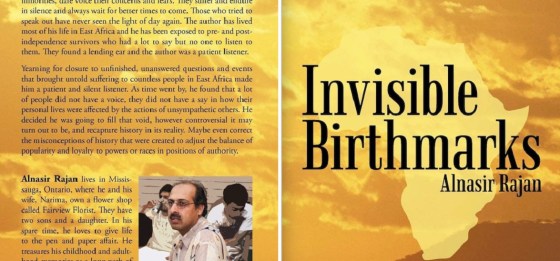
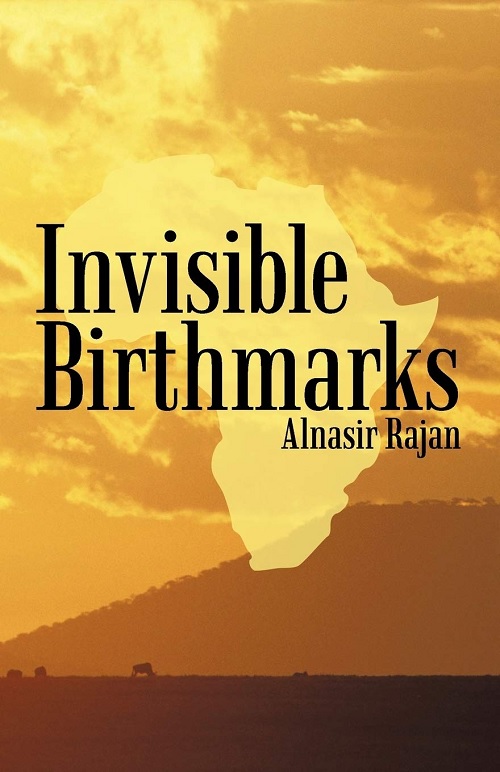
Cover of Alnasir Rajan’s “Invisible Birthmarks,” pp. 236, available in Soft and Hardbacks as well as Ebook formats.
Simerg: How can I purchase the book and what are its available formats?
Rajan: They are available in Paperback, Hard cover and eBook formats. I am contemplating to get an Audiobook version created as that seems the future of readership for me. This book is available from all online book sellers including iUniverse and Amazon.
Simerg: How did you find a publisher for the book?
Rajan: Traditional publishers are very difficult to please. They kept returning my manuscript saying it was not a Canadian content. I have no idea what that meant. So, I opted for a self-publishing route because it is a very fast process of getting a publication online.
Simerg: Did you hire an editor, an illustrator or did you do all the work by yourself?
Rajan: I did all the writing by myself. I hired an editor but because my book had some Kiswahili language in it, I had to make sure that it was not edited out by error. I had to read the edited version over and over for this reason. The self-publishing company that I had to pay dearly, did the cover page and some esthetics like selecting the images and preparing the book descriptions etc.
Simerg: Which was your first book and how many have you written?
Rajan:Invisible Birthmarks is my first book about the survival of minorities in the pre and post independent Zanzibar. My second book is Unfolding Africa which is a story of my family’s migration history from India to Africa in 1897 and the shared history of the generations that followed.
Simerg: How long did it take you to write Invisible Birthmarks — from start to finish and to begin marketing it?
Rajan: When I came to Canada on 15th November 1995, I already had a hand written manuscript that was very raw. The journey to rewrite it began while I was working in Canada and it came into fruition after 15 years in 2010. I went through a learning process. I realized writing a book is just like any other job. You have to sit and work.
Simerg: Tell us something more about the book and its main character(s).
Rajan: Some of the people I met when I returned to Dar-es-salaam, Tanzania after 18 years, were originally from Zanzibar. How they ended up living in Dar-es-salaam became an interesting topic but one which was full of sadness. I listened to many people and I realized that tragedies had happened in our beloved Zanzibar that no one was talking about. It was like a dark phase no one was ready to talk about. People in Tanzania are very forgiving. But the pain still exists. I began writing down these events and the writing bug in me was awakened. I had to share these stories with the rest of the world.
Shiraz is one of the main characters who faced rejection from family and society. He is a very humble person with no bitterness as he still loves his homeland Zanzibar. In my book, I have mentioned Ramzan Bhaloo who was from Zanzibar. Before he came to Canada, he was the care-taker of the Mombasa Ismaili Rest house. A very popular and loved man. Mohammed Meghji is also mentioned in my book. He had shared some of his experiences. I used their struggles and the struggles of some other families to show in totality what the system did to harm them as a minority. I have not used any real names of my friends as characters as the characters are a combination of several characters. However, I tried to do justice by relaying a shared history of sufferings that the surviving families told me about. It is never enough to write about it, but at least it is a start.
Date posted: April 13, 2021.
_______________________
Alnasir Rajan
Alnasir Rajan lives in Mississauga, Ontario, Canada where he and his wife, Narima, own a flower shop called Fairview Florist. They have two sons and a daughter. In his spare time, he loves to give life to the pen and paper affair. He treasures his childhood and adulthood memories as a long path of learning.
_____________________
CALLING ALL ISMAILI AUTHORS
We encourage Ismaili writers to introduce their books in a similar format as Shafeen Ali, Mansoor Ladha, Zeni Shariff and Shamas Nanji have done in their respective interviews. Please also see the series launch article and submit your responses to Malik at Simerg@aol.com. All submissions will be acknowledged. If a writer has published multiple books, each book will be highlighted in a separate article, and not combined with other books into one post. All writers should include a brief profile with a portrait photo.
The Ismaili Authors’ Series so far (in chronological sequence, oldest article first):
We welcome feedback from our readers. Please complete the LEAVE A REPLY form below or click Leave a comment. Your letter may be edited for length and brevity, and is subject to moderation.
Before departing this website please take a moment to review Simerg’s Table of Contents for links to hundreds of thought provoking pieces on a vast array of subjects including faith and culture, history and philosophy, and arts and letters to name a few. Also visit Simerg’s sister websites Barakah, dedicated to His Highness the Aga Khan, and Simergphotos.
Shiraz Bandali of Edmonton, Canada, passed away at the age of 56. A passionate photographer, he captured “DOORS” during a family trip to Morocco, Portugal and Spain, and shared them with Simergphotos. We pay a tribute to Shiraz through his beautiful collection. Please click DOORS or on the image below.
“DOORS” by Shiraz Bandali. Please click on image to see collection.
Simerg’s series entitled “Books by Ismaili Authors” continues with USA based Shafeen Ali’s acclaimed book “To be One with God: Seven Journeys to the Meaning of Life,” in the same Q/A format as our recent presentations of books written by Mansoor Ladha, Zeni Shariff and Shamas Nanji. We encourage Ismaili authors to participate in this series, regardless of when their books were published. See details of the series HERE and submit your responses to the editor of Simerg, Malik, at Simerg@aol.com.
****************
Simerg: What is behind the naming of the title of the book?
Shafeen Ali: Imam Sultan Mahomed Shah’s following quote was my inspiration: “A man must be at one with God. … how we stand this instant and every instant toward Him matters to us more than anything else in the universe. That is the fundamental question:- Are you in harmony with God? If you are – you are happy.” [1]
Simerg: Why would you want me or my family members to read the book, and what will we all learn from it?
Ali: It is my aspiration that anyone who sincerely gives themselves to this book will find oneness with God, for a moment, if not a lifetime. This has been the experience of many of the book’s reviewers. I myself read the book when I feel despair or distant from God.
Simerg: What inspired you to write the book?
Ali: I had been married for 18 months and happy materially. But one evening, late at night, I was awakened with a feeling that I was not fulfilling my purpose in life. That night began an inner search which reached one milestone in the publishing of this book, six years later.
Article continues below
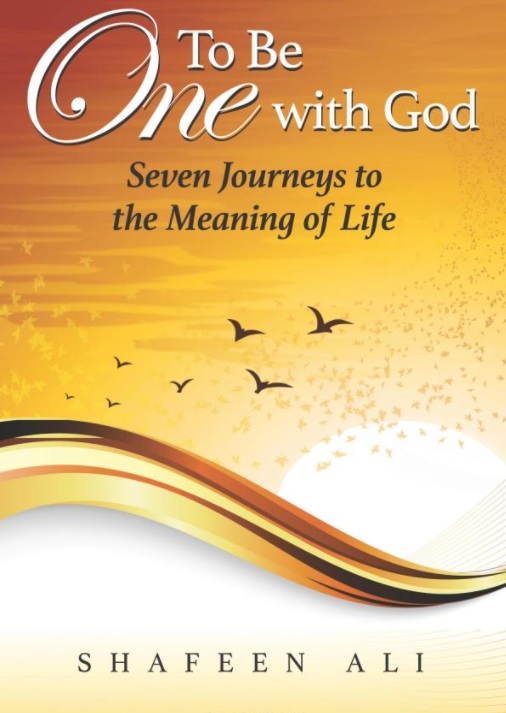
Cover of “To Be One with God: Seven Journeys to the Meaning of Life” by Shafeen Ali, 254 pp, available in paperback and digital formats.
Simerg: How can I purchase the book and what are its available formats?
Ali: The book is available in Paperback and Digital formats (epub, kindle, etc.). One can find all the different channels to buy the book as well as preview sample readings from each of the seven journeys on my website home page at: https://shafeenali.com/. [Readers will appreciate the options Shafeen has provided on his website; please visit it. To purchase the book at Amazon please click Paperback/Digital — Ed.]
“it will be very difficult to put this book down as you will keep expecting something more meaningful and deeper to unravel”
“… appealed to my heart and soul and provided me with an unforgettably transformational experience“
Review quotes from the author’s website
Simerg: How did you find a publisher for the book?
Ali: I published the book myself through Createspace (currently Kindle Direct Publishing for Amazon, paperback and kindle ebooks) and Smashwords (for other ebook formats).
Simerg: Did you hire an editor, an illustrator or did you do all the work by yourself?
Ali: My book cover designer was Shaila Abdullah (please see her website My House of Design), an award winning Ismaili Muslim designer and author, and my editors were two other Ismaili Muslim sisters, Rozi Banani and Sonia Nur Mohammed (email scholastic.sessions@gmail.com).
Simerg: Which was your first book and how many have you written?
Ali: This has been my only book. I have aspirations to develop more means, including books, for people to be one with God. I have recently published a 3-Part Mini Video Series on Realizing the Inner Imam For One Humanity on my website and on Youtube.
Simerg: How long did it take you to write To Be One With God — from start to finish and to begin marketing it?
Ali: Active research, writing, editing, and publishing took around 2 years including building a website on my own to market the book. It has now been 4 years since the book was published.
Simerg: Tell us something more about the book.
Ali: This book explores seven different journeys for man to seek oneness with God, all inspired by the inner being of the author, his “Inner Imam.” While on these journeys, readers will encounter many voices: man, God, teachers of God, and the author himself. The purpose of these voices is to harmonize the reader’s understanding and experiences of oneness with God. The teachers of God include Shri Rama, Shri Krishna, Jesus Christ, Moshe Rabbeinu, Gautama Buddha, Muhammad Rasulullah, Shri Hanuman, and the great philosopher Socrates, all of whom witnessed these journeys unfold in their own lives.
Date posted: March 25, 2021.
_______________________
Shafeen Ali
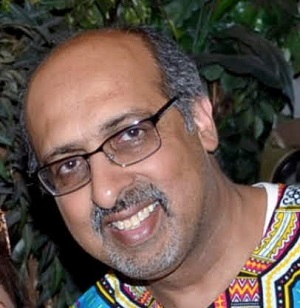
Shafeen Ali is a Shia Ismaili Muslim who has been a faith-based teacher and speaker for the last 10+ years. He has delivered more than 150 presentations and workshops throughout the world on faith and religious education. Shafeen also has a Masters in Business Administration and has spent more than 13 years managing and executing business and technology projects and teams in the United States. The source of strength and guidance in Shafeen’s life has always been the spirit of God within, his Inner Imam. Through his book, To Be One with God: Seven Journeys to the Meaning of Life, Shafeen is externalizing that innermost part of him with the hope and prayer that this spirit will provide strength and guidance to others just as it has done for him.
We encourage Ismaili writers to introduce their books in a similar format as Shafeen Ali, Mansoor Ladha, Zeni Shariff and Shamas Nanji have done in their respective interviews. Please also see the series launch article and submit your responses to Malik at Simerg@aol.com. All submissions will be acknowledged. If a writer has published multiple books, each book will be highlighted in a separate article, and not combined with other books into one post. All writers should include a brief profile with a portrait photo. The Ismaili Authors’ Series so far (in chronological sequence, oldest article first):
We welcome feedback from our readers. Please complete the LEAVE A REPLY form below or click Leave a comment. Your letter may be edited for length and brevity, and is subject to moderation.
Before departing this website please take a moment to review Simerg’s Table of Contents for links to hundreds of thought provoking pieces on a vast array of subjects including faith and culture, history and philosophy, and arts and letters to name a few. Also visit Simerg’s sister websites Barakah, dedicated to His Highness the Aga Khan, and Simergphotos.
Open your doors and let the honeyed fragrance of Spring, Enter your household while the seraphic birds sweetly sing, All life is born again now that the gruelling winter is done, Raise hands and praise Allah under the melting rays of the sun.
Navroz Mubarak, the New Year begins, We welcome it with wonder and repent for our sins, Three hundred million of us over three thousand years, Jubilantly celebrate with sacred songs and with cheers.
A new chapter to read, a new seed to plant, For abundance and prosperity a sacred prayer we chant. On Navroz we strengthen bonds and our families unite, Exchanging human values, our wishes with foresight.
Envisioning the New Year to bring with it Peace, And for all calamities and ill health to immediately cease. We dance and we sing sacred Ginans from our Pirs Qasidas and Garbis unite and cohere.
In harmony with Nature we must strive to exist, If not pandemics like COVID-19 will sadly persist, But if we take it in stride as a hard lesson learned We will appreciate the respect that Nature truly yearned.
We all share a common fate and must aim to erase, All discrimination and hatred and truly embrace, Love, tolerance and respect for all of mankind, So that cultural diversity will not be undermined.
We pray for global peace and international cooperation For we are all in the Ummah from nation to nation. Let nothing divide us and bring us to fight, Let us instead hold and value for tomorrow is in sight.
What was dead becomes alive, let the festivities begin, Intricate henna designs are dyed on our skin, We receive our roji and take our Navroz wishes, For barakat and abundance and we enjoy festive dishes.
It is that time of year, tulips spring out from the soil A hearty true effort from a burdensome winter’s toil, Shadowed they waited for this day to emerge, Colors in splendour they burst and they surge.
Spring blossoms are shedding their soft petals in few, The buds are just opening thinly covered in dew, Moist raindrops with sunlight the perfect combination, To bring creation forth in a renewing sensation.
Take notice of Kudrat and all the miracles of Mawla, His Bounty is Ever-Present, Al-Hamdu l’illah. The Spring breeze whispers through the meadows and the trees, And there is flitting and buzzing of butterflies and bees.
The animals all awaken from a dazed winter’s sleep, The goats, the chickens and the sheep, The horses, the donkeys, the rabbits, and the squirrels, All the animals arise for the Navroz’ precious pearls.
So arise and awaken to the Navroz, our New Year, And welcome all customs with good heart and good cheer, United we stand and divided we fall, The Ummah prevails and respectfully unites us all.
Farah Tejani graduated with her Bachelor of Arts in English Literature and her Master of Fine Arts in Creative Writing from the University of British Columbia in May of 1997 and earned top Honors for her Thesis on Short Fiction. She has published a collection of short stories “Make Your Own Chai, Mama’s Boy!” dealing with different dilemmas South Asians face. Farah also wrote and co-directed her stage play, “Safeway Samosas,” which won “The Best of Brave New Playwrights Award” in July 1995. Her short story , “Too Hot” won third place in the “Canada-Wide Best Short Fiction Award” and was read at The Vancouver Writers Festival. Currently, Farah is working on Childrens’ stories and a collection of poetry called, “Elastic Embrace” to be published in 2021.
We welcome feedback from our readers. Please complete the LEAVE A REPLY form below or click Leave a comment. Your letter may be edited for length and brevity, and is subject to moderation.
Please also read Farah’s previous contributions to Simerg and its sister website Barakah by clicking on the following links:
Before departing this website please take a moment to review Simerg’s Table of Contents for links to hundreds of thought provoking pieces on a vast array of subjects including faith and culture, history and philosophy, and arts and letters to name a few. Also visit Simerg’s sister websites Barakah, dedicated to His Highness the Aga Khan, and Simergphotos.
This is the 3rd in our series “Books by Ismaili Authors.” The two previous books highlighted were Little One, You Are the Universe by Toronto’s Zeni Shariff and Justice Bertha WilsonPushes the Boundaries of Humanity by Edmonton’s Shamas Nanji. We ask each author to introduce their book(s) to our readers by answering a series of short questions. In this post, award winning journalist Mansoor Ladha of Calgary, Canada, responds on his book “Memoirs of a Muhindi.”
****************
Simerg: What is behind the naming of the title of the book?
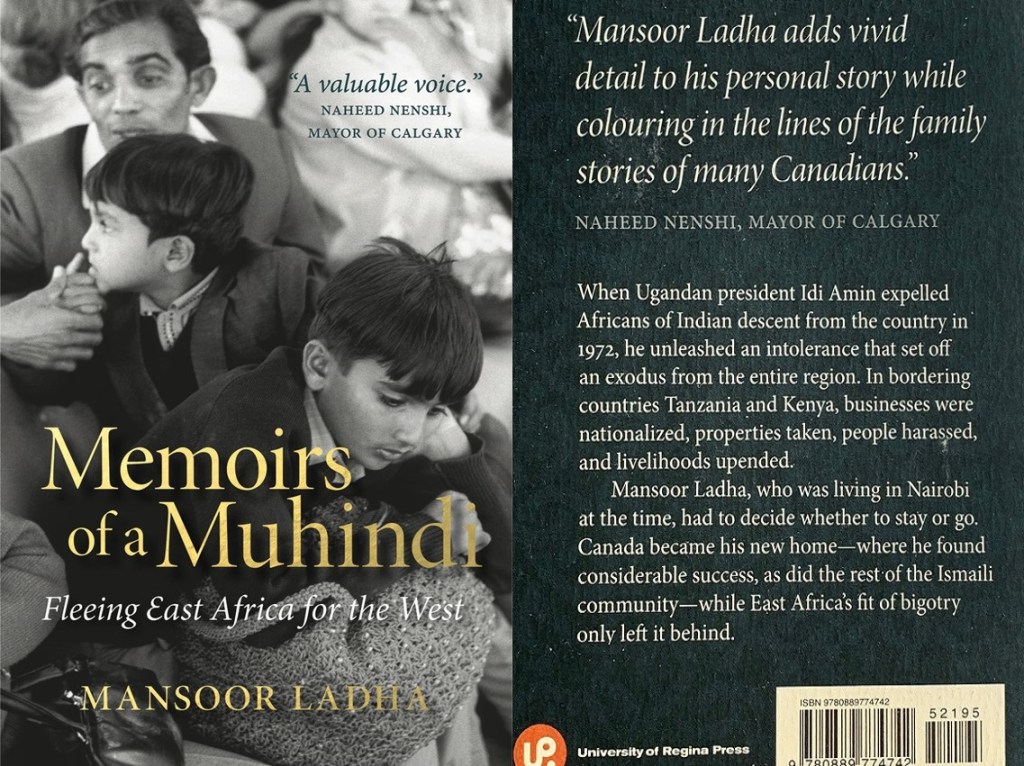
Mansoor Ladha:Memoirs of a Muhindi is a story of a descendant of immigrants, brown in colour, living in a black society (Tanzania), who later became a brown immigrant living in a white society (Canada). The book, which has been endorsed by Calgary Mayor Naheed Nenshi, sheds light on the experiences felt by immigrants, the challenges of cross-cultural differences, the hurt of discrimination, and other hardships of displacement. It has received favourable reports from the media and literary journals.
Simerg: Why would you want me or my family members to read the book, and what will we all learn from it?
Ladha: For those who lived in East Africa, the book is a historical document, providing memories of life during pre and post-colonial Africa. For those not born during the time, it describes what their parents went through before they came to Canada. This is the story of Ismailis who migrated from India to Africa to the west. Many immigrants, including myself experienced discrimination in Africa as well as in Canada. This book contains several interesting episodes and is a valuable, well-written historical document which should be on everyone’s book shelf.
Simerg: What inspired you to write the book?
Ladha: Western writers who have published books on Africa have neglected to describe contributions made by South Asians. As a South Asian journalist, I was prompted to publish a book depicting the prevailing political situation, how Asians adapted to the changing political landscape and their contributions in developing African nations.
Article continues below
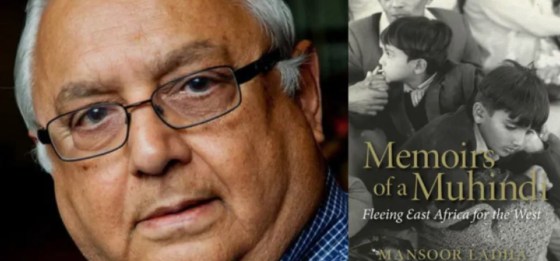
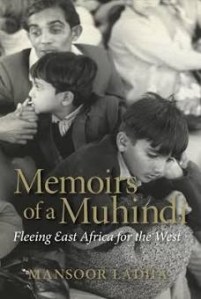
Front and back cover of Mansoor Ladha’s book “Memoirs of a Muhindi” published by University of Regina Press. 2017, 288 pp, available in hardcover and kindle editions.
Simerg: How can I purchase the book and what are its available formats?
Ladha: The book is available from Amazon.ca in hardcover and kindle and from Chapter/Indigo or can be ordered from any neighbourhood book store. You can also buy it at Amazon.com as well as Amazon’s affiliated websites worldwide. Signed copies are available at a special reduced price from mlpublish@shaw.ca but postage is extra.
Simerg: How did you find a publisher for the book?
Ladha: There are two types of book publishers. First type will not accept any submissions from an author unless the query comes through a literary agent. Second type are those who will accept manuscripts directly from authors, without an agent. It is very difficult to get a literary agent interested in a submission. There are authors whose submissions have been rejected by 20 literary agents; and this is not considered to be unusual. I researched for publishers who will accept unagented submissions and was fortunate to get University of Regina Press interested in publishing my book.
Those authors who have not been successful to get their books published through a traditional publisher can resort to get their books published by self-publishing companies. You do not have to pay anything if your book is published by traditional publishers while one has to pay the entire cost when self-publishing.
“Mansoor’s is a brilliant story teller and he writes very simply. I loved his narration of the Dar University days, Nyerere, his work, discrimination etc. For me the greatest contribution Mansoor has made in his memoir is the last sentence on page 249. “I do not want to be a dweller of several lands, accepted by none.”….I was actually teary as I read Mansoor’s cry for a homeland based on UNIVERSAL HUMANITY. That is a powerful message given Eric Hobsbawm’s statement: “Our world risks both explosion and implosion. It must change.” The world must be our collective homeland. Mansoor has given us some message to live for.” — Dr. Willy Mutunga, D.Jur,SC,EGH, Former Chief Justice/President, Supreme Court of Kenya
Simerg: Did you hire an editor, an illustrator or did you do all the work by yourself?
Ladha: Once your book is accepted for publication, the publishing company would send a contract for you to sign. Under the contract, they would provide all editorial services, including a graphic designer until the book is published. The editor would suggest some revisions/alterations and seek your approval until the final document is ready. Same would go for the designer. I was fortunate in that as a copy editor on daily newspapers my job has been to correct and edit stories of reporters. Hence, this background helped me to send clean, edited submission to publishers.
“Ladha has written Memoirs of a Muhindi with a universal audience in mind. Immigrants can learn perhaps how to avoid the pitfalls of settling in a new country, and employers can learn different ways so that they can treat immigrants with fairness and equality,” he says. “One should be able to learn from past incidents and derive positive policies for future use.”– Margaret Anne Fehr, Prairie books NOW
Simerg: Which was your first book and how many have you written?
Ladha: My first book was Portrait in Pluralism: Aga Khan’s Shia Ismaili Muslims published by Detselig. Memoirs of a Muhindi: Fleeing East Africa for the West is my second book. I was also among a group of journalists and scholars invited to contribute a chapter in a book called “The Story that Brought Me Here” published by Brindle & Glass.
Simerg: How long did it take you to write Memoirs of a Muhind — from start to finish and to begin marketing it?
Ladha: I had written bits and pieces of the above book when I was a full time publisher of Morinville Mirror and Redwater Tribune newspapers. However, I concentrated in completing it full time after my retirement from active newspapering and working diligently for about four months. I was fortunate in publishing both my books with traditional publishers, unagented, and so the publishers also took marketing duties in sending books to Amazon, Chapters/Indigo and other publishers. One main piece of advice I would like to offer is that no one but you, as the author, must try to promote your book through your contacts, friends, relatives and colleagues. My third book has been accepted by a Toronto literary agent for publication this year and I am working on my first novel.
Date posted: March 6, 2021.
_______________________
Mansoor Ladha
Mansoor Ladha has held senior editorial positions as a copy editor in Canada (Edmonton Journal & Calgary Herald), features editor (The Standard in Dar es Salaam, Tanzania), copy editor (Daily Nation, Nairobi, Kenya) and was the only owner/publisher of colour of a mainstream English newspaper in Canada for 25 years. Since retiring, he has been travelling around the world as a travel writer on assignments and has published travel features in leading Canadian newspapers and magazines. He has numerous awards to his credit including being a Citizen of the Year in the Town of Morinville, Alberta; Silver Quill Award by the Alberta Weekly Newspapers for distinguished service to newspapers as well as Canada’s Caring Canadian Award for “outstanding and selfless contribution to your community and Canada” by the Governor General of Canada. He has most recently completed another non-fiction book and a novel, both of which are scheduled to be published in 2021. Ladha was also contributor to Simerg’s highly acclaimed series I Wish I’d Been There with a remarkable piece His Name is Jawhar.
_____________________
We encourage Ismaili writers to introduce their books in a similar format as Mansoor Ladha, Zeni Shariff and Shamas Nanji have done in their respective interviews. Please also see the series launch article and submit your responses to Malik at Simerg@aol.com. All submissions will be acknowledged. If a writer has published multiple books, each book will be highlighted in a separate article, and not combined with other books into one post. All writers should include a brief profile with a portrait photo.
We welcome feedback from our readers. Please complete the LEAVE A REPLY form below or click Leave a comment. Your letter may be edited for length and brevity, and is subject to moderation.
Before departing this website please take a moment to review Simerg’s Table of Contents for links to hundreds of thought provoking pieces on a vast array of subjects including faith and culture, history and philosophy, and arts and letters to name a few. Also visit Simerg’s sister websites Barakah, dedicated to His Highness the Aga Khan, and Simergphotos.
This is the 2nd in our bi-weekly series “Books by Ismaili Authors.” The series began with Justice Bertha WilsonPushes the Boundaries of Humanity by Shamas Nanji of Edmonton, Canada. We ask each author to introduce their book(s) to our readers by answering a series of short questions. In this post, Zeni Shariff of Toronto, Canada, responds on her latest title “Little One, You Are The Universe.”
****************
Simerg: What is behind the naming of the title of the book?
Zeni Shariff: The meaning behind the title Little One, You Are The Universe is that the Universe belongs to all living beings and it is incumbent upon all living beings to look after the Universe and one another.
Simerg: Why would you want me or my family members to read the book, and what will we all learn from it?
Zeni: I would like you or your family members to read the book for the following reasons:
(1) It will connect you with the child within you; and (2) It will connect you with your parents and grandparents in a very personal way.
For those of who you who have not been to different continents, I believe you will understand, through the story of the elephants, what kinds of struggles living beings go through as they are relocated from one continent to the other, overcome struggles, adjust and live in new environments, and find joys in the small things of life.
Simerg: What inspired you to write the book?
Zeni: My grandchildren and the legacy I wish to live for them.
Article continues below
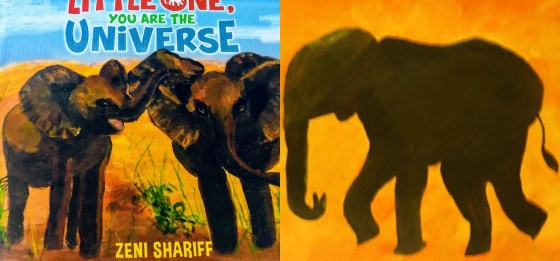
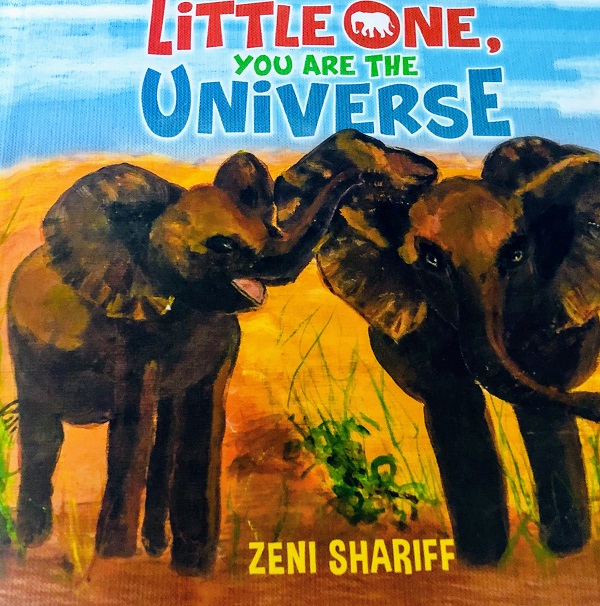
Front cover of Toronto Ismaili writer’s book “Little One, You Are the Universe;” published by Bublish, Inc., USA, 2020; 38 pp, available in hardcover, eBook and paperback.
Simerg: How can I purchase the book and what are its available formats?
Zeni:Little One, You are the Universe is available in three formats: eBook, paperback, and hardcover. Details of where and how to purchase including prices are at my updated webpage link https://little-one.ca.
You can also buy it through Amazon sites worldwide. In North America, Little One, You are the Universe is available on Amazon.ca (Canadian site) and Amazon.com (for U.S. and international purchases).
Simerg: How did you find a publisher for the book?
Zeni: I contacted several publishers and used the one that met my budget criteria. I went with Bublish, Inc.
Simerg: Did you hire an editor, an illustrator or did you do all the work by yourself?
Zeni: I requested our youngest son Naguib to edit my work. I did all the illustrations and writing.
“This book [Little One, You are the Universe] is a heartwarming and beautiful story kids are sure to love. It also teaches about history, geography, and the environment making it more than just a read aloud for kids — it’s a great book to grow with. The illustrations are fantastic and compliment the story perfectly.” — DD reviewer, from author’s website
Simerg: Which was your first book and how many have you written?
Zeni: My first book is a photographic book entitled Alter Your Heart beats in an Oasis, and it is about a visitor going into and around the Aga Khan Museum in Toronto, Canada. My second book is How Things Grow. It teaches young children how things grow and where the food we eat comes from. Its inspiration was tending to a garden that grew strawberries in Toronto. And Little One, You are the Universe is my third book and, as mentioned earlier, it is published by Bublish.
Simerg: How long did it take you to write Little One, You are the Universe — from start to finish and to begin marketing it?
Zeni: It took me approximately 9 years. The illustrations were painted by myself first, and then I wrote the book. Covid-19 was one of the incentives for having the book published.
Simerg: Tell us a little bit more about Little One, You are the Universe.
Zeni: While crossing the Yamuna River in their home of northern India, elephants Lotus and Adia are separated from each other and captured by humans. Lotus is sent to Tanzania in East Africa to work on the railways. Adia is sent to the Ashantee Forest in West Africa to carry heavy loads for the miners.
The book is an invitation to you to join Lotus and Adia on their journeys.
Date posted: February 25, 2021.
_______________________
Zeni Shariff
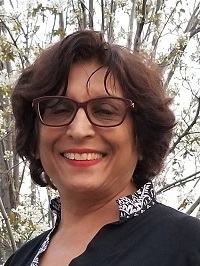
Zeni Shariff completed her education at the Aga Khan Girls Secondary School in Dar es Salaam, Tanzania, and later studied at Ryerson, in Toronto, Canada. She loves to read and share stories from the journeys of her late grandparents and parents from one continent to another. Their stories and experiences have taught Zeni to be kind and decent to everyone and to never give up hope.
We encourage Ismaili writers to introduce their books in a similar format as Zeni’s book described above (or see Nanji’s post). Please also see the series launch article and submit your answers to Malik at Simerg@aol.com. All submissions will be acknowledged. If a writer has published multiple books, each book will be highlighted in a separate article, and not combined with other books into one post. Please also include your brief profile, with a photo.
We welcome feedback from our readers. Please complete the LEAVE A REPLY form below or click Leave a comment. Your letter may be edited for length and brevity, and is subject to moderation.
Before departing this website please take a moment to review Simerg’s Table of Contents for links to hundreds of thought provoking pieces on a vast array of subjects including faith and culture, history and philosophy, and arts and letters to name a few. Also visit Simerg’s sister websites Barakah, dedicated to His Highness the Aga Khan, and Simergphotos.
Recently we invited Ismaili writers to submit a synopsis of their books for listing on this website. We asked each author to introduce their book to Simerg readers by responding to a series of questions. We begin the first in this special bi-weekly series with Justice Bertha WilsonPushes the Boundaries of Humanity by Shamas Nanji of Edmonton, Canada.
****
Simerg: What is behind the naming of the title of the book?
Shamas Nanji:Justice Bertha WilsonPushes the Boundaries of Humanity points to Bertha Wilson breaking out of narrower monolithic interpretations of Canadian law. The Charter is new territory. The presence of a working-class, immigrant woman on the Supreme Court is indicative of new orientations that will question traditional readings of pre-Charter law.
Simerg: Why would you want me or my family members to read the book, and what will we all learn from it?
Nanji: You will learn about the Canadian past from outside the boxes of patriarchy and whiteness. Bertha Wilson elevates the importance of plural democratic contexts compared to historical precedents in her decisions as a judge in the Ontario Court of Appeal and in the Supreme Court of Canada.
Simerg: What inspired you to write the book?
Nanji: A Scotswoman emigrated to Canada with her husband and went to law school despite the Dean telling her to go home and take up crochet. She went on to become one of the hardest working judges on the Supreme Court with landmark cases like Angelique Lavalle, Henry Morgenthaler, and Horseman, in addition to Pushpa Bhaduaria at the Ontario Court of Appeal.
Article continues below
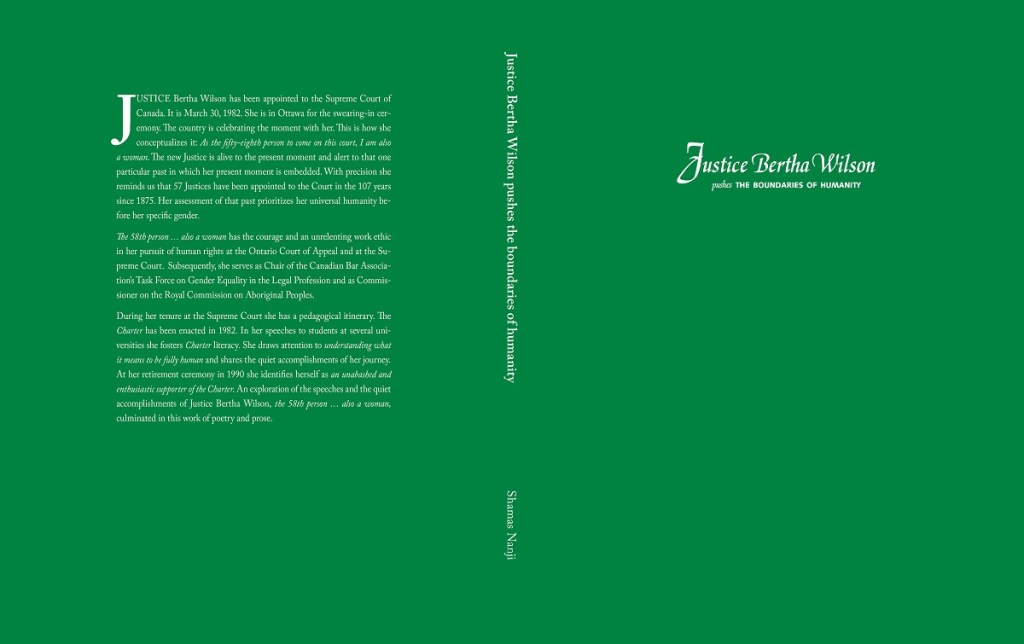
Cover of “Justice Bertha Wilson Pushes the Boundaries of Humanity” by Edmonton based Shamas Nanji, 161 pp,
Simerg: How can I purchase the book and what are its available formats?
Nanji: The book is available in paperback at Audreys Books in Edmonton (the book is listed HERE).
Simerg: How did you find a publisher for the book?
Nanji: It’s self published.
Simerg: Did you hire an editor, an illustrator or did you do all the work by yourself?
Nanji: Apart from the printing and binding, I have done everything.
Simerg: Which was your first book and how many have you written?
Nanji: My first book is Canadian Rubaiya (2003). Since then I have published nine more. This includes Meditations on Abraham (2008) Sijistani’s design for Enlightenment (with Boustan Hirji, 2013), The Visionary Quest of Nasir Khusraw (2014), and Lalla’s Courage reaches for an Infinite Consciousness (2015).
Simerg: How long did it take you to write the book — from start to finish and to begin marketing it?
Nanji: About two years.
Simerg: Tell us a little bit more about Bertha Wilson and the book.
Nanji: Bertha Wilson was a Justice on the Supreme Court of Canada 1982–1990. At the swearing-in ceremony, she observed As the fifty-eighth person to come on this court, I am also a woman.
She prioritized her universal humanity before her specific gender. It set the tone for future judgments in the Court and in her speeches at several universities where she fostered Charter literacy.
After a foreword in prose, the book uses poetry to illustrate her life and to explore her accomplishments as an unabashed and enthusiastic supporter of the Charter. There are maps and extensive notes for further reading.
Date posted: February 10, 2021. Last updated: February 10, 2021 (CORRECTION: In an earlier version of this article, Justice Bertha Wilson was left out from the title of the book in both the heading of this post as well as in the body of the text. The book title said Pushes the Boundaries of Humanity instead of Justice Bertha WilsonPushes the Boundaries of Humanity. A correction has been applied; the editor apologizes for the oversight).
_______________________
We encourage Ismaili writers to introduce their books in a similar format as Nanji’s work above (or see article) and submit the details to Malik at Simerg@aol.com. All submissions will be acknowledged. If a writer has published multiple books, each book will be highlighted in a separate article, and not combined with other books into one post.
We welcome feedback from our readers. Please complete the LEAVE A REPLY form below or click Leave a comment. Your letter may be edited for length and brevity, and is subject to moderation.
Before departing this website please take a moment to review Simerg’s Table of Contents for links to hundreds of thought provoking pieces on a vast array of subjects including faith and culture, history and philosophy, and arts and letters to name a few. Also visit Simerg’s sister websites Barakah, dedicated to His Highness the Aga Khan, and Simergphotos.
We shall be commencing our special series on books by Ismaili authors at the beginning of February 2021, followed by the publication of a revised version of our beautiful artists compendium at the end of March.
First edition of Simerg’s artists compendium
These are major initiatives by Simerg and we want as many authors and artists to be represented on our website series on Ismaili authors as well as our artists compendium that was published a few years ago — it is in need of a major update, and we need artists not recorded in the publication to submit their profiles as shown in the compendium. Please see our earlier announcement on this initiative by clicking HERE and submit the information that we require by February 15, 2021.
Date posted: January 20, 2021.
________________________
Before departing this website please take a moment to review Simerg’s Table of Contents for links to hundreds of thought provoking pieces on a vast array of subjects including faith and culture, history and philosophy, and arts and letters to name a few.