Simerg is an independent initiative dedicated to Ismaili Muslims, the Aga Khan — their Hereditary Imam — and the Ismaili Imamat, and Islam in general through literary readings, photo essays and artistic expressions
Category Archives: Literary Readings from Ismaili History
(This article has been adapted and abridged from an article first published on the official website of the Ismaili Muslim community under the title Why Do Muslims Revere Jesus? Please note that the photograph of the Altar of Nativity and the selected verses from chapter 19 of the Qur’an, are not part of the Ismaili piece — Ed.)
“Then she brought him to her own folk, carrying him. They said: O Mary! Thou hast come with an amazing thing.” — Qur’an, 19:27
His name is mentioned in the Holy Qur’an twenty-five times, often in the form ‘Isa ibn Maryam, meaning “Jesus, son of Mary.” In the Qur’an, he is referred to by the unique title of “Messiah” (al-masih in Arabic), meaning “anointed one.” Descriptions of Jesus in the Qur’an include many aspects of the narrative found in the Gospels about the life of Jesus, including his virgin birth, the signs given to him by God, that he was raised by God into His presence, and it also suggests his future return. Jesus is also referred to in the Qur’an as the “Word” and the “Spirit” of God, a special honour.
The Altar of the Nativity, beneath which is the star marking the spot where tradition says the Virgin Mary gave birth to Jesus. Photograph: Muslim Harji, Montreal.
The Holy Qur’an frequently mentions that divine guidance was sent to humankind through various prophets. For example, it says:
“So [you believers], say, ‘We believe in God and in what was sent down to us and what was sent down to Ibrahim (Abraham), Isma’il (Ishmael), Ishaq (Isaac), Ya’qub (Jacob), and the Tribes, and what was given to Musa (Moses), ‘Isa (Jesus), and all the prophets by their Lord. We make no distinction between any of them, and we devote ourselves to Him’” (Qur’an 2:136).
This view that all prophets are considered to be equal is also supported by a widely-reported hadith, in which Prophet Muhammad (peace be upon him and his family) is believed to have said:
“Both in this world and in the Hereafter, I am the nearest of all the people to Jesus, the son of Mary. The prophets are paternal brothers; their mothers are different, but their religion is one.”
Many Qur’anic verses also describe the prophets as belonging to the same family. For example, there is a line of prophets descended from Prophet Ibrahim. Both of his sons, Ishaq and Isma’il were prophets, as was Prophet Ishaq’s son, Prophet Ya’qub, and his grandson, Prophet Yusuf, or Joseph (peace be upon them).
Thus, God chose certain families over others based on their devotion, faith and commitment towards the Divine, as reflected in the following two Qur’anic verses:
“Allah chose Adam and Nuh (Noah), the family of Ibrahim, and the family of Imran above all mankind: a progeny one from the other” (Qur’an, 3:33-34).
“We have already given the family of Ibrahim the Book and Wisdom and conferred upon them a great kingdom” (Qur’an, 4:54).
Article continues below, after quotes from the Qur’an
_________________________________________
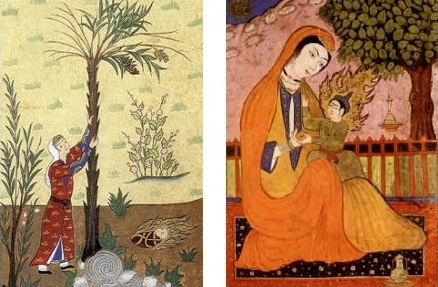
Mary and the Birth of Jesus in the Qur’an
Left: Virgin Mary nurtured by a palm tree in a Turkish miniature, as described in the Qur’an; right: Mary and Jesus in a Persian miniature. Images: Wikipedia.
Please click on the image for enlargement. Read Barnaby Rogerson’s story related to the above verses HERE
_________________________________________
Jesus in Islamic Traditions
The Qur’an mentions that angels announced the coming birth of Prophet ‘Isa, saying:
The angels said, ‘O Maryam, Allah gives you good news of a Word [kalima] from Him. His name is [the Messiah], ‘Isa ibn Maryam, honoured in this world and in the next, and of those brought near [to God]’” (Qur’an, 3:45).
Throughout history, Prophet ‘Isa has been viewed by Muslims as someone who embodied the qualities of piety and a concern for the needy, and whose example inspired Prophet Muhammad. In Sufi literature, he is frequently portrayed as an example of detachment from the material world and closeness to God.
The Ikhwan al-Safa’, or Brethren of Purity, depicted Prophet ‘Isa as a spiritual exemplar par excellence. In his article “Jesus, Christians and Christianity in the Thought of the Ikhwan al-Safa’,” Dr Omar Ali-de-Unzaga writes:
“Jesus figures prominently in the Rasa’il, as one of the exemplars who embodied the views of the Ikhwan al-Safa’: belief in the eternity of the soul and the pursuit of the purification of the soul from matter by detachment from the bodily realm.”
“Despite the long history of religious conflict, there is a long counter-history of religious focus on tolerance as a central virtue – on welcoming the stranger and loving one’s neighbour. ‘Who is my Neighbour?’ – one of the central Christian narratives asks. Jesus responds by telling the story of the Good Samaritan – a foreigner, a representative of the Other, who reaches out sympathetically, across ethnic and cultural divides, to show mercy to the fallen stranger at the side of the road.”
THE people Of the book
In Islamic traditions, Jesus is held in high regard as a messenger of God and an exemplar of piety and as a guide to spiritual truth. He is also part of the shared heritage that binds the monotheistic faiths of Judaism, Christianity, and Islam. Together, they are known in the Qur’an as the ahl al-kitab, or People of the Book, that is, people to whom God sent revelation.
His Highness Prince Karim Aga Khan highlighted this shared Abrahamic heritage in his address to the Canadian parliament in 2014, stating:
“We find singularly little in our theological interpretations that would clash with the other Abrahamic faiths — with Christianity and Judaism. Indeed, there is much that is in profound harmony.”
We welcome feedback from our readers. Please click LEAVE A COMMENT. Your letter may be edited for length and brevity and is subject to moderation.
~~~~~~~~
SOURCES:
Faith and Practice in Islamic Traditions, vol. 1 (Student Reader). London: Islamic Publications Limited for The Institute of Ismaili Studies, 2015.
The Qur’an and its Interpretations vol. 1 (Student Reader). London: Islamic Publications Limited for The Institute of Ismaili Studies, 2017.
Shedinger, Robert F. “Jesus“, in: Oxford Bibliographies in Islamic Studies.
Omar Ali-de-Unzaga. “Jesus, Christians and Christianity in the Thought of the Ikhwan al-Safa’”, in: Christian-Muslim Relations. A Bibliographical History. Volume 2 (900- 1050), ed. David Thomas et al. (Leiden: E.J. Brill, 2010); The History of Christian-Muslim Relations, 14; pp. 306-311.
“As you build your lives, for yourselves and others, you will come to rest upon certain principles. Central to my life has been a verse in the Holy Quran which addresses itself to the whole of humanity. It says: ‘Oh Mankind, fear your Lord, who created you of a single soul, and from it created its mate, and from the pair of them scattered abroad many men and women. I know of no more beautiful expression about the unity of our human race — born indeed from a single soul.” — The Aga Khan, excerpt from an address to both the Houses of the Canadian Parliament, February 27, 2014, see featured photo at top of post.
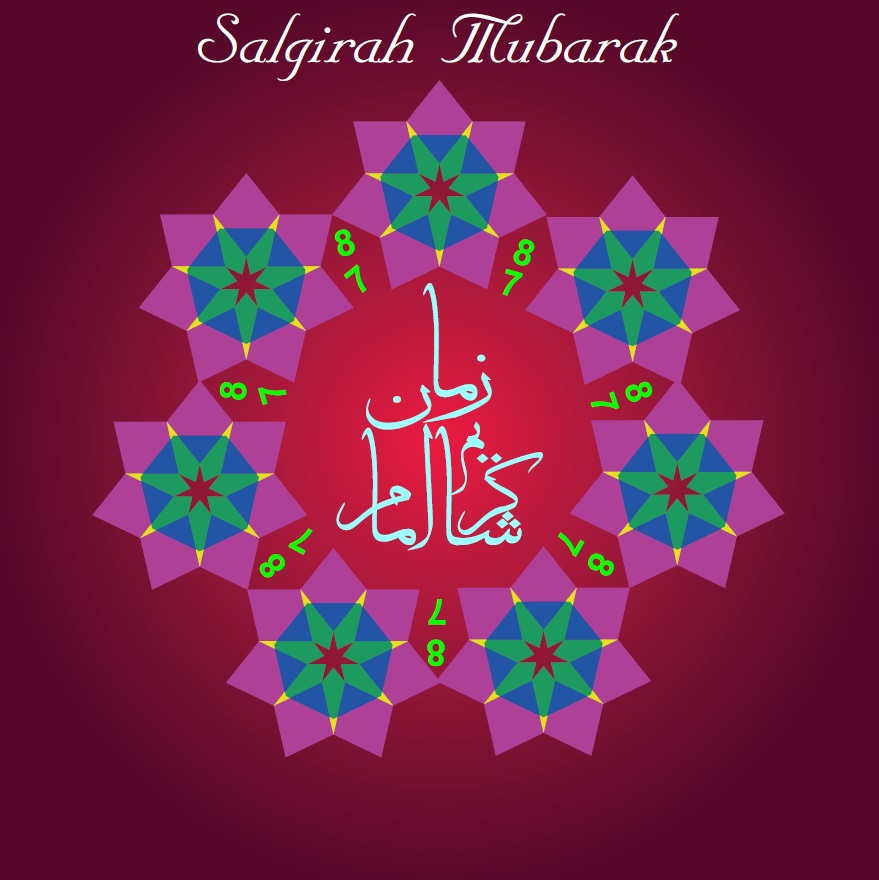
A calligraphy by Toronto’s Karim Ismail depicting the 87th birthday of His Highness the Aga Khan, the 49th Hereditary Imam of the Ismaili Muslims. Please clik on image for special post.
On December 13, 2023, Ismaili Muslims around the world mark the 87th birthday of their Imam, His Highness the Aga Khan. Simerg’s sister website Barakah presents a special post for the birthday. Please click The Benevolent Imam.
At the age of 87, the current Aga Khan is the oldest living Imam in Ismaili history. On July 11, 2023, he celebrated his 66th Imamat Day, still 5 years away from the record breaking 71 years of his predecessor, Aga Khan III (d. July 11, 1957), who began his reign at the age of seven in August 1885. Canada is home to more than 100,000 Ismailis and the Aga Khan’s projects include the beautiful Aga Khan Garden in Edmonton — part of the University of Alberta’s Botanic Garden — and the Aga Khan Museum in Toronto, two iconic Ismaili Centres in Toronto and Vancouver, and the Global Centre for Pluralism in Ottawa. In Calgary, the Ismailis host the annual stampede breakfast which is open to the entire public. Thousands attend and enjoy this annual event.
Editor’s note: On November 12, 2023, a day after the publication of the article “A Legacy of Lost Heritage” below, Simerg received a communique from ITREB in Karachi, via an Ismaili institutional leader, providing further details on the extent of the damage to the Ismaili institution’s Central library located in Karachi. According to the communique, the damage was more limited than initially thought and reported in our piece. In particular, the more than 200 manuscripts are completely safe because of protective measures taken to ensure their safekeeping. The Gujarati and Khojki-language magazines were previously moved to a different location within the library and were also saved. While a significant number of other materials in the library were damaged due to heat, smoke and water, rather than completely destroyed, they may be recoverable to some degree.
Simerg sincerely hopes that the majority of important objects and documents in the ITREB library remain in their original state and that those that were damaged are recoverable. We also hope that proper fire safety rules are in place to avoid such incidents from taking place in the library as well as Ismaili institutional buildings, especially the older ones, around the world. As noted in a UNESCO Study, the cost of restoring documents and books damaged in a library fire is substantially greater than what would be spent to store the materials under the best fire protection conditions.
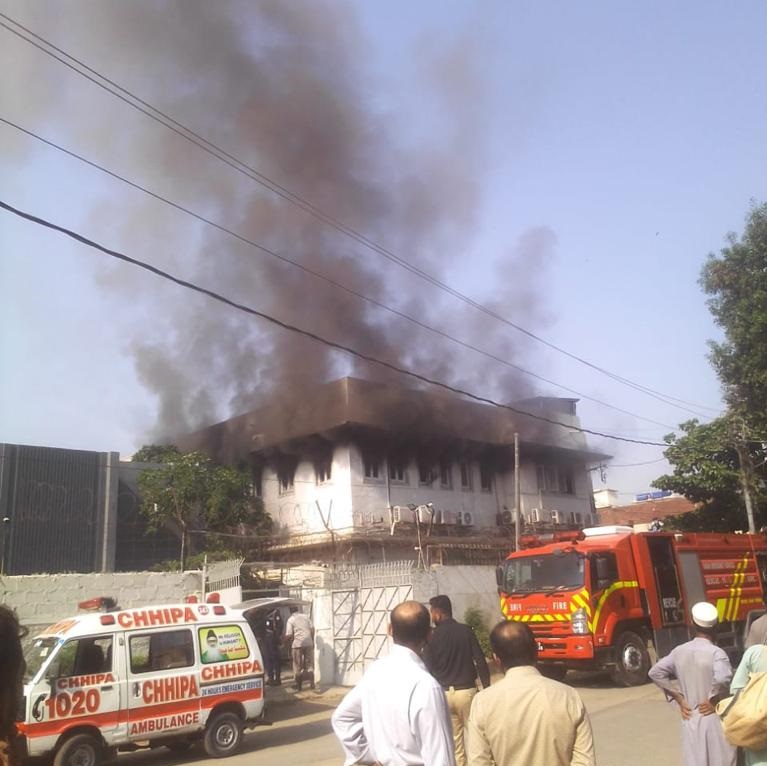
On the morning of November 2nd, 2023, at 9:15am local time, the National ITREB (Ismaili Tariqah and Religious Education Board) building for Pakistan located in the Garden East district of Karachi caught on fire. Fortunately, no one was hurt in the blaze. However, it quickly became apparent there would be another casualty.
Story continues below; click on images for enlargements
Smoke billows from a fire on November 2, 2023, at the ITREB building in Karachi, Pakistan, housing an important library collection of tens of thousands of printed materials, photographs, memorabilia, audiovisual materials, and manuscripts.
Located within the building was an important library housing tens of thousands of printed materials, photographs, memorabilia, audiovisual materials and manuscripts. The fire destroyed much of the collection. What wasn’t burnt or singed by the fire was then subject to water damage as firetrucks attempted to extinguish the blaze which was fed by the thousands of pages of flammable material in the building.
In the context of the Central ITREB Library located in Karachi, the local history, writing and output of the Khoja Jamats in particular, and more broadly of the Jamats of the Indian Subcontinent and to a lesser extent Eastern Africa and Northern Pakistan were preserved in the portion of the collection that focused on the contemporary period. In this post, I have included some gems of materials that I was able to capture on some of my journeys as an homage to the library and its role in my own archival research and being able to cobble together a social and religious history of the Ismailis.
Story continues below
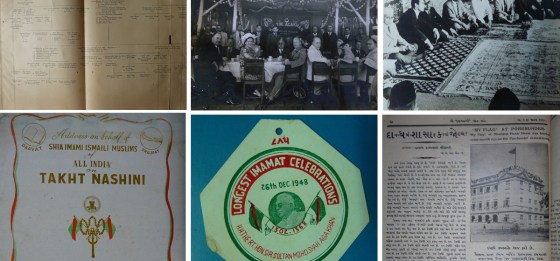
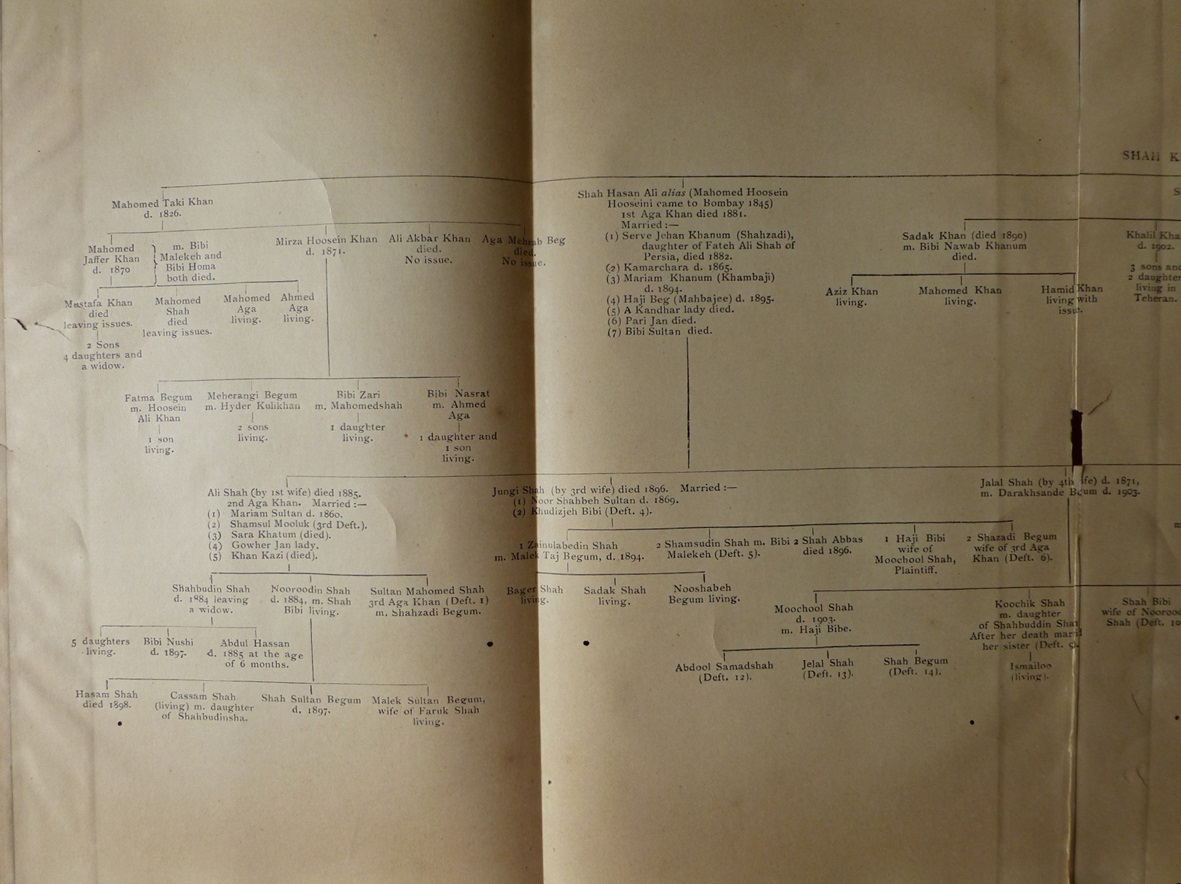
One section of the foldout outlining the family tree of the 46th Imam, Shah Hasan Ali Shah (d. 1881), that formed part of book of the judgement made by Justice Russell who proceeded over what became known colloquially as the Haji Bibi Case. In this section of the family tree, some of Imam Hasan Ali Shah’s siblings, wives, children, and their relations are listed. The case lasted from February 3, 1908 to August 7, 1908 and until that point was the longest ever trial in Bombay’s High Court.
~~~~~~
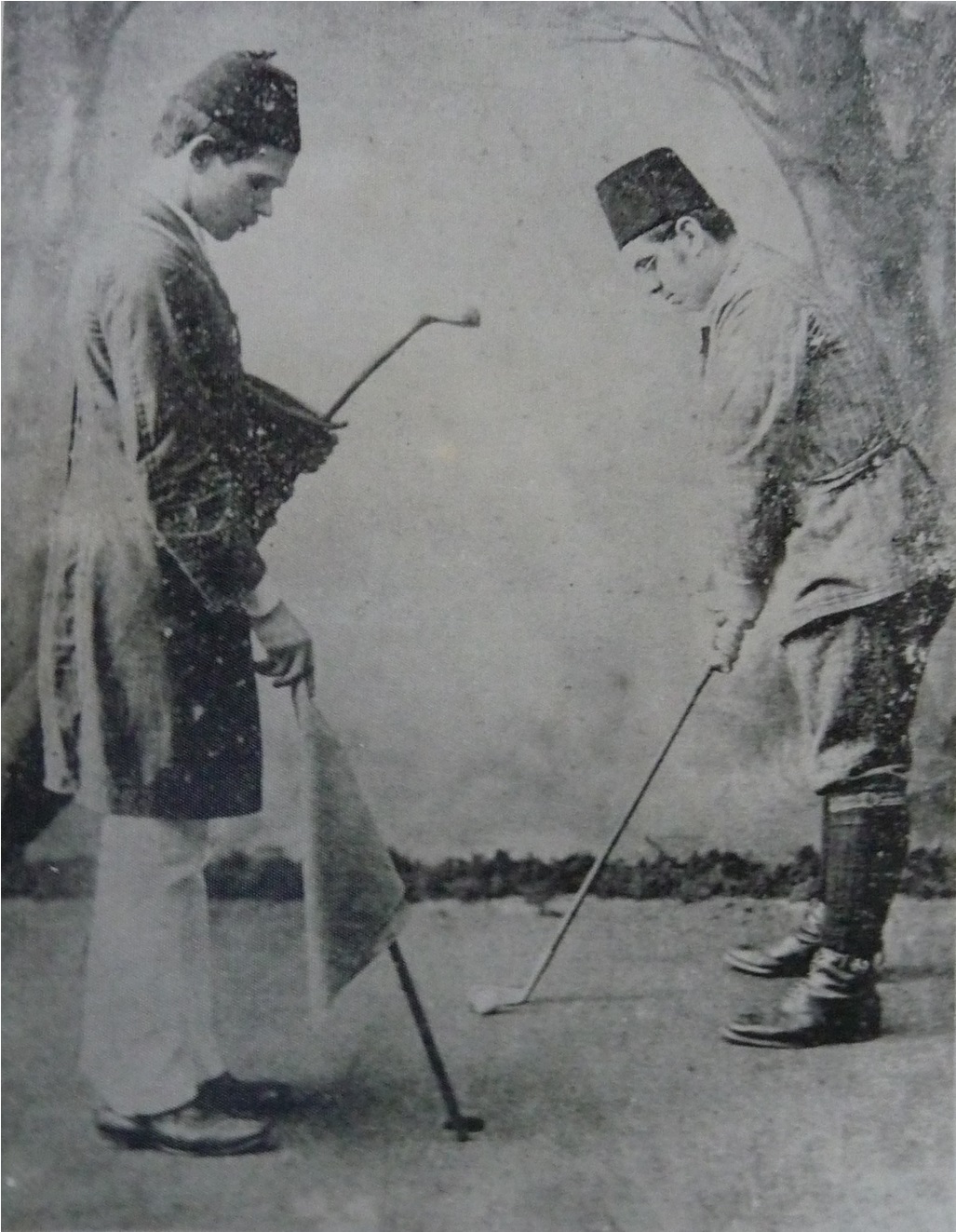
Photograph of Imam Sultan Mahomed Shah, His Highness the Aga Khan, playing golf in his youth.
~~~~~~
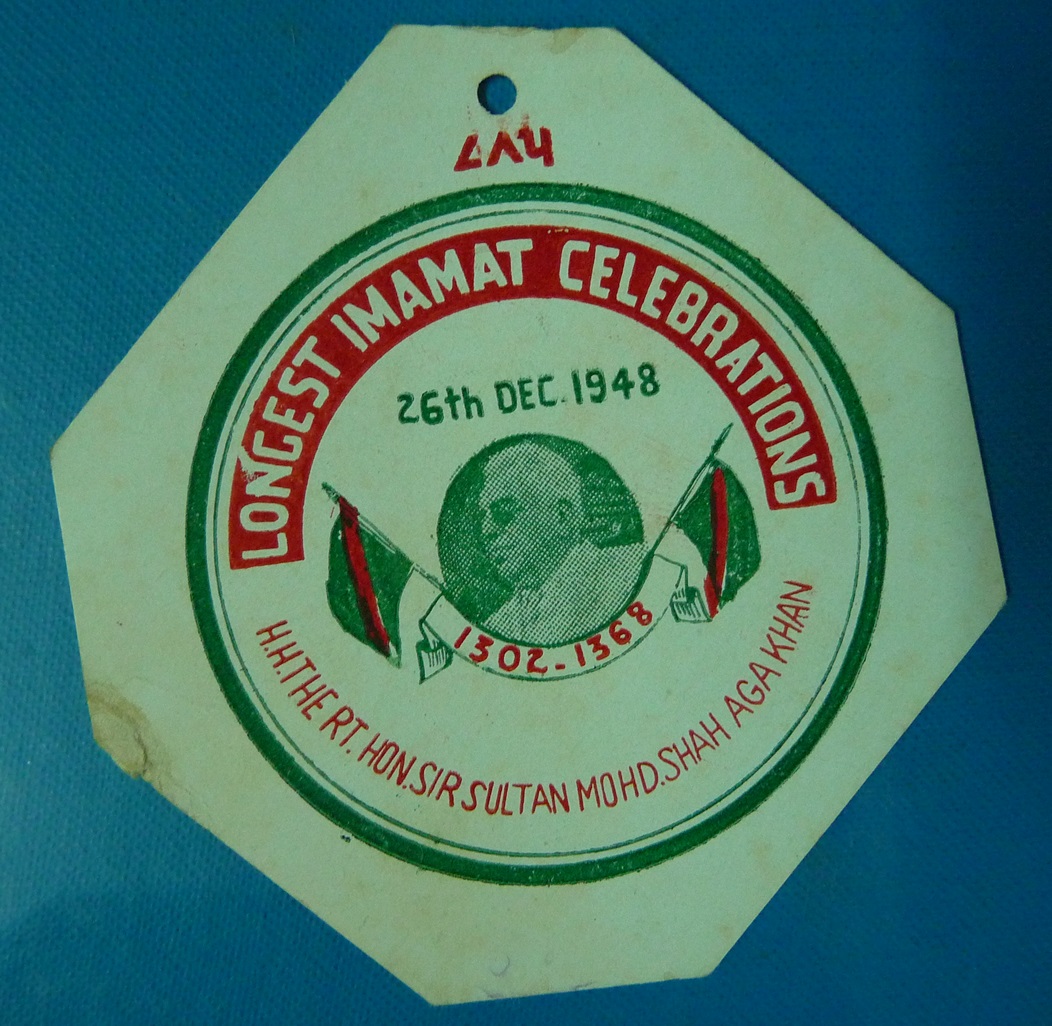
Souvenir produced to mark the occasion of the milestone reached by Imam Sultan Mahomed of the longest-ever Imamat in 1948 after surpassing 63 years as Imam of the Ismailis at the age of 71 years. The 48th Imam died nine years later on July 11, 1957, at the age of 79 having been the Imam for 71 years. He became the Imam in August 1885 at the age of 7.
While assessing the full extent of the damage is still an ongoing process, a number of items were able to be saved including a unique collection of Khojki manuscripts which were housed in fire retardant boxes. When I first heard about the tragedy the next day, I was devastated to learn of the loss of such a treasure trove of materials so important to better understanding the history of the Ismaili community. I had had the opportunity to consult the library on several occasions during my visit to Karachi over the years, including on my last visit in 2013. I was amazed from my first visit in 2006 at the breadth and richness of the collection and easily lost myself for hours and days within the library perusing its shelves, flipping through the pages of its meticulously organized items and often feeling a sense of delight at a personal discovery of a publication or image I was unaware of or that shed important light on a question I’d been pondering.
Story continues below
A picture of the first Muslim Baronet in British India, Sir Karimbhoy Ibrahim published in one of the earlier Ismaili periodical publications, Ismaili Sitaro in July 1910.
~~~~~~
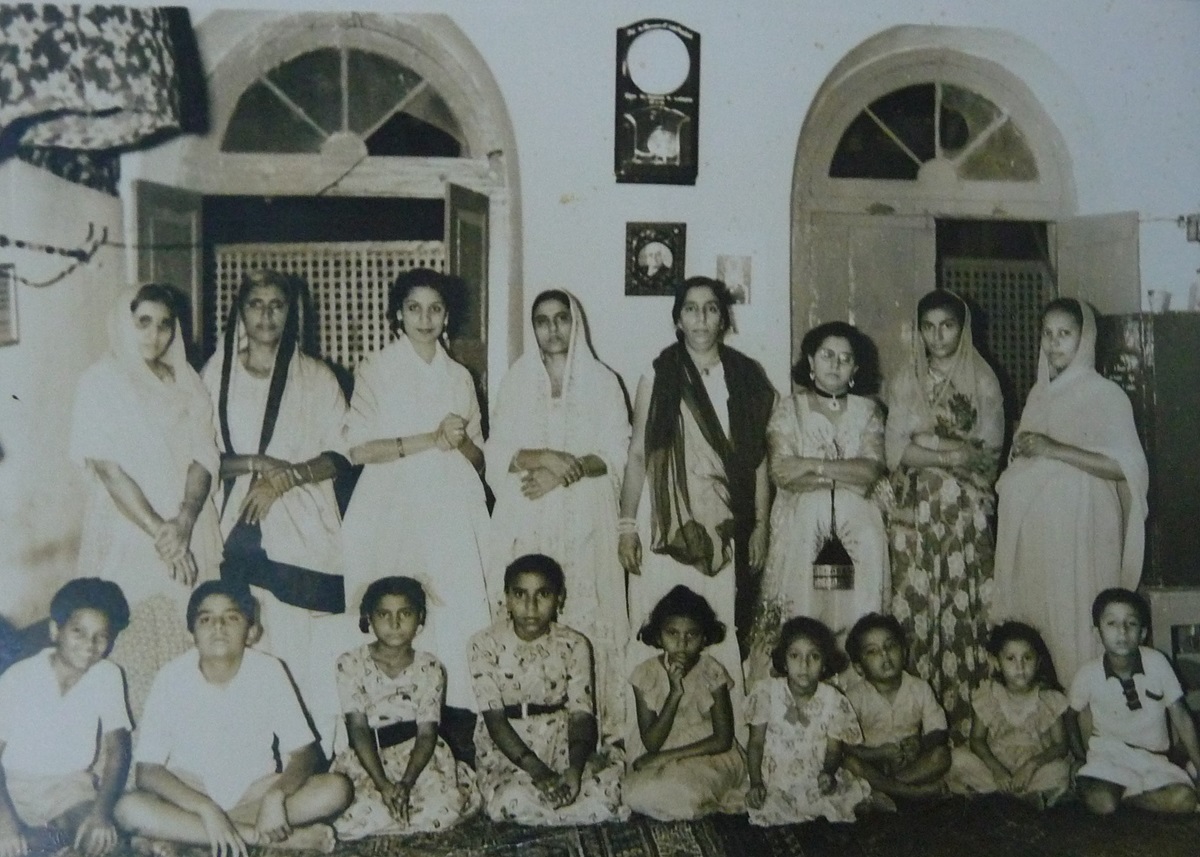
Photograph of women and children of the Ismaili Jamat in Aden, Yemen.
~~~~~~
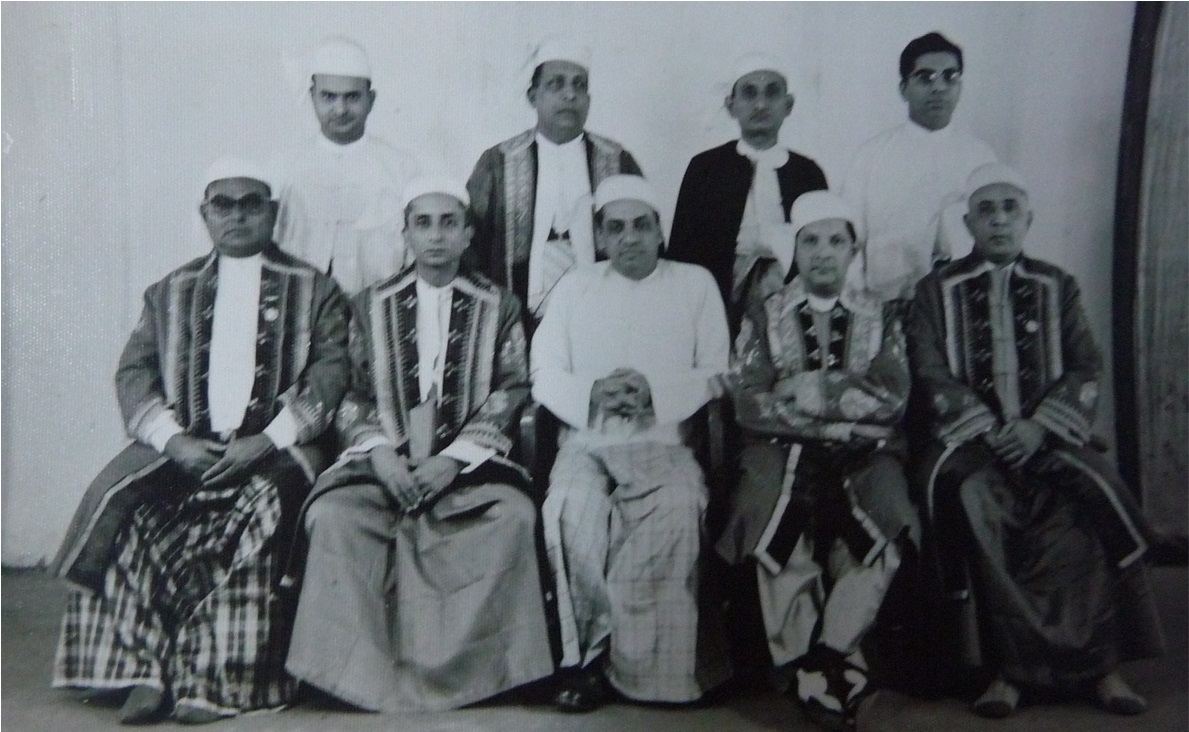
Photograph of members of the Ismaili Supreme Council, Burma 1958.
My own research interests were in the printed collection of the library in English and Gujarati including the photographic documentation of the community in the Indian Subcontinent and around the world. I had taken the opportunity to photograph umpteen works so that I could consult them in more detail and at my leisure once I returned to my home and now I realize the singular importance of those acts of documenting the legacy of the production of individual Ismailis and of Ismaili communities and institutions around the world. Much of ITREB’s Central Library collection owes a debt to Ismailis in Karachi, Pakistan, and around the world who donated materials including photographs as well as the library’s role in actively obtaining and safeguarding those materials.
Story continues below
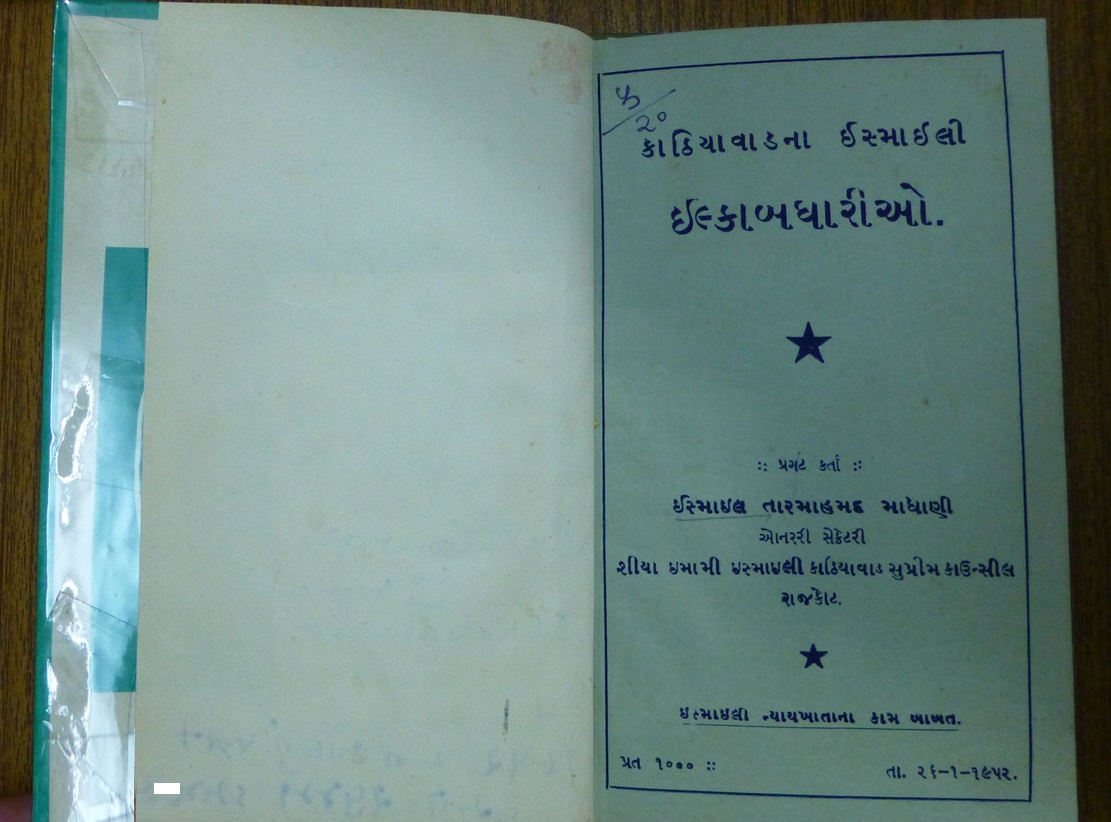
Cover page of the Kathiawadana Ismaili Ilkabadhara’o, Ismaili Census of Kathiawar published by Ismail Tarmahmad Madhani, Honorary Secretary of the Imami Ismaili Kathiawar Supreme Council Rajkot, 1952.
The Importance of Local Libraries
Since the establishment of The Institute of Ismaili Studies in London in 1977, a central repository of the community has been under development and many familial, local, institutional and national collections have been kindly donated to the IIS for safekeeping, preservation, digitization with the larger mandate of providing resources for research. However, before that, the guardians of these materials were often personal collectors, families and smaller institutions such as The Ismaili Society and Ismailia Associations, the predecessors of the now-ITREBs as well as local Jamatkhana libraries. In fact, it was because of these collections, not necessarily large-scale libraries, that scholars such as Wladimir Ivanow, Husayn Hamdani, Asaf Fyzee, Jawad Muscati and many now celebrated Nizari Ismaili authors, scholars, khalifas and waezeen of current and previous generations were able to make breakthroughs in their understanding of the Ismaili past and had source materials for their research.
Story continues below
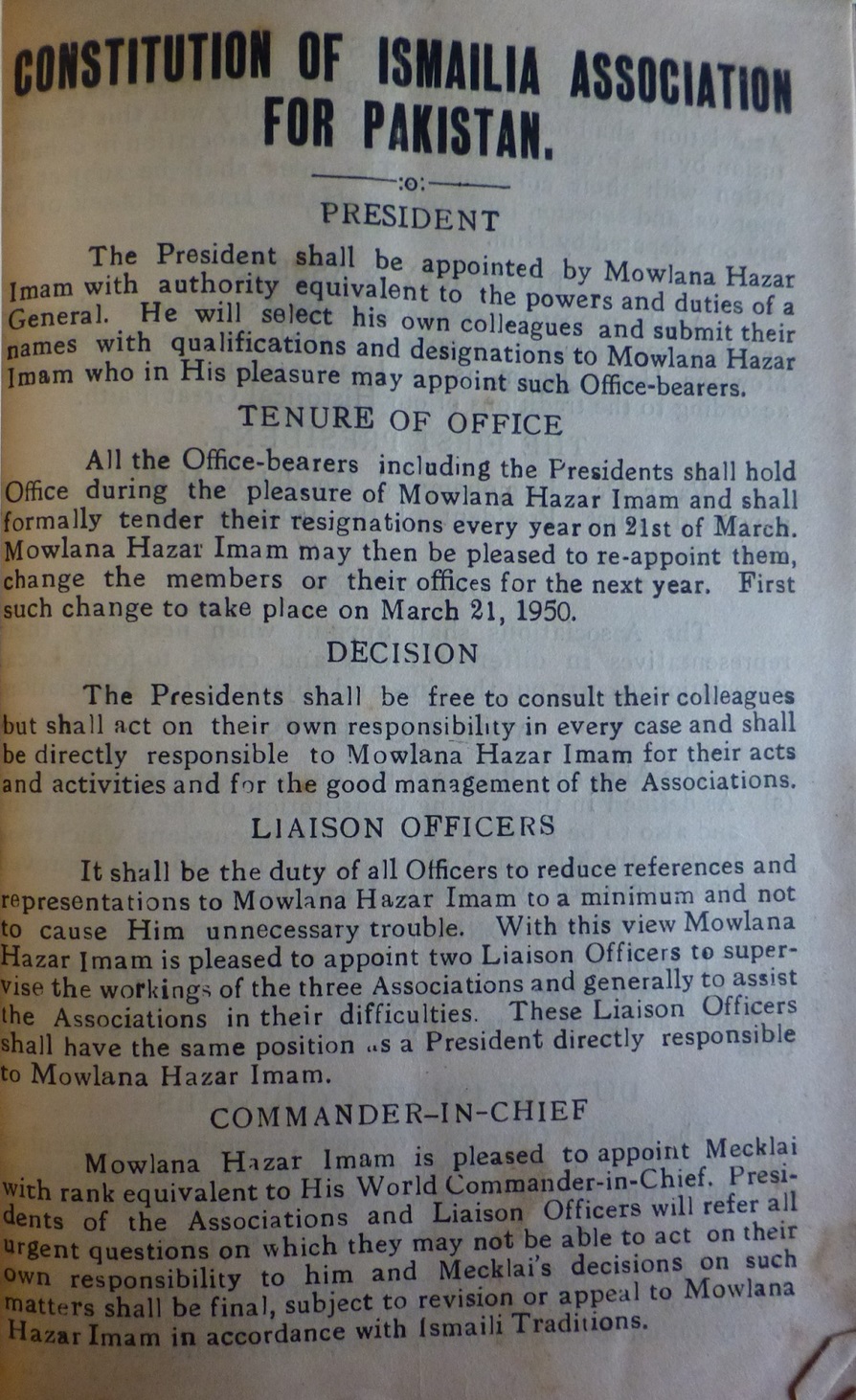
The cover page of the Constitution of the Ismailia Association of West Pakistan from 1950.
~~~~~~
The opening page of the Constitution of the Ismaili Association of West Pakistan from 1950 outlining the system, structure, and rules that were to be abided by for members of the Ismailia Association of West Pakistan (in contrast to the jurisdiction of East Pakistan, which eventually became Bangladesh).
The importance of these regional libraries, especially for local researchers, cannot be underestimated. Throughout my travels over the past 25 years to areas where Ismailis live or once lived, its has often been the works preserved in individual homes, in smaller institutional collections and in local and regional Jamatkhana libraries that have provided some of the most unique documents and witnesses to history; and it is through them that have come the greatest insights and breakthroughs. Large institutional collections such as those of national libraries or of learned societies have become more accessible as they digitize their collections, but it is our debt to local institutions that cannot be underestimated.
Story continues below
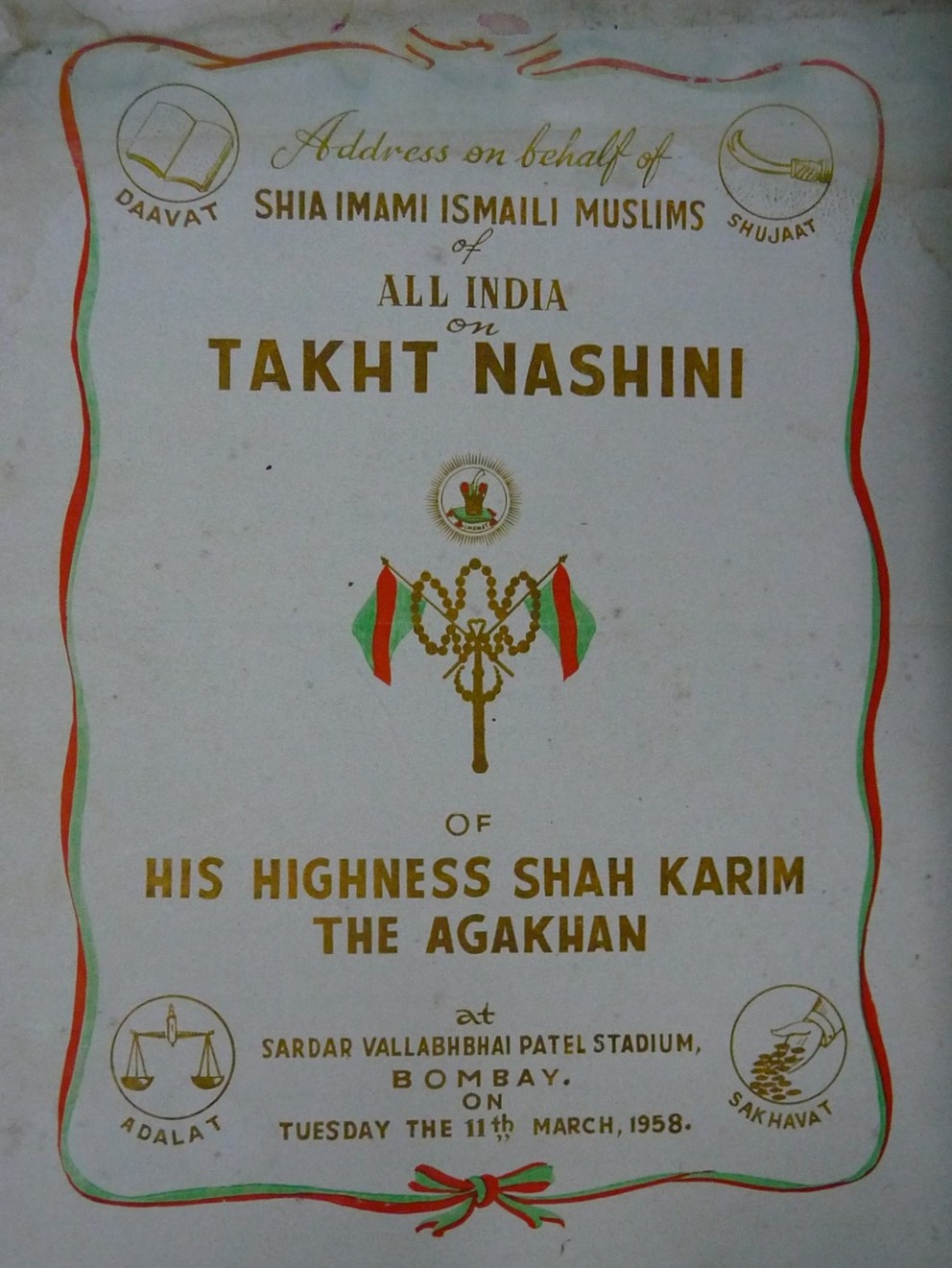
Cover of the Souvenir of Mawlana Hazar Imam’s Takht Nashini (accession ceremony to the office of Imamat) in Bombay in 1958.
~~~~~~
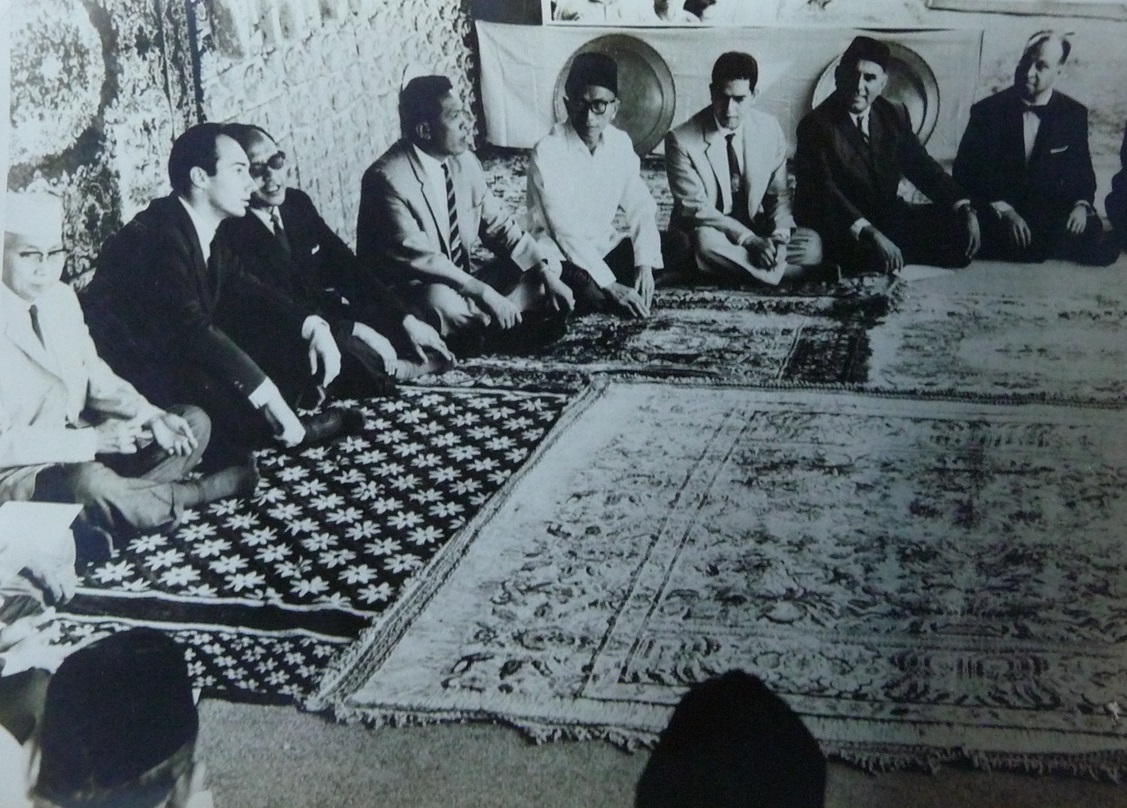
Mawlana Hazar Imam at a meeting with the leadership of Mindanao University and Kalimul Islam Colleges, Philippines during his visit in 1963. The information on the back of the photo reads: “Kamilul Islam Colleges Convocation Function in Honour of H.R.H. Prince Karim Aga Khan. The Aga Khan is seen sitting in the Philippine Native style flanked by Dr. Antonio Isidro, President of Mindanao State University on his right and Honourable Ahmed Domocao Alanto President of Colleges on his left. In the picture also are seen Mr. Amirali Fancy on his extreme left (back to camera) and Captain Amirali Currim second from the right, both wearing Philippine caps, who accompanied H.R.H on Philippine tour as his ministers”.
~~~~~~
Local institutions, including Jamatkhanas, throughout the world have often preserved innumerable documents, manuscripts, published works, photographs and even newspaper cuttings which shed light on one of the least understood and most complex periods of Ismaili history — the last few hundred years. As Jamats in local environments fell under the dominion of various empires and rulers, and later national governments, local histories become increasingly important for understanding how Ismaili communities have come to be where they are today.
Story continues below
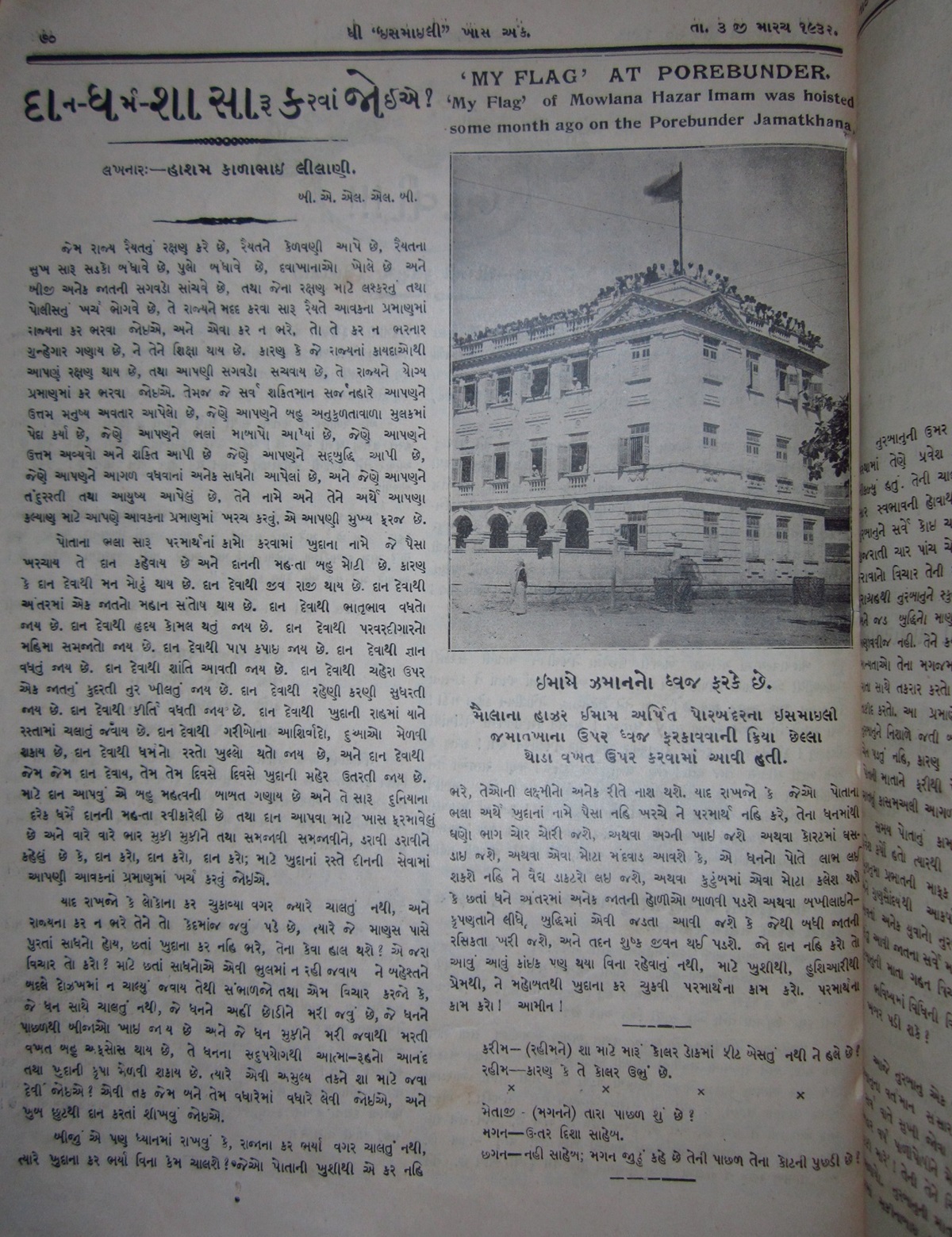
A page from The Ismaili magazine, March 3rd, 1932 edition showing a photograph of the newly raised “My Flag” at Porbander Jamatkhana.
Furthermore, since the early 1980s as part of the global processes of standardization and institutionalization, the focus of important publications such as local Ismaili magazines have shifted the majority of their spotlights to the Imam, his family and the work of Imamat institutions where previously the magazines also included much more detail, output on the production and development of Ismaili communities through the lens of the local and told from the ground-up. While there has been many things gained in the centralization of the Ismaili magazines, one of the most notable losses has been the capturing of stories of the ground realities, literary output, reflections of individual Ismailis and the vibrancy and details of the local development of Ismaili communities.
Story continues below
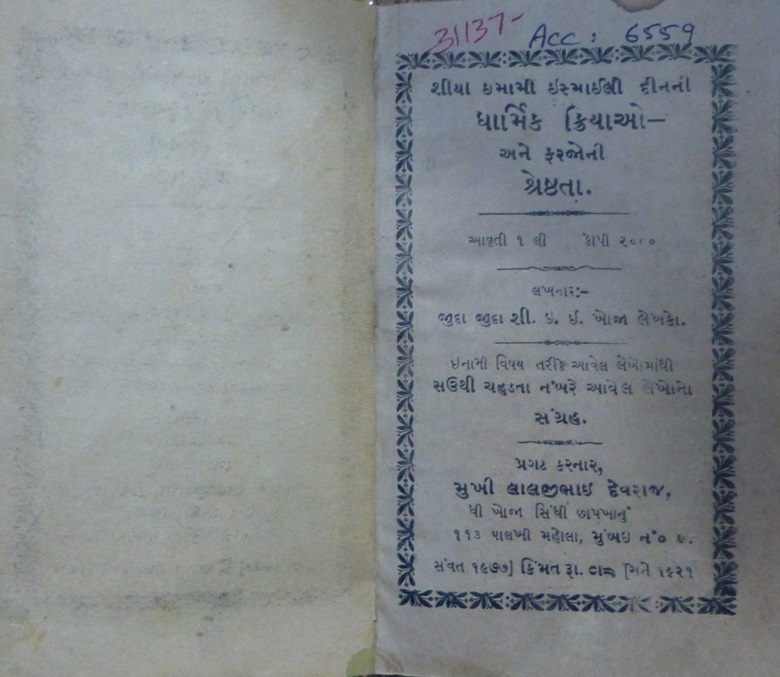
The cover of a text on religious ceremonies by Mukhi Laljibhai Devraj published by a Sindhi press in Mumbai in 1921.
~~~~~~
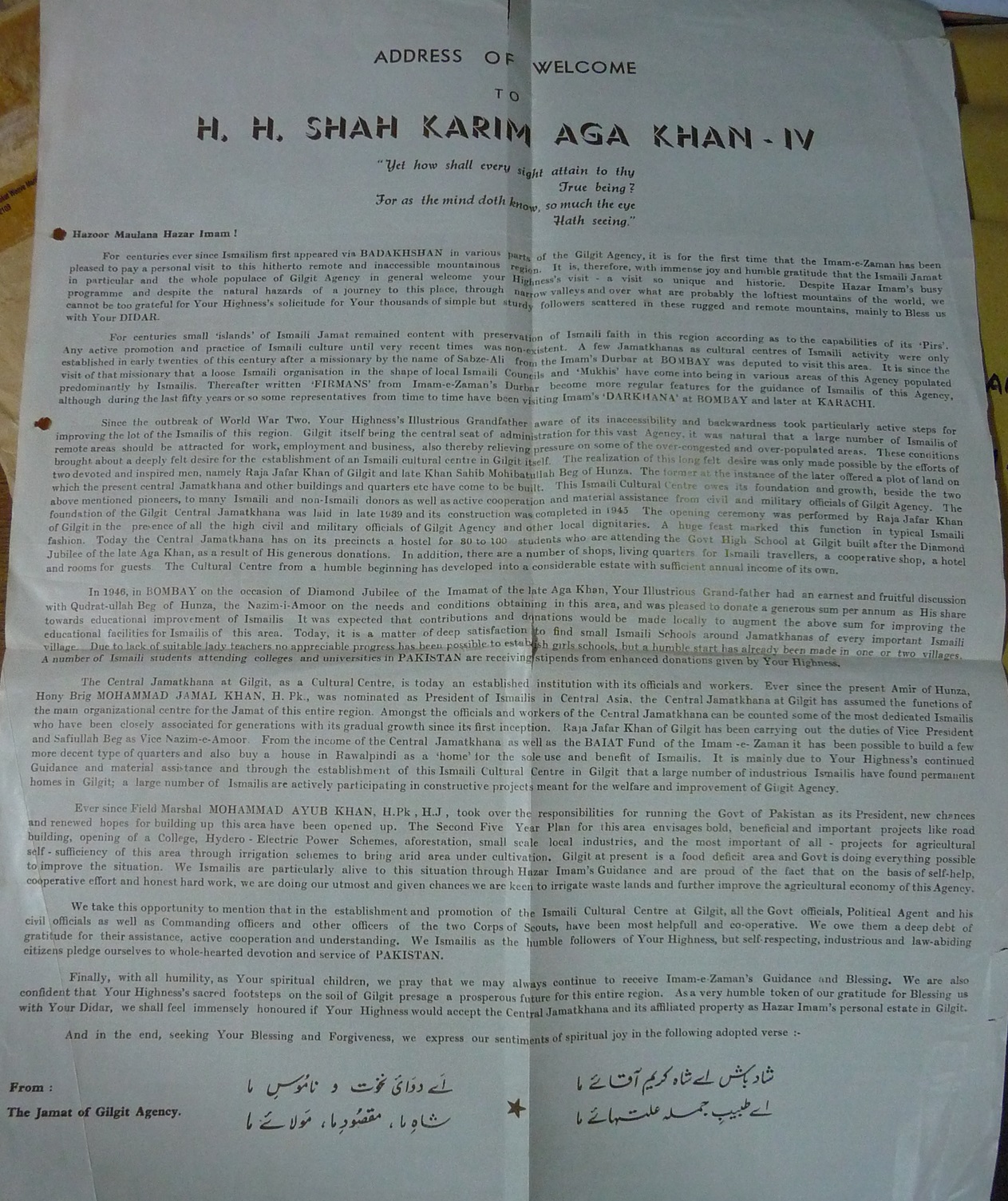
Address of Welcome offered to Mawlana Shah Karim Hazar Imam, His Highness the Aga Khan, on the occasion of his first visit to the Gilgit Agency in October 1960.
~~~~~~
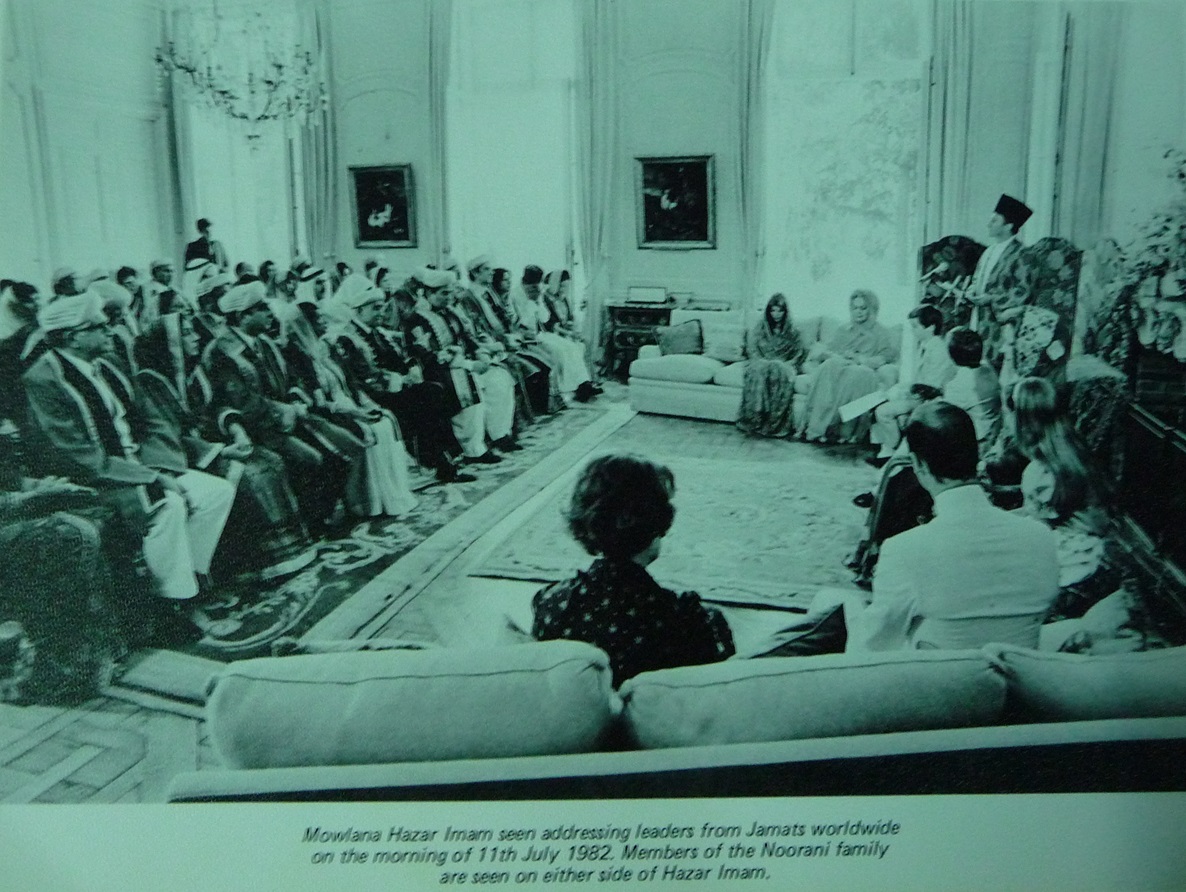
Mawlana Hazar Imam, His Highness the Aga Khan, addressing leaders of the global Jamat in the presence of his family on July 11, 1982, the occasion of his Silver Jubilee as the 49th Imam of the Ismaili Muslims.
I wrote this short piece with the hopes that it would be an homage or memorial of sorts to the Central ITREB Library Pakistan and to encourage families and small institutions to safeguard their collections for the benefit of the community in the service of documenting its past. We must also remember that just as important, however, is to preserve the present for future generations.
Date posted: November 11, 2023. Last updated: November 13, 2023 (see editor’s note at top of page).
__________________
About the author: Rizwan Mawani has a background in Anthropology and Religious Studies and is the author of Beyond the Mosque: Diverse Places of Muslim Worship (I. B. Tauris in association with The Institute of Ismaili Studies, 2019). Rizwan has written for a wide variety of audiences and his work has appeared in academic publications, encyclopedias as well as the Wall Street Journal and The Huffington Post. Rizwan was previously Website Content Editor and Research Coordinator in the Department of Constituency Studies at The Institute of Ismaili Studies. His current research focuses on the past two centuries of global Ismaili history with a focus on the Jamatkhana and its development during that period.
We are pleased to announce that a generous sponsor has donated a limited number of tickets for students, seniors (75+), newcomers, and any others for whom cost is a barrier to Kiana Rawji’s Film Screening in the Nanji Family Foundation Auditorium at the Aga Khan Museum on Sunday, October 15, 2023. Those identifying with these categories may use the promo code KRFILMS2023. The link to obtain tickets is https://krfilms.eventbrite.com/. When the screen is displayed, click on the icon Get Tickets; it will take you to the check-out screen where you can enter the promo code KRFILMS2023. The cost of the ticket, CA$22.63, will be waived and you will get a free ticket provided tickets are still available.
The two films screening on October 15th are:
Inside Job: A short fictional film about an Indian woman who, when preparing to leave her home in 1970s Kenya, loses a piece of jewelry and suspects one of her African domestic servants stole it; and
Mama of Manyatta: A short documentary about an extraordinary woman fighting HIV and gender-based violence in a Kenyan slum.
Kiana recently gave us an EXCLUSIVE INTERVIEW where she told us about her work and what inspires her. We now invite you to watch her two short films at the Aga Khan Museum in Toronto on Sunday, October 15.
Purchase Tickets at Eventbrite for Kiana Rawji’s Film Screening at the Aga Khan Museum, October 15, 2023, 11 AM – 1 PM
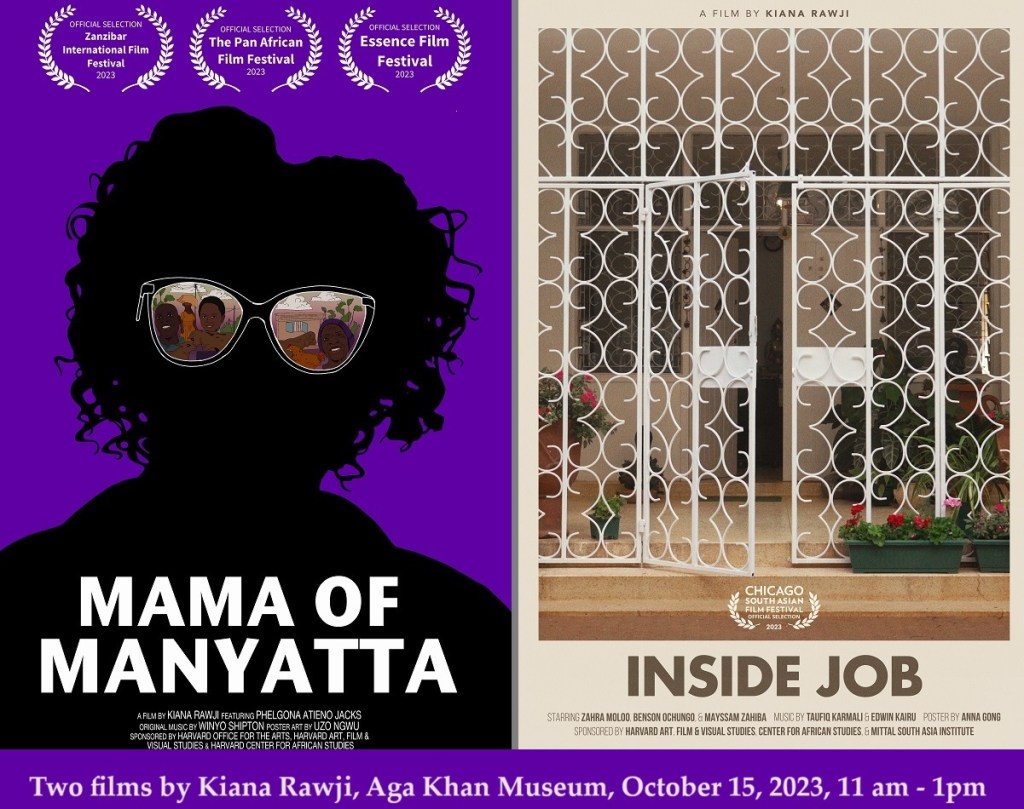
Click on https://krfilms.eventbrite.com/ or on the image below to obtain your tickets. If cost is a barrier, use the Promo Code KRFILMS2023 to acquire a free ticket; Kiana wants everyone who wants to attend to be able to attend the screening of her films. Tickets are limited!
Please click on image to purchase tickets at Eventbrite. If cost is a barrier, enter promo code KRFILMS2023 at checkout for a free ticket.
Date posted: October 14, 2023.
____________________
Kiana Rawji
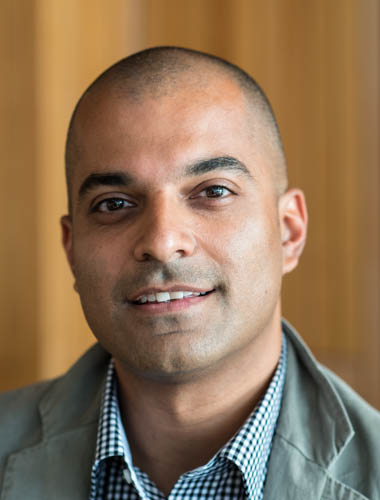
Kiana Rawji is an award-winning filmmaker from Calgary, Alberta, and daughter of South Asian immigrants from Kenya. She recently graduated summa cum laude from Harvard College studying Film and History & Literature. Through film, she tries to amplify social issues and drive cultural change; from independent theatres to Oscar-qualifying film festivals, her films have screened across Canada, the USA, and East Africa. Kiana’s TEDx talks on Islam and the Cosmopolitan Ethic have reached over 150,000 people worldwide. Please click https://krfilms.eventbrite.com/ to attend her two short film screenings at the Aga Khan Museum on Sunday, October 15, 2023.
On October 15, at the Aga Khan Museum’s Nanji Foundation Auditorium, will be the Canadian premiere of two short films by award-winning Canadian filmmaker, Kiana Rawji. Kiana recently graduated summa cum laude from Harvard College with a joint concentration in History & Literature and Film, specializing in Cross Cultural Encounters, Diasporic Identities and The Indian Ocean. From independent theaters to Oscar-qualifying film festivals, her films have screened across Canada, the US, and East Africa.
The two films screening on October 15th are:
Inside Job: A short fictional film about an Indian woman who, when preparing to leave her home in 1970s Kenya, loses a piece of jewelry and suspects one of her African domestic servants stole it; and
Mama of Manyatta: A short documentary about an extraordinary woman fighting HIV and gender-based violence in a Kenyan slum
In our interview with Kiana we learn more about her work and what inspires her. We invite you to watch her two short films at the Aga Khan Museum in Toronto on Sunday, October 15:
Voices: Simerg’s Interview with Kiana Rawji
“I strive to tell stories that recognize diversity, complexity, and nuance, while connecting people through universal, human experiences. I’m especially interested in topics surrounding migration, diasporas, and identity” — Kiana Rawji
Kiana Rawji
Simerg: Can you tell us about how you got into filmmaking?
Kiana Rawji: Throughout high school, I had been interested in the intersection between storytelling and social justice, and I had pursued that through writing and public speaking. Filmmaking was always a hobby of mine growing up, but I never even considered it as an academic or career path. When I got to Harvard, I thought I was going to study Government and go to Law School. But then I took a class called Social Justice and the Documentary Film my first year and I was drawn to film as a provocative medium to raise awareness, evoke empathy, and elevate marginalized voices. After I made my first short film in that class, I never looked back. Now I can’t imagine myself as anything other than a filmmaker.
At Harvard, I pursued a joint concentration because through History & Literature, I could learn about the very histories, in all their nuance and complexity, that would inform the stories I want to tell through film. Inside Job was a perfect example of that.
Simerg: Where did the idea for Inside Job come from?
Kiana: The film was largely based on my own family history — my parents and grandparents grew up in Nairobi, but before that my family traces back to Gujarat, India. I knew I wanted to make a film set in the 1970s Kenya, during a period of exacerbated racial tensions, due to the rise of ethnocentric nationalism in the region. I was particularly interested in the ways “Africans” and “Indians”/“Asians” perceived and interacted with each other. Since society was so racially segregated though, I realized the most common realm of interracial interaction and intimacy was in the household; virtually all brown households employed black domestic “servants”. What was all the more interesting was that, despite the deeply entrenched taboo that restricted social contact between brown women and black men in particular, these two types of people consistently interacted on a daily basis through the domestic labor relationship. I started to wonder how larger cultural norms and boundaries as well as political tensions were both reinforced and transcended in such close quarters.
Interview continues below
Inside Job, a film by Kiana Rawji that will premiere with Mama of Manyatta on Sunday, October 15, 2023, at the Aga Khan Museum, Toronto.
So I decided to explore that dynamic through oral history research. I interviewed many East African Asian women who lived through the 70s, as well as black African domestic workers. These interviews informed my whole script, from the subtleties of the dialogue to the core elements of the plot. I decided to focus on the theme of theft because of how much it came up in my interviews, and how symbolic it was; it was clear that both sides felt the other had stolen something from them. South Asians in East Africa felt that their own homes, along with properties, businesses, etc., were stolen from them when they were largely expelled from the region in the 70s. At the same time, native East Africans felt that “Asians” had stolen all the wealth and land in the first place. Both were stuck in a colonial system of inequality and a highly racialized socioeconomic hierarchy that lasted well beyond the colonial period. It’s a complex issue. Both sides built up mythologies around and resentments toward each other, and I think part of that can be reflected in relationships fostered in the household.
Simerg: What was most difficult about filming Inside Job?
Kiana: Well, the effort to make a period film in a foreign country in under a week with a budget under $10,000 was a huge challenge in itself. But I was able to find an incredible, talented cast and crew to achieve this and make it all easier.
The biggest challenge I faced was trying to get it right. I was recreating a history that I hadn’t lived through. I studied Swahili at Harvard and that helped but I don’t even speak or understand Gujarati. But the way I addressed that challenge was to consult a lot of experts.
The interviews I conducted before writing the script were, themselves, instrumental to helping me understand the details of what it was like to live in 1970s East Africa, from the food that was eaten to the daily routines. I looked at old photos from my interview subjects as source material for my costume designer. I based the Indian family off of an Ismaili family, since that’s who I was primarily interviewing and that’s my family history, so that meant that the family would be much more westernized than other South Asians in the region, wearing western clothing and using British dishware.
I was fortunate to receive generous support from Nazim Mitha at the National Museum in Nairobi; he connected me with one of the main museum curators (who was helping put together the upcoming exhibit on East African Indians) who was basically my set design consultant, guiding me on props and setups. Shariffa Keshavjee, who has been a regular contributor to Simerg and an avid patron of the arts, was also such an amazing source of support; she was a source of cultural knowledge and also helped connect me to people in the local film industry. And then one of the most important things was finding actors who spoke the languages of the film (English, Gujarati, and Swahili) and could move authentically and fluidly between them, infusing scripted lines with their own touch. All these details are what helped me build the world of my film in a colorful, sensitive, and authentic way. It was one of the most fun and rewarding experiences I’ve had.
____________
“When it comes to filmmaking around social issues, I’ve learned that stories of injustice and adversity are incomplete without the stories of resilience and endurance that invariably exist alongside them” — Kiana Rawji
____________
Simerg: As for your other film, Mama of Manyatta, how did that come about? How did you come to meet the subject, Phelgone Jacks?
Kiana: A few years before I made the film, my older sister Zahra had met Mama Phelgone through a Harvard College summer global health program that connected students with local NGOs and CBOs. Mama Phelgone worked on removing stigma around those affected by HIV/AIDS in Kisumu. After spending some time with Mama Phelgone, Zahra told me there was a story there that I had to tell. The next summer (summer 2019), when I went to Kisumu and met Phelgone myself, I instantly agreed that hers was a story that needed to be told. Her community-centered approach to creating impact was remarkable, and she, herself, was one of the most generous, compassionate, and dedicated people I have ever met.
Twenty years ago, Phelgone founded a community-based organization fighting HIV/AIDS and gender-based violence in the slum of Manyatta in Kisumu. She was a mother figure to Manyatta’s young and old; she built an Early Childhood Development Center outside her home, hosted safe-sex workshops for teenage girls, counseling sessions for women survivors, and more. Though she helped people work through immense trauma, what was most remarkable about Mama Phelgone (as she was affectionately known in Manyatta) was that she cultivated strength and joy wherever she went, through prayer, song, and dance. She was, in her own words, an “ambassador of hope.”
Rather than the all-too-common narrative of the suffering African poor, I wanted Mama of Manyatta to present a portrait of African empowerment and leadership.
In a similar vein, while my 2021 documentary Long Distance was an exposé of systemic racial injustice in Canada’s immigration system, it was also, at its core, a love story about a Filipino immigrant couple — two resolute dreamers who prevailed despite the forces working against them. When it comes to filmmaking around social issues, I’ve learned that stories of injustice and adversity are incomplete without the stories of resilience and endurance that invariably exist alongside them.
Soon after I shot Mama of Manyatta in 2022, Mama Phelgone was diagnosed with metastatic cancer. She passed away in the middle of my post-production. Though I was deeply saddened, my drive to preserve a remarkable life and legacy only intensified. Through my film, I hope Phelgone’s story continues to inspire change.
Interview continues below
Mama of Manyatta, a film by Kiana Rawji that will premiere with Inside Job on Sunday, October 15, 2023, at the Aga Khan Museum Toronto.
____________
“I decided I didn’t want to be a filmmaker who hides behind her lens, observing, recording, then leaving. I want to be the kind who knows when to stop being a fly on the wall and start engaging — when to be a friend, not just a filmmaker. When artists get proximate to their subjects — which sometimes requires those precious interactions unmediated by a camera lens — opening their souls and immersing themselves in the lives of others, the product is more meaningful and fulfilling for everyone involved” — Kiana Rawji
____________
Simerg: What were some of the most memorable moments from the production/filming of Mama of Manyatta?
Kiana: There were so many — it was such a joy and a privilege to be included in the circle of warmth and love that Mama Phelgone radiated.
But there is one moment in particular that stuck with me. It was in the middle of a workshop on gender-based-violence; Phelgone was helping a group of women — survivors of sexual assault –prepare for upcoming post-election violence and the risk it posed to women in the community, including themselves. I remember that, when Phelgone sensed the air in the room growing heavy, she suggested a dance break.
And so they got up, they played music, they danced, they smiled, and they laughed.
Phelgone and the women beckoned for me to join them. But the filmmaker in me was so keen to capture every detail of this moment — the rhythmic body movements, the courageous smiles, the unbridled laughter. Something unexpected and beautiful could happen any second, and if my camera wasn’t rolling, I thought, I might miss it. But that day, I realized that sometimes you also miss things when the camera is rolling. After filming the women dancing for a few minutes, I decided to set down my camera and join them. They showed me some moves, I was awful, they laughed at me, Ilaughed at me, and it was wonderful.
I went into that shoot believing in the power of the camera, but I came out of it having also learned the power of putting it down. I decided I didn’t want to be a filmmaker who hides behind her lens, observing, recording, then leaving. I want to be the kind who knows when to stop being a fly on the wall and start engaging — when to be a friend, not just a filmmaker.When artists get proximate to their subjects — which sometimes requires those precious interactions unmediated by a camera lens — opening their souls and immersing themselves in the lives of others (whether through dancing, sharing meals, or conversations), the product is more meaningful and fulfilling for everyone involved.
Simerg: What inspires you? What drives your creative process?
Kiana: My intersecting identities as a South Asian Muslim woman and child of immigrants from East Africa inform the stories I want — and need — to tell.I strive to tell stories that recognize diversity, complexity, and nuance, while connecting people through universal, human experiences. I’m especially interested in topics surrounding migration, diasporas, and identity.
My creative process is driven by compassion, curiosity and collaboration. It begins with passion and personal investment in a story, followed by detailed research and engagement with real people and real stories. Sometimes my work is based on my personal life and serves as catharsis. Other times, I start with family history, like in Inside Job. Other times yet, I look for the extraordinary in ordinary people who endure injustice, like in Mama of Manyatta, or my previous documentary, Long Distance.
Simerg: What is your advice to aspiring filmmakers?
Kiana: It doesn’t take much to start. You don’t need fancy equipment or huge amounts of funding — all you need is a camera (which could be your phone) and a good story. There are so many resources online. I taught myself how to use film editing software and write film scripts on the Internet. It just takes initiative and passion, and if you have those two things, you’re off to the races. I always remember what my idol, Ava DuVernay, said once when giving advice to filmmakers starting out. (I remember meeting her at a Harvard event, and feeling so energized and unbelievably inspired by her; she is the person who made me realize I wanted to be a filmmaker in the first place). She said something along the lines of ‘don’t wait for something precious.’ Just begin. It doesn’t need to be the perfect, most eye-grabbing, world-changing idea. Everything you make will help you learn, and you’ll only get better. Just begin by telling stories you care about.
~~~~~~~~~
Purchase Tickets at Eventbrite for Kiana Rawji’s Film Screening at the Aga Khan Museum, October 15, 2023, 11 AM – 1 PM
A limited number of tickets to the screening of Kiana’s two films on Sunday, October 15, 2023 from 11 AM – 1 PM at the Aga Khan Museum’s Nanji Foundation Auditorium are available and can be purchased by clicking on EVENTBRITE – KIANA RAWJI FILM SCREENING. Secure your tickets ASAP before they sell out! The price of the ticket includes parking at the Museum.
On the day of the screening, the Museum’s restaurant, Diwan, will be open (it is recommended to make a reservation in advance) as well as the Museum cafe.
Film screening guests will receive a 50% off discount on museum tickets (normally valued at $20), and are invited to explore the Aga Khan Museum exhibitions before or after the screening, during operating hours of 10 AM – 5:30 PM.
~~~~~~~~~
Visit Kiana Rawji’s Website
Details about Kiana and her previous work can be found at www.kianarawji.com.
Date posted: September 28, 2023.
____________________
Kiana Rawji
Kiana Rawji is an award-winning filmmaker from Calgary, Alberta, and daughter of South Asian immigrants from Kenya. She recently graduated summa cum laude from Harvard College studying Film and History & Literature. Through film, she tries to amplify social issues and drive cultural change; from independent theatres to Oscar-qualifying film festivals, her films have screened across Canada, the USA, and East Africa. Kiana’s TEDx talks on Islam and the Cosmopolitan Ethic have reached over 150,000 people worldwide.
The Ismaili Imamat is a Hereditary Institution and originates from the time the Prophet Muhammad (may peace be upon him and his family) appointed Hazrat Ali — his cousin and son-in-law — to succeed him as the Imam at a pivotal gathering held between Mecca and Medina following his final pilgrimage. The current Hereditary Imam of the Shia Imami Ismaili Muslims, directly descended from Imam Ali (may peace be on him), is His Highness the Aga Khan (actual name Shah Karim Al Hussaini) who is lovingly addressed by his Ismaili Muslim followers as Mawlana Hazar Imam (Our Lord, the manifest and present living Imam).
Canada is home to more than 100,000 Ismailis and the Aga Khan Museum in Toronto, the Aga Khan Garden in Edmonton, and the Global Centre for Pluralism in Ottawa are just some of the many projects of the Ismaili Imamat in Canada. The Aga Khan’s younger brother Prince Amyn has been singularly involved in these and other projects of the Imamat around the world for almost six decades and we honour him today, September 12, 2023, as he celebrates his 86th birthday. Please click Prince Amyn Aga Khan or on the photographs to find out more about his contribution and devotion to the Imamat.
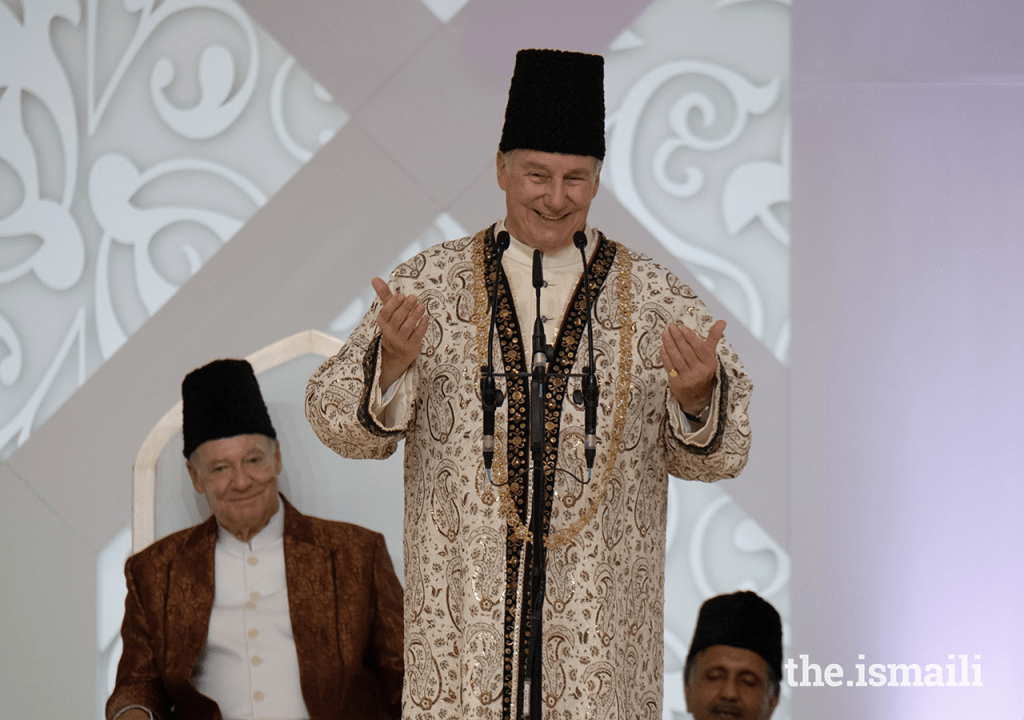
Prince Amyn Aga Khan, seated at left, looks on as his older brother, His Highness the Aga Khan, addresses his Ismaili Muslim followers at a Darbar — a grand ceremonial gathering — in Lisbon, Portugal, during his Diamond Jubilee celebrations in July 2018. Photograph: The Ismaili.
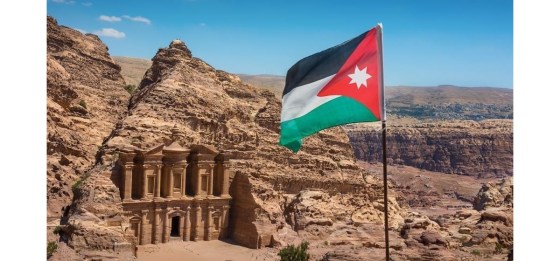
The featured photo of Jordan’s flag at the top of this post is reproduced from the website Embassy of the Hashemite Kingdom of Jordan, Tokyo, Japan. The following textual material has been gathered from the Embassy’s website as well as the websites of North Carolina’s Timothy S. Y. Lam Museum of Anthropology and a-z-animals, an interesting educational website on animals that also provides factual and well-researched information on other topics while describing animals in a specific country.
The Jordanian flag, in its current form, was adopted in 1922. It is inspired, in shape and colours, by the Great Arab Revolt banner, which was raised from the plains of Mecca in 1916.
Each of the three stripes represents a different caliphate, with black representing the Abbassid Caliphate, white, representing the Ummayyad Caliphate, and green, representing the Fatimid Caliphate, while the red chevron encompassing the flag’s components represents the Hashemite Family, in addition to paying homage to the Arab Revolt. The Fatimids, who ruled in North Africa and Egypt from 909 – 1171 CE are the ancestors of the current 49th Hereditary Imam of the Shia Ismaili Muslims, His Highness the Aga Khan, who is respectfully addressed by his Ismaili followers as Mawlana Hazar Imam — Our Lord, the Present/Living Imam.
The red triangle contains a seven-pointed star to symbolize the seven verses of the Surat Al Fatiha, the opening chapter of the Holy Qur’an. The website A-Z Animals adds that the verses symbolize unity as well as include “humanity, virtue, humility, faith in one God, national spirit, social justice, and aspiration.”
The website of the Timothy S. Y. Lam Museum of Anthropology located in North Carolina, mentions that colours are used to represent beliefs, traditions, and concepts in many religious traditions. The article also notes that “the color green is associated with Islam because it is believed to have been the Prophet Muhammad’s favorite color. It is said he wore a green cloak and turban, and his teachings reference the color. The Qur’an states that green will be worn by the inhabitants of paradise.”
Article 4 of the Constitution of Jordan specifies the form and dimensions of the Jordanian flag as follows:
“The length of the flag shall be twice its width. It shall be divided horizontally into three parallel and equal stripes, the uppermost of which shall be black, the center, white and the lowest, green. At the end of the flag-staff the flag shall have a red chevron, the base of which shall be equal to the flag’s width and the altitude of which shall be half of the flag’s length. In the chevron, there shall be a white seven-pointed star of such a size that it may be one-fourteenth of the flag’s length. The star shall be so placed that its center shall be at the intersection of the lines bisecting the angles of the chevron, and the axis running through one of its points shall be parallel to the base of the chevron.”
Yasser Desai’s rendition of a Naat (song) honouring the Prophet Muhammad has been making its rounds in the social media. The reaction to the Naat — that is presented below through YouTube — has been very positive from listeners around the world. Listeners wrote (selected excerpts): “The song brought tears to my eyes!….Your voice is magical and unique. I love your passion while singing this amazing Naat e Mustafa….As a Muslim [the song] melts my heart and I felt some inner peace.”
Story continues below, with lyrics of song
Born on November 15, 1989 in Mumbai, India, Yasser Desai started his journey in music from the age of 11. Completely self-taught, Yasser Desai has sung many highly acclaimed songs like “Dil Ko Karaar Aaya”, “Hue Bechain”, and “Aankhon Me Aansoon Leke”, among others; he has more than 200 songs to his credit in Bollywood movies. He has also sung several singles for Zee Music Company and many other music channels.
LYRICS
(the text of the lyrics corresponds to the flow of the song; refrains are therefore repeated in the text)
Hasbi Rabbi Jallallah Mafi Qalbi Ghair ullah Noor e Muhammad Sallallah La ilaha illallah
Hasbi Rabbi Jallallah Mafi Qalbi Ghair ullah Noor e Muhammad Sallallah La ilaha illallah
Tere Sadqe main Aaqa Saare jahaa(n) ko deen mila Be-deeno(n) ne kalma parha La ilaha illallah
Simt e Nabi Abu-Jehal gaya Aaqa se usne ye kaha Tum ho Nabi batlaao zara Meri muthi mai hai kya
Simt e Nabi Abu-Jehal gaya Aaqa se usne ye kaha Tum ho Nabi batlaao zara Meri muthi mai hai kya
Aaqa ka farmaan hua Aur Fazl e Rahman hua Muthi se pathar bola La ilaha illallah
Hasbi Rabbi Jallallah Mafi Qalbi Ghair ullah Noor e Muhammad Sallallah La ilaha illallah
Wo jo Bilal e Habshi hain Sarwar e dee(n) ka pyara hai Dunya kay har aashiq ki Aankho(n) ka wo taara hai
Wo jo Bilal e Habshi hain Sarwar e dee(n) ka pyara hai Dunya kay har aashiq ki Aankho(n) ka wo taara hai
Zulm hue kitne us par Seenay pay rakha pathar Phir bhi zubaa(n) pay jaari tha La ilaha illallah
Hasbi Rabbi Jallallah Mafi Qalbi Ghair ullah Noor e Muhammad Sallallah La ilaha illallah
Apni behen se bole Umar Ye to bata kya karti thi Mere aane se pehle Kya chupke chupke parhti thi
Apni behen se bole Umar Ye to bata kya karti thi Mere aane se pehle Kya chupke chupke parhti thi
Behen ne jab Qur’an parha Sun ke kalaam e paak e khuda Dil ye umar ka bol utha La ilaha illallah
Hasbi Rabbi Jallallah Mafi Qalbi Ghair ullah Noor e Muhammad Sallallah La ilaha illallah
Dunya ke insaan sabhi Shirk o bid’at kartay thay Rab ke thay banday phir bhi Buut ki ibadat kartay thay
Dunya ke insaan sabhi Shirk o bid’at kartay thay Rab ke thay banday phir bhi Buut ki ibadat kartay thay
Butt khaney hai tharraye Mere Nabi hain jab aaye Kehnelagi makhlooq e khuda La ilaha illallah
Hasbi Rabbi Jallallah Mafi Qalbi Ghair ullah Noor e Muhammad Sallallah La ilaha illallah
Artistic Greeting Cards by Karim Ismail, Brief Notes on the Imamat and the Aga Khans, and an Explanation and Recitation of a Celebratory Ismaili Ginan (Hymn)
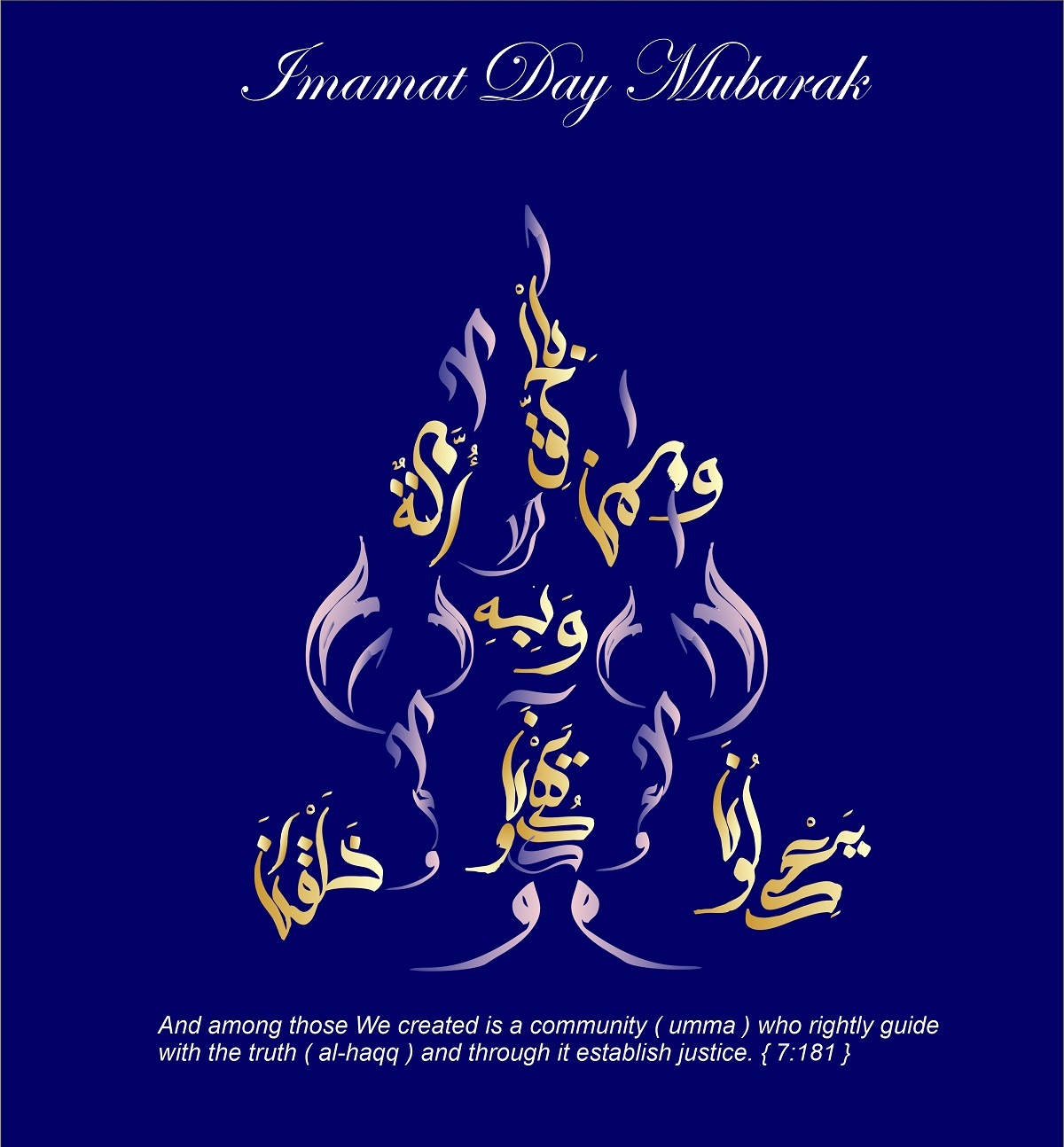
Simerg and its sister websites, Barakah and Simergphotos, convey heartiest felicitations to Ismailis and friends of the Ismaili community in Canada and around the world on the auspicious occasion of His Highness Prince Karim Aga Khan’s 66th Imamat Day anniversary which falls on July 11, 2023. The Aga Khan succeeded to the Hereditary Throne of Imamat on July 11, 1957 at the age of 20 upon the death of his grandfather, Mawlana Sultan Mahomed Shah Aga Khan III, whose reign of 71 years as the 48th Imam is the longest in the 1400 year history of the Shia Ismaili Muslims.
Yesterday, on July 10, 2023, we presented a unique collection of pages from the Tanganyika Standard newspaper that reported on the death of the late Aga Khan and the succession and enthronement of his grandson Prince Karim. For July 11, we present a series of beautiful works of Imamat related calligraphies created over the years by Toronto’s Karim Ismail, including one for 2023 which is shown below.
Inspiration for the calligraphy was drawn from the book “The Master and the Disciple” in which the ayat (7:181) is quoted, and which relates to the Imams. The book is an early Islamic spiritual Dialogue by Ja’far b. Munsur al-Yaman. In this section of the book two characters are involved in a dialogue. One is an Ismaili da’i by the name of Salih and a knowledgeable Mullah called Abu Malik. After some time the dialogue turns to the concept of Divine Justice where Salih refers to 7:181 several times. The Ismaili da’i explains to Abu Malik (who has gained the surname of Cube of scholars) that God’s act of justice towards His servants is through just witnesses (7:181). Salih uses the Arabic word adl to also mean witness (7:181). In Shi’i and especially Ismaili understanding, these just witnesses are the Imams (Ahl al-bayt). Upon hearing this, Abu Malik exclaims, ‘By my life, this is the very foundation of justice!’. He now understands that God’s justice is by means of the just witnesses mentioned in 7:181.
According to well-known Muslim traditions, the Prophet Muhammad (May peace be upon him and his family) said:
“I am leaving amongst you two weighty things after me, the Qur’an and my Progeny (ahl al-bayt). Verily, if you hold fast to them both you will never go astray. Both are tied with a long rope and cannot be separated till the Day of Judgement.” (Muslim, Vol. II, pg. 279).
The Prophet appointed Hazrat Ali to be his successor as the Imam in a pivotal gathering during his return to Medina from his final pilgrimage to Mecca. The Aga Khan, who is respectfully addressed by the Ismailis as Mawlana Hazar Imam (our Lord the present/living Imam), is the 49th Hereditary Imam in direct succession of Imams since Imam Ali.
In the Ismaili Ginan (hymn) Girbah Vali, attributed to the Ismaili missionary Pir Sadr al-Din, the Pir says:
“If the Imam did not have his feet on this earth for even a moment, then the world, moon, sun would vanish and nothing would exist, neither the heaven nor the earth.”
This notion of the cosmic necessity of an Imam, expressed by the Pir, is also found in famous traditions of the Prophet Muhammad (cited in “The Divine Guide in Early Shi’ism,” pp 125-131):
“The earth cannot be devoid of an Imam; without him, it could not last an hour,” and also: “If there were only two men left in the world, one of them would be the Imam.”
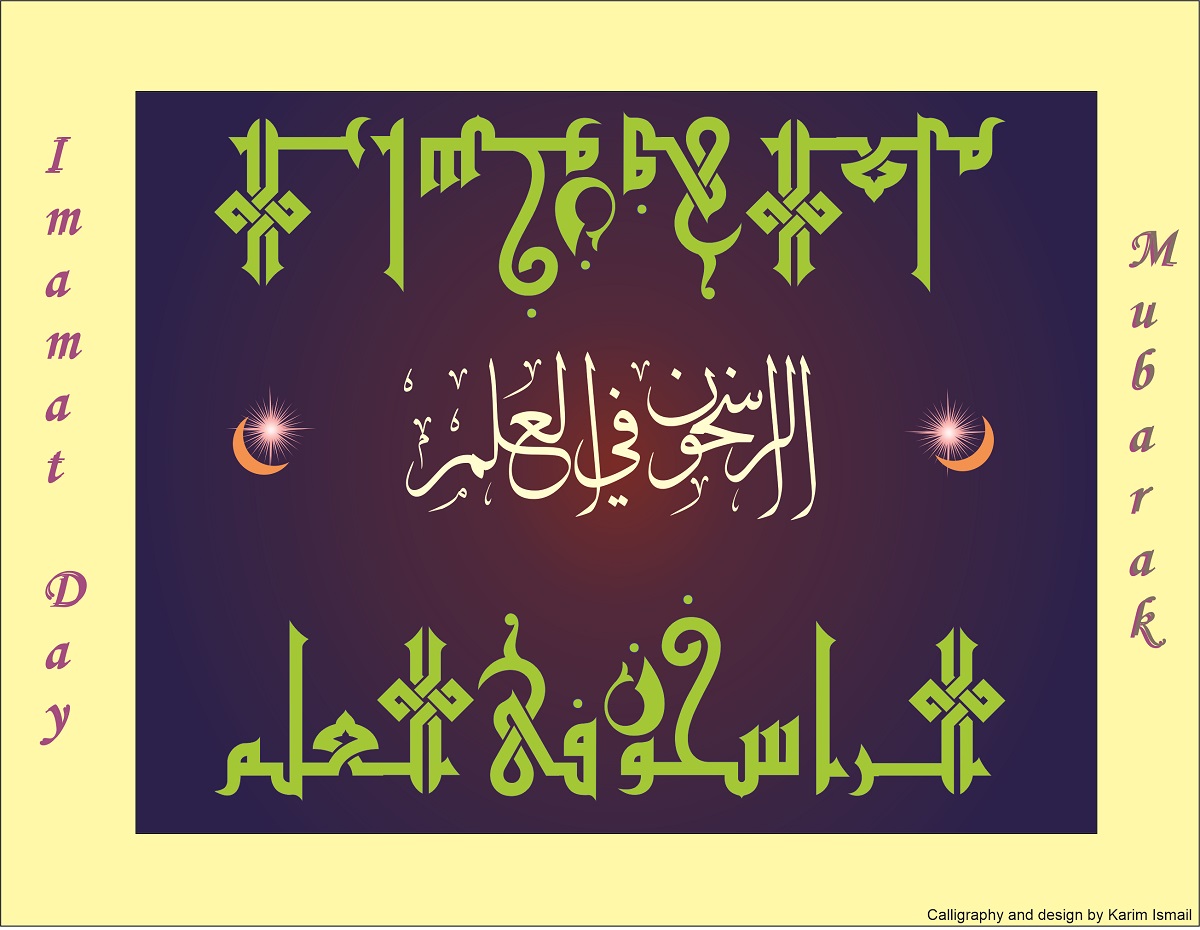
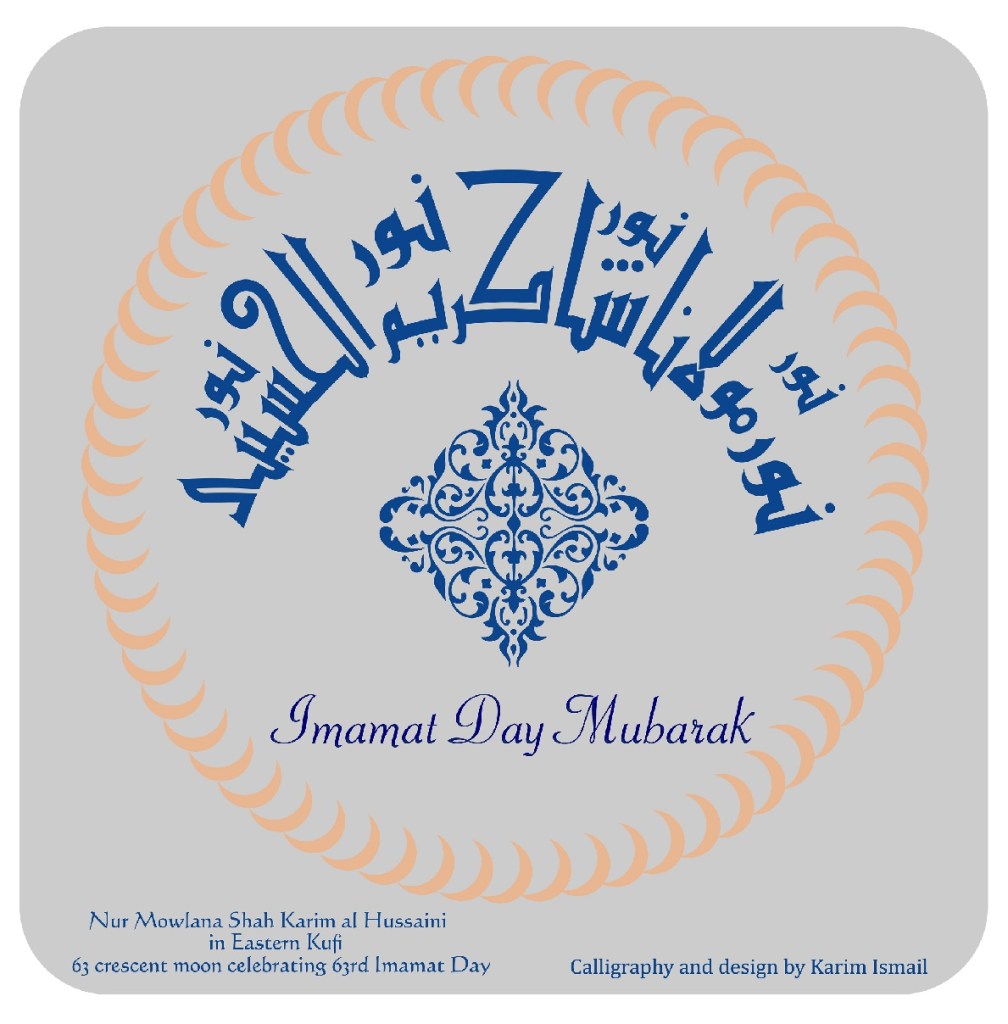
The calligraphies that Toronto’s Karim Ismail has created for Imamat Day over the past few years, are inspired by Qur’anic phrases that in Shia tradition refer to the Imam, and we are happy to include all the calligraphies that he has contributed to the website since 2020.
The Qur’anic phrase Al-rasikhun fi’l-ilm (Those firmly rooted in knowledge) in Fatimid Kufi script on all 4 sides of the art work. The Fatimids were rulers of North Africa and Egypt from the 10th through the 12th centuries. The Fatimid Imams or Caliphs were ancestors of the current Aga Khan.
The Qur’anic phrase Al-rasikhun fi’l-ilm (Those firmly rooted in knowledge) on top and bottom of the art work in Fatimid Kufi script; the centre of the art work has the same phrase in Thuluth script. Calligraphy and design by Karim Ismail, Toronto.
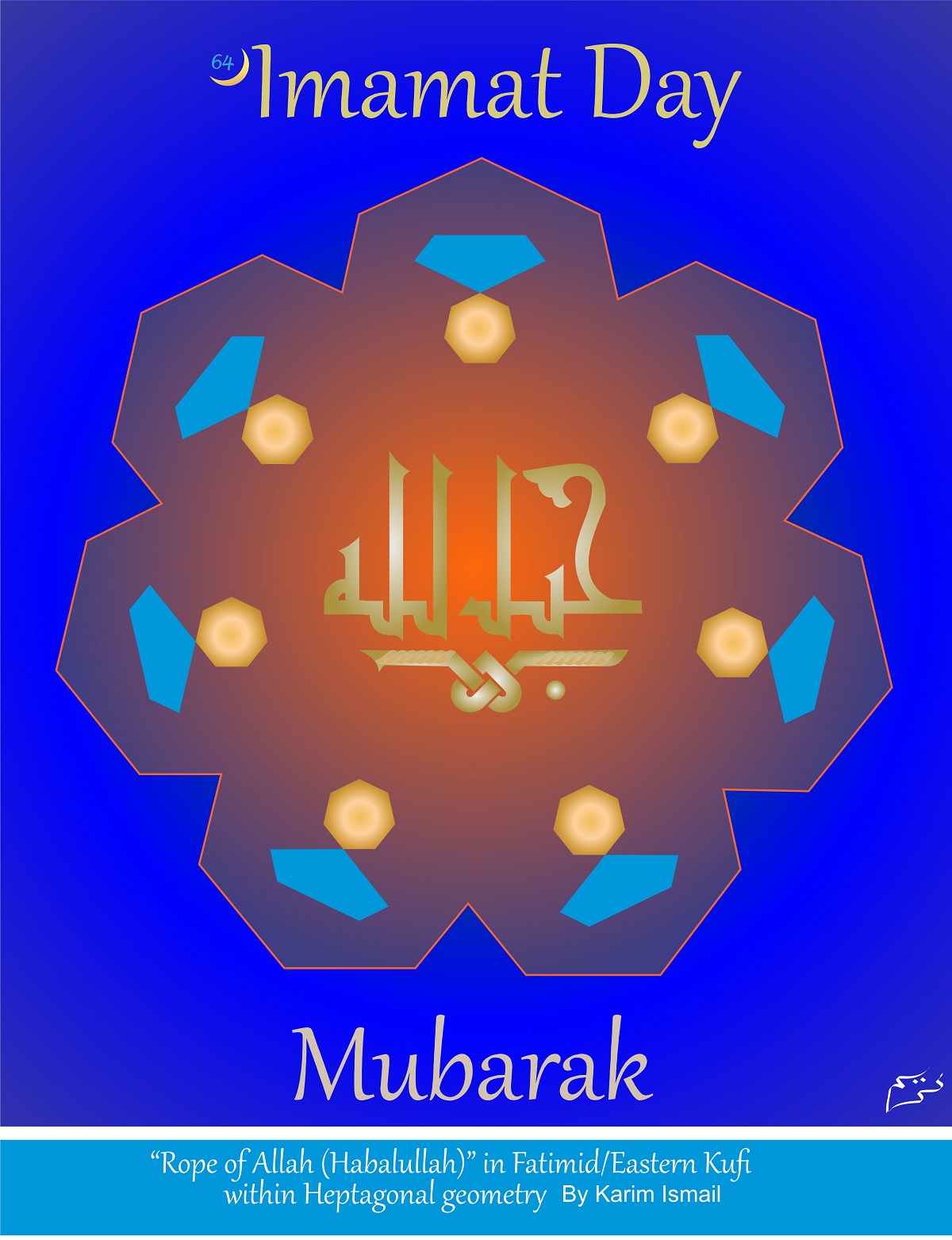
In Shi’i tradition, “The Rope of Allah” (Qur’an 3:103) refers to the “Ahl al Bayt” — the Imams from the House of the Prophet Muhammad (S.A.S). This important tradition appears in the card within heptagonal geometry (seven-sided polygon) about which the (Late) Karl Schlamminger, creator of extraordinary designs and distinctive calligraphies for the Ismaili Centres in London, Lisbon and Toronto, observed as follows in an essay for Arts & The Islamic World (volume 3, number 3, page 25-26): “The floor of the outer entrance hall [of the Ismaili Centre London] has an open ended pattern in heptagonal form which rises at the focus of the room to create a fountain: such a pattern in such space is of course a completely classical Islamic response — but I have never heard of a heptagonal pattern anywhere in Islamic architecture. “The number seven symbolizes for Ismailis the values of its essential philosophy — but has never been used in an architectural context. Here the sevenness of the design is no superficial effigy or naturalistic picture of an idea, but — as always in Islam — is expressed in geometry (literally: measurement of the earth).”
Calligraphy by Karim Ismaili on the auspicious occasion of Mawlana Hazar Imam’s 63rd Imamat Day Anniversary.
_______________________
The Aga Khans
From the day the Prophet Muhammad (May peace be upon him and his family) passed away on June 8, 632, and Hazrat Ali became the first Imam on the Divine Commandment that the Prophet had received at Ghadir Khumm, there have been forty-nine Ismaili Imams in continuous Hereditary Succession, spanning a period of 1391 years in Islamic history.
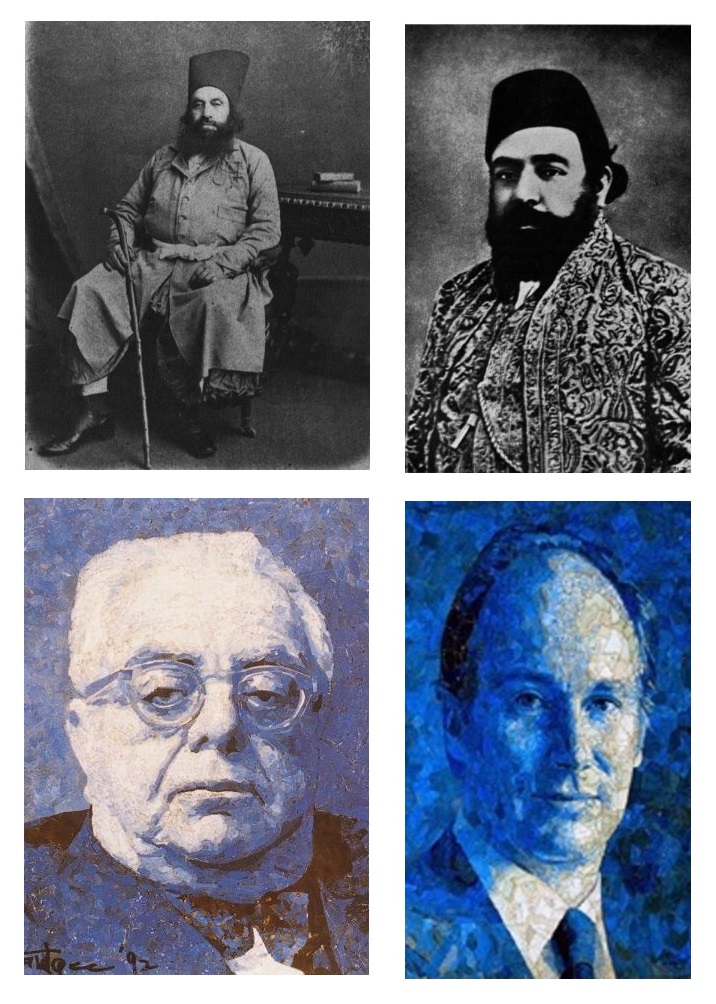
Upper row: Imam Shah Hassanali Shah (Aga Khan I) and Imam Shah Ali Shah (Aga Khan II). Lower row: Imam Sultan Mahomed Shah (Aga Khan III) and Mawlana Shah Karim Al Hussaini (Aga Khan IV). Total reign of the four Imams 203 years from 1817 to current year (2021). Longest reign Aga Khan III, 71 years; followed by Aga Khan I and Aga Khan IV, each 64 years.
The current Aga Khan and his immediate three predecessors have reigned the Ismaili community for a total of 207 years or 14.9 % of the entire span of Imamat, as follows:
1. Mawlana Shah Karim Al Hussaini Hazar Imam (His Highness the Aga Khan IV, Imam from 1957 – Current, 66 years, he became the 49th Imam at the age of 20); 2. Imam Sultan Mahomed Shah (His Highness the Aga Khan III, Imam from 1885 – 1957, Imam for 71 years, he became the 48th Imam at the age of 7 years); 3. Imam Shah Ali Shah (Aga Khan II, 1881 – 1885, Imam for 4 years, he became the 47th Imam at the age of 51 years); and 4. Imam Shah Hassanali Shah (Aga Khan I, 1817 – 1881, Imam for 66 years, he became the 46th Imam at the age of 13 years).
This 207 year period of the reign of 4 successive Ismaili Imams accounts for more time than does the entire Fatimid period, reigned by 8 Imams from Imam Mehdi (11th Imam, North Africa) to Imam Mustansir bi Allah (18th Imam, Cairo).
On that historical and interesting statistical fact, we convey to members of the Ismaili community around the world as well as friends and supporters of the community Imamat Day Mubarak. We also pray for the fulfillment of our readers’ wishes and that everyone’s lives are filled with barakah (happiness) and success. We particularly wish families with young children and youth success in their studies. On this auspicious day, we also pray that the souls of the deceased may rest in eternal peace and that their family members may find strength and courage to overcome the grief over the loss.
_______________________
An Explanation and Recitation of the Ismaili Celebratory Ginan Ya Ali Khuba Mijalas
Editor’s note: This is a very condensed, yet comprehensive, post on the munajat, Ya Ali Khuba Mijalas that is recited in many Ismaili Jamatkhanas around the world for the auspicious celebration of Imamat Day. For the complete version, which offers much more in terms of the Ginan’s history, composition, style, and explanation with a glossary, please click Original article.
By SADRUDIN K. HASSAM
INTRODUCTION
Popular tradition has it that the Munajat,Ya Ali Khuba Mijalas, was first recited during the enthronement ceremony of the 48th Imam, Mawlana Sultan Mahomed Shah, His Highness the Aga Khan III, which took place at Aga Hall at Mazagon Road in Mumbai in September 1885. Another tradition says that the recitation first took place when the young Imam met his followers at the main Ismaili Jamatkhana in Mumbai, known as the Darkhana. In any case, the munajat became very much part of the Ismaili tradition in many parts of the world to recite it in jamati gatherings (mijalas) to commemorate the enthronement of their 48th Imam Sultan Muhammad Shah, the late Aga Khan III (1877 – 1957). Continuing with this tradition, this Munajat, with slight variations, is now recited on the occasion of the anniversary of the ascension of Mawlana Shah Karim al-Hussaini (His Highness the Aga Khan IV) as the 49th Ismaili Imam. July 11th, 2023 marks his 66th Imamat anniversary.
The Arabic word Munajat is formed from the root word na-ja-wa which means ‘to converse secretly’ or ‘confidentially’. From the context of the Ginanic literature of the Ismailis, the term Munajat would be equivalent to venti (supplication). Apart from conveying this basic idea of venti, the term Munajat also has the connotation of conveying mubaraki (greetings) and adoration or reverence to a holy person, in this case the Ismaili Imam.
The complete Munajat has eight stanzas of four lines each, the chopai. At the end of each stanza there is a warani (refrain) of four lines which ends with the words ‘Mubarak hove’. This refrain is repeated at the end of each stanza for collective recitation and participation of the Jamat.
EXPLANATION
It is not an easy task to explain and translate a Ginan or Qasida from one language to another. For this Munajat which is a blend of several languages and is suffused with deep feelings and sublime supplication, the task becomes even more daunting. A conscious effort has been made to be as close to the original as possible and we hope that this explanation will impart our readers with some understanding about Ya Ali Khuba Mijalas.
VERSE ONE
Transliteration
Ya Ali Khuba Mijalas Zinat Karake Farasha Bichhai Gali, Aan Baithe Hay Takht-Ke Upar Shah Karim Shah Vali
Refrain
Aaj Raj Mubarak Hove, Noor Ain Alikun Raj Mubarak Hove, Shah Aal-e Nabi Kun Raaj Mubarak Hove, Hove Hove Aaj Raj Mubarak Hove.
Explanation
O Ali! In the fair assembly, gloriously adorned with carpets spread on the floor, Our Lord Shah Karim sits on the takht, our Lord Shah Karim our Guardian.
Refrain
Today blessed be your rule Oh the light of Ali’s eye, Blessed be your rule Shah, the descendant of the Holy Prophet, Blessed be your rule today Blessed be your rule today.
VERSE TWO
Transliteration
Ya Ali Didar Lenekun Aye Shah Teri, Hindi Jama-et Sari, Sijada Baja Kar Najaran Deve Jan Apniku Vari…. Aaj.
Explanation
O Ali! To be blessed with didar (glimpse of the Imam) your whole Indian jamat have assembled. They prostrate and they offer nazrana (homage) devoting their lives to you.
VERSE THREE
Transliteration
Ya Ali Tera Nasiba Roje Awal-Se, Deta Haire Kamali, Shah Sultan Shah Ke Mukhamen Se Nikala, Shah Karim Shah Vali….Aaj
Explanation
O Ali! Your fortune from the very first day (right from the beginning) has bestowed perfection upon you, Hazrat Imam Shah Sultan Muhammad Shah declared that Mawlana Shah Karim is the Lord and the Guardian.
VERSE FOUR
Transliteration
Ya Ali Shah Kahun To Tujakun Baja Hay, Bakhta Bulanda Peshani, Chhoti Umarmen Aali Marataba, Taluki Hay Nishani….Aaj
Explanation
O Ali! To call you Lord is your due. Your fortune and greatness is evident on your forehead. Your exalted status at the young age is a sign of greatness.
VERSE FIVE
Transliteration
Ya Ali Takhta Ne Chhatra Tujakun Mubarak, Zaheraji-Ke Piyare, Abul Hasan Shah Karani So Teri Jannat Aap Sanvare….Aaj
Explanation
O Ali! May your throne and canopy (exalted position) be blessed, the dear one of Fatimatuz Zahra. O Mawla Ali! All this is because of your glorious deeds. Paradise is embellished by your presence.
VERSE SIX
Transliteration
Ya Ali Takht ne Chhatra sunake tere Falakase Barase Nooran, Moti Tabaka Hathunmen Lekar, Shah KunVadhave Huran….Aaj
Explanation
O Ali! At the news of your Takht Nashini (Takhta ne Chhatra) the heavens shower Light, with trays of pearls in their hands, the houris (chaste heavenly maidens) greet the Lord.
VERSE SEVEN
Transliteration
Ya Ali Maheman Khanemen Momankun Jab La-i ‘Id Musal-le Shamsi Jo Salavat Pada Kar Marafat-Ki Khushiyali….Aaj
Explanation
In the guest-house when the celebration of your Takht Nashini takes place, the momins celebrate like ‘Id. They recite the Shamsi prayer, the salwat, and they experience the ecstasy of spiritual enlightenment.
VERSE EIGHT
Transliteration
Ya Ali Teri Mubarak Badike Khatar, Sayyad Karte Munajat, Shah Najaf Tere Pushta Panah Tere Dushman Hove Fanah….Aaj
Explanation
O Ali! To offer greetings, the Sayyads make their humble supplication (munajat) O Ali, the Lord of Najaf, may your progeny be protected and your enemies be destroyed.
~~~~~~~~~~~
Recitation of the Munajat by Shamshu Bandali Haji
A rare portrait of the late Ismaili missionary Shamshu Bandali Haji from his early years. Photograph: Shamshu Bandali Haji Family Collection.
Simerg welcomes your feedback. Please complete the LEAVE A REPLY form below or click on Leave a comment Your letter may be edited for length and brevity, and is subject to moderation.
CONTRIBUTORS
Karim Ismail
Originally from Uganda, Karim Ismail lived in England before settling in Canada. By profession, he is a Pharmacist (retired). It was in England, in 1986, that he came across the artwork of a German Muslim, Karl Schlamminger (1935-2017), at the Ismaili Centre London. Karl’s artwork on calligraphy and geometrics, had a profound effect on Karim. He is frequently seen conducting calligraphy workshops for children at the Aga Khan Museum in Toronto. Karim is also active on the literature counter at the Ismaili Centre Toronto.
Malik Merchant
Malik Merchant is the founding publisher and editor of Barakah (2017) as well as its two sister websites Simerg (2009) and Simergphotos (2012). See full profile HERE
Before departing this website please take a moment to review Simerg’s Table of Contents for links to hundreds of thought provoking pieces on a vast array of subjects including faith and culture, history and philosophy, and arts and letters to name a few. Also visit Simerg’s sister websites Barakah, dedicated to His Highness the Aga Khan, and Simergphotos.
The family of Ajmal Andani (1949 – 2021) originally of Tanzania (known as Tanganyika until 1964) has shared Ajmal’s collection of the Tanganyika Standard newspapers that carried reports of the celebration of the Diamond Jubilee of the late Aga Khan in 1946, his death in 1957 after a reign of 71 years, and the succession of his grandson, the current Aga Khan, as the 49th Ismaili Imam. Our sister website, Barakah, brings you a selection of Jpeg images from the newspaper along with a PDF file. Please click HERE or on the image below for the memorable post.



















 Simerg - Insights from Around the World