On Canada Day, Reflections of Canada Through Images and Quotes of His Highness the Aga Khan

OTTAWA’S EMERGING SKYLINE

Please click on images for enlargement

A scene of Ottawa's emerging skyline inscribed on a stone plaque as seen from Gatineau, Quebec, across the Ottawa River. The  inscription reads as follows: "Canada has grown and evolved and so have the country's institutions. In 1867, the new Parliament Buildings welcomed the country's first government. When Canada became independent from Britain in 1931, new federal institutions were built to support the country's "coming of age." In 1967, Canadians celebrated the country's centennial year and their shared English and French heritage. The government embraced this ideal, and in the 1970's extended the federal public service into Quebec - a first step toward the creation of a bilingual and culturally representative capital region." Buildings represented on the plaque (l to r) 1 - National Gallery of Canada; 2 - Embassy of the United States of America; 3 - Canad Revenue Agency; 4 - The Parliemanrt Buildings, 5- Confederation Building; 6 - Department of Justice; 7 - Supreme Court of Canada, and 8 - National Library and Archives Canada. Photo: Malik Merchant. Copyright. June 2014.

A scene of Ottawa’s emerging skyline inscribed on a stone plaque as seen from Gatineau, Quebec, across the Ottawa River, metres from the Canadian Museum of Civilization. The inscription reads as follows: “Canada has grown and evolved and so have the country’s institutions. In 1867, the new Parliament Buildings welcomed the country’s first government. When Canada became independent from Britain in 1931, new federal institutions were built to support the country’s “coming of age.” In 1967, Canadians celebrated the country’s centennial year and their shared English and French heritage. The government embraced this ideal, and in the 1970’s extended the federal public service into Quebec – a first step toward the creation of a bilingual and culturally representative capital region.” Buildings represented on the plaque (l to r) 1 – National Gallery of Canada; 2 – Embassy of the United States of America; 3 – Canada Revenue Agency; 4 – The Parliament Buildings, 5 – Confederation Building; 6 – Department of Justice; 7 – Supreme Court of Canada, and 8 – National Library and Archives Canada. Photo: Malik Merchant. Copyright. June 2014.

_______________

His Highness the Aga Khan on Canada
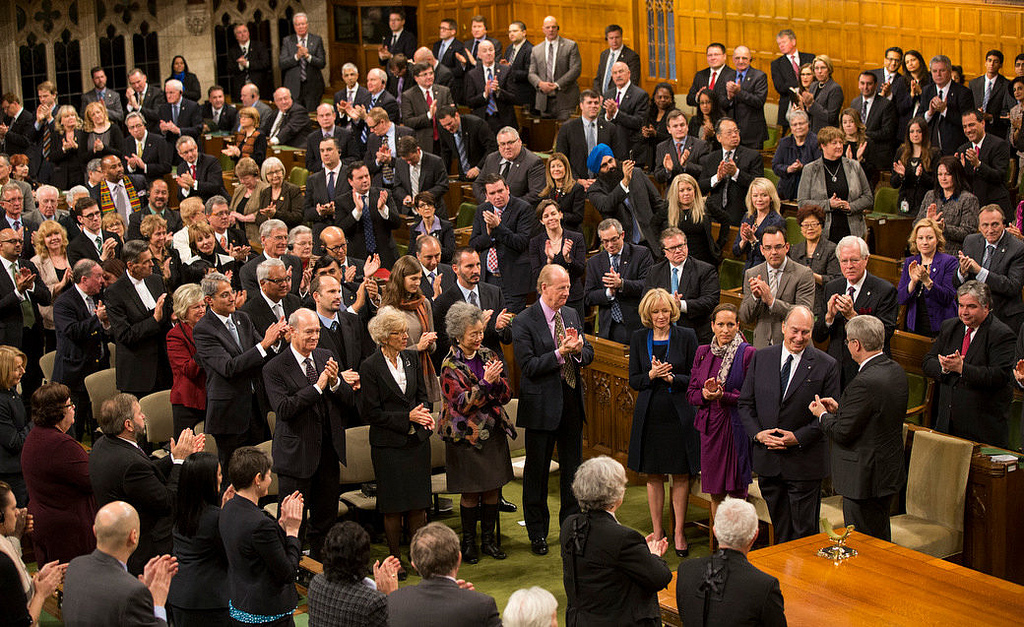
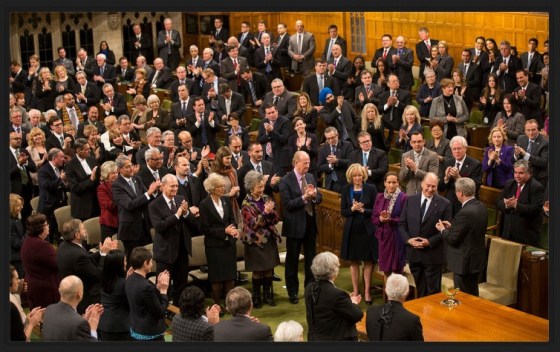
His Highness the Aga Khan is applauded by the Prime Minister, Members of the House, as well as other distinguished visitors as he arrives  in the House of Commons on Thursday, February 27, 2014 to deliver a rare address - the first by a faith leader in 75 years. The Ottawa Citizen published a similar photo on its front page of Friday February 28, giving it the title "In Divine Company." Alongside the Ismaili Imam are his daughter Princess Zahra and the Prime Minister's wife, Laureen Harper. Others in the photo, in rows adjacent to Mrs. Harper (l to r) -- 1st row: The Aga Khan's younger brother, Prince Amyn Muhammad Aga Khan, Chief Justice of the Supreme Court of Canada, The Right Honourable Beverly McLachlin, Former Governor General of Canada, The Right Honourable Adrienne Clarkson, and renowned Canadian author, intellectual and philosopher,  John Ralston Saul; 2nd row (l to r). President Malik Talib of the Aga Khan Ismaili Councli for Canada, Prince Hussain Aga Khan, Princess Salwa Aga Khan and her husband Prince Rahim Aga Khan - with both the Princes in the photo being the Aga Khan's children. Photo credit: The Office of the Prime Minister of Canada.

His Highness the Aga Khan is applauded by the Prime Minister, Members of the House, as well as other distinguished visitors as he arrives in the House of Commons on Thursday, February 27, 2014 to deliver a rare address – the first by a faith leader in 75 years. The Ottawa Citizen published a similar photo on its front page of Friday February 28, giving it the title “In Divine Company.” Alongside the Ismaili Imam are his daughter Princess Zahra and the Prime Minister’s wife, Laureen Harper. Others in the photo, in rows adjacent to Mrs. Harper (l to r) — 1st row: The Aga Khan’s younger brother, Prince Amyn Muhammad Aga Khan, Chief Justice of the Supreme Court of Canada, The Right Honourable Beverly McLachlin, Former Governor General of Canada, The Right Honourable Adrienne Clarkson, and renowned Canadian author, intellectual and philosopher, John Ralston Saul; 2nd row (l to r). President Malik Talib of the Aga Khan Ismaili Council for Canada, Prince Hussain Aga Khan, Princess Salwa Aga Khan and her husband Prince Rahim Aga Khan – with both the Princes in the photo being the Aga Khan’s children. Photo credit: The Office of the Prime Minister of Canada.

A VISION FOR THE OTTAWA RIVERFRONT?…. ISMAILI COMMUNITY AND CANADA

“In just three years, Canada will mark its 150th anniversary, and the whole world will be ready to celebrate with you. Sharing Canada’s robust pluralistic history, is a core mission of our Global Centre, and 2017 will be a major opportunity for doing so, operating from its headquarters in the former War Museum on Sussex Drive. Perhaps 2017 and the celebrations can be a catalyst with our neighbours to improve the entire riverfront area around that building.

“Our partnership in Canada has been immensely strengthened, of course, by the presence for more than four decades of a significant Ismaili community. Like most historic global communities the Ismaili peoples have a variegated history, but surely our experience in Canada has been a particularly positive chapter.

“I happily recall the establishment of the Delegation of the Ismaili Imamat here in 2008 and the Prime Minister’s description that day of our collaborative efforts to make Canada “the headquarters of the global effort to foster peace, prosperity, and equality through  pluralism. [1]
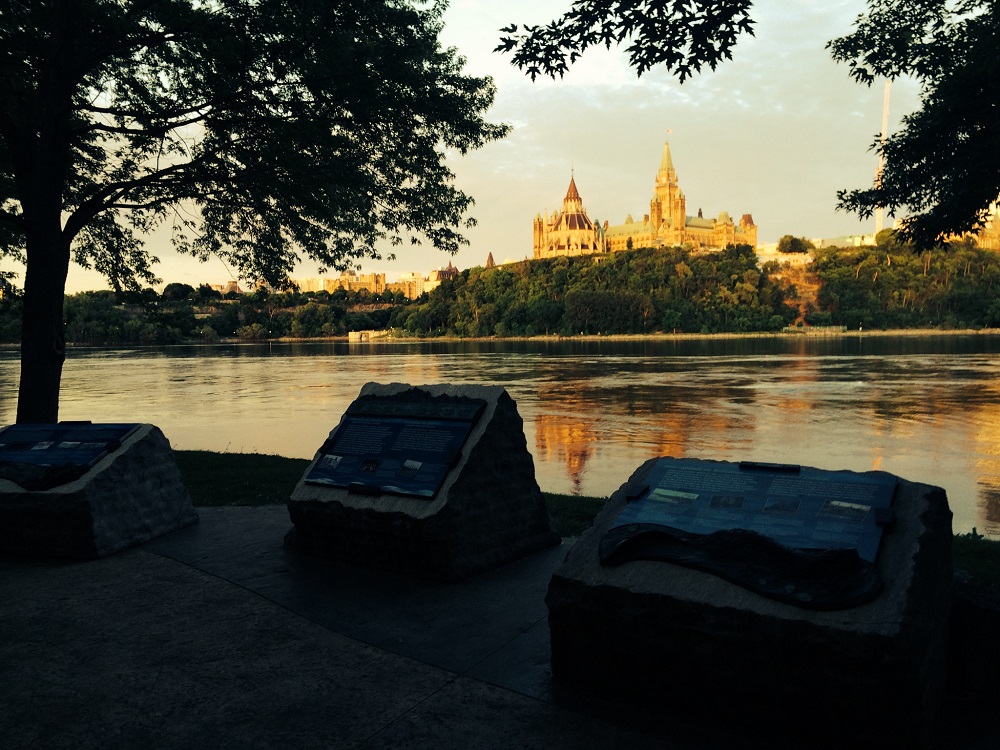
Parliament Buildings from the spot where the top image was taken. Photo: Malik Merchant. Copyright.

Parliament Buildings from the spot where the top image was taken. Photo: Malik Merchant. Copyright.

A statue of French explorer Samuel de Champlain at Nepean Point in Ottawa. The explorer is  seen holding his famous astrolabe upsidedown. Nepean Point is a hill in Ottawa, Ontario, Canada, overlooking the Ottawa River, Parliament, the Canadian Museum of Civilization, and other features of downtown Ottawa and Gatineau. It is located between the National Gallery of Canada and Alexandra Bridge. The sculpture was made by Hamilton MacCarthy in 1915. Photo: Malik Merchant, Copyright.

A statue of French explorer Samuel de Champlain at Nepean Point in Ottawa. The explorer is seen holding his famous astrolabe upsidedown. Nepean Point is a hill in Ottawa, Ontario, Canada, overlooking the Ottawa River, Parliament, the Canadian Museum of Civilization, and other features of downtown Ottawa and Gatineau. It is located between the National Gallery of Canada and Alexandra Bridge. The sculpture was made by Hamilton MacCarthy in 1915. Photo: Malik Merchant, Copyright.

The rock crystal shaped dome of the Delegation of the Ismaili Imamat  shown just above the top deck of a boat on the Ottawa River, beneath Ottawa's Royal Alexandra Bridge. Photo: Malik Merchant. Copyright. June 2014.

The rock crystal shaped dome of the Delegation of the Ismaili Imamat shown just above the top deck of a boat on the Ottawa River, beneath Ottawa’s Royal Alexandra Bridge. Photo: Malik Merchant. Copyright. June 2014.

CANADA – A HAVEN OF PEACE

“Canada is an international power who takes her responsibilities seriously and whose policies have never in her history been tainted by the cruder forms of colonialism, racialism or isolationism. [2]

“Successful experience with democracy, civil society and pluralism are the national genius of Canada of which much of the developing world is in dire need. [3]

“Canada remains for the rest of the world an enviable haven. A haven of peace, and of immense natural beauty and wealth. The wealth I speak of, is not merely its natural resources but the peoples of Canada, steeped in your tradition of tolerance, generosity and compassion in alleviating human suffering and respect for diversity of thought and culture.” [4]
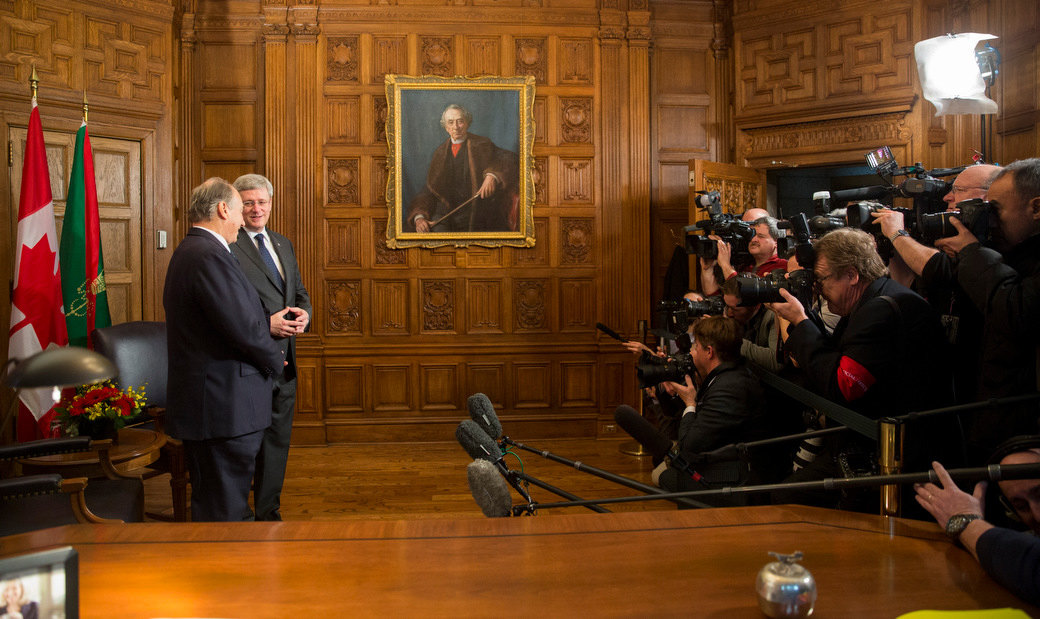
His Highness the Aga Khan and the Right Honourable Stephen Harper, the Prime Minister of Canada, face eager cameras at the Canadian Parliament Building on Thursday, 27 February, 2014. An oil on canvas painting of The Right Honourable Sir John Alexander Macdonald, Prime Minister (1867-1873; 1878-1891) adorns a wall as part of the House of Commons Heritage Collection, while the Ismaili Imamat and Canadian Flags form a backdrop in this historical photo. Photo credit: The Office of the Prime Minister of Canada.

His Highness the Aga Khan and the Right Honourable Stephen Harper, the Prime Minister of Canada, face eager cameras at the Canadian Parliament Building on Thursday, 27 February, 2014. An oil on canvas painting of The Right Honourable Sir John Alexander Macdonald, Prime Minister (1867-1873; 1878-1891) adorns a wall as part of the House of Commons Heritage Collection, while the Ismaili Imamat and Canadian Flags form a backdrop in this historical photo. Photo credit: The Office of the Prime Minister of Canada.

CANADA – MOST SUCCESSFUL PLURALIST SOCIETY ON EARTH

“Canada is a country that has invested in making this potential liability [of pluralism] become an asset, and I think that Canada has been perhaps too humble in its own appreciation of this global asset. It’s a global asset, and few countries, if any have been as successful as Canada has. [5]
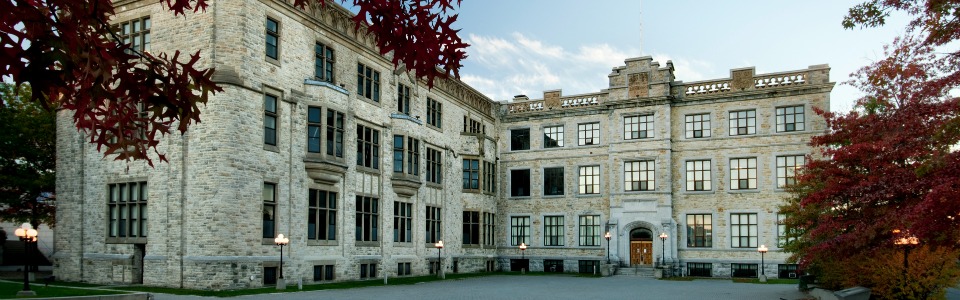
The Old Canadian War Museum will become the future site of the Global Centre for Pluralism, once renovations  are completed inside the building. The Centre is governed by an international Board of Directors chaired by His Highness the Aga Khan. The Global Centre for Pluralism was inspired by the example of Canada’s inclusive approach to citizenship, and works to advance respect for diversity worldwide, believing that openness and understanding toward the cultures, social structures, values and faiths of other peoples are essential to the survival of an interdependent world.

The Old Canadian War Museum will become the future site of the Global Centre for Pluralism, once renovations are completed inside the building. The Centre is governed by an international Board of Directors chaired by His Highness the Aga Khan. The Global Centre for Pluralism was inspired by the example of Canada’s inclusive approach to citizenship, and works to advance respect for diversity worldwide, believing that openness and understanding toward the cultures, social structures, values and faiths of other peoples are essential to the survival of an interdependent world.

“Canada is today the most successful pluralist society on the face of our world. Without any doubt in my mind. You have created the perfect pluralist society where minorities, generally speaking, are welcome, they feel comfortable, they assimilate the Canadian psyche, they are allowed to move forward within civil society in an equitable manner, their children are educated. So Canada has succeeded in putting together a form of pluralist society which has been remarkably successful. I’m not the one who’s making a judgement.” [6]

Date posted: July 1, 2014.

_______________

[1] House of Commons, Thursday, February 27, 2014.
[2] Diplomatic Banquet (Toronto, Canada), 19 November 1978.
[3] The Delegation of the Ismaili Imamat Foundation Stone Ceremony (Ottawa, Canada), 6 June 2005.
[4] Diplomatic Corps Banquet (Toronto, Canada), 19 August 1992.
[5] CBC Interview, One-on-One with Peter Mansbridge (Ottawa, Canada), 28 October 2006. Click One on One: Peter Mansbridge Interview with His Highness the Aga Khan
[6] Globe and Mail Interview (3rd), John Stackhouse and Patrick Martin (Toronto, Canada), 30 January 2002

Please also click His Highness the Aga Khan and Canada: A Profound Affinity – But Why Canada?
His Highness the Aga Khan Shows Path to Renew and Re-Express the Post Millennium Development Goals Agreed on by World Leaders in 2000

Compiled and presented by Abdulmalik Merchant
(Editor-Publisher, http://www.simerg.com and http://www.simergphotos.com)

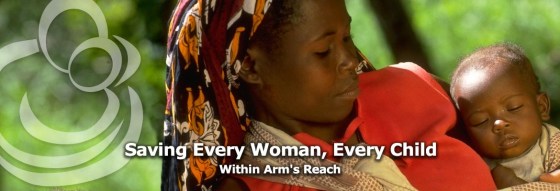
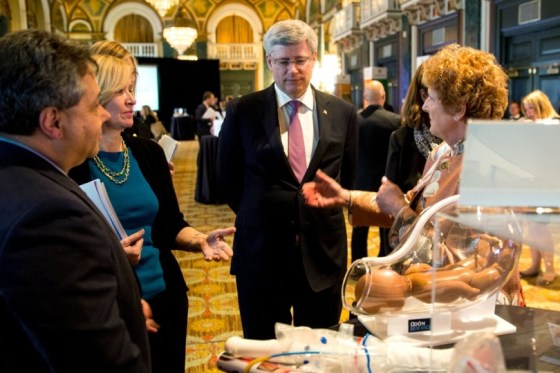
Prime Minister Stephen Harper receiving an explanation about an exhibit displaed at the summit Saving Every Woman, Every Child: Within Arm’s. Phooto: The website of the Prime Minister of Canada.

Prime Minister Stephen Harper receiving an explanation about an exhibit displayed at the summit Saving Every Woman, Every Child: Within Arm’s Reach. Photo Credit: The website of the Prime Minister of Canada.

Editor’s note: In 2000 world leaders joined together in an unprecedented UN summit to develop a blueprint to meet the needs of the world’s poorest, with the targeted date of 2015.  The leaders along with the support of worldwide institutions set the following eight goals in what became known as the Millennium Development Goals (MDGs):

  • Eradicate Extreme Hunger and Poverty
  • Achieve Universal Primary Education
  • Promote Gender Equality and Empower Women
  • Reduce Child Mortality
  • Improve Maternal Health
  • Combat HIV AIDS Malaria and Other Diseases
  • Ensure Environmental Sustainability
  • Develop a Global Partnership for Development

A special summit in Toronto under the theme Saving Every Woman Every Child: Within Arm’s Reach, is addressing some of the MDGs goals and we are pleased to publish below excerpts from His Highness the Aga Khan’s remarks made at the summit on May 29, 2014.

~~~~~

Bismillah-ir-Rahman-ir-Rahim

His Highness the Aga Khan, 49th Ismaili Imam and the direct descendant of the Prophet Muhammad (s.a.s), delivers keynote remarks at the Maternal, Newborn and Child Health Summit in Toronto on 29 May 2014. Photo: The Ismaili/Zahur Ramji.

His Highness the Aga Khan, 49th Ismaili Imam and the direct descendant of the Prophet Muhammad (s.a.s), delivers keynote remarks at the Maternal, Newborn and Child Health Summit in Toronto on 29 May 2014. Photo: The Ismaili/Zahur Ramji.

I. THE ISMAILI IMAM EXPLAINS HIS PRESENCE

“Like you, I am here today because of my conviction that improving maternal, neonatal and child health should be one of the highest priorities on the global development agenda. I can think of no other field in which a well-directed effort can make as great or as rapid an impact.

“I am here, as well, because of my enormous respect for the leadership of the Government of Canada in addressing this challenge. And I am here too, because of the strong sense of partnership which our Aga Khan Development Network has long experienced, working with Canada in this critical field.

“Leadership and partnership – those are words that come quickly to mind as I salute our hosts today and as I greet these distinguished leaders and partners in this audience.”

II. THE MUSKOKA INITIATIVE AND ONE OF ITS OFF-SHOOTS

“Mr Prime Minister – I recall how our partnerships were strengthened four years ago when you launched the Muskoka Initiative. It led to an important new effort in which our Network has been deeply involved in countries such as Afghanistan, Pakistan, Tanzania, Mozambique, and Mali.

“In all of these efforts, we’ve built on our strong history of work in this field. It was 90 years ago that my late grandfather founded the Kharadhar Maternity Home in Karachi. In that same city, for the last thirty years, the Aga Khan University has worked on the cutting edge of research and education in this field – including its new specialised degree in midwifery.”

III. WHAT THE AGA KHAN UNIVERSITY’S NEW REPORT REVEALS, AND HOW THE WORK OF AKDN WORK IMPACTS MILLIONS

“One of our Aga Khan University scholars [Dr. Zulfiqar Bhutta] helped fashion the new series of reports on this topic that was released last week – an effort that involved more than 54 experts from 28 institutions in 17 countries. The reports tell us that right intensified steps can save the lives of an additional 3 million mothers and children annually.

“To that end, our Development Network has also focused on building durable, resilient healthcare systems. One example is the not-for-profit health system by the Aga Khan Health Service in Northern Pakistan – a community-based network of facilities and health workers, including a growing number of nurse-midwives.

Photo: The Government of Canada.

Photo: The Government of Canada.

“We have extended these approaches to other countries, including a remarkable partnership in Tanzania funded by the Canadian government and implementing in close partnership with the Tanzanian government.

“Such AKDN activity now serves some two-and-a-half million people in 15 countries, with 180 health centres both in urban and rural areas, often in high-conflict zones, and embracing some of the world’s poorest and most remote populations.

“Last year alone, these facilities served nearly 5 million visitors, inpatients and outpatients, with more than 40,000 newborn deliveries.

IV. HIS HIGHNESS SHARES WHAT HIS NETWORK
HAS LEARNED FROM EXPERIENCE

“So our experience has been considerable. But what have we learned from it? Let me share a quick overview.

1. Sustainable Systems

“First, I would underline that our approaches have to be long-term. Sporadic interventions produce sporadic results, and each new burst of attention and activity must then start over again. The key to sustained progress is the creation of sustainable systems.

2. Local Ownership

“Second, our approaches should be community-oriented. Outside assistance is vital, but sustainable success will depend on a strong sense of local “ownership”.

3. Broad Health-Care Focus

“The third point I would make is that our approaches should support the broad spectrum of health care. Focusing too narrowly on high-impact primary care has not worked well – improved secondary and tertiary care is also absolutely essential.

4. New Financial Models – Savings Groups, Debts Financing, Tax-Privileged Donations

“Our approaches should encourage new financial models. Donor funding will be critical, but we cannot sustain programmes that depend on continuing bursts of outside money. Let me underscore for example, the potential of local “savings groups” and micro-insurance programmes, as well as the under utilised potential for debt-financing. Also – and I think this is very, very important indeed – we have watched for many years as many developing countries, and their economies of course, have created new financial wherewithal among their people. These growing private resources can and I think should, help social progress, motivated by a developing social consciousness and by government policies that encourage tax-privileged donations to such causes.

5. Reaching the Hardest to Reach with Modern Communications Technology

“Our approaches should also focus on reaching those who are hardest to reach. And here, new telecommunications technologies can make an enormous impact. One example has been the high-speed broadband link provided by Roshan Telecommunications, one of our Network’s companies, between our facilities in Karachi and several localities in Afghanistan and in Tajikistan. This e-medicine link can carry high-quality radiological images and lab results. It can facilitate consultations among patients, doctors and specialists at various centres. And it can contribute enormously to the effective teaching of health professionals in remote areas.

6. Multi-Sectoral Challenges Need Effective Multi-Input Coordination

“Our approaches should be comprehensive, working across the broad spectrum of social development. The problems we face have multiple causes, and single-minded, “vertical” interventions often fall short. The challenges are multi-sectoral, and they will require the effective coordination of multiple inputs. Creative collaboration must be our watchword. This is one reason for the growing importance of public-private partnerships.

“These then are the points I would emphasise in looking back at our experience. I hope they might be helpful as we now move into the future, and to the renewal and re-expression of the Post Millennium Development Goals.”

V. THE USEFULNESS OF MEETINGS –  BUT PARTNERS MUST TALK AND WORK WELL TOGETHER THROUGH CANDID EXCHANGE

His Highness the Aga Khan, President Kikwete of Tanzania and Prime Minister Stephen Harper of Canada, who hosted the 3 days summit in Toronto. Photo: The website of the Prime Minister of Canada. Copyright.

His Highness the Aga Khan with President Jakaya Kikwete of Tanzania and Prime Minister Stephen Harper of Canada, who hosted the summit in Toronto. Photo credit: The website of the Prime Minister of Canada. Copyright.

“As we undertake the new planning process, the opportunity to exchange ideas at meetings of this sort can be enormously helpful. And potential partners must be able to talk well together if they are going to work well together.

“I would hope such occasions will be characterised by candid exchange, including an acknowledgment of where we have fallen short and how we can do better. The truth is that our efforts have been insufficient and uneven. We have not met the Post Millennium Development Goals.”

VI. LEVERAGING PROGRESS THROUGH THE FIELD OF MATERNAL AND NEWBORN HEALTH

“At the same time, we must avoid the risk of frustration that sometimes accompanies a moment of reassessment. Our challenge – as always – is a balance [between] honest realism with hopeful optimism.

“And surely there are reasons to be optimistic.

“In no other development field is the potential leverage for progress greater than in the field of maternal and newborn health.”

VII. RESULTS: THE HEARTENING EXAMPLE OF AFGHANISTAN

“….I thought I might close by talking about some of the results. My example comes from Afghanistan – a heartening example from a challenging environment.

“The rural province of Afghan Badakhshan once had minimal infrastructure and few health-related resources. Less than a decade ago it had the highest maternity mortality ratio ever documented.

“It was about that time that the Afghan government, supported by international donors, contracted with the Aga Khan Health Service to create a single non-governmental health organisation in each district and in each province. Today, the Badakhshan system alone includes nearly 400 health workers, 35 health centres, two hospitals, serving over 400,000 people. Its community midwifery school has graduated over 100 young women.

“The impact has been striking. In Badakhshan in 2005, six percent of mothers died in childbirth – that is 6,000 for every 100,000 births. Just eight years later, that number was down twenty-fold – for every 100,000 live births, death has gone from 6,000 down to 300.

“Meanwhile, infant mortality in Badakhshan has fallen by three-quarters, from over 20 percent to less than 6 percent.”

VIII. CHILDBIRTH RISKS GAPS ARE NOT DESTINED – WITH SCIENCE AND EFFECTIVE COORDINATION RISKS CAN BE TRANSFORMED FOR THE BETTER

“For most of the world, science has completely transformed the way life begins, and the risks associated with childbirth. But enormous gaps still exist. These gaps are not the result of fate – they are not inevitable. They can be changed, and changed dramatically.

“When government and private institutions coordinate effectively in challenging a major public problem, as this example demonstrates, we can achieve substantial, genuine, quantifiable progress – and fairly rapidly.

“This is the story we need to remember, and this is the sort of action we need to take as leaders and as partners in addressing one of the world’s most critical challenges.”

Date posted: Friday, May 30, 2014.

________________

Photos and text used in this post compilation were obtained from the following sources.

1. http://www.pm.gc.ca (Prime Minister of Canada)
2. http://www.akdn.org (the Aga Khan Development Network)
3. http://www.theismaili.org (official website of the Ismaili Community)
4. http://www.undp.org/content/undp/en/home/mdgoverview/
(The Millennium Development Goals)

An Ismaili (and the Flag) on Top of Mt. Everest….and Forthcoming @Simergphotos, Rare and Historical Photos from Australian and Other Private Collections

EXCLUSIVE INTERVIEW WITH ISMAILI MOUNTAINEERS

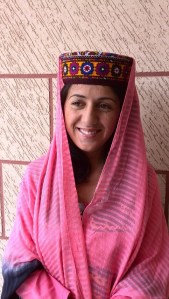
Samina Baig's cultural elegance captured in this  exquisite cultural dress from Hunza. Photo: Samina Baig's Facebook page.

Samina Baig’s cultural elegance captured in this exquisite cultural dress from Hunza. Photo: Samina Baig’s Facebook page.

PLEASE CLICK: Simerg’s Exclusive Interview with Mirza Ali and his Sister Samina Baig Who Became the First Ismaili and Pakistani Woman to Reach the Summit of Mt. Everest

Samina Baig at 21 became the first Ismaili woman to reach the summit of Mt. Everest as part of her goal to scale the world’s SEVEN SUMMITS. In an exclusive interview with Simerg, when asked about placing the Ismaili flag on top Everest and if she left it there, she said:

“….And when it comes to being the first Pakistani woman and the first Ismaili woman to put the nation’s flag and the Ismaili Imamat red and green flag on top of the world, one cannot adequately express the feeling. It is indeed a BLESSING of a life time! We did bring the flag back, and with all love and respect, sent it to Sarcar Mawlana Hazar Imam.”

Please Continue Reading This World Exclusive Interview for the broader perspectives it offers about the challenges of climbing some of the world’s highest mountains!

Share and forward this LINK to your friends and family around the world. Please also leave your comments on the article’s feedback form.

~~~~~~~

STARTING WEEK OF MAY 5:  EXTRAORDINARY, RARE AND HISTORICAL PHOTOS FROM PRIVATE COLLECTIONS FROM AROUND THE WORLD

Photo: Collection of the family of the late Mrs. Jean Kirk, Headmistress, Aga Khan Primary School, Nairobi. Copyright: Allison Wallace, Australia.

Photo: Collection of the family of the late Mrs. Jean Kirk, Headmistress, Aga Khan Primary School, Nairobi. Copyright: Allison Wallace, Australia.


Simerg Exclusive Interview: Samina Baig, the First Pakistani and Ismaili Woman to Climb Mt. Everest, Sets Ambitious Goal to Conquer the World’s Seven Summits

On May 19, 2013, at precisely 7:40 am, Samina Baig became the first Pakistani woman to reach the peak of the world`s highest mountain, Everest, and proudly place on it the flag of Pakistan as well as that of the Ismaili Imamat, which is often referred to as ‘My Flag’ by members of the Ismaili community. She spent 10 minutes on the summit as her mentor, trainer and proud older brother, Mirza Ali Baig, watched her unique accomplishment from a few hundred metres away….Continue Reading This World Exclusive Interview

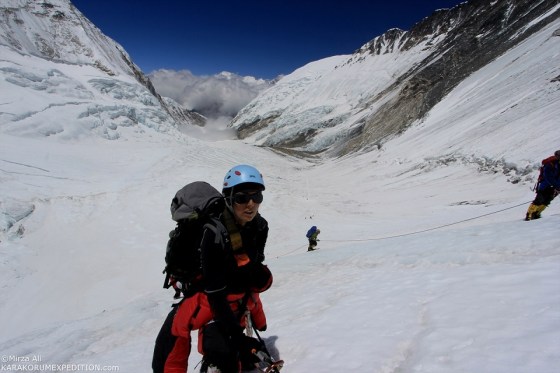
Samina Baig climbing Mt. Everest. Photo: Mirza Ali. Copyright.

Samina Baig climbing Mt. Everest. Photo: Mirza Ali. Copyright. Click on image to read interview.

PLEASE CLICK: Simerg’s Exclusive Interview with Mirza Ali and his Sister Samina Baig Who Became the First Ismaili and Pakistani Woman to Reach the Summit of Mt. Everest


Roshan Thomas – Acting in the Path of God By Jalal Jaffer

ACTING IN THE PATH OF GOD

Roshan Thomas was among those who were killed in a terrorist incident in Kabul while she was celebrating the commencement of the Persian New Year, Navruz. She was buried earlier this week in Vancouver, where almost 2000 people from all walks of life attended her funeral at the North Vancouver Ismaili Jamatkhana.

Roshan Thomas was among those who were killed by terrorists in an incident in Kabul while she was celebrating the commencement of the Persian New Year, Navruz. She was buried earlier this week in Vancouver, where almost 2000 people from all walks of life attended her funeral at the North Vancouver Ismaili Jamatkhana.

By Jalal Jaffer

Acting in the path of God
Eliminates limitations, restrictions, conceptions
In pursuit of noble actions
To sustain, promote, achieve
Enhancement, progress, understanding
Amongst God’s most beautiful creation
The human being.

With clarity of mind
Determination against any odds
It was but natural
That Roshan picked a far-away geography
Hoping and pursuing and working towards
A change, some progress, any improvement
In a country, amongst a people
Engulfed in reactionary, ideological, meaningless
Battles and wars and human carnage
To what end, what purpose
Nobody could understand, far less explain
Where pre-historic level of crass ignorance
Animalistic behaviour, un-knowledge…prevailed.

Her commitment to her cause
To act in the path of God
Open the minds and hearts
Of the young and the old
Especially free the girls and women
From the yoke of servitude and worse
Through schooling, through learning, through education
A cause as noble as difficult
A place as harsh as promising
An activity as demanding as fulfilling.
Was solid and uncompromising.

Threats of violence and physical harm
Were ever present
Wise counsel to resist and desist
Came from all corners
None of this held her back
None of this affected her resolve
None of this dampened her spirits

Alas, the heartless ignoramus
A curse on human kind
Targeted her physical form…
Never realizing, never understanding
The spirit, earnestness, commitment
Residing in and within her
That would inspire, empower
Hundreds of new Roshans
More motivated, with greater commitment
To  rise, fight and complete
Her cause, her belief, her vision
For the whole world to watch and celebrate.

Copyright: Jalal Jaffer.

_____________________

About the author: Jalal Jaffer is a practising lawyer in Vancouver.

Related: To the Memory of Roshan Thomas and Zeenab Kassam by Navyn Naran

Mawlana Hazar Imam’s 1983 and 2014 Visits to the Parliament of Canada by Farouk B.K.S. Verjee

A QUANTUM LEAP

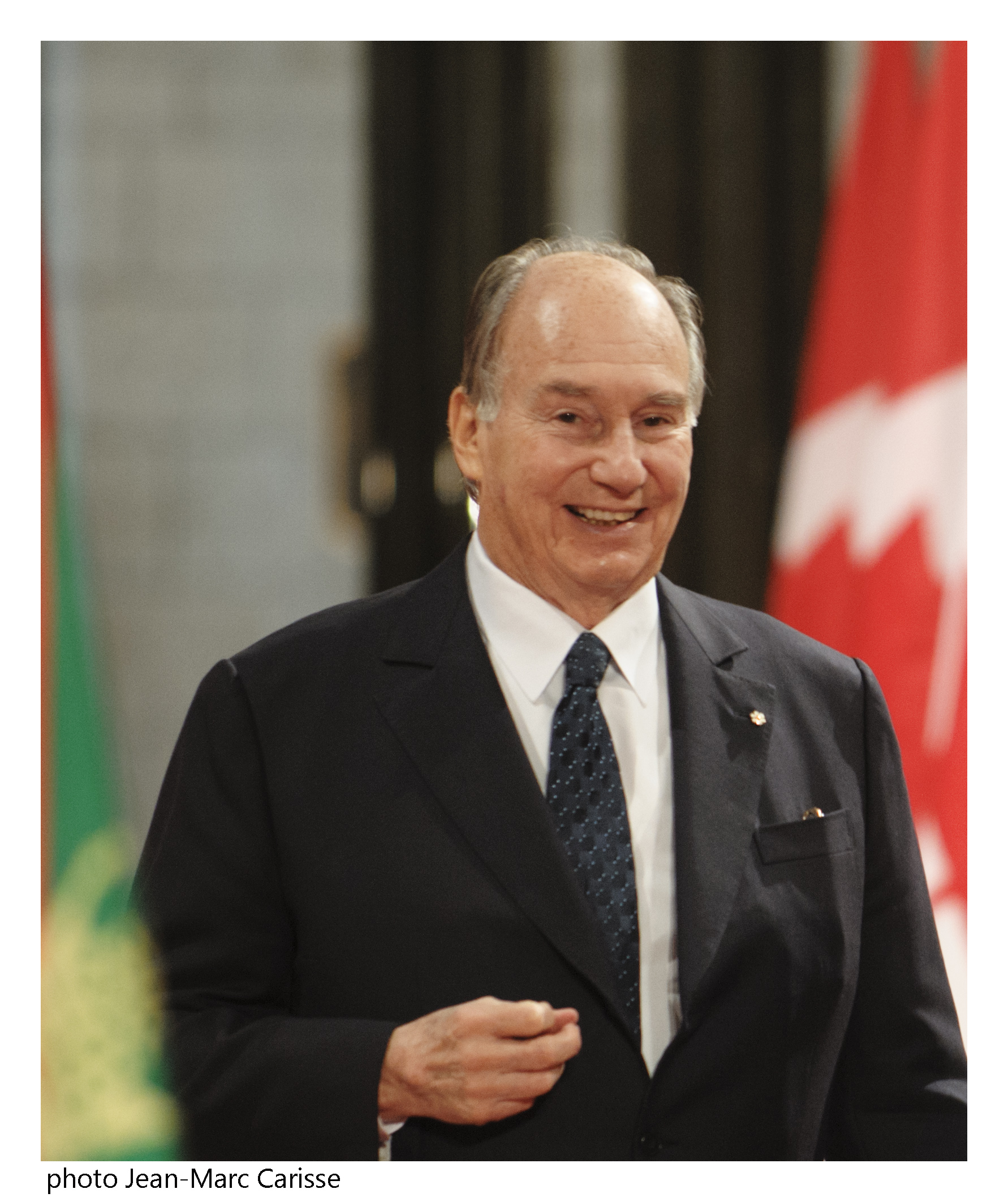
Mawlana Hazar Imam, His Highness the Aga Khan, 49th Imam and the direct descendant of the Prophet Muhammad (s.a.s.), at the Canadian Parliament on Thursday, February 27, 2014. Simerg Exclusive Photo: Copyright Jean-Marc Carisse.

Mawlana Hazar Imam, His Highness the Aga Khan, the direct descendant of the Prophet Muhammad (s.a.s) and 49th hereditary Imam at the Canadian Parliament on Thursday, February 27, 2014. Simerg Exclusive Photo: Copyright Jean-Marc Carisse. Please click on photo for enlargement.

By Farouk B.K.S. Verjee

Parliament Hill

27th February, 2014 will be etched as a momentous day in Ismaili history with Mawlana Hazar Imam becoming the first faith leader in 75 years to address the Joint Session of the Parliament of Canada, at the invitation of the Prime Minister, Stephen Harper. Our group of invitees who travelled to Parliament in a coach proudly sang “O Canada,” and as we reached the snow-covered lawns of the Parliament Building we saw the Imamat flag flying on the hill. We had truly arrived!

The Chamber of the House of Commons was filled to capacity. Shortly after 11 a.m as Mawlana Hazar Imam entered the House to rousing applause from both sides of the House, my eyes welled up in tears as I travelled back in time to the Silver Jubilee.

 Mawlana Hazar Imam signs the distinguished visitors books for the House of Commons and the Senate in the Canadian Parliament Rotunda as Prime Minister Stephen Harper, his wife Laureen Harper, The Honourable Andrew Scheer, Speaker of the House of Commons and the Honourable Noël Kinsella, Speaker of the Senate, and other individuals look on. Photo: Post Media Clip


Mawlana Hazar Imam signs the distinguished visitors books for the House of Commons and the Senate in the Canadian Parliament Rotunda as Prime Minister Stephen Harper, his wife Laureen Harper, The Honourable Andrew Scheer, Speaker of the House of Commons and the Honourable Noël Kinsella, Speaker of the Senate, and other individuals look on. Photo: Post Media Clip. See video link below.

I had been the Hon. Secretary of the Ismaili Council for Canada during Mawlana Hazar Imam’s Silver Jubilee visit, and was thinking back to how far we had come since his first visit to the House during the Jubilee in April, 1983. Pierre Trudeau was the Prime Minister, and Zulficar Lalji our National President. During that visit, Mawlana Hazar Imam was recognised from the Distinguished Visitors’ Gallery by the speaker of the House, Madame Jeanne Sauve.

A unique and historical photo signed by the late Canadian Prime Minister, Pierre Trudeau, which was taken in the Prime Minister's Office during Mawlana Hazar Imam's Silver Jubilee visit to Canada in April 1983.  (l to r) -  Hon. Sec Farouk Verjee (National Council), Mr. Gerry Wilkinson (His Highness the Aga Khan's Secretariat, Aiglemont, France), Hon. Sec Mohamed Manji (Ontario Council), President Amirali Rhemtulla (Grants Council), Mawlana Hazar Imam, Prime Minister Pierre Trudeau, Prince Amyn Muhammad Aga Khan, President Mehboob Dhanani (Ontario Council) and President Zulficar Lalji(National Council). Canada. The full signature line note from the Prime Minister read:  To Farouk with the best of Memories . Trudeau. 1983. Photo: Photo: Farouk Verjee Collection, Vancouver,

This unique and historical photo signed by the late Canadian Prime Minister, Pierre Trudeau, was taken in the Prime Minister’s Office during Mawlana Hazar Imam’s Silver Jubilee visit to Canada in April 1983. (l to r) – Hon. Secretary Farouk Verjee (Aga Khan Council for Canada), Mr. Gerry Wilkinson (His Highness the Aga Khan’s Secretariat, Aiglemont, France), Hon. Secretary Mohamed Manji (Aga Khan Ontario Council), President Amirali Rhemtulla (Aga Khan Grants Council), Mawlana Hazar Imam, Prime Minister Pierre Trudeau, Prince Amyn Muhammad Aga Khan, President Mehboob Dhanani (Aga Khan Ontario Council) and President Zulficar Lalji (Aga Khan Council for Canada). The full signature line note from the Prime Minister read: To Farouk with the best of Memories. Trudeau. 1983. Photo: Farouk Verjee Collection, Vancouver. Please click for enlargement.

After a raucous question period relating to a budget leak, the late Prime Minister invited Hazar Imam, Prince Amyn Muhammad and the accompanying Ismaili leaders to his office. He immediately asked if we would like to have a picture taken (see photo above). It was like being in seventh heaven! Prime Minister Trudeau praised our jamats’ engagement in all aspects of National Life, having arrived here only a decade earlier. It is a well know-historical fact that the Prime Minister facilitated the settlement of thousands of stateless Asians, including Ismailis, after they were forced to leave Uganda by Idi Amin in 1972. Referring to the rowdy question period earlier, the Prime Minister jokingly said it was like going to the dentist every day! The charismatic Mr. Trudeau with his usual panache was always at his very best with his sharp wit.

At one point I quipped that hopefully by the next Jubilee we would have Ismailis in the House. The Prime Minister with his typical shrug said, “Why not earlier?” Until recently we had Yasmin Rattansi (Liberal — Toronto) and Rahim Jaffer (Conservative — Edmonton) as Federal MP’s. Mobina Jaffer sits in the Senate.

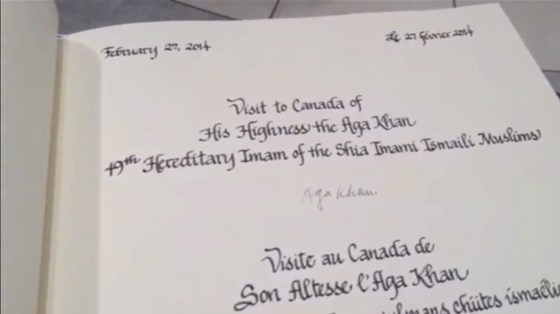
Mawlana Hazar Imam's signature in the Visitor's Book from the signing ceremony shown in a previous photo. Credit: Post Media Clip.

Mawlana Hazar Imam’s signature in the Visitor’s Book from the signing ceremony shown in a previous photo. Credit: Post Media Clip. See video link below.

Last week’s address by Mawlana Hazar Imam to both houses was extensive, and was punctuated by numerous applauses. It ended beautifully with the following quote from the Holy Qur’an:

“Oh Mankind, fear your Lord, who created you of a single soul, and from it created its mate, and from the pair of them scattered abroad many men and women.”

Following the joint session of Parliament, Prime Minister Harper and Mawlana Hazar Imam signed an important Protocol of Understanding with the Government of Canada and the Ismaili Imamat in the Hallway of Honour, which was draped with our National flag and the Imamat flag. As part of this historical visit Mawlana Hazar Imam also signed the distinguished Visitors Books of the House of Commons and the Senate.

Massey Hall

On the following day, a very large gathering of some 2500 people from all walks of life attended Massey Hall in Toronto to hear both the Prime Minister and Mawlana Hazar Imam.

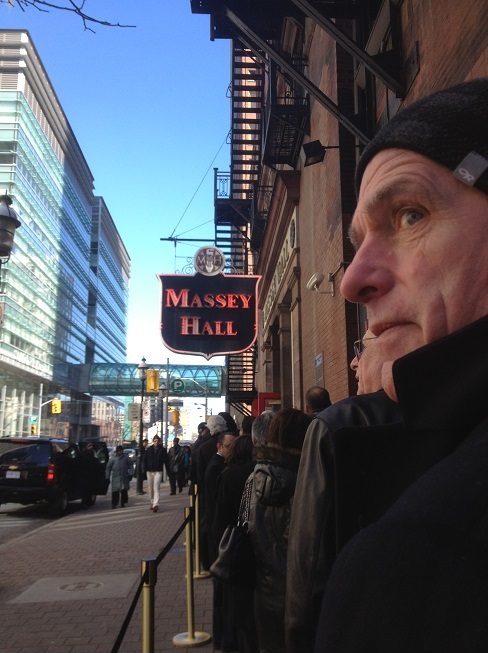
More than 2500 people from all walks of life and from different communities lined up on Friday February 28, 2014, in frigid temperatures outside Toronto's iconic Massey Hall Theatre to attend an event hosted by Prime Minister Stephen Harper in honour of Mawlana Hazar Imam. Photo: Nurin Merchant. Copyright.

More than 2500 people from all walks of life and from different communities lined up on Friday February 28, 2014, in frigid temperatures outside Toronto’s iconic Massey Hall Theatre to attend an event hosted by Prime Minister Stephen Harper in honour of Mawlana Hazar Imam. Photo: Nurin Merchant. Copyright.

As we huddled outside the iconic 120 year old building in extreme weather with a temperature of around -28c with windshield, to go through the security checks, I was impressed by the number of non-Ismailis who were lining up in good cheer to hear our Imam. One individual got a large canister of Starbucks coffee and handed it out freely to the freezing crowd!

Our jamat can be truly proud of the events at the Parliament and Massey Hall and we can now all look forward to the opening this year in Toronto of the magnificent Ismaili Centre, the Aga Khan Museum and the Park.

Date posted: Friday, March 7, 2014.

Copyright: Farouk Verjee/Simerg. 2014.

_________________

Click on  Aga Khan Signs Visitors Books to watch a brief 1 minute video of the signing ceremony.

Other related links at Simerg:

About the writer: Farouk B.K.S. Verjee served as the Honorary Secretary of His Highness the Aga Khan Ismaili Council for Canada for a period of 5 years from 1979-1984, following which he became its President until 1987. His terms of office saw the foundation laying ceremony of the Ismaili Jamatkhana and Centre (a Silver Jubilee Project) by the Honourable Henry Bell-Irving, Lieutenant-Governor General of British Columbia, as well as its opening in 1985 by Canada’s Prime Minister, Brian Mulroney. Both the ceremonies took place in the presence of Mawlana Hazar Imam and members of the Noorani family. In a farman made to the jamat on the opening day, Mawlana Hazar Imam declared the jamatkhana as Canada’s darkhana. 

Watch short 1 minute video of the signing ceremony, please click on story:  Conservatives Harvested Emails

Photo Collection and Stirring Speech Excerpts of His Highness the Aga Khan at Simergphotos

Simerg’s recent post about His Highness the Aga Khan’s dynamic and stirring address to members of the Canadian Parliament has been published at Simergphotos under a different page theme suited for photos. Please click on the following image to read the speech as well as view the photos, some of which are exclusive to Simerg.

Please click on image to read post at ww.Simergphotos.com

Please click on image to read post at www.Simergphotos.com

For the original Simerg post, please click on In a Dynamic and Stirring Address to Members of the Canadian Parliament, His Highness the Aga Khan Shares His Faith Perspectives

His Highness the Aga Khan at the Parliament of Canada: Selected Excerpts from the Live English Translation of Remarks Made in French

The following English translation of selected parts of His Highness the Aga Khan’s speech on February 27, 2014 to the Canadian Parliament which were in French was obtained from the live translation that was provided during the broadcast.

HONOUR AND THE WORLDWIDE RECOGNITION OF IMAMAT

His Highness the Aga Khan humbly accepts a standing ovation and honour at the Canadian Parliament on Thursday February 24, 2014. Prime Minister Stephen Harper is seen applauding, with Princess Zahra, the daughter of His Highness, and Laureen Harper, the Prime Minister's wife, standing alongside the 49th Ismaili Imam. Photo credit: The Office of the Prime Minister of Canada

His Highness the Aga Khan humbly accepts a standing ovation and honour at the Canadian Parliament on Thursday February 24, 2014. Prime Minister Stephen Harper is seen applauding, with Princess Zahra, the daughter of His Highness, and Laureen Harper, the Prime Minister’s wife, standing alongside the 49th Ismaili Imam. Photo credit: The Office of the Prime Minister of Canada

Bismillah-ir-Rahman-ir-Rahim

….Thank you again, Prime Minister, for your invitation. It is for me an unprecedented honour. It is a feeling, a profound feeling…because I have been told that this is the first time in 75 years that a spiritual leader has addressed the Senate and the House of Commons together as part of an official visit.

It is, therefore, with humility and awareness of eminent responsibility that I address to you today, elected representatives of the Federal Canadian Parliament and in the presence of other Senior Federal Officials.

I have the great privilege of representing the Ismaili Imamat — this institution which has stretched beyond borders for more than 1400 years and which defines itself and is recognised by an increasingly large number of states, as the succession of Shia Imami Ismaili Imams.

As the 49th Imam, I have for the past 50 years, looked after two inseparable responsibilities: overseeing the spiritual wellbeing of Ismailis, as well, at the same time, as focusing on improving their quality of life and that of the people with whom they live.

Even if there was a time when Ismaili Imams were also Caliphs — in other words, Head of States, for example in Egypt during Fatimid times — my duties today are apolitical. All Ismailis are first and foremost citizens of their countries of birth or adoption. The reach of the Ismaili Imamat is, however, much larger than it was at that time since it is active today in many regions of the world. It is from this perspective that I will share with you some thoughts with you that I feel are worthy of your presence here today.

OPPOSING FORCES BUT HARMONY IS POSSIBLE
THROUGH A CONSTITUTIONAL PROCESS

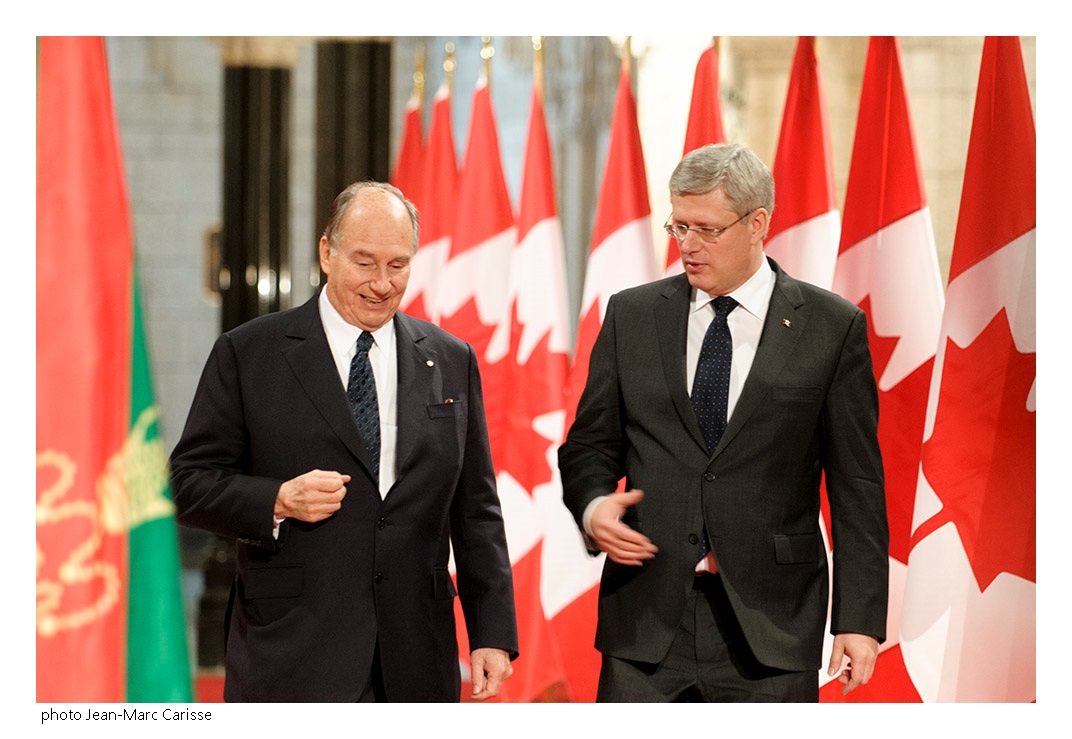
His Highness the Aga Khan and Prime Minister Harper in a conversation as they proceed to the signing ceremony of  the protocol of understanding between the Ismaili Imamat and Canada. They are flanked on either side by the flags of the red and green flags of the Ismaili Imamat and the maple leaf of Canada. Photo: Jean-Marc Carisse. Copyright.

His Highness the Aga Khan and Prime Minister Harper in a conversation as they proceed to the signing ceremony of the protocol of understanding between the Ismaili Imamat and Canada. They are flanked on either side by the flags of the red and green flags of the Ismaili Imamat and the maple leaf of Canada. Photo: Jean-Marc Carisse. Copyright.

Allow me at this point to address you again in French. I have just spoken about the incomprehension that exists between industrialised world and Muslim world and about how opposing forces have undermined relations with the great traditions of Islam. Yet, our hearts, our minds, and for many, our faith, tell us that harmony is possible. In fact, recent developments are an indication of this.

I would like to say how important constitutional development is in correcting the inability of several existing constitutions to match the evolution of societies, especially when these societies are evolving. This is a fundamental issue that, given my responsibilities, I cannot ignore. You maybe surprised to learn that 37 countries throughout the world have adopted a new constitution over the past 10 years, and 12 are at an advanced phase of modernising their own constitutions. That is a total of 49 countries. In other words, this movement involves a quarter of the UN member states. Out of that 49, 25 percent have a Muslim majority. This shows that there is now no turning back from the demand by civil societies for new constitutional structures.

I would like to take a moment now to speak to a specific political difficulty that involves the Muslim world. Religious parties, by their very structure, are based on the principle of inseparability between religion and daily life. The consequence of this is that when it comes time to negotiate constitutional terms with those who want separation between state and religion, a consensus of overarching legislation becomes very difficult to reach.

THE EXAMPLE OF TUNISIA: A GREAT STEP FORWARD

His Highness the Aga Khan seen addressing at the House of Commons Chambers to both the houses of Canadian Parliament on Thursday, February 24, 2014. Photo credit: The Office of the Prime Minister of Canada.

His Highness the Aga Khan seen addressing at the House of Commons Chambers to both the houses of Canadian Parliament on Thursday, February 24, 2014. Photo credit: The Office of the Prime Minister of Canada.

However, there is one country that has shown us now that this is possible, and that is the Tunisian Republic.

Now is not the time or the place to go into details on its new Constitution, however, allow me to point out that this is the outcome of a responsible pluralist debate, and that it appears to contain the necessary rules to ensure mutual respect between the various parts of civil society. This is reflected in, among other things, a use of notion of coalition, whether that be at an electoral level or government level. This is a great step forward for the kind of pluralism that Canada and the Ismaili Imamat have been hoping for.

Allow me also to make note of a hopeful outcome of these developments. That is that the forum for debate and conflict within any pluralist society no longer has to be the street or square, but that it can be the constitutional court of a state’s law.

THE PORTUGUESE CONNECTION AND THE ROLE OF CIVIL SOCIETY 

His Highness the Aga Khan and the Right Honourable Stephen Harper, the Prime Minister of Canada, face eager cameras at the Canadian Parliament Building on Thursday, 27 February, 2014. An oil on canvas painting of The Right Honourable Sir John Alexander Macdonald, Prime Minister (1867-1873; 1878-1891) adorns a wall as part of the House of Commons Heritage Collection, while the Ismaili Imamat and Canadian Flags form a backdrop in this historical photo. Photo credit: The Office of the Prime Minister of Canada.

His Highness the Aga Khan and the Right Honourable Stephen Harper, the Prime Minister of Canada, face eager cameras at the Canadian Parliament Building on Thursday, 27 February, 2014. An oil on canvas painting of The Right Honourable Sir John Alexander Macdonald, Prime Minister (1867-1873; 1878-1891) adorns a wall as part of the House of Commons Heritage Collection, while the Ismaili Imamat and Canadian Flags form a backdrop in this historical photo. Photo credit: The Office of the Prime Minister of Canada.

Besides the genius of Tunisian constitutionalists, the preparatory work of this involved consultations on comparative Constitutional Law. And I would like to acknowledge in particular the role that the Portuguese legal experts have played, citizens of the country that I greatly admire and that, like Canada, has developed a civilisation of mutual respect between communities and openness to religions. I am referring here to the law regulating the relations between the Portuguese Republic and the Ismaili Imamat since 2010. I am very pleased to add, before this very honourable audience, that this law was unanimously passed and it recognises the nature of the Ismaili Imamat as being a supranational entity.

In conclusion, on the Tunisian constitution, Mr Francois Hollande, the President of the French Republic, said in Tunis that “what makes your revolution unique and even your constitution, is the role of civil society.”

Date posted: Sunday March 1, 2014

Please also see: In a Dynamic and Stirring Address to Members of the Canadian Parliament, His Highness the Aga Khan Shares His Faith Perspectives on the Imamat, Collaboration with Canada, the Muslim World Community (the Ummah), the Nurturing of Civil Society, Early Childhood Education, Voluntary Work, and the Unity of the Human Race

 _____________________

Ismaili Youth and Students Thrilled to Receive Invitations to Massey Hall Gathering to Honour their 49th Imam, His Highness the Aga Khan – Simerg Wants Your Stories and Photos!

Simerg Welcomes Eye Witness Accounts of His Highness the Aga Khan’s Parliament Address and His Presence at the Iconic Massey Hall

Massey Hall is a performing arts theatre in the Garden District of downtown Toronto. The theatre originally was designed to seat 3,500 patrons but, after extensive renovations in the 1940s, now seats nearly 2800. Photo via blogto.com.

Massey Hall is a performing arts theatre in the Garden District of downtown Toronto. The theatre originally was designed to seat 3,500 patrons but, after extensive renovations in the 1940s, now seats nearly 2800. Photo via blogto.com.

Many dozens of Ismaili youth and university students living and studying in close proximity to Metro Toronto were pleasantly surprised to receive an email invitation for a gathering on Friday, February 28th at 2pm at Toronto’s iconic Massey Hall in which His Highness the Aga Khan will be present. This event will follow his historic address in Ottawa at the Canadian Parliament on Thursday, February 27, 2014 at the invitation of the Prime Minister, Stephen Harper.

Recipients of the email were left wondering whether the email invitation was indeed some kind of a spam, and many youth were contemplating on not replying to the invitation. But with key government of Canada phone numbers and details listed in the email most were expected to confirm their attendance by the February 24th deadline.

An elderly Ismaili who also received an email invitation proudly forwarded it to his contacts, including the editor of this website. The invitation to him read:

Dear (name withheld),

The Prime Minister of Canada, the Right Honourable Stephen Harper is pleased to invite you to an event in honour of His Highness the Aga Khan, 49th Hereditary Imam of the Shia Imami Ismaili Muslims.

Prime Minister Harper will be joined by Minister Baird, Minister Kenney, Minister Alexander, and other Ministers and Parliamentarians.

The event will be held at Massey Hall on Friday, February 28, 2014 at 2 p.m. in Toronto, Ontario in the presence of His Highness the Aga Khan, to honour him on the occasion of his visit to Canada and address to Parliament the previous day.

The dress code for this event is business attire.

Please confirm your attendance and mailing address by replying to this email no later than February 24th, 2014. Upon confirmation of your attendance, additional details regarding the event at Massey Hall will be sent to you.

Kindly note this invitation is personal and non-transferable.

Best regards,

Name and contact information withheld

Congratulations to him and all others who will participate at the historic ceremonies.

If you are at the Parliament on Thursday or at Massey Hall on Friday we would like you to share your experience and story for the benefit of this website’s world-wide readers. Your contribution will be appreciated by everyone.  Please click on  Leave a comment and provide as much information from the event(s) as you can, including your own personal and memorable experience. If you have a Facebook or other social media page or blog provide the link. Photos (as well as your narrative) may also be submitted to Simerg@aol.com.

A special post will be created with everyone’s stories and photos to mark the historical occasion!

Date posted: Monday, February 24, 2014.

Copyright.

___________________

See also:

His Highness the Aga Khan to Become First Faith Leader to Address Joint Session of Canadian Parliament on February 27, 2014: The ABC’s of the Event Including Past Distinguished Speakers

Material compiled and presented by Abdulmalik J. Merchant
(Publisher-Editor, www.simerg.com)

“Our Government is honoured to once again welcome His Highness the Aga Khan to Canada. Our country has a warm and lasting friendship with His Highness, who was granted honorary Canadian citizenship for his leadership as a champion of international development, pluralism and tolerance around the world.” – Prime Minister Stephen Harper

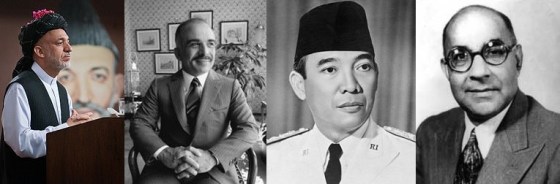
2006 - Hamid Karzai, 1989 - His Majesty King Hussein Ibn Talal, 1956 - His Excellency Dr. Sukarno, 1950 - Hon. Liaquat Ali Khan. Photos: Wikipedia.

Muslims leaders who have addressed the Canadian Parliament (l to r): 2006 – Hamid Karzai, 1989 – His Majesty King Hussein Ibn Talal, 1956 – His Excellency Dr. Sukarno, 1950 – Hon. Liaquat Ali Khan. Photos: Wikipedia.

ADDRESSES BY DISTINGUISHED VISITORS

A Joint Address to Parliament is a speech made by a distinguished visitor, usually a foreign head of state or head of government, to Members of the Senate and the House of Commons. Fifty-two heads of state and five non-heads of state have addressed the Joint Sessions of the Senate and House of Commons of Canada since 1939.

When His Highness the Aga Khan delivers his address on Thursday, February 27, 2014, he will become the first faith leader in 75 years and fifth among Muslims to address the Joint Sessions, since His Majesty King George VI (1895-1952) of the United Kingdom delivered the first ever address on May 19, 1939.

Photo of the Centre Block and Library of the Parliament of Canada from the Gatineau side, overlooking the Ottawa River. Photo: Wikipedia.

Photo of the Centre Block and Library of the Parliament of Canada from the Gatineau side, overlooking the Ottawa River. Photo: Wikipedia.

These extra-parliamentary events usually take place in the House of Commons Chamber and the regular proceedings of the House are suspended for the occasion. The assembly does not constitute a sitting of the House and the Mace (a large, heavy and richly ornamented staff which is the symbol of authority of the Speaker) is not present at its usual location on the Clerk’s Table.

The proceedings are jointly presided over by the Speakers of the Senate and of the House.

 Sample of Hansard from The House of Commons, 1895. Shows sample of several members speaking as described in the text. The Canadian Hansard is not strictly verbatim, and is guided by the principle of avoiding "repetitions, redundancies and obvious errors." Photo: Wikipedia.


Sample of the Canadian Hansard from The House of Commons, 1895. Shows sample of several members speaking as described in the text. The Canadian Hansard is not strictly verbatim, and is guided by the principle of avoiding “repetitions, redundancies and obvious errors.” Photo: Wikipedia.

The House usually decides to broadcast the event (see link below) and to append the text of the address to Hansard, the daily printed record of the debates of parliament. The Hansard was adopted by Canada in 1880 and quickly gained a record for its excellent quality.

WELCOMING CEREMONY AND THE SIGNING OF THE VISITORS’ BOOK

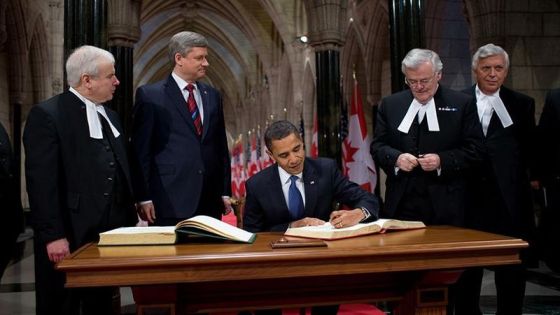
Distinguished visitors are met in the Rotunda of the Centre Block by the Prime Minister, the Speakers of both Houses and other dignitaries where they sign the Senate and House of Commons visitors’ books.

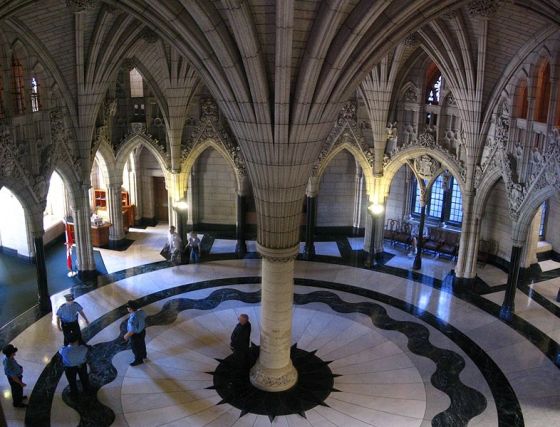
The Rotunda, also called the Confederation Hall, is the formal entrance to Centre Block. Its grandeur immediately reveals the significance of the building and the institutions it houses. It welcomes visitors with an elaborate representation of Canada's political landscape. With carved and sculpted symbols of every province and territory, it also welcomes every Canadian home. Photo: Wikipedia.

The Rotunda, also called the Confederation Hall, is the formal entrance to Centre Block. Its grandeur immediately reveals the significance of the building and the institutions it houses. It welcomes visitors with an elaborate representation of Canada’s political landscape. With carved and sculpted symbols of every province and territory, it also welcomes every Canadian home. Photo: Wikipedia.

President Barack Obama signs the guest book in Parliament Hill during his visit to Ottawa shortly after becoming the US President. Prime Minister Stephen Harper is standing to President Obama's right. Photo: Whitehouse.

US President Barack Obama signs the distinguished Visitors’ Book of the Canadian Senate and House of Commons during his visit to Ottawa shortly after taking office. Prime Minister Stephen Harper is standing to President Obama’s right. Photo credit: The Whitehouse.

At the appointed time, the official party enters the House of Commons Chamber. After being introduced by the Speaker of the House, the Prime Minister provides an official welcome and invites the visitor to address the assembly.

WHO ATTENDS AND WHERE DO THEY SIT?

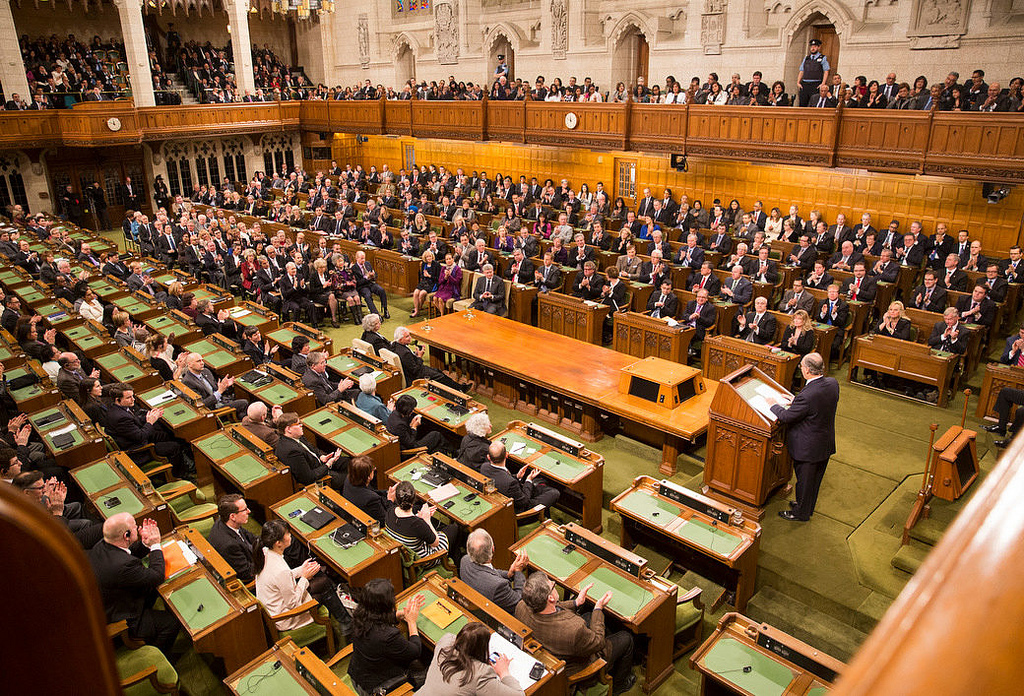
When a Joint Address takes place, the House of Commons becomes a grand hall, accommodating both Members of the House and the Senate, and the various guests invited for the occasion.

The seating arrangements in the House are not what they would be for a regular sitting. The Speaker of the House takes the Speaker’s Chair, with the Speaker of the Senate seated in a chair to his or her right. The Clerk’s Table is cleared of its usual material and a lectern placed at its head.

House of Commons Chamber.

House of Commons Chamber.

The Prime Minister and the distinguished visitor are seated along the side of the Table to the Speaker’s right; the Clerk of the Senate and the Clerk of the House of Commons are seated along the other side of the Table.

Senators and Justices of the Supreme Court are seated on the floor of the House in front of the Table. Members of the official delegation and other dignitaries are seated along the back wall of the Chamber. Members of the House of Commons take their usual seats.

All seats in the galleries overlooking the House of Commons are assigned to invited guests. Gallery privileges are suspended and access to the galleries is strictly controlled for this occasion.

DEPARTURE CEREMONY

At the conclusion of the address, the Speakers of the Senate and of the House make remarks. At this point, the official party exits the Chamber and proceeds to the House of Commons Speaker’s Chambers.

LIST OF DISTINGUISHED VISITORS 

Heads of States and of Governments who have addressed Joint Sessions of the Senate and House of Commons of Canada

  1. 2011.09.22, Rt. Hon. David Cameron, P.M. of the U.K. of Great Britain and Northern Ireland
  2. 2010.05.27, His Excellency Felipe Calderón Hinojosa, President of the United Mexican States
  3. 2008.05.26, Victor Yushchenko, President of Ukraine
  4. 2006.09.22, Hamid Karzai, Afghanistan President
  5. 2006.05.18, Hon. John Howard, P.M. of Australia
  6. 2004.10.25, His Excellency Vicente Fox, President of the United Mexican States
  7. 2001.02.22, Rt. Hon. Tony Blair, P.M. of the U.K. of Great Britain and Northern Ireland
  8. 1999.04.29, Václav Havel, President of the Czech Republic
  9. 1998.09.24, Nelson Mandela, President of the Republic of South Africa
  10. 1996.06.11, His Excellency Ernesto Zedillo, President of Mexico
  11. 1995.02.23, Bill Clinton, U.S. President
  12. 1992.06.19, His Excellency Boris Yeltsin, President of the Federation of Russia
  13. 1991.04.08, His Excellency Carlos Salinas de Gortari, President of Mexico

    Her Majesty the Queen has addressed the Canadian Parliament on three occasions. His Highness the Aga Khan received the title "His Highness" from Britain's Queen Elizabeth II on July 26th 1957. Here he is pictured with  Her Majesty the Queen and His Royal Highness Prince Philip when the Queeen hosted a dinner hosted to mark the Ismaili Imam's Golden Jubilee and to acknowledge the close relationship he and his family have had over generations with the British Monarchy and the UK.  Photo Credit: Akdn.org

    Her Majesty the Queen has addressed the Canadian Parliament on three occasions.
    His Highness the Aga Khan received the title “His Highness” from Britain’s Queen Elizabeth II on July 26th 1957. Here he is pictured with Her Majesty the Queen and His Royal Highness Prince Philip when the Queeen hosted a dinner hosted to mark the Ismaili Imam’s Golden Jubilee and to acknowledge the close relationship he and his family have had over generations with the British Monarchy and the UK. Photo Credit: Akdn.org

  14. 1989.10.11, His Majesty King Hussein Ibn Talal, King of the Hashemite Kingdom of Jordan
  15. 1989.06.27, Chaim Herzog, President of the State of Israel
  16. 1988.06.22, Rt. Hon. Margaret Thatcher, P.M. of the U.K. of Great Britain and Northern Ireland
  17. 1988.06.16, Dr. Helmut Kohl, Chancellor of the Federal Republic of Germany
  18. 1988.05.10, Her Majesty Queen Beatrix, Queen of the Netherlands
  19. 1987.05.25, His Excellency François Mitterrand, President of the French Republic
  20. 1987.04.06, Ronald Wilson Reagan, U.S. President
  21. 1986.01.13, His Excellency Yasuhiro Nakasone, P.M. of Japan
  22. 1984.05.08, His Excellency Miguel de la Madrid, President of Mexico
  23. 1984.01.17, His Excellency Zhao Ziyang, Premier of the State Council of the People’s Republic of China
  24. 1983.09.26, Rt. Hon. Margaret Thatcher, P.M. of Great Britain
  25. 1981.03.11, Ronald Wilson Reagan, U.S. President
  26. 1980.05.26, His Excellency Jose Lopez Portillo, President of Mexico

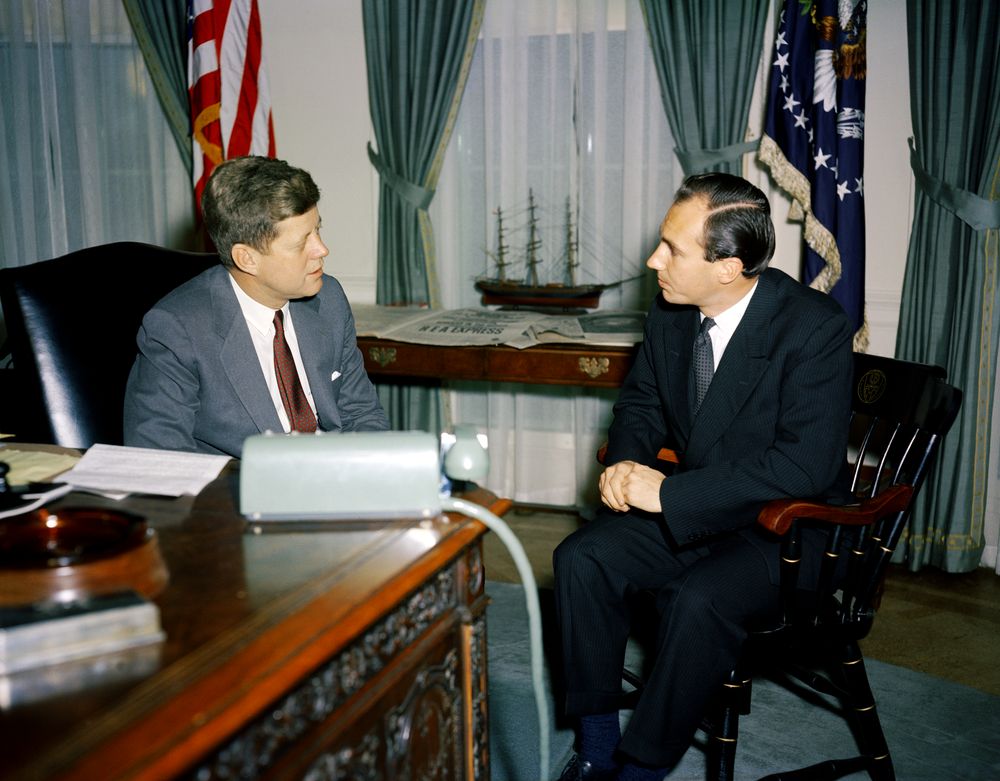
    President John F. Kennedy addressed the Canadian Parliament in 1961. Here he is seen meeting with His Highness the Aga Khan, Prince Karim al-Husseini, at the Oval Office, White House, on March 14, 1961. The Ismaili Imam had first met the President in France some six years earlier. Photo: Robert L. Knudsen (Robert LeRoy), 1929-1989.

    President John F. Kennedy addressed the Canadian Parliament in 1961. Here he is seen meeting with His Highness the Aga Khan, Prince Karim al-Husseini, at the Oval Office, White House, on March 14, 1961. The Ismaili Imam had first met the President in France some six years earlier. Photo: Robert L. Knudsen (Robert LeRoy), 1929-1989.

  27. 1980.05.05, His Excellency Masayoshi Ohira, P.M. of Japan
  28. 1977.10.18, Her Majesty the Queen (Speech from the throne)
  29. 1973.06.19, Madam Indira Gandhi, P.M. of India
  30. 1973.03.30, Luis Echeverria, Constitutional President of United Mexican States
  31. 1972.04.14, Richard M. Nixon, U.S. President
  32. 1967.07.01, Her Majesty the Queen
  33. 1961.05.17, John F. Kennedy, U.S. President (link to video of President Kennedy’s speech follows this article)

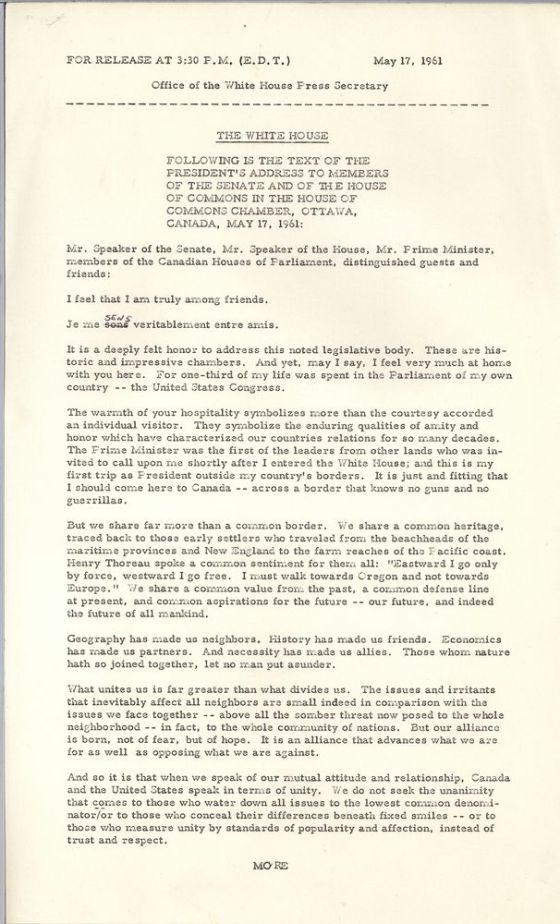
    An image of the original text of address by President John F. Kennedy to Canadian Parliament, Ottawa, 17 May 1961. Credit: John F. Kennedy Presidential Library and Museum

    An image of the original text of address by President John F. Kennedy to Canadian Parliament, Ottawa, 17 May 1961. Credit: John F. Kennedy Presidential Library and Museum

  34. 1958.07.21, Hon. Dr. Kwame Nkrumah, P.M. of Ghana
  35. 1958.07.09, Dwight D. Eisenhower, U.S. President
  36. 1958.06.13, Rt. Hon. Harold Macmillan, P.M. of the United Kingdom
  37. 1958.06.02, Professor Theodor Heuss, President of Federal Republic of Germany
  38. 1957.10.14, Her Majesty the Queen (Speech from the throne)
  39. 1957.03.04, His Excellency Guy Mollet, Premier of France

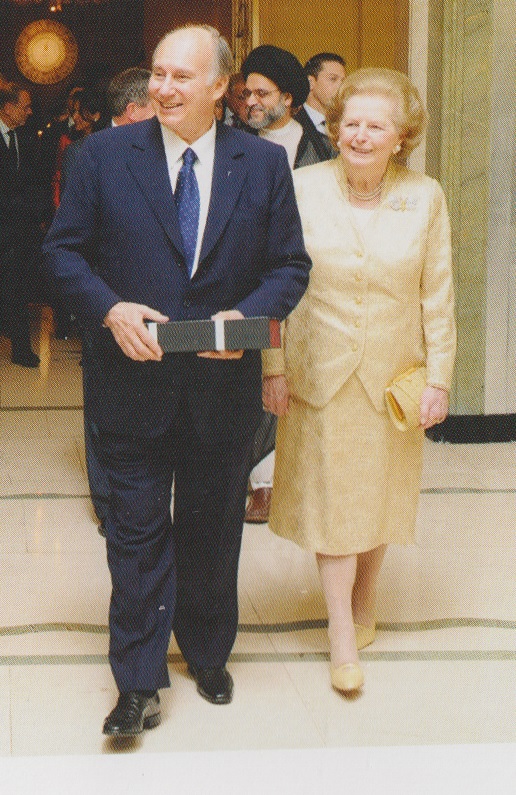
    His Highness the Aga Khan, 49th Ismaili Imam and direct descendant of the Prophet Muhammad, with Baroness Margaret Thatcher at the banquet hosted by His Highness in London on July 3, 2008 during his Golden Jubilee Celebrations. Baroness Thatcher addressed the Canadian Parliament in1988 as Prime Minister of Great Britian. Photo: Mawlana Hazar Imam Shah Karim Al Hussaini Aga Khan, Golden Jubilee Souvenir, published by Islamic Publications Limited. 2012. Copyright.

    His Highness the Aga Khan, 49th Ismaili Imam and direct descendant of the Prophet Muhammad, with Baroness Margaret Thatcher at the banquet hosted by His Highness in London on July 3, 2008 during his Golden Jubilee Celebrations. Baroness Thatcher addressed the Canadian Parliament in 1988 as Prime Minister of Great Britain. Photo: Mawlana Hazar Imam Shah Karim Al Hussaini Aga Khan, Golden Jubilee Souvenir, published by Islamic Publications Limited. 2012. Copyright.

  40. 1956.06.05, His Excellency Dr. Sukarno, Indonesian President
  41. 1956.03.05, His Excellency Giovanni Gronchi, Italian President
  42. 1956.02.06, Rt. Hon. Sir Anthony Eden, P.M. of Great Britain
  43. 1953.11.14, Dwight D. Eisenhower, U.S. President
  44. 1951.04.05, Vincent Auriol, French Republic President
  45. 1950.05.31, Hon. Liaquat Ali Khan, P.M. of Pakistan
  46. 1949.10.24, Pandit Jawaharlal Nehru, P.M. of India
  47. 1947.06.11, Harry S. Truman, U.S. President
  48. 1945.11.19, Rt. Hon. Clement R. Attlee, P.M. of Great Britain
  49. 1944.06.01, Rt. Hon. John C. Curtin, P.M. of Australia
  50. 1943.06.03, Eduard Benes, Czechoslovakian President
  51. 1941.12.30, Rt. Hon. Winston S. Churchill, P.M. of Great Britain
  52. 1939.05.19, His Majesty the King

Non-Heads of State who have addressed Joint Sessions of the Senate and House of Commons of Canada

Canada's Prime Minister, Stephen Harper, invites the Ismaili Imam, His Highness the Aga Khan to speak to the joint session of the Canadian Parliament on February 27, 2014.  Here they are pictured in the Prime Minister's Office at the Parliament Building in Ottawa during one of Aga Khan's  visits to the country. Photo credit: Akdn.org

Canada’s Prime Minister, Stephen Harper, has invited the 49th Ismaili Imam, His Highness the Aga Khan, to speak to the joint session of the Canadian Parliament on February 27, 2014. Here they are pictured in the Prime Minister’s Office at the Parliament Building in Ottawa during one of Aga Khan’s visits to the country. Photo credit: Akdn.org

  1. 2014.02.27, (forthcoming) His Highness the Aga Khan, 49th Imam of the Shia Imami Ismaili Muslims and the direct descendant of the Prophet Muhammad
  2. 2004.03.09, His Excellency Kofi Annan, Secretary General of the United Nations Organization
  3. 1990.06.18, Mr. Nelson Mandela Deputy President of the African National Congress  (note – at this time Nelson Mandela was not yet head of South Africa, which was still under apartheid rule)
  4. 1985.03.07, His Excellency Javier Perez de Cuellar, Secretary General of the United Nations Organization
  5. 1964.05.26, His Excellency U Thant, Secretary General of the United Nations Organization
  6. 1943.06.16, Madame Chiang Kai-Shek, Wife of Leader of Republic of China

Date posted: Monday, February 17, 2014.
Last updated: Thursday, February 20, 2014, 8:00 AM EST.

_______________

1. Compiled from the following sources:

Prime Minister Harper to Welcome His Highness the Aga Khan
Parliament of Canada – Addresses by Heads of State
Parliament of Canada – Addresses by Foreign Dignitaries
Parliament of Canada – Compendium
Hansard in Canada
Wikipedia 

2. Link to live broadcast on Thursday, February 27, 2014
(11:00 AM – 11:45 AM EST, U.K. 16:00 – 16:45)
Address to Canadian Parliament by His Highness the Aga Khan

3. For video of Kennedy’s speech click JFK Library Archives.