Simerg is an independent initiative dedicated to Ismaili Muslims, the Aga Khan — their Hereditary Imam — and the Ismaili Imamat, and Islam in general through literary readings, photo essays and artistic expressions
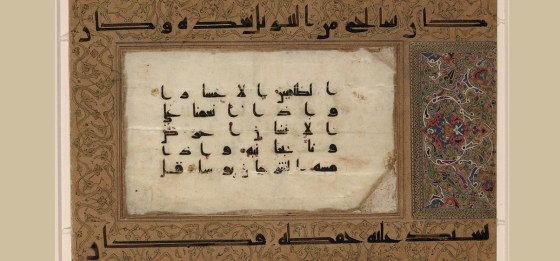
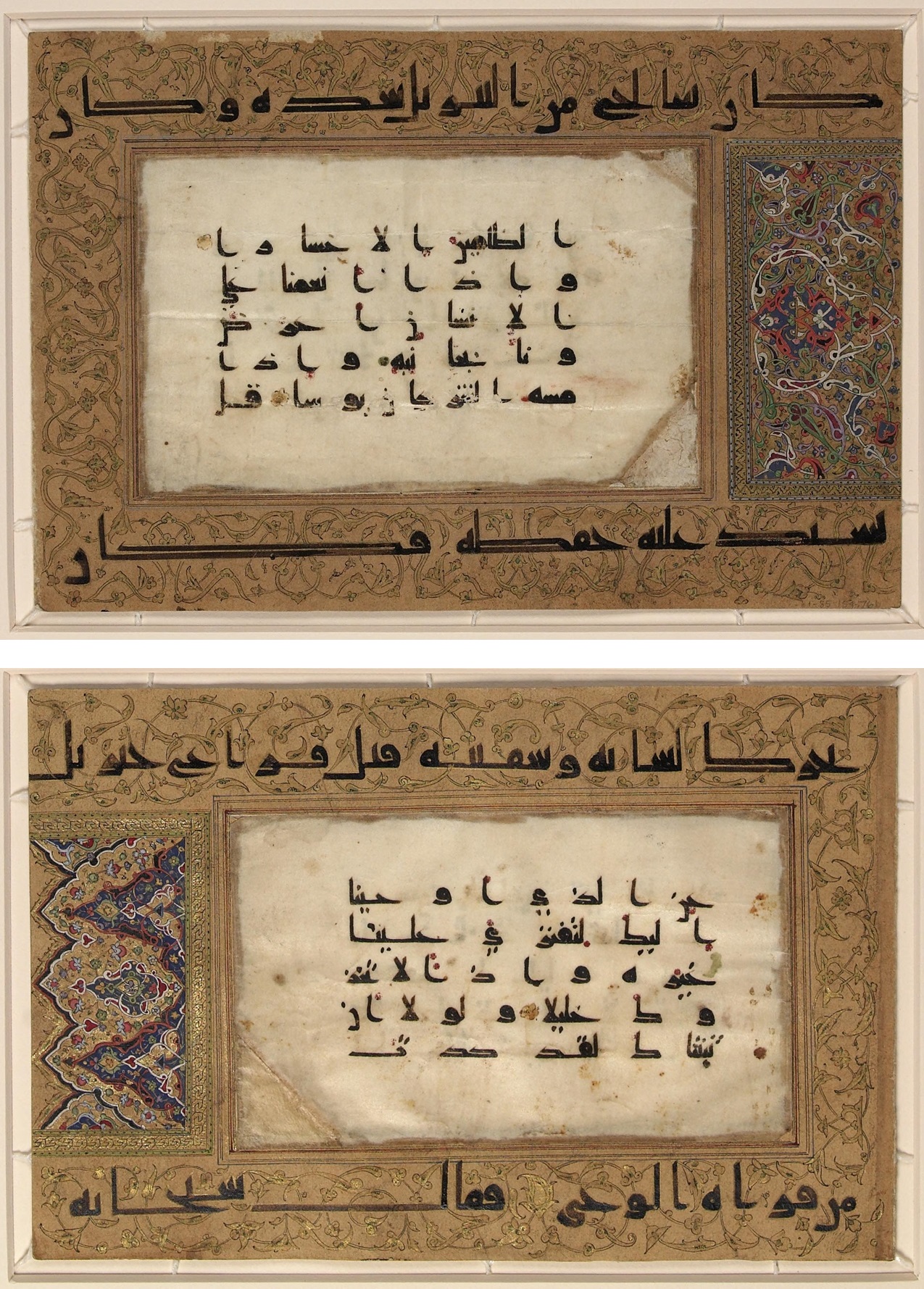
Chapter 17 of the Holy Qur’an known as Suraj I-isra (The Night Journey) or Bani Israel (The Children of Israel), describes several events, including the Prophet Muhammad’s (May peace be upon him and his progeny) night journey (Isra’) to Jerusalem and his ascension (Mi’raj) through the skies. The two fragments from the USA Library of Congress (LOC) shown in this post below are from Chapter 17, Verses 73-84, and describe the value of prayer and the Qur’an. These Qur’anic fragments are written in Kufi script on parchment. In-depth details of these fragments can be found on the LOC website HERE.
We present pertinent verses from the Qur’an on the night of Mir’aj and prayer, followed by a brief explanation of the holy night and its significance among the Shia Ismaili Muslims.
Verses from Suraj I-isra
Glory be to Him, who carried His servant by night from the Holy Mosque to the Further Mosque the precincts of which We have blessed, that We might show him some of Our signs. He is the All-hearing, the All-seeing — 17:1
Say: ‘Call upon God, or call upon the Merciful; whichsoever you call upon, to Him belong the Names Most Beautiful.’ And be thou not loud in thy prayer, nor hushed therein, but seek thou for a way between that — 17:110
Perform the prayer at the sinking of the sun to the darkening of the night and the recital of dawn; surely the recital of dawn is witnessed — 17:78
And as for the night, keep vigil a part of it, as a work of supererogation for thee; it may be that thy Lord will raise thee up to a laudable station — 17:79
The Night of Miraj is observed by Muslims around the world on the 27th night of the seventh month of
And whosoever desires the world to come and strives after it as he should, being a believer — those, their striving shall be thanked — 17:19
Your Lord knows very well what is in your hearts if you are righteous, for He is All-forgiving to those who are penitent. — 17:25.
___________
Mi’raj among the Shia Ismaili Muslims: The Imam-of-the-Time Leads his followers to spiritual elevation
Qur’anic fragments written in Kufi script on parchment. Photograph: The US Library of Congress, Washington DC
The night of Mi’raj falls on the 27th day of Rajab, the seventh month in the Islamic lunar calendar, which is 11 days shorter than the Gregorian calendar. Thus, in 2025, Miraj falls on or around January 26 or 27, 2025, depending on when the moon was sighted.
Mi’raj is an Arabic word that literally means a ‘ladder’ and refers to an experience in the life of Prophet Muhammad during the night. Interpretations of the Mi’raj include a literal event in which the Prophet Muhammad first travelled to Jerusalem before mounting a horse called Buraq and being taken to God’s Throne. Along the flight, he met with the great Prophets, including Abraham, Moses, and Jesus (may peace be on them).
However, among Sufis and other Islamic esoteric traditions, such as those practiced by the Shia Ismaili Muslims, Mi’raj is considered the highest point of spiritual perfection an individual can attain through religion and the practice of faith.
Believers long to experience a Mi’raj, just as the Prophet experienced it. The Shia Ismailis seek out this spiritual elevation under the guidance of the Imam-of-the-Time, presently Mawlana Shah Karim Al-Hussaini Hazar Imam, His Highness the Aga Khan, who leads his followers to self-awareness, spiritual insight and elevation. This is clearly noted in the Preamble of the Ismaili Constitution in paragraph (F), which reads:
“Historically and in accordance with Ismaili tradition, the Imam of the time is concerned with spiritual advancement as well as improvement of the quality of life of his murids. The Imam’s ta‘lim lights the murid’s path to spiritual enlightenment and vision. In temporal matters, the Imam guides the murids, and motivates them to develop their potential.”
His Highness the Aga Khan, the 49th Hereditary Imam, is a direct descendant of Hazrat Ali (may peace be upon him) whose remarkable teachings, preserved in works such as Nahj al-Balaghah, have a profound impact on all Shia Muslims, including the Ismailis. Another literary work, known as the Kalam-i Mawla, poems of Imam Ali, is not just historical text but holds a personal relevance to the community members. These verses, rendered in Hindi, delve deep into individuals’ conduct, behaviour, and actions during their lives on earth (please read Farouk Topan’s excellent piece Kalam-i-Mawla).
We are pleased to provide a recitation of verses from the Kalam of Hazrat Ali that focus on ethics, spirituality and the Mi’raj of the Prophet Muhammad. The verses are recited by Alnoor Saleh and have been downloaded from the website Ginans Central, which is maintained by Karim Tharani of the University of Saskatchewan.
The month of Rajab, 7th in the Islamic calendar, marks two important anniversaries — the birth of the first Shia Imam and Islam’s 4th Caliph, Hazrat Ali (may peace be upon him), on the 13th of Rajab (which was observed on January 24, 2024), and the Shab-i-Miʿrāj on the 26th of Rajab commemorating the blessed night when Prophet Muhammad (peace be upon him and his progeny) ascended to the heavens. The Mi’raj of the Prophet Muhammad will be observed by Ismaili Muslims in Canada and several other countries around the world on Wednesday, February 7, 2024.
Mi’raj is an Arabic word which literally means a ‘ladder’ and refers to an experience in the life of Prophet Muhammad which took place during the night. Thus, sometimes it is referred to as the ‘night journey’ of the Prophet. The first verse of Surah al-Isra (The Night Journey) in the Holy Qur’an says:
“Glory be to Him, who carried His servant by night from the Holy Mosque to the Further Mosque the precincts of which We have blessed, that We might show him some of Our signs. He is the All-hearing, the All-seeing.” — 17:1, translated by A.J. Arberry, see Corpus Qur’an for multiple translations.
Article continues below
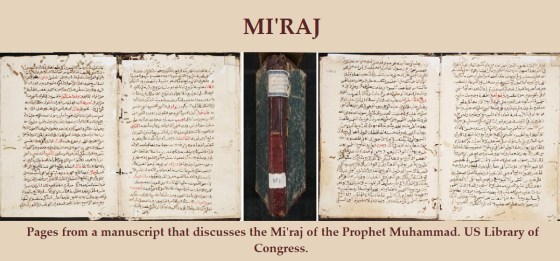
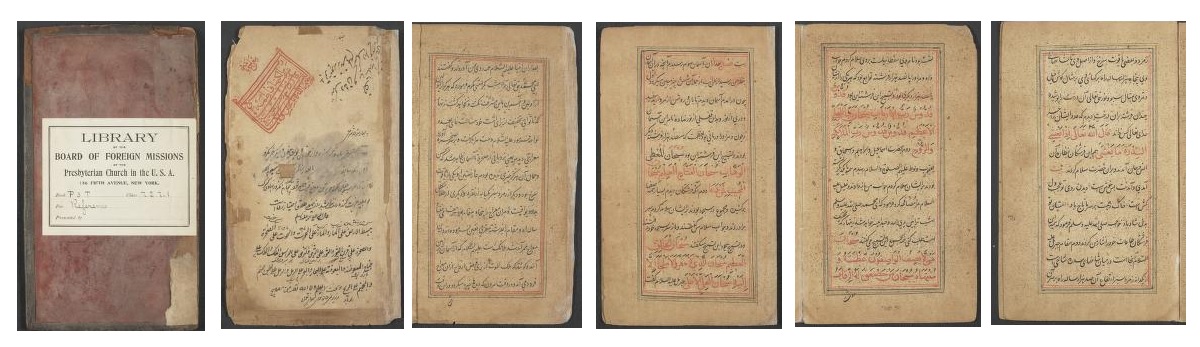
Six images from a total of 408 from an unidentified Persian treatise on the Miʻrāj and several other topics from the Hadith (traditions) of the Prophet Muhammad. Image: US Library of Congress. For more details please click https://www.loc.gov/item/2016397783/
~~~~~~
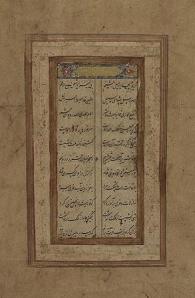
Fragment from page 7 of the Bustan of Sadi. The last two lines of poetry on this page extol the Prophet’s miraculous ascension to the heavens (mi’raj): One night he sat (on his flying steed Buraq) and passed through the heavens. / In majesty and grandeur, he exceeded the angels. / So impulsive, he urged (his steed) into the plain of closeness (to God) / While Gabriel remained behind him at the Lote Tree (of the Limit). Image: Wikipedia.
Among Sufis and other Islamic esoteric traditions, such as those practiced by Ismaili Muslims, Mi’raj is considered the highest point of spiritual perfection an individual can attain through religion and the practice of faith. Believers long to experience a Mi’raj, just as the Prophet experienced it. The Shia Ismailis seek out this spiritual elevation under the guidance of the Imam-of-the-Time, presently Mawlana Shah Karim Al-Hussaini Hazar Imam, His Highness the Aga Khan, who leads his followers to self-awareness, spiritual insight and elevation. This is clearly noted in the Preamble of the Ismaili Constitutionin paragraph (F), which reads:
“Historically and in accordance with Ismaili tradition, the Imam of the time is concerned with spiritual advancement as well as improvement of the quality of life of his murids. The Imam’s ta‘lim lights the murid’s path to spiritual enlightenment and vision. In temporal matters, the Imam guides the murids, and motivates them to develop their potential.”
His Highness the Aga Khan is the 49th Hereditary Imam, directly descended from Hazrat Ali, whose remarkable teachings have come down to us through the preservation of his sermons and teachings which are recorded in works such as Nahj al-Balaghah. Close to the heart of the Ismaili Muslims are poems of the Imam Ali known as Kalam-i Mawla that have been rendered into Hindi. The verses speak about the conduct, behaviour and action of man during his sojourn on earth (please read Farouk Topan’s excellent piece Kalam-i-Mawla)
We are pleased to provide a recitation of verses from the Kalam of Hazrat Ali that focus on ethics, spirituality and the Mi’raj of the Prophet Muhammad. The verses are recited by Alnoor Saleh and have been downloaded from the MUST VISIT website Ginans Central, which is maintained by Karim Tharani of the University of Saskatchewan.
[The month of Rajab, 7th in the Islamic calendar, marks two important anniversaries — the birth of Hazrat Ali on the 13th of Rajab (which was observed on February 3, 2023, please read articles by Dr. Farouk Topan and Professor James Morris) and the Mi’raj of the Prophet Muhammad (may peace be upon him and his family) on the 27th of Rajab which will be observed on Friday, February 17. The introductory article in English and French published by Ismaili institutions in France was shared with us by Paris based Mohez Nato, and we present it with minor changes. We follow the introduction with an insightful and reflective article by Alwaez Jehangir Merchant (d. May 27, 2018) that was first published in the mid 1980’s in UK’s flagship Ismaili religious magazine, Ilm. The Prophetic tradition “I have a time with God” was the inspiration behind Alwaez’s piece. NOTE: A short description of the image shown at top of this page is given at the end of the article – Ed.]
Introduction to the Mi’raj
Six images from a total 408 from an unidentified Persian treatise on the Miʻrāj and several other topics from the Hadith (traditions) of the Prophet Muhammad. Image: US Lobrary of Congress. For more details please click https://www.loc.gov/item/2016397783/
Ismaili Muslims in Canada and many parts of the world will celebrate on Friday 17th February, the blessed night of Shab-i-Miʿrāj commemorating the night when Prophet Muhammad (peace of Allah be upon him and his family) ascended to the heavens.
Miʿrāj is an Arabic word which literally means a ‘ladder’ and refers to an experience in the life of Prophet Muhammad (may peace be upon him) which took place during the night. Thus, sometimes it is referred to as the ‘night journey’ of the Prophet. The first verse of Surah al-Isra in the Holy Qur’an says:
“Glory be to Him Who took His servant by night from the Masjid al-Haram to the Masjid al-Aqsa whose surroundings We have blessed, so that We might show him of Our signs: He is the All-hearing, the All-seeing.”
In esoteric traditions, Miʿrāj is considered the highest point of spiritual perfection an individual can attain through religion and the practice of faith. Believers long to experience a Miʿrāj, just as the Prophet experienced it. By viewing Miʿrāj symbolically as a ladder, believers are encouraged to engage in regular spiritual seeking through God’s love, prayers, piety, and discipline.
In the Ismaili Tariqah, the practice of tasbīḥ, dhikr and Bait ul-khayal, encourages believers to engage in personal spiritual search for enlightenment under the guidance of the living Imam whose guidance and blessings can lead to self-awareness, spiritual elevation and communion with God.
____________
French
Nous célébrerons ce vendredi 17 février la nuit bénie de Shab-i-Miʿrāj commémorant « le voyage nocturne » de notre bien-aimé Prophète Muhammad (que la paix d’Allah soit sur lui et sur sa famille).
Miʿrāj signifie littéralement « échelle » en arabe. Miʿrāj consacre une expérience spirituelle marquante dans la vie du Prophète Muhammad (que la paix d’Allah soit sur lui et sur sa famille) ayant eu lieu au cours de la nuit. Miʿrāj est ainsi parfois appelé le « voyage de nuit » du Prophète. Dans le premier verset de la sourate al-Isra, Allah dit:
«Gloire à Lui qui a fait voyager de nuit Son serviteur de la Mosquée Sacrée (Masjid al-Haram) à la Mosquée Très-Eloignée (Masjid al-Aqsa) dont nous avons béni les alentours, et ceci afin que Nous puissions lui montrer certains de Nos signes : Il est Celui qui entend et qui voit parfaitement.»
Dans les traditions ésotériques, Miʿrāj est considéré comme le sommet de la perfection spirituelle qu’un individu peut atteindre à travers la religion et la pratique de la foi. Les croyants aspirent à vivre un Miʿrāj, tout comme le Prophète l’a vécu. En considérant Miʿrāj symboliquement comme une échelle, les croyants sont encouragés à s’engager dans une recherche spirituelle régulière à travers l’amour de Dieu, les prières, la piété et la discipline.
Dans la Tariqah Ismailie, la pratique du tasbīḥ, du dhikr et du Bait ul-khayal, encourage les croyants à s’engager dans une quête spirituelle personnelle pour l’illumination sous la direction de l’Imam du Temps dont les directives et les bénédictions peuvent nous aider à l’élévation spirituelle, à l’éveil et à l’union avec Dieu.
_________________________
li ma’a Allah waqt – I have a time with God
Fragment from page 7 of the Bustan of Sadi. The last two lines of poetry on this page extol the Prophet’s miraculous ascension to the heavens (mi’raj): One night he sat (on his flying steed Buraq) and passed through the heavens. / In majesty and grandeur, he exceeded the angels. / So impulsive, he urged (his steed) into the plain of closeness (to God) / While Gabriel remained behind him at the Lote Tree (of the Limit). Image: Wikipedia.
BY LATE JEHANGIR A. MERCHANT
While Muslim artists created marvellous miniatures depicting the Prophet’s mi’raj (ascension) between arrays of fanciful clouds in gold and radiant colours with delightful angels serving him, Muslim poets in their admiration of the event soared high into their imaginative world and portrayed the Prophet in all his glory, flying through the seven heavens to the Mysterious Beyond in the Holy Presence of his God. Over time, a considerable amount of literature grew around the mi’raj of the Prophet. The following is one such expression which can be found among esoteric circles in Islam:
God sent out Gabriel:
“My Muhammad shall come!” He said. “Take Buraq, draw it before him, My Muhammad shall mount!” He said.
“He shall go to the city of Medina, In front of him angels shall fly. The door of paradise shall open, My Muhammad shall enter,” He said.
“My Muhammad shall come, shall come, He shall see and look at My Throne; He shall pluck the roses of Paradise, My Muhammad shall smell them,” He said…’ [1]
The original theme of Prophet Muhammad’s (s.a.s.) mi’raj upon which the wealth of mi’raj literature has grown, including the above excerpts, is referred to very briefly in the opening verse of chapter 17 of the Holy Qur’an entitled al-Isra (The Nocturnal Journey). [2] It says:
“Glory be to Him Who carried His servant by night from the Sacred Place of Worship (al-masjid al-haram) to the Far Distant Place of Worship (al-masjid al-aqsa) [3] whose precincts We have blessed, that We might show him Our signs. Lo! He alone is the Hearer, the Seer.”
The theme is further expanded in the first eighteen verses of Chapter 53, al-Najm (The Star):
“By the star when it sets, your compatriot errs not, nor is he deceived; nor does he speak of (his own) desire. It is nothing save an inspiration that is inspired, which One of Mighty Powers has taught him, endued with Wisdom. And he grew clear to view when he was on the uppermost horizon. Then he drew near and came closer till he was at the distance of two bows-length or even closer.
“And He revealed unto His servant that which He revealed. His heart lied not (in seeing) what he saw.
“Do you then dispute with him concerning what he saw? And indeed, he had seen Him yet another time, near the Lote Tree (Sidrat al-muntaha) [4] of the utmost boundary, near which is the Garden of Repose (jannat al-ma’wa). When the Lote Tree was shrouded (in mystery), his sight swerved not, nor did it wander. Verily he saw the greatest of the signs of his Lord.”
While the Hoy Qur’an doesn’t speak of the event any more than what we have quoted, the version of the event in the books of Hadith is more detailed. However, the mysterious words and phrases mentioned in the quoted Qur’anic verses such as the Sacred Place of Worship (al-masjid al-haram), the Far Distant Place of Worship (al-masjid al-aqsa) , the Lote Tree of the utmost boundary (sidrat al-muntaha), the Garden of Repose (jannat al-ma ‘wa) go unexplained, as do the references in the literary expressions and the Hadith to the mount of the Prophet (Buraq), the ladder (al-mi’raj) and so on. In this short essay, I wish to offer my interpretation about these terms.
There have been exoteric and esoteric interpretations of mi’raj among Muslims. According to the esoteric interpretation, the mi’raj was a spiritual journey; it was a fitting example of a mystical experience, a breaking through into the unseen world, and a symbol of the rise of the soul from the bonds of the material world to the heights of mystical knowledge through the temple of the heart as noted in the following verses:
“On the path of God Two places of worship mark the stages. The material temple, And the temple of the heart, Make your best endeavour To worship at the temple of the heart”. [5]
The Ismaili missionary Pir Shams, in speaking of the heart, says:
…dil manhe deval pujiye Ane dil manhe dev dwar; Dil manhe sanhiya aap vasey, Dil manhe apey didar-re.
Translation:
In the heart worship your Lord, In the heart is the Lord’s abode; In the heart the Lord dwells, In the heart His Face unveils.
The fulfillment of ritual polishing and worshiping in this inner sanctuary of the heart is symbolized by the Prophet’s retirement from his prayers. The journey begins in the heart, the Sacred Place of Worship (al-masjid al-haram). Love is represented by the celestial steed (Buraq) that carries the Prophet to a place in heaven (at-masjid al-aqsa, the Far Distant Place of Worship) where the angels sing praises of Allah.
The Love that we speak of here is divine, and it reminds the soul of its eternal home and leads it to the overwhelming vision of the Divine Light. Rumi says:
Love entered the mosque and said: “o master and guide, Tear the shackles of existence — why are you still in the fetters of the prayer rug? Let your heart not tremble because of the blow of my sword; Put down your head if you want to travel from knowing to seeing!” [6]
Buraq, the heavenly mount of the Prophet, is the symbol of Love. It has strong wings which carry the lover toward the roof of the Beloved:
That is Love, to fly heavenward, To tear a hundred veils in every moment….[7]
The Prophet enters the temple in heaven (al-masjid, al-aqsa) and sees the assembly of Angels and Prophets and receives the salute of welcome from each of them in turn. Then he is brought three vessels containing wine, honey and milk. He drinks the milk, upon which Gabriel said to him, “O Muhammad! You have been rightly guided.” The contents of the three vessels respectively represent the three states — the state of ‘intoxication’ as in the case of the mystics, the state of ‘annihilation’ (fana) as experienced by Moses who fell senseless to the ground while God revealed Himself at the mountain [8] and the state of ‘prophetic sobriety’ as shown by the Prophet who returns from the Divine Presence without fainting.
Now begins the ascension by means of a ladder (al-ma‘arij) of sublime beauty, to the seventh heaven and into the presence of God.
“I turned my face and looked upward; I found a ladder (al-ma‘arij) with alternate rungs of silver and gold” – Prophet Muhammad. [9]
The aspiring soul climbs the ladder that leads to the roof of the Beloved and instantly finds itself in a sate of awe and bewilderment as it recognises that:
“He (Allah) is the Lord of the Ways of Ascent (Dhu ‘l-ma‘arij) by which the Angels and the Spirits ascend unto Him in a day whereof the measure is fifty thousand years.” (Holy Qur’an, 70:3-4)
While ascent (al-ma’arij) in its simple meaning gives a clue to the upward direction of the Prophet’s journey, it proclaims very emphatically that if God has placed man on this earth, He has also set up a ladder for man to climb up to Him. No wonder Allah calls Himself the Lord of the Ways of Ascent (Dhu ’l-ma‘arij).
The rungs of ladder of silver and gold are spiritual stations which are interconnected, yet individually they are distinct and different from each other. Like each step of a ladder, each spiritual station is a rallying point in which the experience of the previous station finds its completion, but where at the same time there is a new level of development and a new departure. It would be wrong to assume each station as an entirely separate experience. There is interpenetration and, what is more, progress is an interrupted climb, it is oscillatory, swinging between the higher and lower spiritual stations:
“(He knows) all that comes down from heaven and all that ascends to it.” (Holy Qur’an, 57:4)
The Prophet and Angel Gabriel arrive at the ‘Lote Tree of the utmost boundary’ (sidrat al-muntaha) at which point Gabriel declares his inability to continue the journey. Rumi explains this as the weakness of the discursive reason which, though useful as a guide on the initial steps of the Path, becomes useless once the seeker has reached the Chamber of Union:
“Reason speaks, like Gabriel: O Ahmad, If I advance one step, He will burn me.” (Mathnavi, 1:1066)
Ibn al-Arabi, the great Muslim mystic and philosopher attributes ascension to the contemplation and love for the Divine, rather than reason. In his Futuhat (ii: 356-375), he makes a believer and a philosopher journey together, but the philosopher stops at the seventh whilst the believer journeys on to feast in the Divine Presence of His Creator.
Beyond the ‘Lote Tree of the utmost boundary’ the Prophet journeys alone. It is the precinct of God Himself. The Prophet experiences the Divine Presence as a column of infinite veils of Light, denied to Gabriel who says:
“Between me and Him (God) are 70,000 veils of Light.”
But soon, for the Prophet, the Supreme Mystery was to unfold Itself. A drama is enacted. The Prophet asks that the eye of the heart be opened in him, and like Moses, he supplicates: “…My Lord! reveal Yourself to me, that I may look upon You.”
He is not to be denied the Vision. A Voice summons him:
“O soul at peace! Return unto your Lord, well-pleased, and pleasing in His Sight…” (Holy Qur’an, 89:27),
and the Prophet enters the Garden of Repose (jannat al-ma’wa). But the Voice summons again: “Come yet nearer.”
He does not see, nor does he apprehend. There is Silence, all-engulfing Silence. There is nothing for him to do, but to draw near and go closer till he is at a distance of two bows-length or even closer. Again the Voice speaks: “Ask,” and the Prophet prays again: “My Lord! reveal Yourself to me, that I may look upon You.”
And He, The Lord of Majesty and Reverence, reveals Himself unto His servant, that which He wishes to reveal. The Prophet’s eyes do not swerve and nor do they wander. He sees the greatest of the signs of his Lord — His Vision.
When the Prophet returns from this spiritual journey of the ‘Far Distant Place of Worship’ and the ‘Proximity of God’, the bed on which he had laid was still warm. This explains the secret of the “Eternal Now in God.” In this connection the Prophet has said:
“I have a time with God” (li ma’a Allah waqt).
In spiritual life, serial time no longer exists. The moment a soul breaks through created time and reaches the ‘Eternal Now in God’, everything created is annihilated in its experience. The serial time is torn. Finally, the Prophet says: “And He revealed to me secrets that I am not allowed to communicate to you.”
His yearning for the ‘exalted station’ becomes intense, and as often as he feels this longing he turns to Bilal and says: “O Bilal, comfort us by the call to prayer.” Thus to the Prophet every time of prayer is an ascension (mi’raj) and a new nearness to God.
The mystical interpretation of the mi’raj is all the more revealing, since:
“…The Prophet, although created as the most perfect being, still remains a servant…The opening words of Sura 17 – ‘praised be He Who travelled with His servant at night’ – indicate that even in the moment of rapture the Prophet is still called abduhu, ‘His Servant.’ That implies that ‘servant’ is the highest possible name for a human being who, however, is able to speak to God without being extinguished.” [10]
The Prophet’s journey beyond the ‘Lote Tree of the utmost boundary’, all by himself, is an affirmation of the exalted destiny of man:
“Although Adam had not got wings, yet he has reached a place that was not destined even for angels.” [11]
And as by the verse “You have indeed in the Apostle of God a beautiful pattern of conduct,” (Holy Qur’an, 33:21), Prophet Muhammad (s.a.s.) is made an example to be followed; his mi’raj, to the believers, is indicative of the rise of the soul from the plane of material existence to the proximity of God.
“You have been in the station of dust, you have made a hidden journey: When you have reached the state of Adam, be careful lest you establish yourself there; You continue the journey, and you travel up to heaven, And you move bit by bit so that God may give you freedom.” [12]
Date originally posted: June 13, 2012. Last updated: February 16, 2023.
_______________
Featured image at top of page: The images featured at the top of this page belong to a 16th-century manuscript containing an early copy of the mystical work by Najm Al-Dīn Muhammad ibn Ahmad Al-Ghayṭī (died 1573) entitled Kitāb al-ibtihāj bil-kalām ‘alà al-Isrā’ wal-Mi’rāj (The book of delight at the discussion of the night journey and ascension of the Prophet Muhammad.) The author of the work was a religious scholar who lived in Cairo. This manuscript copy, made before the original author’s death, is especially significant for its age, having been created in AH 979 (AD 1571). For a full description of the manuscript and to view all 76 images please click LOC Item 2021667187
[1]. Yunus Emre, Divan, p575, CCLIV quoted in Poetry in Honour of the Prophet by Annemarie Schimmel in As Through a Veil Mystical Poetry in Islam, p.1 83, Columbia University Press, New York, 1982.
[2]. The chapter gets its title ‘al-isra’ from the first verse itself Subhanal lazi asra hi abdihi lailan, “Glory be to Him Who carried His servant by night…”.
[3].al-masjid al-haram in its exoteric interpretation is the Holy Ka’ba at Makkah and al-masjid al-aqsa is the Mosque of Jerusalem which was the Qibla of the Muslims until about 16 months after Hijra when Ka’ba was established as the Qibla. While commanding the highest respect of all Muslims, they are also given an esoteric interpretation by many Muslims.
[4]. In ancient times, Arabs often planted a tree to mark the end of a road. The cosmic tree or lote tree which is also called the “tree of the extreme limit” marks the end of the universe. The Prophet described the lote tree as a large tree not resembling any of the trees of paradise. The tree has an infinite number of branches, and every branch has an infinite number of leaves and an angel sits on each leaf. Springs of water, milk, wine and honey flow from the trunk. See The Islamic World edited by John Esposito and Abdulhussein Sachedina, p.117, Oxford University Press.
[5].The Persian Mystics, Wisdom of the East Series, p.35.
[6]. Mawlana Rumi, Diwan-i Kabir, quoted in As Through a Veil Mystical Poetry in Islam by Annemarie Schimmel, p.129,130, Columbia University Press, New York 1982.
[7].ibid, p.130.
[8]. “And when Moses came at the appointed time and his Lord had spoken to him, he said: ‘My Lord! reveal Yourself to me, that I may look upon You’. He said: ‘You will not see Me, but look upon the mountain; if it remains firm in its place, then only will you see Me.’ And when his Lord revealed His Glory to the mountain, He crushed it to fine dust. Moses fell down senseless, and when he came to himself he said: ‘Glory be to You! I turn unto You in repentance. I am the first of the believers.” (Holy Qur’an, 7:143)
[9]. Henry Corbin, Avicenna and the Visionary Recital, p. 1 74, Spring Publications, Texas.
[10].Mystical Dimensions, p.220.
[11]. Khwaja Mir Dard, Urdu Diwan, ed. Khalil ur-Rahman Da’udi, Lahore, 1962 quoted in Mystical Dimensions.
[12]. Mawlana Rumi, Diwan-i Kabir, v.2837, quoted in The Triumphal Sun by Annemarie Schimmel, East-West Publications, The Hague, 1978.
___________
This piece by Jehangir Merchant is a revision of the original piece which first appeared in the March 1985 issue of Ilm (Volume 9, Number 2) published by the Shia Imami Ismaili Tariqah and Religious Education Board for the United Kingdom. Alwaez Jehangir edited and contributed several articles for the flagship Ismaili magazine during his long tenure with the UK institution. His other articles on this website include:
Before departing this website, please take a moment to review Simerg’s Table of Contents for links to hundreds of thought-provoking pieces on a vast array of subjects including faith and culture, history and philosophy, and arts and letters to name a few. Also visit Simerg’s sister websites Barakah, dedicated to His Highness the Aga Khan, and Simergphotos. The editor may be reached via email at mmerchant@simerg.com.
The night journey (al-isra) and the ascension (al-mi’raj) of the Prophet is observed on the 27th day in the Islamic month of Rajab (falling in 2021 on Wednesday/Thursday, March 10/11).
This is an event of great spiritual significance because the exalted experience of Prophet Muhammad (s.a.s.) is viewed by all Muslims as an example of his elevated status. Significant events of this nature in the life of the Prophet are a source of inspiration for the believers to excel in their quest for spiritual enlightenment and also serve as a model for the believers to emulate. The attainment of this exalted status is possible for every believer who correctly practice his or her Faith in accordance with the proper guidance of Allah through His Prophet and the designated successors (i.e. the Hereditary Imams).
Fragment from a manuscript of Bustan of Sadi extolling the Prophet’s miraculous ascension to the heavens (mi’raj) Image: Wikipedia. Please click for article.
While ascent (al-ma’arij) in its simple meaning gives a clue to the upward direction of the Prophet’s journey, it proclaims very emphatically that if God has placed man on this earth, He has also set up a ladder for man to climb up to Him. No wonder Allah calls Himself the Lord of the Ways of Ascent (Dhu ’l-ma‘arij).” — Read More
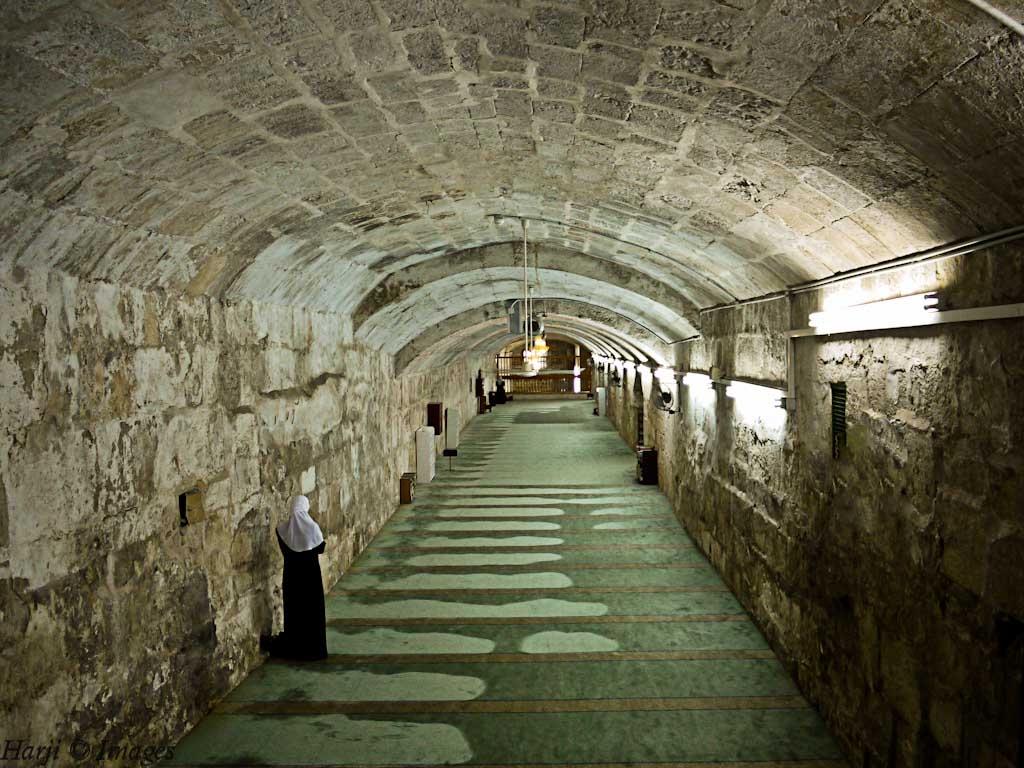
It is believed that Prophet Muhammad (s.a.s.) prayed at this mosque (which is in the basement of present day Al Aqsa, see next photo) before he took the night journey to heaven. Photo: Muslim Harji, Montreal, PQ. Copyright. Please click on image for article on Miraj.
A view of old Jerusalem with the Dome of the Rock as the centerpiece. Photo: Muslim Harji, Montreal, PQ. Copyright.
Date posted: Tuesday, May 3, 2016. Last updated: Tuesday, April 2, 2019.
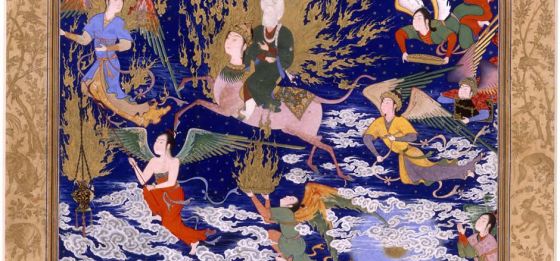
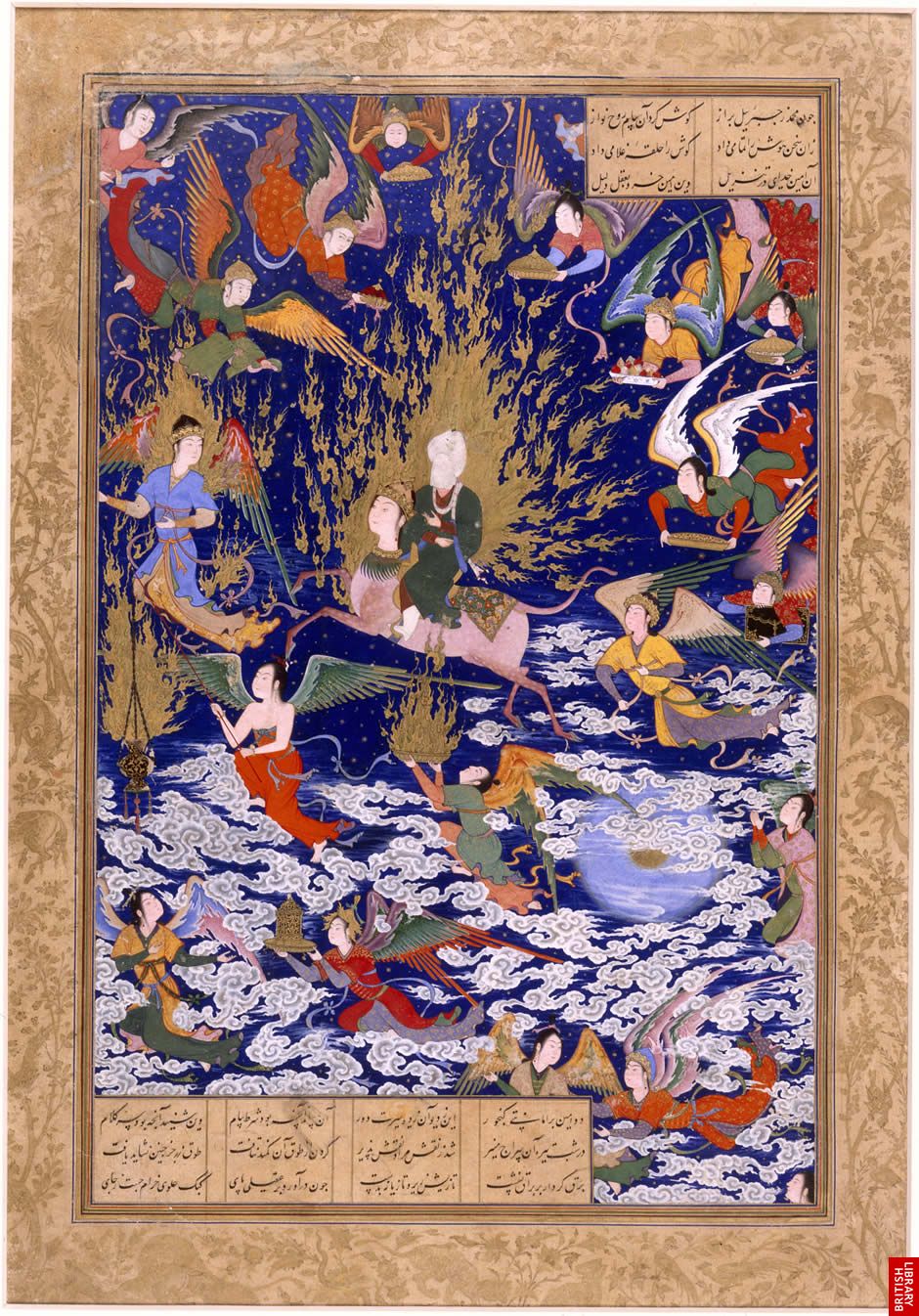
Photo: The Trustees of the British Museum. Copyright. Click on image for article, I Have a Time with God
“While ascent (al-ma’arij) in its simple meaning gives a clue to the upward direction of the Prophet’s journey, it proclaims very emphatically that if God has placed man on this earth, He has also set up a ladder for man to climb up to Him. No wonder Allah calls Himself the Lord of the Ways of Ascent (Dhu ’l-ma‘arij).” — Read more
This is an unusual example of the Prophet Muhammad (s.a.s) pictured in an Islamic manuscript. It comes from a royal miniature made to illustrate a copy of the poems of the celebrated Persian Nizami, and depicts the Prophet’s ascension to heaven on the horse Buraq, guided by the archangel Gabriel, with an escort of angels. According to tradition, the face of the Prophet is blanked out in the miniature.
“In spiritual life, serial time no longer exists. The moment a soul breaks through created time and reaches the ‘Eternal Now in God’, everything created is annihilated in its experience. The serial time is torn. Finally, the Prophet says: ‘And He revealed to me secrets that I am not allowed to communicate to you’” — Read more
The identity of the artist who created the illustration is not known. The calligraphy in this piece was created by Shah Mahmud Nishapuri (d. 1564-5) for Shah Tahmasp (r. 1524-76) — the ruler of Iran who at one point owned the Koh-i-noor diamond, then the world’s largest, and now in the Tower of London.
“His yearning for the ‘exalted station’ becomes intense, and as often as he feels this longing he turns to Bilal and says: “O Bilal, comfort us by the call to prayer.” Thus to the Prophet every time of prayer is an ascension (mi’raj) and a new nearness to God.” — Read more
The story of Prophet Muhammad’s journey has had a profound influence on Islamic thought, and Sufism and other esoteric traditions in Islam particular see it as a powerful metaphor for man’s spiritual journey. Please read The Prophetic Tradition ‘I Have a Time with God’ (li ma’a Allah waqt).
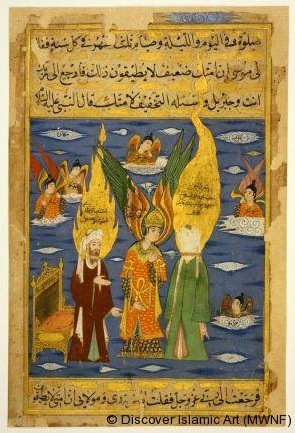
This painted page from a manuscript shows the Archangel Gabriel with the Prophets Moses (left) and Muhammad (right). Surrounded by angels they discuss the question of daily prayers. This happened during Prophet Muhammad’s ascent to heaven. Because it was forbidden to show Muhammad, his face is veiled. Image: Copyright Museum With No Frontiers (MWNF). Please click on image for literary reading.
DETAILS OF THE IMAGE
This single sheet probably came from a handwritten work completed for the Ottoman Sultan Murad III (r. AH 982–1003 / AD 1574–95), and is currently housed at the Museum of Islamic Art at the Pergamon Museum in Berlin, Germany. It features, between bands of script, the prophets Moses and Muhammad and the Archangel Gabriel conversing in heaven. Angels, perched on five clouds behind these three principal characters, appear to be listening. The scene portrayed is one from Muhammad’s visionary ascension to heaven. Muhammad stands on the right-hand side in a long green robe and turban, and Moses, wearing a long dark red robe, is on the left, in front of his heavenly throne, which is denoted by an inscription in Arabic lettering. Moses is gesturing his hands in speech. Muhammad, with whom he is conversing, stands on the opposite side. A white veil conceals his face, while his hands are hidden in the long sleeves of his gown. The heads of both prophets are crowned with halos, within which their names, written in a black script, can be deciphered. The Archangel Gabriel stands between Muhammad and Moses, turning towards Muhammad. He is characterised by a twin pair of multi-coloured wings and a crown. He is featured in the Old Testament as the gate-keeper of Paradise. As one of two angels standing in the presence of God (Luke 1:19), it was Gabriel who explained the story of the Messiah (Daniel 8:16ff.). In Muslim tradition, the angel brought the Divine Revelation of the Holy Qur’an to Prophet Muhammad. In Sura 2 verse 97 it is written that: Gabriel ‘has by God’s grace revealed it [the Qur’an] to you [Muhammad] to your heart’.
The text above the three personages, which describes the story, is written in Ottoman Turkish. It includes the account of Muhammad discussing with God the number of daily prayers. Both eventually agreed on five daily prayers. Moses is Muhammad’s heavenly adviser and Gabriel is his companion. The direct speech of all those involved is written in Arabic. The text is taken from a biography of the prophet which had appeared from the AH 1st century/AD 7th century on. The generic term for this type of biography is sira, which translates as ‘life facts’ or ‘way of life’. (Text adapted from the website of MWNF – see link below).



 Simerg - Insights from Around the World