Laylat al-Qadr – A Night Better than a Thousand Months

Compiled by Simerg
with contributions from Karima Maghraby

In his Khamsa, Shab-i Qadr (the Night of Power), the renowned Persian poet Amir Khusraw Dihlavi (d. 1325 CE) tells the story of a saint who made a failed attempt to stay awake until the Laylat al-Qadr. This image is taken from a folio in the Aga Khan Museum collection; the Toronto museum is due to open in 2014. Photo: Courtesy of the Aga Khan Museum

In his Khamsa, Shab-i Qadr (the Night of Power), the renowned Persian poet Amir Khusraw Dihlavi (d. 1325 CE) tells the story of a saint who made a failed attempt to stay awake until the Laylat al-Qadr. This image is taken from a folio in the Aga Khan Museum collection; the Toronto museum is due to open in 2014. Photo: Courtesy of the Aga Khan Museum

Laylat al-Qadr is the auspicious night when the Prophet Muhammad (s.a.s.) first received the revelation of the Holy Qur’an, thereby conferring upon him the mantle of prophet hood at the age of forty.

The Shia Ismaili Muslims observe Laylat al-Qadr on the 23rd night of Ramadan, in keeping with traditions received through Hazrat Ali (a.s.) and his wife Hazrat Bibi Fatimah (a.s.), and the Imams of the Fatimid dynasty. It is a night of special prayer, reflection and remembrance of Allah.

The following verses from the Holy Qur’an describe the loftiness of this night and articulate the importance of the final revealed scripture to mankind:

“Lo! We revealed it on the Night of Power. What will convey unto you what the Night of Power is! The Night of Power is better than a thousand months. The angels and the spirit descend therein, by the permission of their Lord, with all decrees. Peace it is until the rising of the dawn.” — 94:5

“(This is) a Scripture which We have revealed unto you (Muhammad) that thereby you may bring forth mankind from darkness unto light, by the permission of their Lord, unto the path of the Mighty, the Owner of Praise” — 14:01 

“And celebrate the name of thy Lord morning and evening. And part of the night, prostrate thyself to Him; and glorify Him a long night through. As to these, they love the fleeting life, and put away behind them a Day (that will be) hard.” — 76:25-27 

“We sent it down during a Blessed Night”  — 44:3 

“Ramadhan is the (month) in which was sent down the Qur’an, as a guide to mankind, also clear (Signs) for guidance and judgment (Between right and wrong)” — 2:185

Hazrat Mawlana Murtaza Ali (a.s.) the successor of Prophet Muhammad (s.a.s) to the throne of Imamat is quoted as having said:

“Do not remember God absent-mindedly, nor forget Him in distraction; rather, remember Him with perfect remembrance (dhikran kamilan), a remembrance in which your heart and tongue are in harmony, and what you conceal conforms with what you reveal.” — quoted in  Justice and Remembrance, Introducing the Spirituality of Imam Ali, by Reza Shah Kazemi, p. 162.

Date posted: Sunday, July 28, 2013

____________

Readers will be interested in a recently published piece on this blog, Assessing English Translations of the Qur’an, and Links to Translations on the Internet by Khaleel Mohammed (USA)

A collection of additional literary readings and essays inspired by the Holy Qur’an:

The Noble Qur’an –  An Inexhaustible Well-Spring of Inspiration and Knowledge by His Highness the Aga Khan

Literary Reading: Fatimid Scientist, Al Hazen, Inspired by the Spirit of the Qur’an

The Story of Noah’s Ark in the Holy Qur’an

The Parable of Moses and Khidr in the Holy Qur’an: An Esoteric Interpretation

In the Beginning….The Qur’an and Muslim Thinkers on Creation

“The Blue Manuscript” by Sabiha Al Khemir – An Intriguing Fiction About the Hunt for a Priceless Fatimid Qur’an

Literary Reading: Some Considerations of the Term ‘Imam’ in the Holy Qur’an

Historical Images: The Blue Qur’an from the Fatimid Period, “A Very Spiritual Piece”

A “Thank You” Letter to the Makers of the Blue Qur’an

The Verses of the ‘Immaculate Conception’ of Jesus Christ in the Holy Qur’an and their Lasting Impact on a Christian Emperor

The Birth of Jesus and the Status of Mary in the Qur’an

Historical Images: President Thomas Jefferson’s Copy of the Qur’an

_______________

We welcome feedback/letters from our readers. Your feedback may be edited for length and brevity, and is subject to moderation. We are unable to acknowledge unpublished letters. Please visit the Simerg Home page  for links to articles posted most recently. For links to articles posted on this Web site since its launch in March 2009, please click What’s New.
“I Wish I’d Been There” – Volunteeering at the Dawn of the Age of Imamat by Aziz R. Kurwa

In History in Quotations, which reflects five thousand years of World History, authors M. J. Cohen and John Major write as follows:

“Muhammad said:

‘He of whom I am the Mawla (patron), Ali is his Mawla. O God, be the friend of him who is his friend and be the enemy of his enemy.’

“This became the proof text for the Shia claim that Ali, the Prophet’s cousin and son-in-law, was the Prophet’s rightful successor after the Prophet’s death in 632. The meaning of Mawla here probably implies the role of patron, lord or protector.”

The authors then sum up by stating that through the use of the term Mawla, Prophet Muhammad (s.a.s.) was giving Mawlana Ali (a.s.) the parity with himself in this function. Dr. Aziz Kurwa, a long serving member of the Ismaili community, takes us to the beginning of Islamic and Ismaili history and imaginatively constructs the role he played as a volunteer on that eventful and historic occasion, a day which was described by one of our readers as “an introduction to a new world order”. Aziz Kurwa was among the thirty-one who contributed to Simerg’s highly acclaimed series I Wish I’d Been There.

Please click on image below or: Volunteering at the Dawn of the Age of Imamat

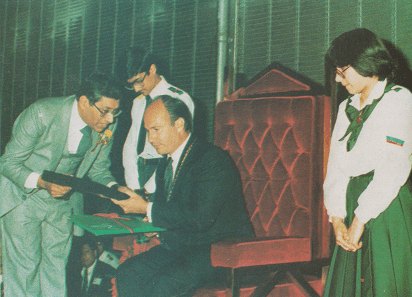
London, 1979: His Highness the Aga Khan, 49th hereditary Imam of the Ismailis and direct descendant of the Prophet Muhammad (s.a.s) receiving Fatimid Gold dinars from Dr. Aziz Kurwa, a long serving leader of the Ismaili community who was at the time President of the Ismailia Association for the U.K.

Ghadir-Khumm and the Two Weighty Matters by Jehangir A. Merchant

In our classic series, I Wish I’d Been There, we had asked our readers to pick up one incident in Ismaili History which they would like to have witnessed. One of the thirty-one contributors for the series, Ismaili missionary (Alwaez), teacher and writer Jehangir Merchant, went back 1400 years to the beginnings of Islamic history and imaginatively constructed a picture of the iconic event when Prophet Muhammad (s.a.s) raised the hand of Hazrat Ali (a.s.) and declared, “He of whom I am the Mawla, Ali is also the Mawla!” Based on authoritative sources, this piece by a long-serving Alwaez shows his vast knowledge and flair, and brings alive a pivotal time in human history.

Please click Ghadir-Khumm and the Two Weighty Matters

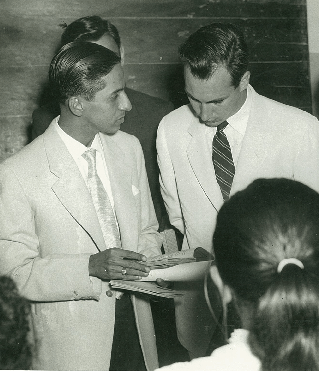
Lourenço Marques, 1958: His Highness the Aga Khan, direct descendant of the Prophet Muhammad (s.a.s.) and current 49th hereditary Imam of the Shia Ismaili Muslims is seen taking a keen interest as Alwaez Jehangir explains the Gujarati history texts that were used to impart religious education to Ismaili youth in Mozambique.

“Muhammad: Legacy of a Prophet” – A Film Created and Produced by Alex Kronemer and Michael Wolfe

Originally aired on PBS to a word-wide audience exceeding 150 million people

“CANDID, THOUGHTFUL AND VISUALLY STUNNING” – Los Angeles Times

Prophet Muhammad (s.a.s) changed world history in 23 years and continues to shape and inspire the lives of more than 1.4 billion Muslims around the world.

Simerg is pleased to make available for its readers around the world a link to the film, Muhammad: Legacy of a Prophet, that was originally aired on PBS to a world-wide audience exceeding 150 million people.  The internet age is a blessing of our time that, through outstanding movies such as this, we are able to learn more about the wonderful and noble qualities of  Prophet Muhammad. In his Presidential Address to the Seerat Conference in 1976, His Highness the Aga Khan had asked:

“In the face of this changing world, which was once a universe to us and is now no more than an overcrowded island, confronted with a fundamental challenge to our understanding of time, surrounded by a foreign fleet of cultural and ideological ships which have broken loose, I ask, ‘Do we have a clear, firm and precise understanding of what Muslim Society is to be in times to come?’ And if as I believe, the answer is uncertain, where else can we search then in the Holy Qur’an, and in the example of Allah’s last and final Prophet?”

 His Highness continued:

“The Holy Prophet’s life gives us every fundamental guideline that we require to resolve the problem as successfully as our human minds and intellects can visualise. His example of integrity, loyalty, honesty, generosity both of means and of time, his solicitude for the poor, the weak and the sick, his steadfastness in friendship, his humility in success, his magnanimity in victory, his simplicity, his wisdom in conceiving new solutions for problems which could not be solved by traditional methods, without affecting the fundamental concepts of Islam, surely all these are foundations which, correctly understood and sincerely interpreted, must enable us to conceive what should be a truly modern and dynamic Islamic Society in the years ahead.”

Some of these examples from the Prophet’s life come alive through this ground-breaking PBS film, which takes the viewers from the ancient Arabian sites where Prophet Muhammad’s story unfolded to the homes, mosques, and workplaces of some of America’s estimated seven million Muslims. The Los Angeles Times called the film “a candid, thoughtful, flowing, visually stunning film,” while The Catholic News Service commented that the Prophet’s biography offers viewers fresh insights into the spiritual foundations of Islam.

Simerg is grateful to Daniel Tutt of upf.tv for facilitating the showing of the film though this website. We strongly encourage all the viewers to watch the complete film, if not in one seating then by watching the timed segmented clips which will open at the bottom of the viewing window. We are sure you will enjoy this film. Please click:

Readers who wish to watch a preview of the film and other selected clips before viewing the full-length movie are invited to click http://www.muhammadfilm.tv or on the following image:

Please click for links to full length movie and excerpts

A Story from ‘Pyara Imam ni Pyari Wato’: Historical Memories by Sairab Abuturabi and Jaferali Bhalwani

Loving Tales of our Beloved Imams: (I) Farazdaq’s Praise and Support of Imam Zainul Abideen (a.s.)

“…This tale belongs to ages past. It goes back to the era of Hazrat Imam Zainul Abideen (a.s.), our third Imam, from whose veins was to ensue the Divine Line of the Imams. He was the Imam who, on the battlefield of Karbala, received the nass of Imamat from his father, Hazrat Imam Hussain (a.s.) with the blessing: “Through you the line of Imamat will continue till the Day of Judgment…”

Please click for story

An Englishman Reflects on the Nature of Imam Ali by Barnaby Rogerson @Simerg

Please click: An Englishman Reflects on the Nature of Imam Ali

“….No one could ever doubt the devotion with which Ali held Muhammad and the many bonds that connected them: Ali was the Prophet’s cousin, the Prophet’s son-in-law, the Prophet’s first male believer, the father of the Prophet’s only male grandchildren, the Prophet’s most intimate disciple and the first heroic warrior champion of Islam. Ali had also served the Prophet as an army commander, missionary, diplomat and administrative secretary…..”

This is an image of Nurin Merchant’s mixed media canvas painting titled “Nature of Prayer.” Secured on the 14″ x 10″ canvas with strong glue are a handmade Tasbih (prayer beads), and 3 dried leaves bearing the Arabic inscriptions of Allah, Ali, and Muhammad. The whole piece represents prayer through the invocation of these names. Copyright: Nurin Merchant. Please click for Barnaby Rogerson’s article.

Previous post: Readings for the Birth Anniversary of Hazrat Ali (a.s.): Kalam-i Mawla, Nahj al-Balaghah for Young People, and more @Simerg