Simerg is an independent initiative dedicated to Ismaili Muslims, the Aga Khan — their Hereditary Imam — and the Ismaili Imamat, and Islam in general through literary readings, photo essays and artistic expressions
Author Archives: Malik Merchant, Editor
Founding publisher and editor of www.barakah.com, www.simerg.com and www.simergphotos.com.
A portrait of the 49th Ismaili Imam, Mawlana Shah Karim Al Hussaini, His Highness the Aga Khan, taken after he succeeded his late grandfather to the throne of Imamat. A framed portrait of the late 48th Imam is seen in the background. Photo by Philippe Le Tellier/Paris Match via Getty Images.
“As soon as one Imam passes away, his successor takes on from the very minute the Imam has passed away” — Mawlana Shah Karim Al Hussaini, His Highness the Aga Khan, 49th Hereditary Imam, interview during Takhtnashini, 1957.
By MALIK MERCHANT
The 12 million strong Shia Imami Ismaili Muslims worldwide have learnt with deep sadness in the last few hours that our beloved 49th Imam, Mawlana Shah Karim Al-Hussaini, His Highness the Aga Khan, passed peacefully to Almighty Allah’s grace on Tuesday, February 4, 2025, in Lisbon, Portugal, surrounded by his family, who were with him in his final moments. At age 88 (December 13, 1936 to February 4, 2025), Mawlana Shah Karim was the longest-lived Imam in Ismaili history. He reigned the Ismaili community for 67 years (July 11, 1957 to February 4, 2025), just three years short of his Platinum Jubilee. His predecessor, Mawlana Sultan Mahomed Shah’s reign of 71 years was the longest in Ismaili history.
Mawlana Shah Karim’s successor, as the 50th Shia Imami Ismaili Imam, has been designated in conformity with the historical Shia Imami Ismaili tradition and practice of Nass. The designation made by Mawlana Shah Karim is recorded in his Will, which will be read in the presence of the Imam’s family and senior international Ismaili leaders. Thereafter, the Jamat will be notified of the declared Mawlana Hazar Imam in whom the Nur already exists in unbroken hereditary succession from Mawlana Ali (peace be upon him).
This belief in the continuity of the Imamat, when one Imam has passed away and succeeded by the next, was articulated by Mawlana Shah Karim in an interview with an American reporter in 1957. He said:
The [installation] ceremony is a public installation of the Imam. The Ismailis pay homage to the Imam and that is when you are recognised by the world at large as the Imam. Officially, as soon as one Imam passes away, his successor takes on from the very minute the Imam has passed away.”
This instantaneous succession underlines the principle of the Unity of Imamat, that is, the Ismaili belief and understanding that each Imam is the same Bearer of the Nur (Light) of Imamat, irrespective of his own age or the time he lives in. This belief, with its enduring nature, has been articulated and preserved throughout Ismaili history, reassuring us of its continuity. The 33rd Imam, Abd al-Salam, who lived in the 15th century, said:
“The Imam’s true face is to be perceived with the eyes of the heart. He has thousands of physical habitations, but his true home is traceless; He has had a thousand names, but all of them refer to one reality.”
As we all come to bear the sad reality and news of Mawlana Shah Karim’s passing, let us all reflect on the Farman he made on December 13, 1964, on his 28th birthday. He said:
“For hundreds of years, my spiritual children have been guided by the Rope of Imamat; you have looked to the Imam of the Age for advice and help in all matters and through your Imam’s immense love and affection for his spiritual children, his Noor has indicated to you where and in which direction you must turn to obtain spiritual and worldly satisfaction.”
As we honour, cherish, and offer gratitude for Mawlana Shah Karim’s life and legacy, we remain secure under the permanent love and protection of the eternal Rope of Imamat and the Manifest Nur (Light) in the 50th Imam-of-the-Time.
In the coming few days, reports, updates, and stories on Mawlana Shah Karim’s life will be published on Simerg and its sister website Barakah.
We express our deepest condolences to the Ismaili world and Mawlana Shah Karim’s family.
Date posted: February 4, 2025.
__________________
We invite readers to contribute their feelings about the sad news that we have all heard about the passing of our beloved 49th Imam, Mawlana Shah Karim. Please click Leave a comment.
Mawlana Shah Karim Al-Hussaini passed peacefully to Almighty Allah’s grace on 4 February 2025 in Lisbon, Portugal, surrounded by his family.
When will the next Imam be announced?
Mawlana Shah Karim’s successor, as the 50th Shia Imami Ismaili Imam, has been designated in conformity with the historical Shia Imami Ismaili tradition and practice of nass. The designation made by Mawlana Shah Karim is recorded in his Will, which is to be read in the presence of the Imam’s family and senior international Jamati leaders. Thereafter, the Jamat will be notified of the declared Hazar Imam in whom the Nur of Imamat exists in unbroken hereditary succession from Mawlana Ali (peace be upon him).
What is “nass”?
In the Shi‘a Imami tradition, the word nass is applied to the transfer of the Imamat from one Imam to the next by way of explicit designation. It is believed that in the same way as the Prophet was divinely designated by Allah, the Prophet through divine support or inspiration (ta’yid) designated Imam ‘Ali as his legatee (wasi) and successor at Ghadir Khumm.
Thus, Imamat is believed to be a prerogative bestowed by God upon a chosen person from the progeny of the Prophet, who before his death and by way of ta’yid (divine support or inspiration) transfers the Imamat to another by explicit designation. As such, nass is the ‘formal act’ of an Imam designating his successor from amongst his male progeny or a remoter issue. For the Shi‘a Ismailis, by way of nass, Imamat has continued in the line of Imams directly descended from Prophet Muhammad through Hazrat ‘Ali and Hazrat Fatima and through the lineage of Imam Husayn and his progeny in perpetuity.
When will the Will be read and who will be present for the reading?
The Will is expected to be read as soon as members of the family, senior leaders of the Ismaili community, and the Executors of the Will have gathered. The reading of the Will is to take place in Lisbon.
What happens when one Imam has passed away and the next Imam has not yet been publicly named? Is the Rope of Imamat broken?
In the Ismaili faith and tradition, the Jamat is never without an Imam. As soon as one Imam leaves this physical world, his spiritual light passes to his designated successor, thus continuing the line of Imamat, which has existed unbroken for over 1400 years. The 50th Imam has been named in Mawlana Shah Karim’s last Will and Testament.
What can I do to offer prayers for our late Imam?
As we express our sadness at the passing of our beloved 49th Imam, and express our shukrana to him, special prayers will be offered in Jamatkhanas around the world. Individual prayer and remembrance is also encouraged. The Ismaili TV will also have special programmes to accompany the Jamat during this historic moment of transition.
Prayers during this period will focus on expressing gratitude for Allah’s mercy on the departed soul, and prayers for eternal rest. Special prayers will be offered on the 40th day following death, consistent with customary practice in Ismaili and other Muslim traditions.
What are the details for the Imam’s funeral?
Mawlana Shah Karim’s funeral is expected to take place in Lisbon as soon as arrangements are finalised. Further information will be shared as it becomes available.
Will the Imam’s body lie in state?
No, in keeping with Muslim tradition, the funeral will take place as soon as possible.
Where will he be buried?
Details of Mawlana Shah Karim’s burial will be communicated in due course.
Who will attend the funeral?
Mawlana Shah Karim’s family and invited senior leaders of the Jamat and Imamat institutions will attend the funeral.
Can I attend Mawlana Shah Karim’s funeral?
Jamati members are respectfully requested to not seek to attend any of the ceremonies in person unless specifically invited.
Will there be changes in our rites and practices following the Imam’s passing?
Changes to Tariqah practices are made at the sole discretion of the Imam-of-the-Time. Any changes will be communicated in Jamatkhanas through the Ismaili Tariqah and Religious Education Boards.
Visit a specially-updated The Ismailiwebsite for more information and The Ismaili TV for related programming.
“I’d arrived at the Hyatt Regency’s Imperial Ballroom to witness Nenshi being chosen as the NDP’s new leader. A few months earlier, this outcome might have shocked me as much as that first mayoral victory…here was a real, united, ambitious opposition, ready and able to contend for power not just in the next election but in any number after that….” — Chris Turner, albertaviews
Over the last three years since relocating to Alberta and my travels to provincial and national parks, I have met friendly Albertans who quickly notice my passion and love for nature as I take photographs. Often, I approach them and say to them, as if I were a full-time paid guide, “If this is your first time here, please walk 50 metres for this incredible view.” I walk them to the point that fascinates me, which would otherwise be missed due to its hidden location. They are grateful for my suggestion! They stop to talk to me, and we engage in a mutual exchange of information, often sharing about their favourite places that I should visit.
Invariably, the conversations often turn to my origins. I proudly tell them that shortly after my birth in Mumbai, my parents were offered teaching positions in Africa. Mozambique and Tanzania were my home for almost twenty years before I moved to London to study. I also tell them that some of the best national parks in Africa are in Tanzania, which is also the home to Africa’s highest mountain, Kilimanjaro. This is where I mention Naheed Nenshi, who served 11 years as the Mayor of Calgary between 2010 and 2021. Everyone I have met, without exception, remembers Naheed fondly and admires his leadership as a Mayor, which has left a lasting impact on Calgarians. I tell them that he was also raised in Tanzania.
His Highness the Aga Khan is warmly greeted by the then Lieutenant Governor Lois Mitchell and Calgary Mayor Naheed Nenshi during his visit to Calgary in May 2018 to celebrate his Diamond Jubilee. Photograph: The Ismaili.
I am often asked what I do. I respond that I’m retired, but my time is dedicated to three non-commercial websites. I tell them that the websites, Barakah, dedicated to His Highness the Aga Khan, Simerg, and Simergphotos, serve as platforms to share and celebrate the rich Ismaili culture and the work of the Aga Khan, the 49th Hereditary Imam of the dynamic worldwide Ismaili community. I invite them to visit these blogs to learn more and also view my photographs of places I visit. I also share that Naheed, like me, is an Ismaili Muslim, and I encourage them to see the Aga Khan Garden when they are in Edmonton. This beautiful and serene space reflects the principles of Islamic garden design and is part of the University of Alberta Botanic Garden. It was gifted to the University by the Aga Khan.
During my conversations, I gather that many know that the Ismaili community hosts a breakfast in Calgary annually during Stampede Week, which is open to everyone. They appreciate that while recognizing the excellent Ismaili community float in downtown Calgary’s popular annual Stampede Parade. All this makes me happy and proud as a member of a vibrant and diverse community with over 12,000 members in Calgary.
Story continues below
The Trump Tariffs will hurt Alberta businesses whether they start today, in 30, or in 90 days. While we wait for the UCP to get to work, you can make a difference today:⁰⁰✅ Buy Alberta-made products⁰✅ Support local retailers⁰✅ Share your purchases using #ShopLocal… pic.twitter.com/KhchNQ3d3a
As all Albertans know by now, Naheed is the new Alberta NDP leader. His party will contest the 2027 provincial election against the current Premier Danielle Smith’s United Conservative Party. I receive emails from the NDP Party almost every day, and if I were to focus my attention on them, I would not have the time to dedicate myself to my three blogs.
But I stay in touch with Nenshi’s activities. His most recent Tweet on Tuesday, February 3 — see above — still asks Albertans to buy local and Alberta-made products following President Trump’s reversal of Tariffs on Canadian exports to the USA, which would have taken effect on Tuesday, February 4.
Late last year, while browsing magazines at Indigo, I was drawn to a cover page piece on Naheed Nenshi in the November 2024 issue of albertaviews. This magazine offers a new perspective for engaged citizens. Chris Turner is the author of “MASS APPEAL: Can Nenshi Win Over Alberta?” I am delighted to provide a link to this excellent six-page article by a long-time Albertan resident who witnessed Naheed win his first mayoral race in 2010 and be chosen as the new NDP leader in 2024. I invite you to click Can Nenshi win over Alberta? or on the cover page image below.
Cover page story on Alberta’s NDP leader, Naheed Nenshi, in albertaview, volume 27 Number 9, November 2024. Please click on the image for the full story in the online edition of the magazine. Photograph: Albertaviews.
Of course, Simerg will report about the Alberta elections in 2027. We featured an excellent piece submitted by Shameela Rawji of Calgary when Nenshi ran for the NDP leadership.
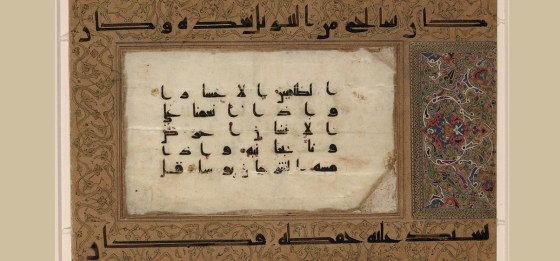
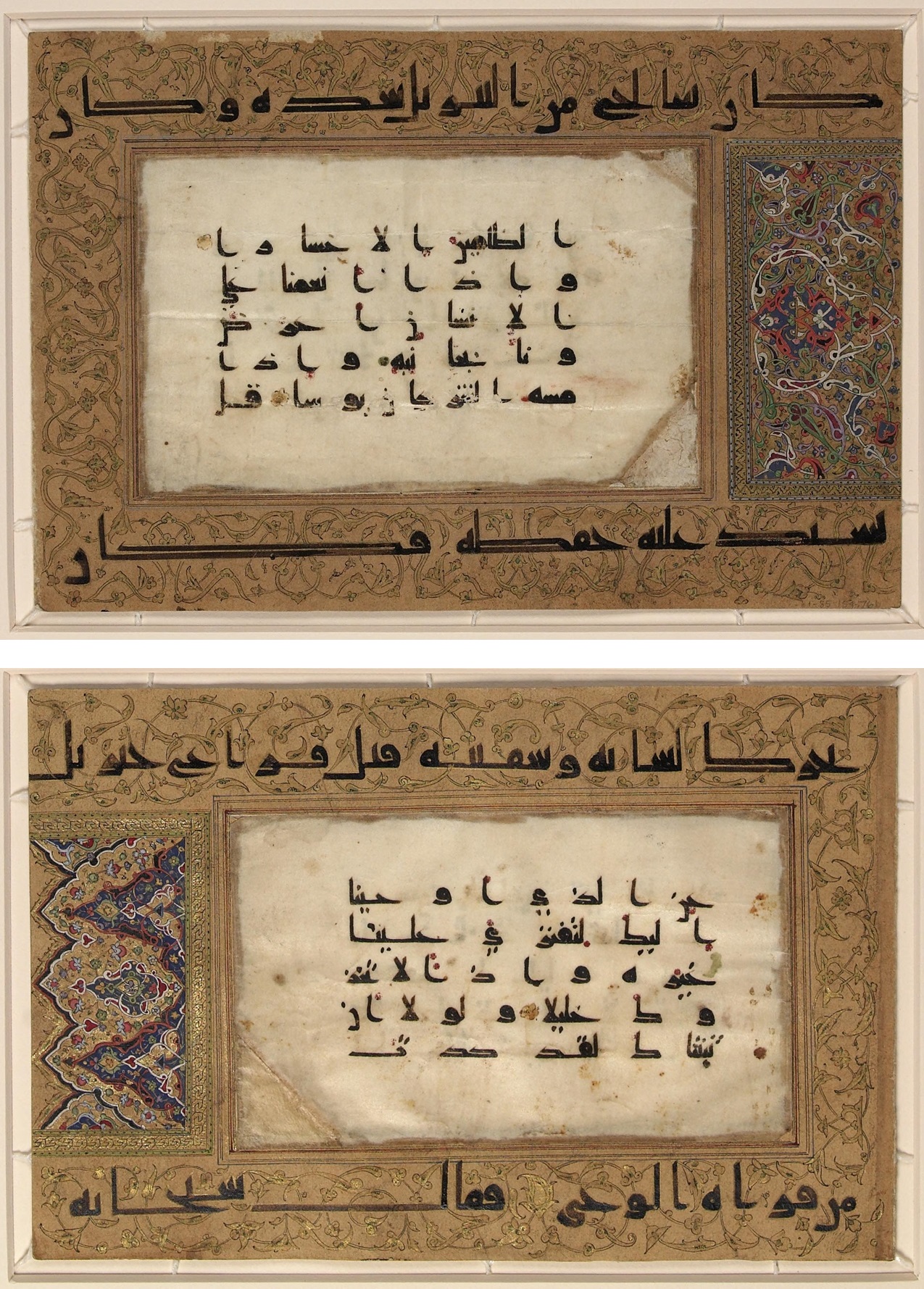
Chapter 17 of the Holy Qur’an known as Suraj I-isra (The Night Journey) or Bani Israel (The Children of Israel), describes several events, including the Prophet Muhammad’s (May peace be upon him and his progeny) night journey (Isra’) to Jerusalem and his ascension (Mi’raj) through the skies. The two fragments from the USA Library of Congress (LOC) shown in this post below are from Chapter 17, Verses 73-84, and describe the value of prayer and the Qur’an. These Qur’anic fragments are written in Kufi script on parchment. In-depth details of these fragments can be found on the LOC website HERE.
We present pertinent verses from the Qur’an on the night of Mir’aj and prayer, followed by a brief explanation of the holy night and its significance among the Shia Ismaili Muslims.
Verses from Suraj I-isra
Glory be to Him, who carried His servant by night from the Holy Mosque to the Further Mosque the precincts of which We have blessed, that We might show him some of Our signs. He is the All-hearing, the All-seeing — 17:1
Say: ‘Call upon God, or call upon the Merciful; whichsoever you call upon, to Him belong the Names Most Beautiful.’ And be thou not loud in thy prayer, nor hushed therein, but seek thou for a way between that — 17:110
Perform the prayer at the sinking of the sun to the darkening of the night and the recital of dawn; surely the recital of dawn is witnessed — 17:78
And as for the night, keep vigil a part of it, as a work of supererogation for thee; it may be that thy Lord will raise thee up to a laudable station — 17:79
The Night of Miraj is observed by Muslims around the world on the 27th night of the seventh month of
And whosoever desires the world to come and strives after it as he should, being a believer — those, their striving shall be thanked — 17:19
Your Lord knows very well what is in your hearts if you are righteous, for He is All-forgiving to those who are penitent. — 17:25.
___________
Mi’raj among the Shia Ismaili Muslims: The Imam-of-the-Time Leads his followers to spiritual elevation
Qur’anic fragments written in Kufi script on parchment. Photograph: The US Library of Congress, Washington DC
The night of Mi’raj falls on the 27th day of Rajab, the seventh month in the Islamic lunar calendar, which is 11 days shorter than the Gregorian calendar. Thus, in 2025, Miraj falls on or around January 26 or 27, 2025, depending on when the moon was sighted.
Mi’raj is an Arabic word that literally means a ‘ladder’ and refers to an experience in the life of Prophet Muhammad during the night. Interpretations of the Mi’raj include a literal event in which the Prophet Muhammad first travelled to Jerusalem before mounting a horse called Buraq and being taken to God’s Throne. Along the flight, he met with the great Prophets, including Abraham, Moses, and Jesus (may peace be on them).
However, among Sufis and other Islamic esoteric traditions, such as those practiced by the Shia Ismaili Muslims, Mi’raj is considered the highest point of spiritual perfection an individual can attain through religion and the practice of faith.
Believers long to experience a Mi’raj, just as the Prophet experienced it. The Shia Ismailis seek out this spiritual elevation under the guidance of the Imam-of-the-Time, presently Mawlana Shah Karim Al-Hussaini Hazar Imam, His Highness the Aga Khan, who leads his followers to self-awareness, spiritual insight and elevation. This is clearly noted in the Preamble of the Ismaili Constitution in paragraph (F), which reads:
“Historically and in accordance with Ismaili tradition, the Imam of the time is concerned with spiritual advancement as well as improvement of the quality of life of his murids. The Imam’s ta‘lim lights the murid’s path to spiritual enlightenment and vision. In temporal matters, the Imam guides the murids, and motivates them to develop their potential.”
His Highness the Aga Khan, the 49th Hereditary Imam, is a direct descendant of Hazrat Ali (may peace be upon him) whose remarkable teachings, preserved in works such as Nahj al-Balaghah, have a profound impact on all Shia Muslims, including the Ismailis. Another literary work, known as the Kalam-i Mawla, poems of Imam Ali, is not just historical text but holds a personal relevance to the community members. These verses, rendered in Hindi, delve deep into individuals’ conduct, behaviour, and actions during their lives on earth (please read Farouk Topan’s excellent piece Kalam-i-Mawla).
We are pleased to provide a recitation of verses from the Kalam of Hazrat Ali that focus on ethics, spirituality and the Mi’raj of the Prophet Muhammad. The verses are recited by Alnoor Saleh and have been downloaded from the website Ginans Central, which is maintained by Karim Tharani of the University of Saskatchewan.
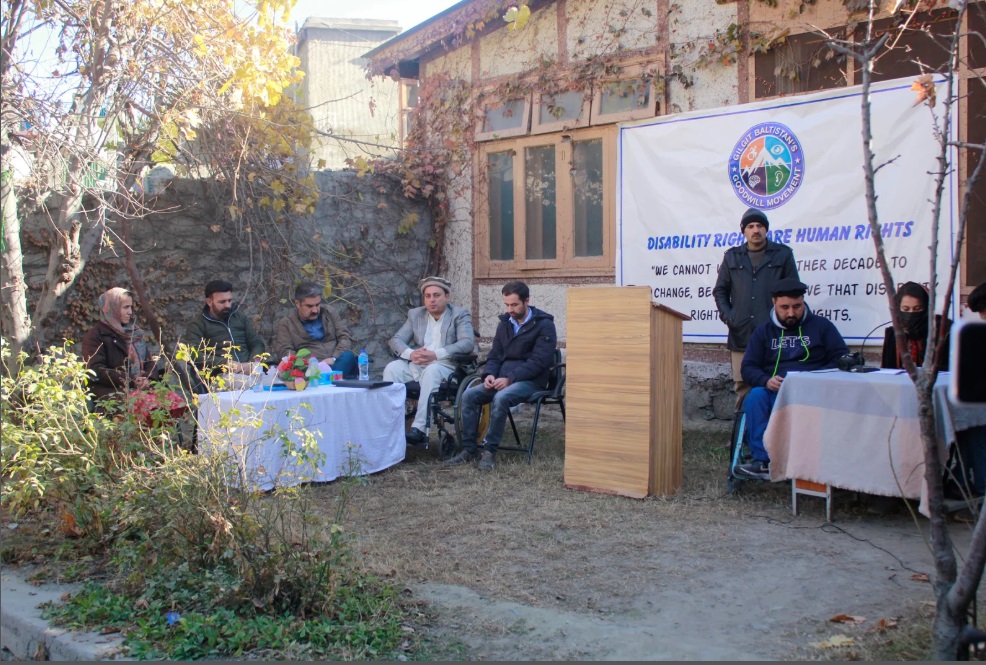
“I urge you to imagine the loneliness of being unseen, the despair of being unheard, and the pain of being forgotten. Now imagine that world being yours. If you can’t walk in our shoes, try to walk beside us. Offer a hand, a voice, or even just a moment of empathy….The “Straight Path” requires all strands of society to come together to care for society’s most vulnerable” — Ghulam Baig, CEO, Gilgit-Baltistan Goodwill Movement
The concept of the “Straight Path” (Sirat-Al Mustaqeem) represents a journey guided by justice, compassion, and equity — principles that urge us to care for society’s most vulnerable. This path transcends spiritual growth, calling for a community where everyone is uplifted and included. The Ismaili Imamate’s focus on social work and community development through Jamati Institutions and the Agencies of the Aga Khan Development Network consistently reminds murids of these values.
Yet, in the rush of modern life, we often lose sight of those left behind: the elderly, the disabled, and the sick — the most vulnerable among us. While many indulge in comfort, countless others struggle in silence.
A Global and Local Perspective on Suffering
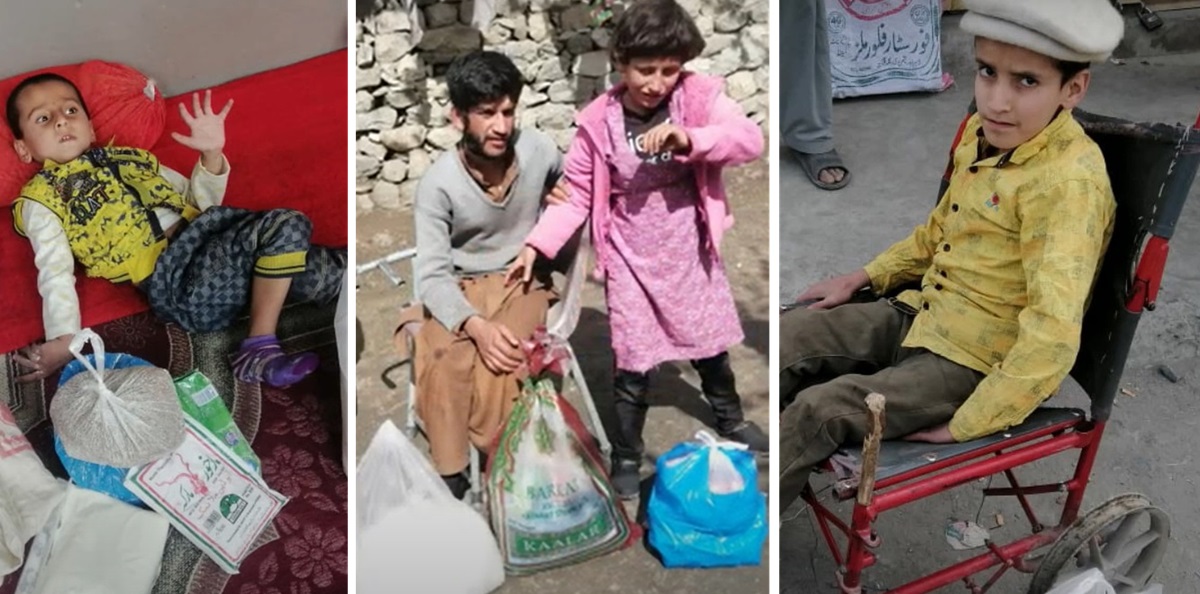
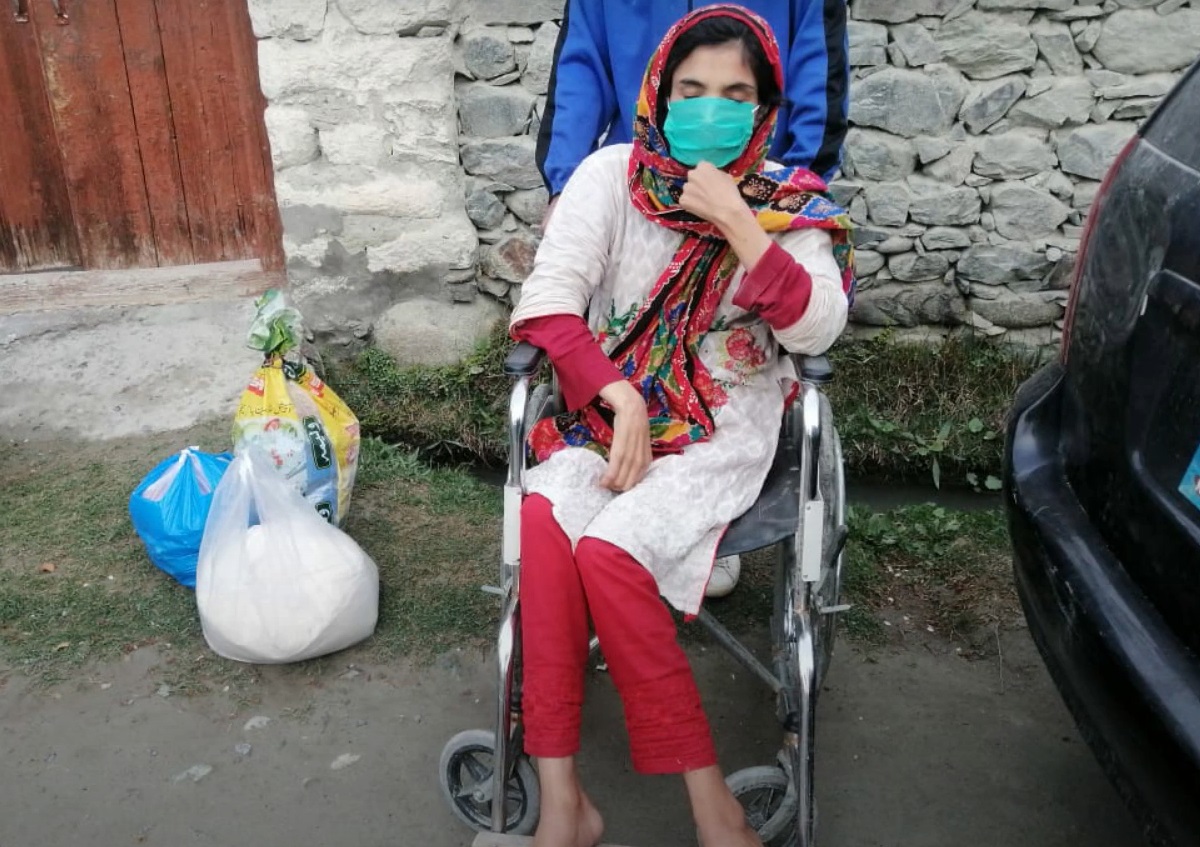
When we think of suffering, images of famine, poverty, or war often come to mind — realities associated with regions like Africa. Yet suffering also exists in less visible forms. One of these is the struggle for inclusion. In Gilgit-Baltistan, particularly in areas like Hunza and Yasin, disabled individuals live on the margins, yearning for equal rights and opportunities. Their pleas for dignity, inclusion, and opportunity are often drowned out by societal indifference.
During my time at a community college, the COVID-19 pandemic offered space to reflect on societal norms, especially regarding disability in Gilgit-Baltistan. While organizations like Aga Khan Focus for Habitat, KADO, and other local disability-focused groups have made progress, these efforts remain limited compared to the inclusivity and accessibility seen in more developed regions.
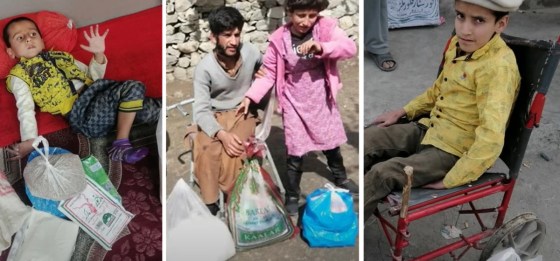
Through my organization, the Gilgit-Baltistan Goodwill Movement (GBGM), we are addressing these challenges. Guided by the values of justice, compassion, and equity, GBGM strives to improve the lives of disabled individuals through initiatives such as:
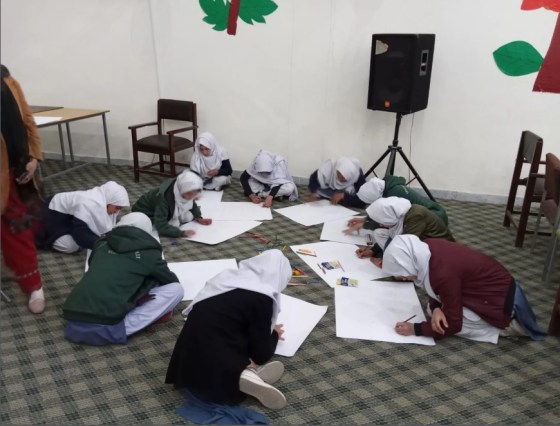
Vocational and Life Skills Training: Free programs equip individuals with tools for independent living.
Assistive Devices: Wheelchairs, hearing aids, and other essential devices improve mobility and quality of life.
Healthcare Support: Free medicines and personalized healthcare services are provided to those in need.
Financial Aid: Economic challenges are alleviated with support for essentials like food and shelter.
Advocacy and Awareness: Campaigns and outreach efforts aim to eliminate stigmas and foster acceptance.
Our website, www.gbgoodwillmovement.com, showcases stories of resilience and transformation, demonstrating the profound impact of these initiatives.
Stories of Change
One of our beneficiaries shared:
“As a disabled woman, I had limited opportunities within my community. The Goodwill Movement not only supported me but also empowered other women, fostering gender inclusion in society. Today, I help others as a teacher in an additional support needs school in Gilgit.”
Another student remarked:
“I learned from Goodwill and now apply these skills at KIU Gilgit. Thank you, Goodwill Movement. I had no other options, but your one-on-one support five days a week changed my life.”
These testimonials highlight that disabled individuals are often excluded from active participation in Gilgit’s culture but can thrive with the right support.
Challenges Persist
~~~~~~
~~~~~~
~~~~~~
Despite significant strides, challenges remain:
Infrastructure: Public spaces often lack accessibility.
Barriers to Mobility: Ramps, elevators, and accessible transportation are scarce.
Educational Gaps: Inclusive education resources are insufficient.
Healthcare Access: Affordable, quality healthcare is often out of reach.
Social Stigma: Deep-seated prejudices continue to marginalize disabled individuals.
These obstacles, while significant, are not insurmountable. Addressing them requires collective action and a commitment to compassion, justice, and equity.
Working for the Disabled Jamati Members
While the GB Goodwill Movement maintains impartiality regarding religion and gender, most of our students have been from the Ismaili Jamat in regions such as Hunza, Ghizer, Yasin, Chilas, and various villages across Gilgit.
Story continues below after messages
_______________________________________________
SUPPORT AND APPRECIATION FOR GHULAM BAIG AND HIS GILGIT-BALTISTAN GOODWILL MOVEMENT
The following is an excerpt from Lyn Patterson, Ghulam Baig’s Mathematics Teacher at Ashton — formerly Ashcraig — Secondary School, Glasgow, Scotland:
From early on in his secondary school career Muhammad impressed me with his determination to overcome the challenges presented by his disability (cerebral palsy) and to succeed as far as possible in his studies. His willingness to work hard was clear from a young age and increased even more as he matured. He developed a real understanding of the barriers to learning experienced by students with a range of disabilities. His fellow students in Ashcraig included young people with conditions such as Muscular Dystrophy, Spina Bifida, visual and hearing impairments, and autism spectrum disorders. Muhammad always displayed an interest in classmates and an empathy towards them. It therefore does not surprise me to see that he has now founded the GBGM devoted to improving the lives of disabled people. Muhammad demonstrated a clear commitment to equality and diversity issues, speaking passionately about such topics.
~~~~~~
The following is an excerpt from the Dhanani Family of the USA, with family members supporting the initiative living in Georgia, California, and Texas:
We have known GBGM’s leadership for over three years and have financially facilitated some of their activities in support of their mission. During this period, we have found the leadership to be very conscientious in executing their duties and accomplishing GBGM’s goals. We are really impressed with their desire to raise awareness about the challenges faced by the DA population, especially in the GB area. They have worked hard to lobby the federal, state and local governments in Pakistan in support of their DA activities. We were fortunate to have met some of their leadership and staff during our visit to GB in September 2022. The visit provided further evidence of their commitment to DA population and reaffirmed our own desire to continue to work with them for a foreseeable future.
~~~~~~
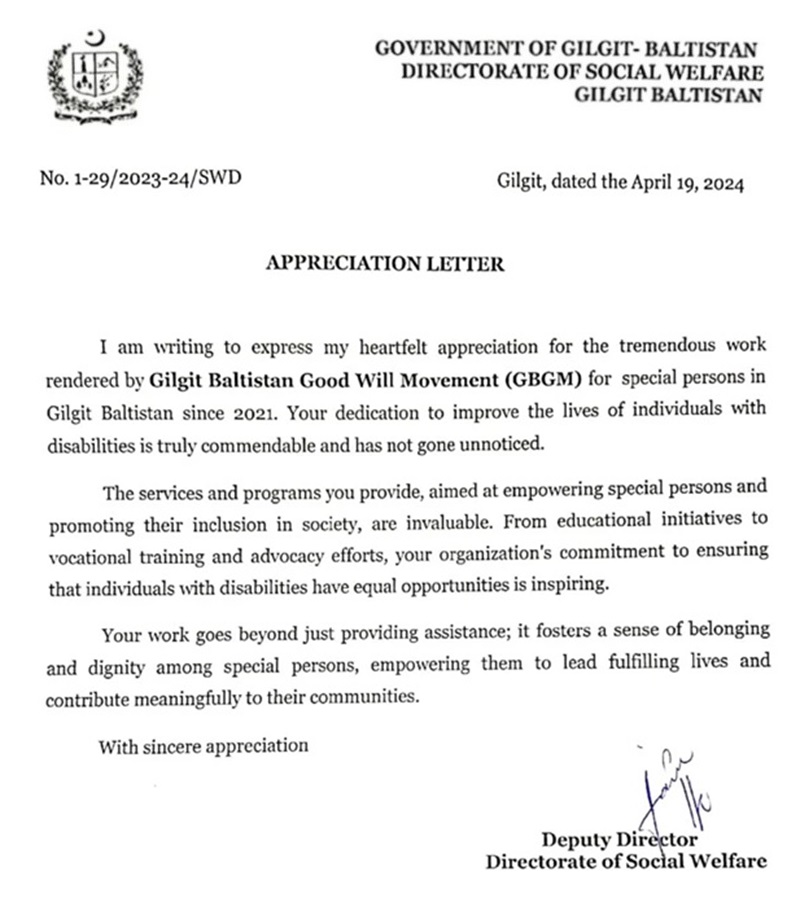
The following is a message from the Government of Gilgit-Baltistan:
_______________________________________________
A Call to Action
Returning to the West, I hoped my experiences in the social care sector would inspire support for the disabled community within the Jamat. While responses have been minimal, the Dhanani Family of the USA has been a notable exception, providing instrumental support for many of our initiatives. In April 2025, GBGM has an exciting project lined up. With the Dhanani family members, we will do a face-to-face project to contribute to the disability community in parts of Gojal, Upper Hunza, Yasin, and Ghizer.
To the readers, I urge you to imagine the loneliness of being unseen, the despair of being unheard, and the pain of being forgotten. Now imagine that world being yours. If you can’t walk in our shoes, at least try to walk beside us. Offer a hand, a voice, or even just a moment of empathy. Whether through financial contributions, volunteering, or spreading awareness, your support can make a tangible difference.
Building an Inclusive Society
The “Straight Path” requires all strands of society to come together, each contributing unique skills and perspectives. Just as a plumber and a surgeon serve different roles, we all have a part to play in building a more inclusive world. Let us follow this path to ensure that no voice goes unheard, no individual unseen, and no life unlived to its fullest potential.
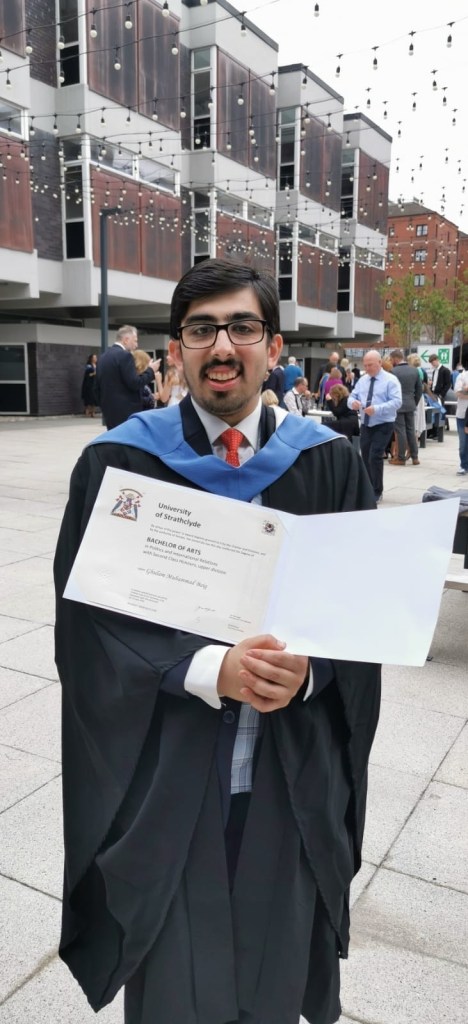
About the author: Ghulam Muhammad Baig, originally from the Hunza Valley in Northern Pakistan’s Gilgit-Baltistan region, received primary and secondary schooling in the UK with his parent’s support. He completed his university studies with an honours degree in Politics and International Relations from the University of Strathclyde in Glasgow, Scotland. Being disabled himself with Cerebral palsy, Ghulam was deeply moved by the plight of the disabled community in his home region, especially during COVID-19 pandemic. They were grappling with severe challenges, including a lack of basic facilities such as healthcare, education, and employment. This realization fueled his lifelong commitment to work for the Disabled or Differently Abled Community of Gilgit-Baltistan. He created the Gilgit-Baltistan Goodwill Movement (GBGM), of which he is the CEO.
Despite the closure of educational institutions during the first year of the pandemic, Ghulam remained proactive on social media. His efforts led to the formation of a large team of volunteers, including prominent disabled activists of Gilgit-Baltistan, such as Sehrish Kanwal Farhan Baig, Abrar Ahmed, Mumtaz Ali, Abdul Hakeem, Mustafa Kamal, Najeeba, Khushan Bano, and Ali Ahmed.
Recognizing the disparity in opportunities available to others in similar circumstances, Ghulam passionately advocates for the rights and well-being of persons with disabilities in Pakistan’s Gilgit-Baltistan region. With the support of his team, he is using his education and experience to improve the lives of disabled individuals in his home region.
Inna lillahi wa inna ilayhi raji’un “Surely we belong to God, and to Him we return” — Holy Qur’an, 2:156
“Life is a great and noble calling, not a mean and grovelling thing to be shuffled through as best as we can but a lofty and exalted destiny.” — Mawlana Sultan Mahomed Shah, His Highness the Aga Khan III (1877-1957), 48th Ismaili Imam.
I have learned with deep sadness that Mukhi Vazir Nurdin Gulamhussein Jivraj, originally of Dar es Salaam, Tanzania, has passed away in London, UK, at the age of 92.
My memories of the Mukhi (congregation leader in Ismaili Jamatkhana) span many years. They are intertwined with the shared experiences of the UK Ismaili Muslim Jamat (community), particularly during the historic seven-day visit to London by Mawlana Hazar Imam, His Highness the Aga Khan, from September 1 to 7, 1979. This visit, which also saw the foundation laying ceremony of the Ismaili Centre London, a significant event presided over by Lord Soames in the presence of His Highness, holds a special place in our hearts.
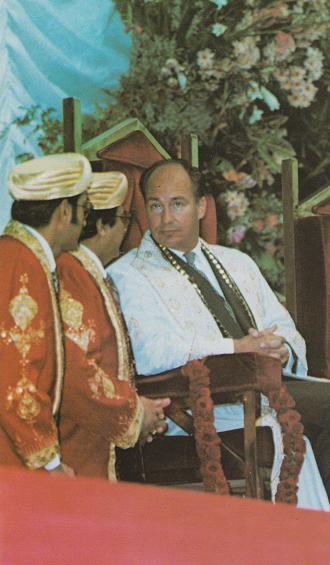
Mawlana Hazar Imam, His Highness the Aga Khan, pictured at the Olympia Hall, London, with Mukhi Nurdin Jivraj and Kamadia Nizar Dhanani during his weeklong visit to the United Kingdom Jamat from September 1-7, 1979. Photograph: Jehangir Merchant collection.
Mukhi Nurdin Jivraj was assisted by Kamadia Nizar Dhanani, a name I had known from Dar es Salaam as a cricket player with my dad, Jehangir, on the Young Ismailis team. Our shared love for cricket was a bond that connected us. This bond was further strengthened as Kamadia Nizar played for the Aga Khan Cricket Club in London in the significant 20-20 knockout matches in 1975-76 and became the Kamadia of the London Jamatkhana.
This personal tribute to the late Mukhi Nurdin Jivraj is based on one singularly important incident during the final mulaqat (meeting) on Friday, September 7, 1979, the last day of Mawlana Hazar Imam’s visit to the UK at London’s Olympia Hall. My late mum, Mrs. Merchant (d. January 21, 2021), was on stage duty to recite the Salawat. She had an excellent memory and articulated the incident when we returned home later that evening.
As on previous days, the eagerly awaited Mawlana Hazar Imam’s daily mulaqat with the Jamat commenced with the recitation of Ginan (hymn) verses by our fellow Jamati members who were selected for the recitations by the Ismailia Association judges (the Ismailia Association is now known as the Ismaili Tariqah and Religious Education Board, ITREB).
On that particular final day, Friday, September 7, Hazar Imam began his mulaqat in the morning by performing religious ceremonies and delivering a Farman (guidance or edict) to the Jamat. A Ginan was recited during the morning mulaqat, and everyone designated for the week’s recitations had had their turn.
During the afternoon session, Hazar Imam gave a mulaqat to the volunteers in an adjoining room. He returned to the main hall to bid farewell and bless the Jamat. Of course, everyone expected him to give his final Farman to the Jamat before he left.
However, before doing so, once seated on the stage, Mawlana Hazar Imam turned to Mukhi Jivraj. He unexpectedly requested: “I want Ginan.”
Story continues below
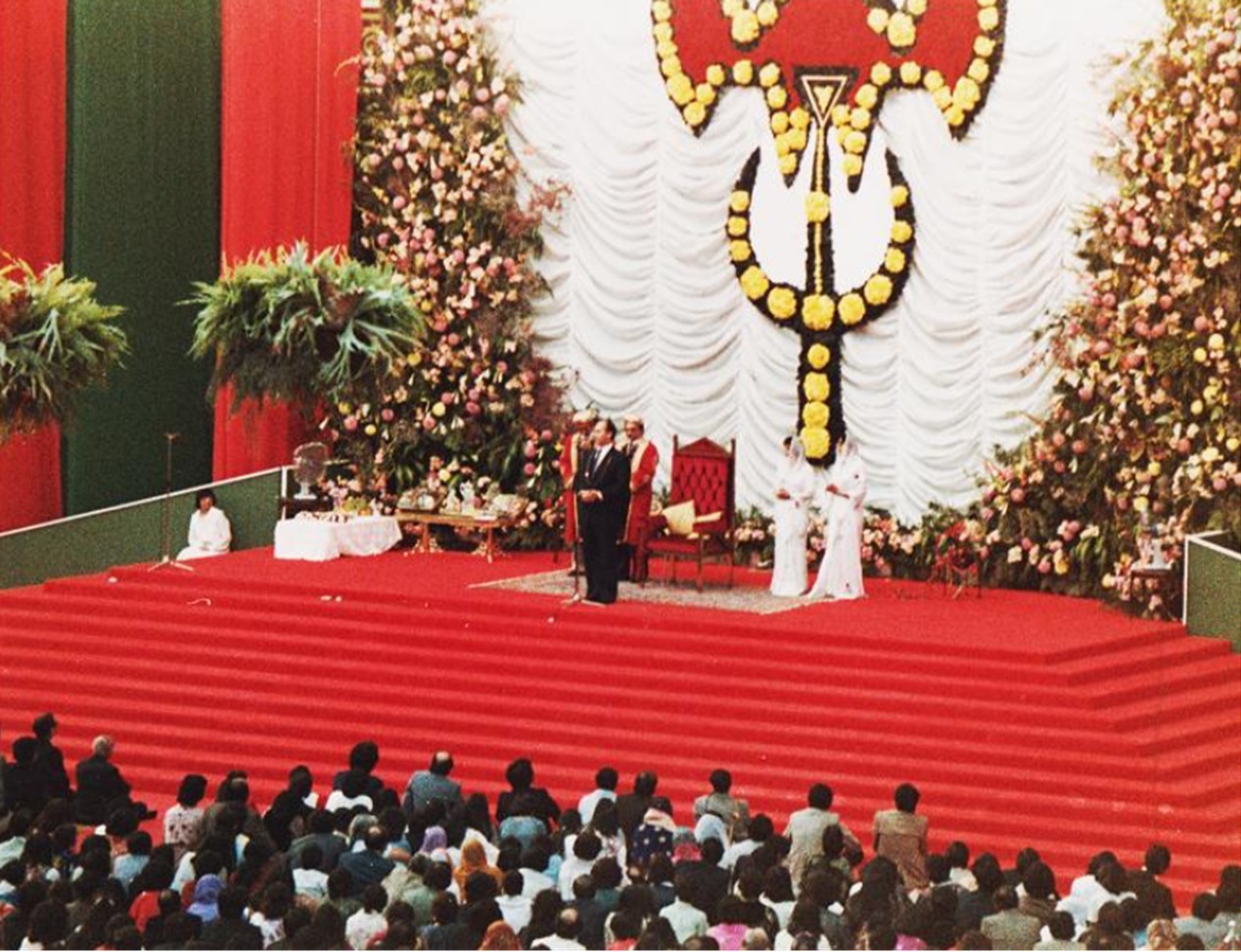
Mawlana Hazar Imam, His Highness the Aga Khan, delivering his Farman (guidance) to the UK Ismaili community in Olympia Hall, London, during his weeklong visit from September 1-7, 1979. On stage are Mukhi Nurdin Jivraj and Kamadia Nizar Dhanani, their respective wives, and Mrs. Merchant, seated on the far left. Photograph: Jehangir Merchant collection.
Unprepared, the Mukhi was startled and didn’t know what to say. He turned to my mum, who was on the stage a few feet away, and said, “Alwaeza, Ginan.” My mum had heard Mawlana Hazar Imam’s request to the Mukhi. She reacted immediately to Mukhi’s call, walking to the front of the stage and asking a youth — Salim Champsi — seated a few metres away to recite a Ginan. Of course, my mum had known him as a good reciter, only that he had not been selected to recite a Ginan during the Jamati mulaqats. He confidently came onto the stage and beautifully recited verses from the iconic and inspiring Ginan Satgur sathe goṭhadi kije, a piece that resonates deeply with the Ismaili community (listen to the Ginan sung by the late Alwaez Shamshudin Bandali Haji HERE. You can hear the same Ginan recited by multiple singers at Ginan Central, a truly informative and educational website).
The recitation was so powerful that it left me with goosebumps and tears in my eyes throughout. The impact of those words in the Ginan was profound. When I met the reciter, Salim Champsi, some 20 years later at the Bayview Jamatkhana in Toronto, he recalled that extraordinary and joyous day and expressed his heartfelt gratitude, saying he would never forget my mum for picking him out of the crowd.
Today, befittingly, I remember this unique incident, which very few people outside my family would know, as my tribute to Mukhi Jivraj with his passing 45 years later. Reflecting on that moment, I am reminded about the importance Mawlana Hazar Imam attaches to our hundreds of years-old traditions. During an evening of Ginan recitation or concert (mehfil) held in Karachi in December 1964, he said:
“I would be surprised if ever such a big Mehfil-e-Ginan has ever been held…many times I have recommended to my spiritual children that they should remember Ginans, that they should understand the meanings of these Ginans and they should carry these meanings in their hearts. It is most important that my spiritual children…hold to this tradition which is so special, so unique and so important to my Jamat…I have been deeply happy tonight, deeply happy because I have seen the happiness in the hearts of my Jamat and this is what makes Imam happy” — Mawlana Hazar Imam, Karachi, December 16, 1964, published by the Ismailia Association for Pakistan.
Indeed, the recitation of the Ginan on September 7, 1979, filled the hearts of thousands with unbounded spiritual happiness and joy.
Of course, the entire UK Jamat will remember the late Mukhi Nurdin Jivraj. I earnestly hope someone will write a detailed tribute to him, highlighting his services to the Jamat and his and his family’s unwavering devotion to the Imam-of-the-Time over the past several decades.
Story continues below
Mawlana Hazar Imam, His Highness the Aga Khan, walks through his followers and past the Ismailia Association literature counter as he departs Olympia Hall after his audience with the Ismailis in London in September 1979. Following him are Mukhi Nurdin Jivraj, Kamadia Nizar Dhanani, and Begum Salimah with the Mukhiani and Kamadiani. Photograph: Sarfaraz Sadruddin/Ilm Magazine, December 1979.
I fondly remember Mukhi Jivraj for the above incident, which gave the Jamat an excellent and inspiring conclusion to Mawlana Hazar Imam’s and Begum Salimah’s visit to the UK Jamat. The event, as narrated by my mum, was not just inspiring, but truly extraordinary. I can never forget that particular inspirational and happy day in my life.
We express our sincerest condolences to Mukhi Nurdin Jivraj’s family, friends and the Jamats he led and served for years. We pray that his soul may rest in eternal peace. Ameen.
Date posted: January 18, 2025. Last updated: January 25, 2025 (new photo added).
___________________
Condolence messages: We invite readers to submit their condolences, memories and tributes to Mukhi Nurdin Jivraj by clicking LEAVE A COMMENT.
The birth anniversary of Hazrat Ali (Peace be on him), the son-in-law of Prophet Muhammad (May Peace be on him and his progeny), and the first Imam of Shia Muslims and the 4th Caliph of Islam, is a highly anticipated and significant event that will be observed by the Shia Imami Ismaili Muslim community and other Shia communities on or around January 12, 2025, the thirteenth day in the seventh Islamic month of Rajab. Hazrat Ali was born in Mecca on March 17, 599 A.C, and January 2025 marks his 1425th birth anniversary.
We present highlights of three essential books on Imam Ali from whom the present 49th Hereditary Imam of the Ismaili Muslims, Mawlana Hazar Imam, His Highness Prince Karim Aga Khan, is directly descended. The Preamble of the Shia Imami Ismaili Constitution affirms as follows:
“In accordance with Shia doctrine, tradition, and interpretation of history, the Holy Prophet (s.a.s.) designated and appointed his cousin and son-in-law Hazrat Mawlana Ali Amiru-l-Mu’minin (a.s), to be the first Imam to continue the Ta’wīl and Ta‘līm of Allah’s final message and to guide the murids, and proclaimed that the Imamat should continue by heredity through Hazrat Mawlana Ali (a.s) and his daughter Hazrat Bibi Fatimat-az-Zahra, Khātun-i-Jannat (a.s)”
and
“Mawlana Hazar Imam Shah Karim al Hussaini, His Highness Prince Aga Khan, in direct lineal descent from the Holy Prophet (s.a.s.) through Hazrat Mawlana Ali (a.s.) and Hazrat Bibi Fatima (a.s), is the Forty-Ninth Imam of the Ismaili Muslims.”
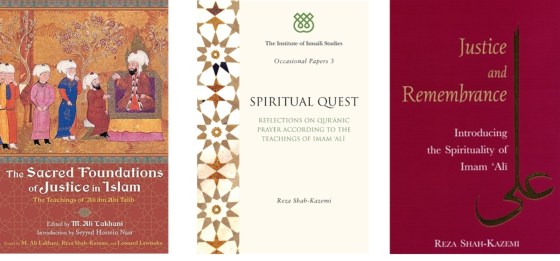
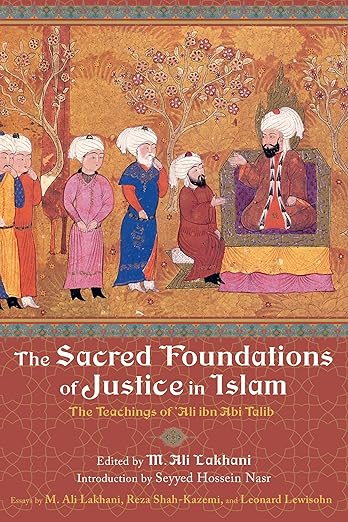
The Sacred Foundation of Justice in Islam: The Teachings of ‘Ali ibn Abi Talib
The book, edited by M. Ali Lakhani and introduced by the renowned philosopher Seyyed Hossein Nasr, is a treasure trove of three thought-provoking essays. Lakhani’s award-winning essay, The Metaphysics of Human Governance: Imam ‘Al, Truth and Justice at the International Congress on Imam ‘Ali, Tehran, 2001, is followed by the second prize essay by Reza Shah-Kazemi, A Sacred Conception of Justice: Imam Ali’s Letter to Malik al-Ashtar (read letter excerpts HERE). Both essays have been recommended by the esteemed Professor Nasr as ‘obligatory reading,’ A testament to their quality and significance. The third essay, ‘Ali ibn Abi Talib’s Ethics of Mercy in the Mirror of the Persian Sufi Tradition’ by Leonard Lewisohn, offers a unique perspective. The book is available in Kindle and paperback editions, making it easily accessible to all on Amazon. The book may be in stock at Jamatkhana literature counters worldwide.
~~~~~~~
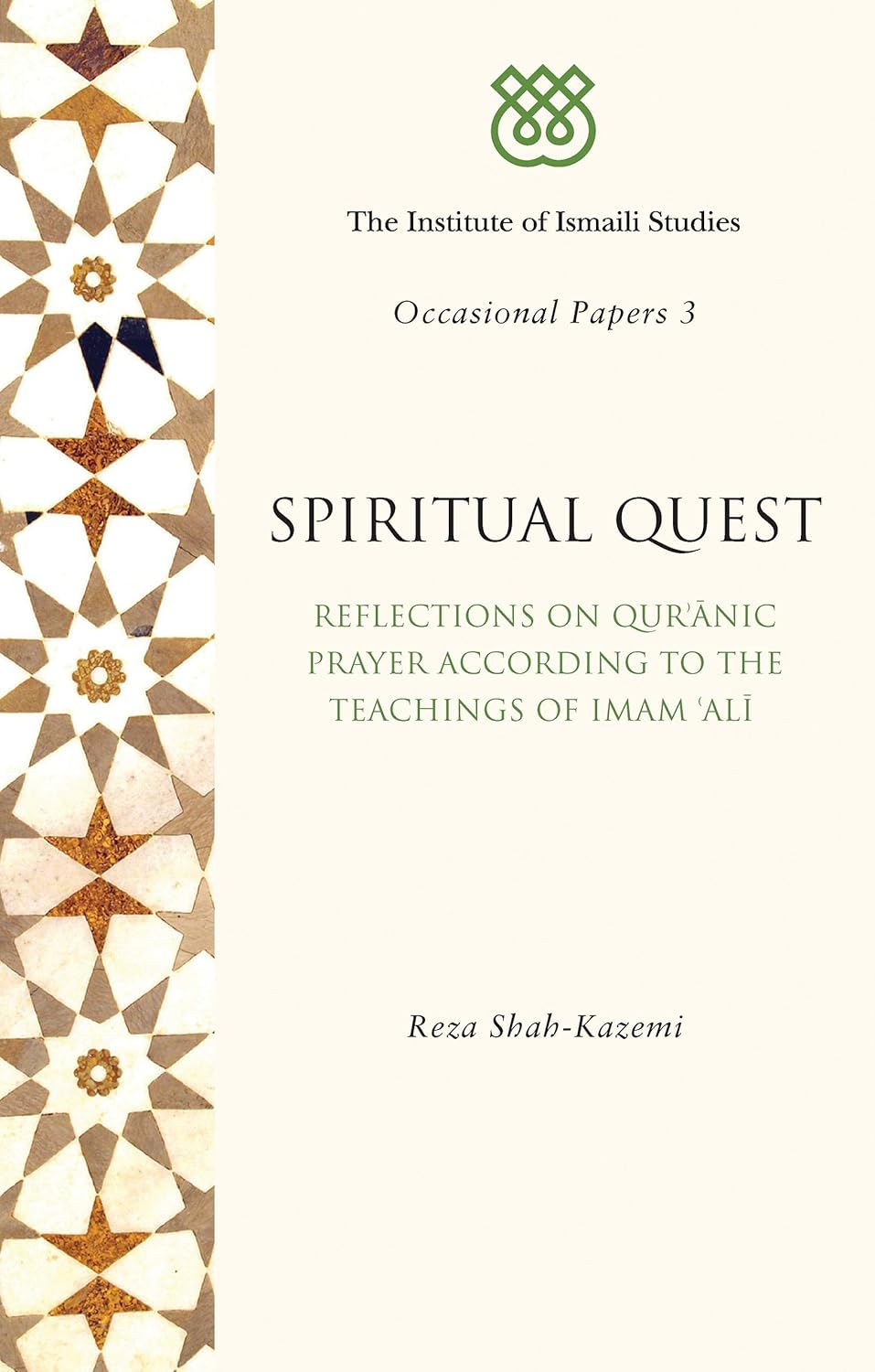
Spiritual Quest: Reflections on Qur’anic Prayer According to the Teachings of Imam Ali
The Qur’an is the sacramental foundation of prayer in Islam. Its inspirational power is perpetually renewed by Muslims, who recite and meditate upon it daily. This succinct monograph, Spiritual Quest: Reflections on Qur’anic Prayer According to the Teachings of Imam ‘Ali, part of occasional papers published by the Institute of Ismaili Studies in London, provides a unique contemporary insight into the spiritual, intellectual and moral dynamics set in motion by the short Qur’anic chapters recited in their prayers by Muslims of all traditions, but which are particularly recommended within Shi’i Islam.
Dr Shah-Kazemi’s profound engagement with the chapters of the Qur’an, including the ‘Opening’ (al-Fatiha) chapter, is a testament to his intellectual depth. He bases his philosophical reflections on the teachings of Imam ‘Ali, delving into the intricate relationship between the moral and the mystical aspects of the texts. The result is a stimulating philosophical meditation that probes the profound meaning within the verses of a Revelation, which has been a constant source of inspiration, nourishment, and fulfillment for the spiritual quest of Muslims. The book is available in Kindle and Paperback editions on Amazon and may be in stock at Jamatkhana literature counters worldwide.
~~~~~~~
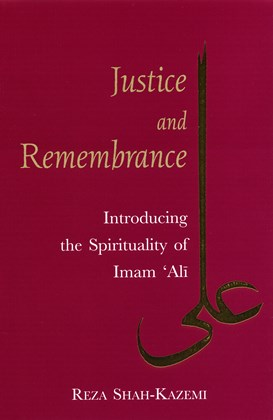
Justice and Remembrance: Introducing the Spirituality of Imam Ali
Reza Shah-Kazemi’s award-winning bookJustice and Remembrance: Introducing the Spirituality of Imam Ali, published by I. B. Tauris in association with the Institute of Ismaili Studies in London, is the first serious engagement in English with the intellectual principles underpinning the first Shia Imam’s teachings. Hazrat Ali is a monumental figure in Islamic tradition. However, despite the immense importance of Imam Ali, there is a dearth of literature in Western languages about his life and thoughts. Therefore, this book is a welcome and valuable addition to the available sources. It consists of three parts. Part one introduces the person of Hazrat Ali in a general manner and focuses particularly on the spiritual and ethical content of his teachings. Part two evaluates ʿHazrat Ali’s ‘sacred conception of justice.’ Part three addresses the theme of spiritual realization through the remembrance of God, the central mystical practice of the Sufis. Justice and Remembrance will be of great value to students and scholars of Islamic thought and those interested in the relationship between spirituality and ethics. Amazon lists its availability in Kindle, Paperback and Hardback formats, ensuring that readers can access the book in their preferred format. The print editions may be used or new. The book may be in stock at Jamatkhana literature counters worldwide. The first edition of the book was published in 2006.
A video interview about the book with the author Reza Shah Kazemi can be seen on the IIS website.
Date posted: January 11, 2025.
_______________________
The Institute of Ismaili Studies (IIS) website provides a comprehensive list with brief descriptions of all its publications since it was founded by Mawlana Hazar Imam in 1977. Please click on the IIS publications listing. A few publications are also available as Audiobooks.
Opening my late parents’ literary archives is a challenging, ongoing exercise yet enriching journey. It’s been a few years — and please read the follow-up article — since I last referenced a special Ismaili Volunteer, Scouts and Guides Souvenir, a historical gem published in 1954 as a dedication to the Platinum Jubilee of Mawlana Sultan Mahomed Shah Aga Khan and 35 years of His Highness the Aga Khan’s Bombay Volunteer Corps. This Souvenir was a gift from Noordin Babul, originally of Lourenço Marques (now Maputo), Mozambique, to my parents during their visit to Toronto in 2011. Uncovering the souvenir recently, as I opened a few more of my parent’s boxes, I was struck by its historical significance and decided to examine it more closely.
The opening page of this extraordinary Souvenir includes the following message by the publisher, Lt. Col. Pirmohamed V. Madhani:
“In Commemoration of the Platinum Jubilee of His Royal Highness Prince Aga Khan and the completion of 35 years’ all-embracing humble services to Our Hazar Imam, Our country and the Ismailis by H.H. The Aga Khan’s Bombay Volunteer Corps, this Souvenir is dedicated to …..text not readable….and fervent supplication in the Holy Huzur-pur-nur of His Royal Highness….text not readable….Mohammad Shah Prince Aga Khan, Mawlana Hazar Imam Our Spiritual Father, May His Exalted Highness’ Blessings and Order Prevail, With dutiful homage, Pirmahomed V. Madhani, Lt.–Col.”
The page facing the dedication contains a special message from Mawlana Sultan Mohamed Shah in English, and on the following page, there is a text of the message in Gujarati. The message reads:
“Lt. Col. Pirmohamed has served brilliantly for a life time for the Volunteer Corps, and I do hope that all will have their names inscribed as volunteers and will take him as an example and give the same devoted services as he did” — Signed Aga Khan, 4th. June 1954.
Facing the Gujarati translation is a portrait of Imam Sultan Mahomed Shah, which appears under the Qur’anic verse, “And every thing have We counted in the Manifest Imam” — 36:12.
Story continues below
Portrait of Imam Sultan Mahomed Shah Aga Khan, 48th Ismaili Imam, in a special 1954 Souvenir commemorating his Platinum Jubilee.
As I prepare to share intriguing material from the souvenir in the coming weeks, I was surprised to learn that our present Imam, Mawlana Shah Karim Al Hussaini Hazar Imam, visited India in 1954 during his grandfather’s Platinum Jubilee year, a visit that holds significant historical importance. His advice to the Jamat, given three years before he succeeded to the Imamat on July 11, 1957, is a timeless guidepost, a beacon of wisdom that he has consistently mentioned in his Farmans (guidance, edict) during his 67-year reign as the 49th Hereditary Ismaili Imam. This enduring relevance of his advice when he was not an Imam is a powerful thread connecting us to our past and guiding us into the future. The following piece from the Souvenir’s article has been adapted and edited for clarity.
June 1954: Ismaili Volunteers, Scouts and Guides Souvenir on Prince Karim Aga Khan
A portrait of Prince Karim Aga Khan before he became the 49th Hereditary Imam of the Ismailis in a unique Souvenir commemorating his grandfather’s Platinum Jubilee.
Prince Karim Aga Khan is the grandson of His Royal Highness Prince Aga Khan and the eldest son of Prince Aly Khan. He has a brilliant personality and a most promising career for the Ismaili community. Every heart is thrilled and feels excited and joyful when one recalls the most cherished memories of Prince Karim’s glorious period of childhood and youth.
The brilliant achievements of the Fatimid Imams and direct descendants of Hazrat Ali (A.S.) have a significant bearing on Prince Karim Aga Khan, and Prince Karim’s atmosphere of bliss and divine enlightenment is clearly perceptible.
Prince Karim’s outstanding leadership and high talent qualities were evident during his visit to Bharat [India]. The golden advice that Prince Karim tendered to the Jamats is proof of his clear thought and tremendous love and affection for the Ismailis.
Prince Karim Aga Khan said:
“Strive to impart such an education to children so that they may earn their rightful place in the world because on it depends on the success of their lives. It is an important requirement of life which will stand them in good stead in the battle of life. So, every effort must be made to impart to the Ismaili children the right type of education.”
The souvenir article notes that this advice is one example of Prince Karim Aga Khan’s great concern for the education of our children. The article then continues:
On another occasion during the visit, Prince Karim impressed Jamat with the need for hard work and great perseverance. He called upon everyone to do good deeds; endless service to humanity is eternal and immortal. Prince Karim requested the Jamat to help one another and thus show their true love and devotion to the community. He said:
“Your patriotism and loyalty must be sincere, active and productive. Please follow this advice, and be industrious and hardworking. The work done for the community is always noble and verily we are taught that all good deeds shall be compensated fourfold.”
Prince Karim called upon everyone to always remember the Farmans so lovingly bestowed by Imam-e-Zaman [the Imam-of-the-Time, then his grandfather, the 48th Imam, Mawlana Sultan Mahomed Shah] and to translate the Farmans fully into action.
The Souvenir states that the Ismailis of Bharat were fortunate to have His Serene Highness Prince Karim Aga Khan in their midst in 1954. His words of wisdom, which he uttered on various occasions, were so full of meaning that everyone was highly impressed with his intellectual superiority and qualities of mind and heart.
The Souvenir concludes: “We are all so happy that Prince Karim is taking such a keen interest in our welfare and happiness.”
May I note that the Souvenir is rich with information about Ismaili volunteers of the time and narratives of Mawlana Sultan Mahomed Shah’s visits to the Jamat in India. We look forward to sharing some of the Souvenir’s content in future pieces in Simerg and its sister website, Barakah.
Date posted: January 6, 2025. Last updated: January 7, 2025 (typo).
A new Moon occurs when all of the Sun’s light is reflected away from Earth, and the side of the Moon facing Earth is barely visible, as illustrated in the above NASA photo.
Chandraat, the Night of the New Moon, is a joyous celebration for Ismaili Muslims. It marks the start of a new Islamic month and is celebrated with great religious fervour. The 48th Hereditary Ismaili Imam, Mawlana Sultan Mahomed Shah, His Highness the Aga Khan III (d. July 11, 1957), in a timeless message to his community in East Africa in the mid-1900s, described Chandraat as a blessed night that brings immense spiritual happiness and inner peace. This emphasis on the spiritual significance of Chandraat serves to uplift and connect the Ismaili community to their faith.
In Canada, Ismailis observed Chandraat on December 31, 2024 — which began the month of Rajab — when the New Moon’s illumination was 1.1%. The Jamatkhanas were filled to capacity, and in Calgary, Alberta, Ismailis welcomed 2025 with a festive dinner and a lively musical show in their respective Jamatkhana social halls after the religious ceremonies.
One of the highlights of the Chandraat evening was a special announcement by the Ismaili Leaders International Forum (LIF), a platform that brings together Ismaili leaders from around the world to discuss and address community issues. In this announcement, Mawlana Hazar Imam asked his senior LIF leaders to convey his blessings to the Jamat when they met him on the joyous occasion of his birthday. He turned 88 on December 13, 2024. Sweets blessed by the Imam during the meeting were distributed in the Jamatkhana, bringing everyone overwhelming happiness as they were about to enter 2025.
Story continues below
New Year 2025 decoration in the foyer of Calgary Headquarters Jamatkhana, December, 31, 2024. Photograph: Malik Merchant/Simerg.
On celebratory days and special occasions, Mawlana Hazar Imam sends a Talika (a holy written message) to convey special blessings to the Jamat. His message, read out on December 13, 2024, touched upon the state of affairs in the world today. It included a powerful reminder to the Jamat that throughout its history, it has faced challenges with strength and inspiration, derived from the Imam’s individual spiritual bond with his followers. Importantly, he reassured us that he would always be with us, even when he was not physically able to visit us, providing a comforting sense of support.
Now, our New Year Resolution for 2025, aside from our personal resolutions, whatever they may be, should focus on further strengthening the spiritual bond with the Imam by fulfilling his aspirations of the Jamat — to live in unity, be regular in the practice of our faith and understand the faith well, be in remembrance of Allah, build bridges with other communities, educate ourselves because our faith is a faith of intellect, and be generous in spirit as well as with wealth. Specifically, the Imam wishes his Jamat nothing but the best in both material and spiritual matters.
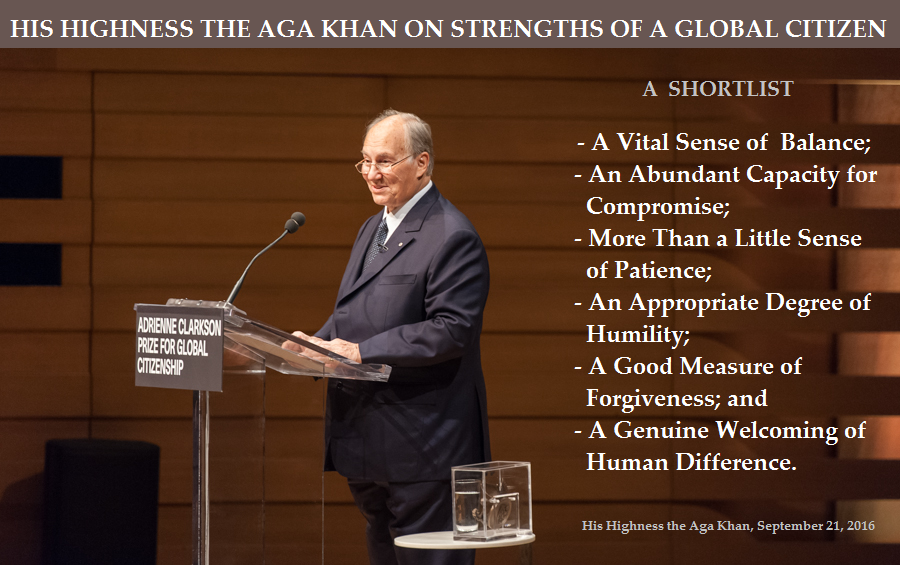
In addition, his recommendations on what it takes to be a global citizen are worth reflecting upon as we make our resolutions and commit ourselves to our future well-being and progress, both materially and spiritually, in 2025 and beyond.
Our sister website, Barakah.com, established independently in 2017, is a treasure trove of information dedicated to Mawlana Hazar Imam, His Highness the Aga Khan, the 49th Hereditary Imam of the Shia Ismaili Muslims and direct descendant of the Prophet Muhammad (peace be upon him and his family).
Barakah logo
The word Barakah is inspired by the Arabic root b-r-k; its most fundamental meaning is ‘Blessing’, conferred by the Divine upon humankind.
You’ll find informative articles there, including the latest pieces on the Aga Khan’s sister, Princess Yasmin, and her incredible commitment over the past 40 years to eradicating Alzheimer’s, and a tribute to the late Indian Prime Minister Manmohan Singh, who received the Aga Khan on numerous occasions during his visits to India. We assure you that visiting Barakah will be not only informative but also enjoyable, strengthening your connection to the work of the Ismaili Imam through the Aga Khan Development Network, which is dedicated to improving the quality of life of those in need, mainly in Africa and Asia, irrespective of their origin, faith, or gender.
Story continues below
Princess Yasmin Aga Khan addresses a Gala event to raise funds for Alzheimer’s Association and Late Indian Prime Minister Manmohan Singh (d. December 27, 2024) receives His Highness the Aga Khan in 2013. Please click on image for link to these and other stories on Barakah.com
It will be of particular interest for Canadians to note that aside from the beautiful Ismaili Centres in Toronto and Vancouver, the Aga Khan has created a lovely museum in Toronto, the Aga Khan Museum, the first such museum in North America dedicated to Islamic Art and Culture, and the Aga Khan Garden, which is a gift to the University of Alberta and is part of the University’s magnificent Botanic Gardens in Parkland County near Edmonton. American readers might note that Houston, Texas, will house a superb purpose-built Ismaili Center. There are more than 200,000 Ismailis in North America.
Story continues below
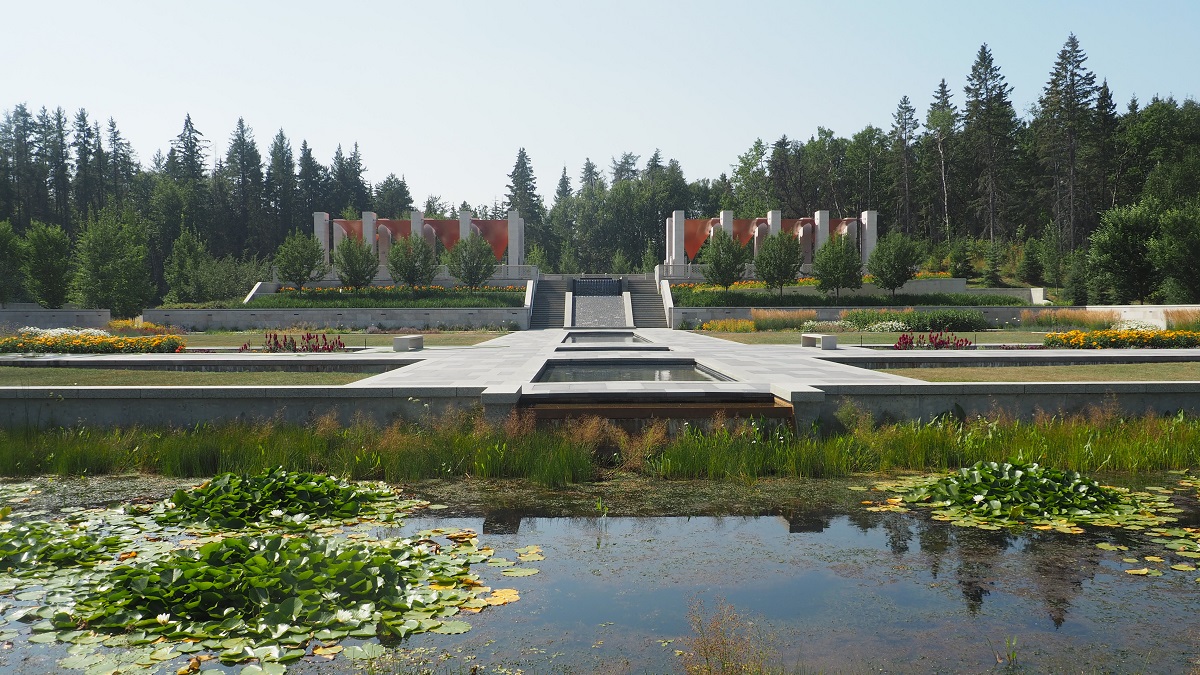
Aga Khan Garden, University of Alberta Botanic Garden, Parkland County, Alberta. Photograph: Nurin Merchant/Simerg. For stories and photographs about the Garden and other travel narratives, please visit Simergphotos.
~~~~~~
The Ismaili Center Houston is under construction and is scheduled to be completed in late 2025. Image: Imara Houston Inc. /IPL via The Ismaili (the official website of the worldwide Ismaili community
Featured image at the top of post: Cover page of “Where Hope Takes Root” featuring selected speeches of His Highness the Aga Khan (see book review HERE), the logo of Barakah, and the Aga Khan addressing his subjects in the Pamir mountains of Gorno-Badakhshan Autonomous Province, Tajikistan, in 1995.
Part I of this post is adapted from Michael Wolfe’s excellent piece, Jesus Through a Muslim Lens. In Part II, we link to New Lines magazine for Mustafa Aykol’s well-researched and insightful piece. Aykol discusses the traditional Christian accounts of the place of Jesus’ birth in a manger or a cave, contrasting it with the Qur’anic description that Mary gave birth to Jesus under a tree. Both these pieces offer diverse and inspiring perspectives, and they underscore the importance of respecting different beliefs as Christians worldwide celebrate the birth of Jesus (peace be upon him) on December 25, 2024. We express our best wishes to our readers during this inclusive holiday season, valuing the diversity of our audience’s beliefs.
Part 1: Jesus in Islam
Selected verses from the Qur’an from Chapter 19 entitled Maryam (the Muslim name attributed to Mary) about the birth of Jesus (or Hazrat Issa as he is known in Islam). Please click on image for enlargement. Photograph: Simerg.
The miraculous birth of Jesus of Nazareth was a remarkable event. It gave rise to Christianity, the world’s largest religion, and changed the course of history. Yet something is captivating about this remarkable birth which many Christians may not be aware of: that Muslims believe in the Virgin Birth and Jesus’ miracles and that he is not just acknowledged but venerated throughout Islam, the world’s second-largest faith. This profound veneration of Jesus in Islam adds depth to the topic, particularly for those interested in religious studies.
Two events in the life of the prophet Muhammad may help explain why Muslims revere the Christian Jesus.
The first event involves an elder resident of Mecca named Waraqa bin Nawfal. This man was an early Arab Christian and an uncle of Muhammad’s wife, Khadija. We know he could read Hebrew, that he was mystical by nature, and that he attended Khadija and Muhammad’s wedding in about 595 C.E. Fifteen years later, a worried Khadija sought Waraqa out and brought her husband to him.
At the time, Muhammad was a 40-year-old respected family man. He attended this “family therapy” session in a rare state of agitation. He was frightened. He had been meditating one evening in a cave on the outskirts of town. There, while half asleep, he had experienced something so disturbing that he feared he was possessed. A voice had spoken to him.
Waraqa listened to his story, which Muslims will recognize as a description of Muhammad’s first encounter with the angel Gabriel. When it was finished, Waraqa assured him he was not possessed.
“What you have heard is the voice of the same spiritual messenger God sent to Moses. I wish I could be a young man when you become a prophet! I would like to be alive when your own people expel you.”
“Will they expel me?” Muhammad asked.
“Yes,” the old man said. “No one has ever brought his people the news you bring without meeting hostility. If I live to see the day, I will support you.”
Christians will recognize in Waraqa’s remarks an aphorism associated with Jesus: “A prophet is not without honor, save in his own country.” But that a Christian should first have verified Muhammad’s role as a prophet may come as a surprise.
The second important event concerning Islam and Christianity dates from 616, a few years after Muhammad began to preach publicly. This first attempt to reinstate the Abrahamic tradition in Mecca met (as Waraqa had warned) with violent opposition.
Perhaps the Meccans resented Muhammad’s special claim. Perhaps his message of a single, invisible, ever-present God threatened the economy of their city. A month’s ride south from the centers of power in Syria and Persia, poor remote Mecca depended on long-distance trade and on seasonal pilgrims who came there each year to honor hundreds of pagan idols, paying a tax to do so.
At any rate, Muhammad’s disruptive suggestion that “God was One” and could be found anywhere did not sit well with the businessmen of Mecca.
Many new Muslims were being tortured. Their livelihoods were threatened, their families persecuted. As matters grew worse, in 616 Muhammad sent a small band of followers across the Red Sea to seek shelter in the Christian kingdom of Axum. There, he told them, they would find a just ruler, the Negus, who could protect them. The Muslims found the Negus in his palace, somewhere in the borderland between modern Ethiopia and Eritrea.
And protect them he did, after one Muslim recited to him some lines on the Virgin Mary from the Qur’an. The Negus wept at what he heard. Between Christians and Muslims, he said, he could not make out more difference than the thickness of a twig.
These two stories underscore the support Christians gave Muhammad in times of trial. The Qur’an distils the meaning from the drama:
“Those who feel the most affection for us (who put our faith in the Qur’an), are those that say, “We are Christians,” for priests and monks live among them who are not arrogant. When they listen to what We have shown Muhammad, their eyes brim over with tears at the truth they find there….”
Even today, when a Muslim mentions Jesus’ name, you will hear it followed by the phrase “peace and blessings be upon him,” because Muslims still revere him as a prophet.
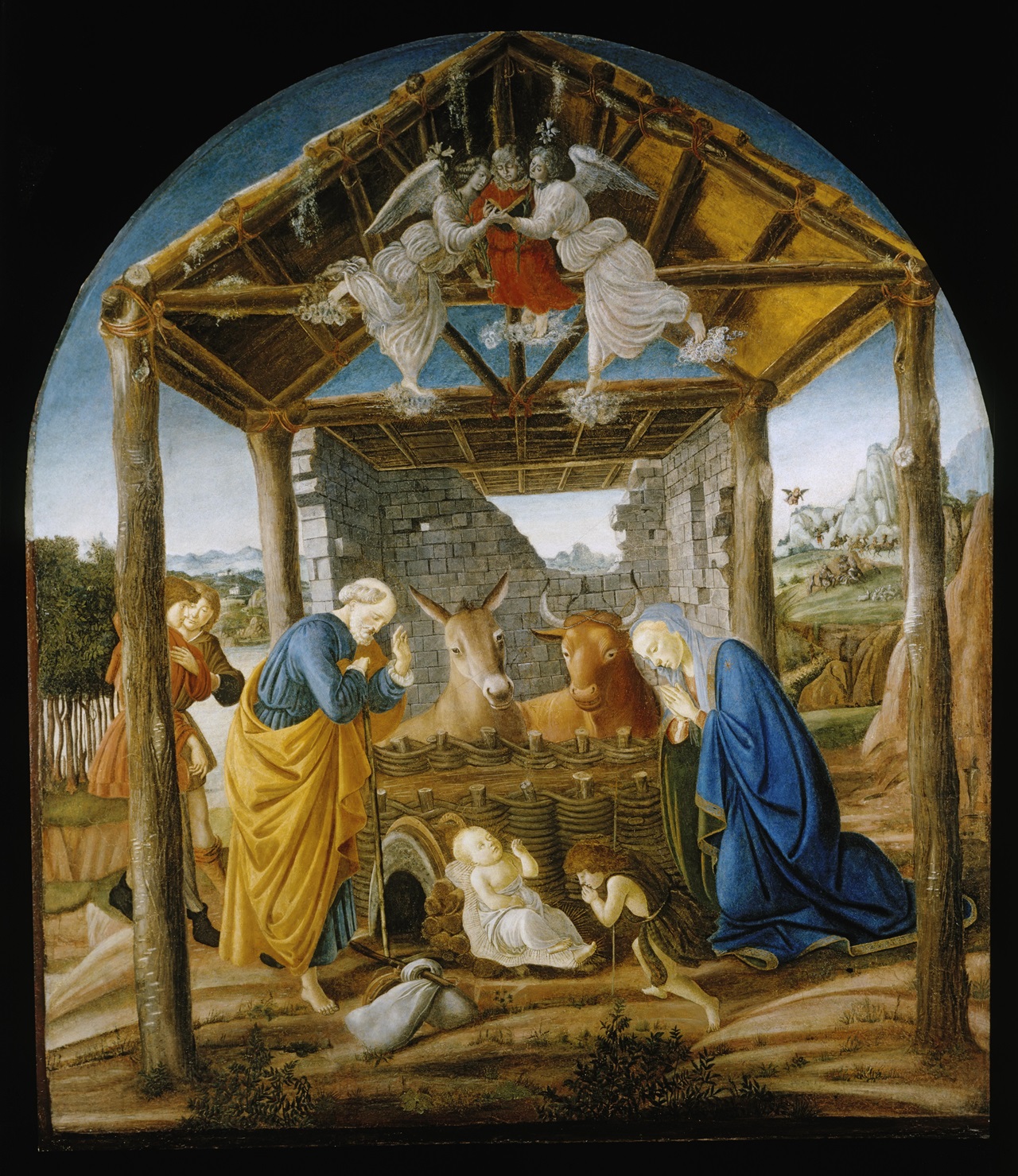
Was Jesus born in a manger or in a cave, as many Christian traditions inform us, or under a tree, as some Christian traditions, as well as the Qur’an, tell us? For example, the story in the New Testament, as narrated in the gospels of Matthew and Luke with some nuances, is well known: Jesus was born in Bethlehem. His virgin mother, Mary, according to Luke, wrapped her newborn baby in swaddling cloths and laid him in a manger. “This description,” writes Mustafa Akyol, “has defined Christian imagination for centuries, with countless works of art depicting the baby Jesus lying in a barn, surrounded by hay, sheep and cows.”
Other accounts suggest he was born in a cave within the confines of the Church of the Nativity in Bethlehem (see photograph, below), one of the oldest continuously operating churches in the world.
The Altar of the Nativity, beneath which is the fourteen-point silver star marking the traditional spot of Jesus’ birth. The star is set into the marble floor and surrounded by 15 silver lamps representing the three Christian communities: six belong to the Greek Orthodox, four to the Catholics, and five to the Armenian Apostolic. For more about the significance and history of the Church, please click Wikipedia. Photograph: Muslim Harji, Montreal.
Islam, while accepting the miraculous birth of Jesus, provides a significantly different account of the Nativity. According to the Qur’an, Jesus is born not in Bethlehem but in an unspecified “distant place.” Mary is all alone while giving birth to him, and there is no one to help her. She is said to give birth under a palm tree next to a miraculous spring. Read Mustafa Aykol’s beautifully written and insightfully researched piece, Jesus’ Birth Between Islam and Christianity, published in New Lines Magazine.
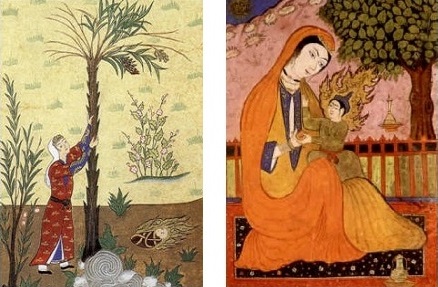
Left: Mary nurtured by a palm tree in a Turkish miniature, as described in the Qur’an; right: Mary and Jesus in a Persian miniature. Images: Wikipedia.




















 Simerg - Insights from Around the World