Simerg is an independent initiative dedicated to Ismaili Muslims, the Aga Khan — their Hereditary Imam — and the Ismaili Imamat, and Islam in general through literary readings, photo essays and artistic expressions
“The Ismaili Center is intended to be a resource for all Houstonians as a place to come together with local, national, and international partners to enhance the vibrant nature and rich cultural tapestry of this city” — Prince Amyn Aga Khan (READ MORE ON BARAKAH)
Houston’s Mayor Sylvester Turner introduces Prince Amyn Aga Khan to Houston Police Department Chief Troy Finner. Please click on photo to read report.
“The Ismaili Center Houston will be a magnificent building, both physically — with its landmark architecture, picturesque gardens, and ingenious design — and societally speaking, through its impact on Houston, across Texas, and throughout the United States” — Honourable Sylvester Turner, Mayor of Houston (READ MORE ON BARAKAH)
Prince Amyn Aga Khan is joined by Greater Houston Partnership President and CEO Bob Harvey, and Performing Arts Houston CEO Meg Booth as they hear remarks from Mayor Sylvester Turner. Please click on photo to read report.
Date posted: August 13, 2022.
_______________________
Before departing this website please take a moment to review Simerg’s Table of Contents for links to hundreds of thought provoking pieces on a vast array of subjects including faith and culture, history and philosophy, and arts and letters to name a few. Also visit Simerg’s sister websites Barakah, dedicated to His Highness the Aga Khan, and Simergphotos for beautiful photographs on diverse themes including nature and culture.Simerg’s editor Malik Merchant may be reached via email at mmerchant@simerg.com.
Over the past week, the media around the world has taken note of an important worldwide study published in the July 14, 2022 issue of The Lancet (see News Release) which says that the consumption of alcohol in any amount carried significant health risks and no benefits to young people. The Lancet is among the world’s oldest and best-known general medical journals. Some of the headlines in the media, with links to detailed reports (that are accessible without a subscription), were as follows:
Alcohol is never good for people under 40, global study finds (The Guardian)
Alcohol, Even in Moderation, Carries Health Risks for People Under 40 (Healthline)
No amount of alcohol is healthy if you’re under 40, study says (CNN)
Drinking just 3 cans of beer a week may be linked to cognitive decline (Medical News Today)
Young people should not drink’: World study challenges alcohol guidelines (Global News)
Drinking Any Amount of Alcohol Isn’t Good for People Under 40, New Global Study Finds (People Magazine)
Sobering new study says that those under age 40 shouldn’t drink alcohol at all (Fox News)
In October 2018, when Canada legalized the recreational use of marihuana, we expressed our concern on the matter, and asked the Ismaili Jamat and its youth to seek to be wary, and apply principles of good health in our daily lives, in view of the very easy access to the drug, and temptations to try it out.
Both Mawlana Sultan Mahomed Shah Aga Khan III and Mawlana Hazar Imam, His Highness the Aga Khan, have articulated their feelings and concerns about social habits and their harmful effects during their Imamat. When speaking to the Transvaal Muslim League in the Johannesburg City Hall on August 12, 1945, Mawlana Sultan Mahomed Shah asked his Muslim audience to avoid alcohol at all costs. He said:
“The greatest danger, to every Muslim citizen — I have not the least hesitation in saying it — is alcohol. Time has shown that it is an injury to you; an injury to your person; an injury to your health. It is forbidden because it carries greater evil than good. Believe me, in a community like yours, alcohol is a very grave danger. Once you got into the alcohol habit, I do not know where it would lead you. A handful, here and there, of the weak, or of the unhappy, find their way to this terrible poison. Avoid it at all costs. Avoid it, I say, for in this country you cannot afford to lose one man.”
Speaking to the Jamat and addressing the youth in particular the present 49th Imam has said:
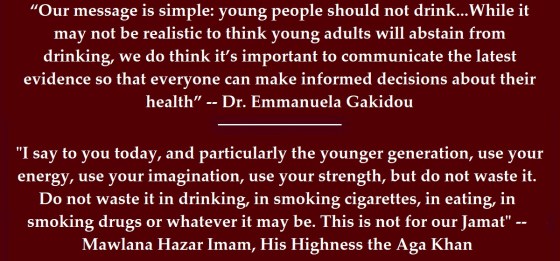
“In the past I have said to you, do not squander your money on social habits which are of no interest and which are harmful and I have mentioned smoking, I have mentioned drinking. I now add to the list drug-taking. I say to you today, and particularly the younger generation, use your energy, use your imagination, use your strength, but do not waste it. Do not waste it in drinking, in smoking cigarettes, in eating, in smoking drugs or whatever it may be. This is not for our Jamat. I say to you stay a healthy Jamat and face the problems without wasting your energy and time and money on these other habits. Remember this is a matter of importance, because these habits can weaken the Jamat.” — Mawlana Hazar Imam, Dar es Salaam, November 11, 1970 [1]
And:
“Do not abandon the overall principle of good health, of good morality which Islam has taught all the members of its faith. To the young, I say, remember that one day you will be parents, and ask yourselves if you will authorize your children to participate in certain habits which are prevalent in the Western World, and I am sure the answer will be in the vast majority, no. Because our Jamat is a strong Jamat, and I want you to be absolutely clear in your minds that when you come to another society, you must have the wisdom to absorb that which is good and to ignore or reject that which would be detrimental to you or to your family.” — Mawlana Hazar Imam, August 3, 1969 in London, England [2]
With a reputable journal such as The Lancet now suggesting that young people should not drink, we urge the Ismaili youth and its young professionals to avoid alcohol at all costs, and seek to abide by Mawlana Hazar Imam’s guidance to the younger generation: “Use your energy, use your imagination, use your strength, but do not waste it. Do not waste it in drinking, in smoking cigarettes, in eating, in smoking drugs or whatever it may be.”
During his Takht Nashini visit to Kampala, Uganda, on October 27, 1957, Mawlana Hazar Imam said:
“My Beloved Spiritual Children,
Your care and welfare will always be my concern. I am certain that you and your children, will benefit if you follow the advice I have given you.”
Throughout his Imamat of 65 years, Mawlana Hazar Imam has always sought that the characteristic of the Jamat should be such that we should seek at all times for the best in worldly matters and the best in spiritual matters, and that so long as the Jamat continued in this search for the best in both the worlds and followed his Famans we would always have a happy and prosperous future. (Dacca, December 8, 1964).
REVIEW SIMERG’S TABLE OF CONTENTS AND VISIT ITS SISTER WEBSITES
Before departing this website please take a moment to review Simerg’s Table of Contents for links to hundreds of thought provoking pieces on a vast array of subjects including faith and culture, history and philosophy, and arts and letters to name a few. Also visit Simerg’s sister websites Barakah, dedicated to His Highness the Aga Khan, and Simergphotos. Reach the editor, Malik, at mmerchant@simerg.com
[This post includes material from The.Ismaili, the official website of the Ismaili community – Ed. ]
Map and Video: Ghadir Khumm
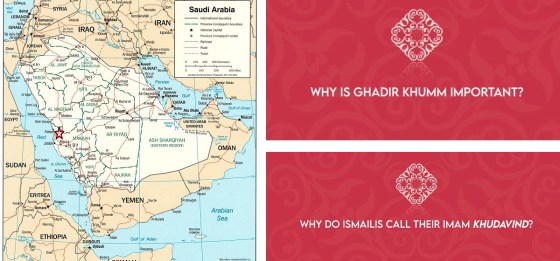
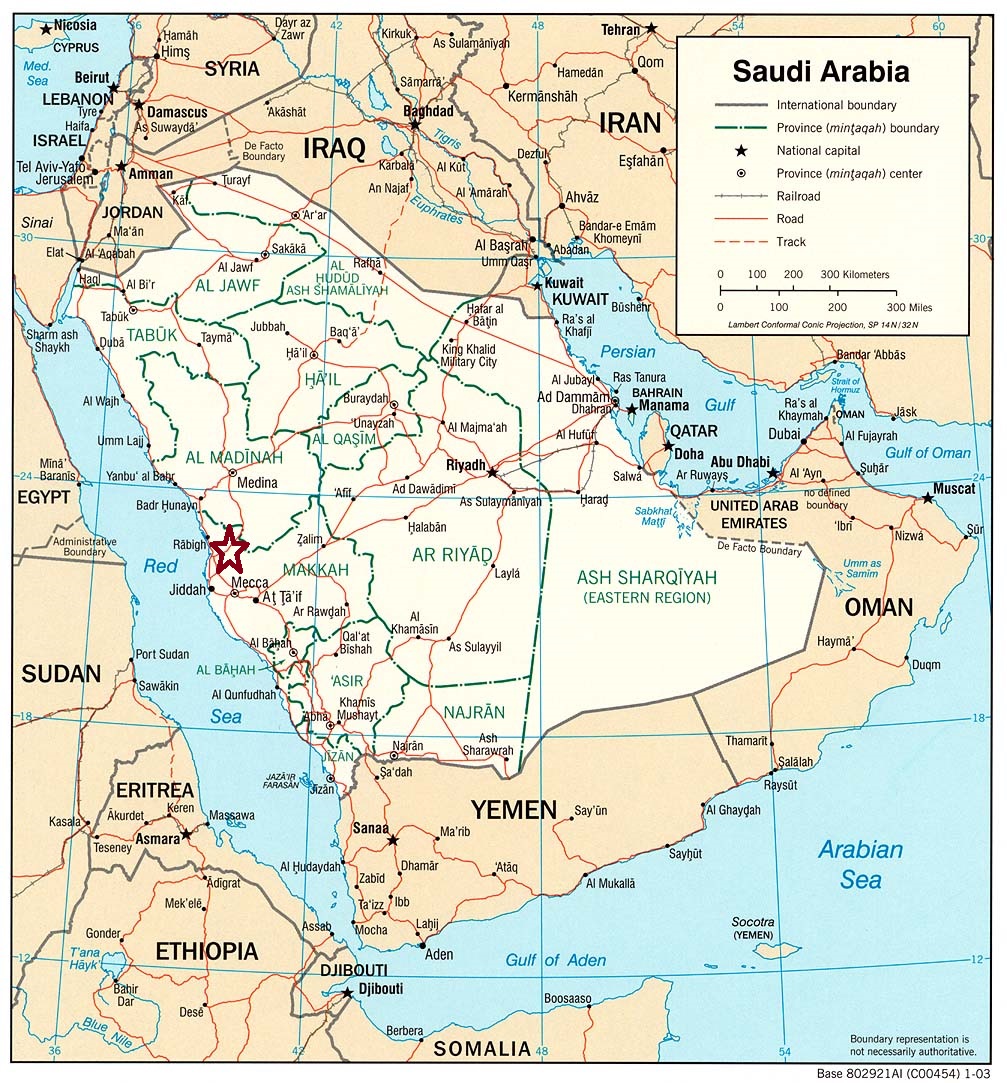
According to Shia belief, by declaring Hazrat Ali as Mawla after him at Ghadir Khumm, the Prophet Muhammad (peace be upon him and his family) transferred his own spiritual authority bestowed upon him by Allah to Hazrat Ali, making him — and all the Imams that follow — the Amirul Mu’minin, or Master of the Believers. Please see map for location of Ghadir Khumm and watch the short video on the importance of Ghadir Khumm.
Click on map for enlargement
Political map of Saudi Arabia and surrounding countries. The approximate location of Ghadir Khumm near the modern day town of Ragibh (known in the past as Al-Juhfah) has been highlighted in red. Driving distances: Mecca to Ghadir Khumm (location where Prophet Muhammad appointed Hazrat Ali as his successor) appx. 208 Kms; and distance from Ghadir Khumm to Medina, appx. 300 kms. Credit: Map adapted by Simerg from the Perry-Castañeda Library Map Collection, University of Texas Libraries.
~~~~~~~~~~
__________________
Video: Khudavind
The Persian word khudavind or khudawand means, “a king, prince, lord, master; or man of great authority.” Many Persian and Central Asian empires used this term throughout history to refer to people of high standing, including, at times, the sultan (ruler), wazir, government officials, and patrons. The Ismaili Imams lived in Persia (modern-day Iran) from the 12th to the 19th centuries. During this period, the community adopted the term khudawand to refer to the Imam. Its meaning is similar to the Arabic term mawla, which also means “master” or “lord.” (for more see the.Ismaili).
REVIEW SIMERG’S TABLE OF CONTENTS AND VISIT ITS SISTER WEBSITES
Before departing this website please take a moment to review Simerg’s Table of Contents for links to hundreds of thought provoking pieces on a vast array of subjects including faith and culture, history and philosophy, and arts and letters to name a few. Also visit Simerg’s sister websites Barakah, dedicated to His Highness the Aga Khan, and Simergphotos. Reach the editor, Malik, at mmerchant@simerg.com
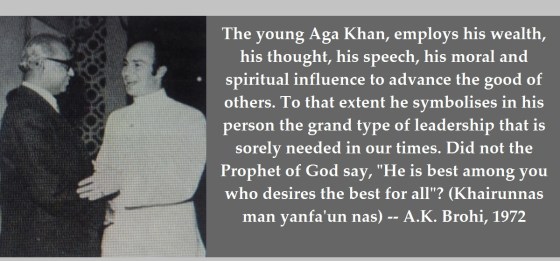
“If it be true that a true test of really great man, as Brougham teaches us, is that he be endowed with three remarkable attributes, namely, (a) generosity in design; (b) humanity in execution; and (c) moderation in success, then I have not the slightest hesitation in saying that the Aga Khan answers that test adequately. He is an indefatigable worker and has a tremendous power of uptake. He has a way of bearing the burdens of the leadership he is called upon to provide, cheerfully. He is calmest in storms, and most fearless under menace and his reliance on truth, on virtue and on God who, after all is their source and sanction, is ever so unfaltering” — A. K. BROHI, JULY 11, 1972 – READ BROHI’S TRIBUTE BY CLICKING HERE OR ON PHOTO BELOW
REVIEW SIMERG’S TABLE OF CONTENTS AND VISIT ITS SISTER WEBSITES
Before departing this website please take a moment to review Simerg’s Table of Contents for links to hundreds of thought provoking pieces on a vast array of subjects including faith and culture, history and philosophy, and arts and letters to name a few. Also visit Simerg’s sister websites Barakah, dedicated to His Highness the Aga Khan, and Simergphotos. Reach the editor, Malik, at mmerchant@simerg.com
Simerg and its sister websites, Barakah and Simergphotos, convey heartiest felicitations to Ismailis and friends of the Ismaili community in Canada and around the world on the auspicious occasion of His Highness the Aga Khan’s 65th Imamat Day anniversary (July 11, 2022). He succeeded to the Throne of Imamat on July 11, 1957 at the age of 20 upon the death of his grandfather, Mawlana Sultan Mohamed Shah Aga Khan III, whose Imamat (spiritual leadership) of 71 years is the longest in the 1400 year history of the Shia Ismaili Muslims.
According to well-known Muslim traditions, the Prophet Muhammad (S.A.S) said:
“I am leaving amongst you two weighty things after me, the Qur’an and my Progeny (ahl al-bayt). Verily, if you hold fast to them both you will never go astray. Both are tied with a long rope and cannot be separated till the Day of Judgement.” (Muslim, Vol. II, pg. 279).
The Prophet appointed Hazrat Ali (A.S.) to be his successor as the Imam, and His Highness the Aga Khan, who is respectfully addressed by the Ismailis as Mawlana Hazar Imam, is the 49th Hereditary Imam in direct succession of Imams since Imam Ali.
In the Ismaili Ginan (hymn) Girbah Vali, attributed to the Ismaili missionary Pir Sadr al-Din, the Pir says:
“If the Imam did not have his feet on this earth for even a moment, then the world, moon, sun would vanish and nothing would exist, neither the heaven nor the earth.”
The notion of the cosmic necessity of an Imam, expressed by the Pir, is also found in famous traditions of the Prophet Muhammad (cited in “The Divine Guide in Early Shi’ism,” pp 125-131):
“The earth cannot be devoid of an Imam; without him, it could not last an hour” and also “If there were only two men left in the world, one of them would be the Imam.”
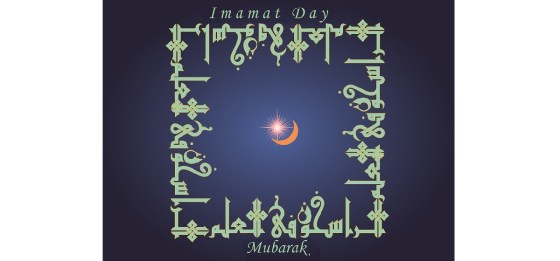
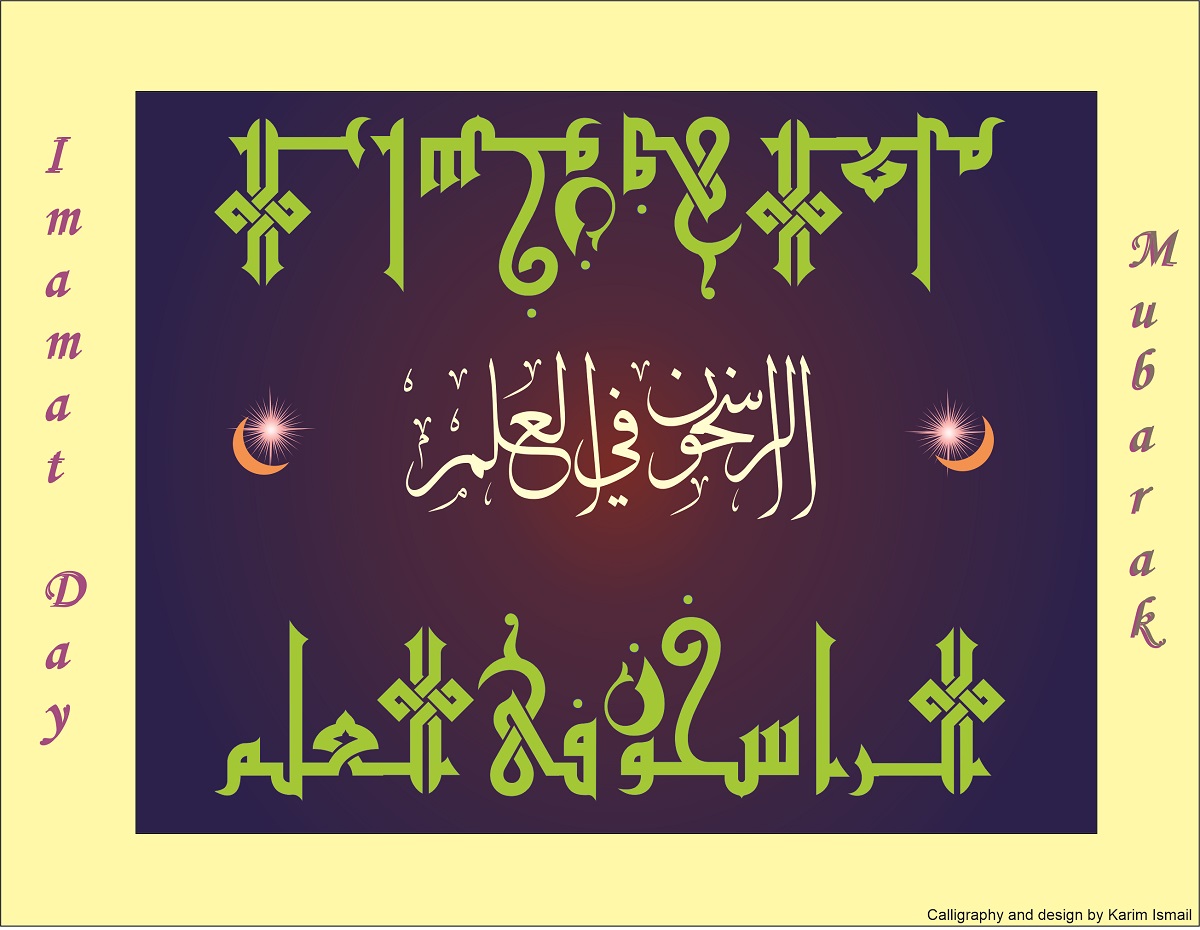
The two calligraphies that Karim Ismail has created express another important notion of the Imam based on the Qur’anic phrase: Al-rasikhun fi’l-ilm (those firmly rooted in knowledge). According to the Ismaili Baitul Ilm Secondary Curriculum, Volume 1, produced by the Institute of Ismaili Studies in London, the phrase, in the Shia tradition, is understood to be referring to the Imam descended from the Prophet’s family.
The first calligraphy has the Qur’anic phrase Al-rasikhun fi’l-ilm in Fatimid Kufi script on all the 4 sides of Karim Ismail’s artwork. The Fatimids were rulers of Egypt and North Africa in the 10th through the 12th centuries. The Fatimid Imams or Caliphs were ancestors of the current Aga Khan.
The Qur’anic phrase Al-rasikhun fi’l-ilm (Those firmly rooted in knowledge) on all 4 sides of the art work. Calligraphy and design by Karim Ismail. Toronto.
The second calligraphy, shown below, has the same phrase on the top and bottom borders in Fatimid Kufi script, as above. The centre has the same phrase in Thuluth script. We sincerely thank Karim Ismail for conceiving these pieces of art for Imamat Day.
The Qur’anic phrase Al-rasikhun fi’l-ilm (Those firmly rooted in knowledge) on top and bottom of the art work in Fatimid Kufi script; the centre of the art work has the same phrase in Thuluth script. Calligraphy and design by Karim Ismail, Toronto.
We wish all our readers a very Happy Imamat Day, with prayers for everyone’s good health, strength in Iman (faith), family unity and the fulfillment of all our wishes. May we fulfill the aspirations that Mawlana Hazar Imam has of each one of us of staying on the path of Sirat al Mustaqim (the Straight Path), excelling in our studies and endeavours, and keeping the right balance between our material and spiritual lives.
As we celebrate Mawlana Hazar Imam’s 65th Imamat Day, may we always remain under his guidance, loving care and protection. Ameen.
Date posted: July 11, 2022.
___________________
FEEDBACK
Simerg welcomes your feedback. Please complete the LEAVE A REPLY form below or click on COMMENT. Your letter may be edited for length and brevity, and is subject to moderation.
CONTRIBUTORS
Karim Ismail
Originally from Uganda, Karim Ismail lived in England before settling in Canada. By profession, he is a Pharmacist (retired). It was in England, in 1986, that he came across the artwork of a German Muslim, Karl Schlamminger (1935-2017), at the Ismaili Centre London. Karl’s artwork on calligraphy and geometrics, had a profound effect on Karim. He is frequently seen conducting calligraphy workshops for children at the Aga Khan Museum in Toronto. Karim is also active on the literature counter at the Ismaili Centre Toronto.
Malik Merchant
Malik Merchant is the founding publisher and editor of Barakah (2017) as well as its two sister websites Simerg (2009) and Simergphotos (2012). His interest for literature and community publications began in his childhood years in Tanzania through the work of his late parents Jehangir (d. May 2017, aged 89) and Malek Merchant (d. January 2021, also 89), who both devoted their lives to the service of the Ismaili community, its institutions and the Imam-of-the-Time, His Highness the Aga Khan, as missionaries and religious education teachers. In the UK, Malik edited the flagship Ismaili magazine, ILM, with his father. A resident of Ontario since 1983, he relocated to Alberta in January 2022. He has an animal loving daughter Dr. Nurin Merchant; she is a vet and practices in Ontario. Malik can be contacted by email at mmerchant@simerg.com. He can also be reached — and followed — @twitter and @facebook.
Before departing this website please take a moment to review Simerg’s Table of Contents for links to hundreds of thought provoking pieces on a vast array of subjects including faith and culture, history and philosophy, and arts and letters to name a few. Also visit Simerg’s sister websites Barakah, dedicated to His Highness the Aga Khan, and Simergphotos.
Our sister website, Barakah presents a beautiful piece on the ceremonial installation of Mawlana Hazar Imam, His Highness the Aga Khan, as the 49th Hereditary Imam of the Shia Ismaili Muslims. The post is on events that took place in October 1957 in Dar es Salaam, Nairobi and Kampala. It brings together photographs and textual material that many of our regular as well as new readers may not have seen or read before. Please click HERE or on the images on this page to read Barakah’s informative and inspiring article.
We wish Ismailis around the world a very happy 65th Imamat Day Mubarak. We have the knowledge that we are under the loving care of the Imam-of-the-Time, whose hand is always on our shoulders. At the same time, we should remain grateful for Mawlana Hazar Imam’s constant blessings for our material and spiritual comfort and well being as well as protection from difficulties. We wish all Ismailis success in all their endeavours, with a sincere wish that we follow the Imam’s advice to us to keep the right balance between matters of the world (dunya) and faith (din).
Please click on photo for special article in Barakah.
“As he says in his own introduction to the book, Otte engaged in a deep research of the photo archives of the Aga Khan, finding images chosen for their quality but also for the fascinating story they tell. The result is a unique collection of photos, many of which have not been published before, but which, taken together, form a visual biography. It is a book about His Highness the Aga Khan, but it is also a portrait in time and space of the world seen from a different perspective, one of endless change and movement, but also one of hope” — Philip Jodidio, Preface, p. ix, “Depth of Field: The Aga Khan Beyond the Lens”
~~~~~~~~~~~~~~~~~~~~~~~~~~~~~~~~~~~~~
DEPTH OF FIELD: THE AGA KHAN BEYOND THE LENS, edited by Gary Otte with texts by Bruno Freschi, Philip Jodidio, Don Cayo and Gary Otte Hardcover 260 pp. Published by Prestel, February 2022; 220 colour illustrations. To purchase the book, please see links provided immediately after the article.
~~~~~~~~~~~~~~~~~~~~~~~~~~~~~~~~~~~~~
Reflections
Cover jacket of Depth of Field: The Aga Khan Beyond the Lens; Hardcover, 260 pages, 25 x 30 cms, 220 colour illustrations; published by Prestel, February 2022.
By NIZAR A MOTANI, PhD
I have used the Aga Khan and Hazar Imam interchangeably in my reflections about this visual biography of him, by Gary Otte
When I finally received the long-awaited book about Hazar Imam, I gleefully looked at the cover, actually the “jacket,” with his picture. It was intriguing that this photograph portraying Hazar Imam had part of his shoulder hidden: it was found in the inside “folding”, which also has an extract from the Preface. The complete photograph appears on page 121. Then, I instinctively and happily thumbed through this delightful “coffee table” edition, as if it was just an album, though about a familiar figure, without much thought and not reading most of the captions. It soon became apparent that the three essays preceding the photographs must have a purpose and should be read before taking a second closer look at them. In my humble opinion, this is what every viewer should do since these textual and contextual commentaries guide the viewer to not only how to view the images, but also, and more importantly, to ponder over them to see beyond these images, which collectively constitute a pictorial biography of the Aga Khan.
The editor of this milestone photographic record, Gary Otte, explains in the Introduction, that as the Aga Khan’s principal photographer for some thirty years, he had ample, varied and exhausting opportunities to capture a lot of “interesting stuff.” He witnessed happenings at “exotic and iconic locations; global leaders and ordinary folks”; — and events of great historical, cultural, religious and economic significance (p. xi).
~~~~~~~~~~
“In an age dominated by moving images, still photographs continue to carry remarkable power. Nothing captures a moment as memorably. There is no movement to miss, no soundtrack to distract. It is the still photograph that becomes iconic – a fraction of a second with great impact that people can readily call to mind. Few moments in film or video imprint themselves so clearly. It is that single frame from a vivid scene that we carry with us… Like all the photographers who covered the life of the Aga Khan, I benefitted from his acceptance of us as chroniclers of history” — Gary Otte, Introduction, p. xiii, “Depth of Field, The Aga Khan Beyond the Lens”
~~~~~~~~~~
The two hundred twenty meticulously selected photographs — ninety by him and 130 taken by some fifty other photographers — take the viewers on a panoramic tour of all aspects of the Aga Khan’s amazing life. They are not chronologically presented but were chosen because they were deemed “technically, compositionally, and editorially excellent” and were “more representative of geography, subject area and decades.” (p. xi).
Otte recommends viewers to inspect and revisit all the photographs because “every long look can reveal something new as you discover or imagine, what is happening.” (p. xi).
Philip Jodidio, a prolific author and an expert on contemporary art and architecture, has written a glowing Preface in which he comprehensively and chronologically portrays the major initiatives of Hazar Imam, who is described as “one of the most fascinating personalities in the world….he is a spiritual leader, the driving force behind numerous humanitarian and cultural organizations” as well as “one of the most important figures who has sought to bridge the divide between the Muslim world and the West” (p. v).
By reading this essay, themes and patterns will emerge in the two hundred twenty otherwise randomly presented photographs. The renowned Bruno Freschi’s brief but telling Foreword is centered on his deep respect for Otte’s superb photographic skills as well as his profound admiration of Otte’s extraordinary subject’s (The Aga Khan’s) ambitious, multidimensional, multifaceted mission, which has been so diligently and visually portrayed.
The Aga Khan’s mission, or more appropriately, his mandate as the Imam of the Shia Ismaili Muslims, has been succinctly conveyed in excerpts from one of his numerous speeches (p. xvii) and from his historic address to the special joint session of the Canadian Parliament, on February 27, 2014. Thankfully, Jodidio has excerpted the essence of this speech in his Preface (p. v).
~~~~~~~~~~
“Gary’s photography and his curation have produced a collection with a magical quality. The reader/viewer is transported into the event-image reality. The photography is the doorway into the spirit of the frozen moment. These event-moments are the curtain in the great theatre of life. Once the curtain is raised it reveals the compelling life story of the Aga Khan, an elegant portrait of his historic mission” — Bruno Freschi, Foreword, p. xv, “Depth of Field: The Aga Khan Beyond the Lens”
~~~~~~~~~~
In my reflections on just a few of the photographs in this non-chronological historical biography, I hope to be faithful to the sound, revealing guidance on how to embrace each image. Evidently, beyond and behind the photographs, there must be careful and plentiful preparation and coordination, prior to, during, and even after each different event: airport arrivals and departures; protocols; media liaison; motorcade escorts; security arrangements; translators, meetings with heads of state and other leaders; banquets and speeches — to think of just a few. The photograph on page 212 shows Dr. Shafik Sachedina, Head of the Department of Jamati Institutions at the Diwan of the Ismaili Imamat, and Dr. Mohammed Khesavjee, who served as the Information Officer at Mawlana Hazar Imam’s Secretariat at Aiglemont for many years, playing complementary roles behind and at the scene. Most photographs do not show such senior and other personnel in the Aga Khan’s entourage doing the critical groundwork.
The photograph on page 163 shows Hazar Imam thanking the police escort for his motorcade. He is always mindful of the very many individuals, institutions and organizations involved during his official visits as the state guest of the host governments, and he is known to unfailingly acknowledge his gratitude to all of them. Only some of them can be seen in some of the photographs, but they were there and we have to imagine them, as explained by the editor.
Article continues below
Jacket, “Depth of Field: The Aga Khan Beyond the Lens,” 220 photographs
In 1983 and 2008, the Aga Khan, the 49th hereditary Shia Imami Ismaili Muslim spiritual leader paid official visits as the guest of the ruling Sunni family of the emirate of Dubai (pp. 134 and 135). Significantly, the 2008 occasion was the opening ceremony of the new Ismaili Centre. We can only imagine the elaborate preparations and protocols for this historic event. Being invited as a virtual head of state by governments across the world is an unmistakable theme of this fascinating volume. So much planning and coordination by so many unseen volunteers and paid staff within and outside the Ismaili jamat is always the case.
______________________
READERS SHARE THEIR THOUGHTS ON “THE AGA KHAN BEYOND THE LENS”
This fabulous book with its layout, font, selection of photos and essays is extraordinary — Moez Murji
The photographs chosen are not only beautiful but were also very carefully selected, and each carries a deeper message of the Aga Khan’s incredible — and farsighted — vision. It’s indeed remarkable and an occasion of immense happiness for the Ismailis that the unbelievable results that have been achieved by Mawlana Hazar Imam in so many countries around the world are finally covered in such a well condensed pictorial book — Amin Jaffer
In this 280-page bumper pictorial biography of Mawlana Hazar Imam, which I ordered and have already received it as one of my living room’s table top collections, some of the pictures will bring alive our individual and family memories — Kamruddin Rashid
Beautiful! Now [after reading Nizar Motani’s reflections] I have to go back to the Visual Biography (love that!!) and look at it differently! Different viewers may have different meanings to different pictures. Great job Mr Gary Otte for the book and Nizar Motani for his reflections on the book — Mirza Smile
______________________
Gary Otte’s very first illustration is a two-page panoramic view of the October 1957 Dar es Salaam Takht Nashini. It requires deep individual contemplation to merely “digest” the thousands in attendance. And much more imagining of the hundreds more involved in numerous aspects of staging this majestic enthronement ceremony, in a British colonial African country, with several non-African immigrant minorities among the heterogeneous African populations, can be a challenging mental exercise!
It is almost on the eve of the 50th anniversary of the August 4th 1972 mass Asian Expulsion by Uganda’s mercurial megalomaniac military dictator, Idi Amin Dada, that I am encountering Hazar Imam’s somber photograph with Amin. It was taken during Hazar Imam’s critical February 1972 visit to Kampala (p. 59). I was still in London completing my doctoral dissertation on the topic of Uganda’s African Civil Service, hoping to teach African History at Makerere. It so happened that I returned on that fateful day — August 4th 1972, not to a much anticipated warmest welcome at the Entebbe Airport, but to most somber news, from my parents, about the expulsion order issued just prior to my arrival!
~~~~~~~~~~
Such an epic volume should be an occasion of immense pride and happiness for every Ismaili murid. Gary Otte has clearly acknowledged that Hazar Imam remained very accommodating and patient during the long period of compiling this unprecedented collection…and has thanked Hazar Imam for taking the time to offer suggestions on choosing the photographs and the book’s design. Princess Zahra, Prince Rahim and Prince Hussain gave their time and advice on selection of photographs and the final draft of images and the text. Hence this official authorized visual biography of our 49th Imam and a once in a life time publication, should belong in our homes — Dr Nizar Motani, author of this post
~~~~~~~~~~
Therefore being absent from Uganda during Hazar Imam’s February visit, I can only imagine the challenging task of the local Ismaili entourage and leadership on how to brief Hazar Imam for any meeting with such a vainglorious man controlling the destiny of all Ugandans. Could Amin have given any clear signal about what was brewing in his mind prior to the alleged dream to ethnically cleanse Uganda of its much maligned Asian minorities? Could Hazar Imam have sensed any forebodings in order to prepare for all eventualities — since the expulsion order’s short deadline was met with fairly well-organized and timely evacuation under the most harrowing circumstances? I was one of the lucky ones who chose to and could leave, within a week, for the USA, but remained tormented and concerned about the rest of the family’s fate who had to plan their escape. This image on page 59 may linger for a long while but with deep gratitude that almost all Asians escaped relatively physically unscathed.
I will conclude my brief reflections about this unique official pictorial biography of the Aga Khan, our beloved Hazar Imam, by simply stating that such an epic volume should be an occasion of immense pride and happiness for every Ismaili murid. The editor, Gary Otte, has clearly acknowledged that Hazar Imam remained very accommodating and patient during the long period of compiling this unprecedented collection of mostly previously unpublished photographs, from his childhood in Kenya to the Diamond Jubilee celebrations in various parts of the world, where he was welcomed by the host countries’ Heads of State as a virtual visiting head of state.
Gary Otte has thanked Hazar Imam for taking the time to offer suggestions on choosing the photographs and the book’s design. Princess Zahra, Prince Rahim and Prince Hussain gave their time and advice on selection of photographs and the final draft of images and the text.
Hence this official authorized visual biography of our 49th Imam and a once in a life time publication, should belong in our homes. It also makes a wonderful gift to give to thoughtfully selected non-Ismaili friends and colleagues to increase their awareness of the Aga Khan which Jodidio has stated may be lacking in the general public. But even we, his murids, will be be astonished and overjoyed to learn so much that we cannot possibly already know about or have seen images of his multifarious undertaking, as well as his personal life.
One final thought, as I take the elderly members of the Jamat into consideration. Mawlana Hazar Imam’s life, through the photographs in this book, spans three generations. How exciting and inspiring might it be for the elders, were their children and grandchildren to sit alongside them and leaf through all the beautiful photographs of their beloved Imam, not once but on multiple occasions. Old memories would be revived and new stories, narratives, anecdotes, and perspectives would emerge, individually and collectively, adding to our knowledge of Mawlana Hazar Imam’s glorious life and Imamat. This book MUST occupy a place in all Ismaili homes.
PURCHASING THE AGA KHAN’S BEAUTIFUL PICTORIAL BIOGRAPHY
The Aga Khan Beyond the Lens; Hardcover, 260 pages, 25 x 30 cms, 220 colour illustrations; published by Prestel, February 2022.
The publisher’s recommended retail price for Depth of Field: The Aga Khan Beyond the Lens is US $ 60.00; £ 45.00 but retailers and on-line book sellers may sell it for less. To purchase the book in Canada, click Aga Khan Museum Shop, Amazon.ca or Indigo.ca; in the USA, click Amazon.com; in the UK and other European countries, click Amazon.co.uk; and in Spain and Portugal click Amazon.es. Elsewhere, see if there is a local Amazon chapter serving your location or visit Amazon’s global page. Note that the book is also available for members of the Ismaili community at Jamatkhana literature counters around the world or through the local Jamatkhana leadership.
FEEDBACK
Simerg welcomes your feedback, review and reflections on The Aga Khan Beyond the Lens. Please complete the LEAVE A REPLY form below or click Leave a comment. Your letter may be edited for length and brevity, and is subject to moderation
ABOUT THE AUTHOR
Nizar Motani
Nizar A. Motani has a doctorate from the University of London (SOAS) in African history, specializing in British colonial rule in East Africa. He has been a college professor at Bowdoin College (Brunswick, ME) and Western Michigan University (Kalamazoo, MI). He was the first Publication Officer at the Institute of Ismaili Studies (London, UK). He now lives in Atlanta, Georgia.
Dr. Motani’s previous pieces on Simerg and its sister website Barakah are:
A SHORT Youtube Presentation: Gary Otte on the Making of the Book
_____________________
REVIEW SIMERG’S TABLE OF CONTENTS AND VISIT ITS SISTER WEBSITES
Before departing this website please take a moment to visit Simerg’s Table of Contents for links to more than 1500 pieces posted since the website was founded in the spring of 2009. Also visit our two sister websites, Barakah and Simergphotos.
Ismaili Muslims belong to the Shia branch of Islam, the other branch being the Sunnis who form the Muslim majority. His Highness the Aga Khan is the 49th Hereditary spiritual leader or Imam of the Ismailis and is directly descended from the Prophet Muhammad (S.A.S.) through his son-in-law, Ali (A.S.), who was married to the Prophet’s daughter, Fatima (A.S.). Prophet Muhammad and Hazrat Ali were also first cousins — their respective fathers Abd al-Muttalib and Abu Talib were brothers.
According to Shia Muslims, the Prophet had designated Ali to succeed him as the Imam. The Sunnis dispute this, and Muslims have remained divided over this contentious matter for centuries. However, in their book, “History in Quotations”, which reflects five thousand years of World History, the authors M. J. Cohen and John Major write as follows:
“Muhammad said: ‘He of whom I am the Mawla (patron), Ali is his Mawla. O God, be the friend of him who is his friend and be the enemy of his enemy.’
“This became the proof text for the Shia claim that Ali, the Prophet’s cousin and son-in-law, was the Prophet’s rightful successor after the Prophet’s death in 632. The meaning of Mawla here probably implies the role of patron, lord or protector.”
The authors, Cohen and Major, sum up by stating that through the use of the term Mawla, Muhammad was giving Ali the parity with himself in this function.
Over the course of history, the Shia Muslims split into a number of branches over the succession of Imams descended from Ali. The first major split occurred during the 8th century, two centuries after the passing of Prophet Muhammad, following the reign of Imam Ja’far al-Sadiq, when one group considered his son Musa Kazim as the rightful Imam. The other group regarded Imam Ja’far’s elder son, Ismail, as the rightful successor. Musa Kazim’s successors continued until the 12th Imam, who is then said to have gone into hiding. This group of Shia Muslims, awaiting the re-appearance of the hidden 12th Imam to take part in the final judgement, forms the Shia majority in Iran and Iraq. They are known as the Twelver Shias or Ithnashries.
The group that held to Imam Ismail became known as the Ismailis and continue to thrive today under the Hereditary leadership of His Highness the Aga Khan, who is respectfully addressed by his Ismaili Muslim followers as Hazar Imam (the present living Imam). Thus, the Ismailis are the only Shia Muslims to have a living Imam, namely the Aga Khan.
Naheed Nenshi, left, at an event in Ottawa.
Having recently re-established myself as a resident of Alberta after 40 years, and to put the Ismailis and their Hereditary 49th Imam, the Aga Khan, into an Albertan perspective, I should like to mention that Naheed Nenshi, who served as Calgary’s mayor for three terms from 2010 until 2021 is an Ismaili Muslim. Readers are invited to read his piece in the Globe and Mail, Why I’m grateful for the Aga Khan’s extraordinary service to humanity (a subscription or registration may be required to read the article).
The Honourable Salma Lakhani
It is noteworthy that Her Honour, the Honourable Salma Lakhani, who was installed as the 19th Lieutenant Governor on August 26, 2020, is also an Ismaili Muslim, and her profile can be read on this website by clicking HERE. The piece also has a link to an interview that Canadian Geographic conducted with her.
In Edmonton, the spectacular 4.8-hectareAga Khan Garden within the University of Alberta’s Botanic Garden was gifted by the Aga Khan as “a symbol of the continued intellectual, educational and cultural collaboration between the University of Alberta and the Aga Khan Development Network.” The Botanic Garden will open for the 2022 season on May 7th, and is a MUST visit site, according to Hundreds of Google and Tripadvisor reviews. I look forward to publishing a special photo essay in the near future on the Botanic Garden, with a focus on the Aga Khan Garden.
Story continues below
Views of the beautiful Aga Khan Garden in Edmonton. The Garden is scheduled to open for the 2022 season on May 7. Photos: Aga Khan Trust for Culture.
And elsewhere in Canada, His Highness the Aga Khan’s projects include the Global Centre for Pluralism and the Delegation of the Ismaili Imamat Building, both located on Sussex Drive in Ottawa; the Aga Khan Museum, the Aga Khan Park and the Ismaili Centre on Wynford Drive in Toronto; and the Ismaili Centre Vancouver on Canada Way in Burnaby.
Canada is home to more than 100,000 Ismailis, with around 12,000 in Calgary.
Story continues below
Clockwise from top left: Ismaili Centre and Aga Khan Museum, both in Toronto (ponds in foreground in both photos are part of the Aga Khan Park); Ismaili Centre Vancouver, Delegation of the Ismaili Imamat, Ottawa, Global Centre for Pluralism, Ottawa, and Aga Khan Park Toronto. Collage: Simerg.
With these preliminary remarks on the Aga Khan and his Ismaili Muslim followers, I now invite you to read two excellent interviews that France’s Politique International and Canada’s Peter Mansbridge conducted with the Aga Khan. Both the interviews have appeared on this website with the publishers’ permission.
The Aga Khan’s Absorbing Interview with Politique International
Click on image for “Power of Wisdom”
“We are a long way from the democratization of nuclear energy. Maybe I’m naïve but I advocate another approach, which I call “positive proliferation.” The positive proliferation that I would dearly love to see happen is based on a simple principle: yes to energy, no to arms” — To read full interview, click Politique Internationale: The Power of Wisdom
The Aga Khan’s One on One Interview with Peter Mansbridge
Click on image for “One on One”
Peter Mansbridge: What is the quality that you most admire about this country?
The Aga Khan: I think a number of qualities. First of all, it’s a pluralist society that has invested in building pluralism, where communities from all different backgrounds and faiths are happy. It’s a modern country that deals with modern issues, not running away from the tough ones. And a global commitment to values, to Canadian values, which I think are very important. — To read the interview and the story behind the interview, please click Peter Mansbridge: One on One.
Date posted: May 6, 2022. Last updated: May 9, 2022 (caption updates and typos).
_______________________
Before departing this website please take a moment to review Simerg’s Table of Contents for links to hundreds of thought provoking pieces on a vast array of subjects including faith and culture, history and philosophy, and arts and letters to name a few. Also visit Simerg’s sister websites Barakah, dedicated to His Highness the Aga Khan, and Simergphotos.
“My spiritual children should always remain mindful that it is the principles of our faith that will bring peace and solace in these times of uncertainty. I am with my Jamat at all times, and each of you, individually, is always in my heart, in my thoughts and in my prayers” — Mawlana Hazar Imam, May 23, 2020
According to the websites Griffith Observatory and Time and Date, the New Moon that has just marked the end of Ramadan actually occurred on April 30, but as Time and Date mentions the illumination was 0% making the crescent invisible to the naked eye. However, on Sunday, May 1, at the time of writing this post, the illumination has increased to around 1.2%, again making the new moon crescent virtually impossible to see. The moon is scheduled to set at 10:18 pm (Mountain Daylight Time — Calgary), so following this evening’s sunset at around 8:58 pm, I hope to be able to focus my eyes on the sky in the direction 300 WNW, knowing that the crescent moon is there, and that Eid ul-Fitr will be observed by Ismaili Muslims as well as many other Muslim communities in Canada and other parts of the world tomorrow, Monday May 2, 2022.
On this auspicious occasion of Eid ul-Fitr, my family joins me in wishing all our friends and readers of Simerg, Barakah and Simergphotos a very joyous Eid, with a very sincere hope and prayer that the uncertainty, wars, and tribulations that the world is facing should come to an end.
On that note, I leave readers with Mawlana Hazar Imam His Highness the Aga Khan’s blessings to his spiritual children around the world on the occasion of Eid-u-Fitr on May 23, 2020. As murids of Mawlana Hazar Imam, we should always keep in mind that the Imam’s blessings are with us all the time, and we should seek to constantly remember his words and keep the blessings in our hearts, minds and souls for constant inspiration and happiness, and for courage and strength to cope with difficulties that may come our way. As Mawlana Hazar Imam says in his holy Talika, “I am with my Jamat at all times, and each of you, individually, is always in my heart, in my thoughts and in my prayers.”
STORY CONTINUES BELOW
Please click on photo for enlargement
New moon in the sky above the city of Calgary, Alberta, Canada, April 2, 2022, 09:47 pm, shortly after the month of Ramadan commenced. Photo: Malik Merchant/Simerg.
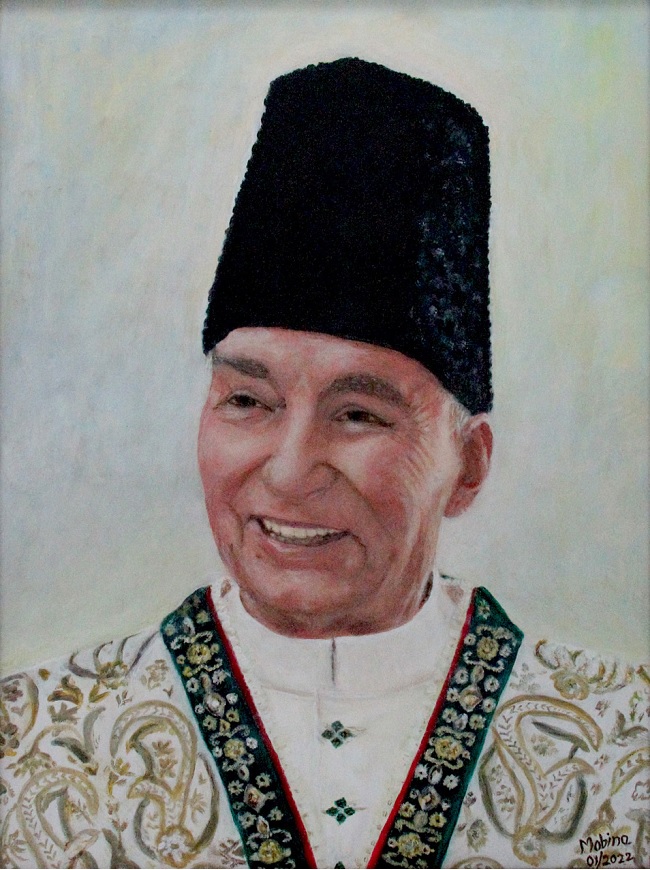
Along with Mawlana Hazar Imam’s benevolent blessings, I am pleased to include photos of the crescent moon that I captured in Calgary about a month ago that marked the start of the month of Ramadan. I am also particularly happy to include a photo of a painting of Mawlana Hazar Imam completed earlier this year by Ismaili artist Mobina Marani (Jamani). The painting along with several other pieces of work by the artist were especially submitted for publication in Simerg. Mobina’s beautiful rendition of Mawlana Hazar Imam, below, is based on a portrait taken during the Diamond Jubilee celebrations in Lisbon, Portugal, in 2018. We hope to be able to publish her submissions in the near future.
Mawlana Haza Imam’s Eid ul-Fitr Talika Mubarak to the Worldwide Jamats, May 23, 2020
Please click on photo for enlargement
A rendering of Mawlana Hazar Imam’s portrait by Ismaili artist Mobina Marani (nee Jamani) of Crystal Beach, Ontario. Mobina completed this 13″ x 17″ acrylic painting on composite wood in January 2022.
My beloved spiritual children,
“On the occasion of Eid ul-Fitr, I send my special loving blessings to my Jamats throughout the world for your happiness, peace, safety, and good health. My family joins me in wishing you all Eid Mubarak.
“At this difficult time, I applaud, with the highest admiration and gratefulness, the selfless services of all my Jamati volunteers, as well as the doctors, nurses, paramedics and support workers in the AKDN and other health facilities and related programmes: Their exemplary courage, commitment and dedication in extending care and comfort to my Jamat and others, and especially to those who are vulnerable and sick, is an outstanding actualization of the human values and ethics that all faiths cherish.
“It is my wish that my Jamat should look to the future with hope and courage, in keeping with its age-old tradition of unity, generosity and mutual support which has at all times enabled it to move forward to a position of enhanced strength and resilience, from generation to generation.”
“My spiritual children should always remain mindful that it is the principles of our faith that will bring peace and solace in these times of uncertainty. I am with my Jamat at all times, and each of you, individually, is always in my heart, in my thoughts and in my prayers.
“I send my most affectionate paternal, maternal loving blessings to all my Jamat – for happiness, good health, confidence and security in your lives ahead, and for mushkil-asan.”
Date posted: May 1, 2022.
Please visit our sister website Barakah to read all the Talikas sent by Mawlana Hazar Imam to his Jamats throughout the world and published online during the Covid-19 lockdown https://barakah.com/talikas/.
___________________
Before departing this website please take a moment to review Simerg’s Table of Contents for links to hundreds of thought provoking pieces on a vast array of subjects including faith and culture, history and philosophy, and arts and letters to name a few. Also visit Simerg’s sister websites Barakah, dedicated to His Highness the Aga Khan, and Simergphotos. Simerg’s editor Malik may be reached at mmerchant@simerg.com
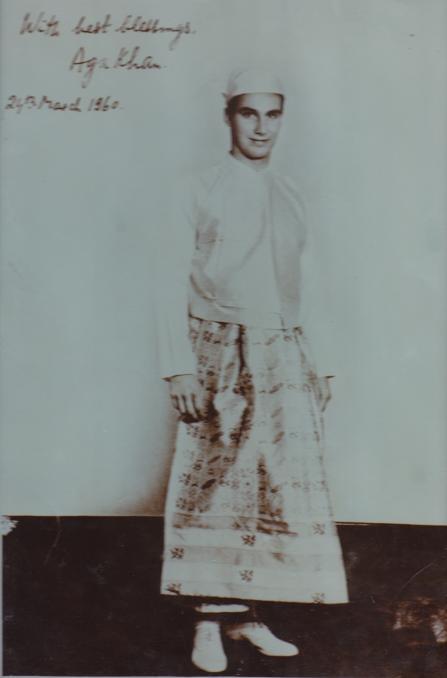
Our sister website Barakah is pleased to launch a new series entitled “Historic days in the life of Mawlana Hazar Imam, His Highness the Aga Khan”. We commence the series with his visit to Burma (now Myanmar) sixty-two years ago when he celebrated the Iranian New Year or Navroz with his community on March 21, 1960. Why does Barakah consider it to be a historic day? To find out, please CLICK HERE or on the image below, and feel free to submit your feedback through Barakah’s comment box.
Mawlana Hazar Imam, His Highness the Aga Khan, the 49th Hereditary Ismaili Imam, pictured in a Burmese traditional dress during his visit to Burma in March 1960. Please click on photo for article.
Date posted: March 20, 2022.
___________________
Before departing this website please take a moment to review Simerg’s Table of Contents for links to hundreds of thought provoking pieces on a vast array of subjects including faith and culture, history and philosophy, and arts and letters to name a few. Also visit Simerg’s sister websites Barakah, dedicated to His Highness the Aga Khan, and Simergphotos.






















 Simerg - Insights from Around the World