Simerg is an independent initiative dedicated to Ismaili Muslims, the Aga Khan — their Hereditary Imam — and the Ismaili Imamat, and Islam in general through literary readings, photo essays and artistic expressions
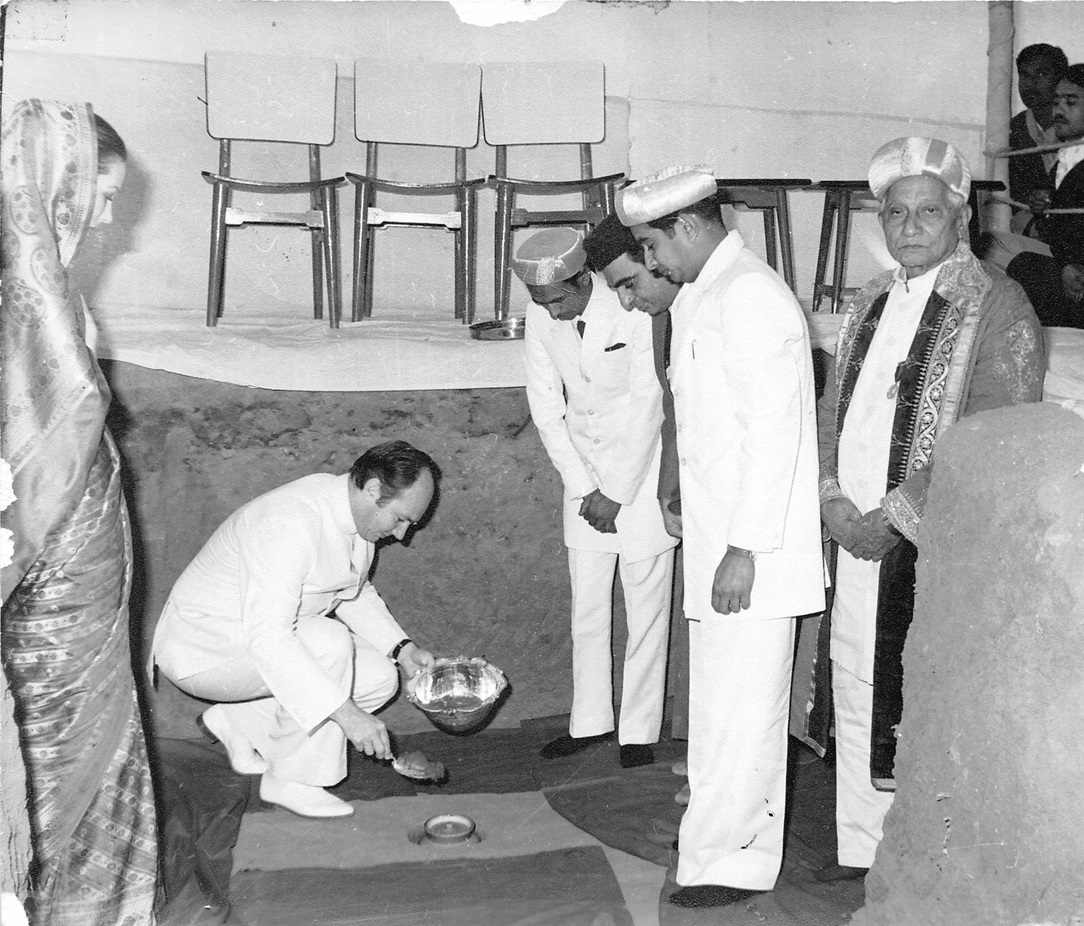
Nazar Kasamali Momin of Houston, Texas, went through his family archives, and came across a very rare collection of photos of His Highness the Aga Khan’s visit to the small village of Methan, in Sidhpur, India. It appears that the 1978 visit did not receive much media coverage, and even the Ismaili world is unaware about the historical visit. We are pleased to present a selection of photographs from Momin’s collection, along with his report of the visit. His piece appears on our sister website, Barakah, which is dedicated to the Aga Khan, the 49th Hereditary Imam of the Ismaili Muslims. Please click The Aga Khan in Methan.
The Aga Khan at the foundation for a new Jamatkhana for the Ismaili Muslim community in Methan, India. Please click on photograph for full story and more photos.
Editor’s note: On November 12, 2023, a day after the publication of the article “A Legacy of Lost Heritage” below, Simerg received a communique from ITREB in Karachi, via an Ismaili institutional leader, providing further details on the extent of the damage to the Ismaili institution’s Central library located in Karachi. According to the communique, the damage was more limited than initially thought and reported in our piece. In particular, the more than 200 manuscripts are completely safe because of protective measures taken to ensure their safekeeping. The Gujarati and Khojki-language magazines were previously moved to a different location within the library and were also saved. While a significant number of other materials in the library were damaged due to heat, smoke and water, rather than completely destroyed, they may be recoverable to some degree.
Simerg sincerely hopes that the majority of important objects and documents in the ITREB library remain in their original state and that those that were damaged are recoverable. We also hope that proper fire safety rules are in place to avoid such incidents from taking place in the library as well as Ismaili institutional buildings, especially the older ones, around the world. As noted in a UNESCO Study, the cost of restoring documents and books damaged in a library fire is substantially greater than what would be spent to store the materials under the best fire protection conditions.
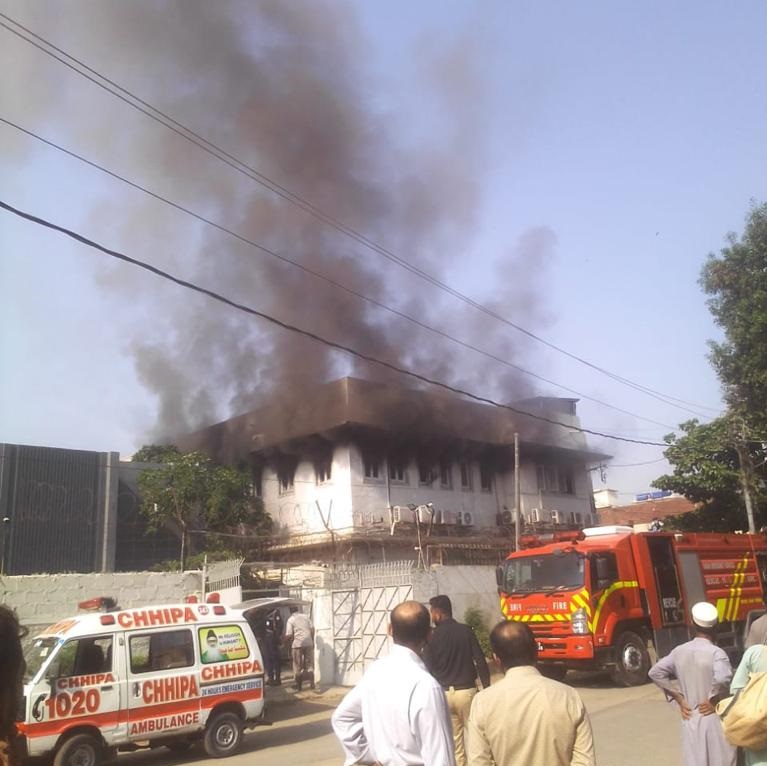
On the morning of November 2nd, 2023, at 9:15am local time, the National ITREB (Ismaili Tariqah and Religious Education Board) building for Pakistan located in the Garden East district of Karachi caught on fire. Fortunately, no one was hurt in the blaze. However, it quickly became apparent there would be another casualty.
Story continues below; click on images for enlargements
Smoke billows from a fire on November 2, 2023, at the ITREB building in Karachi, Pakistan, housing an important library collection of tens of thousands of printed materials, photographs, memorabilia, audiovisual materials, and manuscripts.
Located within the building was an important library housing tens of thousands of printed materials, photographs, memorabilia, audiovisual materials and manuscripts. The fire destroyed much of the collection. What wasn’t burnt or singed by the fire was then subject to water damage as firetrucks attempted to extinguish the blaze which was fed by the thousands of pages of flammable material in the building.
In the context of the Central ITREB Library located in Karachi, the local history, writing and output of the Khoja Jamats in particular, and more broadly of the Jamats of the Indian Subcontinent and to a lesser extent Eastern Africa and Northern Pakistan were preserved in the portion of the collection that focused on the contemporary period. In this post, I have included some gems of materials that I was able to capture on some of my journeys as an homage to the library and its role in my own archival research and being able to cobble together a social and religious history of the Ismailis.
Story continues below
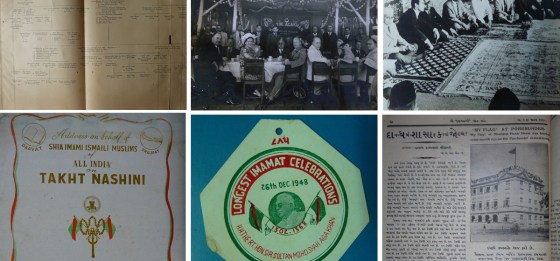
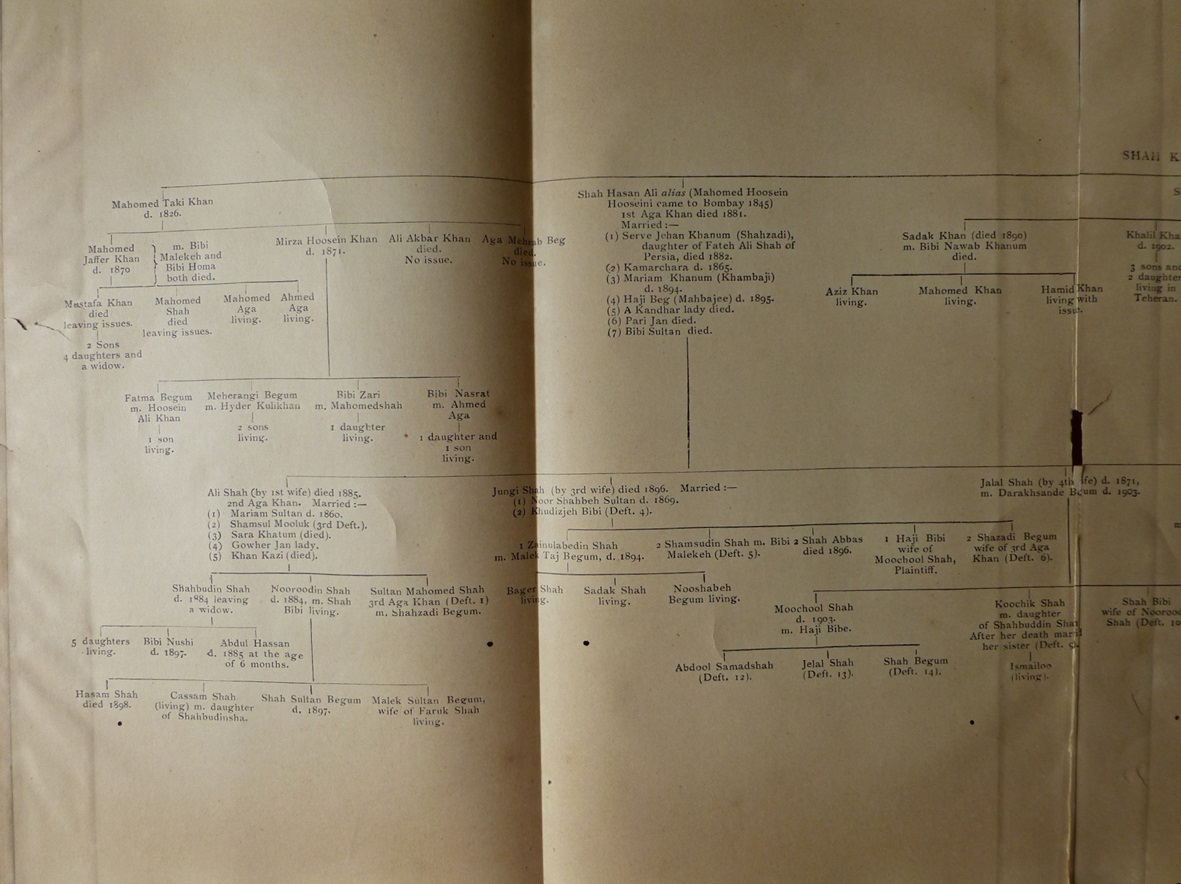
One section of the foldout outlining the family tree of the 46th Imam, Shah Hasan Ali Shah (d. 1881), that formed part of book of the judgement made by Justice Russell who proceeded over what became known colloquially as the Haji Bibi Case. In this section of the family tree, some of Imam Hasan Ali Shah’s siblings, wives, children, and their relations are listed. The case lasted from February 3, 1908 to August 7, 1908 and until that point was the longest ever trial in Bombay’s High Court.
~~~~~~
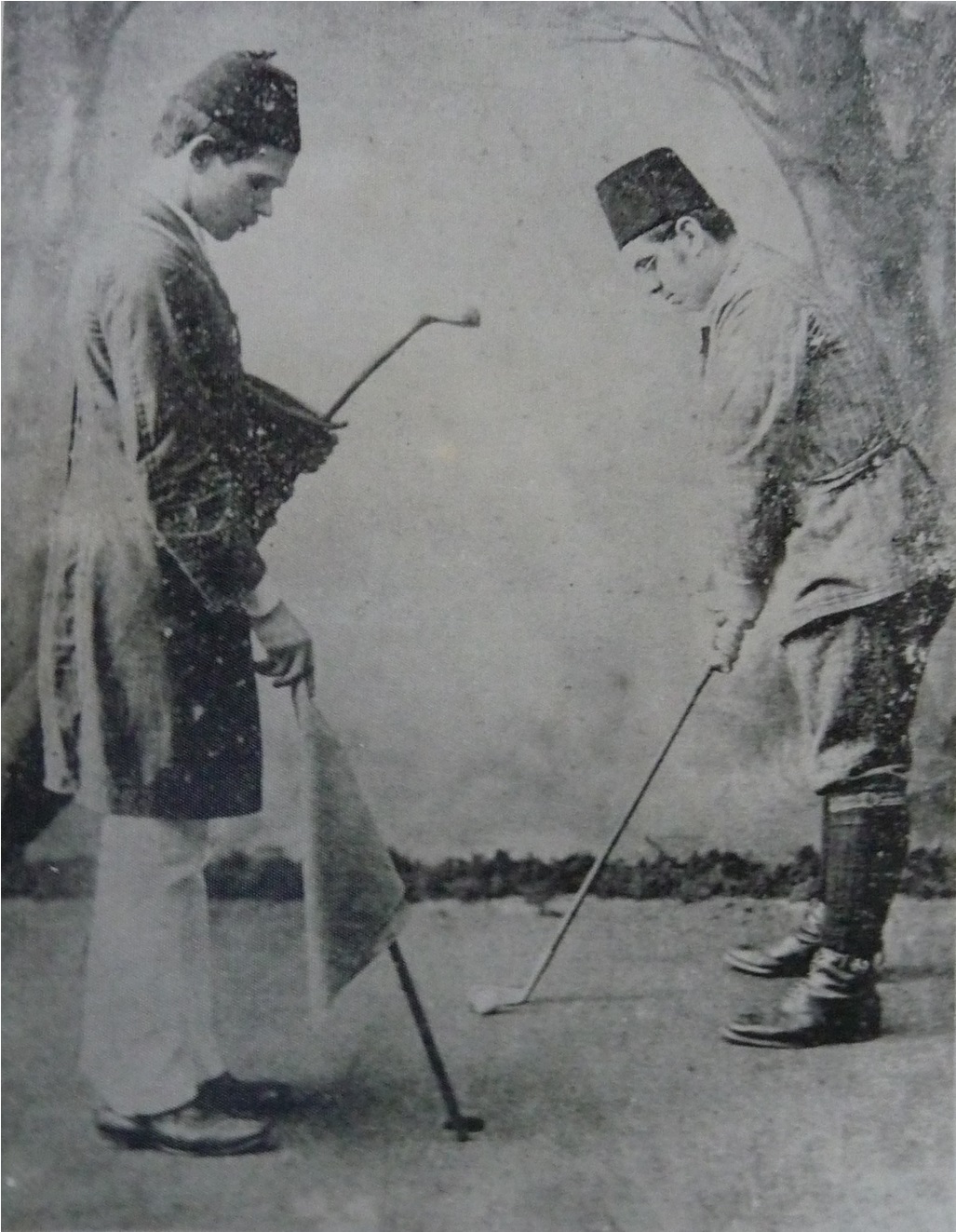
Photograph of Imam Sultan Mahomed Shah, His Highness the Aga Khan, playing golf in his youth.
~~~~~~
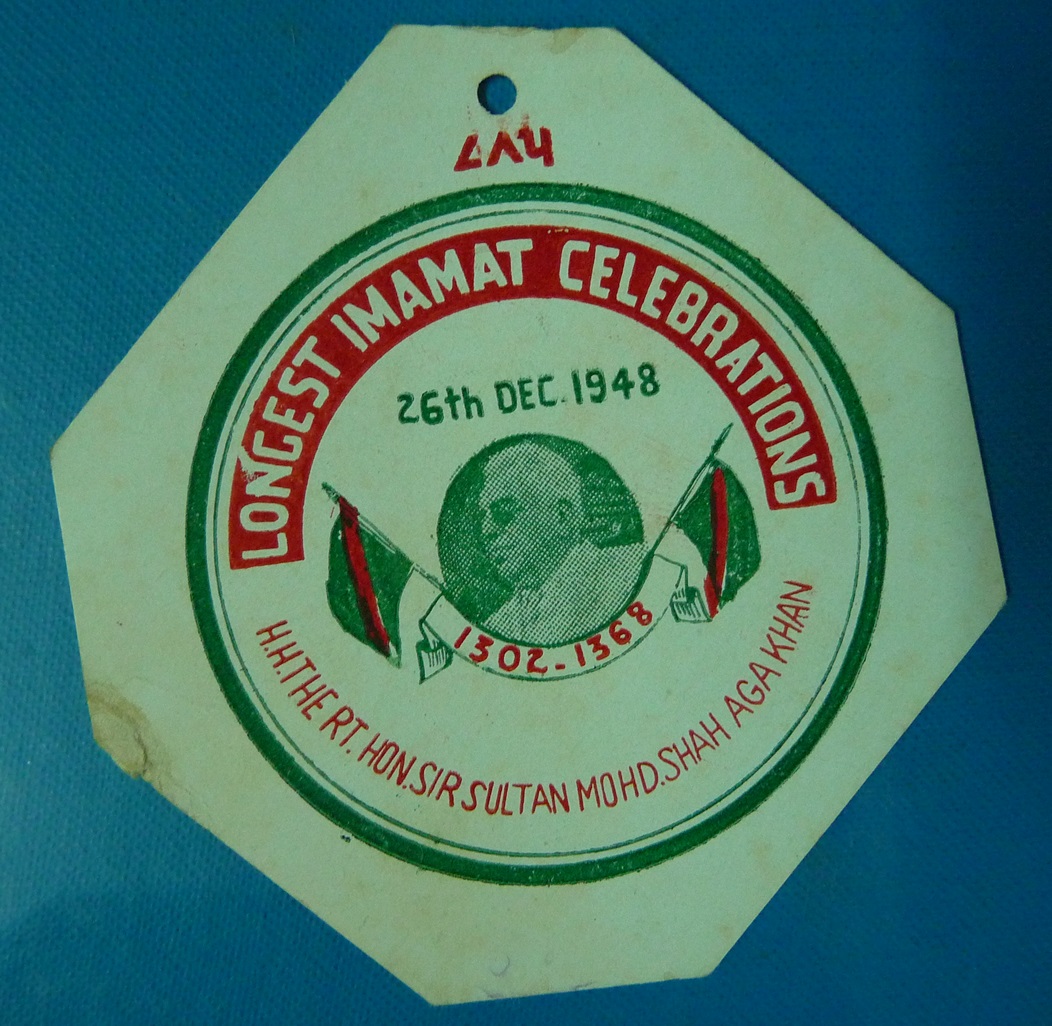
Souvenir produced to mark the occasion of the milestone reached by Imam Sultan Mahomed of the longest-ever Imamat in 1948 after surpassing 63 years as Imam of the Ismailis at the age of 71 years. The 48th Imam died nine years later on July 11, 1957, at the age of 79 having been the Imam for 71 years. He became the Imam in August 1885 at the age of 7.
While assessing the full extent of the damage is still an ongoing process, a number of items were able to be saved including a unique collection of Khojki manuscripts which were housed in fire retardant boxes. When I first heard about the tragedy the next day, I was devastated to learn of the loss of such a treasure trove of materials so important to better understanding the history of the Ismaili community. I had had the opportunity to consult the library on several occasions during my visit to Karachi over the years, including on my last visit in 2013. I was amazed from my first visit in 2006 at the breadth and richness of the collection and easily lost myself for hours and days within the library perusing its shelves, flipping through the pages of its meticulously organized items and often feeling a sense of delight at a personal discovery of a publication or image I was unaware of or that shed important light on a question I’d been pondering.
Story continues below
A picture of the first Muslim Baronet in British India, Sir Karimbhoy Ibrahim published in one of the earlier Ismaili periodical publications, Ismaili Sitaro in July 1910.
~~~~~~
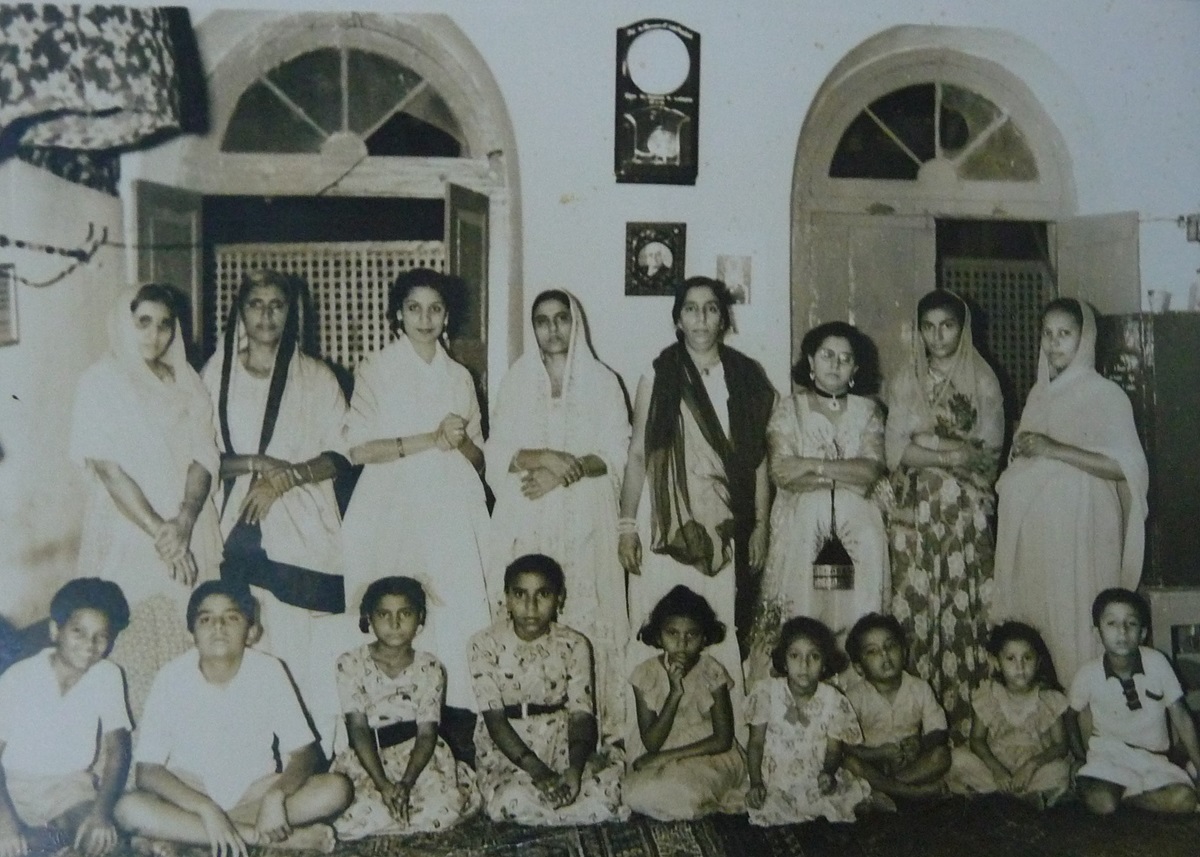
Photograph of women and children of the Ismaili Jamat in Aden, Yemen.
~~~~~~
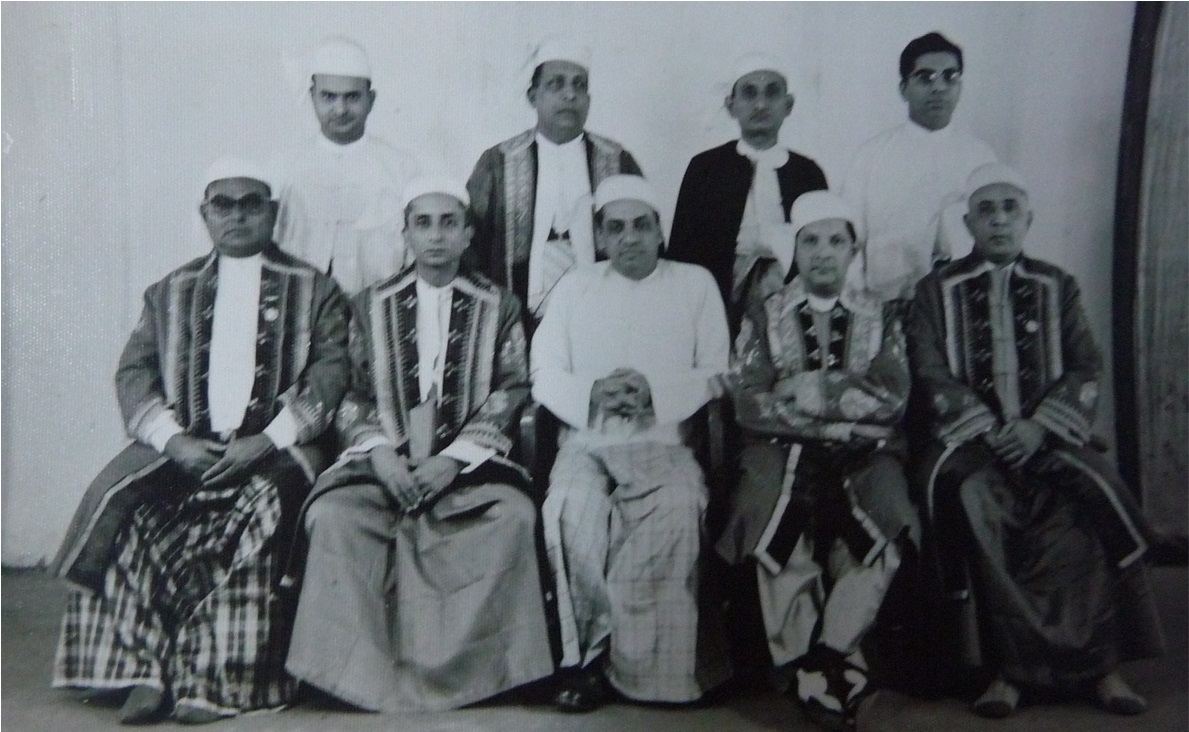
Photograph of members of the Ismaili Supreme Council, Burma 1958.
My own research interests were in the printed collection of the library in English and Gujarati including the photographic documentation of the community in the Indian Subcontinent and around the world. I had taken the opportunity to photograph umpteen works so that I could consult them in more detail and at my leisure once I returned to my home and now I realize the singular importance of those acts of documenting the legacy of the production of individual Ismailis and of Ismaili communities and institutions around the world. Much of ITREB’s Central Library collection owes a debt to Ismailis in Karachi, Pakistan, and around the world who donated materials including photographs as well as the library’s role in actively obtaining and safeguarding those materials.
Story continues below
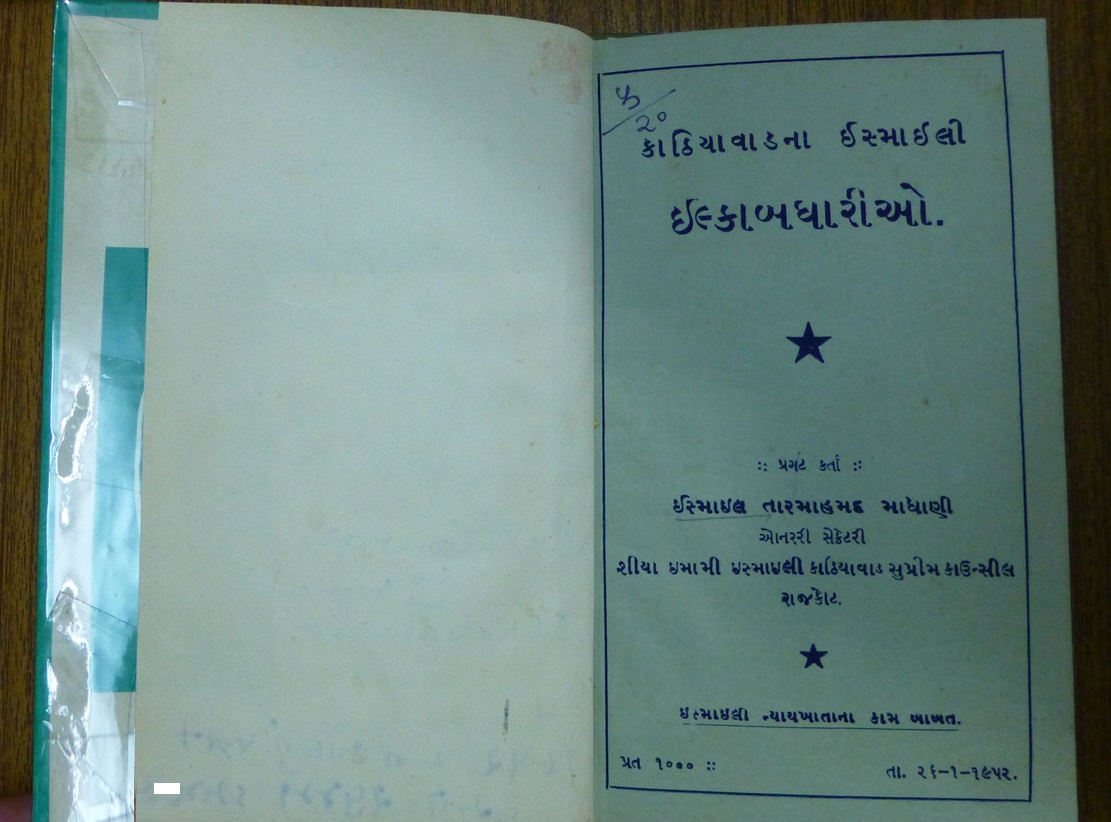
Cover page of the Kathiawadana Ismaili Ilkabadhara’o, Ismaili Census of Kathiawar published by Ismail Tarmahmad Madhani, Honorary Secretary of the Imami Ismaili Kathiawar Supreme Council Rajkot, 1952.
The Importance of Local Libraries
Since the establishment of The Institute of Ismaili Studies in London in 1977, a central repository of the community has been under development and many familial, local, institutional and national collections have been kindly donated to the IIS for safekeeping, preservation, digitization with the larger mandate of providing resources for research. However, before that, the guardians of these materials were often personal collectors, families and smaller institutions such as The Ismaili Society and Ismailia Associations, the predecessors of the now-ITREBs as well as local Jamatkhana libraries. In fact, it was because of these collections, not necessarily large-scale libraries, that scholars such as Wladimir Ivanow, Husayn Hamdani, Asaf Fyzee, Jawad Muscati and many now celebrated Nizari Ismaili authors, scholars, khalifas and waezeen of current and previous generations were able to make breakthroughs in their understanding of the Ismaili past and had source materials for their research.
Story continues below
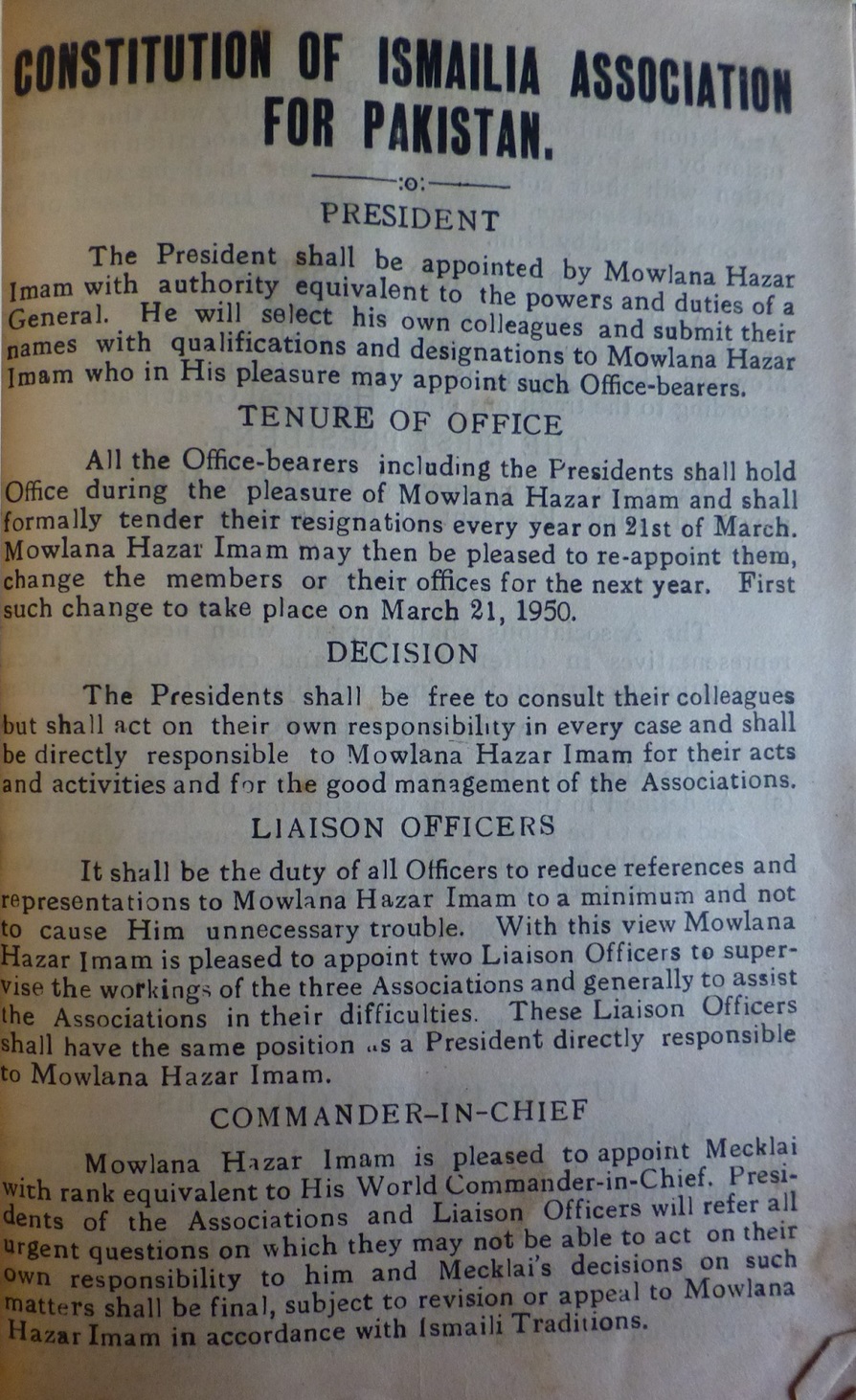
The cover page of the Constitution of the Ismailia Association of West Pakistan from 1950.
~~~~~~
The opening page of the Constitution of the Ismaili Association of West Pakistan from 1950 outlining the system, structure, and rules that were to be abided by for members of the Ismailia Association of West Pakistan (in contrast to the jurisdiction of East Pakistan, which eventually became Bangladesh).
The importance of these regional libraries, especially for local researchers, cannot be underestimated. Throughout my travels over the past 25 years to areas where Ismailis live or once lived, its has often been the works preserved in individual homes, in smaller institutional collections and in local and regional Jamatkhana libraries that have provided some of the most unique documents and witnesses to history; and it is through them that have come the greatest insights and breakthroughs. Large institutional collections such as those of national libraries or of learned societies have become more accessible as they digitize their collections, but it is our debt to local institutions that cannot be underestimated.
Story continues below
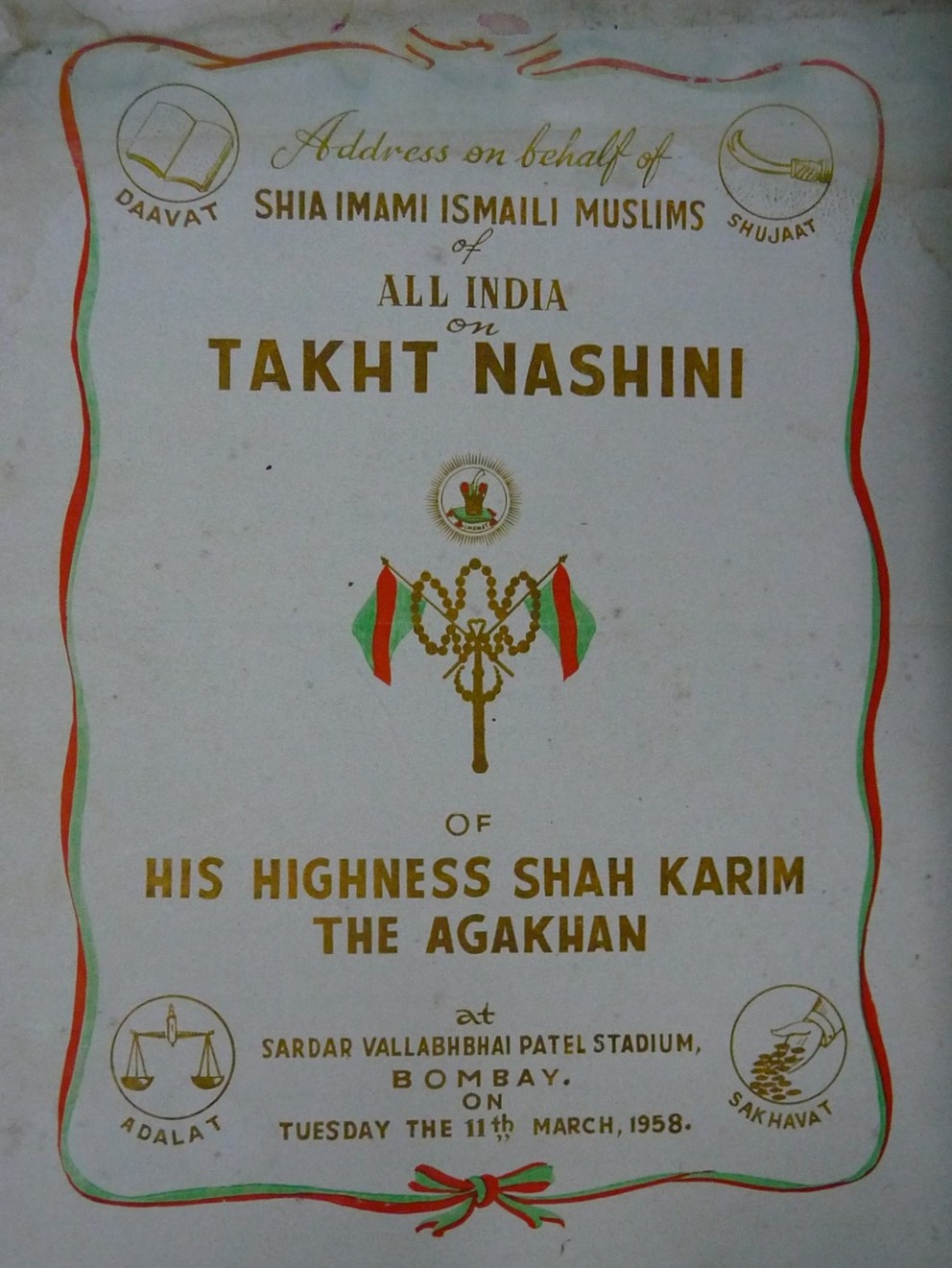
Cover of the Souvenir of Mawlana Hazar Imam’s Takht Nashini (accession ceremony to the office of Imamat) in Bombay in 1958.
~~~~~~
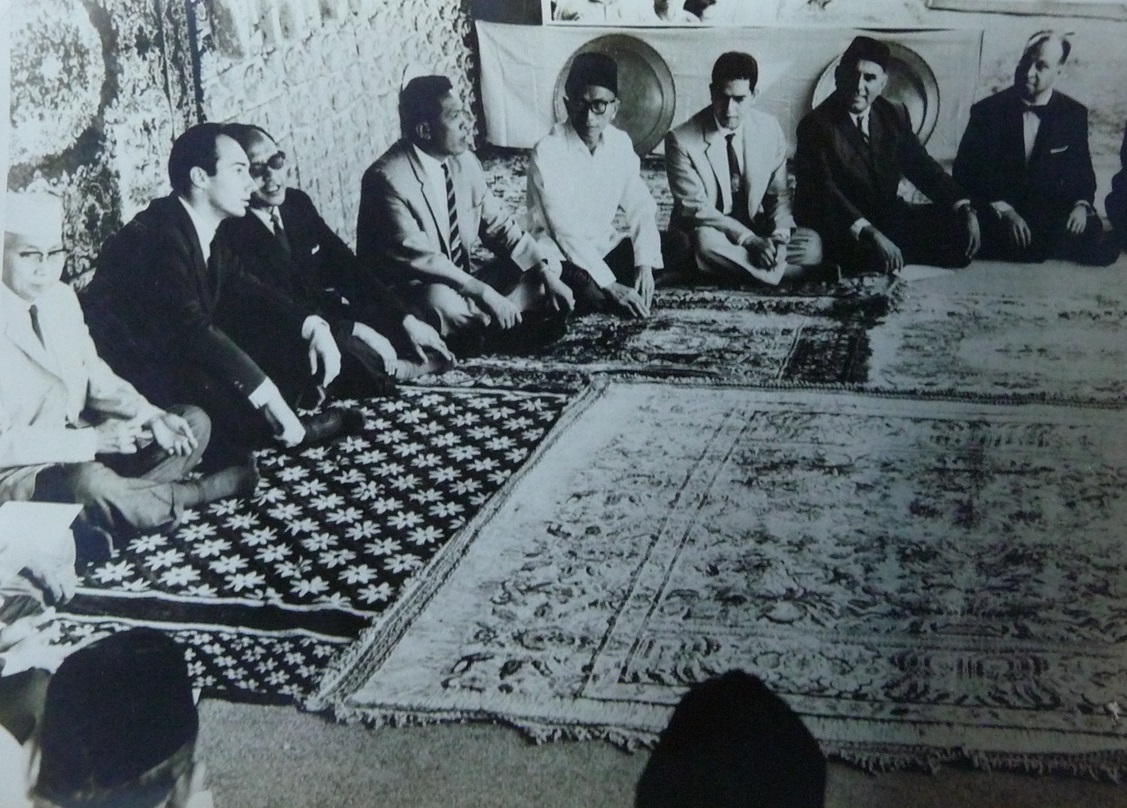
Mawlana Hazar Imam at a meeting with the leadership of Mindanao University and Kalimul Islam Colleges, Philippines during his visit in 1963. The information on the back of the photo reads: “Kamilul Islam Colleges Convocation Function in Honour of H.R.H. Prince Karim Aga Khan. The Aga Khan is seen sitting in the Philippine Native style flanked by Dr. Antonio Isidro, President of Mindanao State University on his right and Honourable Ahmed Domocao Alanto President of Colleges on his left. In the picture also are seen Mr. Amirali Fancy on his extreme left (back to camera) and Captain Amirali Currim second from the right, both wearing Philippine caps, who accompanied H.R.H on Philippine tour as his ministers”.
~~~~~~
Local institutions, including Jamatkhanas, throughout the world have often preserved innumerable documents, manuscripts, published works, photographs and even newspaper cuttings which shed light on one of the least understood and most complex periods of Ismaili history — the last few hundred years. As Jamats in local environments fell under the dominion of various empires and rulers, and later national governments, local histories become increasingly important for understanding how Ismaili communities have come to be where they are today.
Story continues below
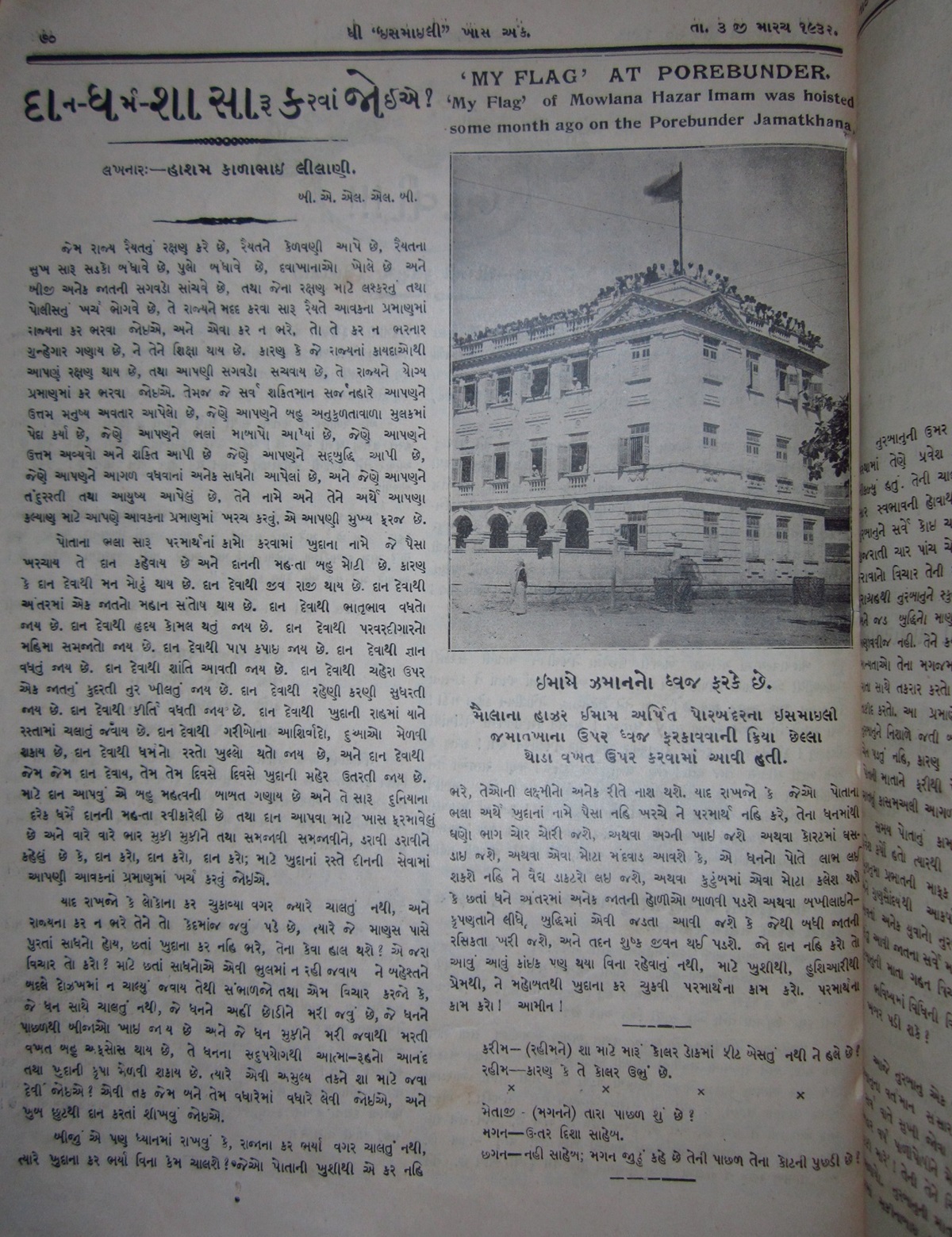
A page from The Ismaili magazine, March 3rd, 1932 edition showing a photograph of the newly raised “My Flag” at Porbander Jamatkhana.
Furthermore, since the early 1980s as part of the global processes of standardization and institutionalization, the focus of important publications such as local Ismaili magazines have shifted the majority of their spotlights to the Imam, his family and the work of Imamat institutions where previously the magazines also included much more detail, output on the production and development of Ismaili communities through the lens of the local and told from the ground-up. While there has been many things gained in the centralization of the Ismaili magazines, one of the most notable losses has been the capturing of stories of the ground realities, literary output, reflections of individual Ismailis and the vibrancy and details of the local development of Ismaili communities.
Story continues below
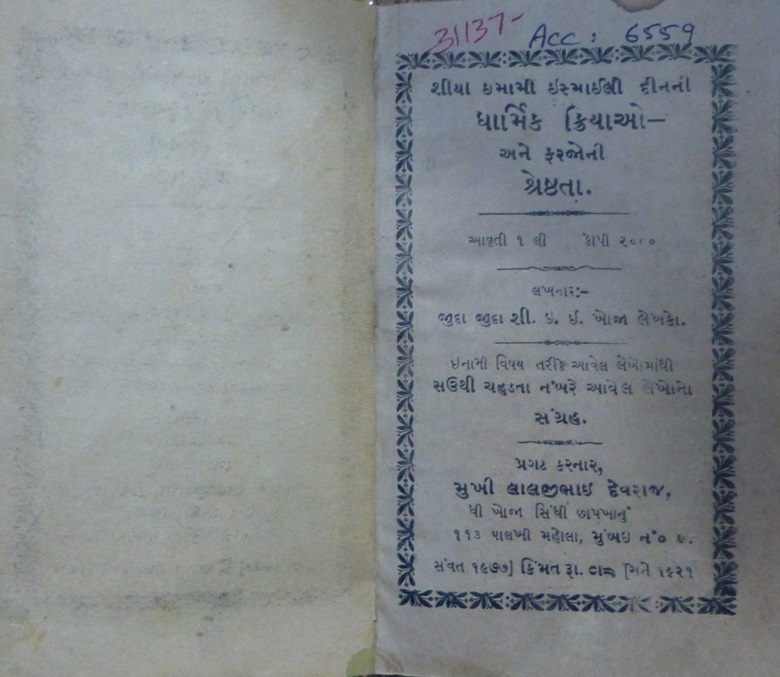
The cover of a text on religious ceremonies by Mukhi Laljibhai Devraj published by a Sindhi press in Mumbai in 1921.
~~~~~~
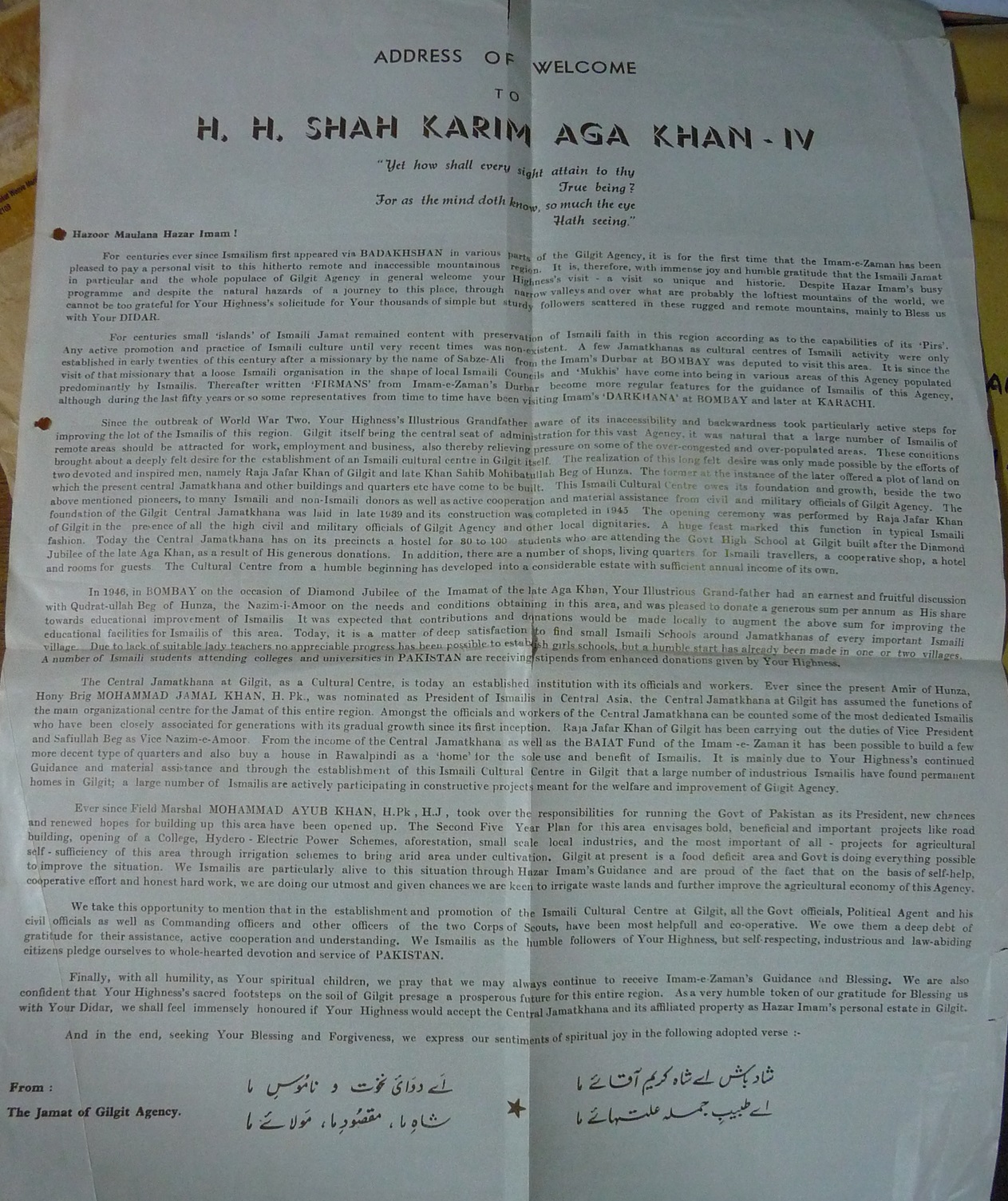
Address of Welcome offered to Mawlana Shah Karim Hazar Imam, His Highness the Aga Khan, on the occasion of his first visit to the Gilgit Agency in October 1960.
~~~~~~
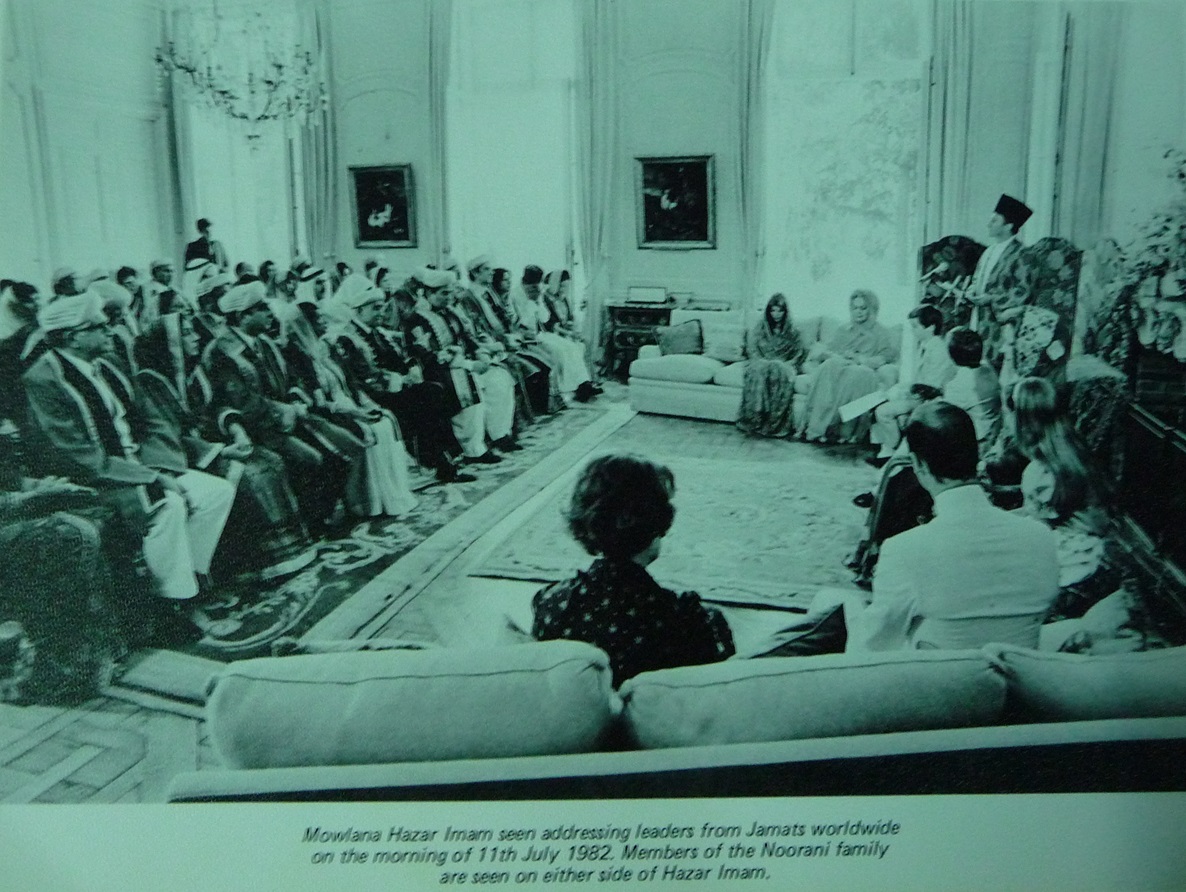
Mawlana Hazar Imam, His Highness the Aga Khan, addressing leaders of the global Jamat in the presence of his family on July 11, 1982, the occasion of his Silver Jubilee as the 49th Imam of the Ismaili Muslims.
I wrote this short piece with the hopes that it would be an homage or memorial of sorts to the Central ITREB Library Pakistan and to encourage families and small institutions to safeguard their collections for the benefit of the community in the service of documenting its past. We must also remember that just as important, however, is to preserve the present for future generations.
Date posted: November 11, 2023. Last updated: November 13, 2023 (see editor’s note at top of page).
__________________
About the author: Rizwan Mawani has a background in Anthropology and Religious Studies and is the author of Beyond the Mosque: Diverse Places of Muslim Worship (I. B. Tauris in association with The Institute of Ismaili Studies, 2019). Rizwan has written for a wide variety of audiences and his work has appeared in academic publications, encyclopedias as well as the Wall Street Journal and The Huffington Post. Rizwan was previously Website Content Editor and Research Coordinator in the Department of Constituency Studies at The Institute of Ismaili Studies. His current research focuses on the past two centuries of global Ismaili history with a focus on the Jamatkhana and its development during that period.
[An extended version of this post can be read on Simerg’s sister blog Barakah which was launched in 2017 as an honour and dedication to the 49th Hereditary Ismaili Imam, Mawlana Shah Karim al Husssaini, His Highness the Aga Khan, on the auspicious and historic occasion of his 60th Imamat anniversary or the Diamond Jubilee — Ed.]
When the 48th Ismaili Imam, Mawlana Sultan Mahomed Shah, His Highness the Aga Khan, passed away on July 11, 1957 at the age of 79, he chose his 20 year old grandson, Shah Karim al Hussaini, then a student at Harvard University, to succeed him as the 49th Hereditary Imam of the community.
The late Aga Khan who was born on November 2, 1877, succeeded to the throne of Imamat on August 17, 1885, when he was only 7 years old. His Imamat of 71 years is the longest in the 1400 span of Ismaili history that goes back to the origins of Shia Islam when the Prophet Muhammad — may peace be upon him and his family — appointed his son-in-law, Ali, to continue his teachings within the Muslim community. The current 49th Imam said in an interview, that the Ismailis are the only Shia Muslims to have a living Imam, namely himself.
At the death of the 48th Imam in 1957, Her Majesty Queen Elizabeth II (d. September 2022), sent the following message to the new Aga Khan through her Private Secretary:
“His Highness will be remembered by all for the wise guidance and selfless leadership which he has freely given during his many happy and eventful years. His energetic and devoted work for the League of Nations in a life dedicated to the service of his followers and to the welfare of mankind will long be remembered. In the arduous responsibility which you will be called on to bear as leader of your people, Her Majesty extends to you her sincere greetings and prayers that you may long fulfil your role as counsellor to the Ismaili community who owe you their allegiance.”
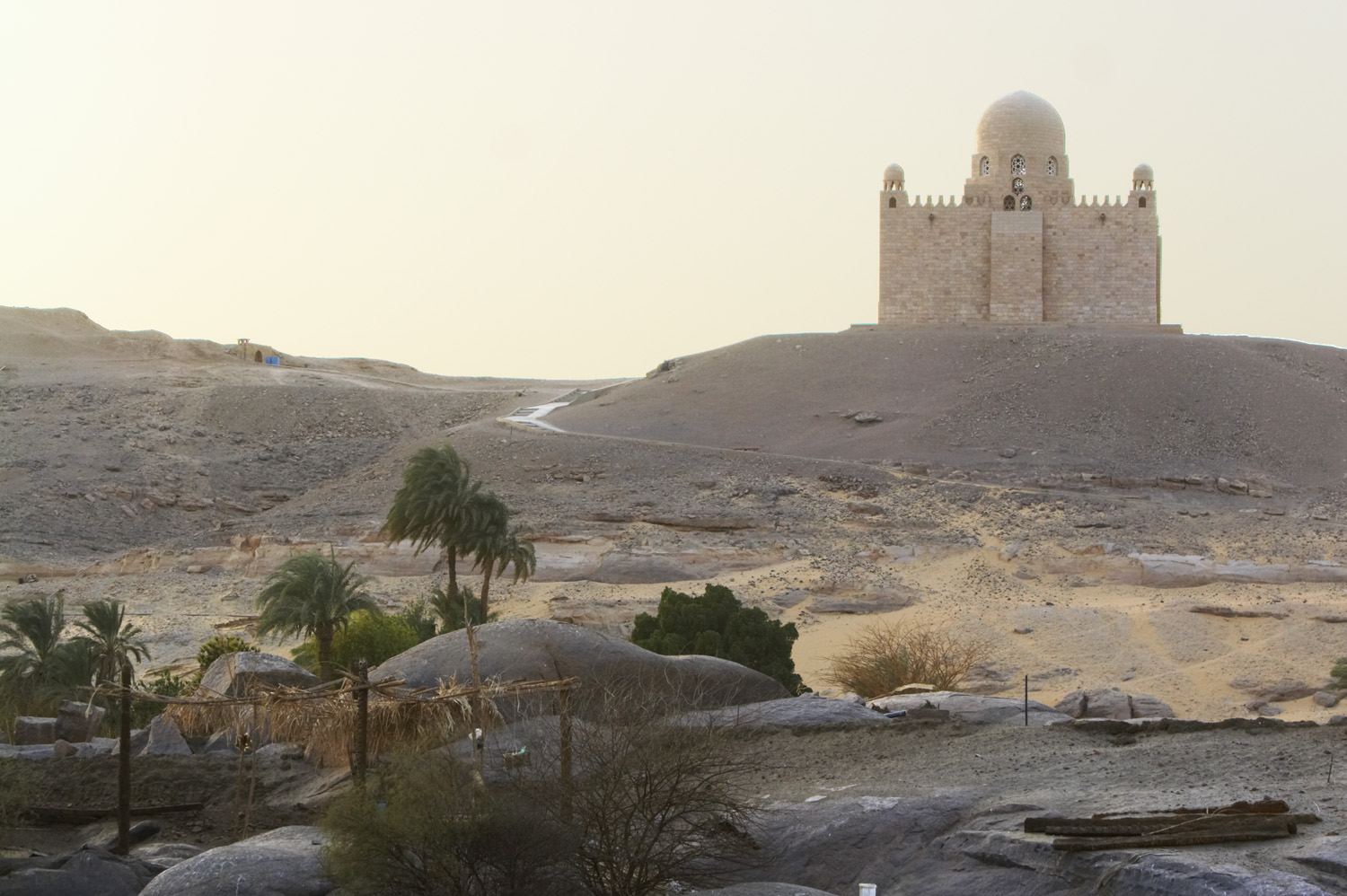
Aga Khan III had long expressed the wish that his burial should be in Aswan, Egypt. His wife, the Begum Om Habibeh Aga Khan, undertook the monumental task of coordinating the construction of the mausoleum near the villa. The mausoleum was completed in about 18 months. In the meanwhile, the body of the late Imam was temporarily buried in the compounds of the Villa. The final burial then took place on February 19, 1959.
We present a selection of photographs of the mausoleum as well as other images from the historical day (for more details and photos see the post in Barakah.)
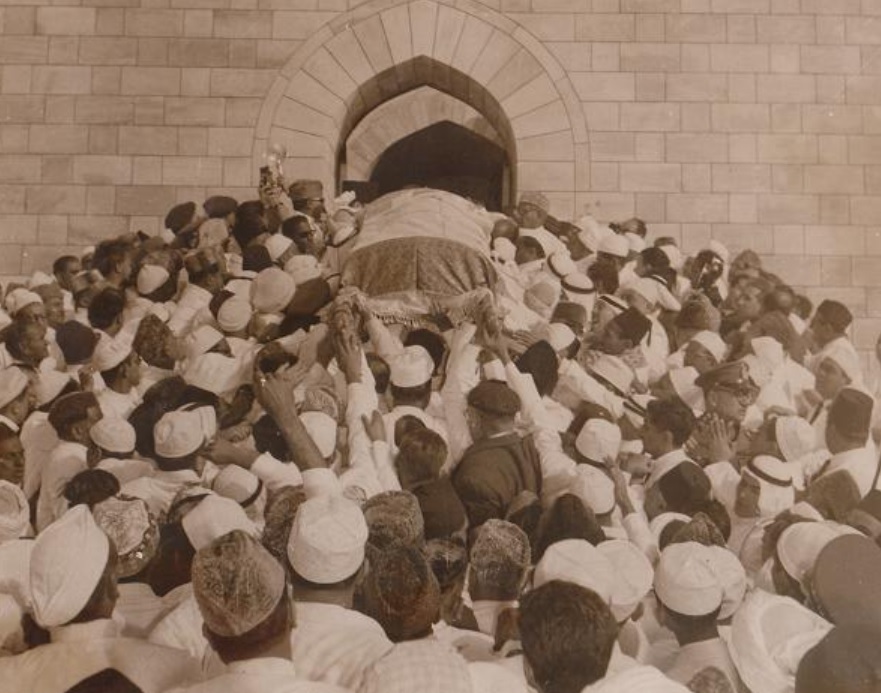
The successor of Aga Khan III, Mawlana Sha Karim al Hussaini, His Highness the Aga Khan, left, his uncle Prince Sadruddin Aga Khan, right, and his younger brotehr Prince Amyn Aga Khan at the back, carrying the shrouded body of the 48th Ismaili Imam, Mawlana Sultan Mahomed Shah, from its temporary resting place to the mausoleum. Photograph: Jehangir Merchant collection.
Mourners watch as the body of the 48th Ismaili Imam, Mawlana Sultan Mahomed Shah, His Highness the Aga Khan, is carried into the mausoleum, February 19, 1959. Photograph: Jehangir Merchant collection.
Mawlana Hazar Imam, His Highness the Aga Khan, pictured on October 19, 1957 at his 1st Takhtnashini or ceremonial installation, held in Dar es Salaam, Tanganyika (now Tanzania). He became the 49th Imam of the Shia Imami Ismaili Muslims,on July 11, 1957 at the age of 20. Photograph: Ilm Magazine, July 1977.
“Today, I am speaking to you in a city and in a country which have a particular meaning to my family and myself. On 2nd November, 1877 my beloved grandfather was born here in Karachi. Through 72 years of Imamat, he guided his spiritual children to happiness and prosperity” — Karachi, August 4, 1957.
“Many many memories come to our minds as we think of him. He achieved in his life, for our community that which could only have been accomplished normally in a period of many generations. The tributes that the world has paid him bear honest testimony to his great life and work” — Takhtnashini, ceremonial installation, Karachi, Pakistan, January 23, 1958.
Date posted: February 21, 2023.
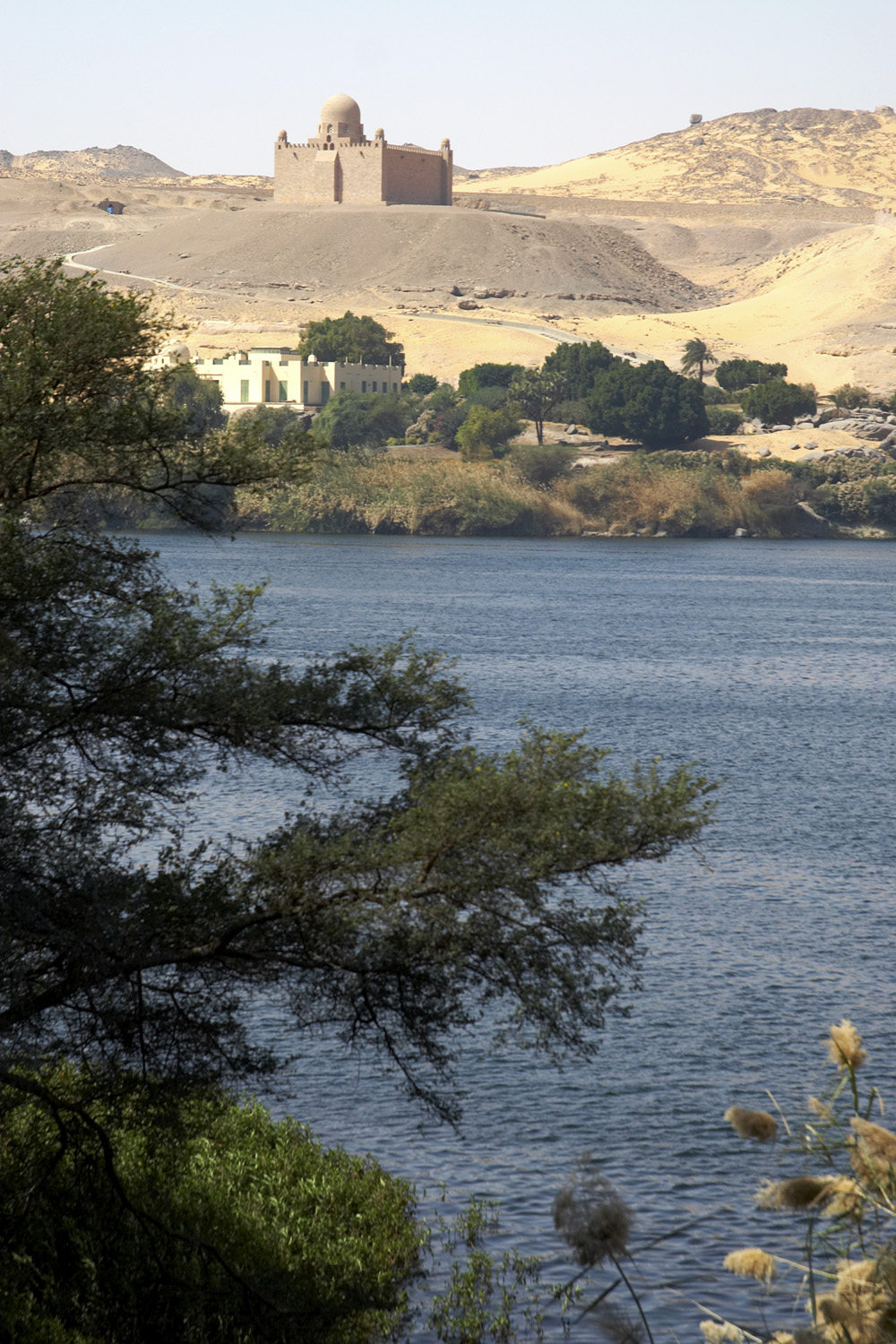
Featured image at top of post: The mausoleum of Mawlana Sultan Mahomed Shah, His Highness the Aga Khan, overlooking his villa and the Nile. Photograph: Motani Family collection, Ottawa, Canada.
_________________
For an extended version of this post please click HERE.
Before departing this website, please take a moment to review Simerg’s Table of Contents for links to hundreds of thought-provoking pieces on a vast array of subjects including faith and culture, history and philosophy, and arts and letters to name a few. Also visit Simerg’s sister websites Barakah, dedicated to His Highness the Aga Khan, and Simergphotos.
“As he says in his own introduction to the book, Otte engaged in a deep research of the photo archives of the Aga Khan, finding images chosen for their quality but also for the fascinating story they tell. The result is a unique collection of photos, many of which have not been published before, but which, taken together, form a visual biography. It is a book about His Highness the Aga Khan, but it is also a portrait in time and space of the world seen from a different perspective, one of endless change and movement, but also one of hope” — Philip Jodidio, Preface, p. ix, “Depth of Field: The Aga Khan Beyond the Lens”
~~~~~~~~~~~~~~~~~~~~~~~~~~~~~~~~~~~~~
DEPTH OF FIELD: THE AGA KHAN BEYOND THE LENS, edited by Gary Otte with texts by Bruno Freschi, Philip Jodidio, Don Cayo and Gary Otte Hardcover 260 pp. Published by Prestel, February 2022; 220 colour illustrations. To purchase the book, please see links provided immediately after the article.
~~~~~~~~~~~~~~~~~~~~~~~~~~~~~~~~~~~~~
Reflections
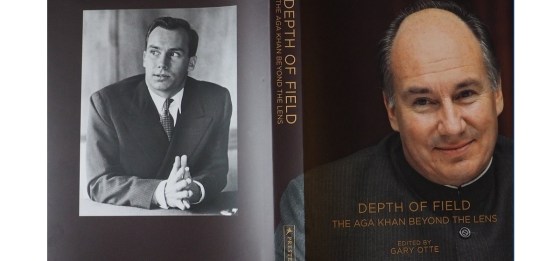
Cover jacket of Depth of Field: The Aga Khan Beyond the Lens; Hardcover, 260 pages, 25 x 30 cms, 220 colour illustrations; published by Prestel, February 2022.
By NIZAR A MOTANI, PhD
I have used the Aga Khan and Hazar Imam interchangeably in my reflections about this visual biography of him, by Gary Otte
When I finally received the long-awaited book about Hazar Imam, I gleefully looked at the cover, actually the “jacket,” with his picture. It was intriguing that this photograph portraying Hazar Imam had part of his shoulder hidden: it was found in the inside “folding”, which also has an extract from the Preface. The complete photograph appears on page 121. Then, I instinctively and happily thumbed through this delightful “coffee table” edition, as if it was just an album, though about a familiar figure, without much thought and not reading most of the captions. It soon became apparent that the three essays preceding the photographs must have a purpose and should be read before taking a second closer look at them. In my humble opinion, this is what every viewer should do since these textual and contextual commentaries guide the viewer to not only how to view the images, but also, and more importantly, to ponder over them to see beyond these images, which collectively constitute a pictorial biography of the Aga Khan.
The editor of this milestone photographic record, Gary Otte, explains in the Introduction, that as the Aga Khan’s principal photographer for some thirty years, he had ample, varied and exhausting opportunities to capture a lot of “interesting stuff.” He witnessed happenings at “exotic and iconic locations; global leaders and ordinary folks”; — and events of great historical, cultural, religious and economic significance (p. xi).
~~~~~~~~~~
“In an age dominated by moving images, still photographs continue to carry remarkable power. Nothing captures a moment as memorably. There is no movement to miss, no soundtrack to distract. It is the still photograph that becomes iconic – a fraction of a second with great impact that people can readily call to mind. Few moments in film or video imprint themselves so clearly. It is that single frame from a vivid scene that we carry with us… Like all the photographers who covered the life of the Aga Khan, I benefitted from his acceptance of us as chroniclers of history” — Gary Otte, Introduction, p. xiii, “Depth of Field, The Aga Khan Beyond the Lens”
~~~~~~~~~~
The two hundred twenty meticulously selected photographs — ninety by him and 130 taken by some fifty other photographers — take the viewers on a panoramic tour of all aspects of the Aga Khan’s amazing life. They are not chronologically presented but were chosen because they were deemed “technically, compositionally, and editorially excellent” and were “more representative of geography, subject area and decades.” (p. xi).
Otte recommends viewers to inspect and revisit all the photographs because “every long look can reveal something new as you discover or imagine, what is happening.” (p. xi).
Philip Jodidio, a prolific author and an expert on contemporary art and architecture, has written a glowing Preface in which he comprehensively and chronologically portrays the major initiatives of Hazar Imam, who is described as “one of the most fascinating personalities in the world….he is a spiritual leader, the driving force behind numerous humanitarian and cultural organizations” as well as “one of the most important figures who has sought to bridge the divide between the Muslim world and the West” (p. v).
By reading this essay, themes and patterns will emerge in the two hundred twenty otherwise randomly presented photographs. The renowned Bruno Freschi’s brief but telling Foreword is centered on his deep respect for Otte’s superb photographic skills as well as his profound admiration of Otte’s extraordinary subject’s (The Aga Khan’s) ambitious, multidimensional, multifaceted mission, which has been so diligently and visually portrayed.
The Aga Khan’s mission, or more appropriately, his mandate as the Imam of the Shia Ismaili Muslims, has been succinctly conveyed in excerpts from one of his numerous speeches (p. xvii) and from his historic address to the special joint session of the Canadian Parliament, on February 27, 2014. Thankfully, Jodidio has excerpted the essence of this speech in his Preface (p. v).
~~~~~~~~~~
“Gary’s photography and his curation have produced a collection with a magical quality. The reader/viewer is transported into the event-image reality. The photography is the doorway into the spirit of the frozen moment. These event-moments are the curtain in the great theatre of life. Once the curtain is raised it reveals the compelling life story of the Aga Khan, an elegant portrait of his historic mission” — Bruno Freschi, Foreword, p. xv, “Depth of Field: The Aga Khan Beyond the Lens”
~~~~~~~~~~
In my reflections on just a few of the photographs in this non-chronological historical biography, I hope to be faithful to the sound, revealing guidance on how to embrace each image. Evidently, beyond and behind the photographs, there must be careful and plentiful preparation and coordination, prior to, during, and even after each different event: airport arrivals and departures; protocols; media liaison; motorcade escorts; security arrangements; translators, meetings with heads of state and other leaders; banquets and speeches — to think of just a few. The photograph on page 212 shows Dr. Shafik Sachedina, Head of the Department of Jamati Institutions at the Diwan of the Ismaili Imamat, and Dr. Mohammed Khesavjee, who served as the Information Officer at Mawlana Hazar Imam’s Secretariat at Aiglemont for many years, playing complementary roles behind and at the scene. Most photographs do not show such senior and other personnel in the Aga Khan’s entourage doing the critical groundwork.
The photograph on page 163 shows Hazar Imam thanking the police escort for his motorcade. He is always mindful of the very many individuals, institutions and organizations involved during his official visits as the state guest of the host governments, and he is known to unfailingly acknowledge his gratitude to all of them. Only some of them can be seen in some of the photographs, but they were there and we have to imagine them, as explained by the editor.
Article continues below
Jacket, “Depth of Field: The Aga Khan Beyond the Lens,” 220 photographs
In 1983 and 2008, the Aga Khan, the 49th hereditary Shia Imami Ismaili Muslim spiritual leader paid official visits as the guest of the ruling Sunni family of the emirate of Dubai (pp. 134 and 135). Significantly, the 2008 occasion was the opening ceremony of the new Ismaili Centre. We can only imagine the elaborate preparations and protocols for this historic event. Being invited as a virtual head of state by governments across the world is an unmistakable theme of this fascinating volume. So much planning and coordination by so many unseen volunteers and paid staff within and outside the Ismaili jamat is always the case.
______________________
READERS SHARE THEIR THOUGHTS ON “THE AGA KHAN BEYOND THE LENS”
This fabulous book with its layout, font, selection of photos and essays is extraordinary — Moez Murji
The photographs chosen are not only beautiful but were also very carefully selected, and each carries a deeper message of the Aga Khan’s incredible — and farsighted — vision. It’s indeed remarkable and an occasion of immense happiness for the Ismailis that the unbelievable results that have been achieved by Mawlana Hazar Imam in so many countries around the world are finally covered in such a well condensed pictorial book — Amin Jaffer
In this 280-page bumper pictorial biography of Mawlana Hazar Imam, which I ordered and have already received it as one of my living room’s table top collections, some of the pictures will bring alive our individual and family memories — Kamruddin Rashid
Beautiful! Now [after reading Nizar Motani’s reflections] I have to go back to the Visual Biography (love that!!) and look at it differently! Different viewers may have different meanings to different pictures. Great job Mr Gary Otte for the book and Nizar Motani for his reflections on the book — Mirza Smile
______________________
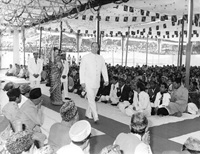
Gary Otte’s very first illustration is a two-page panoramic view of the October 1957 Dar es Salaam Takht Nashini. It requires deep individual contemplation to merely “digest” the thousands in attendance. And much more imagining of the hundreds more involved in numerous aspects of staging this majestic enthronement ceremony, in a British colonial African country, with several non-African immigrant minorities among the heterogeneous African populations, can be a challenging mental exercise!
It is almost on the eve of the 50th anniversary of the August 4th 1972 mass Asian Expulsion by Uganda’s mercurial megalomaniac military dictator, Idi Amin Dada, that I am encountering Hazar Imam’s somber photograph with Amin. It was taken during Hazar Imam’s critical February 1972 visit to Kampala (p. 59). I was still in London completing my doctoral dissertation on the topic of Uganda’s African Civil Service, hoping to teach African History at Makerere. It so happened that I returned on that fateful day — August 4th 1972, not to a much anticipated warmest welcome at the Entebbe Airport, but to most somber news, from my parents, about the expulsion order issued just prior to my arrival!
~~~~~~~~~~
Such an epic volume should be an occasion of immense pride and happiness for every Ismaili murid. Gary Otte has clearly acknowledged that Hazar Imam remained very accommodating and patient during the long period of compiling this unprecedented collection…and has thanked Hazar Imam for taking the time to offer suggestions on choosing the photographs and the book’s design. Princess Zahra, Prince Rahim and Prince Hussain gave their time and advice on selection of photographs and the final draft of images and the text. Hence this official authorized visual biography of our 49th Imam and a once in a life time publication, should belong in our homes — Dr Nizar Motani, author of this post
~~~~~~~~~~
Therefore being absent from Uganda during Hazar Imam’s February visit, I can only imagine the challenging task of the local Ismaili entourage and leadership on how to brief Hazar Imam for any meeting with such a vainglorious man controlling the destiny of all Ugandans. Could Amin have given any clear signal about what was brewing in his mind prior to the alleged dream to ethnically cleanse Uganda of its much maligned Asian minorities? Could Hazar Imam have sensed any forebodings in order to prepare for all eventualities — since the expulsion order’s short deadline was met with fairly well-organized and timely evacuation under the most harrowing circumstances? I was one of the lucky ones who chose to and could leave, within a week, for the USA, but remained tormented and concerned about the rest of the family’s fate who had to plan their escape. This image on page 59 may linger for a long while but with deep gratitude that almost all Asians escaped relatively physically unscathed.
I will conclude my brief reflections about this unique official pictorial biography of the Aga Khan, our beloved Hazar Imam, by simply stating that such an epic volume should be an occasion of immense pride and happiness for every Ismaili murid. The editor, Gary Otte, has clearly acknowledged that Hazar Imam remained very accommodating and patient during the long period of compiling this unprecedented collection of mostly previously unpublished photographs, from his childhood in Kenya to the Diamond Jubilee celebrations in various parts of the world, where he was welcomed by the host countries’ Heads of State as a virtual visiting head of state.
Gary Otte has thanked Hazar Imam for taking the time to offer suggestions on choosing the photographs and the book’s design. Princess Zahra, Prince Rahim and Prince Hussain gave their time and advice on selection of photographs and the final draft of images and the text.
Hence this official authorized visual biography of our 49th Imam and a once in a life time publication, should belong in our homes. It also makes a wonderful gift to give to thoughtfully selected non-Ismaili friends and colleagues to increase their awareness of the Aga Khan which Jodidio has stated may be lacking in the general public. But even we, his murids, will be be astonished and overjoyed to learn so much that we cannot possibly already know about or have seen images of his multifarious undertaking, as well as his personal life.
One final thought, as I take the elderly members of the Jamat into consideration. Mawlana Hazar Imam’s life, through the photographs in this book, spans three generations. How exciting and inspiring might it be for the elders, were their children and grandchildren to sit alongside them and leaf through all the beautiful photographs of their beloved Imam, not once but on multiple occasions. Old memories would be revived and new stories, narratives, anecdotes, and perspectives would emerge, individually and collectively, adding to our knowledge of Mawlana Hazar Imam’s glorious life and Imamat. This book MUST occupy a place in all Ismaili homes.
PURCHASING THE AGA KHAN’S BEAUTIFUL PICTORIAL BIOGRAPHY
The Aga Khan Beyond the Lens; Hardcover, 260 pages, 25 x 30 cms, 220 colour illustrations; published by Prestel, February 2022.
The publisher’s recommended retail price for Depth of Field: The Aga Khan Beyond the Lens is US $ 60.00; £ 45.00 but retailers and on-line book sellers may sell it for less. To purchase the book in Canada, click Aga Khan Museum Shop, Amazon.ca or Indigo.ca; in the USA, click Amazon.com; in the UK and other European countries, click Amazon.co.uk; and in Spain and Portugal click Amazon.es. Elsewhere, see if there is a local Amazon chapter serving your location or visit Amazon’s global page. Note that the book is also available for members of the Ismaili community at Jamatkhana literature counters around the world or through the local Jamatkhana leadership.
FEEDBACK
Simerg welcomes your feedback, review and reflections on The Aga Khan Beyond the Lens. Please complete the LEAVE A REPLY form below or click Leave a comment. Your letter may be edited for length and brevity, and is subject to moderation
ABOUT THE AUTHOR
Nizar Motani
Nizar A. Motani has a doctorate from the University of London (SOAS) in African history, specializing in British colonial rule in East Africa. He has been a college professor at Bowdoin College (Brunswick, ME) and Western Michigan University (Kalamazoo, MI). He was the first Publication Officer at the Institute of Ismaili Studies (London, UK). He now lives in Atlanta, Georgia.
Dr. Motani’s previous pieces on Simerg and its sister website Barakah are:
A SHORT Youtube Presentation: Gary Otte on the Making of the Book
_____________________
REVIEW SIMERG’S TABLE OF CONTENTS AND VISIT ITS SISTER WEBSITES
Before departing this website please take a moment to visit Simerg’s Table of Contents for links to more than 1500 pieces posted since the website was founded in the spring of 2009. Also visit our two sister websites, Barakah and Simergphotos.
Author Zahir Dhalla’s Preamble: Khojas, and Indians in general, were not known for keeping personal journals. Thus, there is a dearth of records documenting our history. However, the practice of keeping family photo albums was quite widespread. Photos can fill in some of those blanks, provided someone can tell the stories behind them. This would be a valuable series, people digging into their memorabilia and writing the stories behind them. Below then, is my attempt to do so, hoping it can also serve as one of the templates that others may want to use or adapt as preferred.
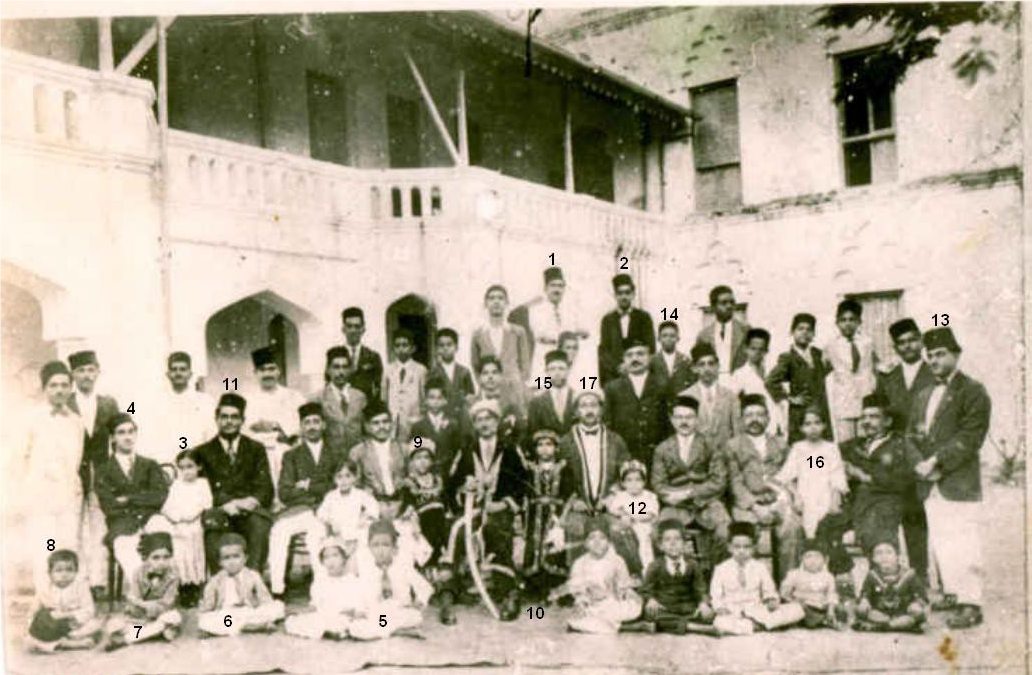
Photo 1: Huseinali Harji (with sword) wedding photo. In the Ismaili Club’s courtyard, Zanzibar, early 1920s. It used to be the British Club where Dr. David Livingstone stayed in the late 1860s. Photo: Safder Alladina, Zerabai’s {10 in photo} youngest son. Captioning: Marhum Kassamali Tejpar, Roshan’s {3} husband. Please click on photo for enlargement.
By ZAHIR K. DHALLA
Gulamhusein Harji Sumar Walji Jendhani* was a pawn broker in the Soko Mahogo neighbourhood of Zanzibar’s Stone Town. Gulamhusein had a large brood, as was common at the time, of 9 sons and 3 daughters, by three wives, the eldest son, Ali {17 in top photo}, being my paternal grandmother Sakarbai’s {16} father. This wedding photo is of Gulamhusein Harji’s third son Huseinali’s marriage to Rukiya.
A guide to individuals in the annotated wedding photo. Dilgir {4} composed the Ismaili anthem.
These are their stories:
All elders and a few toddlers are wearing hats, while youngsters are bare headed, the groom and his eldest brother Ali {17} are wearing ceremonial turbans. By the 1950s, hats were no longer in vogue!
Of the Gulamhusein’s nine sons, Haji (see photo 4, below) and Noorali “Mamma” are not in the above wedding photo. “Mamma” chacha is possibly in the photo, just unidentified.
The Harjis spent, all told, a couple of decades or so in Tanga, Tanganyika (now Tanzania) where at one time they ran a grocery-wines-spirits store called Planters Store. All then left Tanga: Ali {17} going to Mombasa; Haji to Lushoto (see photo 4 below); Hussein {13} to Dar es Salaam; Saleh {2} taking over the grocery business under the name Korogwe Stores, with a branch store in Korogwe, a small town west of Tanga — he also ran a petrol station in Tanga; and Huseinali (the groom) running a chai, toast, maandazi, etc. restaurant called “Karaketa” at the Korogwe railway station, which his widow Rukiya ran after his death.
Story continues after photo
Photo 2: Khatibai and her three sons, right to left, Mohamedali {7 in top photo}, Kasu {6} and Abdulmalek {8}, Tanga, early 1950s.
KASU {6}: Younger half-brother of my paternal grandmother Sakarbai Ali Harji {16}, his is a touching story.
His mother Khatibai (nee Jiwan Lalji, Itmadi, of Zanzibar), a most beautiful lady, became demented (during WWII) and was hospitalized in Nairobi. Her three sons, Mohamedali {7}, Kasu {6} and Abdulmalek {8} (in decreasing order of age; see photo 2, above) conferred and decided that they would buy a native bride in Tanga for Kasu, who would settle there as a fishmonger. His bride, Chausiku, was a fine lady, devotedly looking after Khatibai. Khatibai, despite her condition, could always remember faces. Whenever we visited her, she would smile at each one of us, lighting up the whole room! When both Kasu and Khatibai passed away, Mohamedali sent support money to Chausiku. Before he passed away, he instructed son Zul (a fine guitar player in Nairobi, now in Tri-Cities, British Columbia, Canada) to continue support payments, which he did until one day he received a letter from Chausiku’s family, informing him that she had passed away, so not to send support money any more!
ABDULMALEK {8}: Youngest half-brother of my paternal grandmother Sakarbai Ali Harji {16}, he was the youngest of Khatibai’s sons. There was a comical vignette he told me: In 1940, he and three friends decided to enlist in the army (WW II). Mother Khatibai was against it, while father Ali {17} was okay with the idea. They headed for Nairobi for interviews, and along the way one of them dropped out! In Nairobi, someone questioned them as to what they thought they were doing: Didn’t they know they would get only black tea and burnt roti?
Part of their enlistment interview was an examination of their education:
Q. 7 + 5? A. 11. Wrong.
Q. 14 + 9? A. 22. Wrong.
They all came up short and were told, “All you Mombasa guys are hopeless” and were given tickets to return home. Actually, Abdulmalek’s whole class in Mombasa had failed Cambridge, except for one solitary student! Abdulmalek returned to working at his old job at Fatehali Dhala Grocers for 60 shillings a month, filling candy jars, opening and displaying crates of fruit from South Africa. Once he was in the middle of enjoying a nice peach from South Africa, when in walked Count Fatehali who remarked, “It is good that you are tasting and approving these fruits because only then will customers buy them!”
ALI {17}: Father of my paternal grandmother Sakarbai Ali Harji {16}, he was the eldest of the 9 brothers, born in Zanzibar in c1890. In the late 1920s, he worked at a cotton ginnery in Entebbe, Uganda, alongside my paternal grandfather, Gulamhusein, Ali’s son-in-law to be. His last job was as a detective with the CID (Criminal Investigation Department) in Mombasa. He was engaged by the head of the department, an Abdallah Mzee. But soon Ali crashed his motor bike, badly hurting his leg. He retired! Before he died, he told youngest son Abdulmalek {8} that he would be reborn as his son. Sure enough, within a year of his death, a son was born, Gulamali, named by Mawlana Sultan Mahomed Shah Aga Khan III. Gulamali would go on to play up his grandfather role to maximum advantage –- yes, he was untouchable!
Story continues after photo
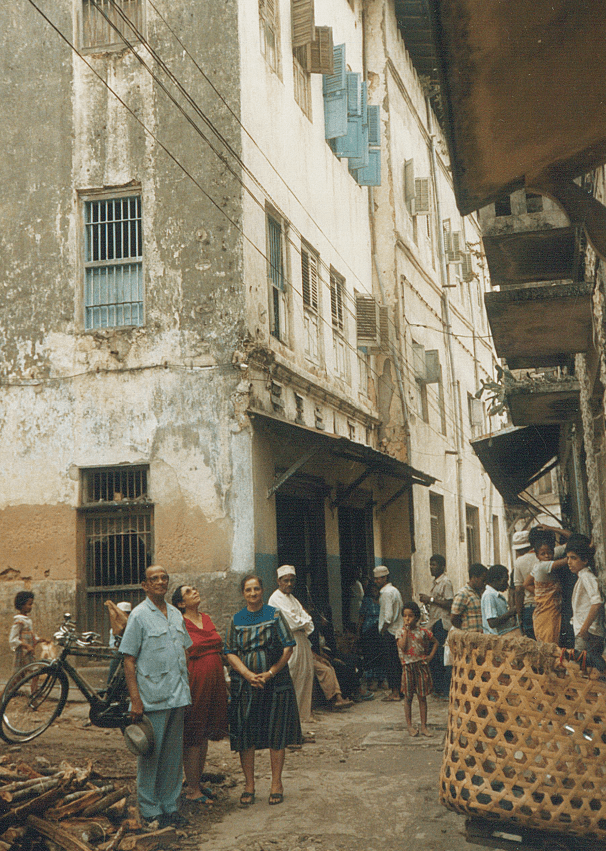
Photo 3:Gulamhusein Harji Sumar residence in Zanzibar.
GULIBAY {9}: Lady Gulibai, first cousin of my paternal grandmother Sakarbai Ali Harji {16}, was very well known in Nairobi. She married Ramzanbha of the K. B. Jamal family, owners of Tropicana bistro on Hardinge Street (now Kimathi Street), as well as of Keby’s restaurant further north of Tropicana.
SAKARBAI {16}: My paternal grandmother was very independent, not wanting to be a burden on anybody, even in death, for she had a small briefcase under her bed, which she showed everyone over time, containing everything necessary for a funeral and its rites: a shroud, cotton wool, holy water tablets (made from the earth at the well of Zam Zam), rose water, etc plus enough money for the prayer plate! Her independence also showed in how she addressed my paternal grandfather, her husband: she called him Dhalla, something unheard of in those days when a wife never called her husband by name, resorting to something oblique like “Are you listening?” or simply “Listen then”.
ZERABAI {10}: Born in Zanzibar, she moved to Tanga when she was 12/13 years old. She lived in Tanga the rest of the time until moving to Vancouver. She married Shariffbha Aladin Giga Patni. The Aladin clan adapted this name to a Muslim one: Alladina. This was around the time of the Indo-Pak hostilities after the partition. The Patni refers to people of the town of Patan in Gujarat, India, it having been built on the banks of the mythical river Saraswati.
Zerabai too, like her grandpa Gulamhusein Harji, had a large family of 5 sons and 3 daughters. She herself was of a large family; she was the eldest of a brood of 4 brothers and 6 sisters. When her mother, Khati Gulamhusein Bhaloo Kurji, died while most of her children were still growing up, her uncles Saleh {2} and Haji stepped up and adopted all the young ones, each picking up 4 children! Zerabai herself was married off to Shariffbha when she was in her early teens.
BADRU {5}: He was the younger brother of my paternal grandmother Sakarbai Ali Harji {16}. He and his family lived in two places, in Tanga first, where most of his children were born, then in Mombasa.
Story continues after photo
Photo 4: Chacha Haji with adopted children Sherbanu, Gavar and Dolat, Lushoto, Tanganyika (now Tanzania), c1930s.
Any still around? To my knowledge, none of the identified people above are alive today, although Gulibai’s {9} younger sisters, Dolat (in photo 4 above), and Lily are alive and live in Vancouver and Toronto respectively. The Harji clan today is huge, of several hundred!
Date posted: April 23, 2020. Last updated: May 1, 2020 (added 1905 historical photo in author’s footnote, see below).
_____________________
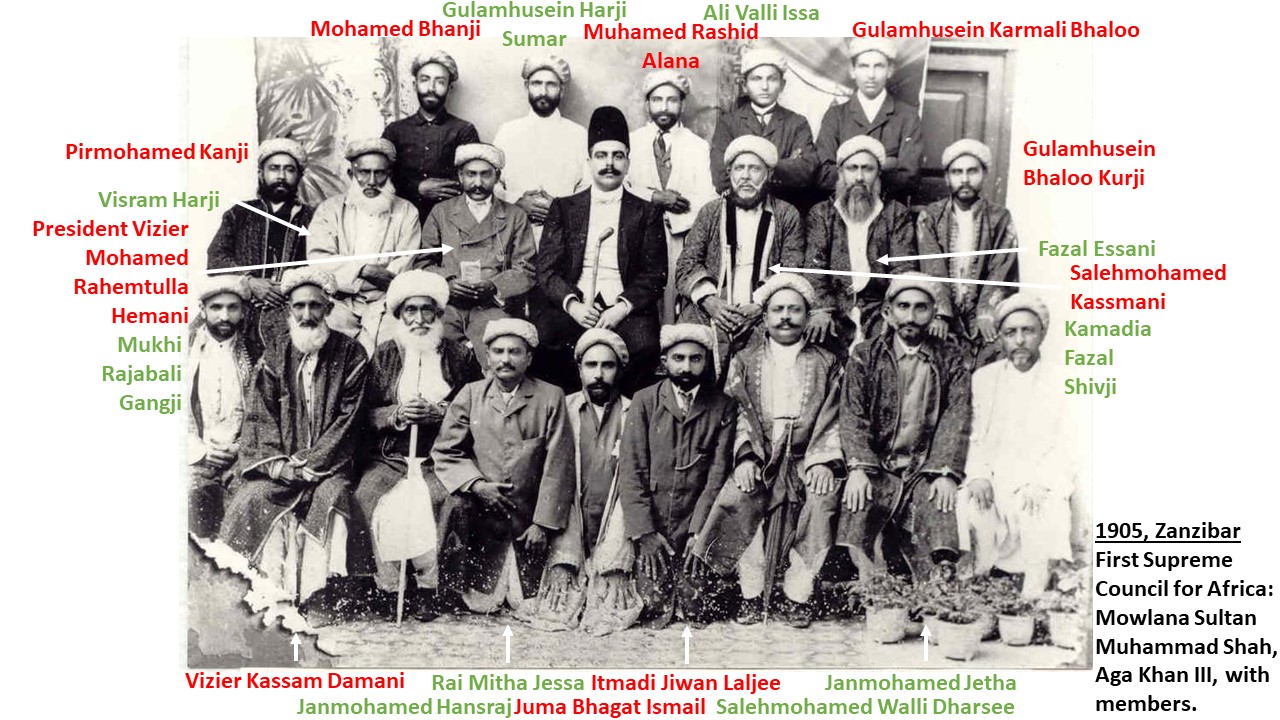
* Author’s footnote: Gulamhusein Harji Sumar (father of the groom, with the sword in the wedding photo) was a member of the first Supreme Council for Africa, 1905, Zanzibar. Itmadi Jiwan Lalji (father of Khatibai, photo 2) was a member too. Please see Noorali Harji’s historical family photos with Mawlana Hazar Imam.
Gulamhusein Bhaloo Kurji (maternal grandfather of Zerabai, number 10 in the wedding photo) ditto.
All the above three are also in the classic photo of Imam Mawlana Sultan Mahomed Shah Aga Khan III with the Supreme Council; see photo 5 below.
Photo 5: Zanzibar 1905 — Aga Khan III, 48th Ismaili Imam, with Ismaili leaders. BACK ROW (left to right): Mohamed Bhanji, Gulamhussein Harji Sumar, Mohamed Rashid Alana, Ali Valli Issa, Gulamhussein Karmali Bhaloo; CENTRE ROW (left to right): Peermohamed Kanji, Visram Harji, President Varas Mohamed Remtulla Hemani, MAWLANA SULTAN MAHOMED SHAH, HIS HIGHNESS THE AGA KHAN, Varas Salehmohamed Kasmani, Fazal Issani, Gulamhussein Bhaloo Kurji; FRONT ROW (left to right): Mukhi Rajabali Gangji, Varas Kassam Damani, Varas Janmohamed Hansraj, Rai Mitha Jessa, Juma Bhagat Ismail, Itmadi Jivan Lalji, Salehmohamed Valli Dharsi, Janmohamed Jetha, Kamadia Fazal Shivji. Photo Credit: Nashir Abdulla Collection, Ottawa, Canada. Please click on photo for an annotated version.
_________
Zahir K. Dhalla is a retired GIS (Geographic Information Systems) and IT (Information Technology) freelance consultant in Toronto, Canada. He is a graduate of the University of Nairobi, Kenya (mapping science) and the University of Toronto, Canada (computer science). In addition to his non-fiction writings (see list below) he has also written many private biographies as family keepsakes. He is also the editor of Ismailis of Tanga.
Zahir Dhalla’s books available from Amazon:
My F-word Plan: How I Routinely Maintain Low Weight & Good Health
Poetry: The Magic of Few Words (Definition and Some Poetry on East Africa)
Nine Ginans of Nine Ismaili Pirs: A Brief History of Khoja Ismailis
Learn Good Swahili Step by Step: A Complete Language Textbook in 3 volumes:
A Complete Grammar
Swahili-English Dictionary (5,750 words)
English-Swahili Dictionary (5,750 words)
The Willowdale Jamat Khana Story
Writing [Auto] Biographies: Demonstrated by author’s early autobiography
From Kibwezi to Kensington: Sherbanu K. Dhalla’s Memories of East Africa
My Tanga Days: 1950s & 60s
Learn Urdu: اُردو: Read, Write, Speak, includes 4,000-word Tri-directional Dictionary
Naked Eye Astronomy: How to Read the Heavens
Two Short Stories: I. Happy Phoebe, II. Troglodytes
Khojo Aawyo! The Khoja has Come! A Story of Migrations
Before departing this website please take a moment to review Simerg’s Table of Contents for links to hundreds of thought provoking pieces on a vast array of subjects including faith and culture, history and philosophy, and arts and letters to name a few.
We welcome feedback/letters from our readers. Please use the feedback box which appears below. If you don’t see the box please click Leave a comment. Your comment may be edited for length and brevity, and is subject to moderation. We are unable to acknowledge unpublished letters.














 Simerg - Insights from Around the World