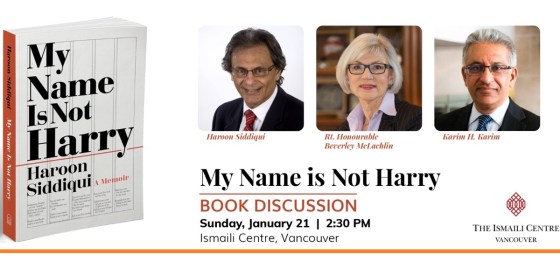
Must Attend Event: On Sunday, January 21, 2024, the Ismaili Centre Vancouver Will Host Haroon Siddiqui, An Award Winning Canadian Journalist and Author of His Memoir “My Name Is Not Harry”

My Name Is Not Harry: A Memoir by Haroon Siddiqui,
Front cover, My Name Is Not Harry: A Memoir, by Haroon Siddiqui, published September 26, 2023, Dundrum Press, 472 pp, available at Indigo (paperback and Kobo editions), Amazon (paperback and Kindle editions) and other booksellers.
My Name Is Not Harry by Haroon Siddiqui, Award winning Canadian Journalist
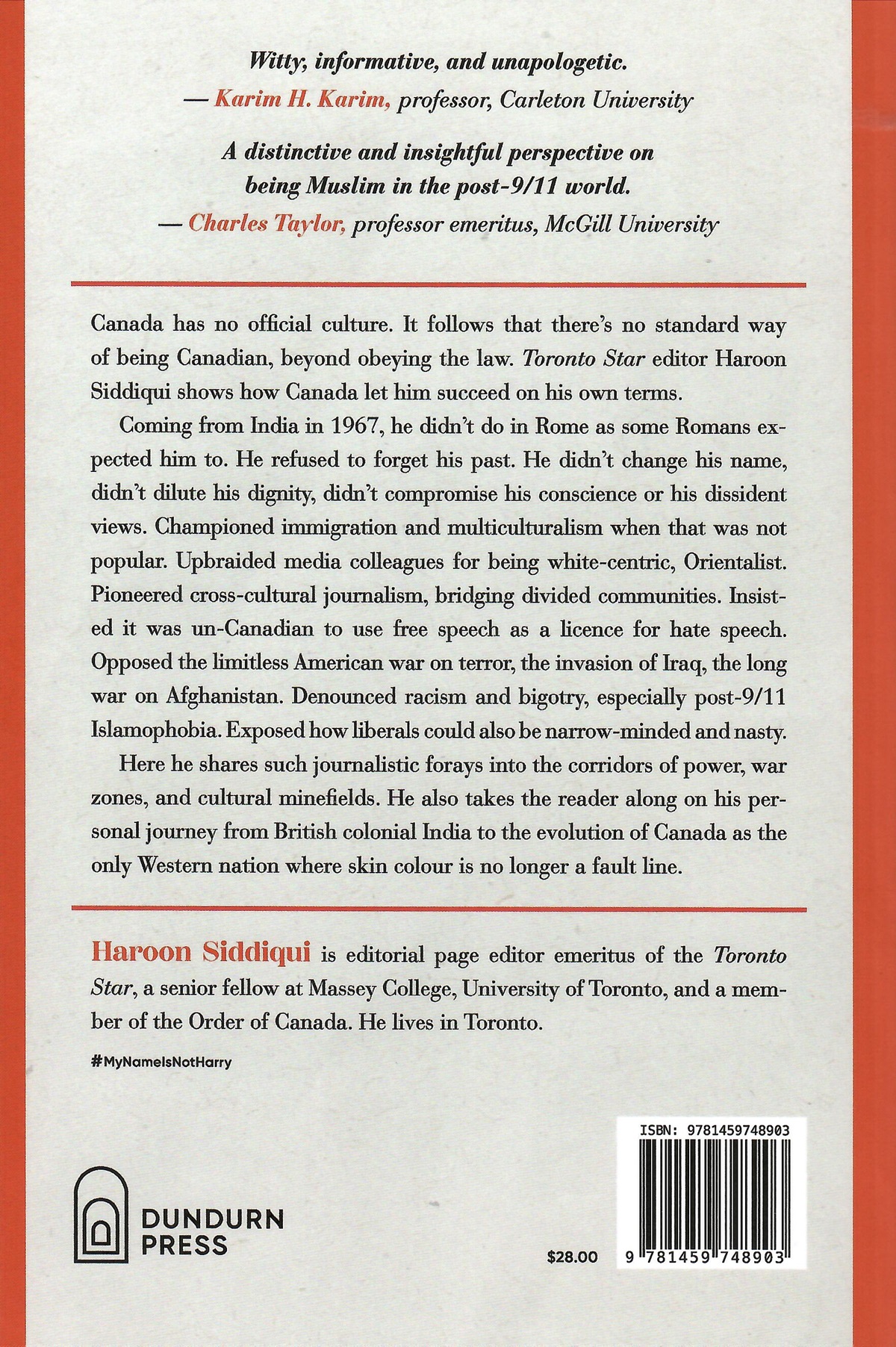
Back cover of My Name Is Not Harry. Please click on image for enlargement

The Aga Khan: Benevolent Imam of the Ismaili Muslims

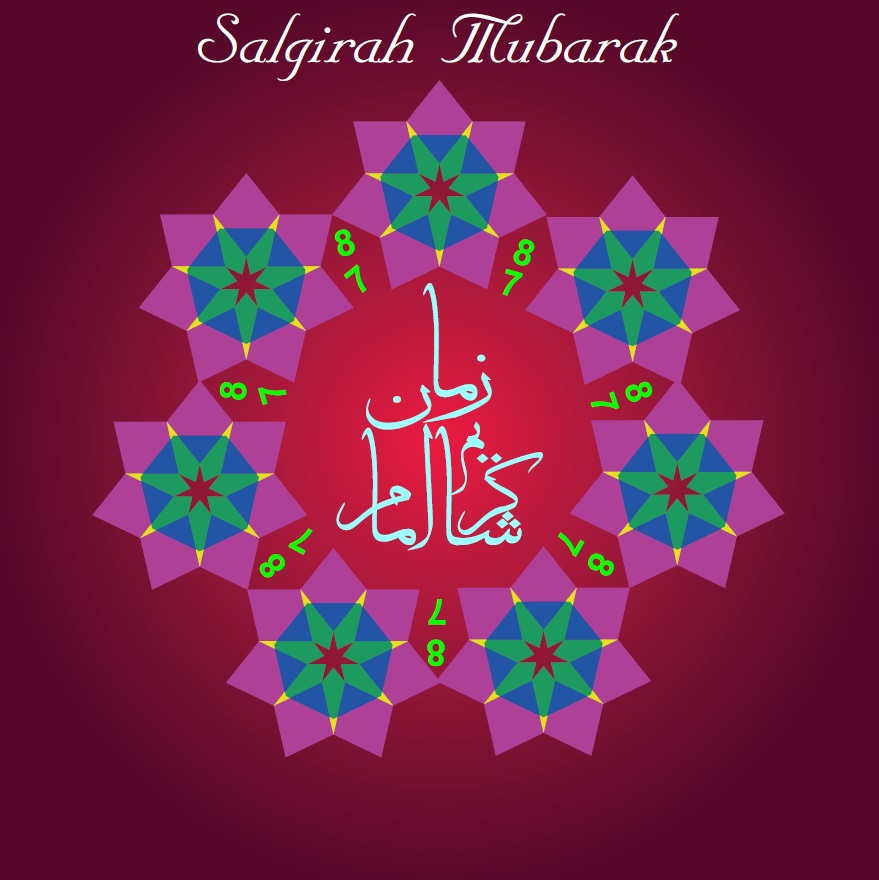
The Aga Khan Birthday December 13, 2023.
A calligraphy by Toronto’s Karim Ismail depicting the 87th birthday of His Highness the Aga Khan, the 49th Hereditary Imam of the Ismaili Muslims. Please clik on image for special post.

___________________

Fall’s Ubiquitous Pumpkin: While Used Creatively for Decorations and in Artistic Works, the Healthy Fruit is Mentioned in the Earliest Muslim Traditions Dating to the Prophet Muhammad

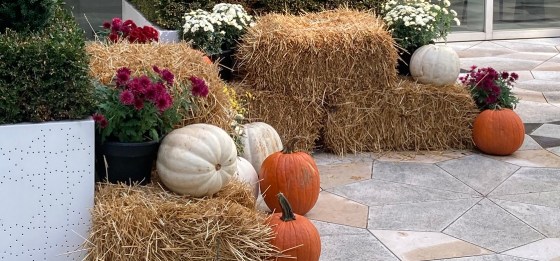
Pumpkin Aga Khan Museum
Aga Khan Museum Toronto Courtyard decorated with pumpkins, October 23, 2020. Photograph: Malik Merchant / Simerg.

______________________

On World Architecture Day, the Aga Khan’s Inspired Vision of Architecture by Bruno Freschi (OC)

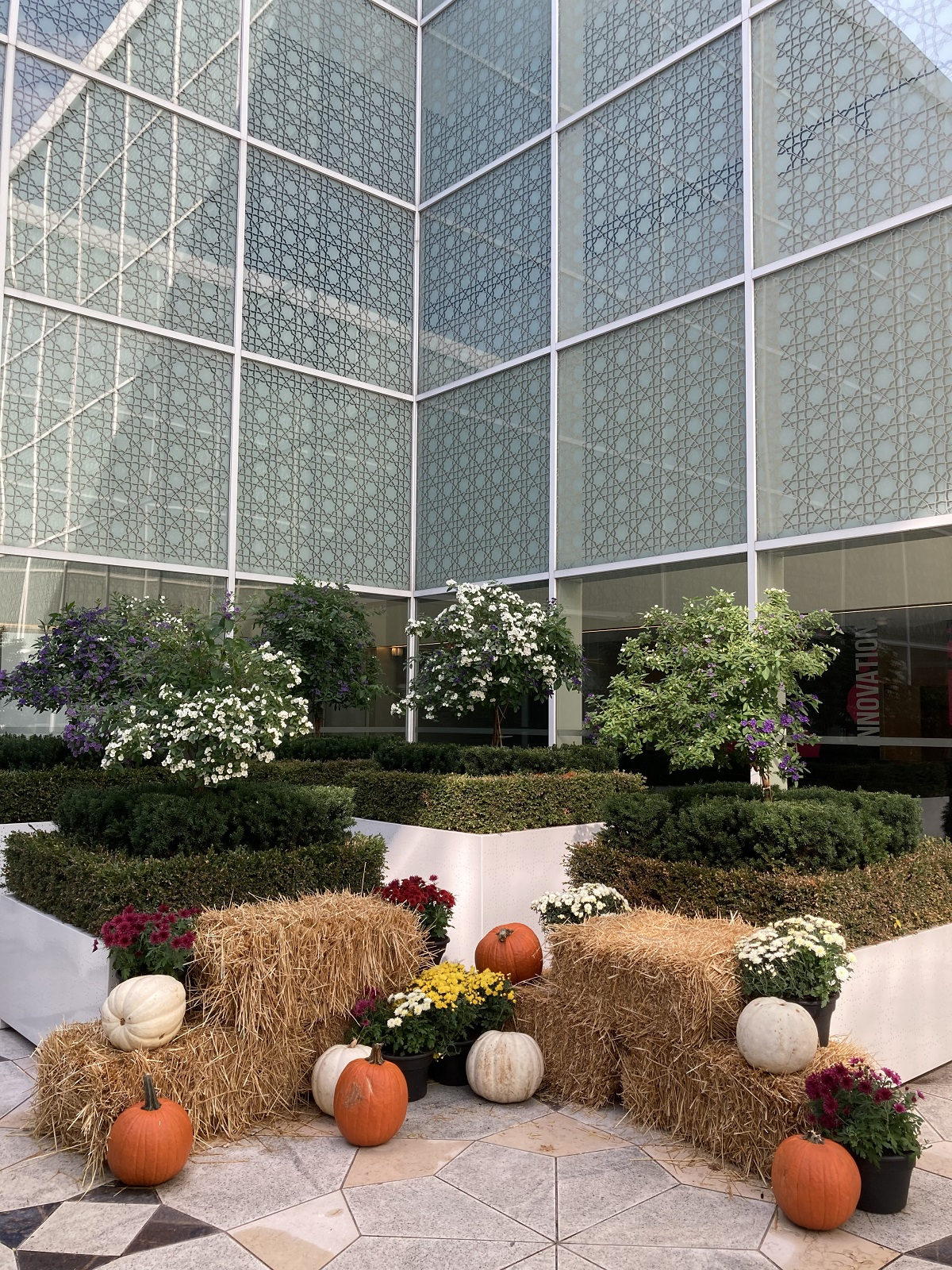
Ismaili Centre Vancouver Bruno Freschi, Order of Canada,
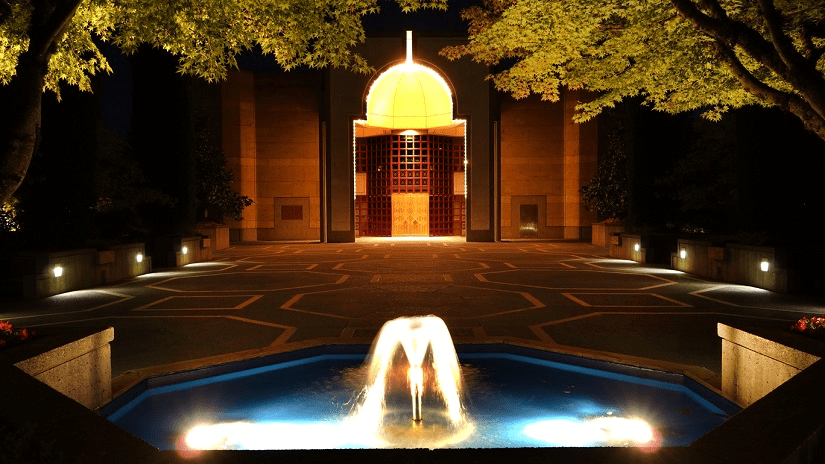
Courtyard looking toward the front entry portal of the Ismaili Centre Vancouver at night time: Please click on photo for Bruno Freschi’s insightful piece on the Aga Khan. Photograph: © Mohib Ebrahim.

__________________

The Aga Khan on Prophet Muhammad: We Present a Historic and Timeless Speech by the 49th Hereditary Ismaili Imam, as Muslims Around the World Celebrate “Mawlid” – the Prophet’s Birth Anniversary

___________________

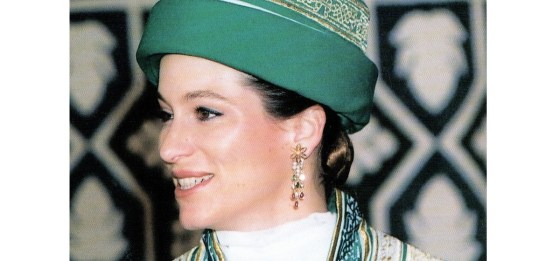
Princess Zahra Aga Khan: Dedicated to the Service of Humanity Through the Ismaili Imamat

Princess Zahra Aga Khan
Please click on photo for story of Princess Zahra Aga Khan.

____________________

Honey bees pollinating on Russian Sage flowers, Aga Khan Park, Toronto. July 25, 2021. Photo: © Nurin Merchant/Simergphotos.

The Industrious Ants and Bees in the Qur’an

Honey bees pollinating on Russian Sage flowers, Aga Khan Park, Toronto. July 25, 2021. Photo: © Nurin Merchant/Simergphotos.
Honey bees pollinating on Russian Sage flowers, Aga Khan Park, Toronto. July 25, 2021. Photograph: © Nurin Merchant/Simergphotos.

Imam Husayn by Wilfred Madelung

INTRODUCTION: Mawlana Hazar Imam Shah Karim al Hussaini, His Highness the Aga Khan, is the 49th Hereditary Imam of the Shia Imami Ismaili Muslims, and directly descended from Hazrat Ali and his son Imam Husayn.

Imam Husayn B. ‘Aly began his reign as the 2nd Ismaili Imam* on the death of his father, Hazrat Ali on January 27, 661 CE who, 29 years earlier in 632 CE, had been publicly proclaimed by the Prophet Muhammad (May peace be upon him and his progeny) to be his successor at Ghadir Khumm.

The succession ended the cycle of the Divine Institution of Nubuwwah and ushered the world into a new era of the Divine Institution of Imamat. Thus, the Imams directly descended from the Prophet Muhammad, from Hazrat Ali to Mawlana Shah Karim, have continued to guide their murids (followers) in the ta’wil (interpretation) and talim (teaching) of the Holy Qur’an for the last 1391 years.

Entrance to to the great mosque, holy city of the Shia Muslims. Photograph: G. Eric and Edith Matson Photograph Collection, Library of Congress,
A 1932 photograph showing the entrance to the great mosque at Karbala, the holy city of e Shia Muslims. Photograph: G. Eric and Edith Matson Photograph Collection, Library of Congress, Washingon D.C.

Imam Husayn was martyred in the Battle of Karbala on the 10th day of the Muslim month of Muharram, or October 10, 680, at the age of 54, and was succeeded to the Hereditary throne of Imamat by Imam Zainul Abideen.

The Islamic calendar is based on the lunar cycle, and thus shorter than the 365 day solar calendar by roughly 11 days. This year (2023), the 10th day of Muharram falls on or around July 28/29, almost 1343 years since the Imam’s tragic death at the hands of Yazid’s army.

Please download the PDF version of Wilfred Madelung’s excellent piece on Imam Husayn B. ‘Ali published on the IIS website. Note: The eminent German scholar Professor Madelung passed away in May 2023 and the IIS has published an In Memoriam in his honour HERE

Also read one of Simerg’s earlier pieces on Imam Husayn where Muslim and non-Muslim sources speak about the Karbala tragedy

Date posted: July 28, 2023 (This post is an update to earlier versions of the article that has appeared periodically on this website over the past few years.)

______________________

*Note: In the Shia Imami Nizari Ismaili tradition Imam Husayn’s brother, Hazrat Hassan, is not counted as an Imam. However, he is regarded as their second Imam by other Shia Muslims, thus making Imam Husayn as their 3rd Imam.

Historic Editions of the Tanganyika Standard Newspaper on the Late Aga Khan’s Diamond Jubilee in 1946 and His Grandson’s Enthronement in 1957 as the 49th Hereditary Imam of the Ismaili Muslims

PLEASE CLICK: Tanganyika Standard Reports on the Aga Khans

The family of Ajmal Andani (1949 – 2021) originally of Tanzania (known as Tanganyika until 1964) has shared Ajmal’s collection of the Tanganyika Standard newspapers that carried reports of the celebration of the Diamond Jubilee of the late Aga Khan in 1946, his death in 1957 after a reign of 71 years, and the succession of his grandson, the current Aga Khan, as the 49th Ismaili Imam. Our sister website, Barakah, brings you a selection of Jpeg images from the newspaper along with a PDF file. Please click HERE or on the image below for the memorable post.

The Aga Khans in the Tanganyika Standard, Simerg and Barakah

Date posted: July 10, 2023.

_______________________
An Arabic-script ambigram, where ‘Muhammad’ upside down is read as ‘Ali’ and vice versa.

Eid-e Ghadir: The Pivotal Day in Islamic History, Unknown to the World at Large, When Prophet Muhammad Appointed Ali as His Successor — the Aga Khan Today is the 49th Ismaili Imam in the Succession of Hereditary Imams

God chose Adam and Noah and the House of Abraham and the House of Imran above all beings, the seed of one another; God hears, and knows — Qur’an, 3:33-34, translation by A. J. Arberry, see Corpus Quran for multiple translations.

Today the Ismailis are the only Shia community who, throughout history, have been led by a living, hereditary Imam in direct descent from the Prophet — His Highness the Aga Khan, Parliament of Canada, Ottawa, February 27, 2014.

Prepared and Compiled by MALIK MERCHANT

On Wednesday June 28, 2023, corresponding to the 10th day of the Islamic month of ‘DhuI-Hijjah, Muslims around the world celebrated the Festival of Sacrifice or Eid al-Adha at the completion of the annual pilgrimage to Mecca.

Little is it known in the broader context and understanding of Islamic history, that on the 18th day of ‘DhuI-Hijjah, a week following his final pilgrimage, the Prophet Muhammad (may peace be upon him and his family) — based on a divine command from Allah — designated Hazrat Ali as his successor and the first in the continuing line of Hereditary Imams. This event took place in 632 CE and is observed by all Shia Muslims, including the Ismailis, as Eid-e Ghadir, because the event itself took place at a place called Ghadir Khumm, a valley between Mecca and Medina.

The majority of the Muslims, the Sunnis, do not accept the Shia version of this historic event and do not associate it with Ali’s succession to Muhammad. Thus, the world’s lack of knowledge about a pivotal historic moment in Islam.

For the Shia Ismaili Muslims, who will be commemorating this historic day on or around July 5, 2023, this event is of added significance as they are led by a living Hereditary Imam, His Highness the Aga Khan, whom they lovingly and respectfully address as Mawlana Hazar Imam (Our Lord the Present/Living Imam).

The Aga Khan in a rare interview with France’s journal, Politique International, has comprehensively described the general Shia understanding of Imamat, the Sunni belief as well as his own status as follows:

“The religious leadership of the Ismaili Imam goes back to the origins of Shia Islam when the Prophet Muhammad appointed his son-in-law, Ali, to continue his teachings within the Muslim community. The leadership is hereditary, handed down by Ali’s descendants, and the Ismailis are the only Shia Muslims to have a living Imam, namely myself. The other Shia — the Twelvers — revere a “hidden” Imam who will return on the Day of Judgment to take part in the final judgment.

“It is the presence of the living Imam that makes our Imamat unique.

“The Sunni are completely different in that they do not accept the idea of continuity of religious leadership by members of the Prophet’s family.”

Speaking to both the Houses of the Canadian Parliament, the Aga Khan further elaborated on the Ismaili Imamat and the role of an imam as follows:

Aga Khan at the Parliament of Canada, September 2014
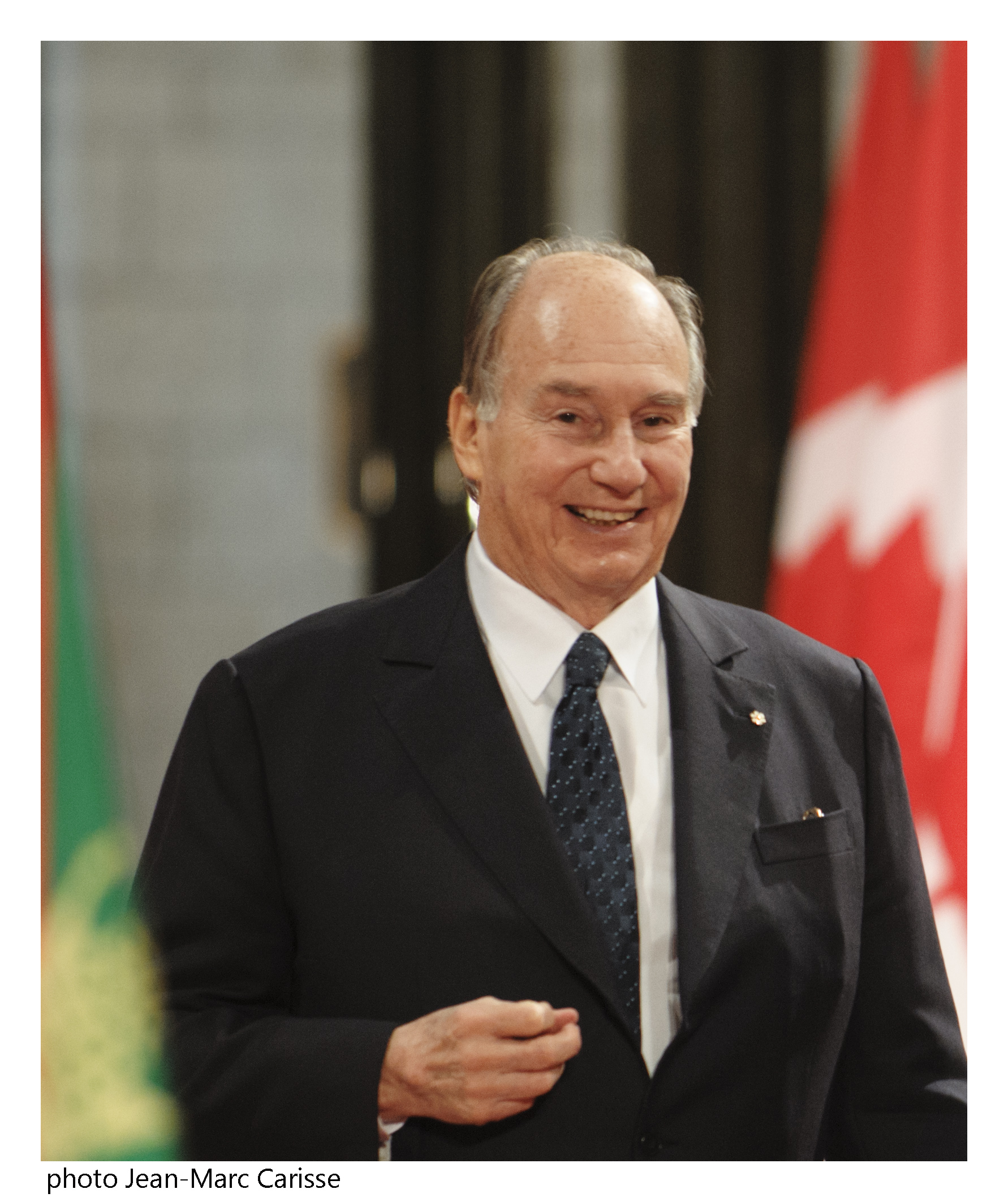
Mawlana Hazar Imam, His Highness the Aga Khan, 49th Imam and the direct descendant of the Prophet Muhammad at the Canadian Parliament on Thursday, February 27, 2014. Photograph: © Jean-Marc Carisse.

“The Ismaili Imamat is a supra-national entity, representing the succession of Imams since the time of the Prophet. But let me clarify something more about the history of that role, in both the Sunni and Shia interpretations of the Muslim faith. The Sunni position is that the Prophet nominated no successor, and that spiritual-moral authority belongs to those who are learned in matters of religious law. As a result, there are many Sunni imams in a given time and place. But others believed that the Prophet had designated his cousin and son-in-law, Ali, as his successor. From that early division, a host of further distinctions grew up — but the question of rightful leadership remains central. In time, the Shia were also sub-divided over this question, so that today the Ismailis are the only Shia community who, throughout history, have been led by a living, hereditary Imam in direct descent from the Prophet.”

In historical sources, it is recorded that on the way back to Medina after performing a pilgrimage to Mecca, the Prophet received a revelation that Ismaili Muslims recite in their daily prayers:

“O Messenger, deliver that which has been sent down to thee from thy Lord; for if thou dost not, thou wilt not have delivered His Message. God will protect thee from men. God guides not the people of the unbelievers” — Qur’an, 5:67, translation by A.J. Arberry, see Corpus Quran.

Article continues after quote

“We search for a union with the family of the Chosen (Prophet Muhammad). We search for the truth of son after son. We are totally obedient to his offspring, one of the other. There is no other thing we can add to this but itself. We endeavour in our faith so that we do not turn out to be faithless.” — Ismaili poet Nizar Quhistani in reference to the Qura’nic verses mentioned at top of post

Upon receiving this revelation, the Holy Prophet stopped at an oasis known as Ghadir Khumm, and addressed a large gathering of Muslims who had accompanied him.

In History in Quotations M. J. Cohen and John Major write:

“Muhammad said: ‘He of whom I am the Mawla, Ali is his Mawla. O God, be the friend of him who is his friend and be the enemy of his enemy.’

“This became the proof text for the Shia claim that Ali, the Prophet’s cousin and son-in-law, was the Prophet’s rightful successor after the Prophet’s death in 632. The meaning of Mawla here probably implies the role of patron, lord or protector.”

In an entry for the Encyclopaedia of Islam, 2nd edition, (EI2), under the title Ghadir Khumm, L. Veccia Vaglieri writes:

“Ghadir Khumm is famous in the history of Islam because of a sentence (or some sentences) in favour of ‘Ali which the Prophet uttered there during a discourse….Taking ‘Ali by the hand. he asked of his faithful followers whether he, Muhammad, was not closer to the Believers than they were to themselves; the crowd cried out: “It is so, O Apostle of God!”, he then declared. “He of whom I am the mawla, of him ‘Ali is also the mawla (man kuntu nawlahu fa-‘Ali mawlahu)

Article continues below

Images of some stamps and coins issued by the Islamic Republic of Iran between 1990 and 2010 commemorating the Idd-e-Ghadir. The inscriptions inlude the Shahada, Qur'anic ayats and the declaration made by Prophet Muhammad at Ghadir Khumm, "Mun Koontu Mawla, Fa Hada, Aliyun Mawla" meaning "He of whom I am the Mawla Ali is also the Mawla." Simerg
Images of some stamps and coins issued by the Islamic Republic of Iran between 1990 and 2010 commemorating the Idd-e-Ghadir. The inscriptions inlude the Shahada, Qur’anic ayats and the declaration made by Prophet Muhammad at Ghadir Khumm, “Mun Koontu Mawla, Fa Hada, Aliyun Mawla” meaning “He of whom I am the Mawla Ali is also the Mawla.”

“Most of those sources which form the basis of our knowledge of the life of the Prophet pass in silence over Muhammad’s stop at Ghadir Khumm….Consequently, the western biographers of Muhammad, whose work is based on these [Sunni] sources, make no reference to what happened at Ghadir Khumm. It is however certain that Muhammad did speak in this place and utter the famous sentence…the hadiths are so numerous and so well attested by the different isnads that it does not seem possible to reject them.” (Note: special access is required to read articles in EI2. Vaglieri’s piece was reproduced in full in the UK Ismaili Association’s publication Ilm, December 1976, pages 28-30, with the permission of E.J. Brill, publishers of EI2.)

The Prophet, about 90 days before his death, was transferring his own spiritual authority bestowed upon him by Allah to Hazrat Ali, making him — and all the Imams that follow — the Amirul Mu’minin, or Master of the Believers.

On instruction from Prophet Muhammad, Hazrat Ali received baiyat (the oath of allegiance), from the Muslims assembled there, including Umar b. al-Khattab, Islam’s second Caliph, as stated in Vaglieri’s piece in EI2.

According to Shia traditions and sources, following the proclamation, the final verse of the Qur’an was revealed to the Prophet:

“Today I have perfected your religion for you, and I have completed My blessing upon you, and I have approved Islam for your religion” — Qur’an 5:5/3, translation by A. J. Arberry, see Corpus Qur’an.

This marked the end of the period of Nabuwwa, or Prophethood, and the historical beginning of the Institution of Imamat.

Eid-e Ghadir is an anniversary of special significance to all Shia Muslims, as it is also associated with the well-attested tradition in which the Prophet is said to have proclaimed:

“I am leaving among you two matters of great weight (al-thaqalayn), the Book of Allah and my kindred (itrati), the People of my House (Ahl al-Bayt), and these two shall never be separated until they return to me at the Pool [of Kawthar in Paradise on the Day of Judgement]…”

The Shia Ismaili tradition bears witness to the continuity of the authority vested at Ghadir Khumm. Today, this leadership and authority is vested in Mawlana Hazar Imam, His Highness the Aga Khan. The rope of Imamat has continued over 1,400 years, from Hazrat Ali, to the present 49th hereditary Imam and direct descendant of Prophet Muhammad through Hazrat Ali and Hazrat Bibi Fatima al-Zahra, Khatun-i Jannat.

In commemorating Eid-e Ghadir, the Ismaili Muslims celebrates the seminal event of Ghadir Khumm, reaffirming their allegiance to the Imam-of-the-Time as the direct lineal successor and inheritor of the authority of Hazrat Ali.

Date posted: July 4, 2023.

__________________

A selection of further readings on Ghadir Khumm and related topics in Simerg and its sister websites:

External Links:

Featured image at top of post: An Arabic-script ambigram, where ‘Muhammad’ upside down is read as ‘Ali’ and vice versa.

A special note about the Encyclopaedia of Islam, Second Edition (EI2): Finished in 2005, the EI2 is a massive resource spanning five decades of scholarship. It sets out the present state of our knowledge of the Islamic World. It is a unique and invaluable reference tool, an essential key to understanding the world of Islam, and the authoritative source not only for the religion, but also for the believers and the countries in which they live.