On Sunday November 25, 2012, Simergphotos began a series of historical illustrations that underline an artistic, ethical, moral, religious or scientific theme. The latest piece is on the exquisite Blue Qur’an which has been referred to as “the Picasso of Islamic Art.” More….
Category Archives: Uncategorized
“Crystal Clear” – A New Year Observation by Navyn Naran

here’s to crystal magic, clink!
and starlight.
shimmering
cool and clearest,
p e a c e
in the vacuum of purple night
of unseen and
unheard
a magic so hidden
you scarce believe in its reality..
for they say, it is the most real thing there is.
look!
light of all light
shimmering ….
impenetrable,
but yes, conscionable.
clinking glass and platefuls..
musically cheery and
mirrors, mirrors,
reflecting glamour and light
what a happy night!
faces are smiling, lips moving, masterful chatter
practising attitudes.
beautiful shimmers, radiant!
glitter and glory
oh, happy night and new year!
there are sparkles of crystal and bangles
rushes of laughter and giggles
all in tonight…thank you God for this another moment,
thank YOU.
what we have learnt and gained this year,
are Blessings beyond truths.
who have we hurt and cared for?
been hurt by and healed from?
only children make it real delight,
a time of play and being,
a reality of truth
ah yes, a respectable consort you are indeed.
how beautifully perfect.
behind festivities and food and dance and happiness
grateful for the safety and health of your space.
and the world crumbles on
hurting exposures, crying and deceit
lies and lip service
a rich, heavy deep velvet
fertile for an inner fortitude ..
here’s to a very happy new year
in these mirrors of charm.
and he rewards you for your heights and emblems,
‘ there are those i see with my eyes and
there are those i feel with my heart’.
which one am i?
which? in the limelight?
in the mirror perhaps?
flight…
in the crystal shimmers
there’s a seen.
and in magic, we are told,
and perhaps we pray,
and maybe we can really try to believe..
a practice of faith,
in action, yes, perhaps there IS
the unseen.
~~~~

Navyn Naran
About the author: Navyn Naran was born in Dar-es-Salaam, Tanzania, to Anaar and Badrudin Naran. After beginning her high school in the UK, her family immigrated to the USA where she has lived since. Navyn went to medical school at Tufts University School of Medicine in Boston, MA. Dr Naran, has a subspecialty in Paediatric Critical Care.
Mo Tejani, An Ismaili Essayist of Distinction at Simerg
There is one writer Simerg would like to single out just before 2012 ends, and the person is Mohezin (Mo) Tejani for his thought-provoking contributions both in prose and poetry. Tejani, a global nomad who has lived and worked in humanitarian aid in five continents of our planet, writes with insight and brilliance on many themes and topics including nature, social issues and travel narratives.

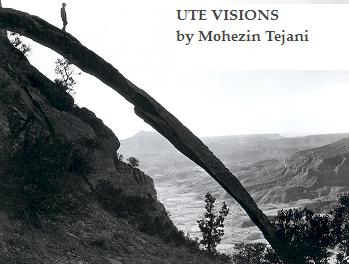
“Ute Visions” – a great piece by essayist Mo Tejani. Please see links on this page
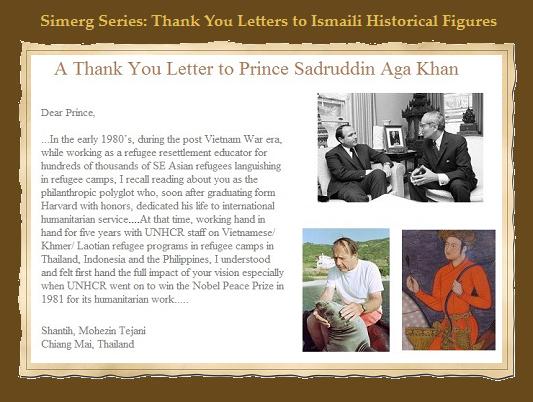
The award-winning author’s latest piece is based on Shakespeare’s The Seven Ages of Man and looks at the life of an Indian, African, and American in 2012 in contrast to Shakespeare’s man of 1538. An earlier piece was dedicated to Prince Sadruddin Aga Khan for Simerg’s special series, “Thanking Ismaili Historical Figures”, which portrayed the late Prince’s life-long contributions with warmth and affection.

One of the many superb pieces by Tejani on this website. See links on this page.
We invite our readers around the globe to get to know Tejani through the following fine pieces which Simerg was proud to publish in 2012 (and earlier):
2012:
“The Seven Ages of Man Redux”
Thank You Letter to Prince Sadruddin Aga Khan – “A Man of Multiple Visions”
“New Hampshire Twilight” and “Iguazu”
~~~~~

A thank you letter to Prince Sadruddin, an affectionate portrayal by Mo Tejani. See links on this page for Tejani’s fine contributions.
More 2012…
Ute Visions
Inca Gods
A Nature Poem
Exploring Belgium: The Modern and the Medieval
_________
Pre-2012:

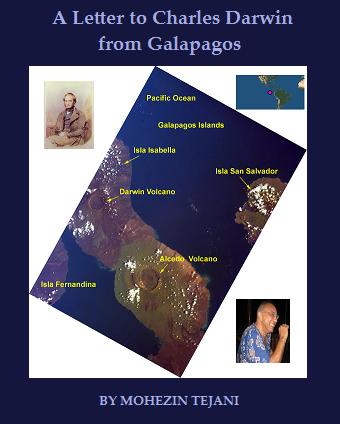
A nature piece by Tejani which appeared in 2011. Please see links on this page for Tejani’s great essays.
A Letter to Charles Darwin from Galapagos
Singida
Childhood Games
The Verses of the ‘Immaculate Conception’ of Jesus in the Qur’an and their Impression on a Christian Emperor by Barnaby Rogerson
Muhammad, who could do nothing to alleviate the suffering of his small embattled community of believers, at last advised some of his followers to leave sacred Mecca and take refuge elsewhere. He said to them: “If you were to go to Abyssinia, it would be better for you until such time as God shall relieve you from your distress.” The Quraysh of Mecca, rather than celebrate their departure, grew irritated by this development. They dispatched a delegation to the ruler of Axsum where the Quraysh delegation planned to slander the new faith in the eyes of a Christian king, and so expedite their expulsion….Read More

The Altar of the Nativity, beneath which is the star marking the spot where tradition says the Virgin Mary gave birth to Jesus. Photo: Muslim Harji, Montreal, PQ. Copyright. Please click on image for Barnaby Rogerson’s piece.
Mowlabapa’s 76th – Only For Us: A Poem by Noorani Datoo, A Young Ismaili Girl
Remarkable Tales of Ismaili Women of Shimshal: Hussn Bibi and Her Journey to New Zealand
“When I was 15 there were 21 people living in the house and my friend Hasiet and I had to do all the weekly washing for the whole family, even in winter. It took all day and I got frost bite in my feet several times. My toes would turn black. We’d go down to the river and make a fire to heat the water. We used to burn our socks, trying to warm our toes by the fire” — Hussn Bibi
Tales of Ismaili Women of Shimshal: Hussn Bibi and Her Journey to New Zealand to Study English
“….The university recommended the Campbell Institute. When I went to see the Campbell directors they were intrigued by the notion of this woman [Hussn], this mountain farmer from Pakistan, coming to their school which mostly enrolled Korean and Chinese youths. The fees seemed astronomical to me, but my mother’s estate provided collateral, the Campbell Institute awarded a generous scholarship to Hussn, and Lynette, my companion on the first trip to Shimshal, sent one thousand pounds….” — Pam Henson, author of Women of Shimshal
“I Wish I’d Been There” – Volunteeering at the Dawn of the Age of Imamat by Aziz R. Kurwa
In History in Quotations, which reflects five thousand years of World History, authors M. J. Cohen and John Major write as follows:
“Muhammad said:
‘He of whom I am the Mawla (patron), Ali is his Mawla. O God, be the friend of him who is his friend and be the enemy of his enemy.’
“This became the proof text for the Shia claim that Ali, the Prophet’s cousin and son-in-law, was the Prophet’s rightful successor after the Prophet’s death in 632. The meaning of Mawla here probably implies the role of patron, lord or protector.”
The authors then sum up by stating that through the use of the term Mawla, Prophet Muhammad (s.a.s.) was giving Mawlana Ali (a.s.) the parity with himself in this function. Dr. Aziz Kurwa, a long serving member of the Ismaili community, takes us to the beginning of Islamic and Ismaili history and imaginatively constructs the role he played as a volunteer on that eventful and historic occasion, a day which was described by one of our readers as “an introduction to a new world order”. Aziz Kurwa was among the thirty-one who contributed to Simerg’s highly acclaimed series I Wish I’d Been There.
Please click on image below or: Volunteering at the Dawn of the Age of Imamat

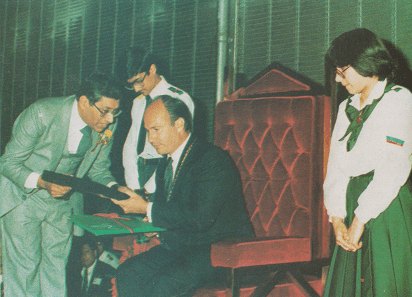
London, 1979: His Highness the Aga Khan, 49th hereditary Imam of the Ismailis and direct descendant of the Prophet Muhammad (s.a.s) receiving Fatimid Gold dinars from Dr. Aziz Kurwa, a long serving leader of the Ismaili community who was at the time President of the Ismailia Association for the U.K.
Naser-e Khosraw on Fatimid Cairo’s Biggest Ceremony, from Michael Wolfe’s “One Thousand Roads to Mecca”
IN PART II OF NASER-E KHOSRAW’S TRAVELS
“….There is a lighthouse that I saw in Alexandria, on top of which used to be an incendiary mirror. Whenever a ship came from Istanbul and approached opposite the mirror, fire would fall from the mirror and burn the ship up…. On the morning when the Sultan is going out for the ceremony, ten thousand men are hired to hold the steeds….At some distance behind all of these comes the Sultan [al-Mustansir], a well-built, clean-shaven youth with cropped hair, a descendant of Husayn son of Ali. He is mounted on a camel with plain saddle and bridle with no gold or silver and wears a white shirt…”
Naser-e Khosraw in Fatimid Cairo: From “One Thousand Roads to Mecca” Edited by Michael Wolfe

Map of Naser-e Khosraw’s travels as described in his “Safarnama” or the Book of Travels. Credit: Wikipedia. Please click for article.
_________
Previous instalment: One Thousand Roads to Mecca: Naser-e Khosraw’s Writing About the Muslim Pilgrimage
One Thousand Roads to Mecca: Naser-e Khosraw’s Writing About the Muslim Pilgrimage Edited and Introduced by Michael Wolfe
In the early 1990’s Michael Wolfe, a prolific American writer and award winning producer of Islamic documentaries including Muhammad: The Legacy of a Prophet, became aware of a string of accounts by Muslims and non-Muslims who over the last one thousand years had gone to Mecca on the pilgrimage. Wolfe’s accounts are collected into a single volume called One Thousand Roads to Mecca, and the first of the twenty-four edited accounts is based on the Book of Travels, a classic text by the famous Ismaili poet, philosopher and traveller Naser-e Khosraw who lived during Islam’s expansive Middle period between the 11th and 14th centuries. The period has also been called the Golden Age of Muslim travel and, as Wolfe notes, Khosraw set the tone for a thousand years of Persian travel writing.
To begin reading Naser-e Khosraw’s spirited account of his journey, with an excellent introduction by Michael Wolfe, please click One Thousand Roads to Mecca: Naser-e Khosraw’s Writing About the Muslim Pilgrimage, or the image below.
_______________
Previous post:
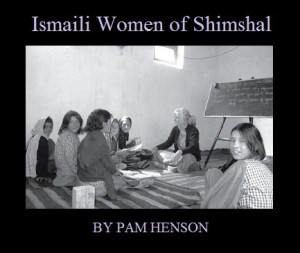
Ismaili Women of Shimshal: Celebrations After a Difficult Trip and Other Fascinating Stories by Pam Henson
‘‘When I was 15 there were 21 people living in the house and my friend Hasiet and I had to do all the weekly washing for the whole family, even in winter. It took all day and I got frost bite in my feet several times. My toes would turn black. We’d go down to the river and make a fire to heat the water. We used to burn our socks, trying to warm our toes by the fire. It was hard to find enough money to buy new ones with all those people in the house.’’ — Hussn Bibi
____________
Previous installment:
Remarkable Tales of Ismaili Women from Shimshal, a Remote Village in the Karakoram