
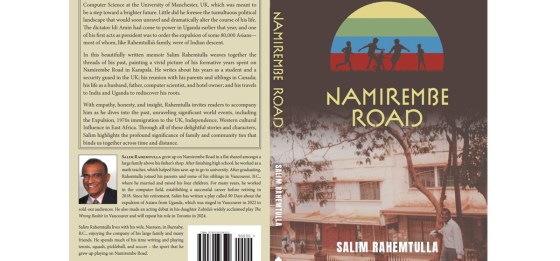
Simerg’s introduction of “Books by Ismaili Authors” continues with Salim Rahemtulla’s “Namirembe Road.” We follow the same Q/A format as our earlier presentations of books, which are listed chronologically below. We encourage Ismaili authors worldwide to participate in this series, regardless of when their books were published. See details of the series HERE and submit your responses to Simerg’s editor, Malik, at mmerchant@simerg.com.
****************
“With empathy, honesty, and insight, Rahemtulla invites readers to accompany him as he dives into the past, unraveling significant world events, including the Expulsion, Independence, Western cultural influence in East Africa and 1970s immigration to the UK. Through all of these delightful stories and characters, Salim highlights the profound significance of family and community ties that binds us together across time and distance”
Simerg: What is behind the name and title of the book?
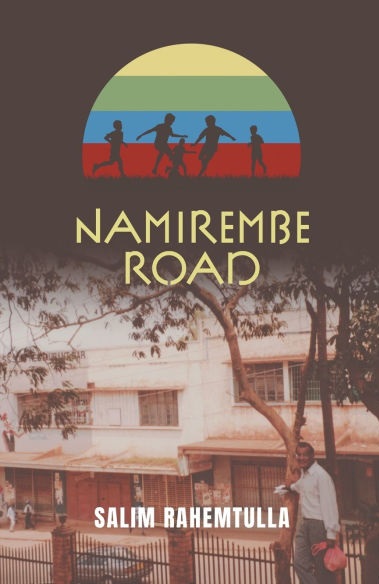
Salim Rahemtulla: Namirembe Road is the name of the street that my family and I lived on, in a small apartment facing the majestic Kampala Jamatkhana. My father ran a second-hand shop on the road, and we lived upstairs. Right up until we had to leave Uganda, my life revolved around this road and the many friends and community members in the neighbourhood.
Simerg: Why would you want me or my family to read the book, and what will we learn from it?
Rahemtulla: This book will appeal to people that have been displaced from their homeland and forced to establish themselves in far away countries. For Ismaili readers in particular, the life of the community, how so much of life revolved around the Jamatkhana and community, may also be resonant. For those from East Africa and Kampala, a lot of the memories and places recalled in the memoir will be familiar. It’s a Life Journey that many people in similar situations can identify with.
Simerg: What inspired you to write the book?
Rahemtulla: After I retired about five years ago, my children encouraged me to enter the Arts World. Reluctantly I agreed and wrote a play about the 90 Days that Asians were given to leave Uganda. It was successful, and I continued with another project in the literary world by writing my memoir. I wanted to recall memories of Kampala, a place that is so fond to me, memories of my big family, and of my parents.
Interview continues below
_____________________________
Simerg: How can I purchase the book, and what are its available formats?
Rahemtulla: The book is available in ebook, paperback, and hardback format on my publisher’s website, FriesenPress and can also in these formats from Chapter-Indigo, Amazon, and Barnes and Nobles.
Simerg: Did you hire an editor, an illustrator or did you do all the work by yourself?
Rahemtulla: When I first started, I spent a few weeks with an editor but once I settled on which publisher to go with, they provided editorial feedback and cover designers.
Simerg: How did you find a publisher for the book?
Rahemtulla: Through online research, focusing on the types of books that had already been handled by the publisher.
Simerg: Which was your first book, and how many have you written?
Rahemtulla: My first script was 90 Days, a theatre production produced by Western Gold Theatre in Vancouver in September 2022. Namirembe Road is my first book.
Simerg: How long did it take you to write the book — from start to finish?
Rahemtulla: It took me approximately two years to complete.
Simerg: Tell us something more about your book (and its primary character).
Rahemtulla: The book is my memoir/autobiography from early childhood to present day. When my children were growing up, I used to tell them stories about my life in Kampala and how I went to University and then the expulsion which brought us to Canada. They remember some of the stories and often talk about it, and also tease me for all the details I remember. So, I decided to entrench it by writing my memoir for the family, for the grandchildren to come and for friends that were with me in some of my life experiences.
Date posted: August 3, 2024.
_______________
About the Author
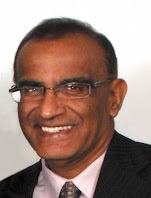
Salim Rahemtulla was raised in Kampala as one of nine children in a deeply united family of modest means. In 1971, he received a partial bursary to study Computer Science at the University of Manchester, UK, which was meant to be a step toward a brighter future. Little did he foresee the tumultuous political landscape that would soon unravel and dramatically alter the course of his life. The dictator Idi Amin had come to power in Uganda earlier that year, and one of his first acts as president was to order the expulsion of some 80,000 Asians — most of whom, like Rahemtulla’s family, were of Indian descent. Salim completed his education in the UK and then reunited with his parents and siblings in Canada, a country that had opened its arms to thousands of fleeing Asian Ugandans as refugees. Salim — a husband, father, computer scientist, and hotel owner — has travelled to India and Uganda to rediscover his roots. His theatre production “90 Days,” telling the story of an Ismaili Muslim family’s forced departure from Uganda in 1972, premiered at the Pal Studio Theatre in Vancouver in September 2022. He also made an acting debut in his daughter Zahida’s widely acclaimed play The Wrong Bashir in Vancouver and Toronto in 2024.
Salim Rahemtulla lives with his wife, Nasreen, in Burnaby, B.C., enjoying the company of his large family and many friends. He spends much of his time writing and playing tennis, squash, pickleball, and soccer — the sport that he grew up playing on Namirembe Road.
Calling all Ismaili Authors
We encourage Ismaili writers to introduce their books in a similar format as has been done in the post above. Please also see the series launch article and submit your responses to Malik at mmerchant@simerg.com. All submissions will be acknowledged. If a writer has published multiple books, each book will be highlighted in a separate article, and not combined with other books into one post. All writers should include a brief profile with a portrait photo.
_______________
Links to the Ismaili Authors’ Series (in chronological sequence, oldest article first)
- “Justice Bertha Wilson Pushes the Boundaries of Humanity” by Shamas Nanji (featured in Simerg on February 10, 2021, series start date)
- “Little One, You Are The Universe” by Zeni Shariff (February 25, 2021)
- “Memoirs of a Muhindi” by Mansoor Ladha (March 6, 2021, and see also 15 and 21 by the same author)
- “To Be One With God: Seven Journeys to the Meaning of Life” by Shafeen Ali (March 25, 2021)
- “Invisible Birthmarks” by Alnasir Rajan (April 13, 2021)
- “IN THE NAME OF JUSTICE – Portrait of a ‘Cowboy’ Judge” by Azmina Suleman (April 28, 2021)
- “RSVP Rice and Stew Very Plenty” by Nazlin Rahemtulla (May 28, 2021)
- “Coughdrops” by Nargis Fazal (June 12, 2021)
- “The Roots and the Trees” by Nizar Sultan (June 25, 2021)
- “Faith and Ethics: The Vision of the Ismaili Imamat” by M. Ali Lakhani (July 4, 2021)
- “Nairobi Days by Shelina_Shariff Zia (July 21, 2021)
- “Shine Brighter” by Shairoz Lakhani (December 8, 2021)
- “This is My Life” by Naznin Rahemtulla Hébert (February 26, 2022)
- “Humanizing Medicine – Making Health Tangible” by Dr. Azim Jiwani (March 9, 2022)
- “A Portrait in Pluralism: Aga Khan’s Shia Ismaili Muslims” by Mansoor Ladha (June 8, 2022, and see also 3 and 21 by the same author)
- “Malaria Memoirs: My Life Journey as a Public Health Doctor in Tanzania” by Dr Zul Premji (June 30, 2022)
- “Monkey Tales and Other Short Stories” by Mahmoud Hirji (September 10, 2022)
- “Bloom! A Story of Diversity and Understanding” by Shamim Murji (October 27, 2022)
- “Cooking with Mom” by Rozina Ramji (November 7, 2022)
- “SPARK: Journey from Success to Significance” by Azim Jamal (July 17, 2023)
- Off the Cuff by Mansoor Ladha (August 3, 2023, and see also 3 and 15 by the same author)
- Mehndi Boy by Zain Bandali (November 18, 2023)
- All the Russ Without the Fuss by Reeshma Haji (March 2, 2024)
- al-Risalah al-Bahirah (The Epistle on the Radiance) by Abu Ya’qub al-Sijistani, translated by Boustan Hirji (April 3, 2024)
- Namirembe Road by Salim Rahemtulla (August 3, 2024).
_______________________
Before departing this website please take a moment to review Simerg’s Table of Contents for links to hundreds of thought provoking pieces on a vast array of subjects including faith and culture, history and philosophy, and arts and letters to name a few. Also visit Simerg’s sister websites Barakah, dedicated to His Highness the Aga Khan, and Simergphotos.
Simerg’s editor may be reached via email at mmerchant@simerg.com.






 Simerg - Insights from Around the World