Simerg is an independent initiative dedicated to Ismaili Muslims, the Aga Khan — their Hereditary Imam — and the Ismaili Imamat, and Islam in general through literary readings, photo essays and artistic expressions
Author Archives: Malik Merchant, Editor
Founding publisher and editor of www.barakah.com, www.simerg.com and www.simergphotos.com.
I first met met Bruno Freschi, the architect of the Ismaili Centre Vancouver, in Washington D.C., when Mawlana Hazar Imam, His Highness the Aga Khan, was awarded the Vincent Scully Prize in January 2005 at the National Building Museum. After meeting him at the door, I politely intruded into a conversation the Aga Khan Council Canada President, Firoz Rasul, was having with Fumihiko Maki, the Japanese architect of the Delegation of the Ismaili Imamat Building in Ottawa (December 2008), and the Aga Khan Museum in Toronto (September 2014), and introduced Bruno to the President. So for the first time two great architects from different ends of the world met each other. We are truly proud of what both have done for the Ismaili Imamat and the Ismaili community.
Later that evening before the ceremonies were over — and also later in my interview with him — Bruno told me that he met Mawlana Hazar Imam who thanked him for building the Jamatkhana in Vancouver which he said was one of his most favoured buildings. At the time, Bruno was based in the US capital.
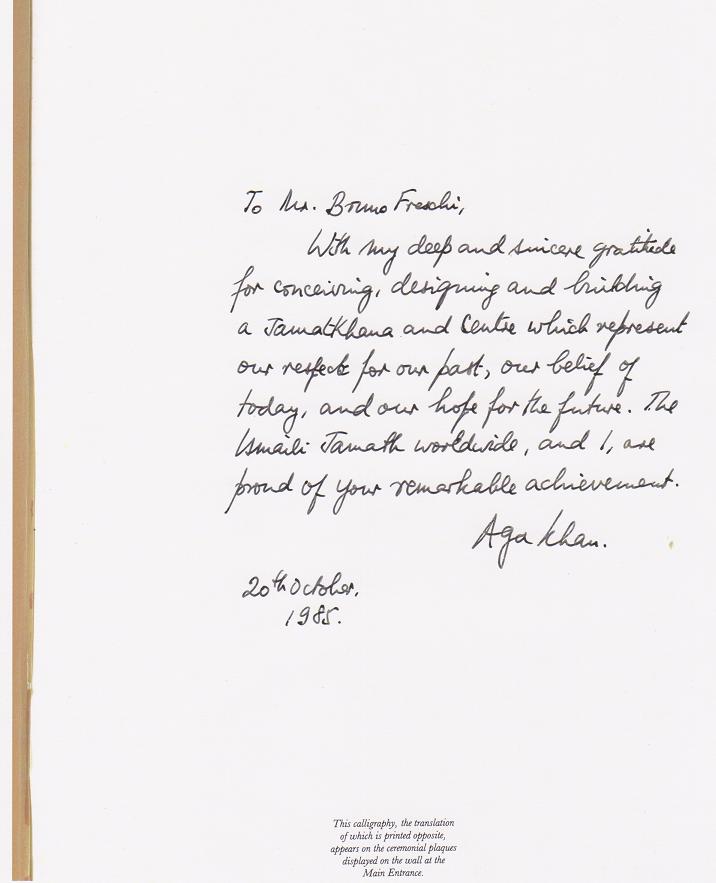
His Highness the Aga Khan’s appreciative note to Mr. Bruno Freschi for his “remarkable achievement”. Message written in the architect’s personal volume of the Ismaili Centre Souvenir publication. Image: Bruno Freschi Collection, 1985.
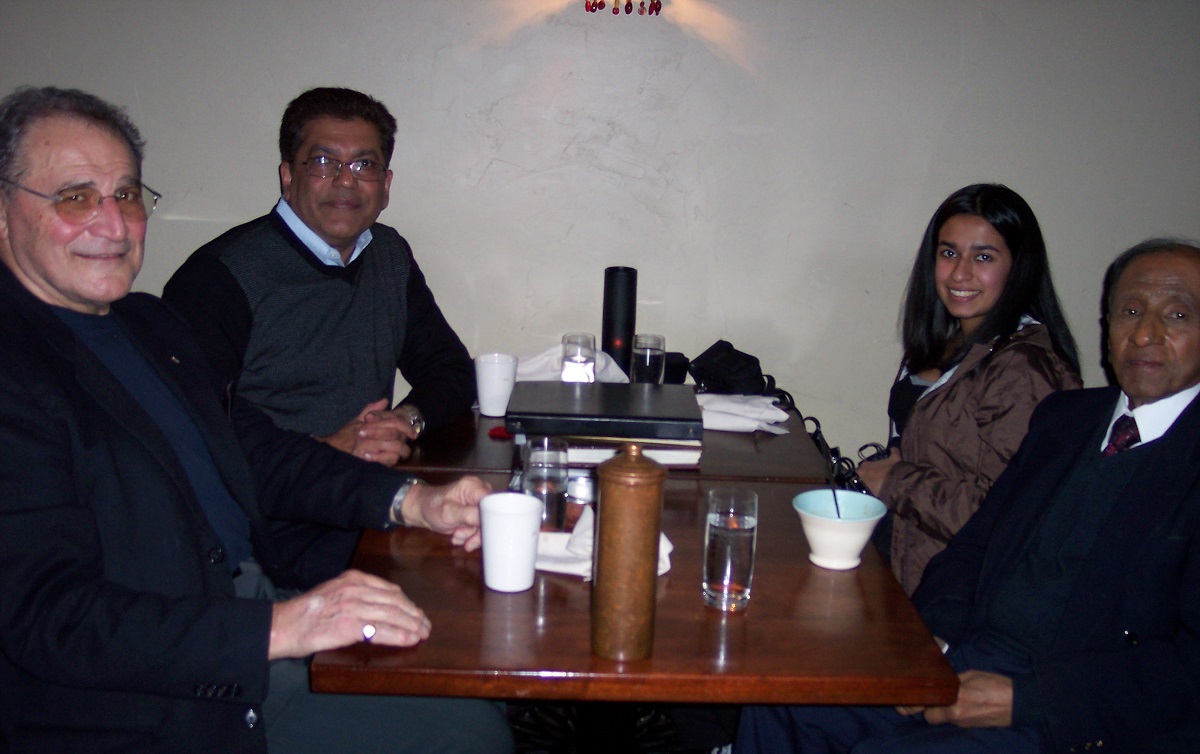
A few years later when Bruno was back in Vancouver but still travelling, I met him for the second time shortly after launching Simerg in the spring of 2009. My daughter had travelled with me to visit my parents in Vancouver. Bruno happened to be in town and was available one evening for dinner at the famous VJ’s restaurant.
(From left, anti-clockwise) Bruno Freschi, Jehangir Merchant (d. May 2018), Nurin Merchant and Malik Merchant at the famous VJs in Vancouver, March 2009.
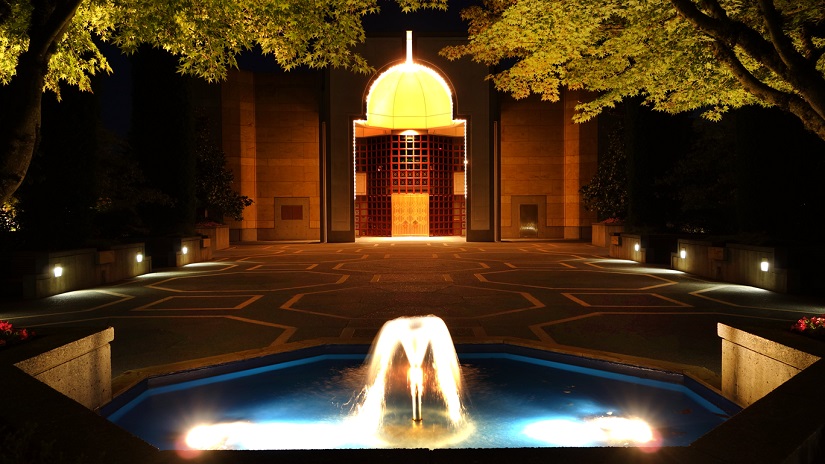
My dad joined us for a fantastic meal with Bruno, and what an evening it turned out to be. Among other matters, and in a setting of a great ambience, our conversation also centered around the magnificent Jamatkhana building that he had designed. That evening’s conversation along with subsequent text exchanges then became part of Simerg’s though provoking interview with Bruno Freschi, that includes several unique photos.
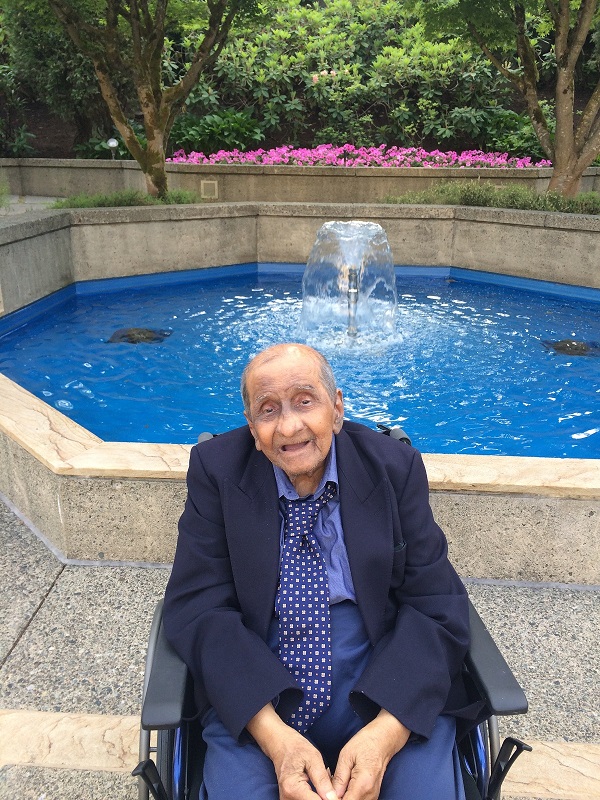
Jehangir Merchant pictured in front of the fountain in the beautiful courtyard of the Ismaili Centre and Jamatkhana, Vancouver, designed by Bruno Freschi. It was designated as the Darkhana Jamatkhana by Mawlana Hazar Imam, His Highness the Aga Khan. Both Jehangir and his wife, Maleksultan, attended the Darkhana Jamatkhana every single day, and found immense comfort and happiness within the Jamatkhana space and the building’s overall interior and exterior environment. This photo was taken a few months before Alwaez died in May 2018 at the age of 89. Photo: Malik Merchant/Simerg.
Mrs. Merchant (d. January 2021) pictured with Nazim Rawji, her former 1960/1970’s neighbour from Dar es Salaam, Tanzania, outside the courtyard of the Ismaili Jamatkhana and Centre in Vancouver during an event marking the 59th Imamat Day of Mawlana Hazar Imam, His Highness the Aga Khan. The building was designed by architect Bruno Freschi, and opened in 1985 by Prime Minister Brian Mulroney in the presence of Mawlana Hazar Imam. Photo: Malik Merchant. July 2016.
I invite readers to read Simerg’s insightful interview with Bruno, and to also watch a fantastic program hosted by journalist Zahra Premji in Ismaili Canada’s series Summer Reflections. The video, below, must not be missed as it provides Bruno Freschi’s rare and unique glimpses into the making of this absolutely beautiful building which was opened in September 1985. His admiration and respect for Mawlana Hazar Imam is deeply touching.
I have always enjoyed being around Bruno because of his humble qualities and for sharing inspiring insights into the work of the Ismaili Imamat. I was delighted to meet him again at a much different VJ’s some years later just before the Diamond Jubilee of Mawlana Hazar Imam. He then contributed a thought provoking article The architecture of empathic pluralism: His Highness the Aga Khan, an inspired vision of architecture for Barakah, a website dedicated to Mawlana Hazar Imam and members of his family. Then, after my dad passed away, I met him once more when my mum was with me at a daytime event at the Ismaili Centre. She was very happy that she had finally met the person who designed the Jamatkhana that both she and my dad had visited every single day for years and years. The Jamatkhana had provided them with spiritual happiness and comfort as well as strength in their daily lives, like it has for thousands and thousands of Ismailis living in Vancouver as well as visitors from around the world.
We thank you Bruno for creating a beautiful space to which we all enter (go in) with anticipation and leave (go out) with an immense amount of happiness and hope. We return to it over and over again. Your insight into the Ismaili Jamatkhana and Centre will make us think more about the building you painstakingly designed for us, working together side by side with our beloved Imam to see its total and full completion.
The Ismaili Canada Conversation with Bruno Freschi
Note: To skip the pre-show of songs and music, please start the video at approximately the 13 minute mark to watch Zahra Premji’s excellent and extensive interview with Bruno Freschi, the architect of the Ismaili Jamatkhana and Centre in Vancouver.
To skip songs and watch Ismaili Centre program and interview with Bruno Freschi, please begin at 13 minute mark.
Date posted: August 14, 2021.
________________________
Before departing this website please take a moment to review Simerg’s Table of Contents for links to hundreds of thought provoking pieces on a vast array of subjects including faith and culture, history and philosophy, and arts and letters to name a few. Also visit Simerg’s sister websites Barakah, dedicated to His Highness the Aga Khan, and Simergphotos.
INTRODUCTION: The Muslim New Year begins with the month of Muharram. In most of the countries, the celebrations are not marked by a public holiday. However, the coming of the New Year is observed by offering of special prayers at night and reflection on the life and times of the Holy Prophet Muhammad (S.A.S.). His emigration (Hijrah) from Mecca to Medina in the year 622 AC was a significant event and later adopted to mark the beginning of the Muslim Era.
Amongst the Shi’a Muslims, the first part of the month of Muharram is also an occasion which is marked with a sense of sorrow and solemnity. The 10th of Muharram was the day when Hazrat Imam Hussain (A.S.) together with most of the members of his family and close companions were martyred on the fields of Karbala.
For 2021, the month of Muharram commenced on Monday or Tuesday August 2 or 3. We provide below links to two articles posted in this website.
I
“I want to know how, after God says the Prophet is a beautiful role-model (33:21), that so many of the earliest Muslims turned against his family. To kill the family of the Prophet became a sport from within the community. I wish I had been there to understand that, because no historian will be able to answer the question.” — Hussein Rashid
Please click for “Muslim and non-Muslim Expressions on Imam Hussain” and also see below for link to second piece. Credit: “Ya Hussain” calligraphy from wallpaper designed by Mohammad Sajjad, Sajjadsgraphics.blogspot.com. Reproduced with permission.
~~~~~~~~~
II
Ibn-e-Sa’d: If you pay homage to Yazid, everything will go well for you and whatever worldly comforts and priviliges you desire will be at your disposal
Imam Hussain: Tell Yazid to tempt with the worldly comforts those who are after this world. I am the Imam, the representative of the Apostle of God. Hussain will cheerfully meet any catastrophe but never surrender Truth to falsehood.
Featured image at top of post: This image of an oil on canvas painting by Abbas Al-Musavi commemorates the martyrdom of Imam Hussein at the Battle of Karbala. Its focus is his half-brother Abbas ibn Ali on a white horse. This image was uploaded into Wikipedia Commons as a donation by the Brooklyn Museum and is a faithful photographic reproduction of a two-dimensional, public domain work of art. The painting is a gift of K. Thomas Elghanayan in honor of Nourollah Elghanayan.
A Note to Readers: Please clickTable of Contentsfor links to all articles published on this blog since March 2009. Subscribe to this Website via the box near the top right of this page.
Nurbanu Abdulrasul Rashid (1923-2019) celebrating her 95th birthday in Toronto. Photo: Kamrudin Rashid & Family Collection.
Submitted by KAMRUDIN RASHID & FAMILY
Nurbanu Abdulrasul Rashid, our dearest mother, mother-in-law, grandmother and great-grandmother and an extremely respected elder in the entire family passed away on July 15, 2019 at the age of 96. She enjoyed a wonderful life with her entire family, including all the extended family members, without any major ailment for which we offer our humble Shukhrana.
Article continues below
Nurbanu Abdulrasul Rashid and husband Abdulrasul Rashid pictured in 1939 at their wedding. Photo: Kamrudin Rashid & Family Collection.
Born on June 3, 1923 in Zanzibar, she witnessed many milestone events in the family. During her lifetime she was also fortunate to celebrate the Golden and Diamond Jubilees of both the 48th and 49th Ismaili Imams, Mawlana Sultan Mahomed Shah Aga Khan (d. July 11, 1957) and Mawlana Shah Karim al Hussaini Aga Khan. Her first Deedar (lit. glimpse) with Mawlana Hazar Imam was on November 18, 1957 in the Island of Pemba, and her last mulaqat took place when Mawlana Hazar Imam was in Toronto on November 18, 2018 for the first-leg of his Diamond Jubilee visit to Canada.
Article continues below
Seated left and right respectively are Sherbanu Haji Abdulla Dewsi and her husband Haji Abdulla Dewsi. The young boy in centre is Akbarali Haji Abdulla Dewsi. Standing are Nurbanu Abdulrasul Rashid (left), the subject of this tribute, and Abdulrasul Rashid whom Nurbanu would marry in later years. Photo: Kamrudin Rashid & Family Collection.
A historical photo of Ismaili ladies and Ismaili youth volunteers outside Wete Pemba Jamatkhana with a framed portrait of Mawlana Sultan Mahomed Shah Aga Khan. Nurbanu Abdulrasul Rashid was an active volunteer and is pictured seated 4th from left, just in front of the framed photo. Photo: Kamrudin Rashid & Family Collection, Toronto.
We would like to recount a sad incident that took place in her lifetime when her own mother, Sherbanu Haji Abdulla Dewsi, who lived in Wete-Pemba and had travelled to Zanzibar for Mawlana Sultan Mahomed Shah’s visit in 1945, passed away during the Imam’s visit to Zanzibar. The visit took place before the Diamond Jubilee celebrations in Dar es Salaam the following year, in August 1946. Mawlana Sultan Mahomed Shah happened to be at an event when Sherbanu’s funeral procession to the cemetery was underway and was passing along the narrow street outside. Imam Sultan Mahomed Shah asked everyone in attendance to observe a moment of silence and pray for the departed soul.
During Nurbanu’s lifetime dozens of her birthdays were celebrated in a formal setting with many family members in attendance, including her 90th and 95th birthdays in Toronto which were organized and celebrated in style by all her grand and great-grandkids.
Article continues below
Nurbanu Abdulrasul Rashid (front row, centre) pictured with her immediate and extended family members in 2008 in Toronto. Photo: Kamrudin Rashid & Family Collection. Please clik on photo for enlargement.
The greatest strength of the families that we all grew up in was living as united families. That ethical aspect of our faith has remained with us along with the ideals of faith, devotion, love and service to Mawlana Hazar Imam that our mother Nurbanu and all the elder members of our family imparted to us during their rich and noble lives. They led the family successfully through three generations.
Article continues below
Nurbanu Abdulrasul Rashid celebrating her 90th birthday with her grandchildren and great-grandchildren. Photo: Kamrudin Rashid & Family Collection.
We are deeply happy to share a few memories from our photo albums. We humbly request members of the Jamat to join with us in praying for the peace and rest of the soul of Nurbanu Abdulrasul Rashid, as well as other deceased members of our family and the Jamats in Canada and around the world. Ameen.
Date posted: August 10, 2021.
___________________________
Tributes and condolences: We invite our readers to submit their memories and tributes to Nurbanu Abdulrasul Rashid by completing the feedback form below or by clicking on Leave a comment.
Simerg welcomes obituaries/tributes to honour past and recently deceased members of Ismaili families. Please see our guidelines for submission by clicking on PASSINGS.
_________________
Nurbanu Abdulrasul Rashid (1923-2019) celebrating her 95th birthday in Toronto. Photo: Kamrudin Rashid & Family Collection.
See Nurin and Malik Merchant’s extraordinary photos of their visit to Aga Khan Park. Nurin notes that with 6 summer weeks remaining, make the most by visiting the Park or other gardens and trails where you live. Then of course, we will all see the arrival of autumn that will offer us spectacular fall colours!
Broad-winged hawk at Aga Khan Park, August 7, 2021. Photo: Malik Merchant/Simergphotos. Please click for photo essay.
Date posted: August 9, 2021.
__________________________
Before departing this website please take a moment to review Simerg’s Table of Contents for links to hundreds of thought provoking pieces on a vast array of subjects including faith and culture, history and philosophy, and arts and letters to name a few. Also visit Simerg’s sister websites Barakah, dedicated to His Highness the Aga Khan, and Simergphotos.
An artistic rendition of the Ismaili Flag. Please click on image for photo essay.
Under the new Ismaili Constitution that was ordained by Mawlana Hazar Imam, His Highness the Aga Khan, in 1986 — and revised in 1998 — the popular flag of the Ismailis that had been referred to by many Ismaili Jamats around the world for decades as the “My Flag” officially acquired a new name, “The Ismaili Flag.” There was no specific Imamat flag before 1986 — the “My Flag” with its red and green colours was used during ceremonial and other events where Hazar Imam was present. But with the new constitution, the crest (or taj) of Mawlana Hazar Imam was incorporated into the “The Ismaili Flag” and this flag with the crest is referred to as the “Personal Standard of Mawlana Hazar Imam.” Barakah’s photo essay seeks to explain the colours red and green in “The Ismaili Flag” and, through dozens of photos from around the world, illustrates the usage of the “Personal Standard of Mawlana Hazar Imam.”
Before departing this website please take a moment to review Simerg’s Table of Contents for links to hundreds of thought provoking pieces on a vast array of subjects including faith and culture, history and philosophy, and arts and letters to name a few. Also visit Simerg’s sister websites Barakah, dedicated to His Highness the Aga Khan, and Simergphotos.
The greeting card shown above as a featured image and in the post below is from my daughter Nurin, and it is more than what I would wish for on my birthday on August 5, which coincides with the birthday of Princess Salwa, wife of Prince Rahim (b. October 12), and mother to their beautiful two children Prince Irfan (b. April 11) and Prince Sinan (b. January 2).
Like all children and youth of today, Nurin is multi-talented, and who would think that a veterinarian would have an interest in designing creative birthday cards for friends and family members — but that’s one of her favourite hobbies. She has done tons, and they are gorgeous. She has been an artist from her childhood, and could have easily pursued a degree in the fine and visual arts — during her schooling years she learnt to play the flute, the chelo and the piano, and she was great at tap dancing. She continues to paint and sculpt whenever time permits her.
For the Golden Jubilee of Mawlana Hazar Imam, His Highness the Aga Khan, her mixed media painting “The Nature of Prayer,” shown above, was featured in the print edition of The Ismaili magazine.
I think she was very thoughtful about her decision on the career path she ultimately chose to pursue. She loves animals and has adopted two bunnies, Canela and Luc, from an animal care and rescue facility. Her previous bunnies Wobbles and Pistachio died. Luc who fractured his leg late last week is recovering after a surgery.
Please click on photos for enlargement
Nurin and Malik Merchant framed onto a creative birthday card designed by Nurin.
The Blue Jays are back in Toronto playing their home games after a long long time and Nurin, as the team’s fan, is wearing the club’s baseball cap. I take photos with an Olympus, so she had that in mind too when creating the card, and her wish for me in the card is: “I pray that Mawla Bapa [Mawlana Hazar Imam, His Highness the Aga Khan] always bless you with good and improved health, happiness, barakat, mushkil assan, and long life. Ameen.”
That certainly made my day, and I feel very very happy. Thank you Nurin, and I await as my friends and family members treat me to lunch and dinner in the coming days and weeks! If anyone is thinking of a little present, no handkerchiefs please! I get a new white set from Nurin every couple of birthdays.
A side view of Nurin’s birthday card which she created for me because of my love of taking photos with my simple Olympus E-M10 camera!
I really look forward to Nurin’s photo essay of her recent trip to Toronto when she visited the Aga Khan Park, Edwards Gardens, the East Don Trail and the Ever Green Brick Works. Here are samples of her photos including one taken at the Aga Khan Park of a bee pollinating on a Russian (Purple) Sage herb plant. These plants are located in front of the Ismaili Jamatkhana dome along with the matching coloured lavenders; the honey and bumble bees as well as other insects simply love them. You will see tons of bees buzzing around the plants on a sunny day. The bumble bees favour the lavenders over the sage. She also took a photo of the Jamatkhana dome as we were travelling north on Don Valley Parkway, a feat that is unsafe for me to carry out while I am driving. As Ismailis, we are enormously proud of what Mawlana Hazar Imam has built in Canada.
A bee on Russian sage at Aga Khan Park, Toronto. July 2021. Photo: Nurin Merchant/Simerg.
A view of the dome of the Ismaili Headquarters Jamatkhana from Toronto’s busy Don Valley Parkway, Northbound. The photo was taken from a moving car by Nurin who was seated on the passenger side. Note the references to the Aga Khan Museum and the Ismaili Centre by the Eglington Avenue Exit sign. The dome when fully lit at night looks spectacular. We hope to bring that photo to our readers in the near future. July 2021. Photo: Nurin Merchant/Simerg.
A butterfly on tree at Aga Khan Park. July 2021, Photo: Nurin Merchant/Simerg.
Flower, East Don Trail, Toronto, July 2021. Photo: Nurin Merchant/Simerg.
Finally, if you are celebrating your birthday this week, a very happy birthday to you too with best wishes for your health, success and happiness as well as fulfillment of your wishes.
Date posted: August 2, 2021.
_______________________
Before departing this website please take a moment to review Simerg’s Table of Contents for links to hundreds of thought provoking pieces on a vast array of subjects including faith and culture, history and philosophy, and arts and letters to name a few. Also visit Simerg’s sister websites Barakah, dedicated to His Highness the Aga Khan, and Simergphotos.
Barakah’s multi-part pictorial series on the 61st thru 64th years of Mawlana Hazar Imam His Highness the Aga Khan’s reign as the 49th Hereditary Imam of the Shia Ismaili Muslims continues with a new post highlighting his Diamond Jubilee Celebrations in Lisbon, Portugal, that culminated with a Grand Darbar on July 11, 2018 in the presence of more than 40,000 Ismailis from around the world. Earlier on the same day, the Henrique Mendonça Palace, acquired by the Ismaili Imam a few years earlier, was ordained as the Seat of the Ismaili Imamat, and designated by His Highness as the Diwan of the Ismaili Imamat. Please click HERE or on image below for exceptional photos as well as excerpts from 3 exclusive eyewitness accounts of the Lisbon Jubilee celebrations.
Mawlana Hazar Imam, His Highness the Aga Khan, pictured on his 61st Imamat Day anniversary, July 11, 2018, with members of his family and leaders of the Ismaili community on the steps of Henrique Mendonça Palace, which was ordained as the Seat of the Ismaili Imamat and at the same time designated as The Diwan of the Ismaili Imamat by Mawlana Hazar Imam. Please click on image for a fantastic pictorial post of the Diamond Jubilee celebrations in Lisbon.
Date posted: August 2, 2021.
___________________
Before departing this website please take a moment to review Simerg’s Table of Contents for links to hundreds of thought provoking pieces on a vast array of subjects including faith and culture, history and philosophy, and arts and letters to name a few. Also visit Simerg’s sister websites Barakah, dedicated to His Highness the Aga Khan, and Simergphotos.
Inna lillahi wa inna ilayhi raji’un “Surely we belong to God and to Him we return” — Holy Qur’an, 2:156
“Life is a great and noble calling, not a mean and grovelling thing to be shuffled through as best as we can but a lofty and exalted destiny.” — Mawlana Sultan Mahomed Shah, His Highness the Aga Khan III (1877-1957), 48th Ismaili Imam
“Mowla is with us day and night in our heart, thought and prayer. We as Ismailis are most fortunate with Allah’s mercy” — Zarina Bhatia
It is with utmost sadness that I share with you the demise of Zarina Bhatia of Birmingham, England, originally of Kampala, Uganda, at the age of 82. Her funeral ceremony took place on Friday July 30, 2021, at Birmingham Jamatkhana, and she was later buried at the city’s Handsworth Cemetery. She had been unwell for some time and of late wasn’t able to communicate as frequently as was her wish.
Since the launching of Simerg some 12 years ago, Zarina became one of its most ardent supporters. She would comment frequently on articles that were posted in Simerg as well as its sister website Barakah, and would write personal inspirational notes to encourage me in my endeavours. She would always remember my late parents, Jehangir (d. May 2018) and Maleksultan Merchant (Mrs. Merchant, d. January 2021), whom she came to know during their waez and teaching visits to Birmingham during their tenure with the Ismaili Tariqah and Religious Education Board for the United Kingdom (ITREB).
“This article brings tears of joy and spirit of true brotherhood for the Ismaili Jamats of Badakhshan. While we have been so fortunate to have visits, never enough from our Beloved Imams of the Age over decades, these brethren are meeting our Imam-e-Zaman Mowlana Shah Karim al-Husseini for the first time!
“My own late Father who was born in a village of Jamnagar in Gujerat in India had described to me his journey as a child of about 8 years old, to the city of Baroda, partly by foot, that took him a few days with his two older and one younger brother along with some Jamati members (his father had already passed away by then) to meet Mowlana Sultan Mahomed Shah, with similar zeal and sentiment. He recalled the Farman Imam made then about importance of educating a daughter, emphasising that with choice between a son if resources were limited, the future was in doing so. With physical health, the son could use his labour and feed the family, but daughter should not be kept at home in illiteracy. We see the significance of this Farman today in Shia Imami Ismailis the world over. Please overlook errors I have made, I am overwhelmed by reading the whole article. May Allah bless you for compiling such moving articles about our Global Jamat scattered across this world we share. Ameen.”
In another letter, in response to Simerg’s article Prayers for Syria, Zarina poignantly wrote:
“Ignorant as I am in Arabic, the English version you have given out of this Prayer (Naad-e-Ali) with beautiful Arabic script that sadly I cannot read, but can hear it and share it with our afflicted brethren not just in Syria but also in Bahrain, Iran and more currently with Shia in Sana’a in Yemen. This, the most powerful prayer of Nade Ali in its entirety rings in my ears and jogs my memory of times when I have addressed it to Mowla.
“Since our young days our parents taught us lovingly while comforting us. When any of us face tribulations, for Mushkeel Asaan we privately recite it [Nade Ali] connecting as if on a direct line, a personal phone call to Ali. He is engraved in our hearts; this supplication is embossed deep down in our soul as the SOS, ultimate call out to help us, to our Mowla Ali present our ‘ghat’ closer than our jugular vein, for example in Ginanic verses: ‘Rome rome maaro Shah vase, jem champa phul manhe vaas…avun Janine bhagatai kijiye …’

“Enough. Words fail me as I bow down my head in Sujjud with all His created human kind. Thank you for the beautiful gift of ‘Nade Ali’ to us, the victims of atrocities, pain and suffering. Ameen.”
Zarina became an elder sister to me, and she promised me that if she ever visited Canada from the UK she would make a special trip to Ottawa. She kept her promise by making that trip in 2015. She travelled on the bus to Ottawa, accompanied by her gracious Toronto host Nadira Lakhani. I was indeed honoured and privileged to receive her and to spend time showing her and Nadira the key tourist points in Ottawa. Before their departure for Toronto, we visited the Delegation of the Ismaili Imamat Building on Sussex Drive.
Zarina Bhatia of Birmingham, England, visits the Delegation of the Ismaili Imamat Building on Sussex Drive in Ottawa in 2015 with her Toronto friend and host Nadira Lakhani. Photo: Malik Merchant.
Zarina was adorned with beautiful virtues, and her motives were pure and upright. She was never afraid to voice her opinion whenever she felt she had to. Throughout her life she remained dedicated to the Palestinian cause, freely discussing their plight and right to statehood. She was also a peace activist and campaigned for nuclear disarmament voicing her strong opposition on the development and distribution of the Trident nuclear programme. She wrote, “Wars cause destruction not only of lives but natural resources. That is why I am an adamant follower of Global Peace and am without reservation a Peace Activist. As a citizen of the world I would like every human being to refrain from wars.”
As a devout Ismaili, she sought to share the Ismaili Tariqah and the work of Mawlana Hazar Imam with her non-Ismaili friends, and encouraged them to learn about the Ismaili faith by sending them pertinent links.
During her trip to Ottawa she shared with me some momentous and unforgettable events in her life, including the blessings that she received from Mawlana Hazar Imam as she embarked on her Ph.D studies in Social Anthropology at Oxford University in 1969.
Mawlana Hazar Imam’s letter of August 16, 1969, sent directly to her Oxford address said: “I send you my best loving blessings in your studies at Oxford” — and then in his own handwriting Mawlana Hazar Imam added — “, and for spiritual happiness and for worldly achievement.”
Later, in 1987, several years after completing her Ph.D, she sent a copy of her thesis entitled “Social Changes in the Ismaili Society of East Africa with Reference to the Imamat of Four Successive Aga Khans” to Mawlana Hazar Imam. He responded with blessings for her success in her career in the UK. Mawlana Hazar Imam’s letter of July 21, 1987 also included prayers and blessings for the souls of her two brothers, Mohamed and Nizar, who had died a few years earlier.
However, she went largely unrecognized by Ismaili institutions, considering her background and achievements dating back to the 1960’s. Despite the indifference shown to her, as well as other personal grief and challenges that she had to deal with during her lifetime, Zarina always remained staunchly devoted to Mawlana Hazar Imam. She wrote to me in an email:
“Mowla is with us day and night in our heart, thought and prayer. We as Ismailis are most fortunate with Allah’s mercy.”
Indeed, as she told me, she kept Mawlana Hazar Imam’s blessings constantly in her heart throughout her life. They were keys to her courage and strength. During her visit to Ottawa, she also presented me with a photocopy of her photograph taken with Mawlana Hazar Imam when he visited her classroom in Kampala in 1959.
On a final note, readers may not be aware that when Her Majesty Queen Elizabeth II visited Oxford in 1968, Susan Mollar, the renowned feminist and campaigner for multi-cultural feminism, introduced Zarina to the Queen in the Common Room of Sommerville College as an African student from Uganda. A photo of the introduction was taken by the then Central Office of Information in London which ceased to exist in 2012.
This is an insufficient tribute to a true, sincere, honest, simple, straightforward and a highly educated Ismaili murid of Mawlana Hazar Imam. I humbly ask all readers to join me in offering prayers that Zarina’s beautiful and pure soul may rest in eternal peace. Ameen.
Date posted: July 30, 2021. Last updated: August 5, 2021 (Photo added of Zarina Bhatia’s visit to Ottawa in 2015).
Tributes and condolences: We invite our readers to submit their condolences, memories and tributes to Zarina Bhatia. To pen your reflection please complete the feedback form below or click on Leave a comment.
___________________
Before departing this website please take a moment to review Simerg’s Table of Contents for links to hundreds of thought provoking pieces on a vast array of subjects including faith and culture, history and philosophy, and arts and letters to name a few. Also visit Simerg’s sister websites Barakah, dedicated to His Highness the Aga Khan, and Simergphotos.
“My interest in horses, their breeding, training, and racing, has been with me all my life and is of course also part of the tradition that I have inherited, the environment in which I was bred.” – Aga Khan III in Memoirs of Aga Khan, page 192
The first-ever book on the history of His Highness the Aga Khan III’s horse breeding, training and racing activities was published in April 1938. Titled The Aga Khan’s Horses, this book was authored by the horse racing writer, R. C. Lyle.
Article continues below
Signature page of Limited Numbered Edition 128 of 140 of The Aga Khan’s Horses, with signatures of the author, illustrator and Aga Khan III. Photo: Simerg.
Besides a trade edition, a limited edition of 140 specially bound numbered copies of The Aga Khan’s Horses were also produced. A special and unique feature of these numbered copies is that they are signed by the author (R. C. Lyle), the artist (Lionel Edwards) and His Highness the Aga Khan III (see photo of signature page, above). Of the 140 signed and numbered limited edition copies, only 125 were made available for sale.
Simerg is delighted to offer for sale a copy of this limited numbered and signed edition. The Limited Numbered Edition 128 is bound in beautiful olive green quarter parchment, with the boards covered in linen-texture brown cloth (emulating the racing colours of Aga Khan III). The olive green calf is accentuated with a single gold line and gold lettering on the spine. The upper edges of the handmade paper are gilded, with the other edges untrimmed.
The overall condition of #128 of The Aga Khan’s Horses is excellent. Besides the colour frontispiece, there are 7 other plates of colour photolithographs (each covered with guard sheet printed in red with title of illustration), 12 pencil sketches (photolithograph plates), all by the famous British painter Lionel Edwards, who specialized in painting horses, as well as a further 16 photographic illustrations.
Limited edition signed copies of The Aga Khan’s Horses are extremely rare and most are in private or institutional collections. This is a unique opportunity to acquire an original limited edition signed and numbered copy of The Aga Khan’s Horses.
Please send an email to Malik Merchant at simerg@aol.com for pricing details; include your name and contact details with a phone number where we can reach you.
Brief Highlights from The Aga Khan’s Horses Signed by Aga Khan III
An illustration of “Bahram” in The Aga Khan’s Horses, 1938, Signed by the Aga Khan.
R. C. Lyle in his dedication, states:
To H.H. Aga Khan
The only man living who has headed the Leading Owners’ List seven times
1924 1929 1930 1932 1934 1935 1937
And the only man living who has won the Derby three times
1930 1935 1936
In his introduction, R.C. Lyle writes:
“It is a special pleasure and honour to thank His Highness the Aga Khan himself, both for his permission to enquire into all that appertains to his Stable and for the very helpful interviews that he has given.”
An illustration of Mumtaz Mahal in The Aga Khan’s Horses, 1938, Signed by the Aga Khan.
Date posted: July 28, 2021.
____________________
Before departing this website please take a moment to review Simerg’s Table of Contents for links to hundreds of thought provoking pieces on a vast array of subjects including faith and culture, history and philosophy, and arts and letters to name a few. Also visit Simerg’s sister websites Barakah, dedicated to His Highness the Aga Khan, and Simergphotos.
We have two short pieces on the festival of Eid-e Ghadir, which is commemorated on the 18th of the Islamic month Dhul Hijja (in 2021 falling on or around Tuesday July 27). The first piece, along with the ambigram at the top, is reproduced from The Ismaili, the official website of the Ismaili Muslim community. The ambigram, which is in the Arabic script, can be read as ‘Muhammad’ and, upside down, as ‘Ali’. The second piece, At the Ghadir Khumm Campsite, by British writer Barnaby Rogerson first appeared in Simerg’s acclaimed series I Wish I’d Been that can be downloaded as a PDF file. We have also embedded excerpts from the Ismaili Constitution as well as an Ismaili Ginan that are pertinent to the occasion.
This week, Shia Muslims across the world observe Eid-e Ghadir, marking the anniversary of an important event in Muslim history. According to Shia belief, tradition, and interpretation of history, this occasion commemorates the pivotal gathering at Ghadir Khumm, when Prophet Muhammad (peace be upon him and his family) — based on a divine command from Allah — designated Hazrat Ali as his successor and the first in the continuing line of hereditary Imams.
In historical sources, it is recorded that on the way back to Medina after performing a pilgrimage to Mecca, the Prophet received a revelation — Surah al-Ma’ida (sura 5 ayat 67) — that we recite in our daily prayers:
“O Messenger, deliver [to the people] what has been revealed to you from your Lord, and if you do not do so, then you will not have delivered His message …”
Numerous reliable hadith sources — both Shia and Sunni — record this event, which took place in the year 632 CE. Upon receiving this revelation, the Holy Prophet stopped at an oasis known as Ghadir Khumm, and addressed a large gathering of Muslims who had accompanied him. It is said that The Prophet proclaimed: “Man kuntu mawlahu fa aliyyun mawlahu” meaning: “He whose Mawla I am, Ali is his Mawla.” The Prophet then prayed: “O Allah, be a friend of whoever is his friend and extend your support to those who support him.”
Article continues below
Mawlana Hazar Imam, His Highness the Aga Khan, is seen signing a new constitution for the worldwide Ismaili community on his 50th birthday, December 13, 1986. The preamble excerpts produced in this post are from this constitution.
In accordance with Shia doctrine, tradition, and interpretation of history, the Holy Prophet (s.a.s.) designated and appointed his cousin and son-in-law Hazrat Mawlana Ali Amiru-l-Mu’minin (a.s), to be the first Imam to continue the Ta’wīl and Ta‘līm of Allah’s final message and to guide the murids, and proclaimed that the Imamat should continue by heredity through Hazrat Mawlana Ali (a.s) and his daughter Hazrat Bibi Fatimat-az-Zahra, Khātun-i-Jannat (a.s). — Preamble, Ismaili Constitution
According to Shia belief, by declaring Hazrat Ali as Mawla after him, the Prophet transferred his own spiritual authority bestowed upon him by Allah to Hazrat Ali, making him — and all the Imams that follow — the Amirul Mu’minin, or Master of the Believers.
On instruction from Prophet Muhammad, Hazrat Ali received baiyat (the oath of allegiance), from the Muslims assembled there. According to Shia traditions and sources, following the proclamation, the final verse of the Qur’an was revealed to the Prophet:
“On this day, I have perfected for you your religion, completed my favours upon you, and have chosen for you Islam as your religion.”
This marks the end of the period of nabuwwa, or Prophethood, and the historical beginning of the Institution of Imamat. Eid-e Ghadir is an anniversary of special significance to all Shia Muslims, as it is also associated with the well-attested tradition in which the Prophet is said to have proclaimed:
“I am leaving among you two matters of great weight (al-thaqalayn), the Book of Allah and my kindred (itrati), the People of my House (Ahl al-Bayt), and these two shall never be separated until they return to me at the Pool [of Kawthar in Paradise on the Day of Judgement]…”
Mawlana Hazar Imam Shah Karim al Hussaini, His Highness Prince Aga Khan, in direct lineal descent from the Holy Prophet (s.a.s.) through Hazrat Mawlana Ali (a.s.) and Hazrat Bibi Fatima (a.s), is the Forty-Ninth Imam of the Ismaili Muslims. — Preamble, Ismaili Constitution
The Shia Ismaili tradition bears witness to the continuity of the authority vested at Ghadir Khumm. Today, this leadership and authority is vested in Mawlana Hazar Imam. The rope of Imamat has continued over 1,400 years, from Hazrat Ali, to the present 49th hereditary Imam and direct descendant of Prophet Muhammad through Hazrat Ali and Hazrat Bibi Fatima al-Zahra, Khatun-i Jannat.
In commemorating Eid-e Ghadir, the Jamat celebrates the seminal event of Ghadir Khumm, reaffirming our allegiance to the Imam-of-the-Time as the direct lineal successor and inheritor of the authority of Hazrat Ali.
Eid Mubarak!
______________
Ginan: Imam Must Be Present on Earth
Purush shan matra pag dharani na dharante, Sansaar, chandra, suraj na dhrashtante, Kuchh na dhrashtante, Bhom kar, megh, dharti na aakaash bhave
Translation:
If the Imam did not have his feet on this earth for even a moment, then the world, moon, sun would vanish and nothing would exist, neither the heaven nor the earth.
_______________
Objects Commemorating the Idd-e Ghadir
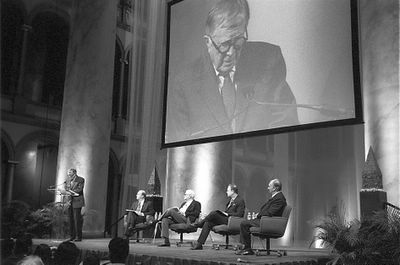
Images of some stamps and coins issued by the Islamic Republic of Iran between 1990 and 2010 commemorating the Idd-e-Ghadir. The inscriptions inlude the Shahada, Qur’anic ayats and the declaration made by Prophet Muhammad at Ghadir Khumm, “Mun Koontu Mawla, Fa Hada, Aliyun Mawla” meaning “He of whom I am the Mawla Ali is also the Mawla.”
_______________
At the Ghadir Khumm Campsite
By BARNABY ROGERSON
Barnaby Rogerson
What an offer! To travel back in time and return as a true witness to the history that I have so often thought and dreamed about. Perhaps I could travel in the habit of a Christian envoy from some Celtic island monastery off the west coast of the British Isles, sent east to seek advice from the wise holy man of whom we had heard, far off in Arabia. For in my homeland the light of civilization seems on the point of extinction, as Barbarian invaders appear like devils from out of the German sea.

I would arrive in the oasis of Medina at a time of peace, when all of Arabia was sending delegations to seek peace and instruction. Here, in my imagination, I would be befriended by Ali and taken back to his home, where I would witness how this battle-scarred warrior was also content in his role as a young father, playing with his boys Hussein and Hassan on the reed mats in his humble hut amongst the palm groves.
Then, in a flurry of energy, I receive a last-minute invitation to join the Prophet’s Last Pilgrimage to the holy shrine at Mecca. Although I am not permitted to approach the shrine itself and am left at a campsite just outside the pilgrimage city, I make certain to record the events as told by the eyewitnesses I travelled with.
On the journey back, I bear witness to the exact succession of events at the Ghadir Khumm campsite: the blessings, the sermon and the ritual actions of the Prophet ordaining Ali as his successor. These I faithfully record in the pages of my journal, before hurriedly departing and returning to my homeland. There, the account of my travels is neatly copied out onto vellum and placed in the monastery library. Years later, the monastery is sacked by raiders coming out of the sea, who in their fury destroyed even the walls of this holy place. But this was fortunate in a way, for the domed roof of the library collapsed preserving all the books, which lie there still…
Date posted: July 26, 2021.
___________________
Before departing this website please take a moment to review Simerg’s Table of Contents for links to hundreds of thought provoking pieces on a vast array of subjects including faith and culture, history and philosophy, and arts and letters to name a few. Also visit Simerg’s sister websites Barakah, dedicated to His Highness the Aga Khan, and Simergphotos.