Two of many verses from the Qur'an from Chapter 19 entitled Maryam (the Muslim name attributed to Mary). Photograph: Simerg.

The Birth of Jesus in the Qur’an, as Christians Around the World Celebrate His Birth at Christmas

: The Altar of the Nativity, beneath which is the star marking the spot where tradition says the Virgin Mary gave birth to Jesus
The Altar of the Nativity, beneath which is the star marking the spot where tradition says the Virgin Mary gave birth to Jesus. Photograph: Muslim Harji, Montreal.

_________________________________________

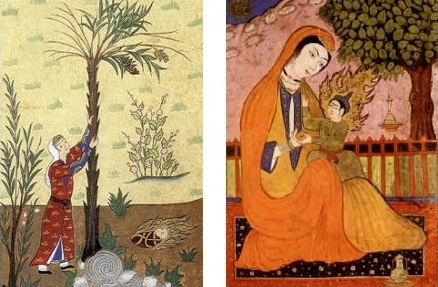
Mary and Jesus and the palm tree that nourished them
Left: Virgin Mary nurtured by a palm tree in a Turkish miniature, as described in the Qur’an; right: Mary and Jesus in a Persian miniature. Images: Wikipedia.

Verses in the Quran regarding Jesus and Mary
Please click on the image for enlargement. Read Barnaby Rogerson’s story related to the above verses HERE

_________________________________________

_________________________

~~~~~~~~

~~~~~~~~

  1. Faith and Practice in Islamic Traditions, vol. 1 (Student Reader). London: Islamic Publications Limited for The Institute of Ismaili Studies, 2015.
  2. The Qur’an and its Interpretations vol. 1 (Student Reader). London: Islamic Publications Limited for The Institute of Ismaili Studies, 2017.
  3. Shedinger, Robert F. “Jesus“, in: Oxford Bibliographies in Islamic Studies.
  4. Omar Ali-de-Unzaga. “Jesus, Christians and Christianity in the Thought of the Ikhwan al-Safa’”, in: Christian-Muslim Relations. A Bibliographical History. Volume 2 (900- 1050), ed. David Thomas et al. (Leiden: E.J. Brill, 2010); The History of Christian-Muslim Relations, 14; pp. 306-311. 
  5. Andani, Khalil, “Jesus in Esoteric Islam: An Ismaili Muslim Christology,” Lecture for the Society of Comparative Theology, Harvard Divinity School, 1 March 2013. 
  6. Aga Khan III. The Memoirs of Aga Khan: World Enough and Time. London: Cassell and Company Ltd, 1954.

The Easter tradition and sacred Christian objects

On April 9, 2023, Christians around the world will observe Easter Sunday as mark of their faith that Jesus Christ — Prophet Issa (may peace be on him) as he is known in Islam — was resurrected three days after his death by crucifixion. Simerg presents a selection of photos related to Easter traditions and the Christian faith captured by Montreal’s Muslim Harji during his travels around the world. The photographs shown on this page are part of a broader presentation of Harji’s highly acclaimed and must-read photo essay SACRED SPACES in world faiths that appears on Simergphotos.

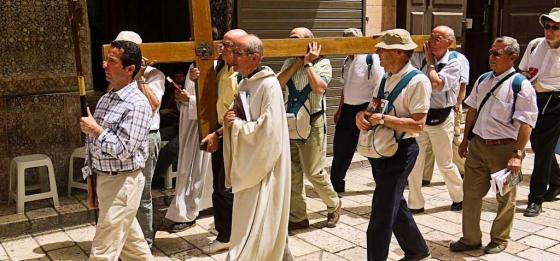
Crucifixion procession Jerusalem
This route through the Old City of Jerusalem is revered by Christian pilgrims as the route taken by Jesus as he was led to his crucifixion. It is the setting of regular processions. Photo: © Muslim Harji, Montreal, PQ, Canada.

***

Muslim Harji Sacred Spaces Christian Simergphotos Stone of Anointing
The Stone of Unction, also known as the Stone of Anointing, is just inside the entrance of the Church of the Holy Sepulchre in Jerusalem, and is believed to be the place where the body of Jesus Christ was laid down after being removed from the crucifix and prepared for burial. Photo: © Muslim Harji, Montreal, PQ, Canada.

***

Muslim Harji Sacred Spaces Christian Simergphotos
A Coptic Christian priest at the Lake Tana Churches and Monasteries in Bahar Dar, Ethiopia, holding for display an early manuscript. The Lake Tana area was important from the 14th through 16th centuries in view of its role in maintaining the Christian faith against contemporary pressures, and the rise of the Solomonic Dynasty which patronized the building of churches and monasteries. Many of the earliest manuscripts and precious examples of ecclesiastical art as well as royal objects were safely stored in their treasuries. Photo: © Muslim Harji, Montreal, PQ, Canada.

***

Muslim Harji Sacred Spaces Christian Simergphotos
Sacred objects of ecclesiastical art at the Lake Tana Churches. Photo: © Muslim Harji, Montreal, PQ, Canada.

***

Muslim Harji Sacred Spaces Christian Simergphotos Monastery
St. George’s Monastery, Jerusalem, where Christian monks maintain their ancient way of life, began in the fourth century with a few monks who sought the desert experiences of the prophets. Photo: © Muslim Harji, Montreal, PQ, Canada.

Date posted: April 4, 2021 (in Simpergphtos).
Date reposted: April 8, 2023.

_____________________

Please take a moment to review Simerg’s Table of Contents as well as visit Simerg’s sister websites Barakah and Simergphotos. The editor may be reached via email at mmerchant@simerg.com.

The Aga Khan, Pope Benedict XVI, the Ismaili Imamat, the Papacy and Simon (St.) Peter

Aga Khan, Pope Benedict, Papacy, Ismaili Imamat and Simon Peter
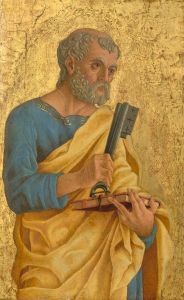
Simon Peter. Click on image to read article

As part of his famous Apostolic Journey to France in 2008, Pope Benedict XVI — who died on December 31, 2022 — paid a visit to the “Institut De France” in Paris where he was presented with a gold medal by the Institut. Pope Benedict also unveiled a plaque commemorating his visit. During his very brief remarks to the audience, the Pope expressed his gratitude to the Institut “both personally and as the successor of [Simon] Peter.” The Aga Khan met the Late Pope, with everyone’s attention drawn to their handshake…Over the past 15 years, there has been an increased collaboration between Catholic institutions and the work of the Ismaili Imamat, through the Aga Khan Development Network…The Catholics adhere to the belief that the Pope is a successor of St. Peter. The succession of the Pope is determined by a college of cardinals who elect the Pope, while the office of the Imam of the Ismailis is a hereditary position.  — READ MORE

Date posted: January 1, 2023.

__________________________

REVIEW SIMERG’S TABLE OF CONTENTS AND VISIT ITS SISTER WEBSITES

Before departing this website, please take a moment to review Simerg’s Table of Contents for links to hundreds of thought-provoking pieces on a vast array of subjects including faith and culture, history and philosophy, and arts and letters to name a few. Also visit Simerg’s sister websites Barakah, dedicated to His Highness the Aga Khan, and SimergphotosThe editor may be reached via email at mmerchant@simerg.com.

Photo of the Day: The Birthplace of Jesus, and the Depiction of Jesus in Islam including His Immaculate Conception

Why Do Muslims Revere Jesus?

His name is mentioned in the Holy Qur’an twenty-five times, often in the form ‘Isa ibn Maryam, meaning “Jesus, son of Mary.” In the Qur’an, he is referred to by the unique title of “Messiah” (al-masih in Arabic), meaning “anointed one.” Descriptions of Jesus in the Qur’an include many aspects of the narrative found in the Gospels about the life of Jesus, including his virgin birth, the signs given to him by God, that he was raised by God into His presence, and it also suggests his future return. Jesus is also referred to in the Qur’an as the “Word” and the “Spirit” of God, a special honour. READ MORE

_____________________

Photo of the Day: Birthplace

Click on photo for enlargement

Interior view of a religious site, featuring ornate decorations, lit candles, and icons behind a protective enclosure.
Photo of the Day: The Altar of the Nativity, beneath which is the star marking the spot where tradition says the Virgin Mary gave birth to Jesus. Photo: Muslim Harji, Montreal.

_____________________

Muslims Articulate the Immaculate Conception of Jesus in the Presence of a Christian Emperor

To read Barnaby Rogerson’s article, please click HERE or on image below

Left: Virgin Mary nurtured by a palm tree in a Turkish miniature, as described in the Qur'an; right: Mary and Jesus in a Persian miniature. Please click on image for Michael Wolfe's article "Jesus Through a Muslim Lens." Images: Wikipedia.
Left: Virgin Mary nurtured by a palm tree in a Turkish miniature, as described in the Qur’an; right: Mary and Jesus in a Persian miniature. Please click on image for Barnaby Rogerson’s article. Images: Wikipedia, Creative Commons

Date posted: December 25, 2022.

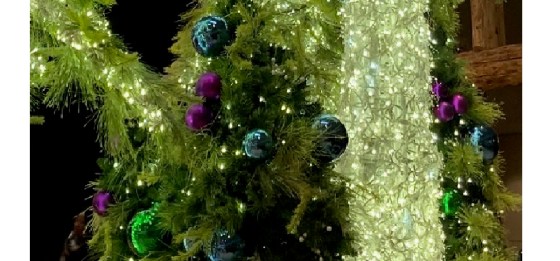
Featured photo at top of post: Festive season decorations at CrossIron Mills, Calgary, December 24, 2022. Photograph: Malik Merchant/Simerg.

_______________________

REVIEW SIMERG’S TABLE OF CONTENTS AND VISIT ITS SISTER WEBSITES

Before departing this website, please take a moment to review Simerg’s Table of Contents for links to hundreds of thought-provoking pieces on a vast array of subjects including faith and culture, history and philosophy, and arts and letters to name a few. Also visit Simerg’s sister websites Barakah, dedicated to His Highness the Aga Khan, and SimergphotosThe editor may be reached via email at mmerchant@simerg.com.

(1) The Immaculate Conception of Jesus in the Qura’n and its Impact on a Christian Emperor by Barnaby Rogerson; and (2) Jesus Through a Muslim Lens by Michael Wolfe

“Muhammad, who could do nothing to alleviate the suffering of his small embattled community of believers, at last advised some of his followers to leave sacred Mecca and take refuge elsewhere”…. Read Barnaby Rogerson’s Piece

The Altar of the Nativity, beneath which is the star marking the spot where tradition says the Virgin Mary gave birth to Jesus. Photo: Muslim Harji, Montreal, PQ. Copyright. Please click on image for Barnaby Rogerson's piece.
The Altar of the Nativity, beneath which is the star marking the spot where tradition says the Virgin Mary gave birth to Jesus. Photo: Copyright Muslim Harji, Montreal, PQ. Please click on image for Barnaby Rogerson’s piece.

________________

“Christians may be surprised to learn that Muslims believe in the Virgin Birth and Jesus’ miracles”….. Read Michael Wolfe’s Piece

Left: Virgin Mary nurtured by a palm tree in a Turkish miniature, as described in the Qur'an; right: Mary and Jesus in a Persian miniature. Please click on image for Michael Wolfe's article "Jesus Through a Muslim Lens." Images: Wikipedia.
Left: Virgin Mary nurtured by a palm tree in a Turkish miniature, as described in the Qur’an; right: Mary and Jesus in a Persian miniature. Please click on image for Michael Wolfe’s article “Jesus Through a Muslim Lens.” Images: Wikipedia.

Date posted: May 23, 2022.

_____________________

The Birth of Jesus Christ in the Qur’an and Its Impact on a Christian Emperor by Barnaby Rogerson

The Altar of the Nativity, beneath which is the star marking the spot where tradition says the Virgin Mary gave birth to Jesus. Photo: Muslim Harji, Montreal, PQ. Copyright. Please click on image for Barnaby Rogerson's piece.
The Altar of the Nativity, beneath which is the star marking the spot where tradition says the Virgin Mary gave birth to Jesus. Photo: © Muslim Harji, Montreal, PQ. Please click on image for complete article.

Verses from the Holy Qur’an on the Immaculate Conception of Jesus Christ

19:17 Then We sent unto her Our Spirit and it assumed for her the likeness of a perfect man.

19:18 She said: Lo! I seek refuge in the Beneficent One from thee, if thou art God-fearing.

19:19 He said: I am only a messenger of thy Lord, that I may bestow on thee a faultless son.

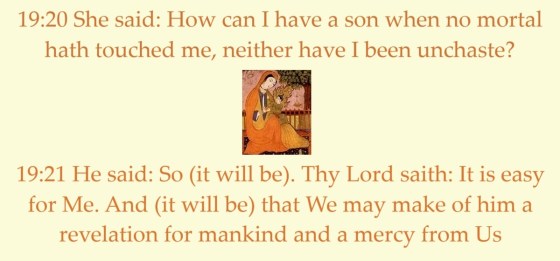
19:20 She said: How can I have a son when no mortal hath touched me, neither have I been unchaste?

19:21 He said: So (it will be). Thy Lord saith: It is easy for Me. And (it will be) that We may make of him a revelation for mankind and a mercy from Us, and it is a thing ordained.

19:22 And she conceived him, and she withdrew with him to a far place.

19:23 And the pangs of childbirth drove her unto the trunk of the palm-tree. She said: Oh, would that I had died ere this and had become a thing of naught, forgotten!

[Mary complains to a palm tree about the pains of childbirth. The tree tells her to shake its trunk and ripe dates will fall.]

19:24 Then (one) cried unto her from below her, saying: Grieve not! Thy Lord hath placed a rivulet beneath thee,

19:25 And shake the trunk of the palm-tree toward thee, thou wilt cause ripe dates to fall upon thee.

19:26 So eat and drink and be consoled. And if thou meetest any mortal, say: Lo! I have vowed a fast unto the Beneficent, and may not speak this day to any mortal.

19:27 Then she brought him to her own folk, carrying him. They said: O Mary! Thou hast come with an amazing thing……CLICK TO READ FULL ARTICLE

Date posted: December 25, 2020.

Before departing this website please take a moment to review Simerg’s Table of Contents for links to hundreds of thought provoking pieces on a vast array of subjects including faith and culture, history and philosophy, and arts and letters to name a few.

_______________

Prophet Muhammad’s Covenants with Christians and His Vision for a Pluralistic Society with Complete Religious Freedom

 “Prophet Muhammad believed that freedom of religion and civic rights were important components of a ‘Muslim Nation’….His covenants with Christians can be viewed as a kind of medicine to cure the diseases of Islamic extremism and Islamophobia.” — Rice University Study

The_Patent_of_Mohammed

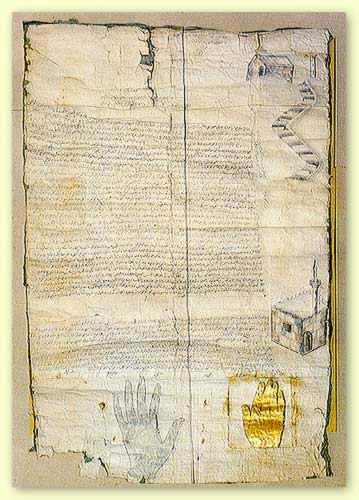
The Covenant with the Monks of Mount Sinai was commissioned by Prophet Muhammad, with Hazrat Ali as its scriber. Manuscript copies are from Saint Catherine’s Monastery, and Simonopetra. Photo: Wikipedia.

The following piece is adapted from a report released by Rice University – ed.

Prophet Muhammad believed that freedom of religion and civic rights were important components of a ‘Muslim nation,’ according to a Rice University analysis of the Prophet’s covenants with Christians.

Researcher Craig Considine, a lecturer in Rice’s Department of Sociology, argues that the covenants can be used to develop a stronger democratic partnership between Muslims and Christians in the Islamic world and elsewhere. His study is published in the journal Religions under the title “Religious Pluralism and Civic Rights in a ‘Muslim Nation’: An Analysis of Prophet Muhammad’s Covenants with Christians.” It can be downloaded through the link provided at the bottom of this post.

“These covenants were designed to protect and even defend peaceful Christian communities, not attack them,” Considine said. He found that these agreements established freedom of religion and civic rights for Christians living within the “ummah” (Arabic for “community”). “The research clearly shows that contemporary Islamic states that mistreat and discriminate against Christians cannot be justified in light of Prophet Muhammad’s covenants,” adds Considine.

The covenants were written between 622 and 632 A.D. Considine said it is assumed they were written because of Prophet Muhammad’s desire to build alliances to bolster his new community and because of his positive interactions with members of the Christian faith. The paper explores the Prophet’s covenants with the monks of Mount Sinai, the Christians of Najran, the Christians of Persia and the Christians of the World.

In “The Covenant of the Prophet with the Christians of Persia,” the Prophet was emphatic on the issue of complete religious freedom:

“And even as they honor and respect me, so shall Muslims care for that people as being under our protection and whensoever any distress or discomfort shall overtake (Christians), Muslims shall hold themselves in duty bound to aid and care for them, for they are a people subject to my Nation, obedient to their word, whose helpers also they are. It therefore is proper for my sake to attend to their comfort, protection and aid, in face of all opposition and distress, suppressing everything that becomes a means to their spoliation,” the Prophet wrote.

Considine said a similar — if not identical — passage is found in the three other covenants addressed in this paper.

Article continues after Aga Khan quote….

HIS HIGHNESS THE AGA KHAN ON THE ETHIC OF PLURALISM

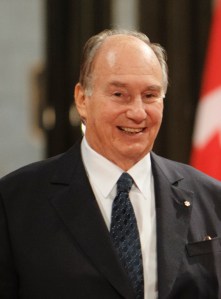
His Highness the Aga Khan at the Canadian Parliament on 27 February 2014.

“A cosmopolitan ethic is one that welcomes the complexity of human society. It balances rights and duties, freedom and responsibility. It is an ethic for all peoples, the familiar and the Other, whether they live across the street or across the planet…..Sadly, the world is becoming more pluralist in fact, but not necessarily in spirit. “Cosmopolitan” social patterns have not yet been matched by “a cosmopolitan ethic.”…..As you build your lives, for yourselves and others, you will come to rest upon certain principles. Central to my life has been a verse in the Holy Qur’an which addresses itself to the whole of humanity. It says: “Oh Mankind, fear your Lord, who created you of a single soul, and from it created its mate, and from the pair of them scattered abroad many men and women…” I know of no more beautiful expression about the unity of our human race — born indeed from a single soul.” — Excerpts from the Aga Khan’s speech made to the Parliament of Canada, Ottawa, February 27, 2014.

“Prophet Muhammad made it clear that freedom of religion is an inherent right for Christians living in a Muslim nation,” he said. “His cordial relations with Christians were not due merely to political expediency or personal aspirations, but rather they resulted from his belief that Christians should be able to freely practice their own faith in accordance with their own will. Christian Persians were under no compulsion whatsoever to accept or reject Islam.”

Considine also noted that Prophet Muhammad believed that a Muslim nation must also extend civic rights to Christian religious leaders, as discussed in “The Covenant of the Prophet with the Christians of the World.” The Prophet wrote:

“The covenant of Allah is that I should protect their land, their monasteries, with my power, my horses, my men, my strength and my Muslim followers in any region, far away or close by, and that I should protect their businesses. I grant security to them, their churches, their businesses, their houses of worship, the places of their monks, the places of their pilgrims, wherever they may be found.”

“The Prophet Muhammad did not want to inflict harm on Christians, nor interfere or encroach on their privacy or private property,” Considine said. “For the state to give preference to one or more groups means devaluating citizens based upon their ethnic or cultural backgrounds.”

Considine said documents have been located in obscure monasteries around the world and books that have been out of print for centuries.

Considine said the rediscovery of these documents provides an opportunity to give new birth to Islam and regenerate the essence of Islamic teachings. He hopes that the findings will have a positive impact on the impressions of Muslims in today’s society and will combat anti-Muslim sentiments.

“Prophet Muhammad’s covenants with Christians can be viewed as a kind of medicine to cure the diseases of Islamic extremism and Islamophobia,” Considine said. “His message radiates compassion and peace. This is what American society — and indeed the world — needs now more than ever.”

Please download the entire paper in text or PDF format at http://www.mdpi.com/2077-1444/7/2/15.

Date posted: February 6, 2018.

__________________

We welcome your feedback. Please click Leave a comment.

A Brief Note on Papacy and the Ismaili Imamat, and St. Peter in Roman Catholic and Ismaili Traditions

PREPARED AND COMPILED BY ABDULMALIK MERCHANT
(Publisher-Editor http://www.simerg.com, http://www.barakah.com and http://www.simergphotos.com)

Handshake: Pope Benedict XVI and His Highness the Aga Khan

As part of his famous Apostolic Journey to France in 2008, Pope Benedict XVI, on September 13, paid a visit to the “Institut De France” in Paris. The Pope, who had been elected as the 265th Pope of the Roman Catholic Church in 2005, was presented with a gold medal by the Institut, and also unveiled a plaque commemorating his visit. During his very brief remarks to the audience, the Pope expressed his gratitude to the Institut “both personally and as the successor of [Simon] Peter.”

His Highness the Aga Khan, Mawlana Hazar Imam, was also in attendance at the Institut de France as the Associate Foreign Member of the Académie des Beaux-Arts (Academy of Fine Arts), one of five learned societies within the Institut which was founded in 1795.

Everyone’s attention in the hall was drawn to Mawlana Hazar Imam and the Pope, with an extraordinary sense of interest and keenness, as the two faith leaders greeted each other with a handshake.

A couple of years earlier in 2006, the Pope made some controversial remarks concerning Islam to which the Aga Khan responded in an  which appeared in Germany’s widely read Spiegel website.

In 2013, Pope Benedict dramatically resigned his position as the Head of the Catholic Church due to his deteriorating strength, advanced age and the heavy demands of being Pope, and retired at the Mater Ecclesiae, a small monastery located inside the Vatican State City. His present successor is Pope Francis I, born Jorge Mario Bergoglio.

Pope Benedict XVI is seen greeting His Highness the Aga Khan on September 13 at the Institut de France in Paris during an official visit to France in 2008. Photo: Copyright. Getty Images. Published on Simerg/Simergphotos with a Licencing arrangement with Getty Images. Fench caption: Vue plongeante du pape BENOIT XVI serrant la main de l'AGA KHAN à son arrivée sous la coupole de l'Institut de France à PARIS entouré de nombreux académiciens et autres personnalités dont Gabriel DE BROGLIE, Hélène CARRERE D'ENCAUSSE, Jean-François JARRIGE, Jean-François BACH, Arnaud D'HAUTERIVES, Michel ALBERT, Christian PONCELET président du Sénat, Jean TULARD, Alain DECAUX, Pierre-Jean REMY, Michel MOHRT, Max GALLO, le cardinal André VINGT-TROIS archevêque de Paris et le cardinal Paul POUPARD. (Photo by Philippe Petit/Paris Match via Getty Images)

Everyone’s attention is drawn to Pope Benedict XVI and His Highness the Aga Khan as they greet each other on September 13, at the Institut de France in Paris during an official visit by the Pope to France in 2008. Photo: Copyright. Getty Images. Published on Simerg/Simergphotos with a Licensing arrangement with Getty Images. Fench caption: Vue plongeante du pape BENOIT XVI serrant la main de l’AGA KHAN à son arrive sous la coupole de l’Institut de France à PARIS entouré de nombreux académiciens et autres personnalités dont Gabriel DE BROGLIE, Hélène CARRERE D’ENCAUSSE, Jean-François JARRIGE, Jean-François BACH, Arnaud D’HAUTERIVES, Michel ALBERT, Christian PONCELET président du Sénat, Jean TULARD, Alain DECAUX, Pierre-Jean REMY, Michel MOHRT, Max GALLO, le cardinal André VINGT-TROIS archevêque de Paris et le cardinal Paul POUPARD. (Photo by Philippe Petit/Paris Match via Getty Images).

SIMON PETER IN THE CHRISTIAN AND ISMAILI TRADITIONS

The Catholics adhere to the belief that the Pope is a successor of St. Peter or Simon Peter. The succession of the pope is determined by a college of cardinals who elect the pope, while the office of the Imam of the Ismailis is a hereditary position.

In a speech made at the Canadian Parliament in 2014, the Aga Khan declared that “the Ismaili Imamat is a supra-national entity, representing the succession of Imams since the time of the Prophet.” And, in an interview with Politique International he said, “The religious leadership of the Ismaili Imam goes back to the origins of Shia Islam when the Prophet Muhammad appointed his son-in-law, Ali, to continue his teachings within the Muslim community. The leadership is hereditary, handed down by Ali’s descendants, and the Ismailis are the only Shia Muslims to have a living Imam, namely myself.”

In the Catholic tradition, the foundation for the office of the Pope is found primarily in Matthew, where Jesus is quoted as telling Simon Peter:

“You are ‘Rock,’ and on this rock I will build My Church and the gates of hell shall not prevail against it. And I will give unto thee the keys of the kingdom of heaven: and whatsoever thou shalt bind on earth shall be bound in heaven: and whatsoever thou shalt loose on earth shall be loosed in heaven.”

This series of successions of the Pope is known as “Apostolic Succession,” with the line of Bishops stretching back to the apostles, who lived during the time of Jesus. Simon Peter is recognized as having been the first Pope. Early Christians however reserved the title of “Pope” for St. Peter’s successors.

In branches of Shia theology as well as Ismailism, Simon Peter’s role is seen as the direct parallel to that of Hazrat Ali as the first Imam. Ismailis along with some other Shia groups maintain that every major Prophet had a spiritual legatee (Waṣi) or successor called the Asas (foundation) who taught the inner meaning to those who had the capacity to understand it. In this regard, Adam had Seth; Noah had Shem; Moses had Aaron, and Jesus had Simon Peter. A well known sacred tradition of the Prophet Muhammad says that “Ali is to me as Aaron was to Moses,” confirming that Ali held the same level of authority as Aaron did.

Date posted: January 3, 2018

An earlier version of this post appeared on this website on December 31, 2015.
_______________

We welcome your feedback, please click Leave a comment or send it to simerg@aol.com, Your feedback may be edited for length and brevity, and is subject to moderation. We are unable to acknowledge unpublished letters.

The following were used as references for the compilation of this piece:

  1. Apostolic Journey to France: Greeting by the Holy Father during the visit at the Institut de France (September 13, 2008)
  2. The Popes: From St. Peter to Pope Frances by Rupert Matthews,  2014 Edition published by arrangement with Moseley Road Inc.
  3. http://www.catholic-pages.com/pope/peter.asp
  4. Peter in Islam, at Wikipedia.
  5. Comparing the Imamat and the Papacy: Some Short Notes (at Ismailignosis.com).
  6. The Delegation Decoded – An Esoteric Exegesis of the Delegation of the Isma‘ili Imamat, by Khalil Andani.
  7. Concise Encyclopedia of Islam, C. Glasse.
  8. Voices: “The Power of Wisdom” – His Highness the Aga Khan’s Interview with Politique Internationale (English translation)
  9. In a Dynamic and Stirring Address to Members of the Canadian Parliament, His Highness the Aga Khan Shares His Faith Perspectives on the Imamat, Collaboration with Canada, the Muslim World Community (the Ummah), the Nurturing of Civil Society, Early Childhood Education, Voluntary Work, and the Unity of the Human Race

Also see the following important features to learn more about the Aga Khan and the Ismaili Imamat:

in which His Highness the Aga Khan responded to Pope Benedict’s controversial remarks concerning Islam that he had made in 2006; and Special Series: Ismaili Expressions on the Imamat and Imam of the Time — (I) The Preamble of the Constitution of the Shia Imami Ismaili Muslims

His Highness the Aga Khan and Pope Benedict XVI: A Very Special Photo of Two Faith Leaders Meeting Each Other at the Institut De France in Paris

PREPARED AND COMPILED BY ABDULMALIK MERCHANT
(Publisher-Editor http://www.simerg.com and http://www.simergphotos.com)

As part of his famous Apostolic Journey to France in 2008, Pope Benedict XVI, on September 13, paid a visit to the “Institut De France” in Paris. The Pope, who had been elected as the 265th Pope of the Roman Catholic Church in 2005, was presented with a gold medal by the Institut, and also unveiled a plaque commemorating his visit. During his very brief remarks to the audience, the Pope expressed his gratitude to the Institut “both personally and as the successor of [Simon] Peter.”

His Highness the Aga Khan, Mawlana Hazar Imam, was also in attendance at the Institut de France as the Associate Foreign Member of the Académie des Beaux-Arts (Academy of Fine Arts), one of five learned societies within the Institut which was founded in 1795.

Everyone’s attention in the hall was drawn to Mawlana Hazar Imam and the Pope, with an extraordinary sense of interest and keenness, as the two faith leaders greeted each other with a handshake. Simerg is pleased to present this licensed copyright photo with permission from Getty Images.

Pope Benedict XVI is seen greeting His Highness the Aga Khan on September 13 at the Institut de France in Paris during an official visit to France in 2008. Photo: Copyright. Getty Images. Published on Simerg/Simergphotos with a Licencing arrangement with Getty Images. Fench caption: Vue plongeante du pape BENOIT XVI serrant la main de l'AGA KHAN à son arrivée sous la coupole de l'Institut de France à PARIS entouré de nombreux académiciens et autres personnalités dont Gabriel DE BROGLIE, Hélène CARRERE D'ENCAUSSE, Jean-François JARRIGE, Jean-François BACH, Arnaud D'HAUTERIVES, Michel ALBERT, Christian PONCELET président du Sénat, Jean TULARD, Alain DECAUX, Pierre-Jean REMY, Michel MOHRT, Max GALLO, le cardinal André VINGT-TROIS archevêque de Paris et le cardinal Paul POUPARD. (Photo by Philippe Petit/Paris Match via Getty Images)

Everyone’s attention is drawn to Pope Benedict XVI and His Highness the Aga Khan as they greet each other on September 13, at the Institut de France in Paris during an official visit by the Pope to France in 2008. Photo: Copyright. Getty Images. Published on Simerg/Simergphotos with a Licensing arrangement with Getty Images. Fench caption: Vue plongeante du pape BENOIT XVI serrant la main de l’AGA KHAN à son arrive sous la coupole de l’Institut de France à PARIS entouré de nombreux académiciens et autres personnalités dont Gabriel DE BROGLIE, Hélène CARRERE D’ENCAUSSE, Jean-François JARRIGE, Jean-François BACH, Arnaud D’HAUTERIVES, Michel ALBERT, Christian PONCELET président du Sénat, Jean TULARD, Alain DECAUX, Pierre-Jean REMY, Michel MOHRT, Max GALLO, le cardinal André VINGT-TROIS archevêque de Paris et le cardinal Paul POUPARD. (Photo by Philippe Petit/Paris Match via Getty Images).

In 2013, Pope Benedict dramatically resigned his position as the Head of the Catholic Church due to his deteriorating strength, advanced age and the heavy demands of being Pope, and retired at the Mater Ecclesiae, a small monastery located inside the Vatican State City. His present successor is Pope Francis I, born Jorge Mario Bergoglio.

SOME BRIEF NOTES ON THE PAPACY AND THE IMAMAT, AND SIMON PETER IN THE ROMAN CATHOLIC AND ISMAILI TRADITIONS

The Catholics adhere to the belief that the Pope is a successor of St. Peter. The succession of the pope is determined by a college of cardinals who elect the pope, while the office of the Imam of the Ismailis is a hereditary position. The Ismailis regard their 49th hereditary Imam as the direct descendant of the Prophet Muhammad (s.a.s) through Hazrat Ali (a.s.) and Hazrat Bibi Fatima (a.s.). In a speech made at the Canadian Parliament in 2014, the Aga Khan declared that “the Ismaili Imamat is a supra-national entity, representing the succession of Imams since the time of the Prophet.” And, in an interview with Politique International he said, “The religious leadership of the Ismaili Imam goes back to the origins of Shia Islam when the Prophet Muhammad appointed his son-in-law, Ali, to continue his teachings within the Muslim community. The leadership is hereditary, handed down by Ali’s descendants, and the Ismailis are the only Shia Muslims to have a living Imam, namely myself.”

In the Catholic tradition, the foundation for the office of the Pope is found primarily in Matthew, where Jesus is quoted as telling Simon Peter:

“You are ‘Rock,’ and on this rock I will build My Church and the gates of hell shall not prevail against it. And I will give unto thee the keys of the kingdom of heaven: and whatsoever thou shalt bind on earth shall be bound in heaven: and whatsoever thou shalt loose on earth shall be loosed in heaven.”

This series of successions of the Pope is known as “Apostolic Succession,” with the line of Bishops stretching back to the apostles, who lived during the time of Jesus. Simon Peter is recognized as having been the first Pope. Early Christians reserved the title of “Pope” for St. Peter’s successors.

However, in branches of Shia theology as well as Ismailism, Simon Peter’s role is seen as the direct parallel to that of Hazrat Ali as the first Imam. Ismailis along with some other Shia groups maintain that every major Prophet had a spiritual legatee (Waṣi) or successor called the Asas (foundation) who taught the inner meaning to those who had the capacity to understand it. In this regard, Adam had Seth; Noah had Shem; Moses had Aaron, and Jesus had Simon Peter. A well known sacred tradition of the Prophet Muhammad says that “Ali is to me as Aaron was to Moses,” confirming that Ali held the same level of authority as Aaron did.

Date posted: December 31, 2015.
Last updated: January 1, 2015.

_______________

We welcome your feedback, please click Leave a comment or send it to simerg@aol.com, subject: Aga Khan and Pope.  Your feedback may be edited for length and brevity, and is subject to moderation. We are unable to acknowledge unpublished letters.

The following were used as references for the compilation of this piece:

  1. Apostolic Journey to France: Greeting by the Holy Father during the visit at the Institut de France (September 13, 2008)
  2. The Popes: From St. Peter to Pope Frances by Rupert Matthews,  2014 Edition published by arrangement with Moseley Road Inc.
  3. http://www.catholic-pages.com/pope/peter.asp
  4. Peter in Islam, at Wikipedia.
  5. Comparing the Imamat and the Papacy: Some Short Notes (at Ismailignosis.com).
  6. The Delegation Decoded – An Esoteric Exegesis of the Delegation of the Isma‘ili Imamat, by Khalil Andani.
  7. Concise Encyclopedia of Islam, C. Glasse.
  8. Voices: “The Power of Wisdom” – His Highness the Aga Khan’s Interview with Politique Internationale (English translation)
  9. In a Dynamic and Stirring Address to Members of the Canadian Parliament, His Highness the Aga Khan Shares His Faith Perspectives on the Imamat, Collaboration with Canada, the Muslim World Community (the Ummah), the Nurturing of Civil Society, Early Childhood Education, Voluntary Work, and the Unity of the Human Race

Also see the following important features to learn more about the Aga Khan and the Ismaili Imamat:

in which His Highness the Aga Khan responded to Pope Benedict’s controversial remarks concerning Islam that he had made in 2006; and Special Series: Ismaili Expressions on the Imamat and Imam of the Time — (I) The Preamble of the Constitution of the Shia Imami Ismaili Muslims

Islam’s 99 Names of God: Andrew Kosorok, A Christian Artist from Utah, Seeks to Explore Them Through Glass Sculptures

“I learned that when Mohamed was asked how a person could get into Heaven he told them they needed to learn the Names of God; when pressed on how many there were Mohamed responded that there were 99. This really resonated with me; I began to study the Names and respond to them through glass sculpture, and the 99 Names Project was born…” — Andrew Kosorok, Utah

PLEASE CLICK: A Christian Artist’s Epic and Noble Journey of Uniting Faiths Continues As He Completes the First 25 Sculptures Depicting Islam’s 99 Names of God

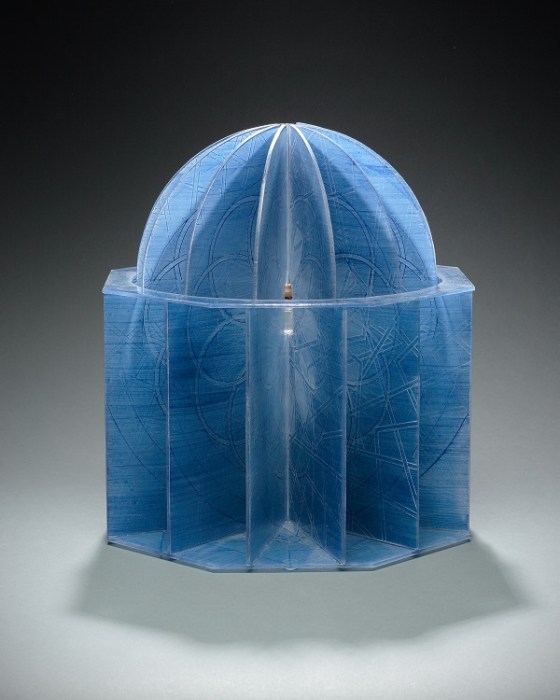
Wellspring of Peace (As-Salam). Photo: Andrew Kosorok. Copyright.

Wellspring of Peace (As-Salam). Photo: Andrew Kosorok. Copyright.