Simerg is an independent initiative dedicated to Ismaili Muslims, the Aga Khan — their Hereditary Imam — and the Ismaili Imamat, and Islam in general through literary readings, photo essays and artistic expressions
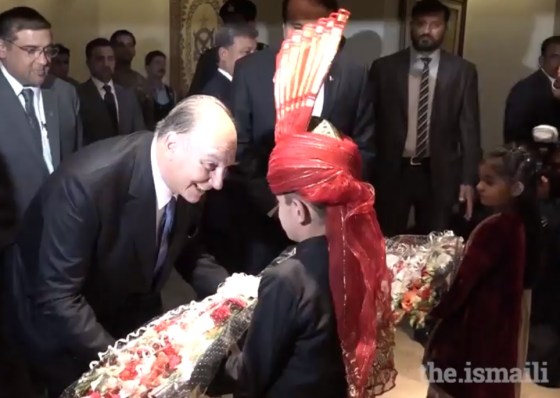
A young boy from Chitral presented a bouquet of flowers to Mawlana Hazar Imam, His Highness the Aga Khan on December 7, 2017. What then followed is a brief conversation the boy will remember all his life.
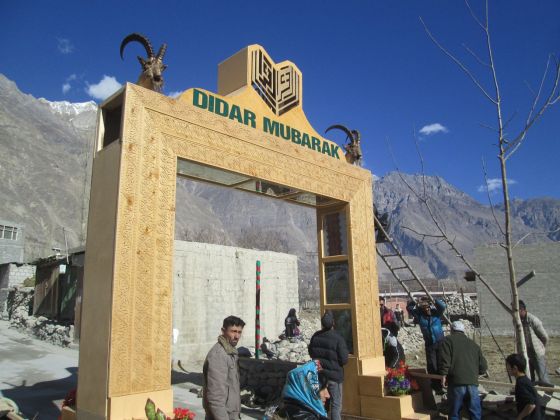
HUNZA’S FAQIR ULLAH KHAN in a special report for Barakah provides a lively update with great photos of the Darbar preparations that are underway in Aliabad, Hunza. Read his wonderful piece and share it with all your friends…..MORE
The excitement for the didar has spilled into every corner of Hunza. There will be more Jamati members participating in this Darbar than ever before. The entire registration process began some months ago and this has proceeded very well. The spirit of the Jamat and volunteers particularly in central Hunza is extremely high. The darbar task force members are active at each of the villages. Transportation, crowd control, accommodation and lodging have become major challenges. Jamats living in remoter areas will start moving to Aliabad at least 4 days before darbar…..MORE
INTRODUCTION: On February 18, 1976, His Highness the Aga Khan, Mawlana Hazar Imam, accompanied by Begum Salimah Aga arrived in Pakistan for a month long visit that included several mulaqats with Ismailis around the country. During the visit they both attended numerous public and private events and engagements and Mawlana Hazar Imam announced the creation of the Aga Khan Award for Architecture. The first cycle of the award ceremony was held at the beautiful Shalimar Gardens in Lahore in 1980.
The extended 1976 visit also co-incided with Pakistan hosting the Seerat Conference over a 10 day period at which eminent scholars from around the world spoke in Islamabad, Lahore, Peshawar and Karachi on various aspects of the life of the Holy Prophet Muhammad (may peace be upon him). When the Aga Khan was invited by Mowlana Kausar Niazi, Pakistan’s Federal Minister for Religious Affairs, to preside over the Seerat gathering that took place in Karachi on March 12, 1976, he noted at the beginning of his presidential that he felt both trepidation and joy at the opportunity, “trepidation because few subjects could be more awe inspiring for any Muslim to speak on, joy as few subjects could give greater happiness to be involved with.”
As hundreds of millions of Muslims around the world prepare to celebrate the life of the Prophet on the occasion of his birth anniversary that falls on the 12th of Rabi al-Awwal — between November 29 and December 3, 2017 — no piece would be more befitting for the auspicious anniversary than the inspiring and insightful words spoken at the Seerat Conference by the direct descendant of the Prophet Muhammad himself. We are pleased to present the following excerpts from 49th Ismaili Imam’s Seerat speech, following which we have included the audio of the speech.
The Aga Khan on Allah’s Last Messenger
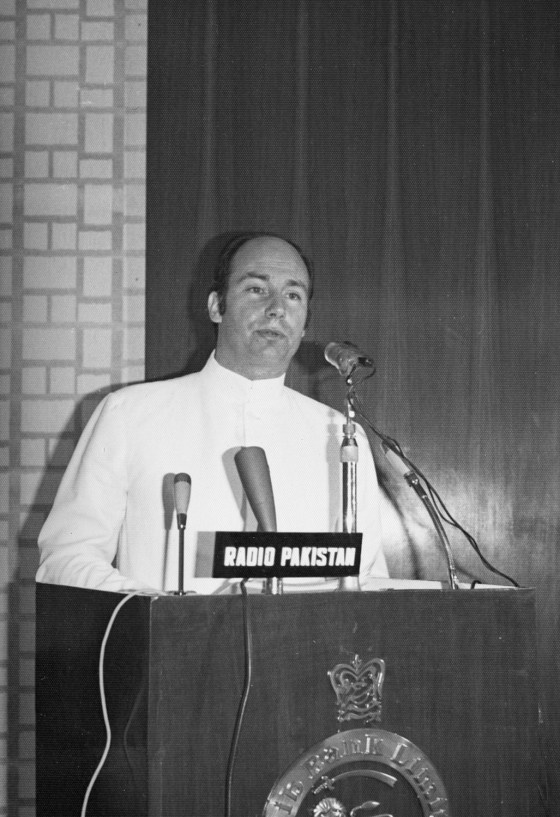
His Highness the Aga Khan giving his Presidential Address at the Seerat Conference in Karachi on March 12, 1976. Photo: The Ismaili.
A request to the conference
“Few conferences can have gathered so many men of outstanding intellect, who have devoted so much time and wisdom to the study of Islam and the life of the Holy Prophet, peace be upon him….I will begin by making a request: One hundred and seventy two eminent scholars from forty-eight countries have gathered in Islamabad, Lahore, Peshawar and Karachi to present the results of their research and reflection on various aspects of the life of the Holy Prophet. From all these exchanges, from all the private debates which have preceded and succeeded the presentation of each paper, will have come an immense range of new thoughts, new ideas and new understanding of the Prophet’s life. I sincerely request that you have available to all Muslims a complete printed record of these papers and the subsequent debates.”
Responsibilities of rich Muslim countries
“The poorer countries of Islam have ahead of them years of increasingly hard work if they wish to progress materially to acceptable standards of every day life. The richer countries, especially those that have new means, will rapidly find that this wealth, blessing that it is, will impose upon them heavy new responsibilities. They will have to administrate this wealth wisely, in the best interest of their citizens, but also keeping in mind that they have a heavy responsibility to their less well endowed brother Muslim countries, and indeed to the human race at large. Thus it is my profound conviction that Islamic Society in the years ahead will find that our traditional concept of time, a limitless mirror in which to reflect on the eternal, will become a shrinking cage, an invisible trap from which fewer and fewer will escape.”
Holding firm the ship of life: Answers in the Qur’an and the Prophet
“I have observed in the Western world a deeply changing pattern of human relations. The anchors of moral behaviour appear to have dragged to such depths that they no longer hold firm the ship of life: what was once wrong is now simply unconventional, and for the sake of individual freedom must be tolerated. What is tolerated soon becomes accepted. Contrarily, what was once right is now viewed as outdated, old fashioned and is often the target of ridicule.”
“In the face of this changing world, which was once a universe to us and is now no more than an overcrowded island, confronted with a fundamental challenge to our understanding of time, surrounded by a foreign fleet of cultural and ideological ships which have broken loose, I ask, “Do we have a clear, firm and precise understanding of what Muslim Society is to be in times to come?” And if as I believe, the answer is uncertain, where else can we search then in the Holy Qur’an, and in the example of Allah’s last and final Prophet?
“There is no justification for delaying the search for the answer to this question by the Muslims of the world, because we have the knowledge that Islam is Allah’s final message, the Qur’an His final book and Muhammed His last Prophet. We are blessed that the answers drawn from these sources guarantee that neither now, nor at any time in the future will we be going astray. As the demands on his time increase, every Muslim will find it more and more difficult to seek for himself the answer to the fundamental question of how he should live his life for it to be truly Muslim. It is men such as you who will have to bring forth the answers, answers which will have to be practical and realistic in the world of today and tomorrow. Rather than let force of circumstance impose upon us through our default in not having suitably prepared ourselves for the future, ways of life which are not or should not be ours, we must ourselves design the path we should tread.”
Bearing fruits in the diverse Muslim world
“In seeking to define what our Islamic Society should be in times ahead, 50 and 100 and 200 years hence we should, I believe, be aware that the Muslims of this world cover such an amazing range of historical, ethnic and cultural backgrounds that a completely monolithic answer may not be found. I am convinced on the other hand, that we do want to avoid so much diversity that our Muslim countries are in conflict amongst themselves or that they are so divided that they are incapable successfully of facing common enemies, be they cultural, religious, national or otherwise. This is why I so applaud Pakistan for having organized the first Muslim Summit Conference, and now this Seerat Conference, for it is only through dialogue, personal contacts and continuous exchanges that the great diversity of cultures, knowledge, outlook and resources can be co-ordinated and brought to bear fruit for the Muslim world.”
Greatest opportunity for Muslim unity is now
“Let me return, now, to the question of what Muslim Society should seek to be in the years ahead. Islam, as even non-Muslims have observed, is a way of life. This means that every aspect of the individual’s daily existence is guided by Islam: his family relations, his business relations, his education, his health, the means and manner by which he gains his livelihood, his philanthropy, what he sees and hears around him, what he reads, the way he regulates his time, the buildings in which he lives, learns and earns.
“I cannot think of any time in Islamic history when Muslims have had a greater opportunity to unite, and to ensure that the society in which they live is that which they have defined and chosen for themselves.
“Not only are all forms of human communication easier than ever before in history, but rarely, if ever has the Muslim world had such means to ensure its future. Conferences such as this seeking inspiration from the life of the Holy Prophet could render no greater service to Islam than to assist in defining what steps can be taken, where, and how, to ensure that our people can live in the years ahead in greater peace, greater prosperity and in an Islamic Society which will not be overrun or simply taken by surprise, by forces, pressures or concepts which are totally alien and may damage us irretrievably.”
Searching for a solution through eminent men and women
“In our search for a solution, I am convinced that we must call upon our own men and women, who have achieved positions of eminence anywhere in the world, and persuade them to return, for us to benefit from their knowledge, their learning and their work. All too often in my journeys I have met or learnt of outstanding Muslim scholars, doctors, scientists, and architects who have remained abroad, or who, when they do come home, have failed to receive the support and encouragement necessary for them to bring to their nations’ benefit their Muslim outlook on key areas of modern progress.
“Any meaningful human endeavour, any original thinking, any authentic research, will require moral encouragement and material support. This we must provide, not only during the individual’s initial years of learning, but equally when he leaves the restricted life of his academic centre to enter into the wider world of national or international activity.”
The inspiring life of the Holy Prophet
“The Holy Prophet’s life gives us every fundamental guideline that we require to resolve the problem as successfully as our human minds and intellects can visualise. His example of integrity, loyalty, honesty, generosity both of means and of time, his solicitude for the poor, the weak and the sick, his steadfastness in friendship, his humility in success, his magnanimity in victory, his simplicity, his wisdom in conceiving new solutions for problems which could not be solved by traditional methods, without affecting the fundamental concepts of Islam, surely all these are foundations which, correctly understood and sincerely interpreted, must enable us to conceive what should be a truly modern and dynamic Islamic Society in the years ahead.”
Audio of the Aga Khan speech made at the Seerat Conference
Date posted: November 30, 2017.
_____________________
Simerg welcomes your feedback. Please complete the LEAVE A REPLY form below or send your comment to simerg@aol.com.
Note: This article also appears on http://www.barakah.com, a special Simerg project to celebrate 60 years or the Diamond Jubilee of His Highness the Aga Khan.
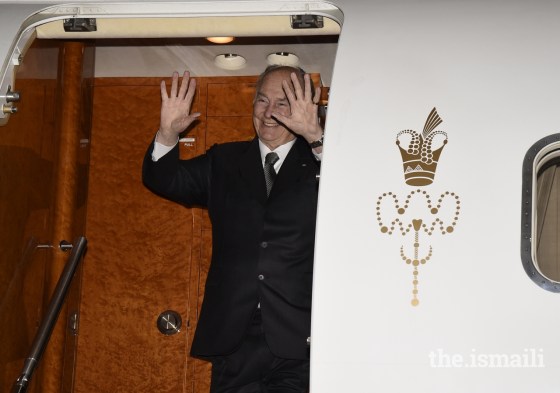
Mawlana Hazar Imam, His Highness the Aga Khan, waves goodbye at Montreal airport at the end of his recent visit to Canada. Photo: The Ismaili/Moez Visram.
By SHIRAZ PRADHAN
It is natural that as we reflect and interiorize the joys of sights and sensations of mulaqats with Mawlana Hazar Imam including the most recent ones in Toronto and Montreal, the post-mulaqat vacuum may create a sense of post-padhramni sadness or what we call blues. The chores and demands of daily life which are put in abeyance during the anticipatory period of the mulaqat, once again begins to claim our attention and the bliss of mulaqat may begin to fade from the minds of some. The “presence” that had given joy to the heart begins to fade. These are the precursors to the onset of a sense of sadness. Lose not hope. There is a remedy. Glittering gems are scattered around to light our path, away from the blues. Let me explain.
In his commentary on the Visionary Recitals of Avicenna [1, 2], the renowned Orientalist Henry Corbin has recognized an essential bridge that gives rise to religious or mystical/spiritual consciousness. Corbin call this the faculty of Active Imagination. What does this term “Active Imagination” mean? In ordinary language, Active Imagination is the sum total of our mental faculties with imagination as its chief driver that allows us to configure the existence of a spiritual universe as a concrete reality. Without it the existence of such universes becomes doubtful. Visionary Recitals of Avicenna are renowned for promoting the realm of this Active Imagination which allow the flowering of spiritual symbolism in the heart that prepares it for an adventure into the unknown.
Sufism recognizes two different conditions of consciousness on the mystical path: the first of these known as al-Hal is a state of consciousness which is transient or passing. It could be a state of sadness, ecstasy, happiness or any other state dictated by the mind. Pir Sadardin’s epic granth Buj Niranjan (Chapter 20, Verse 4) describes such a state when a soul, intoxicated in divine love, vacillates between state of happiness and sadness:
Kabuek hanse aur kabuek rove Kabuek lag piya gal sove……(4)
Translation:
Sometimes she cries, at others she laughs
Sometimes she is as if in embrace of the beloved……(4)
The other condition known as al-Maqam is a permanent station achieved by the desire and effort of the seeker and grace from above. These stations (pl. maqaamat) are necessary stages of progress along the path to spiritual enlightenment. At a deeper level, Active Imagination is at work in the attainment of the various states and stations of the path. The aim of those who are on the esoteric path is not to get bogged down in the transient, passing states but to steadfastly continue on the path to the encounter with the Higher Reality.
With this background we turn our attention to the post padhramni sadness we referred to earlier and to its cure(s). One Ginan that help us in this regard is Aji Hete Sun Milore Mara Munivero. [3] The beauty of this Ginan is that it does not require a complex philosophical project or spiritual mumbo-jumbo to deliver a simple elixir for the heart. The messages it conveys are profound truths of spiritual search and the practical engagement of the Active Imagination. The verses of our interest are 4, 5 and 8.
The key points of verse 4 are that Lord’s name is pure and divine; that one needs to invoke Him by this “Name” with regularity; that His “presence” is mingled intimately with the heart just as fragrance is an intimate essence of the flower.
Aji Paak saajeb ji nun naam chee Tene jampi-e saas ussas Dur ma dekho dil maahe vase Jem chaampa phool mahe vaas……(4)
Translation:
Divine is the “Name” of the Lord
Invoke this “Name” with regularity,
Do not see Him far, He is intimately mingled in your heart
Just as fragrance is intimate with the Flower……(4)
Verse 5 reinforces what has been stated in Verse 4 and exemplifies and demands the engagement of the Active Imagination in the practice of the invocation of the “Name.” It states that every atom of the body is imbued with the divine presence.
So, in essence the “presence” never left! It is always there. The last line of the verse capitulates one of the remedies to counter the sadness: Perform devotion with the understanding that He, the Lord is always seated in the heart.
Aji rome rome maaro Shaah vase, Ane antar nahi ek til Evun jaanni bhgaataai kij-e Shaah partake bethaa dil……(5)
Translation:
The Lord is mingled with every atom of your body.
Do not harbor delusion that you are separate from him
Perform your devotion with the knowledge that
He is forever seated in your heart……(5)
Faith is the ultimate essence of Active Imagination. In verse 8 of Hetesun Milore Mara Munivero we see this at play:
Aji raini ajvari chaand sun, ane divas ajvaro sur Tem Ghat ajvaro Iman sun……(8)
This verse provides an added, joyful ingredient to the uplifting elixir provided by verses 4 and 5. It states that just as night is lighted by the moon and sun lights the day, so faith lights the heart. And such a heart is in continual bliss of rain of Nur (light).
What these verses of the Ginan indicate is that the “presence” of the Imam never left the heart. It is always there. A combination of faith and Active Imagination provides a continual reinforcement of the “presence.” But this requires the necessary action of continual remembrance with the understanding that He is ever present in the heart.
Date posted: November 29, 2017.
_____________
Notes:
[1]. Avicenna and the Visionary Recital, translated from the French by Willard R. Trask, Bollingen Series, LXVI, 1960. [2]. All the World an Icon: Henry Corbin and the Angelic Function of Beings by Tom Cheetham, North Atlantic Books, Berkeley, California, 2012. Available also as a Kindle book. [3].http://ginans.usask.ca/.
Shiraz Pradhan
Shiraz Pradhan, in parallel with his work as an international engineering consultant, has contributed for several years to furthering religious education among the Ismaili community in the UK, Canada, USA and Japan. He is the author of several articles published on this website and was a regular contributor to UK’s flagship Ismaili magazine, Ilm. Currently he is concluding the script of a full-length play of the 10th Century trial of the Sufi Saint Mansur al-Hallaj in Baghdad based on historical facts.
Mubaraki to the Ontario jamat, mubaraki to the volunteers and mubaraki to the leadership; and Mawlana Hazar Imam “Amen” for your immense love, care and blessings, as well as for assuring us that you are always with us!
By ABDULMALIK J. MERCHANT
Qur’anic ayat inside front page of Mulaqat Canada 2017 information booklet.
I have arrived in Montreal! It’s Sunday evening. I can see the Palais des congrès de Montréal from the 10th floor of the apartment I have rented. The Palais des congrès, or the Convention Centre as it is also known, is in the north end of Old Montreal. This is a gigantic place and is capable of holding multiple events simultaneously. It is where the Ottawa jamat will be joining with the jamat of the Quebec and Maritime Provinces to undergo an experience of the kind the Ontario jamats have gone through in the last 72 hours or so. A total of approximately 12,000 murids, divided into 2 equal seatings, will be meeting with their beloved Imam on Tuesday, November 21st. The Quebec jamat is overwhelmingly of Afghan origin. I will be huddled with them and I am looking forward to that. I am confident their spirit, their kindness, their discipline and their voices of devotion will uplift me immensely.
My spirit is growing with each minute that passes by. Text messages and emails are coming from everywhere describing the joyful didars in Toronto. Murids of all ages are overwhelmed. A friend wrote to me: “It was very special; everyone is very happy and feeling blessed, it has been amazing; it has been amazing because of the superb organization and also the Jamat was very disciplined!”
Another family friend of Portuguese origin wrote to me and others: “You were in our thoughts and prayers. You were remembered individually and (we) submitted prayers for all deceased members, your families and relatives, the world Jamat as well as the entire humanity!”
There are other inspiring narratives that I keep on receiving, and they all share the same sentiments, including the great discipline of the jamat; the active participation in the intezari program because of the wonderful items that were selected for recitation and the high calibre of reciters. Their messages mention the intense interaction of the Jamat with the Imam as he walked around to shower his Noorani rain and blessings on the jamat.
The messages circulating the earth carry with them the blessings that Hazar Imam asked the jamats in Toronto to convey to their families (Amen, I respond most joyously and happily); his blessings on the volunteers for their superb work (they would get to their duty positions well before the halls opened, as early as 4:30 or 5 am); the blessings for the deceased souls of our family members; the Imam’s hopes for brotherhood and a spirit of unity around the world; his guidance to the youth on the importance of education, prayers for the Jamats facing unrest and for mushkil aasan; his advice to us asking us to adopt best practices in our lives; his desire to end poverty in the jamat. And of course there were instances of humour and laughter.
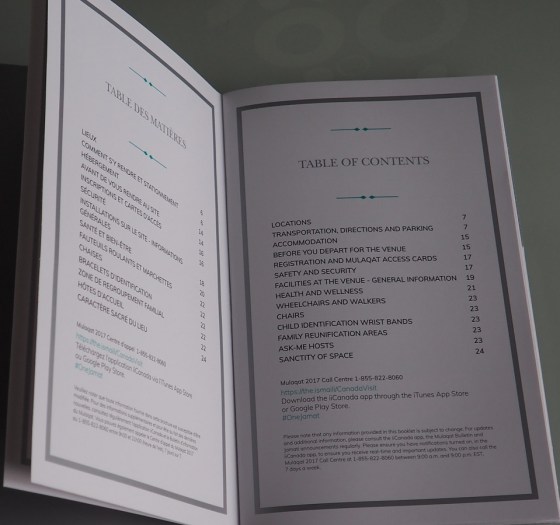
Table of contents in Mulaqat Canada 2017 information booklet produced by Ismaili institutions, one each for Montreal and Toronto mulaqats. Shown is the bilingual Montreal edition.
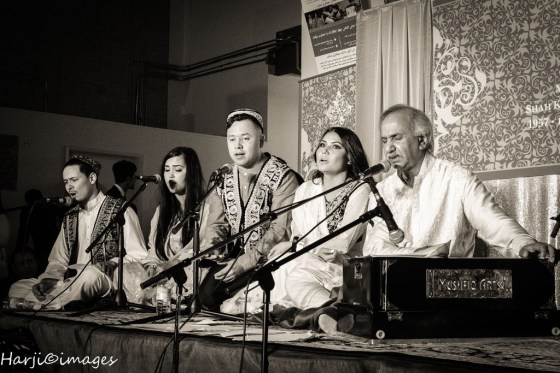
Taufiq Karmaili (right) with a team of local Ismaili singers performing at a devotional evening in Montreal. Photo: Copyright Muslim Harji.
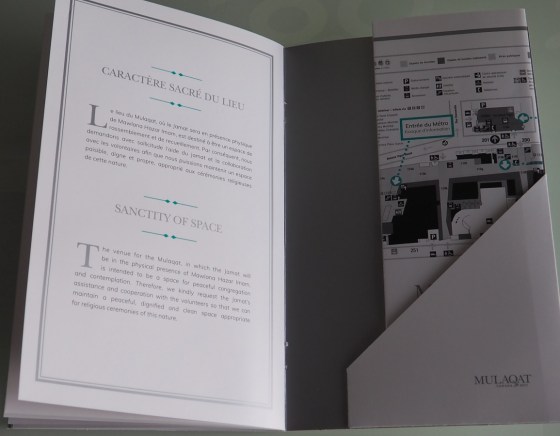
Mulaqat Canada 2017 information booklet produced by Ismaili institutions, one each for Montreal and Toronto mulaqats.
In Ottawa, I witnessed how well coordinated the leadership and the volunteers are with their Quebec counterparts. I attended on Friday an overview of preparations that are underway in Montreal. I was stunned! Everything has been thought of! Now imagine, the Toronto mulaqat hosted more than twice as many! The preparations leading to the mulaqat have been intense in all ways one can imagine. The registration process that got underway as soon as the visit was announced on October 27, was efficient, as was the delivery of the entrance cards this week; devotional evenings with the singing of qasidas, ginans and songs have set the tone for one of a kind spiritual experience; waezes have illuminated us on matters concerning discipline and importance of didar. Nothing has been overlooked or left out including regular notifications through jamati announcements and special Al-Akhbar newsletters as well as updates on the downloadable iiCanada app – and all this in a matter of weeks. This is awesome, an unbelievable accomplishment, and I await my chance in about 40 hours! I will remember everyone just as I was remembered by others during their mulaqats in Toronto!
Earlier today, I trusted the snow ploughs and salt trucks to make my trip to Montrael a safe one after last night’s freezing rain. I may get lost entering through one of the many entry points at the Palais des congrès. I may be a few hundred meters from the main mulaqat meeting point. But I know the volunteers will be there to guide me and thousands like me to our intended destination. Therefore I will go worry free and stress free!
I have an abundance of faith in the Jamat, in the volunteers and in the leadership at all levels to make this holy encounter potentially the most memorable one for me in my life. I say potentially because they have done their work, the remaining preparations are on my – and our – part. My preparations with prayers, supplications and a few hundred salwaats in the time that is remaining will assist me for that joyful experience that everyone in Toronto had in the holy presence of Mawlana Hazar Imam, inshallah.
We congratulate the Ontario Jamat, and ask for your prayers that the 12,000 strong souls that will be gathered in Montreal will have as beautiful a didar as you experienced. MUBARAKI. And thank you for uplifting and inspiring us through everything you have done.
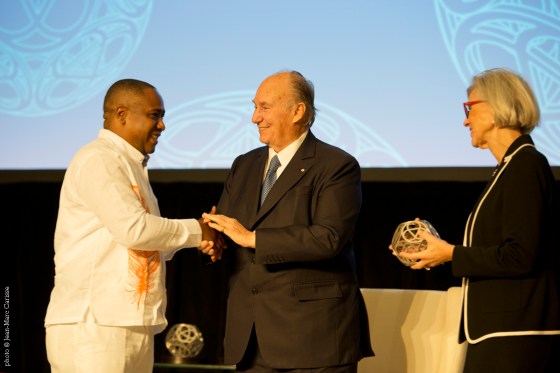
Having photographed His Highness the Aga Khan several times over the past decades, the Ismaili spiritual leader always struck me as an affable gentleman with his charismatically warm demeanour. This year alone, I attended two of his events. The award ceremony this past week, on November 15, at the beautiful Delegation of the Ismaili Imamat on Sussex Drive in Ottawa was distinctively different…CLICK TO SEE PHOTOS BY JEAN-MARC CARISSE
Please click on image to read Jean-Marc Carisses’s exclusive piece for Barakah.
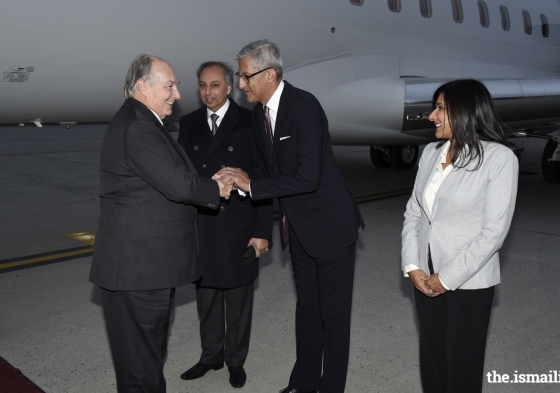
Mawlana Hazar Imam is received at Ottawa International Airport by the Aga Khan Development Network Representative for Canada, Mahmood Eboo (left), the President of the Aga Khan Council for Canada, Malik Talib, centre with Hazar Imam, and Karima Karmali, the Council’s Vice President. Photo: Moez Visram/The Ismaili.
By ABDULMALIK MERCHANT
His Highness the Aga Khan arrived in Ottawa Tuesday, November 14, to begin his week long trip to Canada during which he will meet with his Ismaili followers in Eastern Canada for religious meetings in Toronto and Montreal.
A short photographic tour of the Global Centre for Pluralism
Flashback: The unveiling of the plaque by His Highness the Aga Khan and the former Governor General of Canada, David Johnston, during the inauguration ceremony of the building on May 16, 2017. The plaque is now embedded in the right wall, just inside the main entrance to the building. Photo: Jean-Marc Carisse.
In preparation for the press conference that was held yesterday (Tuesday, November 14), and this evening’s award ceremony, I decided to visit the Global Centre for Pluralism on Saturday, November 11, the last day the interior of the building was open for viewing by the public (it will reopen again next spring).
A short video presentation highlighting the purpose of the Global Centre for Pluralism. Above Princess Zahra Aga Khan. Note: Light streak is camera reflection. Photo: Malik Merchant/Barakah/Simerg.
An immense transformation has taken place, while still preserving the historic features of the building. The Aga Khan during the official opening of the building on May 16, 2017, noted: “The architects, designers, engineers and so many others who have rehabilitated this wonderful Tudor Gothic building have taken enormous care to respect its distinctive historic character.”
A plaque highlighting the Global Centres connection to the Ottawa River, see following two photos. Photo: Malik Merchant/Barakah/Simerg.
One of the major features that you are drawn to as you enter the building and climb its few steps is the large window that overlooks the Ottawa River. And the Aga Khan provided an insight on the topic too. In the same speech, he said:
“When I first visited this site, I went across the Ottawa River, to see things from the opposite side. From that perspective, I noticed that many buildings on the Ontario side had, over the years, turned their backs to the river. But as we began to plan, another possibility became evident. It seemed increasingly significant to open the site to the water.” This is precisely what the building offers every day to each person who walks in, perhaps with the thought: “Let me see the Ottawa River first.”
Visitors at the Global Centre on Saturday, November 11, 2017. One, far right end, is standing a few metres from the full-height window, and pointing to the Ottawa River, see next photo. Photo: Malik Merchant/Barakah/Simerg.
A beautiful view of the Ottawa River from the Global Centre’s full height window.See photo of plaque, above. Photo: Barakah/Simerg.
Global Centre for Pluralism was designated as one of 10 CONFEDERATION PAVILIONS, for 2017, the 150th anniversary of Canada. This plaque stands outside the building on Sussex Drive. Photo: Malik Merchant/Barakah/Simerg.
The Global Centre for Pluralism was designated as one of the 10 Confederation Pavilions in the National Capital Region for the year 2017. The Commission identified buildings that had been dormant and then brought back to life. A passport booklet highlighting all the 10 buildings has been published, as shown in the next image. It encourages everyone to visit the buildings and experience them for their architectural heritage.
Bilingual front cover of the passport booklet, with an insert (English shown) on the Global Centre for Pluralism. Photo: Barakah/Simerg.
The Global Centre has been a National Historic Site since 1990, at which time it was the home of the Canadian War Museum. The PASSPORT booklet explains: “Today a $35 million investment from His Highness the Aga Khan has brought the building back to life as the new home of the Global Centre for Pluralism. This independent research and education centre, created in partnership with the Government of Canada, advances respect for diversity around the world. Become a pluralism champion; visit this heritage landmark, and explore the mission and work of the Centre.”
The historic Sir Arthur Doughty’s fireplace inside the Global Centre’s presentation room. See plaque, next photo, explaining the significance of the fireplace. Photo: Malik Merchant/Barakah/Simerg.
Fireplace plaque. Photo: Malik Merchant/Barakah/Simerg.
Chandelier in the hall by the main entrance. Photo: Malik Merchant/Barakah/Simerg.
A segment of a drawing, “Invincible before daybreak”, by Edward Pien (2007). Photo: Malik Merchant/Barakah/Simerg.
Ceiling in seminar room, with all the high tech gadgets seamlessly incorporated. Photo: Malik Merchant/Barakah/Simerg.
A segment of a painting symbolizing past indigenous injustices. Photo: Malik Merchant/Barakah/Simerg.
Decorative designs on walls and windows symbolizing plurarity. Photo: Malik Merchant/Barakah/Simerg.
Painting (details soon). Photo: Malik Merchant/Barakah/Simerg.
Contemplative garden. The Aga Khan in referring to this exterior space said, “a new garden in the forecourt, a tranquil space for contemplating the past and thinking about the future.” Background building is the Royal Canadian Mint. Photo: Malik Merchant/Barakah/Simerg.
A colourful plaque on wall explaining pluralism in all its aspects. Photo: Malik Merchant/Barakah/Simerg.
The last of the beautiful fall colours shading the Global Centre for Pluralism on November 11, in a delayed autumn foliage. Photo: Malik Merchant/Barakh/Simerg.
~~~~~~
Press Conference with winners of the 2017 Pluralism Award
(l to r): Daniel Webb of Australia, Alice Wairimu Nderitu of Kenya, Leyner Palacios Asprilla of Colombia – all three are Pluralism Award Winners – Rt. Hon. Joe Clarke and John McNee.
Members of the media were invited on Tuesday morning for an hour long press conference at the Global Centre for Pluralism to meet with the winners of the first Pluralism Award. The opening remarks by the Centre’s Secretary General John McNee were followed by the introduction of each of the 3 winners by the Rt. Hon. Joe Clark, Canada’s former Prime Minister. Mr. Clarke headed the jury that selected the 3 winners and 7 other honourable mentions from over 200 nominations that were submitted in 43 different countries.
Leyner Palacios Asprilla: The humble and courageous activist Leyner Asprilla of Colombia spoke about the the terrible massacre in May 2002 when the Revolutionary Armed Forces of Colombia, the guerilla movement known with the Spanish acronym FARC, launched gas cylinder bombs at a church in Bojayá full of civilians that was being used as a human shield by a paramilitary group. The bombs bursted the church killing 79 people including 48 infants and children. Asprilla survived the massacre but he emerged to find that 32 of his family members had been killed. Instead of becoming despondent over this cruel tragedy, Asprilla went on to found the Committee for the Rights of Victims of Bojayá, giving voice to over 11,000 victims of the conflict that live in the municipality of Bojayá, Chocó. As a result of his fight for social justice, Leyner was asked to represent Bojayá massacre victims during peace negotiations between guerilla forces and the government. One of the results was that FARC publicly acknowledged their role in the 2002 tragedy and, in a private ceremony in a Bojayá church, requested forgiveness.
Leyner Palacios Asprilla. Photo: Barakah/Simerg.
Asprilla organized assemblies with representatives from every community in Bojayá, even the most remote, and encouraged each community to include a female representative. Now, these remote communities have a united voice that takes their demand for human rights to the highest levels of government, and around the world. By bringing communities together in the fight for social justice, Leyner realized how powerful a chorus of diverse voices can be. Today, he continues to demand that Colombia embrace diversity by respecting the rights of all its citizens, particularly its most marginalized.
~~~~~~~~~
Alice Wairimu Nderitu. Photo:Barakah/Simerg.
Alice Wairimu Nderitu: The graceful Alice Nderitu of Kenya has been a tireless peacemaker, conflict mediator and gender equality advocate who believes that differences can be strengths, not weaknesses. She took a seat at the peace table with 100 elders from ten ethnic communities who had never negotiated peace with each other before. This was 18 months after violence erupted in Kenya’s Rift Valley when results of a flawed election were announced which ignited historic grievances over land and deep-seated ethnic tensions. As a child eavesdropping in a tree, Alice was told that as a woman she could not participate in the work of making peace. But Alice took her place at the table with male mediators and led the elders in a dialogue that resulted in the region’s first peaceful elections in 20 years Today, as a lead mediator brokering peace throughout Africa, she has proven again and again that making peace is very much women’s business; however she explained that she found it necessary to integrate attitudes generally reserved for man!
~~~~~~~~~
Daniel Webb. Photo: Barakah/Simerg.
Daniel Webb: The narrative by the articulate Australian Daniel Webb, a lawyer by training, was forceful. He was severely critical of the Australian Government for its decision to place every refugee arriving in boat in Australia’s offshore detention center on Manus Island, Papua New Guinea. The conditions in these detention centres are inhumane and demoralizing, with numerous reports of violence, medical neglect, suicide, self-harm. When Daniel visited the island he met many refugees and found out that they were inspiring people who could make great contributions to Australian society, if only given the chance to live on the mainland.
To tackle the offshore detention issue in Australia, Daniel has developed an innovative approach that combines legal action, media advocacy, public campaigns and United Nations engagement. Daniel’s work has helped to hold the Australian government accountable for breaches in international law. His work has not stopped there. He realized he needed to change the public perception of people seeking asylum. Australians had to understand that the people detained offshore were not threats, but rather human beings with their own stories, talents and families.
In addition to hearing stories of Leyner, Alice and Daniel, the media was also briefed about seven other individuals and corporations who received honourable mentions.
Press Conference Video
To access press conference, click on image below and then click again where its says “Watch this video on Youtube”
Date posted: November 15, 2017.
Note: Another version of this post, with enlarged photos, can be read at http://www.barakah.com
This is the second article in a special series that we hope will contribute to making the forthcoming mulaqat with Mawlana Shah Karim al-Hussaini Hazar Imam more meaningful and purposeful. If you missed any of the previous post(s), here are the links:
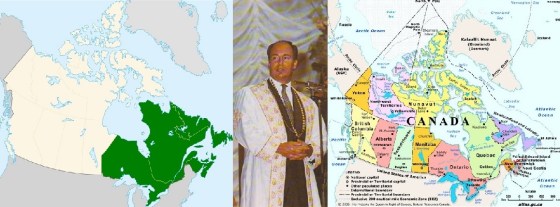
Eastern Canada shown in green on map (left) consists of the provinces of New Brunswick, Newfoundland and Labrador, Nova Scotia, Ontario, Prince Edward Island, and Quebec. The total population is 23,946,177 (2016), and approximately 40-45,000 Ismailis live in these provinces, with the largest concentration in Ontario and Quebec. Credits: Map (left) yy Connormah – Wikipedia, CC BY 1.0, https://commons.wikimedia.org/w/index.php?curid=19857457, and (right) Department of Natural Resources.
1. By Shaykh Khudr, contemporary of 40th Ismaili Imam, Mawlana Nizar
The people of the House of Prophethood
are the Manifestations of Light;
They are that which exists forever
and in what has already elapsed;
They are the ships of salvation for those
who come running to them with hope;
They are the rain abundant in moisture
and their grace is the best of springs;
The essence of their souls is knowledge
from a world beyond the intellects;
Indeed, it is their invitation which rescues
souls from the pit of destruction.
~~~~~~~
2. By Muayyad Al-Shirazi, Fatimid period
“I was taken near the place where from I saw the bright Light of the Prophethood. My eyes were dazzled by the Light. I shed tears of joy and felt as if I was looking at the face of the Prophet of Allah and of the Commander of the Faithful, Hazrat Ali. I prostrated myself before the one who is the fittest person to bow to. I wanted to say something, but I was awe-struck.
“I tried to speak but my tongue refused to move. People asked me to say what I wished to say. I could say nothing. The Imam said, ‘Leave him. Let his fear and awe subside’. After this, I rose. I took the holy hand of the Imam [Mustansir-billah], placed it on my eyes and on my chest and then kissed it. I left the place with immense joy.”
~~~~~~~
3. By Fidai Khurasani
He is always present
a witness with his followers;
but who has seen his beauty
except the blessed?
He who is the cupbearer of
the fount of paradise
is aware altogether of
the hearts of his followers
He is the Imam of the time
the guide and comforter
the protector of his followers
whether young or old
Like the sun in the sky
he is manifest in the world
but the blind bat cannot see
his luminous face
~~~~~~~
4. By Imam Mustansir-Billah, 32nd Ismaili Imam
“All believers are urged to come into the presence of the Imam and to see him with their own eyes. Thus, the esoteric (batini) vision, realized through pious works and the constant remembrance of God during the nightly vigil, as well as the exoteric (zaheri) vision, achieved by travelling to the Imam’s residence and beholding the gateway of God’s mercy, becomes the ultimate purpose of human life.
“Piety should be for the purpose of recognizing and beholding God, which is achieved through the recognition and vision of the Imam of one’s time.”






 Simerg - Insights from Around the World