Simerg is an independent initiative dedicated to Ismaili Muslims, the Aga Khan — their Hereditary Imam — and the Ismaili Imamat, and Islam in general through literary readings, photo essays and artistic expressions
Featured photo at top of post: A general view of the Imam Husayn (Hussein) Mosque in Karbala, Iraq. The photo was taken between September 26 and October 12, 1932. Photograph: G. Eric and Edith Matson Photograph Collection, Library of Congress, Washingon D.C.
INTRODUCTION: Mawlana Hazar Imam Shah Karim al Hussaini, His Highness the Aga Khan, is the 49th Hereditary Imam of the Shia Imami Ismaili Muslims, and directly descended from Hazrat Ali and his son Imam Husayn.
Imam Husayn B. ‘Aly began his reign as the 2nd Ismaili Imam* on the death of his father, Hazrat Ali on January 27, 661 CE who, 29 years earlier in 632 CE, had been publicly proclaimed by the Prophet Muhammad (May peace be upon him and his progeny) to be his successor at Ghadir Khumm.
The succession ended the cycle of the Divine Institution of Nubuwwah and ushered the world into a new era of the Divine Institution of Imamat. Thus, the Imams directly descended from the Prophet Muhammad, from Hazrat Ali to Mawlana Shah Karim, have continued to guide their murids (followers) in the ta’wil (interpretation) and talim (teaching) of the Holy Qur’an for the last 1391 years.
Article continues below
A 1932 photograph showing the entrance to the great mosque at Karbala, the holy city of e Shia Muslims. Photograph: G. Eric and Edith Matson Photograph Collection, Library of Congress, Washingon D.C.
Imam Husayn was martyred in the Battle of Karbala on the 10th day of the Muslim month of Muharram, or October 10, 680, at the age of 54, and was succeeded to the Hereditary throne of Imamat by Imam Zainul Abideen.
The Islamic calendar is based on the lunar cycle, and thus shorter than the 365 day solar calendar by roughly 11 days. This year (2023), the 10th day of Muharram falls on or around July 28/29, almost 1343 years since the Imam’s tragic death at the hands of Yazid’s army.
Please download the PDF version of Wilfred Madelung’s excellent piece on Imam Husayn B. ‘Ali published on the IIS website. Note: The eminent German scholar Professor Madelung passed away in May 2023 and the IIS has published an In Memoriam in his honour HERE
Date posted: July 28, 2023 (This post is an update to earlier versions of the article that has appeared periodically on this website over the past few years.)
______________________
*Note: In the Shia Imami Nizari Ismaili tradition Imam Husayn’s brother, Hazrat Hassan, is not counted as an Imam. However, he is regarded as their second Imam by other Shia Muslims, thus making Imam Husayn as their 3rd Imam.
Artistic Greeting Cards by Karim Ismail, Brief Notes on the Imamat and the Aga Khans, and an Explanation and Recitation of a Celebratory Ismaili Ginan (Hymn)
Simerg and its sister websites, Barakah and Simergphotos, convey heartiest felicitations to Ismailis and friends of the Ismaili community in Canada and around the world on the auspicious occasion of His Highness Prince Karim Aga Khan’s 66th Imamat Day anniversary which falls on July 11, 2023. The Aga Khan succeeded to the Hereditary Throne of Imamat on July 11, 1957 at the age of 20 upon the death of his grandfather, Mawlana Sultan Mahomed Shah Aga Khan III, whose reign of 71 years as the 48th Imam is the longest in the 1400 year history of the Shia Ismaili Muslims.
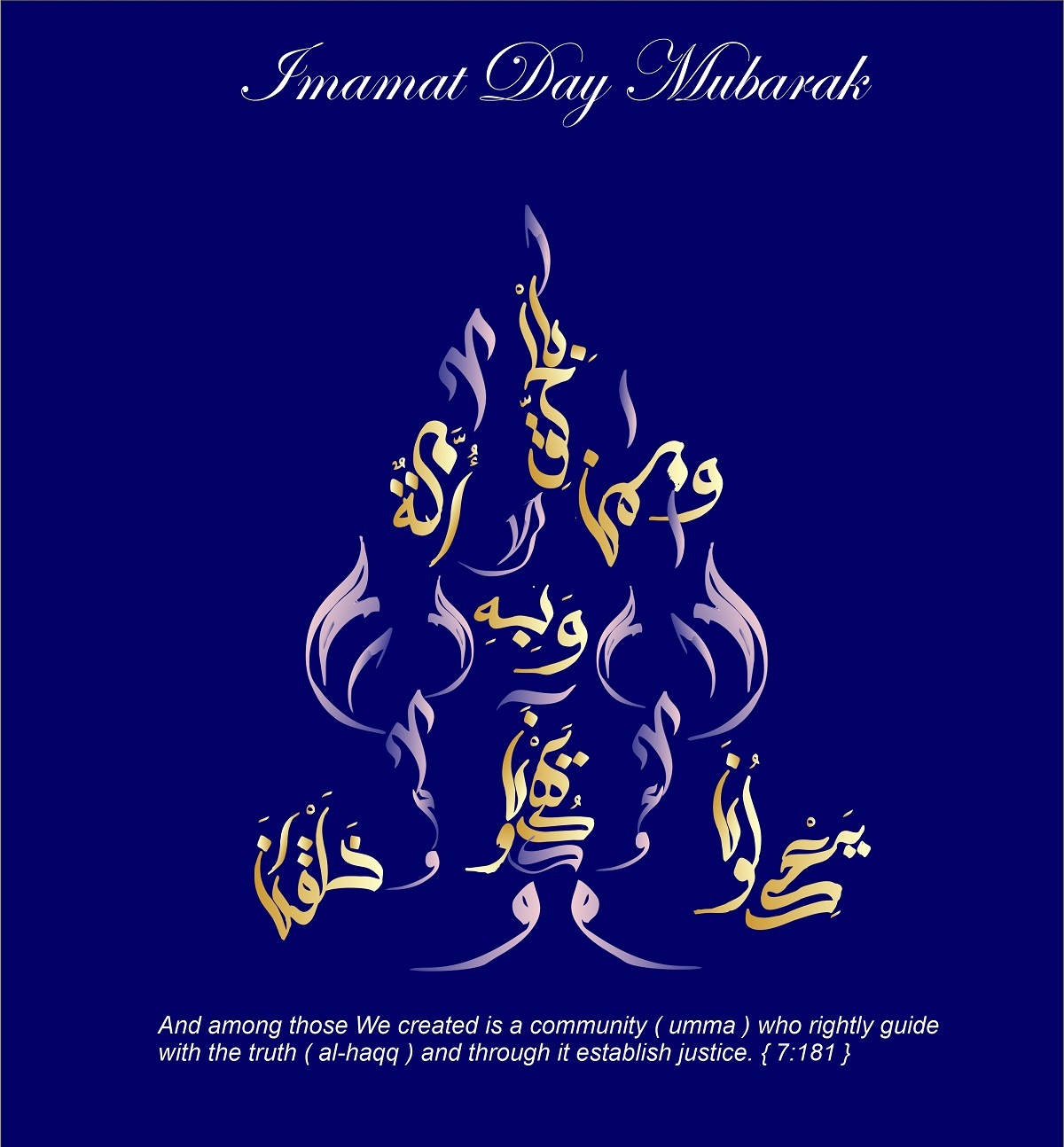
Yesterday, on July 10, 2023, we presented a unique collection of pages from the Tanganyika Standard newspaper that reported on the death of the late Aga Khan and the succession and enthronement of his grandson Prince Karim. For July 11, we present a series of beautiful works of Imamat related calligraphies created over the years by Toronto’s Karim Ismail, including one for 2023 which is shown below.
Inspiration for the calligraphy was drawn from the book “The Master and the Disciple” in which the ayat (7:181) is quoted, and which relates to the Imams. The book is an early Islamic spiritual Dialogue by Ja’far b. Munsur al-Yaman. In this section of the book two characters are involved in a dialogue. One is an Ismaili da’i by the name of Salih and a knowledgeable Mullah called Abu Malik. After some time the dialogue turns to the concept of Divine Justice where Salih refers to 7:181 several times. The Ismaili da’i explains to Abu Malik (who has gained the surname of Cube of scholars) that God’s act of justice towards His servants is through just witnesses (7:181). Salih uses the Arabic word adl to also mean witness (7:181). In Shi’i and especially Ismaili understanding, these just witnesses are the Imams (Ahl al-bayt). Upon hearing this, Abu Malik exclaims, ‘By my life, this is the very foundation of justice!’. He now understands that God’s justice is by means of the just witnesses mentioned in 7:181.
According to well-known Muslim traditions, the Prophet Muhammad (May peace be upon him and his family) said:
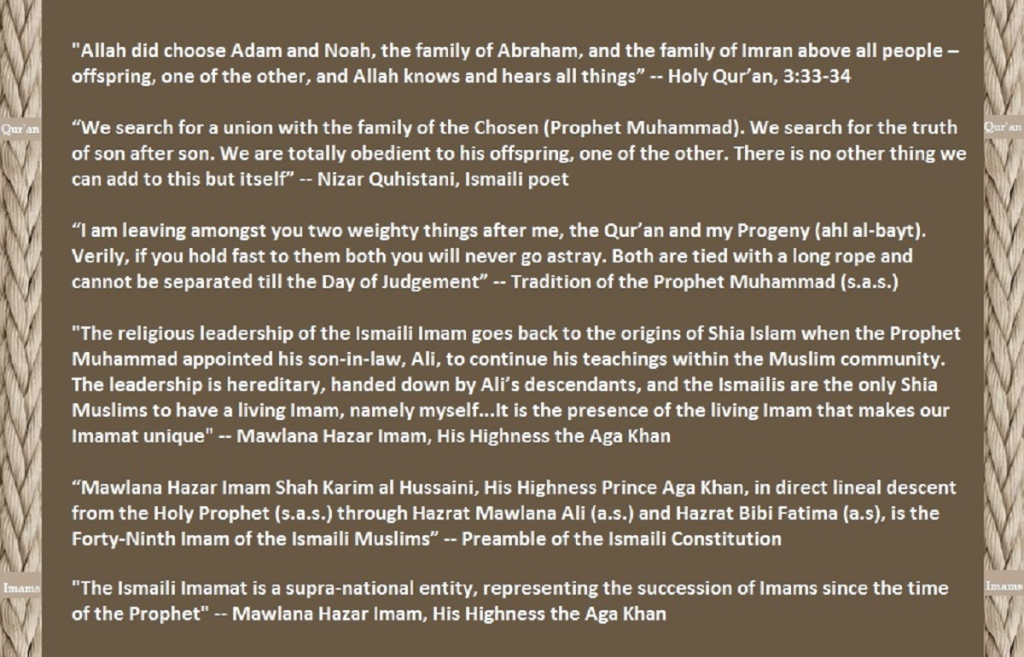
“I am leaving amongst you two weighty things after me, the Qur’an and my Progeny (ahl al-bayt). Verily, if you hold fast to them both you will never go astray. Both are tied with a long rope and cannot be separated till the Day of Judgement.” (Muslim, Vol. II, pg. 279).
The Prophet appointed Hazrat Ali to be his successor as the Imam in a pivotal gathering during his return to Medina from his final pilgrimage to Mecca. The Aga Khan, who is respectfully addressed by the Ismailis as Mawlana Hazar Imam (our Lord the present/living Imam), is the 49th Hereditary Imam in direct succession of Imams since Imam Ali.
In the Ismaili Ginan (hymn) Girbah Vali, attributed to the Ismaili missionary Pir Sadr al-Din, the Pir says:
“If the Imam did not have his feet on this earth for even a moment, then the world, moon, sun would vanish and nothing would exist, neither the heaven nor the earth.”
This notion of the cosmic necessity of an Imam, expressed by the Pir, is also found in famous traditions of the Prophet Muhammad (cited in “The Divine Guide in Early Shi’ism,” pp 125-131):
“The earth cannot be devoid of an Imam; without him, it could not last an hour,” and also: “If there were only two men left in the world, one of them would be the Imam.”
The calligraphies that Toronto’s Karim Ismail has created for Imamat Day over the past few years, are inspired by Qur’anic phrases that in Shia tradition refer to the Imam, and we are happy to include all the calligraphies that he has contributed to the website since 2020.
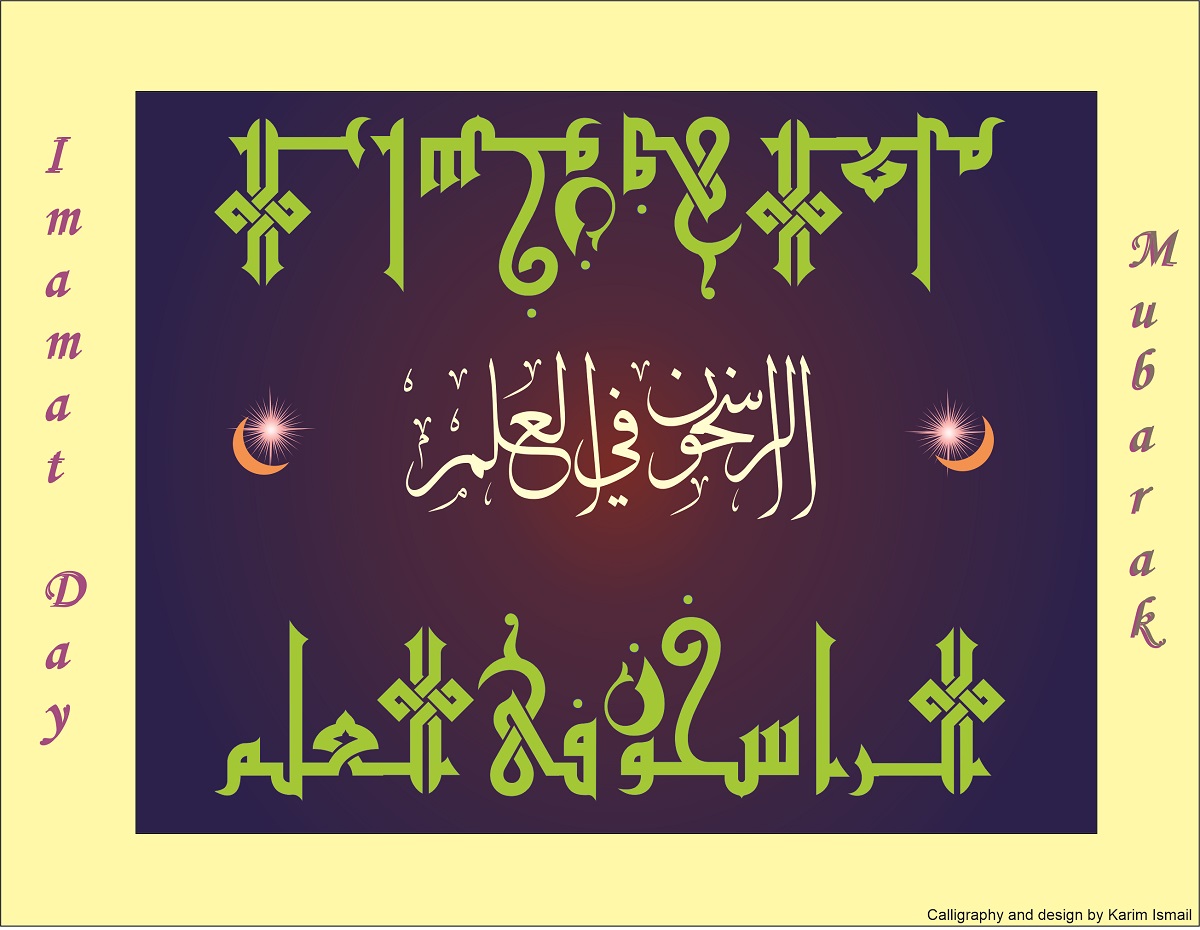
The Qur’anic phrase Al-rasikhun fi’l-ilm (Those firmly rooted in knowledge) in Fatimid Kufi script on all 4 sides of the art work. The Fatimids were rulers of North Africa and Egypt from the 10th through the 12th centuries. The Fatimid Imams or Caliphs were ancestors of the current Aga Khan.
The Qur’anic phrase Al-rasikhun fi’l-ilm (Those firmly rooted in knowledge) on top and bottom of the art work in Fatimid Kufi script; the centre of the art work has the same phrase in Thuluth script. Calligraphy and design by Karim Ismail, Toronto.
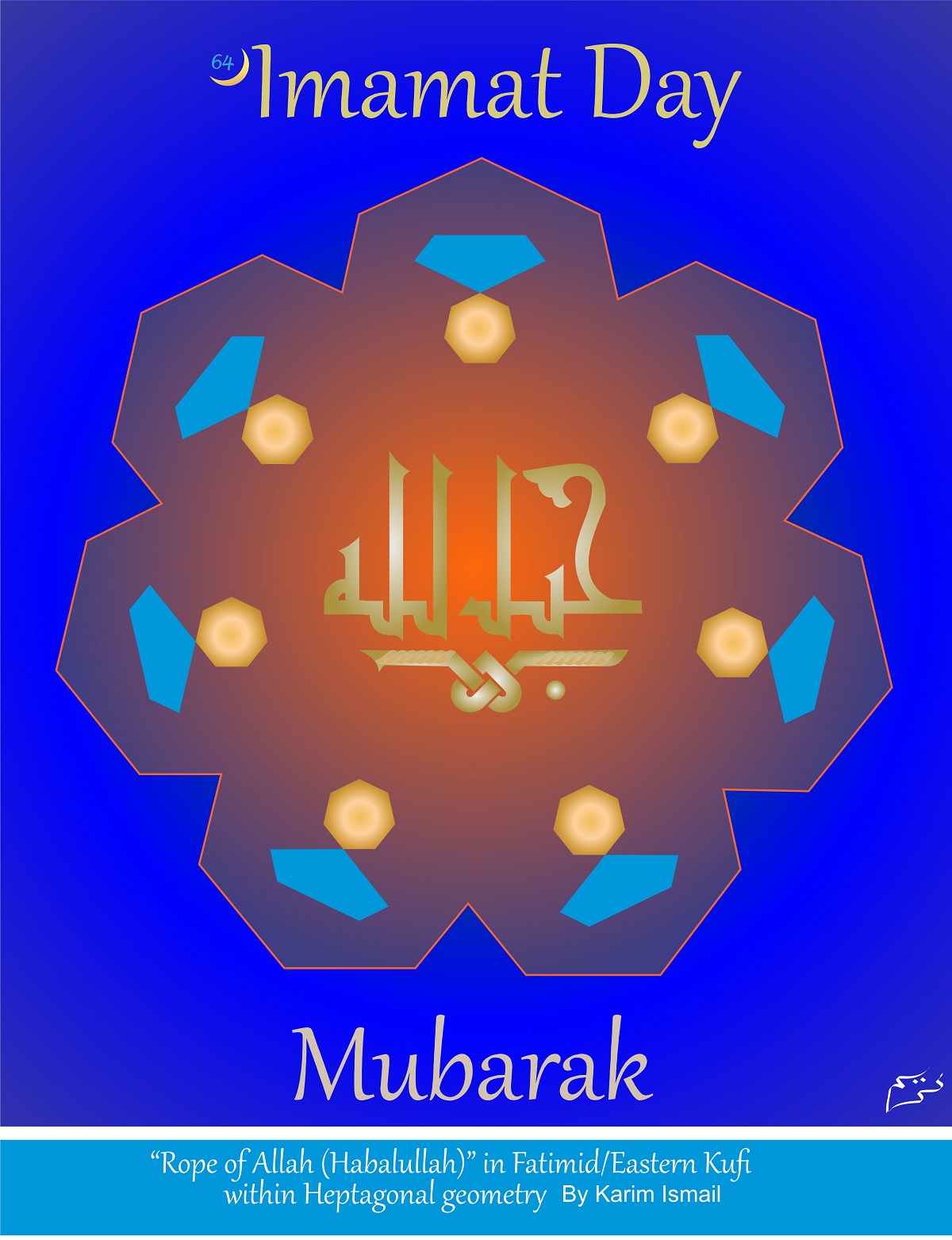
In Shi’i tradition, “The Rope of Allah” (Qur’an 3:103) refers to the “Ahl al Bayt” — the Imams from the House of the Prophet Muhammad (S.A.S). This important tradition appears in the card within heptagonal geometry (seven-sided polygon) about which the (Late) Karl Schlamminger, creator of extraordinary designs and distinctive calligraphies for the Ismaili Centres in London, Lisbon and Toronto, observed as follows in an essay for Arts & The Islamic World (volume 3, number 3, page 25-26): “The floor of the outer entrance hall [of the Ismaili Centre London] has an open ended pattern in heptagonal form which rises at the focus of the room to create a fountain: such a pattern in such space is of course a completely classical Islamic response — but I have never heard of a heptagonal pattern anywhere in Islamic architecture. “The number seven symbolizes for Ismailis the values of its essential philosophy — but has never been used in an architectural context. Here the sevenness of the design is no superficial effigy or naturalistic picture of an idea, but — as always in Islam — is expressed in geometry (literally: measurement of the earth).”
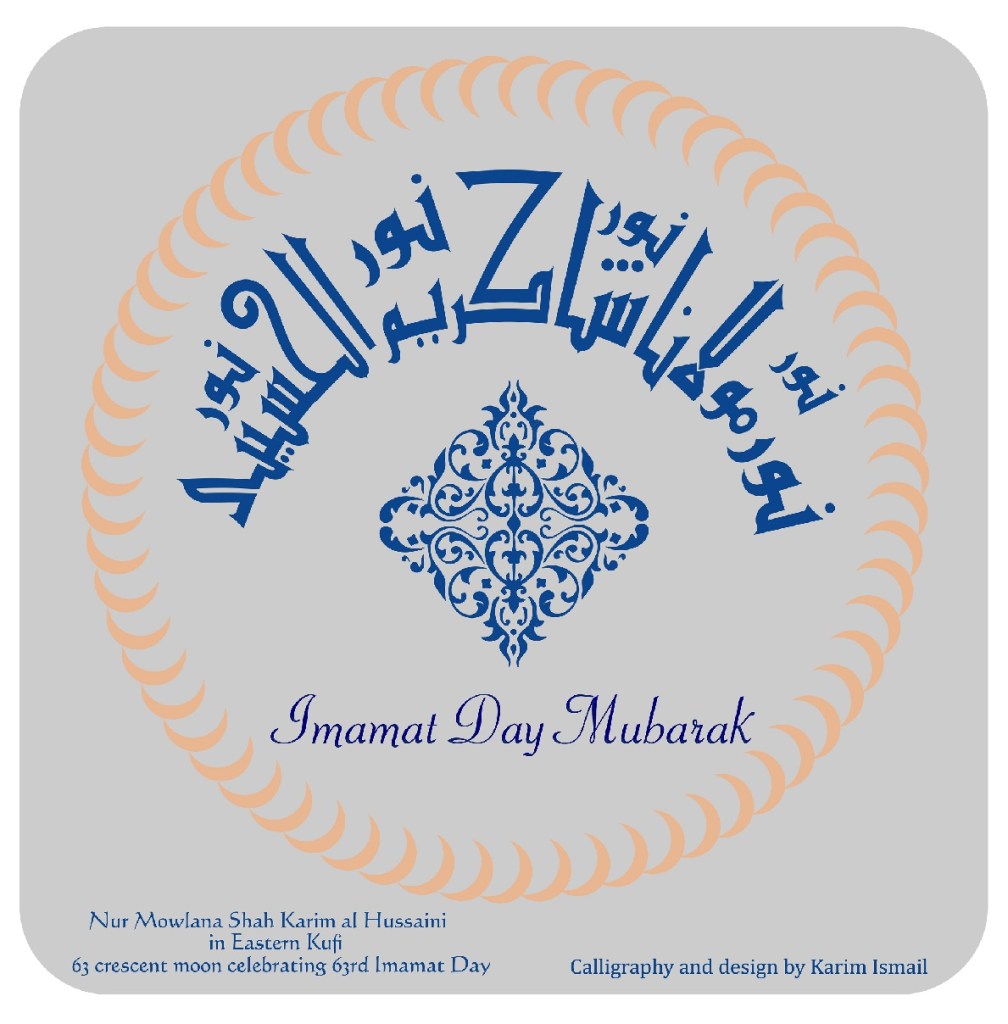
Calligraphy by Karim Ismaili on the auspicious occasion of Mawlana Hazar Imam’s 63rd Imamat Day Anniversary.
_______________________
The Aga Khans
From the day the Prophet Muhammad (May peace be upon him and his family) passed away on June 8, 632, and Hazrat Ali became the first Imam on the Divine Commandment that the Prophet had received at Ghadir Khumm, there have been forty-nine Ismaili Imams in continuous Hereditary Succession, spanning a period of 1391 years in Islamic history.
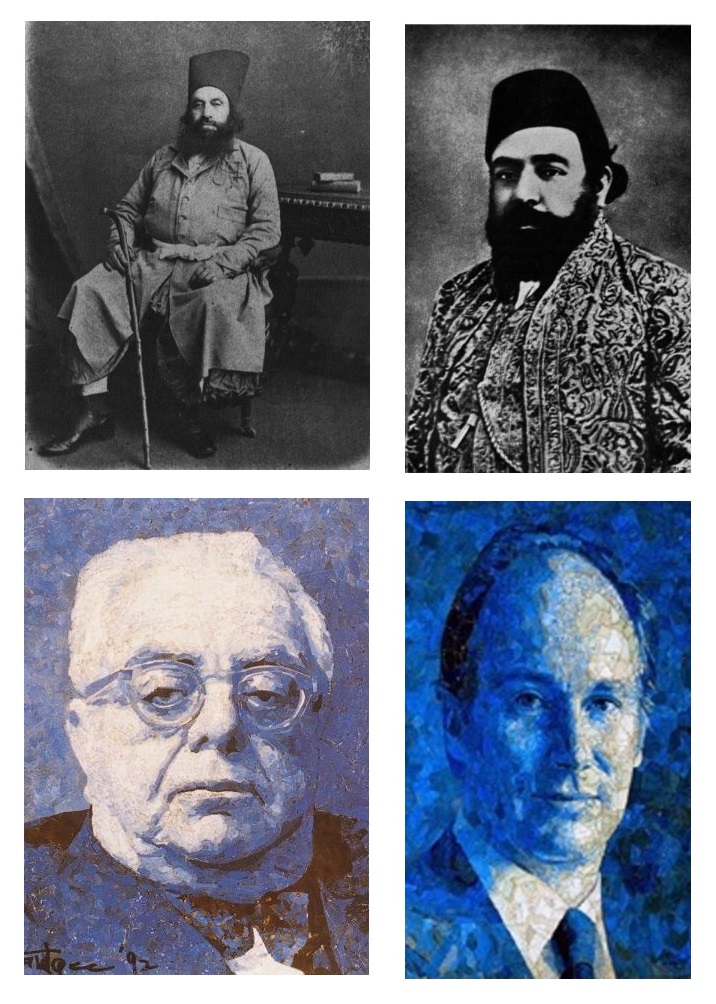
Upper row: Imam Shah Hassanali Shah (Aga Khan I) and Imam Shah Ali Shah (Aga Khan II). Lower row: Imam Sultan Mahomed Shah (Aga Khan III) and Mawlana Shah Karim Al Hussaini (Aga Khan IV). Total reign of the four Imams 203 years from 1817 to current year (2021). Longest reign Aga Khan III, 71 years; followed by Aga Khan I and Aga Khan IV, each 64 years.
The current Aga Khan and his immediate three predecessors have reigned the Ismaili community for a total of 207 years or 14.9 % of the entire span of Imamat, as follows:
1. Mawlana Shah Karim Al Hussaini Hazar Imam (His Highness the Aga Khan IV, Imam from 1957 – Current, 66 years, he became the 49th Imam at the age of 20); 2. Imam Sultan Mahomed Shah (His Highness the Aga Khan III, Imam from 1885 – 1957, Imam for 71 years, he became the 48th Imam at the age of 7 years); 3. Imam Shah Ali Shah (Aga Khan II, 1881 – 1885, Imam for 4 years, he became the 47th Imam at the age of 51 years); and 4. Imam Shah Hassanali Shah (Aga Khan I, 1817 – 1881, Imam for 66 years, he became the 46th Imam at the age of 13 years).
This 207 year period of the reign of 4 successive Ismaili Imams accounts for more time than does the entire Fatimid period, reigned by 8 Imams from Imam Mehdi (11th Imam, North Africa) to Imam Mustansir bi Allah (18th Imam, Cairo).
On that historical and interesting statistical fact, we convey to members of the Ismaili community around the world as well as friends and supporters of the community Imamat Day Mubarak. We also pray for the fulfillment of our readers’ wishes and that everyone’s lives are filled with barakah (happiness) and success. We particularly wish families with young children and youth success in their studies. On this auspicious day, we also pray that the souls of the deceased may rest in eternal peace and that their family members may find strength and courage to overcome the grief over the loss.
_______________________
An Explanation and Recitation of the Ismaili Celebratory Ginan Ya Ali Khuba Mijalas
Editor’s note: This is a very condensed, yet comprehensive, post on the munajat, Ya Ali Khuba Mijalas that is recited in many Ismaili Jamatkhanas around the world for the auspicious celebration of Imamat Day. For the complete version, which offers much more in terms of the Ginan’s history, composition, style, and explanation with a glossary, please click Original article.
By SADRUDIN K. HASSAM
INTRODUCTION
Popular tradition has it that the Munajat,Ya Ali Khuba Mijalas, was first recited during the enthronement ceremony of the 48th Imam, Mawlana Sultan Mahomed Shah, His Highness the Aga Khan III, which took place at Aga Hall at Mazagon Road in Mumbai in September 1885. Another tradition says that the recitation first took place when the young Imam met his followers at the main Ismaili Jamatkhana in Mumbai, known as the Darkhana. In any case, the munajat became very much part of the Ismaili tradition in many parts of the world to recite it in jamati gatherings (mijalas) to commemorate the enthronement of their 48th Imam Sultan Muhammad Shah, the late Aga Khan III (1877 – 1957). Continuing with this tradition, this Munajat, with slight variations, is now recited on the occasion of the anniversary of the ascension of Mawlana Shah Karim al-Hussaini (His Highness the Aga Khan IV) as the 49th Ismaili Imam. July 11th, 2023 marks his 66th Imamat anniversary.
The Arabic word Munajat is formed from the root word na-ja-wa which means ‘to converse secretly’ or ‘confidentially’. From the context of the Ginanic literature of the Ismailis, the term Munajat would be equivalent to venti (supplication). Apart from conveying this basic idea of venti, the term Munajat also has the connotation of conveying mubaraki (greetings) and adoration or reverence to a holy person, in this case the Ismaili Imam.
The complete Munajat has eight stanzas of four lines each, the chopai. At the end of each stanza there is a warani (refrain) of four lines which ends with the words ‘Mubarak hove’. This refrain is repeated at the end of each stanza for collective recitation and participation of the Jamat.
EXPLANATION
It is not an easy task to explain and translate a Ginan or Qasida from one language to another. For this Munajat which is a blend of several languages and is suffused with deep feelings and sublime supplication, the task becomes even more daunting. A conscious effort has been made to be as close to the original as possible and we hope that this explanation will impart our readers with some understanding about Ya Ali Khuba Mijalas.
VERSE ONE
Transliteration
Ya Ali Khuba Mijalas Zinat Karake Farasha Bichhai Gali, Aan Baithe Hay Takht-Ke Upar Shah Karim Shah Vali
Refrain
Aaj Raj Mubarak Hove, Noor Ain Alikun Raj Mubarak Hove, Shah Aal-e Nabi Kun Raaj Mubarak Hove, Hove Hove Aaj Raj Mubarak Hove.
Explanation
O Ali! In the fair assembly, gloriously adorned with carpets spread on the floor, Our Lord Shah Karim sits on the takht, our Lord Shah Karim our Guardian.
Refrain
Today blessed be your rule Oh the light of Ali’s eye, Blessed be your rule Shah, the descendant of the Holy Prophet, Blessed be your rule today Blessed be your rule today.
VERSE TWO
Transliteration
Ya Ali Didar Lenekun Aye Shah Teri, Hindi Jama-et Sari, Sijada Baja Kar Najaran Deve Jan Apniku Vari…. Aaj.
Explanation
O Ali! To be blessed with didar (glimpse of the Imam) your whole Indian jamat have assembled. They prostrate and they offer nazrana (homage) devoting their lives to you.
VERSE THREE
Transliteration
Ya Ali Tera Nasiba Roje Awal-Se, Deta Haire Kamali, Shah Sultan Shah Ke Mukhamen Se Nikala, Shah Karim Shah Vali….Aaj
Explanation
O Ali! Your fortune from the very first day (right from the beginning) has bestowed perfection upon you, Hazrat Imam Shah Sultan Muhammad Shah declared that Mawlana Shah Karim is the Lord and the Guardian.
VERSE FOUR
Transliteration
Ya Ali Shah Kahun To Tujakun Baja Hay, Bakhta Bulanda Peshani, Chhoti Umarmen Aali Marataba, Taluki Hay Nishani….Aaj
Explanation
O Ali! To call you Lord is your due. Your fortune and greatness is evident on your forehead. Your exalted status at the young age is a sign of greatness.
VERSE FIVE
Transliteration
Ya Ali Takhta Ne Chhatra Tujakun Mubarak, Zaheraji-Ke Piyare, Abul Hasan Shah Karani So Teri Jannat Aap Sanvare….Aaj
Explanation
O Ali! May your throne and canopy (exalted position) be blessed, the dear one of Fatimatuz Zahra. O Mawla Ali! All this is because of your glorious deeds. Paradise is embellished by your presence.
VERSE SIX
Transliteration
Ya Ali Takht ne Chhatra sunake tere Falakase Barase Nooran, Moti Tabaka Hathunmen Lekar, Shah KunVadhave Huran….Aaj
Explanation
O Ali! At the news of your Takht Nashini (Takhta ne Chhatra) the heavens shower Light, with trays of pearls in their hands, the houris (chaste heavenly maidens) greet the Lord.
VERSE SEVEN
Transliteration
Ya Ali Maheman Khanemen Momankun Jab La-i ‘Id Musal-le Shamsi Jo Salavat Pada Kar Marafat-Ki Khushiyali….Aaj
Explanation
In the guest-house when the celebration of your Takht Nashini takes place, the momins celebrate like ‘Id. They recite the Shamsi prayer, the salwat, and they experience the ecstasy of spiritual enlightenment.
VERSE EIGHT
Transliteration
Ya Ali Teri Mubarak Badike Khatar, Sayyad Karte Munajat, Shah Najaf Tere Pushta Panah Tere Dushman Hove Fanah….Aaj
Explanation
O Ali! To offer greetings, the Sayyads make their humble supplication (munajat) O Ali, the Lord of Najaf, may your progeny be protected and your enemies be destroyed.
~~~~~~~~~~~
Recitation of the Munajat by Shamshu Bandali Haji
A rare portrait of the late Ismaili missionary Shamshu Bandali Haji from his early years. Photograph: Shamshu Bandali Haji Family Collection.
Simerg welcomes your feedback. Please complete the LEAVE A REPLY form below or click on Leave a comment Your letter may be edited for length and brevity, and is subject to moderation.
CONTRIBUTORS
Karim Ismail
Originally from Uganda, Karim Ismail lived in England before settling in Canada. By profession, he is a Pharmacist (retired). It was in England, in 1986, that he came across the artwork of a German Muslim, Karl Schlamminger (1935-2017), at the Ismaili Centre London. Karl’s artwork on calligraphy and geometrics, had a profound effect on Karim. He is frequently seen conducting calligraphy workshops for children at the Aga Khan Museum in Toronto. Karim is also active on the literature counter at the Ismaili Centre Toronto.
Malik Merchant
Malik Merchant is the founding publisher and editor of Barakah (2017) as well as its two sister websites Simerg (2009) and Simergphotos (2012). See full profile HERE
Before departing this website please take a moment to review Simerg’s Table of Contents for links to hundreds of thought provoking pieces on a vast array of subjects including faith and culture, history and philosophy, and arts and letters to name a few. Also visit Simerg’s sister websites Barakah, dedicated to His Highness the Aga Khan, and Simergphotos.
The family of Ajmal Andani (1949 – 2021) originally of Tanzania (known as Tanganyika until 1964) has shared Ajmal’s collection of the Tanganyika Standard newspapers that carried reports of the celebration of the Diamond Jubilee of the late Aga Khan in 1946, his death in 1957 after a reign of 71 years, and the succession of his grandson, the current Aga Khan, as the 49th Ismaili Imam. Our sister website, Barakah, brings you a selection of Jpeg images from the newspaper along with a PDF file. Please click HERE or on the image below for the memorable post.
God chose Adam and Noah and the House of Abraham and the House of Imran above all beings, the seed of one another; God hears, and knows — Qur’an, 3:33-34, translation by A. J. Arberry, see Corpus Quran for multiple translations.
Today the Ismailis are the only Shia community who, throughout history, have been led by a living, hereditary Imam in direct descent from the Prophet — His Highness the Aga Khan, Parliament of Canada, Ottawa, February 27, 2014.
On Wednesday June 28, 2023, corresponding to the 10th day of the Islamic month of ‘DhuI-Hijjah, Muslims around the world celebrated the Festival of Sacrifice or Eid al-Adha at the completion of the annual pilgrimage to Mecca.
Little is it known in the broader context and understanding of Islamic history, that on the 18th day of ‘DhuI-Hijjah, a week following his final pilgrimage, the Prophet Muhammad (may peace be upon him and his family) — based on a divine command from Allah — designated Hazrat Ali as his successor and the first in the continuing line of Hereditary Imams. This event took place in 632 CE and is observed by all Shia Muslims, including the Ismailis, as Eid-e Ghadir, because the event itself took place at a place called Ghadir Khumm, a valley between Mecca and Medina.
The majority of the Muslims, the Sunnis, do not accept the Shia version of this historic event and do not associate it with Ali’s succession to Muhammad. Thus, the world’s lack of knowledge about a pivotal historic moment in Islam.
For the Shia Ismaili Muslims, who will be commemorating this historic day on or around July 5, 2023, this event is of added significance as they are led by a living Hereditary Imam, His Highness the Aga Khan, whom they lovingly and respectfully address as Mawlana Hazar Imam (Our Lord the Present/Living Imam).
The Aga Khan in a rare interview with France’s journal, Politique International, has comprehensively described the general Shia understanding of Imamat, the Sunni belief as well as his own status as follows:
“The religious leadership of the Ismaili Imam goes back to the origins of Shia Islam when the Prophet Muhammad appointed his son-in-law, Ali, to continue his teachings within the Muslim community. The leadership is hereditary, handed down by Ali’s descendants, and the Ismailis are the only Shia Muslims to have a living Imam, namely myself. The other Shia — the Twelvers — revere a “hidden” Imam who will return on the Day of Judgment to take part in the final judgment.
“It is the presence of the living Imam that makes our Imamat unique.
“The Sunni are completely different in that they do not accept the idea of continuity of religious leadership by members of the Prophet’s family.”
“The Ismaili Imamat is a supra-national entity, representing the succession of Imams since the time of the Prophet. But let me clarify something more about the history of that role, in both the Sunni and Shia interpretations of the Muslim faith. The Sunni position is that the Prophet nominated no successor, and that spiritual-moral authority belongs to those who are learned in matters of religious law. As a result, there are many Sunni imams in a given time and place. But others believed that the Prophet had designated his cousin and son-in-law, Ali, as his successor. From that early division, a host of further distinctions grew up — but the question of rightful leadership remains central. In time, the Shia were also sub-divided over this question, so that today the Ismailis are the only Shia community who, throughout history, have been led by a living, hereditary Imam in direct descent from the Prophet.”
In historical sources, it is recorded that on the way back to Medina after performing a pilgrimage to Mecca, the Prophet received a revelation that Ismaili Muslims recite in their daily prayers:
“O Messenger, deliver that which has been sent down to thee from thy Lord; for if thou dost not, thou wilt not have delivered His Message. God will protect thee from men. God guides not the people of the unbelievers” — Qur’an, 5:67, translation by A.J. Arberry, see Corpus Quran.
Article continues after quote
“We search for a union with the family of the Chosen (Prophet Muhammad). We search for the truth of son after son. We are totally obedient to his offspring, one of the other. There is no other thing we can add to this but itself. We endeavour in our faith so that we do not turn out to be faithless.” — Ismaili poet Nizar Quhistani in reference to the Qura’nic verses mentioned at top of post
Upon receiving this revelation, the Holy Prophet stopped at an oasis known as Ghadir Khumm, and addressed a large gathering of Muslims who had accompanied him.
In History in Quotations M. J. Cohen and John Major write:
“Muhammad said: ‘He of whom I am the Mawla, Ali is his Mawla. O God, be the friend of him who is his friend and be the enemy of his enemy.’
“This became the proof text for the Shia claim that Ali, the Prophet’s cousin and son-in-law, was the Prophet’s rightful successor after the Prophet’s death in 632. The meaning of Mawla here probably implies the role of patron, lord or protector.”
In an entry for the Encyclopaedia of Islam, 2nd edition, (EI2), under the title Ghadir Khumm, L. Veccia Vaglieri writes:
“Ghadir Khumm is famous in the history of Islam because of a sentence (or some sentences) in favour of ‘Ali which the Prophet uttered there during a discourse….Taking ‘Ali by the hand. he asked of his faithful followers whether he, Muhammad, was not closer to the Believers than they were to themselves; the crowd cried out: “It is so, O Apostle of God!”, he then declared. “He of whom I am the mawla, of him ‘Ali is also the mawla (man kuntu nawlahu fa-‘Ali mawlahu)
Article continues below
Images of some stamps and coins issued by the Islamic Republic of Iran between 1990 and 2010 commemorating the Idd-e-Ghadir. The inscriptions inlude the Shahada, Qur’anic ayats and the declaration made by Prophet Muhammad at Ghadir Khumm, “Mun Koontu Mawla, Fa Hada, Aliyun Mawla” meaning “He of whom I am the Mawla Ali is also the Mawla.”
“Most of those sources which form the basis of our knowledge of the life of the Prophet pass in silence over Muhammad’s stop at Ghadir Khumm….Consequently, the western biographers of Muhammad, whose work is based on these [Sunni] sources, make no reference to what happened at Ghadir Khumm. It is however certain that Muhammad did speak in this place and utter the famous sentence…the hadiths are so numerous and so well attested by the different isnads that it does not seem possible to reject them.” (Note: special access is required to read articles in EI2. Vaglieri’s piece was reproduced in full in the UK Ismaili Association’s publication Ilm, December 1976, pages 28-30, with the permission of E.J. Brill, publishers of EI2.)
The Prophet, about 90 days before his death, was transferring his own spiritual authority bestowed upon him by Allah to Hazrat Ali, making him — and all the Imams that follow — the Amirul Mu’minin, or Master of the Believers.
On instruction from Prophet Muhammad, Hazrat Ali received baiyat (the oath of allegiance), from the Muslims assembled there, including Umar b. al-Khattab, Islam’s second Caliph, as stated in Vaglieri’s piece in EI2.
According to Shia traditions and sources, following the proclamation, the final verse of the Qur’an was revealed to the Prophet:
“Today I have perfected your religion for you, and I have completed My blessing upon you, and I have approved Islam for your religion” — Qur’an 5:5/3, translation by A. J. Arberry, see Corpus Qur’an.
This marked the end of the period of Nabuwwa, or Prophethood, and the historical beginning of the Institution of Imamat.
Eid-e Ghadir is an anniversary of special significance to all Shia Muslims, as it is also associated with the well-attested tradition in which the Prophet is said to have proclaimed:
“I am leaving among you two matters of great weight (al-thaqalayn), the Book of Allah and my kindred (itrati), the People of my House (Ahl al-Bayt), and these two shall never be separated until they return to me at the Pool [of Kawthar in Paradise on the Day of Judgement]…”
The Shia Ismaili tradition bears witness to the continuity of the authority vested at Ghadir Khumm. Today, this leadership and authority is vested in Mawlana Hazar Imam, His Highness the Aga Khan. The rope of Imamat has continued over 1,400 years, from Hazrat Ali, to the present 49th hereditary Imam and direct descendant of Prophet Muhammad through Hazrat Ali and Hazrat Bibi Fatima al-Zahra, Khatun-i Jannat.
In commemorating Eid-e Ghadir, the Ismaili Muslims celebrates the seminal event of Ghadir Khumm, reaffirming their allegiance to the Imam-of-the-Time as the direct lineal successor and inheritor of the authority of Hazrat Ali.
Date posted: July 4, 2023.
__________________
A selection of further readings on Ghadir Khumm and related topics in Simerg and its sister websites:
Featured image at top of post: An Arabic-script ambigram, where ‘Muhammad’ upside down is read as ‘Ali’ and vice versa.
A special note about the Encyclopaedia of Islam, Second Edition (EI2): Finished in 2005, the EI2 is a massive resource spanning five decades of scholarship. It sets out the present state of our knowledge of the Islamic World. It is a unique and invaluable reference tool, an essential key to understanding the world of Islam, and the authoritative source not only for the religion, but also for the believers and the countries in which they live.
[An extended version of this post can be read on Simerg’s sister blog Barakah which was launched in 2017 as an honour and dedication to the 49th Hereditary Ismaili Imam, Mawlana Shah Karim al Husssaini, His Highness the Aga Khan, on the auspicious and historic occasion of his 60th Imamat anniversary or the Diamond Jubilee — Ed.]
When the 48th Ismaili Imam, Mawlana Sultan Mahomed Shah, His Highness the Aga Khan, passed away on July 11, 1957 at the age of 79, he chose his 20 year old grandson, Shah Karim al Hussaini, then a student at Harvard University, to succeed him as the 49th Hereditary Imam of the community.
The late Aga Khan who was born on November 2, 1877, succeeded to the throne of Imamat on August 17, 1885, when he was only 7 years old. His Imamat of 71 years is the longest in the 1400 span of Ismaili history that goes back to the origins of Shia Islam when the Prophet Muhammad — may peace be upon him and his family — appointed his son-in-law, Ali, to continue his teachings within the Muslim community. The current 49th Imam said in an interview, that the Ismailis are the only Shia Muslims to have a living Imam, namely himself.
At the death of the 48th Imam in 1957, Her Majesty Queen Elizabeth II (d. September 2022), sent the following message to the new Aga Khan through her Private Secretary:
“His Highness will be remembered by all for the wise guidance and selfless leadership which he has freely given during his many happy and eventful years. His energetic and devoted work for the League of Nations in a life dedicated to the service of his followers and to the welfare of mankind will long be remembered. In the arduous responsibility which you will be called on to bear as leader of your people, Her Majesty extends to you her sincere greetings and prayers that you may long fulfil your role as counsellor to the Ismaili community who owe you their allegiance.”
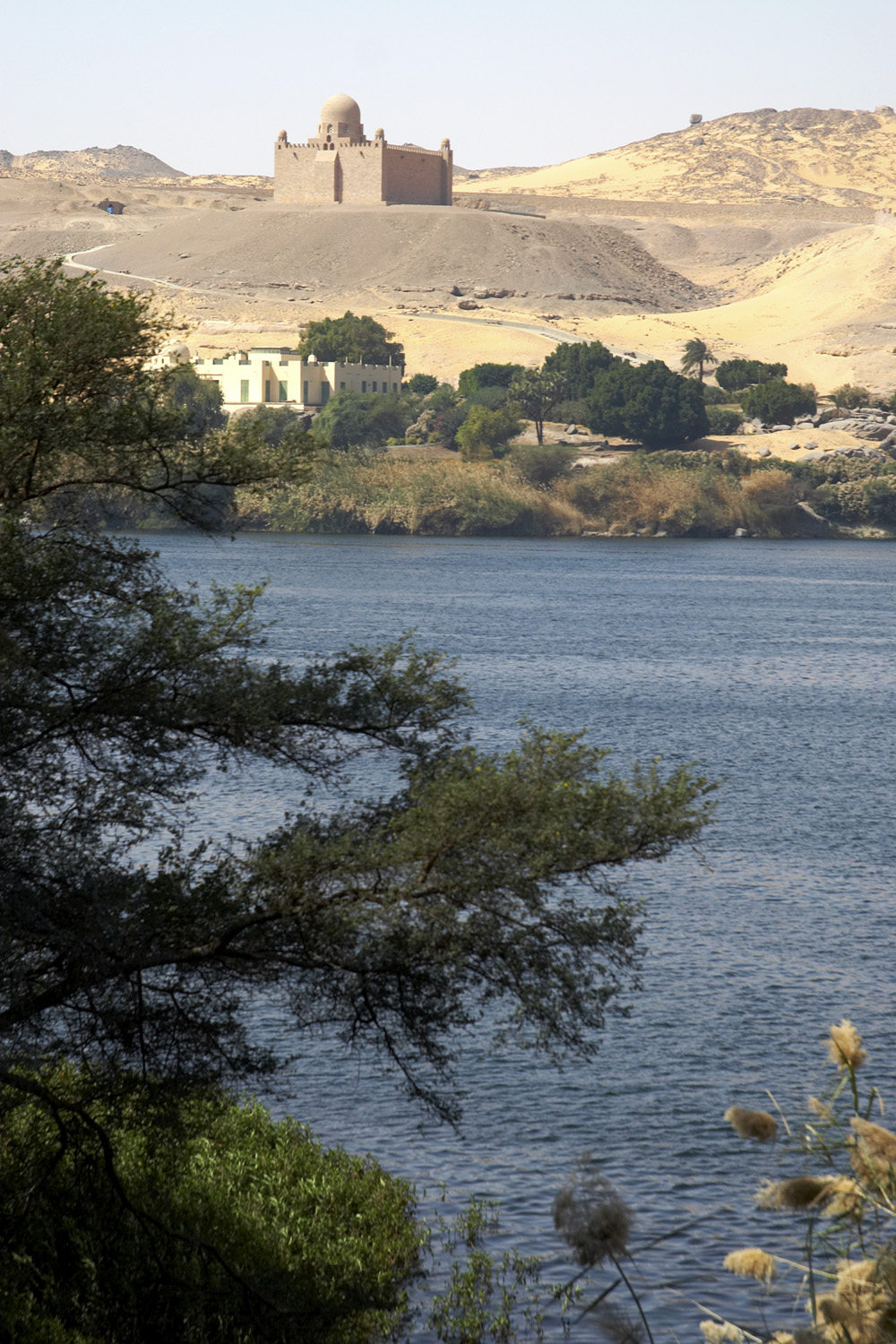
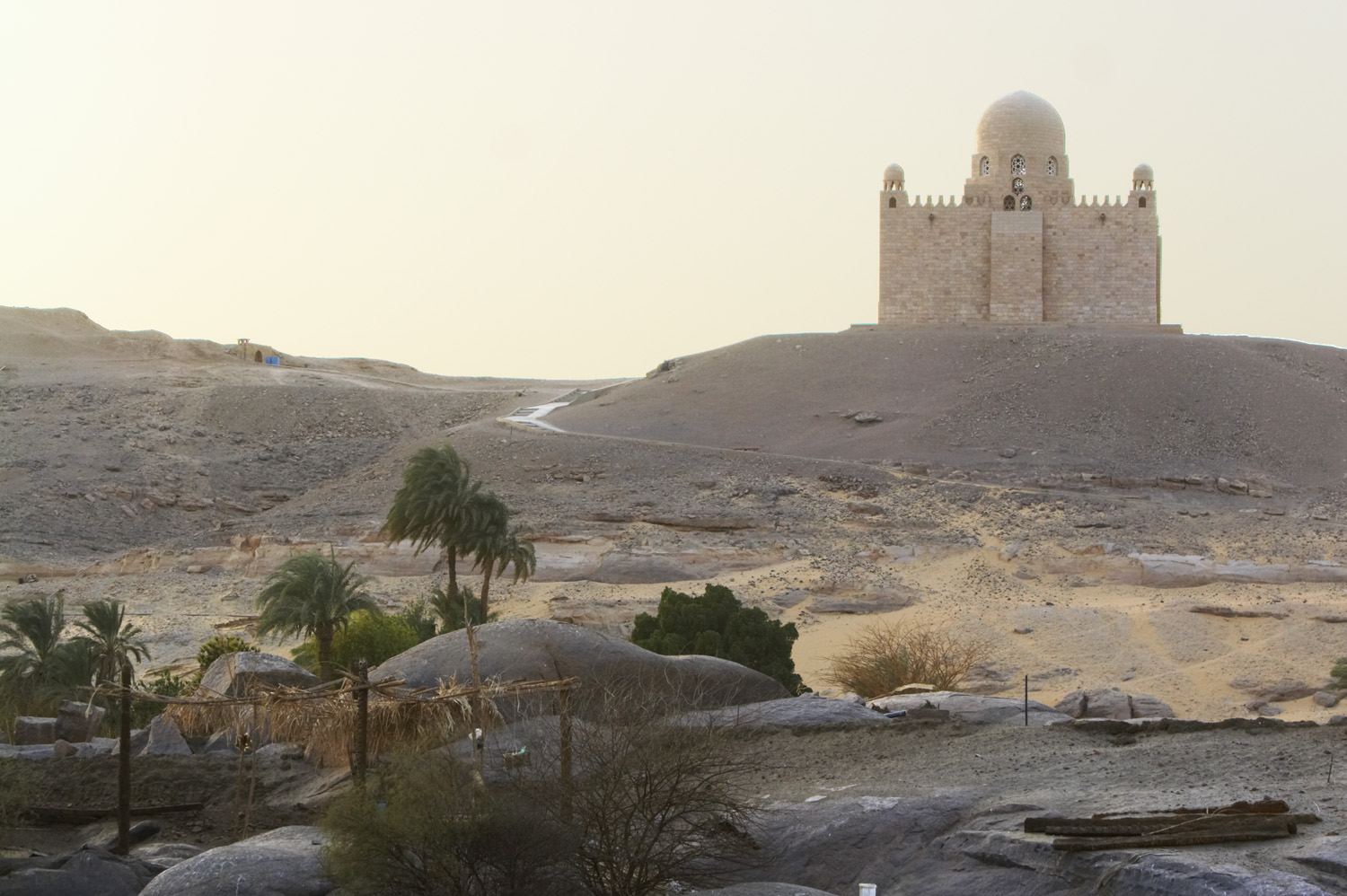
Aga Khan III had long expressed the wish that his burial should be in Aswan, Egypt. His wife, the Begum Om Habibeh Aga Khan, undertook the monumental task of coordinating the construction of the mausoleum near the villa. The mausoleum was completed in about 18 months. In the meanwhile, the body of the late Imam was temporarily buried in the compounds of the Villa. The final burial then took place on February 19, 1959.
We present a selection of photographs of the mausoleum as well as other images from the historical day (for more details and photos see the post in Barakah.)
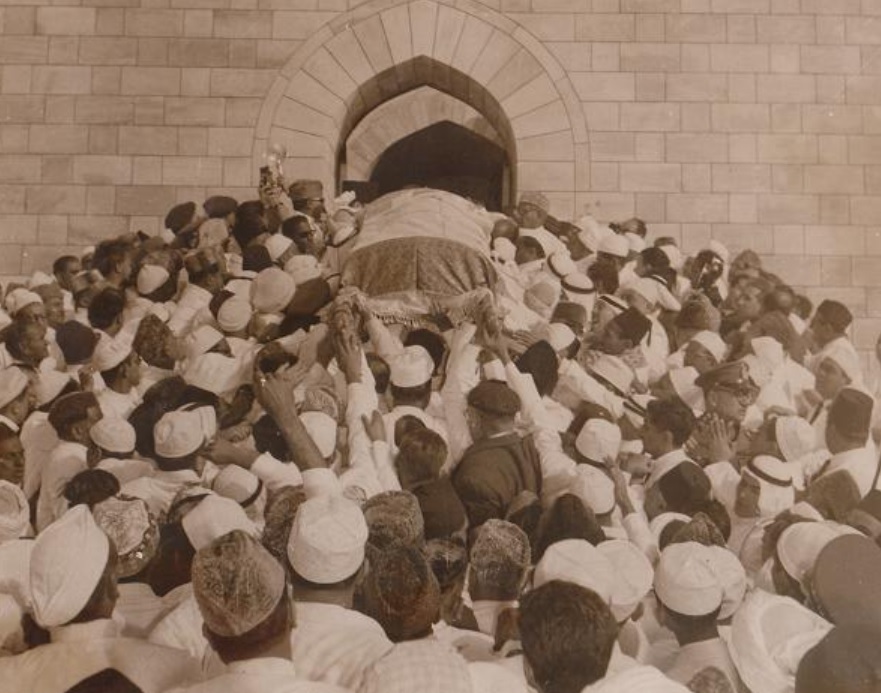
The successor of Aga Khan III, Mawlana Sha Karim al Hussaini, His Highness the Aga Khan, left, his uncle Prince Sadruddin Aga Khan, right, and his younger brotehr Prince Amyn Aga Khan at the back, carrying the shrouded body of the 48th Ismaili Imam, Mawlana Sultan Mahomed Shah, from its temporary resting place to the mausoleum. Photograph: Jehangir Merchant collection.
Mourners watch as the body of the 48th Ismaili Imam, Mawlana Sultan Mahomed Shah, His Highness the Aga Khan, is carried into the mausoleum, February 19, 1959. Photograph: Jehangir Merchant collection.
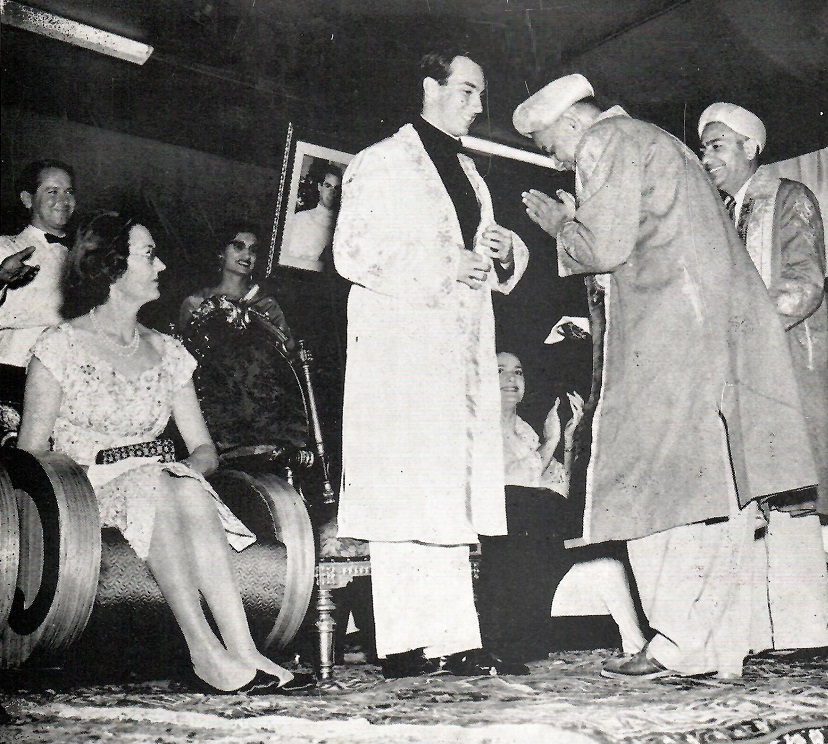
Mawlana Hazar Imam, His Highness the Aga Khan, pictured on October 19, 1957 at his 1st Takhtnashini or ceremonial installation, held in Dar es Salaam, Tanganyika (now Tanzania). He became the 49th Imam of the Shia Imami Ismaili Muslims,on July 11, 1957 at the age of 20. Photograph: Ilm Magazine, July 1977.
“Today, I am speaking to you in a city and in a country which have a particular meaning to my family and myself. On 2nd November, 1877 my beloved grandfather was born here in Karachi. Through 72 years of Imamat, he guided his spiritual children to happiness and prosperity” — Karachi, August 4, 1957.
“Many many memories come to our minds as we think of him. He achieved in his life, for our community that which could only have been accomplished normally in a period of many generations. The tributes that the world has paid him bear honest testimony to his great life and work” — Takhtnashini, ceremonial installation, Karachi, Pakistan, January 23, 1958.
Date posted: February 21, 2023.
Featured image at top of post: The mausoleum of Mawlana Sultan Mahomed Shah, His Highness the Aga Khan, overlooking his villa and the Nile. Photograph: Motani Family collection, Ottawa, Canada.
_________________
For an extended version of this post please click HERE.
Before departing this website, please take a moment to review Simerg’s Table of Contents for links to hundreds of thought-provoking pieces on a vast array of subjects including faith and culture, history and philosophy, and arts and letters to name a few. Also visit Simerg’s sister websites Barakah, dedicated to His Highness the Aga Khan, and Simergphotos.
In both the beautiful songs presented below, there are prayers, supplications and references to Ali, the first Shia Imam whose birth anniversary will be observed with reverence on the 13th of Rajab (on or around February 3, 2023).
However, in Ismaili theology, the Imams descended from Imam Ali are the bearers of the same Light (Noor) of Imamat. Thus, an Ismaili living during the period of any Imam, when uttering the name of Ali, has in his heart and mind the presence of the Imam-of-the-Time. Currently, the holder of the Divine Authority of the Imamat is Shah Karim al Hussaini, His Highness the Aga Khan, or Mawlana Hazar Imam (Our Lord, the Present Imam). He is the 49th Hereditary Imam of the Ismailis and the Ismailis are the only Shia community to have a Living Imam.
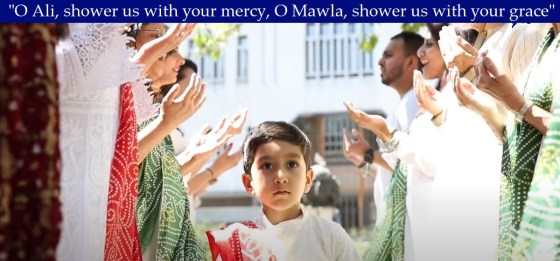
The lyrics in the first video song entitled “Ameen — A Global Prayer of Hope” are in multiple languages including the sign language, and the expressions by musicians and singers, young and old alike, show the love that each participant in the video has for his or her Imam. Listeners will feel totally immersed as they watch and listen to the song. Please watch the entire video (10:32 minutes), because the different components carry their own special messages. We then present another song “Cry Aloud to Ali.”
~~~~~~~
Song: A Global Prayer of Hope
(excerpts from lyric)
…. We are never alone Never have been Never will be Ameen …..
…. Khudawanda tu Sultane Karimi …. (Lord: You are the King of Generosity)
…. I look to you, I pray to you for hope, I love you ….
…. Ya Ali tu Rahem Kar, Ya Mawla tu Fazal Kar …. (O Ali, shower us with your mercy, O Mawla, shower us with your grace)
Ya Ale Nabi, Aulad-e-Nabi, Ya Mushkil Kusha, Ya Hazar Imam (O Progeny of the Prophet, O the Progeny of Ali, O reliever of difficulties, O Hazar Imam)
Ameen
________________
Ali’s love for his spiritual children is constant, and we are in his prayers and heart every moment. This has been articulated by Mawlana Shah Karim throughout his Imamat and I quote from a message that Malik Talib, the Chairman of the Ismaili Leaders International Forum (LIF), was asked to convey to the Jamat. Hazar Imam said:
“Please convey my best paternal and my best maternal loving blessings to my worldwide Jamat, and tell them that I think of them every minute of the day, each day, and I pray for Mushkil Asan and for their peace and happiness.”
“My spiritual children should always remain mindful that it is the principles of our faith that will bring peace and solace in these times of uncertainty. I am with my Jamat at all times, and each of you, individually, is always in my heart, in my thoughts and in my prayers. I send my most affectionate paternal, maternal loving blessings to all my Jamat – for happiness, good health, confidence and security in your lives ahead, and for mushkil-asan.”
________________
Song: Naad e Ali
[Note: The lyrics in the song in both Arabic and English are slightly different from the transliteration and translation published below – Ed.]
Nade Ali, Nade Ali, Nade Ali Nade Aliyyan mazhar al-ajaib Tajidahu awnan lakafin-nawaib Kullu hammin wa ghammin sayanj-i Ali Bi wilayatika, Ya Ali! Ya Ali! Ya Ali!
Translation
Call Ali call Ali call Ali, the manifestation of marvels He will be your helper in difficulty Every anxiety and sorrow will end Through your friendship. O Ali, O Ali, O Ali.
Date posted: February 1, 2023.
_______________
REVIEW SIMERG’S TABLE OF CONTENTS AND VISIT ITS SISTER WEBSITES
Before departing this website, please take a moment to review Simerg’s Table of Contents for links to hundreds of thought-provoking pieces on a vast array of subjects including faith and culture, history and philosophy, and arts and letters to name a few. Also visit Simerg’s sister websites Barakah, dedicated to His Highness the Aga Khan, and Simergphotos. The editor may be reached via email at mmerchant@simerg.com.
“Do not seek to know the Truth (al-Haqq) according to other people. Rather first come to know the Truth — and only then will you recognize Its people.” — Imam ‘Alī Ibn Abī Tālib [1]
One of the most striking characteristics about those surviving oral traditions that have come down to us from the earliest periods of each of the world-religions — as with the Gospels, the earliest Buddhist teachings, or the Prophetic hadith — is the distinctive directness, simplicity, and extreme concision of those original oral teachings. It is as though everything else that follows is only a kind of endlessly extended commentary on those few simple words. Certainly this is true of many of the surviving sayings attributed to ‘Ali ibn Abi Talib (d. 40/660) — including the short, but highly memorable passage that is the subject of this study, which has inspired repeated commentaries and elaborate theological and even dramatic interpretations down through the centuries. [2]
The wider significance of this particular passage is that it illustrates so perfectly Ali’s emblematic role as the fountainhead of virtually all the esoteric traditions of Islamic spirituality, both among the many branches of Shiite Islam (which revere him as their first Imam) and throughout the even more numerous Sufi paths, where his name is almost always included as the initial transmitter of the Prophetic baraka in each order’s chain of transmission. That central initiatic role is beautifully summarized in the famous Prophetic saying:
‘I am the City of (divine) knowing, and Ali is its doorway.’
And perhaps the most important literary vehicle in the wider transmission of Ali’s teachings, since it has been equally revered by both Sunni and Shiite audiences down to our own time, is the Nahj al-Balāgha (‘Pathway of Eloquence’), a wide-ranging collection of various sermons, letters, and wise sayings attributed to Ali, that was assembled several centuries later by the famous scholar and poet al-Sharíf al-Rādí (d. 406/1016). [3]
The famous saying of Ali placed as the epigraph for this study, with which al-Ghazālí begins his own spiritual autobiography, highlights the indispensable — if somewhat paradoxical — starting point for any well-grounded discussion of religious and spiritual understanding. For all problems of inter-religious understanding — and perhaps even more important, of that initial ‘intra-religious’ understanding on which all further dialogue depends — necessarily come back to this fundamental question: What is the ultimate divine Reality (al-Haqq), and how we can come to know and properly conform to what It requires of us (‘the Right’, which in Arabic is also an inseparable dimension of the divine Haqq)? Almost all the extensive sermons and teachings of the Nahj al-Balāgha are devoted to one or another of the equally essential dimensions of this question — to that ongoing interaction between our purified actions and intentions (‘amal), and our maturing spiritual understanding (‘ilm), which together constitute each person’s uniquely individual, spiralling process of spiritual realization (tahqíq).
Now one of the most important keys to approaching this primordial question in the Nahj al-Balāgha is the famous passage (translated in full in the Appendix at the end of this study) describing Ali’s intimate advice to one of his closest companions and disciples, Kumayl ibn Ziyād al-Nakhā’ī. [4] The difficulty and intrinsic dangers of that unique lesson are emphasized already in its dramatic setting. Kumayl, who recounts the story, stresses the great pains Ali takes to assure his privacy and solitude, leading his disciple out to the cemetery beyond the city wall of Kufa: that is, to the symbolic home of those who — like those rare true Knowers of God described in the rest of Ali’s saying — are spiritually already at once ‘alone with God’ and ‘dead to this world.’ In addition, the wider historical setting at that particular moment in time — so full of religious intrigues, claims, betrayals, and prolonged bloody civil wars among the triumphant Arabs — only highlights the profound wealth of concrete earthly experience which underlies the Imam’s conclusions and intimate teachings summarized in this saying.
No other text of the Nahj al-Balāgha is so pointedly set in the same kind of strictest privacy and intimacy. As a result, this famous testament to Kumayl constitutes the indispensable link between the more public, relatively exoteric teachings of the Nahj al-Balāgha and the wealth of more intimate, often esoteric spiritual teachings of Ali that were eventually preserved — at first orally, and eventually often in writing — in both Shiite and Sufi Islamic traditions.
The contents of Ali’s lesson to Kumayl are all presented as a clarification of his opening statement that:
There are three sorts of people (with regard to Religion, al-Dīn). A divinely inspired Knower (‘ālim rabbānī); the person who is seeking (that true spiritual) Knowing (muta‘allim) along the path of salvation; and the riffraff and rabble, the followers of every screaming voice, those who bend with every wind, who have not sought to be illuminated by the Light of (divine) Knowing and who have not had recourse to a solid support.
In the remainder of his lesson, Imam Ali goes on to explain some of the basic conditions for these three radically different levels of (and potentials for) true religious understanding. Each of his points here — as throughout the Nahj al-Balāgha — is of course profoundly rooted in the central teachings of the Qur’an. However here we can only summarize his most essential observations in the simplest possible terms.
First, and most importantly, it is human Hearts (the Qur’anic qalb al-insān) that are the locus of true spiritual ‘Knowing’ (‘ilm) and of our awareness of God and Truth: that is, it is not simply our mind or intellect or passion. Hence the decisive practical importance, throughout the Nahj al-Balāgha, of Ali’s constant stress on the purification of our hearts, through inner surrender to the divine Will (taslīm), as the underlying spiritual purpose of the many divine commandments. Divine, inspired ‘Knowing,’ however it is outwardly acquired, can only be perceived as such by the Heart that has been ‘polished,’ emptied of this world’s distractions and attachments, and thereby opened up to the full significance and reality of the divine Word — and to the further rights and obligations (another dimension of the Arabic al-Haqq) flowing from that opening.
Second, the practically indispensable key to this human potential for religious Knowing is the real existence and efforts of a limited number of divinely guided individuals — again, not of particular books, rituals, doctrines or worldly institutions, none of which are even mentioned in this intimate, highly personal lesson. Ali refers here to those very special human doorways to true religious understanding by several profoundly significant Qur’anic expressions: the ‘divine Knowers’; the ‘Friends of God’ (awliyā’ Allāh); God’s ‘Proofs’ or ‘Clear Signs’ on Earth (hujja, bayyina); God’s ‘True Servants’ (‘ibād Allāh); and finally as God’s true earthly ‘stand-ins’ or ‘Stewards’ (khalīfat Allāh).
The Imam tells us several other very important things in his description of these true ‘Friends of God:’
They are always present on earth, ‘whether openly or in secret.’ [5]
They are directly inspired by the divine ‘Spirit of Certainty’ (rūh al-yaqīn).
Therefore they pre-eminently possess true spiritual Insight (haqīqat al-basīra) into the deeper spiritual realities underlying earthly events and experiences, into the actual meanings of the infinite divine ‘Signs’ constituting our existence.
Their spiritual task and mission on earth is to pass on this divine Knowing to those properly qualified souls who are truly ready for and receptive to their divinely inspired teachings.
In contrast to these particular points of Alī’s teaching here, it is surely essential to recall all those manifold dimensions of what we ordinarily, unthinkingly call or presume to be ‘religion’ which in fact are not central to the particular divine mission of these inspired individuals as it is described in this lesson.
Third, Ali describes the divine ‘Knowing’ that can be conveyed uniquely by these specially missioned individuals as having the following qualities:
It is the ‘Dīn (true Religion/true Justice) by which God is truly worshipped and served.’
It is the indispensable key to realising what the Qur’an constantly describes as our ultimate human purpose: i.e., to transforming the mortal biped or ‘human-animal’ (bashar) into the theomorphic, truly human being (insān), who alone can freely follow and truly obey God (the inner state of itā‘a), eventually becoming a pure manifestation of the divine Will.
Their divinely inspired Knowing is the true ‘Judge’ or Criterion for rightly perceiving and employing all the illusory possessions (māl) of this world .
Fourth, the ‘true Seekers’ (muta‘allimūn) of that divine Knowing have at least the following basic pre-requisites, each of which distinguishes them from the large majority of ordinary souls (al-nās). One might therefore say that each of these following five points mentioned by Ali here is in itself an essential pre-condition for acquiring true religious understanding:
Those true religious Seekers have a rare natural spiritual capacity to recognize, absorb, and actualize the inspired teachings of the Friends of God.
They know that they need the indispensable guidance of God’s Friends (the awliyā’), and therefore actively seek it out. That is to say, they actually realize that they are spiritually ‘ignorant’ and needy.
They are willing and able to submit to the guidance of those divine Knowers and Bearers of Truth, especially with regard to acknowledging the true, ultimate aims of this inspired spiritual Knowing. In other words, they have the indispensable humility to recognize their inner ignorance and to overcome the central spiritual obstacle of pride.
They have the practical insight and active spiritual perspicacity (basīra) to ‘see though’ the ongoing divine ‘private lessons’, the most essential divine ‘Signs’ (āyāt) of each soul’s life. (This particular point is one that Ali especially stresses throughout all the sermons and teachings of the Nahj al-Balāgha.)
They are not secretly governed by their desires for power and domination, qualities which Ali stresses (along with pride) as the particular psychic passions most likely to trip up the otherwise apt potential spiritual seekers of this group.
Finally, the rest of humanity are clearly — indeed even vehemently — said to lack, for the time being, the above-mentioned prerequisites for realized spiritual learning and illumination, because of the current domination of their hearts by their psychic passions of the nafs: for power, pleasure, possessions, and the attractions ‘this lower world’ (al-dunyā) in general. In this particular context, Ali does not openly clarify whether or not ‘purification’ of our hearts from such worldly passions is in itself the only obstacle to deeper spiritual and religious realization, or whether some individuals are simply born with dramatically greater, relatively unique spiritual capacities and potential. However, his recurrent and insistent practical stress on the ethically purifying dimensions of Islamic ritual and devotional practice throughout much of the rest of the Nahj al-Balāgha is a strong indication that revealed prescriptions for religious teaching and practice can and should be understood as well as an indispensable preparatory discipline that can be used to move at least some individuals toward the receptive inner state of these true ‘seekers.’
Now the practical consequences of all of Ali’s observations briefly enumerated here are quite visible in the particular structure and emphases of almost all his longer sermons and discourses throughout the Nahj al-Balāgha. To put it in the simplest possible form, each longer text in that work typically stresses the dual religious dimensions of both taslīm (‘surrender’) and tahqīq (‘realization’). [6] That is, almost all of Imam Ali’s teachings are directed at the same time toward both (1) the essential purification of our own will — i.e., the discovery and gradual distillation of the true human/divine irāda from the endless promptings of our domineering ego-self or nafs — through true inner conformity and surrender (taslīm) to the authentic divine commandments; and (2) the subsequent stage of more active ‘realization’ (tahqīq) of the divinely inspired teachings that can only come about when an individual has developed enough humility and inner awareness of their spiritual ignorance to recognize their unavoidable need for a divine Guide and Knower, along with the many other essential qualities of the ‘seeker on the path of salvation’ that have just been summarized above. From this perspective, all of the Nahj al-Balāgha constitutes an extended, lifelong example of the sort of essential spiritual teaching and guidance (ta‘līm) alluded to here in Ali’s private advice to his close disciple.
In conclusion, we cannot help but notice that Ali’s remarks to Kumayl ibn Ziyād here provide a radical contrast to many prevailing modern-day assumptions about ‘religious understanding’ and religious teaching, whether our focus happens to be on ‘inter-’ or ‘intra-’religious concerns. Here I can mention only a few of the most salient points of contrast between popular contemporary conceptions of inter-religious understanding and Ali’s own teachings on this subject, without entering into a more detailed discussion of the deeper philosophic underpinnings and presuppositions on either side.
To begin with, the primary focus of most modern attempts at inter-religious understanding is either intellectual and theological, where formal doctrines and religious symbols are concerned; or else on ‘social ethics,’ where certain historically accumulated external practical precepts and rituals of two religious traditions are being compared. In either case, the particular comparison (or ‘understanding’) of the religious traditions concerned is typically carried out in an external, reductive social, historical or political way that supposedly reveals the ‘real,’ common meanings and functions of the religious phenomena in question. In this widespread approach, the aims of those particular practical or theological dimensions of a given religion are usually reduced, explicitly or implicitly, to a given, presumably familiar and universally accessible set of historical, this-worldly (dunyawī) social, political, or even psychic ends.
What is key in each such case, of course, is the reductive, socio-political emphasis and assumptions shared by virtually all such modern approaches. Now no rational observer would deny that every historical religion does indeed ‘function’ in such ways in this world — in ways that are in fact so poignantly illustrated by the endless ‘religious’ polemics, strife, and open civil warfare of early Islamic history during Ali’s own lifetime, seminal events that are recorded in such thorough detail throughout the Nahj al-Balāgha. But modern writers unfortunately too often tend to ignore the equally obvious limits of such reductive forms of interpretation and understanding: what is it, one might ask all the same, that also differentiates, for example, a genuine Sufi tarīqa from a social club, real spiritual guidance from psychotherapy, or transformative spiritual music (dhikr and samā‘ in their primordial sense) from any other concert performance?
In dramatic contrast to such popular contemporary approaches to ‘religious understanding’, Ali’s remarks in this passage focus on radically different, spiritually distinctive and difficultly attainable — but nonetheless fundamental — aspects of religious life and understanding, whatever the particular historical traditions in question:
First, for Ali, true inter-religious understanding — at any of the three levels he distinguishes here — is always between individuals, growing out of each soul’s individual encounter with the ‘other’ and their common spiritual reality and relationship with al-Haqq (God, Reality, and Truth). From this perspective, therefore, true religious understanding is always the ultimate fruit of a sort of ‘tri-alogue’ — not a worldly dialogue — in which both the human parties, the Knower and the properly prepared disciple, share and gradually discover their common divine Ground of reality and true being.
Secondly, the possibilities of religious understanding (again whether inter- or intra-religious) are essentially limited above all by the intrinsic barrier of the specific spiritual capacities, shortcomings and level of realization of each individual. As in the familiar imagery of so many hadith and later Islamic writings, souls here are indeed revealed as mirrors, who can only see in the ‘other’ — whether that be a religious phenomenon or anything else — their own reflection. Therefore the basharic ‘rabble’ of whom Ali speaks so painfully here — whatever their particular religion or historical situation — are necessarily and unavoidably in the position so aptly described in Rumi’s famous tale of the blind men and the elephant.
Thirdly, for Ali, even the first beginnings of our approach to a true, immediate awareness of God and the divine Religion (dīn) are necessarily grounded above all in humility, in an awareness of one’s own essential spiritual ignorance and limitations — and therefore not in the acquisition of some further external form of knowledge, ritual, or belief. In other words, the greatest, primordial obstacle to any serious religious understanding — as Socrates and so many other inspired teachers have repeatedly reminded us down through the ages — is our own ‘compound ignorance’ (jahl murakkab), our own illusion that we truly ‘know’ so much that we in fact only believe or imagine.
Finally, if Ali teaches us — as this story itself so dramatically illustrates — that the keys to the deepest and most profound forms of religious understanding are to be found in seeking out God’s true ‘Knowers’ and Guides and our own intimate spiritual relation to them, then the corresponding area of human religious life and experience most likely to lead to genuine inter-religious understanding is that of our particular individual devotional life and prayer, of each soul’s unique, ongoing inner relationship with its Guide and source of Light, in what has traditionally been termed ‘practical spirituality’ (‘irfān-i ‘amalī). Not surprisingly, this domain of our personal spiritual experience and practice, where God is so obviously and unavoidably the ultimate ‘Actor’ and Creator, in reality exhibits an extraordinary phenomenological similarity across all external historical and credal boundaries and socio-political divisions….
These brief reflections on some of the central teachings of the Nahj al-Balāgha cannot help but remind us of one of the most remarkable Qur’anic verses on the subject of humankind’s recurrent religious misunderstandings and their ultimate resolution in and by the Truly Real (al-Haqq). Not surprisingly, this verse also serves well as a remarkable symbolic allusion to the strife-torn historical events and conflicts among the early Muslims, those critical, paradigmatic ‘tests’ (fitan) that are so vividly illustrated and evoked throughout the remainder of the Nahj al-Balāgha — and which continue to recur, with such poignancy, in our own and every age.
The verse in question (al-Baqara, 2:213) begins with the reminder that ‘all people were one religious community,’ but then:
God sent prophets bearing good news and warning, and He revealed through them the Scripture with Truth (Haqq), so that He might judge among the people concerning that about which they differed. And only those differed concerning It to whom (the Scripture) was brought, after the Clear Proofs came to them, out of strife and rebellion among themselves. But then God guided those who had faith to the Truth about which they had differed, through His permission. For God guides whoever He wishes to a Straight Path!
____________
Appendix: Ali’s Speech to Kumayl ibn Ziyād al-Nakhā’ī [7]
Kumayl ibn Ziyād said: The Commander of the Faithful — Peace be upon him! — took my hand and brought me out to the cemetery (beyond the city walls). So when he had entered the desert he let out a great sigh, and then he said:
O Kumayl ibn Ziyād, these Hearts are containers: the best of them is the one that holds the most. So remember well what I am going to say to you!
The people are (divided into) three groups: a lordly (divinely inspired) Knower [8]; one seeking Knowing along the path of salvation; and the riffraff and rabble, the followers of every screaming voice, those who bend with every wind, who have not sought to be illuminated by the Light of Knowing and who have not had recourse to a solid Support.
O Kumayl, Knowing is better than possessions: Knowing protects you, but you must guard possessions. Possessions are diminished as they’re spent, but Knowing multiplies (or ‘purifies’) as it is shared. But whoever makes the possessions disappears as they do!
O Kumayl ibn Ziyād, the awareness/recognition (ma‘rifa) of Knowing is a Religion (dīn) by which (God) is worshipped and served: through it the truly human being (insān) acquires willing obedience (to God) during their life (here), and a beautiful, wonderful state after their passing away. For Knowing is the Judge, and possessions are what is adjudged!
O Kumayl, those who accumulate possessions have perished, even while they are still alive. But the Knowers endure for all eternity: their particular-instances [9] are lost, but their likenesses are found in the Hearts. O what Knowledge abounding there is right here! — and he pointed with his hand to his breast [10] — if only I could reach those who are its (rightful) bearers.
True, I’ve reached a quick-learner who couldn’t be trusted with It, who would seek to use the instrument of Religion for this world — who would try to use God’s blessings to dominate His (true) servants and His proofs to overcome His Friends. [11] Or someone submissive to the bearers of the divine Truth (al-Haqq), but without any true Insight (basīra) into Its twists and curves, whose Heart is consumed by doubt at the first onset of some difficulty. But alas, neither this one nor that (can truly bear the Truth)! Or someone greedy for pleasures, easily led by their passions? Or someone engrossed in acquiring and accumulating (worldly possessions)? Those two are not among the guardians [12] of Religion in any respect — the closest semblance to that sort are the grazing cattle! Thus Knowing dies with the death of those who bear it.
Yet indeed, O my God, the world is never without one upholding the Evidence [13] for God, either outwardly and known to all, or secretly and in obscurity, [14] so that God’s Evidences and His illuminating-manifestations may not come to nought. But how many are these, and where are they!?
By God, these (true Knowers) are the fewest in number, but the greatest of all in their rank with God! Through them God preserves His Evidences and His Illuminating-manifestations, so that these (Knowers) may entrust them to their (true) peers and sow them in the Hearts of those like them. Through (those Knowers) Knowing penetrates to the inner reality of true Insight (haqīqat al-basīra). They are in touch with the Spirit of Certainty (rūh al-yaqīn). They make clear what the lovers of comfort had obscured. They are at home with what distresses the ignorant. And their bodies keep company with this world, while their spirits are connected to the Loftiest Station.
Those are the ones who are (truly) God’s Stewards [15] on the earth, who are calling (the people) to His Religion. Oh, how I long to see them! Go on now, Kumayl, if you want.
[1] A well-known saying commonly attributed to Imam ‘Alī Ibn Abī Tālib, quoted here as it is cited by al-Ghazālī at the beginning of his famous spiritual autobiography, the Munqidh min al-Dalāl.
[2] Many of these same points were later developed by the famous religious author Ghazālí (Abū Hāmid al-Ghazālī) in the influential closing section of his Mīzān al-‘Amal (‘The Scale of [Right] Action’). Already a century before the actual collection of Nahj al-Balāgha, this same story of Ali and Kumayl provided the architectonic framework for a highly creative dramatic reworking of these spiritual lessons in Ja‘far ibn Mansūr’s Kitāb al-‘Alim wa’l-ghulām (see our translation and Arabic edition, The Master and the Disciple: An Early Islamic Spiritual Dialogue, London, I. B. Tauris, 2001).
[3] To give some idea of the ongoing popular importance and relative familiarity of that text even today, one finds beautifully calligraphed Arabic proverbs and epigrams drawn from the Nahj al-Balāgha on the walls of homes in every part of the Muslim world, framed for sale in suqs and bazaars, and even being sold as postcards. Even more tellingly, the owners (or sellers) of that calligraphy will often explain that this or that saying is simply ‘a hadith’.
[4] Saying number 147 in the final section of short maxims, corresponding to pages 600-601 in the complete English translation by Sayed Ali Reza (Peak of Eloquence, NY, 1978). (Details on the Arabic text in the Appendix below.)
[5] It is perhaps important to note that this last qualification (sirran, ‘secretly’) can be understood to refer not simply to the outward modesty and relative social and historical ‘invisibility’ of the vast majority of the true ‘Friends of God’ — a point also strongly emphasised in the famous Prophetic hadith about the qualities of the walí — but also to their ongoing spiritual presence, actions and effects, even more visible and widespread long after their bodily sojourn on earth, which is of course central to the manifest spiritual role of the prophets and ‘Friends’ (awliyā’ Allâh) throughout every authentic religious tradition.
[6] See the more adequate discussion of this key polyvalent term in our Introduction to Orientations: Islamic Thought in a World Civilisation (London, Archetype, 2004).
[7] This particular well-known passage from Nahj al-Balāgha, the famous later compilation (by al-Sharīf al-Rādī, 359/970-406/1016) of the many letters, teachings, sermons and proverbs attributed to Alī ibn Abī Tālib, is also included in almost identical form in a number of earlier extant Shiite works, in both the Imami and the Ismaili traditions. The text translated here is from a popular Beirut edition of Nahj al-Balāgha (Dār al-Andalus, 1980), pp. 593-595, numbered 147 in the long later section of ‘Wise Sayings’ (hikam). The setting of this particular lesson is apparently outside the new Arab settlement of Kufa (on the edge of the desert in southern Iraq), during one of the drawn-out, bloody civil wars that divided the nascent Muslim community throughout the period of Ali’s official Imamate.
[8] ‘Alim rabbānī: ‘Knower’ here is used in the strong and inclusive Qur’anic sense, to refer to profound, God-given spiritual Knowing (‘ilm). The qualifier recalls the Qur’anic term rabbānīyūn and apparently is related both to the Arabic root referring to God as ‘Lord’ (rabb, hence ‘divine’ or ‘god-like’), and to another Arabic root referring to spiritual teaching and education in the very broadest sense (r-b-y). The latter meaning is emphasized at Qur’ān 3:79, which probably underlies the special usage here: …Be rabbānīyūn through your teaching the Book and through your studying (It).
[9] A‘yān (pl. of ‘ayn): that is, their individual, temporal earthly manifestation, as opposed to their ‘images’ or ‘likenesses’ (amthāl, or ‘symbols’) in the Hearts of other human individuals after them. Here we can see how Alí’s perspective parallels — and at the same time embodies — the Qur’anic understanding of the relationship between the archetypal divine ‘Names’ (which ultimately constitute this Knowing) and their infinitely re-created individual manifestations.
[10] Here, as in the Qur’an, the term ‘breast’ or ‘chest’ (sadr) is virtually synonymous with the ‘Heart’ (qalb) as the locus of all true perception, selfhood, etc.
[11]Awliyā’ Allāh: see the Qur’anic use of this key term (10:62).
[12] Or ‘shepherds’, ‘pastors’: ru‘āt.
[13] Or ‘Proof’ (al-Hujja) — but in the sense of the indisputable living human Manifestation, not any sort of logical or rhetorical ‘argument’; this is another central Qur’anic concept (4:165, 6:149) frequently alluded to in other teachings of Imam Ali in the Nahj al-Balāgha. The Qur’anic expression bayyināt (‘Illuminating-manifestations’) used several times in the immediately following passage seems to refer to the same key spiritual figures in this context.
[14] Literally, ‘in fear’ (used in the Qur’an, for example, of the young Moses fleeing Egypt for Midian) and ‘submerged’ (by the power of earthly tyranny).
[15] This famous Qur’anic phrase (khalīfat Allāh) is variously applied to prophets (Adam, at 2:30; David, at 38:27) and to ‘you-all’ (= all of humanity), at 6:165, 10:14 and 73; 35:39; 27:62; etc. Within a short time after the death of the Prophet — and certainly by the time of this story — it had taken on a highly charged and disputed political significance in the long and violent decades of protracted civil wars over the worldly leadership of the nascent Arab-Muslim political community.
Date posted: January 30, 2023.
__________________
About the writer: Dr. James Morris is Professor of Islamic Studies at Boston University’s Theology department and Islamic Civilization and Societies program. Prior to that he held the Sharjah Chair of Islamic Studies at the University of Exeter in the United Kingdom. He has also taught at Princeton University, Oberlin College, Temple University, and the Institute of Ismaili Studies in Paris and London. He has served as visiting professor at the Ecole Pratique des Hautes Etudes (Paris), University of Malaya, and University of Sarajevo, and he lectures and gives workshops widely throughout Europe and the Muslim world. Professor Morris serves on numerous international editorial, consulting, and examining boards in his fields. Professor Morris‘ interests in Islamic thought and religious studies date from his BA work at the University of Chicago. After further studies in Morocco, Egypt and France, he completed his PhD work at Harvard University and did advanced research at the Academy of Islamic Philosophy in Tehran.
Professor Morris is a prolific author, having written dozens of journal articles along with thirteen books, including most recently, The Reflective Heart: Discovering Spiritual Intelligence in Ibn Arabī’s Meccan Illuminations’; Orientations: Islamic Thought in a World Civilization; and The Master and the Disciple: An Early Islamic Spiritual Dialogue. He has often interviewed on current issues for the BBC and international journals and newspapers dealing with the Middle East.
______________
REVIEW SIMERG’S TABLE OF CONTENTS AND VISIT ITS SISTER WEBSITES
Before departing this website, please take a moment to review Simerg’s Table of Contents for links to hundreds of thought-provoking pieces on a vast array of subjects including faith and culture, history and philosophy, and arts and letters to name a few. Also visit Simerg’s sister websites Barakah, dedicated to His Highness the Aga Khan, and Simergphotos. The editor may be reached via email at mmerchant@simerg.com.
___________________
Calligraphy by Toronto’s Karim Ismail to on the birth anniversary of Hazrat Ali. Please click on image for reading.
As we enter the year 2023 this weekend, we present links to articles we posted in 2022 on Simerg’s sister website, Barakah, which is dedicated to His Highness the Aga Khan, members of his family and the Ismaili Imamat. The Aga Khan is the 49th Hereditary Imam of the Shia Ismaili Muslims, and is directly descended from the Prophet Muhammad (may peace be upon him and his family) through his son-in-law Imam Ali, the first Imam of all Shia Muslims, who was married to the Prophet’s daughter, Fatimah.
We commence the presentation with an image containing a verse from the Qur’an, a tradition (hadith) of the Prophet Muhammad and excerpts from the Aga Khan’s speeches and/or interviews. This is followed with links to more than thirty must read 2022 pieces.
The Ismaili Imamat is Unique
~~~~~~~~~~~~~~~
Note: All photos may be clicked for enlargement. Preceding each photograph is a link to the corresponding piece. Please click on the links and read the articles.
With this post, we welcome new readers to our 3 websites – Simerg, Barakah and Simergphotos – and wish them as well as all our existing readers a very happy, peaceful and prosperous 2023.
Date posted: December 29, 2022.
____________________
REVIEW SIMERG’S TABLE OF CONTENTS AND VISIT ITS SISTER WEBSITES
Before departing this website, please take a moment to review Simerg’s Table of Contents for links to hundreds of thought-provoking pieces on a vast array of subjects including faith and culture, history and philosophy, and arts and letters to name a few. Also visit Simerg’s sister websites Barakah, dedicated to His Highness the Aga Khan, and Simergphotos. The editor may be reached via email at mmerchant@simerg.com.
[This post includes material from The.Ismaili, the official website of the Ismaili community – Ed. ]
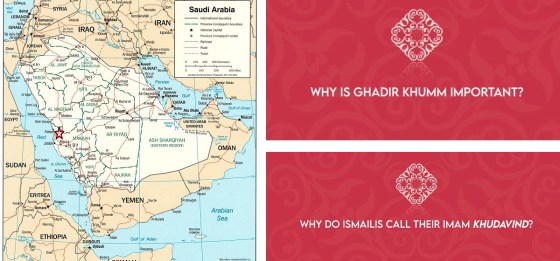
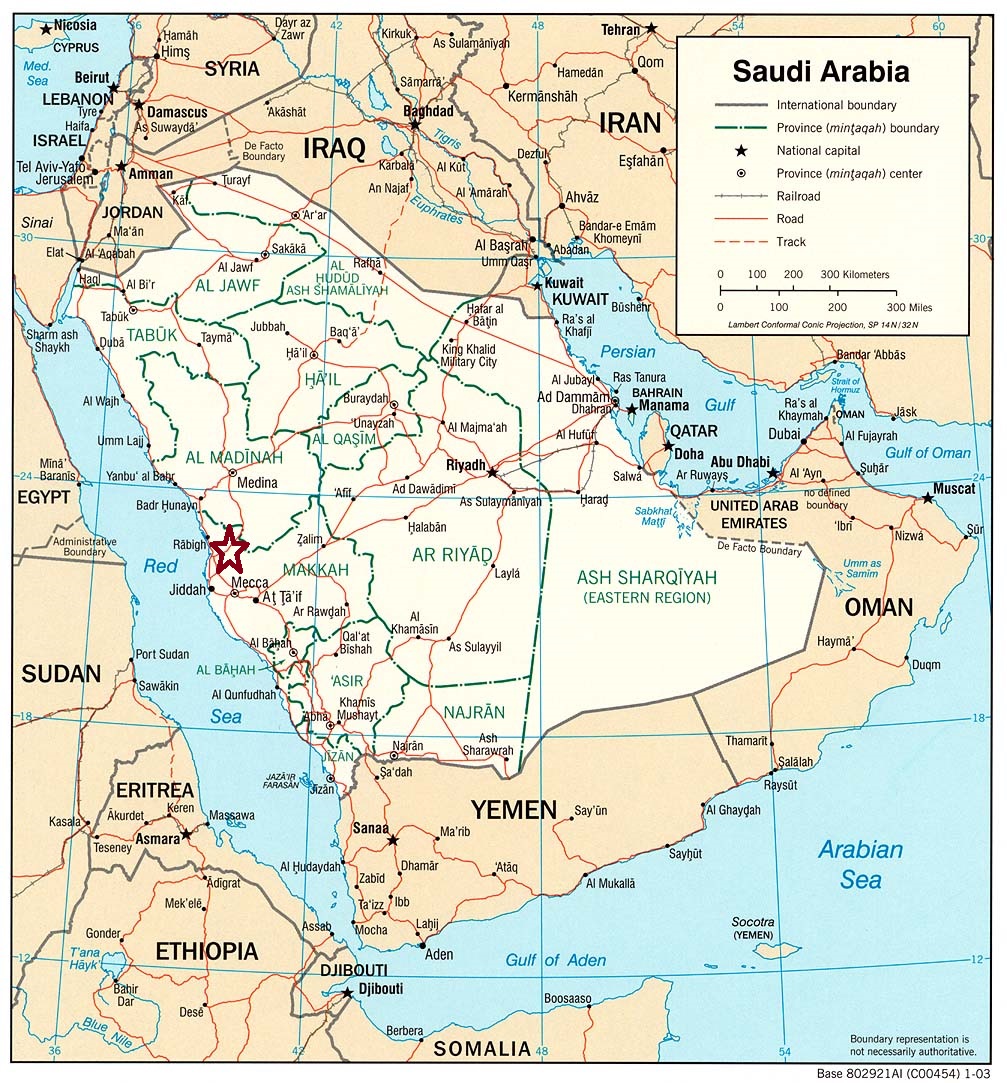
Map and Video: Ghadir Khumm
According to Shia belief, by declaring Hazrat Ali as Mawla after him at Ghadir Khumm, the Prophet Muhammad (peace be upon him and his family) transferred his own spiritual authority bestowed upon him by Allah to Hazrat Ali, making him — and all the Imams that follow — the Amirul Mu’minin, or Master of the Believers. Please see map for location of Ghadir Khumm and watch the short video on the importance of Ghadir Khumm.
Click on map for enlargement
Political map of Saudi Arabia and surrounding countries. The approximate location of Ghadir Khumm near the modern day town of Ragibh (known in the past as Al-Juhfah) has been highlighted in red. Driving distances: Mecca to Ghadir Khumm (location where Prophet Muhammad appointed Hazrat Ali as his successor) appx. 208 Kms; and distance from Ghadir Khumm to Medina, appx. 300 kms. Credit: Map adapted by Simerg from the Perry-Castañeda Library Map Collection, University of Texas Libraries.
~~~~~~~~~~
__________________
Video: Khudavind
The Persian word khudavind or khudawand means, “a king, prince, lord, master; or man of great authority.” Many Persian and Central Asian empires used this term throughout history to refer to people of high standing, including, at times, the sultan (ruler), wazir, government officials, and patrons. The Ismaili Imams lived in Persia (modern-day Iran) from the 12th to the 19th centuries. During this period, the community adopted the term khudawand to refer to the Imam. Its meaning is similar to the Arabic term mawla, which also means “master” or “lord.” (for more see the.Ismaili).
REVIEW SIMERG’S TABLE OF CONTENTS AND VISIT ITS SISTER WEBSITES
Before departing this website please take a moment to review Simerg’s Table of Contents for links to hundreds of thought provoking pieces on a vast array of subjects including faith and culture, history and philosophy, and arts and letters to name a few. Also visit Simerg’s sister websites Barakah, dedicated to His Highness the Aga Khan, and Simergphotos. Reach the editor, Malik, at mmerchant@simerg.com
In the space of seven days, Ismaili Muslims around the world have come together in their respective Jamatkhana prayer and social halls as well as outdoors to celebrate three historic festivals and events. Last Saturday, Ismailis joined other Muslim communities in Canada and around the world to celebrate Eid al-Adha, to commemorate the historic event thousands of years ago when Prophet Abraham was asked to sacrifice his son, Prophet Ismail, to test his faith and loyalty to God. In Calgary, the Ismailis hosted the wider Canadian community to a Stampede/Eid al-Adha breakfast at its Headquarters Jamatkhana.
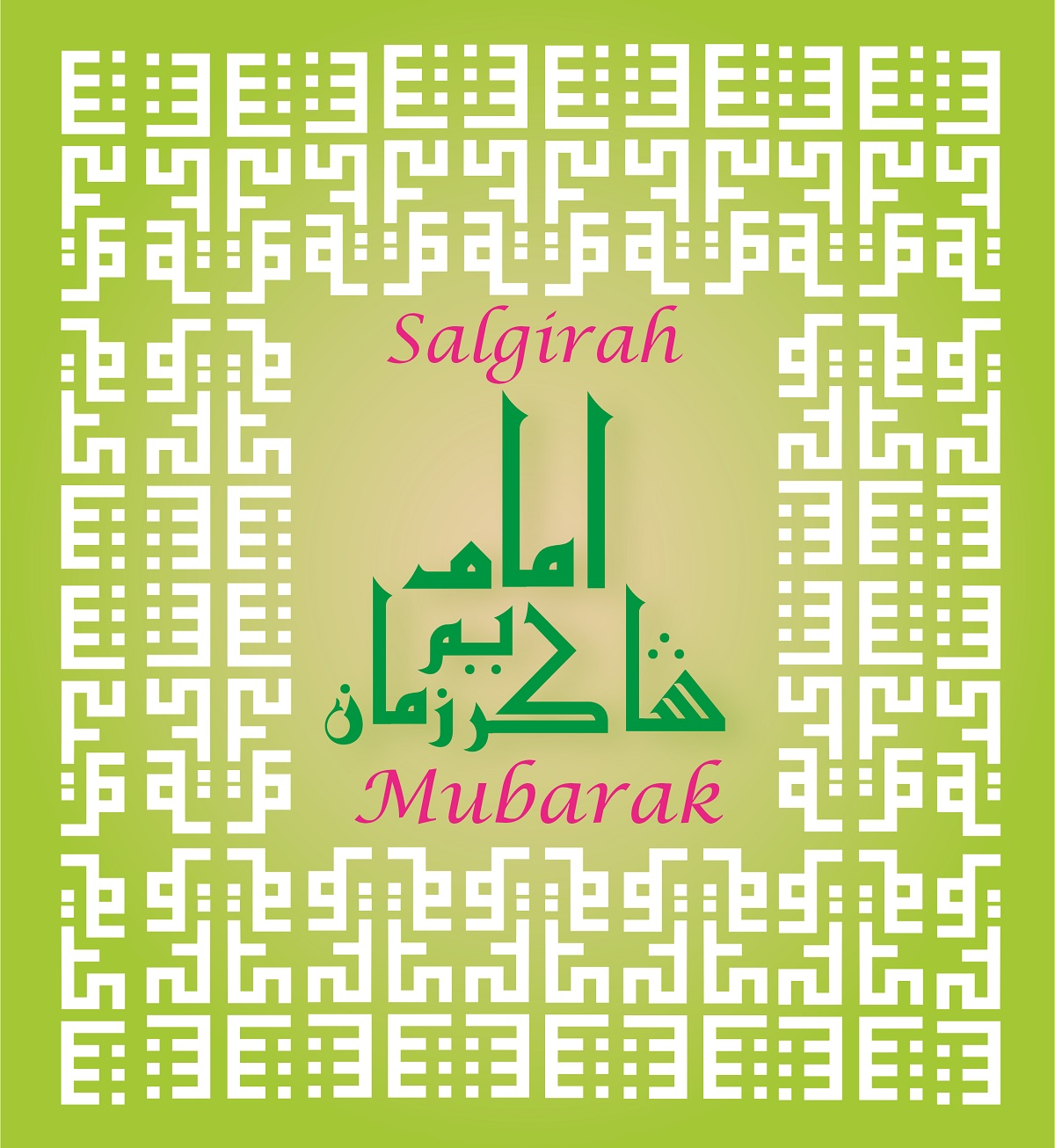
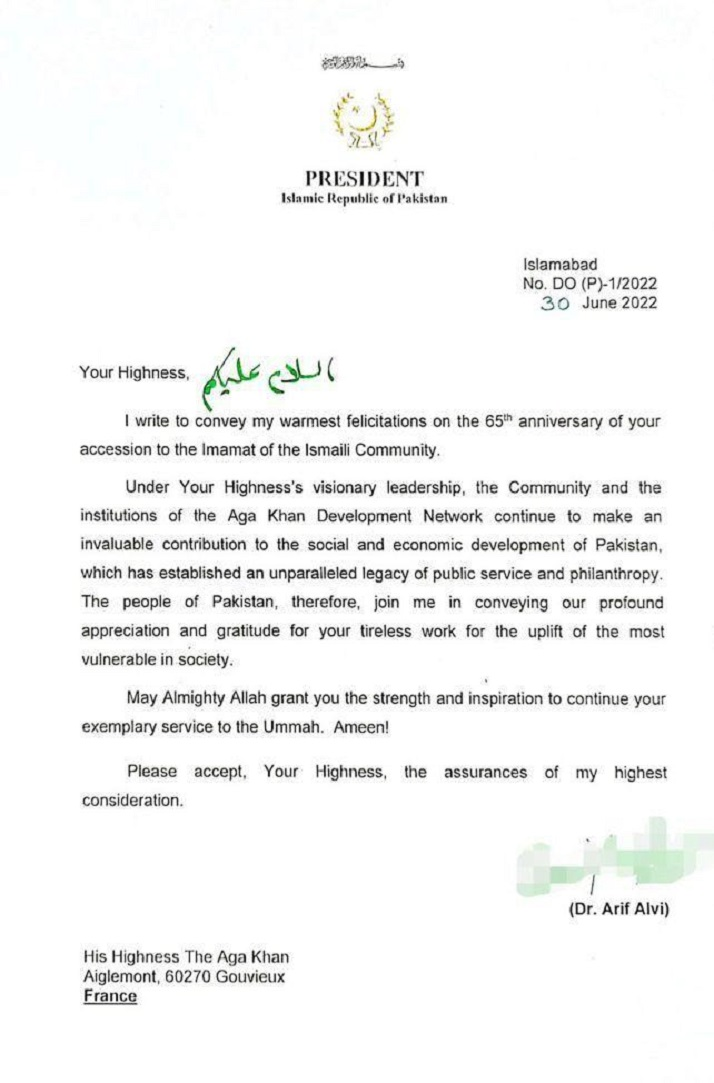
Then, on Monday July 11, Ismailis celebrated the 65th anniversary of the spiritual leadership (Imamat) of their 49th Imam, His Highness the Aga Khan, who is respectfully and lovingly addressed by the Ismailis as Mawlana Hazar Imam (our lord, present/living Imam). Indeed, the appellation of “Hazar Imam” is so appropriate, because the Ismailis are the only Shia community who, throughout history, have been led by a living, hereditary Imam in direct descent from the Prophet Muhammad (may peace be upon him and his family). On behalf of the world wide Ismaili community, the Ismaili leadership presented a beautiful ‘Alam to their Imam in Lisbon.
The Prophet Muhammad’s proclamation “Man kuntu mawlahu fa aliyyun mawlahu” (He whose Mawla I am, Ali is his Mawla) in square Kufi. Design by Karim Ismail, Toronto.
Coincidentally, this week, and specifically on Saturday July 16th, marks the historic day when the Prophet designated his cousin and son-in-law, Ali, as his successor. Hazrat Ali became the first Imam, and the continuity of the Imamat is reflected in the present manifest Imam, His Highness the Aga Khan. The historic event is known as Eid e-Ghadir, when the Prophet proclaimed “Man kuntu mawlahu fa aliyyun mawlahu” meaning: “He whose Mawla I am, Ali is his Mawla.” The Prophet then prayed: “O Allah, be a friend of whoever is his friend and extend your support to those who support him.” A very famous tradition of the Prophet says:
“I am leaving amongst you two weighty things after me, the Qur’an and my Progeny (ahl al-bayt). Verily, if you hold fast to them both you will never go astray. Both are tied with a long rope and cannot be separated till the Day of Judgement.” (Muslim, Vol. II, pg. 279).
_______________
The ‘Alam Presented to His Highness the Aga Khan on His 65th Anniversary of Imamat
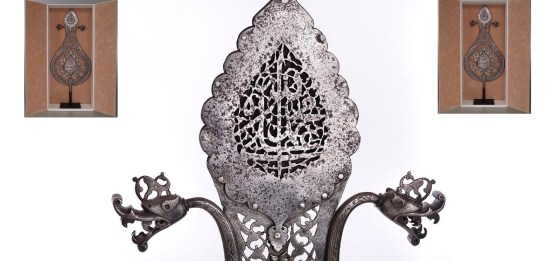
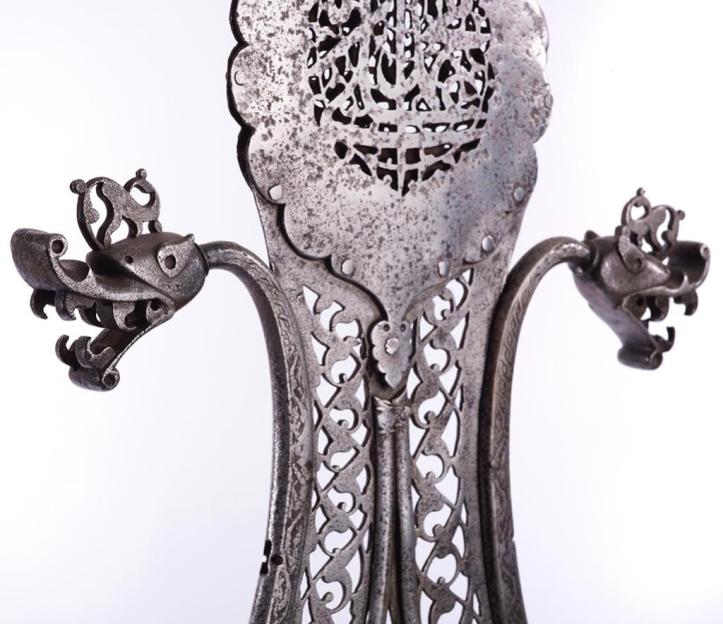
The steel processional standard (‘Alam) presented to Mawlana Hazar Imam by the Ismaili leadership on behalf of the worldwide Ismaili Muslims on the 65th anniversary of his Imamat comprises a central drop-shaped panel decorated with a calligraphic inscription in elegant thuluth on a scrolling vine background. The inscription reads “Allah, Muhammad, Ali”, with the hijri date 1061 (equivalent to 1651 of the Common Era) inscribed below. A smaller cartouche at the top of the ‘Alam also reads “Allah, Muhammad, Ali”. A panel at the base is inscribed with the name of the maker, Muhammad Ardabili. The inner framing and outer band has foliate patterned openwork, and each side of the standard has a dragon-headed cast steel terminal facing outwards.
The inscriptions on this standard — Allah, Muhammad, Ali — symbolise the foundational principles of the Shia Ismaili Muslim tariqah: the concepts of tawhid, nubuwwa and imama.
Another important Shia aspect that is reflected in the inscriptions on this ‘Alam is the concept of a single, pre-eternal spiritual light, the Nur Muhammad. According to this concept, Allah created a light from His Divine Light. When the angels asked about this light, Allah answered: “This is a light out of My Light; its main part is prophethood, and its ray is the imamate. The nubuwwa is for Muhammad, My servant and messenger, and the imama is for Ali, My hujja and My wali. Were it not for them, I would not have created My creation.” [1] This notion of light is beautifully represented on the ‘Alam by the dragon heads flanking each side of the standard. For, in Islamic art, one of the primary meanings of the dragon is as a producer and a symbol of light and protection.
We also invite you to view a video of the ‘Alam on the.Ismaili, the official website of the Ismaili Muslim community.
Date posted: July 16, 2022.
______________________
Footnote(s):
[1] For this Hadith and the concept of Nur Muhammad, see Uri Rubin, “Pre-existence and light. Aspects of the Concept of Nur Muhammad“, Israel Oriental Studies, 5 (1975), pages 62-119, especially 112-113.
Note: A slightly different version of this post also appears on our sister blog, Barakah, which is dedicated to His Highness the Aga Khan, members of his family and the Ismaili Imamat.
FEEDBACK
Simerg welcomes your feedback. Please complete the LEAVE A REPLY form below. Your letter may be edited for length and brevity, and is subject to moderation.
REVIEW SIMERG’S TABLE OF CONTENTS AND VISIT ITS SISTER WEBSITES
Before departing this website please take a moment to review Simerg’s Table of Contents for links to hundreds of thought provoking pieces on a vast array of subjects including faith and culture, history and philosophy, and arts and letters to name a few. Also visit Simerg’s sister websites Barakah, dedicated to His Highness the Aga Khan, and Simergphotos.















































 Simerg - Insights from Around the World