Simerg is an independent initiative dedicated to Ismaili Muslims, the Aga Khan — their Hereditary Imam — and the Ismaili Imamat, and Islam in general through literary readings, photo essays and artistic expressions
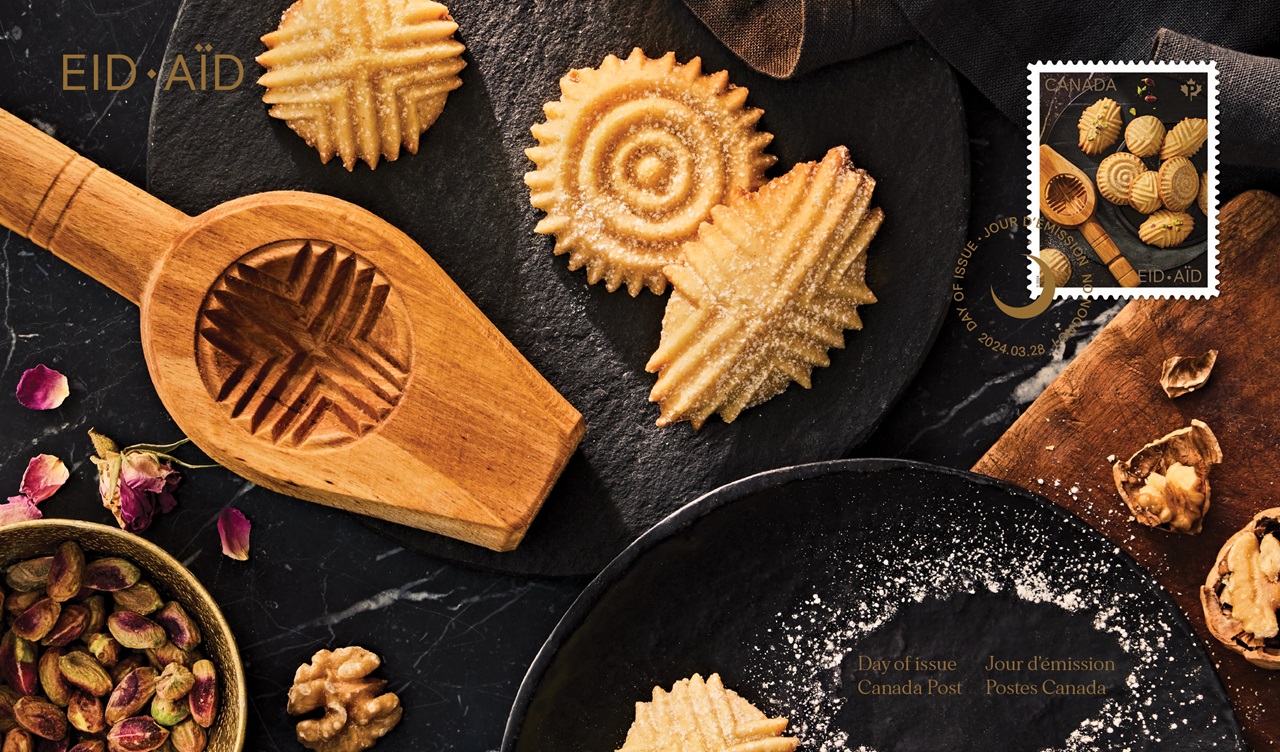
Simerg wishes Muslims worldwide and friends of the Muslim community a very happy Eid Mubarak for 2024. We welcome Canada Post’s special Eid Stamp and First Day Cover publications for the auspicious occasion featuring images of a delicious Middle Eastern cookie — the maamoul.
We sincerely hope and pray that wars will be replaced by peace so that children everywhere, especially in war-affected zones, can experience the sweet delights that Eid offers everyone and begin to live with hope for the future. It is up to humanity to ignite the unfortunate ones with the spark of hope over a life of continuing degradation and despair.
___________________
2024 Commemorative Eid Stamp Issued by Canada Post
Canada Post’s Commemorative Eid Stamp for 2024, issued March 27. Photograph: Canada Post.Please click BUY 2024 EID STAMPS BOOKLET OF 6($5.52).
On March 27, 2024, Canada Post issued a new stamp to mark two important Islamic holidays: Eid ul-Fitr, which will be celebrated this week from April 10 after the month of Ramadhan after the sighting of the New Moon on April 9, and the upcoming Eid ul-Adha, which will be held from June 17 to mark the Festival of Sacrifice commemorating Ibrahim’s (Abraham) willingness to sacrifice his son to God. The Eid ul-Adha will be held at the end of the annual pilgrimage to Mecca.
The 2024 issue is Canada Post’s sixth Eid stamp; the others were issued in 2017, 2020, 2021, 2022 and 2023.
The 2024 stamp was designed by Kristine Do, photographed by Maya Visnyei, and food-styled by David Grenier. Printed by Colour Innovations, the issue includes six Permanent™ domestic rate stamps booklets and an Official First Day Cover cancelled in London, Ontario. The new stamp and collectibles are available at canadapost.ca and postal outlets across Canada.
Celebrated by more than one million Muslims in Canada, both events can last several days and include communal prayers and feasts, visits with family, gift-giving and acts of charity. The 2024 commemorative stamp features maamoul, Middle Eastern cookies, and a traditional carved wooden mould used to make them.
Melt-in-your-mouth cookies stuffed with a delicious walnut, pistachio or date filling, maamoul are a sweet staple during Eid celebrations. They are traditionally handmade from semolina and flavoured with fragrant rose or orange-blossom water and mahlab — a spice made from ground cherry pits. Before baking, the dough balls are stuffed with walnut, pistachio, or date filling and formed with specially carved wooden moulds. Early versions of maamoul can be traced back to ancient Egypt and Mesopotamia. Today, family and friends often gather before Eid ul-Fitr and Eid ul-Adha to bake the cookies together.
Story continues below
Canada Post 2024 Eid Stamp Booklet
2024 Eid booklet of six stamps issued by Canada Post on March 27, 2024. The stamps can be detached from the booklet and used to mail letters. Please click BUY 2024 EID STAMPS BOOKLET($5.52).
~~~~~~~~~
Canada Post 2024 Eid Stamp First Day Cover
2024 Eid Stamps First Day Cover issued by Canada Post on March 27, 2024. Please click BUY 2024 EID FIRST DAY COVER ($1.92).
The Eid stamp is one of several stamps Canada Post issues each year to mark annual celebrations important to Canada’s culturally diverse population – others include Diwali, Hanukkah and Christmas. To buy the stamp online, please click Buy 2024 Eid Stamps Booklet of 6. Most postal outlets do not carry Eid stamps and are not aware of their release. I recommend that you obtain them online, where postage is free if you order 5 booklets or more.
Date posted: April 8, 2024. Last updated: April 21, 2024 (typos).
Simerg’s introduction of “Books by Ismaili Authors” continues with Boustan Hirji’s translation of Sijistani’s “Al-Risalah al Bahirah.” We follow the same Q/A format as our earlier presentations of books, which are listed chronologically below. We encourage Ismaili authors worldwide to participate in this series, regardless of when their books were published. See details of the series HERE and submit your responses to Simerg’s editor, Malik, at mmerchant@simerg.com.
****************
Simerg’s Interview with Ismaili Scholar Dr. Boustan Hirji
Dr. Boustan Hirji
“Al-Risalah al Bahirah is such a profound, fathomless space of intellectual ideas and crucial for understanding the depth of the Ismaili tradition, that I would hope that it makes for interesting reading for both Ismailis and anyone curious about syncretic traditions that have an impact on our current lives and societies” — Boustan Hirji
Simerg: What is behind the name and title of the book?
Boustan Hirji: The book’s title is a translation of the title given to the treatise by al-Sijistani himself.
Simerg: Why would you want me or my family to read the book, and what will we learn from it?
Boustan: This treatise in particular makes for a very interesting reading because Sijistani writes on the subject of Resurrection from a wider perspective on the history of ideas yet stays focused on the Isma’ili point of view. He is an original thinker who draws from the Buddhist, Hindu, and Hellenistic traditions and yet is uniquely representative of the Badakshani Ismaili tradition.
Simerg: What inspired you to write the book?
Boustan: My Professor and thesis supervisor at McGill University, Dr Hermann Landolt, shared this manuscript with me when I spent some days with him and his family in Pany, Switzerland. It is a manuscript that is very dear to his heart, and I am indebted to him for introducing me to the world of Sijistani. Ever since then, Sijistani has been my constant companion, a treasure waiting to be revealed.
Interview continues below
_____________________________
Print Edition
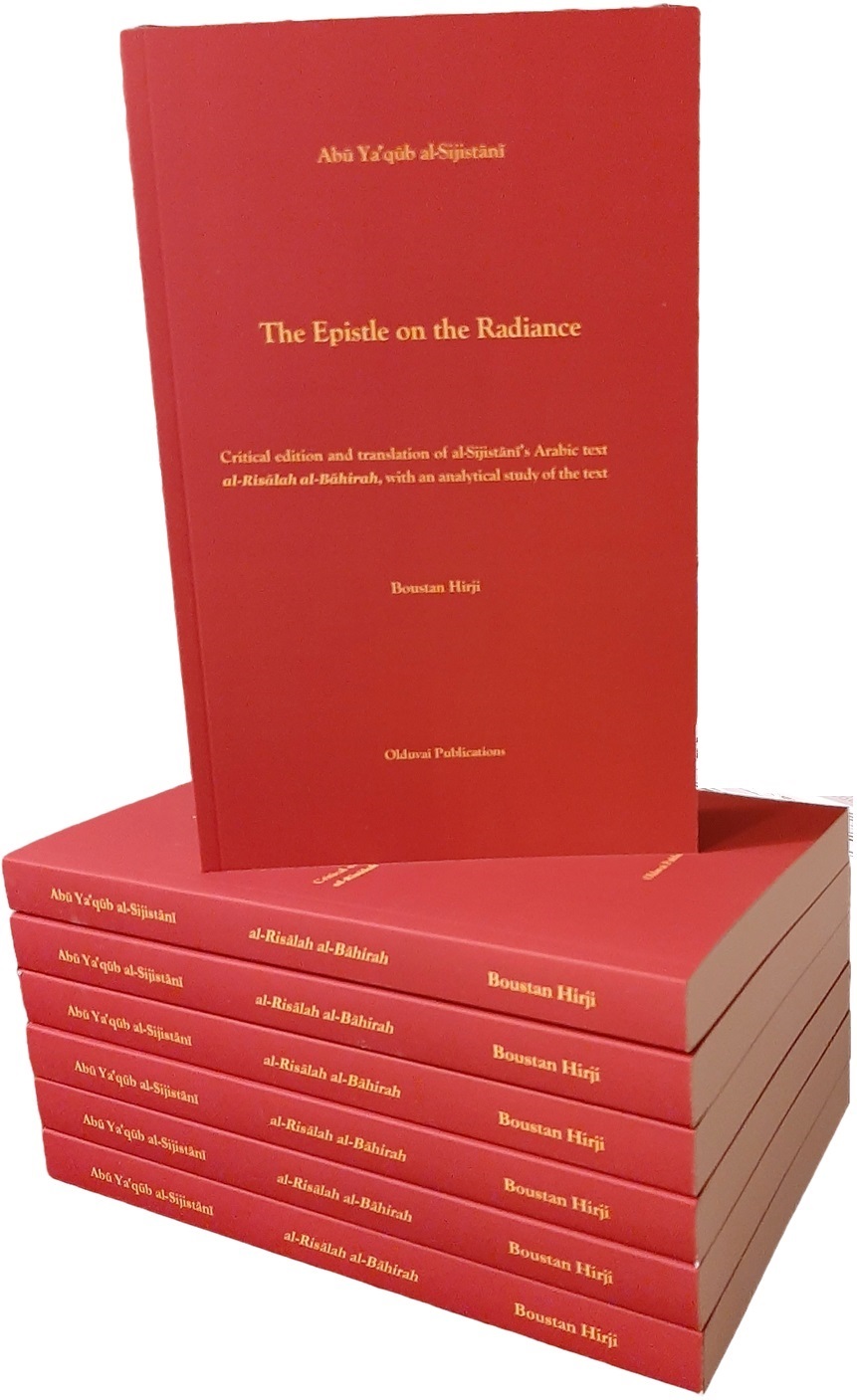
Front cover of the print edition of Boustan Hirji’s translation of Fatimid philosopher al-Sijistani’s epistle al-Risalah al-Bahirah, published by Olduvai Publications, Burnaby, British Columbia, Canada, 2024, pp. 167. Foreword by Mohamed Abualy Alibhai.
Thanks to the pioneering and lifelong studies by Paul Walker, we are becoming increasingly knowledgeable about the Fatimid daՙi and philosopher Abu Yaՙqub al-Sijistani. Based on two manuscripts, Dr. Boustan Hirji has prepared an English translation and critical edition of the Arabic text of Yaqub al-Sijistani’s al-Risalah al-Bahirah (‘The Epistle on the Radiance‘). The book is free of charge in print and PDF through an email request to olduvai.publications@gmail.com. The free distribution has been made possible by a generous donor. Kindly note that only limited copies of the print edition are available.
Electronic Edition (PDF)
Front and back covers of the PDF edition of Boustan Hirji’s translation of Fatimid philosopher al-Sijistani’s epistle al-Risalah al-Bahirah, published by Olduvai Publications, Burnaby, British Columbia, Canada, 2024. Foreword by Mohamed Abualy Alibhai.
_____________________________
Simerg: How can I purchase the book, and what are its available formats?
Boustan: The book is available in paperback and ebook (pdf) formats.
(We are pleased to inform our readers that both versions of Dr. Boustan Hirji’s book are free due to a generous donation. Please write to Dr. Mohamed Alibhai at olduvai.publications@gmail.com for more details about obtaining the book. Note that the availability of the print edition is limited — Ed.)
Simerg: How did you find a publisher for the book?
Boustan: My friend and fellow Sijistani scholar, Dr. Mohamed Alibhai, is a publisher, and he was keen to publish it. He was my editor, my Socrates, my friend and my taskmaster!
Simerg:Which was your first book, and how many have you written?
Boustan: This is my first book in the academic field of Ismaili philosophy. The first edition of the manuscript al-Risalah al Bahirah, its translation and Introduction to it was originally published by the Tehran branch of McGill University. Earlier, I had published a book on Gender stories in Syria, Egypt and Bangladesh. It is available from Amazon under the title Sands Under a Relentless Sun.
Simerg: How long did it take you to write the book — from start to finish?
Boustan: The current work has accompanied me on a long journey as I lived my tumultuous life! I kept re-reading, rethinking passages and ideas, until I agreed to have it published. Al-Risalah al Bahirah is such a profound, fathomless space of intellectual ideas and crucial for understanding the depth of the Ismaili tradition that I would hope that it makes for interesting reading for both Ismailis and anyone curious about syncretic traditions that have an impact on our current lives and societies.
Date posted: April 3, 2024.
_______________
About the Author
Dr. Boustan Hirji
Boustan Hirji was born and grew up in Bangladesh and attended the convent-run Holy Cross School and Holy Cross College until she was 18. She completed a Bachelor of Arts at St. Mary’s at Notre Dame, cum laude, majoring in Political Sociology.
Boustan obtained a Master of Theological Studies at The School of Theology (a Methodist Seminary) Boston University. Her thesis compared the Exodus and the Hijrah.
She then proceeded to join an MA-PhD programme at the Institute of Islamic Studies, McGill University. The MA was in Islamic Theology (Kalam). The PhD was in Ismaili philosophy, focusing on al-Sijistani. Her doctoral dissertation (upon which her book is based) was recommended by the external examiner, Dr. Abbas Hamdani, for the university’s Dean’s List.
Boustan Hirji was appointed to teach in the joint programme of McGill University and The Institute of Ismaili Studies in London, England in the 1980s. After this, Dr. Hirji taught in the Religious Studies department of McGill University.
She was given The Alumni Award of the Year in 2016, for Excellence in Teaching and Leadership Skills by the School of Theology, Boston University, USA.
Until she retired in 2020, she taught in the Liberal Arts Honours Programme at Dawson College, Montreal, Canada.
Calling all Ismaili Authors
We encourage Ismaili writers to introduce their books in a similar format as has been done in the post above. Please also see the series launch article and submit your responses to Malik at mmerchant@simerg.com. All submissions will be acknowledged. If a writer has published multiple books, each book will be highlighted in a separate article, and not combined with other books into one post. All writers should include a brief profile with a portrait photo.
_______________
Links to the Ismaili Authors’ Series (in chronological sequence, oldest article first)
Before departing this website please take a moment to review Simerg’s Table of Contents for links to hundreds of thought provoking pieces on a vast array of subjects including faith and culture, history and philosophy, and arts and letters to name a few. Also visit Simerg’s sister websites Barakah, dedicated to His Highness the Aga Khan, and Simergphotos.
Aunt, Nurumasi, at 100! Acrylic, 16″ x 20″, March 2020. Painting by Mobina Marani, Crystal Beach, Ontario, Canada.
By MOBINA MARANI
Two years ago, I introduced a selection of my paintings on this website as part of its Artistic Expressions category, which encourages Ismaili Muslim artists to showcase their works of art. Among the paintings on the website was a portrait that I had painted of my aunt when she turned 100. The work was completed for her 100th birthday, celebrated on March 4, 2020.
Recently, I exhibited at the Illume Festival — an event showcasing talented Ismaili artists from across Canada — at both the regional and national levels. Out of the four paintings shown at the regional event, one was picked for display at the National Illume Festival held in November 2023 at the Ismaili Centre Toronto. It was that of my beloved aunt! This couldn’t have made me happier. My aunt, carrying a tasbih (rosary), honoured me by attending the event.
Nurbanu Esmail — popularly known as Nurumasi — was born in Uganda and married Haiderali Esmail, who passed away in Kampala on December 28, 1971, when she was only 51. All their children — daughters Khatoon, Parin, Firoza and Laila, and son Sultan — are still alive. She has 9 grandchildren and 13 great-grandchildren. Nurumasi, at 104, may be among the oldest living Ismailis in Canada.
My aunt dedicated her life to serving the Ismaili community, its institutions, and the Imam-of-the-Time, Mawlana Hazar Imam, His Highness the Aga Khan. She has served as a congregational leader in an Ismaili Jamatkhana and held many voluntary positions in Ismaili institutions. She was also a member of the ghusal committee that oversees all the funeral arrangements and preparations for deceased Ismaili community members. This is one of the noblest services one can perform.
Nurumasi has also keenly followed all the worldwide Imamat projects and travelled widely to see them.
Ismaili artist Mobina Marani pictured with her aunt, turning the beads on her tasbih (rosary), at the National Illume Ismaili Art Festival held at the Ismaili Centre Toronto in November 2023. On the wall is Mobina’s painting of her aunt, completed in March 2020, when she turned one hundred on March 4. Photograph: Mobina Marani Collection.
Nurumasi’s immense strength has come from regularly attending the Jamatkhana for prayers and services and her devotion and love for Mawlana Haza Imam. She has come to be adored by the community members who seek her out for prayers for strength in all aspects of their and their family’s lives.
It is a privilege for me and all the family members to have been blessed with an outstanding lady who has been with us for so long. Her presence and inspiration have been a source of strength and courage to all of us. Nurumasi is indeed one of the elders who has lived by Mawlana Hazar Imam’s guidance to both the young and older community members, in which he asked us to fulfill our material and spiritual responsibilities to the best of our abilities. He told the old that they were never too old and that as long as they were alive, every day must be lived, and we must seek to fulfill our responsibilities. That message has guided her throughout her life, leading to the age of 104.
May Allah, in His Infinite Mercy, continue to shower our beloved Nurumasi with strength, courage and faith and bestow her with the Light (Noor) of the Imam-of-the-Time in the days and weeks to come. Ameen.
Date posted: April 2, 2024.
_________________
Is anyone in your family a centenarian? We would like to hear from you, with a story and a photograph or two! Please write to the editor Malik at mmerchant@simerg.com.
We welcome feedback/letters from our readers. Please click Leave a comment. Your feedback may be edited for length and brevity and is subject to moderation. We are unable to acknowledge unpublished letters.
“I should emphasize that a total solar eclipse is probably THE most spectacular celestial phenomenon that earth-based human beings can experience. It is truly a miracle of nature. The sun is hugely larger than the moon and yet, viewed from the earth, one is just far away enough compared to the other that they both subtend exactly the same size in the sky” — Arif Babul, University of Victoria Distinguished Professor of Physics and Astronomy
The total eclipse of the sun, a rare celestial event where the moon completely obscures the sun for a brief period, is set to occur on April 8, 2024. Tens of millions across North America who will be on the path of the total solar experience will witness this once-in-a-lifetime experience. After crossing Mexico and the U.S., it will enter Canada in Southern Ontario on its eastward path to other parts of Ontario, Quebec and the Atlantic provinces, where the sun’s light will be completely blocked out by the moon. Many other parts of Canada, such as Alberta, will only experience a partial eclipse, where not all of the sun’s light is obscured.
With the sun’s incredibly bright face fully eclipsed by the moon, its faint, normally invisible, corona of hot gases pops up. Zooming further reveals red features in two or three places on the dark rim. These are solar prominences. Photograph: Arif Babul. Please click on the image for Arif Babul’s story and photographs.
In Ontario, the solar eclipse is expected to start just minutes after 2:00 p.m. and last for about two and a half hours. The sun will be fully eclipsed at approximately 3:20 to 3:25 p.m. EDT (Eastern Daylight Time). The anticipation is so high that Niagara Falls is preparing to welcome over 1 million visitors for this extraordinary event. Reuters writes: “From vintage train rides costing almost $4,000 per person to hotel rooms listed at $1,600 a night, businesses in and around majestic Niagara Falls are preparing to cash in on the April 8 total solar eclipse – with around a million visitors expected.”
This is a rare chance, as the next total solar eclipse won’t grace North America until 2045.
The solar eclipse has prompted school closures in many parts of Ontario for the well-being of students and staff during the solar eclipse. As many students would be getting on the bus or walking home from school during this timeframe, their risk of looking directly at the solar eclipse would be significantly increased.
Story continues below
Watching the solar eclipse safely with solar eclipse glasses. Photograph: Al-Akhbar weekly newsletter, His Highness the Aga Khan Council for Canada.
Everyone will need to be careful as looking directly at the eclipse, could damage your eyes. However, the solar eclipse is a spectacular sight and a significant educational opportunity. Ottawa’s Canada Aviation and Space Museum will throw open the doors of an aircraft hangar tohost an eclipse viewing event. The museum will also provide free eclipse viewing glasses with admission, along with educational activities and crafts for children.
The beautiful Aga Khan Park on Wynford Drive in Toronto hosts what the Al-Akhbar Ismaili community newsletter calls “a celestial gathering like no other.” The sold-out, awe-inspiring solar eclipse event will occur on April 8 from 1:45 to 4:30 p.m. The Park will provide a pair of solar glasses and will have a special guest speaker who will discuss solar eclipses and their significance.
Story continues below
The Diamond Ring effect is a breathtaking sparkle of the sun’s radiance coming from a tiny exposed sliver of the sun’s surface. It is seen 15 seconds before and again just after totality. Photograph: Arif Babul. Please click on the image for Arif Babul’s story and photographs.
In 2017, our sister website Simergphotos published Professor Arif Babul’s eyewitness account of his experience of the total solar in Idaho. The 2017 eclipse lasted close to 3 minutes. This year’s eclipse will differ from the 2017 eclipse, as the moon will be closer to the Earth. Thus, it will cast a more enormous shadow onto the Earth and cover the sun longer. The April 8 eclipse will last for more than four minutes.
Interestingly, the New Moon that will be seen on April 9, the day following the total solar eclipse, will also mark the end of the month of Ramadhan. On April 10, hundreds of millions of Muslims will observe Eid ul-Fitr, the most important festival in the Muslim calendar. Simerg and its sister website will provide updates leading to the total solar eclipse and the celebration of the Muslim Eid festival.
Featured image at top of page: Artist’s representation of a total solar eclipse, with a new moon in the foreground and the Sun’s corona visible in the background. Photograph: NASA/Vi Nguyen. Click Download the Poster.
“You and I are brothers, and you and I are from the same city, the same country; we speak the same language and share the same history” — Christian pastor
Every Ramadan, an Iraqi Christian preacher returns from the Netherlands to his hometown of Mosul. He celebrates the holy Islamic month there to promote understanding between Muslims and Christians. Voice of America’s Kawa Omer has the story, narrated by Bezhan Hamdard.
The Aga Khan on Moving Christian-Muslim Relations Forward for a Better World
“Our histories have taught us the value of dialogue, and that rarely, indeed very rarely, does anything good come out of conflict. Our world view is to engage with the problem of social exclusion in our societies and to contribute to building bridges across faiths and across nations, by linking diverse parts of the world” — the Aga Khan
“I have no doubt that for you, whose historical roots are in the Christian world, it is as painful as it is for us Muslims, with our roots in the East, to watch an increasingly deep gulf growing between significant parts of our respective worlds. We cannot stand by as passive observers letting this gulf grow wider and wider, at the cost of future generations. If we have the will, which I am certain we share, we have the historical knowledge and the ethical foundations to move our world forward, to make it a better and more hopeful place, and to put an end to the storm of hatred which appears to be building up around us.
“Our histories have taught us the value of dialogue, and that rarely, indeed very rarely, does anything good come out of conflict. Our world view is to engage with the problem of social exclusion in our societies and to contribute to building bridges across faiths and across nations, by linking diverse parts of the world.
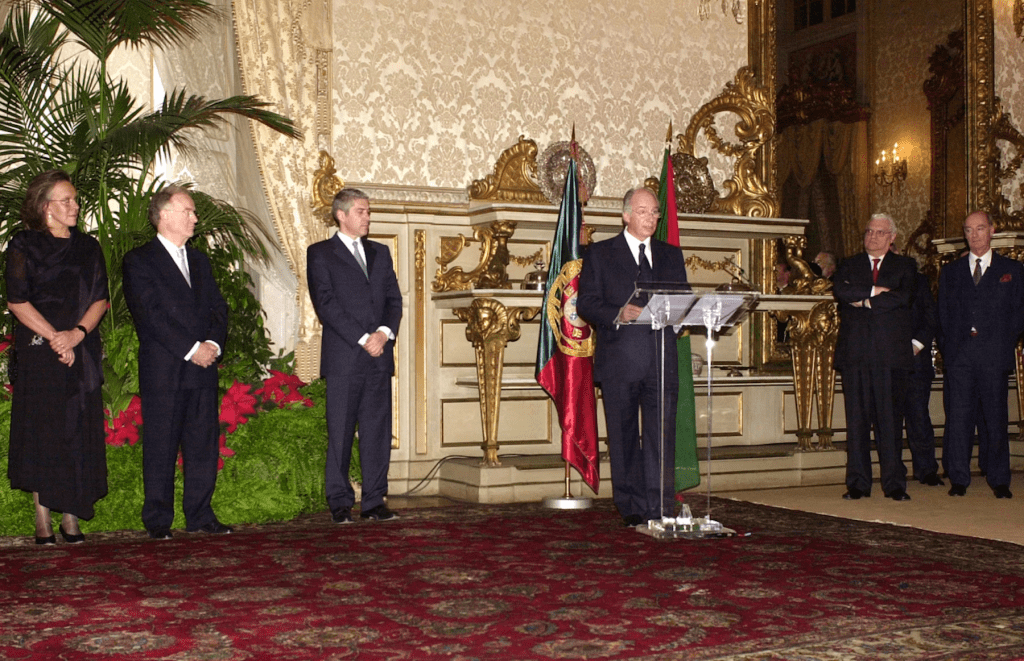
“We are concerned, and most rightly so, that there is poverty among our respective peoples, and we cannot stand by watching this inhuman indignity become a permanent part of our societies, of our generations of today and tomorrow. We must work together to develop an arsenal of peaceful weapons to attack this plight which blights our times, and to try to make sure that those who are marginalised today can be certain that we are not blind to them, that we will not let their future generations live in the same hopeless world in which they themselves are seeking, often only in despair, to survive.” — the Aga Khan, speaking at the Protocol of Co-operation Signing Ceremony between the Ismaili Imamat and the Government of Portugal, Lisbon, Portugal, December 19, 2005 (Read full speech HERE).
The following story by Benazir Samad is reproduced from the Voice of America (VOA) website. The VOA article, dated March 23, 2024, originated from VOA’s Urdu Service. Please note that the photographs and the Brief Profile within the body of the story are not part of the original VOA article; Simerg has reproduced the photos from Suriya Bibi’s Official Facebook Page.
Historic Win Shatters Stereotypes, Empowers Women in Pakistani Politics
“Sometimes, I had to walk kilometers on foot when there were no roads for vehicles. Despite facing these difficulties and even being unwell at times, I remained dedicated to connecting with people and meeting voters. The support of women who walked with me provided comfort and bolstered my determination throughout this demanding campaign” — Suriya Bibi.
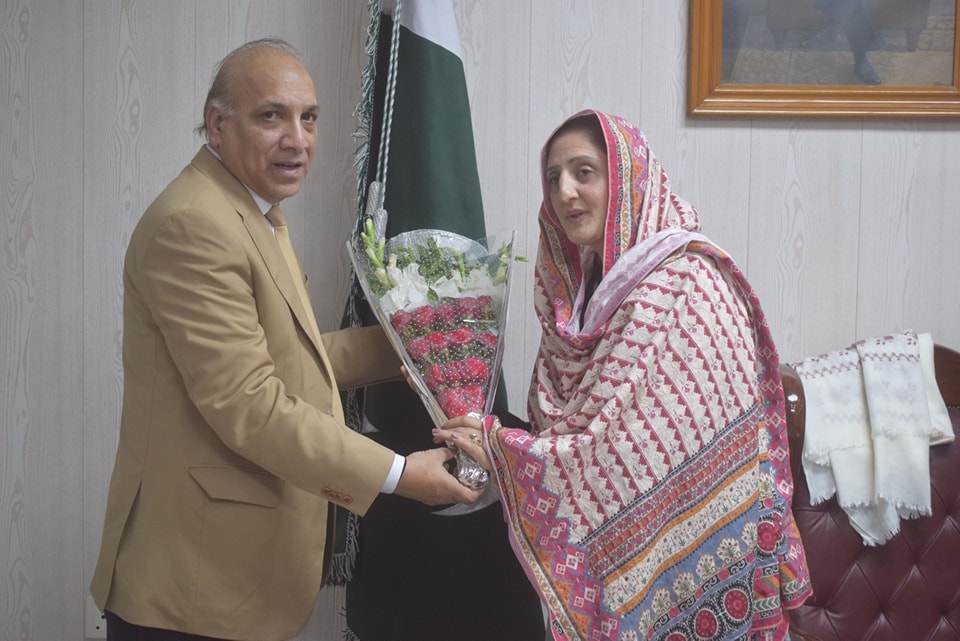
(Former) Aga Khan Ismaili Council President for Peshawar, Imtiaz Sahib, presents a bouquet of flowers to Suriya Bibi as he pays his respects at her office chamber following her election victory. Photograph:Official Facebook Page of Suriya Bibi.
By BENAZIR SAMAD, VOA
When Suriya Bibi was running for a seat earlier this year on the Khyber Pakhtunkwa provincial assembly, she faced numerous challenges beyond being a woman and hailing from a minority sect in Pakistan’s remote district of Chitral.
Another obstacle appeared when the Election Commission randomly assigned a hen symbol as her identifier on ballot papers — such symbols are tools to aid illiterate voters. In January, Pakistan’s Supreme Court barred her political party, Pakistan Tehreek-e-Insaf, or PTI, from using the cricket bat symbol associated with former Prime Minister Imran Khan.
The hen symbol inadvertently perpetuated the stereotype that women in Chitral were better suited for poultry farming than politics. Her opponents capitalized on their good luck, ridiculing her and mocking the symbol’s association with domesticity.
In a phone interview with VOA, Bibi said that there was no shame in poultry farming and rejected the attempt to diminish her worth based on her election symbol.
History Made
Bibi made history in early February by becoming the first woman from Chitral district to secure an assembly seat through a direct election rather than assuming a seat reserved for women, as is customary in the region. Not only did she clinch victory in the PK-1 constituency in Chitral with a decisive majority, but she also ascended to the position of deputy speaker in the Khyber Pakhtunkhwa assembly.
In Pakistan, where women’s involvement in governance is often restricted, Bibi encountered obstacles while navigating and challenging traditional norms to carve out her place in male-dominated politics.
According to social critic and feminist writer Sabahat Zakariya, Bibi belongs to the rare category of women parliamentarians who have secured their positions through open seats without relying on the political influence or lineage of male family members.
“Currently, all the big female names in Pakistani politics are scions of big feudal or industrial political families,” Zakariya said. “In that, Suriya Bibi’s achievement is not just unique for Chitral but also [for] all of Pakistan.”
VOA story continues below
_____________________
BRIEF PROFILE: SURIYA BIBI
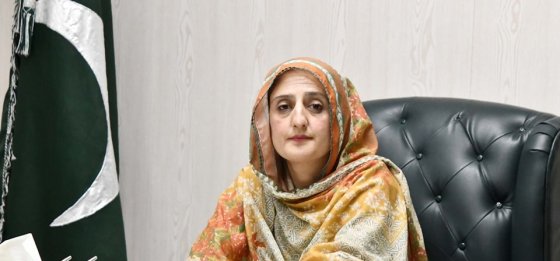
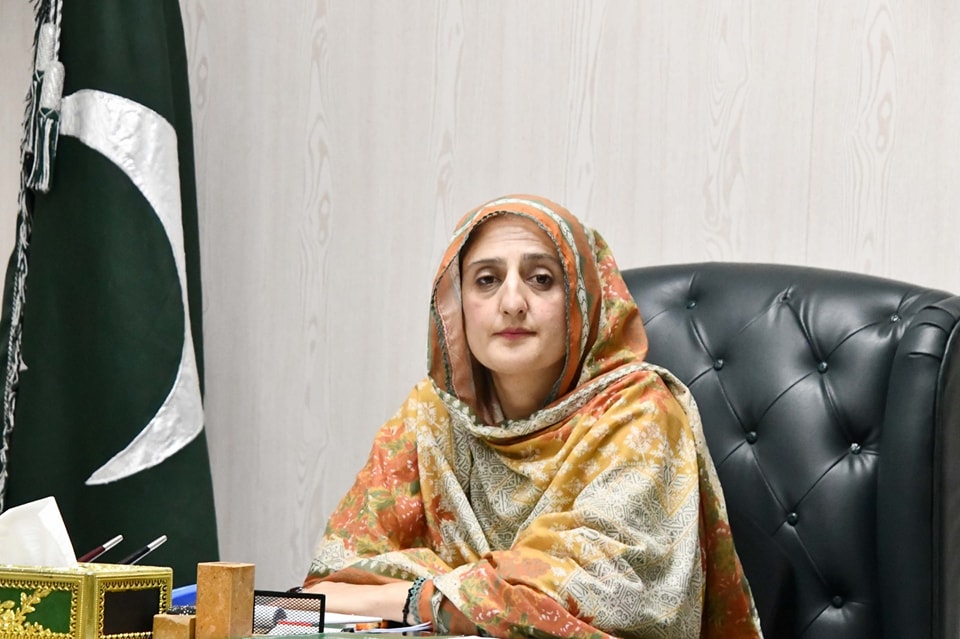
Suriya Bibi. Photograph: Official Facebook Page of Suriya Bibi.
Suriya Bibi hails from the Chitral District of Khyber Pakhtunkhwa, Pakistan’s 4th largest province in the country’s northwest, with Peshawar as its capital. Chitral District is situated in the north of Khyber Pakhtunkhwa province. She earned a master’s degree in Urdu (M.A Urdu) in 2002, after which she became involved in the socio-economic development of the population with a particular focus on the promotion of education among women and their social upliftment through organizations such as the Aga Khan Rural Support Program and Biyar Local Support Organization. Concurrently, she became engaged in politics with the Pakistan Tehreek-e-Insaf (PTI) party, where she has been the Vice President of PTI Malakand Division since 2007. Suriya Bibi is the first female member elected to a general seat in the history of Chitral. (Profile condensed from Provincial Assembly Khyber Pakhtunkhwa.)
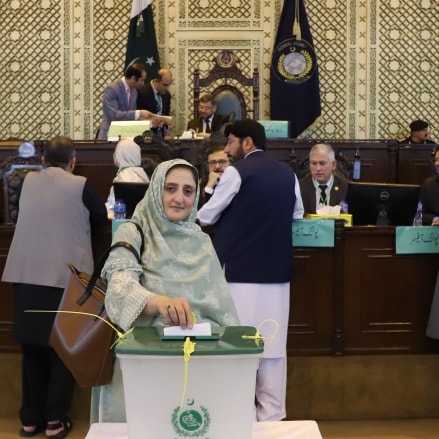
Suriya Bibi casts her vote in the Khyber Pakhtunkwa Assembly during the Pakistan presidential election held in March 2024. Photograph: Official Facebook Page of Suriya Bibi.
__________________________
Campaigning in Rough Terrain
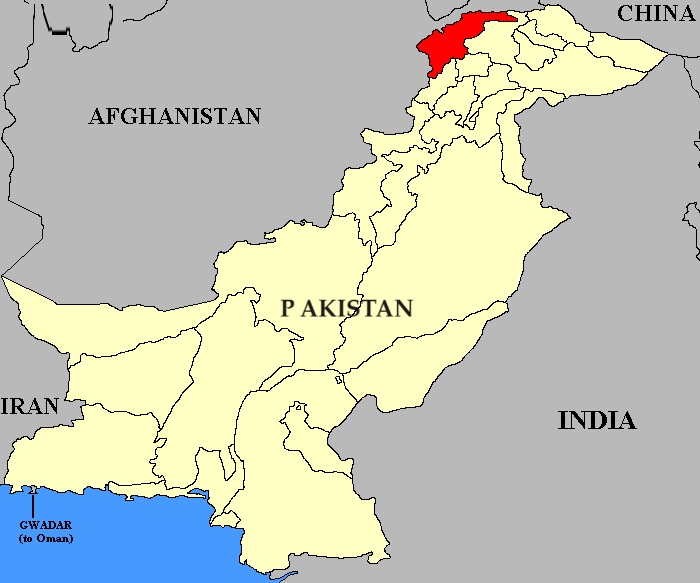
The remote District of Chitral (red) in Pakistan. Map adapted from Wikipedia.
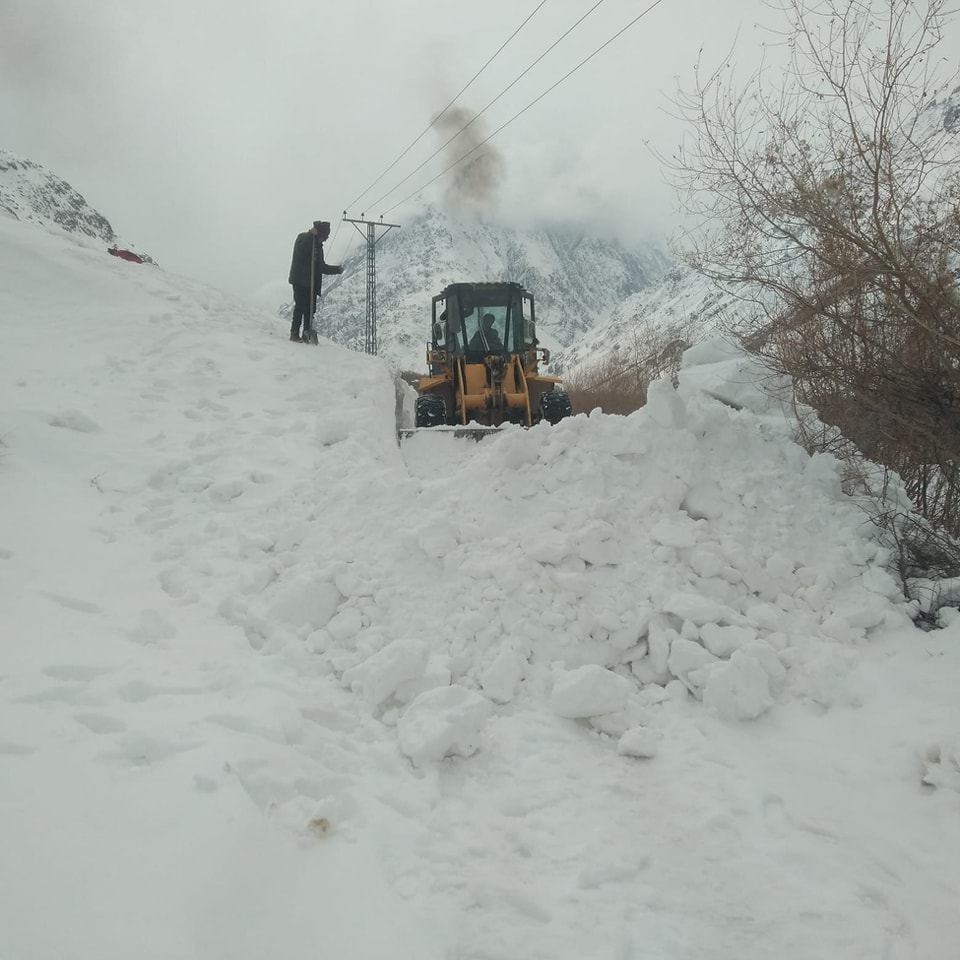
Bibi also reflected on how the severe winters and the daunting terrain of the Hindukush mountains presented yet another challenge to her campaign.
Dilapidated roads and inadequate infrastructure made reaching the remote areas of her constituency difficult. Spanning approximately 210 kilometers (about 130 miles), the upper Chitral PK-1 district encompasses the farthest village, Broghil, which borders the Badakhshan province of Afghanistan.
“Sometimes, I had to walk kilometers on foot when there were no roads for vehicles,” she said. “Despite facing these difficulties and even being unwell at times, I remained dedicated to connecting with people and meeting voters. The support of women who walked with me provided comfort and bolstered my determination throughout this demanding campaign.”
VOA story continues below
Rough terrain in Chitral as snow clearance is underway following heavy snowfall; Photograph: Official Facebook Page of Suriya Bibi.
Bibi grew up with both her father and a grandfather engaged in local politics and knew that she, too, wanted to be a politician.
“Despite my family’s support for another party, I made an independent choice and joined Pakistan Tehreek-e-Insaf, PTI party, [which means] ‘Pakistan movement for justice,’ in 2007,” she said.
“Joining politics, I initially faced resistance and received criticism for participating in protests and rallies, as it wasn’t common for women in the conservative region like Chitral to break through a male-dominated field like politics.”
Starting as a grassroots worker, Bibi began by mobilizing women at the village level, then represented Chitral as a female leader and then became the vice president of PTI Malakand Division. So, she ascended through the ranks within her party before getting a nomination to run for election from the party.
In the recent election, Bibi’s constituency was predominately female. Women voters surpassed men in supporting her, giving Bibi 35,377 votes, compared with the 30,345 votes from men.
In Chitral, where no local woman had previously secured an electoral victory and where her opponents wielded greater financial resources, Bibi initially doubted her chances.
“Men establish connections, friendships, and network with party officials, gaining exposure and influence,” she said. “However, as a woman, I couldn’t do the same. Despite these challenges and cultural norms, I only had dedication and the unwavering support of my family, particularly my husband. He consistently encouraged me when I was nominated to run for the seat, urging me to take it up as a challenge.”
VOA story continues below
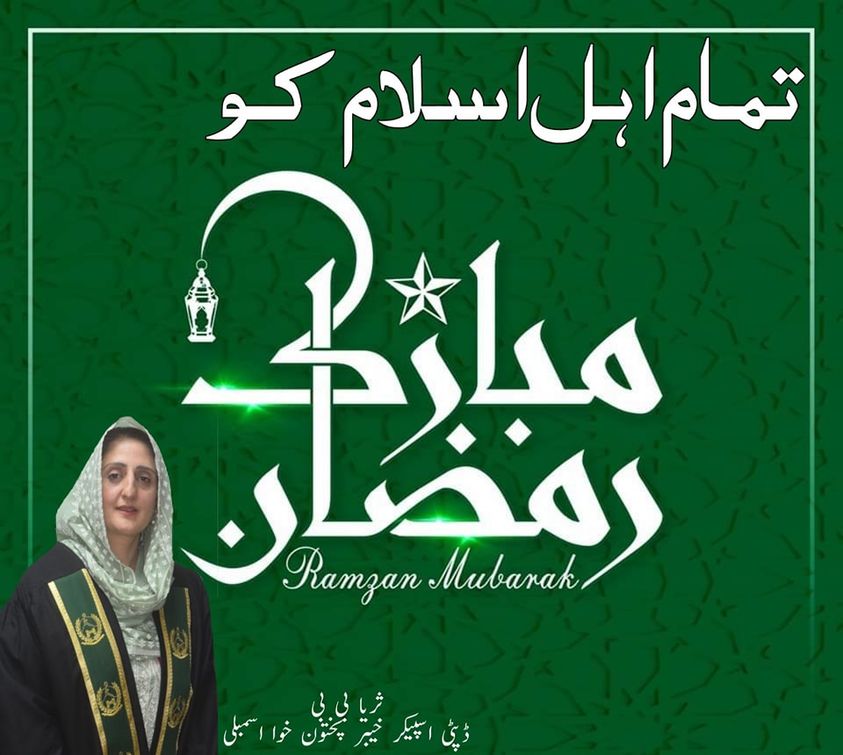
Ramzan Mubarak greeting from Suriya Bibi. Photograph: Official Facebook Page of Suriya Bibi.
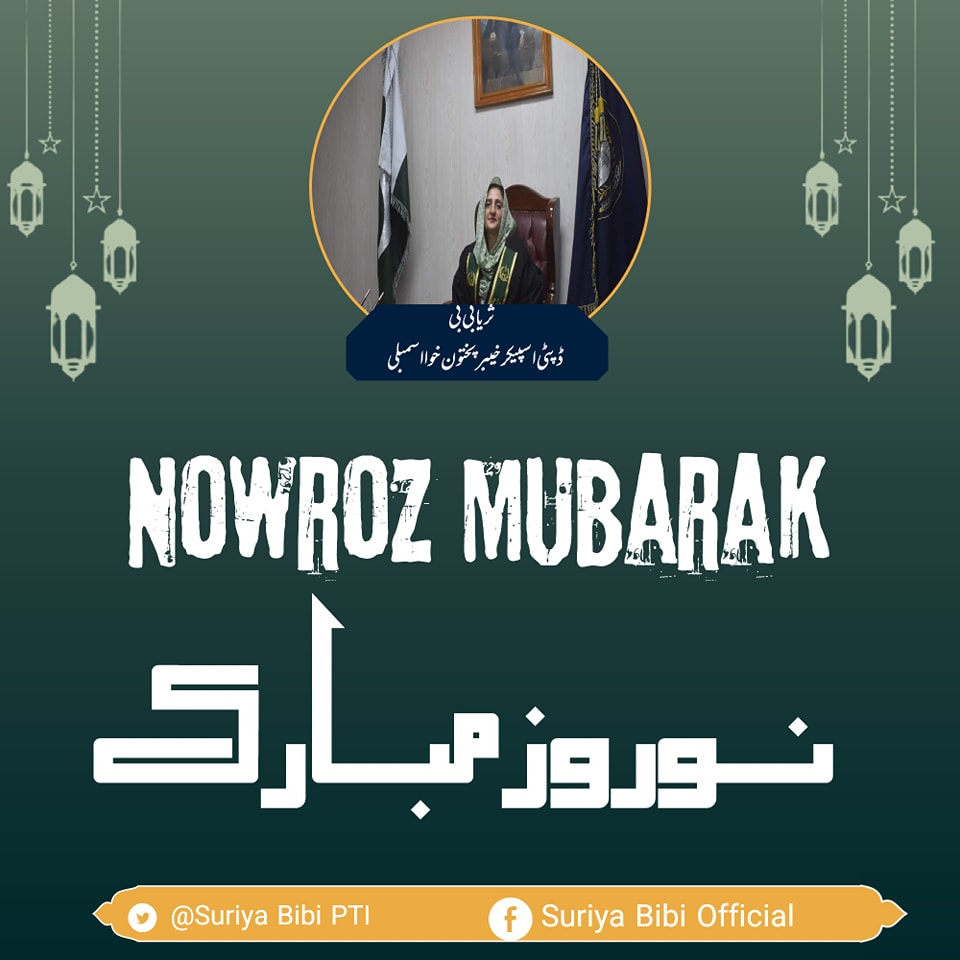
Navroz Mubarak greeting from Suriya Bibi. Photograph: Official Facebook Page of Suriya Bibi.
Speaking about her plans, Bibi said her focus would be on tackling property rights issues for women and prioritizing girls’ education. Given her background as an educator, she eagerly anticipates establishing a nursing school in the region, recognizing that young women who pursue nursing careers often must move far from their families.
Aspiring female students have begun approaching her about internship opportunities in her office, she said, reflecting a shift in the perception that politics are exclusively dominated by powerful men.
She said her political journey shows how even an ordinary middle-class woman like herself can ascend to great heights in the realm of politics.
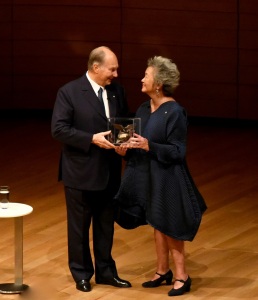
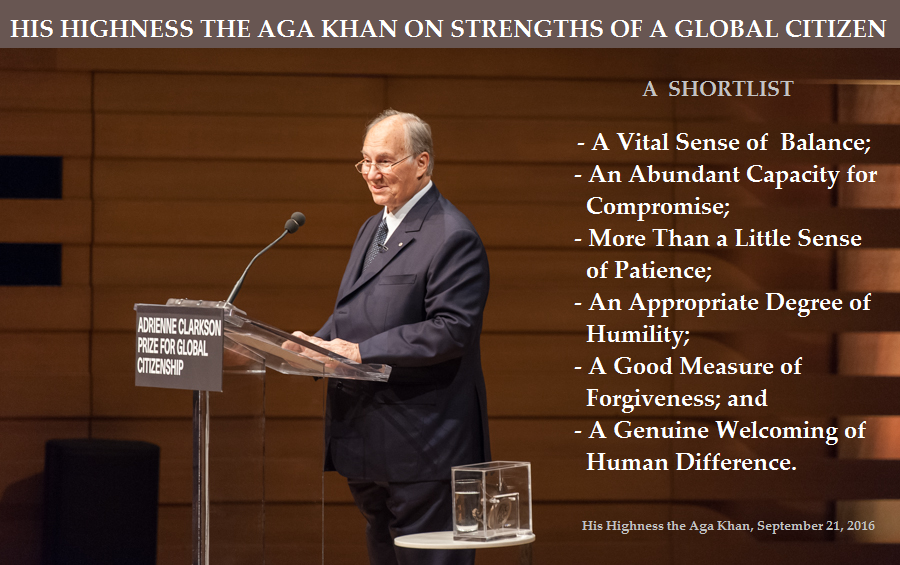
There were many cherishable and memorable moments on Wednesday, September 21, 2016, at Koerner Hall in Toronto when the inaugural Adrienne Clarkson Prize for Global Citizenship was presented to Mawlana Hazar Imam, Highness the Aga Khan, the 49th Hereditary Imam of the Ismaili Muslims and the direct descendant of the Prophet Muhammad (may peace be upon him and his progeny).
World-renowned vocalist and songwriter Rufus Wainwright welcomed the audience with a beautiful rendition of Leonard Cohen’s song Hallelujah. Rufus reminded us that September 21 also marked Cohen’s birthday — his 82nd (Cohen passed away 6 weeks later, on November 7). A video of Prime Minister Justin Trudeau’s congratulatory message to His Highness Aga Khan received big applause from the packed auditorium hall, as did the presentation of the unique award to His Highness by Madame Clarkson. This was followed by her welcome speech and the 49th Ismaili Imam’s words of wisdom.
But of all the absorbing moments that the event offered, there was one defining moment at the end of the Aga Khan’s speech that I took to heart. What strengths should we have to be a good global citizen? The Aga Khan shortlisted the following:
A vital sense of balance;
An abundant capacity for compromise;
More than a little sense of patience;
An appropriate degree of humility;
A good measure of forgiveness; and
A genuine welcoming of human difference
Article continues below
Photograph: Lisa Sakulensky/The Ismaili. Note: The superimposition of text on the photo is by Simerg.
More than 300 million people worldwide celebrated the significant occasion of Navroz — a New Day, a New Year — on March 21st, symbolizing a fresh start in their lives. Concurrently, a much larger number of Muslims — almost 2 billion — are observing the month of Ramadhan, with the Laylat al-Qadr, the night of the revelation of the Qur’an, considered the holiest night in the month or year, to be observed from 3rd week of the month (on odd days). Ismaili Muslims will mark it on the 21st (April 1 in 2024). Eid ul-Fitr will follow that at the end of the month of Ramadhan (April 10). More than 2 billion Christians will celebrate Easter between March 29 and April 1.
These are not just mere dates on the calendar but opportunities for us to reflect on ourselves and strive for self-improvement in every aspect of our lives, bettering our minds and hearts and lifting our spirits. Let’s embrace His Highness and Aga Khan’s six pieces of advice mentioned during his speech when he was honoured with the Global Citizenship Award. They will serve us well and make our lives more meaningful.
Date posted: March 20, 2024. Last updated: March 23, 2024.
___________________
Note: A version of this post appears on our sister website, Barakah, which is dedicated to His Highness the Aga Khan.
The author has adapted this article from the March 1982 issue of Al-Misbah Magazine, published by the Ismailia Association for the UK. The original article, which was under the title Navroz, has been edited and improved for clarity and includes additional material.
Navroz, meaning New Day or New Year, marks the start of the Persian spring festival. It occurs on or around March 21 of the March equinox. The United Nations has designated March 21 as the International Day of Nowruz annually (the Secretary General’s 2024 message can be read HERE.)
It is an occasion of great rejoicing among people in Iran, many parts of the Middle East, Central and South Asia, and the Shi’a communities worldwide. Besides being New Year’s Day, it is also celebrated as the Festival of Spring because it is at this period that winter makes its exit for the colourful spring season.
Navroz holds a significant place in history, dating back some 2,500 years to the reign of King Jamshed. Despite a temporary halt after the rise of Islam in Iran, it was reintroduced by the Abbasid Caliph Mansoor in 770 AC (153 AH, or Hijri). Since then, Navroz has been a cherished national occasion and custom, celebrated with zeal by more than 300 million people worldwide.
In Fatimid Egypt, the state ruled by Ismaili Imams, the Spring Festival was a national celebration during the reign of the first eight Fatimid Imams/Caliphs from 969 to 1094 AC (358 to 487 AH). Although the Fatimid Imams ruled over Egypt, this festival was not exclusively Ismaili because the Ismailis, even at that time, were a minority group in the Caliphate.
The actual celebration of Navroz among the Ismailis could be said to have started in Iran during the Alamut Period of Ismaili history. Ismailis living in Alamut were farmers; hence, in the spring season, they would look forward to preparing their farms for a good harvest.
The glorious transformation of nature at the time of Navroz, the start of the spring season, reminds us of Allah’s creative power and the bounties He continually showers on us. The arrival of spring, with its sprouting seedlings, blossoming buds, vibrant colours, and rushing waters, is a vivid reminder of our true inner essence.
Like these elements of nature, we, too, have the potential to bloom and grow under the nurturing care and warmth of Imam-of-the-Time. The Preamble of the Ismaili Constitution proclaims that the Imam’s ta‘lim (guidance/teaching) lights the each follower’s path to spiritual enlightenment and vision.
Born as Ismailis, with the recognition of the Imam, this life is the spring season of our souls. The Divine Noor shines brightly over our souls. We must cleanse ourselves of unrighteousness and cultivate an original, spontaneous, and permanent relationship with the Noor (Light) of Imamat so that every breath and activity of our life becomes the worship of the Merciful. The festival of Navroz should result in a spiritual rebirth for each of us and inspire greater love for our Imam.
Article continues below
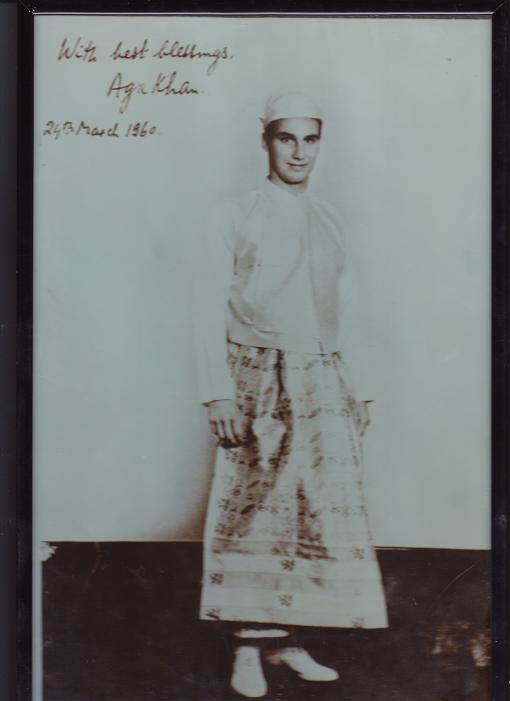
This is a signed photograph, dated March 24, 1960, of Mawlana Hazar Imam, His Highness the Aga Khan, 49th Imam of the Shia Imami Ismailis, pictured in a Burmese traditional dress during his visit to Burma in March 1960 when he celebrated the Persian New Year, Navroz, which falls on March 21st, with his Ismaili followers. The signed photograph contains his blessings. Photo: Anwar Virani Archives, Ottawa.
Navroz is an auspicious time to initiate self-improvement because nature, so to speak, is turning a new page in the book of life. It is a time to review our lives and determine necessary improvements. In a detached, objective way, we should analyze our positive and negative traits and then resolve to change bad habits into good ones.
Our covenant with Mawlana Hazar Imam is a promise we have given him to endeavour to achieve a proper balance between our material and spiritual lives. When choosing our resolution, one idea should always loom before the rest: ask ourselves, “What do we want from life, and what will earn Mawlana Hazar Imam’s divine pleasure?” A straightforward answer to this question should be: “To govern our lives by his deep desire for us to live within the Islamic concepts of unity, justice, tolerance, goodwill, generosity and the regularity by which we practice our faith.”
Mowlana Hazar Imam’s message spells out the meaning and significance of this auspicious day for us. He says: “I say to you all on Navroz, ‘Navroz Mubarak,’ and I want you, at the beginning of this New Year, to try to think a bit ahead in your future. Each Navroz, say to yourselves, ‘Have we done our work?’ If you have, then I will be very happy indeed. I say Idd Mubarak to all of you and give you most affectionate blessings.” — Rangoon, Burma, March 21, 1960.
By steeping our consciousness in love for the Imam-of-the-Time and wisely directing our activities, we shall make our lives one unending act of worship. Therefore, let this Navroz be a New Day on the path of spiritual glory, material well-being, and progress. Let each New Day be a Navroz to strengthen our spiritual bonds with Imam-e-Zaman, reminding us that his blessings are always with us.
We conclude with our beloved Imam’s final words spoken in Rangoon: “On this day of Navroz, I say to each and every one of you, Idd Mubarak, and I pray that in this New Year, your worldly and spiritual happiness should progress tenfold and that this will be the case every year.” — Rangoon, Burma, March 21, 1960.
Date posted: March 18, 2024. Last updated: March 20, 2024 (inserted link to UN Secretary General’s 2024 Nowruz message in 1st paragraph).
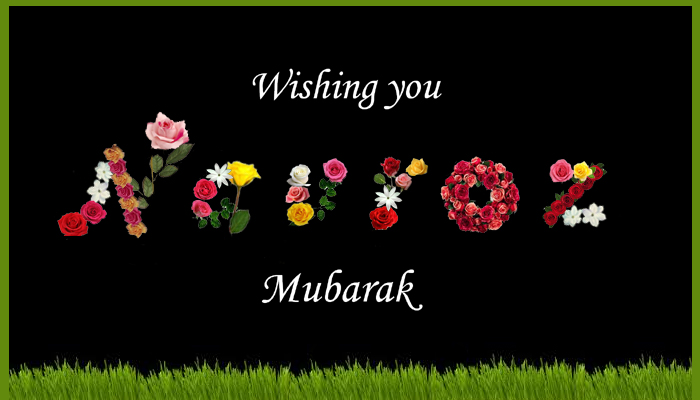
Conceived and created by Dr. Nurin Merchant, this Navroz greeting incorporates the rose and jasmine flowers which are extremely popular in Iran during the celebration of Navroz. The base of the picture shows shoots of wheat grass signifying robust evergreen health throughout the year.
Abstract: The auspicious occasion of Navroz generates immense happiness and makes our hearts jump with joy as we receive blessings from Mawlana Hazar Imam together with roji and Ab-e-Shifa and recite the traditionally Ginan Navroz na din Sohamna. This post includes two beautiful recitations of the Ginan by Shamshudin Bandali Haji (full Ginan) and Mumtaz Bhulji (selected verses) followed by an explanation by Sadruddin Hassam. In the Ginan, Sayyid Fatehali Shah relates the combined experience of the zahiri deedar (exoteric or physical glimpse or meeting) that he was granted by the 45th Ismaili Imam, Shah Khalilullah (peace be on him), and the inner joy of contentment and ecstasy that he experienced with the bestowal of Noorani (spiritual or esoteric) grace.
Navroz Ginan recitation by Shamshu Bandali Haji
Recitation of Navroz Ginan by Late Shamshudin Bandali Haji. In his opening remark, the reciter mistakenly attributes the Ginan to Pir Shamsh. The clarification about the composer is provided in the article below.
_______________________
Navroz Ginan recitation of selected verses by Mumtaz Bhulji
Recitation of selected verses of Navroz Ginan by Mumtaz Bhulji
An attempt is made in this article to give an interpretation of the devotional Ginan Navroz na din Sohamna, which is recited by Ismaili Jamats in many parts of the world on the occasion of the celebration of the Persian New Year which falls on March 21st. In this ginan the composer, Sayyid Fatehali Shah, relates the combined experience of the zahiri deedar (exoteric or physical glimpse or meeting) that he was granted by the 45th Ismaili Imam, Shah Khalilullah (peace be on him), and the inner joy of contentment and ecstasy that he experienced with the bestowal of Noorani (spiritual or esoteric) grace. At the same time, he gently persuades the mu’min (a believer) to always strive for esoteric understanding as well as to develop a lasting spiritual relationship with the Imam of the Time. It may be noted that in Shia Imami Ismaili theology each Imam is the bearer of the same Divine Light (Noor). The Divine Institution of Imamat has its origins in the first Shia Imam, Hazrat Ali (peace be on him), who was declared as the successor to Prophet Muhammad (may peace be upon him) at the famous historical event at Ghadir-e-Khumm.
As the composer has to narrate the exoteric experience as well as the ineffable esoteric relationship, the ginanic diction that he uses has to resort to the traditional and familiar imagery and symbolic expressions in order to convey his message. The words, the imagery and the symbolic expressions, however, blend beautifully in this ginan. This beauty, unfortunately, cannot be recreated in this prosaic interpretation. Nor can we go into the prosody of the ginan.
In this reading we shall first address a common held misunderstanding about the identity of the composer. We shall then make an attempt to describe the exoteric experience of the composer’s meeting with the Imam, as so wonderfully narrated in the ginan, and finally we shall examine and interpret some of the key words and expressions to convey the ineffable spiritual experience as well as the composer’s gentle persuasion to the mu’mins. One hopes that this brief reading will heighten the reader’s appreciation and understanding of this ginan.
~~~~~~~
A clarification about the composer and the period of composition
The composition of this ginan is sometimes wrongly attributed to Pir Shams al-Din who lived more than four centuries before the actual composer of this ginan, Sayyid Fatehali Shah. This mistake may have arisen because of the pen-name he has used in the second line of the last verse which reads:
Bhane Shamsi tamme sambhro rookhi.
It was a normal practice for the composer to mention his own name in the concluding verses of the ginan. But Shamsi here does not refer to Pir Shams al-Din – rather it was the pen-name of Sayyid Fatehali Shah.
He, like a number of other Sayyids, who did the work of da’wa (propagation and teaching) in India, may have been a descendant of Pir Hassan Kabirdin. Sayyid Fatehali Shah himself preached among the communities in Sind. He eventually died there and was buried near Jerruk which is south of Hyderabad in Pakistan.
The first two lines in verse seven give us the clues as to the period when this ginan was composed as well as validate the real name of the composer. These lines read:
Eji gaddh Chakwa ne kille Shah Khalilullah ramme Tiyaan Fatehali ne mayya karine bolaawiyya
Shah Khalilullah here refers to the forty-fifth Ismaili Imam, whose Imamat was from 1780 to 1817 A.C. He lived in Iran in the town of Mahallat, which is located approximately 362 kilometers from Tehran. The town is situated on the slope of a mountain. Mahallat is also amongst the most ancient residential areas in Iran and was an important base of the Ismailis; hence the many references to the 46th and 47th Imams (Aga Khan I and II) as Aga Khan Mahallati. Sayyids and murids of the Imam from various parts used to come to Mahallat to pay their respects. This ginan is therefore fairly recent, having been composed either towards the end of eighteenth century or early in the nineteenth century.
It appears that like many other murids, Sayyid Fatehali Shah travelled from Sind to Iran to meet Hazrat Imam Shah Khalilullah.
On arriving in Mahallat on the day of Navroz, he learns that the Imam has gone to the woods on a hunting expedition. The Sayyid naturally feels disappointed that having come all the way, he did not have the opportunity for the deedar. This feeling of sadness is lamented in the first stanza of the ginan. Despite this, there is an undercurrent of inner hope at the prospect of having the deedar by the mercy of the Imam.
The pangs of separation from the beloved and the yearning for reunion are a recurrent theme in Ismaili ginans and also in Sufi mystical poetry. In this ginan, there is the lament of this separation, but in keeping with the traditional ginanic function, there is also gentle persuasion and hope of spiritual union.
We shall now examine how Sayyid Fatehali Shah relates his zaheri deedar of the Imam and how this blends with his esoteric experience.
~~~~~~~
The meeting with the Imam of the Time in the woods and at the fort
In the following four verses (1, 2, 3 and 7), Sayyid Shamsi relates his quest for the Master which leads to his meeting with Imam Shah Khalilullah. The meetings (deedar) fulfilled his intense yearning.
Transliteration:
Eji Navroz na din sohamna, Shah Ali Qayam shikaar ramwa vann gaya, Sevak na mann thaya oodassi, Praan Ali charne rahiya…..1
Interpretive Translation and Explanation
On a beautiful day of Navroz, Imam-e-Zaman had gone to the woods to hunt. (I) His murid (disciple) became sad at heart (for missing my Master), as my soul was yearning to be at the feet of the Imam. (An expression of respect and – obedience to the Imam)….1
Navruz (Navroz – Gujrati variation) is a Persian word meaning ‘New Year’s Day’ (twenty-first March). This is the first day of spring, hence the day is beautiful (sohamna). Shah Ali Qayam refers to Imam-e-Zaman (Imam of the Time) because Noor-e-Imama is everpresent (qayam). Shikaar ramwa gaya means ‘went hunting’ and vann means ‘woods.’ Sevak is ‘one who is ready to serve or obey,’ in this case a ‘disciple’ or a ‘murid.’ Praan means ‘inner life’ or ‘soul.’
VERSE 2
Transliteration
Eji Shah Qayam preete jo chint baandhi Nar ne preete amme vann gaya Eva vann sohamna Nar Qayam ditha, Dela dai devanta rahiya …..2
Interpretive Translation and Explanation
Impatient because of my ardent and deep loving desire to meet the Imam, I also went into the woods, which in the presence of the Imam unfolded like heavenly gates looking angelically beautiful….2
The expression preete jo chint baandhi literally means ‘with love when (one) focuses on the remembrance (dhikr).’ Dela dai devanta rahiya is an idiomatic expression implying ‘the unveiling of angelic (devanta) beauty with the opening of gates (dela).’ When the murid (devotee) searches inwards for the murshid (master), spiritual insight keeps on unveiling the gates with ever-increasing beauty.
VERSE 3
Transliteration
Eji bhalu thayu Saahebe soomat aali, Shah Ali Qayam saathe ramwa amme vann gaya. Anant aasha poori amaari Shah dil bhaave gamya….3
Interpretive Translation and Explanation
It was a blessing that the Master inspired in me the wisdom so that I went into the woods. My intense yearning was fulfilled because true bliss had blossomed in my heart…..3
Saahebe soomat aali means ‘the Master inspired in me the wisdom.’ Anant asha poori amaari means ‘my intense yearning (for deedar, both zahiri and batini) was fulfilled.’
VERSE 7
Transliteration
Eji gaddh Chakwa ne kille Shah Khalilullah ramme, Tiyaan Fatehaline mayya kari ne bolaawiya, Anant aasha poori amaari Neet Ali Noore oothiya….7
Interpretive Translation and Explanation
Shah Khalilullah, pleasantly relaxing at the fortress in Chakwa, graciously summoned me (Fatehali) in his presence; then with the constant overflowing of His Noor, fulfilled my many ardent wishes (for spiritual growth)….7
The expression Neet Ali Noore oothiya implies ‘the mystical experience of the overflowing of the Noorani Deedar of Ali (The Imam Eternal) which was granted (to him).’
~~~~~~~
The inner search and experience
In the remaining four verses (4, 5, 6 and 8 ) of the ginan, Sayyid Shamsi, touches upon his own inner yearnings and gently persuades the listener to seek out the spiritual vision through the love and grace of the spiritual lord.
VERSE 4
Transliteration
Eji hette Alisu hirakh baandho, Avichal ranga Sahebse girahiya, Evi chint baandhi Nar Qayam saathe, Sat bhandaar motiye bhariya….4
Interpretive Translation and Explanation
Be joyfully bound in the love of Ali And attain the unfading spiritual color (the state of bliss) from the Master; When my mind was bound to the Ever-Living Lord in contemplation Reality adorned (the Soul) with priceless treasure of (Noorani) pearls….4
Avichal ranga Sahebse girahiya means ‘the permanent state of bliss from the Lord’ and refers to the nafs-i-mutmainna or ‘the contented self’ (Holy Qur’an, 89:27). It is a state of mind which is serene because the self has understood the Reality. The verse of the Holy Qur’an reads: But ah! thou soul at peace! (translated M. Pickthall).
VERSE 5
Transliteration
Eji amme Saheb saathe sahel kidha, Riddh siddhaj paamiya, Ek mann ginan je saambhre Aa jeev tena odhariya….5
Interpretive Translation and Explanation
I (Fatehali) relished the spiritual journey with the Master (the Imam), and (as a result) I was blessed with spiritual elevation and gnosis (spiritual insight). He who listens to the Ginans attentively (and strives for the contemplative knowledge), his soul finds the path to salvation….5
Here the Sayyid implies that a mu’min should strive for the batini deedar (spiritual reality of the Imam). One may achieve this with the blessing of the Imam.
VERSE 6
Transliteration
Eji jeev jiyaare joogat paame, Praan popey ramm rahiya, Agar chandan prem rasiya, Hette hans sarowar zeeliya…..6
Interpretive Translation and Explanation
When the self understands reality, the soul blends beautifully like a flower and experiences musk and sandalwood-like fragrance. The self floats in ecstasy of love as a swan swims in a lake….6
This verse contains symbolic expressions and imagery to convey the ineffable serenity and the inner joy of the fortunate one who has been graced with the the batini (esoteric) experience. The life of such a person becomes beautiful like a flower.
The fragrance of musk (agar) and sandalwood (chandan) symbolizes good behavior of the gifted one through speech and good deeds.
The swan (hans) represents the soul that is pure. Through esoteric and ecstatic experiences it remains liberated and is in abiding love for the beloved.
VERSE 8
Transliteration
Eji bhai re moman tamey bhaave araadho, Bhane Shamsi tamey saambhro rookhi, Saaheb na goon nahi wisaare, Tena praan nahi thashe dookhi….8
Interpretive Translation and Explanation
O momin brothers! With deep affection remember the Lord. Take heed and listen to what Shamsi says: “They who do not forget the batin of the Imam (realizable through Imam’s grace), their souls will never ever be miserable or unhappy”…..8
Sayyid Shamsi gently reminds his momin brothers (rookhi) always to remember the Lord with affection. Here, rookhi is probably the intimate form of the word rikhisar which is used in the ginans to refer to mu’min brothers. The word has been used thus to rhyme with the last word of the stanza dookhi (miserable).
The last two lines are to remind us not to forget the batin of the Imam but to strive towards it through regular prayers. Those who carry out these responsibilities with dedication and devotion can never be unhappy whatever the worldly life might impose upon them. Thus the souls of the true mu’mins will always be at peace within themselves, knowing that they are under the protection and guidance of a living manifest Imam.
“Remember the Day when we will summon all human beings with their Imam. …” – The Holy Qur’an 17:71
From the above discourse, we can see why the ginan is appropriate for the occasion of Navroz, which marks the commencement of a new year. The glorious transformation of nature in spring reminds us of the creative power of Allah, who continually showers His bounties for us. Thus, the festival of Navroz should effect a spiritual renewal in each one of us. It should inspire greater love for Imam-e-Zaman as is enjoined upon us by Allah and our beloved Prophet Muhammad (may peace be upon him).
This Navroz ginan by Sayyid Fatehali Shah reminds us of our spiritual obligations for continuous search for enlightenment through the Ta’alim (teachings and guidance) of the Imam of the time.
Date posted: March 19, 2020. Last updated: March 20, 2024 (reformatting.)
_____________________
Before departing this website please take a moment to review Simerg’s Table of Contents for links to hundreds of thought provoking pieces on a vast array of subjects including faith and culture, history and philosophy, and arts and letters to name a few.
The piece on Navroz included this post has been adapted by Simerg from the original article, “Eji Navroz Na Din Sohamna – An Interpretation,” by Sadrudin K. Hassam, which appeared in Ilm, Volume 9, Number 2, (March 1985).
Inna lillahi wa inna ilayhi raji’un “Surely we belong to God and to Him we return” — Holy Qur’an, 2:156.
“Life is a great and noble calling, not a mean and grovelling thing to be shuffled through as best as we can but a lofty and exalted destiny” — Mawlana Sultan Mahomed Shah, His Highness the Aga Khan III (1877-1957), 48th Imam of the Shia Imami Ismaili Muslims.
It is with deep sadness that I inform readers that Aitmadi Dr. Aziz Rajabali Kurwa of Mumbai, India, London, England, and Calgary, Canada, passed away peacefully in Calgary on Wednesday, March 13, 2024, at the age of 91. Dr. Kurwa’s wife, Aitmadibanoo Shirin Aziz Kurwa (d. December 2016), and his two brothers, Ramzan and Mohammedally, predeceased him.
Surviving Dr. Kurwa are his three children and their respective spouses, six grandchildren, and two great-grandchildren. They are daughter Khadeeja and her husband Steven Emmerson, and their two children, Adam and Daniel; daughter Laila and her husband Rahim Arstall and their two children, Nadia and Karim; and son Dr. Habib Kurwa and his wife Farzana and their two children, Khalil and Hassan. Laila’s daughter Nadia is Dr. Kurwa’s granddaughter, and with her husband Bob, they have two children, Rohan and Remi, making Dr. Kurwa a great-grandfather. Also surviving Dr. Kurwa is his younger brother, Dr. Badru Kurwa, an ophthalmologist in California.
Aitmadi Dr. Aziz Kurwa’s funeral will take place at Calgary’s South Jamatkhana on Saturday, March 16, 2024, at 11 AM. The funeral will be preceded by a dilsoji (condolences) to family members at the same Jamatkhana on Friday, March 15, after the evening ceremonies.
Article continues below
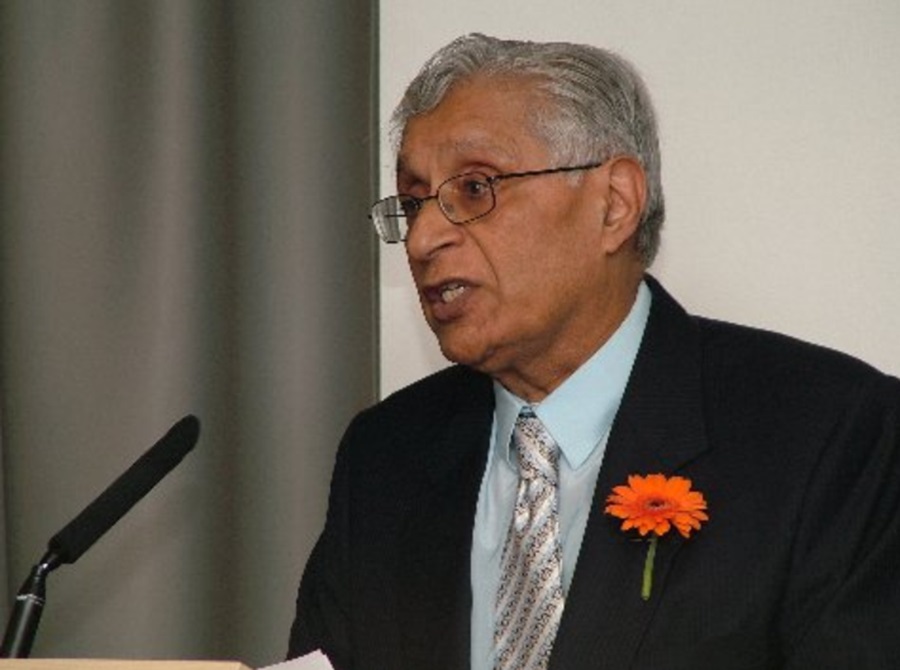
Aitmadi Dr. Aziz Rajabali Kurwa (d. March 13, 2024, aged 91)
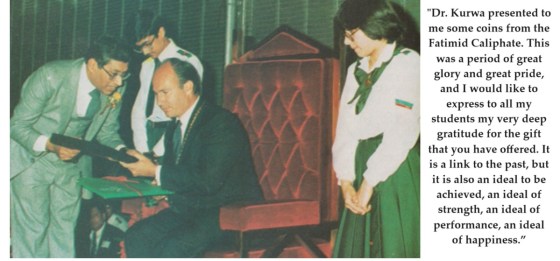
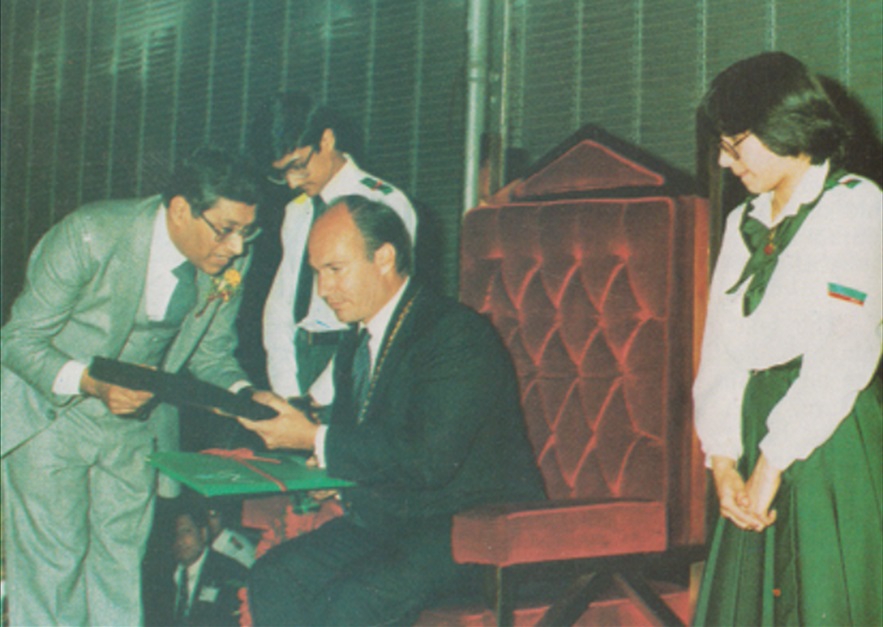
Dr. Aziz Kurwa was an exceptional and dedicated Ismaili leader who left an indelible mark on the community by pursuing excellence and implementing transformative programs and ideas in the United Kingdom. As someone who, with my late parents Alwaez Jehangir and Alwaeza Malek Merchant, served under Dr. Kurwa’s leadership as the President of the Ismailia Association for the United Kingdom (now known as the Ismaili Tariqah and Religious Education Board or ITREB), I have fond and special memories as I think of him. Still, there is one that was extraordinarily special. It is of the day in London, England, when he presented a framed set of 3 Fatimid coins to Mawlana Hazar Imam, His Highness the Aga Khan, at a student gathering in Olympia Hall during his weeklong visit in September 1979 to the Ismaili Jamat (community). Mawlana Hazar Imam looked at the gift with deep interest and admiration and responded as follows:
“Dr. Kurwa earlier, presented to me some coins from the Fatimid Caliphate. This was a period of great glory and great pride, and I would like to express to all my students my very deep gratitude for the gift that you have offered. It is a link to the past, but it is also an ideal to be achieved, an ideal of strength, an ideal of performance, an ideal of happiness.” (Excerpt from Ilm, Volume 4, Number 3).
Following the presentation, Dr. Kurwa brought the gift to the Ismaili Association’s literature counter for display for the benefit of the Jamat. This first-ever presentation of Fatimid coins to Mawlana Hazar Imam during his 22 years of Imamat from 1957 to 1979 raised the Jamat’s interest in the glory of the Fatimid Empire.
Article continues below
London, September 1979: Mawlana Hazar Imam, His Highness the Aga Khan, is seen receiving the report of the Ismailia Association’s Activity and a framed set of 3 Fatimid Gold Dinars from the President of the Association, Dr. Aziz Kurwa. The students Mukhi and Mukhiani are standing on either side in a volunteer’s uniform. Photo: Ilm magazine.
Aziz Rajabali Kurwa was born in Mumbai on December 1, 1932, and studied there until his medical graduation. He became involved with services to the Ismaili community at a very young age. As a college student, he helped revive a student society under the new name of Ismaili Students Education Society (ISES). The committee then undertook several initiatives, including organizing an arts and crafts exhibition in the city. Prince Aly Khan, who was then visiting Mumbai, very graciously accepted the committee’s invitation to inaugurate the exhibition.
Article continues below
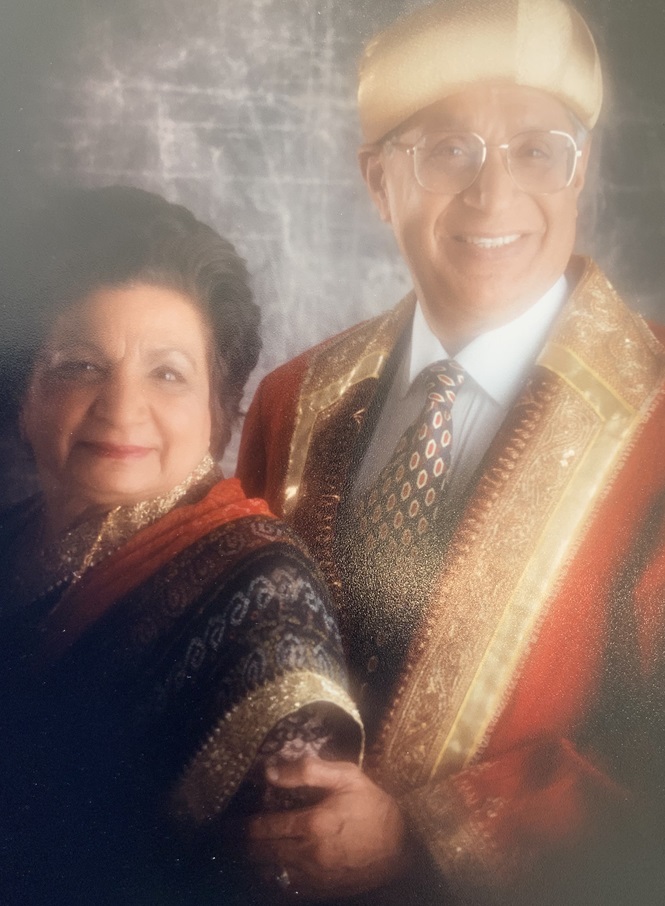
Aitmadi Aziz Kurwa and Aitmadibanoo Shirin Kurwa. Photograph: Habib Kurwa family collection.
Dr. Kurwa arrived in England in 1958. With his solid medical background from India, he went on to specialize as a dermatologist, obtaining FRCP(Edinburgh) and FRCP(London). Before Dr. Kurwa relocated to London, where he opened a dermatology clinic in the city’s famous medical district, Harley Street, he pursued his ambition of serving the Ismaili Jamat in Birmingham. He became the Mukhi (leader of the congregation) of the Jamat in 1970 and, together with his counterpart and other members of the Jamat, assisted in settling many Ismailis who arrived in the Midlands area as refugees from Uganda after their 1972 expulsion by Idi Amin.
Article continues below
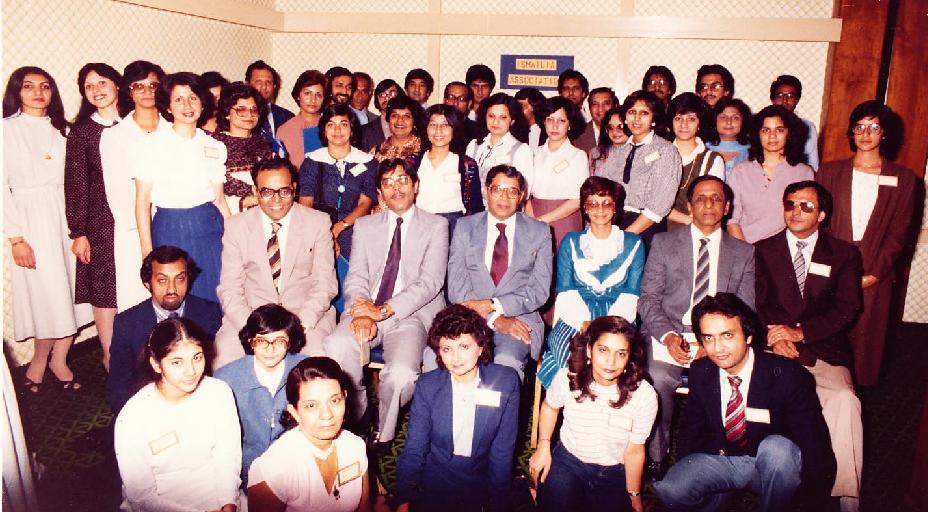
Dr. Aziz Kurwa, President of the Ismaili Association for the U.K. between 1979 and 1985, is seated third from left and is pictured with the members, staff, and teachers who served under him. Photograph: Jehangir Merchant Family Collection.
When he opened his dermatology practice in London’s Harley Street, Dr. Kurwa continued to set his sights on serving the Ismaili community. He established a Jamatkhana in Purley, Surrey, and in 1979, he was appointed President of the Ismailia Association for the United Kingdom by Mawlana Hazar Imam.
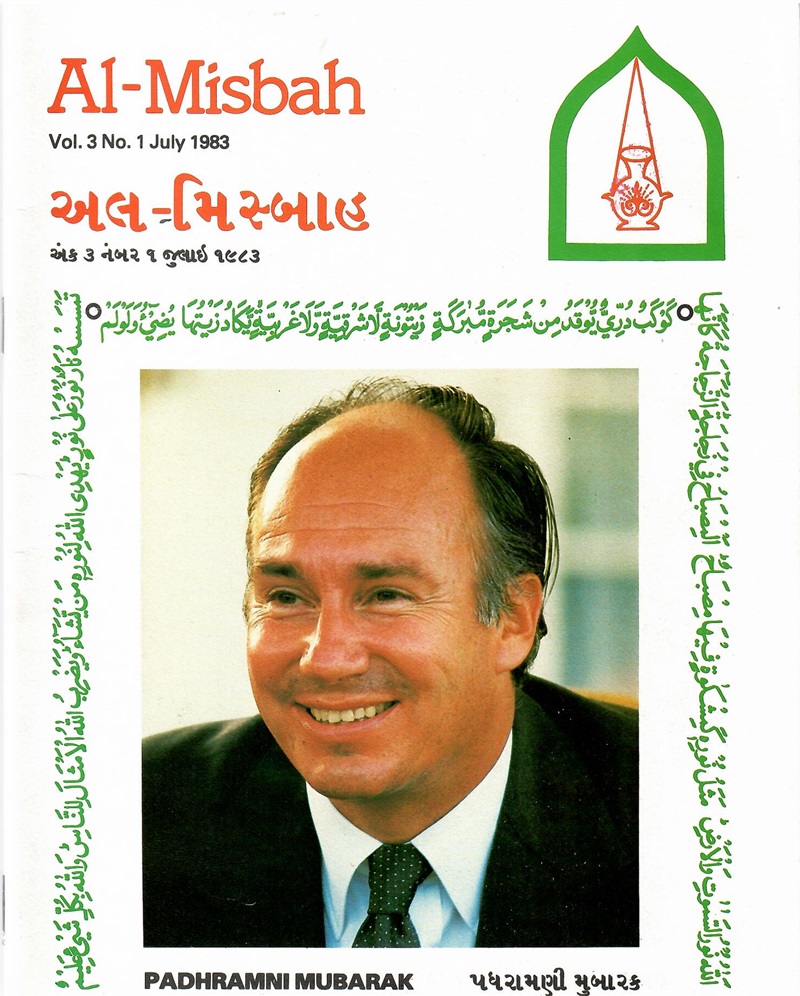
As a visionary leader, he introduced the concept of Baitul Ilm, an Ismaili religious education program for children and youth, which continues to shape the U.K. and other worldwide Ismaili communities. He also championed the distribution of high-quality religious material in cassettes to remote Jamats in the U.K. He created a bilingual religious magazine, Al-Misbah, containing easy-to-follow religious material, stories for children, and readings for the Gujarati-speaking members of the Jamat.
~~~~
Article continues below
The bi-lingual Gujarati-English Al-Misbah magazine was launched in the UK during Dr. Aziz Kurwa’s term as the President of the Ismailia Association for the UK.
His support for adult education and the growth of the literature and library portfolios further underscored his commitment to the community. Waezin (sermon) activities grew multifold throughout the U.K. as did children’s activities and participation in the Jamatkhanas. Dr. Kurwa also ensured that missionaries in the U.K. would regularly travel to the widespread European Jamats to support their religious activities and interests. The highly acclaimed Ilm magazine, established in 1975, continued to prosper with increasing circulation in the U.K. and abroad. Such was the magazine’s reputation that in 1980, the magazine’s editor, my dad Jehangir, was invited by the Aga Khan Award for Architecture to attend the first Award Ceremony in Lahore. Sadly, he was unable to go.
After completing his two terms as the President of the Ismaili Association, Mawlana Hazar Imam, in 1986, chose him to be one of the resident governors of the Institute of Ismaili Studies in London, which Dr. Kurwa proudly served until 1995.
Article continues below
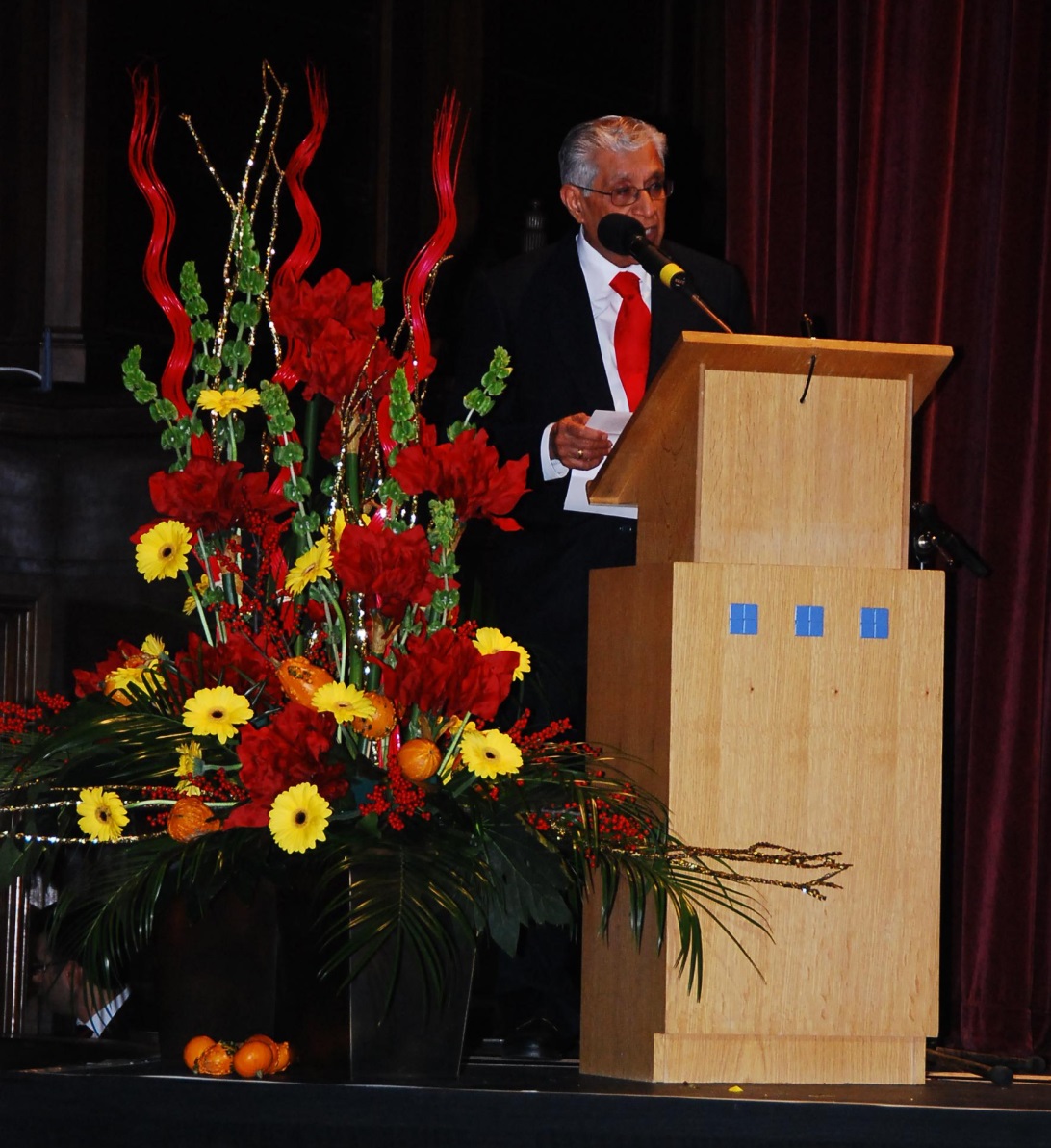
Dr. Aziz Kurwa, producer and director of “The Festival of Poetic Expressions” speaking at the event which was held by the Ismaili Council for the UK in London, Manchester and Germany to commemorate the Golden Jubilee of Mawlana Hazar Imam, His Highness the Aga Khan Aga Khan.
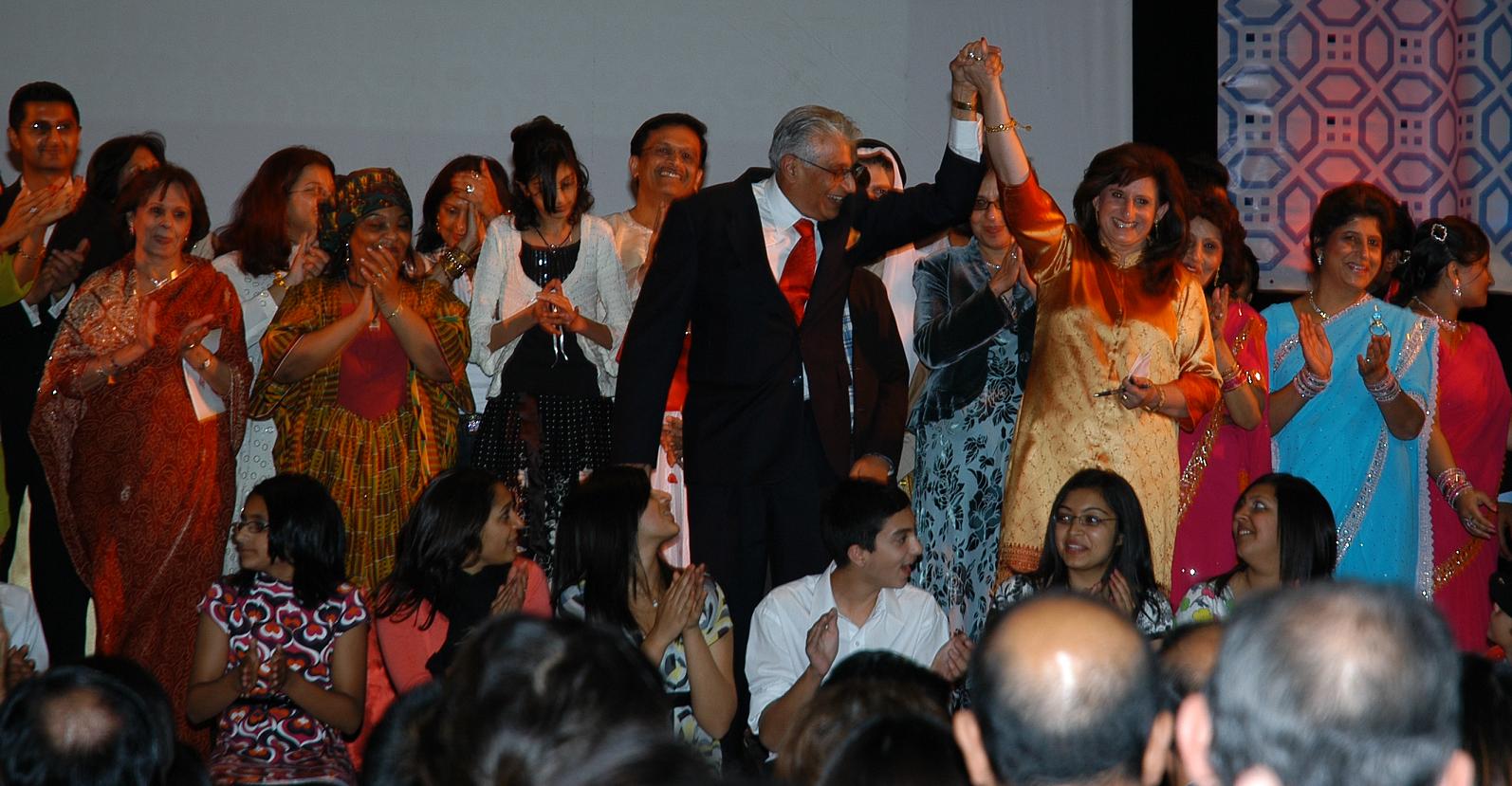
Dr. Aziz Kurwa celebrates at the conclusion of “The Festival of Poetic Expressions” which was held by the Ismaili Council for the UK in London, Manchester and Germany to commemorate the Golden Jubilee of Mawlana Hazar Imam, His Highness the Aga Khan Aga Khan.
Dr. Kurwa continued relentlessly to participate in other activities within the community. He contributed in creating the Health Care Professional’s Association and reviving the Ismaili Seniors Club. His passion for the Baitul Ilm religious education program led him to organize poetry sessions for Ismaili children and seniors, the success of which led to the Festival of Poetic Expressions as a Golden Jubilee programme. The event was staged in London, Manchester and Germany. He invited Simerg to publish the poems on the website, which we proudly did. Dr. Kurwa also served as a member of the Executive Committee of The Association For The Study Of Ginans, a private initiative.
In his article on Volunteering at the Dawn of Imamat, Dr. Kurwa wrote: “In whatever position in the Jamat, in my heart, I am devoted to voluntary service, and in this article, I am making an effort to recognise that volunteer services have existed since the inception of Islam and Inshallah will continue to flourish in the Jamat as long as Imam-e-Zaman wishes it to be.”
Article concludes below
All smiles as Aitmadi Dr. Aziz Kurwa is pictured with his son Dr. Habib Kurwa and his wife Farzana and their two children Khalil and Hassan. Photograph: Habib Kurwa family collection.
Dr. Kurwa moved to Calgary, Canada, in 2017 following the demise of his beloved and wonderful wife, Aitmadibanoo Shirin Aziz Kurwa, in December 2016. He cherished the beautiful moments with his loving son, Dr. Habib Kurwa, and his family. I was honoured to visit my former president and to meet him in Jamatkhanas. My wish to see him on Thursday, March 14, 2024, at 3:30 PM never materialized. A day earlier, on March 13, Habib texted me mid-morning, “Ya Ali Madad – Dad passed away this morning.”
Allah most graciously granted Aitmadi Aziz Kurwa a peaceful, happy and healthy life — a life that was filled with service to the Ismaili community, its institutions and the Imam-of-the-Time
He was an extremely rare Ismaili leader who returned to serve the Jamat at the grassroots level in any capacity as long as it enabled him to contribute to the community’s upliftment.
Aitmadi Aziz Rajabali Kurwa was a gallant, humble leader and a devoted murid of Mawlana Hazar Imam. We pray that his soul may rest in eternal peace. Ameen. We further pray that his family may face this immense loss with great courage and fortitude.
Date posted: March 14, 2024. Last updated: March 15, 2024 (reformatting and typos.)
__________________________
We invite you to submit your condolences, memories, and tributes to Aitmadi Dr. Aziz Kurwa by completing the feedback form below or clicking Leave a comment. Should you encounter technical issues or difficulties submitting your comment, please send it via email to mmerchant@simerg.com (subject Aziz Kurwa).