Simerg is an independent initiative dedicated to Ismaili Muslims, the Aga Khan — their Hereditary Imam — and the Ismaili Imamat, and Islam in general through literary readings, photo essays and artistic expressions
Following our earlier post that explored the Aga Khan’s speeches from 2007 to 2025, this new post on our sister website Barakah provides a comprehensive, detailed pictorial overview of the Ismaili Imam’s life, paying tribute to his significant role both before and after becoming the Imam. His Highness Prince Rahim Aga Khan, fondly known as Mawlana Hazar Imam (Our Lord, the present living Imam) by his Ismaili followers, assumed the Throne of the Ismaili Imamat on February 4, 2025. This is his first birthday celebration as the community’s Imam, a momentous occasion. Ismailis refer to this celebratory day as Salgirah, exchanging greetings of “Salgirah Mubarak” and attending Jamatkhanas in huge numbers. The celebration holds deeper significance as the community reflects on the profound care, concern, and guidance provided by the Everlasting Rope of Imamat, prompting us to contemplate and reflect on the Imam’s role in our lives. Life, as we all know, is transitory. An Imam will live his life as everyone else does, but there WILL always be an Imam to guide the community. This is the central notion of the Ismailis and the Imamat.
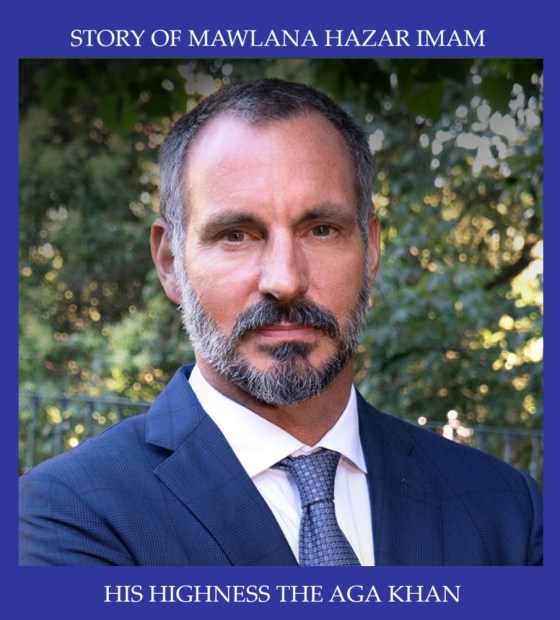
As Ismaili Muslims worldwide come together to celebrate the historic first Salgirah (birthday) of His Highness the Aga Khan, as their 50th Ismaili Imam, Barakah presents a collection of speeches which cover a diverse array of topics — from arts and culture to education and faith. The diverse range of topics will stimulate our intellect and broaden our perspectives. The speeches also highlight the urgency of the climate crisis. Please click HERE or on the image below to read his speeches and messages.
Please click on the image for the Aga Khan’s speeches, statements and messages.
Abstract: In this expanded version of his original article, which was published in the February 2025 issue of the Institute of Ismaili Studies Alumni Newsletter, Professor Karim writes about the subtle dynamics between the Imam-of-the-Time and those in his service, an insight he gained from his personal interactions with Mawlana Shah Karim Shah, who appointed him to the leadership of the Institute of Ismaili Studies. The article not only describes the contemporary dynamics but also emphasizes the enduring historical significance of truth, faith, piety, and proper management in Ismaili administration, instilling a sense of tradition and continuity.
To be asked by Mawlana Shah Karim (1936-2025) to lead the Institute of Ismaili Studies (IIS) was an exceptional honour. The London-based IIS is unique among the large number of institutions that His Late Highness Aga Khan IV and 49th Nizari Ismaili Imam established in his Imamat of 67 years (July 11, 1957, to February 4, 2025). Its management demands a nuanced understanding of the academic and communal spheres which intersect within it. The Imam’s invitation to me in 2009 felt like the culmination of a long relationship with the Institute, where I had been a student, a research collaborator and a senior visiting scholar over the previous two and a half decades. I stepped down from my position as Director of Carleton University’s renowned School of Journalism and Communication and headed for London.
Story continues below
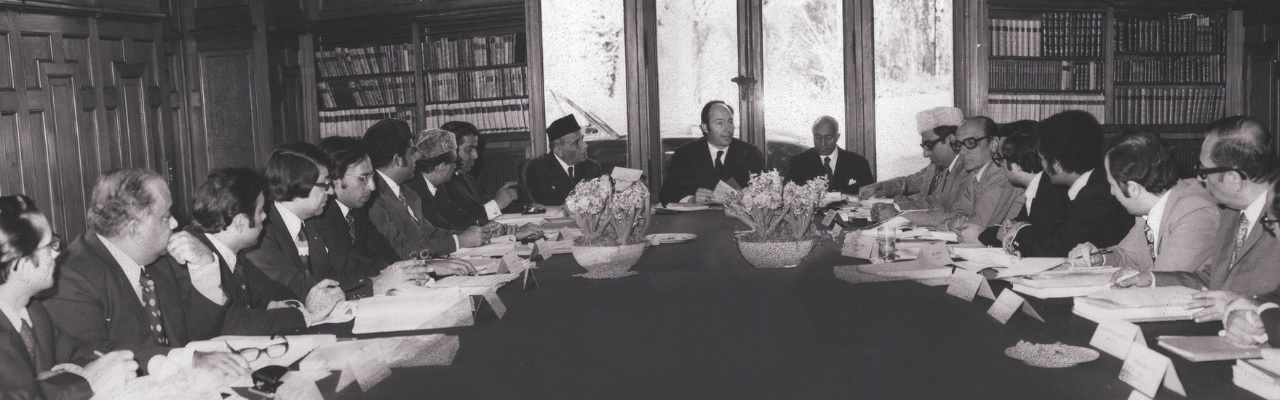
The Institute of Ismaili Studies (IIS) owes its establishment to the leadership and vision of Mawlana Shah Karim, His Late Highness Aga Khan IV. Along with leaders of the Ismailia Association and Ismaili scholars, a momentous decision was made to establish the IIS at a conference held in April 1975 in Paris. This decision, which carries the weight of history, was a pivotal moment for the Ismaili community. The IIS was formally established on December 13, 1977, through a Talika (written holy message) that His Late Highness sent to his worldwide community. Photograph: Ilm magazine, October 1975.
Before joining the IIS as Co-Director, it had been my privilege to give seva (service) to jamati (community) institutions in Kenya, USA, UK and Canada. I had also conducted research for Aga Khan Foundation Canada and been a correspondent for Compass News Features, a media agency which Mawlana Shah Karim founded in Luxembourg. The Aga Khan University (AKU) had asked me in 2007 to serve on an international “Thinking Group,” comprising prominent professors and senior journalists who were tasked with exploring the possibility of establishing a Graduate School of Media and Communications. Several months into the deliberations, Aga Khan IV, the university’s founding chancellor, informed us that he would meet with us in Washington, DC. We were assembled in a room when His Highness walked in, wearing a sling on his right arm because of a skiing accident a few weeks prior. He went around the table, smiling and graciously greeting each person. Having led the highly successful Nation media organization in East Africa since the late 1950s, he spoke about the media business and journalism education. With Kenya’s post-election violence fresh in his mind, the Imam shared insights about how the corruption of journalists and media owners contributed to social instability. The distinguished group was impressed with the breadth and depth of his knowledge and left with a deepened scope of considerations. Some seven graduate AKU schools had been planned but only the Graduate School of Media and Communications in Nairobi proceeded to establishment. I was thankful that Mawlana Shah Karim gave me the opportunity to contribute to my country of birth in this manner.
It was September 2009 when I arrived in London from Ottawa, Canada, to assume the IIS’s co-directorship. A few weeks later, Mawlana Shah Karim invited the Aga Khan Development Network’s Higher Education Forum, of which I was a member, to a dinner meeting at his secretariat in Aiglemont, France. The Forum also included the senior leadership of Aga Khan Foundation, Aga Khan University, the University of Central Asia, Aga Khan Academies, and Aga Khan Education Services. According to the arrangements that the Imam had determined, Azim Nanji, the preceding IIS director, was to be seated on Mawlana Shah Karim’s left-hand side and I on his right. This was a remarkable honour for Azim Nanji, me and the IIS. The Imam entered the room, greeting us warmly. Attendees took their seats but, feeling daunted, I hesitated. Mawlana Shah Karim kindly gestured for me to sit next to him. The participants presented project updates about which the Imam asked probing questions. He was gracious about shortcomings and made suggestions on dealing with challenges. After the meeting came to a close, Mawlana Shah Karim looked at me and told me not to hesitate to contact him should the need arise. I felt humbled and immensely grateful.
“I was convinced that it was vital for individuals tasked with responsibilities to be entirely transparent with Mawlana Shah Karim even if it produced discomfort for oneself and others in the room. Therefore, I became resolute in speaking up — at the risk of being marginalized — when I saw things to be amiss. Mawlana Shah Karim’s positive responses to my carefully considered interventions were very encouraging.” — Karim H Karim
It was my good fortune to have a number of interactions with the 49th Imam. He upheld very high standards and asked the same of others. Mawlana Shah Karim expected accurate information and frankness, especially when goals had not been met. Having thoroughly read the papers submitted in advance of meetings he inquired into specifics and gave discerning guidance. From time to time, as the discussion was flowing in a particular direction, I would ask myself whether it was appropriate for me to offer contrary observations and critical thoughts on vital points. It turned out that Mawlana Shah Karim appreciated such interventions, which I sought to conduct in a thoughtful and respectful manner. He was also kind in tolerating my errors, gently directing me towards correcting them. This helped me understand more clearly the subtle dynamics of interaction between the Imam and those in his service.
Around a thousand years ago, da‘i Ahmed al-Naysaburi’s writings reminded Fatimid administrators that the Imam-of-the-Time depends on them for the ethical governance of his community, failing which “chaos will reign.” He was extremely concerned that influential officials had become preoccupied with their own power and privilege rather prioritizing knowledge of the faith(ilm), piety (taqwa) and proper administration (siyasa), the fundamental principles by which the Imamat’s institutions should abide. The more meetings I attended with Mawlana Shah Karim the more it became apparent that he was not always receiving the complete picture, especially when conflicts of interests were involved or when things had not turned out according to expectations. Qadi al-Nu‘man, who was a close confidant of several Fatimid Imams, advised those who interacted with the Imam: “Let us speak the truth and hide nothing from the Imams.” I was convinced that it was vital for individuals tasked with responsibilities to be entirely transparent with Mawlana Shah Karim even if it produced discomfort for oneself and others in the room. Therefore, I became resolute in speaking up — at the risk of being marginalized — when I saw things to be amiss. Mawlana Shah Karim’s positive responses to my carefully considered interventions were very encouraging.
However, adverse organizational currents began to generate a disabling environment for me. I strived to deal with the changing situation, but it became increasingly problematic to carry out my duties. Being under intense stress, I was compelled to review my position and consider the possibility of moving back to Canada. This presented an extremely difficult situation: it was my Imam who had personally selected me for the leadership role in his vital institution, and I felt deeply distressed that I would be letting him down. After several long weeks of agonizing, I wrote to him seeking guidance. Mawlana Shah Karim’s personal assistant contacted me to arrange a telephone call. I waited anxiously in my office as the time arrived. The phone rang, and the assistant informed me that the Imam was on the line.
Mawlana Shah Karim greeted me affectionately and he mentioned a current international issue which we discussed briefly. Turning to the matter at hand, he said that he understood the organizationally problematic nature of the situation and appreciated the difficulty of the circumstances for me. The Imam told me that it was my decision to stay or to leave and that he would be fine with whatever I decided. Mawlana Shah Karim assured me that “there are many ways to serve.” These words, expressed with paternal care, lifted an enormous weight from my shoulders. Following considerable further reflection, I wrote to the Imam of my decision to return to Canada. Upon settling back in Ottawa, I continued to provide service to Imamat institutions like the Central Asian and Aga Khan universities and was immensely pleased with Mawlana Shah Karim’s continued positive responses to my recommendations.
Story continues below
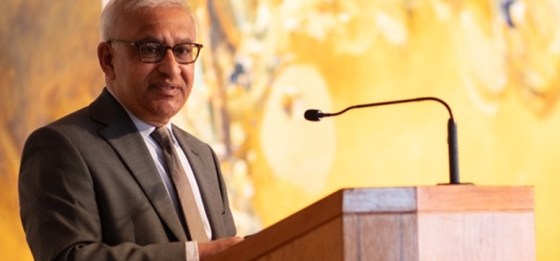
Professor Karim H. Karim, the author of this piece and a respected member of our academic and Ismaili community, was awarded the first Alumni Recognition Award by the Institute of Ismaili Studies. This prestigious honour, presented to him on March 23, 2024, at the Ismaili Centre London, is a testament to his exceptional service, leadership, positive impact, and professional excellence. Photograph: The Institute of Ismaili Studies via Karim H. Karim.
Mawlana Shah Karim’s words from the phone call shaped the direction of my subsequent service to the Imamat and the community. While at the IIS, I had published a chapter on Ismailis in Canada in a book that my fellow Co-Director Farhad Daftary edited. This was the beginning of a series of writings on the contemporary community, which I am analyzing from the basis of my research and institutional service. The insights gained from these sources have strengthened my conviction about the vital importance of upholding intellectual rigour and professional ethics in studying the community, its organizations and its leadership. I draw from my academic training as well as my religious commitment to truth in this endeavour. It is of great significance to me that the original and authentic name of the Imamat’s movement is “Da‘wat al-Haqq” — Invitation to Truth — which has involved critical self-reflection on the part of the community’s intellectuals in their endeavour to uphold its integrity.
At the grand Diamond Jubilee Darbar in Lisbon in July 2018, Mawlana Shah Karim asked his murids (committed aspirants) to be da‘is (summoners to truth). As mentioned above, Ismaili da‘is like al-Nu‘man and al-Naysaburi provided corrective guidance to officers of the Fatimid state who lapsed ethically from time to time. Administrators are under pressure to deliver on commitments and tend on occasion to adopt means that diverge, often unknowingly, from the tradition’s ethical precepts. It is vital that there be an intellectual counterpoint in the contemporary community that discusses ethical adherence with the institutional structure just as al-Nu‘man, al-Naysaburi and other da‘is did in their time. Upon discussing this matter with a former president of the Aga Khan Ismaili Council for Canada, I learned that Mawlana Shah Karim advised community leaders to engage in productive discourse with the independent voices of sincere murids.
My writings and oral discourses, which seek to offer respectful and carefully considered communal self-critique, elicit considerable discussion and feedback. A conference paper that I delivered in 2022 at the IIS on the challenges of ethical propriety in Ismaili institutions generated intense debate, with scholars and students variously agreeing and disagreeing with me. I am heartened that many scholars cite my writings on contemporary Ismaili topics in their academic publications. However, I consider the platforms of independent and autonomous Ismaili communal media like Simerg to be the most viable venues for sharing analysis and engaging in discussion with the community and its leadership.
Mawlana Shah Karim’s advice that “there are many ways to serve” has constantly inspired and motivated me to pursue a path that may be occasionally contentious but constantly and sincerely strives to respond to the da‘wa’s call to truth. It was extremely humbling and encouraging that in 2024 the IIS endowed me with an award for “exceptional service, leadership, positive impact and professional excellence.”
Date posted: September 29, 2025.
________________
About the author:Karim H. Karim is a Chancellor’s Professor at Carleton University in Canada. He has served as Co-Director of the Institute of Ismaili Studies and as Director of Carleton University’s Centre for the Study of Islam and its School of Journalism and Communication. Professor Karim is a prize-winning, interdisciplinary scholar whose publications have received worldwide acclaim. The Ismaili Imamat, the Government of Canada, the Institute of Ismaili Studies and civil society organizations have granted him honours.
Featured photo at the top of the post: Professor Karim H Karim delivering his remarks on March 23, 2024, at the Ismaili Centre in London upon being presented with the Inaugural Alumni Recognition from the Institute of Ismaili Studies. Photograph: Institute of Ismaili Studies via Karim H. Karim.
If you have feedback on this piece, please click LEAVE A COMMENT. Also, don’t miss the opportunity to explore the diverse and extensive range of articles by clicking on TABLE OF CONTENTS. We also invite you to visit our sister websites, Barakah and Simergphotos. You can stay updated by following the editor, Malik Merchant, @Facebook, @X and @LinkedIn.
~~~~~~~~
Articles contributed by Karim H Karim on Simerg and its sister websites:
Inna lillahi wa inna ilayhi raji’un “Surely we belong to God, and to Him we return” — Holy Qur’an, 2:156
“Life is a great and noble calling, not a mean and grovelling thing to be shuffled through as best as we can, but a lofty and exalted destiny.” — Mawlana Sultan Mahomed Shah, His Highness the Aga Khan III (1877-1957), 48th Ismaili Imam.
It is with deep sadness that we record the death of Nadir Mohamed on September 18, 2025, at the age of 69. We convey our heartfelt condolences to his wife, Shabin, and Nadir’s entire family and wish them strength and courage at this difficult time of bereavement.
Upon his passing, his family issued the following statement in the Globe and Mail’s Legacy page:
“The family of Nadir mourn his passing. He was an extraordinary man whose grace, wisdom, and openness deeply enriched our lives. May his spirit endure as a guiding light and his kindness live on in our hearts. Nadir passed away peacefully on September 18, 2025. In lieu of flowers, donations can be made to Princess Margaret Hospital or Mt. Sinai Hospital.”
An invitation has been extended to those who wish to plant trees in his memory at the Sympathy Store.
The exceptional tributes paid to Nadir Mohamed in the media bear witness to his remarkable contributions and achievements as a visionary in business and high technology. In recognition of Nadir’s contributions to Canada, he was named a Member of the Order of Canada (C.M.) by the Governor General on November 22, 2019, and invested with C.M. on May 6, 2022. The Order reads as follows:
“Esteemed leader Nadir Mohamed has advanced Canada’s high-tech sector. Using his expertise from a successful 30-year career in the telecommunications and media industry, the former president and CEO of Rogers Communications co-founded ScaleUP Ventures to fund and foster promising start-up technology companies across Canada. The accomplished business executive has also shared his time and sought-after acumen with Ryerson University’s innovation initiatives, including Digital Media Zone, as well as with a range of community organizations in the business, arts and health sectors.”
Rogers Communications, Canada’s leading communications and entertainment company, released the following statement in their tribute to Nadir:
QUOTE
“We are deeply saddened by the passing of Nadir. Nadir was an exceptional leader, a deeply respected executive and a generous person who led Rogers during an extraordinary time of change for our company and industry. He contributed immensely to our long-term success and made meaningful contributions to our community and our country,” said Edward Rogers, Executive Chair, Rogers.”
“Nadir joined Rogers in August 2000 and served as President and CEO of Rogers Wireless from 2001 to 2005. He was appointed President and Chief Operating Officer of Rogers in 2005, and in 2009 succeeded Ted Rogers as President and CEO. He retired from Rogers in January 2014. During his tenure, he strengthened Rogers balance sheet, solidified its financial position and set Rogers up for long-term success.
“Nadir was co-founder and chair of ScaleUP Ventures and chair of DMZ Ventures. Nadir also gave back to his community as a board member of Tennis Canada, Toronto Metropolitan University, UHN Toronto General & Western Hospital Foundation and a founding board member of NEXT 36/NEXT Canada.
“Nadir was a remarkable leader who played a pivotal role at Rogers and the broader Canadian business community,” said Tony Staffieri, President and Chief Executive Officer, Rogers. “He meaningfully contributed to Rogers legacy of innovative firsts, and he passionately contributed to Canada’s innovation agenda. He was a gracious leader, and a true class act. Our thoughts are with Shabin and the entire Mohamed family during this difficult time.”
UNQUOTE
Although I did not know C.M. Nadir Mohamed personally, I had met him on a few occasions. My first memory of meeting him was at the Rogers Centre during the Golden Jubilee of His Late Highness Aga Khan IV in 2008. I was deeply affected when I was informed about his passing. I was further moved on Tuesday, September 23, 2025, as I watched the Toronto Blue Jays play the Boston Red Sox on Sportsnet Plus. The Blue Jays commentator, Dan Shulman, alongside Buck Martinez, paid tribute to Nadir between the 3rd and 4th innings of the baseball game, which was played at Rogers Centre. A moment of silence was also observed during the game, with Nadir’s portrait projected onto the stadium’s jumbotron. A friend who was at the game has shared the following clip:
Video clip: A moment of silence for Nadir Mohamed at the Rogers Centre
It is worth noting that during his tenure at Rogers, the communications company also made significant inroads in sports, including negotiating what was then a record-breaking $ 5.2 billion, 12-year exclusive broadcast deal for NHL hockey rights.
C.M. Nadir Mohamed’s funeral will take place at the Burnaby Lake Ismaili Jamatkhana on Thursday, September 25, 2025.
We pray that his soul may rest in eternal peace. Ameen.
Date posted: September 24, 2025.
___________________
Condolence messages: We invite readers to submit their condolences, memories and tributes to Nadir Mohamed, Member of the Order of Canada, by clicking LEAVE A COMMENT. If you encounter technical difficulties submitting your feedback, please email your message to mmerchant@simerg.com, subject line: Nadir Mohamed.
Princess Zahra Aga Khan, with her brother, the 50th Imam, and with her late father, Mawlana Shah Karim. Please click on image for her story.
We honour Princess Zahra, the beloved daughter of his Late Highness Aga Khan IV (d. February 4, 2025, aged 88), and sister of his successor, Mawlana Shah Rahim Al Hussaini, His Highness the Aga Khan, as she marks her 55th birthday, September 18, 2025.
Her brother, on becoming the 50th Hereditary Imam, said:
“My sister, Princess Zahra, has played a major leadership role for many years, contributing with all her heart, intellect and capacity to advance the well-being of the Jamat. I know that she is still well-loved and admired by the Jamat and the leadership and staff of our institution. These sentiments are well deserved, and I share them too.” on the occasion of his installation on February 11, 2025.”
Inna lillahi wa inna ilayhi raji’un “Surely we belong to God, and to Him we return” — Holy Qur’an, 2:156
“Life is a great and noble calling, not a mean and grovelling thing to be shuffled through as best as we can, but a lofty and exalted destiny.” — Mawlana Sultan Mahomed Shah, His Highness the Aga Khan III (1877-1957), 48th Ismaili Imam.
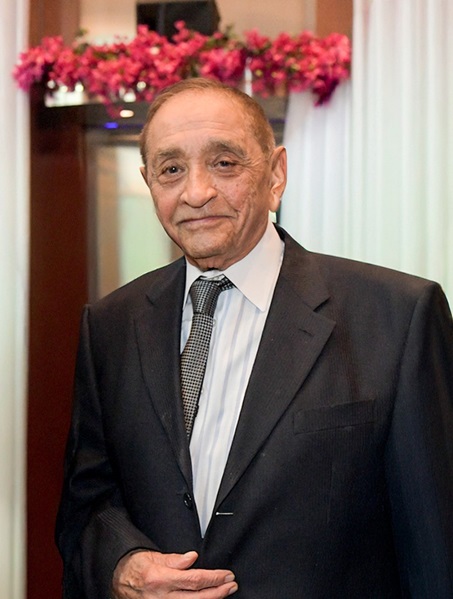
Beloved husband of Gulshan for 74 years; cherished father of Azim, Tazmin, Narmin (Nimi), and Hanif (Chiko); and proud grandfather and great-grandfather, Pyarali Gulamali Nanji (Member of the Order of Canada, C.M.), whose life was defined by the inspiring values of hard work, kindness, and generosity, died on August 20, 2025, at the age of 95, just one month shy of his 96th birthday.
Mr. Nanji’s funeral was attended by a vast crowd on Tuesday, August 26, 2025, at the Ismaili Jamatkhana and Centre in Scarborough, Ontario. The diverse group of attendees, including representatives and leaders from organizations and businesses, past and current leaders from the Ismaili Muslim Community, and family members, all came together to pay their respects. This diversity underscored the wide range of people he influenced and the respect he garnered.
Mr. Nanji, along with his young family, was among the thousands of South Asian refugees who, under the rule of Uganda’s dictator, Idi Amin, were stripped of their citizenship and assets and declared stateless. They found sanctuary in Montréal, Canada, thanks to mercy flights organized by the Canadian government. The Nanji family, who stayed in temporary lodgings at the downtown YMCA, were deeply grateful for the kindness they were shown in the face of catastrophe. Their gratitude towards Canada was profound, and they pledged to pay that kindness forward when they had the means to do so. Relocating to Toronto, Mr. Nanji started a hugely successful packaging firm. The family, committed to giving back, decided it was time to fulfill their promise.
~~~~~~~~
“My father was so impressed by the way we were treated, the way our host country took us in during our time of need. It was always his goal to be able to give back.” — Nimi Nanji-Simard, quoted in Global Heroes.
“He was fearless, a great man, impatient to make the world better.” — Nimi Nanji-Simard, quoted in Toronto Star
“In my life, I have learned something; that if God gives you the opportunity, try to share it. First of all, you have to make sure that you are taking care of your family, your community, and then the whole country. So, I thought we have to pay back to the country and the world… and for more than 20 years, we have been doing this.” — Pyarali Nanji, quoted in a UNHCR press release
“It is beautiful what you said about giving back, and even more so, giving opportunity… You can be assured that we will spend it well, this donation. We will spend it to give people opportunities. And maybe in life there is a chain, that people suffer and go through exile and deprivation, and then if they have opportunities, they can give back. And the cycle continues if everybody does what you did.” — Filippo Grandi, UN High Commissioner for Refugees, quoted in a UNHCR press release
~~~~~~~~
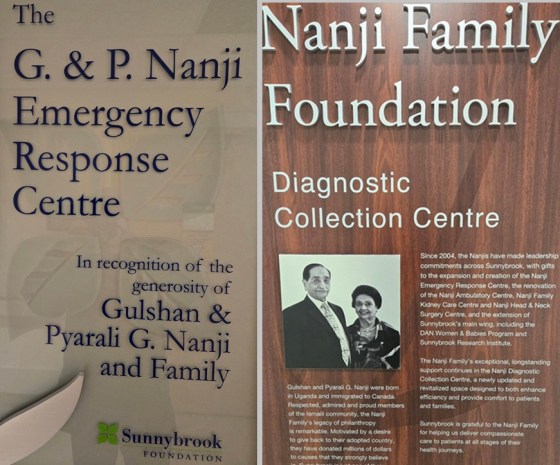
Plaques honouring Pyarali Nanji for his enormous contribution to healthcare in Canada. Photographs: Kamrudin Rashid.
Today, we are all witnesses to the profound impact of Nanji’s philanthropy, a legacy that resonates deeply with the thousands of residents of Toronto and the province of Ontario. His name, proudly displayed on hospital buildings and plaques, serves as a poignant reminder of his generous gifts to our community.
The Nanji Ambulatory Center, Nanji Kidney Care Center, Nanji Acute Kidney Care Center, Nanji Neck and Head Surgery Center, and the Nanji Emergency Response Center at Sunnybrook Hospital, and the Nanji Ambulatory Care Center, Nanji Orthopedic Center, Nanji Diagnostic Center, and Nanji Academic Center at North York General Hospital, are just a few of the many tangible manifestations of his extraordinary contributions. Like my family and I, thousands of Canadians have directly benefited from Nanji’s millions of dollars to Canadian hospitals in and around the Toronto area, a testament to his unwavering commitment to our well-being. His legacy, a beacon of hope and continuity, will continue to inspire future generations.
Story continues below
On Dec. 2, 2010, North York General Hospital officially reopened its renovated Medical Imaging Centre, largely funded by Pyarali Nanji, right, and his wife, Gulshan. The couple is pictured here with Justin Trudeau, whose father, Pierre, was Prime Minister when thousands of Ugandans were offered sanctuary in Canada in 1972. Photograph: CBC via Nimi Nanji-Simard.
The multimillion-dollar contribution to Seneca College’s school of nursing, the most significant gift in Seneca’s history, is a testament to the donor’s unwavering commitment to education and healthcare. Seneca renamed the school as the Seneca Nanji Foundation School of Nursing. This name reflects the exceptional support this gift will provide to students and the significant impact it will have on health care for all Canadians.
One of Mr. Nanji’s most touching and profound contributions was a significant gift to support eye care initiatives at the University of Toronto’s Department of Ophthalmology and Vision Sciences in 2017. The generous donation established a five-year term Chair for the Department, which was held by Dr. Sherif El-Defrawy, an eye surgeon, researcher, and award-winning teacher. A substantial portion of the funds was dedicated to capacity-building global health missions. These missions, led by El-Defrawy and other faculty members, have made a significant impact in Uganda, Kenya, Ethiopia, Ghana, and Haiti, among other low- and middle-income countries, bringing hope and progress that inspire us all.
Story continues below
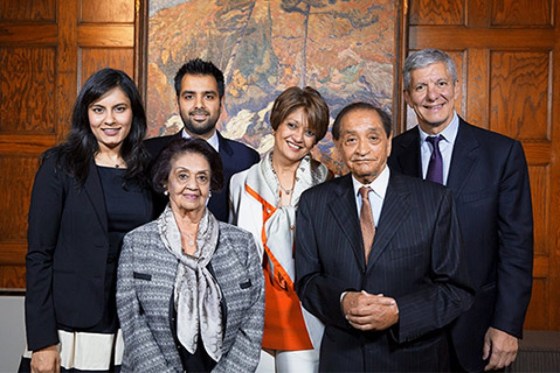
Gulshan and Pyarali Nanji (front) and family with Dr. Sherif El-Defrawy. Photograph: Matthew Volpe / University of Toronto magazine.
“We spend our days performing cataract surgery and corneal transplantation surgery, restoring vision and sometimes allowing people to see for the first time in their lives,” El-Defrawy explained. The training sessions, designed to provide a platform for local surgeons, have been instrumental in allowing them to observe and then perform operations under supervision, playing a crucial and valued role in the process.
During the worldwide COVID-19 crisis, the Nanji Family Foundation donated $1.6 million to be split equally among 16 Canadian hospitals to help combat COVID-19 through research and staff support.
In April 2022, in commemoration of the 50th anniversary of the South Asian exile from Uganda, the Nanji Family Foundation granted $1 million in funds to UNHCR, the UN Refugee Agency, for tertiary education scholarships in support of its Aiming Higher campaign. The contribution helped provide sorely needed financial support to refugees pursuing higher education by funding scholarships for health-related university studies in their countries of asylum.
In mourning Mr. Nanji’s death, the Oakville Valley’s Health Markham Stouffville Hospital called Mr. Pyarali G. Nanji, a visionary philanthropist, transformational leader, and cherished friend. Writing on Instagram, the Hospital said that, through the Nanji Family Foundation, “Mr. Nanji and his family have been among our hospital’s most generous supporters for more than three decades. Their extraordinary generosity has strengthened the care we provide for every patient who walks through our doors, and our Gulshan & Pyarali G. Nanji Mental Health Services remain a lasting reflection of his belief that ‘the greatest wealth is health’. We extend our heartfelt condolences to the entire Nanji family. His kindness, vision, and dedication will live on through the countless patients and families whose lives he helped transform. At Markham Stouffville Hospital Foundation and Oak Valley Health, we are deeply grateful to have been part of his remarkable legacy — one that will continue to inspire and bring hope for generations to come.”
Story continues below
Pyarali Gulamali Nanji (Member of the Order of Canada, or C.M.) pictured with Prince Amyn Aga Khan as the Ugandan born Canadian philanthropist makes a transformative multi-million-dollar donation to the Aga Khan Museum in Toronto.
~~~~~~~~
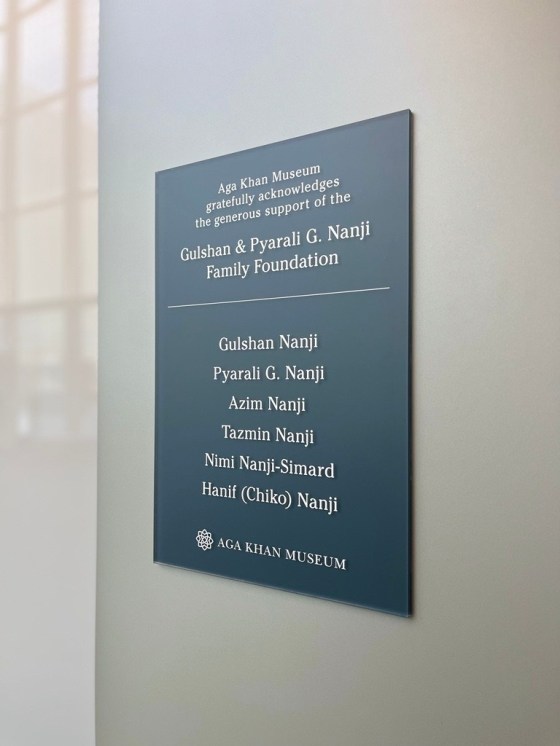
Plaque on a wall at the Aga Khan Museum acknowledging the generous support of the Nanji Family Foundation. Photograph: Aga Khan Museum.
~~~~~~~
Visitors to the iconic Aga Khan Museum in Toronto will note that its beautiful auditorium has been named after Gulshan and Pyaraly G. Nanji Family Foundation following their transformative multi-million-dollar donation to the Museum. This generous gift, with its global reach, will impact millions of people, deepening their understanding of Muslim arts and cultures and their connection with the world.
In recognition of extraordinary contributions, he was appointed a Member of the Order of Canada by Her Excellency the Right Honourable Mary Simon, the Governor General of Canada. The citation in his honour stated:
“Pyarali Nanji is a prominent philanthropist in Canada, devoted to giving back to the country that welcomed him. His family foundation has made transformational charitable contributions to numerous local, national and international hospitals, institutions and organizations, including Sunnybrook Hospital, the Aga Khan Museum and the Seneca Nanji School of Nursing. (Please see The Governor General of Canada: Mr. Pyarali Gulamani Nanji).
On a personal level, Mr. Nanji’s support has been instrumental in my initiative to help international students access higher education in Canada. Mr. Nanji’s contributions also significantly boosted efforts to raise funds for the Aga Khan Foundation Canada (AKF, C) through its annual World Partnership Walk. The Nanji family’s role in broadening Canadians’ understanding of international development is truly significant, as noted in AKF’s tribute to Mr. Nanji. The family’s efforts have inspired millions to walk in solidarity against global poverty and played a transformational role in improving the quality of life globally.
I cannot end this tribute without mentioning Munira Premji, a personal friend, who shared her own touching and heartfelt tribute to Pyarali Nanji in the following words:
“Now and then, a life reminds us what it means to live with purpose, humility, and generosity — Pyarali Nanji’s was such a life. I was deeply saddened to learn of his passing, a man whose generosity and faith touched my life in the most personal ways. He was an extraordinary gentleman — a man of purpose and vision. A philanthropist who gave generously to causes that mattered to him and his family in the areas of education, healthcare, arts and culture, and social welfare. His giving had an immense and personal impact on me. In the past 10 years, as I battled three advanced cancers, I found myself repeatedly at the doors of hospitals his philanthropy had touched:
In 2015, I was treated at the Breast Centre Clinic at North York General Hospital;
I received radiation at Sunnybrook Health Sciences Centre; and
when I broke my ankle, it was the Nanji Orthopedic Centre that looked after me.
“And I am only one person. His contributions supported millions of people during their most vulnerable times. But what I will remember most about Pyarali Nanji is his character. Two words stay with me: his smile and his humility. He knew of my health challenges, and each time I saw him in Jamatkhana, he would greet me with a warm smile, a simple hand gesture asking how I was doing, and then raise his hands high. I always understood that to mean: trust in God, have faith. His faith informed how he lived, and I took much inspiration from him.
“Pyarali Nanji — as you journey onward, I imagine the doors of heaven opening wide — and God welcoming you home with the same smile you shared so freely here on earth. Your promise became a legacy, your legacy became hope, and your hope will continue to serve generations long after your passing.”
We express our deep-felt gratitude to Mr. Nanji, a man who has touched each of our lives with his contributions to humanity. His legacy of philanthropy and kindness, a beacon of hope, will continue to inspire and guide us. We pray that his departed soul rest in eternal peace. Ameen. We also pray that his family derive courage and fortitude in the face of their significant loss, and that they may also be in a position to emulate the philanthropic legacy he left behind. He will be remembered with deep love and respect by all whose lives he touched.
Date posted: September 6, 2025.
Condolence messages: We invite readers to submit their condolences, memories and tributes to Pyarali Nanji, Member of the Order of Canada, by clicking LEAVE A COMMENT. If you encounter technical difficulties submitting your feedback, email your message to mmerchant@simerg.com, subject: Pyarali Nanji.
Featured picture at the top of this post. Mr. Pyarali Nanji and members of his family, along with Prince Amyn Aga Khan, leaders of the Aga Khan Museum and the Ismaili Council for Canada, as the Canadian philanthropist makes a transformative, multi-million-dollar donation to the Aga Khan Museum in Toronto.
_________________
Kamrudin Rashid
About the writer: Born in Zanzibar, Kamrudin Rashid lived in both Zanzibar and Pemba from 1946 until after the 1964 Zanzibar Revolution that saw the island merge with mainland Tanganyika into a unified country called Tanzania. He then settled in Dar es Salaam before making Canada his home in early 1975. Kamru was in Pemba during Mawlana Shah Karim’s historic visit on November 18th, 1957. Kamru has served the Ismaili community in honorary and professional capacities for over six decades, and continues to serve and contribute to Ismaili institutions today.
The following articles were referenced for this tribute to Pyarali Nanji:
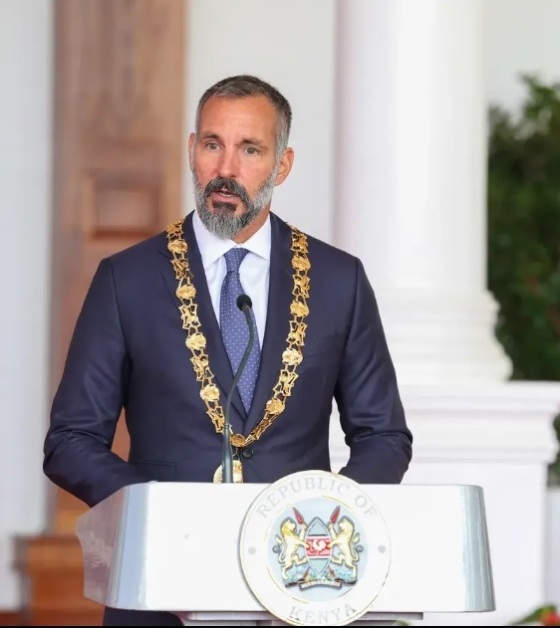
Mawlana Shah Rahim Al Hussaini, His Highness the Aga Khan, commenced his visit to Kenya on Monday, October 25, 2025, at the invitation of Kenya’s President, William Ruto. On Tuesday, August 26, the Aga Khan was honoured with Kenya’s highest accolades at the State House, with the investiture by President Ruto of the Chief of the Order of the Golden Heart. Two significant agreements were signed at the State House: one to reaffirm the deep-rooted partnership between the Ismaili Imamat and the Government of Kenya; and another, a Memorandum of Understanding, to deepen cooperation on critical issues such as environmental conservation, climate change, urban rehabilitation and cultural heritage.
President William Ruto decorates His Highness the Aga Khan with the Chief of the Order of the Golden Heart at the State House in Nairobi, August 26, 2025. Photograph: AKDN / Akbar Hakim.
The moment that Ismailis had been eagerly anticipating finally arrived on Wednesday, August 27, as their beloved Imam, the bearer of the Noor (Light) of Imamat, blessed them with a Didar (lit. glimpse). This unique moment was filled with overwhelming joy and happiness as the Imam’s blessings and guidance for their well-being and progress were bestowed upon them. Our sister website, Barakah, diligently followed this historic visit, providing regular updates on all the events that unfolded. Please click Barakah – His Highness the Aga Khan in Kenya.
Date posted: August 26, 2025. Last updated: August 28, 2025.
After having featured twenty-nine English books authored by Ismailis since the inception of our special series Books by Ismaili Authors in 2021, we present for the first time a Gujarati book that provides insight into an Ismaili Institution of the early 20th century, the Recreation Club. The author, Chhotubhai Khanderia, lovingly known as CNK, a native Gujarati speaker, has also made it available as a downloadable PDF file, ensuring easy access for our readers. We are pleased to feature his work in the series.
We call Ismaili authors worldwide to highlight their books in our continuing series by submitting their responses to our standard set of questions — please see details HERE. For any queries, please email Malik at mmerchant@simerg.com.
Interview with Chhotubhai Khanderia
Simerg: What constitutes your book Recreation Club Institute: History and Illustrated Glimpses of Service Holders? Why would you want me to read it, and what will we learn from it?
Chhotubhai Khanderia: My book “Recreation Club Institute: History and Illustrated Glimpses of Service Holders” is a significant contribution to the history of the Ismaili community. It chronicles its early days, from the Recreation Club to the Ismailia Association in the 1950s, which is now known as the Ismaili Tariqah and Religious Education Board (ITREB).
The Recreation Club had a glorious history that our beloved 48th Imam, Mawlana Sultan Mahomed Shah, nurtured through instruction and guidance. The book also includes glimpses of members of the Jamat who served in the institution in the early years from 1901 to 1925, and made unparalleled contributions. As many as 45 missionaries who were recorded in the pages of history during the period of the Imam have presented their illustrious service. After that, during the 68 years of the Imamat of Mawlana Shah Karim, the institution, which had been renamed as the Ismailia Association before his Imamat, made unparalleled progress that we can all be proud of. And after the promulgation of the 1986 Constitution, the institution was renamed as the Ismaili Tarqiah and Religious Education Board. Many new institutions were created, strengthening the Ismaili institutional structure and making it uniform around the world.
One of the aims of this book is to provide insights into the vast work done by missionaries. The larger aim is for the Ismaili community to become familiar with the history of the institution and to gain a deeper understanding of the services of many who served the Society.
Simerg: What is behind the name and title of the book?
CNK: The book’s title acts as a window into the illustrious history of the Institute and a bridge, connecting the Jamat to the lives of the organization’s early foundation service members. These members, such as Waris Ismail Mohammad Jafar, Huzur Wazir Ali Muhammad Rehamtullah Macklay, Mukhi Lalji Devraj, Virji Premji Parapiya, Master Hashim Bogha, Manji GulamHussain Padamshi, and Alijah Wali Muhammad Nanji Hudda, are brought to life through the book’s pages. Moreover, the book is a treasure trove for those interested in the organization’s history, as it acquaints readers with the brief biographies of 210 Ismaili missionaries, who are known today as Alwaez.
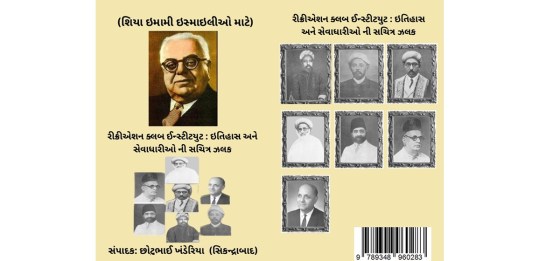
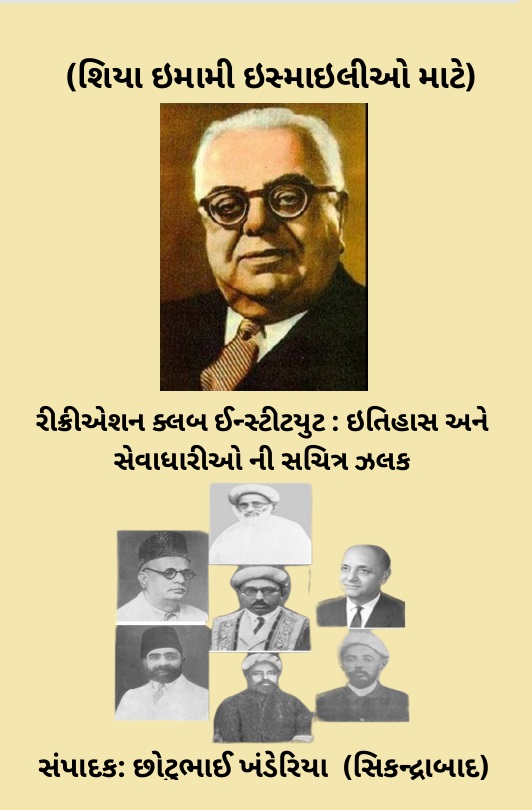
Cover page of “Recreation Club Institute: History and Illustrated Glimpses of Service Holders” by Chhotubhai Khanderia, self-published, July 2025, 222 pages. Please click on the image to download the PDF version of the book.
Simerg: How can I purchase this book?
CNK: The hard copy of the book is available upon request by writing to me at cnkhanderia@gmail.com. However, I have made an electronic copy available as a PDF file, which can be downloaded HERE (or by clicking on the image above). The book is entirely self-funded and self-published by me.
Simerg: Did you hire an editor or designer, or did you do all the work yourself?
CNK: I hired a graphic designer to work on the layout and the formatting of the book.
Simerg: What inspired you to do this important work?
CNK: The practice of daw’a in the Ismaili community was pioneered centuries ago by the Ismaili Dais, Pirs and Sayyids. In later centuries, the Ismaili missionaries took on the responsibility of imparting religious and moral education to the Jamat in a unique way, under the careful guidance of the Imam-of-the-Time. Their service, which has left an indelible mark on the Ismaili community, is a significant part of our history, recorded in various books and on websites. The material that I came across encouraged me to collect, consolidate and include information about our unsung missionaries.
Story continues below
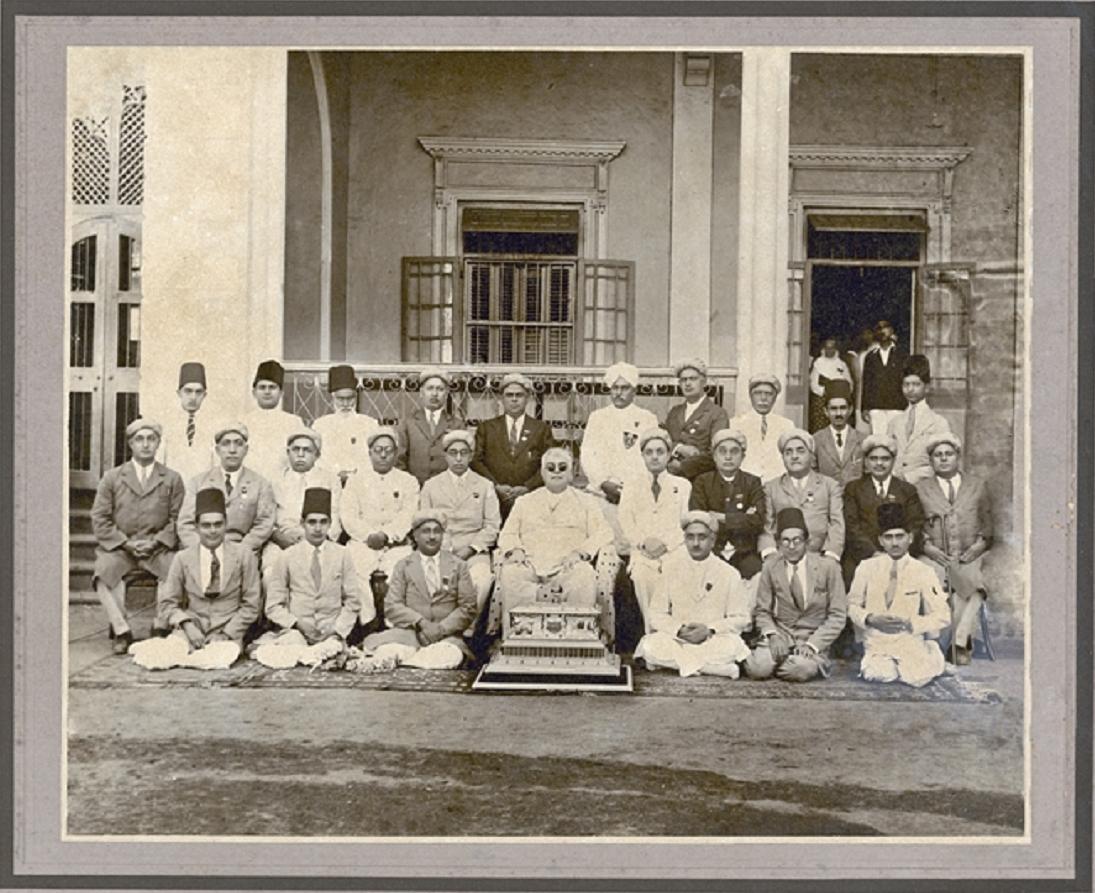
March 1936: This photo was taken in India on the occasion of the presentation of a casket by a group of Ismaili missionaries to His Late Highness Aga Khan III to mark the occasion of his Golden Jubilee. The casket, a symbol of respect and honour, was created and donated by ‘Senior’ Missionary Alijah Moloobhai Allarakhia Jangbarwalla. Unless otherwise noted, we may assume that all the persons in the photograph are missionaries. STANDING BACK ROW Left to right: Noorali Bandali, Gulamhusein Juma, Sayyed Mohamed Shah, Jaffer Jivan, Alidina Mamu, Ebrahim J. Varteji, Tajjar Mukhi Mohamed, Damji Velji, Abdulla Esmail and Badrudin Nurmohamed. SEATED ON CHAIRS Left to right: Meghji Maherali, Husseini Pirmohamed, Alijah Moloo Allarakhia (Donor of Casket), Chief Secretary Gulamhusein Virjee, President Alimohamed R Maklai, HIS LATE HIGHNESS THE AGA KHAN III, President Alijah Esmail Mohamed Jaffer, Finance Secretary Tarmohamed Ravji, Alijah Sabza Ali Ramzanali, Jamal Virji and Hamir Lakha. SEATED ON CARPET Left to right: Kassamali L Wadiwalla, Amirali Khudabaksh, Hajimohamed Fazalbhai, Mahmed Muradali, Madatali Rahemtullah Rajan and Juma Jiwa. Photo: Late Ameer Janmohamed Collection, London, UK.
Simerg: How long did it take you to complete your monograph?
CNK: The idea to write the book came in 2021. While reading an article on Simerg, I came across a picture of Imam Sultan Mahomed Shah with the missionaries taken in 1936. In that picture, the Imam was presented with a casket in 1936 to mark his Golden Jubilee. When I curiously started searching for the history of those missionaries, I found the history of about 40 missionaries online, and I consolidated it. Then it expanded to include more missionaries who were in different regions worldwide, creating a global narrative that spans India, Pakistan, Kenya, Tanzania, Uganda, the USA, Canada, the UK, and the UAE. As the famous saying goes: ‘मैं अकेला ही चला था जानिब-ए-मंज़िल मगर, लोग साथ आते गए और कारवाँ बनता गया’ (which roughly translates as ‘I started alone towards my destination, but people kept joining me and a caravan started forming’). This journey of discovery and collaboration, which is described in the book in more detail, transformed a mere idea into a comprehensive account of missionary history. After I had gathered all the information, I passionately began to develop the book in April 2025 and completed it in three months.
Simerg: Tell us something more about your book
CNK: The cover page was specially chosen, with our beloved 48th Imam as the primary focus. He laid the foundation of the Recreation Club. The cover page also includes portraits of some prominent leaders of the Club.
This is the first edition of the book, and your feedback could shape its future. If you find errors in the factual information, please let me know, and I will incorporate the corrections in the next edition. This will ensure the accuracy of the book. Some missionary biographies are brief — one-liners in some instances. I am particularly interested in including more details about their contributions to the Jamat. I would be deeply grateful if the surviving missionaries or members of their families could send me brief profiles for inclusion in the revised edition. Finally, I wish to say that while readers may use Google to translate the PDF Gujarati book into English, I intend to make the book available in English.
Date posted: August 20, 2025.
______________
About the author: Mr. Chhotubhai Khanderia, fondly known as CNK, was born in Porbandar, Gujarat. He pursued a Diploma in Civil Engineering and began his government service in 1981, supervising the repair and maintenance of government buildings, roads, bridges, and new constructions. In the Ismaili community, he has held numerous voluntary positions since 1977, which have left a lasting impact: he has served as a secondary level religious instructor, a local board member in ITREB, a regional member in the Youth and Sports Board, a secretary in the Ismaili Council, a regional chair in the Southern Saurashtra Social Welfare Board and ITREB, and as Mukhi of Majlises (special gatherings). His services were recognized with the title of Alijah by Mawlana Shah Karim, His Late Highness Aga Khan IV. Chhotubhai currently resides in Secunderabad, India, as a retired serviceman. He can be reached at cnkhanderia@gmail.com.
~~~~~~~~~
Links to the Ismaili Authors’ Series (in chronological sequence, oldest article first)
Before departing this website please take a moment to review Simerg’s Table of Contents for links to hundreds of thought provoking pieces on a vast array of subjects including faith and culture, history and philosophy, and arts and letters to name a few. Also visit Simerg’s sister websites Barakah, dedicated to His Highness the Aga Khan, and Simergphotos. Simerg’s editor Malik Merchant may be reached via email at mmerchant@simerg.com. You can also stay updated by following Malik on Facebook, X, and LinkedIn.
Inna lillahi wa inna ilayhi raji’un “Surely we belong to God, and to Him we return” — Holy Qur’an, 2:156
“Life is a great and noble calling, not a mean and grovelling thing to be shuffled through as best as we can but a lofty and exalted destiny.” — Mawlana Sultan Mahomed Shah, His Highness the Aga Khan III (1877-1957), 48th Ismaili Imam.
My attention to the news of the tragic death of several Ismaili youth volunteers was first drawn by a UK-based friend who sent me death announcements posted on Mustak Hasham’s website, Ismaili Death & Funeral Announcements. Mustak, a dedicated individual, began this service years ago through his Facebook page, which was featured in Simerg HERE. He has since established a dedicated website which posts death, mafi (forgiveness), samar and zyarat (special prayers for the deceased) announcements that he is made aware of from around the world.
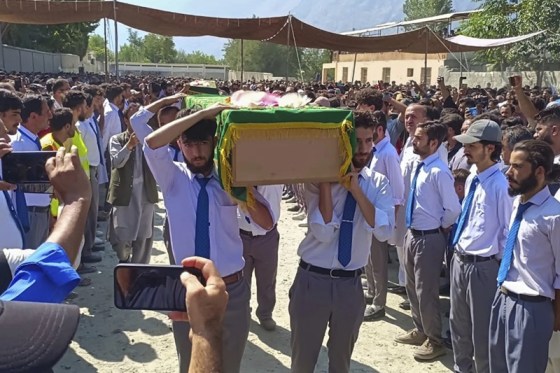
Seeking to learn more about the tragedy, I came across an ABC News report from the Associated Press (AP) that led me to the AP news website. The report includes a photograph (see below) of the funeral procession, where Ismaili volunteers in their uniforms are seen carrying the caskets of the deceased through a vast crowd, united in grief, with Ismaili volunteers lining the funeral route.
Story continues below after photo and video
A vast crowd of mourners observes funeral prayers of volunteers killed in a massive mudslide when they were repairing a drainage channel damaged by flash floods in Gilgit in Northern Pakistan, Monday, August 11, 2025. Volunteers line up the route as their fellow Ismaili volunteers carry the caskets of the deceased volunteers. Photograph: AP Photo / Abdul Rehman. Please click AP: Massive mudslide kills 7 volunteers repairing flood damage in northern Pakistan, or on the photo for the report of the tragedy.
~~~~~~~~
WATCH DAWN NEWS REPORT VIDEO (in Urdu)
A further inquiry into the tragedy and details of individuals who died led me to a Reddit post by Khalid Ansari, a graduate of the Graduate Programme in Islamic Studies and Humanities (GPISH 24) at the Institute of the Ismaili Studies, London. Originally a resident of Danyore and of Hunzai descent, he currently lives in London. Khalid, along with a group of friends, has united in the face of this tragedy to create a GoFundMe page, Support Families of Ismaili Volunteers Who Lost Their Lives. I am posting their full announcement — with minor reformatting for clarity — which reads as follows:
ANNOUNCEMENT BY KHALID ANSARI AND FRIENDS
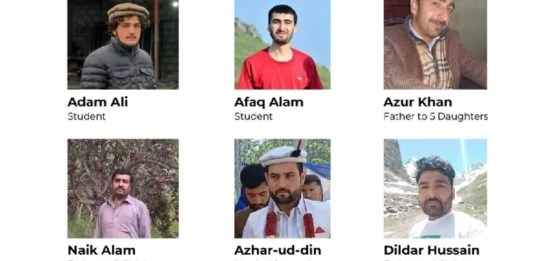
Photos of seven of eight Ismaili volunteers who were killed in a mudslide in Northern Pakistan, left to right: Azur Khan (father to 5 daughters); Afaq Alam (student); Azhar-ud-din (married two months ago); Adam Ali (student); Naik Alam (father to 2 children); Dildar Hussain (father to 4 children); and Piyar Ali (married, no children). Missing in the collage Abdul Karim (married with 3 children). Photograph: via Ismaili Death & Funeral Announcements. Click on photo for enlargement..
On August 11 2025, tragedy struck in Danyore, Gilgit-Baltistan, Pakistan. Eight dedicated Ismaili volunteers were working selflessly to restore a vital water channel for their community when disaster claimed their lives.
We remember and honor:
Adam Ali — Student, full of potential and dreams for the future;
Afaq Alam — Student, passionate about serving his community;
Azur Khan — Father to 5 daughters, the sole provider for his family;
Naik Alam — Father to 2 children, working tirelessly to support them;
Azhar-ud-din — Newly married just two months ago, with a life ahead of him;
Dildar Hussain — Father to 4 children, devoted to both family and service;
Piyar Ali — Married, with no children, always ready to volunteer when needed; and
Abdul Karim — Married, with three children; he is missing in the photo above.
They were not just volunteers; they were fathers, sons, brothers, the sole breadwinners of their families. In serving others, they made the ultimate sacrifice. Today, their loved ones face unimaginable grief and financial hardship. By coming together, we can ensure these families are not left alone in their struggle.
Your donations will go towards:
Immediate financial support for the affected families
Covering essential living costs such as food, shelter, and utilities
Supporting children’s education and long-term needs
Please note that the funds will be distributed to the families based on their specific needs and urgencies.
Every contribution, no matter the size, will be a lifeline. Your generosity will honour their service, preserve their dignity, and provide hope for the future. Please donate and share this campaign so that their sacrifice is never forgotten and their families are cared for in their time of need.
I am Khalid Ansari, a graduate of the Graduate Programme in Islamic Studies and Humanities (GPISH 24) at the Institute of the Ismaili Studies, London. I am a resident of Danyore by origin, of Hunzai descent, and currently living in London. My social media accounts are linked to my profile. This fundraiser is initiated by a close group of friends, mainly Aga Khan Higher Secondary School Gilgit graduates living abroad, to support the families of the deceased.
For those donors who want to donate from within Pakistan you can do so on the account below:
Bank: Habib Bank Limited; Acc name: BAALAJ PK34HABB0008967901262103
If you need additional context or clarification, you can reach out to me via WhatsApp at +44 7751 559195. You can also reach out to the co-organizer, Adnan Karim at +44 7735 110702, Hassan Ali Shah at +44 7435 930559, Nadir Abbas at +44 7736 662233 and Mir Balaj at +44 7450 874130.
~~~~~~ END OF ANNOUNCEMENT ~~~~~~
As we express our deep shock and sadness at this tragedy, we reflect on the quote of Mawlana Sultan Mahomed Shah at the top of this post about the meaning of life — “a great and noble calling.” We pay our heartfelt respect and tribute to the eight individuals who, in the service of their community, demonstrated the highest form of nobility. We pray for the eternal peace and rest of their souls and that their families and friends find the courage and fortitude to face the loss of their beloved ones.
Inna lillahi wa inna ilayhi raji’un. Ameen.
Submit your tributes and condolence messages
We invite readers to submit their condolences, memories and tributes to the eight Ismaili volunteers who met a tragic death repairing a drainage channel damaged by flash floods in Gilgit in Northern Pakistan. Please click LEAVE A COMMENT. If you encounter technical difficulties submitting your feedback, email your message to mmerchant@simerg.com, subject: Ismaili volunteers.
The 50th Hereditary Imam of the Ismaili Muslims, His Highness Prince Rahim Aga Khan — respectfully addressed as Mawlana Hazar Imam (our Lord, the present Imam) by the Ismailis — made history as he, in his capacity as the new Imam of the worldwide community, met his followers for the first time during his historic visit to France from July 10-13, 2025. The Ismailis refer to this encounter or sight of the Imam as Didar. These are rare and epic moments in the life of every Ismaili, and the visit to France and his visits to Ismailis worldwide in the coming year will be remembered as a significant milestone in Ismaili history.













 Simerg - Insights from Around the World