Simerg is an independent initiative dedicated to Ismaili Muslims, the Aga Khan — their Hereditary Imam — and the Ismaili Imamat, and Islam in general through literary readings, photo essays and artistic expressions
Established in 2018 by His Late Highness Prince Karim Aga Khan IV and his brother, Prince Amyn Aga Khan, the Aga Khan Music Awards (AKMA), held every three years, are under the governance of an Advisory Council, which is co-chaired by the 50th Hereditary Imam of the Ismaili Muslims, Mawlana Hazar Imam, His Highness Prince Rahim Aga Khan, and his uncle, Prince Amyn Aga Khan.
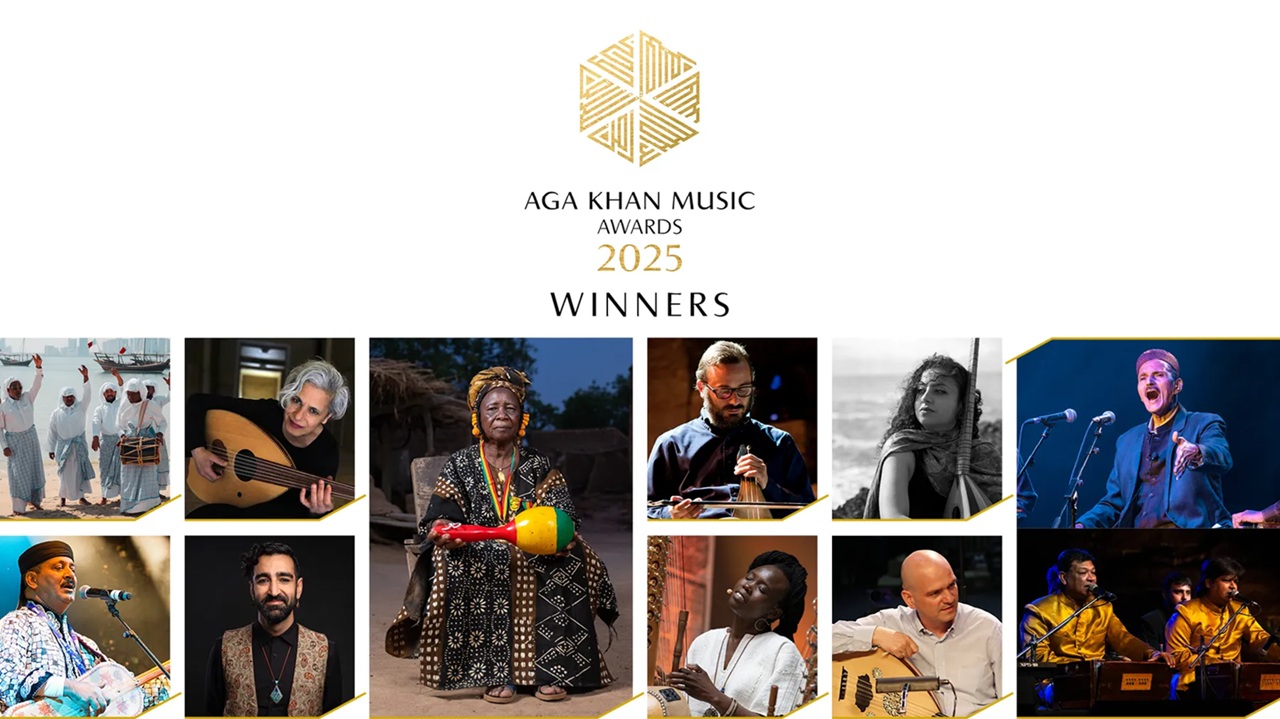
Please click on the image for the winners of the 2025 Aga Khan Music Awards.
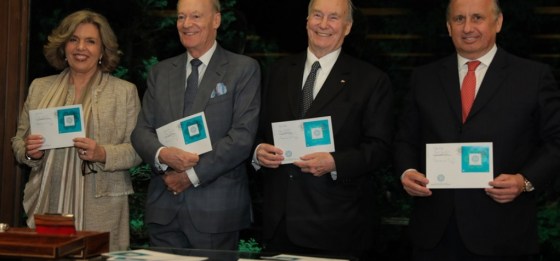
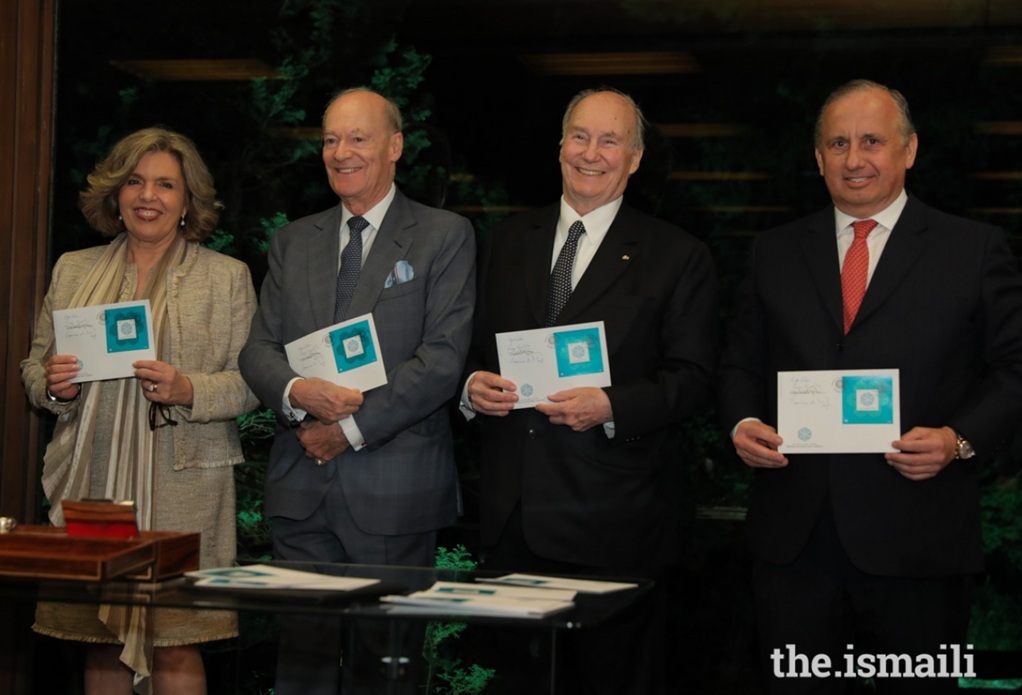
The photograph captures Mawlana Shah Karim, His Late Highness Aga Khan IV, with his brother, Prince Amyn, and Isabel Mota, President of the Calouste Gulbenkian Foundation (left), and Raul Moreira, Head of Philately at CTT (right). They are holding signed first-day covers of the commemorative stamp to celebrate the 2019 Aga Khan Music Awards. The stamps were unveiled on March 29, 2019, by Francisco Lacerda, the CEO of CTT (Portugal Post). Photograph: The Ismaili / Akbar Hakim.
~~~~~~~~
2022: MUSCAT, OMAN
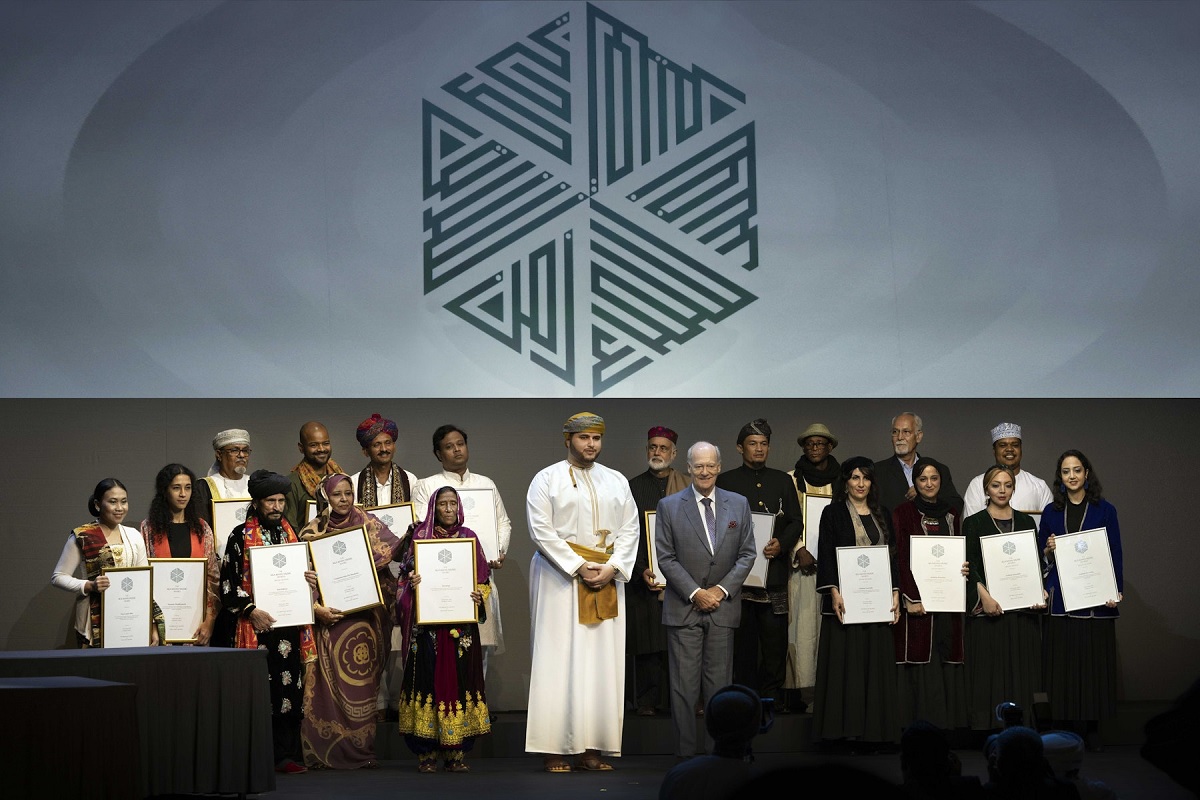
Prince Amyn Aga Khan, younger brother of His Late Highness Aga Khan IV, and His Highness Sayyid Bilarab, preside over the presentation of the 2022 Aga Khan Music Awards in Muscat, Oman, October 30, 2022. Photograph: Akbar Hakim / AKDN.
2025: LONDON, ENGLAND
For the first time, the 2025 Aga Khan Music Awards are teaming up with the EFG London Jazz Festival and Southbank Centre to bring an extraordinary programme of concerts, collaborations, and award celebrations to the UK. This unique partnership is a testament to AKMA’s unwavering vision of excellence in world traditions.
For programming details over four days, November 20-23, 2025, please visit the EFG London Jazz Festival website and scroll down for more information and tickets.
The first day’s program on November 20, with two performances at 1 pm and 9 pm London time, will be held at the Ismaili Centre, London, and will be transmitted live on The Ismaili TV.
Viewers worldwide will be able to watch the live coverage as follows:
1 pm and 9 pm (London)
5am and 1pm (Vancouver);
7am and 3pm (Houston);
8am and 4pm (Toronto);
2pm and 10pm (Paris);
4pm (Nairobi); and
6pm (Karachi).
The winners will be celebrated on November 21 and 22, at London’s Southbank Centre, in an awards ceremony forming part of the four-day festival.
Date posted: November 19, 2025.
Note: A version of this post appears on Barakah, our sister website dedicated to His Highness the Aga Khan.
The Institute of Ismaili Studies (IIS) in London, England, was established by Mawlana Hazar Imam, His Highness the Aga Khan, the 49th Hereditary Imam of the Ismaili Muslims, on December 13, 1977. For more than 45 years, the IIS has sought to promote scholarship and learning on Islam in historical and contemporary contexts and contributed to a better understanding of Islam’s relationship with other societies and faiths.
The Institute has also dedicated a significant amount of time and resources to studying the history of the Ismaili branch of Islam in all its aspects, including its intellectual, scientific, artistic and commercial activities. The Ismaili Imams ruled over vast territories such as the Fatimid Empire in North Africa and Egypt and the Nizari Ismaili state of Iran and Syria during the Alamut period. Under the Fatimid rule, the Ismailis created one of the world’s oldest learning seats, the Al-Azhar University in Cairo; today, the university is a major Sunni institution.
The IIS’s research and publications, led by both Ismaili and non-Ismaili scholars, have had a profound impact over the past 30 years. They have fundamentally reshaped the perception of Ismailis, who, for centuries, were primarily understood through the lens of works by medieval heresiographers and polemicists, who were generally hostile towards Shias and particularly the Ismailis.
Story continues below
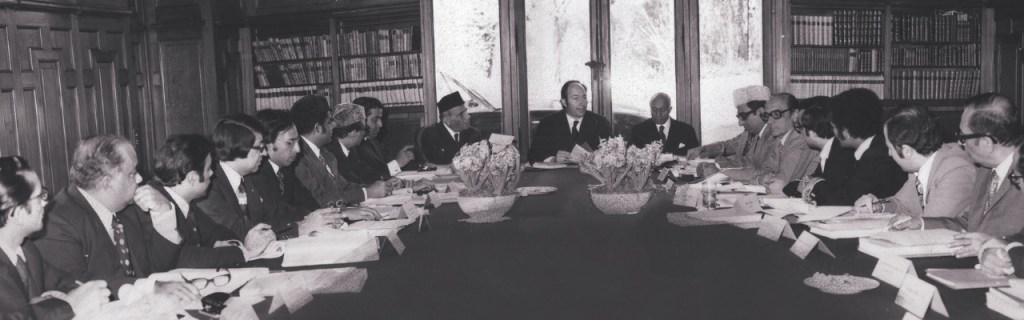
Mawlana Hazar Imam, His Highness the Aga Khan, met with leaders of the Ismailia Association and Ismaili scholars in April 1975 in Paris. A decision was taken at the world conference to establish the Institute of Ismaili Studies. Photo: Ilm magazine, October 1975.
Aside from research papers, scholarly publications and participation in essential conferences worldwide, the IIS has conducted significant programmes such as the Waezeen and Teacher Education Programme (WTEP), the advanced curriculum-planning programme with the University of London’s Institute of Education, the joint IIS-McGill University programme, the Graduate Programme in Islamic Studies and Islamic Humanities (GPISH), and the Secondary Teacher Education Programme (STEP). Some eight hundred individuals have graduated from IIS’s educational programmes since the Institute began receiving postgraduate students in 1980.
Story continues below
Professor Zayn Kassam, the current director of the Institute of Ismaili Studies, presents the inaugural IIS Alumni Recognition Award to Professor Karim H. Karim during the IIS’s 2024 graduation ceremony, March 23, 2024, at the Ismaili Centre in London. Photograph: Farid Daya.
Several IIS alumni have made remarkable achievements in different parts of the world. On March 23, 2024, the IIS had its first ever Alumni Recognition Award at the Ismaili Centre in London, UK, during its 2024 graduation ceremony.
The Award celebrates those who have demonstrated a career of exceptional service and leadership. A panel of senior management and academics from the AKDN and IIS reviewed the nominations for the Award and selected Professsor Karim H. Karim as the recipient of the First Award based on the following primary criteria:
Professional or Academic Accomplishment: Achieved a high degree of prominence and leadership in their respective field, which may or may not be directly relevant to the work of the IIS.
Contributions to Community Service: Distinguished service to their professional or faith community.
Professor Zayn Kassam, the Institute’s current director, presented the inaugural Award to Professor Karim.
~~~~~~~~
Citation Honouring Karim H. Karim on Being the First Recipient of the IIS’s Alumni Recognition Award
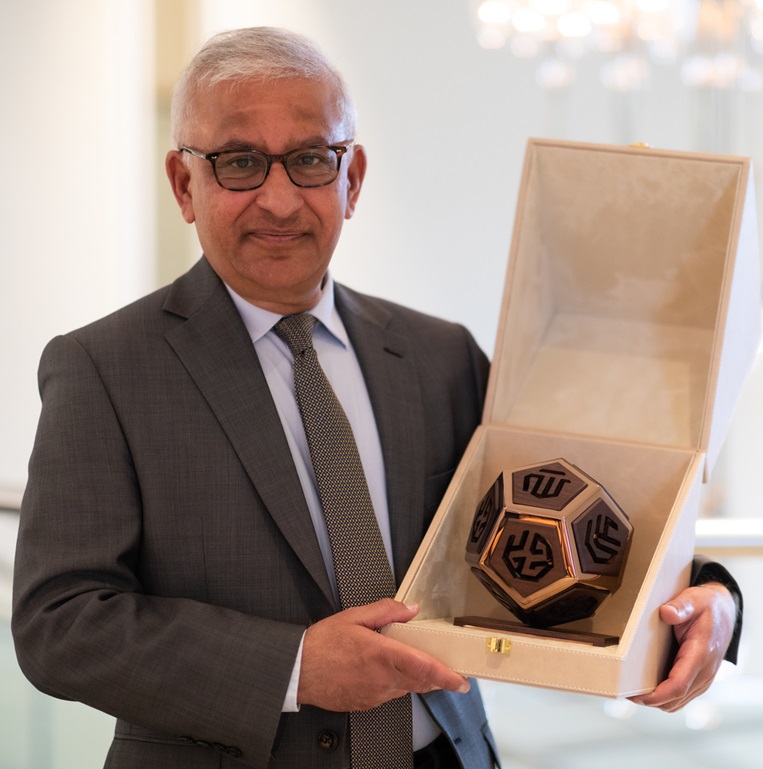
Professor Karim H. Karim holding the first Alumni Recognition Award that was presented to him by the Institute of Ismaili Studies on March 23, 2024, at the Ismaili Centre London. The sculpture was designed by Mohammed Adra (AKDN Geneva) and is inspired by (Late) Karl Schlamminger’s Hepta Globe sculpture, which is placed at the entrance of the Aga Khan Centre in London. Photograph: The Institute of Ismaili Studies via Karim H. Karim.
The citation for the award read as follows:
“Professor Karim has an extensive record of over three decades of scholarship, service, and leadership. His designation as Chancellor’s Professor is the highest honour given by Carleton University for scholarship of outstanding merit with substantial international impact, research leadership and continued active participation in the development of research excellence. Professor Karim has a worldwide reputation as a leading scholar of media representations of Muslims and diasporic communications. He has had visiting appointments at Harvard, Aga Khan, and Simon Fraser universities. Professor Karim has delivered keynote addresses in several countries and his critically acclaimed publications are cited widely. He was the inaugural winner of the Robinson Book Prize and has received media coverage in six continents.
“Dr. Karim has served as Director of Carleton’s renowned School of Journalism and Communication and its Centre for the Study of Islam, respectively. He was also the Institute of Ismaili Studies’ first alumnus to lead it in a directorial capacity. He spearheaded founding initiatives on Accessibility to Digitized Collections and the Canadian Race Relations Foundation as a Senior Policy Officer in the Canadian Government, which endowed him with awards for exceptional public service and for fostering collaboration between ethno-religious communities.
“Karim has an extensive record of international service to academic, community, government, and civil society institutions, including Aga Khan University (Kenya) and Central Asian University; AKDN Higher Education Forum; Canadian Parliamentary Committees and government boards; and Ismaili community organizations (Kenya, USA, and Canada). He has also held an International Ismaili Studies Conference at Carleton University; founded a prize for research in Ismaili Studies’ understudied aspects; and has been a mentor and external Ph.D. examiner for IIS alumni.”
We take this opportunity to congratulate Professor Karim on his accomplishments over the past several decades and on receiving the First Alumni Recognition Award from the Institute of Ismaili Studies. We are proud to have published several of his pieces on our websites (follow the links below).
Below are excerpts from his acceptance speech upon receiving the IIS’s inaugural Alumni Recognition Award.
“Let the Truth Infuse Your Words”
Professor Karim H Karim delivering his remarks on March 23, 2024, at the Ismaili Centre in London upon being presented Inaugural Alumni Recognition from the Institute of Ismaili Studies. Photograph: Institute of Ismaili Studies via Karim H. Karim.
By KARIM H. HARIM March 23, 2024, Ismaili Centre, London
Bismillahir-Rahmanir-Rahim.
I would like to thank the Institute of Ismaili Studies for selecting me as the recipient of its inaugural Alumni Recognition Award. This is a profound honour, which takes me back 40 years when I was a student at the IIS. This beautiful building, the Ismaili Centre London, was under construction at that time.
Congratulations to all the GPISH and STEP students who have graduated today. You carry enormous potential and promise. Allow me to speak about an event in my life that underlined the long-term impact that an individual can have. I attended the funeral of Professor Amin Amershi, a mathematician, two weeks ago in Vancouver. He taught me one class as a guest lecturer in a religious class in Nairobi, when I was 12 years old. It was a singular experience that opened my mind and sparked my imagination because his explanations had the ring of truth. I have found it remarkable that I continue to think about his ideas some 55 years later. You, too, have the potential of a long-lasting impact that will span decades and range as far into the future as the 22nd century. Let the truth infuse your words.
As you may know, our tradition adopted the name “Ismaili” in the early 20th century. Prior to that it was called Da’wat al-Haqq — which means Invitation to Truth, Summons to Truth, or Mission of Truth. In India, the Pirs named it Satpanth — Path of Truth or the True Path. Our aspiration is to have truth manifest our worldview and actions. It underpins our ethical outlook.
We are thrown many challenges throughout our lives. We face success, failure, joy, and frustration. The organizations that we work for pressure us to get the job done and we are often tempted to take shortcuts in order to fulfill expectations. But this is where critical thinking, which you have discussed extensively in your studies, becomes pertinent. How does one balance the imperative to get the job done, on the one hand, and remain ethical, on the other? His Highness the Aga Khan, Mowlana Hazar Imam, instructed the community’s leaders at a gathering in the United States in 1986, that “we will ask the hard questions.” Fulfilling your tasks ethically is one of the hard issues that you will face constantly in your careers.
Let the truth infuse your words, your music, your art, and your actions as you go ahead to fulfill your potential and promise.
Date posted: April 17, 2024.
______________
Featured image at top of post: Professor Zayn Kassam, the current director of the Institute of Ismaili Studies, presents the inauguralIISAlumni Recognition Award to Professor Karim H. Karim during the IIS’s 2024 graduation ceremony, March 23, 2024, at the Ismaili Centre in London. Photograph: Farid Daya.
The following are links to articles by Karim H. Karim published in Simerg and its sister websites:
Recently, I had the immense pleasure of meeting and having a delightful lunch at Vancouver’s well-known Jambo Grill with (Itmadi) Farouk B.K.S. Verjee who was the President of His Highness the Aga Khan Shia Imami Ismaili Council for Canada during the 1980’s. During his term of office, he witnessed the opening of two major Ismaili Centres in the Western World, including one in his own jurisdiction in Canada, the Ismaili Jamatkhana and Centre located in Burnaby, British Columbia. He was, as Canada’s President, very much involved in every phase of the planning, construction, completion and opening of the magnificent Burnaby icon which was designed by Canadian architect Bruno Freschi.
Presidents of National Ismaili Councils around the globe are often invited to major functions and projects related to the Ismailis and the Ismaili Imamat, as community representatives for their respective countries, and Farouk Verjee was present for the historic opening of the London Ismaili Centre from which the following anecdote, with photo, is published.
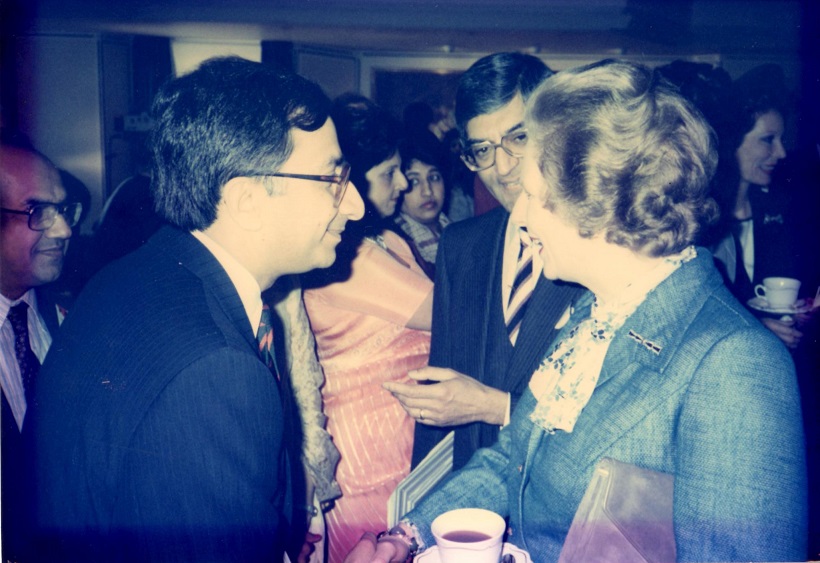
Farouk Verjee, left, with Baroness Margaret Thatcher (1925 – 2013) at the opening of the iconic Ismaili Centre in London, England, on April 24, 1985. Looking on in the centre is Anil Ishani, then President of the Ismaili Council for the UK. Photo: Farouk Verjee Collection, Vancouver, Canada.
After being introduced to the late Baroness Margaret Thatcher by His Highness the Aga Khan, Verjee told her that the Ismaili Centre in Burnaby was nearing completion and that it would be opening in the coming summer, and he hoped she would visit it on her next visit to British Columbia. She asked, “Which is the better building?” Farouk replied that one was a Cadillac and the other a Rolls! In a typical British fashion, the Baroness quickly responded, “I hope this one is the Rolls!.” Verjee found the Baroness to be a very amicable person.
The Ismaili Centre and Jamatkhana in Burnaby was opened a few months later in the same year on August 23 by the then Canadian Prime Minister Brian Mulroney in the presence of His Highness, Premier Bill Bennett of the Province of British Columbia and other dignitaries including members of the Aga Khan’s family. Mawlana Hazar Imam, as His Highness is addressed by members of his community, designated the new Ismaili Jamatkhana as the Darkhana of Canada at a gathering of some 20,000 Ismailis on the same day at BC Place.
It may be of interest to note that Itmadi Farouk Verjee’s father was Kamadia of the London Jamat with Janmohamed Verjee as Mukhi. They were appointed to their positions in a talika (a written message) from Imam Sultan Mahomed Shah, His Highness the Aga Khan III (1877 – 1957), the 48th Imam of Ismaili Muslims, which is dated April 10, 1936. The newly appointed Mukhi and Kamadia were law students in the U.K. at that time. Janmohamed Verjee was the father of Amir Bhurio a well-known personality in the UK Ismaili community.




 Simerg - Insights from Around the World