Simerg is an independent initiative dedicated to Ismaili Muslims, the Aga Khan — their Hereditary Imam — and the Ismaili Imamat, and Islam in general through literary readings, photo essays and artistic expressions
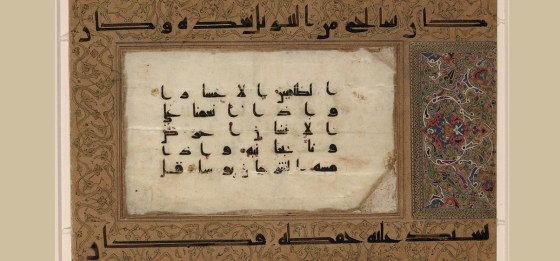
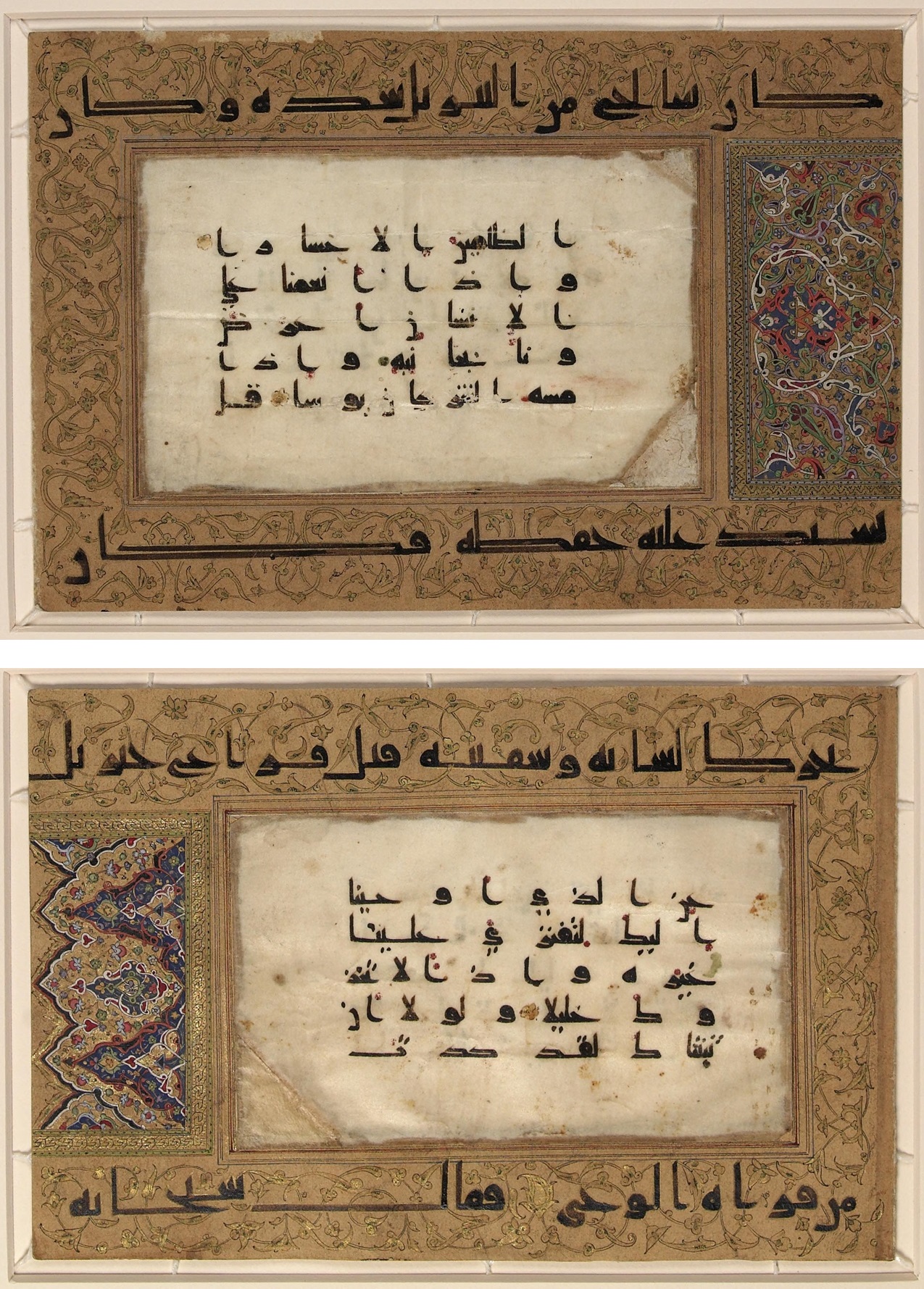
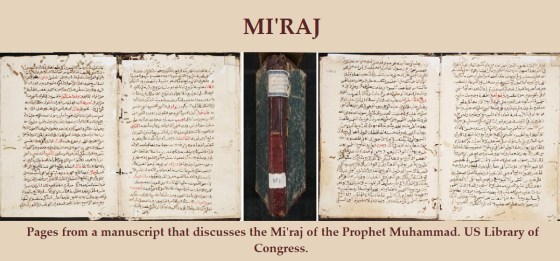
Chapter 17 of the Holy Qur’an known as Suraj I-isra (The Night Journey) or Bani Israel (The Children of Israel), describes several events, including the Prophet Muhammad’s (May peace be upon him and his progeny) night journey (Isra’) to Jerusalem and his ascension (Mi’raj) through the skies. The two fragments from the USA Library of Congress (LOC) shown in this post below are from Chapter 17, Verses 73-84, and describe the value of prayer and the Qur’an. These Qur’anic fragments are written in Kufi script on parchment. In-depth details of these fragments can be found on the LOC website HERE.
We present pertinent verses from the Qur’an on the night of Mir’aj and prayer, followed by a brief explanation of the holy night and its significance among the Shia Ismaili Muslims.
Verses from Suraj I-isra
Glory be to Him, who carried His servant by night from the Holy Mosque to the Further Mosque the precincts of which We have blessed, that We might show him some of Our signs. He is the All-hearing, the All-seeing — 17:1
Say: ‘Call upon God, or call upon the Merciful; whichsoever you call upon, to Him belong the Names Most Beautiful.’ And be thou not loud in thy prayer, nor hushed therein, but seek thou for a way between that — 17:110
Perform the prayer at the sinking of the sun to the darkening of the night and the recital of dawn; surely the recital of dawn is witnessed — 17:78
And as for the night, keep vigil a part of it, as a work of supererogation for thee; it may be that thy Lord will raise thee up to a laudable station — 17:79
The Night of Miraj is observed by Muslims around the world on the 27th night of the seventh month of
And whosoever desires the world to come and strives after it as he should, being a believer — those, their striving shall be thanked — 17:19
Your Lord knows very well what is in your hearts if you are righteous, for He is All-forgiving to those who are penitent. — 17:25.
___________
Mi’raj among the Shia Ismaili Muslims: The Imam-of-the-Time Leads his followers to spiritual elevation
Qur’anic fragments written in Kufi script on parchment. Photograph: The US Library of Congress, Washington DC
The night of Mi’raj falls on the 27th day of Rajab, the seventh month in the Islamic lunar calendar, which is 11 days shorter than the Gregorian calendar. Thus, in 2025, Miraj falls on or around January 26 or 27, 2025, depending on when the moon was sighted.
Mi’raj is an Arabic word that literally means a ‘ladder’ and refers to an experience in the life of Prophet Muhammad during the night. Interpretations of the Mi’raj include a literal event in which the Prophet Muhammad first travelled to Jerusalem before mounting a horse called Buraq and being taken to God’s Throne. Along the flight, he met with the great Prophets, including Abraham, Moses, and Jesus (may peace be on them).
However, among Sufis and other Islamic esoteric traditions, such as those practiced by the Shia Ismaili Muslims, Mi’raj is considered the highest point of spiritual perfection an individual can attain through religion and the practice of faith.
Believers long to experience a Mi’raj, just as the Prophet experienced it. The Shia Ismailis seek out this spiritual elevation under the guidance of the Imam-of-the-Time, presently Mawlana Shah Karim Al-Hussaini Hazar Imam, His Highness the Aga Khan, who leads his followers to self-awareness, spiritual insight and elevation. This is clearly noted in the Preamble of the Ismaili Constitution in paragraph (F), which reads:
“Historically and in accordance with Ismaili tradition, the Imam of the time is concerned with spiritual advancement as well as improvement of the quality of life of his murids. The Imam’s ta‘lim lights the murid’s path to spiritual enlightenment and vision. In temporal matters, the Imam guides the murids, and motivates them to develop their potential.”
His Highness the Aga Khan, the 49th Hereditary Imam, is a direct descendant of Hazrat Ali (may peace be upon him) whose remarkable teachings, preserved in works such as Nahj al-Balaghah, have a profound impact on all Shia Muslims, including the Ismailis. Another literary work, known as the Kalam-i Mawla, poems of Imam Ali, is not just historical text but holds a personal relevance to the community members. These verses, rendered in Hindi, delve deep into individuals’ conduct, behaviour, and actions during their lives on earth (please read Farouk Topan’s excellent piece Kalam-i-Mawla).
We are pleased to provide a recitation of verses from the Kalam of Hazrat Ali that focus on ethics, spirituality and the Mi’raj of the Prophet Muhammad. The verses are recited by Alnoor Saleh and have been downloaded from the website Ginans Central, which is maintained by Karim Tharani of the University of Saskatchewan.
“The doors of goodness are many: enjoining good, forbidding evil, removing harm from the road, listening to the deaf, leading the blind, guiding one to the object of his need, hurrying with the strength of one’s legs to one in sorrow who is asking for help, and supporting the feeble with the strength of one’s arms.” And the Aga Khan has accepted this tradition of the Prophet Muhammad as a personal job description…Many prophets of the Bible recorded their prophetic lineage, just as Matthew and Luke in the New Testament stressed Jesus’s ancestry. In similar vein, His Highness the Aga Khan, is the 49th Imam directly descended from the Prophet Muhammad — Please click NOT ALL HEROES WEAR CAPES BY ANDREW KOSOROK.
~~~~~~~~~~~~
“We are receiving you here officially and not just as a friend because you are an important leader of the Muslim religion…What we admire in you is that you have been able to integrate a modern outlook with religion so that religion has been allowed its true role which is not merely to provide an all-embracing explanation of the universe but also to furnish the fundamental solutions of the problems which life poses us.” —Please click LEOPOLD SENGHOR’S TRIBUTE TO THE AGA KHAN.
“The love of the Imam knows no physical boundaries. No mountain, no river, no desert, can stop the love of the Imam for his Jamat [community] worldwide” — Mawlana Hazar Imam, His Highness the Aga Khan, 49th Hereditary Imam of Ismaili Muslims (please watch video, below)
From Prophet Muhammad’s declaration at Ghadir-e-Khumm, after his farewell pilgrimage to Mecca, appointing his son-in-law Ali as his successor to the present 49th Hereditary Imam of the Ismailis, we invite our readers to watch the following video to learn about the Ismaili Imamat. Each Imam, from the past to the present, has been a Guiding Light to his followers, a source of inspiration and guidance through their changing times and circumstances. We present this video as two Aga Khan projects in Canada, the Aga Khan Museum and the Ismaili Centre in Toronto, are about to celebrate their tenth anniversary in mid-September. The most recent project, the beautiful Aga Khan Garden near Edmonton, is part of the University of Alberta Botanic Garden and will soon mark its 6th anniversary in mid-October.
“God chose Adam and Noah and the House of Abraham and the House of Imran above all beings, the seed of one another; God hears, and knows” — Qur’an, 3:33-34, translation by A. J. Arberry, see Corpus Quranfor multiple translations
A calligraphy designed by Toronto’s Karim Ismail honouring the first Shia Imam Ali, on the auspicious commemoration of Idd-e Ghadir.
On Monday, June 24, 2024, Ismaili Muslims in Canada and other parts of the world will unite to observe and celebrate Eid-e Ghadir. This momentous occasion marks the pivotal gathering at Ghadir Khumm, where Prophet Muhammad (peace be upon him and his family) designated Hazrat Ali as his successor, the first in the continuing line of Hereditary Imams.
This historical event holds immense significance in the Ismaili faith. Today, the holder of the Hereditary position is Mawlana Hazar Imam, His Highness the Aga Khan, the 49th Imam in direct succession. In this regard, the Aga Khan has affirmed “that the Ismailis are the only Shia community who, throughout history, have been led by a living, hereditary Imam in direct descent from the Prophet” — His Highness the Aga Khan, Parliament of Canada, Ottawa, February 27, 2014.
History records that on the way back to Medina after performing the final pilgrimage to Mecca, the Prophet received a revelation:
“O Messenger, deliver [to the people] what has been revealed to you from your Lord, and if you do not do so, then you will not have delivered His message” Surah al-Ma’ida (5:67)
Upon receiving this revelation, the Holy Prophet stopped at an oasis known as Ghadir Khumm. He addressed a large gathering of Muslims who had accompanied him. The Prophet proclaimed: “Man kuntu mawlahu fa aliyyun mawlahu,” meaning: “He whose Mawla I am, Ali is his Mawla.” The Prophet then prayed: “O Allah, be a friend of whoever is his friend and extend your support to those who support him.”
This event, occurring at a crucial point in Islamic history, marked the transition of leadership from the Prophet to Hazrat Ali, setting the stage for the leadership and future of the Muslim community. Thus, by declaring Hazrat Ali Mawla after him, the Prophet transferred the spiritual authority bestowed upon him by Allah to Hazrat Ali, making him — and all the Imams that follow — the Amirul Mu’minin, or Master of the Believers. In this context, ‘Mawla’ refers to a leader, protector, and guide, indicating the profound responsibility and authority bestowed upon Hazrat Ali.
Article continues below following excerpts
________________________________
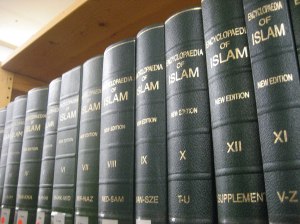
Excerpts from L. Veccia Vaglieri piece in Encyclopaedia of Islam, Second Edition
“Ghadir Khumm is famous in the history of Islam because of a sentence (or some sentences) in favour of ‘Ali which the Prophet uttered there during a discourse….Taking ‘Ali by the hand. he asked of his faithful followers whether he, Muhammad, was not closer to the Believers than they were to themselves; the crowd cried out: “It is so, O Apostle of God!”, he then declared. “He of whom I am the mawla, of him ‘Ali is also the mawla (man kuntu nawlahu fa-‘Ali mawlahu)
Photograph: Vysotsky – Own work, CC BY-SA 3.0, Wikimedia.
~~~~~~
“Most of those sources which form the basis of our knowledge of the life of the Prophet pass in silence over Muhammad’s stop at Ghadir Khumm….Consequently, the western biographers of Muhammad, whose work is based on these [Sunni] sources, make no reference to what happened at Ghadir Khumm. It is however certain that Muhammad did speak in this place and utter the famous sentence…the hadiths are so numerous and so well attested by the different isnads that it does not seem possible to reject them.” Vaglieri goes on to state that on instruction from Prophet Muhammad, Hazrat Ali received baiyat (the oath of allegiance) from the Muslims assembled there, including Umar b. al-Khattab, Islam’s second Caliph.
(Note: special access is required to read articles in the on-line edition of EI2. Vaglieri’s piece was reproduced in full in the UK Ismaili Association’s publication Ilm, December 1976, pages 28-30, with the permission of E.J. Brill, publishers of EI2.)
________________________________
Excerpts from the Preamble of the Ismaili Constitution
“In accordance with Shia doctrine, tradition, and interpretation of history, the Holy Prophet (s.a.s.) designated and appointed his cousin and son-in-law Hazrat Mawlana Ali Amiru-l-Mu’minin (a.s) to be the first Imam to continue the Ta’wīl and Ta’līm of Allah’s final message and to guide the murids, a term referring to the followers and disciples of the Imams. The proclamation also established the principle of the Imamat continuing by heredity through Hazrat Mawlana Ali (a.s) and his daughter Hazrat Bibi Fatimat-az-Zahra, Khātun-i-Jannat (a.s)”
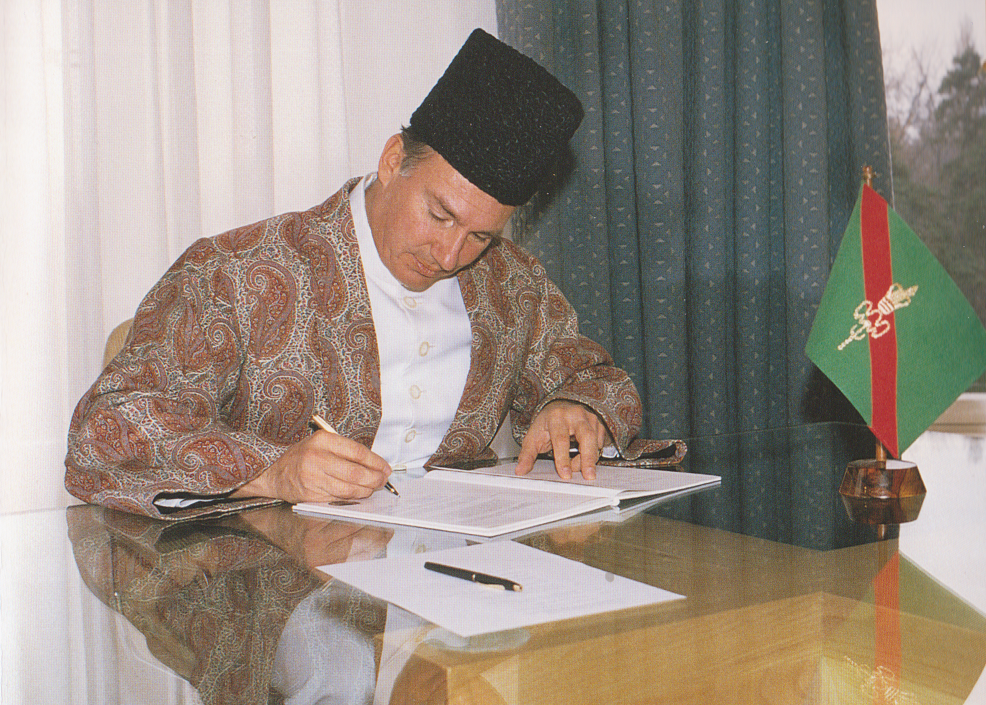
Mawlana Hazar Imam, His Highness the Aga Khan, is seen signing a new constitution for the worldwide Ismaili community on his 50th birthday, December 13, 1986. The preamble excerpts produced in this post are from this constitution.
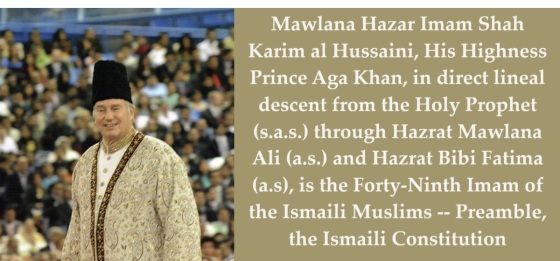
“Mawlana Hazar Imam Shah Karim al Hussaini, His Highness Prince Aga Khan, in direct lineal descent from the Holy Prophet (s.a.s.) through Hazrat Mawlana Ali (a.s.) and Hazrat Bibi Fatima (a.s), is the Forty-Ninth Imam of the Ismaili Muslims.”
________________________________
…. continued
On instruction from Prophet Muhammad, Hazrat Ali received baiyat (the oath of allegiance) from the Muslims assembled there. According to Shia traditions and sources, following the proclamation, the final verse of the Qur’an was revealed to the Prophet:
“On this day, I have perfected for you your religion, completed my favours upon you, and have chosen for you Islam as your religion.”
Eid-e Ghadir is an anniversary of profound significance to all Shia Muslims. It is also associated with the well-attested tradition that the Prophet is said to have proclaimed:
“I am leaving among you two matters of great weight (al-thaqalayn), the Book of Allah and my kindred (itrati), the People of my House (Ahl al-Bayt), and these two shall never be separated until they return to me at the Pool [of Kawthar in Paradise on the Day of Judgement]…”
The phrase ‘two matters of great weight’ refers to the Quran and the Ahl al-Bayt, emphasizing their inseparability and eternal significance in the Islamic faith.
In commemorating Eid-e Ghadir, the Ismaili community celebrates the seminal event of Ghadir Khumm, reaffirming their allegiance to the Imam of the Time as the direct lineal successor and inheritor of Hazrat Ali’s authority. The community is not just inspired, but united and driven by the following remark made during his speech in Canada’s Parliament on February 27, 2024:
“Today, the Ismailis are the only Shia community who, throughout history, have been led by a living, hereditary Imam in direct descent from the Prophet.”
Date posted: June 23, 2024.
____________________
Please click HERE for many more pieces on this website on the topic of Eid-e Ghadir.
The month of Rajab, 7th in the Islamic calendar, marks two important anniversaries — the birth of the first Shia Imam and Islam’s 4th Caliph, Hazrat Ali (may peace be upon him), on the 13th of Rajab (which was observed on January 24, 2024), and the Shab-i-Miʿrāj on the 26th of Rajab commemorating the blessed night when Prophet Muhammad (peace be upon him and his progeny) ascended to the heavens. The Mi’raj of the Prophet Muhammad will be observed by Ismaili Muslims in Canada and several other countries around the world on Wednesday, February 7, 2024.
Mi’raj is an Arabic word which literally means a ‘ladder’ and refers to an experience in the life of Prophet Muhammad which took place during the night. Thus, sometimes it is referred to as the ‘night journey’ of the Prophet. The first verse of Surah al-Isra (The Night Journey) in the Holy Qur’an says:
“Glory be to Him, who carried His servant by night from the Holy Mosque to the Further Mosque the precincts of which We have blessed, that We might show him some of Our signs. He is the All-hearing, the All-seeing.” — 17:1, translated by A.J. Arberry, see Corpus Qur’an for multiple translations.
Article continues below
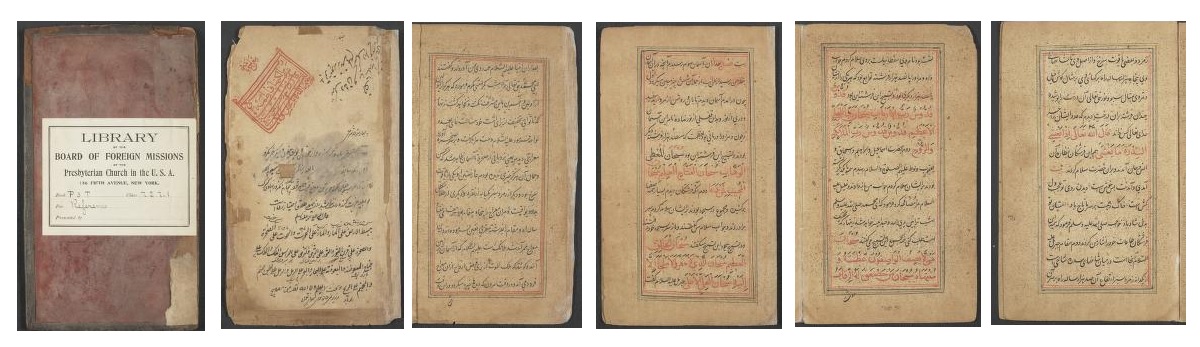
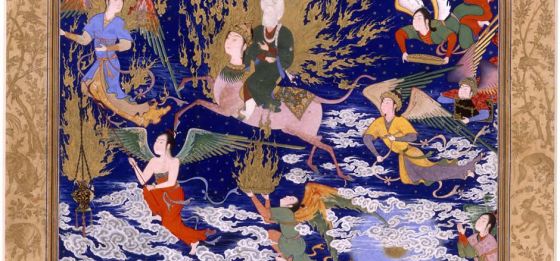
Six images from a total of 408 from an unidentified Persian treatise on the Miʻrāj and several other topics from the Hadith (traditions) of the Prophet Muhammad. Image: US Library of Congress. For more details please click https://www.loc.gov/item/2016397783/
~~~~~~
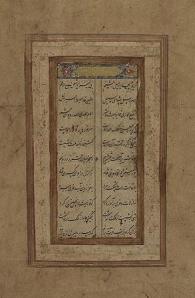
Fragment from page 7 of the Bustan of Sadi. The last two lines of poetry on this page extol the Prophet’s miraculous ascension to the heavens (mi’raj): One night he sat (on his flying steed Buraq) and passed through the heavens. / In majesty and grandeur, he exceeded the angels. / So impulsive, he urged (his steed) into the plain of closeness (to God) / While Gabriel remained behind him at the Lote Tree (of the Limit). Image: Wikipedia.
Among Sufis and other Islamic esoteric traditions, such as those practiced by Ismaili Muslims, Mi’raj is considered the highest point of spiritual perfection an individual can attain through religion and the practice of faith. Believers long to experience a Mi’raj, just as the Prophet experienced it. The Shia Ismailis seek out this spiritual elevation under the guidance of the Imam-of-the-Time, presently Mawlana Shah Karim Al-Hussaini Hazar Imam, His Highness the Aga Khan, who leads his followers to self-awareness, spiritual insight and elevation. This is clearly noted in the Preamble of the Ismaili Constitutionin paragraph (F), which reads:
“Historically and in accordance with Ismaili tradition, the Imam of the time is concerned with spiritual advancement as well as improvement of the quality of life of his murids. The Imam’s ta‘lim lights the murid’s path to spiritual enlightenment and vision. In temporal matters, the Imam guides the murids, and motivates them to develop their potential.”
His Highness the Aga Khan is the 49th Hereditary Imam, directly descended from Hazrat Ali, whose remarkable teachings have come down to us through the preservation of his sermons and teachings which are recorded in works such as Nahj al-Balaghah. Close to the heart of the Ismaili Muslims are poems of the Imam Ali known as Kalam-i Mawla that have been rendered into Hindi. The verses speak about the conduct, behaviour and action of man during his sojourn on earth (please read Farouk Topan’s excellent piece Kalam-i-Mawla)
We are pleased to provide a recitation of verses from the Kalam of Hazrat Ali that focus on ethics, spirituality and the Mi’raj of the Prophet Muhammad. The verses are recited by Alnoor Saleh and have been downloaded from the MUST VISIT website Ginans Central, which is maintained by Karim Tharani of the University of Saskatchewan.
February 14th, Valentine’s Day, and Mother’s Day are the most significant days for the flower industry. Still, there is almost an entire season — and not just a day — in Canada and the USA where the pumpkin remains the king in indoor and outdoor markets and at numerous events celebrating corn and pumpkin harvests. In fact, Calgary and other cities acround Canada including Edmonton, Milton, Burnaby and Ottawa are hosts to “Pumpkins After Dark“, Canada’s award-winning outdoor fall event that feature over 10,000+ hand-carved pumpkins.
The pumpkin is associated with Thanksgiving in Canada (2nd Monday in October) and the USA Thanksgiving (4th Thursday in November), and is one of the most popular desserts served during the holiday. In between, on Halloween Day, October 31, pumpkin heads are put to scary uses through creative works of art. Aside from the pumpkins’ use in decorations and artistics works, the fruit is used in restaurants in North America, such as Starbucks, Tim Horton, McDonalds and many others for special pumpkin chais, coffees and desserts.
Story continues below
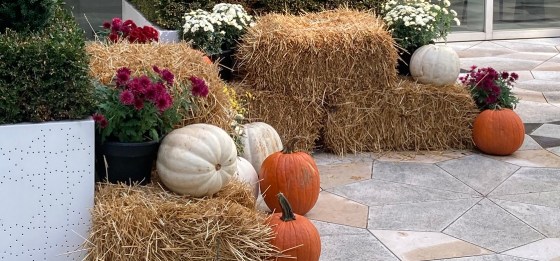
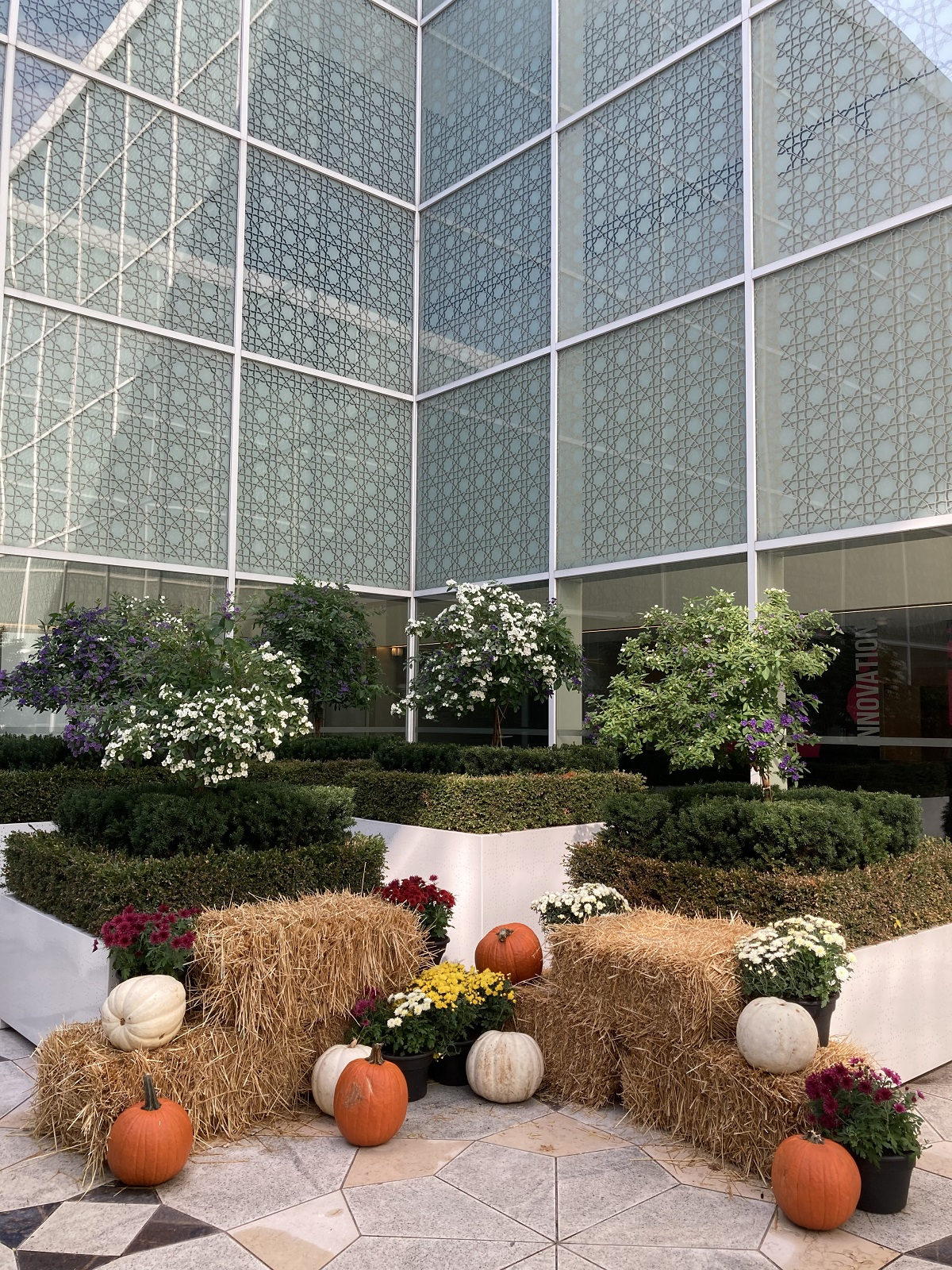
Aga Khan Museum Toronto Courtyard decorated with pumpkins, October 23, 2020. Photograph: Malik Merchant / Simerg.
My real interest on the health benefits of the pumpkin was drawn when I saw the large fruit decoratively laid out at the Aga Khan Museum’s coutyard during the pumpkin season some three years ago. I then wondered whether the fruit was mentioned anywhere in Islamic literature and, to my amazement, I read that the Prophet Muhammad (may peace be upon him and his progeny) was fond of pumpkins. I am pleased to include a small selection of adaptations from readings that I found.
“I saw the Prophet being served with soup and containing gourd (pumpkin or squash) and cured meat, and I saw him picking and eating the pieces of gourd.” — Bukhari Volume 7, Book 65, Number 348.
It is related that a sailor once invited Prophet Muhammad to eat some food that he had prepared. Anas bin Malik, a companion of the Prophet, noted that the Prophet was served barley bread and a soup with pumpkin in it. The Prophet keenly ate the pumpkin around the dish, and from that day Anas made it his favourite food. Traditions also note that whenever a a dish of bread, meat and broth was presented to the Prophet and it contained pumpkin, the Prophet would pick up the pumpkin because he really liked it, and made the heart strong. Other Muslim traditions note that the pumpkin increases brain function and brain strength.
Ibn Ridwan, in a medical treatise written during the Fatimid period, recommended the pumpkin as a diet for healthy living along with several other fruits and vegetables such as celery, carrots, lentils and cucumbers.
Interestingly, there is also a general consensus among researchers and scholars about the Arabic word yaqteen that is mentioned in the Holy Qur’an. They say that it refers to the pumpkin — a food that nourished and helped heal Prophet Yunus, after he was cast into the wilderness while he was sick (see Qur’an, 37:144-146, at Corpus Quran English Translation).
The website healthline mentions that pumpkin is rich in vitamins, minerals and antioxidants, and is incredibly healthy. Moreover its low calorie content makes it a weight-loss-friendly food. It goes on to add that “its nutrients and antioxidants may boost your immune system, protect your eyesight, lower your risk of certain cancers and promote heart and skin health.”
Yasser Desai’s rendition of a Naat (song) honouring the Prophet Muhammad has been making its rounds in the social media. The reaction to the Naat — that is presented below through YouTube — has been very positive from listeners around the world. Listeners wrote (selected excerpts): “The song brought tears to my eyes!….Your voice is magical and unique. I love your passion while singing this amazing Naat e Mustafa….As a Muslim [the song] melts my heart and I felt some inner peace.”
Story continues below, with lyrics of song
Born on November 15, 1989 in Mumbai, India, Yasser Desai started his journey in music from the age of 11. Completely self-taught, Yasser Desai has sung many highly acclaimed songs like “Dil Ko Karaar Aaya”, “Hue Bechain”, and “Aankhon Me Aansoon Leke”, among others; he has more than 200 songs to his credit in Bollywood movies. He has also sung several singles for Zee Music Company and many other music channels.
LYRICS
(the text of the lyrics corresponds to the flow of the song; refrains are therefore repeated in the text)
Hasbi Rabbi Jallallah Mafi Qalbi Ghair ullah Noor e Muhammad Sallallah La ilaha illallah
Hasbi Rabbi Jallallah Mafi Qalbi Ghair ullah Noor e Muhammad Sallallah La ilaha illallah
Tere Sadqe main Aaqa Saare jahaa(n) ko deen mila Be-deeno(n) ne kalma parha La ilaha illallah
Simt e Nabi Abu-Jehal gaya Aaqa se usne ye kaha Tum ho Nabi batlaao zara Meri muthi mai hai kya
Simt e Nabi Abu-Jehal gaya Aaqa se usne ye kaha Tum ho Nabi batlaao zara Meri muthi mai hai kya
Aaqa ka farmaan hua Aur Fazl e Rahman hua Muthi se pathar bola La ilaha illallah
Hasbi Rabbi Jallallah Mafi Qalbi Ghair ullah Noor e Muhammad Sallallah La ilaha illallah
Wo jo Bilal e Habshi hain Sarwar e dee(n) ka pyara hai Dunya kay har aashiq ki Aankho(n) ka wo taara hai
Wo jo Bilal e Habshi hain Sarwar e dee(n) ka pyara hai Dunya kay har aashiq ki Aankho(n) ka wo taara hai
Zulm hue kitne us par Seenay pay rakha pathar Phir bhi zubaa(n) pay jaari tha La ilaha illallah
Hasbi Rabbi Jallallah Mafi Qalbi Ghair ullah Noor e Muhammad Sallallah La ilaha illallah
Apni behen se bole Umar Ye to bata kya karti thi Mere aane se pehle Kya chupke chupke parhti thi
Apni behen se bole Umar Ye to bata kya karti thi Mere aane se pehle Kya chupke chupke parhti thi
Behen ne jab Qur’an parha Sun ke kalaam e paak e khuda Dil ye umar ka bol utha La ilaha illallah
Hasbi Rabbi Jallallah Mafi Qalbi Ghair ullah Noor e Muhammad Sallallah La ilaha illallah
Dunya ke insaan sabhi Shirk o bid’at kartay thay Rab ke thay banday phir bhi Buut ki ibadat kartay thay
Dunya ke insaan sabhi Shirk o bid’at kartay thay Rab ke thay banday phir bhi Buut ki ibadat kartay thay
Butt khaney hai tharraye Mere Nabi hain jab aaye Kehnelagi makhlooq e khuda La ilaha illallah
Hasbi Rabbi Jallallah Mafi Qalbi Ghair ullah Noor e Muhammad Sallallah La ilaha illallah
The night journey (al-isra) and the ascension (al-mi’raj) of the Prophet is observed on the 27th day in the Islamic month of Rajab (falling in 2021 on Wednesday/Thursday, March 10/11).
This is an event of great spiritual significance because the exalted experience of Prophet Muhammad (s.a.s.) is viewed by all Muslims as an example of his elevated status. Significant events of this nature in the life of the Prophet are a source of inspiration for the believers to excel in their quest for spiritual enlightenment and also serve as a model for the believers to emulate. The attainment of this exalted status is possible for every believer who correctly practice his or her Faith in accordance with the proper guidance of Allah through His Prophet and the designated successors (i.e. the Hereditary Imams).
Fragment from a manuscript of Bustan of Sadi extolling the Prophet’s miraculous ascension to the heavens (mi’raj) Image: Wikipedia. Please click for article.
“Prophet Muhammad believed that freedom of religion and civic rights were important components of a ‘Muslim Nation’….His covenants with Christians can be viewed as a kind of medicine to cure the diseases of Islamic extremism and Islamophobia.” — Rice University Study
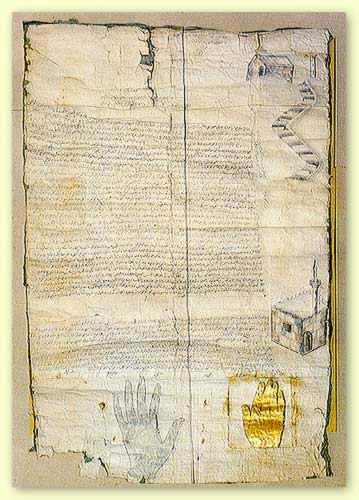
The Covenant with the Monks of Mount Sinai was commissioned by Prophet Muhammad, with Hazrat Ali as its scriber. Manuscript copies are from Saint Catherine’s Monastery, and Simonopetra. Photo: Wikipedia.
The following piece is adapted from a report released by Rice University – ed.
Prophet Muhammad believed that freedom of religion and civic rights were important components of a ‘Muslim nation,’ according to a Rice University analysis of the Prophet’s covenants with Christians.
Researcher Craig Considine, a lecturer in Rice’s Department of Sociology, argues that the covenants can be used to develop a stronger democratic partnership between Muslims and Christians in the Islamic world and elsewhere. His study is published in the journal Religions under the title “Religious Pluralism and Civic Rights in a ‘Muslim Nation’: An Analysis of Prophet Muhammad’s Covenants with Christians.” It can be downloaded through the link provided at the bottom of this post.
“These covenants were designed to protect and even defend peaceful Christian communities, not attack them,” Considine said. He found that these agreements established freedom of religion and civic rights for Christians living within the “ummah” (Arabic for “community”). “The research clearly shows that contemporary Islamic states that mistreat and discriminate against Christians cannot be justified in light of Prophet Muhammad’s covenants,” adds Considine.
The covenants were written between 622 and 632 A.D. Considine said it is assumed they were written because of Prophet Muhammad’s desire to build alliances to bolster his new community and because of his positive interactions with members of the Christian faith. The paper explores the Prophet’s covenants with the monks of Mount Sinai, the Christians of Najran, the Christians of Persia and the Christians of the World.
In “The Covenant of the Prophet with the Christians of Persia,” the Prophet was emphatic on the issue of complete religious freedom:
“And even as they honor and respect me, so shall Muslims care for that people as being under our protection and whensoever any distress or discomfort shall overtake (Christians), Muslims shall hold themselves in duty bound to aid and care for them, for they are a people subject to my Nation, obedient to their word, whose helpers also they are. It therefore is proper for my sake to attend to their comfort, protection and aid, in face of all opposition and distress, suppressing everything that becomes a means to their spoliation,” the Prophet wrote.
Considine said a similar — if not identical — passage is found in the three other covenants addressed in this paper.
Article continues after Aga Khan quote….
HIS HIGHNESS THE AGA KHAN ON THE ETHIC OF PLURALISM
“A cosmopolitan ethic is one that welcomes the complexity of human society. It balances rights and duties, freedom and responsibility. It is an ethic for all peoples, the familiar and the Other, whether they live across the street or across the planet…..Sadly, the world is becoming more pluralist in fact, but not necessarily in spirit. “Cosmopolitan” social patterns have not yet been matched by “a cosmopolitan ethic.”…..As you build your lives, for yourselves and others, you will come to rest upon certain principles. Central to my life has been a verse in the Holy Qur’an which addresses itself to the whole of humanity. It says: “Oh Mankind, fear your Lord, who created you of a single soul, and from it created its mate, and from the pair of them scattered abroad many men and women…” I know of no more beautiful expression about the unity of our human race — born indeed from a single soul.” — Excerpts from the Aga Khan’s speech made to the Parliament of Canada, Ottawa, February 27, 2014.
“Prophet Muhammad made it clear that freedom of religion is an inherent right for Christians living in a Muslim nation,” he said. “His cordial relations with Christians were not due merely to political expediency or personal aspirations, but rather they resulted from his belief that Christians should be able to freely practice their own faith in accordance with their own will. Christian Persians were under no compulsion whatsoever to accept or reject Islam.”
Considine also noted that Prophet Muhammad believed that a Muslim nation must also extend civic rights to Christian religious leaders, as discussed in “The Covenant of the Prophet with the Christians of the World.” The Prophet wrote:
“The covenant of Allah is that I should protect their land, their monasteries, with my power, my horses, my men, my strength and my Muslim followers in any region, far away or close by, and that I should protect their businesses. I grant security to them, their churches, their businesses, their houses of worship, the places of their monks, the places of their pilgrims, wherever they may be found.”
“The Prophet Muhammad did not want to inflict harm on Christians, nor interfere or encroach on their privacy or private property,” Considine said. “For the state to give preference to one or more groups means devaluating citizens based upon their ethnic or cultural backgrounds.”
Considine said documents have been located in obscure monasteries around the world and books that have been out of print for centuries.
Considine said the rediscovery of these documents provides an opportunity to give new birth to Islam and regenerate the essence of Islamic teachings. He hopes that the findings will have a positive impact on the impressions of Muslims in today’s society and will combat anti-Muslim sentiments.
“Prophet Muhammad’s covenants with Christians can be viewed as a kind of medicine to cure the diseases of Islamic extremism and Islamophobia,” Considine said. “His message radiates compassion and peace. This is what American society — and indeed the world — needs now more than ever.”
INTRODUCTION: On February 18, 1976, His Highness the Aga Khan, Mawlana Hazar Imam, accompanied by Begum Salimah Aga arrived in Pakistan for a month long visit that included several mulaqats with Ismailis around the country. During the visit they both attended numerous public and private events and engagements and Mawlana Hazar Imam announced the creation of the Aga Khan Award for Architecture. The first cycle of the award ceremony was held at the beautiful Shalimar Gardens in Lahore in 1980.
The extended 1976 visit also co-incided with Pakistan hosting the Seerat Conference over a 10 day period at which eminent scholars from around the world spoke in Islamabad, Lahore, Peshawar and Karachi on various aspects of the life of the Holy Prophet Muhammad (may peace be upon him). When the Aga Khan was invited by Mowlana Kausar Niazi, Pakistan’s Federal Minister for Religious Affairs, to preside over the Seerat gathering that took place in Karachi on March 12, 1976, he noted at the beginning of his presidential that he felt both trepidation and joy at the opportunity, “trepidation because few subjects could be more awe inspiring for any Muslim to speak on, joy as few subjects could give greater happiness to be involved with.”
As hundreds of millions of Muslims around the world prepare to celebrate the life of the Prophet on the occasion of his birth anniversary that falls on the 12th of Rabi al-Awwal — between November 29 and December 3, 2017 — no piece would be more befitting for the auspicious anniversary than the inspiring and insightful words spoken at the Seerat Conference by the direct descendant of the Prophet Muhammad himself. We are pleased to present the following excerpts from 49th Ismaili Imam’s Seerat speech, following which we have included the audio of the speech.
The Aga Khan on Allah’s Last Messenger
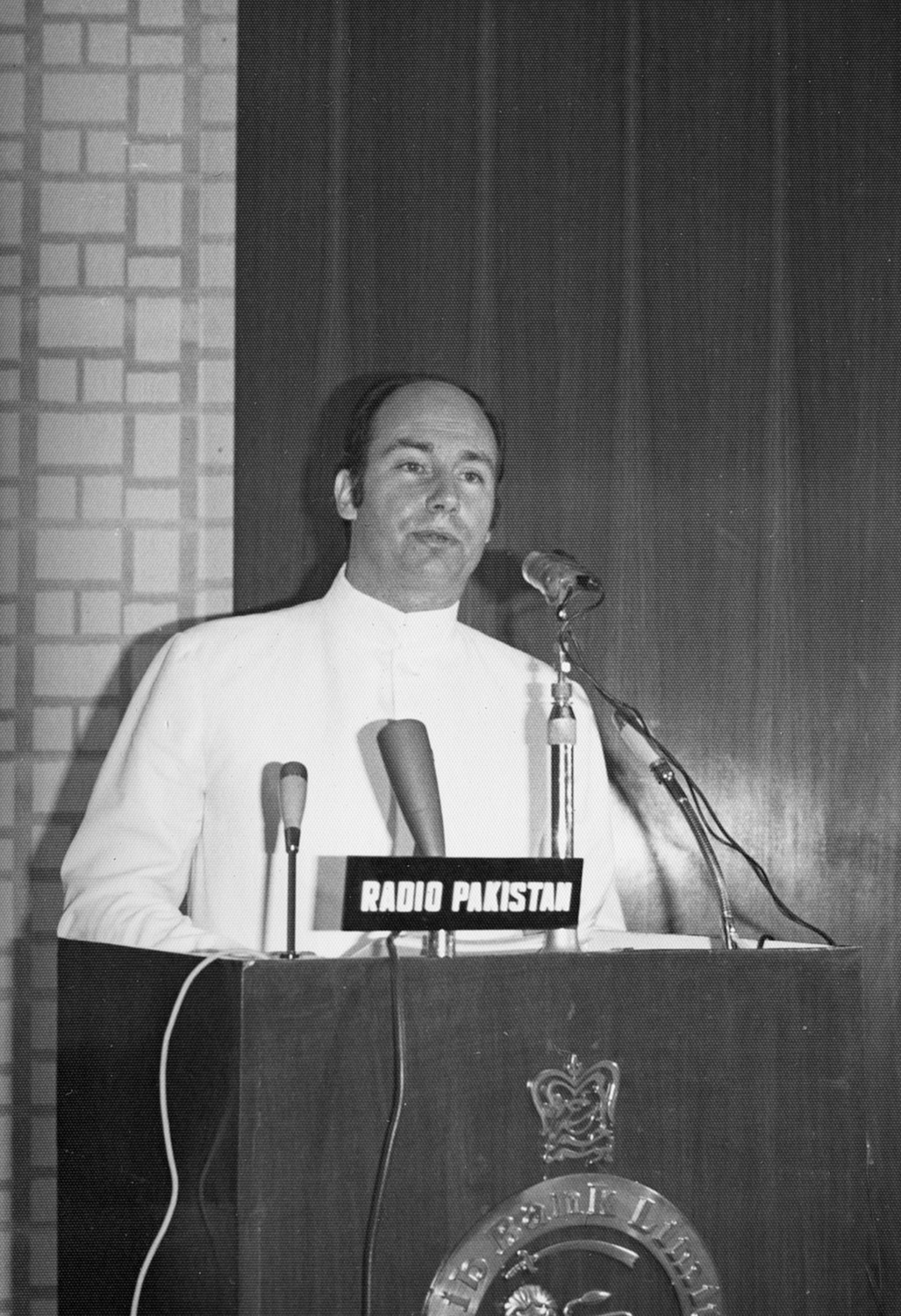
His Highness the Aga Khan giving his Presidential Address at the Seerat Conference in Karachi on March 12, 1976. Photo: The Ismaili.
A request to the conference
“Few conferences can have gathered so many men of outstanding intellect, who have devoted so much time and wisdom to the study of Islam and the life of the Holy Prophet, peace be upon him….I will begin by making a request: One hundred and seventy two eminent scholars from forty-eight countries have gathered in Islamabad, Lahore, Peshawar and Karachi to present the results of their research and reflection on various aspects of the life of the Holy Prophet. From all these exchanges, from all the private debates which have preceded and succeeded the presentation of each paper, will have come an immense range of new thoughts, new ideas and new understanding of the Prophet’s life. I sincerely request that you have available to all Muslims a complete printed record of these papers and the subsequent debates.”
Responsibilities of rich Muslim countries
“The poorer countries of Islam have ahead of them years of increasingly hard work if they wish to progress materially to acceptable standards of every day life. The richer countries, especially those that have new means, will rapidly find that this wealth, blessing that it is, will impose upon them heavy new responsibilities. They will have to administrate this wealth wisely, in the best interest of their citizens, but also keeping in mind that they have a heavy responsibility to their less well endowed brother Muslim countries, and indeed to the human race at large. Thus it is my profound conviction that Islamic Society in the years ahead will find that our traditional concept of time, a limitless mirror in which to reflect on the eternal, will become a shrinking cage, an invisible trap from which fewer and fewer will escape.”
Holding firm the ship of life: Answers in the Qur’an and the Prophet
“I have observed in the Western world a deeply changing pattern of human relations. The anchors of moral behaviour appear to have dragged to such depths that they no longer hold firm the ship of life: what was once wrong is now simply unconventional, and for the sake of individual freedom must be tolerated. What is tolerated soon becomes accepted. Contrarily, what was once right is now viewed as outdated, old fashioned and is often the target of ridicule.”
“In the face of this changing world, which was once a universe to us and is now no more than an overcrowded island, confronted with a fundamental challenge to our understanding of time, surrounded by a foreign fleet of cultural and ideological ships which have broken loose, I ask, “Do we have a clear, firm and precise understanding of what Muslim Society is to be in times to come?” And if as I believe, the answer is uncertain, where else can we search then in the Holy Qur’an, and in the example of Allah’s last and final Prophet?
“There is no justification for delaying the search for the answer to this question by the Muslims of the world, because we have the knowledge that Islam is Allah’s final message, the Qur’an His final book and Muhammed His last Prophet. We are blessed that the answers drawn from these sources guarantee that neither now, nor at any time in the future will we be going astray. As the demands on his time increase, every Muslim will find it more and more difficult to seek for himself the answer to the fundamental question of how he should live his life for it to be truly Muslim. It is men such as you who will have to bring forth the answers, answers which will have to be practical and realistic in the world of today and tomorrow. Rather than let force of circumstance impose upon us through our default in not having suitably prepared ourselves for the future, ways of life which are not or should not be ours, we must ourselves design the path we should tread.”
Bearing fruits in the diverse Muslim world
“In seeking to define what our Islamic Society should be in times ahead, 50 and 100 and 200 years hence we should, I believe, be aware that the Muslims of this world cover such an amazing range of historical, ethnic and cultural backgrounds that a completely monolithic answer may not be found. I am convinced on the other hand, that we do want to avoid so much diversity that our Muslim countries are in conflict amongst themselves or that they are so divided that they are incapable successfully of facing common enemies, be they cultural, religious, national or otherwise. This is why I so applaud Pakistan for having organized the first Muslim Summit Conference, and now this Seerat Conference, for it is only through dialogue, personal contacts and continuous exchanges that the great diversity of cultures, knowledge, outlook and resources can be co-ordinated and brought to bear fruit for the Muslim world.”
Greatest opportunity for Muslim unity is now
“Let me return, now, to the question of what Muslim Society should seek to be in the years ahead. Islam, as even non-Muslims have observed, is a way of life. This means that every aspect of the individual’s daily existence is guided by Islam: his family relations, his business relations, his education, his health, the means and manner by which he gains his livelihood, his philanthropy, what he sees and hears around him, what he reads, the way he regulates his time, the buildings in which he lives, learns and earns.
“I cannot think of any time in Islamic history when Muslims have had a greater opportunity to unite, and to ensure that the society in which they live is that which they have defined and chosen for themselves.
“Not only are all forms of human communication easier than ever before in history, but rarely, if ever has the Muslim world had such means to ensure its future. Conferences such as this seeking inspiration from the life of the Holy Prophet could render no greater service to Islam than to assist in defining what steps can be taken, where, and how, to ensure that our people can live in the years ahead in greater peace, greater prosperity and in an Islamic Society which will not be overrun or simply taken by surprise, by forces, pressures or concepts which are totally alien and may damage us irretrievably.”
Searching for a solution through eminent men and women
“In our search for a solution, I am convinced that we must call upon our own men and women, who have achieved positions of eminence anywhere in the world, and persuade them to return, for us to benefit from their knowledge, their learning and their work. All too often in my journeys I have met or learnt of outstanding Muslim scholars, doctors, scientists, and architects who have remained abroad, or who, when they do come home, have failed to receive the support and encouragement necessary for them to bring to their nations’ benefit their Muslim outlook on key areas of modern progress.
“Any meaningful human endeavour, any original thinking, any authentic research, will require moral encouragement and material support. This we must provide, not only during the individual’s initial years of learning, but equally when he leaves the restricted life of his academic centre to enter into the wider world of national or international activity.”
The inspiring life of the Holy Prophet
“The Holy Prophet’s life gives us every fundamental guideline that we require to resolve the problem as successfully as our human minds and intellects can visualise. His example of integrity, loyalty, honesty, generosity both of means and of time, his solicitude for the poor, the weak and the sick, his steadfastness in friendship, his humility in success, his magnanimity in victory, his simplicity, his wisdom in conceiving new solutions for problems which could not be solved by traditional methods, without affecting the fundamental concepts of Islam, surely all these are foundations which, correctly understood and sincerely interpreted, must enable us to conceive what should be a truly modern and dynamic Islamic Society in the years ahead.”
Audio of the Aga Khan speech made at the Seerat Conference
Date posted: November 30, 2017.
_____________________
Simerg welcomes your feedback. Please complete the LEAVE A REPLY form below or send your comment to simerg@aol.com.
Note: This article also appears on http://www.barakah.com, a special Simerg project to celebrate 60 years or the Diamond Jubilee of His Highness the Aga Khan.








 Simerg - Insights from Around the World